

Introduction
The attempted insurrection that transpired on January 6, 2021 at the United States Capitol marked a pivotal moment in contemporary American politics. As the dust settled and narratives crystallized, it became evident that predominantly white zealots aligned with former President Donald Trump, and with deeply entrenched sentiments regarding electoral fraud, led the assault. Existing scholarship has linked insurrectionist support to factors such as racial status threat, racial resentment, and Christian nationalism, but has primarily focused on white attitudes (Barreto et al. Reference Barreto2023; Davis and Wilson Reference Davis and Wilson2023; Armaly, Buckley and Enders Reference Armaly, Buckley and Enders2022; Bucci, Kirk and Sampson Reference Bucci, Kirk and Sampson2022). We focus our exploration on Latines, an under-explored group in this line of work, but whose support of the insurrection is even more puzzling.
Exploring attitudes toward the insurrection allows us to probe Latine political attitudes, as well as their underlying motivations and perspectives, more closely. Recent studies have sought to understand the motivations behind why some Latines may adopt conservative policy attitudes and support affiliated political candidates (Corral and Leal Reference Corral and Leal2024; Cadena Reference Cadena2022; Hickel and Deckman Reference Hickel and Deckman2022; Alamillo Reference Alamillo2019; Fraga, Velez and West Reference Fraga, Velez and West2024). As Latine politics scholars have discussed, the identity-to-politics link for a group as heterogeneous as Latines is complicated. Not only does attachment to the group identity vary by context over time (Lee Reference Lee2008), but it is also impacted by the vast heterogeneity of the group (Ocampo and Ocampo Reference Ocampo and Ocampo2020; Irizarry Reference Irizarry2023; Cisneros Reference Cisneros2016; Pérez and Vicuña Reference Pérez, Vicuña, Huddy, Sears, Levy and Jerit2023; Garcia-Rios, Pedraza and Wilcox-Archuleta Reference Garcia-Rios, Pedraza and Wilcox-Archuleta2019; Schut Reference Schut2021; Stokes-Brown Reference Stokes-Brown2012; Posner Reference Posner2005; Chandra Reference Chandra2005). However, we argue that perceived within-group status has been under-explored as an axis that can explain Latines’ political attitudes toward conservative candidates and their agenda.
While Latines as a whole are positioned at a lower standing than non-Hispanic whites in the U.S. racial hierarchy, there are reasons to believe that there is significant variation in the understanding of individual Latine’s positionality within the group (Ostfeld and Yadon Reference Ostfeld and Yadon2022a; Cuevas-Molina Reference Cuevas-Molina2023; Cisneros Reference Cisneros2016). Latinidad itself is defined as “a particular geopolitical experience, but it also contains within it the complexities and contradictions of immigration, (post)(neo)colonialism, race, color, legal status, class, nation, language, and the politics of location” (Rodriguez Reference Rodriguez2003). Latinidad can also be characterized as a “site of permanent political contestation,” signifying “a political rather than merely a descriptive category” (Beltrán Reference Beltrán2010). Each identity attribute they hold is afforded a different level of status within the racial hierarchy—such as their race, skin tone, or citizenship status. With so much variation along these many attributes and experiences, how Latines perceive their individual positions across the racial hierarchy will likely reflect these differences. We further expand upon the concept of honorary whiteness (Bonilla-Silva Reference Bonilla-Silva2004) and its implications for certain segments of the Latine population.
This paper uses a framework of within-group status to further a concept we call aspirational status. On the one hand, Latines who are cognizant of their marginalized status in U.S. society oppose the events that occurred on January 6th. On the other hand, some Latines, who disregard the group’s racialization, adopt an aspirational status. This aspirational status, which consists of ethno-cultural and socioeconomic aspirations, as well as distancing from less desirable groups such as Black Americans, helps to explain why some Latines are supportive of January 6th. In addition to documenting the relationship between status and perceptions of January 6, we also explore who are the Latines who aspire to a higher ethno-cultural and socioeconomic status.
To empirically investigate this phenomenon, we utilize data from the 2020 Collaborative Multiracial Post-Election Survey. By leveraging this rich dataset, we explore the interplay of demographic, attitudinal, and contextual factors shaping Latine attitudes toward the January 6th insurrection. We find strong and consistent support for our measure of ethno-cultural aspirational status and mixed support for socioeconomic aspirational status. Additionally, we find that racial resentment held by Latines also holds explanatory power in explaining pro-January 6th attitudes. These findings are robust to a consideration of the additional role of partisanship, favorability toward Trump, and ideology. Ultimately, our study highlights the importance of the concept of status and its varying dimensions to better understand Latine political attitudes.
Latines’ Racialized Position
Latinidad encompasses individuals with varied skin tones, experiences with immigration, language abilities, national heritage, transnational backgrounds, class, and legal statuses (Padilla Reference Padilla1985; Rodriguez Reference Rodriguez2003; Beltrán Reference Beltrán2010). While it is often assumed that individual Latines adopt a minoritized status due to their group’s marginalized position in society, the relationship between Latines and whiteness is complicated: relative to other racial groups, the historic and contemporary boundaries between Latinidad and whiteness are more permeable (Hernandez v. State of Texas 1954; Haney-López Reference Haney-López2006; Masuoka and Junn Reference Masuoka and Junn2013).
The group’s diversity along many axes means that racialization experiences, as well as the identity categories available to Latines in their repertoire, can vary substantially (Stokes-Brown Reference Stokes-Brown2012; Golash-Boza and Darity Reference Golash-Boza and Darity2008; Garcia-Rios, Pedraza and Wilcox-Archuleta Reference Garcia-Rios, Pedraza and Wilcox-Archuleta2019). Sociologists have found that across generations, Hispanic-origin people are less likely to identify as Latine and more likely to solely identify as white (Alba and Islam Reference Alba and Islam2009). Other scholarship has uncovered great variation in the incorporation process of distinct Latine-origin communities, where national origin may influence whether individuals identify as Latine or white (Vargas Reference Vargas2018; Schut Reference Schut2021). In addition, factors such as skin color and partisanship shape racial identification among Latines (Stokes-Brown Reference Stokes-Brown2012; Vargas Reference Vargas2015). However, as scholars have argued, the meaning behind identifying as white is more complicated than it might seem.
As Dowling (Reference Dowling2015) argues, many Latines identify as white on forms like the Census not because they see themselves as white or believe that others see them as “white,” but because they are resisting “racial othering” and are trying to claim their place as Americans. These individuals describe various discriminatory experiences in their lives, but prefer to minimize the role of race. While these Latines would not use “white” to identify themselves in their day-to-day lives, Dowling (Reference Dowling2015) argues that some individuals use this “to assert a public racial identity with outsiders” (pg. 32), suggesting that simply identifying as white does not capture complete disassociation from their Latine identity. Others in Dowling’s study simply chose “white” because there was no Latine option under race and felt that was the second-best option.
While Dowling’s study does not capture the sentiments of individuals who truly feel indistinguishable from non-Latine whites, or a desire to fully become white, more work is needed on whether there are indeed Latines who adhere to such ideology. However, studies that just focus on self-identification as white as a marker for Latines’ racial ideologies are limited in their ability to disentangle beyond these two potential explanations. Thus, to fill this gap, our study explores adherence to pro-white political attitudes to better understand which Latines aspire to the higher status and benefits that whiteness can provide (Roediger Reference Roediger2007).
Given the minoritized status of the Latine group at large (Zou and Cheryan Reference Zou and Cheryan2017), some individual Latines may choose to find ways to distance themselves from other members of their group. According to social identity theory, distancing from one’s in-group is one of the possible avenues an individual might take when their group is threatened by an outside stimulus (Tajfel and Turner Reference Tajfel, Turner, Austin and Worchel1979). As others have shown, some Latines harbor negative stereotypes of members of their in-group, especially those who they think are devaluing the group as a whole (Cadena Reference Cadena2022; Hickel, Oskooii and Collingwood Reference Hickel, Oskooii and Collingwood2024). Individuals, and particularly those at the margins, may choose to instead identify with another identity altogether to avoid any reputational cost (Tajfel and Turner Reference Tajfel, Turner, Austin and Worchel1979; Ellemers and Jetten Reference Ellemers and Jetten2013). But an important part of this explanation is that aspiring to a higher-status group offers more benefits than if an individual were to simply distance themselves from a lower-status group. We reason that if Latines express attitudinal attachment to higher-status vis-à-vis pro-white attitudes, then Latines are after an aspirational status. This attachment to higher status, or aspirational status, may appear as a decision to highlight a white or even American identity over their ethnic identity, as these identities signify higher social status relative to their targeted Latine identity (Zou and Cheryan Reference Zou and Cheryan2017; Hickel et al. Reference Hickel, Alamillo, Oskooii and Collingwood2021). Further, simply identifying as white is not synonymous with expressing attachment to a higher-status white group; this could be due to measurement error (Hitlin, Brown and Elder Reference Hitlin, Brown and Elder2007), historical attachment (Hernandez v. State of Texas 1954), or a genuine belief among respondents that this is correct given the options provided (Dowling Reference Dowling2015).
Moreover, while scholars have in part explored the relationship between perceived racialized position and political attitudes, more work is needed to understand these political inclinations. Political attitudes are related to self-identification as white; Vargas (Reference Vargas2015) finds that more conservative Latines are more likely to identify as white (when no Hispanic/Latine category is available). Scholars who have tested the opposite relationship also find that the two are related: white racial identification is associated with identifying as Republican (Cuevas-Molina Reference Cuevas-Molina2023). Other scholars have explored the implications of prioritizing an American identity over ethnic identity among Latines, finding that it is associated with more conservative positions on immigration and support for Republican candidates (Hickel et al. Reference Hickel, Alamillo, Oskooii and Collingwood2021). Studies also suggest that the decision to identify as white goes beyond the conventionally considered markers—such as skin tone and other physical appearance traits—but is also influenced by factors such as socioeconomic status (Vargas Reference Vargas2015).
Ethno-cultural Aspirational Status
In this paper, we examine two forms of aspirational status: ethno-cultural status and socioeconomic status. However, we argue that ethno-cultural aspirations toward higher status are not solely determined by individuals’ demographic characteristics. Rather, ethno-cultural aspirational status captures an ideological or attitudinal desire to approximate whiteness. We argue that holding these aspirational views should explain Latine opinion toward the insurrection.
As mentioned above, Latines hold varied ethnoracial and cultural identities. For a member of a group whose status is devalued in society, escaping to a higher-status group may be more beneficial (Tajfel and Turner Reference Tajfel, Turner, Austin and Worchel1979). Given the privilege and benefits that are associated with identifying as white, including higher wages, better educational outcomes, and more leeway in the criminal justice system (Roediger Reference Roediger2007; Kim Reference Kim2011; Burch Reference Burch2013), Latines may view it as more advantageous to do so. Beyond simply identifying as white, individuals may hold pro-white attitudes to reach this aspirational higher status. Indeed, qualitative studies suggest some racial distancing among Latines in order to claim belonging (Vasquez-Tokos Reference Vasquez-Tokos2020).
Bonilla-Silva (Reference Bonilla-Silva2004) discusses a tri-racial system in the United States such that Latines are divided into three groups: “whites,” “honorary whites,” and the “collective black.” This theoretical framework creates a demarcation by means of skin tone such that fully assimilated, white Latines are considered white, lighter-skinned Latines belong to an honorary white category, and darker-skinned Latines exist within the collective black. While Bonilla-Silva discusses demographic characteristics like nationality and income as factors shaping this stratification, we expand on this theory. In particular, within-group aspirational status captures attitudinal and ideological facets beyond those that are in an individual’s identity repertoire, which allows us to better capture why some Latines distance themselves from members of the in-group.
Whiteness is defined beyond just a racial, skin tone, or phenotypical presentation, but rather as an ideology that helps to advance white supremacy in the United States (Ozawa v. United States, 1922; United States v.Thind 1923; Hernandez v. State of Texas 1954; Haney-López Reference Haney-López2006). Such ideology includes preserving European and Christian heritage in the United States and limiting immigration to those who fit this criteria (Huntington Reference Huntington2004). Ethno-cultural aspirational status toward whiteness stands in stark contrast to stereotypes about Latines, who continue to be viewed as “unassimilable” across generations (Lacayo Reference Lacayo2017). The rhetoric that draws a contrast between whites and Latines is largely directed at immigrants, who continue to be the targets of xenophobic rhetoric. Thus, there is a demarcation between the values of Latines, particularly Latine immigrants, and those of non-Hispanic whites (Lacayo Reference Lacayo2017).
A modern extension of these white nationalist sentiments is that whites in the United States are facing increased levels of discrimination and an opposing reaction to a sentiment of privilege in comparison to other people of color (Jardina Reference Jardina2019; Berry, Cepuran and Garcia-Rios Reference Berry, Cepuran and Garcia-Rios2022). This reaction stems from a fear of losing their heightened position in society (Reyna, Bellovary and Harris Reference Reyna, Bellovary and Harris2022) and relative sense of deprivation (Gest Reference Gest2016). In other words, these individuals feel threatened that people of color will wield more political, economic, or social power over them.
For some Latines, and particularly those who aspire toward a higher status, grievances expressed by non-Latine white insurrectionists about perceived anti-white discrimination or the decline of white socio-political dominance may resonate. Latines who view whiteness as a pathway to higher social status in the United States may perceive that the diminishing socio-political dominance of whiteness poses a threat not only to non-Latine whites but to their own prospects of heightened within-group status. This may also be coupled with the fear that this higher status may no longer ensure their present or future socio-political advantages. Maintaining the structural status quo preserves their positionality in a category of honorary whiteness (Bonilla-Silva Reference Bonilla-Silva2004), as separate from other Latines who are not afforded the possibility of higher status. As shared by white insurrectionists, these Latines see the restructuring of the racial hierarchy as a threat to their socio-racial standing. For these Latines, support for the grievances of non-Latine whites may represent both an alignment with a dominant narrative and a way of advocating for their place within a redefined social order.
Moreover, both scholarly and popular understandings of whiteness are tied to American identity. Devos and Banaji (Reference Devos and Banaji2005) reveal that “the cultural ‘default’ value for ‘American’ is ‘white’.” Respondents implicitly connect American and white identities; both Asian Americans and Black Americans are seen as less American than whites (which supports earlier scholarship from Kim Reference Kim2000). As Latines are racialized as foreign (Zou and Cheryan Reference Zou and Cheryan2017), they may attempt to reclaim a sense of belonging (Ocampo Reference Ocampo2024; Salgado Reference Salgado2023) by prioritizing their identity as American (Hickel et al. Reference Hickel, Alamillo, Oskooii and Collingwood2021).
Rhetoric by the Trump campaign further created a heightened threat around foreignness. Latines who aspire toward ethno-cultural higher status seek to create a psychological distancing from those they perceive as lower-status Latines who are labeled as foreign—and thus a dangerous threat to American democracy. In preserving white ethno-cultural supremacy, higher-status Latines adopt attitudes similar to non-Latine whites that “protect and preserve” the racial status quo, attitudes that fueled insurrectionist support.
We argue that aspirational status can therefore be comprised of ethno-cultural affirmations that are pro-white, though need not necessarily mean a complete rejection of their Latinidad. In a national context where whiteness takes a form beyond that of phenotypical characteristics, it expands to pro-white beliefs and attitudes. These attitudes include support for preserving European and Christian heritage, not recognizing the existence of white privilege, sharing grievances of white discrimination, and the prioritization of American identity over any other identities.
Hypothesis 1: Latines who express aspirational ethno-cultural status are more likely to hold insurrectionist beliefs.
Socioeconomic Aspirational Status
Latines have also been marginalized socioeconomically. Not only have they experienced hurdles to achieving upward socioeconomic mobility but they are also the target of stereotypes of being “lazy,” “job-stealers,” or “dependent” (Lacayo Reference Lacayo2017; Cafferty and McCready Reference Cafferty and McCready1985; Rivadeneyra, Ward and Gordon Reference Rivadeneyra, Ward and Gordon2007; Morales et al. Reference Morales2002; US Census Bureau 2022). Though far less explored in the literature, we argue that this marginalization exists separate from ethno-cultural aspirations toward whiteness and should have some explanatory power over insurrectionist beliefs.
Much of the grievances captured by Trump’s campaign and presidential term center around economically disenfranchised whites (Cramer Reference Cramer2016). Trump’s supporters expressed frustration with what they perceived as a rigged economic system that favored some groups over their own (Gest, Reny and Mayer Reference Gest, Reny and Mayer2018). This sentiment was frequently coupled with opposition to job outsourcing and rising immigration (Broughton Reference Broughton2015), which they believed had led to economic decline in many parts of the country (Blake Reference Blake2014). This undoubtedly is linked to racial grievances directed at immigrants, Black Americans (Davis and Wilson Reference Davis and Wilson2022), and other racial minorities.
While Latines are often the target of these grievances, narratives about self-reliance and hard work are also appealing to Latines. Scholarly work shows that Latines use narratives of being “good workers” as a way of uplifting their status in society (Hallett Reference Hallett2012; Andrews Reference Andrews2018). This perspective is often rooted in the immigrant experience, where migrants and their descendants work to achieve the “American Dream” through perseverance (Madriaga Reference Madriaga2005). Nevertheless, expressing these beliefs may also stem from a desire to distance themselves from other in-group members who they perceive are giving the group a bad reputation (Cadena Reference Cadena2022; Hickel, Oskooii and Collingwood Reference Hickel, Oskooii and Collingwood2024; Vasquez-Tokos Reference Vasquez-Tokos2020). As a result, by emphasizing economic self-reliance and narratives about hard work, Latines may seek to distance from these negative stereotypes about members of their in-group, to emphasize higher aspirational status, and further show some ideological cohesion with higher-status groups.
Hypothesis 2: Latines who express aspirational socioeconomic status are more likely to hold insurrectionist beliefs.
Racial Resentment
Another important component of aspirational status is distancing themselves from those who are seen as less desirable—in this case, Black Americans. Prejudicial attitudes toward Black Americans have been extensively documented among Latines (McClain et al. Reference McClain2006; Jones-Correa Reference Jones-Correa, Telles, Sawyer and Rivera-Salgado2011; Morin, Sanchez and Barreto Reference Morin, Sanchez, Barreto, Telles, Sawyer and Rivera-Salgado2011; Krupnikov and Piston Reference Krupnikov and Piston2016; Oliver and Wong Reference Oliver and Wong2003; Haywood Reference Haywood2017). While scholarship has highlighted how a shared sense of discrimination can bring the two groups together (Robertson and Roman Reference Robertson and Roman2024; Jones Reference Jones2019; Wilkinson Reference Wilkinson2014; Ocampo and Flippen Reference Ocampo and Flippen2021; Corral Reference Corral2020), other work has highlighted how Latines may view Black Americans as direct competition (Pérez, Robertson and Vicuña Reference Pérez, Robertson and Vicuña2022; Zamora Reference Zamora2022), thus hindering Latine attitudes. Specifically, Krupnikov and Piston (Reference Krupnikov and Piston2016) find that Latines and non-Hispanic whites have similar levels of anti-Black prejudice, but Latines were more supportive of policies intended to assist Black Americans.
Racial resentment is intimately tied to the motivations for January 6 among whites (Barreto et al. Reference Barreto2023; Davis and Wilson Reference Davis and Wilson2023). Driven by the perceived injustice of former President Donald Trump’s electoral defeat, beneath this explanation lies a deeper undercurrent of status threat directed toward immigrant and Black communities. The insurrectionists’ actions reflected not only a desire to overturn the election results but also a broader resistance to perceived challenges to their socio-cultural hegemony (Barreto et al. Reference Barreto2023). Specifically, as Davis and Wilson (Reference Davis and Wilson2022) discuss, one of racial resentment’s key drivers that has been influential in the Trump era has been the idea of deservingness: whites believe that people should work hard and should be responsible for when they fail, thus leading them to express racial resentment toward Black Americans for what they consider to be “special treatment.” They believe that Black Americans are taking advantage of resources to the detriment of whites.
Indeed, Cadena (Reference Cadena2022) argues that Latines who adopt conservative political attitudes often distance themselves from Black Americans. They view them as a lower-status, and less deserving group, who does not embody the same narratives of hard work and perseverance that Latines do. Thus, while racial resentment has been explored more extensively among Whites, it is likely, given both the existing research on Latine attitudes toward Black Americans, as well as Latine adherence to narratives about hard work, that racial resentment will shape attitudes toward January 6 among Latines:
Hypothesis 3: Latines who are more racially resentful will hold more insurrectionist attitudes.
Where does Partisanship Fit?
Studies on insurrectionist support—and broader Trump support—emphasize the importance of partisan-motivated reasoning (Barreto et al. Reference Barreto2023; Davis and Wilson Reference Davis and Wilson2023; Shino, Smith and Uribe Reference Shino, Smith and Uribe2023). We agree that partisan-motivated reasoning plays an important role in understanding support for the insurrection—after all, Trump called for supporters to “stand back and stand by” (Ronayne and Kunzelman Reference Ronayne and Kunzelman2020). While Latines generally support the Democratic Party (Cain, Kiewiet and Uhlaner Reference Cain, Kiewiet and Uhlaner1991), we expect that Latines who hold favorable attitudes toward Trump will be more inclined to be apologetic about the insurrection and Trump’s role in the insurrection. Nevertheless, we expect that aspirational status will still hold explanatory power in uncovering insurrection support. Given that previous scholarship suggests the power of higher aspirational status in shaping narratives that lead some Latines to adopt attitudes that are closely aligned with the Republican Party (Cadena Reference Cadena2022; Alamillo Reference Alamillo2019), we believe these two will be intimately linked to one another.
Data and Methods
We leverage data from the 2020 Collaborative Multiracial Post-Election Survey (CMPS) to test whether aspirational status holds explanatory power in understanding why Latines show support for the insurrection and the extent to which they believe Donald Trump incited those who stormed the Capitol. We subset the dataset to self-identified Latines for a total respondent pool of 4,577. The CMPS dataset offers a unique opportunity to test our theory as it comprises a comprehensive set of items on the insurrection as well as a large enough sample of Latines to capture key variation among this heterogeneous ethnoracial group.
As we have argued, we expect that Latines who exhibit aspirational status in two key ways, as well as racial resentment, are more likely to support the insurrection, minimize Donald Trump’s connection to the events that transpired on January 6th, uphold ideas about fraud taking place in the 2020 election, and disregard the racialized motivations of those who stormed the U.S. Capitol.
First, to tap into insurrection beliefs, we rely on a binary measure that asked respondents if they believed the attack on the U.S. Capitol was a protest that went too far (1) or if it was an insurrection (0). The second dependent variable, Trump no connection, assessed how much respondents believed that former President Trump encouraged or incited the rioters to carry out the attack on the U.S. Capitol. This was a three-point categorical variable collapsed into a binary variable, where (1) meant Trump had no connection, and (0) signified Trump inspired the actions or incited the attack on the U.S. Capitol.Footnote 1 Our third dependent variable, Capitol attackers no racism, examined perceptions about the people who stormed the Capitol. This three-point categorical variable was recoded to a binary variable such that (1) meant Capitol attackers had no connection to racism, and (0) stood for the belief that many or some of them had some connection to racism and white supremacy. Our last dependent variable tapped into beliefs about fraud being present in the 2020 Election, which we called fraud impact. There were several versions of this question on the CMPS, but we selected the one that asked respondents if they believed there was voter fraud in the presidential election which impacted the results.Footnote 2 This version of the question was only asked to 1,506 Latine respondents. This categorical variable ranged from 1 to 5 and it was recoded such that 1 meant there was not any fraud and 5 indicated that there definitely was fraud. For consistency, our four dependent variables are coded from least supportive of the events that transpired on January 6 (anti-insurrectionist beliefs) to most supportive of the events that occurred that day (pro-insurrectionist beliefs).
To test our theory of aspirational status and its ethno-cultural and socioeconomic components, we rely on a number of independent variables. First, as we argued, pro-white beliefs and attitudes are key indicators of ethno-cultural affirmations toward whiteness. These measures have generally been used by prior studies to capture the nuances of how whiteness operates among non-Latine whites, particularly how they seek to minimize their role within a white supremacist system. However, to our knowledge, these measures have not been empirically tested among Latines. At the same time, we argue that these are aspirational in the case of Latines because their status is not widely recognized as being on par with non-Latine whites (Lacayo Reference Lacayo2017). Thus, for Latines who adhere to this ideology that minimizes racism, by employing the same tactics that non-Latine whites do, they are expressing an aspiration toward whiteness. The first independent variable to tap into these is support for European heritage in the United States. This item asked respondents to agree or disagree with how much they believed America must protect and preserve its white European heritage. This item ranged from 1 to 4 and was recoded such that 1 represented strong disagreement with protecting white European heritage and 4 stood for strong agreement with protecting white European heritage. This measure is particularly appealing to use to capture ethno-cultural aspirational status among Latines, as it captures the influence of ideologies such as la raza cósmica and mestizaje, which emphasize European heritage as part of a narrative of racial mixing. As scholars have noted, these ideologies are rooted in eugenicist and white supremacist logic, yet they were pervasively adopted by Mexican Americans in the early 20th century (Johnson Reference Johnson2011). The second item taps into the belief that Christian values are central to the United States, and therefore, they must be preserved. The item ranged from 1 to 4, where 1 was recoded to represent strong disagreement with the idea that America must protect and preserve its Christian heritage and 4 represented strong agreement. This measure captures Christian nationalism, which although has been largely studied among whites, has also recently been extended to Latines (Perry et al. Reference Perry2024). In particular, Christian nationalism among Latines can be characterized as a desire to aspire to national belonging by aligning themselves with the dominant group (whites) against other out-groups (Perry et al. Reference Perry2024). To tap into the belief that whites are facing greater discrimination, we rely on an item that asks respondents if they believe that discrimination against whites has become as big a problem as discrimination against racial minorities. This four-point categorical item was recoded such that 1 signified strong disagreement and 4 indicated strong agreement with this idea. This measure captures victimization against whites, where those who adhere to this narrative seek to deflect the impact of systemic and structural racism and its effect on racial minorities (Langrehr et al. Reference Langrehr2021). To further evaluate leaning into pro-whiteness as part of a ethno-cultural aspirational status, we included a variable that asked how much respondents believed that white privilege was a major problem in U.S. society. For consistency with the other independent variables that measure ethno-cultural aspirational status, higher values on this measure indicate disagreement that white privilege is a problem, meaning more pro-white attitudes. This item is a four-point scale, where those on the low end believe that white privilege is a problem, whereas those on the high end do not believe white privilege is a major problem. This measure captures the cognitive component of a lack of awareness of white privilege, which further minimizes the role of racism in society (Pinterits, Poteat and Spanierman Reference Pinterits, Poteat and Spanierman2009). Ultimately, minimizing whites’ privileged position and racism is an expression of aspirational status: despite Latines not being widely accepted as equal to whites, those who adhere to this ideology are seeking to lessen the distance between themselves and the white majority. In addition, studies suggest the importance of denial of racism as a factor that shapes support for Trump among Latines (Alamillo Reference Alamillo2019). Lastly, we include an item to tap into how much respondents prioritized an American identity over any other identities. This item took a value of 1 if respondents ranked American identity as first and any other identity available to them in any other place. Scholars have found that American identity prioritization over ethnic identity among Latines is associated with conservative political attitudes (Hickel et al. Reference Hickel, Alamillo, Oskooii and Collingwood2021). Prioritizing American identity captures a desire for national belonging.Footnote 3
To tap into socioeconomic aspirational status, we assess beliefs about self-reliance and hard work. The first item asked respondents the extent to which they believed that Latines in the United States can always create something for themselves when others depend on handouts. We recoded this five-category item to range from 1, which represented strong disagreement, to 5 representing strong agreement that Latines are self-reliant while others depend largely on handouts. This measure captures socioeconomic aspirational status, as it emphasizes a narrative of self-reliance. It also emphasizes a narrative of Latines as upwardly mobile (Dávila Reference Dávila2008), yet simultaneously contrasts Latines to other groups who are seen as less desirable. The aspirational component of this measure, in part, emerges from contrasting these perceptions to the number of Latines who receive government benefits. Of all TANF and SNAP recipients in 2022, 33% were Hispanic/Latine (King Reference King2022). The second item was a question that tapped into the belief that Latine immigrants were hardworking. This seven-point item was recoded such that 1 captures respondents who believed Latine immigrants were lazy and 7 for respondents who viewed Latine immigrants as hardworking. This measure captures resentment toward immigrants (Hickel, Oskooii and Collingwood Reference Hickel, Oskooii and Collingwood2024). It allows respondents who view immigrants as less desirable to distance themselves from the group.
In addition, we rely on the commonly used racial resentment items to capture distancing from Black Americans. Each of these items was measured on a five-point scale. The first item asked if respondents believed that Black people have gotten less than they deserve over the past few years. The second assessed agreement or disagreement with the belief that generations of slavery and discrimination have created conditions that make it difficult for Black people to work their way out of the lower class. These two measures capture distancing from Black Americans that is consistent with our interest in capturing ethno-cultural aspirational status. As scholars have argued, distancing from Black Americans is associated with conservative political attitudes among Latines (Cadena Reference Cadena2022). The third item asked how much respondents agreed that Irish, Italians, Jewish, and many other minorities overcame prejudice and worked their way up and that Black people should do the same without any special favors. The last item asked agreement or disagreement with the idea that it really is a matter of some people not trying hard enough and if Black people would only try harder they could be just as well off as whites. The latter two items align closely with socioeconomic aspirational status, particularly capturing a distancing from Black Americans in relation to notions of hard work and financial independence. These four items were combined into an additive scale ranging from least resentful to most resentful.
To account for perceived connection to other co-ethnics, we used the five-point item that asked Latines how important is being Latino/Hispanic to your identity. This item ranged from 1 meaning not at all important to 5 representing extremely important. We also account for respondent’s self-reported skin tone, which was measured with the Yadon-Ostfeld skin color scale (Ostfeld and Yadon Reference Ostfeld and Yadon2022b). Because experiences of discrimination might make Latines aware of their current status in U.S. society, we include a variable to measure if respondents had ever been treated unfairly or had experienced discrimination because of their race, ethnicity, gender, sexuality, being an immigrant, religious heritage or having an accent. This is included in the model as a binary item.
When asked about race and ethnicity, respondents were allowed to mark one or more boxes. We use this item to account for any respondents who self-reported their race as white, in addition to reporting Latine ethnicity or ancestry. This is a dummy variable that captures identification as white. In addition, we include a dummy variable that captures Mexican origin vs. non-Mexican origin (reference category).
We include dummy measures of partisan identification including Democrat, Independent, Republican (reference category), and no party affiliation. For ideology, we rely on a five-point item, ranging from 1 being very liberal to 5 being very conservative. To account for general Trump support, we include a Trump favorability item ranging from 1 representing low favorability to 5 representing high favorability.
Our additional controls include education, income, gender, language of interview, and whether respondents were born outside of the U.S. Education captures respondents’ level of education, ranging from having achieved less than a high school degree (1) to having achieved a post-graduate degree (7). Income is measured using a twelve-point item where the first category represents earning less than $20,000 and the last category represents earning $200,000 or more. We account for gender, language of interview (Spanish), and foreign-born each as binary variables.
Before presenting multivariate results, we do a descriptive investigation of Latine ethno-cultural aspirational status, socioeconomic aspirational status, and racial resentment. We also descriptively explore Latine attitudes on the insurrection, Donald Trump’s involvement, motivations of those who attacked the U.S. Capitol, and perceptions about electoral fraud. Following this, we present multivariate results to test our previously laid-out argument and hypotheses.
Findings
Who are the Latines Who Hold Aspirational Status?
To best capture which Latines hold aspirational status, we first present descriptive statistics that capture Latines’ perceptions. Table A1 in the appendix shows which Latines aspire to a higher ethno-cultural status. This measure is an additive index that combines the four independent variables described above that capture whether respondents agree with a pro-Christian, pro-European version of America and whether they agree with white grievances about discrimination and lack of privilege. For ease of exploration, we have broken it down into those who have low, medium, and high levels of ethno-cultural aspirational status. Lower socioeconomic status Latines, across both education and income, are the most likely to express medium levels of ethno-cultural aspirational status. As education and income increase, respondents are more likely to have low levels of ethno-cultural aspirational status and less likely to express medium levels of ethno-cultural aspirational status. In addition, men are more likely to report higher levels of ethno-cultural aspirational status. Ethno-cultural aspirational status is most pronounced among Republicans and those who are very conservative. Other notable differences emerge between different countries of origin; while Mexicans and Puerto Ricans express lower levels of ethno-cultural aspirational status, Cubans are more likely to report medium and high ethno-cultural aspirations. In addition, those who are native-born and those who took the survey in English are more likely to express lower levels of ethno-cultural aspirational status than their less acculturated counterparts. Interestingly, those with medium to dark skin tones are more likely to express higher ethno-cultural aspirational status relative to their counterparts who reported having lighter skin tones.
The descriptive characteristics of Latines and whether they adopt a higher aspirational socioeconomic status are shown on Table A2. These individuals tend to be those with lower socioeconomic status (on both income and education), men, non-Mexicans, and those who took the survey in Spanish. Republicans and respondents who are more conservative also have higher aspirational socioeconomic status. In addition, people with darker skin tones tend to have these higher socioeconomic aspirational attachments as well.
Similarly, those with lower levels of education and income are more likely to express medium levels of racial resentment, whereas those with higher levels of education are less likely to be racially resentful. However, while those with lower income levels are more likely to express medium levels of racial resentment, those with the highest income levels are slightly more likely to express both low and high levels of racial resentment. Those who live in areas with higher proportions of non-Hispanic whites are also more likely to express racially resentful attitudes. In addition, women are less likely to report racial resentment compared to men. Cubans are the most likely to express racially resentful attitudes compared to those from other national origin groups. Foreign-born Latines and those who took the survey in Spanish are also more likely to express racial resentment. In addition, those who reported the lightest skin color are the most likely to express racially resentful attitudes, as well as those who identify as white or who do not identify as Black.
Latines Who Supported the Insurrection and those Who Denounced It
Furthermore, we also explore which Latines perceived that there was any fraud in the 2020 election, which can be found in Table A5. For our descriptive analysis, we break down the fraud perception question into whether respondents believed there was any fraud or whether they do not believe there was any fraud at all. The contrast between those who have a high school diploma or less and those with a bachelor’s degree or more is fairly large, where those with less education are more likely to believe there was fraud. Interestingly, those who report darker skin tones and who identify as Black are also more likely to report believing there was fraud. In addition, those who took the survey in Spanish and those who were born outside of the United States are less likely to believe there was fraud.
In addition, we also created an additive index that compiled those who had the least to most supportive attitudes of the events that happened on January 6 from our other three dependent variables, which can be found on Table A6. Those with the highest levels of education and highest incomes are polarized: they are both the most likely to not express any support of the events, but are also more likely than other groups to express the most support. Cubans are the most likely to express support for the events that occurred. The U.S. born are less likely to support the insurrection compared to those who are foreign-born. Finally, those who identify as Black are also less likely to express support for January 6.
Multivariate Results
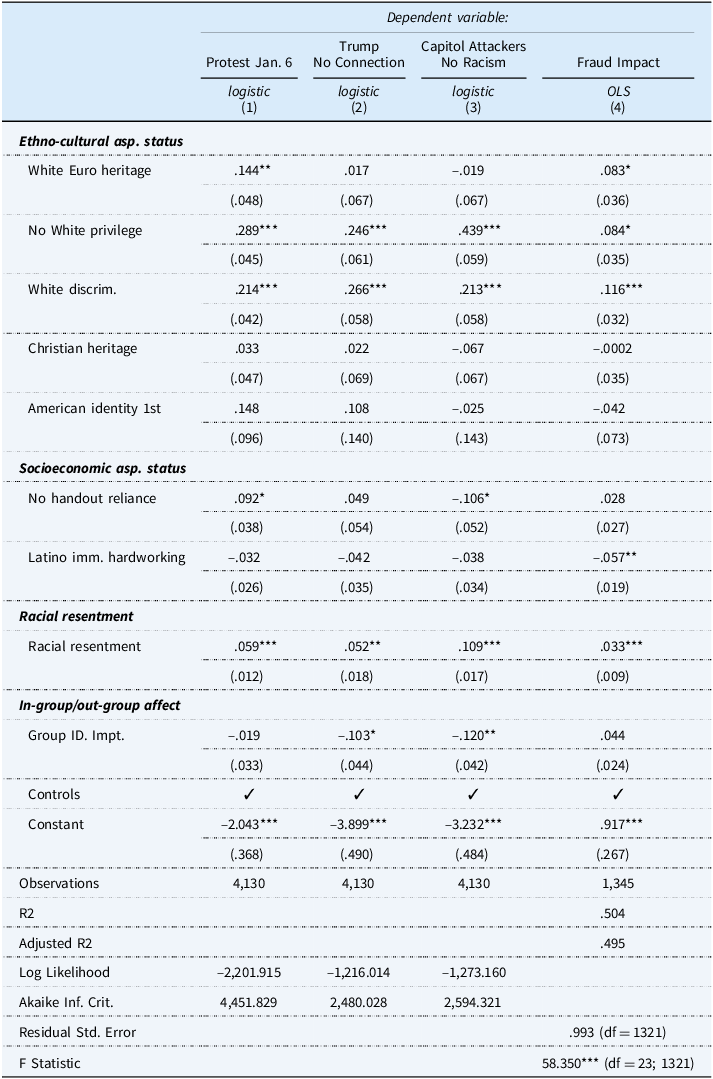
We estimate four models. The first three are logistic regression models, given that the dependent variables are binary. The remaining model, where fraud impact is the categorical dependent variable, is an ordinary least squares model. The models are displayed in Table 1. In this table, we present an abbreviated set of models that include relevant variables for discussion. Full models with all the above-mentioned covariates and controls are shown in the appendix.
Predictors of Latine support for insurrection, trump connection, attackers of capitol, and electoral fraud
Note: *p < .05; **p < .01; ***p < .001.
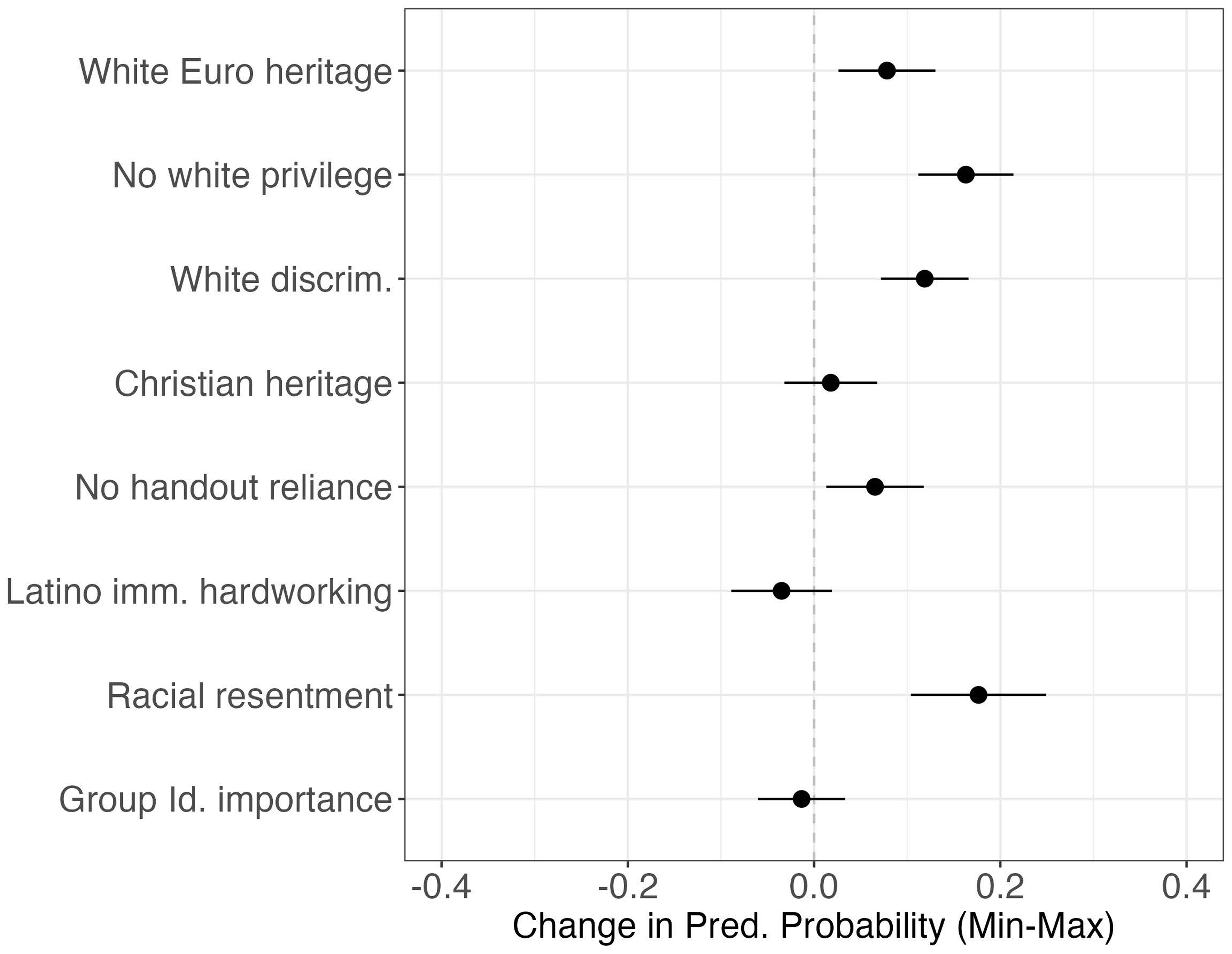
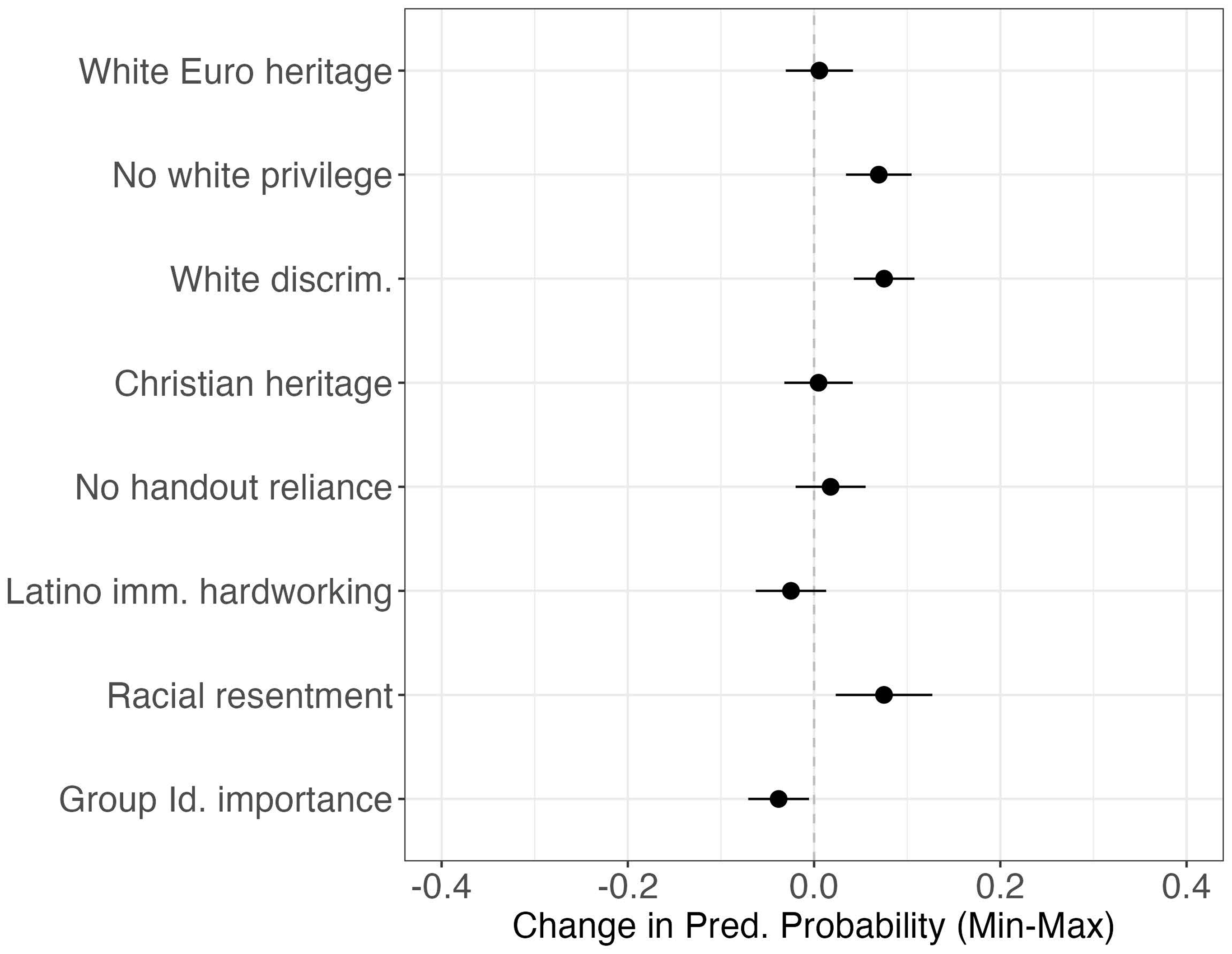
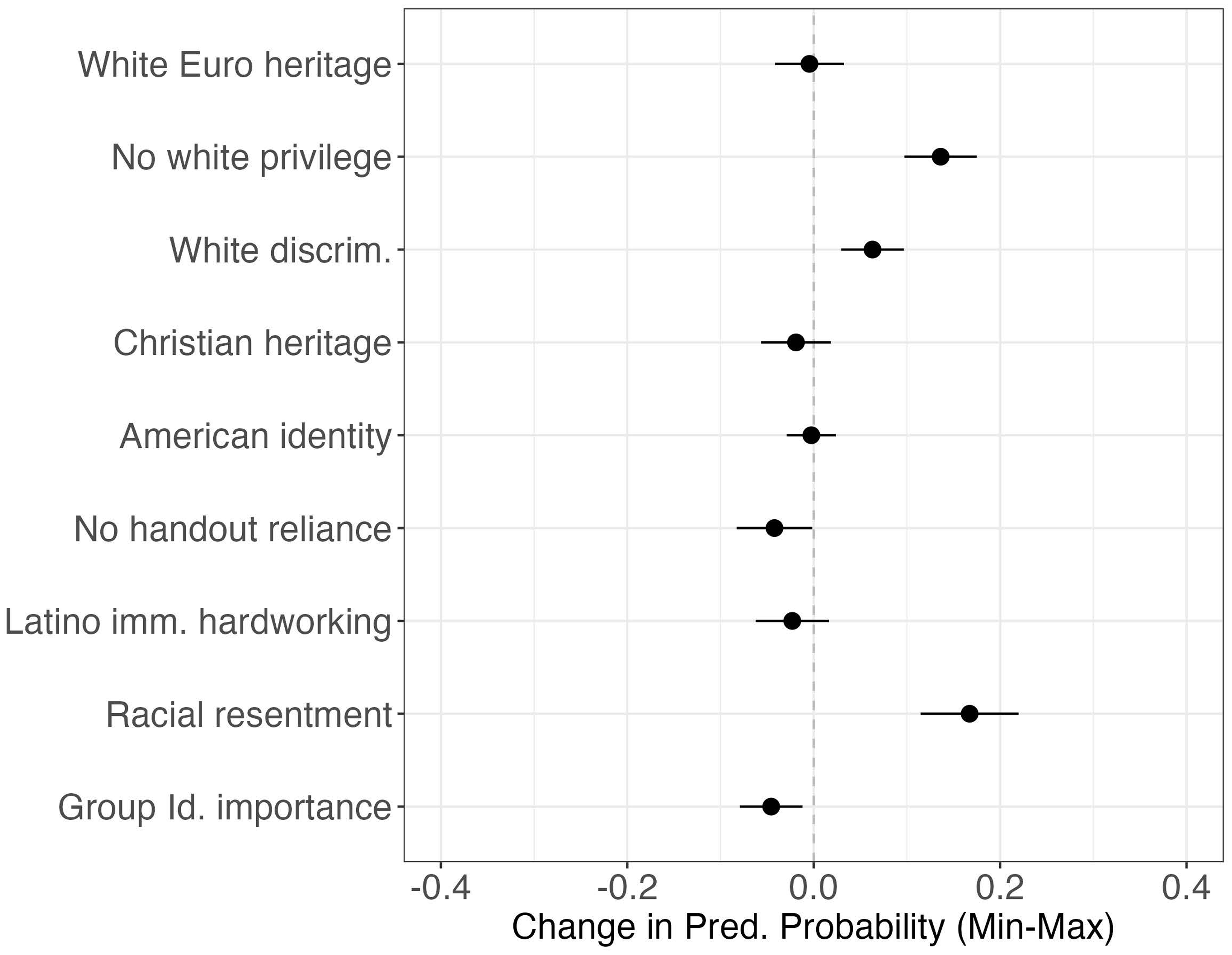
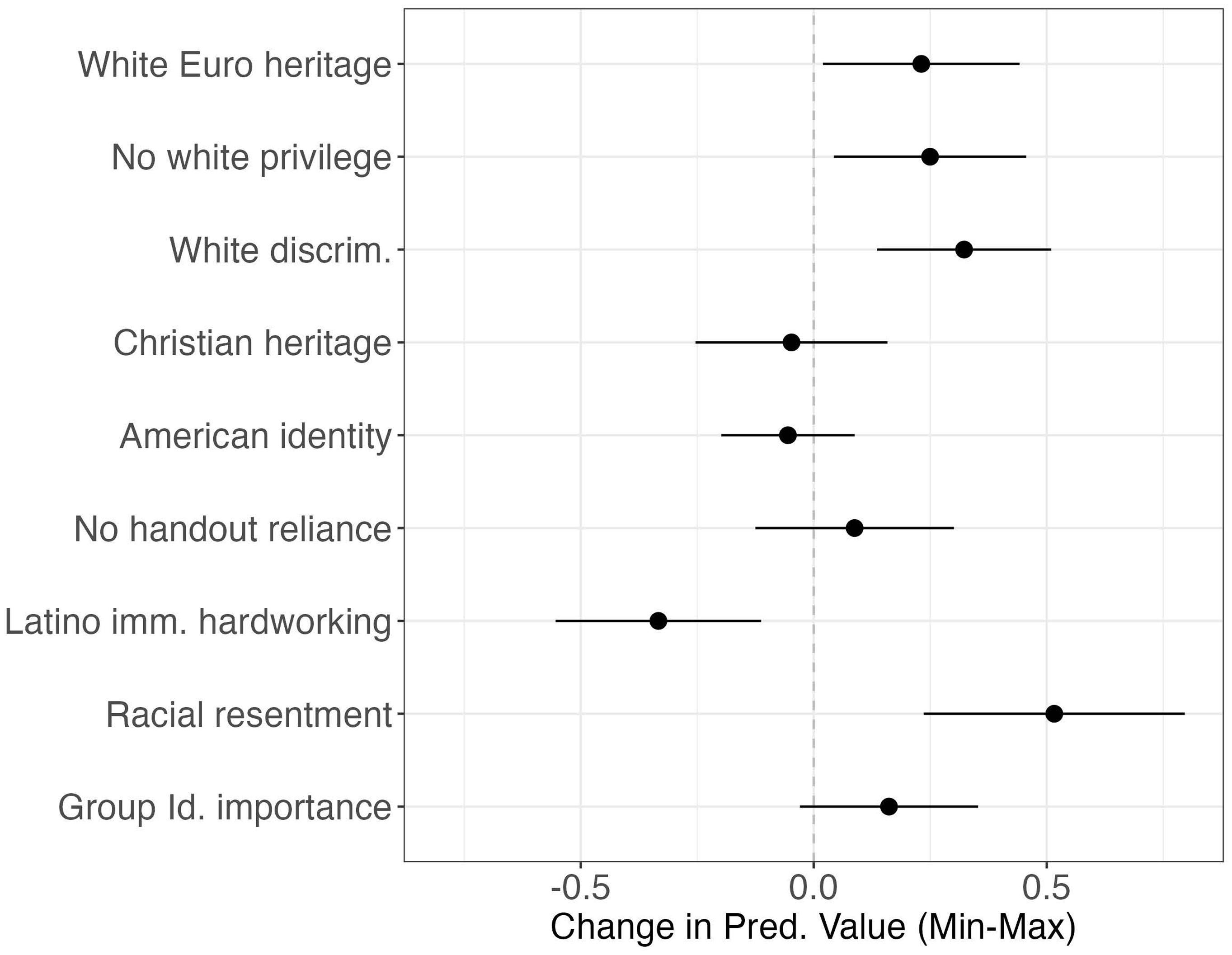
Since the coefficients from models 1–3 presented in Table 1 are not directly interpretable, we rely on post-estimation to calculate predicted probabilities. For model 4, we calculate predicted values. These predicted probabilities and values can be found in Figures 1–4.
Predicted probabilities of Latine support for insurrection. DV: Jan. 6 was a protest that went too far.
Predicted probabilities of Latine support for insurrection. DV: Trump had no connection to Jan. 6.
Predicted probabilities of Latine support for insurrection. DV: Capitol attackers were not racist.
Predicted values of Latine support for insurrection. DV: Fraud impacted 2020 Election.
We begin analyzing results from Table 1 model 1. As the results suggest, no white privilege, white discrimination, and white European heritage are positively associated with calling the events of January 6 a protest that went too far rather than an insurrection. Latines who think white privilege is not a problem are more likely to indicate that January 6th was just a protest rather than an insurrection. Going from believing that white privilege is a major problem to strongly agreeing that white privilege is not a societal problem is associated with a 16% increase in the likelihood of calling the insurrection just a protest. Moving from strongly disagreeing to strongly agreeing that discrimination toward whites has become a major problem in U.S. society is associated with a 10% increase in the likelihood of calling January 6th a protest. Furthermore, wanting to preserve European heritage is positively and significantly associated with pro-insurrectionist beliefs. Going from strongly disagreeing to strongly agreeing that America’s white European heritage should be preserved is associated with a 7% increase in the probability of naming the events of January 6th just a protest. These findings support our first hypothesis.
We now turn to the results on socioeconomic aspirational status in model 1. Our proxy of no handout reliance indicates that Latines who strongly agree with the idea that Latines can always create something for themselves while others depend on handouts are more likely to believe that January 6th was just a protest. As we had argued, Latines who were motivated to support the insurrection should express beliefs of economic self-reliance and hard work as a way to distance themselves from in-group members who might be giving their group a bad reputation or push against negative stereotypes often affiliated with the in-group. As such, these Latines should see what happened on January 6th as another protest and be less likely to call it an insurrection. Our post-estimation indicates that going from strongly disagreeing to strongly agreeing that Latines can always create something for themselves when others depend on handouts is associated with a 6% increase in the likelihood of calling the storming of the Capitol a protest and not an insurrection. This finding lends support for our second hypothesis.
As model 1 suggests, racial resentment is strongly and positively associated with calling January 6th a protest rather than an insurrection. Moving from the lowest to the highest level of racial resentment is associated with a 17% increase in the likelihood of calling the Capitol storming a protest. As these results indicate, we find support for the third hypothesis, where we expected to find that racial resentment was a motivating factor for Latines who supported the insurrection.
Turning to Table 1 model 2, and the corresponding Figure 2, we find that respondents who do not think that white privilege is a problem are more likely to report that Trump had no connection to the events of January 6th. In addition, those who think that whites are discriminated against hold similar positions. For Latines, going from believing that white privilege is a major problem to reporting that it is not a major problem at all is associated with a 7% increase in the likelihood of reporting that Trump had no connection whatsoever to the insurrection. For Latines, moving from disagreeing that white discrimination is a problem to strongly agreeing that it is a big problem is associated with a 7% increase in the likelihood of reporting Trump had no connection to the storming of the Capitol. Ultimately, these findings further support hypothesis 1, suggesting that ethno-cultural aspirations drawing Latines closer to whiteness are important factors in shaping their political attitudes. However, socioeconomic aspirational status is not significantly related to attitudes about Trump’s involvement in the events of January 6th, providing no support for our second hypothesis in this particular model.
Nevertheless, model 2 does provide further support for hypothesis 3, where respondents who are more racially resentful are more likely to believe that Trump had no connection to the events that transpired on January 6. Among Latines, moving from the lowest level of racial resentment to the highest level is associated with a 8% increase in the likelihood of reporting that Trump had no connection to the insurrection.
Table 1 model 3 explores whether respondents believe that those involved in the events of January 6th were not racist. Respondents who do not think white privilege is an issue as well as those who think whites are discriminated against are more likely to believe that those who participated in the January 6th insurrection were not racist, supporting hypothesis 1. For Latines, moving from agreeing that white privilege is a problem to strongly disagreeing that it is a major issue is associated with a 14% increase in the likelihood of perceiving January 6th participants as not racist. Similarly, going from believing that white discrimination is not a problem to believing that white discrimination is a major problem is associated with a 6% increase in the probability of viewing those involved in the events of January 6th as having no connection to racism.
Furthermore, those who think that Latines do not need to rely on handouts in comparison to other groups are less likely to think that those who stormed the capitol were not racist, which complicates the expectations set out by hypothesis 2, as we expected this effect to be in the opposite direction. For racial resentment, we find consistent support of hypothesis 3. Racially resentful Latines are more likely to believe that Capitol attackers had no connection to racism. Going from the lowest level of racial resentment to the highest is associated with a 17% increase in the likelihood of believing that the Capitol attackers were not motivated by racism.
Table 1 model 4 examines how much fraud respondents believed there was in the 2020 election. This model shows similar results as our earlier dependent variables. Those who think that America should preserve its European heritage are more likely to think that there was fraud in the 2020 election. Moving from strongly disagreeing to strongly agreeing that the United States should preserve its white European heritage is associated with a .23 increase in the belief there was fraud in the presidential election. Similarly, those who do not think white privilege is an issue, as well as those who think discrimination against whites is a major problem, are more likely to think there was fraud in the 2020 election. These two are associated with a .25 and a .32 increase in the belief there was fraud in the presidential election when going from the minimum to the maximum on each covariate, respectively (white privilege and white discrimination). These results support hypothesis 1.
Our results suggest support for hypothesis 2, suggesting that those who think Latine immigrants are hardworking (instead of lazy) are less likely to think there was fraud in the 2020 election. Going from thinking Latine immigrants are lazy to thinking they are hardworking is associated with a .33 decrease in the belief that there was fraud which impacted the presidential election in 2020. In other words, Latines who think Latine immigrants live up to the stereotype that they are lazy (and as a consequence make the rest of the in-group look bad) were more likely to think there was electoral fraud in 2020.
Those who are more racially resentful toward Black Americans are more likely to believe that fraud impacted the 2020 election results. Going from the lowest level of racial resentment to the highest is associated with a .52 increase in the belief there was fraud in the 2020 Presidential Election. This further supports our third hypothesis.
Additionally, we found that in two of the models, a strong connection with the pan-ethnic community, which signals that Latines might not feel a sense of status threat and are therefore not seeking distancing from the group, is significantly and negatively associated with pro-insurrection attitudes. In model 2, Latines who reported that being Hispanic/Latino was an extremely important part of their identity, as opposed to reporting that it was not at all important, had a 4% decrease in the likelihood of reporting that Trump had no connection to the insurrection. Similarly, model 3 indicates that moving from the lowest to the highest level of Latine identity attachment yields a 5% decrease in the likelihood of believing that Capitol attackers were not motivated by racism.
We note that white racial identification by Latines holds limited explanatory power on the insurrection DVs. Self-identifying as white is only predictive of beliefs about the insurrection versus a protest that went too far but not any other dependent variable. Interestingly, model 1 reveals that those who self-identify as white are less likely to call January 6th just a protest, and instead are more likely to call it an insurrection. As other scholars have shown, Latine self-identification as white is complex and instrumental (Dowling Reference Dowling2015). While some Latines may choose to identify as white for distinct reasons, and in many cases it yields a stronger identification as Republican (Cuevas-Molina Reference Cuevas-Molina2023), we have uncovered that aspiring to whiteness in an ideological sense has much more consistent explanatory power in relation to support for the insurrection.
It is important to note that while we find support for our hypotheses of ethno-cultural and socioeconomic aspirational status, as well as racial resentment, these results hold up even after accounting for partisanship, ideology, and favorability toward Trump. These additional covariates do have some explanatory power on our insurrection DVs. However, what is important to highlight is that in addition to partisanship and Trump support, aspirational status (of both types) and racial resentment provide further insight into those Latines who were in line with the ideas of those who stormed the Capitol and engaged in the insurrection. In all four of our models, Trump favorability is strongly predictive of each respective dependent variable. Latines who strongly favor Trump are more likely to call January 6 a protest, more likely to think Trump had no connection, more likely to think that those who attacked the Capitol had no connection to racism, and are more likely to believe that there was definitely fraud that impacted the election results.
Nonetheless, it is important to consider how ethno-cultural and socioeconomic aspirational status operate alongside partisanship. We ran a series of models where we interacted with all of the measures of aspirational status with partisanship to explore this relationship more closely.Footnote 4 While the relationship between partisanship and aspirational status is not consistent across every single measure, there are several noteworthy patterns to highlight. First, some of these analyses suggest that aspirational status is capturing differences that go beyond partisanship. The first example is when exploring perceptions of white discrimination. Among Democrats, those who do not think there is discrimination against whites have very low pro-insurrectionist attitudes. However, Democrats who strongly agree that whites are discriminated against have higher pro-insurrectionist attitudes. Democrats who score highly on this measure have similar pro-insurrectionist attitudes as Republicans, as seen in Figure A3. Similarly, Democrats who strongly believe in preserving America’s European heritage are more likely to believe that Jan. 6 was just a protest than Democrats who do not believe in this (Figure A1). This pattern, where Democrats who have high ethno-cultural aspirational status being different than those with low ethno-cultural aspirational status, also appears to be the case when it comes to negating white privilege and perceiving that Jan. 6 was just a protest and that the capitol rioters were not racists, as shown in Figure A2. This suggests that in some instances, and particularly in the case of perceiving white discrimination, ethno-cultural aspirational status is capturing a component that goes beyond differences by partisanship.
In some cases, it appears that the effect of aspirational status is attenuated by partisanship. Democrats who are highly likely to agree that Latines do not rely on handouts are still less likely to express pro-insurrectionist attitudes compared to Republicans who strongly believe that Latines do not rely on handouts, according to Figure A4. Similarly, Democrats who strongly perceive that America should preserve its European heritage are still less likely to believe fraud impacted the 2020 election compared to Republicans who strongly believe in preserving America’s European heritage. This is also the case when exploring the relationship between perceiving that Latine immigrants work hard and believing that fraud impacted the 2020 election and that Trump had no connection to the insurrection (Figure A5).
Variation in Interpretation by Language
Though we find general support for our three hypotheses, the findings uncovered other important patterns worthy of mention. In three of our four models, we find that taking the survey in Spanish is positively associated with pro-January 6 attitudes. Table A7 in the appendix reveals that Latines who are Spanish speakers are more likely to believe that January 6 was a protest gone too far, as opposed to an insurrection. They are also more likely to report that Trump had no connection to the insurrection and more likely to believe that the Capitol attackers had no connection to racism.
Spanish-language dominance has traditionally been used as a proxy for acculturation (Michelson Reference Michelson2003; Alba and Nee Reference Alba and Nee2003; Cruz et al. Reference Cruz2008). In other words, it has been used to assess how Latines who might be less accustomed to U.S. culture and customs might fare in socio-political processes. Based on this, we might interpret the above-mentioned findings as evidence that less acculturated Latines were more likely to hold pro-insurrectionists beliefs. While this is one plausible interpretation, we must also consider other possible ways of interpreting Spanish-language dominance.
One potential explanation could be due to language effects. As Pérez (Reference Pérez2016) shows, language impacts the accessibility of certain concepts. Language-opinion effects suggest that some political concepts and opinions are more strongly linked in some languages versus others. Some of the language effects may also indicate that concepts like insurrection may not be as accessible to Spanish-dominant Latine speakers. Upon preliminary investigation, Spanish-language news sources that covered the January 6th events such as UnivisionFootnote 5 and TelemundoFootnote 6 discussed it as insurrección in Spanish despite other available translations such as rebellión or insurgencia.Footnote 7 Data constraints do not allow us to further examine these potential differences in language effects. Nonetheless, we seek to bring attention to how long-standing proxies for acculturation might indicate language accessibility effects that need to be further investigated.
Discussion and Conclusion
In this paper, we argue that Latines seeking an aspirational higher status, both ethno-culturally and socioeconomically, as well as distancing from lower-status groups, helps to explain why they adopt specific political attitudes. As this study is one of the first to explore the nuances of within-group status among Latines, we first explore who the Latines are who aspire to a higher ethno-cultural status; we find that these are largely those of lower socioeconomic status, Cubans, Spanish speakers and the foreign-born, as well as those who are ideologically conservative and who identify as Republican.
With regard to how this aspirational status is associated with political attitudes, we find strong and consistent evidence that ethno-cultural aspirations toward whiteness are positively associated with supportive attitudes toward the events that occurred on January 6th. Specifically, it is the attitudes that are most associated with white grievance—belief that whites experience discrimination, as well as a rejection of the idea that white privilege exists in society—that are most consistently predictive of attitudes in support of the events that occurred on January 6. This is a striking similarity to other studies that show that racial grievances are at the center of non-Hispanic white support for the insurrection (Barreto et al. Reference Barreto2023; Davis and Wilson Reference Davis and Wilson2023). The desire for America to preserve its European heritage is also an important component of ethno-cultural aspirational status for Latines, although this only positively predicts thinking of the day’s events as a protest and thinking that there was fraud in the 2020 Election.
Across all models, we do not find that a desire to preserve the United States’ Christian heritage predicts support for January 6, which is an important contrast to studies focusing on white attitudes (Armaly, Buckley and Enders Reference Armaly, Buckley and Enders2022). Evidence on the role of religious ideology among Latines is mixed. Wong argues that Latine Evangelicals are significantly less likely to vote for Trump compared to white Evangelicals (Wong Reference Wong2018). However, recent scholarship has found that Latine Evangelicals are more likely to support Trump relative to Latines with other religious identifications (Martinez and Martí Reference Martinez and Martí2024) and that Christian nationalism can be an appealing way for Latines to claim membership and belonging as Americans (Perry et al. Reference Perry2024). At the same time, Latine Evangelicals are a small percentage of the overall Latine population (estimated to be around 18 percent in Martinez and Martí (Reference Martinez and Martí2024)’s study). Thus, it is possible that Latines who are most likely to adhere to Christian nationalist beliefs are underrepresented in our sample. In addition, in contrast to prior studies that have emphasized the importance of American identity prioritization on Latine political attitudes (Hickel et al. Reference Hickel, Alamillo, Oskooii and Collingwood2021), we do not find that this is associated with attitudes toward January 6. It is possible that our other measures of ethno-cultural aspirational status are capturing some of these same sentiments that American identity prioritization has captured in previous studies, thus rendering it not statistically significant in our study.
We find mixed evidence for our hypothesis of socioeconomic aspirational status as an important factor in shaping political attitudes in our analysis. While respondents who perceive that Latines always make something for themselves while others rely on handouts are more likely to think of January 6 as a protest rather than an insurrection, they are also more likely to think that January 6 participants are racist. This latter effect may suggest a potential differentiation between socioeconomic aspirational status and ethno-cultural aspirational status—where those who believe they work harder compared to other groups are not equivalent to those who aspire to whiteness. This interpretation is also consistent with recent work by Davis and Wilson (Reference Davis and Wilson2023), who specifically outline that while whites may oppose racism, their ideas about deservingness make it so that they do not want specific racial groups to receive what they deem to be “special treatment.”
Furthermore, respondents who think that Latine immigrants are lazy are more likely to think there was fraud in the 2020 Election. This captures a socioeconomic status distancing consistent with our second hypothesis. As Hickel, Oskooii and Collingwood (Reference Hickel, Oskooii and Collingwood2024) argue, Latine immigrant resentment is a specific distancing strategy that some Latine individuals use to claim higher status, positioning themselves as more hardworking and more deserving in comparison to group members who they see as less deserving (Cadena Reference Cadena2022).
Ultimately, racial resentment is positively associated with pro-January 6 attitudes across the board, further highlighting the importance of distancing from lesser status racial groups in shaping these attitudes. This also echoes what previous studies have found about the drivers of these attitudes among non-Hispanic whites (Barreto et al. Reference Barreto2023; Davis and Wilson Reference Davis and Wilson2023), illustrating important parallels between white and Latine attitudes. While the traditional racial resentment scale does not allow us to capture a more complex anti-Black sentiment rooted in the confluence of Latin American racial hierarchies along with U.S.-based ideologies (Cuevas-Molina Reference Cuevas-Molina2023), the findings highlight the striking similarities between white and Latine motivations for supporting the insurrection.
Overall, these results have important takeaways regarding the political attitudes of Latines and the factors that shape them. Given that Latines are an extremely heterogeneous group, it is important to note that despite sometimes being the target of pro-white, and anti-minority sentiment, they can still adhere to aspirational statuses rooted in white supremacy, which then impact their political attitudes. Future work should continue to explore different forms of aspirational statuses among Latines and continue to explore how to capture these when the group seeks to be in closer proximity to higher-status groups but simultaneously distances themselves from lower-status groups. In particular, future work should explore socioeconomic aspirational status to better measure these perceptions and their impact on political attitudes. Furthermore, we encourage scholars to consider how we can understand the racialized incorporation of Latines beyond self-identification and use other measures to explore their ethno-cultural aspirational statuses.
Another question to consider is how our findings may extend to other groups. Latines are uniquely positioned as simultaneously foreign and inferior compared to whites (Zou and Cheryan Reference Zou and Cheryan2017). However, it is possible that similar aspirational status dynamics occur among other racial and ethnic groups such as Asian Americans. As scholars have theorized, Asian Americans’ racialization has also shifted relative to whiteness depending on historical and social contexts (Masuoka and Junn Reference Masuoka and Junn2013). In particular, Asian Americans may seek to distance themselves from Black Americans and other lower-status, non-white groups. Scholars have argued that in the attempt to claim equal rights for Asian Americans in education, Asian Americans often engage in anti-Black discourse (Liu et al. Reference Liu2023; Kim Reference Kim2000). At the same time, one important caveat is the inability for some Asian Americans to escape the stereotype of being perpetual foreigners due to their phenotypical and cultural characteristics, even in the third generation (Tuan Reference Tuan1999). Therefore, it is important to consider that Latines may be the most likely to phenotypically “pass” as non-Hispanic whites, thus making their adherence to honorary whiteness (Bonilla-Silva Reference Bonilla-Silva2004) more seamless.
Supplementary material
The supplementary material for this article can be found at https://doi.org/10.1017/rep.2025.6
Acknowledgments
We would like to thank Muyao Hang and Sara Gomez for invaluable research assistance. We are also grateful to Matt Barreto and the UCLA Voting Rights Project team for inviting us to present an earlier version of this project at UCLA, where we received excellent comments from attendees. Thank you to Benjamin Gonzalez O’Brien and Christopher Towler, JREP editors, for all of their support in seeing this project to completion. We would also like to thank the anonymous reviewers for their generous and detailed feedback, which greatly improved the manuscript.
Funding statement
This research did not receive any specific financial support.
Competing interests
The authors declare no competing interests.


 Open access

