

INTRODUCTION
There is a saying in the village of Battir, located to the southwest of Jerusalem, that a week “lasts eight days, not seven.” Each of Battir’s eight families has a one-day long claim to the village’s water supply. One family uses its share—a day’s worth of water—and then passes it to the next family, meaning that a full rotation of water lasts eight days (Trottier Reference Trottier1999; Kershner Reference Kershner2012). For those accustomed to thinking of water usage in terms of a given volume of water, this time-based measurement may appear strange. What does it mean to possess a claim to one day of water? Why conceive of one’s rights to water in terms of time as opposed to volume? This time-volume distinction, and the contrasting regimes of property rights in which it is embedded, lies at the heart of this article.
In this article, I examine some of the processes by which Zionist settlers dispossessed Palestinians of their water resources over the course of the British Mandate, which spanned from the early 1920s to the creation of the State of Israel in 1948. Zionist appropriation of water was neither as organized nor as systematic as that of land. It occurred in both direct and indirect ways. This article examines two such ways in particular, with the hopes of revealing something not only about the Zionist project and Palestinian dispossession but also about settler colonial processes at large. While settler colonialism often understands and justifies itself in terms of efficiency and progress, I argue that, in this instance, it actually functioned through legalized processes of exclusion.
First, I present a basic overview of the customary law of time-based water sharing—a practice seen across much of the larger Arab and Islamic world. I argue that this time-based method of water distribution can be understood as a system of rules that govern how a given community shares its water resource. Recognizing this set of rules as an institution in its own right is important. Doing so enables us to contrast it with volume-based measures, which were the preferred unit of incoming settlers and the British. I show that, with time-based water sharing, water rights are embedded in a larger network of social relationships. Volume-based rights, on the other hand, abstract away from the larger social milieu in which water use is embedded, making them better suited for a settler colonial context, in which a newcomer seeks to buy up or invest in water. I argue that volume-based measures facilitated a process of commodification, making water an object of speculation over the course of the Mandate.
The shift from time- to volume-based measurement, and the process of commodification that it facilitated, in turn helped pave the way for a more direct form of Zionist appropriation of water resources. I show how the corporate form itself—in this case, that of the Palestine Electric Corporation (PEC)—was used as a tool of exclusion. The PEC held monopolistic rights to generate hydroelectricity in northern Palestine and Transjordan and was purposefully organized in such a way as to ensure Zionist control over these means of production. At the same time, it funneled foreign capital into Palestine, making its rivers an object of investment for foreign shareholders, and amassing enough capital to be able to assert a kind of de facto sovereignty. While Zionist state building during this period is often framed as a socialist or quasi-socialist endeavor, examining the PEC shows that there were key capitalist components to the state-building process.
Building on current scholarship on the PEC, I show how it restricted the possibilities for water use in an area that had historically been primarily agrarian. The concessions that the company operated to generate electricity gave it control over northern Palestine’s three major rivers, control that the corporation exploited to the fullest. It is for this reason that water use during the Mandate cannot be understood separately from that of electricity. The PEC effectively cut off these rivers from local use, to the detriment of Palestinian and Zionist farmers alike. When the history of the PEC is seen in terms of the shifting regimes of property rights over water, it shows how water appropriation worked in intimate and local ways as well as from afar. While the very basics of how water was measured were gradually redefined, this water also became an object for foreigners to invest in and control. This article suggests that these two processes might not be as distinct from one another as it appears at first glance. Taken together, they show how a conceptual transformation—a shift in the ways of measuring water—helped pave the way for the dispossession of one of Palestine’s most valuable resources.
“ABSORPTIVE CAPACITY” AND INTENSIVE AGRICULTURE
Following the First World War, the needs of the British government and the Zionist movement converged in important ways (Wolfe Reference Wolfe2012). The Covenant of the League of Nations divided up the former Ottoman Empire and placed it under the mandate system, a type of transitional protectorate that put areas “inhabited by peoples not yet able to stand by themselves” under the tutelage of more “advanced nations.”Footnote 1 Palestine and Transjordan fell under British authority. Yet British duties to Palestinians were in tension with the Balfour Declaration, a 1917 British statement in support of building a “national home for the Jewish people” in Palestine.Footnote 2 The Palestine Mandate, which was ratified in 1922, reiterated support for such a Jewish home.Footnote 3 The British government thus had to find a way to make good on the Balfour Declaration and supposedly not compromise their colonial duty as the caretakers of the preexisting population.
This purported balancing of Zionist and Palestinian interests was accomplished, at least in theory, through the metric of “absorptive capacity.” The concept was borne out of a 1922 British white paper that said that Jewish immigration quotas would be calculated based on “the economic capacity of the country at the time to absorb new arrivals.”Footnote 4 Absorptive capacity was determined in part by a Malthusian calculation of the potential of Palestine’s natural resources, such as land and water, to hold and employ people. Tying Jewish immigration to absorptive capacity meant that throughout the Mandate there was an emphasis on surveying Palestine and creating statistical knowledge of its economic potential (Seikaly Reference Seikaly2016; Sasson and Shamir Reference Sasson and Ronen2020).Footnote 5
The British saw implementing intensive agriculture in Palestine, a place that historically practiced mostly extensive farming, as a means of enhancing absorptive capacity. This distinction between intensive and extensive land cultivation was based in part on a Lockean understanding of what it means to use land effectively versus letting it go to waste, which, from the British perspective, was precisely what the Palestinians did (Survey of Palestine 1946; Wolfe Reference Wolfe2012). Intensive land use meant a more efficient utilization of natural resources—more frequent crop rotation, irrigated farming, and more labor- and capital-intensive work—and, by extension, more densely settled land. According to the British, intensive agriculture could thus provide the economic basis to accommodate an incoming Jewish population without compromising the livelihood of the Palestinians (Shafir Reference Shafir1989). British policy thus explicitly promoted intensive farming as the basis of Zionist colonization. The 1922 Palestine Mandate stipulated that the British administration “shall encourage … close settlement by Jews on the land,” a reference to the use of intensive agriculture.Footnote 6 Despite minimal British funding for local education and social services over the course of the Mandate (Seikaly Reference Seikaly2016; Wolfe Reference Wolfe2012), the colonial government invested heavily in, and assisted the Jewish Agency with, agricultural research (Survey of Palestine 1946).
Intensive agriculture also filled a major need for the Zionist movement—a viable economic program. By the beginning of the First World War, the Zionist movement was still struggling to establish a self-sustaining economic basis for settlement in Palestine. During the first aliya, or wave of Zionist immigration from 1882 to 1903, settlements were primarily engaged in monocultural cash crops for export, such as viticulture and citrus growing. This was difficult to sustain on unirrigated land and uncompetitive in international markets. During the second aliya, from 1904 to 1914, there was a shift toward mixed farming, but Jewish farmers were again unable to sustain themselves along these lines, prompting many who immigrated at this time to eventually leave Palestine altogether. The eventual answer was the kibbutz, a Jewish-only communal farm that practiced intensive agriculture. With the support of Zionist institutions and overseas capital, the kibbutzim were shielded from market imperatives. They thus provided an economic life for Jewish immigrants that would have been much more precarious if there had been a need to yield a profit, and, in doing so, they helped create a foundation for the eventual state (Shafir Reference Shafir1989; Wolfe Reference Wolfe2012).
Yet, over the course of the Mandate, the Zionist perspective also came to see absorptive capacity as a malleable metric. In 1936, David Horowitz, director of the Economic Department of the Jewish Agency, noted in his report “Scheme for the Settlement of German Jews in Palestine,” that
a country’s absorptive capacity is not an absolute category. The limits of absorption are no longer determined only by the…factors of geographical conditions and natural resources, but by the variable forces of scientific technique and political manipulation. With the aid of science and politics absorption has become an elastic concept capable of considerable expansion.Footnote 7
Science and politics thus became the means of expanding absorptive capacity, of which scientific, irrigated agriculture and the development of water resources became integral parts (Reichman Katz and Paz Reference Reichman, Yossi and Yair1997). According to the Jewish National Fund and the Jewish Agency for Palestine Water Research Bureau, absorptive capacity would “inevitably depend on the intensive exploitation of water resources.”Footnote 8 For this reason, Zionist entities expended a significant amount of resources on gathering hydrological knowledge of Palestine and developing water infrastructure (Shamir Reference Shamir2013, Reference Shamir2017; Sasson and Shamir Reference Sasson and Ronen2020). It is in this context that water became crucial to the project of creating an economy that could sustain Zionist settlement and growth. As is clear from the concept of absorptive capacity, water management was more than just an issue for engineering; it was also a political cause. Water supply thus became the site of considerable debate, a great deal of which concerned the very basis of how water rights were measured and defined.
“A MULTIPLICITY OF UNITS”
Current scholarship on water in Mandate Palestine typically references the Ottoman Civil Code, Mejelle, in discussions of preexisting legal regimes. Yet the Mejelle was relatively recent in implementation and neither reflected actual practice on the ground (Survey of Palestine 1946; Nadan Reference Nadan2006) nor fully represented Indigenous legal institutions of water sharing (Schorr Reference Schorr2014). While a deeper analysis of Palestinian water rights during the Mandate still remains to be undertaken, we can begin in this direction by presenting a simplified overview of time-based water sharing.Footnote 9 Contemporary British accounts are littered with references to such sharing, but they, and scholars since then, have not entirely recognized such references as pointing toward a coherent system.Footnote 10 While time-based distribution worked differently from place to place, varying from one water source to the next, its local and customary nature does not mean that it was random or that it did not comprise a system. Recognizing it as such helps shed new light on how we understand water appropriation during this period.
Scholars have documented two basic schemas of time-based water distribution around the Arab and Islamic world, including in the Levant or greater Syria. In one such scheme, water is tied to the land itself and cannot be alienated separately from the land it irrigates. Water is divided proportionally according to the amount of land to be irrigated. In the second system, water rights can be sold off or rented separately from the land they accompany and are typically measured as time-based turns in a rotating system or a “water shift” (40).Footnote 11 These two systems are not necessarily mutually exclusive. Scholars have documented instances in which the sharing scheme could switch from one system to the other (Hammoudi Reference Hammoudi and Mayer1985). Regardless of such specificities, there is a common underlying thread. Claims to water are not conceived of in a form of abstract rights to a definite amount but, rather, as a proportion of the larger whole.
There is evidence from British archival sources that both of these schemas existed in Palestine during the Mandate, but more research is needed to say definitively. A British irrigation advisor, D. G. Harris, wrote in a detailed note in 1935 on a proposed irrigation ordinance:
The Irrigation Officer will make measurements of the volume of water available and of the area of land to which it appertains, while the Water Settlement Officer will record all water rights … and incorporate them in a Report. This Report will necessarily be based largely on verbal evidence rather than written contract and will probably describe the rights in a multiplicity of units, one man being entitled to a proportion of the discharge of a spring, another to the volume passing through an opening of ascertained size, another to a certain number of hours of supply in a rotation of a certain number of days, and so one [sic].Footnote 12
This report, not to mention the proposed ordinance itself, never materialized. But it gives us a window into how the British perceived Palestinian water claims and the “multiplicity of units” with which any memorializing of such claims would have to grapple. It is likely that the first unit mentioned—“a proportion of the discharge”—corresponds to the first of the two schema mentioned above—namely, proportional water claims that are tied to the land that they irrigate. The last unit described—“a certain number of hours of supply”—likely correlates with the second schema—namely, water rights that have been alienated from their associated land and are thus understood solely in terms of time as opposed to a proportion.
The British administration did not always understand or appreciate time-based water sharing. Lewis French, the British director of development, wrote in his 1931 report, “Agricultural Development and Land Settlement in Palestine” of Beisan, where users rotated water every twenty to thirty days: “Use of land and water is at present as unsystematic and chaotic as can be conceived … water channels wander about apparently with no object and no system. Yet they are all subject to well-known rights” (see also Tyler Reference Tyler2001).Footnote 13 What the British perceived as chaos fed into colonial discourse about the need to civilize native land tenure, water use, and agriculture.Footnote 14 Colonial policy aimed at partitioning communally held land, and the British were continually looking for ways to limit what was often perceived as an inefficient or wasteful use of water, as with the Palestinian farming methods that they found wasteful and primitive (Nadan Reference Nadan2003).Footnote 15 With an incoming settler population, there was a constant push to maximize both water and land use in order to accommodate more people.
In the contrast between time- and volume-based water rights, and the broader legal regimes of which they were a part, we can draw a parallel to Gershon Shafir’s (Reference Shafir1989, 201) analysis of pre-Mandate Zionist colonization as the “decisive historical encounter” of two different understandings of land ownership. Drawing on Edward Said (Reference Said1979), he points out that settler colonialism often justified itself by claiming to have superior knowledge of land cultivation and, by extension, of civilization: “Ultimately, even disregard for local custom was not just a matter of ignorance, but the unavoidable opposition of two types of property systems, and at stake was the very legitimacy of European overseas settlement” (Shafir Reference Shafir1989, 202). The British took for granted that their methods of water and land use were superior and this basic sense of superiority justified the larger colonial project.
There are two important differences between time- and volume-based measures—differences that explain how water became increasingly commodified. First, while volume is a standardized unit of measurement, time is not. Water flow measured in time is never constant—it varies based on weather and season. During a drought or a dry summer, a spring’s output decreases. A volume-based unit, on the other hand, guarantees the same amount of water in each instance it is used. A cubic meter of water is the same from any source, under any weather conditions, during any time of the year. Economic and environmental historians have often emphasized the role of standardized measures in the commodification of natural resources (Kula Reference Kula, Szreter and Princeton1986; Cronon Reference Cronon1991; Worster Reference Worster2004). Donald Worster (Reference Worster2004, 143), for example, has argued that the division of land in the Midwestern United States into neat, 160-acre square parcels for white settlement was a way of making the land fungible: “It was much easier to buy and sell land when it was conveniently laid out in uniform, interchangeable boxes. To further this process of exchange, every parcel became an arithmetical abstraction, a quantity identified by a number.” The unit itself—the 160-acre lot—conveyed very little qualitative information about the underlying good. Each lot was, at least in theory, the same as any other. Measuring land in uniform boxes thus abstracted it, dislocating it from its social context and transforming it into a commodity that was more easily bought and sold and on which it was easier to speculate.
Something similar occurred in terms of water during the colonization of Palestine. Like in the western United States, there was an incoming settler population in Palestine and a speculative land and water market. Standardized, volume-based measurements, as opposed to “one day” or “one week” of water, made water increasingly like an “arithmetical abstraction” and, in doing so, rendered it increasingly fungible and commodified. A standardized, volume-based unit is more easily convertible into other terms. It can be more easily equated to the exchange values of other commodities, making it more easily bought and sold.
The second, and perhaps more important, difference between time- and volume-based measures is that measuring water in time forces each user to understand his usage in terms of the larger community. If one user decides to take more than his share and increase his time at the spring, it cuts directly into someone else’s time. Time-based sharing thus embeds water in a network of social relations. It reinforces the idea of water as a shared resource, emphasizes that it is finite, and ideally allows the community to share that finite amount. If a member of the community instead claims rights to a certain volume of water, he can effectively take from the spring until that amount is realized, regardless of what remains for others. There is no way of guaranteeing that the spring can support everyone’s claim. Users no longer see their consumption in terms of one another but, rather, at the expense of one another. It is therefore a more exclusive system of property rights (see Figure 1).
A visualization of the differences between idealized versions of time and volume-based water rights. Credit: Courtesy of the author.
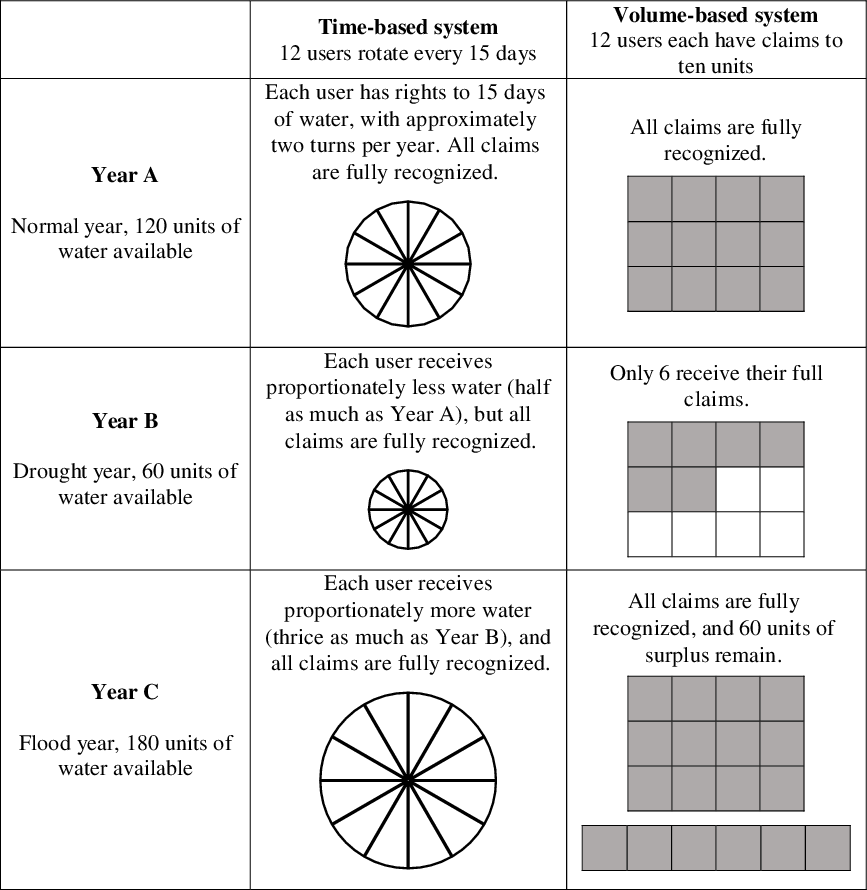
The difference between a time- and volume-based system, therefore, is not just the adoption of a different unit or method of measuring but also the reconceptualization of the social relations that surround a water source. Measuring water in time allows users to take into account the natural properties of water—that it is neither constant nor infinite—and frames water as a collective resource of the community. When measuring water by time, each user receives his share, regardless of the volume or amount available. Measuring by volume, on the other hand, obscures water’s natural properties and constraints, privileging the claims of the individual over the needs of the group. This is not to say that a time-based system is always fairer or more equitable in practice. Shares may still become the object of dispute (Nader Reference Nader and Mayer1985). Those with more resources can buy up or appropriate more shares, meaning that social hierarchies are reflected in inequitable proportions of water (Attia Reference Attia and Mayer1985; Hammoudi Reference Hammoudi and Mayer1985). Certain turns might also be less desirable than others, such as those at night or during weekly days of rest (Hammoudi Reference Hammoudi and Mayer1985).
What such possibilities illustrate is that a time-based distribution system is not simply a form of private property that creates a relationship between a person and a thing. It places the water user into a network of social relationships, and the nature of those relationships is both embedded in, and reflected by, the distribution of water (Hammoudi Reference Hammoudi and Mayer1985; Nader Reference Nader and Mayer1985). Laura Nader (Reference Nader and Mayer1985, 4) notes that, in the context of a time-based water-sharing system in the Ḍrā Valley in Morocco, that “[p]atterns of individual rights and collective obligation must be identified in order to understand water distribution. Water received is one person’s property, but at the same time it forms part of a network of collective rules and obligations.” An incoming settler population is naturally going to disrupt such a network. Settlers have two options in such a situation. They can assimilate into a preexisting network by buying up time shares of a water source, requiring them to embed themselves in a web of social relationships. Or, conversely, they can find some other way of appropriating water. In the case of Mandate Palestine, this was by drilling and pumping groundwater and using volume-based measurements to delineate a new, exclusive set of water rights.Footnote 16
WATER INVESTMENT AND SPECULATION
Differing ways of measuring water rights were but one piece of a larger picture. Because securing and developing water resources was seen as crucial to the Zionist project, there arose a high volume of traffic in water rights and a speculative water market. In this climate, time-based water rights became an obstacle to outside investment, frustrating both the British government and Jewish settlers. Because time-based water rights are embedded in a network of social relations, they obstruct potential outside investment from someone not already in that community. If a group of farmers sharing a spring all define their usage based on time, there is no problem with collectively investing in an upgrade. They will each have the same time allotment before and after the upgrade, and everyone’s output will increase equally.Footnote 17 However, if an outside investor wants to upgrade the spring in order to increase the output and exploit the surplus, he cannot put money into the spring unless there is a guaranteed surplus of water that will come from that investment. Only a standardized, volume-based unit can denote a guaranteed amount of surplus water and, hence, guarantee a return. For example, in 1943, the British administration wanted to construct a masonry channel in Wadi Fari,Footnote 18 but it could not do so because it would not be able to claim the new surplus supplied by the channel. Preexisting users who held rights to the water each held a period of time and would be able to claim any new surplus during their turn at the spring.Footnote 19
In addition to often necessitating volume-based measurements, loans for water infrastructure sometimes decided de facto rights in place of disputed water ownership. It was not always clear if a loan applicant held rights to the sources that they wanted to develop. This was often the case when Jewish settlements applied for credit. The loan officer acted as a water arbiter because “[t]o approve loans in the absence of such settlement [of water rights] entails the tacit recognitions by Government of rights in water for the utilisation of which the loan is granted.”Footnote 20 Getting a loan, therefore, determined water rights simply by enabling one party to build the infrastructure to exploit the water in question. Settlements were able to take over water sources simply because they had access to credit.
Creating yet further confusion was the rise of a speculative market for water rights, which the director of development, Lewis French, attributed to the shift to intensive agriculture.Footnote 21 In 1935, the British attorney general wrote in a memorandum:
Water rights are a frequent subject of commercial transactions; a man may sell half his land and the whole of his water rights or he may retain the whole of his land and sell half his water rights. It is, moreover, not uncommon for speculators, who own no land at all, to purchase the water rights in an area and to farm out the water thus required to the highest bidders.Footnote 22
According to British officials, both speculation and partitioning communally held land disadvantaged users with fewer water rightsFootnote 23 and disorganized the time-based method of water sharing.Footnote 24 As speculation continued, a man who could not afford to develop his water was often forced to “sell his holding to a capitalist who can develop it.”Footnote 25
Water was in such high demand that in 1920 the Jewish Agency even hired a sorcerer who was famed for finding underground petroleum, water, and mineral deposits to survey Palestine in search of groundwater.Footnote 26 By the 1930s, Zionist organizations began deep well boring—a process that requires expensive equipment, such as mechanical drills (Survey of Palestine 1946; Nadan Reference Nadan2006). Because underground water sources feed into springs and shallower wells, deep well boring often diminishes the supplies of neighboring water sources, leading effectively to appropriation. Infrastructure, such as a mechanical drill or pump, was therefore not only a way to secure water but also to take it from others.Footnote 27 Those unable to invest in such infrastructure—typically, the fellaheen (peasant farmers)Footnote 28 —were the most disadvantaged. Varying regimes of property rights were thus one complicating factor in a larger, chaotic environment.
GRANTING THE CONCESSIONS
In 1921, before the Palestine Mandate had been ratified, the high commissioner for Palestine granted Pinhas Rutenberg, a Russian Jewish immigrant, two concessions for the generation and supply of electricity in Palestine and Transjordan. The concessionaire was to generate hydropower from three rivers—the ‘Auja, Jordan, and Yarmuk—as well as supply irrigation from the ‘Auja. Significantly, the concessions gave Rutenberg rights of expropriation and forbade preexisting users of these rivers from increasing their water usage. Rutenberg was thus given the unique authority early on in the Mandate to expropriate, destroy, and lay significant infrastructure over a large territorial area. The PEC eventually took over both of these grants, vesting these powers in the corporation itself (Shamir Reference Shamir2013).
These concessions were important from the outset, not only because the electric supply they were to generate had the potential to transform the region’s economy, but also because they granted broad control over three of Palestine’s major rivers. It is for this reason that the issue of water use during the Mandate cannot be understood separately from that of electricity. As such, the concessions generated a significant amount of controversy. While the significance of granting control over these rivers was not fully grasped from the outset, the ramifications would become clearer over time. They were understood from the start, however, by at least some Palestinians as blatant Zionist favoritism that excluded them from the economic life of the country.
During a 1922 debate in the House of Commons, some opposed the concessions, while others championed them as economic progress, a source of job creation, and an affirmation of the Balfour Declaration. Winston Churchill, then secretary of state for the colonies, described the concessions as creating a “new Palestinian world … a good gift which the Zionists could bring with them. Left to themselves, the Arabs of Palestine would not have in a thousand years have taken effective steps towards the irrigation and electrification of Palestine.”Footnote 29 The “gift” of electricity and irrigation, therefore, was part of colonial tutelage and the task of civilizing a backward population. Yet the concessions also solved a more pragmatic issue—funding. Churchill emphasized that the concessions would alleviate the British government’s burden of financing public works in Palestine. Any British development project would have to be funded by a loan, but electrification did not promise profit or the ability to repay such a loan (Shamir Reference Shamir2013).Footnote 30 Churchill argued that Rutenberg could raise the capital, and Baron Edmond de Rothschild would fund him on non-commercial terms.Footnote 31
Arabs protested the concessions through official and informal channels. Despite contemporary stereotypes of Palestine as a feudal, uncultivated desert, Sherene Seikaly (Reference Seikaly2016) has shown that the area was, during the Mandate period, experiencing an economic nahda (renaissance) of cultural and economic thought. This is reflected in some of the arguments against the concessions. The Palestine Arab delegation communicated in writing to the Colonial Office in 1922 their upset at the granting of monopolistic rights to public works: “The Zionists, through Mr. Rutenberg, are aiming at getting a stranglehold on the economics of Palestine, and once these are in their hands they become virtual masters of the country.Footnote 32 The delegation further argued that the concessions should have at least been put to public tender, allowing for basic competition. What else are economic and social matters like financing public works, they queried, if not “the entire life of the country?”Footnote 33
Arabs in Palestine and Transjordan also protested in more informal ways, such as through boycotts.Footnote 34 Many refused to hook up to the grid, and Transjordan went for years without electricity or industrial development as a result (Konikoff Reference Konikoff1946). In 1923, in Palestine, residents of Jaffa and the surrounding orange groves similarly boycotted the power (Shamir Reference Shamir2013). In fact, in the early 1920s, hardly any demand for electricity existed beyond Tel Aviv, and the idea of building another powerhouse on the Jordan, which the concessions had authorized, appeared absurd.Footnote 35 While Jaffa ultimately connected, many continued to oppose the scheme.Footnote 36
Given the protests from the Palestine Arab delegation, granting the concessions cannot be fully understood simply as a benign peace offering or “good gift” to the Palestinians. In more honest terms, the chief secretary to the high commissioner for Palestine wrote in 1921 that the “Rutenberg Concession is as much a part of the Mandate as if it had actually been included in it. There has never been any doubt in my mind that the Rutenberg Concession must go through, and that it must go through whether the people of Palestine agree with it or not.”Footnote 37 British officials knew that they were going against the wishes of at least some part of the population. The concessions, therefore, were not merely a well-intentioned scheme of good governance or pacification.
CORPORATE VOTING RIGHTS
On its surface, the Rutenberg concessions may seem like a rather benign form of favoritism. After all, the PEC did employ and provide electricity to Jewish settlers and Palestinians alike. The catch, however, was that Rutenberg and other initial investors designed the PEC’s corporate structure to keep management of the company in Zionist hands. The corporate form thus functioned as a vehicle of exclusion, delineating who could and could not exercise control over electric production and, by extension, rivers, in Palestine. This can be understood, at least in part, in the context of Rutenberg’s own personal Zionist orientation, which differed from Labor Zionism, the branch that would become the most mainstream.
Labor Zionism favored exclusively “Hebrew labor,” meaning a segregated, wholly Jewish workforce, as a colonizing strategy. Because homogenous Jewish labor was difficult to achieve over a wide geographic base, Labor Zionism was willing to forgo geographic expansion over the entirety of historic Eretz Israel in order to not sacrifice Jewish autonomy. It was also expensive. Jewish labor was, on the whole, more costly than Palestinian labor. Central labor institutions, such as the kibbutz, succeeded in large part because they were funded on non-commercial terms and thus shielded from capitalist market imperatives (Shafir Reference Shafir1989; Wolfe Reference Wolfe2012). Rutenberg, however, did not espouse such views. He was part of the Revisionist strand, which would accept integrated Jewish-Arab labor but was more adamant in its demand for geographic expansion and territorial integrity. He was also an ardent capitalist, and his penchant for profit making often put him at odds with the Zionist establishment.Footnote 38
Rutenberg and his initial investors structured the PEC so that anyone—Jew or Arab—could be a shareholder, but with the caveat that shares with full voting rights would remain firmly in Zionist hands. Rutenberg knew that the corporation would have to issue shares in order to raise enough capital to build the hydroelectric plants and that he would have to “allow” Arabs to purchase these shares, “but he did not want them to have any voice in the concession themselves.”Footnote 39 Management was to remain in Zionist control. He and his initial investors achieved this by constructing three classes of shareholders, each with a different set of voting rights. Ordinary shareholders had full voting rights, preference shareholders had conditional voting rights, and ordinary “A” shareholders held no voting rights. The only ordinary shareholders, and, therefore, the only ones with full voting privileges, were five Zionist groups: the Palestine Jewish Colonization Organization, the Jewish Colonial Trust, the Palestine Development Council, the Joint Distribution Committee, and the Economic Board. The preference and ordinary “A” shares were offered for general subscription, meaning that anyone could buy them, but they could not vote on management issues.Footnote 40
Rutenberg’s concern, therefore, was not about Arabs subscribing to shares, gaining employment, or connecting to the electric grid but, rather, about them having a voice in electricity and irrigation in Palestine.Footnote 41 In Rutenberg’s own words, in a 1923 letter to US Judge Julian Mack, “I succeeded in creating a powerful political and economic instrument for the Jewish people in Palestine. And this instrument I have placed at the disposal of my people.”Footnote 42 Another frantic letter, written over a decade later in 1934, worried about where certain shares were going: “Mr. Rutenberg has been complaining that we are selling shares to Arabs, and thus endangering the fate of the most important institution of which, since our Father Abraham’s time the Jewish people can boast.”Footnote 43
The PEC itself, therefore, was far from neutral. Its structure embedded a hierarchy of those who owned, managed, and controlled the concessions, those whom the concessions employed or connected to the grid, and, finally, those who boycotted or could not afford to access the grid altogether. In 1940, one British official wrote that Rutenberg’s plan was to secure “Jewish economic predominance in Palestine as a step towards political supremacy.”Footnote 44 In addition to facilitating Zionist control, the PEC also directed foreign investment into Palestine. In 1935, the corporation made a public offering in London of ordinary “A” and preference shares, drawing mostly non-Jewish investors. The idea of the “development of Palestine or ‘the Holy Land’” appealed to the British public. A London-based Anglo-Palestine Bank employee wrote: “[T]here is an association of ideas, people being attracted by the word ‘Palestine’ both in the name of the [Palestine Electric] Company and in our own name, and use is being made of us accordingly.”Footnote 45 The 1935 public offering was oversubscribed,Footnote 46 and, as a result, many shareholders lived in Britain.
None of this would have been possible, however, without volume-based measures. The PEC appealed to foreign investors through brochures and prospectuses that surveyed Palestine’s water resources in cubic meters and used those measurements to calculate potential kilowatt hours.Footnote 47 Measuring water in this way allowed Rutenberg to make Palestine’s water legible to foreign investors. A prospective shareholder in London would not have understood days of water, but cubic meters and kilowatt hours were recognizable from afar.
The ability of the corporate form to funnel foreign capital into Palestine is significant for two reasons. First, by 1934, the British government could no longer afford to buy out the PEC.Footnote 48 As a result, the PEC was able to go against the administration when their interests conflicted and assert a kind of de facto sovereignty, to be discussed more below. Second, the success of this corporate model complicates conventional narratives that frame Zionist colonization as a socialist endeavor. Numerous scholars have highlighted the fact that, unlike in other settler colonies, money invested in Zionist settlement did not expect a return on investment (Smith Reference Smith1993; Wolfe Reference Wolfe2012). Yet the project of electrification itself, like Rutenberg’s outlook, was fundamentally capitalist in nature, and it was crucial to the development of a Zionist economy (Shamir Reference Shamir2013). While Rutenberg could outwardly claim that electrification served both parties equally, in reality, it benefited Zionists and systematically excluded Palestinians from any kind of meaningful ownership of the means of electric production.
THE PEC’S WATER MONOPOLY
With control over the ‘Auja, Jordan, and Yarmuk rivers, the PEC exercised an effective monopoly over surface water in northern Palestine—a monopoly that was felt in various ways by Jewish settlers, Palestinians, and the British administration alike. One such way was the PEC’s hydroelectric works on the Jordan River, which severely constricted both up and downstream users. Generating hydroelectricity requires specific physical conditions. Upstream water must flow at a rate and volume significant enough to produce power. For this reason, the PEC effectively controlled Lake Tiberias, just upstream of the powerhouse, using it as a holding basin for water and managing lake levels according to generator needs.Footnote 49
The PEC also exercised upstream control even further north, over Lake Huleh. The Jewish Agency wanted to drain Lake Huleh and reclaim the land—a project that would eventually be completed later—but losing the lake as a reservoir would have cost the PEC fifty thousand horsepower of electric capacity.Footnote 50 Rutenberg and the Jewish Agency agreed to not drain the lake and instead compromised on using a portion of the water for irrigation.Footnote 51
Downstream users, on the other hand, were disadvantaged by the low angle at which the water exited the Jordan powerhouse. Since, in the process of electric production, the water’s kinetic energy has already been harnessed for electricity (Gupta Reference Gupta2006), the water requires added energy, such as pumping, to raise it again and make it productive. One frustrated official wrote to the secretary of state for the colonies in 1937 that “water cannot be tapped until it has passed through the turbines, by which time it is at too low a level to be of practical value.”Footnote 52 Pumping on any large scale to make use of the water downstream would have been expensive and energy intensive, requiring either the purchase of electricity from the corporation or access to some other energy source. In 1937, one British official labelled the PEC “a hostile vested interest,”Footnote 53 preventing agricultural development of the Jordan Valley, a charge that Rutenberg denied.Footnote 54 In 1943, the PEC even refused to let the administration use the Jordan and Yarmuk for wartime irrigation (Survey of Palestine 1946).
The PEC also refused to exercise its rights to irrigation, making the ‘Auja inaccessible to local farmers, many of whom were Jewish. Without access to this river, many turned to energy-intensive groundwater pumping for irrigation, which created a large local demand for electricity. Because an ‘Auja irrigation scheme would have generated more than enough water to meet agricultural needs, thereby obviating this demand for electricity, the PEC had no incentive to create an irrigation scheme (Shamir Reference Shamir2013). From the British perspective, building such a scheme had been a key aim of the concession. By refusing to follow through, the corporation was “prevent[ing] adequate utilisation of one of the most important sources of irrigation in Palestine.”Footnote 55 The administration and the PEC struggled for six years on this issue, and, as a result, the ‘Auja remained largely inaccessible to irrigators over the course of the Mandate.
In addition to refusing to build any irrigation schemes, the PEC also actively prevented cultivators from drawing water from the Jordan, Yarmuk, and ‘Auja rivers (Gaarde Reference Gaarde, Coopey and Tvedt2006). For example, in 1932, the PEC sued an Arab farmer for using the ‘Auja.Footnote 56 By 1935, at least four appellate cases claimed preexisting rights to the river for irrigation.Footnote 57 In another incident, the PEC wanted the government to expropriate Jordan and Yarmuk water from the fellaheen in the Huleh basin. The high commissioner refused, arguing that to do so would trigger the “depopulation” of the basin and areas of the Transjordan. He did, however, make loans to these populations contingent upon the corporation’s approval of their water usage.Footnote 58
By making these rivers inaccessible, the PEC successfully created a demand for its product among those who, left without any alternative water source, could afford to pump groundwater. By the 1930s, pumping groundwater in fact became the PEC’s largest demand for electricity, followed by industry. Domestic use and streetlamps trailed behind in a distant third and fourth place (Faris Reference Faris1936).Footnote 59 The eventual result was over-pumping. By 1930, citrus cultivating areas were already experiencing salinity and a decrease in the water table. By 1946, such effects had spread to Haifa, Tel Aviv, and the Lydda-Rehovoth-Rishon area, south of the ‘Auja (Survey of Palestine 1946).
This effective river monopoly continued until even after the formation of the State of Israel. When the United Nations Relief and Works Agency (UNRWA) wanted to develop the Yarmuk and Jordan rivers as part of a settlement program for Palestinian refugees, the PEC challenged UNRWA’s rights to the water and put forth its own scheme for the settlement project. In effect, the PEC was willing to sabotage UNRWA’s program in order to take advantage of settling Palestinians as a profitable scheme, despite the fact that UNRWA was the “only hope of Jordon [sic] of settling a large number of refugees.”Footnote 60 Finally, in 1953, the State of Israel purchased half of the PEC’s share capitalFootnote 61 and changed its name to the Israel Electric Corporation, which is how it is still known today (Shamir Reference Shamir2013).
With the help of the corporate form, Rutenberg took rivers that had long been locally used and put them under foreign control. The PEC was arranged in such a way as to not only systematically exclude Palestinians from that control but also to amass enough power to be able to assert a kind of de facto sovereignty vis-à-vis the British administration. This de facto sovereignty ultimately enabled the corporation to exercise a river monopoly, policing farmers who attempted to use more water than the PEC deemed acceptable and blocking any large-scale irrigation scheme.
FAILURE TO REGULATE
Whether to regulate irrigation was another key debate on which the British administration, Rutenburg and the PEC, and the Jewish Agency all took different positions. Legal regulation of surface and groundwater was a prerequisite for both government-led water development and for solving the problems of water rights, speculation, and irrigation, which have been detailed above.Footnote 62 According to the director of development, Lewis French, intensive agriculture was “squeeze[ing] out” poorer farmers, “and the ownership of water in the free-flow areas [was] tending to pass into the hands of the capitalist who usually by the common Oriental methods gets more than his fair share of water.”Footnote 63
The conflict over regulation further demonstrates the space between the Jewish Agency and the PEC. The corporation wanted the administration to regulate well drilling and take ownership of, and levy a rate on, all underground water. Rutenberg maintained that this was a prerequisite for building the ‘Auja irrigation scheme discussed above. As long as farmers were able to pump free water from their own wells, there would be no financial incentive to use another source of irrigation, and an ‘Auja irrigation scheme would be “commercially untenable.”Footnote 64 The PEC essentially wanted to cut users off from free water, making them reliant on either the corporation’s electricity for pumping or on a future irrigation scheme. Rutenberg’s priority was, in essence, profit making.
Conversely, the Jewish Agency objected to regulation because they had “benefited much under the present chaotic conditions.”Footnote 65 As discussed above, Jewish settlers were able to secure water rights in a speculative market. The British government wanted to rejoin water to its appurtenant land in perpetuity,Footnote 66 which would have impeded the buying up of water rights and possibly invalidated water rights already purchased and acquired (Shamir Reference Shamir2013). Furthermore, because the Jewish Agency had invested in deep well boring, they wanted to keep underground sources unregulated (Gaarde Reference Gaarde, Coopey and Tvedt2006).Footnote 67 The Jewish Agency thus took a different approach from the PEC. The corporation favored limiting public access to water in order to generate revenue from it, while the Jewish Agency expended money to amass water rights and underground sources. The PEC’s method was profitable, while the Jewish Agency’s was expensive. The British colonial government, on the other hand, agreed with neither party. The administration wanted control over surplus water only. Taking ownership of all water, as Rutenberg advocated, would have been too far of a step away from the former Ottoman lawFootnote 68 and costly, as the administration would have had to reimburse owners for expropriated water.Footnote 69
Finally, in 1943, the colonial government ended fifteen years of attempts to pass irrigation ordinances. While no Arab representatives objected to legislation,Footnote 70 the administration wanted to avoid a “first-class issue” with the Jewish Agency, which had “the most violent feelings” on the subject.Footnote 71 Despite the government’s desire to regulate and develop irrigation, water rights remained ambiguous, speculation persisted, and the rivers were cut off from use. This ultimately most disadvantaged those without access to capital or credit, such as the fellaheen.
SABOTAGE AT A DISTANCE
One of the most salient effects of the PEC is that it essentially cut off Palestine’s rivers from common use, taking water that had previously been under local control and placing it under the management of foreign shareholders. The PEC thus amassed and exercised a significant amount of power—power that can be best understood not only in terms of its control over water but also in its ability to deny that water to others, to withhold it from the community. The result was, in the words of French, “an apparent stranglehold on all irrigational enterprise other than the concessionaire’s operations.”Footnote 72
Writing in the early twentieth century, Thorstein Veblen (Reference Veblen1923) describes this ability to withhold as the “legal right of sabotage,” part of what he calls “absentee ownership” of natural resources. Absentee ownership differs from Lockean formulations of property that see ownership as deriving from mixing one’s labor with what one owns. Rather, in absentee ownership, what one owns is loaned to others to work. Ownership and workmanship are split. The legal right of sabotage is the ability to not loan what one owns out to work, withholding it from workers and from the market. Because absentee ownership is not derived from labor, it typically originates in an act of expropriation or seizure, “legalized by statute or confirmed by long undisturbed possession” (51).
One could loosely describe the PEC’s control over Palestine’s rivers as power, but Veblen’s (Reference Veblen1923) concept of sabotage helps get at a more precise understanding of what that power was and how it functioned. It operated by cutting off supply, by limiting the ways in which people could use their water, and by making them dependent upon the electric grid. By withholding rivers from common use and refusing to build any irrigation projects, Palestine’s rivers were denied from the community at large. Moreover, the PEC’s effective ownership of Palestine’s rivers stemmed precisely from this kind of seizure, which was deemed legitimate by the granting of concessions by the British administration when it had only just become the governing Mandatory authority.
The theme of “present absenteeism” appears often in Palestinian studies. To begin with, it is often argued that many Jewish European settlers purchased land before and during the Mandate from absentee landowners—landlords in Syria or Lebanon with little understanding of what was going on in Palestine (Wolfe Reference Wolfe2012).Footnote 73 Second, after the creation of the State of Israel, the new government created a special category for displaced Palestinians who remained inside the Jewish state, “present absentee,” essentially internal refugees who, in many cases, were never able to return to their homes (Masalha Reference Masalha and Masalha2005). The category thus holds a specific place in Palestinian memory. In this instance, however, it was the PEC’s foreign shareholders, and not Palestinians, who were the present absentees. This kind of absentee ownership—a corporation with many shareholders in Britain and the United States that controlled the water used by farmers in Palestine—constitutes what Veblen (Reference Veblen1923, 66) calls “sabotage at a distance” and likely shares many similarities with the multinational corporation today. Sabotage at a distance directed foreign capital into Palestine, kept Palestine’s rivers idle, and, in doing so, shifted social and economic relations.
The power to withhold water and electricity was enhanced as more people depended on the corporation. Rutenberg and the PEC’s directors therefore wanted as many people as possible—whether Jewish or Arab—to depend on its electric grid.Footnote 74 The number of connected electric appliances increased five-fold in two years, from 1,649 in 1932 to 8,300 in 1934, and the number of motors rose from 2,082 in 1931 to 6,379 in 1934 (Faris Reference Faris1936). Yet, by making people, agriculture, and industry reliant on electricity, the PEC also created a point of vulnerability—the grid itself. During the 1936–39 Arab Revolt, the PEC’s fixtures and irrigation systems became points of counter-sabotage. In 1938, transmission lines were attacked. The corporation sent repair workers to the site, who were attacked and killed. The notifying telegram intimated the danger of losing electric supply: “Failure safeguard supply bound result ruin orange crop dislocating industry and security towns.”Footnote 75 While not sabotage in Veblen’s sense of the term, damaging and disrupting colonial infrastructure was a method of disrupting the new status quo.
Palestinians continued using alternatives to electricity throughout the Mandate, likely largely because of the prohibitive cost of connecting to the grid. By 1932, kerosene remained the dominant energy source in Palestine, providing a cheaper alternative for heating, cooking, and lighting. By 1936, however, kerosene usage declined in Haifa, Tiberias, and Jaffa, where the PEC operated, and increased in Nablus, where there was no electric supply (Faris Reference Faris1936). A 1936 report noted a “shift, by a large number of [citrus] growers, back to Diesel motors and gasoline engines,” although the cause is unknown (Faris Reference Faris1936, 167).
CONCLUSION
The appropriation of Palestinian water thus occurred in many different ways during the Mandate. Some types of appropriation were intimate and local. For farmers who measured their share of water in hours or days, water use was embedded in complex networks of community relationships and composed the temporal rhythm of daily life (Peteet Reference Peteet2018; Seikaly Reference Seikaly2019). With Zionist settlement, however, time-based water sharing increasingly came into tension with a different kind of property regime, one that understood rights to water as claims to a definite amount. Measuring water by volume abstracted away water use from the social context in which it had previously been immersed, making it more easily bought and sold. Given the larger speculative market and high demand for water, many farmers sold off their water shifts.
Other methods of appropriation functioned on a larger scale. Using volume-based measures to calculate electrical energy, Rutenberg transformed Palestine’s rivers into an object of investment, placing them under foreign control. The PEC excluded Palestinians both from meaningful ownership of these means of production and from using rivers that had previously been open to common use. By amassing such economic power, the PEC was ultimately able to assert a kind of sovereign authority when it came into conflict with the British administration. What this shows is a discrepancy between the way in which settler colonialism understands and justifies itself and the way it operates in actuality. In the case of Palestine, exploiting water was framed as part of the efficient utilization of natural resources. The drive for transitioning from extensive to intensive agriculture, of which irrigation was such a central part, was undoubtedly partly based in a Lockean understanding of property (Shafir Reference Shafir1989; Wolfe Reference Wolfe2012) and in the concept of colonial tutelage that lay at the heart of the Mandate system (Anghie Reference Anghie2005). Both British officials and Zionist settlers believed they knew how to use water better than the native population.
In actuality, however, settler colonialism sustained itself through legalized processes of exclusion. Appropriation of water, both in the case of new, volume-based measures and of the PEC, came not through better workmanship or more sophisticated forms of water use but, rather, through transforming water into an investment—an object that could be held exclusively, easily bought and sold, and, in the case of the PEC, on which money could be made. The introduction of new measures, the exploitative use of the corporate form, and the monopoly established over Palestine’s rivers, as well as the larger Mandate itself, were each legal frameworks that in some way subordinated Palestinians. Given this narrative, it might be tempting to see one of these property regimes as becoming ever more present and one of them as becoming ever more absent over the course of the Mandate—volume-based, exclusive rights gradually eclipsing time-based practices. Yet this may not be entirely true. During the Mandate, Palestinians were able to block outside investment by using time-based sharing. Some even actively resisted the PEC’s grid. To this day, Battir still has an eight-day week. The process, as we can see, is more complicated and still ongoing.


 Open access

