


Comments on semi-parliamentarism
George Tsebelis, Department of Political Science, College of Literature, Science and the Arts, University of Michigan (U-M LSA), 6759 Haven Hall, 505 South State Street, Ann Arbor, MI 48,109–1045, USA. Email: tsebelis@umich.edu.
Steffen Ganghof has identified a new political system: semi-parliamentarism. Countries with this system (like Australia) have been classified as bicameral parliamentary systems previously. However, Ganghof demonstrates that this system preserves the separation of powers existing in a presidential system, while eliminating connections to “executive personalism” (p. 1). The advantage of this system is that “it enables voters to make a clear choice between competing cabinet alternatives, while also being fairly represented in an issue-specific or policy-specific process of deliberation and legislative decision-making” (p. 87). The system is based on the interaction of two directly elected chambers, one that has the exclusive power to select and dismiss the cabinet, while the other has equal or greater democratic legitimacy and robust veto power over ordinary legislation (p. 50). This is a fertile book that has been very well received by the profession.
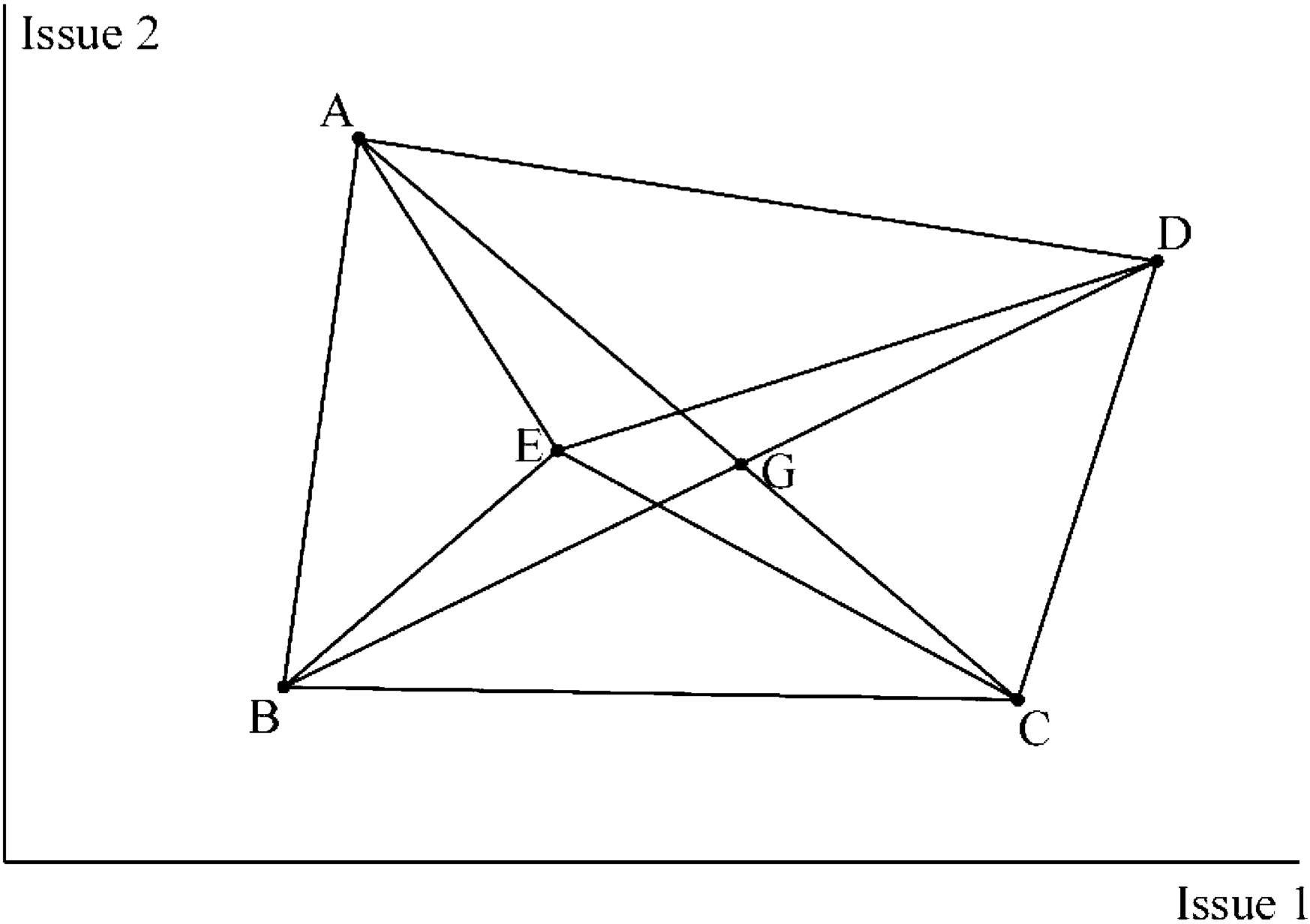
In this review, I will focus on the interaction between the two chambers which have different powers: one exclusively over the government; both over legislation. Let us assume that the electorate has selected the two chambers independently; Ganghof provides many different alternatives for this election, whereby one chamber is composed of parties above a certain threshold, while the other represents all parties. I will present two scenarios regarding policymaking, by looking at the configuration of political parties in the chambers (see figures one to three).
Five parties (A, B, C, D, and E) in a two-dimensional space Source: Each figure was made by Dr. Tsebelis

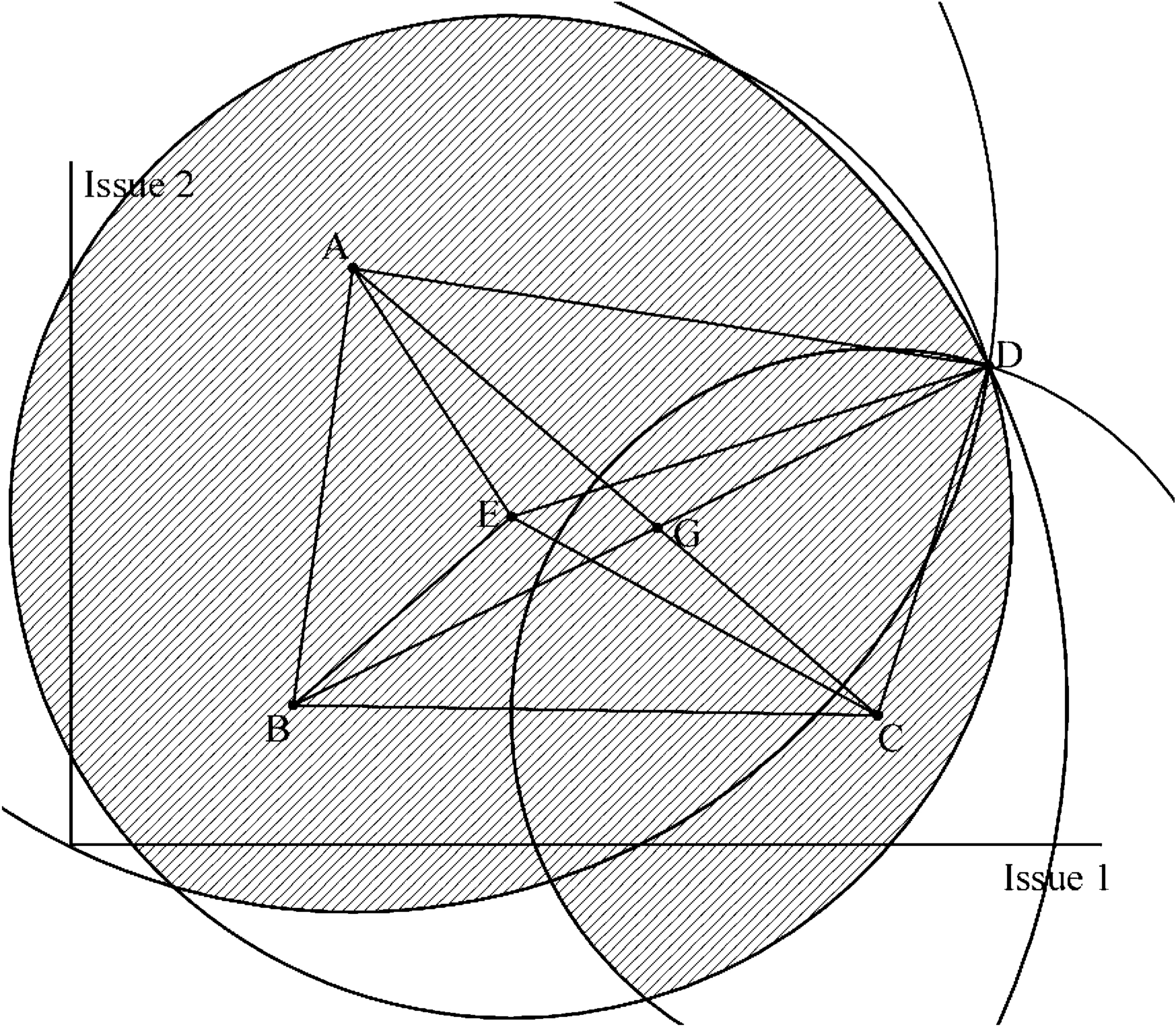
Winset of D (if D is the government) Source: Each figure was made by Dr. Tsebelis

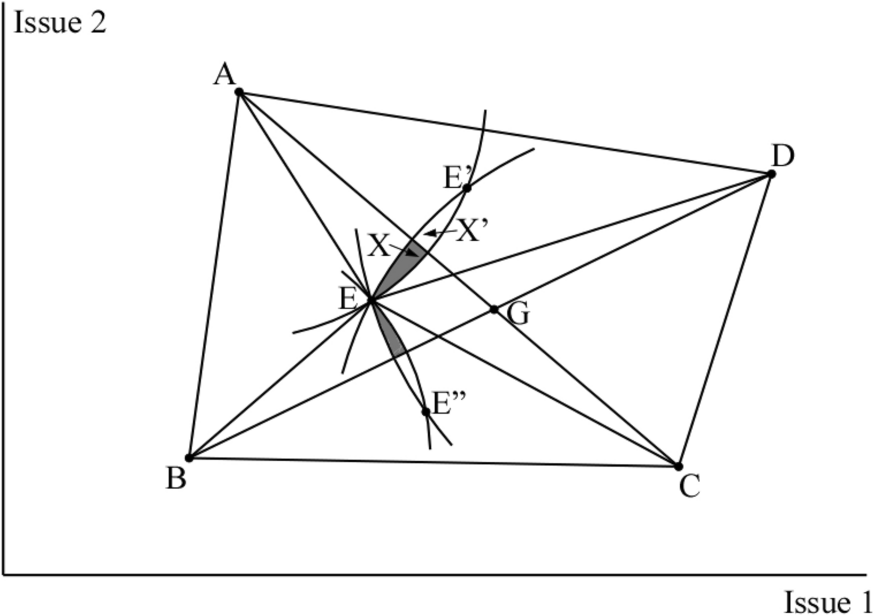
Winset of E (if E is the government) Source: Each figure was made by Dr. Tsebelis

Let us assume that there are five parties in an election for the second chamber and that for a policymaking majority, we need three of those parties present (figure one). Party E is centrally located in the policy space, while the other four parties occupy the periphery of the political system. In figure two, I consider the scenario where one of the parties in the periphery (D) has the majority in the first chamber. This way the reader will understand what happens if an extremist party becomes the government in a semi-parliamentary country.
D will want to have its policy programme implemented and therefore will introduce it to the second chamber. Figure two demonstrates what is the winset of D, that is, what is the set of points that can defeat D in the second chamber. In order to construct this set, we draw circles around each one of the parties in the second chamber (parties A, B, C and E) and find the intersection of any three of these circles (the majority in the second chamber). This is the shaded area in figure two and shows that the government will be faced by a resounding defeat. Note that even B (the party exactly opposite to the government) can have its own ideal point preferred by a majority of the parliament, over the position of the government. Actually, if the status quo is anywhere inside the shaded area, the government will not be able to modify, no matter how strong its agenda-setting powers.
This scenario is not very plausible. It is assumed that party D won a majority in the first chamber, but it is unlikely that an extreme party would win a majority by itself; chances are that it would need some more moderate parties to govern. But of course, this is a function of the electoral system, and it did happen in Hungary in 2010 and in Italy in 2022. That said, I suspect that a mechanism regulating a parliament dissolution and the election of a new government would be mobilised, meaning the scenario outlined above would be invalidated.
A second scenario (see figure three) assumes that the centrist party E becomes the government and presents its own ideal point into the parliament. This is the case that Ganghof investigates. If the government has no agenda-setting power, then its proposal can be replaced by any one of the points included in the lenses EE’ and EE” in figure three. If the government has absolute (take it or leave it) agenda-setting power, then it will be able to impose its will on the parliament and have point E approved by the parliament unless the status quo is located inside one of the two lenses (EE’ and EE”), in which case it cannot be defeated. If the government’s agenda-setting powers are somewhere in between the two extremes as has been argued elsewhere (Tsebelis, 2002), the outcome will not be exactly in the government’s ideal point but somewhere close to it. In such a case, if the government’s proposal E was about to be defeated, and if one of its MPs were to make the last proposal when the bill is being discussed in parliament, then, a case may be made for proposal X’ to be put forward, with proposal X ultimately prevailing. This is exactly what Ganghof argues on page ninety of his book.
So, what is the effect of semi-parliamentarism on the policymaking process? Firstly, the prevailing government is likely to be moderate. The reason being is that voters tend to select moderate parties or coalitions to become the government, but even if they do not, as demonstrated in figure two, the politicians themselves tend to avoid extreme government. Secondly, the final outcome of the legislative process will depend on a variable not discussed in the book because it is not part of the constitutional design of a country: ie, the agenda-setting powers of the first chamber. Agenda-setting rules have been shown to influence coalition formation in parliamentary systems, for example, Tsebelis and Ha (2014) show that weaker agenda-setting rules force parties to seek positional advantages in government formation. Under semi-parliamentarism, it is likely that agenda-setting powers will affect the relative significance of the two chambers in the minds of the voters, and the way they make their party choices.
References
Tsebelis, G. (2002) Veto Players: How Political Institutions Work, Princeton: Princeton University Press and Russell Sage Foundation.
Tsebelis G. and Ha, E. (2014) ‘Coalition Theory: A Veto Players approach’, European Political Science Review, 6(3): 331–357.
The peril of semi-parliamentarism: upper house obstructionism in a divided parliament
Michael Thies, Department of Political Science, University of California Los Angeles (UCLA), 4289 Bunche Hall, Box 951,472, Los Angeles, CA90095-1472, USA. Email: Thies@polisci.ucla.edu.
Steffen Ganghof has produced the most interesting contribution to the comparative study of political institutions for many years. He coins the term semi-parliamentarism to describe a structure that features a bicameral parliament with different roles for the two democratically legitimate chambers. One chooses and may remove a government, while the other plays no confidence role, but wields a powerful legislative veto.Footnote 1
In a unicameral (or weakly bicameral) parliament, power is concentrated not just in the lower (only) parliamentary chamber, but even further in the cabinet to which it delegates. Formally, the cabinet is responsible to the parliament, but that confidence role can undermine its incentive to scrutinise policy, making it a rubber stamp. A second house with a veto but no confidence role is not similarly conflicted. It can serve as a meaningful check without worrying that careful scrutiny will be interpreted as disloyalty or dissent. This deviation from pure parliamentarism is important enough, Ganghof argues, to constitute a distinct regime type.
The rapid increase worldwide in the number of hybrid constitutional forms and mixed-member electoral systems speaks to the search by practitioners to find a middle ground between the pure regimes types of parliamentarism and presidentialism, even if only as a pragmatic compromise (Shugart and Wattenberg, 2001; but also see Bawn and Thies, 2003). But might hybrid systems prove more Frankenstein’s monster than Goldilocks? Might attempts to split the difference result in internal contradictions? One example might be a built-in ambiguity over the division of power between president and prime minister in a premier-presidential system. Another is the danger of perpetual cabinet instability under president-parliamentarism because the cabinet is responsible to both the president and the parliament (Shugart and Carey, 1992).
Comparative political scientists theorise about how those rules constrain or incentivise a hypothetically generic set of players. But of course, the real political game is played by real political actors. At best, a careful reading of the constitution can provide one with some broad parameters about what is possible or impossible, but a consideration of context (including of adjacent non-constitutional rules such as electoral laws) is necessary to get a sense of what is likely. We need to know the preferences of the players who would wield those powers before we can theorise about behavioural equilibria. And while the structure of veto points may not change much without a constitutional amendment, the preferences of the players who control those veto points can change with every election or party split/merger or even coalition-building episode.
For purposes of expositional clarity and normative evaluation, Ganghof focuses mainly on the potential benefits of semi-parliamentary government and less on the likelihood that those benefits will be realised. The optimistic vision of semi-parliamentarism balances “simple majoritarianism” with “complex majoritarianism” (pp. 66 – 107; chapters five and six) The former may be manifest in a lower house featuring a majority party with a mandate to form a government and use its manifesto as the basis for government policy. The latter may be realised in an upper house that represents a more nuanced array of societal interests through a multiparty system. This combination can produce outcomes that are superior to presidentialism (checks without executive personalism) and to pure parliamentarism (a clear electoral mandate for a government checked by a proportionally constituted upper house).
But a more pessimistic scenario may arise if that powerful upper chamber falls under the control of a party or coalition hostile to the government. What if that hostile veto player prioritises obstruction over compromise, actually spurning policy offers that it prefers to the status quo because its bigger goal is to frustrate the government until it resigns? My own 2014 study of the “Twisted Diets” in Japan between 2007 and 2012 suggests that this is precisely what transpired. After winning control of the upper house, the opposition Democratic Party of Japan (DPJ) resolved to shut down law-making (and even such things as central bank appointments) until the ruling Liberal Democratic Party (LDP) gave up and called a general election. The DPJ won that election, only to see the LDP regain the upper house and use its veto almost indiscriminately, browbeating two DPJ governments into collapse and a third into an early election. All in all, the period of divided semi-parliamentarism saw six governments collapse in less than six years. Even emergency legislation to respond to 2011 Tohoku earthquake, tsunami, and nuclear power plant meltdown was held hostage by the opposition-controlled upper house until the prime minister of the day promised to step down (Thies and Yanai 2014). The Japanese upper house does not have a formal confidence role. But clearly, the power of the upper house veto can be used to circumvent this constitutional limitation.
A good deal of the reconsideration of the Linzian critique of presidentialism (Linz 1990) considers legislative electoral rules and the syncing of electoral cycles across branches to make divided government less likely (Shugart and Carey, 1992). The Japanese experience suggests that semi-parliamentarism should come with a similar warning label – or, to borrow from Madison (1987), “auxiliary precautions”. Semi-parliamentarism should probably only be used in combination with upper house electoral rules that make any majority party very unlikely. Australia’s combination of ranked-choice voting in the lower house and the single-transferable vote in the upper house seems very wise, in that sense. Even so, Australia experienced a constitutional crisis in 1975 when norms of upper house forbearance fell victim to opportunistic obstructionism. A second precaution (present in Australia but not Japan) would be to allow for double dissolutions to resolve gridlock. In Japan, the lower house can be dissolved early, but the upper house cannot. So, the only pressure-release valve from gridlock is if the opposition wins a general election to attain bicameral control, rewarding obstructionism. If the opposition had to risk its upper-house control when brandishing its veto, it might show more restraint and allow the government a chance to govern.
References
Bawn, K. and Thies, M.F. (2003) ‘A comparative theory of electoral incentives: representing the unorganized under PR, plurality and mixed-member electoral systems’, Journal of Theoretical Politics 15(1), 5–32.
Linz, J.J. (1990) 'The Perils of Presidentialism', Journal of Democracy, 1(1), 51–69.
Madison, J. (1987) “Federalist 51” in A. Hamilton, J. Madison and J. Jay The Federalist Papers, London: Penguin, p. 318.
Shugart, M.S. and Carey, J.M. (1992) Presidents and Assemblies. Constitutional Design and Electoral Dynamics, New York: Cambridge University Press.
Shugart, M.S. and Wattenberg, M.P. (2001) Mixed-member electoral systems: The best of both worlds?, Oxford: Oxford University Press.
Thies, M.F. and Yanai, Y. (2014) 'Bicameralism vs. Parliamentarism: Lessons from Japan's Twisted Diet', Japanese Journal of Electoral Studies, 30(2), 60–74.
Presidents, parties, and personalism
José Antonio Cheibub, Department of Political Science, Texas A&M University, 4348 TAMU, College Station, TX 77,843–4348, USA. Email: cheibub@tamu.edu.
Steffen Ganghof has produced a truly thought-provoking book. He has raised again the discussion of which regime form should be preferable in a democracy. His answer is semi-parliamentarism, a regime that has two main desirable characteristics: it preserves the separation of powers inherent to presidentialism by splitting power between two functionally distinct and differently elected chambers; it avoids executive personalism inherent in presidentialism by creating a system in which the government, subject to assembly confidence, is supported by strong and programmatic parties.
Avoiding executive personalism is a crucial attraction of semi-parliamentarism. For Ganghof, executive personalism exists when executive power is vested in a single person, who occupies office for a fixed term by virtue of a popular election. Direct consequences of executive personalism include less programmatic and representative parties and the increased risk that the incumbent president will stage an authoritarian takeover. Indirect consequences include the costs of adopting or avoiding certain constitutional features necessary for containing “the dangers of executive personalism” (p. 5). This includes limits to executive re-election and prohibition of assembly dissolution.
For Ganghof, the alternative to executive personalism is a government controlled by political parties. In this view, government leaders are agents of their parties and parties, in turn, are agents of voters. The crucial institutional condition for this to happen is the confidence mechanism, whereby a coalition of parties can remove the current government from office even in the absence of an election. In semi-parliamentarism, the power to remove the government is exclusive to one of the chambers, although the concurrence of both is necessary for legislation to pass.
I am less concerned with executive personalism than Ganghof. While it may be true that presidentialism is associated with higher likelihood of incumbent takeovers, it is also true that other regime forms do not eliminate this risk, as the contemporary examples of India, Hungary and Poland illustrate. While it is true that limits on the number of terms presidents can serve prevent voters from keeping in office leaders they like, incumbency advantage can be curbed in other ways. And while parliamentary dissolution may allow the unknotting of deadlocks, it also confers significant advantages on incumbents who have the discretion to bring it about.
In my view, the prevalence of an idealised conception of what political parties are and can do has led to a naïve view of presidents. Presidents, just like prime minister do not exist in a political vacuum. They are very powerful individuals indeed, but they do face significant political constraints. Presidents have goals, and in order to achieve them they must take into consideration voters and political organisations, the bureaucracy, their ministers, their parties, other politicians, other constitutional powers and, of course, the constitution itself. Even when they issue the all-powerful decrees some constitutions allow them to issue, presidents must contend with the reaction of congress, the courts, interest groups and other civil society organisations that can and do mobilise against presidential actions. Thus, a more realistic view of presidents in democratic regimes would recognise that they are strong actors, even with some privileges that others do not have, but that they are not unconstrained. Once we understand this, executive personalism becomes less dangerous and the need to design a political system that protects against it becomes less urgent.
Regarding strong and programmatic political parties, consider that the qualifiers are rarely explicitly defined. My impression is that when people refer to strong and programmatic parties, they have in mind something similar to the type of parties some of us believe dominated Western European countries in the twentieth century. Yet, the conditions that led to the emergence of those parties cannot be reproduced. In fact, it is doubtful they exist now even in the countries where they are supposed to have prevailed in the past. Moreover, the fact that in systems like semi-parliamentarism, the confidence mechanism requires that parties sustain a government in a unified way inside parliament does not necessarily translate into strong parties in society, capable of meaningfully articulating and aggregating the public’s preferences, as the example of France illustrates. Highly disciplined partisan legislative majorities can co-exist with parties that have weak societal penetration. The unified behaviour of legislative parties thus is not always the reflection of socially strong and aggregative organisations, something that significantly complicates any notion of strong parties.
Additionally, the fact that prime ministers are removed from office by their parties does not, pace Samuels and Shugart (2010), immediately translate into parties that act as agents of voters. While presidentialised parties may be different from parties in systems with no presidents, it is not necessarily the case that these parties have no meaningful programmes or that they are weak. At the same time, parties are political organisations and, as such, have interests of their own. It is not clear whose preferences they actually represent: the preferences of those who voted for them, of the party’s street workers, of those who hold formal positions within the organisation, or those holding mandates acquired with the aid of the party. The interests of these groups do not always align with one another or with that of voters. Note that the point is not that parties represent factional interests. The point is that we do not know which kind of supporter they are representing.
Ganghof ends his book by saying that academics have not produced a “principled and cogent justification of presidentialism as a form of democracy” (p. 167). I believe this to be absolutely true. But even if they had, I do not believe it would have mattered very much. In my opinion, the answer to which form of government is more democratic is as indeterminate as the answer to whether proportional representation electoral systems are better than majoritarian ones. Not only will the answer depend on what we mean by better, but it is also likely to be incomplete since it is not always productive to evaluate these institutional alternatives in isolation. What I find most valuable about semi-parliamentarism, thus, is not that it is said to be superior to existing alternatives. To me, Ganghof’s analysis is interesting in that it brings to the discussion an additional way of organising democratic governments, thus adding to the repertoire of constitutional solutions available to those who have to make choices in specific contexts.
Semi-parliamentarism: promise and limits?
Rosalind Dixon, School of Global and Public Law, University of New South Wales (UNSW), High Street, Kensington NSW 2052, Sydney, Australia. Email: rosalind.dixon@unsw.edu.au.
Daniel Bogéa, Department of Political Science, University of São Paulo, Av Professor Luciano Gualberto, 315, 05,508–900, São Paulo, Brazil. Email: daniel.bogea@usp.br.
The debate between advocates of presidential and parliamentary systems of government is familiar to lawyers and political scientists alike (see, for example, Cheibub, 2007). But in an important new book, Beyond Presidentialism and Parliamentarism, Steffen Ganghof invites us to consider the varieties of parliamentarism.
Parliamentary systems, Ganghof suggests, are not unitary in design. They are distinct in the degree to which they incorporate unitary versus divided forms of majority rule, including through bicameral versus unicameral models of government, and a variety of minority veto powers within a given legislative chamber. For instance, some directly elected second chambers lack a no-confidence vote or veto over money bills. And in this sense, they are more semi rather than pure parliamentary in nature.
Attention to these fine-grained dimensions of parliamentary constitutional design is also extremely valuable: it helps us better understand what kind of parliamentary systems are most likely to succeed in creating stable and effective forms of government, and under what conditions. It echoes work by scholars such as José Antônio Cheibub in the context of presidential systems: Cheibub has famously noted the different variants of presidential constitutional government, including the rise of semi-presidential systems (Cheibub, 2007). But it extends it to the world of parliamentary government in new and fertile ways. And in doing so notes the many varieties and distinctive benefits of semi-parliamentary as well as semi-presidential systems, compared to presidential systems.
Ganghof is careful to note the challenges of any existing constitutional system adopting semi-parliamentarism as a preferred constitutional model. But in this short comment, we want to emphasise these difficulties, and the challenges they pose to any science of comparative constitutional design.
Brazil adopted a presidential system in the transition to democracy in 1988 after extended debate. Several Brazilian experts expressed scepticism about the virtues of a presidential model for many of the same reasons stressed by Ganghof (for example, Linz 1990; Mainwaring, 1990; Lamounier, 1994). And the presidential model was confirmed only after a public plebiscite in 1993. But for some period of time, it seemed to function quite well; it helped achieve the most prolonged period of democratic stability in the country’s constitutional history.
The recent experience, however, has been quite different. There has been a high degree of political instability associated with various corruption scandals, and the impeachment of President Rousseff, as well as rising party fragmentation and patronage (Taylor, 2020). Constitutional thinking adjusted to this reality, relocating its attention to incremental reforms to counterbalance some of the undesirable effects of coalitional presidentialism (Abranches, 1988, Taylor, 2019). And in recent years, the election of President Jair Bolsonaro has meant that presidentialism has become associated with a trend toward abusive constitutional change (Benvindo, 2022; Mendes et al., 2021; Landau, 2013; Dixon and Landau, 2021). This has also led to a renewed focus on the virtues of parliamentarism but under the guise of semi-presidentialism. Curiously, this alternative has not been posed as an alternative to check an overly powerful presidency but rather as a mechanism to supplant the weakness of an inefficient and flawed executive office.
This focus, however, has not led to any meaningful steps toward the adoption of anything close to semi-parliamentarism. Ganghof points out that semi-presidentialism has spread mainly because “it suits the self-interest of politicians involved in constitution-making” (p. 28), and it does not attain the advantages he envisions in semi-parliamentarianism as to the reduction of executive personalism. Even the incremental adjustment of semi-presidentialism has attained only marginal support. The proposal has been criticised by major Brazilian forces on the right and the left alike, as a tentative soft coup to retract power from the more popular opposing forces in recent presidential races.
More importantly to our point, scholars have depicted the proposal as an “idea out of place” (Faria, 2018), ascertaining the problematic borrowing of a new model without accounting for “pre-existing sociological and institutional contexts” (Albala and Borges, 2021). It is noteworthy that advocates of semi-presidentialism—which include the President of the House of Deputies and an influential Supreme Court justice—support their thesis on the alleged success of Portugal and France without even mentioning the much closer (and more problematic) Peruvian experience (Elgie, 2011: 153), not only as a neighbouring reality but also as a system that transitioned from a presidential model.
This environment is a testament to the gravitational force of the President as the central source of legitimacy, manager of the governing coalition and as the driver of policymaking (Raile et al., 2011; Pereira et al., 2017), even if under the critical moniker of hyper-presidentialism (Llanos and Nolte, 2016). Presidentialism is sedimented in the public eye as the only game in town and it has reinforced a path that has led to a lack of familiarity with alternative models. Even a new constitution-making process in Brazil, as defended by some (Ackerman, 2020, but also see Bustamante et al., 2020), would therefore be unlikely to lead to a radical change toward the semi-parliamentarian model.
In Beyond Presidentialism and Parliamentarism, Ganghof has offered a rich taxonomy and set of case-studies of diverse parliamentary models in operation. He has also offered cogent arguments in favour of the virtues of semi-parliamentary models, and the need for us as lawyers and political scientists, to pay more attention to this as distinctive model. Yet there are also clearly a range of obstacles to real-world constitution makers gaining the benefits of those insights.
References
Abranches, S. (1988) ‘Presidencialismo de Coalizão: O Dilema Institucional Brasileiro’, Dados Revista de Ciências Sociais, 31(1): 5–34.
Ackerman, B. (2020) ‘Brazil’s Constitutional Dilemma in Comparative Perspective: Do Chile and Spain Cast Light on the Bolsonaro Crisis?’, July 17, available at https://macmillan.yale.edu/news/brazils-constitutional-dilemma-comparative-perspective-do-chile-and-spain-cast-light-bolsonaro, accessed 9 January 2023.
Albala, A. and Borges, A. (2021) ‘A crise brasileira e os perigos do semipresidencialismo,’ October 11, available at https://www1.folha.uol.com.br/colunas/latinoamerica21/2021/10/a-crise-brasileira-e-os-perigos-do-semipresidencialismo.shtml, accessed 9 January 2023.
Background Paper 15 (1997) ‘Western Australian Elections 1996’, Parliament of Australia, 19 June, available at https://www.aph.gov.au/About_Parliament/Parliamentary_Departments/Parliamentary_Library/Publications_Archive/Background_Papers/bp9697/97bp15, accessed 9 January 2023.
Benvindo, J. (2022) ‘Informal Co-Optation Semi-Presidentialism : Bolsonaro´s Most Successful Autocratising Strategy’, Blog of the International Journal of Constitutional Law, May 12, available at: http://www.iconnectblog.com/2022/05/informal-co-optation-semi-presidentialism-bolsonaros-most-successful-autocratizing-strategy, accessed 9 January 2023.
Bustamante, T; Meyer, E; Oliveira, M; Pereira, J; Benvindo, J. And Paixão, C. (2020) ‘Why Replacing the Brazilian Constitution Is Not a Good Idea: A Response to Professor Bruce Ackerman’, Blog of the International Journal of Constitutional Law, July 28, available at http://www.iconnectblog.com/2020/07/why-replacing-the-brazilian-constitution-is-not-a-good-idea-a-response-to-professor-bruce-ackerman/#_edn2, accessed 9 January 2023.
Cheibub, J.A. (2007) Presidentialism, Parliamentarism, and Democracy, Cambridge: Cambridge University Press.
Faria, J. (2018) ‘Semipresidencialismo, uma ideia fora do lugar’ April 15, available at https://www.jota.info/opiniao-e-analise/artigos/semipresidencialismo-uma-ideia-fora-do-lugar-15042018, accessed 9 January 2023.
Dixon, R. (forthcoming, 2023) Responsive Judicial Review: Democracy and Dysfunction in the Modern Age, Oxford: Oxford University Press.
Drum, M. (2021) ‘Labor’s thumping win in Western Australia carries risks for both sides’, The Conversation, 14 March, available at https://theconversation.com/labors-thumping-win-in-western-australia-carries-risks-for-both-sides-156301, accessed 9 January 2023.
Elgie, R. (2011) Semi-Presidentialism: Sub-Types and Democratic Performance, Oxford: Oxford University Press.
Figueiredo, A. and Limongi, F. (2000) ‘Presidential Power, Legislative Organisation and Party Behaviour in the Legislature’, Comparative Politics, 32: 151–170.
Lamounier, B. (1994) ‘Brazil: Toward Parliamentarism?’, in J.J. Linz and A.Valenzuela (eds.) The failure of presidential democracy, Baltimore: The Johns Hopkins University Press, pp. 253–293.
Levitsky, S. and Ziblatt, D. (2019) How Democracies Die, New York: Penguin Random House.
Linz, J. (1990) ‘The perils of presidentialism’, Journal of Democracy, 1(1), pp. 51–69.
Mainwaring, S. (1990) ‘Presidentialism in Latin America’, Latin American Research Review, 25(1), pp. 157–179.
Mendes, C.H; Brito, A; Amaral, M and Barreto, M. (2021) ‘How can we analyse authoritarianism in Brazil? Methodological foundations of the Emergency Agenda, a tool for mapping the authoritarian agenda since 2019’, LAUT Emergency Agenda, available at: https://agendadeemergencia.laut.org.br/wp-content/uploads/2022/05/LAUT-agenda_ingles-v4.pdf (accessed 9 January 2023).
Pereira, C; Batista, M; Praça, S; and Lopez, F. (2017) ‘Watchdogs in Our Midst: How Presidents Monitor Coalitions in Brazil’s Multiparty Presidential Regime,’ Latin American Politics and Society, 59(3), 27–47.
Pérez-Liñán, A; Schmidt, N. and Vairo, D. (2019) ‘Presidential hegemony and democratic backsliding in Latin America: 1925–2016’, Democratisation, 26(4), 606–625.
Posner, E. and Sunstein, C.R. (2007) ‘On Learning from Others’, Stanford Law Review, 59: 1309–1314.
Power, T. (2010) ‘Optimism, Pessimism, and Coalitional Presidentialism: Debating the Institutional Design of Brazilian Democracy’, Bulletin of Latin American Research, 29(1): 18–33.
Steinmo, S, Thelen, K. and Longstreth, F. (2008) Structuring Politics: Historical Institutionalism in Comparative Analysis: Cambridge: Cambridge University Press.
Taylor, M. (2019) ‘The Troubling Strength of Brazilian Institutions in the Face of Scandal’, Taiwan Journal of Democracy, 15(1): 91–111.
Taylor, M. (2020) ‘Coalitions, Corruption, and Crisis: The End of Brazil’s Third Republic?’, Latin American Research Review, 55(3): 595–604.
Thelen, K. (1999) ‘Historical Institutionalism in Comparative Politics’, Annual Review of Political Science, 2: 369–404.
Response to Tsebelis, Thies, Cheibub, Dixon and Bogéa
Steffen Ganghof, Political Science, House 1, Room 1.69, University of Potsdam, August-Bebel-Straße 89, 14,482 Potsdam, Germany. Email: ganghof@uni-potsdam.de.
I am grateful for the careful reviews of Beyond Presidentialism and Parliamentarism (BPP). It is a privilege to be constructively challenged by leading scholars of comparative democratic institutions. My necessarily brief response will not be able to do justice to their challenge.
Manin et al. (1999: 51) observed that “[s]ince the great explosion of institutional thinking, when the present democratic institutions were invented – and they were invented – there has been almost no institutional creativity.” BPP reflects critically on the inventions of the past and tries to offer some creative thinking about options for the future. It explores a neglected form of government — semi-parliamentarism — which divides legislative power between two democratically legitimate parts of parliament, only one of which selects the government and can remove it in a no-confidence vote. This form takes advantage of the separation of powers while avoiding to personalise the power of the chief executive. The book argues that, for this reason, semi-parliamentarism is superior to presidentialism and has important advantages over pure parliamentarism.
BPP also points to a causal inference problem in the presidentialism-parliamentarism debate. To disentangle the causal effects of powers separation from those of executive personalism, we need a conceptual understanding as well as empirical cases of what the former looks like without the latter. The study of semi-parliamentarism is valuable because it provides both.
Semi-parliamentary scenarios
George Tsebelis uses the standard spatial model to explore two semi-parliamentary scenarios. His second scenario is the one BPP focuses on: a centrist government with a majority in the confidence chamber but minority status in the multi-party legislative chamber. He confirms and gives valuable precision to my conclusion: such a government can often govern effectively because it can change its support parties depending on the location of the status quo.
Tsebelis highlights the salience of the government’s agenda power in this scenario, as does BPP (p. 90). He also suggests that this power will affect the significance of the two chambers in the minds of the voters. This is an important hypothesis indeed, but we have to remember that the standard model assumes purely policy-seeking actors. When other motives enter the picture, the power of the agenda setter remains important but may be reduced substantially (Ganghof and Bräuninger 2006).
His first, less probable scenario is an ideologically extreme party gaining a majority in the confidence chamber. Tsebelis argues that such a government faces resounding defeat in the legislative chamber so that parliamentary dissolution becomes likely.
Two points should be noted here. First, the availability of dissolution as a deadlock-resolution mechanism distinguishes many semi-parliamentary cases from their presidential counterparts. BPP argues that this difference is explained, in part, by the dangers of executive personalism in the latter.
Second, BPP suggests that the likelihood of extremist governments is lower under well-designed semi-parliamentarism than pure parliamentarism. Due to the constraints of the confidence mechanism, pure parliamentary systems typically need substantial disproportionality in order to achieve identifiable, responsible and stable governments (chapter five). Yet this disproportionality can allow relatively extreme parties to gain executive power on the basis of electoral pluralities. Hungary and Italy exemplify this. Under well-designed semi-parliamentarism, by contrast, ranked choice voting in the confidence chamber, combined with rather pure proportional representation in the legislative chamber, can reduce the likelihood of electorally manufactured extremism in government. Moreover, the branch-based separation of powers adds a layer of constitutional protection against incumbent-driven subversions of democracy that was absent in a case like Hungary.
Semi-parliamentary designs
Of course, not all semi-parliamentary systems are well-designed. Michael Thies helpfully highlights the case of Japan, where electoral rules sometimes gave the major opposition party or coalition a majority in a second chamber that could not be dissolved. In addition, this chamber could also veto budget-enabling bills, which Thies and Yanai (2014: 70) view as a de facto no-confidence vote. The second chamber’s budget veto was also crucial in Australia’s constitutional crisis of 1974–5.
BPP is entirely sympathetic towards the “precautionary” designs proposed by Thies and shows how some of the Australian cases moved towards them over time. Most notably, the state of Victoria used to be similar to Japan but, in 2003, introduced proportional representation in the second chamber, abolished this chamber’s budget veto and allowed for a double dissolution of both chambers.
Thies is also right to emphasise that institutions do not determine behaviour and the danger of obstruction and deadlock always remains. That is one reason why I do not claim semi-parliamentarism to be all-things-considered superior to pure parliamentarism. However, various forms of deadlock also exist in parliamentary systems, especially those with fragmented parliament; and BPP shows that governments’ legislative success rates in the semi-parliamentary cases seem to be similar to those under pure parliamentarism.
Thies’ most fundamental question is this: Does any attempt at institutional optimisation run the risk of backfiring. I think it does. Yet, as suggested above, this danger is present under any form of government, including the two putatively pure ones. And even if we focus on hybrids, BPP suggests that their risk-reward ratio is not equal. Consider, for instance, the Weimar Republic’s invention of president-parliamentarism, one of Thies’ examples. This hybrid tried to balance a highly proportional and permissive parliamentary system with a powerful president, as a counterweight, ie, a one-person chamber that avoids the problem of unstable majorities. Regardless of the specific context of Weimar Germany, I believe this balancing strategy got it fundamentally wrong. It simultaneously increased the problems of a fragmented parliament with confidence authority and those of a powerful president. By contrast, semi-parliamentarism aims at simultaneously avoiding these problems.
The perils of executive personalism
BPP’s critique of presidentialism is importantly different from that of Linz (1990) and others. It focuses exclusively on executive personalism, not the separation of powers. Indeed, it argues that this personalism attenuates the benefits of powers separation (for example, by requiring term limits that weaken electoral accountability) and accentuates its downsides (for example, by making deadlocks more likely to arise and harder to resolve).
José Cheibub agrees that presidentialism may be more likely to lead to incumbent takeovers and that semi-parliamentarism is an interesting alternative, but he thinks I exaggerate the downsides of executive personalism.
One pertinent observation is that other regimes do not eliminate the risk for incumbent takeovers either. While this is true, the issue is not risk elimination but relative risk reduction. Furthermore, the cases Cheibub mentions, Hungary and others, have parliamentary (and semi-presidential) systems. As I argue above, these systems have their own vulnerabilities, partly due to the lack of powers separation. They tell us nothing about whether semi-parliamentarism reduces the risk relative to presidentialism.
Another important argument is that presidential systems do not need term limits, since incumbency advantage can be curbed in other ways. While this may be true in theory, I am not aware of supporting evidence. Alternatives to term limits have been discussed for some time but effective ones remain conspicuously absent. Furthermore, term limits are viewed as protections against the accumulation of presidential power more generally (e.g. the packing of agencies and courts), not just incumbency advantage. If these limits are necessary to protect presidential democracies, as many have argued, the resulting weakening of electoral accountability is an important cost of executive personalism.
Thirdly, Cheibub usefully highlights that assembly dissolution may be problematic in that it confers significant advantages on incumbents who have the discretion to bring it about. As Cheibub and Rasch (2022) argue, however, many parliamentary systems reduced this discretion while still allowing for dissolutions in the case of deadlock. The same is true for semi-parliamentary systems. Moreover, even discretionary prime-ministerial dissolution power in cases like Denmark is balanced by parliament’s no-confidence authority. By contrast, the dissolution power given to presidents is necessarily personalised.
Cheibub is also entirely right to emphasise that presidents are not unconstrained, which makes executive personalism less dangerous. BPP agrees that the danger comes in degrees (p. 2). Yet, the precise degree of danger only matters for how we rank presidentialism and semi-parliamentarism if executive personalism also has specific benefits that could outweigh the risks. BPP suggests that it has none. Even the widespread idea that direct elections of the chief executive are “more democratic” – espoused by proponents and critics of presidentialism alike – has no validity (chapter 4). Cheibub gives no positive reason for executive personalism either. If something creates costs and risks without any benefits, we should avoid it.
A fifth important argument is that while presidentialised parties (Samuels and Shugart 2010) may indeed be different from those in systems with no presidents, this does not necessarily imply that they have no meaningful programme or are weak. BPP fully agrees but insists that the existing differences do matter. For example, there is systematic comparative evidence that presidential systems facilitate the election of outsiders or newcomers, which in turn increases the likelihood of executive–legislative conflict. This may help to explain, for example, why governments’ legislative success rates seem to be higher under semi-parliamentarism than under presidentialism, even though both systems are characterised by a branch-based separation of powers.
Finally, Cheibub agrees that a principled justification of presidentialism as a form of democracy has never been produced, but he thinks that does not matter. I believe it does matter, but my question is not which form of government is “more democratic” but rather whether and how we can rank the different forms, all things considered. If some generic form of representative democracy can be justified against the alternatives, it is because it promises, within a broad range of contexts, to better achieve widely accepted values such as political equality, social peace and competent decision-making (Landa and Pevnick 2023). The same is true for different types of representative democracy.
Ideas and reforms
None of this implies that semi-parliamentary reforms are likely. I fully agree with Rosalind Dixon and Daniel Bogéa that they are not, certainly not in the near future. In fact, BPP does not agitate for reform at all (see p. 167) but aims to contribute to basic research and theorising. It hopes to advance the presidentialism-parliamentarism debate – as well as the literatures on bicameralism and visions of democracy — and stimulate further critical scrutiny of semi-parliamentarism. How could we possibly expect any reformer to consider a system that is widely unknown or misunderstood, even among experts?
An important observation is offered by Dixon and Bogéa: that the general public in a presidential system often sees presidentialism as the only game in town and has a lack of familiarity with alternative models. BPP suggests that much of the academic literature has contributed to this situation: by equating the branch-based separation of powers with presidentialism; by not exploring the entire logical space of design options in a deductive manner; by treating parliamentarism and semi-presidentialism as the only realistic alternatives to presidentialism; by repeating — without any serious analysis — the notion that the direct election of chief executives and/or head of states is more democratic; and by neglecting and misclassifying semi-parliamentary systems.
Dixon and Bogéa rightly emphasise the important role that path dependence has played in how forms of democratic government have developed around the world. My point is that we should not replicate and perpetuate this path dependence in our own thinking about institutional design.
Of course, scholarly ideas and debates may not often matter for institutional reforms; but sometimes they do. Just think of the influence that Robert Redslob’s rather misleading theory of parliamentarism had on the invention of president-parliamentarism in the Weimar Republic (Lübbe-Wolff 2019). If ideas matter, we should try to get our theories of constitutional design as right as possible, irrespective of their short-term influence. Perhaps our kids or grandkids will need them.
References
Cheibub, J. and Rasch, B.E. (2022) ‘Constitutional parliamentarism in Europe, 1800–2019’, West European Politics, 45(3): 470-501.
Ganghof, S. and Bräuninger, T. (2006) ‘Government status and legislative behaviour: Partisan veto players in Australia, Denmark, Finland and Germany’, Party Politics, 12(4): 521-39.
Landa, D. and Pevnick, R. (2023) Representative Democracy without Apology, unpublished book manuscript (on file with the author).
Linz, J.J. (1990) ‘The Perils of Presidentialism’, Journal of Democracy, 1(1): 51-69.
Lübbe-Wolff, G. (2019) ‘El concepto de democracia de la Constitución de Weimar’, Historia Constitucional, 20: 253-74.
Manin, B., Przeworski, A. and Stokes, S.C. (1999) ‘Elections and Representation’, in A. Przeworski, S.C. Stokes and B. Manin (eds.) Democracy, Accountability, and Representation, Cambridge: Cambridge University Press, pp. 29-54.
Thies, M.F. and Yanai, Y. (2014) 'Bicameralism vs. Parliamentarism: Lessons from Japan's Twisted Diet', Japanese Journal of Electoral Studies, 30(2): 60-74.
Samuels, D.J. and Shugart, M.S. (2010) Presidents, Parties, and Prime Ministers: How the Separation of Powers Affects Party Organisation and Behaviour, Cambridge: Cambridge University Press.
Funding
Open Access funding enabled and organized by Projekt DEAL.

 Open access

