





With the increasing frequency of complex humanitarian challenges around the world, the impact of multiple concurrent crises on mental health is well-established. Reference Sharpe and Davison1,Reference Kola, Kohrt, Hanlon, Naslund, Sikander and Balaji2 Already strained health systems in low- and middle-income countries (LMICs) often lack the capacity to adequately respond to the growing demand for mental healthcare. 3 Many regions of Pakistan have been facing similar challenges, which are likely to worsen the existing burden of mental health needs. Reference Riaz, Nayyer, Lal, Nawaz and Zil-E-Ali4,Reference Shoib, Tayyeb, Armiya’u, Shah, Swed and Chandradasa5 The critical situation is further compounded by low investment in mental healthcare, pervasive stigma, cultural barriers, gaps in human resources and inequitable service delivery. Reference Thompson and Saleem6
The province of Khyber Pakhtunkhwa, located in the north-western region of Pakistan, has been particularly vulnerable, as it has borne the brunt of conflict and terrorism, natural disasters, internal displacements and influx of refugee populations over the past three decades. 7 For a population of over 40 million, there is a critical shortage and uneven distribution of mental health services in the province. There are approximately 50 psychiatrists (1 psychiatrist per 800 000 individuals), most of whom are concentrated in urban centres. 8 Only 30% of Khyber Pakhtunkhwa’s women and children have access to medical services, owing to cultural barriers and other socioeconomic restrictions. 9
In 2021, the Ministry of Planning, Development & Special Initiatives (MoPD&SI) developed a multilayered, digital mental health and psychosocial support (MHPSS) service model, which is evidence-based and scalable. 10 This model aims to build the capacity of a mental health workforce. As part of this initiative, primary healthcare workers (PHCWs), including the primary care physicians (PCPs) and clinical psychologists in Khyber Pakhtunkhwa, were offered training and supervision to manage common mental health conditions. For this purpose, the Mental Health Gap Action Programme Humanitarian Intervention Guide (mhGAP-HIG) 11 was contextualised to prepare a guide adapted for use in Pakistan and developed into a mobile application (app) – referred to as mhGAP-HIG-PK as training tools. 12
This paper presents the first phase of capacity building for PHCWs, focusing on their training using the contextualised training tools. After the training, PHCWs were required to seek supervision on at least 10 cases submitted through the app to receive their certificate. Six district-based WhatsApp groups were created that served as platforms for case-based discussions and peer-support throughout the 3-month supervision period. The detailed structure and outcomes of the supervision phase have been described elsewhere. Reference Humayun, Najmussaqib and Muneeb13
Method
This study was conducted as part of the MHPSS Project, approved by the MoPD&SI, Government of Pakistan, under ethics letter no. 6(262) HPC/2020. The authors assert that all procedures contributing to this work comply with the ethical standards of the relevant national and institutional committees on human experimentation and with the Helsinki Declaration of 1975, as revised in 2013. The trainers and PHCWs participated voluntarily in the study. Informed verbal consent was obtained from all participants.
We present this study in four phases: (a) training needs assessment; (b) training of trainers; (c) training of PHCWs; and (d) feedback and reflections. We applied a triangulation method Reference Noble and Heale14 to both data collection and analysis across these phases of the study, as outlined below.
Training needs assessment
During this phase, we aimed to conduct a training needs assessment to determine the current condition of mental health services in Khyber Pakhtunkhwa, with particular emphasis on understanding the challenges encountered by PHCWs. 15 For this, we applied a triangulation method to review the grey literature and conducted two focus group discussions (FGDs), each lasting 2 h. We recruited 17 participants (9 males; 8 females), including PCPs, clinical psychologists, International Medical Corps (IMC) staff and Khyber Pakhtunkhwa Health Directorate representatives, through convenience sampling. With the consent of participants, we audio-recorded the FGDs to collect data, which was then evaluated by two independent researchers following Braun & Clarke’s thematic analysis approach. Reference Braun and Clarke16
Training of trainers
Study design and sampling
Selecting trainers posed challenges as most qualified and experienced psychiatrists have full-time academic positions and private practice. We recruited eight trainers (five psychiatrists; three clinical psychologists) from or close to our target districts, using purposive sampling. The inclusion criteria included professional qualification, with at least 5 years of clinical and teaching experience (postgraduation), interested in professional development, inclined towards biopsychosocial practice, motivated to strengthen primary care services and having a track record of adherence to ethical standards. Trainers participated voluntarily and received certificates for their contribution.
Training programme
We conducted online training of trainers over 3 weeks. In the first week, the digital copy of the mhGAP-HIG-PK was shared with the trainers to familiarise themselves with the assessment and management protocols in the guide. In the second week, trainers were oriented to the training methodology and assigned a module to prepare. In the third week, we held training sessions where each trainer delivered a teaching session of 1 h for the group.
To ensure uniformity in training pedagogies and maintain mhGAP-HIG fidelity across trainers, two external reviewers were engaged to assess trainers’ competence. This was done using a single-masked (single-blind) approach, where trainers were unaware of the evaluation. The reviewers used a competency assessment form and evaluated trainers’ preparation, contextual understanding, training delivery, organisation, time management and engagement with participants. 15
Supervision of trainers
The trainers received hands-on supervision and guidance during the training workshops and the period of supervision through case-based discussions via the WhatsApp groups.
Training of PHCWs
The criteria for selecting the target districts included presence of refugee villages and logistic feasibility. Although a total of nine districts were selected, because of logistic constraints the participants were divided into six training workshops. These workshops were held between August and December 2023 in: Chitral; Haripur (for Haripur and Mansehra); Lower Dir, Mardan 1 (for Mardan and Swabi); Mardan 2 (for Mardan and Nowshera); and Peshawar (for Peshawar and Kohat).
Study design and sampling
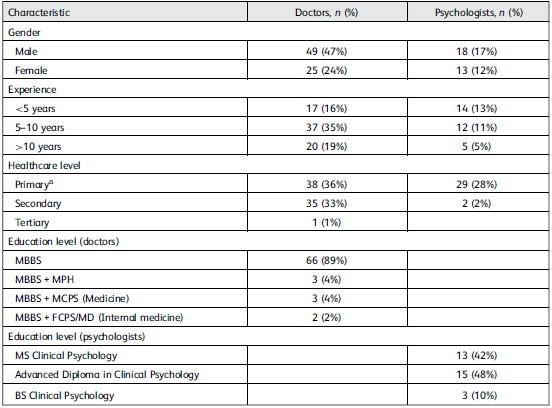
We employed a quasi-experimental pre–post design for this phase. The respective district health officer nominated PCPs with at least 1 year of primary care experience and an interest in mental health training, and IMC staff recruited clinical psychologists who had either an MS degree or an advanced diploma in clinical psychology and 1 year of clinical experience. We aimed to achieve full gender parity, but only one-third of our cohort were female. 17 The demographic details of all participants are presented in Table 1.
Demographics of the participating primary healthcare workers (n = 105)

Table 1 Long description
A table comparing demographic details of participating primary healthcare workers, including doctors and psychologists, across various characteristics. The table has 11 rows and 5 columns. Column headers are Characteristic, Doctors, n (%), and Psychologists, n (%). Row labels include Gender, Experience, Healthcare level, Education level (doctors), and Education level (psychologists). Row 1: Gender, Male, Doctors, 49 (47 percent), Psychologists, 18 (17 percent). Row 2: Gender, Female, Doctors, 25 (24 percent), Psychologists, 13 (12 percent). Row 3: Experience, <5 years, Doctors, 17 (16 percent), Psychologists, 14 (13 percent). Row 4: Experience, 5-10 years, Doctors, 37 (35 percent), Psychologists, 12 (11 percent). Row 5: Experience, >10 years, Doctors, 20 (19 percent), Psychologists, 5 (5 percent). Row 6: Healthcare level, Primary, Doctors, 38 (36 percent), Psychologists, 29 (28 percent). Row 7: Healthcare level, Secondary, Doctors, 35 (33 percent), Psychologists, 2 (2 percent). Row 8: Healthcare level, Tertiary, Doctors, 1 (1 percent), Psychologists, 0 (0 percent). Row 9: Education level (doctors), MBBS, Doctors, 66 (89 percent), Psychologists, N/A. Row 10: Education level (doctors), MBBS + MPH, Doctors, 3 (4 percent), Psychologists, N/A. Row 11: Education level (doctors), MBBS + MCPS (Medicine), Doctors, 3 (4 percent), Psychologists, N/A. Row 12: Education level (doctors), MBBS + FCPS/MD (Internal medicine), Doctors, 2 (2 percent), Psychologists, N/A. Row 13: Education level (psychologists), MS Clinical Psychology, Doctors, N/A, Psychologists, 13 (42 percent). Row 14: Education level (psychologists), Advanced Diploma in Clinical Psychology, Doctors, N/A, Psychologists, 15 (48 percent). Row 15: Education level (psychologists), BS Clinical Psychology, Doctors, N/A, Psychologists, 3 (10 percent).
a. This includes government and non-governmental public health facilities.
Training programme
A total of six 5-day training workshops on mhGAP-HIG were conducted in the six prioritised districts, followed by supervision for 3 months. Before training, PHCWs registered on the ministry’s web portal for MHPSS and the Learning Management System (LMS) and downloaded the mobile app.
Daily sessions were reduced to 5.5 h to accommodate participants’ lengthy commutes, with an added 30 min for home study. This structure resulted in a cumulative training duration of 30 h over 5 days. The training sessions were conducted using interactive learning methodologies, incorporating role-play, small group discussions and reflection activities to enhance engagement and comprehension.
Each day started with a 30 min ‘recap session’ of the previous day’s modules. The average duration of each module was 90 min. The programme covered the introductory General principles of care (GPC), followed by modules: Acute stress (ACU), Grief (GRI), Depression (DEP), Post-traumatic stress disorder (PTSD), Psychosis (PSY), Epilepsy (EPI), Intellectual disability (ID), Harmful use of alcohol and drugs (SUB), Suicide (SUI), and Other significant mental health complaints (OTH).
We measured the knowledge of the PHCWs using a 25-item questionnaire administered pre-, post- and 8 months after the training. 18 Higher knowledge scores reflect greater knowledge of the mental health conditions in the mhGAP-HIG.
Refresher training workshops
Owing to logistical constraints, we conducted only three refresher training workshops after 8 months; these were attended by 48 participants. The content of these refresher workshops was informed by the areas highlighted by participants who attended the initial training workshops.
Feedback and reflections
We utilised data source triangulation by collecting feedback (both quantitative and qualitative) online from PHCWs; and module-specific reflections from both PHCWs and trainers. These reflections were collected during group discussions at the start of each training day, at the end of each module, and from written reports by the respective trainers at the end of each day.
Data analysis
Multiple triangulation analyses were used based on data type and collection phase. All data were cleaned, coded and anonymised before conducting analysis using IBM SPSS Statistics 26 for Windows. Descriptive statistics were reported as percentages or means with their corresponding standard deviation. Ninety-nine participants’ pre- and post-training data, and 48 participants’ 8-month refresher training data were analysed. For analysis, data were organised by district. Knowledge scores were compared across pre-, post- and 8-month assessments using paired t-tests, with items grouped into clusters corresponding to the mhGAP-HIG modules: GPC (2 items), ACU (3), Grief (2), PTSD (1), DEP (3), PSY (3), ID (2), SUB (3), SUI (2), EPI (2) and OTH (2). Qualitative feedback and reflections on the modules were evaluated using thematic and content analysis. Reference Elo and Kyngäs19
Results
Training needs assessment
A desk review had revealed key systematic gaps in mental health service delivery in Khyber Pakhtunkhwa. These included insufficient human resources, inadequate training of PHCWs, no availability of training resources and the absence of any formal supervision or referral mechanism. 7,9,Reference Humayun, Muneeb N ul, Najmussaqib, Haq I and Asif20 Pre-service training in mental healthcare is not prioritised in the MBBS curriculum in Pakistan, with minimal implementation, limited clinical exposure, no dedicated examination and faculty shortage resulting in low student motivation. Reference Javed, Khan, Nasar and Rasheed21 Literature also reports a severe dearth of specialist trainers and supervisors, especially in remote areas, owing to inequitable service distribution, limited incentives for supervisors and logistical barriers. 22,Reference Humayun, Haq, Khan, Azad, Khan and Weissbecker23
The FGDs corroborated the gaps identified in the desk review. PHCWs face a lack of opportunities for professional development and formal supervision. The participation of PCPs in training is constrained by staff shortages, lack of backfill and frequent transfers. There are gaps in their knowledge, skills and confidence to manage people with mental health problems. The PCPs are reluctant to deliver psychosocial care, owing to inadequate training, low incentives and operational constraints. They are aware of stigma and cultural barriers experienced by patients, which result in alternative pathways to care and reliance on traditional and faith healers. They are concerned that difficult work environments, patient overload and limited consultation times often lead to practices that compromised patients’ rights and service quality. Although the Health Information System in Khyber Pakhtunkhwa includes three indicators for mental disorders (DEP, EPI, SUB) no data are ever reported or made publicly accessible. Despite being available, clinical psychologists remain underutilised in public healthcare settings. Health representatives expressed policy-level challenges, including securing financial support and evidence-informed decisions.
PHCWs’ training outcomes
Post-training outcomes
The analysis of pre- and post-training outcomes suggested encouraging levels of baseline knowledge among PHCWs. The percentage of correctly answered questions on the pre-training test was 73.86%, which increased to 85.94% on the post-training test, indicating a 12.08% increase in knowledge.
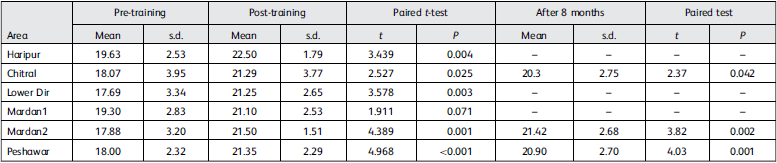
Table 2 demonstrates significant increase in knowledge scores post-training across districts. However, Mardan1 shows only a marginally significant increase, which implies a positive but less definitive impact of the training. Peshawar exhibited the most pronounced improvement (P < 0.001).
Knowledge comparisons by district pre- and post-training (n = 99) and after 8 months (n = 48)

Table 2 Long description
The table presents knowledge scores across different districts at three different times: pre-training, post-training, and after 8 months. It includes data for Haripur, Chitral, Lower Dir, Mardan1, Mardan2, and Peshawar. The table has six rows and five columns. The columns are labeled Pre-training, Post-training, Paired t-test, After 8 months, and Paired test. Each row corresponds to a different district and includes the mean and standard deviation (s.d.) for pre-training and post-training scores, as well as the t and P values for the paired t-test. The After 8 months column includes the mean and standard deviation for scores after 8 months, along with the t and P values for the paired test. Row 1: Haripur, Pre-training Mean 19.63, s.d. 2.53, Post-training Mean 22.50, s.d. 1.79, t 3.439, P 0.004. Row 2: Chitral, Pre-training Mean 18.07, s.d. 3.95, Post-training Mean 21.29, s.d. 3.77, t 2.527, P 0.025. Row 3: Lower Dir, Pre-training Mean 17.69, s.d. 3.34, Post-training Mean 21.25, s.d. 2.65, t 3.578, P 0.003. Row 4: Mardan1, Pre-training Mean 19.30, s.d. 2.83, Post-training Mean 21.10, s.d. 2.53, t 1.911, P 0.071. Row 5: Mardan2, Pre-training Mean 17.88, s.d. 3.20, Post-training Mean 21.50, s.d. 1.51, t 4.389, P 0.001, After 8 months Mean 21.42, s.d. 2.68, t 3.82, P 0.002. Row 6: Peshawar, Pre-training Mean 18.00, s.d. 2.32, Post-training Mean 21.35, s.d. 2.29, t 4.968, P <0.001, After 8 months Mean 20.90, s.d. 2.70, t 4.03, P 0.001.
The decrease in standard deviations across districts post-training indicates a reduction in variability in participants’ knowledge scores. This implies that disparities in knowledge have narrowed, leading to the attainment of a more uniform level of understanding or expertise among participants after the training, as has been previously reported. Reference Griffiths, Carron-Arthur, Parsons and Reid24
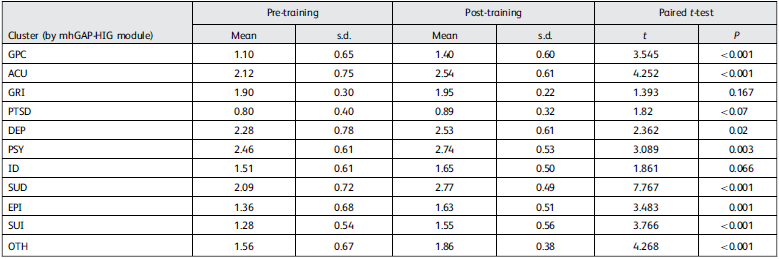
Table 3 demonstrates the improvement by clusters in participants’ knowledge comparisons. Overall, participants’ knowledge significantly improved, from 18.46 to 21.48 (P < 0.001). Furthermore, each cluster also showed significant improvement on all modules except PTSD, GRI and ID. The module with the most noticeable improvements in scores was SUB (22.56%). This is followed by GPC and OTH (15.15%), ACU (13.80%), SUI and EPI (13.13%), PTSD and PSY (9.09%). On the other hand, the ID and GRI modules observed insignificant improvements, with percentage increases of 7.07 and 2.53% respectively.
Knowledge comparisons by clusters pre- and post-training (n = 99)

Table 3 Long description
The table presents data on participants' knowledge across various clusters before and after training. It includes columns for pre-training mean and standard deviation, post-training mean and standard deviation, and paired t-test results with t and P values. The clusters are labeled as GPC, ACU, GRI, PTSD, DEP, PSY, ID, SUD, EPI, SUI, and OTH. Each row provides the mean and standard deviation for pre-training and post-training scores, along with the t and P values from the paired t-test. Notable trends include significant improvements in most clusters except PTSD, GRI, and ID. The SUD cluster shows the most noticeable improvement, followed by GPC, OTH, ACU, SUI, EPI, PTSD, and PSY. The ID and GRI modules show insignificant improvements.
mhGAP-HIG, Mental Health Gap Action Programme Humanitarian Intervention Guide; GPC, General principles of care; ACU, Acute stress; GRI, Grief; Dep, Depression; PTSD, Post-traumatic stress disorder; PSY, Psychosis; EPI, Epilepsy; ID, Intellectual disability; SUB, Harmful use of alcohol and drugs; SUI, Suicide (SUI); OTH, Other significant mental health complaints.
Refresher training outcomes
The evaluation of refresher training workshops demonstrated significant improvement in mean knowledge scores, reaching 20.3 (s.d. = 2.75), 20.90 (s.d. = 2.70) and 21.42 (s.d. = 2.68) respectively (pre-training versus 8 months after the end of training) (Table 2). The refresher training focused on strengthening competencies in assessing depression (DEP module), suicide risk (SUI module) and children with intellectual disorders (including presentations like bedwetting and dissociation) (ID module). Psychosocial interventions were practised in role-play for conditions such as those in the ACU, GRI, DEP, ID and EPI modules and targeted discussions on pharmacological management for DEP, PSY and EPI.
Feedback and reflections
Quantitative feedback
The PHCWs’ feedback provides insights into the programme’s overall success and areas for enhancement (see Supplementary file). Notably, 75% rated their experience as excellent and 23% as good, indicating that the programme was highly effective and well-received.
Qualitative feedback
Thematic analysis of qualitative feedback indicates high participant satisfaction with both the training programme’s content and the interactive pedagogy. The training appeared effective in strengthening knowledge and clinical skills, particularly in identifying and managing mental health conditions.
Overall, the trainees expressed satisfaction with the training, deeming it both beneficial and informative. They particularly valued the interactive methodologies used, such as role-play and group discussions. One participant highlighted the effectiveness of these methods, stating ‘The interactive method of training made the learning multifold’. In addition to the instructional approach, participants were appreciative of the provision of hard copies of the guide, which enhanced their learning experience.
Concerning the impact on knowledge and clinical skills, participants reported significant enhancements in their understanding and abilities related to the identification, diagnosis and treatment of mental disorders, incorporating holistic, psychosocial and pharmacological approaches. The training also improved their capabilities in making management plans, with one participant noting ‘It became clearer whom to refer and whom to treat, who needs no treatment, who needs counseling, and who needs pharmacological intervention’. The trainees recognised and appreciated the expertise of senior trainers. They advocated for the broader dissemination of mhGAP training, refresher courses and the integration of the mhGAP-HIG-PK into the pre-service training of PHCWs.
Reflections on individual modules
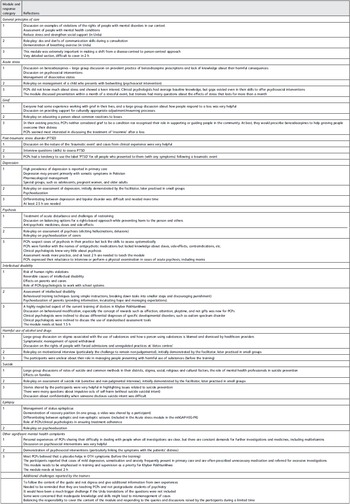
The results of the analysis of trainers’ reflections and trainees’ feedback on individual modules are presented in Table 4 under three categories: category 1, the most beneficial aspect of training for enhancing knowledge, as identified by trainees; category 2, the most valuable training component for strengthening skills reported by trainees; category 3, trainers’ reflections.
Participants’ reflections on individual mhGAP-HIG modules, by category of response a

Table 4 Long description
The table presents participants' reflections on individual mental health training modules, categorized into three response types: enhancing knowledge, strengthening skills, and trainers' reflections. It has 10 rows and 4 columns. Column headers are Module and response, Reflections, and Grief. Row labels include Module names and specific reflections. Each row details the reflections under the respective categories. The table captures the feedback and insights from participants on various modules, highlighting the most beneficial aspects and valuable components of the training.
mhGAP-HIG, Mental Health Gap Action Programme Humanitarian Intervention Guide; PCP, primary care physician; OTH, Other significant mental health complaints.
a. Category 1, the most beneficial aspect of training for enhancing knowledge, as identified by trainees; category 2, the most valuable training component for strengthening skills reported by trainees; category 3, trainers’ reflections.
Discussion
This is the first coordinated effort to build the capacity of PHCWs in Pakistan focusing on training and supervision using the contextualised mhGAP-HIG-PK. The model of collaboration between the MoPD&SI (technical support), IMC (logistic and financial support) and provincial health department (nomination of PCPs) is likely to help scale up the initiative effectively across the province. Previous initiatives to build the capacity of PCPs in Pakistan lacked long-term planning and any lasting impact, Reference Humayun, Haq, Khan, Azad, Khan and Weissbecker23,25 whereas we provided post-training case-based supervision, which has been established as a recommended learning strategy for sustained impact for implementing mhGAP guidelines. Reference Al-Uzri, Al-Taiar, Abdulghani, Abbas and Suleman26,Reference Keynejad, Spagnolo and Thornicroft27 Our findings from supervision also support the need to monitor the performance of PHCWs, as nearly half of them sought supervision for both assessment and management plans. Reference Humayun, Najmussaqib and Muneeb13
The key highlights of our study include a collaborative approach, a diverse group of trainees, including PCPs and clinical psychologists, and a highly interactive training experience, with follow-up refresher training. Our use of a triangulation methodological approach improved the credibility and validity of the research findings. Reference Noble and Heale14
Selection of PHCWs
Despite the support of key stakeholders and well-defined criteria, we found the recruitment of PCPs challenging. As in other studies, Reference Tarannum, Elshazly, Harlass and Ventevogel28 our objective was also to select those who are motivated to learn, have an interest in mental healthcare, and are willing to manage cases and seek supervision. Faregh et al Reference Faregh, Lencucha, Ventevogel, Dubale and Kirmayer29 have pointed out that relegating the task of trainee selection to the beneficiary organisation does not yield best results in terms of training outcomes. Like Faregh et al, we also found that it is more convenient for district health offices to nominate PCPs who are readily available rather than identifying those who meet eligibility criteria. This challenge is further compounded by Pakistan’s under-resourced and challenging healthcare system, which has led many doctors to emigrate for better job opportunities. Nadir et al Reference Nadir, Sardar and Ahmad30 highlighted that one-third of medical students aspire to move overseas after graduation, leading to a critical loss of qualified medical practitioners, attributed to suboptimal remuneration, hectic work schedules, job insecurity, non-recognition of services and ineffective management. Reference Meo and Sultan31 There is an imminent need to invest in younger, ‘tech-savvy’ doctors who choose to work in their districts, are interested in expanding their skills and are more likely to have overcome stigma associated with mental disorders to restore the socio-medical landscape of Pakistan. Reference Nadir, Sardar and Ahmad30,Reference Meo and Sultan31
This marked the first initiative in Pakistan in which PCPs and clinical psychologists participated as both trainers and trainees, which is consistent with mhGAP implementation in some other regions. 3,Reference Kokota, Lund, Ahrens, Breuer and Gilfillan32 Given the growing number of training programmes for clinical psychologists in Pakistan, they represent an underutilised mental health resource whose existing training gaps can be overcome through mhGAP training. 3 The mixed group of participants helped shift discussions from a pure biomedical to a biopsychosocial approach and aligned with other task-sharing models. Reference Spagnolo and Lal33,Reference Raviola, Naslund, Smith and Patel34
Training methodology
Consistent with earlier studies, the availability of training resources in the form of our printed guide and mobile app proved to be valuable during training. Reference Tarannum, Elshazly, Harlass and Ventevogel28,Reference Momotaz, Ahmed, Jalal Uddin, Karim, Khan and Al-Amin35 The hard copies minimised reliance on technology and the internet, helped in better knowledge retention with personalised annotations, and enabled continuous learning outside the formal training sessions. Reference Mehnaz, Baig and Aly36 The Urdu translation of interview questions and psychosocial techniques in the guide were particularly helpful for trainees during role-play to build their confidence and improve skills to elicit symptoms and offer psychosocial interventions. Our efforts were aligned with existing literature, recommending the contextual adaptation of mhGAP training resources into local languages to enhance comprehension and clinical applicability. 3,Reference Faregh, Lencucha, Ventevogel, Dubale and Kirmayer29 We also agree that role-play with cultural examples of clinical presentations can help non-specialists to elicit symptoms better. Reference Tarannum, Elshazly, Harlass and Ventevogel28,Reference Momotaz, Ahmed, Jalal Uddin, Karim, Khan and Al-Amin35 The availability of the printed guide helped the trainers to avoid didactic teaching and the trainees to avoid taking notes. The workshops became more interactive and hands-on as the trainees engaged proactively in clinical discussions and skills demonstrations. Like Momotaz et al, Reference Momotaz, Ahmed, Jalal Uddin, Karim, Khan and Al-Amin35 we also observed that the PHCWs were effectively engaged with the trainers’ competence using a bilingual approach and facilitation skills. Having stated that, we found it difficult to cover the complete guide in 5 days, as this did not allow adequate time for desirable practice of clinical skills in role-play. Reference Engelhard, Haack and Alik37 To compensate for this, we specifically designed refresher training to focus on skill-building through role-play in areas flagged by the PHCWs.
Evaluation of training
In the assessment of knowledge, pre-training test scores showed notable knowledge gaps on the modules on general principles of care, PTSD, suicide, harmful use of alcohol and drugs, and epilepsy. Significant knowledge gaps regarding suicide and the harmful use of alcohol and drugs were also found in other studies, and particularly in humanitarian settings. Reference Momotaz, Ahmed, Jalal Uddin, Karim, Khan and Al-Amin35,Reference Ahrens, Kokota, Mafuta, Konyani, Chasweka and Mwale38,Reference Greene, Haddad, Busse, Ezard, Ventevogel and Demis39 According to the United Nations Office on Drugs and Crime report, 40 10.7% of the population of Khyber Pakhtunkhwa ‘abused harder narcotics’, which was nearly double the national average at that time. Since then, there has been an alarming rise in the use of illicit substances, but health professionals are not equipped to respond with basic psychosocial interventions. 41 This gap is steadily being filled by commercial and sometimes unscientific detoxification services. Hence, we also made additional efforts to educate the PHCWs to protect the rights of people with substance use disorder by identifying it as a disorder and to prevent the common malpractice of forced hospital admission and unsafe practices. Reference Lassi42
The pre-training test also revealed consistent misconceptions about the statements that ‘People with mental disorders cannot make decisions about their treatment’ and ‘Asking about suicide increases the likelihood of suicide’. These misconceptions highlighted deep-rooted stigma and misinformation related to mental illness and people with mental disorders in our cultural context. Mental illness is often misattributed to weak faith, demonic possession or moral transgression, and individuals experiencing it are perceived as dangerous, ‘crazy’ and incapable of friendship. Such perceptions contribute to their social exclusion, denial of human rights and reluctance to seek professional help. Reference Mansoor and Warsi43,Reference Javed, Ahsan, Khattak and Afzal44 Alarmingly, this stigma is not limited to the general community; it also seeps among medical students and healthcare professionals, highlighting the need for stronger emphasis on psychiatric education in pre-service training. Reference Husain, Zehra, Umer, Kiran, Husain and Soomro45 Despite being an alarming public health issue, suicide remains misunderstood owing to cultural and religious prohibitions. It is framed as a source of familial shame or an unforgivable sin, which prevents people from seeking help. A recent review on the need to address stigma for suicide prevention in Pakistan calls for the incorporation of mental health education into school curricula and community-based initiatives and the establishment of accessible mental health services. Reference Mashhood, Saeed and Sami46
The reflective process also revealed commonly held misconceptions and systemic gaps in medical practice. For instance, we know that limited recognition of somatic manifestations of mental disorders in primary care, frequent misdiagnoses and repetitive laboratory investigations act as a barrier to timely initiation of appropriate treatment. Reference Wazir, Kakakhel, Gul, Awan, Khattak and Yousaf47 Similarly, the prevailing disease-centred approach and the malpractice of prescribing benzodiazepines without being aware of their harmful consequences or addiction potential had to be emphasised during the training sessions. Reference Naqvi, Sabzwari, Hussain, Islam and Zaman48
The PCPs acknowledged a gap in their understanding of commonly neglected issues associated with children, such as bedwetting. Role-play was found to be effective in practising the technique of psychoeducation in this scenario. The skill to support the parents of children with intellectual disability was another crucial gap. In Pakistan, high rates of depression and anxiety were found among such parents. Reference Azeem, Dogar, Shah, Cheema, Asmat and Akbar49 The cumulative social, emotional and financial burden placed on these families highlights the necessity of equipping PHCWs with the skills to educate and support the families.
Evaluation of post-training knowledge
The results of the post-training evaluations were encouraging, with a significant increase in knowledge shown at the end of training and after 8 months – a trend reported in other countries. Reference Keynejad, Spagnolo and Thornicroft27,Reference Tarannum, Elshazly, Harlass and Ventevogel28 The refresher training confirmed retention of knowledge among PHCWs over this period. We were able to confirm long-term knowledge retention in only half of our original cohort because of logistical and budgetary constraints. However, based on the similarities in our demographic analysis and post-training scores of all districts, we believe that knowledge retention is likely to be consistent in the other districts as well.
Limitations of the study
We acknowledge specific limitations of our work. First, the grouping of districts was based primarily on logistical considerations rather than contextual variables. In future studies, district grouping could be refined using more relevant criteria – such as urban–rural classification, or service accessibility – to relate to the contextual relevance. Second, our pre- and post-training evaluations of PHCWs’ existing capacity might have been more robust by using additional measures to assess skills, attitudes and confidence. Third, for sustainable outcomes we consider it vital to engage the trainers formally, preferably through financial or career incentives. Fourth, we need to make greater efforts to work with healthcare authorities to carefully recruit PHCWs based on their clinical experience and interest. Last, we believe that either the training time needs to be increased or fewer modules need to be prioritised, so that critical skills are adequately demonstrated and practised during the training.
Future directions
Mental health must be identified as a public health priority at the provincial level. A sustainable coordinating mechanism is needed between the health department, humanitarian agencies and development partners. Currently, many projects are undertaken in silos, with blurred and short-term outcomes. A clear direction needs to be set, with focused objectives to optimise resource utilisation.
An average district in Khyber Pakhtunkhwa has at least 100 doctors working at the primary care level, who are a huge potential resource for providing MHPSS services. Reference Raviola, Naslund, Smith and Patel34 Our work demonstrates a way forward to scale up capacity-building initiatives and develop a multidisciplinary PHCW workforce across the province. For this reason, regular posts for clinical psychologists should be created in primary healthcare facilities. Additionally, we recommend incorporating the mhGAP-HIG-PK into pre-service medical training, as the successful implementation of the mhGAP guidelines in undergraduate and postgraduate programmes for medical and allied specialties is well-documented. Reference Iversen, Ogallo, Belfer, Fung, Hoven and Carswell50
Supplementary material
Supplementary material is available online at https://doi.org/10.1192/bji.2025.10059.
Data availability
The data used in this study is available on request from the corresponding author.
Acknowledgements
We thank Dr Irshad Roghani, former Director Public Health, Department of Health, Khyber Pakhtunkhwa, and the International Medical Corps, Pakistan, for their valuable support and collaboration. We are grateful to our dedicated team of trainers who contributed to the pilot testing without any incentives: Ibrahim Khan, Dr Izaz Jamal, Maria Ayaz, Dr M. Muslim Khan, Shahzad Anwar and Dr Syed Tahir Hussain Shah. We also thank Noor ul Ain Muneeb for her contribution to the revised manuscript.
Author contributions
A.H. led this initiative as a master trainer and supervisor, and was also responsible for project administration and conceptualisation of the study. A.N. curated the data and conducted the analysis. A.H. and A.N. jointly devised the method and composed the original draft. The manuscript was edited and reviewed by A.H.
Funding
This research received no specific grant from any funding agency, commercial or not-for-profit sectors.
Declaration of interest
None.


 Open access


eLetters
No eLetters have been published for this article.