


INTRODUCTION
Hepatitis C virus (HCV) infection is associated with an increased risk of hospitalization and/or death, particularly from severe liver disease [Reference McDonald1], but also from other conditions [Reference Mason2]. Even if transmission of infection ceased today, the time-course of disease (5–15% of individuals develop cirrhosis within 20 years [Reference Benvegnù3, Reference Freeman4]) ensures an increasing future burden of HCV-related morbidity [Reference Zou, Tepper and El Saadany5]. Therefore, if sufficient numbers of chronically infected persons are not identified and given antiviral therapy, then morbidity rates in the HCV-infected population are destined to increase with time spent living with untreated infection. In Scotland, the number of chronically infected current/former injecting drug users (IDUs) progressing to moderate to severe stages of liver disease is estimated to double between 2005 and 2020 (10 930 increasing to 21 240), under conservative treatment scenarios [Reference Hutchinson, Bird and Goldberg6].
The availability of high-quality national HCV diagnosis and in-patient hospital discharge databases provided the opportunity to use record-linkage methods to investigate the current burden of HCV-related morbidity in Scotland. Our main objective was to describe rates of in-patient hospital utilization in the HCV-diagnosed population, and to estimate excess all-cause, liver-related and non-liver-related morbidity through indirect standardization to episode rates in the general Scottish population.
METHODS
Design
The study design was a record-linkage exercise for a retrospective cohort of all HCV-diagnosed persons in Scotland, involving national HCV diagnosis, HIV diagnosis and HIV test databases, and the national in-patient hospital discharge database and registry of deaths, with the subsequent analysis of excess morbidity in this population.
Study population and data sources
The study population consisted of all persons diagnosed with HCV infection in Scotland between 1991 and 2006. Health Protection Scotland (HPS) maintains a database of all persons who have been diagnosed HCV positive in Scotland since testing commenced in 1991 [Reference Shaw7]; laboratory detection of HCV antibody positivity is a requirement for inclusion. This database contains the following non-named information: surname Soundex (a consonant-only phonetic encoding), forename initial, date of birth, sex, and postcode district of residence (at time of most recent HCV test; i.e. updated from postcode at time of diagnosis if the individual is retested), as well as data concerning risk activities for acquiring infection. Inclusion in the HCV diagnosis database was based on the following diagnostic criteria: either (i) HCV antibody positive; (ii) HCV antibody and HCV PCR positive, or (iii) if aged <5 years, two consecutive positive PCR tests or HCV antibody positive at age ⩾12 months. This database contained records for 22 069 persons diagnosed by 31 December 2006 [8]. After excluding records with insufficient identifiers for record-linkage (n=1320), the study population consisted of 20 749 HCV-diagnosed persons.
The Scottish Morbidity Records (SMR01) is an episode-based patient record held by Information Services Division (ISD; a division of NHS National Services Scotland) of all general acute in-patient and day case hospital discharges. Discharge diagnoses use International Classification of Diseases (ICD) Ninth Revision criteria for discharges between 1989 and 1995, and ICD Tenth Revision criteria for discharges between 1996 and 2006. ISD routinely combines the SMR01 data with death registrations held by the General Register Office for Scotland (GROS) to form a linked dataset. Data were available to 31 December 2006.
Mid-year Scottish population estimates, tabulated by sex and 5-year age group, from 1991 to 2006 were also obtained from GROS. Mid-year population estimates according to deprivation quintile were not available; however, the numbers of people in each 5-year age group by sex and deprivation quintile could be retrieved from the 2001 census. Therefore, the numbers in each class for 1991–2006 were approximated using the deprivation distributions corresponding to each age group and sex combination in the 2001 census.
Information on HIV-tested status was obtained through linkage to two national databases. HPS holds data on all persons who have had a personal HIV antibody test in Scotland since 1989; data are collected through the use of a national HIV test request form. Information retained at HPS includes date of specimen, test result, and the following non-named information: forename and surname initials, date of birth, sex, and postcode district of residence. Data were available to 31 December 2006. HPS also maintains a national database of HIV-positive persons in Scotland. This database, incorporating the same non-named information, contains data for 4923 individuals who tested HIV-positive between 1981 and 2006.
Linkage procedure
Linkage of records between the HCV and HIV databases and the hospital discharge database and deaths registry was undertaken in two stages. First, the HCV diagnosis database was sent to ISD, who used probabilistic record-linkage techniques [Reference Kendrick and Clarke9] to ascertain any matches between records in this database with the previously linked hospital discharge/national death registry. For each HCV record, the method produced a scored ranking of the best matching records based on a probabilistically weighted combination of sex, date of birth, forename initial, surname Soundex, and postcode district of residence; a match was successful if the score for the top-ranked record exceeded a predetermined threshold value. ISD had previously estimated the error rate (either false positives or false negatives) of their procedure to be <5% [Reference Kendrick and Clarke9]. This linked dataset was then transferred back to HPS, where it was linked to the HIV databases on the basis of deterministic criteria: complete matches of sex, date of birth, forename initial, and either surname Soundex or surname initial were required. All linkages were approved by ISD's Privacy Advisory Committee which advises on confidentiality issues involving data held on NHS Scotland patients.
Outcomes and epidemiological variables
The primary outcomes of interest were in-patient hospital discharges and the total length of stay (in bed-days) in hospital (i.e. considering all episodes, including first and subsequent admissions). All SMR01 records linked to each HCV-diagnosed person were retrieved. Further, ICD codes were used to extract the subset of linked records in which a liver-related code was listed as either the main or a supplementary discharge diagnosis. A liver-related episode was defined as listing one or more of the following diagnosis codes: liver cancer (ICD-10: C22; ICD-9: 155), alcoholic liver disease (ICD-10: K70; ICD-9: 571·0–571·3), non-alcoholic liver disease (ICD-10: K71-77; ICD-9: 570, 571·4–571·9, 572–573), viral hepatitis (ICD-10: B15-19; ICD-9: 070), and sequelae of viral hepatitis (ICD-10: B94·2, R17, R18, I85·0, I98·2; ICD-9: 789·5, 456·0).
Age, a time-dependent variable, was divided into 10-year groups, with the first group defined as aged <25 years and the last as ⩾65 years. Because of the occurrence of very low counts in some of the cells in the liver-related episode data, the first age group was redefined as aged <30 years and the last as ⩾60 years for the sub-analyses of liver-related and non-liver-related only episodes.
We categorized the study population into three groups according to reported risk activity leading to infection: current/former injecting drug user (IDU), non-IDU, and unknown. Of the HCV-diagnosed individuals, 12 234 (59·0%) were categorized as IDU and 2635 (12·7%) as non-IDU; risk activity was unknown for 5880 (28·3%) persons. Based on capture–recapture methods, it is estimated that many of the latter group will have had a history of injecting drug use [Reference Hutchinson10]; however, which individuals should be labelled as IDU cannot be determined. The non-IDU subset included individuals who had reported exposure to HCV through haemophilia, blood transfusion, tattoo/body piercing, needle-stick injury, sexual contact, or perinatal transmission.
Carstairs social deprivation scores (coded as quintiles) for HCV-diagnosed individuals were made available via linkage to the Community Health Index (CHI) carried out by ISD; deprivation score is determined from postcode sector of residence and is based on 2001 census variables (male unemployment, car ownership, overcrowding, social class) [Reference Carstairs and Morris11]. The fifth quintile corresponds to the 20% most deprived postcode sectors.
HIV test status, coded as tested positive, tested negative, or not tested/unknown was obtained from the linkage to the HIV positives and HIV test databases (see above).
Data analysis
Observation time was defined as beginning at date of HCV diagnosis+30 days. Hospital episodes within 30 days following the date of HCV diagnosis were thus excluded [3567 episodes linked to 2365 individuals, of which 37% (1307 episodes linked to 907 individuals) were liver-related], as were those persons who died within 30 days of being diagnosed with HCV infection (n=502). Follow-up data were available to the end of 2006; thus those who were diagnosed within the 30-day period prior to 31 December 2006 were excluded (n=92). These restrictions reduce bias due to an increased risk of hospitalization or death around the time of diagnosis (persons presenting with established disease are more likely to be tested for HCV). The records for 20 154 HCV-diagnosed individuals were eligible for analysis.
As we wished to analyse multiple events for the same person, time at risk was divided into risk periods, where the first risk period was defined as beginning at HCV diagnosis+30 days and subsequent risk periods at the date of discharge of the previous hospital episode; each risk period ended at either the date of admission of the next episode (if any), date of death, or the right-censoring date (31 December 2006). Thus, time at risk excluded stays in hospital.
Hospital episode (morbidity) rates in the HCV-diagnosed population were computed from the number of in-patient hospital discharges/100 person-years of follow-up, under the assumption that counts are negative-binomially distributed [Reference Glynn and Buring12, Reference Windeler and Lange13]. Negative binomial distributions often provide a better fit in the presence of overdispersion (i.e. when the variance of event counts is larger than the mean). Overdispersion was confirmed by first fitting Poisson models to the episode counts and estimating dispersion as deviance/residual degrees of freedom (e.g. dispersion ranged from 3·5 to 16·2 for the age group covariate, where 1·0 indicates no overdispersion). Next, rates were age (time-dependent), sex, calendar year, and deprivation-quintile standardized to episode rates derived from comparable hospital episode data for the Scottish population (obtained from ISD), to yield standardized morbidity ratios (SMRs). SMRs are reported with associated 95% confidence intervals which were computed allowing for between-individual heterogeneity in event rates [Reference Stukel14].
In a secondary analysis restricting the time period to recent hospital activity (2000–2006), hazard ratios for the covariates sex, age (time-dependent), risk group, deprivation quintile, and HIV status were estimated by fitting a Cox proportional hazards model for recurrent events [Reference Andersen and Gill15]. All statistical analyses were conducted using R version 2.4.0 [16].
RESULTS
Of the 20 154 HCV-diagnosed individuals in the study population, 67·8% were male, 60·7% reported injecting drug use as risk activity leading to infection (88·7% of those with reported risk activity), 40·6% resided in deprivation quintile 5 (48·3% of those with non-missing deprivation data), and 4·0% were determined to be HIV co-infected. Over the follow-up period (mean 6·0 years, median 5·7 years), 11 483 (57%) HCV-diagnosed persons were admitted to hospital for any condition, with an average of 0·9 episodes/person-year of follow-up and a mean length of stay per episode of 4·6 days (s.d.=10·5 days). Mean age at start of follow-up was 33·9 years (s.d.=11·1 years) and mean time to first admission was 1·6 years (s.d.=1·9 years). The majority of episodes were linked to current/former IDUs (58·3%), who represent 58·9% of the study population.
Consistent with the steady increase in the cumulative number of HCV-diagnosed individuals during 1991–2006 (Fig. 1 a; note that this increasing trend is an aggregate of new HCV infections and improvements in case identification/testing), the number of linked hospital episodes and number of bed-days also increased over the same time period (Fig. 1 b).
(a) Cumulative annual HCV diagnoses made between 1991 and 2006 (n=20 749). (b) Annual numbers of linked hospital episodes (–––) and bed-days in hospital (– – –) (values are divided by four for ease of presentation). Admissions occurring prior to date of HCV diagnosis+30 days are excluded.

Overall, the fitted rate of hospital admission for any condition in the HCV-diagnosed population was 79·0 episodes/100 person-years (95% CI 75·6–82·6) (Table 1). The overall admission rate was 3·4 times that in the Scottish general population (SMR 3·4, 95% CI 3·3–3·5), adjusted for year, age, sex, and deprivation. SMRs were higher for: males than for females, for the <25 years age group compared to older age groups, for the earliest calendar period (1991–1995) compared to later periods, and for those persons living in the least deprived quintile. SMRs also differed between risk activity group (non-IDU: 4·8, 95% CI 4·5–5·2; IDU: 3·4, 95% CI 3·3–3·5; risk activity unknown: 2·9, 95% CI 2·8–3·1).
All-cause morbidity and fitted episode rates in persons diagnosed HCV-positive between 1991 and 2006 and for whom birth date, sex, and deprivation data were available (n=16 940). Standardized morbidity ratios compare the observed number of hospital episodes for HCV-diagnosed persons to that expected for the general Scottish population

N, Observed number of hospital episodes; Rate, fitted number of episodes/100 person-years, under the assumption that counts are negative-binomially distributed [Reference Glynn and Buring12]; SMR, standardized morbidity ratio (adjusted for sex, age group, calendar year of episode, and either adjusted or unadjusted for deprivation); CI, confidence interval; IDU, injecting drug user.
95% confidence intervals are derived from the estimated variance for observed recurrent event rates [Reference Stukel14].
SMRs adjusted for only year, age, and sex tended to be slightly larger than those adjusted also for deprivation: 3·8 (95% CI 3·8–3·9) and 3·4 (95% CI 3·3–3·5), respectively. The decreasing trend in SMR with increasing deprivation was not due to confounding with risk activity group (IDU prevalence is lowest in quintiles 1 and 2); analysis of the data for the IDU risk group only [Table S1 (see Supplementary material, available online)] indicated larger SMRs for quintiles 1 and 2 compared to deprivation quintile 5.
Episodes with a liver-related diagnosis vs. non-liver-related episodes
Standardized rates of hospitalization with at least one liver-related diagnosis were higher than those with non-liver-related diagnoses only (SMR 41·3, 95% CI 39·6–43·0; SMR 2·14, 95% CI 2·08–2·19, respectively; see Table 2).
Excess morbidity and fitted episode rates in the Scottish HCV-diagnosed population, showing hospital episodes with at least one liver-related diagnosis separately from episodes with only non-liver-related diagnoses. Study population is comprised of all persons diagnosed HCV-positive between 1991 and 2006 and for whom birth date, sex, and deprivation data were available (n=16 940)
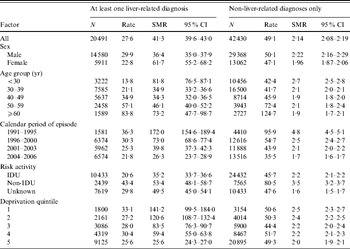
N, Observed number of hospital episodes; Rate, fitted number of episodes/100 person-years, under the assumption that counts are negative-binomially distributed [Reference Glynn and Buring12]; SMR, standardized morbidity ratio (adjusted for sex, age group, calendar year of episode, and deprivation); CI, confidence interval; IDU, injecting drug user.
95% CIs are derived from the estimated variance for observed recurrent event rates [Reference Stukel14].
SMRs for only those episodes with at least one liver-related diagnosis varied with age [Table 2; Fig. S1 (online)]; the greatest excess morbidity was observed for those aged <30 years (SMR 82, 95% CI 77–87), and it steadily increased from the 40–49 years age group (SMR 34, 95% CI 32–37) to about 73 times that of the general population (95% CI 48–99) for those aged ⩾60 years.
Considering episodes with a liver-related diagnosis, the SMR (unadjusted for deprivation) was 63·1 (95% CI 60·5–65·7), higher than the SMR when also adjusting for deprivation (41·3, 95% CI 39·6–43·0). For both episodes with only non-liver-related diagnoses and episodes with a liver-related diagnosis, the confidence intervals for deprivation-adjusted SMRs for the highest quintiles did not overlap those for the lowest quintiles, indicating that deprivation was a strong confounder as well as being positively associated with hospitalization rate.
Analyses of the IDU subpopulation indicated lower fitted admission rates and lower SMRs for the 50–59 and ⩾60 years age groups compared to the same measures for the entire study population (Table S2, online). Non-IDU and unknown groups showed apparent increasing trends with age for both liver- and non-liver-related hospitalization rates, whereas for IDUs the increase in non-liver-related hospitalization rate with age was less pronounced (Fig. S2, online). For IDUs, 29·9% (10 433/34 865) of hospital admissions mentioned a liver-related diagnosis; for the non-IDU and unknown risk groups, the proportion of liver-related admissions was higher (35·8%, 10 058/28 056).
Relative risk of hospitalization with any diagnosis (2000–2006)
Changes in identification/testing/diagnosis practice over the study period may be responsible for the higher SMRs in the earlier analysis periods (1991–1995: 6·6, 95% CI 6·2–7·0; 1996–2000: 4·0, 95% CI 3·9–4·2). Confining analysis to the most recent years (2000–2006), multifactorial Cox regression analysis for recurrent events indicated increased relative risks for male sex [hazard ratio (HR) 1·1, 95% CI 1·0–1·2)], older age (per 10 years, HR 1·55, 95% CI 1·5–1·6), residing in the 40% most deprived localities (HR 1·3, 95% CI 1·1–1·5; HR 1·4, 95% CI 1·2–1·7, for the 4th and 5th deprivation quintiles, respectively), and testing positive for HIV infection (HR 1·6, 95% CI 1·3–1·8) (Table 3).
Determinants of all-cause in-patient hospital episodes in the Scottish HCV-diagnosed population, 2000–2006. The study population consists of all persons diagnosed HCV-positive between 1991 and 2006 and for whom birth date, sex, and deprivation data were available (n=16 232)
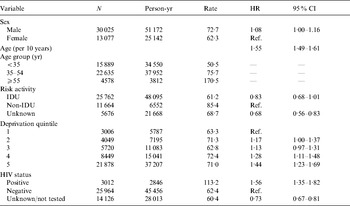
N, Number of hospital episodes, with any diagnosis; Rate, fitted number of episodes/100 person-years, assuming negative-binomially distributed data [Reference Glynn and Buring12]; HR, hazard ratio (adjusted for sex, age, risk activity, deprivation, and HIV status) (age groups are shown for illustration only; age was entered as a continuous variable in the regression); IDU, current/former injecting drug user (HIV status was determined through record-linkage to the HIV diagnosis and the HIV test databases).
Adjusted hazard ratios are estimated by fitting a multifactorial Cox proportional hazards model for recurrent events [Reference Andersen and Gill15].
95% CIs reflect robust standard errors.
HCV-diagnosed persons with IDU risk activity had a reduced relative risk of hospitalization for any cause (HR 0·8, 95% CI 0·7–1·0), compared to the non-IDU risk group. Non-IDUs were hospitalized more frequently than IDUs (expected rate of 86/100 person-years and 69/100 person-years, respectively); the most frequent ICD category (25·9%) for non-IDU admissions was coagulation defects (a disorder of haemophilia, ICD-10: D65-68; ICD-9: 286), compared to 0·2% for the IDU and 0·05% for the unknown risk group. Hazard ratios from a recurrent events regression analysis on the IDU risk group only were consistent with those obtained using the entire study population (Table S3, online), except that the HR for sex was not significant.
DISCUSSION
This study constitutes the first investigation of hospital utilization in all HCV-diagnosed persons in Scotland. The principal results are (i) the risk of this population being admitted to hospital for any condition is extremely high (3·5 times higher than that for the age-, and sex-matched general population, even when additionally adjusting for deprivation; and (ii) although risk considering only liver-related hospital episodes is 42 times that for the general population (consistent with development of liver disease), there is still a twofold excess risk of hospitalization for non-liver-related conditions. The latter finding suggests that excess morbidity not directly related to HCV disease, even after controlling for deprivation, may be due to lifestyle factors accompanying injecting drug use that lead to ill health.
In one of the only studies examining trends in HCV-related morbidity, Myers et al. [Reference Myers, Liu and Shaheen17] report that the burden of HCV infection in Canada (measured in terms of HCV-related in-patient hospital admissions, length of stay in hospital, and patient management costs) is rising more rapidly than predicted. For example, liver-related hospital admission rates increased fourfold between 1994 and 2004. Such an increase is consistent with the substantial increases in mortality in HCV-diagnosed persons reported for the last decade in USA and Scotland [Reference Palmateer18, Reference Wise19].
Earlier calendar-year periods were associated with higher SMRs – for all diagnoses, the multiple admission rate in 1991–1995 was seven times the rate for the standard population, dropping to three times in 2004–2006. Because this trend with calendar period was observed for both liver-related and non-liver-related admissions (Table 2), this finding is probably due to ascertainment bias – with earlier periods representing referrals for HCV testing upon worsening health associated with long-term chronic HCV disease – rather than reflecting a genuine decrease in SMRs over time. Increased rates of treatment for HCV infection and harm reduction initiatives may have also contributed to observed differences across calendar period. Our analysis was for the period up to end of 2006, prior to Phase II of the Scottish Government's Action Plan on HCV (May 2008 to March 2011) when major investment was awarded to improve HCV-related prevention, diagnosis and treatment services across Scotland. It will be of interest to examine if excess morbidity changes over the years during and/or following the Phase II Action Plan.
The SMR for episodes with only non-liver-related diagnoses was highest for the <30 years age group (SMR 2·7), dropping to 1·9 for the ⩾60 years age group. This suggests lifestyle factors (associated with injecting drug use, the most prevalent HCV risk activity for this age group) may underlie the higher than expected admission rate for this young age group. The most frequent non-liver-related discharge diagnoses for the <30 years age group were predominantly drug-use related (phlebitis, drug poisoning, abscess, head injury, abdominal pain).
We noted that HCV-diagnosed persons with IDU risk group had a reduced relative risk of hospitalization for any cause (HR 0·8, 95% CI 0·7–1·0), compared to the non-IDU risk group. The surprising direction of this finding may be explained by differences in multiple admission rates. Non-IDUs tend to be admitted for recurrent illness more frequently than IDUs; the former risk group consists of many individuals with transfusion-acquired HCV infection, who are hospitalized relatively frequently (25% of episodes) for their illness (haemophilia).
In Scotland, living in socially deprived areas is associated with increased mortality and hospitalization rates and a higher prevalence of injecting drug use [Reference Carstairs and Morris11, Reference Leyland20, Reference Hay, McKeganey and Hutchinson21]. Because the highest prevalence of injecting drug use is in the regions of highest deprivation, adjusting for deprivation may have indirectly adjusted for lifestyle factors associated with injecting drug use. However, our finding of a twofold excess risk of non-liver-related morbidity even when analysis was restricted to the current/former IDU subgroup (see Supplementary material) indicates the existence of excess risk not directly related to HCV disease and not accounted for by socioeconomic inequalities. The reasons for this excess morbidity appear to be the consequences of a drug-using lifestyle; as mentioned above, the most frequently appearing diagnosis codes for the <30 years age group were related to injecting drug use.
Another possible explanation for the observed excess morbidity after adjusting for social deprivation is that the distribution of deprivation has changed sufficiently since the 2001 census to invalidate our estimates of counts falling within each population-level sex- / age-group / calendar-year / deprivation-quintile stratum. However, there is a strong correlation between deprivation measures computed from variables measured in the two census years [Reference McLoone22].
Study limitations
Time at risk was defined as beginning 30 days after date of HCV diagnosis, rather than infection, which is unknown for the majority of the HCV-diagnosed persons. This may have resulted in larger SMRs than if the study population were followed up from date of infection: if fewer hospitalizations occur in the earliest stages of chronic infection, then these pre-diagnosis events and person-years of follow-up do not contribute to the calculations. In addition, SMRs may have been affected by changes in testing practice over the study period, and if the location and diagnosis of individuals occurred earlier into disease progression. SMRs tended to decrease with calendar period of follow-up, which is consistent with later periods being represented by relatively greater numbers of recently diagnosed (and outcome-free) individuals compared to earlier periods.
Electronic record-linkage relies on the availability of sufficient patient identifiers. Hence, SMRs may be underestimated due to unrecovered linkages between the HCV diagnosis database and SMR01/GROS. Finally, SMRs may have been underestimated due to viral clearance in part of the cohort, and to hospitalizations occurring outside Scotland.
In summary, our analysis has found substantial excess morbidity in the Scottish HCV-infected population, particularly for hospital episodes with liver-related diagnoses, but also for episodes with only non-liver related diagnoses, even after controlling for social deprivation – the latter step is vital given the strong relationship between HCV-infected status and deprivation. When developing treatment strategies and calculating the cost-effectiveness of treatment, one should consider this information and factor in morbidity that is not directly HCV related.
NOTE
Supplementary material accompanies this paper on the Journal's website (http://journals.cambridge.org/hyg).
ACKNOWLEDGEMENTS
The authors thank ISD for performing the probabilistic record-linkage and supplying the Scottish hospital admission and bed-days data. We are grateful to the following virologists for their support with the HCV diagnosis database: Dr Sheila Burns (East of Scotland Specialist Virology Centre, Royal Infirmary of Edinburgh, Edinburgh), Dr Sheila Cameron (West of Scotland Specialist Virology Centre, Gartnavel General Hospital, Glasgow), Dr Paul McIntyre (Department of Medical Microbiology, Ninewells Hospital and Medical School, Dundee), and Dr Pamela Molyneaux (Department of Medical Microbiology, University Medical School, Foresterhill, Aberdeen). This work was funded by a grant from the Chief Scientist Office of the Scottish Government. S.M.B. was funded by Medical Research Council, WBS no. U.1052.00.002.00001.01.
DECLARATION OF INTEREST
S.M.B. owns stock in GlaxoSmithKline.



