




1 Introduction
Ῥουφείνου τάφος οὗτος, ὃν Ἀστέριόν ποτ’ ἔκλῃζον·
ὃς προλιπὼν Ῥώμης δάπεδον Νείλου πόλιν ἐλθὼν
καὶ προκοπαῖς λάμψας, πολλοῖσι δὲ πολλὰ παρασχών,
μηδένα λυπήσας, ἀλλ’ εἰς τὸ δίκαιον ἀθρήσας,
5 Μοιρῶν οὐκ ἔφυγεν τρι<σ>σῶν μίτον, ἀλλὰ νεκρωθεὶς
τὴν ψυχὴν ἀπέδωκεν ἐς ἀέρα, σῶμα δὲ πρὸς γῆν.
ἀλλὰ καὶ εὐσεβίης ἔσχεν κρίσιν ἐν φθιμένοισιν
καὶ πάλιν εἶδε τὸ φῶς νεκρὸς ὢν καὶ πόντον ἔπλευσε
καὶ χώρης ἰδίης ἐπέ<β>η· σὺν παισὶ δὲ κεῖται,
10 ὧν οὐκ εἶδε τέλος θανάτου· πρῶτο<ς> γὰρ ἔθνῃσκε.
ἡ δὲ τέκνων δισσῶν μήτηρ, σεμνὴ <ἠ>δὲ φίλανδρος,
καὶ πέλαγος διέπλευσε καὶ ἤγαγε σῶμα βυθοῖσιν
καὶ καμάτους ὑπέμεινε καὶ ἐν θρήνοις διέμεινε
καὶ τύνβῳ κατέθηκε καὶ αἰῶσιν παρέδωκε.
15 Δαμοστρατείας ταῦτα τῆς φιλανδρίας.
This is the grave of Rufinus, whom they once called Asterios.
After having left the soil of Rome and having reached the city of the Nile,
he shone with success, offered much to many,
caused grief to nobody, but had an eye for what is right.
He did not escape the thread of the three Fates but, deceased,
5 gave away his soul to the air and his body to the earth.
But he was also judged pious among the dead and,
though a corpse, he again saw the light and sailed across the sea
and set foot on his own land. He lies with his children,
whose death he did not see, since he died first.
10 But the mother of his two children, noble and loving her husband,
also crossed the sea and brought his body over the waves, taking great pains.
Mourning continuously, she buried him
in the tomb and gave him over to Eternity.
These are the tokens of Damostrateia’s love for her husband.
(IGUR 1321, trans. adapted from Hemelrijk 2020)Footnote 1
This Greek funerary epigram from Rome was commissioned by Damostrateia for her husband Rufinus.Footnote 2 It relates how he had travelled to Egypt and had died there. In a remarkable image, the text states that the deceased as a reward for his piety ‘saw the light again and sailed across the sea, and set foot on his own land’ – by which Rome must have been meant.Footnote 3 Being buried in Rome was apparently very important to Rufinus – or at least to his family – because in the last lines we learn that his wife went to a great deal of trouble to bring his body back all the way from Egypt. This epigram raises many questions about the cultural identity (or identities) of Rufinus and his family and their self-presentation in this epigram. Most importantly, if Rome is clearly presented as the homeland of Rufinus and his family, why is this epigram written in Greek?
The epigram for Rufinus is part of a fascinating corpus of roughly 350 inscribed Greek verse epitaphs from the Principate that have been found in Rome.Footnote 4 Although this figure is relatively small in comparison to the tens of thousands of Latin epitaphs (prose and verse) that stem from the city, the corpus is otherwise quite remarkable. Many of the texts are highly original, often surpassing in content, length, imagery, and vocabulary the less literary (if not rather mundane) epigrams found elsewhere in the Roman empire. It is also noteworthy that from the city of Rome substantially more Greek epigrams have survived than from other cities in the Roman empire, including the larger Greek cities in the East. Obviously, Rome housed a large group of Greek migrants, but population figures alone are unlikely to explain the wide discrepancy. Moreover, in Rome the proportion of Greek epitaphs written in verse rather than prose is remarkably high: about thirty per cent of all surviving Greek epitaphs are written in the form of an epigram, while elsewhere this percentage is usually much lower, in the order of 1–3 per cent.Footnote 5 In Rome, once someone chose to set up a funerary inscription in Greek, the likelihood that it would be in verse was apparently quite high.
Under the Principate, Rome clearly had become a major production centre of Greek funerary epigram. We believe this epigraphic phenomenon – which to the best of our knowledge has thus far gone unnoticed – offers an excellent entry point to study the nature of Rome as a cosmopolis. Why, and in what ways, did people who lived in the heart of the Roman empire choose to present themselves as Greek? On the one hand, based on the personal information contained in the verse epitaphs, it is possible to provide a social profile of the individuals who appeared in them, in particular with respect to their status and geographical origin. On the other hand, people articulated in the epigrams one or more cultural identities: they could present themselves as Greek, or Roman, or a combination thereof.Footnote 6
The expression of these cultural identities by people from various social and geographical backgrounds should be placed in the context of globalization. The Roman Principate was characterized by increasing interconnectedness and interdependency between localities and people.Footnote 7 It resulted in a surge of geographical mobility of individuals from Greek-speaking parts of the world to Rome, by both slaves and voluntary migrants.Footnote 8 Part of any globalization process is that ‘multiple and intersecting cultural layers and overlapping jurisdictions (…) generate multiple identities’.Footnote 9 In the city of Rome, Greek funerary epigrams presented an excellent vehicle to navigate the cultural ambiguities of ‘being Greek’ in the heart of the Roman empire. The decision to favour one language over the other (here Greek over Latin) in a multilingual city such as Rome entails a conscious decision to emphasize one particular linguistic, and thereby one specific cultural, identity over the other. This decision could be motivated by various aspects, such as communication aims or a wish to showcase social status.Footnote 10
In analysing cultural identity through the epigrams, we should be aware that both the mention of biographical data and the expression of cultural identity is context dependent. The epigrams that we discuss here stem from only one such context, though quite an important one: that of commemoration upon death. It may well be that during other moments individuals would have chosen to highlight other biographical aspects and express their identity slightly differently. We should also take into account that most epitaphs were set up by the deceased’s close relatives, meaning that the social profiles and cultural identities we see are ascribed by others and usually not by the deceased themselves. For example, the funerary epigram for Rufinus tells us as much about the deceased man as about his wife who dedicated the inscription. Perhaps more importantly, epigrams were regularly written by (semi-)professional poets – although they usually remained anonymous – who followed the poetic conventions of the genre.Footnote 11 Thus, what we are seeing is a representation of the deceased through the eyes of their commemorators, mediated through a poet, in the context of their commemoration. Rather than a hindrance, we believe this nexus of factors forms a major benefit for the analysis, for it implies that, despite the highly individualized nature of the inscriptions, we are dealing with shared norms during a moment that was quite important for what may be called a form of ‘collective self-presentation’.
Our analysis will be divided into three parts. First, we will take a closer look at the deceased and the commemorators in our epigrams. Who were the people setting up the epigrams? What can we say about their backgrounds? Then, we will discuss some of the ways in which Greek identities were constructed in these texts. Finally, we will discuss the connections between these epigrams and the Roman context in which they were produced.
Overall, we argue that, notwithstanding the clear presence of slaves and freedmen, Greek epigrams were used by individuals of a wider spectrum of statuses. Commemorators of various status groups apparently wanted to stress the Greek identity of the deceased. They may have had several motives in doing so, but an important one was simple: in many cases the deceased, or their family, had migrated from the eastern parts of the Roman empire to Rome. By presenting them as Greek, they claimed the paideia and culture associated with the Greek literary past. In the articulation of their Greek cultural identity, they employed a mixture of Homeric language, literary references, and mythological exempla. In the context of the city of Rome, it emphasized the special character of the individuals, drawing a contrast with the majority of people who opted for Latin grave markers. Latin epitaphs could also be expressions of literary refinement, but it is the Greek language and its connotations in particular that are associated with paideia. The thorough Greekness of the epigrams deliberately ignored or even erased other cultural or linguistic heritage of their areas of origin, which carried significantly less prestige. Stressing their Greekness also offered common ground with the Romans: as the Greek cultural past was valued highly, migrants used it as cultural capital to position themselves within their new Roman homeland. Yet despite the heavy emphasis on Greekness they also display an awareness of the Roman context in which the grave markers were set up. Arguably, in this Roman setting, migrants became more Greek than they had been in their homelands. Greek epigrams formed excellent vehicles to articulate their cultural claims, and this explains why Rome could become a major centre of Greek epigram production.
2 A social profile: status and mobility
Σῆμα τόδε Eὐδαίμων Διονυσίῳ, ὃν ῥ’ ἕταρον ὣς
φίλατο, καὶ Μούσαις ἔξοχα φιλαμένωι.
⸐
Eἰ καί μοι θυμός, Διονύσιε, τείρεται αἰνῶς
ἀμφὶ σοί, ἀλλ’ ἔμπης οἷα πάρεστι δέχου
5 ὕστατα δή, φίλε, δῶρα· τὰ δ’ ἄλλα τοι ὅσσα ἔοικε
καὶ πάρος Eὐδαίμων δῶκε καὶ οἰχομένωι·
ζωὸν μὲν μεθέηκεν ἐλεύθερον, οὐδὲ πάροιθεν
οὐ σύ γε ἐπειρήθης πώποτε δουλοσύνης·
ἦ γὰρ ἔης αὐτῶι κεχαρισμένος ἐξέτι παίδων,
10 ἤπιος, ἐσθλὸς ἰδεῖν, εὔνοος, ἀγχίνοος,
καρπαλίμως γράψαι σημή[ι]α δίπλοα φωνῆς
Ἑλλάδος εὖ εἰδὼς [ἠδ]ὲ καὶ Αὐσονίων.
Eudaimon offered this tomb to Dionysius, whom he
loved like a friend and who was exceedingly loved by the Muses.
Although my soul is terribly distressed
about you, Dionysius, receive nonetheless the last gifts
5 that are available, my dear. As for the rest,
Eudaimon gave you as much as was opportune both before and after you were gone.
In fact, when you were alive, he freed you from slavery, and even before that time
you did not ever experience slavery;
for you were the most pleasing to him ever since boyhood,
10 gentle, noble-looking, well-disposed, ready of wit,
well competent to write swiftly a double code of signs,
those of the Greek language and those of the Ausonians.
(IGUR 1194, trans. adapted from Garulli 2019)Footnote 12
The limestone stele on which this epigram was inscribed, probably dating to the first or second century ce, is of considerable size (66 x 123 cm). The careful lettering, the indentations of the couplets, and the so-called ‘forked paragraphos’ between lines two and three – indicating a division or a change in the textFootnote 13 – show the care given to the monument. The text itself is composed in elegiacs (alternations of dactylic hexameters and pentameters), with a few irregularities (such as the penultimate syllable of the first line -ον which is short but should be scanned long for the hexameter). Such epigrams in elegiac couplets arose in the fifth century bce and already became in the fifth century the most common way to inscribe verse inscriptions – it dominated the epigrams of the Greco-Roman world for centuries to come.Footnote 14 The first section of the inscription tells us that Eudaimon set up the monument for his friend Dionysius, for whom he is grieving. Only in the second part do we learn that Dionysius was not just a friend, but also a former slave of Eudaimon – who himself may have been a former slave, based on his Greek name. Dionysius’ freedman status is both made explicit and at the same time downplayed: even while being a slave, Dionysius ‘did not experience slavery at all’. The Latin epigraphy of the imperial period shows a decline in the use of explicit status markers and (pseudo-)filiation, giving rise to a growing number of incerti (people of uncertain legal status). This phenomenon has been attributed to the freedman’s ‘unwillingness to declare his inferior status and his dependence on and obligation to his patron’.Footnote 15 That by contrast Dionysius’ status as freedman is so central to the epigram probably has to do with Eudaimon’s self-representation: he wished to be seen as a good slave-owner. At the same time, by ascribing certain characteristics of free citizens to Dionysius – he was ‘gentle, noble-looking, well-disposed, ready of wit’ – the former slave was humanized, too. Moreover, Dionysius was a skilled individual: he was ‘loved by the Muses’ (perhaps he himself composed poetry or prose texts) and a writer of shorthand, since he could ‘write swiftly’ in Greek and in Latin. As a secretary or scribe, he may have rendered his services to Eudaimon even after being freed – freedmen often stayed within (or near) the household of their former master.Footnote 16 The virtuousness of Dionysius and his friendship with Eudaimon are emphasized. These are the qualities of Dionysius that count – at least for Eudaimon, who produced the tomb with its inscription.Footnote 17 Important for us is that it provides information on which we can base our social profile, which in turn tells us something about who were commemorated in the metrical inscriptions. Dionysius was male and of freed status – but what about the other deceased individuals in the epigrams?
Let us briefly address matters of gender, age, and patterns of commemoration: most of the deceased seem to be male or female adults who were generally commemorated within the nuclear family or by their spouse – that is, if a commemorator is mentioned, for there are quite a few inscriptions that do not. One epigram commemorates a father who was ‘old in age’;Footnote 18 the two-year-old Kritias is commemorated by his parents;Footnote 19 and Rufina buries her husband Proclus, promising – in an act of piousness or virtuousness – to share his grave once it will be her time to go.Footnote 20 Some deceased are commemorated not by family, but by friends – such as Dionysius. In another epigram a man is commemorated by his comrades (ἥλικες).Footnote 21 In light of the evidence and the question this article aims to answer, it is fruitful to give a more detailed account of two other aspects: the status of the deceased and the explicit mentions of mobility.
First, status. In most epigrams the legal status of the deceased individual is not made explicit – often the names are all we have. Greek single names – such as Dionysius and Eudaimon encountered at the beginning of this section – seem to dominate the corpus. Only a couple of individuals have purely Latin names. For example, in one epigram a woman is called Aelia Sabina.Footnote 22 It is well known that Greek names carried servile connotations – at least in Rome – and it was uncommon for freeborn people to have Greek cognomina (third personal names).Footnote 23 Thus, many of the deceased receiving epigrams in Greek may have had a servile background, while some (possibly including the above-mentioned Eudaimon) might be the descendants of freed people.Footnote 24
Still, some caution is needed. For example, there is an epigram for a boy who died at age 2 – the Kritias mentioned briefly above. He has a single name, his father three names (Lucius Attidius Kritias), his mother a single name (Peregrina). Perhaps his father was a freedman, but the deceased himself and his mother were probably slaves.Footnote 25 In another epigram a woman named Lyka states that she ‘came from Crete because of my husband and Queen Rome exposed [i.e. buried] me here’.Footnote 26 This formulation suggests a certain amount of agency and voluntary mobility (although we are dealing with marital mobility), which may imply that the woman, despite her single Greek name, did not have a servile background. One might expect Roman citizenship to be emphasized when someone had obtained it, and epigrams – being lengthier than prose epitaphs – certainly offered room to do so. But, as mentioned, explicit status markers gradually disappear in the Latin funerary inscriptions during the imperial period – something similar may have occurred in the Greek inscriptions in Rome. Moreover, although many Latin funerary inscriptions were commissioned by former slaves wanting to advertise their newly gained status, it was not necessarily citizenship, but family that took centre stage in their self-representation. After all, a slave’s existence was in the hands of his or her master – they had no control over their body or their life. Their families – spouses, children, siblings – were not recognized by Roman law, and they could be separated at any moment. A secure family unit did not come naturally to these individuals. Manumission, therefore, marked a turning point. Freed(wo)men could legally marry, and subsequent children born from this union would have been freeborn. They could also try to free their family members who were still enslaved.Footnote 27 Some Greek epigrams from Rome do mention the citizenship of the deceased, but these are not numerous.Footnote 28 In individual cases certainty is not often obtained; we are dealing with probabilities and tendencies. Still, we would argue that the silence on legal status, together with the overwhelmingly Greek cognomina, suggests that many of the deceased we find in the Greek epigrams from Rome had a servile background.
This servile presence in the Greek epigrams from Rome is noticeable. In the Greek epigrams from the Roman East, it is relatively unusual for slaves or freedmen to appear. Verse epitaphs can be seen as a privileged type of commemoration, as they required time and effort to be set up. They were highly personalized as well. There can be little doubt that among the tens if not hundreds of thousands of slaves and freedmen who lived and died in Rome, only a few would have the means or the relations to obtain so much attention after death. In the Latin epigraphy of the city of Rome, slaves and in particular freedmen dominate the record.Footnote 29 It seems that Greek epigram production in Rome in this respect followed local trends.
Many Greek epigrams can be located in the milieu of slaves and freedmen, but it is noticeable that this does not apply to all. There are also individuals almost at the opposite end of the social scale, close to the Roman elite. In an epigram commemorating multiple family members, the commemorator’s husband, called Rusticus, is said to be a ἡγεμονεύς (‘governor’). Thus, he may have been a governor of a Roman province.Footnote 30 Another example is a dedication by a wife to her husband. She had built a ‘large monument’ that was ‘visible from all sides, to be admired by all’. A life-size statue of her husband in ‘the posture that you had while you excelled among the Roman orators’ completed the funerary monument. All of this suggests that the wife, called Rufina, and her husband Proclus were part of the elite.Footnote 31 The implications are quite important. The Greek epigrams from the Roman East are socially relatively homogeneous: although members of local elites do appear in them, the epigrams often stem from the urban strata just below them. Compared with them, the Greek epigrams from Rome cover a significantly wider social spectrum. Put differently: status considerations, which were otherwise quite important to Roman thinking, were superseded by expressions of cultural identity. The use of Greek epigrams was not confined to slaves and freedmen, and apparently no social stigma applied to their use.
We may now move on to the question of migration. One of the obvious reasons why individuals may have preferred Greek over Latin epitaphs is that they were migrants. The many Greek cognomina present in our corpus already seem to imply this, even if they are not conclusive in themselves. Some epigrams corroborate this by explicitly mentioning geographical mobility. One example is the epigram for Rufinus, which we cited in the first section of this paper. He was probably born as Asterios, possibly in Egypt, and at some point he moved to Rome and took up the name Rufinus.Footnote 32 Later in life he went (back?) to Egypt – perhaps to conduct some public business or to tradeFootnote 33 – and died there. It is not entirely clear where in Egypt he went exactly, but the ‘city of the Nile’ (Νείλου πόλιν) is most probably Alexandria.Footnote 34 In another example, a mother mourned the loss of her eleven-months-old daughter. She vowed to send her ashes back to her ancestral lands. Potentially the mother – who seems to have commissioned the epigram – was herself a migrant. The inscription is slightly fragmentary at the point where the place name is mentioned; as such, it could refer to the Argolis region in Greece or perhaps Judea.Footnote 35
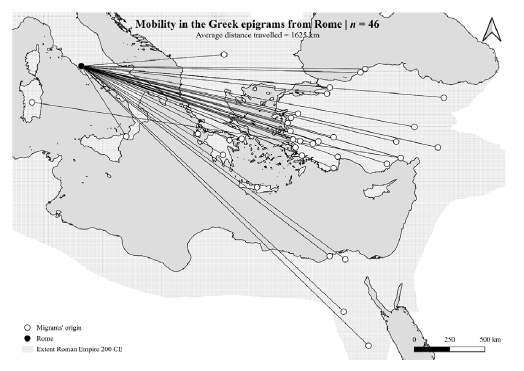
The mobility of the individuals in the Greek epigrams from Rome can be observed in Figure 1.Footnote 36 In forty-four epigrams there are forty-six attestations of mobility, yielding thirty-five different place names. All epigrams, except one, inscribed linear mobility, that is, the inscriptions only tell us where someone was born and where he or she died. The exception is an epitaph for a certain Chariton, who was an imperial freedman. It was Sardinia who gave birth to him. Later on he went to Tarsos to take up an administrative office. Death found him at the age of thirty-five, and he was buried in Italian soil (Rome).Footnote 37
Migration to Rome in the Greek epigrams from Rome (n = 46).

The map shows how the ‘Greek’ world was defined: with the exception of SardiniaFootnote 38 and southern ItalyFootnote 39 , people came from the eastern parts of the Roman empire, where (especially in the cities) Greek was the dominant written and spoken language. In itself it is not particularly surprising that migrants who came from these areas composed epigrams in Greek, as Greek language and culture enjoyed prestige in Rome. Yet we need to keep in mind that other spoken and written languages were also in use in the areas outside the Greek heartland, and that historical and cultural traditions in these areas could vary significantly. The epigrams carefully avoided any reference to this non-Greek heritage.
We can further distinguish between voluntary and forced mobility. As many of the deceased in our epigrams have a servile background, at least some of them may have been forced to move to Rome. For example, Euprosdektos commemorates his mother, Donata. She was probably enslaved and sent from Tralles (her place of birth) to Rome, where she was manumitted by the emperors (either Marcus Aurelius and Lucius Verus or Septimius Severus and Caracalla).Footnote 40 Other movements were more voluntary in nature. We have already encountered a wife following her husband from Crete to Rome. In another epigram, dating to the late first or early second century ce, a woman called Julia Laudice, daughter of Gaius, is said to have moved from Same to Rome. Based on her filiation, we may assume that she is freeborn. The family names of both herself and her husband (called Titus Flavius Alcimus) may, however, imply servile descent traced back to the imperial family.Footnote 41 Another epigram commemorates multiple senatorial family members: a certain Pompeia, the deceased mother of the still-living Atinia, came from Tarsos. Since we are dealing with an elite household, it is quite likely that Pompeia’s mobility was voluntary. Perhaps she also followed her husband, just as the woman from Crete did.Footnote 42 In another epigram, which is structured like a dialogue, the deceased is asked ‘who was it, who raised you?’, the deceased supposedly replies: ‘it was the Cilician Athenaios’.Footnote 43 Either this Athenaios or the deceased (called Numenios) moved from Cilicia to Rome.
More migrants may be hiding behind the other inscriptions; after all, mobility is rarely mentioned in epitaphs in general.Footnote 44 In the absence of explicit statements, absolute certainty cannot be obtained, but with the exception of the two epigrams from Sardinia and South Italy (discussed above), we know of no Greek epigrams in Rome referring to migration from the western Roman provinces (though a relatively small number of Greek funerary epigrams has been found in these areas). We can safely assume that normally migrants moving from these western areas to Rome would use Latin for their epitaphs. There are some epigrams that refer to Rome explicitly as the place of birth. In one epigram the migrant status of the father, who came from Syria, is contrasted with that of his daughter, who was born in Rome.Footnote 45 In another epigram that is accompanied by two Latin prose texts, the patris (‘fatherland’) of two individuals is said to be Rome. The Latin part explains the Greek: the two young men were vernae (natione verna) – that is, slaves born in the household of their master.Footnote 46 These epigrams are quite exceptional, however. The main point here is that for the epigrams visualized in Figure 1 we can be certain that the deceased people or those closely related to them were migrants, and this may have contributed to the decision to set up a funerary epigram in Greek. This illustrates the globalizing nature of the Roman world most clearly: increased interconnectedness facilitated geographical mobility.
3 Constructing Greekness
By commissioning an epigram in Greek in a funerary landscape that was dominated by Latin epitaphs, the dedicators and/or the deceased chose to emphasize their Greekness. ‘Greekness’, however, was an elastic concept.Footnote 47 It is therefore important to investigate in what ways Greek identity could be articulated in the epigrams.
The obvious starting point is the simple fact that the commemorators chose to express themselves in the Greek language. These epigrams are, however, not just written in the koine Greek that was spoken and written in everyday life in Rome. They used an artificial and distinct poetic form of Greek, which is closely associated with the literary genre of epigram and its metre (either pure dactylic hexameters, which are also characteristic of Homeric and Hesiodic epic, or elegiac distichs). In the epigrams, we encounter words from the Ionian or Aeolian dialect that are part of an artificial Homeric, poetic language. Examples include the formulation παλαιγενέεσσιν […] ἡρώεσσιν, ‘heroes of ancient times’, which – even though it is not a literal quotation – has obvious associations with Homeric epic.Footnote 48 Another example from the same epigram is the use of the phrase νῆσοι μακάρων (‘islands of the blessed’) to refer to the underworld, which can be traced back to Hesiod – it became a common way to refer to the underworld in later Greek epitaphic poetry.Footnote 49
It seems that in using this particular language the dedicators intended not just to convey a clear sense of Greekness, but more specifically to associate themselves with the Greek poetic tradition and, in a broader sense, with Greek literature and intellectual culture. The epigrams convey the Greek paideia of the deceased and the dedicators by expressing a knowledge of classical Greek culture and suggesting a classical Greek education.
Apart from the language and poetic allusions, another typical marker of Greekness are the frequent references to Greek mythology. In many of the epigrams, the deceased is compared to a god or a mythical figure. For example, in IGUR 1226, an epigram dedicated by a certain Aeneas to his sister Olympias and her husband, Olympias is compared to both Leda and Alcestis: she surpasses Leda in appearance and Alcestis in intelligence.
Ἱερὸς οὗτος ὁ χῶρος, ὃν Αἰνείας ἀγανόφρων
εἵσαθ’ ἑοῦ ἑτάροιο σεβάσμιον Ἠιθέοιο,
πάντα παλαιγενέεσσιν ἀλινκίου ἡρώεσσιν,
κάλλος τε ἠνορέην τ’ ἀγανοφρο<σ>ύν̣ην τε νόον τε.
5 [ἐ]νθάδε δ’ ἐ[νναί]ει καὶ Ὀλυμπιάς, εἱμερόεσσα
Ἠιθέοιο δάμαρ καὶ ἀδελφεὴ Αἰνείαο,
ἣ πάσας παράμ[ι]ψ[ε] φιλάνδρους ἡρωίνας,
Ἄλκηστιν πινυτῇ, μορφῇ δ’ ἐρατώπιδα Λήδην.
τοῦτ’ ἐτύμως νῆσοι μακάρων πέδον, ἔνθα τε φῶτες
10εὐσεβέες ναίουσι δικαιότατοί τ’ ἀγανοί τε,
οἳ <ξ>υνὸν ζώοντες ἔχον βίον ἀλλήλοισιν
σὺν κόσμῳ σοφίῃ τε δικαιοσύνῃ τε καὶ αἰδοῖ.
ἀγγέλλω τάδε βωμός, ὃν Αἰνείας ἀνέθηκεν,
ὄφρα κε κυδαίνωνται ὑπ’ ἀντιθέοις γεράεσσιν15 πᾶσιν ἐν αἰώνεσσιν ὑπ’ εὐσεβίῃσιν ἑταίρων.
Holy is this place, which the gentle Aeneas
dedicated as the august tomb of his friend Eitheos,
who was in everything like the heroes from ancient times,
in beauty, bravery, gentleness and mind.
5 Olympias dwells there as well, the lovely
wife of Eitheos and sister of Aeneas,
who surpassed all heroines that loved their husbands,
Alcestis in intelligence, in appearance the lovely-looking Leda.
This ground is truly like the isles of the blessed, where
10pious men live, the most just and gentle,
who when they lived had a life in common with each other
characterized by order and wisdom and justice and respect.
I, altar that Aeneas erected, am saying these things,
in order that they will be honoured with godly gifts
15for all years, because of the piety of their friends.
(IGUR 1226)
Olympias, the wife of Eitheos, is compared to ‘husband-loving heroines’ (φιλάνδρους ἡρωίνας) in general, and in particular to two mythological models who illustrate her qualities: Alcestis and Leda. Out of love for her husband Admetus, king of Pherae, with whom she had two children, Alcestis offered to die in his place; she later rose from the dead through the intervention of either Hercules or Persephone. Alcestis is often mentioned in inscriptions for dead wives, as she serves as an exemplum for wives who lived and died virtuously and faithfully to their husband. This is a very old and influential example in funerary poetry. We can find it in Greek epitaphs from the classical period, but also in literature, most famously in Euripides’ play Alcestis. Leda was married to King Tyndareus of Sparta. She was the mother of Castor, Clytemnestra, Helen, and Pollux (the latter two by Zeus, not Tyndareus). Olympias is said to resemble Alcestis in ‘understanding’ (πινυτή) and ‘lovely looking’ Leda in shape (μορφή); Leda’s beauty was indeed famous; according to Ovid (Amores 2.4) she had beautiful black hair and a snowy skin. Although the epigram does not mention whether Olympias and Eitheos had any children, the exempla of Alcestis and Leda might evoke associations with motherhood, too.
In another interesting case, the deceased woman Marcia Helike is compared to several mythological exempla:
Μνήμην τῆς ἰδίας γαμετῆς μετὰ μοῖραν ἄτρεπτον
ἐν στέρνοισιν ἔχων ἴδιος πόσις ὢν ἔτι ζωός,
ἥτις ἔφυ στήλαις, παροιδοπόρε, τοῦθ’ ὑπέγρα[ψ]α·
πρῶτον μὲν τύπος ἦν αὐτῇ χρυσῆς Ἀφροδίτης,
5 εἶχε δὲ καὶ ψυχὴν ἀφελῆ στέρνοισι μένουσαν·
ἦν ἀγαθή, νομίμοις δὲ θεοῦ παρεγείνετο πᾶσιν·
οὐδὲν ὅλως παρέβαινε· χαρίζετο λειπομένοισιν,
δουλὶς ὑπάρχουσα στέφανον τὸν ἐλεύθερον ἔσχεν.
ζωοὺς τρεῖς ἐκύησε γόνους· μήτηρ ἐγενήθη
10 δισσῶν ἀρρενικῶν, τὸ δὲ θῆλυ τρίτον κατιδοῦσα
ἠοῦς ἑνδεκάτης ἔλιπε ψυχὴν ἀμερίμνως.
κάλλος δ’ αὖ μετὰ μοῖραν Ἀμαζόνος ἔσχεν ἄπιστον,
ὥστε νεκρᾶς πλέον ἢ ζώσης εἰς ἔρωτα φέρεσθαι.
εἰκοστὸν δὲ βιώσασαν ἀφελῶς ἐνιαυτὸν
15 Μαρκίαν τὴν Ἑλίκην ζοφερὸς τάφος ἔνθα καλύπτει.
Keeping the memory of my own wife after her unescapable fate
in my heart, I, her husband who is still alive,
have written on the stone, traveller, who she was, as follows;
First of all, she had the appearance of the golden Aphrodite,
5 and she had a persistently modest spirit in her heart;
she was virtuous, and she obeyed all the laws of the god;
she did not at all transgress any; she brought joy to those who are left behind,
and being a slave, she received the wreath of liberty.
She birthed three living children; she became mother
10 of two sons, but after she had seen her third, a daughter,
free from care she left her life on the eleventh day.
After her death she again obtained the unbelievable beauty of an Amazon,
so that you would fall more in love with her while she was dead than while she was alive.
Having lived modestly for twenty years,
15 a dark grave here covers Marcia Helike.
(IGUR 1268)
The poem, composed in dactylic hexameters, was commissioned by a husband for his deceased wife, Marcia Helike, who was a former slave. In the epigram, she is compared to Aphrodite and said to be just as beautiful as the goddess. In line 12, it is stated that in death she obtained the beauty of an Amazon. Although Amazons in Greek literature could be associated with war and violence, here it is their ‘unbelievable beauty’ (κάλλος … ἄπιστον) that the passer-by is asked to remember. It is possible that the reference also suggests something about the origins of Marcia Helike: Amazons were ‘barbarian’ figures, associated with Asia Minor (Lycia and Caria in particular). Notably, the Amazons were also known for their nomadic lifestyle. It is possible, then, that the Amazon, through the associations with mobility and eastern culture, points to a local eastern identity of the deceased.
The reference to the Amazon also brings to mind the well-known story of Achilles and Penthesilea.Footnote 50 This story was told in the Aethiopis, as part of the Trojan cycle, but also by Quintus of Smyrna in his Posthomerica, written in the third century ce, roughly around the same time as this epigram was composed. In this story Achilles slays Penthesilea, queen of the Amazons, but when he looks at her dead body, he is struck by her beauty and falls in love with her.Footnote 51 The comparison of the deceased wife to an Amazon and the subsequent expression of love for her dead body is thus reminiscent of this famous scene. The allusion may tell us something not just about Marcia herself, but also about her husband, as it suggests that he, the commemorator, compared himself to Achilles, falling in love with his deceased Amazon. The reference to this famous scene is a clear expression of (Greek) paideia.
At the same time, however, we should also consider the Amazon as part of a broader funerary tradition, which is exemplified by Roman sarcophagi of the second/third century ce. In Roman funerary art from this period, the Amazon is often used on grave monuments dedicated to young women and becomes a way to emphasize the tragic nature of an early death and the beauty of the depicted woman, often in combination with a reference to the beauty of Aphrodite: the epigram for Marcia Helike fits this pattern.Footnote 52 The Greek epigram, then, offers a Greek image that also clearly appealed to Roman taste.
Remarkably, most of the epigrams in our corpus that contain such mythological comparisons were made for women. The mythological women that function as exempla are the embodiments of quintessentially female virtues, such as philandria (‘love for one’s husband’), faithfulness, and beauty. By emphasizing these virtues, these epigrams are also expressions of the social norm that women should be devoted to their husbands and ideally should not have an active life outside of their household.Footnote 53 This is a stark contrast with the way men were usually praised and remembered in the epigrams, namely through allusions to their active public life and their role in society.Footnote 54
In a highly influential study, Greg Woolf has argued that in the Roman East references to Greek culture and myth served as a status claim for contemporary Greeks.Footnote 55 It provided common ground with the Romans, who otherwise looked down upon contemporary Greeks but revered the Greek past. In consequence people living in the eastern parts of the Mediterranean became more Greek under the Romans than they had ever been before. That such self-positioning through Homeric language and mythological exempla occurred in our Greek epigrams is therefore not particularly surprising, for these texts served as excellent vehicles for such cultural claims. Still, the degree to which this was done remains remarkable, in the heart of the Roman empire, in quite elaborate and at times original imagery. These texts were not just Greek, they breathed Greekness all over. It is hard not to see this as a response to the context in which they were made.
4 The Roman context
Now that we have seen in what different ways the dedicators and deceased presented themselves as Greek and what factors contributed to the formation of Greek identity, we will come back to the Roman context in which these inscriptions were made and the background of the deceased. Even if individuals clearly and loudly expressed a Greek identity, it does not mean that their epigrams were exclusively ‘Greek’. The epigrams demonstrate awareness that they operated in a Roman, primarily Latin-speaking, community.
Some of the inscriptions are even partly in Latin. Several bilingual inscriptions with a Greek epigram have been found in Rome.Footnote 56 Often a Greek poem is combined with a Latin prose text. We see in these inscriptions that generally Latin is used in a more descriptive sense, for example, to communicate the name of the deceased or of the commemorator(s) but that Greek is used in more literary expressions. Apparently, when people wanted to make claims about their education and cultural capital they switched to Greek, even if the rest of the inscription was written in Latin.Footnote 57 This shows that the inscriptions did not just happen to be written within a Roman context, but were written with specifically a Roman audience in mind.
Even the monolingual epigrams, despite their heavy emphasis on Greekness, refer to the Roman context and background of the deceased. Many of the epigrams that we have discussed show that the deceased or their commemorators took active part in Roman society. For example, a high-ranking family including a Roman governor, whose wife’s mother came from Tarsos, certainly operated within a Roman political context.Footnote 58 So, too, did two imperial freed people.Footnote 59 And the freedman Dionysios, whom we discussed above in section 2, was praised for being able to write in both Greek and Latin.Footnote 60
Before we study the more subtle references to Rome, we should discuss something else: the emphasis on the transitory nature of the settlement of the deceased. It is noteworthy that a number of epigrams use the image of what we propose to call ‘multiple migration’, linking migration in life with migration in death.Footnote 61 As we have seen, many of the dedicators and deceased probably came from the Greek East. It is noteworthy that in these epigrams, where a migration background is likely, dying is often presented as a subsequent type of movement, but this time towards the person’s final destination: the underworld. The person who travelled from Tarsos or Alexandria to Rome, subsequently moved from Rome to the underworld.
One epitaph denies emphatically that a young girl named Prote had died: ‘you have not died, Prote, but you moved to a better land’.Footnote 62 This poem mentions just one journey, the one to the underworld, but combined with the Greek name and use of Greek language it could possibly hint at a migrational background of the deceased or her family. The motive of multiple migration is more explicit in other examples, for instance in an epigram in hexameters dedicated by Euprosdektos to his mother, Donata, who came from Asia to Rome. As we can see, her death is also presented as her final journey to the underworld.
Μητέρα τὴν ἀγαθὴν Δωνᾶταν ἐνθάδ’ ἔθαψεν
δάκρυσιν Eὐπρόσδεκτος ὀδυράμενος θαλεροῖσιν,
πασάων γνώμαισιν ἀμείνονα θηλυτεράων·
Τράλλεως ἦν δὲ γένος καὶ γῆς Ἀσίης ἐρατεινῆς·
5 φῶς ἔλαβεν δὲ βλέπειν τόδ’ ἐλεύθερον ἐκ βασιλήω̣ν,
φῶς ὅτ’ ἐν ἀνθρώποισιν ἐδέρκετο, πρὶν δ̣ι̣ὰ̣ Λ̣ή̣[θην]
νύκτα κατ’ ὀρφναίην Ἄϊδος δόμον εἰσαφίκηται,
τεσσαρακοστὸν ἔχουσα τρίτον <τ>ε βίου λυκάβαντα.
Euprosdektos here buried his good mother Donata,
lamenting her with lavish tears,
she who surpassed all other women in judgement;
by birth she was from Tralles and from the lovely land of Asia; Footnote 63
5 From the emperors she received the gift of seeing this light in freedom,
when she saw the light among mortal men, before through the Lethe
in the dark night she reached the home of Hades
in her forty-third year of life.
(IGUR 1200, trans. adapted from Hemelrijk 2020)Footnote 64
Donata has travelled from Asia to Rome, and now from Rome to the house of Hades. Striking (though not uncommon) are the images of light and darkness in this poem: in Rome she ‘saw’ the light of freedom, but now she has entered the underworld ‘in the dark night’. In other words, her time in Rome enlightened her life, but her death in a way sent her back into the darkness that she had known before becoming a freedwoman.Footnote 65
Another fascinating example of the phenomenon of multiple migration is the epigram for Rufinus, which we have discussed above. Rufinus travelled to Egypt while he was still alive, but continues to travel after his death. The epigram describes how he saw the light again and sailed to Italy to be buried there. In the last few lines of the epigram we hear it was actually his wife who brought him there, but in the epigram the repatriation of the deceased is clearly presented as a journey that the deceased husband actively undertook by himself.Footnote 66
Rome may have been just a station on the road to further post-mortem movement into Hades, yet it played a central role, if only because, for all their Greekness, the individuals of our epigrams chose to be buried there. For some this might have happened because of practical reasons, for example because they died while they were temporarily staying in Rome and repatriation was too expensive.Footnote 67 Yet there was also a conscious choice to be buried in Rome, for (as we have seen) relatives of migrants could also go to great lengths to transport their beloved deceased back home.Footnote 68 Various people clearly saw Rome as their patris (‘fatherland’) and as the right place to be buried.Footnote 69
In this context it is interesting that a number of epigrams refer quite explicitly to the physical place of the grave, which is of course Rome. A good example is the epigram dedicated by Aeneas to his sister Olympias and her husband Eitheos, which we have partly discussed above.Footnote 70 In this epigram much emphasis is placed on the location of this grave monument. There are deictic references to the tomb at the very beginning of the poem (ἱερὸς οὗτος ὁ χῶρος, ‘holy is this place’) and in line 9 (τοῦτ’ […] πέδον, ‘this ground’). The close connection between the poem and the place of the grave is further reinforced by the last few lines, where it becomes clear that it is actually the altar, so the monument itself, that is speaking to the reader (ἀγγέλλω τάδε βωμός, ‘I, altar, am saying these things’). We can thus notice that a strong emphasis on Greek culture and Greekness goes hand in hand with a physical setting in Roman soil.
5 Conclusion
The roughly 350 Greek epigrams from Rome will have stood out in a sea of epigraphic latinitas. The roads leading into Rome displayed tens of thousands of epitaphs in Latin. As Latin was the epigraphic default language, the individuals who opted to use Greek verse made a specific choice, explicitly emphasizing their Greek cultural identity. This exceptionalism is borne out by the nature of the texts of the epigrams, which are often quite original.
Although many slaves and freedmen appear in the epigrams, there are also a number of people of relatively high status. The implication is that expressions of Greek identity could override considerations of class. Slaves, freedmen, and freeborn, some of them of very high status, could use the same discourse and anchor themselves in a shared Greek mythological and heroic past.
The individuals in the epigrams often came from outside Rome. The migrants originated from areas in which Greek was the dominant written language and in that sense the choice to use the Greek language and to stress their Greek identity is unsurprising. Yet we should not forget that many of the areas of origin had complex multicultural histories. In the epigrams, these non-Greek identities were overwritten: people did mention specific cities of origin, but in the context of the epitaph these were by and large interchangeable. The epigrams positioned these locations in a Greek world, with a commonly shared Greek heritage. The Greek epigrams in Rome suggest that migrants became Greek, or at any rate became more Greek by moving to Rome.
In the Greek epigrams from Rome, the city of Rome emerges as a capital of Greek culture and paideia, just as Rome also became a capital of Greek literature and philosophy. However, for all the Greekness of the epigrams, the articulation of cultural identities by migrants remained a complex affair. In the epigram dedicated to Rufinus by his wife Damostrateia we encounter two globalizing aspects of the Roman world: the occurrence of multiple cultural identities and the geographical mobility of individuals migrating from Greek-speaking parts of the Mediterranean to Rome. The epigram mentions Rufinus’ mobility from and to Egypt, but it also emphasizes how Rome was his ‘home’. Rufinus ‘left the soil of Rome and reached the city of the Nile’, where he died, but ‘he again saw the light and sailed across the sea and set foot on his own land’, although we learn later that it was his wife who ‘crossed the sea and brought his body’ back to Rome. There ‘she buried him in the tomb and gave him over to Eternity’.
The people in the epigrams – mainly adults, but also children, commemorated by parents, spouses, children, siblings, friends, and other family members – all try in some way to present themselves as Greek and as possessing Greek paideia in contrast and connection with the Roman world in which they lived. But at the same time, the occasional reference to the physical location of the monument, or the pains undertaken by Damostrateia to return her husband’s ashes to Rome, or the explicit reference to legal status, all tell us that Rome and Roman identity played a decisive role in their lives, too. Within this Roman context, however, people consciously made the decision to present themselves as Greek: what mattered to them was being Greek, dying Greek, and being remembered as Greek.Footnote 71

 Open access

