

For Andean scholars of sedentary societies, lithic assemblages generally rank low among datasets of interest, in large part due to the informality of the tools and the relatively small size of most collections. Cross-cultural evidence suggests that, with the exception of some specialist or high-status contexts (e.g., Levine and Carballo Reference Levine and Carballo2014; Whittaker Reference Whittaker, Horowitz and McCall2019), increasing lithic informality is strongly linked to increasing sedentism as access to raw materials becomes predictable and the need for maximizing usefulness per unit of weight diminishes (Andrefsky Reference William2005; Parry and Kelly Reference Parry, Kelly, Johnson and Morrow1987). By informality, we refer to tools that are “unstandardized, require minimal effort in construction, and are produced with immediately available raw materials and with little concern for the final tool form” (Horowitz and McCall Reference Horowitz, McCall, Horowitz and McCall2019:12). Understandably, many archaeologists associate tool informality with a lack of information value for the analyst (Horowitz and McCall Reference Horowitz, McCall, Horowitz and McCall2019). Here, we illustrate the analytical value of informal lithic collections from sedentary agropastoral cultures (collectively referred to here as the ceramic period) for our understanding of Andean prehistory, taking an example from the Chachapoyas region of northern Peru.
The sites in this study represent a variety of forms of social organization and date from Early Intermediate period non-state groups through Inka and European colonization. Their relative proximity allows us to control for multiple variables, including access to natural resources. Moreover, attributes of the assemblages from the selected sites make it possible to use lithic use-wear microscopy and raw material analysis to address questions of theoretical interest to ceramic period archaeologists such as subsistence, household behavior, and ceremonial practices. Finally, the size of the total lithic assemblage (N = 573) permits robust statistical analyses without requiring sampling, which results in data loss.
We begin with an overview of the research sites and methodology, followed by a discussion of what our comparative analysis reveals. Use-wear analysis shows differences in tool use between two sites, consistent with evidence from their ceramic assemblages. Generalized linear models (GLMs) suggest that lithic raw material acquisition at these sites was likely embedded in other activities. Microscopy identified a formally prepared and use-worn limestone tool. Our results highlight the potential of use-wear and stone procurement analyses for examining stone use among ceramic period agropastoral societies.
Ceramic Period Lithic Studies in the Andes
In 1983, Joan Gero noted the “generally cavalier treatment” of lithic artifacts from the Peruvian Formative period (Gero Reference Gero1983:78). The same could have been said then of any sedentary period of Peruvian prehistory. Unfortunately, despite some significant inroads in the past 40 years, Gero's observation largely remains accurate today, especially relative to other forms of material culture.
Obsidian sourcing remains the principal type of lithic analysis used in the study of ceramic period Peru (Burger et al. Reference Burger, Mohr Chávez and Chávez2000; Matsumoto et al. Reference Matsumoto, Nesbitt, Glascock, Cavero Palomino and Burger2018; Tripcevich and Contreras Reference Tripcevich, Contreras, Tripcevich and Vaughn2013). Obsidian, attractive prehistorically for its sharp edges and tendency to fracture conchoidally, is valued archaeologically for its chemical signatures that are indicative of a select number of sources. At most sites, however, obsidian artifacts make up a minority of the lithic assemblage, and although informative regarding movement and exchange, obsidian sourcing alone overlooks the bulk of the lithic material record.
Recently, a number of Andean researchers have begun to employ other lithic analyses to answer questions about sedentary societies, including topics such as warfare (Hu Reference Hu2017), elite control of production systems (Giesso Reference Giesso2000; Surridge Reference Surridge2010), imperial expansion (Bélisle Reference Bélisle2015), and the role of stone in agricultural practices (Downey Reference Downey2010; Nesbitt et al. Reference Nesbitt, Johnson and Horowitz2019). Particularly noteworthy is Downey's (Reference Downey2010) detailed analysis of informal ceramic period lithic assemblages.
Such studies, however, remain uncommon. To quantitatively evaluate recent archaeological treatments of lithic components of later prehistoric sites, we performed iterative Boolean searches of 2008–2018 publications available on Google Scholar, using the terms “Peru,” “archaeology,” and a ceramic period phase name (e.g., “Early Intermediate period”). The term “lithic” appears in 36% of cases (n = 8,170), about half the rate of “ceramic” (Supplemental Figure 1). Searches conducted with the keyword “chipped stone” added 109 unique hits to the total. Although this mass analysis tentatively suggests that lithic assemblages may be underreported, underanalyzed, or both, it is unable to distinguish between mention of a term (e.g., in a paper's citations) and comprehensive engagement with lithic assemblages. Therefore, we undertook a close analysis of articles and reports published in Latin American Antiquity during the same period. We selected this journal as representative of wider publishing trends because of its frequent and predictable publication schedule, high impact factor, and multilingual publication policy.
In 40 issues over the 10 years examined, Latin American Antiquity published 64 articles or reports focused on prehistoric Peru. Of these, 62 (97%) deal exclusively with ceramic period archaeology, and 28 (44%) mention lithics.Footnote 1 However, most articles that refer to lithic artifacts do so at a superficial, descriptive level. A typical passage reads, “The material assemblage recovered from La Banda reveals a diverse arrangement of artifacts and ecofacts, including Janabarroide-style ceramic sherds, lithic artifacts, bone artifacts, shells, and food residues” (Rosenfeld and Sayre Reference Rosenfeld and Sayre2016:501; emphasis added). Only six articles include any kind of quantitative analysis of lithic materials: three present basic counts, weights, or proportions (Bernier Reference Bernier2010; Levine et al. Reference Levine, Stanish, Ryan Williams, Chávez and Golitko2013; Marcone and López-Hurtado Reference Marcone and López-Hurtado2015); two articles include the results of chemical obsidian sourcing analysis (Bélisle Reference Bélisle2015; Matsumoto et al. Reference Matsumoto, Nesbitt, Glascock, Cavero Palomino and Burger2018); and one discusses residue analysis (Logan et al. Reference Logan, Hastorf and Pearsall2012).
The relatively frequent references to lithic technology are a reminder that stone tool technology, although rarely studied, remained ubiquitous in later prehistory even as pottery, agriculture, sedentism, and hierarchical social organization developed. Peruvian archaeology is therefore well positioned to include a serious consideration of lithic materials in our range of analytical techniques, especially as an additional line of evidence alongside other material culture studies.
Study Area and Regional Context
To demonstrate the value of lithic analysis in the study of agropastoral/sedentary groups, we analyzed collections from four sites in the Chachapoyas region of Peru. Chachapoyas is in the ceja de selva, a zone of tropical montane forest on the eastern piedmont of the north-central Andes. Compared to the coast or central highlands, the northeastern Andes has historically been understudied by archaeologists, and even today its prehistory, particularly before the Late Intermediate period, remains somewhat enigmatic. Nevertheless, recent projects in the region have begun to address questions about systems of agriculture (Guengerich and Berquist Reference Guengerich and Berquist2020; Schjellerup Reference Schjellerup2005), settlement patterns and spatial organization (Church Reference Church and Edicions2018; Church and Álvarez Reference Church and Álvarez2017; Church and Guengerich Reference Church and Guengerich2018; Crandall Reference Crandall2017; Guengerich Reference Guengerich2015; McCray Reference McCray2021; VanValkenburgh et al. Reference VanValkenburgh, Cushman, Castillo Butters, Rojas Vega, Roberts, Kepler and Kellner2020), and hierarchy and inequality (Guengerich Reference Guengerich2014a; Toyne and Anzellini Reference Toyne and Anzellini2017)—all themes common to ceramic period archaeology across Peru and that have been addressed by lithic studies elsewhere in the world. Therefore, although Chachapoyas is the backdrop for the present case study, we contend that these conclusions have broad applicability throughout Peruvian archaeology.
An additional factor of significance in this study area is that the people living in Chachapoyas never developed a local metal-working industry. Although Old World studies have demonstrated that metal and stone industries are not incompatible (e.g., Anderson and Chabot Reference Anderson and Chabot2001; Gijn et al. Reference Gijn, Whittaker and Anderson2014; Manclossi and Rosen Reference Manclossi and Rosen2019), this suggests that stone tools represented the principal tools for many everyday and specialized tasks.
All four sites in this study are part of the Tambillo archaeological complex, a group of settlement sites near the modern town of Leymebamba, at the confluence of the Atuén and Tambillo Rivers (Figure 1). Geologically, they are located primarily on the Chambara Formation, featuring Triassic limestone with inclusions of shale, chert, and bitumen (Ingemmet 1999; Szekely and Grose Reference Szekely and Trowbridge Grose1972), while Permian and Neocomian sandstone and siltstone appear nearby (Kummel Reference Kummel1950). A field survey conducted by Pratt suggests that the chert is a microcrystalline quartz—crystal structure becomes visible at about 35× magnification (see Figure 2c)—and is abundantly available both as river cobbles and as nodules within limestone outcroppings, in both cases ranging in size from approximately 2 to 20 cm in diameter (see also Kummel Reference Kummel1950). Igneous bedrock of tonalite, granodiorite, and monzonite can be found about 5 km uphill and upriver (Ingemmet 1999). Some cobbles of igneous material can be found in the study region, likely due to fluvial transport via the Río Tambillo.
Map of the project area, showing the location of the sites in this study. (Color online)

AS #339; limestone-patinated chert tool: (A) view of tool from above; (B) close-up of sheared tip, highlighting chert interior beneath limestone; (C) area of use wear revealing chert interior; and (D) area of use wear restricted to limestone patina. (Color online)

The focal sites were excavated by the Proyecto Arqueológico Tambillo, codirected by Anna Guengerich and Grace Alexandrino Ocaña, between 2017 and 2018. Although part of the same settlement cluster, these sites are distinguished by distinct histories of occupation and development and possibly differentiation in their economic and political roles (Guengerich et al. Reference Guengerich, Ocaña, Crandall, Marla Toyne and Sánchez2019; see Table 1).
Study Sites in Tambillo Archaeological Complex, Chachapoyas, Peru.

Note: Periodization is preliminary and based primarily on ceramic typology, with limited radiocarbon dating.
Bóveda
This site comprises a hilltop ceremonial complex with stone walls radiating from a central platform and a secondary burial pit containing human and camelid remains, as well as a lower zone of dense architecture, primarily circular stone houses. Six units were excavated in 2018, sampling two domestic contexts, two agricultural terraces, a storage structure, and the ceremonial complex. Initial ceramic characterizations suggest that the hilltop complex may date to the Early Intermediate period (AD 300–600) and that the residential sector was in use during Inka occupation (AD 1450–1532) and potentially during the Late Intermediate period (AD 1000–1450; Guengerich et al. Reference Guengerich, Ocaña, Crandall, Marla Toyne and Sánchez2019).
La Joya
La Joya is the most extensive site in the Tambillo complex, with more than 400 domestic and ceremonial stone structures. In 2017–2018, six units were excavated in interior architectural spaces and patios. The earliest radiocarbon date is AD 644–765 (SHCal13, 2σ) (1342 ± 28BP; D-AMS 027588; wood charcoal; corrected for isotopic fractionation, no δ13 value provided by laboratory). Evidence of Inka occupation is also present throughout the site, suggesting that it was continuously occupied for more than 700 years. The large size and the high quality of much of the site's architecture suggest that its residents maintained a preeminent status among the settlements of Tambillo, whereas the presence at this site of prestigious markers of Inka material culture—including Spondylus shell, polychrome vessels, a porra-type macehead, and massive aryballos for brewing chicha—suggest that it later served as a center of Inka administration (Guengerich et al. Reference Guengerich, Ocaña, Crandall, Marla Toyne and Sánchez2019).
Ishpingo and Cuchaconga
Ishpingo is a small settlement site comprising 15 structures. Mixed Inka, local, and colonial material culture finds (including Nueva Cádiz beads) indicate that it was briefly occupied during the colonial period and possibly earlier (Guengerich et al. Reference Guengerich, Ocaña, Crandall, Marla Toyne and Sánchez2019). Cuchaconga includes 200 circular stone domestic structures and more than 150 ha of relict agricultural terracing. It is associated with a brief depositional history; radiocarbon dates indicate that it was founded after Inka consolidation of the area, possibly as an agricultural production center (Sample 1: 410 ± 25BP; D-AMS 027583; wood charcoal; corrected for isotopic fractionation, no δ13 value provided by laboratory; and Sample 2: 490 ± 20BP; D-AMS 027584; wood charcoal; corrected for isotopic fractionation, no δ13 value provided by laboratory). The lithic assemblages of these two sites, dating to the Late Horizon or later, were analyzed for use wear, though none was found, likely because of the relatively small assemblage sizes. These assemblages are included as additional datasets in our spatial analysis of raw material acquisition.
Methods
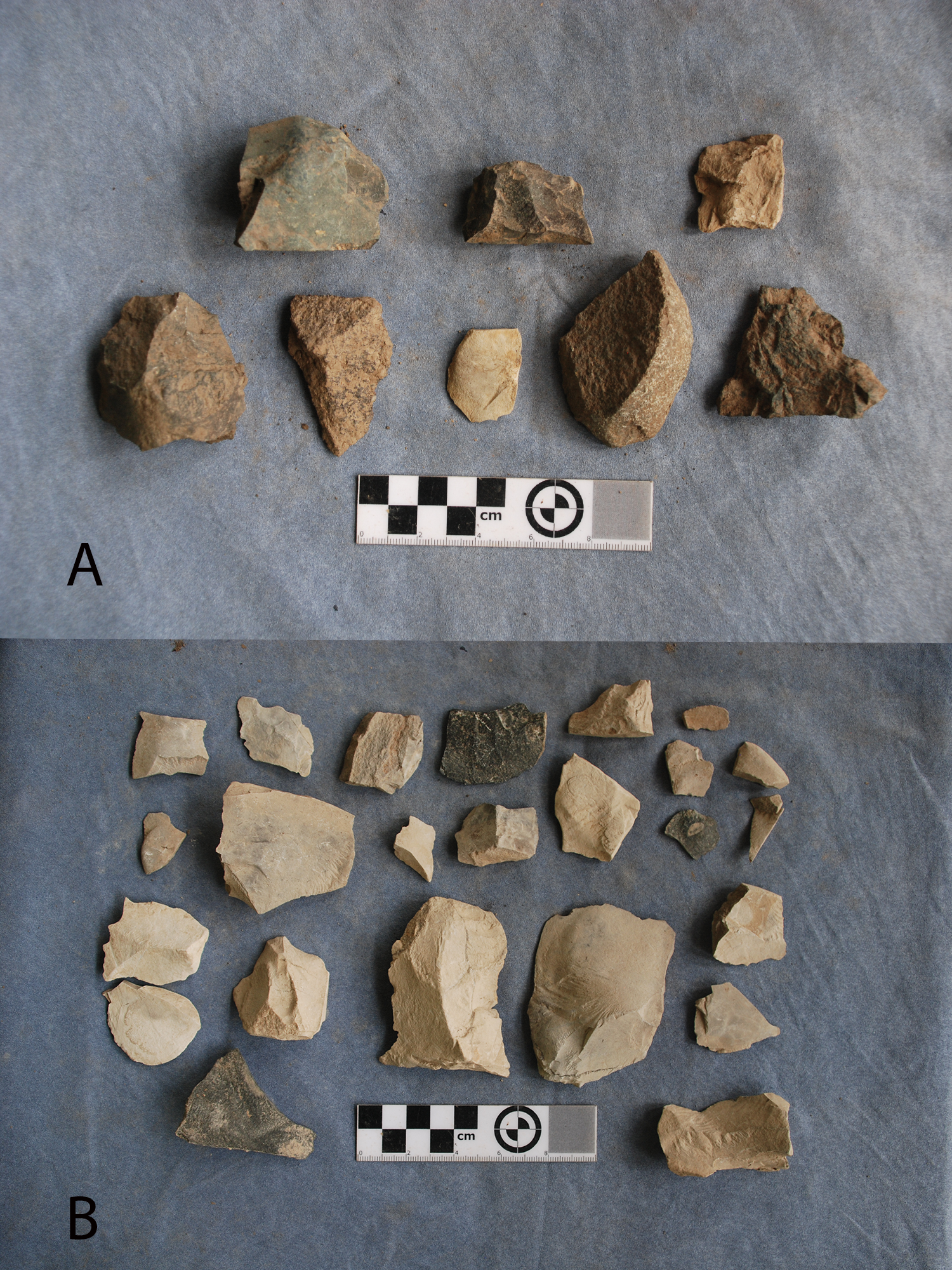
We refer to the chipped stone from these four sites as the Tambillo lithic assemblage, which is composed primarily of debitage, with few cores and no formal stone tools (Figure 3; Supplemental Table 1). By comparison, the preceramic components of Manachaqui, the region's only published hunter-gatherer site, exhibit greater formality, including projectile points, a morphologically distinct burin technology, and highly retouched scrapers (Church Reference Church1996; Lodeho Reference Lodeho2012).
Representative examples of Tambillo assemblage lithics from (A) La Joya and (B) Bóveda. (Color online)
The Tambillo assemblage is dominated by volcanic stone, limestone, and other sedimentary rock (sandstone and siltstone), as well as chert (Supplemental Table 2). In addition to macroscopic raw-material identification, the primary analytical technique applied to this assemblage is use-wear microscopy, chosen for its potential to yield information in the absence of formal tools. Like most lithic analytical methods, use-wear studies were originally developed for use on assemblages generated by hunter-gatherers (Keeley and Newcomer Reference Keeley and Newcomer1977; Odell and Odell-Vereecken Reference Odell and Odell-Vereecken1980). Elsewhere in the world, use-wear analysis has occasionally been employed in the study of sedentary groups’ tools, including obsidian and other lithic tools of the Maya (Aoyama Reference Aoyama1995; Stemp et al. Reference Stemp, Helmke and Awe2010, Reference Stemp, Braswell, Helmke and Awe2019, Reference Stemp, Elizabeth Graham and Awe2021; Walton Reference Walton2019), and of harvesting tools such as sickles and threshing sledges in the Near East (Anderson and Chabot Reference Anderson and Chabot2001; Manclossi and Rosen Reference Manclossi and Rosen2019). In the Andes, however, there are few such studies, and they mainly have been of hunter-gatherer societies such as the preceramic period Ñanchoc Valley (Dillehay and Rossen Reference Dillehay and Rossen2000; see also Nesbitt et al. Reference Nesbitt, Johnson and Horowitz2019).
Low-powered use-wear microscopy, used here, was pioneered by George Odell and typically uses magnification of 100× or less. It focuses on edge damage to tools, with the goals of identifying “the used part(s) of the implements, the prehended part(s), the activities in which the pieces had been engaged, and the relative resistance of the materials” (Odell and Odell-Vereecken Reference Odell and Odell-Vereecken1980:87). Given how little is known about use-wear patterns in ceramic period Peru, our first goal was simply to identify presence/absence. We also collected information on location, extent, and type of wear. Together, these data can provide a window into craft production, subsistence, and other topics for which the principal materials of interest (e.g., the flesh of plants and animals) rarely preserve.
Experimental Comparative Sample
To aid interpretation of use wear observed in archaeological collections, we produced a comparative sample. This is a well-attested method among use-wear analysts (Keeley and Newcomer Reference Keeley and Newcomer1977; Odell and Odell-Vereecken Reference Odell and Odell-Vereecken1980): it generates a collection of stone tools with known use histories while allowing the analyst to control for variables such as raw material, production method, and postdepositional wear.
To this end, Pratt supervised the production of a collection of flakes, blades, and burins by two experienced flintknappers. All pieces were produced on Georgetown flint by direct hard- or soft-hammer percussion. Georgetown flint is a cryptocrystalline quartz from central Texas. It is highly valued by modern hobbyist flintknappers and was selected as a commercially available approximation of the chert of Chachapoyas. Its small grain size encourages the development of clear use wear; although both the Tambillo chert and volcanic stone are somewhat larger-grained, previous studies have indicated that low-power microscopy remains reliable (Odell and Odell-Vereecken Reference Odell and Odell-Vereecken1980). We selected 20 experimental pieces based on completeness and the presence of an acute-angled edge. These were weighed and their dimensions (length, width, and maximum depth) measured. Sixteen of the 20 pieces were used in simulations of various subsistence activities (Supplemental Table 3). We organized the materials on which the tools were used by relative hardness, following Odell and Odell-Vereecken (Reference Odell and Odell-Vereecken1980): soft (grass and raw beef), soft-medium (raw carrot and potato), hard-medium (dry hardwood and soaked antler), and hard (bone and dry antler). Each piece was used for 30 minutes, with scraping, cutting, sawing, or graving motions. Some lithics were restricted to a single motion type, whereas other were used in multiple ways to simulate possible real-life conditions in the prehispanic Andes (e.g., peeling and cutting a tuber). The remaining four pieces were buried in sand and trampled for 30 minutes in shoes with soft rubber soles to test postdeposition edge damage.
Following use, all pieces were examined and photographed at 30–60× magnification using a DinoLite Edge digital microscope. We recorded the presence, location, and description of resulting use wear; Figure 4 provides two examples of experimental use wear.
Examples of experimentally produced use wear: (A) feather-terminated edge damage produced by 30 minutes of engraving wet antler; interior edge of wear outlined in orange; and (B) extensive step fractures produced by scraping bone. (Color online)

Chachapoyas Assemblages
Pratt conducted microscopic analysis of the Chachapoyas lithic assemblages following the methodology of the comparative sample. Additional data collected include flake completeness, retouch, raw lithic material—categorized broadly through macroscopic visual identification (see Table 2)—and excavation context. Each lithic artifact with an acute-angled edge was scanned under a digital microscope at about 30× magnification to identify areas of possible use wear. These areas were examined more closely and photographed at up to 120× magnification.
Raw Material of Use-Worn Stone Tools.

Results
The total lithic assemblage from the four sites in this study includes 573 pieces. Although geochemical analysis has not been performed, none of the lithics displayed visual characteristics inconsistent with locally available stone. By comparison, Manachaqui, some 100 km to the south, has small amounts of obsidian—not found naturally in northern Peru—in both its late preceramic and Empedrada phase (AD 450–570) components (Church Reference Church1996).
The bulk of the assemblage is debitage that is 2–6 cm in diameter (Supplemental Table 4). A handful of informal cores were recovered, as well as a few ground stone objects. With the exception of AS #99 (discussed later) and the cores, none of the chipped stone showed evidence of intentional modification. There were no projectile points or blade industry evident in the collection.
The hilltop ceremonial complex at Bóveda produced 84 lithics/m3, more than eight times the rate of any other in this study. There are several possible explanations for this increased density. First, the hilltop is the oldest context analyzed, likely dating to the Early Intermediate period; the relatively high proportion of stone tools may represent a greater reliance on lithic technology than in later occupations. Second, it seems to be a primarily or exclusively ceremonial complex, whereas other excavated areas include uses such as domestic space, storage, and the like. Why a ceremonial complex would be particularly rich in lithics is not clear.
No use wear was evident on the lithic assemblages from Ishpingo or Cuchaconga. Statistically this is unsurprising, given both the low overall proportion of stone with identifiable use wear in the entire Tambillo assemblage (4%) and these two sites’ small lithic assemblages and brief occupation histories (Table 2).
Of the 21 artifacts with identified use wear, 10 are from Bóveda and 11 from La Joya. Raw material type profiles are similar at both sites, with use most often seen on volcanic stone, followed by chert (Table 2). However, the sites show distinct patterns of activity (Table 3; Figure 5).
Distribution of the estimated hardness of materials worked by use-worn lithic artifacts from La Joya and Bóveda. (Color online)

Use-Wear Activity Types.

A broad array of materials seems to have been processed at La Joya, ranging from soft (e.g., tubers) to hard (e.g., bone). The assemblage is dominated by cutting-like motions (longitudinal to the working edge), with one case of chopping and one of scraping/graving. In contrast, the Bóveda assemblage is dominated by tools indicative of soft to soft/medium materials worked with a scraping motion (parallel to the working edge). Notably, at both sites use-worn tools come primarily from domestic contexts and other food preparation areas; only the limestone tool, discussed later, originates in a spatial context associated principally with ceremonial use.
Figure 6 illustrates characteristic use-wear features from each site, at 41–61× magnification. Edge denticulation and bifacial use damage on materials from La Joya are typical evidence for cutting (Figure 6A and B). Bifacial damage—when both the ventral (interior) and dorsal (exterior) surfaces of the tools become worn—develops as the tool contacts the walls of a developing groove in the worked materials. Denticulation—the development of the edge into a side-to-side wave-like pattern—is a special case that can occur from protracted cutting. The sharp, right-angled scars on Figure 6A are produced by the higher resistance of cutting against a hard material, whereas Figure 6B shows the gently worn edges of lighter resistance against a softer substance. The small, feather-terminated, unifacial damage on artifacts from Bóveda suggests scraping of soft materials (B–C); during scraping activities, only one side of the stone tool comes into contact with the worked material. Feather terminations are chips out of the stone that, unlike step terminations, fade gradually at their interior borders and are produced by friction against softer materials.
Microscopic images of edge damage on lithics from Bóveda and La Joya: (A) La Joya, unmodified chert flake; stepped fractures undercutting the lateral margin indicate cutting of hard materials; (B) La Joya, unmodified volcanic flake; denticulation of edge indicates cutting of soft materials; (C) Bóveda, unmodified volcanic flake; unifacial, small, feather-terminated removals indicate scraping of soft materials; (D) Boveda, unmodified volcanic flake fragment; unifacial, small, feather-terminated removals indicate scraping of soft material. (Color online)

Limestone and Limestone Patination
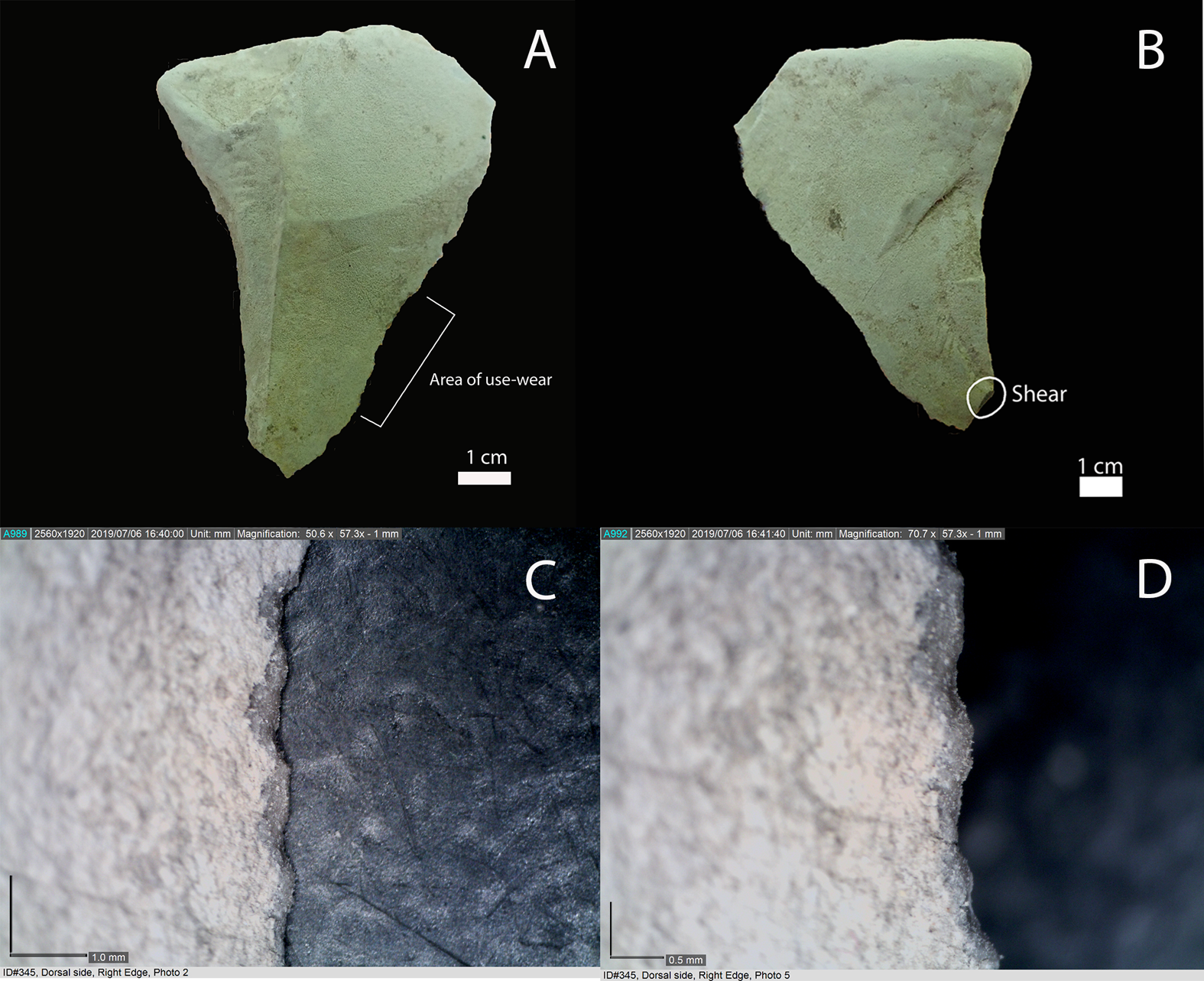
Limestone is the local bedrock and the dominant construction material at the Tambillo sites. Because of its extremely low hardness, it is generally considered a poor tool stone, and its use as knapping material is rare (but see Horowitz et al. Reference Horowitz, Bernadette Cap, Peuramaki-Brown and Eli2019). Therefore, our initial assumption was that the fragments of limestone recovered during excavation were either naturally occurring or debris from building construction. Nevertheless, we conducted use-wear analysis on all such fragments; two (AS #339 and #345) were revealed to be use-worn chert artifacts whose heavy carbonate patinas had caused them to be mistaken for limestone (Figures 2 and 7). In both cases, use-wear patterns showed that the patina was present at the time of use; both also had sheared-off tips, which might suggest testing of the stones before use.
AS #345; limestone-patinated chert tool: (A–B) putative dorsal and ventral views of tool; (B–C) microscopic views of use-worn areas. (Color online)
A third artifact—AS #99—is a true example of limestone as tool stone (Figure 8). A flake nearly blade-like in proportions, this artifact exhibits both intentional edge preparation and use wear; it is the only artifact in the assemblage with both. The level from which it was recovered represents the only probable floor surface of the circular building at the center of Bóveda's hilltop ceremonial structure, likely dating to the Early Intermediate period. The modification appears on the ventral side left edge as a series of large, regular, semicircular removals (Figure 8A, E). Adjacent to these removals are areas of generalized edge damage, which likely indicate points of heaviest use and would have obliterated any edge preparation present (Figure 8C–D). Indeed, the area of distinct preparation is more protrusive than the areas of damage, suggesting that those areas may have been significantly worn down. Although to our knowledge no use-wear studies have been conducted on limestone, the softness of the materials suggests than this kind of damage could result from relatively low levels of use.
AS #99; prepared limestone tool: (A) dorsal view; (B) ventral view; (C–E) heavily use-worn areas, above and below visible retouch; and (E) intentional retouch. (Color online)

Raw Material Acquisition
Fourteen of the 21 use-worn tools from Tambillo are made of volcanic stone, far more than any other raw material (Table 2). This may indicate a preference for volcanic stone, or it may be an artifact of the small sample size. Still, further exploration of lithic raw material acquisition is warranted; as described earlier, the nearest volcanic stone is about 5 km west and upslope from the Tambillo complex. We considered three possible competing hypotheses for the acquisition of volcanic stone: (1) directly from the source; (2) as river cobbles collected from either the Tambillo or Atuén Rivers; or (3) from the Río Tambillo exclusively, which passes directly through the area of igneous bedrock.
We modeled each of these hypotheses via binomial regression, a type of generalized linear model (GLM) appropriate for the binomial distribution of the response variable (i.e., rate of lithics that are igneous). Unlike linear models, GLMs do not rely on assumptions of normality or the transformation of variables, thereby enabling a closer approximation of real-life conditions. GLMs are particularly useful here because, unlike linear modeling, they are equipped to weigh the varying degrees of uncertainty associated with different lithic assemblage sizes. Unlike nonparametric tests (e.g., chi-squared), GLMs produce estimates of effect size. Perhaps most importantly, GLMs can be simply and meaningfully compared using corrected Akaike information criteria (AICc), whereas null hypothesis significance testing produces p- and R-squared values that are difficult to interpret and problematic to compare (Gelman and Carlin Reference Gelman and Carlin2017; Goodman Reference Goodman2008; Wasserstein and Lazar Reference Wasserstein and Lazar2016).
We calculated several binomial regressions, modeling the percentage of lithic artifacts made of igneous stone relative to each hypothesis's predictor variable (Figure 9). The sample assemblages here for Bóveda and La Joya are a subset of those included in the rest of the study, because complete lithic raw material analyses are not yet available for some units excavated in 2018.
Generalized linear models estimating prevalence of igneous raw material based on proximity to (from top to bottom) Río Tambillo, any river, and igneous bedrock.

AICc is a statistical test that compares the predictive accuracy of two or more models, penalizing for complexity. Our AICc test assigns a weight of 0.55 to the Río Tambillo model, 0.45 to the model based on general river proximity, and <0.01 to the model for proximity to igneous bedrock. Relative probability (Figure 9) describes the change in likelihood per meter that a given lithic artifact will be igneous. For example, for each meter farther from Río Tambillo, an artifact is 0.3% less likely to be igneous; over a kilometer, this accumulates to a 30% decrease. To visualize each model, we generated a set of hypothetical lithic artifacts at regular distances from the geographic feature of interest (e.g., Río Tambillo) and used the GLMs to calculate the likelihood that a given artifact would be igneous, as graphically represented in Figure 9.
This analysis suggests that the volcanic stone at the four sites was likely sourced from rivers. Given what we know about local geography, it is reasonable to infer that Río Tambillo was probably the source of most volcanic stone. In this case, modeling supports the intuitive prediction that stone was procured from secondary (riverbed) sources.
Discussion
Our results suggest that smaller datasets, typical of Peruvian ceramic period lithic assemblages, may generate a particularly representative picture of the choices that governed lithic use. Existing use-wear literature focuses primarily on large hunter-gatherer assemblages, forcing selective sampling of only the most promising artifacts and often excluding flakes, debitage, and unretouched stone. Two recent microwear studies from Paleolithic Israel (Lemorini et al. Reference Lemorini, Stiner, Gopher, Shimelmitz and Barkai2006) and Neolithic Mongolia (Liu et al. Reference Liu, Hong Chen, Xue and Yue2020), for example, examined only 20% and 16%, respectively, of stone assemblages, excluding most flakes and unretouched stone. These choices, based on macroscopically observed traits, are a kind of model-based sampling, albeit with informal models based on assumed correlations between retouch, morphology, and so on, as well as the presence or absence of microscopic wear. Statistically speaking, such model-based sampling can be well justified only once the implied correlations are made explicit and tested through design-based methods (e.g., random sampling or population measurements) to provide meaningful starting estimates (de Gruijter and ter Braak Reference de Gruijter and ter Braak1992). In this study, retouch was only evident on three of the 21 use-worn artifacts (14.3%), suggesting there may not always be a strong correlation between retouch and microscopic use wear. In addition, the limestone and carbonate-patinated tools in this study would likely have been excluded by any model-based sampling; whole-assemblage analyses are more able to produce insights that run counter to intuition or prevailing wisdom (McCall et al. Reference McCall, Horowitz, Healan, Horowitz and McCall2019). In this sense, small assemblage size in ceramic period sites may be an advantage, allowing for more complete analysis of an assemblage. At a Late Classic Maya site, for example, Stemp (Reference Stemp2004) was able to microscopically examine all 434 obsidian artifacts for use-wear evidence of bloodletting, and in an assemblage-level analysis of lithic production at the Mesoamerican Formative period site of Chalcatzingo, McCall and coauthors (Reference McCall, Horowitz, Healan, Horowitz and McCall2019) were able to answer economic questions that the study of formal tools alone could not. These analyses not only produce a less biased evaluation of the site in question but can also provide valuable statistical information for future analyses.
Based on the rate of visible use wear in the Tambillo assemblages, we recommend low-power use wear as a lithic analytical technique for ceramic period assemblages with sample sizes of at least 100 artifacts. For collections larger than about 500 pieces, we suggest simple random or stratified random sampling to minimize selection bias.
Artifact Types
The absence of projectile points at Tambillo is consistent with the sites’ faunal remains, which are overwhelmingly domesticated camelid bone, with a minor portion of guinea pig (Cavia porcellus) at some sites. Cervid antlers (likely Odocoileus virginianus) have been recovered from several sites, including Bóveda and neighboring Monte Viudo, but may have been harvested from shed antlers; the only other wild species identified were vizcacha (Lagidium peruanum) at Monte Viudo (Guengerich Reference Guengerich2014b). Among Andean sedentary societies, projectile points are typically interpreted as evidence for hunting, warfare, or both (Fortin Reference Fortin2015:77–83). Their absence here suggests that the residents of Tambillo may not have engaged in either activity. Other lines of evidence for warfare, such as traumatic injury or bolas stones, are likewise absent.
Raw Material Acquisition
Given the small number of sites in this study, results from the spatial analysis of raw lithic materials should be interpreted with caution. Nevertheless, the data suggest that residents at the Tambillo sites were embedding their procurement of igneous tool stone into visits to nearby rivers. The absence of water sources in the immediate vicinity of most sites at Tambillo suggests that travel to nearby rivers for activities such as washing, bathing, and collecting water was a common part of everyday routines—despite a difference of some 500 vertical meters from settlements. Embedded approaches to stone procurement are well documented among hunter-gatherer groups (Binford Reference Binford1979; Garvey Reference Garvey, Andrefsky and Goodale2015) and may persist within farming societies, albeit on a spatial scale more appropriate to agricultural sedentism (Parry and Kelly Reference Parry, Kelly, Johnson and Morrow1987). Future research on raw material acquisition by household agropastoralists could therefore provide a useful line of evidence for continuity or change in land use patterns across the divide of agricultural “revolution.”
Also notable is the absence of demonstrably nonlocal stone; that is, stone that could not be procured locally, whether from bedrock, in nodules, or as river cobbles. Stone was probably not part of any trade network in which the residents of these sites took part, despite evidence for such a network in the presence of lowland plants (see the later discussion).
Although spatial analyses are common in ceramic period studies, their application to lithics has largely been restricted to obsidian. Our results indicate that spatial analyses of other kinds of raw stone can also be instructive. They also call attention to the potential of the local scale, in addition to the regional scales at which both obsidian sourcing and nonlithic spatial analyses usually operate (e.g., spatial network analyses).
Use Wear
Seven of the 10 use-worn lithic tools from Bóveda, dominated by a scraping motion of relatively soft substance(s), were recovered from a unit in the residential zone: the interior of a typical circular stone building atop an unusual, earlier rectilinear one. Abundant faunal bone (1,339 g/m3) and macrobotanicals (258 g/m3) were recovered, attesting to the intensity of food-processing activities in this household. Identifiable macrobotanicals include carbonized potato (Solanum tuberosum) and possibly mashua (Tropaeolum tuberosum; Guengerich et al. Reference Guengerich, Ocaña, Crandall, Marla Toyne and Sánchez2019). Phytolith and starch analyses of soil sampled from agricultural terracing surrounding the site produced evidence of potato, corn (Zea mays), gourd (Cucurbita), and arrowroot (Marantha arundinacea): all these products would be consistent with the soft- to soft-medium materials attested by wear patterns on the lithic assemblage from this site. Camelid bone recovered from the site also suggests meat-, hide-processing activities, or both.
Results from La Joya, as noted, are dominated by chopping and cutting motions indicative of a range of materials from soft to hard. Wear from soft to soft-medium materials could, as at Bóveda, indicate processing of plant foods and meat. Use-worn tools from La Joya come from units that feature evidence for food preparation and consumption, such as an informal hearth, utilitarian ceramics, grinding stones, and animal bone, supporting that conclusion. Harder worked surfaces could include hardwood and bone; paleoecological evidence at nearby Laguna de los Cóndores suggests significant contemporaneous forest cover in the Late Horizon (Matthews-Bird et al. Reference Matthews-Bird, Valencia, Church, Peterson and Bush2017), and materials from well-preserved graves at that site indicate a heavy reliance on wood as a raw material (von Hagen Reference von Hagen, Silverman and Isbell2002). Although stone carving was a widespread medium of craft production in Indigenous Chachapoyan groups, we lack the experimental or systematic artifact studies needed to identify expected use-wear patterns from such crafting, highlighting one important area for future research.
The interpretation of lithic use wear is informed by many other lines of evidence and, in turn, offers novel insights and raises new questions. For example, one possible explanation for the preponderance of scraping of soft materials at Bóveda is the removal of corn kernels from cobs. Bóveda produced large, coarse ceramics compatible with the brewing of chicha; Haslam's (Reference Haslam, Hart and Wallis2003) case of use-worn Central American obsidian suggests that stone tools were likely part of some kinds of corn processing, and the use wear on Bóveda's tools could be consistent with such activity. Potatoes are another possible processed substance, although they require less intensive preparation and are often simply baked or boiled whole. Reeds and grasses, likely used in the characteristic thatched roofs of Chachapoyas (Davis Reference Davis1996), are additional candidates, and the botanical assemblage from Monte Viudo included species of Cyperus, a genus associated with rushes and wetland settings. Hide processing, a common example of preceramic scraping damage, may also have taken place, because leather dress items, such as headdresses and spectacled bear skins, have been recovered from well-preserved contexts elsewhere in Chachapoyas (Vásquez Sánchez et al. Reference Vásquez Sánchez, Koschmieder and Rosales Tham2013; von Hagen Reference von Hagen, Silverman and Isbell2002).
Future analyses of faunal and botanical assemblages from Bóveda and La Joya may provide more insight into the sources of observed lithic use wear. Analysis of ceramic assemblages from the two sites, however, reveals major differences in vessel type that support findings from lithic use-wear analysis. The assemblage at La Joya is dominated by cántaros, a vessel used both for brewing chicha and cooking, which comprise slightly less than half the assemblage at Bóveda (respectively, 84% vs. 48%). Differences are also apparent in the percentage of strainers, a locally distinctive vessel type consisting of a shallow wide bowl perforated by 1 cm long rough holes and likely used for some kind of food processing, potentially of mote (hominy; 13% of 83 total vessels at Bóveda vs. 5% of 128 total vessels at Joya). Although these analyses are preliminary and are biased toward high-status residential contexts at both sites, the differences are substantial. We hypothesize that the site-level differences in food preparation attested in use-wear patterns of lithic assemblages are also reflected in ceramic vessel types. Lithic use wear, therefore, may provide a complementary dataset for reconstructing food-related practices, with a particular emphasis on productive activities, rather than consumption or distribution.
Limestone Artifacts: Use Wear and Raw Material Procurement
A final area of insight is in knowledge of local materials. The limestone tool discussed earlier (AS #99) was both more formally produced (i.e., the prepared edge) and less durable than the other tools in these assemblages. Considering the nonresidential structure in which it was found, we hypothesize it was produced for a ceremonial purpose that would have not required the technical functionality of other stone. Limestone has a hardness of only 2–4 on the Mohs scale—compare to basalt at 6 and chert at 6.5–7—and is not as brittle or elastic as these “tool stones,” making predictable conchoidal fracturing more difficult (Horowitz et al. Reference Horowitz, Bernadette Cap, Peuramaki-Brown and Eli2019). The edge preparation therefore would likely not have added much functional value as a cutting or scraping tool, and its use wear is not extensive enough to completely obscure the retouch, suggesting the possibility of only brief or token use. Anecdotally, this object also suggests a discontinuity in lithic morphology. Although the majority of household tools were unretouched flakes, AS #99 indicates there was also a conception of a more formal toolset, with blade-like proportions and a prepared edge. This discontinuity may represent increasing informality over time (AS #99 was recovered from an Early Intermediate period context), change across social context (AS #99 was recovered from a ceremonial complex), or both.
The two heavily patinated tools with chert interiors raise additional questions about raw material selection. The absence of patina on their use-worn areas, which completely covers the rest of the artifact, demonstrates that the patina was present during use. Two possibilities present themselves: (1) the prehistoric tool user selected these as limestone tools, and their chert interiors incidentally facilitate their identification as use-worn tools today, or (2) the prehistoric tool user recognized them as chert, despite their heavy carbonate patina. Either possibility offers insights regarding ceramic period lithic raw material selection and knowledgeability. Although their sheared tips suggest testing for raw material quality, a sample size of two is insufficient to establish a pattern.
Combined with the embedded procurement of volcanic stone indicated by our spatial modeling, these results suggest significant local knowledge regarding the availability, qualities, and uses of various stones. The prepared limestone tool hints that prehistoric Andean agriculturalists may not have shared our modern archaeological presuppositions about raw materials based on functional utility alone; thus, by a conscious evaluation of our biases and their effects on research design, we may better understand the technological priorities of prehistoric tool users.
Andeanists have long emphasized the choices made by agropastoralist societies in maximizing the ecological opportunities afforded by vertically distributed environments (e.g., Brush Reference Brush1976; Masuda et al. Reference Masuda, Shimada and Morris1985; Murra Reference Murra, Masuda, Shimada and Morris1985). We propose that, likewise, the study of lithic acquisition at the local level may provide insight into how local groups conceptualized and interacted with their environments. In the case of the Chachapoyas region, the use of limestone for tools in domestic and ceremonial contexts may have taken on ideological significance, given its importance as a medium for rock art and for the construction of tombs and sarcophagi in limestone cliff faces (Kauffmann Doig and Ligabue Reference Kauffmann Doig and Ligabue2003; Toyne and Anzellini Reference Toyne and Anzellini2017; von Hagen Reference von Hagen, Silverman and Isbell2002). Indeed, concerns with political ecology and socialized interactions with the environment have become increasingly salient in the work of scholars studying later Andean prehistory (e.g., Contreras Reference Contreras2010; Grant and Lane Reference Grant and Lane2018; Langlie Reference Langlie2018). Because stone represents one of the primary foci of such inquiry, primarily in the context of monumental architecture or wak'as (Bray Reference Bray2015; Dean Reference Dean2010; Janusek and Williams Reference Janusek, Ryan Williams and Costin2016), it is surprising that so little attention has been paid to the ways in which this powerful and often animate substance may have been put to more quotidian ends on a daily basis.
Conclusions
The small size and informality of lithic assemblages of ceramic period sites can lead to the assumption that stone tools were unimportant during these periods. Although it is possible that innovations in material technology such as ceramics and woven cloth diminished some of the cultural significance of stone tools, the hardness, sharpness, and durability of stone can be expected to retain utility not readily matched by wood, ceramic, or soft metal alloys. As traditionally formulated in hunter-gatherer studies, sedentism encourages lithic informality by releasing pressures on portability and the efficient use of stone (Binford Reference Binford and Wright1977, Reference Binford1980; Surovell Reference Surovell2012). It is important, therefore, to evaluate how assumptions about informal tools may underestimate the role of lithics in ceramic period societies, whose tool makers may not have shared our technological values and priorities.
Although changing subsistence bases altered the function and use life of stone tools, it is clear that they were nonetheless a part of the material culture repertoire of sedentary, agricultural Chachapoyas and have information to contribute to our understanding of it. Chipped stone production is especially useful because it typically produces large amounts of debitage that offer more detailed information about the steps of production than can typically be inferred about other craft materials. Stone is also the most ubiquitous prehistoric production material, which—unlike more temporally restricted materials such as ceramics—permits comparisons across broad sweeps of time and major socioeconomic changes (Rosen Reference Rosen1997).
Interpretation of use wear is most useful in combination with other lines of evidence; the significance of a scraping tool is different in a sedentary agricultural society than in the mobile hunter-gatherer groups for whose tools microscopic use-wear analysis was developed. Lithics can also be leveraged using methods such as spatial analysis and modeling that are already familiar to archaeologists studying complex groups. Combined, these techniques not only have the potential to address topics of common interest such as subsistence, landscape use, and ceremonial practices but they may also raise new questions that can be answered via the full spectrum of material analyses. In sum, these results illustrate the need for greater attention to the lithic assemblages of non-hunter-gatherer Peruvian sites; far from being incidental, they hold important and sometimes surprising information value.
Acknowledgments
We express our utmost gratitude to the municipality and the comunidad campesina of Leymebamba, Peru, as well as the landowners on whose properties this research took place. We wish to acknowledge our principal fieldwork coordinator Eyrin Chavez Chancahuana, our codirector Grace Alexandrino Ocaña, and our other team members whose contributions made this fieldwork possible. Macro- and microbotanical analyses from the 2011–2012 and 2017–2018 seasons were conducted by the Arqueobios Laboratories, under the direction of Victor Vásquez Sánchez. Research was supported by the National Geographic Committee for Research and Exploration (#HJ-090-R17) and the Rust Family Foundation Archaeological Research Grant. Additional support came from the University of Michigan Rackham Graduate School and Center for the Education of Women+, and from University of Michigan graduate students who assisted with the creation of the experimental lithics assemblage. Research was conducted with permission from the Peruvian Ministry of Culture, Permits #105-2018/DGPA/VMPCIC/MC and #151-2017/DGPA/VMPCIC/MC.
Data Availability Statement
Documentation and the technical reports from the Tambillo Archaeological Project are on file with the Ministry of Culture, Peru. All artifacts described here are housed at the Amazonas office of the Ministry, in Chachapoyas, Peru. Data and code for the statistical models, testing, and graphics are available at http://doi.org/10.5281/zenodo.5126457.
Competing Interests
The authors declare none.
Supplemental Material
For supplemental material accompanying this article, visit https://doi.org/10.1017/laq.2022.33.
Supplemental Figure 1. Prevalence of “lithic” and “ceramic” in published literature on ceramic period Peruvian archaeology.
Supplemental Table 1. Artifact Types of the Tambillo Lithic Assemblage.
Supplemental Table 2. Raw Material of the Tambillo Lithic Assemblage.
Supplemental Table 3. Experimental Use-Wear Assemblage.
Supplemental Table 4. Size Grades of the Tambillo Lithic Assemblage.


 Open access

