

Buffalo are a primary resource of milk and meat in Southeast Asia. Thermal extremes have been observed to suppress the reproductive ability of the animal resulting in poor expression of oestrus behaviour (Boer et al., Reference Boer, Veerkamp, Beerda and Woelders2010; Gamit et al., Reference Gamit, Singh, Kumar, Choudhary, Kharadi and Fulsoundar2015). Luteinizing hormone is secreted by the anterior pituitary and plays a role in reproductive functions such as ovulation in females and synthesis of androgens in males (Chagas et al., Reference Chagas, Bass, Blache, Burke, Kay, Lindsay, Lucy, Martin, Meier, Rhodes, Roche, Thatcher and Webb2007). Luteinizing hormone consists of two subunits: alpha and beta. Beta subunit has sequence of the 119 amino acids in both bovine and porcine and 17 amino acids replacements were detected in bovine and porcine. There were no free amino terminal residues on beta polypeptide chain of luteinizing hormone (Maghuin‐Rogister and Hennen, Reference Maghuin‐Rogister and Hennen1973). The functional pathway of the hormone has suggested its significant role in ovulation and oestrus cyclicity in mammals (Khatib et al., Reference Khatib, Monson, Schutzkus, Kohl, Rosa and Rutledge2008). Identification of single nucleotide polymorphisms (SNPs) for specific genes involved in reproduction might improve reliability of genomic estimates for these low-heritability traits (Wiggans et al., Reference Wiggans, Vanraden and Cooper2011). Therefore it was hypothesized that SNPs in luteinizing hormone subunit β (LHβ) gene might have specie-specific effect on silent oestrus behaviour in Nili Ravi buffalo and Sahiwal cattle. To test this hypothesis, the LHβ gene was characterized in river buffalo of Pakistan. Animals were categorized into groups based on their heat index (threshold ∼ 50) and blood samples were collected for genomic DNA identification. The exonic regions of the gene were amplified and sequenced. A total of six unique polymorphic sites were identified. Bioinformatics and statistical analysis for each locus illustrated the significance of the polymorphism in the population of river buffalo. Further protein structural conformation was also analyzed and c.V15M was found affecting the structural configuration and deleting a transmembrane helix in the final protein structure. Results illustrated the significance of genomic variations in LHβ gene in affecting the oestrus behaviour and cyclicity.
Materials and methods
Sampling strategy
Sampling was conducted during the months of August-September. Nili-Ravi buffalo was the taxonomic breed for the experiment. Animals in their second and third parity with average body weight of 450–550 kg were selected. All animals were fed on the same diet (green fodder and commercial concentrate ration with water ad libitum). Animals were screened for oestrus behaviour by calculating the heat index as described by Roelofs et al. (Reference Roelofs, Van Eerdenburg, Soede and Kemp2005). According to this method, various signs of heat are given a particular score and then the cumulative scoreof the visible signs is determined to identify the heat index of an animal (see online Supplementary Table S2). If this heat index is less than 50, the animal will fall into the group with low oestrus behaviour. On the basis of heat index, Nili-Ravi buffaloes were categorized into two groups (50 animals in each group). Blood samples (n = 100) were collected from the Buffalo Research Institute and UVAS, Ravi campus, Pattoki-Pakistan in EDTA vacutainer tubes and were placed on ice and then transferred to the laboratory and stored at −20˚C before DNA extraction. Ethical approval for the study was acquired from University Veterinary Ethical Review Committee (VERC/278).
DNA extraction and quantification
Extraction of DNA was done using the organic method (phenol-chloroform-isoamyl alcohol: Sambrook and Russel, Reference Sambrook and Russell2001). The quantity and quality of DNA samples was estimated by Nano Drop ND-2000 spectrophotometer.
Primers
Three sets of primers were designed using Primer3 software (https://primer3.ut.ee/) (online Supplementary Table S1). Exonic regions of LHβ gene were targeted for the selection of primers with optimal GC content and primer melting temperature.
Gene amplification and sequencing
The amplification of the targeted regions of the DNA was performed using the polymerase chain reaction (PCR) in Kary-Tech Thermocycler. The primers were optimized by varying annealing temperature. The sequencing of the PCR amplicons was done by the standard Sanger's chain termination method with collection of data relating to the DNA fragments of different lengths. All of the PCR products were sequenced by ABI labs, Lahore.
Analysis of LHβ sequences
Bioinformatics tools were used for the analysis of amplified sequences. For multiple sequence alignment of various samples, ClustalW was used. NCBI resource nucleotide BLAST (blastn) tool was used for nucleotide sequence homology analysis (Thompson et al., Reference Thompson, Gibson and Higgins2002). Sequences were also aligned against the reference sequence through BLAST software (online Supplementary Figure S1). POPGENE1.32 was used for Chi2 testing and one-way ANOVA was used to find the association of the SNPs with oestrus score. 3D protein structure was predicted using Phyre2 (https://www.sbg.bio.ic.ac.uk/~phyre2/).
Results
Identification of novel polymorphisms
A total of six SNPs were identified in exonic regions of LHβ gene (Figure 1). Four out of these six were transitions (c.356027C < T, c.V15M, c.356087T < C, c.356113C < T & c.356125G < A) and only one was transversion (c.356090A < C). c.V15M SNP was non-synonymous mutation replacing valine with methionine, which is a nonpolar amino acid. c.356090A < C and c. 356113C < T were previously reported by Reen et al. (Reference Reen, Kerekoppa, Deginal, Ahirwar, Kannegundla, Chandra, Palat, Das, Kataktalware and Jeyakumar2018), but the other polymorphic sites are novel for the river buffalo population.
Gene structure and location of SNPs (shaded blue) in LHβ gene of Nili Ravi buffalo of Pakistan.

Population statistical analysis
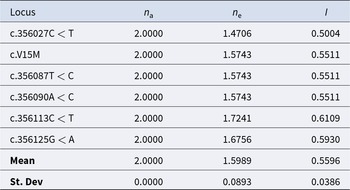
To check the genetic probability of the identified polymorphic sites in the buffalo population, a chi-square test was performed. c.V15M and c.356090A < C were obeying the Hardy-Weinberg equilibrium with Chi2 values greater than 0.05 (0.466742, 0.065443 respectively) (Table 1). These SNPs are the candidate regions for association testing. Allelic frequencies of these two SNPs were 0.7600 for wild and 0.2400 for mutant allele and 0.7200 for wild and 0.2800 for mutant allele (Table 1). Association analysis was done with one-way ANOVA and SNPs genotypes were tested alongside their heat index (Table 2). The wild genotype of c.V15M was found to be associated with the higher heat index group (65 ± 5.62) and mutant and heterozygous genotypes were found to be associated with the lower heat index group (47.5 ± 4.61, 45.86 ± 1.08). The probability of the association was found to be 0.007171 (P < 0.05) depicting medium to strong association of SNP with the trait. Shannon's information index and heterozygosity statistics tests were performed by the POPGENE software (Tables 3 & 4). The mean of Shannon information index for all loci was 0.5596 which shows the community has medium diversity. The average heterozygosity of the population is 0.3729, which is below the expected heterozygosity.
Summary of novel polymorphisms identified in LHβ gene in Nili-Ravi buffalo

* HWE- Hardy Weinberg equilibrium (NS-Nonsignificant, S-Significant).
Association analysis (mean ± S.E) of LHβ gene in Nili-Ravi buffalo on the basis of heat scoring (heat index threshold-50)

Shannon's information index for polymorphic sites of LHβ gene in Nili-Ravi buffalo

n a = Observed number of alleles.
n e = Effective number of alleles.
I = Shannon's Information index.
Summary of heterozygosity statistics of LHβ gene in Nili-Ravi buffalo

Obs: observed homozygosity and heterozygosity values as detected.
* Expected (Exp) homozygosity and heterozygosity.
** Nei's expected heterozygosity.
Ave Het: average heterozygosity.
3D protein modelling
To translate the nucleotide sequences of the LHβ gene and check the amino acid change in the protein, Expasy protein translate tool was used for mutant and wild buffalo sequences. c.V15M was candidate SNP for this analysis. Phyre 2 software was used to construct the 3D model of protein for mutant and wild buffalo (Figure 2). A total of 118 residues (84% of sequence) were modelled with 100.0% confidence by the single highest scoring template. Valine is polar and methionine is nonpolar in nature and slight changes in the protein were observed. The secondary structure of wild and mutant proteins showed that the alpha helix was 16% in mutant whilst it was 18% in the wild protein. The SS confidence shows that the predicted protein is accurate. A transmembrane helix was also predicted from 46 to 61 residues index from N-terminal to C-terminal.
3D structural analysis of the LHβ protein in buffalo. A: sequence alignment of reference and mutated protein shows non-synonymous mutation. B: 3D model of the protein depicts fold change. C: secondary structural elements show variation in wild and mutant forms of protein. D: transmembrane helix is located between residues 46-61 in the LHβ protein.

Discussion
The river buffalo is considered to be a significant livestock species for milk and meat production. Poor expression of oestrus signs leads to low productivity of buffalo throughout the year and the animal can easily become a repeat breeder with a wasted oestrus cycle (Phogat et al., Reference Phogat, Pandey and Singh2016). A genetic association of oestrus behaviour is evident from previous reports (Basavarajappa et al., Reference Basavarajappa, De, Thakur, Datta, Dogra, Yadav and Goswami2008; Ezzat et al., Reference Ezzat, Saito, Sawada, Yaegashi, Goto, Nakajima, Jin, Yamashita, Sawai and Hashizume2010; Homer et al., Reference Homer, Derecka, Webb and Garnsworthy2013), therefore this study tested the hypothesis of association of the LHβ gene with the heat index calculated with the method reported by Roelofs et al. (Reference Roelofs, Van Eerdenburg, Soede and Kemp2005). A total of six SNPs were identified in the exonic regions of the gene, five being synonymous. The frequency of mutated allele B was found to be low in all the loci, depicting the rare nature of this variation among the population. The heterozygosity index was also low to medium, depicting a conserved pattern of inheritance of the gene. A novel non-synonymous variant (c.V15M) was identified in the second exon of the gene, which illustrated deviation in the wild protein configuration by changing the orientation of secondary structural elements (α-helix and β-sheets). The transmembrane helix was found to be unaffected due to this mutation. Protein binding efficiency may also be reduced due to a change in the nature of amino acid (valine is polar and methionine is nonpolar), which can be a cause of poor protein function. Further proteomic analysis is needed to confirm this proposition.
There are few reports of LHβ gene variations in other mammalian species, however, the nucleotide sequences of the LHβ subunit are found to be less conserved (Chien et al., Reference Chien, Shen, Lin and Yu2005). Moreover, there are older reports of variations in the biological activity of LHβ to stimulate testicular androgen secretion in males (Yu and Wang, Reference Yu and Wang1987; Yu et al., Reference Yu, Shen, Liu, Weng, Peng and Liu1995; Yu et al., Reference Yu, Shen, Yang, Papkoff and Ishii1996). In another study by Basavarajappa et al. (Reference Basavarajappa, De, Thakur, Datta, Dogra, Yadav and Goswami2008), various synonymous and non-synonymous variants were identified in river buffalo for the LHβ gene, depicting the non-conserved nature of the gene. In various studies, LHβ gene has also been found associated with semen quality traits in buffalo bulls (Katongole et al., Reference Katongole, Naftolin and Short1971; Cheng et al., Reference Cheng, Gu, Xue, Li, Liang, Wang, Wang, Wu, Liu and Yu2017; Reen et al., Reference Reen, Kerekoppa, Deginal, Ahirwar, Kannegundla, Chandra, Palat, Das, Kataktalware and Jeyakumar2018). In spite of its crucial role in reproduction, variations of the LHβ gene have only being found in a few bovine species and human. Considering the unique nature of the gene, further investigation is needed to examine its architecture in other species, locating the novel functional sites which can control its regulation and expression.
In conclusion, based upon the outcomes of the present research, the LHβ gene does exhibit significant polymorphisms in river buffalo of Pakistan. The newly identified novel SNP, c.V15M has been found to be associated with poor oestrus scoring and silent heat in buffaloes. This can be a candidate marker for animal genetic improvement programs, and may assist in devising useful strategies for exploring the regulation of the expression of the LHβ gene.
Supplementary material
The supplementary material for this article can be found at https://doi.org/10.1017/S0022029925000342.
Acknowledgements
Authors acknowledged the cooperation of officials from Animal Farms, University of Veterinary and Animal Sciences, Pattoki for collection of blood samples and data recording.





 Open access

