

Introduction
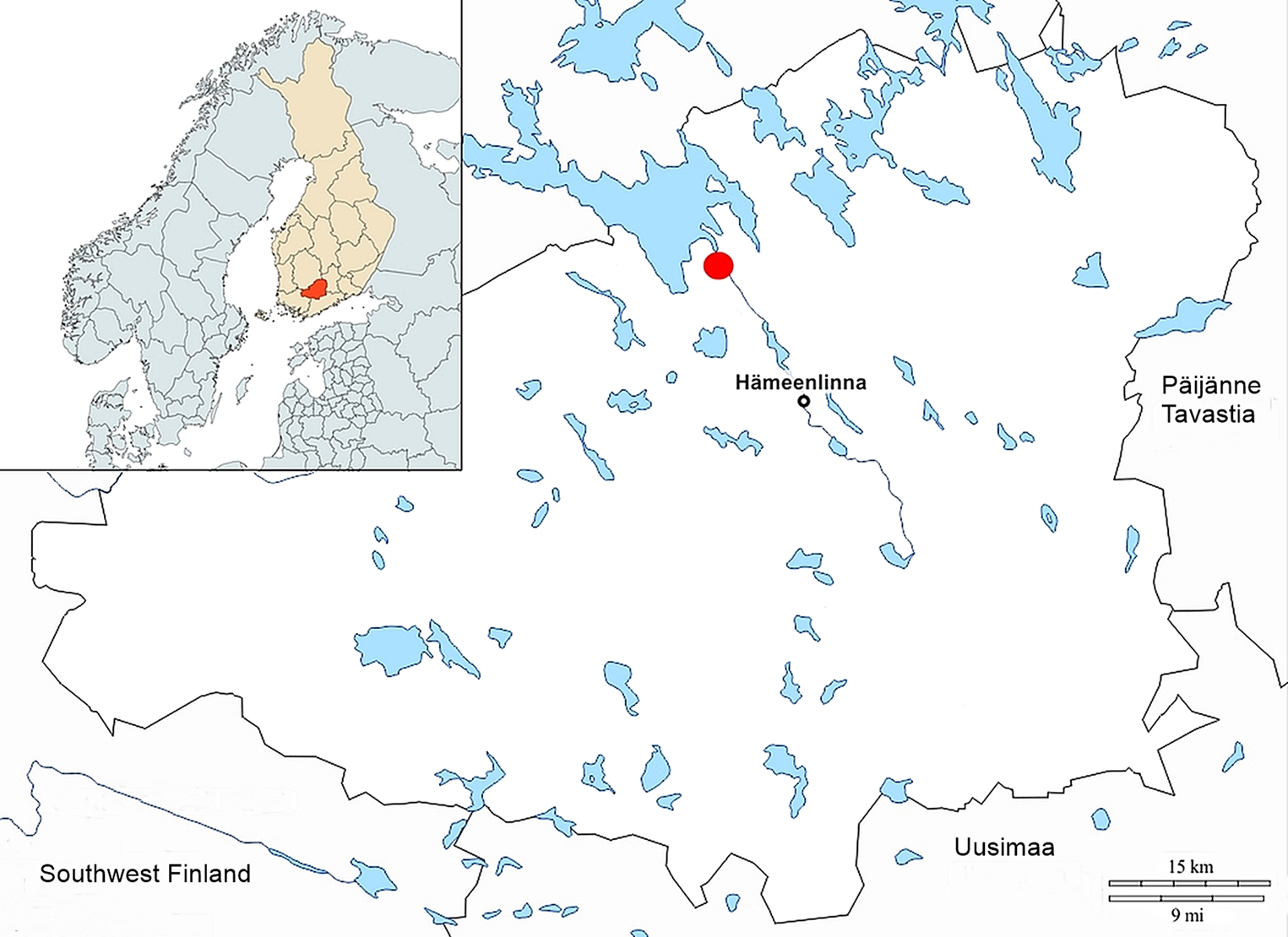
There is an enduring fascination with women buried with weapons, but the topic continues to be debated (e.g. Androshchuk, Reference Androshchuk2018; Price et al., Reference Price, Hedenstierna-Jonson, Zachrisson, Kjellström, Storå and Krzewińska2019). A specific Finnish find, an early medieval inhumation grave dated to (ad 1050–1300)Footnote 1 found at Suontaka Vesitorninmäki in the municipality of Hattula (formerly Tyrväntö) (Figure 1), has often been interpreted as a woman buried with two swords. The interpretation is based on dress accessories and jewellery, which suggest that the individual was dressed in feminine clothes. For decades, the grave has been a popular example of powerful women in Late Iron Age and early medieval societies (Lehtosalo-Hilander, Reference Lehtosalo-Hilander and Jansson1983: 304, 402–03; Ojanen, Reference Ojanen2002: 47; Huurre, Reference Huurre2009: 213). At the National Museum of Finland's permanent exhibition between 1995 and 2016, the grave was used as evidence of female leaders in the past (Erä-Esko et al., Reference Erä-Esko, Huurre, Purhonen and Sarkki-Isomaa1995: 45). In popular discussions and contexts, for example history forums on the internet, international sword replica shops, and even in the controversial ‘Meet the Viking’ exhibition at the National Museum of Denmark (see Pentz et al., Reference Pentz, Varberg and Sørensen2019; Sindbæk, Reference Sindbæk2019), the decorated bronze-hilted sword allegedly found in the Suontaka burial is presented as a female warrior's weapon.
Location of the Häme (Tavastia) region in Finland, with Suontaka marked with a red dot.
In this article, we present the first detailed study of the Suontaka grave. We undertook a careful analysis of the original field documentation to determine whether the grave had initially been a double burial, and to provide clarification on its context. To investigate the grave's original context in detail, we conducted a study of microscopic animal hair and fibre remains from the soil retrieved from the grave. Lastly, we studied ancient DNA (aDNA) from the skeletal remains to infer the chromosomal sex of the individual. We conclude the article by drawing the results of these analyses together and discuss their possible meaning in the framework of gender archaeology.
Sex and Gender: A Complex Issue
The archaeological literature is full of men and women. For decades, buried individuals have been interpreted as male or female based on grave goods, and the development of osteology and genetics have brought in new methods to determine human remains as either female or male. This binary division is, however, problematic. Chromosomal aneuploidies—as well as certain genetic and hormonal conditions—widen the variation in biological sex (Sofaer, Reference Sofaer, Gowland and Knüsel2006: 157; Fausto-Sterling, Reference Fausto-Sterling2020: 74–76), but biology itself offers little in terms of a person's self-identification. Some recent studies suggest that brains produce personality, cognition, and behaviour similarly regardless of chromosomal sex, in opposition to the idea that binary female and male differences exist in the brain (Joel et al., Reference Joel, Berman, Tavor, Wexler, Gaber and Stein2015, Reference Joel, Garcia-Falgueras and Swaab2020).
In the 1970s, it became common to distinguish biological sex from socially and culturally defined gender (e.g. Fausto-Sterling, Reference Fausto-Sterling2020: 14–16 with references). This concept has since been developed further. Butler (Reference Butler1990) has argued that sex and gender are interlinked social constructs: gender is a performance based on the expectations of society, a set of norms associated with a certain kind of body. While social gender can be understood as representing culturally specific expectations of behaviour, sex can be understood as a common agreement on certain chromosomal, hormonal, anatomical, and physical features (Butler, Reference Butler1990; Fausto-Sterling, Reference Fausto-Sterling2012, Reference Fausto-Sterling2020).
The binary division of sexes is arguably rooted in a modern, western mindset, and gendered norms and expectations have varied culturally, geographically, and temporally (e.g. Laqueur, Reference Laqueur1990: 6–12; Comaroff & Comaroff, Reference Comaroff and Comaroff1992: 78; Motschenbacher, Reference Motschenbacher2010: 13). Early medieval societies evidently had their own expectations and norms for female- and male-bodied individuals, but were these norms inflexible and exclusive? And how were they negotiated and displayed in different circumstances? The traditional view emphasizes rigid masculine ideals (e.g. Clover, Reference Clover1993; Hedeager, Reference Hedeager2011), but many recent studies indicate that early medieval societies understood and performed gender in diverse and nuanced ways (e.g. Back Danielsson, Reference Back Danielsson, Alexandersson, Andreeff and Bünz2014; Moen, Reference Moen2019). This encourages us to think about a gender spectrum instead of a binary gender division (Moen, Reference Moen2019: 217).
The complexity of gender is evident in the problem of determining the sex or gender of individuals based on the artefacts recovered from their graves (e.g. Berg & Lie, Reference Berg and Lie1995; Effros, Reference Effros2000; Stratton, Reference Stratton2016). It is unclear how well the grave goods represent the gender roles and identities of the past, and whether these roles should be interpreted from a binary perspective (e.g. Hjørungdal, Reference Hjørungdal1994; Nixon, Reference Nixon, Archer, Fischler and Wyke1994; Conkey & Gero, Reference Conkey and Gero1997; Gilchrist, Reference Gilchrist1999; Sørensen, Reference Sørensen2000; Joyce, Reference Joyce2008; Hedenstierna-Jonson et al., Reference Hedenstierna-Jonson, Kjellström, Zachrisson, Krzewińska, Sobrado and Price2017; Moen, Reference Moen2019; Price et al., Reference Price, Hedenstierna-Jonson, Zachrisson, Kjellström, Storå and Krzewińska2019). Although swords in early medieval graves in northern Europe can be interpreted in many ways, from symbols of power and social status to ancestral heirlooms (Hadley, Reference Hadley, Crawford and Hamerow2008: 273; Gardela, Reference Gardela2013; Härke, Reference Härke2014; Harrison, Reference Harrison, Barrett and Gibbon2015), they are still often associated with masculinity and warrior ideology (see e.g. Jakobsson, Reference Jakobsson1992; Petré, Reference Petré1993; Raninen, Reference Raninen2006: 4; Hadley, Reference Hadley, Crawford and Hamerow2008; Hedeager, Reference Hedeager2011: 118, 124; Harrison, Reference Harrison, Barrett and Gibbon2015; Sayer et al., Reference Sayer, Sebo and Hughies2019: 561). While axes, spearheads, and arrowheads have occasionally been buried with female-bodied people, and may appear in graves together with feminine jewellery (e.g. Mägi, Reference Mägi2002: 77–79; Gardela, Reference Gardela2013; Moisio, Reference Moisio2016; Lund & Moen, Reference Lund and Moen2019), swords are rare items in graves of female-bodied individuals (Raninen, Reference Raninen and Mäntylä2005: 229; Wessman, Reference Wessman2010: 102; McLeod, Reference McLeod2011: 343; Raninen & Wessman, Reference Raninen, Wessman, Haggrén, Halinen, Lavento, Raninen and Wessman2016: 319–20). An interesting aspect of the graves containing osteologically determined females and swords is that they often lack jewellery and other feminine accessories (Simniškytė, Reference Simniškytė and Bliujienė2007; Price et al., Reference Price, Hedenstierna-Jonson, Zachrisson, Kjellström, Storå and Krzewińska2019). This is seemingly in line with the idea that the Scandinavian gender system accepted masculinity as the only normative gender and allowed only some females to obtain masculine gender in certain circumstances (Clover, Reference Clover1993). Weapons are often considered non-normative items in women's graves, and the emphasized masculine symbolism of swords is the reason why graves containing both ‘typically’ feminine and masculine items are often considered problematic. The combined presence of weapons and jewellery in graves easily leads to interpretations of mixed gender double burials, even if the context indicates only a single skeleton in the grave (see Nylén, Reference Nylén, Sarvas and Siiriäinen1973: 165; Taavitsainen, Reference Taavitsainen1990: 91; McLeod, Reference McLeod2011: 343; Androshchuk, Reference Androshchuk2018). However, as Moen (Reference Moen2019) has pointed out, the graves may not tell us about the gender systems of the past per se, but rather about the assumptions of the modern people making the interpretations.
The Context of the Suontaka Grave
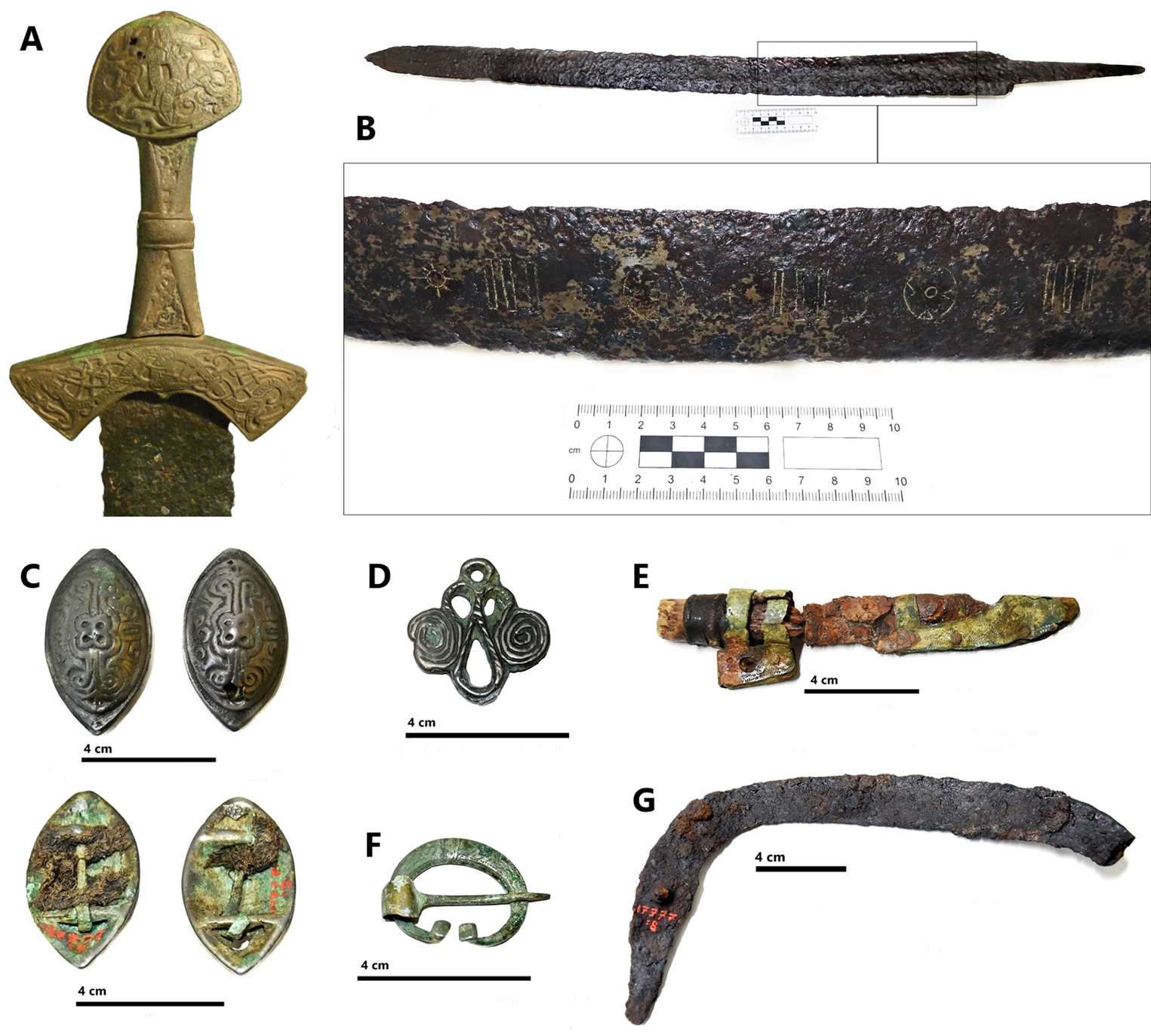
The Suontaka grave is famous for its bronze-hilted sword (National Museum of Finland, hereafter NM, accession number 17777:1), decorated with Urnes style ornaments (Keskitalo, Reference Keskitalo1969b) (Figure 2A). The other finds include a less-discussed, hiltless sword blade (NM 17777:2) with silver inlays, a sheathed knife (NM 17777:3), two oval brooches (NM 17777:4–5), a twin-spiral chain-bearer (NM 17777:6), a small penannular brooch (NM 17777:7), and a sickle (NM 17777:8) (Figure 2B–G). Of these items, the swords are traditionally associated with males and jewellery with females. In Finland, sickles are common in both feminine and masculine graves, although they are slightly more frequently associated with females than with males (Lehtosalo-Hilander, Reference Lehtosalo-Hilander1982: 54–55). The typological dating of the artefacts indicates that the burial took place in the late eleventh or early twelfth century ad (Taavitsainen, Reference Taavitsainen1990: 91), which coincides with the Crusade period (ad 1025–1150) in the western Finnish chronology. Radiocarbon dating supports this, as a femur fragment from the grave gave a date of 921 ± 17 bp (Hela-4566), i.e. ad 1040–1174 at 95.4 per cent; (date modelled in OxCal v4.4.2 (Bronk Ramsey, Reference Bronk Ramsey2017), using the IntCal13 atmospheric curve (Reimer et al., Reference Reimer, Austin, Bard, Bayliss, Blackwell and Bronk Ramsey2020)).
The objects found in the Suontaka grave. A: bronze-hilted sword (NM 17777:1); B: hiltless sword (NM 17777:2) with silver inlays (inset); C: two oval brooches with textile fragments (NM 17777:4–5); D: twin-spiral chain-bearer (NM 17777:6); E: sheathed knife (NM 17777:3); F: penannular brooch (NM 17777:7); G: sickle (NM 17777:8). A: © Finnish Heritage Agency.
The original excavation report from 1969 describes the Suontaka grave and the finds in detail (Keskitalo, Reference Keskitalo1969a). The excavation was carried out in late October 1968 after the bronze-hilted sword was found by water pipeline workers. Oiva Keskitalo, who excavated the site, noticed a dark-coloured area—the grave cut—in the water pipe trench. According to his description, the dark area was the grave pit's upper right corner, where the bronze-hilted sword had been located (Keskitalo, Reference Keskitalo1969a). Although Keskitalo does not mention the exact distance between the sword and the other finds, his photographs indicate that he had to remove some of the dark soil before reaching the skeletal remains and the other artefacts. This suggests that the bronze-hilted sword may have been located in the grave fill, and therefore it is unlikely to be directly associated with the burial assemblage. No other graves are known from the vicinity, and it is unknown whether the burial represents a solitary burial or whether it is part of a larger cemetery.
In the literature, the Suontaka burial has been called ‘partly destroyed’ because of the bronze-hilted sword find and the manner of its discovery. Jussi-Pekka Taavitsainen, who has been critical of its interpretation as a female weapon burial, emphasizes the unreliability of the find context by saying that the grave was excavated in ‘difficult conditions’ (Taavitsainen, Reference Taavitsainen1990: 91). Although the excavation was carried out in late autumn when the temperature had dropped to -10°C, Keskitalo states in his original report (Reference Keskitalo1969a) that only the surface of the ground was frozen. This suggests that the conditions at the bottom of the grave pit (70–90 cm from the topsoil) where the skeleton was lying, were not significantly different from those of summertime excavations.Footnote 2 Therefore, the field observations should be considered reliable. The position and the shape of the skeleton were observed and documented: the tibias, femora, pelvis, elbow joints, ribs, and skull were in situ (Figure 3A). Although observable, the bones were almost fully decomposed and consisted of a soft mass, and only fragments of two femora (NM 17777:9) could be lifted from the ground.
A: plan of the Suontaka burial. ‘Täckdike’ marks the water pipe trench which led to the discovery of the grave (Keskitalo, Reference Keskitalo1969b: 85). B: artist's reconstruction of the burial, showing the position of the objects on the body. A reproduced by permission of Finnish Heritage Agency. B: drawing by Veronika Paschenko.

As mentioned, it is rare in a Nordic context to find a sword in a grave with several artefacts with feminine gender association. Because of the unusual combination of objects, it has been suggested that there must have been two individuals in the grave (Nylén, Reference Nylén, Sarvas and Siiriäinen1973: 165; Taavitsainen, Reference Taavitsainen1990: 91). Keskitalo was himself puzzled by the fact that the skeleton was equipped with two brooches (usually considered part of feminine dress, see Lehtosalo-Hilander, Reference Lehtosalo-Hilander1984) and a sword (traditionally associated with male burials), and he tried to find evidence of more than one individual in the grave without success. Keskitalo (Reference Keskitalo1969a, Reference Keskitalo1969b) observed that the burial pit had an even floor, where the corpse had been placed in a supine position without a coffin. The size of the pit was suitable for only one corpse. If there had been another, it would have been on top of the first. Although placing several bodies in the same grave on top of each other may influence the decomposition process by accelerating the speed of decay in the uppermost bodies (Troutman et al., Reference Troutman, Moffatt and Simmons2014), it is implausible that the Suontaka grave was initially made for two people. No different colouring of the soil indicated another decomposition layer, and no other artefacts were observed in the upper parts of the grave. Even if there had been another corpse above the documented skeleton, its only accompanying item would possibly have been the bronze-hilted sword.
Apart from the bronze-hilted sword, all the other objects were directly connected with the skeletal remains (Figure 3A). The hiltless sword blade was located on the left side of the pelvis and the sheathed knife on top of the sword's blade. Two oval brooches with woollen textile fragments were located below the shoulders, indicating that the individual had been buried in a typical feminine costume of the era (see Lehtosalo-Hilander, Reference Lehtosalo-Hilander1984). The twin-spiral chain-bearer was located on the chest, between the brooches. Based on its position, and on the fact that no chain loops were found from the grave, the object may have been used as a pendant and not as a chain-bearer, the latter being a distinctive artefact in typical female graves (Figure 3B). The penannular brooch was found approximately at the waist level, and the sickle had been placed on the individual's upper chest. Items placed on the chest or stomach might move slightly downwards during the decomposition of soft tissues, but as the burial did not contain a coffin, the sandy soil constantly replaced the decaying tissues (Duday, Reference Duday2009). The displacement of objects and bones is therefore not as extensive as when decomposing in a void created by a coffin or other structure. Because of this, it seems clear that all the items—except the bronze-hilted sword—were placed directly on the body. Hence, these artefacts can be associated with the buried individual, and not another corpse that would have completely decomposed.
Fibres and Animal Hairs in the Grave
Separate soil samples were not taken from the grave during the excavation, but the femur fragments were lifted from the ground with a small amount of soil. This soil represents the original material in the grave, in direct contact with the buried body. The soil was analysed for possible animal hairs and textile fibres (see Supplementary Material 1 for details and methods).
In total, twenty-three mammalian hairs and three bird feather fragments were extracted from the sample (Supplementary Material 1, Table S1). Most of the hairs were very short, from 0.2 to 2 mm long, and for this reason, only part of them could be identified to species or family level. Some 60 per cent of the hairs (n = 14), were identified as belonging to sheep (Ovis aries) fine hairs, i.e. wool (Figure 4C). Most were natural white (n = 6) or brown (n = 3), and single hairs were coloured blue (n = 2) or blueish/green (n = 3). Seven non-medullated, colourless hairs were not identifiable. It is possible that at least some of these might have been fine hairs from sheep, too. In addition to wool fibres, a fine hair of a fur-bearing animal, probably red fox (Vulpes vulpes) or a Mustelid, and a fine hair of a rabbit or hare (Leporidae) were discovered (Figure 4A–B). The latter was exceptional because it was purple in colour, although that might be of secondary origin. Besides mammalian hairs, three minuscule (0.2–0.5 μm) bird feather fragments, so-called barbules, were discovered (Figure 4D). These fragments showed no diagnostic features for species identification.
Examples of identified animal hairs from the soil sample. A: Leporidae (see Supplementary Material 1, Table S1, K3); B: Vulpes vulpes or Mustelidae (K20); C: Ovis aries (K13); D: Aves (K19).

Determining the Chromosomal Sex
As bone material from the Suontaka grave consists of only two highly degraded femur fragments, an osteological analysis could not be carried out. Ancient DNA (aDNA) analyses, on the other hand, may be used to infer the chromosomal sex of an individual even from low quantities of skeletal material (Reich et al., Reference Reich, Green, Kircher, Krause, Patterson and Durand2010). We extracted and sequenced aDNA from one of the femur fragments in the archaeogenetics laboratory of the Max Planck Institute for the Science of Human History in Jena, Germany (see Supplementary Material 2 for a detailed description of the laboratory analysis protocols). Unfortunately, the sample gave a very low yield of endogenous human DNA: even after a capture procedure to enrich for human DNA, the data contained only 106,781 sequence reads mapping to the human genome (of a total of 18,250,176 overall reads), 8329 of which had a mapping quality above 30. Of these, 2534 also showed post-mortem damage (PMD) scores above 0 from PMDtools (Skoglund et al., Reference Skoglund, Northoff, Shunkov, Derevianko, Pääbo, Krause and Jakobsson2014) (Supplementary Material 2, Table S2). This paucity of data seriously limited the range of aDNA analyses that could be conducted, including those for data authentication (see Supplementary Material 2). Therefore, we did not extend our genetic analyses beyond sex determination, as that is among the analysis types that need the least amount of data.
Existing methods for chromosomal sex determination (Skoglund et al., Reference Skoglund, Storå, Götherström and Jakobsson2013; Fu et al., Reference Fu, Posth, Hajdinjak, Petr, Mallick and Fernandes2016; Mittnik et al., Reference Mittnik, Wand, Svoboda and Krause2016) lack power for data as sparse as this, but their results suggested that the Suontaka individual's X-chromosomal and Y-chromosomal read counts fit neither those expected for XX (female) nor for XY (male) individuals. We therefore developed a novel approach to estimate the chromosomal sex of the individual, where we downsampled sequencing reads from individuals of known genetic sex to the number of reads observed in the Suontaka individual (n = 8329) to model four possible scenarios that could have produced the observed data: XX, XY, a contaminated sample with a mix of reads from XX and XY individuals, and an aneuploidic karyotype XXY (male with Klinefelter syndrome). The details and assumptions of the model are described in the Supplementary Material 2.
Despite the extremely low sequencing coverage, we found overwhelming evidence that the genetic data of the Suontaka individual most closely resemble an XXY karyotype: our model classified the Suontaka individual as XXY at a 99.75 per cent probability, as contaminated with a 0.25 per cent probability, and as XX or XY with a very low probability (less than 10-6 in either case). In a subset of data that was enriched for plausibly ancient-looking reads (n = 2534), the corresponding probabilities were 99.96 per cent for XXY, 0.04 per cent for contamination, and again negligible for XX and XY; it therefore seems that the XXY signal in the data is not driven by potential modern contaminating DNA. Even when we take into account the low population frequency of the XXY karyotype, the XX and XY scenarios remain extremely unlikely, and—unless we assume a considerably high prior probability of contamination—the Suontaka individual's karyotype is still most likely to be XXY.
The condition in which males are born with one or more extra X chromosomes is known as Klinefelter syndrome. With its prevalence of 1 in 576 male births, XXY is the most common sex-chromosomal aneuploidy in humans (Nielsen & Wohlert, Reference Nielsen and Wohlert1991). The clinical signs of karyotype XXY vary from very subtle and unnoticeable to apparent differences in physical features. The anatomical appearance of XXY individuals is male, and some of them never even notice that they have the condition. In some cases, the clinical signs are stronger: XXY males can be infertile and have hypospadias (the opening of the urethra is on the underside of the penis), small phallus and testicles, and gynecomastia (breast growth). Testosterone deficiency may cause delayed or incomplete pubertal development. Sometimes effects on physical and cognitive development are reported and, according to some studies, modern XXY males may consider themselves more sensitive and unassertive than others (Visootsak & Graham, Reference Visootsak and Graham2006). Interviews also suggest gender-related insecurities stemming from the XXY males feeling physically more feminine than other males (Berch & McCauley, Reference Berch, McCauley and Holmes1990). Because the modern XXY males may compare their experiences to modern expectations of sex and gender, it is difficult to say how the physical and possibly psychological aspects would have been understood and displayed in eleventh–twelfth-century Finland.
Discussion
The context of the Suontaka grave indicates that the burial belongs to only one individual, dressed in clothes typically gendered feminine. Although the grave includes a hiltless sword placed directly on the corpse, the other, bronze-hilted, sword is unlikely to come from the burial assemblage as it was found in the upper layers of the grave. It is possible that the sword was deliberately hidden or placed in the grave afterwards, perhaps by the next generation. According to literary sources, hiding swords in secure places, such as burial mounds, for magical purposes was common in the past (Wessman, Reference Wessman2010: 97 with references). The placement of the hiltless sword is, on the other hand, significant, as swords placed directly on the body may be interpreted as strong symbols of identity and personhood (Sayer et al., Reference Sayer, Sebo and Hughies2019). The hiltless sword does not bear evidence of battle damage, and the handle has been removed as if to make it unusable, or less violent and genderless if the traditional perspective on the symbolism of swords is followed. Alternatively, the hilt may have been made of organic materials. The fact that the sword may have been unusable is of interest, since the area of Häme seems to have been a turbulent and violent area at the time the burial took place. This is indicated by a large number of hillforts in the area (Taavitsainen, Reference Taavitsainen1990: 133–46; Ojanen, Reference Ojanen2002: 47) and by battle damage features on several other contemporary swords in the region (Moilanen, Reference Moilanen2015: 99–100, 104).
The fibres discovered in the soil around the femora provide evidence for the presence of woollen textiles, furs, and bird feathers in the grave. The new analysis indicates that the textiles were made of natural white and brown as well as blue or blueish yarns. Red fox or Mustelidae species hair imply a garment made of fur or animal skin, although one hair is insufficient to reach further conclusions. In other Finnish early medieval burials, fur and animal skins have been used for linings, mitten, pouches, and knife sheaths in about sixteen per cent of the studied burials (Kirkinen, Reference Kirkinen2015, Reference Kirkinen2019: 54–55, 65–67). The Suontaka grave also contained a hair of a rabbit or hare (Leporidae). In Rast-Eicher (Reference Rast-Eicher2016: 150–52), there are references to the blending of rabbit hairs with wool, and to luxurious rabbit fibre textiles. The Suontaka bird feather fragments are likely to be the remains of a pillow or bedding. Similar material has occasionally been found in Scandinavian Viking Age burials (Dove & Wickler, Reference Dove and Wickler2016; Rast-Eicher, Reference Rast-Eicher2016: 291) and in single cases in Finland (Kirkinen, Reference Kirkinen2015: 107; Kirkinen et al., Reference Kirkinen, Riikonen, Dove and Ruohonen2020). Overall, the furnishing of the grave suggests an elaborate burial that possibly contained feather bedding and fur garments made of prestigious animal pelts, which were often traded further and not used by the hunters or traders themselves (Kirkinen, Reference Kirkinen2019).
The aDNA-based sex determination was complicated by the very small amount of endogenous DNA in the sample. Notably, most uncertainty in the Suontaka individual's karyotypic result concerns the presence of a Y chromosome. Whereas the observed number of X-chromosomal reads is clearly in line with the presence of two X chromosomes rather than one, the smaller size of the Y chromosome leads to a lower number of expected reads, more prone to sampling errors. The observed number of Y-chromosomal reads is at the low end of the distribution expected in the presence of one Y chromosome—but still higher than that expected for XX individuals. Through modelling, we were able to show that even when taking into account the possibility of human DNA contamination, it seems likely that the individual had male chromosomal aneuploidy XXY (Klinefelter syndrome). This is not unprecedented, as archaeological cases of Klinefelter syndrome (XXY) have been reported earlier: there is a case from Viking Age Iceland (Ebenesersdóttir et al., Reference Ebeneserdóttir, Sandoval-Velasco, Gunnarsdóttir, Jagadeesan, Guðmundsdóttir and Thordardóttir2018), one in early Neolithic Germany (Rivollat et al., Reference Rivollat, Jeong, Schiffels, Küçükkalipçi, Pemonge and Rohrlach2020), and possibly one from the Orkney Islands in the Viking Age (Margaryan et al., Reference Margaryan, Lawson, Sikora, Racimo, Rasmussen and Moltke2020), but the find contexts of these individuals have not been reported as atypical. Therefore, to our knowledge, Suontaka would be the first case of chromosomal aneuploidy from a context which has been puzzling archaeologists as an atypical combination of mixed-gender attributes.
While Klinefelter syndrome would be an intriguing explanation behind the mixed-gender grave goods of the Suontaka burial, it is important to remember that chromosomal sex is different from gender, and karyotype XXY does not automatically define an individual's gender identity or even anatomical appearance (see Herlihy & Gillam, Reference Herlihy and Gillam2011). Biological sex variations have several contributing factors, and all chromosomal sexes may identify themselves as male, female, or anything outside the binary. Regardless of karyotype or anatomical appearance, the Suontaka individual too could have identified themself anywhere in the gender spectrum (see Moen, Reference Moen2019).
We can, however, consider the implications if the Suontaka individual had noticeable symptoms of Klinefelter syndrome. The individual's age at death is unknown, but it could be speculated that if they lived through puberty, this could have been the time when the physical signs became more obvious due to the lack of testosterone. If the early medieval society divided individuals into men and women based on certain characteristics, the pubertal changes—or the lack of them—could have led the individual being associated with a non-binary gender role. Although chromosomes do not define gender identities, sex, gender, and sexuality are important aspects of how identity and personhood are constructed. In a wider context, they are also vital in how the society perceives the individual. Gender roles are not necessarily personal choices but shaped by society (see Butler, Reference Butler1990; Fausto-Sterling, Reference Fausto-Sterling1992, Reference Fausto-Sterling2020). In early modern Finland, the masculine roles were sometimes dependent on sexual ability and capability of producing offspring (Stark-Arola, Reference Stark-Arola, Apo, Nenola and Stark-Arola1998: 34). An infertile man, which an XXY male is likely to have been, could have lost his manliness in the eyes of society.
Clothes and adornments are important expressions of persons, and integral in how gender is presented and communicated (Sørensen, Reference Sørensen2000; Hedeager, Reference Hedeager2011: 125; Fausto-Sterling, Reference Fausto-Sterling2012: 23). The significance of appearance is evident in medieval literature, in which female warriors are described as cross-dressers adopting male outfits (Hedeager, Reference Hedeager2011: 121). In early modern rural Finland, clothes were strongly associated with anatomical sex, and cross-dressing individuals were thought to be anatomically ambiguous and often called hermaphrodites (Löfström, Reference Löfström, Apo, Nenola and Stark-Arola1998: 244–46). From this perspective, the gender-mixing features in the Suontaka burial could easily be explained by bodily differences or a belief that they existed. However, the examples we listed from medieval and early modern contexts would indicate a negative attitude towards the individual, which is in contrast with the elaborate Suontaka burial: the individual was dressed in warm, woollen clothes and furs, equipped with jewellery, a sickle, and a sword, and placed on feather bedding as if to ensure gentle rest.
It has been suggested that, in the ultra-masculine environment of early medieval Scandinavia, men with feminine social roles and men dressing in feminine clothes were disrespected and considered shameful (e.g. Price, Reference Price2002; Raninen, Reference Raninen2008: 24; Hedeager, Reference Hedeager2011: 127–28). At the same time, some evidence suggests that cross-dressers and gender-bending ritual specialists could have maintained their own social niche and been tolerated in society (e.g. Zachrisson, Reference Zachrisson and Zachrisson1997: 148; Solli, Reference Solli, Gustafsson and Karlsson1999a, Reference Solli, Markussen and Lothrington1999b; Price, Reference Price2002: 271–72; Raninen, Reference Raninen2008; Weismantel, Reference Weismantel, Stryker and Aizura2013: 320), a contradiction possibly deriving from an idea that Odin himself was associated with feminine magic (Solli, Reference Solli, Gustafsson and Karlsson1999a). While the magic practised by male shamans and sorcerers may have been considered unmanly and feminine in Scandinavia (Wallis, Reference Wallis and Price2001: 223; Hedeager, Reference Hedeager2011: 128), we could consider the possibility of such practitioners being respected and valued members in the neighbouring Finnic and Sámi communities. In this sense, the Suontaka burial resembles a twelfth-century grave excavated in Vivallen, Sweden, in which a biological male was buried in a feminine dress and accompanied with typically masculine items. The Vivallen individual has been interpreted as a gender-mixing shaman, possibly belonging to Sámi culture (Zachrisson, Reference Zachrisson and Zachrisson1997: 148–49; Price, Reference Price2002: 271–73).
The idea of binary gender assumes that there is a strict way of being a man or a woman, but graves like Vivallen and Suontaka suggest that this may not have always been the case. The Suontaka burial could be seen as evidence of non-binary gender identities being given a prominent value and visibility in early medieval northern European society. The individual could have been a respected member of a community because of their physical and psychological differences from the other members of that community; but it is also possible that the individual was accepted as a non-binary person because they already had a distinctive or secured position in the community for other reasons; for example, by belonging to a relatively wealthy and well-connected family. This kind of household would have been able to acquire swords, which were presumably among the most valuable and exclusive artefacts available in the region (Moilanen, Reference Moilanen2015: 310). The Suontaka individual seems to be local rather than a stranger, as the brooches in the grave belong to the so-called ‘Hauho’ type, typical to the area (Taavitsainen, Reference Taavitsainen1990: 91); a least, nothing in the jewellery and equipment indicates other than a local origin for the individual. In this respect, the individual is unlike the rare Scandinavian graves of biological males buried with feminine dress and jewellery who are sometimes interpreted as possible strangers, newcomers, and trespassers, and whose funerary rites represent deliberate humiliation (Hedeager, Reference Hedeager2011: 126–27).
Early medieval Suontaka was located in a central area, with numerous archaeological sites, such as a hillfort, sacrificial stones, cemeteries, and settlement sites surrounded by ancient fields (Keskitalo, Reference Keskitalo1969b; Ojanen, Reference Ojanen2002: 47). Oral tradition also refers to an ancient assembly site, and Ojanen (Reference Ojanen2002: 47) considers Suontaka to be the most important village in the region. The wealth and importance of Suontaka have been explained by the fur trade (Keskitalo, Reference Keskitalo1969b: 96). The elaborate furnishing in the Suontaka burial, i.e. the feather bedding, the fine fur clothes, and the silver-inlaid sword, indeed indicate wealth and long-distance connections. If the Suontaka individual was a member of a powerful and influential local family, as Ojanen (Reference Ojanen2002: 47) has suggested, that status might have allowed more freedom and possibilities in expressing individual gender identities. A secure social position may have also enabled untraditional life choices that would otherwise not have been tolerated. It may also be possible that the strict binary models proposed for Late Iron Age and early medieval gender are not always holding true (see Moen, Reference Moen2019). Burial ritual can be considered an intentional display of interpersonal relations and identities. In the Suontaka burial, the people who performed the burial ritual gave the dress, the jewellery, and the weapon prominence. It is therefore possible that the Suontaka individual was not simply a cross-dressing shaman or a person who was forced into a female outfit, but an individual who was accepted and allowed to express their gender identity freely, and had or attained a relatively high status in their society. The later addition of a spectacular sword in the grave possibly highlights the importance of the individual in the memory of the succeeding generation.
Conclusion
The Suontaka burial has previously been interpreted as a woman buried with two swords. The grave is exceptionally equipped, with several signs of wealth and care, including prestigious furs and rare feather bedding. However, only one sword, hiltless and silver-inlaid, can be conclusively associated with the burial assemblage. The bronze-hilted sword was possibly placed in the grave some time after the burial. Our aDNA analysis suggests that the individual may have had an aneuploid male karyotype XXY (Klinefelter syndrome). These new research results indicate that even in early medieval Finland, which is often considered a masculine and warlike society, there may have been individuals who did not fit into a binary gender model. These individuals could also have been respected and considered important, and their gendered identities could be elaborately represented and remembered in the content of their burials.
Supplementary Material
To view supplementary material for this article, please visit https://doi.org/10.1017/eaa.2021.30
Acknowledgements
This work was supported by grants from the Jalmari Finne Foundation, Kone Foundation, Jane and Aatos Erkko Foundation, Jenny and Antti Wihuri Foundation, Ella and Georg Ehrnrooth Foundation, and the European Research Council (ERC) under the European Union's Horizon 2020 research and innovation programme under grant agreement no. 771234 – PALEoRIDER. We wish to thank Prof. Jussi-Pekka Taavitsainen, Dr Stephan Schiffels, Dr Anna Wessman, Heli Etu-Sihvola, Sofia Paasikivi, and Sami Raninen for their valuable comments and discussions on the subject and the themes of this article in manuscript. We also thank Dr Krista Vajanto for the comments on Leporidae hair colour, Marieke van de Loosdrecht for helping with the additional lab work, and the four anonymous reviewers for their comments.


 Open access

