


Early Electronic Music Tendencies in Yugoslavia
In the period following the Second World War, during which Yugoslav composers were obligated to write music of a traditional and national character as mandated by socialist realism, the rest of Europe and the US were undergoing a significant musical shift by embracing new technologies and adopting avant-garde techniques, such as integral serialism, aleatory, micropolyphony, and musique concrète. For instance, Pierre Schaeffer was already actively experimenting with creative radiophonic methods in 1942. He started recording the sound of trains, which he planned to turn into music with the technologies available at the Studio d’Essai in Paris.Footnote 1 These experimentations culminated in Schaeffer’s six “noise études,”Footnote 2 and the first one, Étude aux Chemins de Fer – a “collage” of recorded sounds – represents the earliest example of musique concrète.Footnote 3
Experimentations in radiophony and musique concrète quickly spread throughout Europe and the US, accelerated by the emergence of new electronic music studios during the 1950s and 1960s, fueled by the Cold War and wartime technologies. The first such studio was the Westdeutscher Rundfunk (WDR) Electronic Music Studio in Cologne, founded in 1951, which hosted the world premiere of the first German electronic music at the Neues Musikfest Köln in May 1953.Footnote 4 Soon after, many other studios appeared, most notably the Groupe de Recherches Musicales (GRM) in Paris, Radio Audizioni Italiane (RAI) in Milan, Columbia-Princeton Electronic Music Center in New York, the BBC Radiophonic Workshop and Electronic Music Studio (EMS) in London, Institute for Psychoacoustics and Electronic Music (IPEM) in Ghent, Helsinki Electronic Music Studio, Polish Radio Experimental Studio (PRES) in Warsaw, and the Experimental Music Studio of Czechoslovak Radio Plzeň.
Meanwhile, in Yugoslavia, composers genuinely interested in electronic music during the 1950s could only read about tape music and other technologies in magazines from abroad or festival reports written by a handful of Yugoslav composers who managed to travel abroad during the period of cultural isolation.Footnote 5 Thus, for most Yugoslav composers, the first and most meaningful exposure to electronic (and, in general, contemporary) musical trends was the inaugural Music Biennale Zagreb in 1961, nearly two decades after Pierre Schaeffer’s first ventures into this domain.
“I Longed to Compose Electronic Music … ”
Vladan Radovanović, Serbia’s most celebrated avant-gardist and founder of the Electronic Studio Radio Belgrade, vividly remembers the challenges he and other Yugoslav composers faced while trying to access the technologies in the early postwar decades:
I longed to compose electronic music much before it was even possible to compose in this domain in Yugoslavia. Unfortunately, there were simply no opportunities for it anywhere, even less so in Belgrade. When I went to Zagreb in 1961 for the first Zagreb Biennale, I met Branimir Sakač, who was also oriented towards avant-garde music and who composed the first musique concrète piece in Yugoslavia, which also had some electronic elements in it. During that encounter, I asked him if there was a possibility that I could take a peek inside their electronic studio and do some work. He refused my request very politely. [Laughter]. Such “willingness” for collaboration by Croats was to be expected.
I began to wonder: What can I do? So, in 1960, I bought the best tape recorder one could find here [in Yugoslavia] – it was a four-channel Telefunken – and I started to make tape compositions. I knew I was late – if we consider that Club d’Essai was formed in 1942 and that Pierre Schaeffer’s Cinq études de bruits premiered in 1958, my works were created twelve years later. I wish I could have done it earlier, I wanted to, but there were simply no means and no possibilities.
I worked by myself for two years on my tape piece, trying to cut it and splice it, but I didn’t have the right tools. Then someone told me that by using scissors to cut tape, I was generating magnetism – that is, I was magnetizing the tape, which created “clicks” in my tracks. I was trying to find antimagnetic scissors, but I could not find them in Belgrade. There was a pair at Belgrade Radio, but I did not have access to any of their tools or machines, and I was not allowed to do any work there. I suffered greatly while making these compositions, but they turned out not so bad. I mean, they are acceptable. They are short little pieces.Footnote 6
The pieces Radovanović refers to in his recollections are Inventions (1960–1961), one of the earliest examples of tape music in Yugoslavia, and certainly in Serbia, which he created using the Telefunken Model 77 Magnetophon Tape Recorder – a four-tube, four-track stereo recorder. Three years later, he completed Sferoön (1960–1964) – a radiophonic work in which the sound source is derived from mixed choir, recitative choir, filtered piano, and electric organ. Radovanović was not the only composer in Yugoslavia writing electroacoustic music in the early 1960s. Several others created electroacoustic compositions – mainly in the domain of tape music – in private studios in Belgrade, Novi Sad (Serbia), and Zagreb. Most notably, Sakač wrote Tri sintetske poeme [Three synthetic poems] in 1959, the first concrete music piece in Yugoslavia, and Jahači apokalipse [The riders of the Apocalypse] (1962); Ernö Király wrote Poema o zori [A poem about dawn] (1960) and Nebo [Sky] (1962); Josip Kalčič composed Improvisations for Organ (1962), Anagram for orchestra, choir, and tape (1964), and Phonochronia for symphony orchestra and tape (1964); Darijan Božić wrote Trije dnevi Anne Frank [Three days of Anne Frank] (1963); Aleksandar Obradović wrote Epitaph X (1965) and Microsymphony (1967); Natko Devčić composed Columbia 68 in 1968.
Specializations at Electronic Music Studios Abroad
With limited means of using reel-to-reel cassette recorders and no access to radio studios, Yugoslav composers quickly exhausted all possibilities of what was musically achievable on their own in the domain of electronic music (i.e., tape cutting and splicing) at the time. The next logical step was to find ways to attend workshops specializing in the use of new technologies at one of the newly established electronic music centers that were flourishing around Europe and the US.
Groupe de Recherches Musicales
Ivo Malec was one of the first Yugoslav composers to depart for the West to work in the domain of electronic music. Malec headed to Paris in 1955, where he remained for the rest of his life. During his first visit, he met Pierre Schaeffer, whom he considered his “only true master.”Footnote 7 He collaborated with Groupe de Recherche de Musique Concrète (GRMC) – a French organization devoted to electroacoustic music production, concert-giving, research, and teaching.Footnote 8 Commissioned by the French Radio and Television Broadcasting Company, Malec composed his first purely musique concrète piece, Mavena (1956–1957), a spoken cantata based on a text (thirty-six sentences) of the same title by a Croatian writer, Radovan Ivšić (1921–2009). Reminiscing about Mavena decades later, Malec described it as his “first, extremely naïve” composition, although “a significant piece in the technique of musique concrète.”Footnote 9 He further elaborated that he marked his own path by “manipulating the voice of the actress and, at the same time, wanting to provide the text with a musically coloured dimension to fit it into the sound surrounding with sound logic.”Footnote 10
In 1958, Malec played a pivotal role in reforming the GRMC into Groupe de Recherches Musicales (GRM) together with Schaeffer, Luc Ferrari, François-Bernard Mâche, and Iannis Xenakis.Footnote 11 During this period, Malec composed his first radiophonic tale, Les Douze Mois (1960).Footnote 12 At GRM, Malec worked on the typology of musical objects before being appointed to head the research in experimental instrument making.
Columbia-Princeton Electronic Music Center
Nearly a decade after Malec had left for Paris, Rajko Maksimović, Natko Devčić, and Aleksandar Obradović went to the Columbia-Princeton Electronic Music Center in New York City. Maksimović represents the first generation of Yugoslav students to study in the US under the newly established Fulbright program partnership between the two countries. In 1965, Maksimović left for Princeton, where he studied electronic composition with James Randall (1929–2014), a pioneer of electronic music at Princeton University. Obradović joined a year later (1966–1967) to study with Vladimir Ussachevsky (1911–1990), a cofounder (with Otto Luening) of the Columbia-Princeton Electronic Music Center, and Devčić arrived the following year (1967–1968).
During his one-year residency at Princeton, Maksimović also had the opportunity to work intensively at the Columbia-Princeton Electronic Music Center, where he learned to operate “six-ton generators, several filters, some other machines, and two to three tape recorders.”Footnote 13 Maksimović recalls that on one occasion he spent an “entire night at the studio trying to ‘produce’ two to three minutes of some sound.”Footnote 14 It is through Maksimović’s detailed and descriptive autobiographical writings that we learn the extent of electronic music techniques that Yugoslav composers learned at the Center during this period. He recollects:
At that time, Milton [Babbitt] was constructing the first synthesizer in the world, which occupied two rooms!
And the applications of computers for music had just started. In order to confirm what I had learned with Jim [Randall], I decided to take a solo section from the prelude of my violin Partita and perform it using the computer! From today’s perspective, this seems like child’s play, nonetheless, it was fascinating. For each individual sound, I had a “card” (the size of a postcard) that I punched in several places, and with it, I determined all musical parameters: height (frequency), loudness level, the force of the attack, and finally, tone color, i.e., the number of individual aliquots it comprised.Footnote 15 Then, I inserted a stack of cards (equivalent in width to three decks of playing cards) into a “reader,” which effortlessly transcribed on paper everything that I punched on the cards.
In this transcribed form, it was easy to visually spot any errors during punching, as a number would appear out of place in a column. After checking everything and making any necessary corrections, I would feed my deck of cards to a computer operator (a machine that occupied half the hall!). Then, a computer would transfer all that data onto a digital one-inch tape. Then, I would place that track inside a machine called a convertor, and behold – coming out of the speakers, I could hear my violin Prelude!Footnote 16
Soon after learning how to operate a computer, tape recorder, and other machines at the Columbia-Princeton Music Center, Maksimović created his first original electronic piece, Two Bashô’s Haiku Poems (1966) for voice, flute, violin, piano, and a stereo tape recorder. The piece was premiered in Princeton (to great success, and with John Heiss on the flute).Footnote 17 Upon his return to Belgrade in 1966, the piece was broadcast on the Third Program of Radio Belgrade, the primary (and only) outlet in Yugoslavia for avant-garde music at that time, and a month later, it was performed at the festival of new music in Opatija, Croatia. Although Maksimović completely abandoned writing electronic music after his return to Serbia, his Two Bashô’s Haiku Poems holds a significant place as one of the first live-performed pieces for voice, instruments, and tape in Yugoslavia.
During his residency in New York, Devčić composed Columbia 68. Although Devčić’s piece was scorned in Zagreb for being “made out of ‘remains’ of other composers’ tapes at the New York studio,”Footnote 18 Alice Shields, the sound engineer who worked on this piece with Devčić, explains the nature of creative processes at the Center in the 1960s:
The attitude Ussachevsky promoted at the Columbia-Princeton Electronic Music Center was the transformation of whatever sound material one started with. The point was to transform the original material either through timbral, rhythmic, durational, or pitch development. So, Natko’s choice of the original source material was not the point: as viewed through the aesthetic of the Center at the time, the point was what the composer like Natko did with that material to transform it into a new piece of music. The process of musique concrète in electronic music during the 1960s and 70s at the Center for many composers involved “found objects,” as in visual art. So, any recorded material could be considered valid to transform and organize into an electronic composition. Other non-musical sounds were often chosen as source material as well. Or these could be any electronically generated sound or any recorded sound whatsoever, either generated by oneself or someone else. So, any recorded material whatsoever was considered valid to start a composition with.Footnote 19
Radovanović has similarly contemplated the notion of novelty – that is, “modernism” – in the works of Maksimović and Obradović created at the Center. He remarked:
Obradović’s Electronic Toccata and Fugue [created in New York in 1967] had a classical form and a classical method of construction. The fact that it is a toccata and a fugue – a toccata in two voices and a fugue in which you can hear the theme in two or three voices – already in itself means that it is “classical.” In Rajko’s Two Haiku Poems, a chamber music piece for several instruments to which he added a tape part – it is tape that represented something “modern,” dare one say “avant-garde”; in Obradović’s piece, only the source he used is what represented certain modernity, but the method of construction and the form itself, in my humble opinion, represented something completely traditional.Footnote 20
Musicologist Vesna Mikić posits that generally speaking, the first generation of Serbian (and Yugoslav) electronic music composers of the 1960s was primarily interested in three processes: finding different ways of transforming vocal and instrumental media; expanding the traditional sound that is based on traditional media but with new technological means; and reinterpreting old techniques with new electronic media.Footnote 21 Within this context, we can understand the notion of novelty and impetus for innovation in the works of composers like Obradović or Maksimović. However, it should not be overlooked that these early electronic music endeavors by Yugoslav composers coincided with the current trends pursued by composers at electronic music centers in Europe and the US. The only serious disparity was that Yugoslavia could not afford its composers the opportunity to explore the field of electronic music in their own country. Thus, it was not the curiosity, creativity, or ideas that were lacking, but the means.
Experimental Music Studio of Czechoslovak Radio Plzeň
Ludmila Frajt, the first woman composer of electronic, as well as film and radio-drama music in Yugoslavia, approached electronic music from a different perspective. As a music producer, first at Avala Film (1946–1952),Footnote 22 later at Radio Belgrade (1952–1958), and then at Yugoslav Radio Television (1958–1972),Footnote 23 Frajt already had ample experience working in music and film studios, using a variety of machines and techniques like sound editing. By 1968, Frajt had collaborated on thirty-five films and had composed music for twelve movies, already mastering a variety of processes.Footnote 24 For instance, she was recording music on a tape using a cassette player, editing the recorded tape with the picture (typically done on an editing table), recording three types of the sound source in the film (music, dialogue, and noise) on three different tapes, and then editing, mixing, and synchronizing the three tapes into one. She was synchronizing sound with picture frame by frame while adjusting the volume levels of the noise, dialogue, or music.
Frajt’s experience in radio and television studios in Belgrade inspired her to think about new ways to enrich and expand her sound palette. Thus, in the early 1960s, supported by Yugoslav Radio Television, Frajt took a course in electronic music at the Darmstadt Summer Course, one of the first composers in Yugoslavia to participate in the program. Soon after, in 1967, she went to study at the Experimental Music Studio (EMS) of Czechoslovak Radio Plzeň,Footnote 25 where she joined Josip Kalčič, who was working on his Improvisation II (1967) at this time.Footnote 26 Established in 1967, EMS in Plzeň was the first professional electroacoustic music studio in Czechoslovakia, whose creation was mainly the result of the activities of Vladimir Lébl, Miloslav Kabeláč, and Eduard Herzog. The Plzeň studio, very much like the GRM, pursued the exploration of the psychoacoustic aspect of sound that correlated to Schaffer’s “solfège theory” (the transfer of sound and the hearing experience without using verbal codes).Footnote 27 During her residency in Plzeň, Frajt completed her first electroacoustic composition, Asteroids (1967) – a collection of three short studies of a “static character,” inspired by the cosmos, for which she created the source of transformed sound with instruments.Footnote 28
A page from her sketchbook of the first study of Asteroids illustrates that Frajt orchestrated the work for prepared piano, organ, cembalo, and several pitched and nonpitched percussion instruments. From the notes in the marginalia and visual cues in the score, we can infer some of the methods she used to enrich and expand the sound source. For instance, Frajt inscribed “noises, one over the other” (šumovi jedan preko drugog); on other pages, she noted, “only noises remain until they vanish” (ostaju samo šumovi dok se ne izgube). Frajt’s sketchbook for Asteroids indicates how she applied the editing techniques she learned in studios in Belgrade to her electronic compositional process. She uses the same terminology in her sketches, such as “šum” (noise), the term that is used to refer to one of three sound sources in music editing for the film. Also, we note Frajt’s application of visual cues to describe the sound. Further, the notes in the marginalia also suggest that Frajt thought about electronic music from a practical viewpoint, not just for the sake of processing the sound, but for achieving a desired sound effect and experience.
Unlike other Yugoslav composers, who moved in avant-garde circles and sought to catch up to the newest trends, we can surmise that it was not necessarily the Yugoslav avant-garde movement of the 1950s and 1960s that brought Frajt to Plzeň. Rather, the impetus behind her curiosity and interest in learning specific avant-garde procedures was more practical – she was looking for applicable methods to expand her musical palette and organize her musical material.
Polish Radio Experimental Studio
Vladan Radovanović, an avant-garde composer in his truest sense, not only pioneered electroacoustic, radiophonic, electronic, and computerized music in Yugoslavia but also introduced polymedia arts, tactilism, hyper-polyphony, and art synthesis, among his many other lifelong innovations in the fields of music, art, and poetry. It was only natural that, after exhausting all his means with a cassette recorder, Radovanović sought ways to pursue further specialization in the domain. In 1966, he managed to secure the funding to go to the Polish Radio Experimental Studio (PRES) for one year. Radovanović recollects his first impressions of Warsaw:
My trip to Poland was my first time outside of Yugoslavia. Although Poland was a country in the Eastern Bloc, to us, Yugoslavs, it seemed like a Western Bloc country at that time. Yet, when I arrived there, I had never seen such a level of poverty. I walked into a grocery store to buy a box of chocolates, and there were only two choices. Yugoslavia had dozens! It was the same case with clothes, food, and everything else. But in terms of its cultural life, Poland has reached a much higher point than Yugoslavia. Serbia, especially, did not even come close to attaining that level; Croatia was just starting to get closer to it with its Zagreb Biennale, but Serbia was still far, far from it. I could buy music scores that I’d only heard of but had never seen in Yugoslavia. There were so many concerts where I could hear new music – everything that was created at the PRES, but also in other studios. They especially had a strong collaboration with Schaeffer’s studio in Paris.Footnote 29
Radovanović’s description is in line with Lisa Cooper Vest’s observation that PRES “did not only serve as a site for creating music” but also “began to function as a clearinghouse and a repository for cultural knowledge, including scores and recordings (sometimes gifted by foreign guests).”Footnote 30 Founded in 1957 by Józef Patkowski, a musicologist, acoustician, and chairman of the Polish Composers’ Union, PRES was the first electronic music studio in the Eastern Bloc.Footnote 31 Equipped with a simple tone generator, a rectangular pulse generator, an oscillograph, high-pass and low-pass RFT filters, two Sander-Jansen SJ100 K tape recorders, and a Poland-produced mixing console with four output limiters,Footnote 32 PRES allowed composers to create music from both European studio models – a French model of previously recorded sounds (i.e., musique concrète) and a German model of electronic music. The Studio’s mission, released in November 1957, announced its “technical conditions for experimentation”: (1) the introduction of new, ready-to-use sound elements for radio plays and for programs that combine music and spoken word; (2) the construction of new equipment for sound effects, and the use and the possible construction of electronic instruments; (3) acoustics; (4) musique concrète; and (5) independent scientific research in this field.Footnote 33
The first autonomous musical composition created at the PRES was Włodzimierz Kotoński’s Etiuda konkretna na jedno uderzenie w talerz [Étude concrète on one cymbal stroke (1959)], followed by Krzysztof Penderecki’s Psalmus (1961), Andrzej Dobrowolski’s Muzyki na taśmę nr 1 [Music for tape, no. 1 (1962)], and Bogusław Schaeffer’s Symfonia: Muzyka Elektroniczna [Symphony: Electronic music (1964–1966)], among others. In addition to composers working at the Studio, PRES also employed creative sound engineers, including Krzysztof Szlifirski, Eugeniusz Rudnik, and Bohdan Mazurek. Radovanović’s experience of working with the PRES engineers was not favorable, as he recalls:
The engineers who worked in the studio knew the inner workings of the technology and techniques, but they knew nothing about forming musical structures. This created certain conflicts. So, a composer either had to sit down and learn everything that he needed to operate the technology himself, or if he was willing to compromise through collaboration, the engineer could learn the language of music, to an extent, to understand the needs of the composer.
In order to avoid such conflicts, I decided to learn everything I could myself, which I did over the period of three months. I learned how to use all tools and build my models, which I intended to use later – to multiply, cut, splice, flip in different directions, and so on – so that I could create my own compositions when I returned to Belgrade.Footnote 34
At the PRES, Radovanović was working on his Electronic Study (1966–1967), one of the earliest electronic music compositions in Yugoslavia. Only one page of the music score survives.Footnote 35 In it, we observe some of the composer’s techniques. The straight line down the middle divides the tape into equal segments of 1 cm in length. Along this continuous timeline, Radovanović inserts and combines various segments of cut and spliced tape at particular time points. Each cut tape segment shows a certain sound Radovanović is working with, denoted by the treble clef and specified pitches (mostly chords and clusters). Below each segment, Radovanović labels the track from which the sound source is derived; for instance, the first one reads “tr 449.” Above, Radovanović labels the manner in which he manipulates each sound source, using techniques such as inversion, retrograde, and retrograde inversion, and their transpositional levels. Thus, the first segment is labeled as an inversion at the interval of the major third (i.e., interval class 4, or I4).
While making his own models (using filtered sine, triangular, and square waves, and other types of noise and sound) and acquiring all of the necessary skills to operate the technological devices at the PRES, Radovanović notes that he managed to create something quite “unusual” at that time:
During my exit interview, it was noted that with my piece, I did something that was not so typical, something that had never been done before. That is, first, I formed my electronic composition completely independently on my own. Even Penderecki came to me and said, “Mr. Radovanović, you are working alone, by yourself!” I explained to him my aesthetic and ethical reasons … Also, I didn’t use the twelve-semitone system but rather a system based on non-octave scales, meaning the octave ratio was something other than 2:1. Further, my piece was nonthematic. I created structural figures – let’s say, like a figure based on ten sine waves that has its own shape and means for expanding – but it is not a “theme.” It doesn’t have a successive arrangement of frequencies, but it has a structural appearance of a large number of voices, a particular sound form. I used it as an element that can be repeated. So, its construction was like a brick structure except that it could be divided at different places. That was the structure of my composition. It’s neither thematic nor athematic.Footnote 36
The Formation of the Electronic Studio Radio Belgrade
It was during his residency at PRES that Vladan Radovanović realized that it was absolutely necessary to establish an electronic studio in Yugoslavia that would afford Yugoslav composers the place and the means to create works in this new electroacoustic medium. Promptly upon his return from Warsaw, Radovanović took the initiative of securing the funds for this mission. In 1972, he cofounded the Electronic Studio of the Third Program of Radio Belgrade (henceforth EMS Radio Belgrade) with Aleksandar Acković (editor-in-chief of the Third Program of Radio Belgrade) and Paul Pignon.Footnote 37 Radovanović served as the Studio’s director until his retirement in 1999.
Toward the end of his studies at the PRES, Radovanović had already begun to develop concrete plans about establishing a similar type of electronic studio in Belgrade, outlining four primary objectives. First, Radovanović deemed it essential to create a space for Yugoslav composers where they could realize projects in the domain of electronic music without having to go abroad.Footnote 38 Radovanović also emphasized that some of the composers who specialized at the music centers in other countries did not necessarily have a good experience:
When Aleksandar Obradović returned from New York, he showed me his Electronic Toccata and Fugue and told me that when he first arrived at the Columbia-Princeton Electronic Music Center, Ussachevsky just showed him the space and the equipment and said “Good luck!” He told me that he didn’t know how to do anything. He started cutting and splicing tape on his own but didn’t know that he needed to use antimagnetic scissors. PRES, for instance, had only antimagnetic scissors. But Obradović didn’t know anything about it so he was cutting tape with a razor blade, so wherever he made a cut, he could hear a “click.” He was not aware that he was creating that noise himself. I learned those basics in my first class at the PRES – how to cut, splice, use special glue, and use tracks to align tape. I even knew about all this before I went to Poland – in 1960, when I was working on my Inventions.Footnote 39
Radovanović’s second objective concerns the different ways it is possible to structure the sound material for electronic music, without imitating the manner in which the vocal-instrumental music structures are built. Third, Radovanović believed that it was necessary to allow and enable composers to be thoroughly trained so that they could realize their electronic works without the aid of sound engineers:
The model should not be Penderecki’s collaboration with his audio engineer, but the composer’s personal mastery of the necessary knowledge for the realization of his own electronic work. It was clear to me that the work can truly be your own only if you realize it yourself.Footnote 40
Lastly, influenced by American composer Arthur Maddox, Radovanović believed that the computer was the future of electroacoustic music, so he envisioned establishing a computer studio in Belgrade. But that goal proved impossible to achieve in Yugoslavia at that time, due to high costs.
With these specific criteria in mind, Radovanović set out to find an institution that would agree to fund the creation of such a studio in Belgrade. He first approached the Composers’ Association in Serbia and the Association of Yugoslav Composers, both of which turned him down. Next, he went to the Music Academy, where Obradović was on the composition faculty and was politically well connected (which, at that time, meant that he was a member of the Yugoslav Communist Party). Even though just a few years prior Obradović himself had gone to New York to study electronic music, he had since abandoned all avant-garde tendencies, conforming to the demands of socialist realism and “moderated modernism.” Thus, Obradović, too, turned down Radovanović’s proposal, deeming it unrealistic and unfeasible, stating that no such funds existed in Yugoslavia, no means, no faculty, and, in his opinion, no demand for such music in Serbia.
This attitude was not unexpected – Radovanović had anticipated that he would encounter resistance both from the composers’ unions and the ultratraditional Music Academy. After all, the avant-garde had been scrutinized in Yugoslavia ever since the end of the war, and during this postwar period nearly all Yugoslav composers, and in Serbia all except Radovanović, had abandoned writing in the electroacoustic medium since their return from abroad. However, Yugoslavia was investing in the rebuilding of the country after the war, not only in its infrastructure but also in its social and cultural programs. This nation-building was the essence of Tito’s model that he wanted to portray as successful to the rest of the world – self-governed communism. Thus, while funds were available, they were still quite limited, and no institution was willing to invest in something that, in their view, had no prospect for profitability.
Nonetheless, firmly believing that electronic music was the future of the field, Radovanović continued to pursue his vision. He was also acutely aware that Yugoslav composers had already been severely hindered by the country’s traditional institutions and by those who blindly followed the socialist doctrine, so time was of the essence. Radovanović’s last resort was the Third Program of Radio Belgrade. Dedicated exclusively to contemporary and experimental music, this studio was founded in 1965 as the fourth of the so-called third radio programs in Europe and the first one in the Balkan region, as Hristina Medić notes.Footnote 41 Although it was modeled after the third programs of BBC Radio and WDR, the first editor-in-chief, Aleksandar Acković, managed to offer a distinctive and interesting concept.Footnote 42 To Radovanović’s pleasant surprise, Acković was enthusiastic about his proposal and vision, and by 1970 he had secured some modest funds for the creation of an electronic studio. Radovanović recalls, “The funds were secured for an adequate studio, definitely not for the state-of-the-art facility.”Footnote 43 Acković recommended that Radovanović should first visit several centers in Europe and survey their technology before making any decisions. Radovanović agreed to visit the GRM in Paris and the Electronic Music Studio in Stockholm and suggested that Paul Pignon visit the EMS in London.
Radovanović first went to the GRM, where he met with his expatriate colleague Malec. At the meeting, Radovanović showed him the score of his Electronic Study that he completed at the PRES, which Malec programmed in the upcoming GRM “Cycle acousmatique” concert series in Paris. Malec was so impressed with Radovanović that he even inquired about the possibility of him staying to work at the Paris studio (which Radovanović declined). After this visit, it was clear to Radovanović that building a studio in Belgrade on par with the GRM was unrealistic. Next, Radovanović continued to Sweden to visit Tamas Ungvary’s EMS Stockholm. Knowing beforehand that Yugoslavia could not possibly afford such a state-of-the-art computerized studio, Radovanović went there just to see “the world’s most advanced hybrid studio” in person.Footnote 44 Radovanović describes his impressions:
EMS Stockholm was the absolute top, equipped like a spaceship. I just wanted to see it firsthand. And I thought to myself, “Just imagine if we could install something like this in Belgrade, how incredible that would be!” But I was very well aware that it would be too expensive and that the sophisticated machines were not so easily accessible to a “classical” composer with a “classical” background. Tamas Ungvary explained in detail how it all worked and gave me an estimated cost, a figure that was so astronomical. Forgive me, I forgot the amount because I get startled every time I think about it. I came back to Yugoslavia with all this information, not expecting that we would ever find a solution that the Third Program would accept.Footnote 45
Meanwhile, Paul Pignon was still in London, where he met with Peter Zinovieff, a British composer and engineer, whose Electronic Music Studios created the Voltage Controlled Studio 3 (VCS3) synthesizer, with circuitry by David Cockerell, case design by Tristram Cary, and input from Zinovieff. The VCS3 was designed as an affordable, small, modular, and portable, yet powerful and versatile electronic music studio, rather than an electronic instrument. Zinovieff gifted the VCS3 to Pignon, who brought it to Belgrade. Radovanović recalls seeing the device for the first time:
Wow, this small “sofa chair” – it looked like one – contained more devices than what fit inside two entire rooms at the PRES. It had synthesizers, shapers, filters, and so on. I suggested that we propose some additional elements that would not exceed $20,000 in cost (which was about a quarter of the price of what other studios offered). EMS accepted our proposal and constructed the machine to our specifications. We called it Studio Belgrade.Footnote 46
The machine was delivered to Belgrade in July 1971. It was the Synthi 100, the first customized device that the EMS London had created.Footnote 47
The Incredible Story of the EMS Radio Belgrade Synthi 100
The Electronic Music Studios (London) built and sold only thirty-one Synthi 100 devices, and quite incredibly, EMS Radio Belgrade managed to secure one model (Figure 4.1). For the Belgrade Studio, it was an ideal solution – the Third Program had ample budget to support Pignon and Radovanović’s specifications, and EMS London had the technology that they had already developed for the VCS3 with the capabilities to expand it further.Footnote 48 Radovanović confirms, “We received a remarkable version of Synthi 100. It was incredibly large – the size of a chiffonier, and we could barely manage to move it inside our studio room. It had two patch panels and a lot of elements.”Footnote 49
Vladan Radovanović (left) and Paul Pignon at EMS Radio Belgrade with the Synthi 100, 1971 (RTS Treći program Radio Beograda [The Third Program of Radio Beograd]).
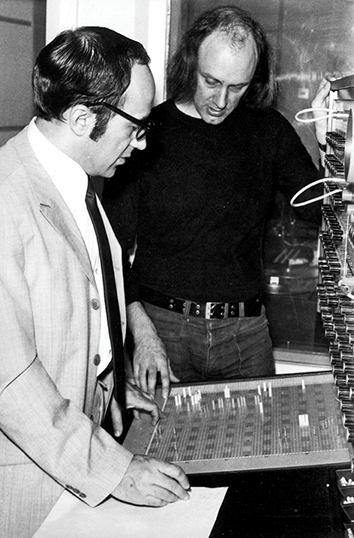
Figure 4.1a Long description
Vladan Radovanović, photographed left, wearing a light suit, shirt, a tie, and his thick, dark-framed glasses, and Paul Pignon in the center, wearing a dark long-sleeved shirt and jeans, at EMS Radio Belgrade with the Synthi 100. The photograph dates from 1971. They are standing over Synthi 100, working. Radovanović is taking notes with his right hand, while pressing some buttons on the control panel with his left hand.
EMS Radio Belgrade’s Synthi 100 and other equipment, ca. 1972–1973 (RTS Treći program Radio Beograda [The Third Program of Radio Belgrade]).
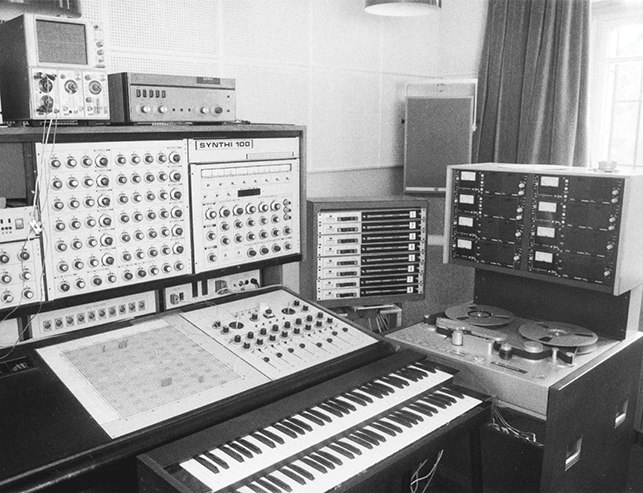
The Synthi 100 is a hybrid analog and digital synthesizer. Its design includes multiple VCS3 modular systems with eight voltage-controlled oscillators, twelve voltage-controlled filters, two monophonic keyboards, digital sequencer cards, and a computer interface, as well as an additional Vocoder 5000 that could also be procured for it. Pignon sums up the many (and relatively inexpensive) advantages of the Synthi 100 in one word: flexibility. He elaborates, “This [flexibility] is achieved especially by the well-designed patching system … which allows series and parallel combinations of any number of any devices, and by the sequences and the way it is integrated into the system as a whole (with convenient keyboard control or data input.”Footnote 50 Further, the VCS3 can be linked up with the Synthi 100, providing various extra modules it requires.
Unfortunately, without the necessary funds for the Synthi 100’s maintenance, barely ten years had elapsed before EMS Radio Belgrade would become obsolete. By the start of the Yugoslav Wars (in the 1990s), the then-director of Radio Belgrade ordered the defunct Synthi 100 to be discarded. Miroslav Savić, a composer who, as a student, defected from the Music Academy due to its resistance to modernism and flocked to the Electronic Studio to study with Radovanović, recalls:
The Synthi 100 was discarded in the hallway with the intention of being thrown away. The attitude from the “top” was – “it’s old, it’s obsolete, it’s trash.” Zorana Hrašovec [the engineer who worked at the studio since its founding], who was still working there and was assigned the role of Synthi’s “caretaker,” called me and asked me if I could put it in my basement because the Radio was getting ready to throw it away. Naturally, I agreed. We had to devise a plan on how to actually do it secretly, away from the sight of the police – even though this instrument was going to be thrown out, the Radio and the police would not allow anyone to take it. So, the plan was: Once the Synthi was discarded on the street, we would show up in some sort of uniforms so that we would look like legitimate workers. Meanwhile, we made an arrangement with the movers – they would pick up the discarded Synthi and put it in their truck, and then we would meet somewhere in the city and move it into our truck, and in exchange, we would buy them beer. [Laughter]. But luckily, [Slobodan] Milošević ruptured, and we didn’t have to proceed with the plan. Our wish was only to save the Synthi until better days returned.Footnote 51
Although the Synthi survived its demise at Radio Belgrade, it remained inoperable until September 2017, when Pignon returned to Belgrade and, together with Svetlana Maraš, the Studio’s composer-in-residence at the time, repaired it.Footnote 52 Savić recalls, “For many years, the Synthi 100 and Electronic Studio Radio Belgrade functioned as a museum.” Maraš explains that after the wars, while the Synthi was still inoperable, “the analog synthesizer was protected by [the] Museum of Science and Technology as the ‘cultural heritage’ of Serbia, and [its] historical importance is immense.”Footnote 53 The Studio celebrated its reopening with a live concert on March 2, 2018, which featured compositions by Pignon, Maraš, and an Italian artist, Nicola Ratti.
The Operations and Collaborations at the Electronic Studio Radio Belgrade
The EMS London delivered the Synthi 100 in July 1971, designing the synthesizer according to Pignon’s and Radovanović’s specifications. EMS Radio Belgrade became operational in December of that year, officially opening its doors in January 1972. Radovanović was appointed the head of the Studio while Pignon, with his expertise in the field of physics, which was a great asset to the Studio, served as a composer and an instructor, a role he maintained until the late 1980s. In addition to Radovanović and Pignon, the Studio also employed two engineers – Milan Orlić, who stayed quite briefly in this role, and Zorana Hrašovec, who remained until the studio became defunct.
Since most of the composers who were coming to work at the Studio were either past or current students at the traditionally oriented Music Academy, and the structure of the Studio’s Synthi 100 was rather complex, Radovanović had to model the process of realizations of composers’ works after PRES. He viewed this process as necessary in order for composers to master electronic media and be able to realize their electronic compositions. Since the Academy was not adequately preparing its students in the domain of technology, it was Radovanović, Pignon, and Hrašovec who taught and worked with the new generation of composers in Yugoslavia. Radovanović explains the process at the beginning:
We had to establish two modes of working at the Studio. For composers who did not work in the electronic medium or for those who found it more difficult to master the necessary technological processes, we provided basic training and then developed a plan of collaboration with the studio staff. Thus, for a composer to realize a composition, the composer first needed to explain his ideas in words and graphics. Based on that information, the coauthor (the implementer) proposed “instruments” and methods of organization, that is, he translated all of the composer’s suggestions into a series of technological actions. […]
The second type of collaboration, which was more crucial for expanding the composer’s experience, entailed educating composers at the level at which they could realize their works mostly independently, without collaboration with a coauthor.Footnote 54
Thus, composers working at the EMS Radio Belgrade were introduced to a new (and collaborative) process of composing: from the idea (concept) to sketching the project (music score) to the sounding of the project (realization and real manifestation) to the performance of the piece. Through this process, the composer became the performer, conductor, and listener.
Pignon explains the technical aspects of the teaching activities in more detail, offering a glimpse of the inner workings of the Studio. He writes:
The courses are primarily intended to equip composers for independent work in the Studio. However, some effort is also made to give them a sound background in electroacoustics in general. Completion of the course is a condition for being allowed to work alone. The material covered by the course is gradually being assembled in a rather copious manual, divided into: Basic Electricity and Electronic Acoustics and Tape Recording; Individual Modules of the Synthi 100; Basic Patches and Work Procedures; Advanced Patches and Procedures.Footnote 55
EMS Radio Belgrade quickly gained popularity. Composers across Yugoslavia were coming to Belgrade to be trained by the Studio’s staff and to realize their works. Some of the first-generation composers included Vojin Komadina, Kalčič, Frajt, Dušan Radić, Srđan Hofman, Lojzet Lebič, Jakob Jež, Sakač, Devčić, Davorin Kempf, and Josip Magdić. The success of the Belgrade Studio curriculum, its model for collaboration, and the opportunity to work on the Synthi 100 spread beyond the borders of Yugoslavia. Composers from France, Belgium, Spain, Poland, and Italy, including Nicole Lachartre, Iván Pequeño Andrade, Peter Beyls, Georg Katzer, Zoltán Pongrácz, and Iván Patachich, among others, were also flocking to Belgrade to create electroacoustic music.Footnote 56
As musicologist Luca Cossettini observes, just looking at the CD released on the thirtieth anniversary of the Electronic Studio Radio Belgrade, it is striking to see Radovanović’s name on nearly every track, either as the author or the coauthor.Footnote 57 For Cossettini, this acknowledgment is revealing about the production system at the Studio – it confirms Radovanović’s role, as well as his expertise and knowledge of the technology.Footnote 58 Further, it informs about the process of composing electronic music during this period – that the process of composing and realizing electronic music was a collaborative task.
With the interest in the Studio rapidly increasing, Pignon and Radovanović added more advanced courses to enable composers to achieve true independence. But as Pignon notes, this new training program went beyond just realizing a composer’s current needs; rather, it recognized the potential of networking and the continuous shaping of the Studio. He explains:
Fortnightly seminars were recently started, where topics of current specialized interest (e.g., arising out of a just finished or still unfinished composition) and discussed after an introductory presentation, e.g., by the composer whose work is discussed. Judging by the initial results it seems that these seminars will fulfill an important function in gathering together all those connected with the Studio and in molding a general physiognomy of the Studio, as [envisioned] by Radovanović.Footnote 59
The Studio was more than just a workshop or “a factory” for electronic music; rather, it provided the space for composers to think about electronic music in new ways, which allowed the field to develop and grow. Savić posits that what sets the EMS Radio Belgrade apart from other studios is that it was open and accessible to everyone: “It wasn’t reserved just for the elite, no committee decided who could or could not come. Everyone had access and equal opportunity. It was truly an incredible privilege.”Footnote 60
Indeed, Radovanović and Pignon welcomed into their Studio anyone who showed any interest in the electronic music medium of any style. Radovanović elaborates on their open-access policy:
Overall, everything created at the Studio was “modernist.” Not wanting to impose our own artistic views on the Studio production, we opted for a stylistic openness, while not neglecting the conditions given by the very nature of the media. Thus, projects of maximalist and minimalist orientation were accepted, as well as those [projects] directed towards the conceptualization of music, provided that the electroacoustic medium was in some way essential.Footnote 61
By 1987, the Studio’s Synthi 100 was becoming outdated and virtually nonoperable due to the lack of funds for its maintenance. Further, Radovanović was looking for means to modernize the studio by computerizing it. Only after Radio Belgrade appointed a new director was Radovanović finally able to secure the necessary funds to purchase the Studio’s first computer. He recalls:
I had to wait some fifteen years to get the means to computerize the Studio. We wanted a new 1987 Apple computer, but we were told that, unfortunately, it was too expensive. So, we had to opt for a more modest brand, which soon after had already become extinct. It was an Atari Mega ST2 with synthesizer modules by Yamaha TX816, running on Notator SL – one of the first computer programs.
Eventually, around 1988–1989, we got one more PC with AudioLogic 3 and a complete manual. It was a very precise, complicated, and difficult program to master. By this time, Paul Pignon had already left Belgrade. So, Zorana Hrašovec and I read the manual ourselves in English and were trying out things in vain, but we managed the best we could. At some point, I was finally able to operate both the computer and the program. Then, we thought of an idea to connect the Synthi to the computer, but we never managed to do it successfully.Footnote 62
The conditions at the Studio were worsening as the Yugoslav Wars were looming. From 1991 until 1997, everything seemed to be falling apart – no composers from outside Serbia were coming to the Studio, and consequently, all activities, including lectures and concerts, were canceled. The first guest to visit the Studio after a long pause was Thomas Wells from Columbus, Ohio, in 1997, and by personal invitation from Radovanović. Before his departure back to the US, Wells gifted the Studio his personal NeXT computer. Finally, the Studio acquired an Apple computer, fulfilling Radovanović’s lifelong dream.
The Legacy of the Electronic Studio Radio Belgrade
The Electronic Studio Radio Belgrade was the first electronic music studio in Yugoslavia and the Balkan region and home to the legendary Synthi 100. Despite its incredible history, it remains virtually unknown to scholars outside of Serbia, excluded from the historiographies of electronic music.Footnote 63 Nonetheless, its legacy is indisputable and invaluable. Resisting the pressures of socialist realism and moderated modernism, Radovanović pressed on with his vision and, with support from Aleksandar Acković, Zorana Hrašovec, and Paul Pignon, achieved his goal of establishing a modern, “third-generation” electronic music studio in Yugoslavia. The delay in founding the EMS Radio Belgrade was actually in some ways advantageous – while nearly all other studios across Europe had only analog equipment at the time they opened, the Belgrade Studio was able to incorporate the new, third-generation digital-analog technology, making it one of the most advanced studios in Europe.
The “state-of-the-art” facility in Belgrade’s Studio granted composers from all around the country an opportunity to gain knowledge and expertise in the domain of electronic music and realize their innovative projects in all types of electroacoustic music – concrete, electronic, synthetic, live electronics, mixed electronics, computer, multimedia creations with electroacoustic music and mental sound works.Footnote 64 Thus, Radovanović’s vision, drafted during his residency in Poland, was one of the principal factors that led to the creation of new generations of avant-garde and electronic music composers in the country. Looking back on this momentous feat, Radovanović recalls:
It was truly a heroic battle for Yugoslav culture to achieve something like this in an environment where music is consistently placed last. And then there was electronic music, which, within the domain of music, was itself placed last. So, we had to fight and advocate, which I did for twenty-eight years as the head of the Studio.Footnote 65
Over the relatively short period of some thirty years – from the Studio’s founding in 1971 until the US/NATO-led bombing of Serbia in 1999 – EMS Radio Belgrade was home to some thirty Yugoslav composers and ten international composers. Seventy-seven works of independent electroacoustic music were realized, twenty-three radiophonic, mentalistic,Footnote 66 and sound-poetic works, and over ninety examples of functional music. The works created in the Studio boasted thirteen national and international awards. When taking into account the context under which the Studio operated – as Radovanović puts it, how slow, time-consuming, and arduous the production of electronic works was in the precomputer era – these achievements are even more remarkable.Footnote 67 A sample of such achievements by two prolific composers – Radovanović and Frajt – will be examined in the following chapter.

 Open access