


Introduction
Secessionism is a highly dynamic phenomenon, often marked by sudden and intense surges in support for independence. The existing literature frequently attributes such “secessionist waves” to the erosion of autonomy rights. Self-rule arrangements are intended to protect the political and cultural interests of ethnic minorities. However, when such arrangements are weakened and legal protections are undermined, the likelihood of a secessionist backlash increases. A growing body of empirical research supports this explanation (Gurr, Reference Gurr1993; Cederman et al., Reference Cederman2015; Siroky and Cuffe, Reference Siroky and Cuffe2015; Germann and Sambanis, Reference Germann and Sambanis2021).
Nevertheless, significant gaps remain in understanding why secessionist waves – defined as substantial increases in public support for independence over relatively short periods – arise at specific points in time. While the existing “lost autonomy” literature highlights the correlation between secessionism and the erosion of self-rule, authors usually examine de jure changes of autonomy at the aggregated country- or group-year levels, leaving the precise causal mechanisms and timing underexplored. Consequently, current approaches tend to be overly static and “objectivized” (Basta and Barrio, Reference Basta and Barrio2023), neglecting the highly dynamic nature of autonomy loss and its political consequences.
In many cases, the decline of autonomy crystallizes in a distinct, disruptive event, making the affected group suddenly and acutely aware of the threat to their autonomy, triggering strong emotional reactions. For instance, in 2010, the Spanish Supreme Court’s decision to declare sections of the 2006 Autonomy Statute unconstitutional was widely interpreted by Catalans as a diminishment of the region’s autonomy status. This court decision is commonly seen as the pivotal event that sparked pro-independence mass protests and catalyzed the 2017-2018 constitutional crisis in Spain (Agustín, Reference Agustín2021; Ninet, Reference Ninet2022; Casas, Curci, and De Moragas, Reference Casas, Curci and De Moragas2024). Comparable “lost autonomy triggers” include Milosevic’s decision to reduce the status of Kosovo within Yugoslavia in 1990 or the 2019 legislative act that centralized powers in India’s Jammu and Kashmir and abolished the special status of the region.
We argue that such transformative, symbolic events possess the causal power to rapidly trigger secessionist waves. They are sufficiently dramatic to spark spontaneous collective action from the bottom up, without the need for elites to first frame these events and persuade group members of their significance. The loss of autonomy, culminating in a specific shocking event, deeply impacts ordinary minority members, prompting them to reassess their allegiances and perspectives. This emergent and highly emotional collective reaction then sets the stage for subsequent political mobilization and enables the success of pro-independence actors. Our model refines existing theories of lost autonomy by temporally disaggregating them, explaining why secessionist waves emerge at specific moments in time.
Our theory carries an important empirical implication: Substantiating events as triggering events demands evidence of their causal efficacy. In other words, without a lost autonomy trigger, the subsequent secessionist wave would not have occurred, at least not at the specific point in time it did occur. To test this counterfactual assumption, we turn to synthetic controls (Synthetic Control Method, SCM). Based on a comparative analysis, we select two autonomous regions that have experienced a lost autonomy trigger, followed by a pronounced increase in secessionist sentiment: the Faroe Islands post-1994 and Catalonia post-2010. Both regions saw a significant surge in secessionist sentiment following disruptive events widely believed to have fueled mobilization. In the Faroe Islands, this was the bankruptcy of a major bank and the imposition of economic constraints by Denmark, while in Catalonia, it was the aforementioned decision by the Spanish Supreme Court. Both are typical cases, making them well-suited to test our assumptions (Gerring, Reference Gerring2007).
Using SCM, we construct “synthetic” control groups composed of autonomous regions that have not experienced significant secessionist waves but which closely mimic the two treated cases prior to the occurrence of the transformative events. By comparing post-treatment outcomes with those of the synthetic controls, we demonstrate the causal role of the lost autonomy trigger for the subsequent secessionist waves in Catalonia and the Faroe Islands, measured by sharp increases in the vote shares of pro-independence parties. In the third step, we complement our statistical analysis with process-tracing to test the proposed causal mechanism.
Our findings indicate that both instances of lost autonomy events were perceived as shocking events, which led to an immediate shift in public opinion among the minority populations. This shift was subsequently reflected in the positions adopted by Catalan and Faroese political parties. In line with our theoretical expectation, the causal efficacy of the lost autonomy triggers is based on their role as highly disruptive moral shocks, causing a sudden and direct change in public opinion. Notably, our empirical analysis does not support the argument that secessionist support and a public opinion shift were due to a retrospective top-down framing of these events. Our findings underscore the importance of incorporating triggering events and the emotional reactions they provoke into the study of secessionism and highlight the need for adopting more dynamic approaches to understanding the effects of autonomy loss.
Lost autonomy and secessionism
Existing research identifies several underlying causes of secessionism, which can be broadly categorized into culturalist, rationalist, and structuralist-institutionalist explanations (Siroky and Abbasov, Reference Siroky and Abbasov2021; Muro, Reference Muro, Griffiths, Pavković and Radan2023). Within the dominant institutionalist perspective, significant emphasis is placed on “accommodative” institutions, including territorial autonomy and power-sharing institutions. A rich literature investigates whether these institutions effectively mitigate the risk of secessionist conflict. Research consistently demonstrates that executive power-sharing and territorial autonomy effectively reduce the likelihood of violent ethnic conflict (Hartzell and Hoddie, Reference Hartzell and Hoddie2003; Cederman, Hug, and Wucherpfennig, Reference Cederman, Hug and Wucherpfennig2022; Schulte and Trinn, Reference Schulte and Trinn2022; Juon, Reference Juon2024). However, most of this literature focuses on violent ethnic conflict and tends to adopt a rather static view of institutions, treating them as either present or absent in a given group-year or country-year.
A smaller, yet growing, body of research adopts a more dynamic perspective, demonstrating that changes to autonomy arrangements are particularly dangerous. The (perceived) loss of self-determination rights and cultural protection plays a key role in bolstering support for secessionism. Losing autonomy fuels grievances against the central government, while organizational capabilities required for collective action are (still) accessible (Cuffe and Siroky, Reference Cuffe, Siroky, Cabestan and Pavković2012; Siroky and Cuffe, Reference Siroky and Cuffe2015). As a result, ethnic groups that have previously enjoyed political autonomy but then experience its withdrawal are especially prone to pursuing secession (Walter, Reference Walter2009; Sorens, Reference Sorens2012). Despite varying conceptualizations of the explanans, studies show a robust empirical link between the loss of self-rule and increased support for secessionism (Cederman et al., Reference Cederman2015; Ahram, Reference Ahram2020; Germann and Sambanis, Reference Germann and Sambanis2021).
A significant gap persists, hindering a deeper understanding of the highly dynamic nature of secessionism: existing approaches are heavily focused on objective changes in the de jure status of territorial autonomy, typically assessing changes from one year to the next. This static operationalization fails to capture the rapid surges in secessionist support frequently observed in autonomous regions, sometimes evolving within mere weeks or even days. The challenge, then, lies in understanding how institutional changes lead to a change in the behavior of the local population, as current theories lack clarity on the mechanisms through which institutional changes translate into collective action. As Basta and Barrio point out, “change” is often conceptualized in a very objectified way (Basta and Barrio, Reference Basta and Barrio2023). The causal efficacy of losing autonomy as an institutional change depends, however, not on the objective features of the change, but on the subjective perceptions of those affected, specifically whether they perceive the loss of autonomy as a profound setback (ibid, p. 5). It is this subjective interpretation, and the emotional response it provokes, that determines whether the loss of autonomy triggers a secessionist backlash.
On this account, we introduce the concept of lost autonomy triggers. We define lost autonomy triggers as transformative events in which the loss of autonomy culminates in a single, pivotal moment. These events are disruptive due to their highly symbolic nature and unexpected occurrence, which endows them with causal power. Put differently, these events spark a surge in support for secessionism that would not have occurred without them – at least not at the exact moment it did. The idea of triggering events has been utilized in various studies to explain the spontaneous eruption of conflictual mass behavior. Such “precipitating events” (Horowitz, Reference Horowitz2001) have been found to provide focal mobilization points and to solve collective action problems (Kuntz and Thompson, Reference Kuntz and Thompson2009; Nyseth Brehm, Robinson, and Saraswati, Reference Nyseth Brehm, Robinson and Saraswati2023; Schulte and Trinn, Reference Schulte and Trinn2025). In general, triggering events serve as critical transformative events, bringing increased attention to a specific issue and promoting a new consciousness that challenges the status quo. In the context of secessionist mobilization, the concept of triggering events has been rarely applied empirically and remains theoretically underdeveloped.
When authors investigate triggering events as proximate causes of secessionism, they frequently employ overly broad conceptualizations. Examples include the conceptualization of political decentralization (Brancati, Reference Brancati2006), political transitions (Lluch, Reference Lluch2010), or economic crises (Cuadras-Morató, Reference Cuadras-Morató2016) as “triggers” of secessionist mobilization. However, these phenomena do not constitute discrete events and specific point-like temporal moments but rather developments – or sequences of events. Overly broad understandings blur the boundaries between long-term underlying drivers and the short-term proximate causes of secessionism: for instance, a political or economic crisis may be the underlying driver of secessionist support, but by itself, it can hardly serve as a catalyst for a secessionist wave. In contrast, a specific political action, such as a bill passed by the central government or a judicial decision by a constitutional court, can function as a pivotal, emotionally resonant triggering event.
Theoretical framework
While certain preconditions create an environment conducive to secessionist sentiments, it is specific disruptive events that trigger a sharp realization among group members of the loss of their self-determination. In this context, the loss of autonomy, defined as the intentional recentralization of authority by the central government to curtail ethnic self-rule, becomes most salient when manifested through a distinct symbolic and transformative event. We contend that an instance of lost autonomy transforms into a triggering event and sparks secessionist waves when it exhibits two interrelated characteristics: (1) First, the event unfolds as a sudden, “point-like” occurrence that takes the public by surprise. Even if the event was not entirely unforeseen, signs were either ignored or misinterpreted. (2) Second, the event is profoundly disruptive and shocking for a substantial part of the local population. As people suddenly become aware that their autonomy is under threat, it sparks intense frustration, anger, and resentment. Strong emotional reactions prompt individuals to undertake even risky actions with uncertain success. Secession is one such radical, high-cost strategy, marked by uncertain prospects and potentially severe consequences (Rodríguez-Pose and Stermšek, Reference Rodríguez-Pose and Stermšek2015; Reynaerts and Vanschoonbeek, Reference Reynaerts and Vanschoonbeek2022).
The causal efficacy of lost autonomy triggers stems from their perception as threats to cultural identity. For those affected, lost autonomy triggers are more than just political reforms but are perceived as attacks on cultural survival and reminders of recurring historical injustices and past wrongs. Drawing on insights from political psychology and social movement theory, we conceptualize such dramatic-symbolic moments as “incidental grievances” – wholly unanticipated situations that put groups at risk (Sewell, Reference Sewell1996; McAdam and Sewell, Reference McAdam and Sewell2001; Hechter, Pfaff and Underwood, Reference Hechter, Pfaff and Underwood2016, p. 167). Such shocks suddenly challenge established conceptions and violate deeply held assumptions about the political and social order. They force individuals to confront the unsettling realization that “the world is not what one had expected” (Jasper, Reference Jasper2011, p. 27).
This process is deeply emotional and politically potent: visceral, socially shared emotions, including moral outrage, anger, and resentment, have the power to prompt immediate collective action. Such “emboldening” affective responses increase perceived political efficacy and motivate individuals to engage in potentially costly behavior (Pearlman, Reference Pearlman2013; Wlodarczyk et al., Reference Wlodarczyk2017). These reactions are especially intense when the event is perceived as an out-group attack on the in-group’s cultural and social identity (Schulte and Trinn, Reference Schulte and Trinn2025). In such cases, the disruptive event is interpreted through a group-based lens, fostering in-group solidarity and driving targeted reaction against the out-group, even if at potentially high costs. In this light, the unexpected revocation of autonomy by a majority-led central government is interpreted as a symbolic act of minority domination, usually tied to historical grievances, and as a direct threat to self-determination and cultural survival. This perception incites strong other-condemning emotions and a backlash reaction, expressed through pro-independence demands, as a means to restore self-determination and to reaffirm a positive group identity (Horowitz, Reference Horowitz1985; Mashuri and van Leeuwen, Reference Mashuri and van Leeuwen2018; Schulte, Reference Schulte2018).
We argue that this response is inherently emergent and spontaneous: lost autonomy triggers are sufficiently dramatic to spur direct reaction by ordinary group members without the need for elites to first mobilize and convince the public of the significance of losing autonomy. In other words, lost autonomy triggers spark endogenous dynamics from “the bottom up.” Rather than initiating these reactions, elites often find themselves responding to already-unfolding secessionist sentiment. In this way, lost autonomy triggers generate emergent pro-independence dynamics. Our approach takes the causal role of triggering events seriously and challenges theories that reduce triggering events to mere discursive tools for elite-driven mobilization (Snow, Reference Snow2013; Basta, Reference Basta2018; Gunzelmann, Reference Gunzelmann2025).
We acknowledge that elites and political parties play important roles in later stages – through strategic mobilization efforts, framing, or party positioning. However, we consider the initial emotional and symbolic impact of autonomy loss sufficient to spark political action – regardless of whether elites have framed the event prospectively or not (Basta, Reference Basta2018). More often than not, elite efforts to manufacture secessionist sentiment are “non-starters” or give rise to unintended dynamics, no matter how these efforts are narrated post hoc. We contend that secessionist waves are rarely the result of deliberate orchestration but emerge when the loss of autonomy is experienced as an emotionally charged, symbolic rupture powerful enough to elicit immediate, collective mobilization. In this, we depart from existing approaches that overemphasize the role of elites and strategic, top-down mobilization efforts.
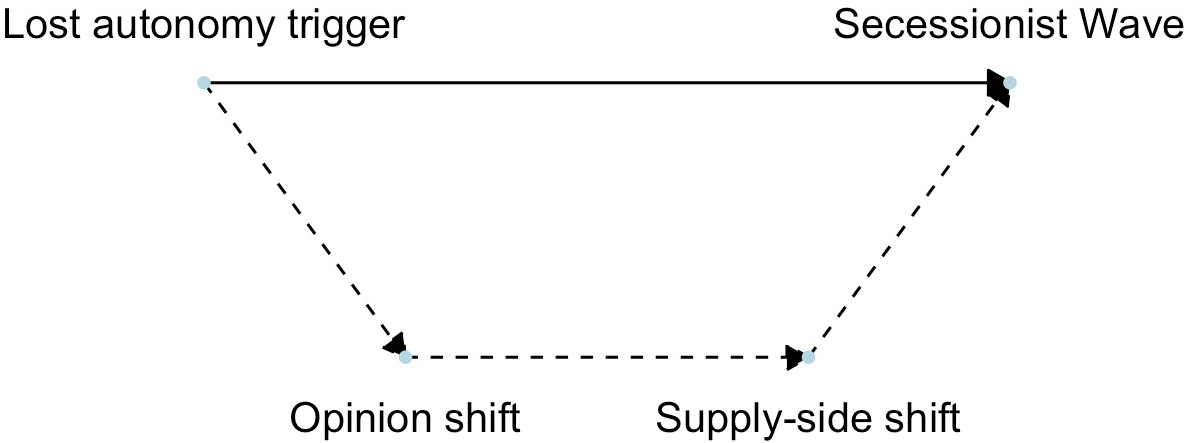
We derive two key implications, which we summarize in Figure 1: (1) First, a lost autonomy trigger is perceived as a shocking event that profoundly impacts ordinary group members. This emotional reaction prompts individuals to reassess their allegiances and perspectives as an ethnic minority in the central state. Consequently, we expect to observe an immediate and substantial shift in public opinion among a significant portion of the local population. (2) Second, this emergent reaction paves the way for subsequent political responses. As support for secession grows, political actors are likely to adapt, reflecting a supply-side reaction to the increased demand for secessionism. This political adjustment unfolds gradually. Parties require time to respond to shifts in public sentiment due to the high political costs associated with advocating independence. Over time, the substantial shift in public opinion compels parties to “ride the wave” (Klüver and Sagarzazu, Reference Klüver and Sagarzazu2015) and to recalibrate their stances in response to public support for independence.
Causal mechanism.

Our argument does not imply that every instance of lost autonomy leads to a secessionist wave. If an act of recentralization is not perceived as a loss of autonomy, with the local population ignoring or accepting institutional change, this does not constitute a lost autonomy trigger. Consequently, we do not expect a secessionist wave to follow. A case in point is the Italian government’s undermining of South Tyrol’s autonomy, which did not elicit a significant secessionist backlash despite elite-led mobilization efforts (Section 9).
Conceptualization and operationalization
Secessionism manifests in a wide spectrum of expressions, ranging from radical behavior in the form of separatist violence to more diffuse attitudes. In line with our broad understanding of secessionism as general public support for independence, we operationalize our dependent variable using the vote shares of secessionist parties on the first sub-state level. This approach is motivated by two considerations: first, voting represents an active political choice and reflects a higher level of political engagement than expressing support in a poll. Therefore, electoral support offers an indirect but meaningful proxy for gauging public support for secession. Second, survey data on support for independence across relevant autonomous regions and time periods is not available.
Our main dependent variable (secession_support) gives information on the combined vote share of secessionist parties across all elections held within a specific region and year. We manually coded the vote share of secessionist parties on the basis of collected data and primary sources (Sorens, Reference Sorens2005; Massetti and Schakel, Reference Massetti and Schakel2016; Álvarez Pereira, Portos, and Vourdas, Reference Álvarez Pereira, Portos and Vourdas2018). To ensure a balanced sample for constructing synthetic control cases, we use five-year rolling averages of electoral outcomes and covariates for each region (Abadie and Gardeazabal, Reference Abadie and Gardeazabal2003; Riera, Reference Riera2020). This approach enhances consistency and provides a more robust measurement of the phenomenon.
To fit our SCM, we use variables that capture the most relevant root causes of secessionism, including rationalist, structuralist-institutionalist, and culturalist factors. Previous studies indicate that economic imbalances among sub-state regions or lower relative positions of ethnic minorities fuel secessionist sentiment (Bolton and Roland, Reference Bolton and Roland1997; Sambanis and Milanovic, Reference Sambanis and Milanovic2014). To account for economic and grievance-based explanations, we include a 5-year rolling average of the ratio between regional and national GDP per capita (av_gdp) along with a measurement of the differences between national and regional unemployment rates (diff_unemployment).
Culturalist explanations emphasize cultural, linguistic, or religious differences. Regions with distinct identities may seek independence to preserve their cultural heritage or due to shared values, cultural cleavages, or grievances fueling secessionism (Petersen, Reference Petersen2002; Sorens, Reference Sorens2005; Nordås et al., Reference Nordås2010; Portos, Reference Portos2020). To capture this dimension, we include the proportion of minority language speakers in each autonomous region (language). The variable distance complements this, measuring the geographical distance between the national and regional capitals, thus capturing the potential influence of spatial factors on secessionist dynamics (Rokkan and Urwin, Reference Rokkan and Urwin1983; Suesse, Reference Suesse2019).
The variable percentage_population reflects the regional population’s proportion to the country’s total population in a specific year, which serves as a proxy for group size and its organizational capacities. This variable is coded based on secondary sources. The occurrence of secessionist waves in autonomous regions may depend on the general level of subnational authority a region enjoys. Therefore, we incorporate a measurement of regional competencies (av_rai) using data from the Regional Authority Index (RAI) (Hooghe et al., Reference Hooghe2021). Finally, to account for the broader political context, we include a measure of the central state’s democratic quality, based on the V-Dem liberal democracy index (democracy) (Coppedge et al., Reference Coppedge2023).
To achieve a comprehensive panel dataset, we apply linear interpolation for the few missing variables across region-years. This interpolation method assumes a steady progression between observed data points, which is appropriate given the gradual nature of the factors we use to construct the synthetic cases and is further justified by the conventional use of rolling averages, which mitigate the influence of short-term fluctuations.
Case selection
We select a sample of 13 minority regions in Europe that meet three criteria: first, the regions demonstrate a sufficient level of democratic governance, which is a scope condition for our study. Second, we have access to long-term national and sub-national electoral data. Third, and most importantly, these regions have experienced varying levels of secessionist support over the past few decades. These criteria are met by the Flemish Region (Belgium), the Faroe Islands (Denmark), Greenland (Denmark), Corsica (France), Bavaria (Germany), South Tyrol (Italy), Trentino (Italy), the Basque Country (Spain), Catalonia (Spain), Galicia (Spain), Navarra (Spain), Scotland (United Kingdom), and Wales (United Kingdom).
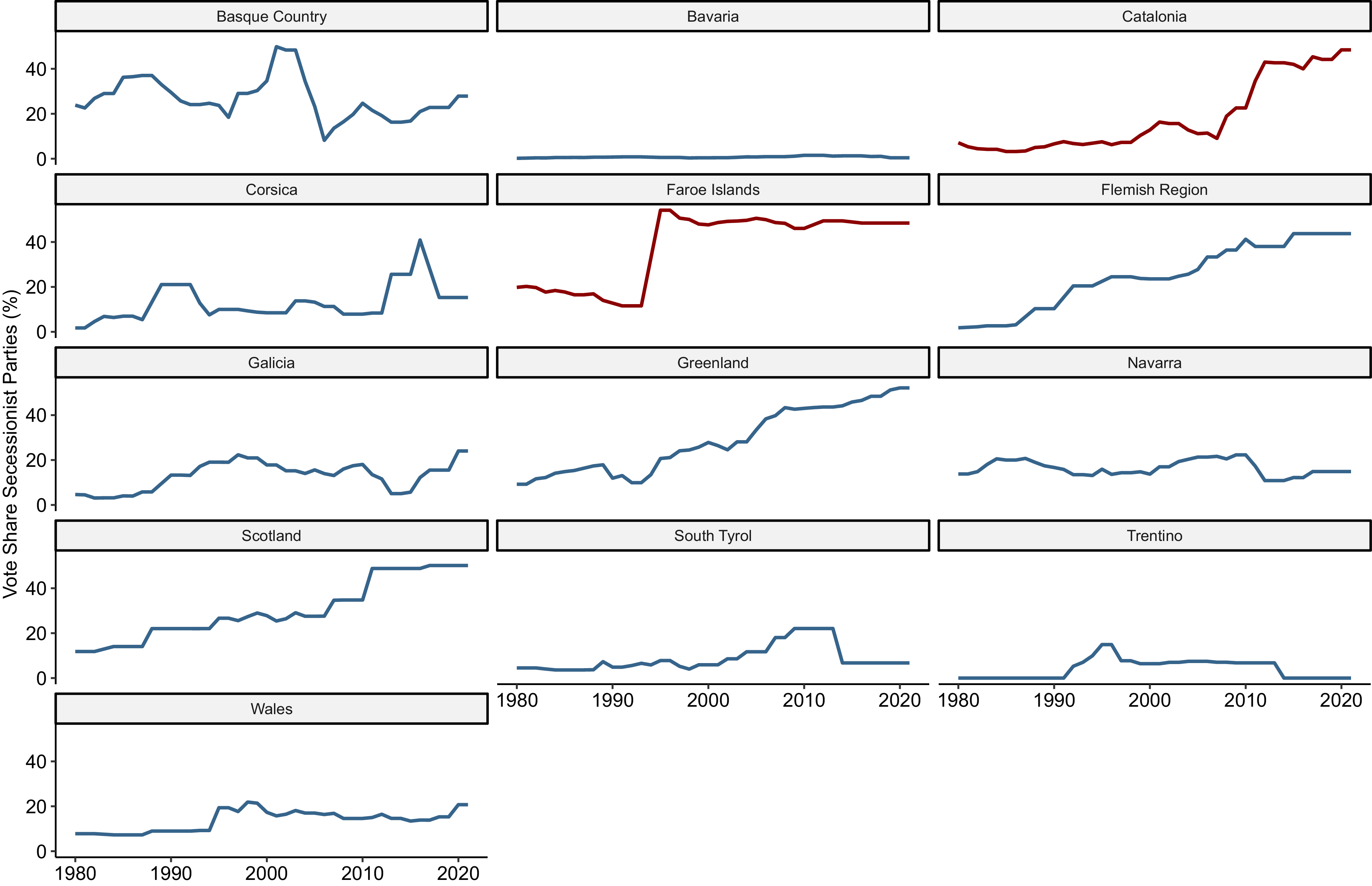
A comparative analysis of secessionist vote shares across these 13 regions highlights two particularly salient cases: the Faroe Islands and Catalonia (Figure 2). Both regions have witnessed substantial surges in pro-independence support over relatively short periods, closely aligning with the phenomenon we seek to explain. Accordingly, they serve as typical cases, providing empirical contexts in which our theory can be meaningfully tested. Moreover, both public perception and academic discourse clearly point to two pivotal events as triggers for secessionist support in these autonomous regions – events whose causal influence remains undertheorized and has rarely been subjected to rigorous empirical testing. Our study addresses this gap. Our case selection follows an inductive logic. We focus on two “positive” cases where both the lost autonomy trigger and the secessionist wave are present, enabling us to investigate the mechanisms that drive sudden increases in support for independence.
Secessionist waves in 13 European regions.
Note: Figure based on 5-year averages, including national and regional elections.

Catalonia
Negotiations for a new Catalan Statute of Autonomy trace their origins to the 2003 regional elections, when major political parties committed to revising the outdated 1979 Statute. In 2006, both the Catalan and Spanish parliaments approved the revised autonomy statute, which was later ratified by 70 per cent of Catalan citizens in a referendum with a 48.9 per cent turnout. However, the conservative and centralist Partido Popular (PP) contested several aspects of the “Estatut,” bringing the case before the Spanish Constitutional Court. On June 28, 2010, the court issued a landmark ruling that overturned and reinterpreted multiple provisions of the statute, particularly those concerning the preferential use of the Catalan language in public administration, media, fiscal matters, and the regional judiciary. Most significantly, the judges reversed the core element of recognition within the statute reform: the reference to Catalonia as a nation (Requejo and Sanjaume, Reference Requejo, Sanjaume, Grégoire and Jewkes2015; Basta and Barrio, Reference Basta and Barrio2023). A substantial part of the Catalan society perceived this ruling as an attack on the Catalan culture and their right to self-determination. The Court’s decision was highly disruptive, provoking strong emotional responses within the minority community. This incident, constituting a lost autonomy trigger, swiftly bolstered support for independence and set the stage for subsequent political developments that escalated tensions between Catalonia and the Spanish government.
Faroe Islands
The Faroe Islands, governed under a Home Rule system that grants substantial executive and legislative autonomy, enjoyed a period of economic prosperity until the 1980s. However, the 1990s brought a severe economic crisis marked by high unemployment and a net emigration of approximately 10 per cent. The situation worsened dramatically on October 6, 1992 (“Black Tuesday”), when the Faroese banking system collapsed following the bankruptcy of Sjóvinnubankin, one of the largest banks on the islands. The Danish central government intervened by establishing a rescue fund and initiating a major reorganization of the Faroese economy. Several agreements were brokered between the Danish and Faroese governments, including the Faroese government’s acquisition of a controlling stake in a struggling bank in March 1993, aimed at stabilizing the banking sector (Føroya Banki deal).
Following what became known as the “Great Bank Affair,” financial policy autonomy under Home Rule was effectively suspended (Adler-Nissen, Reference Adler-Nissen2014). The Danish government mandated that the Faroese Prime Minister sign International Monetary Fund agreements in exchange for the loans provided, leading to the implementation of externally imposed economic policies concerning fisheries, business practices, and taxation. The Danish government defended these measures by blaming the Faroe government for the economic crisis. The tipping point towards secessionist sentiment occurred when it emerged that Denmark had withheld critical financial information, despite the Faroese government’s efforts to bail out Føroya Banki. This revelation left the Faroese feeling betrayed, viewing Danish actions as a clear infringement on their self-rule arrangement. The event was widely perceived as a severe blow to Faroese autonomy, triggering strong negative reactions among the local population.
Empirical strategy
Despite being widely discussed as triggering events (Kraus and Gifra, Reference Kraus and Gifra2017; Cetrà, Reference Cetrà2019; West, Reference West2024b), there is limited evidence to substantiate the causal role of the two events. Descriptive analyses, however, fail to address the fundamental question of whether the secessionist waves would have occurred without these incidents. However, labelling an event as a (lost autonomy) trigger implies that outcome Y would not have occurred without the proximate cause X. If this assertion does not hold, X might be a necessary condition but does not reach the status of a sufficient condition.
To test the causal efficacy of both events, we employ a Synthetic Control Design (SCM). SCM works by constructing a “synthetic” control group that closely resembles the treatment group. To construct the synthetic controls, SCM uses a weighted combination of potential control units that share similar characteristics with the treated unit(s) before the intervention, i.e., the Faroe Islands before 1994 and Catalonia before 2010, but which did not receive the treatment, i.e., experienced a lost autonomy trigger. The weights are statistically assigned based on how closely the potential control units match the pretreatment characteristics of the treated unit. The aim is to identify a weighted average that closely mirrors the behavior of the treated unit across the pre-treatment periods, suggesting that this similarity would have persisted in the absence of the treatment, the lost autonomy trigger (Abadie and Gardeazabal, Reference Abadie and Gardeazabal2003; Abadie, Diamond, and Hainmueller, Reference Abadie, Diamond and Hainmueller2015). By comparing the outcomes of the treated unit with the synthetic control group over time, we estimate the causal effect of the two events by identifying any differences between the actual outcome, i.e., the “real” secessionist wave, and the predicted outcome in the absence of the treatment, i.e., the hypothetical scenario in which the triggering event did not take place.
Finding the optimal synthetic control is expressed as:
 $$W^{*}(V) = {arg min \over W\epsilon W} (X_{1} - X_{0}W)^\prime V (X_{1} - X_{0}W)$$
with $W^{*}V$
as the vector of weights W that minimizes the difference between the pre-treatment characteristics of the treated unit and the synthetic control, given V. We implement penalized synthetic controls, based on a penalization coefficient that strikes a balance in fitting pre-treatment characteristics both before and after their integration into a synthetic unit. This ensures the synthetic control is more effective in predicting the outcome of the treated unit (Abadie and L’Hour, Reference Abadie and L’Hour2021; Engelbrektson, Reference Engelbrektson2024). Our sample provides a suitable donor pool from which we can select comparable regions that have not received similar treatment in the form of a lost autonomy trigger. Note that our focus is on examining the causal significance of the two lost autonomy triggers. The absence of variance in the dependent variable among some of the cases is not a requirement for our analysis.
$W^{*}V$
as the vector of weights W that minimizes the difference between the pre-treatment characteristics of the treated unit and the synthetic control, given V. We implement penalized synthetic controls, based on a penalization coefficient that strikes a balance in fitting pre-treatment characteristics both before and after their integration into a synthetic unit. This ensures the synthetic control is more effective in predicting the outcome of the treated unit (Abadie and L’Hour, Reference Abadie and L’Hour2021; Engelbrektson, Reference Engelbrektson2024). Our sample provides a suitable donor pool from which we can select comparable regions that have not received similar treatment in the form of a lost autonomy trigger. Note that our focus is on examining the causal significance of the two lost autonomy triggers. The absence of variance in the dependent variable among some of the cases is not a requirement for our analysis.
Quantitative findings
We construct versions of our treatment cases by selecting weights that allow the synthetic cases to most closely mirror the secessionist party vote shares prior to the lost autonomy events. Based on the predictors chosen (percentage population, language, distance, av_gdp, av_rai, democracy, diff_unemployment), we find that our synthetic Catalonia is best resembled by a weighted average of five regions: Bavaria (36.41 per cent), South Tyrol (34.67 per cent), Scotland (24.13 per cent), Greenland (2.45 per cent), Wales (2.28 per cent). The synthetic Faroe Islands, based on the variables percentage_population, language, distance, av_gdp, av_rai, and democracy, is a weighted average of three regions: Wales (55.92 per cent), the Basque Country (32.26 per cent), and Scotland (11.82 per cent). All other regions in the donor pool have zero weights and are excluded from the prediction (Table 1).
Weight matrix for synthetic cases

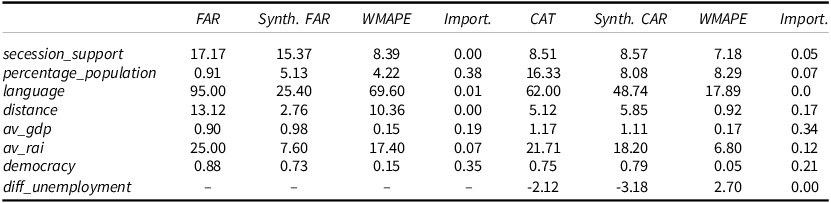
Root mean square prediction errors (RMSPE) provide a measure of the pre-treatment fit between the treated units and their corresponding synthetic controls. For the Catalonia case, we calculate a pre-RMSPE of 2.85, indicating a strong pre-treatment fit. The Faroe Islands case shows a slightly higher pre-RMSPE of 4.93, which still reflects a reasonably good level of fit, supporting the credibility of the constructed synthetic control for both cases (Table A1 in the online Appendix). To further evaluate the quality of the synthetic cases, we conduct a covariate balance analysis using Weighted Mean Absolute Pairwise Errors (WMAPE), which measures the average difference between each control unit in the synthetic control and the treated unit, weighted by the assigned synthetic control weights. The results show fairly similar values for most variables, suggesting a good balance between the treated units and their synthetic counterparts (Table 2).
Covariates between the Faroe Islands (FI) and Catalonia (CAT) and their synthetic controls

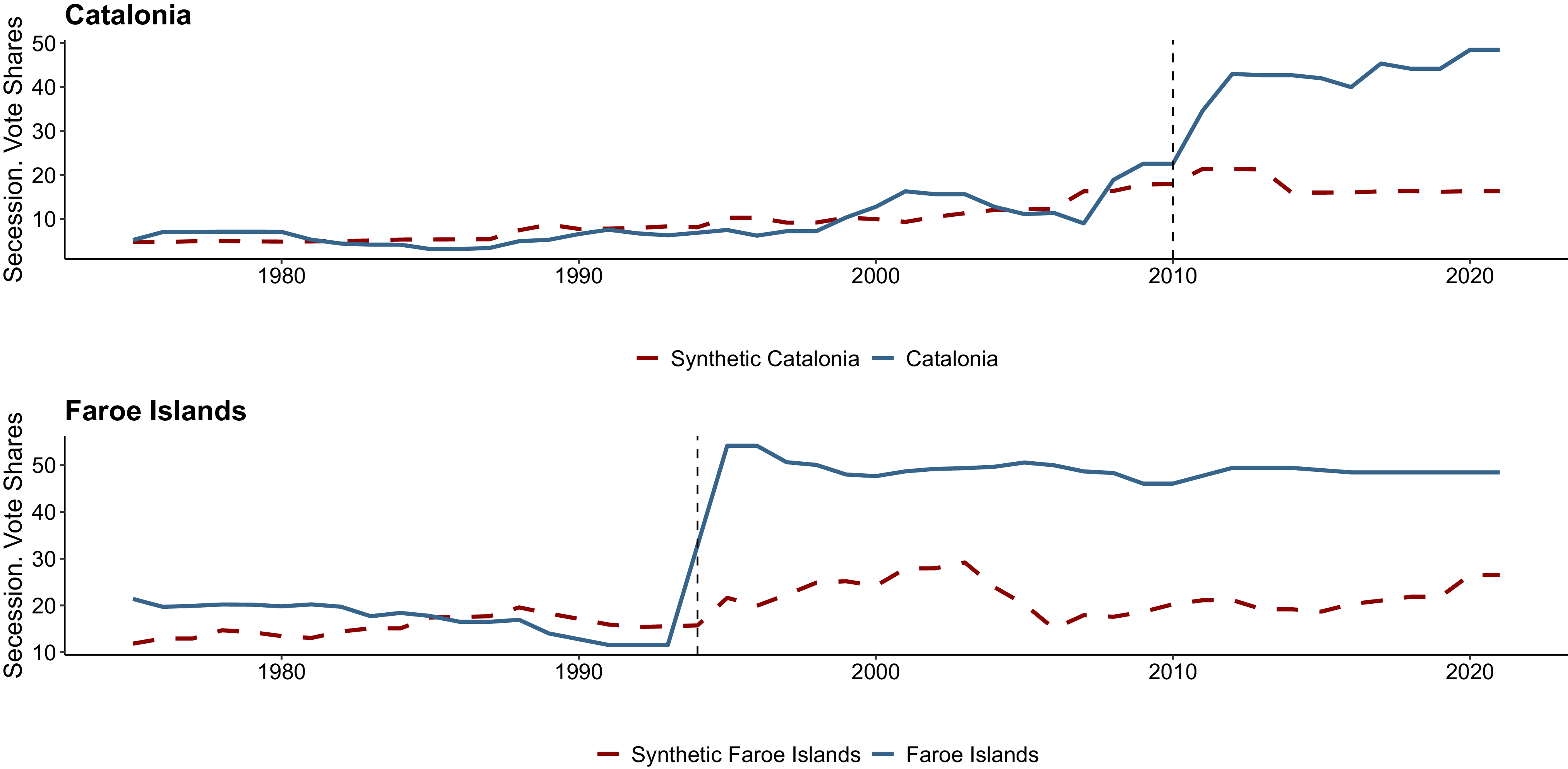
Our prediction provides evidence for the causal power of the lost autonomy triggers (Figure 3). The immediate and significant surge in support for secessionism in the years following these incidents, as demonstrated by our SCM models, would not have occurred without these triggers. Although both minority regions, especially the Faroe Islands, would have seen a slight increase in secessionist support without the events, the counterfactual scenarios suggest that there would have been no significant secessionist wave and considerably lower levels of support for secessionism without the lost autonomy events.
Counterfactual predictions.

Given the limited sample size and absence of randomization, conventional statistical inference methods are not suitable for testing the robustness of our findings. However, we conduct several robustness checks, including data variations and placebo simulations. Placebo simulations assume that our confidence in the synthetic control estimate would be significantly undermined if we observed similar or greater estimated effects in cases where the treatment did not occur. An in-space placebo analysis, which reallocates the treatment to comparison units, generates synthetic control estimates for regions that did not experience a lost autonomy event (Abadie and Gardeazabal, Reference Abadie and Gardeazabal2003; Bertrand, Duflo, and Mullainathan, Reference Bertrand, Duflo and Mullainathan2004). By applying this method iteratively to each region in the donor pool, we can compare the estimated effect of the triggering events to the distribution of placebo effects obtained for other regions. The significance of the triggering event’s effect on the Faroe Islands and Catalonia is determined by whether the estimated effect for these regions is unusually large compared to the placebo distribution.
Compared to the other units that received a placebo treatment, Catalonia stands out as having a substantial difference in RMSPE between the pre-period and post-period. This bolsters confidence in our estimates and the causal impact of the lost autonomy trigger in June 2010. In contrast, the Faroe Islands do not exhibit a pronounced difference between pre-treatment and post-treatment RMSPE (online Appendix) and therefore do not pass this robustness test. While the case aligns with our theoretical expectations and is supported by qualitative evidence, the results of our rigorous causal identification strategy are somewhat less conclusive. We discuss potential explanations in the conclusion.
For a third robustness test, we modify the set of predictors and include a selection of alternative measures that reflect existing explanations of secessionism. We introduce a measurement for subnational human development (shdi_score) at the region-year level (Smits and Permanyer, Reference Smits and Permanyer2019). Rather than relying on the aggregated RAI index, we separately include the self-rule (av_selfrule) and shared-rule (av_sharedrule) scores from the RAI (Hooghe et al., Reference Hooghe2021). Additionally, we incorporate a variable that accounts for minority-friendly policies at the state level (avg_policy_minorityrights), based on V-Party data (Lindberg et al., Reference Lindberg2022). Furthermore, our variable percentage speaker represents the share of the total population that speaks the regional language, namely Catalan and Faroese.
Again, both synthetic cases mirror the pre-trigger developments in both regions sufficiently. The pre-RMSPE score for the Faroe Islands shows a value of 4.96, which is almost identical to the earlier value using a synthetic control constructed from the Basque Country (42.39 per cent), Catalonia (43.84 per cent), and Scotland (13.76 per cent). Similarly, the Catalan case exhibits an almost identical pre-RMSPE score of 3.04. The new synthetic case for Catalonia is composed of Bavaria (59.74 per cent), Scotland (32.37 per cent), and the Flemish Region (7.88 per cent). Again, both counterfactual predictions with differently constructed synthetic cases confirm our theoretical assumptions about the causal role of the two lost autonomy triggers for the subsequent secessionist waves. We provide the prediction plots and the covariate values in the online Appendix.
Qualitative analysis
Our models provide substantial evidence that the 1994 banking crisis in the Faroe Islands and the 2010 Supreme Court decision in Catalonia, both lost autonomy triggers, had a causal effect on the subsequent secessionist waves in those regions that would not have emerged without these triggering events. A qualitative process-tracing analysis complements this quantitative evidence and offers a deeper understanding of how these triggers incited the secessionist waves. Specifically, we test key implications of our theoretical model: the loss of autonomy was an unexpected and shocking event for the local population, perceived as an attack on their self-determination and cultural protection. Both dramatic events led to a notable shift in public opinion, with a significant portion of the minority populations moving toward pro-independence support. Importantly, secessionist sentiment arose independently of top-down mobilization, with political actors reacting to, rather than driving, this shift.
Catalonia
The 2010 Supreme Court ruling is widely regarded as a pivotal moment in the perceived breakdown of the territorial agreement between Spain and Catalonia, marking a profoundly disruptive event for Catalans. While the idea of an independent Catalonia had been present since discussions about reforming the autonomy statute began, its popularity grew only modestly – from 13.6 per cent in June 2005 to 19.4 per cent in February 2010, prior to the ruling. However, following the court’s decision, support for independence surged dramatically, reaching 48.5 per cent by November 2013 (CEO, 2023). Casas et al. (Reference Casas, Curci and De Moragas2024) provide compelling evidence that the ruling triggered a rapid surge in support for independence, boosting it by about 5 percentage points virtually overnight, representing nearly a 20 per cent increase in overall backing for independence. This stands in stark contrast to the pre-trigger period spanning from 2006 to 2010, where support for secession experienced a mere annual increase of 1.4 percentage points (Casas, Curci, and De Moragas, Reference Casas, Curci and De Moragas2024).
The first major manifestation of this dramatic shift in public opinion occurred on July 10, 2010, when over a million people protested in Barcelona under the slogan “We are a nation. We decide!” (“Som una nació. Nosaltres decidim!”). This rally, the largest pro-self-determination rally since the final days of the Franco regime, marked the beginning of a wave of mass mobilizations advocating for Catalan self-determination and independence. Backed by widespread support, the Constitutional Court’s decision significantly bolstered the growth of independentist civil society organizations and compelled political parties to adopt pro-independence stances. Although mobilization efforts and referendums had been underway since 2009, the 2010 ruling marks a definitive turning point (Kraus and Gifra, Reference Kraus and Gifra2017; Rodon and Guinjoan, Reference Rodon and Guinjoan2018; Basta and Barrio, Reference Basta and Barrio2023). For instance, the 2010 mass protests catalyzed a significant transformation within Òmnium Cultural, an organization dedicated to promoting Catalan culture. While it had sporadically engaged in pro-independence campaigns since its establishment in the 1960s, it now openly embraced Catalan independence. This shift paved the way for the emergence of the Assemblea Nacional Catalana (ANC) in 2011, a distinctly secessionist organization born from the coordinating efforts of several local referendum groups.
In the November 2010 Catalan regional election, nationalist parties made significant gains in the regional parliament. The autonomist CiU won the election and formed a minority government in the context of economic recession and growing political discontent. Despite internal pressures to adopt a secessionist stance, CiU maintained a moderate position, focusing its campaign on advocating for greater fiscal autonomy and emphasizing nationalist issues (RMP, 2024). Since the 2010 election, recent studies show that party manifestos have increasingly prioritized territorial and democratic regeneration issues over economic concerns in response to a rapidly shifting public opinion (Scantamburlo, Alonso, and Gómez, Reference Scantamburlo, Alonso and Gómez2018). Similarly, parliamentary debates have shifted dramatically: whereas secession was rarely discussed before 2010, it has since become a dominant theme in Catalan politics. Initially, CiU showed more interest in this issue than the secessionist party Esquerra Republicana de Catalunya (ERC). However, by 2012, ERC had solidified its position and emerged as the party most vocal about Catalan independence. In March of that year, the Democratic Convergence of Catalonia (CDC) convened a landmark Congress titled “the national transition,” marking the party’s historic endorsement of independence for the first time.
In line with our assumptions, we find that the effect of the ruling is primarily demand-driven rather than supply-driven (Casas, Curci, and De Moragas, Reference Casas, Curci and De Moragas2024). Voters expressing a growing preference for greater autonomy increasingly aligned with nationalist and pro-independence parties. This swift rise in support for decentralization coincided with a heightened skepticism towards state institutions, discontent with democratic processes, and a stronger regional identification, resulting in increasing polarization between Catalonia and Spain, accompanied by a mounting wave of secessionism. On September 11, 2012, Catalonia’s national day saw a massive demonstration advocating for secession under the slogan “Catalonia, new state in Europe.” The ANC-organized Diada manifestation of 2012, coinciding with a surge in support for independence, significantly influenced the political landscape, prompting the CiU government to reconsider its stance. Responding to the growing momentum both in the streets and in public opinion, Artur Mas, then-Catalan president, called for snap elections on a pro-independence platform, pledging to hold a self-determination referendum if re-elected president. Mas secured re-election, and a non-binding referendum took place on November 9th, 2014. By this time, the CDC and ERC had fully committed to independence, transitioning from non-secessionist to assertively pro-secessionist positions. This shift culminated in Catalonia’s unilateral declaration of independence in 2017, marking the climax of the secessionist wave examined in this study.
Faroe Islands
The Danish crisis intervention placed the Faroese government under the direct control of the central state, stabilizing the financial system and paving the way for long-term economic recovery. However, the nature of Denmark’s assistance had significant repercussions on Faroese public opinion, as it was not perceived as an act of goodwill toward the Islands. Many Faroese came to feel that Denmark was exploiting the crisis for its own benefit. Initially, most Faroese acknowledged that the metropolitan representatives were there to rescue the Islands from economic collapse, recognizing that the crisis was largely a result of Faroese mismanagement (Karlsson, Reference Karlsson2006; West, Reference West2024b). Yet, attitudes shifted dramatically when it became evident that “the Faroese issue” had been resolved in Copenhagen without the involvement of any minority representatives. This exclusion, combined with the perception that the Danish government was prioritizing its own interests and those of Danish and foreign creditors, fostered widespread resentment and disappointment. The tipping point came in 1994 with the revelation of the so-called Føroya Banki deal, triggering a severe legitimacy crisis and a significant surge in pro-independence sentiment.
In March 1993, the Danske Bank sold a majority stake in Føroya Banki to the Faroese government following losses covered by Danske Bank. Despite this bailout, Føroya Banki soon encountered further financial difficulties, prompting the Faroese government to secure additional loans from Denmark. It was later revealed that the Danish government was aware of Føroya Banki’s financial difficulties but had chosen not to disclose this information to the Faroese government. This disclosure came as a major shock to the Faroese public, particularly given that the Islands’ fiscal autonomy under Home Rule had already been effectively suspended. The event made it clear to the Faroese that this was more than just an economic and financial crisis. In just five months, support for independence doubled from 10 per cent to 20 per cent and continued to rise until 1999, when half of the Faroese voters supported secession. From a comparative perspective, as illustrated in Figure 2, this represents an exceptionally high share of pro-independence support (Ackrén, Reference Ackrén2006).
The shift in public opinion led to a turbulent period for the regional political system. Despite increasing support for independence, political consequences gradually became apparent. Initially, widespread distrust of the political class led to higher abstention rates in the 1994 elections. Significant political changes only became evident in the 1998 elections when the secessionist wave gained momentum. Electoral volatility in the Løgting elections was notably high, reaching 23 percent in 1994 and 1998, compared to 10 percent in 1990 before the crisis, and decreasing to 8 percent in 2002 as economic conditions improved (West, Reference West, Sundberg and Sjöblom2024a). These shifts in the political landscape reflected patterns seen in many countries during the Great Recession: the first phase involved electoral shifts between the main parties, followed by a second phase where votes shifted to a secessionist, anti-establishment party. Again, we observe a demand-driven process, representing a broader movement toward greater political autonomy from Denmark during this critical juncture. Historically, it was the first time since 1966 that independence re-emerged as a central electoral issue (Hansen, Reference Hansen2007; West, Reference West2024b). This change is evident across the entire policy spectrum: the Social Democrats lost over 12 percent of their support, while the People’s Party moved from an ambiguous stance to an explicitly pro-independence position.
In response to the crisis, the regional government implemented administrative reforms. Furthermore, in 1995, the Løgting established a committee to investigate the causes of the crisis. Around the same time, the Danish government set up a separate committee to scrutinize the roles of the Danish Bank and the central state government in the affair. In 1998, the committee published a highly critical report, condemning both the Danish Bank and the Danish government for concealing information and misleading Faroese government representatives during the negotiations. The regional elections that year witnessed a notable rise in support for the Republican Party, along with the People’s Party and the smaller Autonomist Party, collectively achieving 24 per cent of the vote. This coalition formed what became known as Independence Government I, securing a majority with 18 out of 32 seats for their inaugural term (1998–2002). However, to maintain the majority for their second term (2002–2004) in Independence Government II, they required the backing of an additional minor party. The primary aim of the Independence governments was to arrange an independence referendum and commence negotiations with the Danish government regarding the terms of the Faroe Islands’ secession from the Kingdom of Denmark. Nevertheless, the Faroese negotiators were outmaneuvered, as Denmark imposed stringent conditions, particularly concerning economic matters. This led to a fragmented government coalition and ultimately resulted in the cancellation of the referendum in 2004, despite widespread and enduring support for independence among the Faroese.
Discussion
The causal efficacy of lost autonomy triggers in driving secessionist waves stems from their perception as both alarming and threatening to minority identities. This implies that if the local population does not perceive (re-) centralization as significant, lost autonomy events fail to constitute triggering events, and, consequently, secessionist mobilization does not occur. This conditionality receives insufficient attention in existing literature.
South Tyrol
South Tyrol serves as a pertinent example from our donor pool for such a “negative case.” South Tyrol’s territorial autonomy is often hailed as an exemplary model for peaceful conflict resolution. However, since the final settlement of the “South Tyrol Question” between Austria and Italy in 1992, political autonomy has been considerably curtailed – at times in contravention of international law (Obwexer and Happacher, Reference Obwexer and Happacher2015; Haller, Reference Haller2021). Yet, despite objective losses in de jure autonomy status, South Tyrol has never witnessed a secessionist surge comparable to those observed in Catalonia and the Faroe Islands.
The erosion of autonomy can be attributed to two factors: Italy’s 2001 constitutional reform and the nation’s consolidation measures following the Great Recession. While the 2001 reform ostensibly aimed to federalize the country, it paradoxically had a recentralizing effect on special statute regions, including the Autonomous Province of Bolzano – South Tyrol (South Tyrol). Despite efforts to upgrade and adapt the Autonomy Statute to the post-1992 landscape, the Constitutional Court’s centralist jurisprudence not only reversed many of these upgrades but also curtailed long-standing competencies that held constitutional status. The 2008 economic crisis further weakened South Tyrol’s autonomy, with the central government devolving competencies without adequate financial backing and temporarily compromising South Tyrol’s financial autonomy through unilateral budget cuts in 2012 (Scantamburlo and Pallaver, Reference Scantamburlo and Pallaver2014). The erosion of autonomy impacted approximately half of the devolved competencies (Haller, Reference Haller2021). Consequently, two decades after the constitutional reform, South Tyrol’s level of self-determination is below the 1992 level, when its autonomy status was enshrined in international law. Although this deliberate diminishment represents a form of lost autonomy, it does not constitute a lost autonomy trigger.
Crucially, the erosion of autonomy unfolded gradually and bureaucratically rather than as a sudden, dramatic event. Unlike in Catalonia or the Faroe Islands, this diminishment often involved subtle, highly technical changes that did not provoke widespread public outcry among German Speakers. The most notable instance of autonomy loss occurred during the Monti government’s intervention in 2012 and its unilateral budget cuts, coinciding with peak secessionist vote shares at 27 per cent. However, even this most “event-like” incident does not match the intensity of the highly disruptive lost autonomy events in Catalonia or the Faroe Islands. Consequently, in line with our expectations, the autonomy loss failed to trigger a secessionist wave.
Since 1992, support for secessionist parties has consistently remained below one-third of the local population – despite intense elite-led mobilization efforts that peaked during the crisis years. A prominent example is an unofficial referendum organized by the secessionist Süd-Tiroler Freiheit in autumn 2013. Eligible voters could cast their votes online and in ballot boxes at various Catalan-style self-determination events. Despite a 15 per cent turnout, the initiative was a “non-starter” and failed to ignite a broader secessionist backlash. Nevertheless, the erosion of autonomy challenges the longstanding dominance of the South Tyrolean People’s Party (SVP), traditionally viewed as the architect of the autonomy solution (Scantamburlo, Reference Scantamburlo2016; Vampa et al., Reference Vampa and Scantamburlo2021). The SVP’s vision of a “dynamic autonomy” has lost momentum. This shift has allowed secessionist parties to contest the SVP’s dominance on territorial issues. However, secessionist parties have neither succeeded in outbidding the SVP nor in dissuading it from its autonomist stance. Notably, many critics of the SVP’s self-determination policy often maintain a strong commitment to the autonomy system itself. This shared commitment has fostered the development of credible alternative approaches within the existing framework, rather than pushing for the more contentious and costly option of secessionism (Scantamburlo, Reference Scantamburlo2020).
Conclusion
Building on the “lost autonomy” literature, which links deteriorating autonomy arrangements to rising secessionist sentiment, we argue that perceptions of autonomy loss often crystallize around a single, disruptive event. These emotionally charged perceptions prompt a swift public backlash and a surge in secessionist sentiment. Political elites capitalize on this shift, producing what we term a “supply-side shift” that propels secessionist agendas. Exploring two typical cases, the 1994 Faroese banking crisis and the 2010 Spanish Constitutional Court decision revising Catalonia’s autonomy statute, we find evidence for the causal efficacy of lost autonomy triggers: without these events, secessionist support would likely not have surged at that specific time. Process tracing provides further evidence for our argument, showing that lost autonomy triggers spark endogenous dynamics with elites responding to – rather than initiating – secessionist sentiment.
We make three key contributions: first, we demonstrate the importance of incorporating triggering events into the study of secessionism, necessary to overcome overly static views of institutions and the focus on quasi-stable drivers of secessionism, which cannot fully capture its dynamic nature or explain why secessionist waves emerge at particular moments. Second, we highlight the role of emotional reactions to perceived autonomy losses. Unlike previous work that assumes rational responses to de jure changes to autonomy arrangements, we find that autonomy loss is often experienced as an emotional affront to cultural identity, making emotional responses central to its mobilizing power. Third, our study underscores the importance of direct, bottom-up reactions and the emergent dynamics of secessionist waves, challenging existing approaches that tend to overemphasize top-down mobilization efforts.
While our empirical cases originate from consolidated liberal democracies and de jure self-governance arrangements, we propose that our findings apply across various political regimes and forms of secessionism, both violent and non-violent. The protests in Uzbekistan’s Karakalpakstan in 2022 indicate that even the loss of minimal autonomy in a highly autocratic regime can spark backlash protests. Similarly, India’s abrupt revocation of Jammu and Kashmir’s special status in August 2019 triggered intense counter-reactions, contained only by heavy state repression. However, testing the mobilizing role of lost autonomy triggers and, in particular, its causal efficacy in other contexts warrants further empirical analyses.
Due to the unavailability of survey data, our quantitative analysis relies on a proxy measure of subjective perceptions of autonomy loss: the vote shares of secessionist parties. While this measure captures shifts in political support and reflects how parties respond to public sentiment, it only indirectly measures secessionist attitudes, creating a degree of disconnect between our theoretical argument and empirical evidence. Moreover, the case of the Faroe Islands does not meet conventional thresholds of significance. This is to be attributed to the limited availability of fine-grained disaggregated data in the pre-trigger period and a somewhat delayed public perception of autonomy loss. Future research could further explore the complex interplay between structural conditions and triggering events to deepen our understanding of the dynamics of secessionist waves. In particular, we encourage survey-based and comparative work to examine the emotional and perceptual dimensions of autonomy loss across diverse political contexts.
Supplementary material
The supplementary material for this article can be found at https://doi.org/10.1017/S175577392510026X.
Data availability
The data and code necessary to replicate the findings are available at https://doi.org/10.17605/OSF.IO/WJ4UM.
Acknowledgements
The author would like to thank the participants of “Theorizing statehood, sovereignty, and self-determination” at ECPR GC 2024, participants at research seminars at EURAC Bolzano and Ilisimatusarfik, as well as participants at the Deusto Applied Ethics seminar, for their valuable feedback. In particular, the authors want to thank Elisabeth Alber, Sonia Alonso, Vera Axyonova, Shane Barter, George Kyris, Günther Pallaver, Hans A. Sølvará, Geoffrey Swenson, Barbora Valik, and Hallbera West, along with the editors and anonymous reviewers, for their constructive feedback.
Funding statement
Research was partly funded by the German Research Foundation (DFG): 493809260.
Competing interests
The authors declare none.



 Open access

