

Introduction
Upper Palaeolithic parietal art is a term that encompasses a large and varied corpus of drawings, paintings, and engravings on the walls, ceilings and floors of caves and rock shelters, and more rarely open-air sites, throughout regions of Australasia, Africa and Europe. The vast majority of these images are concentrated between 45,000 and 12,000 years ago. They are commonly subdivided into figurative (e.g. animals, including humans although the latter are quite rare) and non-figurative images including lines, dots and other signs whose names suggest their morphology but not necessarily their meaning—e.g. ‘tectiforms’ (roof shaped), ‘aviforms’ (bird shaped), ‘reniforms’ (kidney shaped), ‘cordiforms’ (heart shaped) and ‘penniforms’ (feather shaped). In some caves, particularly in Spain, non-figurative signs occur in greater frequencies than the more visually salient images of animals.
In the roughly 150 years since the antiquity and significance of this body of art were recognized, archaeologists have proposed multiple explanations for it, including that the images functioned as a type of ‘hunting magic’ whereby the ritual killing of images of animals would help Ice Age hunters successfully capture prey in the real world; as ‘fertility magic’ to ensure the continued fecundity of animals or people; as ‘art for art's sake’ where the images were primarily designed to be aesthetically pleasing; as a means of information sharing and/or the visual components of storytelling, particularly to teach younger generations (see Nowell Reference Nowell2023); as symbols of male and female duality within a structuralist approach; as entoptic images produced during shamanistic trances; and as a way of transforming landscapes, thereby making ‘spaces’ into ‘places’ imbued with meaning (but see Conkey Reference Conkey, Conkey, Soffer, Stratmann and Jablonski1997, who argues against grand vitalistic explanations of Upper Palaeolithic art that hold true everywhere and in all phases). This search for meaning in parietal art continues with the recent publication of papers (Bacon et al. Reference Bacon, Khatiri, Palmer, Freeth, Pettitt and Kentridge2022; Taylor Reference Taylor2021) proposing that the associations between animals and certain signs are best understood as lunar calendars. While solar calendars are based directly on the solar year (i.e. 365.242 days), a lunar calendar is a system of marking the passage of time by reference to the monthly cycles of the moon's phases (synodic months or lunations, i.e. 29.531 days). The most widely observed lunar calendar today is the Islamic calendar, while the Jewish calendar is lunisolar. Lunar calendars have previously been proposed to explain sequential markings on Upper Palaeolithic portable art (e.g. Jègues-Wolkiewiez Reference Jègues-Wolkiewiez2014) and the placement of a series of pits in Mesolithic Scotland dating to c. 10,000 bp (Gaffney et al. Reference Gaffney, Fitch and Ramsey2013).
There has been a renewed interest in lunar calendars as an explanation for parietal art from the Upper Palaeolithic (see, for example, Bacon et al. Reference Bacon, Khatiri, Palmer, Freeth, Pettitt and Kentridge2022; Rappenglück Reference Rappenglück and Ruggles2014; Taylor Reference Taylor2021). The reasoning behind this proposed interpretation is that hunter-gatherers are dependent on the animals in their environment for their livelihood (though it should be noted that plant foods may be of overwhelming importance in hunter-gatherer diets: Milton Reference Milton2000; moreover, it has long been noted that the animals predominantly depicted in Palaeolithic art are not those which formed the bulk of the diet: Bahn Reference Bahn2016, contra Bacon et al. Reference Bacon, Khatiri, Palmer, Freeth, Pettitt and Kentridge2022, 1). It is argued that any tool that would allow humans to predict more accurately the behaviour of their prey (e.g. mating, birthing and spring and autumn migrations) would significantly increase their likelihood of survival. A calendar based on lunar months (due to the saliency of the waning and waxing of the full moon) is assumed to have fulfilled that function. Through ‘art’ (i.e. visual imagery), this knowledge could be stored outside the body to instruct future generations. In this paper, we examine the lunar calendar interpretation to evaluate whether it is a viable explanation for Upper Palaeolithic parietal art. First, we consider in detail the history of this approach, focusing on recently published variations on this interpretation. Then we discuss the use of the scientific method by these authors and whether their studies are designed to address the research questions necessary to test a lunar calendar hypothesis. Next, we explore issues of relevance to any study of meaning in Upper Palaeolithic art drawing on examples from these studies. Finally, we examine the larger implications of the lunar calendar interpretation for (proto)writing as argued by Bacon et al. (Reference Bacon, Khatiri, Palmer, Freeth, Pettitt and Kentridge2022).
Celestial bodies, lunar calendar interpretations and Upper Palaeolithic art
The exploration of possible links between Upper Palaeolithic art and celestial bodies generally and lunar calendars more specifically has a long history. This approach includes interpreting specific images as celestial objects or demonstrating the passage of time either through reference to (1) seasonality purportedly depicted in an animal's appearance or behaviour, or (2) supposed notation systems.
Images related to celestial objects
One of the earliest interpretations of Upper Palaeolithic art, even before its official acceptance by the scientific community, was that the animals that decorated the cave walls might represent constellations (Ollier de Marichard Reference Ollier de Marichard1868, 101–2). Since then, this interpretation has regularly reappeared in the literature. For example, in 1967, Charles Morse Huffer, Frederick Trinklein and Mark Bunge proposed that certain Palaeolithic paintings probably represented asterisms (Huffer et al. Reference Huffer, Trinklein and Bunge1967, 95) while in 1968, Franck Bourdier argued that ‘the Palaeolithic decorated cave may have been the scene of a celestial cult, because of its tectiforms, its swirling compositions (sometimes in domed chambers) and its animal depictions, possible symbols of the sky (bull), the sun (horse), or renewal (deer with shed antlers)’ (Bourdier Reference Bourdier1968, 103, our translation). A few years later, Christine Dequerlor (Reference Dequerlor1975) claimed that a series of dots drawn on the right side of Lascaux's Axial Gallery represent the constellation of the Hydra. The same series of dots was interpreted by Árpád Ringer and Norbert Németh (Reference Ringer and Németh2020, 249) more specifically as a lunar calendar linked to the menstrual cycle, in which the ‘invaginated’ part represents a uterus. Ringer (Reference Ringer2020) also proposed a very complex and detailed astral and calendrical reading of Lascaux, in which the animals symbolize months, and the painted ensemble can be explained by a quadrennial cycle. He ended his study by calculating, on the basis of this reconstitution, that the cave was used ‘between 16,800 and 16,500 bc’. He believed that this reading confirmed his theory, since this timeframe ‘is close to the generally accepted AMS date for the art of Lascaux cave’ (Ringer Reference Ringer2020). However, the latest date published for this cave is significantly earlier, around 21,000 bp (Ducasse & Langlais Reference Ducasse and Langlais2019).
Luz Antequera Congregado (Reference Antequera Congregado1991) carefully studied the evolution of depictions of constellations in the history of Western art. She suggested that ‘Palaeolithic people were probably the first to draw the forms of the constellations’. She found a ‘surprising resemblance between the dots above the spine of one of the bulls in Lascaux cave and the position of the Pleiades in relation to Taurus’ (1991). This idea was then taken up by Franklin Edge (Reference Edge1995; Reference Edge1997) and by Michael Rappenglück (1997), among others.
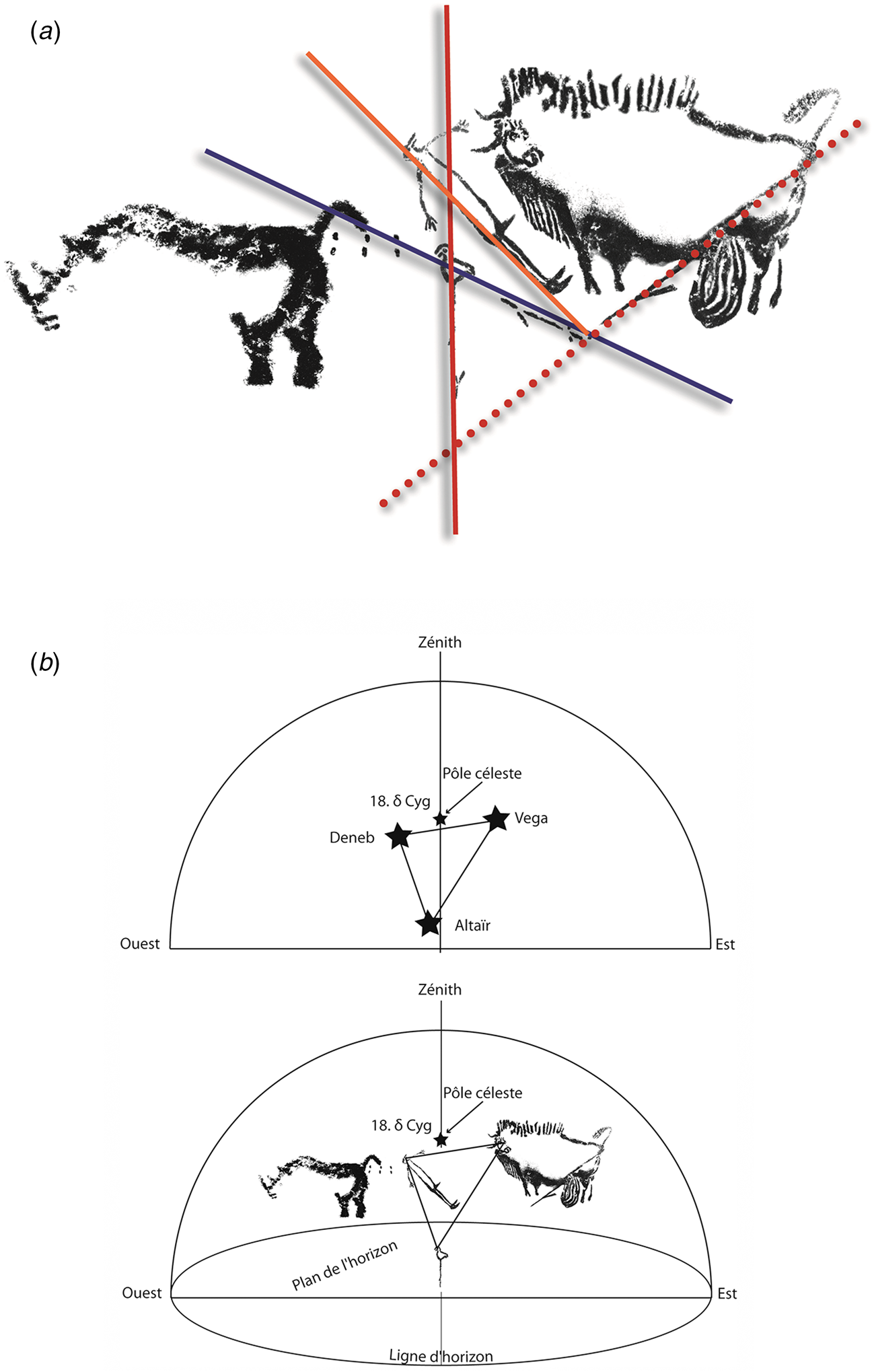
A zodiacal reading of Lascaux cave in its entirety was put forward in the 2000s by Chantal Jègues-Wolkiewiez. In her (2011) discussion of its famous ‘shaft scene’ she argues that ‘the Bird-on-a-stick is in the axis of the world at 0° of azimuth north’ and that ‘the throwing weapons indicate the solstice directions of the sun at Lascaux’ (Fig. 1a). By contrast, Rappenglück regards the shaft scene as a celestial map (Fig. 1b), where the eyes of the bison, the man and the bird represent the three brightest stars visible in the summer night sky: Vega, Deneb and Altaïr, drawing a gigantic triangle in space. Without explaining why the eyes of only these three figures represent stars (i.e. excluding that of the rhinoceros, which is also present in the shaft), he added that around 18,500 bp, this feature he referred to as ‘the summer triangle’ or ‘triangle of summer nights’ never descended below the horizon and must have been particularly visible at the start of spring—which would thus make it possible to date the paintings (Rappenglück Reference Rappenglück, Potemkina and Obridko2002, 276). As for the bird on its post, this is supposedly the North star posed on the axis of the world. He further contends that ‘the man-bird can be understood as a shaman in a state of ecstasy who journeys through the levels of the cosmos along the axis of the world and the Milky Way, and who reaches the domain of the other world, the zone of the circumpolar stars and the celestial pole 18 δ Cyg which, around 14,500bc, was located in the Milky Way, and which thus indicates the real place of creation according to archaic mentality’ (Rappenglück Reference Rappenglück, Potemkina and Obridko2002, 276. See also Rappenglück Reference Rappenglück, Esteban, Belmonte and de Tenerife2000; Reference Rappenglück2001; Reference Rappenglück2004a,Reference Rappenglückb; Reference Rappenglück2009).
(a) The lines drawn by Chantal Jègues-Wolkiewiez in support of her astral interpretation (drawing by JLLQ after Jègues-Wolkiewiez Reference Jègues-Wolkiewiez2011, fig. 6); (b) Explanatory diagrams used by Michael Rappenglück in his thesis to present his astral interpretation of the ‘Shaft Scene’ (drawing by JLLQ after Rappenglück Reference Rappenglück1999, translated and modified).
There are four primary weaknesses to these approaches. First, the same graphic configurations are often interpreted entirely differently by authors who contradict each other without any argument that would help one to arbitrate in favour of one reading versus another. Second, the basis for the assumptions made by these authors are often unclear. For example, in Rappenglück's (Reference Rappenglück, Potemkina and Obridko2002) explanation of the shaft scene, why should the eyes of the man, bird and bison represent stars and why is the Milky Way, which plays a major role in the interpretation, not depicted? Third, these interpretations are based on graphic units arbitrarily extracted from the ensemble to give them meaning, or they rely on details selected a priori. Thus the ‘remarkable resemblance[s]’ (Rappenglück Reference Rappenglück, Jaschek and Atrio Bárendela1997, 3) are artificially constructed. Finally, even if we take all of the above claims at face value, of all the images that make up the corpus of Palaeolithic art, only a small fraction would be related to celestial objects.
Seasonality in animal depictions
In an alternative approach focusing upon calendrical systems rather than astronomy, Norbert Aujoulat (Reference Aujoulat2005) sought clues to seasonality in the depictions of the horses, aurochs and stags which constitute more than 80 per cent of the animals in Lascaux Cave in France. The horse paintings were compared to their modern Przewalski counterparts, whose coat differs markedly in summer and winter. In the equid paintings, a denser colour on the flanks, a tail extended to the hooves and major corpulence supposedly indicate winter. The ventral ‘M’ motif, visible on certain Magdalenian horses, has been interpreted by other authors as marking the limit of colouring of a seasonally varying hide (Lorblanchet Reference Lorblanchet, Floss, Rouquerol and Barbot2007, 194; Sauvet Reference Sauvet, Fine, Perron and Sacco1994, 97). Alexander Marshack (Reference Marshack1972, 220–21) also suggested that the branched signs that accompany the ‘Chinese horses’ of Lascaux are bare branches that mark the end of spring or the autumn/winter. The aurochs paintings at Lascaux feature a very localized development of shagginess, which indicates a summer coat, corroborated by the presence of a juvenile bovine behind the third bull in the rotunda. In stags, the clearest criterion of seasonality is the development of the antlers (Averbouh & Feruglio Reference Averbouh and Feruglio2016), often disproportionately large in the paintings, and also the fact that the males regroup shortly before the courtship ritual, at the start of the autumn, a behaviour illustrated by several figures. Proponents of this approach try to demonstrate that each of the main periods of the calendar is evoked by a particular animal in the bestiary: ‘The horses mark the end of winter or the start of spring, the aurochs mark full summer, while the stags have been depicted with autumn attributes’ (Aujoulat Reference Aujoulat2005, 67–71). These are what Marshack called ‘chrono-factorised’ images. Moreover, the graphic sequence is claimed to follow ‘closely that seen in the annual variations in the animals’ behaviour’ (Aujoulat Reference Aujoulat2005, 112–13).
Marc Azéma extended these reflections by stressing that in the bison herds of Altamira and in a panel in Les Trois-Frères, the males, who are often pictured as highly animated, seem to surround a group of females in heat (identified by their raised tail). Together, these compositions from Altamira and Les Trois-Frères supposedly evoke the mating season. It is also possible to recognize allusions to this season in the bison panel of Fontanet and in the chamber of little bisons at La Mouthe, as well as in the ibex of the frieze of Le Roc-aux-Sorciers at Angles-sur-l'Anglin, the great ceiling of Rouffignac, and also the herds of stags at Massat and Lascaux, or the horses of Chauvet. All these works may evoke preambles to mating, which would be confirmed by the expression of seasonality in some parietal art (Azéma Reference Azéma2006, 500–501).
Unfortunately, the criteria used to support these interpretations are difficult to identify in the paintings, and even more so in engravings. Palaeolithic artists often emphasized deer antlers, going so far as to make them unrealistic and non-specific (i.e. drawn in such as way as to make it impossible to recognize the species) meaning they are not reliable indicators of seasonality. Where equids and bovines are concerned, it is primarily the density of the coat that is modified with the seasons, and their Palaeolithic depictions ‘do not generally make it possible to differentiate their summer and winter coats’ (Bouvier & Dubourg Reference Bouvier and Dubourg1997, 238, our translation). As for the raised tail, it is only a definitive sign of pre-copulation among ibex, because ‘horses and bison (males and females) very often do this for a variety of insignificant reasons’ (Bouvier & Dubourg Reference Bouvier and Dubourg1997, 238, our translation; Pigeaud Reference Pigeaud2000, 19). Among horses, the positions of the tail are highly varied in nature, and most of those which indicate that the female is in estrus are the same as for urination or defecation, and they can also be adopted for getting rid of insects, or can precede a bucking (Waring Reference Waring2007, fig. 20.10). Slender mammoths such as those in the cave of Roucadour have been interpreted as animals emaciated after a long winter and which had become hairless at the time of the first warmth (Delluc & Delluc Reference Delluc and Delluc2004), but Michel Lorblanchet pointed out that the absence of tusks does not argue in favour of the naturalism of these figures (Lorblanchet Reference Lorblanchet, Floss, Rouquerol and Barbot2007, 200).
In summary, indisputable indicators of seasonality are extremely rare, the most cited example being the ‘hook-jawed’ salmon of the Abri du Poisson, a characteristic of certain males during the autumn spawning (e.g. Peyrony Reference Peyrony1932; Roussot Reference Roussot1984; White Reference Randall2006). Moreover, since in the whole corpus of depicted animals there are absolutely no representations of birth or suckling, and practically no indisputable copulation scenes, ‘it is therefore obvious that the representation of the seasons was not the main aim of the Palaeolithic artists’ (Bouvier & Dubourg Reference Bouvier and Dubourg1997, 243, our translation).
Notational systems as indicators of the passage of time
Taylor (Reference Taylor2021), building on Marshack (Reference Marshack1972), argues that Upper Palaeolithic peoples used phases of the moon to mark the passage of time and to record and predict animal behaviour key to their survival (mating, birthing and seasonal migrations), and that non-figurative images associated with the animals are the visual components of this calendrical system. For Taylor (Reference Taylor2021, 223) one dot represents one day, and he claims that box shapes (commonly known as quadrangles) at Lascaux and elsewhere represent new moons: they ‘were easy to paint and perhaps instinctively employed as they are for both geometrically organized calendars in the present and the Chinese character for moon. As pictorially represented with the Axial Gallery Pregnant Mare, each vertical set of boxes or elongated box represents a full moon while the shorter elongated box, or less nighttime illumination, marks the new moon’. Taylor (Reference Taylor2021, 217) further suggests that the number 13 is important because it is ‘the number of days leading up to the full moon from the first crescent (waxing) moon and when hunter-gatherers had specific hunting strategies for and success in harvesting deer, elk and other ungulates’.
Bacon et al. (Reference Bacon, Khatiri, Palmer, Freeth, Pettitt and Kentridge2022) draw on three theories about cave art: (1) Francesco d'Errico (Reference d'Errico and Nowell2002), who argued repeated lines might be an artificial memory system, storing information outside the body; (2) Norbert Aujoulat (Reference Aujoulat2005), who argued that the superposition of images at Lascaux (horse, aurochs, deer) related to the succession of reproduction and thus seasons; and finally (3) they may have been influenced by Steve Mithen (Reference Mithen1991), who argued that the animal images were full of ethological information for teaching young hunters. These authors begin from two suppositions that they consider to be ‘uncontroversial’ (Bacon et al. Reference Bacon, Khatiri, Palmer, Freeth, Pettitt and Kentridge2022, 3, 5): (1) that the art records events and the passage of time; and (2) that lines and dots represent numbers. Like Taylor (Reference Taylor2021), Bacon et al. (Reference Bacon, Khatiri, Palmer, Freeth, Pettitt and Kentridge2022) focus on non-figurative signs in relation to animal figures. In particular, they focus on lines, dots and what they call ‘Y-signs’ (where one line branches into two lines). The hypothesis is that the association of certain numbers and certain animal species is probably significant/meaningful. The authors argue that knowledge of the yearly cycle of animal migrations, mating and birthing was of central importance to Upper Palaeolithic hunter-gatherers and thus it is reasonable to assume that the (non-figurative) number signs relate to the yearly cycle of migrations, mating and birthing. The authors (2022, 6) note that ‘As none of the sequences in our database … contains more than 13 marks, they are consistent with the 13 lunar months of a year. Hence, we hypothesize that sequences are conveying information about their associated animal taxa in units of months. In other words, they present ethological information as a seasonal calendar’. While the lines and dots are both said to represent months, the branching of the Y-sign is believed to symbolize the act of giving birth with one individual becoming two individuals or because the ‘v’ part of the Y-sign represents ‘parted legs’ (Bacon et al. Reference Bacon, Khatiri, Palmer, Freeth, Pettitt and Kentridge2022, 7).
Thus the rhythm of life in the Palaeolithic is said to follow a lunar calendar, and the authors imagine that this calendar must begin in what they call the ‘bonne saison’, in other words, springtime. They use the expression ‘bonne saison’, which they claim is a French zooarchaeological term,Footnote 1 to refer to when the winter ice melts and land is greener, roughly late spring. The dots and lines represent the number of lunar months since the beginning of the ‘bonne saison’ and the total number of months corresponds with the date of important events tied to game animals (spring and autumn migrations, mating and birthing/spawning).
To test their hypothesis, they recorded birthing, spring migration, mating season and autumn migration for eight living species (horse, bison, aurochs, reindeer, roe deer, elephant, birds and salmon) and the corresponding time periods expressed in lunar months from the ‘bonne saison’. Because of the difficulty of reconciling the lunar months with the solar year, the authors argue that Upper Palaeolithic peoples simply stopped counting in the winter months and started their calendar anew at the next ‘bonne saison’. The birth period falls in months 1–2 for all species except for elephants and birds (months 1–3), and salmon (months 7–10). Mating is in months 2–5 for horses, months 4–5 for bison, month 4 for aurochs, months 4–6 for elephants, and later for reindeer (months 6.5–7.5) and red deer (months 5–7). Spring migration takes place generally in months 13 and 1 (i.e. during the ‘bonne saison’) at the beginning of the year or at the end of the preceding one, except for salmon migration that takes place in months 3–6 but does not occur for non-migratory animals, of course. The autumn migration takes place during months 5–7, aurochs are a little bit later (months 7–9) and likewise deer (months 8–9). The next step was simply to compare these dates with the numbers of dots and lines associated with the same animals in the parietal art. While none of the sequences correlated with spring or autumn migrations (figures of these data are not included), Bacon et al. (Reference Bacon, Khatiri, Palmer, Freeth, Pettitt and Kentridge2022) argue they do correspond to mating and/or birthing events for each species.
Rappenglück (Reference Rappenglück and Ruggles2014) made similar arguments almost a decade earlier, using some of the same examples. Rappenglück (Reference Rappenglück and Ruggles2014), Taylor (Reference Taylor2021) and Bacon et al. (Reference Bacon, Khatiri, Palmer, Freeth, Pettitt and Kentridge2022) all emphasize the importance of the number 13 and attempt to link their calendars to events tied to animal behaviour such as mating, birthing and migration, but they differ in the details, for example whether the number 13 connotes days (Taylor Reference Taylor2021), weeks (Rappenglück Reference Rappenglück and Ruggles2014) or months (Bacon et al. Reference Bacon, Khatiri, Palmer, Freeth, Pettitt and Kentridge2022), whether the starting point for the calendar should be the ‘bonne saison’ (Bacon et al. Reference Bacon, Khatiri, Palmer, Freeth, Pettitt and Kentridge2022) or the new moon (Taylor Reference Taylor2021), and over the importance of ‘box signs’ (i.e. quadrangles) (Rappenglück Reference Rappenglück and Ruggles2014; Taylor Reference Taylor2021) versus Y-signs (Bacon et al. Reference Bacon, Khatiri, Palmer, Freeth, Pettitt and Kentridge2022). Rappenglück (Reference Rappenglück and Ruggles2014), however, interprets quadrangles as months of time rather than the new moon (Taylor Reference Taylor2021). We now turn to an evaluation of the interpretations put forth by Rappenglück (Reference Rappenglück and Ruggles2014), Taylor (Reference Taylor2021) and Bacon et al. (Reference Bacon, Khatiri, Palmer, Freeth, Pettitt and Kentridge2022).
Evaluating the lunar calendar interpretation
Hypothesis testing
The fundamental issue with these studies is that the interpretations the authors are proposing are not testable. None of these papers explicitly states a hypothesis. In reference to Bacon et al. (Reference Bacon, Khatiri, Palmer, Freeth, Pettitt and Kentridge2022), Magli (Reference Magli2023, 1, quoting Bacon et al. Reference Bacon, Khatiri, Palmer, Freeth, Pettitt and Kentridge2022, 6) writes, ‘the authors need to establish if and what kind of a calendar was in use. The hypothesis is that the calendar had lunar months … of 29 days. To decide the number of lunar months the authors make a biased choice: “As none of the sequences in our database contains more than 13 marks, they are consistent with the 13 lunar months of a year …”; this procedure is scientifically incorrect because they are using the thesis as an hypothesis’ (italics in the original). This observation is not a case of being pedantic. As a result of not articulating the correct research questions and concomitant hypotheses, the data necessary to test hypotheses that would allow them actually to address whether a lunar calendar was in use or not have not been collected and analysed. Rappenglück (Reference Rappenglück and Ruggles2014) and Taylor (Reference Taylor2021) do not use statistics to test for significant relationships of any kind. Although Bacon et al. (Reference Bacon, Khatiri, Palmer, Freeth, Pettitt and Kentridge2022) do perform statistical tests, they are not actually testing the relationships that will allow them to support or refute the existence of lunar calendars in Upper Palaeolithic parietal art. We return to this point below.
Data sampling
In order to test a hypothesis, it is necessary to collect a representative sample of the available data and not to exclude data that do not support it, thus biasing your results. Unfortunately, Bacon et al. (2022, Supplementary Material) exclude cases where the sequences of lines and dots in association with animals total 14 or more. In their database, they have one case each of 14 signs, 17 signs, 20 signs, 28 signs and 59 signs; two cases of 29 signs; and three cases of 16 signs, but they do not include them in their analysis. Thus, excluding all cases where the sequences exceed 13 biases their dataset in favour of the lunar calendar interpretation. Similarly, Bacon et al. (Reference Bacon, Khatiri, Palmer, Freeth, Pettitt and Kentridge2022) only consider cases where there are lines and/or dots in association with animals. They do not include in their analysis examples of animals without these signs in association, nor do they consider dots or lines or Y-signs when they occur in isolation. They similarly do not consider therianthropes (animal–human hybrids) associated with the signs (Magli Reference Magli2023). In order to test for meaningful relationships between sets of data one must look at all possible permutations of these relationships.
Finally, because in their database sequences of similar signs are overwhelmingly those comprising only three or four elements, Bacon et al. (Reference Bacon, Khatiri, Palmer, Freeth, Pettitt and Kentridge2022) do not consider the other ethological events (i.e. spring and autumn migrations) that they had previously said were important to hunter-gatherers in favor of focusing on mating and birthing. Although they looked for predictors of migrations and claim not to have found them (2022, 14), the migration data are not graphed and the implications of the negative results are not discussed.
Reading ordinal level data
Bacon et al. (2022, 1) write ‘The position of the <Y> within a sequence of marks denotes month of parturition, an ordinal representation of number in contrast to the cardinal representation used in tallies’. Ordinal data are a type of data where the variables have natural, ordered categories but the distances between the categories are not known. An example of ordinal data is categories such as ‘poor’, ‘middle class’ and ‘wealthy’. In the case of this modern example, we understand the natural order of the data, but with the non-figurative signs we do not. Bacon et al. (Reference Bacon, Khatiri, Palmer, Freeth, Pettitt and Kentridge2022) do not consider whether the position of the Y-sign should be counted from left to right, right to left, top to bottom or bottom to top. Taylor (Reference Taylor2021) suggests the signs should be read from right to left based on the trajectory of the moon in the night sky, but this is completely speculative.
Causation versus correlation
Bacon et al. write (2022, 13) ‘The first key message is that the birth periods are significantly well predicted by the position of <Y> (p < 0.0146)’ which they predict to be in position one, two or three based on each species’ birth months noted above. However, since the sequences with lines, dots and Y-signs in the database are short, the Y-sign is almost certain to be in positions one to three by definition. What the authors’ database shows more than anything is that the sequences of three or four lines/dots are by far the most common. This observation is not new and there are several possible explanations. The simplest is that notational systems up to four units are particularly useful; anything more needs to be broken into patterns such as ‘five’ and ‘six’ on dice (Trick & Pylyshyn Reference Trick and Pylyshyn1994). But crucially, what the statistical tests do not tell us is the meaning of this pattern—what is being counted (if anything). As Magli (Reference Magli2023, 4) observes,
in Palaeolithic figurative art the vast majority of the additional signs is concentrated between 3 and 4 in number. This is a clear-cut case of a database in which a small but relatively acceptable set of data (tens to hundreds for each taxa, excluding [mammoths]) corresponds to a very small set of possible results; the results are very clearly not randomly distributed … but the analysis cannot—and indeed, does not—furnish a proof of the proposed interpretation, as many other interpretations could be ‘proved’ in the same way. To put it in yet another way, the statistical analysis says ‘yes’ to both the questions: ‘are the numbers representing the third month of the phenological calendar?’ and ‘are the numbers saying that the artists saw three animals?’. (Emphasis added)
This critique is at the heart of the matter. As currently configured, the lunar calendar interpretation does not and cannot explain anything about Palaeolithic art and remains just one of many possibilities. What Bacon et al. (Reference Bacon, Khatiri, Palmer, Freeth, Pettitt and Kentridge2022) have tested for and have demonstrated (selective data aside) is that the sequences of lines and dots associated with images of animals tend to be short—nothing less, but certainly nothing more. There is a correlation between animal images and length of the associated non-figurative sequence but this brings us no closer to causation, no closer to meaning (see also Dehaene Reference Dehaene2024). When Bacon et al. write (2022, 1) ‘We demonstrate that when found in close association with images of animals the line and dot constitute numbers denoting months’ and that (2022, 1) ‘we also demonstrate that the Y sign … has the meaning “to give birth”’, this is not correct: the statistical analysis establishes a pattern which could be caused by many possibilities, not simply the interpretation asserted. Indeed, it is not clear that this motif has a particular meaning, or only one (see below).
Interpreting Palaeolithic parietal art
The studies assembled here raise a number of methodological issues common to all researchers interpreting Palaeolithic parietal art. In this section, drawing on examples in the work of Rappenglück (Reference Rappenglück and Ruggles2014), Taylor (Reference Taylor2021) and Bacon et al. (Reference Bacon, Khatiri, Palmer, Freeth, Pettitt and Kentridge2022), we consider the challenges of inferring meaning from images created in the deep past, the dependence on secondary sources and the appropriate use of ethnographic analogies.
Inferring meaning
Inferring the meaning(s) of contemporary art is not always straightforward even with written records and living artists with whom to speak. Unsurprisingly, this task is more difficult still with art from the deep past. For example, it is not obvious that dots and lines in parietal art represent either days (Taylor Reference Taylor2021) or months (Bacon et al. Reference Bacon, Khatiri, Palmer, Freeth, Pettitt and Kentridge2022), that these two sign types are functionally equivalent (Bacon et al. Reference Bacon, Khatiri, Palmer, Freeth, Pettitt and Kentridge2022, 3), or that their meanings remained unchanged for tens of thousands of years (Bacon et al. Reference Bacon, Khatiri, Palmer, Freeth, Pettitt and Kentridge2022, 3). Ethnographically, dots in rock art have multiple meanings, for example, bees, seeds, stars, raindrops, huts, fires, tracks or blood, and a set of three dots can evoke the stones of the hearth as well as the hunter, his dog and the game (Delano Smith Reference Delano Smith1982, 20; Faïk-Nzuji Reference Faïk-Nzuji1998, 21; Lawson Reference Lawson2012, 221; Lewis-Williams Reference Lewis-Williams1995, 9; Maggs Reference Maggs, Woodward and Lewis1998, 20; Mveng Reference Mveng1964, 95; Patterson & Duncan Reference Patterson, Duncan, Gillette, Greer, Hayward and Murray2014, 146–7; Solomon Reference Solomon, David and McNiven2017) while ‘arranging tiny dots in an orderly fashion around the body of bigger animals, … appears to imply the nomadic people's hope of high animal reproduction’ (Zhang Reference Zhang, Gillette, Greer, Hayward and Murray2014, 90). It is impossible to guess their meaning by observation alone without any other information. Furthermore, a single motif may have layers of meaning with each layer apparent according to the status of the viewer. Thus the meaning of a motif can change within an individual's lifetime (Calder et al. Reference Calder, Crocker and Ridgeway1981; West Reference West1988).
Archaeologically, dots and lines are some of the most common sign types in European Upper Palaeolithic art. For example, researchers have suggested that when dots are arranged in columns and rows they functioned as tally marks (d'Errico Reference d'Errico1995; Marshack Reference Marshack1991) or may indicate zones of superior acoustic resonance (Reznikoff Reference Reznikoff, Scarre and Lawson2006, 79–80); when associated with animals they have been described as indicating hunting wounds (Baffier Reference Baffier1990; Breuil Reference Breuil1952; d'Huy & Le Quellec Reference d'Huy and Le Quellec2010; Delluc & Delluc Reference Delluc and Delluc1989; Lejeune Reference Lejeune2000; Ucko & Rosenfeld Reference Ucko and Rosenfeld1967) and when found at the ends of galleries or at junction points in passageways, they may have acted as wayfinders or be signalling the limits of the decorated areas of the cave (Breuil Reference Breuil1952; Casado Lopez Reference Casado Lόpez1977; Leroi-Gourhan Reference Leroi-Gourhan1968; Ucko & Rosenfeld Reference Ucko and Rosenfeld1967). Other possible explanations for dots include that they are entoptic images produced during trance (Lewis-Williams Reference Lewis-Williams2002, but see Bahn Reference Bahn, Francfort and Hamayon2001), that they represent constellations (Pásztor & Priskin Reference Pásztor and Priskin2010, but see above) or were created unintentionally through contact between cave walls and ochred bodies (Medina-Alcaide et al. Reference Medina-Alcaide, Garate Maidagan and Sanchidrián Torti2018). Given that dots in European Palaeolithic art span 30,000 years and are found throughout the continent, it is likely that they had multiple meanings that shifted over time and space. Similarly, lines in association with animal or human figures have been interpreted as spears or the ‘the pricking sensations of trance … [hallucinated as] … multiple stabbings of sharp pointed lances’ (Lewis-Williams Reference Lewis-Williams1997, 826; see also Lorblanchet Reference Lorblanchet2010; Solomon Reference Solomon, David and McNiven2017).
Turning to the Y-sign, there is no evidence to support the argument that it represents birth (i.e. parted legs or ‘two becoming one’) particularly when the sign is said to be in association with quadrupeds and fish—the latter not only do not have two legs but they lay hundreds or even thousands of eggs at a time depending on the species. Similarly, there is no basis for Taylor's (Reference Taylor2021) interpretation of ‘boxes’ representing the full moon or a new moon. The reasoning offered is that they are easy to paint and reminiscent of the Chinese character for moon, but these observations are irrelevant.
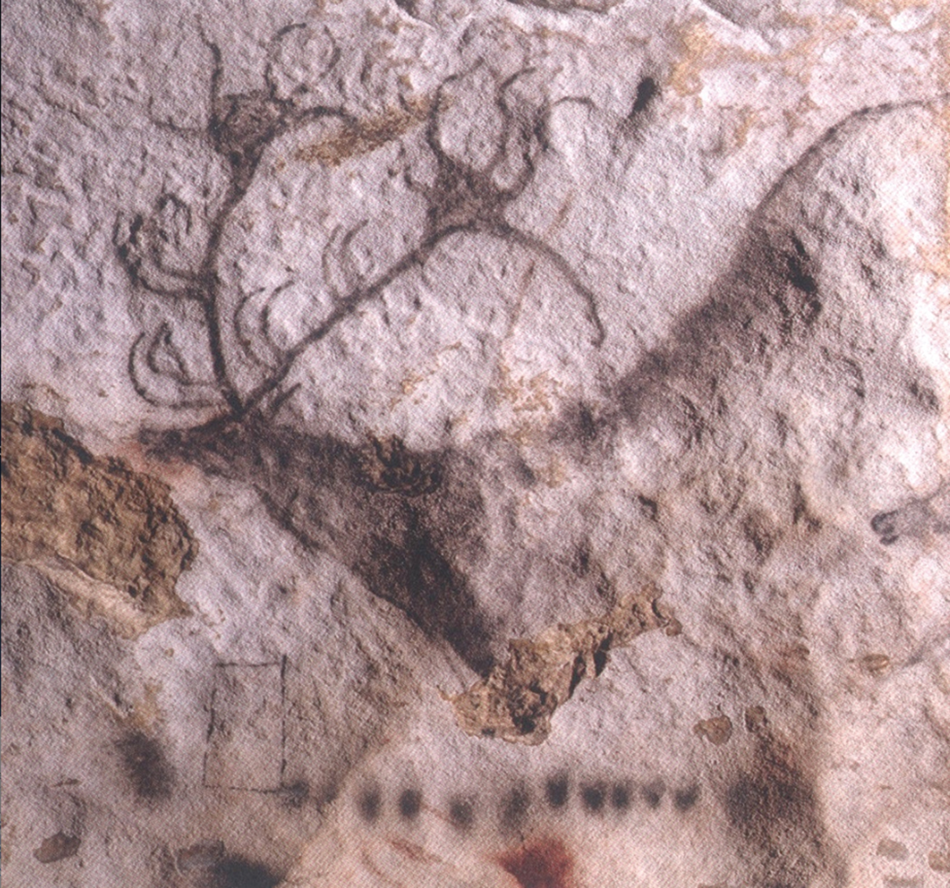
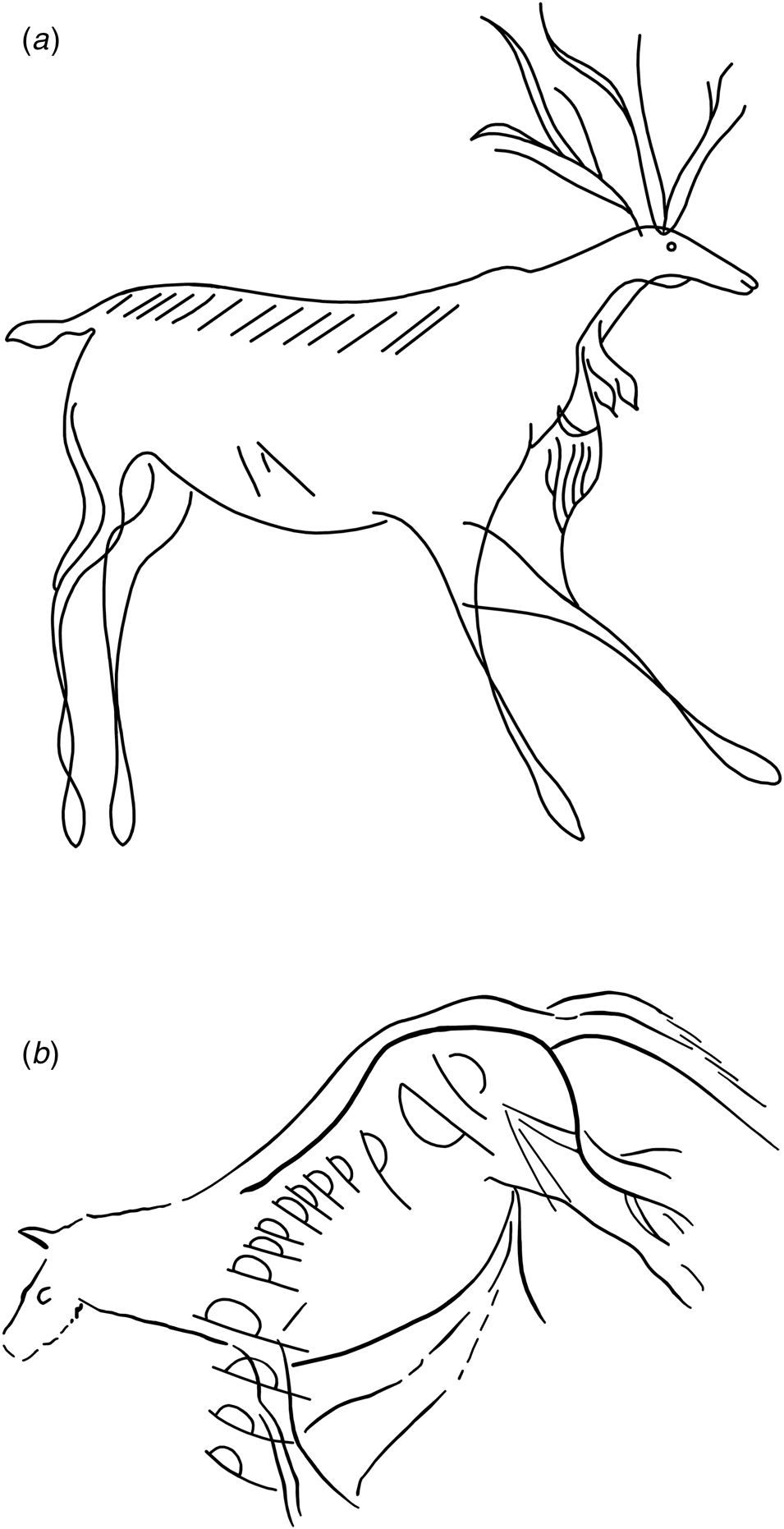
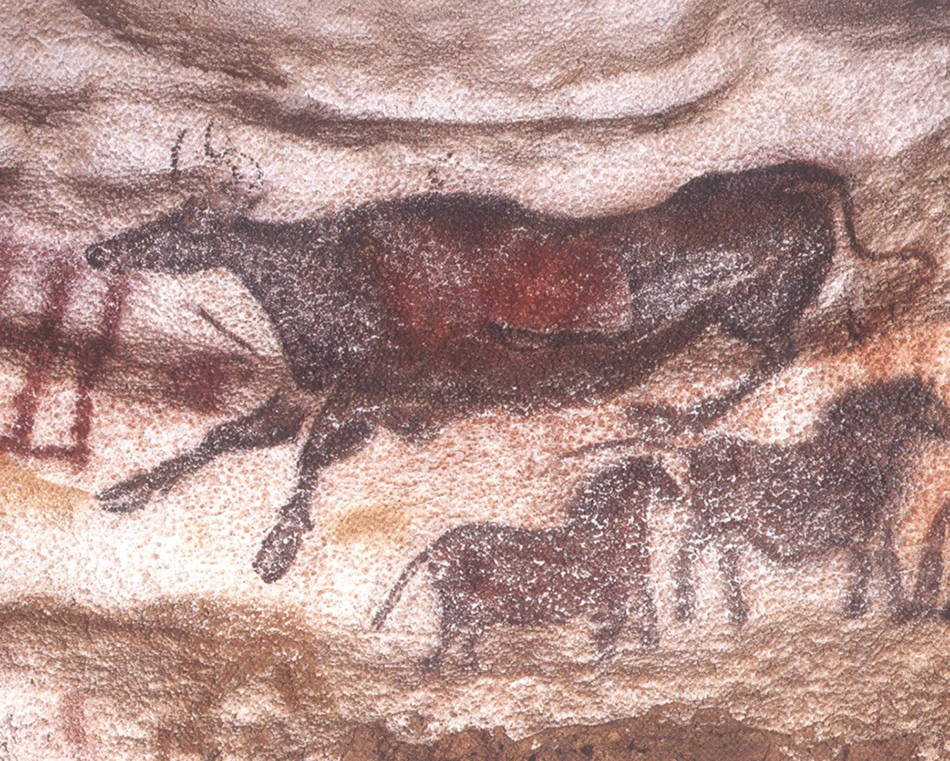
A related issue is pareidolia (the human tendency to see order or a meaningful shape in a random or ambiguous visual pattern) or perhaps even more simply the human desire to see what one wants to see in an image. For example, Taylor (Reference Taylor2021, 216, fig. 1) points to the ‘fogged hot breath’ of the stag from Lascaux to support the supposition that it is in a ‘rutting condition’ and calling to females, but what Taylor is interpreting as fogged breath is actually just the natural colour of the wall (Fig. 2). Taylor (Reference Taylor2021) also frequently refers to ‘pregnant animals’ but as Bahn (Reference Bahn2016, 294, 386) notes, ‘The last resort of those seeking evidence of an interest in animal fertility was to see many figures, especially horses, as “pregnant”. Yet even veterinarians cannot tell if a horse is pregnant from its profile alone (though they can do so from a back-view – J.R.B. Speed, Vet.M.B., M.R.C.V.S., pers. comm.)’. Quite apart from possible stylistic conventions involved in giving horses large, rounded bellies (as well as short legs, tiny heads, etc.), inflated stomachs can also be the result of eating quantities of wet grass. If Taylor's (Reference Taylor2021) assessment of horses as pregnant is correct (and this designation is crucial for his argument related to seasonality), then similarly drawn horses with phalluses would also have to be described as pregnant (Baffier Reference Baffier and Bandi1984, 148–9; Bandi Reference Bandi and Ripoll Perelló1968, 16; Leroi-Gourhan Reference Leroi-Gourhan1966, 39; Reference Leroi-Gourhan1971, 89, 98). González Sainz and Ruiz Idarraga (Reference Sainz, & R and Idarraga2010, 69) likewise argue that pregnancy in horses based on images of them is simply not demonstrable, and Delluc (Reference Delluc2006, 235) has pointed out that, at Lascaux, the big, explicitly sexed bulls have voluminous bellies ‘like pregnant females’ (Bahn Reference Bahn2016, 294, 386). Other examples of unwarranted interpretation include Taylor's (Reference Taylor2021, 216, fig. 2) moon ‘boxes’ on the belly on the stag from Lascaux (Fig. 3a) and on the flank of a horse from Les Trois Frères cave (France) (Taylor Reference Taylor2021, 217, fig. 3) (Fig. 3b) and his (Reference Taylor2021, 226, fig. 12) insistence that he can see ‘the cow's vagina and cervix which in this image is open to the birth canal’ on the jumping cow from Lascaux (Fig. 4) (which Taylor has renamed the ‘birthing auroch’).
Taylor's (Reference Taylor2021) identification of ‘fogged hot breath’ of the stag from Lascaux (France) to support the supposition that it is in a ‘rutting condition’ and calling to females is actually just the natural colour of the rock. (Photograph: J. Vertut, P. Bahn collection.)
(a) Moon ‘boxes’ on the belly of the stag from Lascaux and (b) on the flank of a horse from Les Trois Frères cave (France) are more obviously described as lines and claviforms, respectively. (After Ruspoli Reference Ruspoli1987, 156.)
Taylor (Reference Taylor2021) identifies the cow's vagina and cervix which he describes as open to the birth canal on the jumping cow from Lascaux, but these features are not apparent in photographs. (Photograph: J. Vertut, P. Bahn collection.)
Source criticism
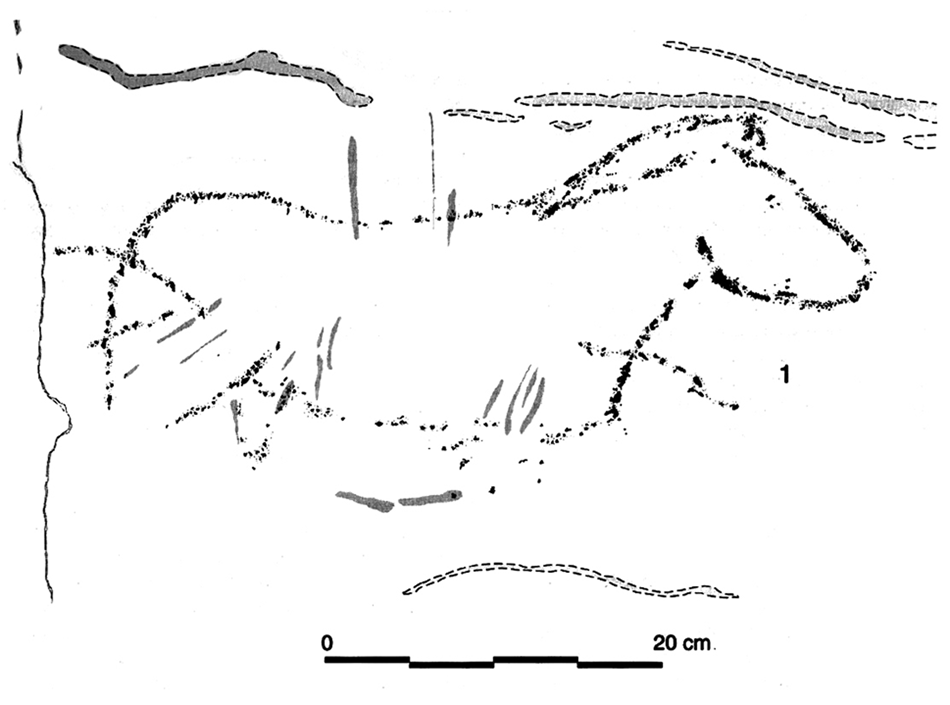
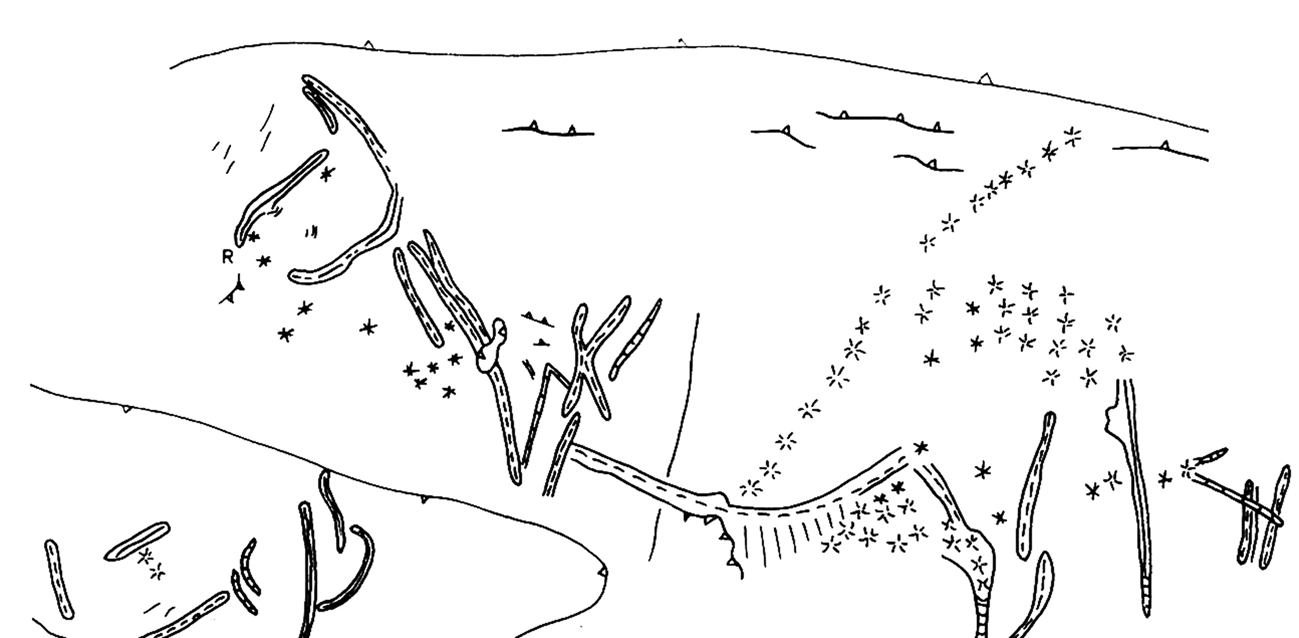
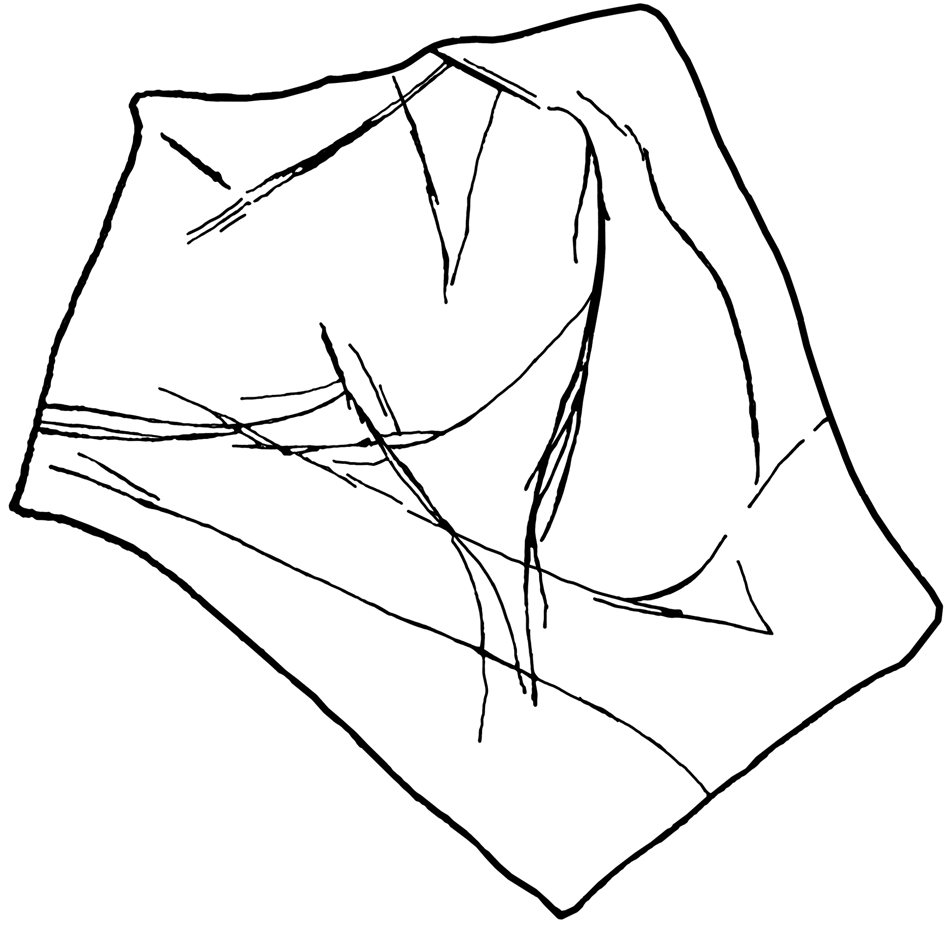
Archaeologists often base their interpretations on reproductions of Palaeolithic parietal images (tracings, drawings, photographs and digital imagery), particularly when images are difficult to access, require special technology to view, or have faded with time. Depending on the technology used and the goal of the individual creating the reproductions, the results can vary greatly. For example, lack of first-hand knowledge of the images combined with the uneven quality of the reproductions used undermines the accuracy of Taylor's (Reference Taylor2021) and Bacon et al.'s (Reference Bacon, Khatiri, Palmer, Freeth, Pettitt and Kentridge2022) findings (see discussion in García-Bustos et al. Reference García-Bustos, Rivero, Sauvet and García-Bustos2023). In some cases, the authors rely on lines that appear in the drawings but do not exist in the original paintings or engravings. For example, contra Bacon et al. (Reference Bacon, Khatiri, Palmer, Freeth, Pettitt and Kentridge2022, fig. 2c), the horse from Sotarriza (Spain) has no lines under it or around it. Both a photograph and an accurate drawing of the animal (González Sainz & San Miguel Llamosas Reference González Sainz and San Miguel Llamosas2001, 212, 134) demonstrate that it is nothing more than a simple outline of a black horse (Fig. 5). Similarly, Bacon et al. (Reference Bacon, Khatiri, Palmer, Freeth, Pettitt and Kentridge2022; fig. 2e), point to a Y-sign on the Commarque horse (France), based on a sketch by Delluc and Delluc (Reference Delluc and Delluc1981). However, both a photograph and an analytical tracing found in the same article by the Dellucs (Reference Delluc and Delluc1981) show that no such Y-sign exists (Fig. 6). This is further corroborated by Breuil's (Reference Breuil1952) drawing of the animal. Another example is Bacon et al.'s (Reference Bacon, Khatiri, Palmer, Freeth, Pettitt and Kentridge2022, fig. 2a) use of the Pair-non-Pair horse (France) to support their arguments. They rely on a sketch of the horse made in 1896 by Daleau, who unfortunately had no experience or expertise in copying cave engravings and who had not yet cleaned sediment off the walls. The lines shown touching the leg do not exist (Lenoir et al. Reference Lenoir and Delluc2013, 15). A final example is the engraved horse on a plaquette (thin stone slab) from Parpalló (Spain) (Bacon et al. Reference Bacon, Khatiri, Palmer, Freeth, Pettitt and Kentridge2022; fig. 2f). It is in association with a V-shaped sign and not a Y-sign (Villaverde Bonilla Reference Villaverde Bonilla1994, fig. 180) (Fig. 7).
The simple outline in black of a horse from Sotarriza (Spain). (After González Sainz & San Miguel Llamosas 2002.)
Contra Bacon et al. (Reference Bacon, Khatiri, Palmer, Freeth, Pettitt and Kentridge2022), a photograph and drawing of the Commarque horse (France) show no Y-sign associated with the animal. (Analytical tracing, after Delluc & Delluc Reference Delluc and Delluc1981.)
Contra Bacon et al. (Reference Bacon, Khatiri, Palmer, Freeth, Pettitt and Kentridge2022), the engraved horse on a plaquette from Parpallo (Spain) (Bacon et al. Reference Bacon, Khatiri, Palmer, Freeth, Pettitt and Kentridge2022, fig. 2f) is in association with a V-shaped sign and not a Y-sign (Villaverde Bonilla Reference Villaverde Bonilla1994, 180). (After Villaverde Bonilla Reference Villaverde Bonilla1994.)
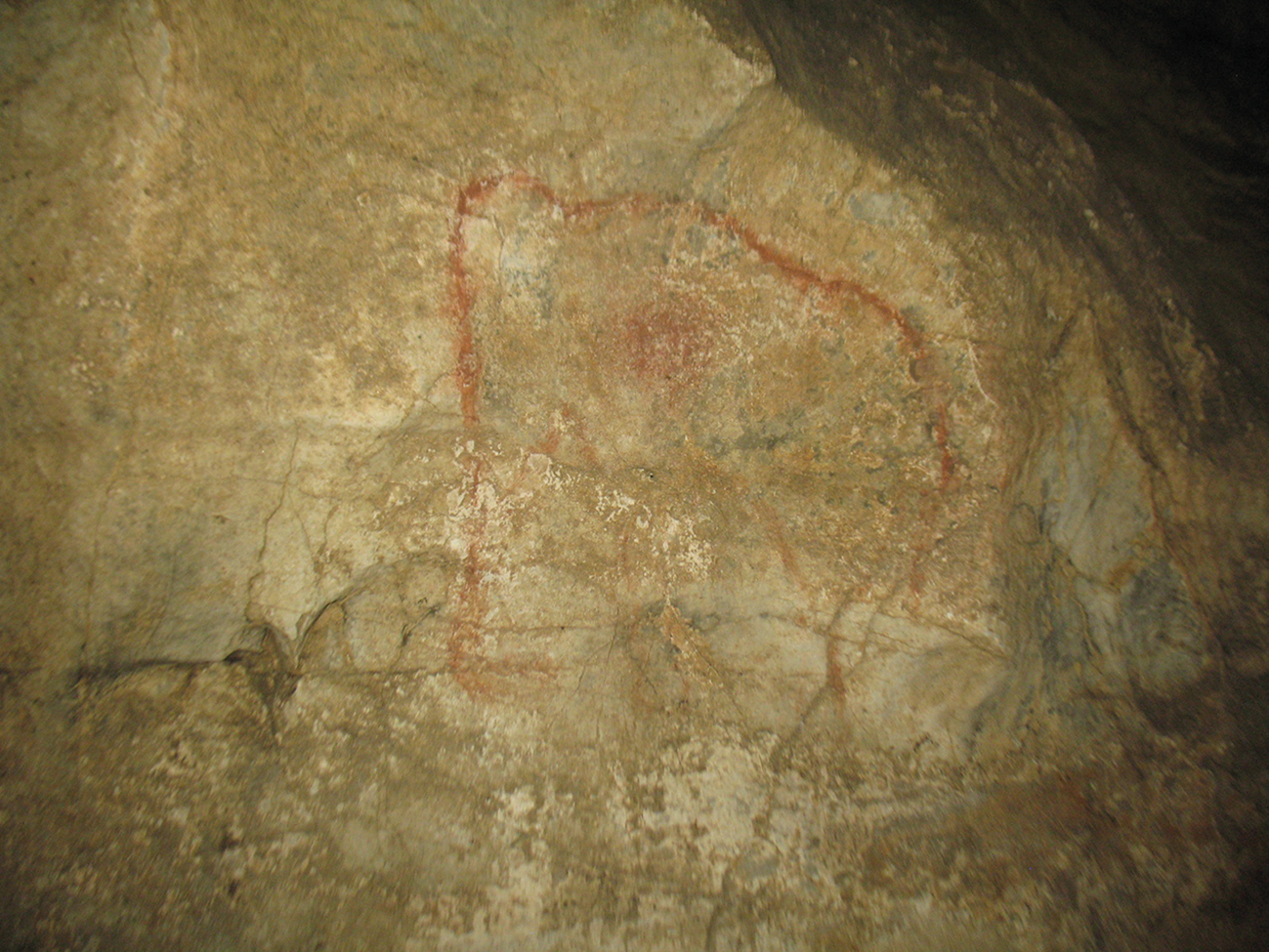
In other cases, older reproductions may not be drawn to scale; and this is relevant because it calls into question whether the lines, dots and Y-signs identified by Taylor (Reference Taylor2021) and Bacon and colleagues (2022) are actually in association with a particular animal. For example, Bacon et al. (Reference Bacon, Khatiri, Palmer, Freeth, Pettitt and Kentridge2022, fig. 1h) rely on Breuil's (Alcalde del Río et al. Reference Alcalde del Río, Breuil and Sierra1911, 61) drawing of the Pindal mammoth (Fig. 8), but it gives no sense of the distance between the animal and the lines. In reality, one set of lines is 60 cm to the left of the animal while another set is 160 cm away from it. This latter grouping is far more likely to mark the end of the cave's decoration, as is the case at the other end of the Pindal frieze and in other caves (González-Pumariega Solis Reference González-Pumariega Solis2011) than to be communicating calendrical information related to the mammoth.
In Breuil's (Alcalde del Río et al. Reference Alcalde del Río, Breuil and Sierra1911, 61) drawing of the Pindal mammoth, the distance between the animals and the sets of lines is not drawn to scale, giving the false impression that they are in association with each other. In reality, one set of lines is 60 cm away from the mammoth while the other set is 160 cm away and not even visible on this photo of the mammoth. (Photograph: P. Bahn.)
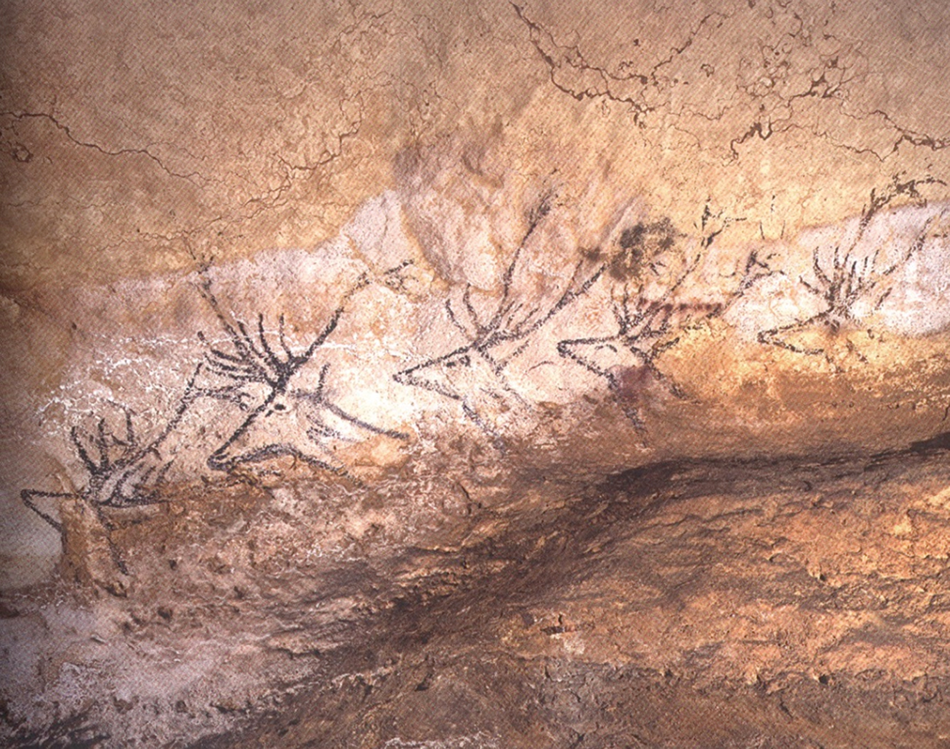
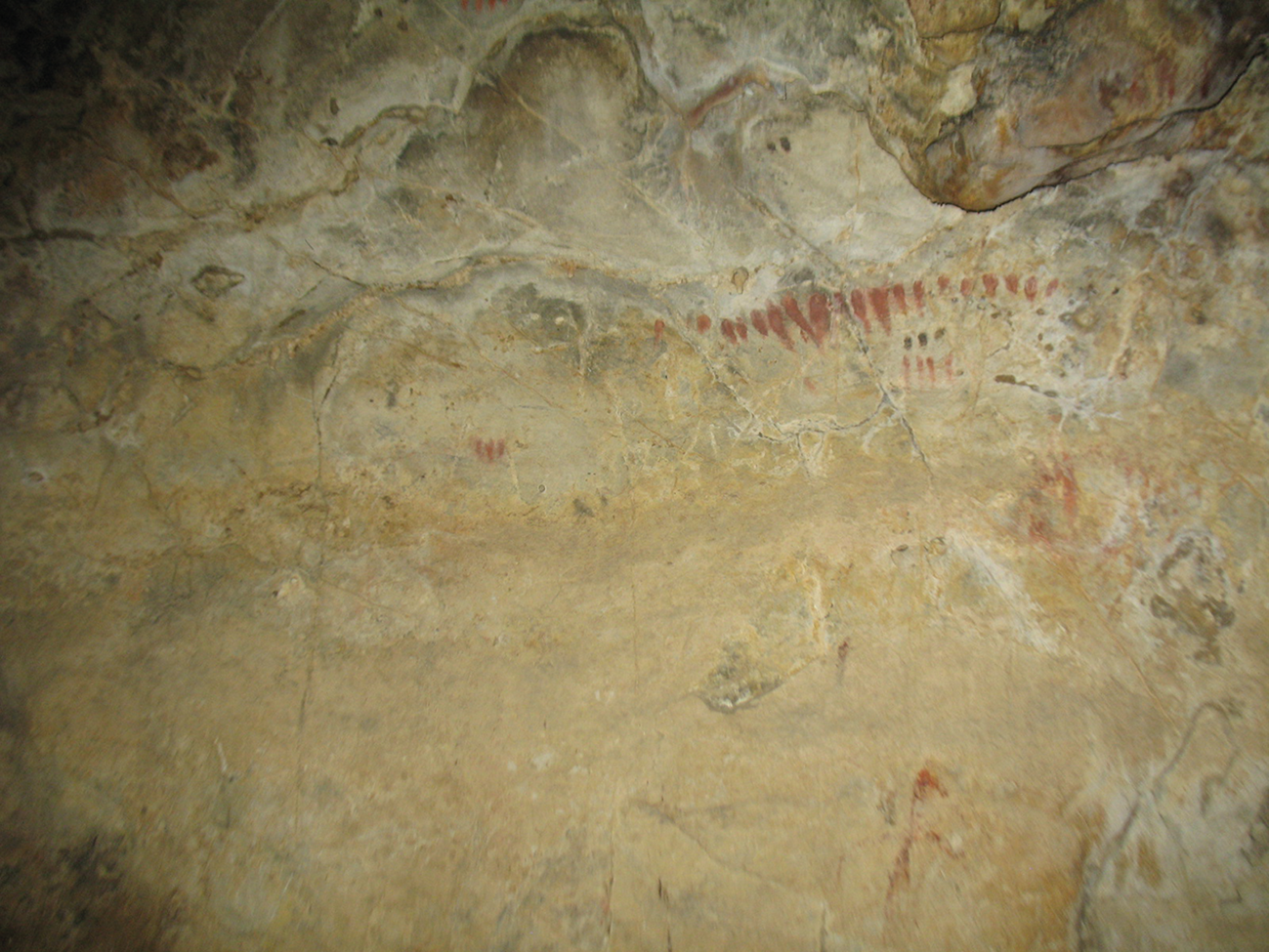
This raises an important issue: even in cases where the animals are in close proximity to the non-figurative signs, how can archaeologists discern association (i.e. a meaningful relationship) from juxtaposition (a coincidental relationship)? Related to this, another source of error is not being aware of the sequence in which the images were produced—again, something that may not be apparent from reproductions or that may be erroneously indicated in them. For example, contra Bacon et al. (2022, fig. 1e), the red dots on the Lascaux stag frieze (Fig. 9) were created before the stags, and are far more likely to be linked—if they are linked to anything—to the red horse head above them (Aujoulat Reference Aujoulat2005) than to the stag. Similarly, the Pindal fish (Bacon et al. Reference Bacon, Khatiri, Palmer, Freeth, Pettitt and Kentridge2022, fg. 1f) was engraved after the 3 red dots supposedly associated with it, with an unknown temporal interval in between (González-Pumariega Solis Reference González-Pumariega Solis2011). Furthermore, there are 4 dots to the right of the fish, and an additional 19 dots just above this group of 4, and another 4 dots above the fish (González-Pumariega Solis Reference González-Pumariega Solis2011), rendering the association between the fish and dots ambiguous at best (Fig. 10).
The red dots on the Lascaux stag frieze were painted before the animal figure and are far more likely to be linked to the red horse head above them (Aujoulat Reference Aujoulat2005) than to the stag. (Photograph: J. Vertut, P. Bahn collection).
The Pindal fish was engraved after the three red dots with an unknown temporal interval in between. The four dots to the right of the fish, and the additional 19 dots just above this group of four, and another four dots above the fish (González-Pumariega Reference González-Pumariega Solis2011) make the associations between the fish and dots ambiguous. In the photo, the fish and three dots are at centre left (Photograph: P. Bahn.)
Finally, another limitation of interpretations based on published data is lack of appreciation of other salient aspects of the location—for example, the difficulty of reaching the place where art is made (see below). This observation underlines the basic fact that looking through books and papers for examples is no substitute for looking at the original images in the caves and seeing precisely where the images are drawn.
The use of ethnographic analogy
As Nowell and French (Reference Nowell and French2020, 17) observe, ‘Recent hunter-gatherers are not direct and unproblematic analogues for Palaeolithic hunter-gatherers. Nonetheless, both past and prehistoric forager societies share many demographic similarities, including small group size, low population density and high mortality.’ The relationship between demography and key features of foraging ways of life makes modern hunter-gatherers a reasonable source of information for generating hypotheses about the lives of modern humans living in the Upper Palaeolithic and for providing checks and balances on interpretations created by archaeologists whose knowledge and experiences may be completely different from the societies they are studying. The use of ethnographic analogy by the proponents of the lunar calendar interpretation is uneven—Taylor (Reference Taylor2021) draws on a mix of foraging and pastoralist societies with the latter being less appropriate models, while Bacon et al. (Reference Bacon, Khatiri, Palmer, Freeth, Pettitt and Kentridge2022) do not appear to have consulted the ethnographic literature at all.
In 2011, Hayden and Villeneuve published a paper that explored the ethnographic evidence for astronomical knowledge among hunter-gatherers. They surveyed 82 hunter-gatherer cultures that they divided into ‘simple’ (n = 7) and ‘complex’ (n = 75). According to these researchers (Hayden & Villeneuve Reference Hayden and Villeneuve2011, 335), complex hunter-gatherers are characterized by relatively high population densities (0.2–10.0 people/sq. km), seasonal or full sedentism, individual or family control of products and significant socio-economic differences within communities often reflected in burials, trade and the creation of prestige objects based on surpluses, and elaborate feasting activities based on surpluses, and complex counting systems. By contrast simple, more egalitarian hunter-gatherers are characterized by ‘communally owned resources, simple counting systems limited to 10–20 numbers, minimal socioeconomic inequalities or prestige objects and negligible economically- based competition or feasting or marriage payments’ (Hayden & Villeneuve Reference Hayden and Villeneuve2011, 335). They argue, based on archaeological evidence, that Upper Palaeolithic groups situated ‘in the most productive Eurasian environments were complex hunter-gatherers’ (Hayden & Villeneuve Reference Hayden and Villeneuve2011, 335, emphasis in the original). These environments include the Dordogne (France) and Cantabrian Spain, from where many of the images used to support the Lunar Calendar interpretation are derived.
Hayden and Villeneuve (Reference Hayden and Villeneuve2011, 340) discovered that 84 per cent (63/75) of complex hunter-gatherers ‘exhibited some solstice observation or monitoring and/or calendars (most often lunar).'Footnote 2 Importantly, these observations correlated with setting the correct date for ceremonies, rituals and feasts, particularly when many families would have to coordinate and pool resources. These ceremonies typically involved more than preparing food, but also complex webs of social and material debt. In sum, ‘What emerges from these observations … is a pattern among complex hunter-gatherers of solstice-monitoring systems together with varying developments of calendrical systems based on lunar cycles and days leading up to key solar events such as solstices’ that are tied to important ceremonies and rituals (Hayden & Villeneuve Reference Hayden and Villeneuve2011, 340) rather than mating, birthing and seasonal migrations. Hayden and Villeneuve's work highlights the importance of choosing appropriate ethnographic analogies from which to formulate hypotheses and test implications—the more points of connection between known variables (e.g. level of socio-economic complexity), the stronger the case is for analogical reasoning.
Implications of the Lunar Calendar interpretation
The calendar's heuristic value
If, as Bacon et al. (Reference Bacon, Khatiri, Palmer, Freeth, Pettitt and Kentridge2022) assert, the Y-sign truly does symbolize the verb ‘to give birth’, i.e. the birthing season, it begs the question of the heuristic value of the lunar calendar. All herbivore prey species they study give birth one to two months following the start of spring or the ‘bonne saison’. Thus, since all these species are the same, there is no information content there to coordinate or of which to keep track. Bacon et al. (2022, 6) dismiss other possible reasons for tally marks, stating ‘It seems to us unnecessary to need to convey information about the numbers of individual animals, the times they have been sighted, or the number of successful kills’. But why would Palaeolithic people need a calendar to record or predict the mundane fact that all their major herbivores give birth one or two months after the snow melts? If they use the temperature and the visual cue of snow melting to know when to start their calendar (Bacon et al. Reference Bacon, Khatiri, Palmer, Freeth, Pettitt and Kentridge2022, 7), it is likely they can deduce when birthing will take place without one.
Further undermining the lunar calendar interpretation is the location of the art. Why place practical information such as the birthing season of bison in the deepest reaches of caves, in often the hardest places to get to, with low visibility? In the above-mentioned case of the Sotarriza horse image, the artist literally risked life and limb to reach the place where the drawing was made. As Magli (Reference Magli2023, 4) writes,
why was it felt necessary to convey such ‘calendrical’ information? Information on mating, migration and the like was of course very well known to all hunter-gatherers and was certainly contained in their cultural background since childhood, making it unlikely the idea that it was necessary to go into a dark cave to see the dots/bars – say, on an auroch's image in order to know the time of their mating. Actually, it seems to the present author that instead of giving credit to the Palaeolithic mind the idea that this ‘proto-writing system’ was used by hunter-gatherers for some 25000 years to write always the same information does not render justice to their way of knowing and connecting with nature.
Lunar calendars and implications for the origins of writing
Bacon et al. (Reference Bacon, Khatiri, Palmer, Freeth, Pettitt and Kentridge2022, 1) claim that the results of their study ‘[give] us our first specific reading of European Upper Palaeolithic communication, the first known writing in the history of Homo sapiens’. They (2022, 14, 15) also claim that the signs ‘functioned as words’ and that the Y-sign ‘may be the first known example of an “action” word, i.e. a verb (“to give birth”), although we acknowledge that this is ambiguous: it could function as a noun, “birth”, or “place of birth”.’ They then write that ‘We will presumably never know the specific words for [animals, moon phases, the bonne saison, mating and birthing] in whatever languages were spoken in Upper Palaeolithic Europe, but we can assume that our script could be communicated orally by using them. Is this then, not the definition of writing?’.
The simple answer is no, this is not ‘writing’. Writing is a system of intercommunication based on the use of conventional visible marks produced on a durable surface whereby all parts of a language are represented (nouns, pronouns, verbs, etc.) (Coulmas Reference Coulmas1996; Gelb Reference Gelb1963; Trigger Reference Trigger and Houston2004; Von Petzinger Reference Von Petzinger2017). Furthermore, writing is a symbol-based system where there is an agreed-upon relationship between an arbitrary sign and its referent. With the development of writing linked to the rise of sedentary, high-density, hierarchical, urbanized societies, it is unlikely that there are many symbols within the category of non-figurative signs in Upper Palaeolithic art (Schmandt-Besserat Reference Schmandt-Besserat1992; Von Petzinger Reference Von Petzinger2017 and references therein).
Bacon et al. (Reference Bacon, Khatiri, Palmer, Freeth, Pettitt and Kentridge2022, 14) also write, ‘We have proposed the existence of a notational system associated with an unambiguous animal subject, relating to biologically significant events informed by the ethological record, which allows us for the first time to understand a Palaeolithic notational system in its entirety.’ Even if we take this at face value, there is no agreed upon typology of Palaeolithic signs (Le Quellec Reference Le Quellec2022, 323–36; see also Tauxe Reference Tauxe2007), and inventories sometimes mention at least 32 different sign types (Von Petzinger Reference Von Petzinger2017), 42 types (Casado Lόpez Reference Casado Lόpez1977) or even 52 types (Vialou Reference Vialou1986), leaving at least 90 per cent of the notational system unknown.
The larger issue here is that Bacon and colleagues (Reference Bacon, Khatiri, Palmer, Freeth, Pettitt and Kentridge2022) have not designed their study in such as way as to allow them to decipher a system of writing. In deciphering a written language, linguists follow tried and tested procedures. They rely on the fact that a written language (like a spoken language) has redundancy built into it—certain combinations of signs occur more frequently than others. As Gelb (Reference Gelb1975) notes, ‘most of the methods of decipherment make use of this fact, and the degree of difficulty or ease with which a writing system can be deciphered depends in large measure on the extent to which this feature can be recognized and exploited’. Gelb (Reference Gelb1975, 96) distinguishes four categories of decipherment that become progressively challenging (if not impossible): Type 0 (Known Writing and Known Language); Type I (Unknown Writing and Known Language); Type II (Known Writing and Unknown Language); and Type III (Unknown Writing and Unknown Language). If the non-figurative signs of Palaeolithic art were writing, they would certainly be Type III. In all cases, decipherment requires deep knowledge of the historical-geographical background of the people who created the ‘script’, of grammatology (the structure and typology of writing that can allow one to answer the basic question of whether something is writing or not) and graphotactics (the evaluation of the position, sequences, arrangement and direction of signs and word division). It would also require the ‘systematic application of statistics to determine redundancy characteristics of the writing’ (Gelb Reference Gelb1975, 102). None of these methods were employed by Bacon et al. (Reference Bacon, Khatiri, Palmer, Freeth, Pettitt and Kentridge2022).
Bacon et al. specifically refer to the signs as ‘writing’ in their abstract (2022, 1) and conclusion (2022, 15) but they use the term ‘proto-writing’ in their title. In their final paragraph, they conclude (2022, 15), ‘We do not want to press the controversial (and in many senses, semantic) question of whether writing was a Palaeolithic invention; perhaps it is best described as a proto-writing system, an intermediary step between a simpler notation/convention and full-blown writing’. When someone says, ‘it is just semantics’, what they mean is that the difference in meaning is trivial, that it is negligible, except in this case, writing and proto-writing are two very different systems of communication that require different analytical methods and approaches to decipherment and have different cognitive, social and cultural implications. With proto-writing, artificially created graphic marks are used to record and transmit information, but unlike with writing there is no direct relationship to a spoken language and cultural knowledge is needed to fill in the missing components (see, for example, Born Reference Born2023 and references therein for a detailed discussion of appropriate methods for the decipherment of proto-Elamite). At the end of the day, Bacon et al. (Reference Bacon, Khatiri, Palmer, Freeth, Pettitt and Kentridge2022) have not demonstrated the existence of either writing or proto-writing. They have merely shown that sequences of 3 and 4 motifs are the most common; whether this means birth month, number of animals the artist saw, something else, many things all at once or nothing at all remains entirely unknown.
Conclusion
In this paper, we reviewed variations of the Lunar Calendar interpretation of Upper Palaeolithic rock art, focusing on recent publications by Taylor (Reference Taylor2021) and Bacon et al. (Reference Bacon, Khatiri, Palmer, Freeth, Pettitt and Kentridge2022). Although some assumptions (e.g. the degree of hunter-gatherer dependence on game animals, the necessity of a calendar to predict when herbivores give birth) are questionable, the key issue is that the interpretations as presented are not testable. In the case of Bacon et al. (Reference Bacon, Khatiri, Palmer, Freeth, Pettitt and Kentridge2022), because they have not formulated a hypothesis with concomitant test implications, their statistical results do nothing more than confirm what archaeologists have long recognized—that short sequences of non-figurative signs are most common. As Magli (Reference Magli2023) observed, their results can be used to answer many different questions with no way to judge between them—it is correlation without causation. Other concerns common to all proponents of this interpretation are a disregard of the scientific method, unsupported assumptions and a selective use of data, a reliance on secondary sources and an uneven use of appropriate ethnographic analogies. The arbitrary choice of the purported meanings of the signs and figurative images, the irrelevance of the message to be transmitted (e.g. ‘giving birth’), the inaccessibility of ‘key’ information (e.g. Sotarriza Cave), the use of unlikely premises as facts/foundations of the Lunar Calendar ‘hypothesis’ and the lack of evidence for (proto)writing are further weaknesses of these proposed explanations of Upper Palaeolithic art.
As is often the case in archaeology, context is everything. These studies highlight the importance of an in-depth knowledge of both the parietal art and the cultures in which it was produced. They also underscore the necessity of applying the scientific method—of the careful construction of hypotheses and choice of appropriate methods for data collection and analysis. Unsubstantiated claims do nothing to move our field closer to understanding why people millennia ago chose to enter caves to create art—in fact, they move us further away.


 Open access

