

In 1946, Peter’s family reunited in Braubach, a village along the Rhine near Koblenz and Oberlahnstein, Peter’s birthplace. Braubach is a medieval village lined with half-timbered buildings that run along narrow winding streets. Nestled in the hills along the Rhine, Braubach is surrounded by vineyards and forest, and was left largely intact after the war. From all points in town including the Marktplatz (marketplace in the town center), the Marksburg castle is visible on the hill above the village. Initially constructed in the 1100s, the castle was badly damaged during the war and was left in ruins for years. During Peter’s teenage years, the castle served as an adventure playground for the youth of Braubach. However, in current times the Marksburg castle has been restored and is now part of the Rhine Gorge UNESCO World Heritage Sites. The family lived in a small apartment near the town center, Rhinestrasse 3. Peter and Dieter shared a room with a window that had a view of the castle.
In 1945, Richard returned to Zschimmer und Schwarz in Lahnstein to find that there was no permanent work. This made it difficult to have his family join him since there were limited resources or food for a family of six. Richard had attempted to transfer his car from Greiz to Braubach because he realized the substantial value of a vehicle at that time and the importance of having one to find food. He had his car dismantled in Greiz and shipped to Zschimmer and Schwarz in Lahnstein. A French army officer in Lahnstein intercepted the shipment and had the car rebuilt. The officer, an inexperienced driver, attempted to drive the car only to smash it into a tree, demolishing it. Richard was left with no car and no other options for cars in Braubach. The car was one of Richards strategies for “making it for his family” after the war, but it was not to be.
Needing to be resourceful, Richard instead started a medicinal chemistry operation from the cellar of his apartment building. Before the arrival of his family, Richard arranged housing with Dr. Deutsch, a renegade physician in Braubach whom he had known from before the war. Richard collaborated with Dr. Deutsch to start a chemical fabrication business to manufacture laxatives and other health remedies in exchange for food and other provisions from local farmers.
Wolfgang described the post-war years: “We were all hungry. Peter and Dieter distributed the medicine products to the farmers by bicycle, in exchange for food. They also worked in the vineyards all seasons. This is how the family survived and fed four growing boys.” Peter also developed a close friendship with the baker next to their home. Peter would help him, in exchange for some bread, further contributing to his lifelong love of baking.
Richard wrote the following letter to Else:
December 8, 1946
Dear Else!
The letters of the boys tell you how it is with us. It is modest in every respect, but we must not let our heads hang down and must try to get through this time of misery with our skins intact. I don’t know if we can get our furniture and household goods out of the east. But I would rather be here without furniture than to disappear with the family somewhere in Russia, like so many colleagues. I wish you a very blessed and happy Christmas and with best wishes for the New Year. I greet you also in the name of my wife. I celebrated your birthday with the boys while chopping wood in the forest!
As your, Richard
Scavenging for food continued to be Peter’s focus after the war in Braubach. Wolfgang and Peter searched for mushrooms in the forest near the castle ruins, and close to their home. One month, they came upon the largest mushrooms they had ever seen. No other families were gathering mushrooms at the time because several families had become ill and a whole family had died eating white mushrooms from the same woods. Wolfgang said, “Peter was very good at identifying edible mushrooms,” an early sign of Peter’s observational skills and interest in biology. Wolfgang relished telling how they gathered many mushrooms in the forest and this made for “delicious” family meals for weeks.
After the war, Else started in earnest to arrange the transit of Peter and Dieter to America. Richard wrote a candid letter to Else in December 1947, concerning the difficult decision to send his boys to America. The translated letter is quoted in full as a remarkable window into that time and place.
Dear Else,
Your letter of the 4th of this month has triggered a tremendous excitement and great consultations and discussions here. The fact that Peter is going to leave us as well is a bit too much at once and a proposal that we must first process. Besides, I am worried whether you won’t be frightened by how the boys will break into your peace and turn your house upside down, so that after 8 days you will have to buy them a ticket back to Europe.
In any case, I thank you in the name of the boys for this invitation. As difficult as it is for us to give them away, this consideration should not play a role in the decision, since the happiness and developmental potential of the children should be the sole deciding factor. We also hope that they will settle in the new country and that they will bring not merely care and trouble but also joy into your home. Coincidently, I just found out that it’s not possible to emigrate from the French occupation zone to other countries except France. I have tried to register Dieter and Peter in Stuttgart. They will be registered pro forma in Stuttgart, Alte Weinsteige 20, and Dieter will smuggle himself to Stuttgart next week to have issued the registration papers and identity cards for himself and Peter. Things are not that easy anymore and there are different laws and regulations in every zone and every occupying power takes care of its sheep differently. On the way back from Stuttgart, Dieter is supposed to go to the consulate in Frankfurt to see if the papers have arrived yet. Then I will go to the American consul myself so that the applications will not remain in the queue forever.
Then I inquired whether the passage from here could be paid in Reichsmark but got a negative answer from two offices in Stuttgart and Cologne. Germans are not allowed to own and buy foreign currency and the passages are only noted in dollars, guilders or pounds. But I will also inquire directly in Hamburg and Bremen because all travel agencies make a rather disoriented impression; it hardly ever happens that someone from here wants to make an overseas trip these days.
On Sunday I was in Stuttgart at Grandma’s birthday, and I found her quite lively, although she has become quite old and shaky. The house in the Weinsteige is now from top to bottom crowded with lodgers and I just found a small sofa in a room on which I could stretch my bones. The lowest floor is occupied by a family and upstairs the rooms are also occupied by two lodgers. But at least the house is habitable again and the roof is closed again, so that Grandma has a place to stay for her old age. I told her, too, that you invited the boys to visit you. And she, too, as hard as it is for her to give them up, since she will not be able to see them anymore, she wants that they have the opportunity to get out of Germany. She sends her best regards to you, dear Else, and asks you to see to it that the two become good and righteous men who stand their ground in life. She can’t write to you herself because her hands have become too shaky, and I had to promise her that I would write to you on her behalf. You know how attached she is to the children and how dear they are to her heart! And she still thinks that we, the young, don’t do it right if we don’t accept her advice. But the young have already become older men with gray hair who should actually know themselves what’s necessary. Fritz has also put in his two cents about the boys’ big trip and, as a real professor, has brought descriptions and maps of Buffalo and the surrounding towns so that Dieter can get his bearings. Fritz, by the way, looks quite bad and old because his stay as a möblierter Herr (furnished gentleman) in Tübingen has taken quite a lot out of him and after the life in Tübingen during weekdays he comes to Stuttgart on Friday evening, completely exhausted and starved, to feed himself over the weekend. I didn’t go to Jule’s because time was quite short, and Dieter will visit him in the next few days when he will come to Stuttgart. I wanted to buy an etching showing the view from Olgastr. to the Stiftskirche after the destruction of Stuttgart: but it was not for sale and Trude will now try to find something similar so that you can picture your hometown as it looks today, although it is better not to see it and not to destroy the images of your memory.
Our life here has become more difficult in recent months, as the hardship has taken on almost unimaginable forms. How we can get through this winter with the allotment of one hundredweight of potatoes and with the miniature rations is a mystery to me at the moment. In Rhineland-Palatinate we received not even one gram of meat in November and today, for the first time, 75 grams of fat. At the same time, we have to watch how freight trains full of wine and butter go west every day, while here the population is literally starving. Hopefully, the London conference will bring an end to this exploitation, which is unbearable in the long run. The French have not only failed to seize their great chance to take the lead on the European continent but have only made enemies and evoked hatred everywhere.
I had a lot of sympathy for France, but I have changed my mind due to this corruption and exploitation economy and I have seen that their methods of plundering are even superior to those of Hitler. With little skill and diplomacy, they could have easily created a union of nations in Europe, which would perhaps have given the old continent a different face in a few years. And I am afraid that all the credits that Europe has received under this leadership are wasted and can just as well be thrown into the sea because they are squandered away by France just like all previous credits. That’s why I am so pessimistic and fear that in a few years Stalin will be hailed and longed for as triumphator everywhere in Europe because his European counterparts are so inept and short-sighted that all the cards will be taken out of their hands.
And since I consider this political development unstoppable, if the USA does not directly dictate the political direction and leadership on the European continent, I am particularly glad that Dieter and Peter will escape this chaos here. Because I don’t think it is opportune that the boys will be here and possibly have to fight for Stalin against America. But all this would be different, if the European West would get together and take the necessary steps today, knowing the danger coming from the East. And the most important step is to stabilize the economy and life again and to oppose the communist propaganda with the prosperity and the power of the democratic states.
But we are not being listened to and at the moment we are the object that is being plundered by France and Russia. It is grotesque when the small French occupation zone exported to France for 11.2 billion francs in 1946, while old Germany exported 11.6 billion francs in 1938. The small zone with 5.6 million inhabitants has to raise as much as formerly the whole German Reich. According to official Paris statistics, France shipped 2 billion francs worth of goods to the occupied zone in 1946, mainly old, spoiled potatoes and other goods that could not be sold on the market. In addition, there were large exports that went illegally to France through the smuggling of the occupation forces, which accounted for billions. This is the balance sheet of a supposedly cultural nation and a country that claims to carry the flag of democracy and human rights. Whereas, when seen correctly, they are just as miserable street robbers as the representatives of the Third Reich.
But we keep carrying our heads upright and will bounce back. However, I do not believe in a recovery of Europe if there won’t come a strong hand from somewhere else that brings order into this stable. As sad as this conclusion is, it really seems that Europe, with the exception of the Russians, has run down and no longer has the strength to renew itself. And given this outlook I am glad that you want to help the boys, and that they are at least out of Europe until one gets an idea of how everything will turn out. Therefore, I thank you once again for all that you are willing to do for the sake of the boys and I hope and wish that this step will lead them to a better future. With best greetings from house to house.
Richard
This was the reality of Peter’s teenage years. Little did Richard or his sons know at the time that, as Richard had hoped, the Americans would soon answer the call to leadership in the democratic west. Beginning in 1948, the United States implemented the Marshall Plan, a bold effort to improve the economy of western Europe and boost the fortunes of a new Germany. Richard could not have known when he wrote his letter that such relief would be forthcoming or how incredibly successful the Marshall Plan would be, impacting the daily lives of Germans in 1948 but also the shape of European and global politics for decades to come.
In a later follow-up letter in 1949 Richard continued his discussion:
And have you ever considered that the burdens imposed on us by the occupying armies are greater than what the Marshall Plan has given us? If Germany had not been robbed and plundered in such a senseless way, the American and British taxpayers wouldn’t have to pay for saving us Germans from naked starvation. This excursion into politics was necessary to help you understand the boys.
Braubach was in the French zone. Richard described the post-war conditions in another letter to Else, further explaining what Peter and Dieter had experienced:
In the east where the Russians, who were worse than animals – and even in the west – French divisions moved in to free southern Germans in a way that all women and girls were abused. They stole and destroyed everything in the name of freedom and democracy – and although they have gotten better this process still has not finished. You know I was very sympathetic to France before – and I was always taking their part – and I would always help a French prisoner in any way that was in my control. And how did I get to know this grand nation after the war? – they were called the west Russians by the Germans. That seems to hit the nail on the head. To this day, one would never have thought this was possible of this cultured nation. I still recognize now as before the intellectual capabilities of France – because I knew them before and learned to appreciate them. But how difficult it is for a young person who knows nothing else but being badly treated by them.
And in another letter Richard wrote:
You must keep in mind that the boys were brought up in the spirit of constant rejection and criticism of Nazism. But after we finally got rid of the Nazis, the hell really got started for us. In the East, the Russians acted worse than animals, and even in the West, French divisions arrived as “liberators” while raping women and girls all over southern Germany. In addition, robbery and plunder took place in the name of freedom and democracy, and this process has not yet found an end, even if it’s conducted in a somewhat refined form. Hundreds of thousands of people met a horrible end in the German concentration camps. But we always had to reckon with the fact that we might be next because giving a cigarette to a foreign prisoner or a Jew was enough to make us disappear in a concentration camp. But after the end of the war, when we were all waiting for the return of humane conditions, millions of the most innocent women and children were murdered in Russia, Poland and the Czech Republic, millions starved to death in the most horrible way in Germany. Those whom we had joyfully expected as our liberators from the Nazi yoke behaved like Hitler’s brutal henchmen. These experiences have made the boys skeptical and oversensitive.
The boys attended school part – time during these years. The Gymnasium was in Lahnstein and had been bombed. Peter went to school in the cellar of the ruins remaining from the former school in Lahnstein. Wolfgang attended the same Gymnasium six years later in the basement, with the same Latin teacher, who had lost his arm in the war. The time was bad. Germany was a “destroyed land.” Richard could not find permanent work in the Lahnstein area and, due to a growing conflict with Dr. Deutsch, Richard started to look for new opportunities. It was difficult to feed his family without reliable work.
During this time, care packages from Else in the United States continued to help the family. Wolfgang remembered looking forward to these care packages from Else, because he was always “hungry.” In addition to food, Else also sent treats of cocoa and gifts for the four boys. Around this time, Richard and Else started the long process of trying to move Dieter and Peter to the United States. It had always been the intention for Else to reunite with her boys when the war ended and conditions stabilized. However, it was difficult to persuade the Americans initially to take young German men, especially Dieter, who had served in the German army. The following letter is from Peter to Else, dated January 1948:
Dear Mom,
I thank you for your Christmas package – everything that you sent was perfect.
We have had so little to eat, and the two little ones [Wolfgang and Götz] were very happy with their part of the package – there was big excitement at New Year’s Eve and for the party.
On New Year’s Day the weather was so beautiful – as it has not been since 1926. The weather now is terrible here. It has been raining and you don’t notice very much about winter. I had a lot of fun for many hours because we were under water – it appeared almost as if we were in Venice. We needed a new house door because of the flooding. We are unable to ski. We would have to be in St. Moritz where we could watch the Olympics. I have finished the school semester satisfactorily but we are getting less and less schooling as the cultural and the economic position of Germany is soon going to collapse. On some days we have only three classes so it is hardly worthwhile traveling there. We have biology and geography. Music and arithmetic do not exist anymore. It is totally unimportant. But we get quite a lot of homework so that we are up to all hours of the night doing work. The reports are getting worse and worse so it cannot go on much longer. Except for the German oil we have not received anything for 3 months but there are some countries that still believe that the Germans are still doing too well. It would be to their advantage if they got to know us more harmoniously so that they could be cured of their impressions. We have not heard yet about the exact date of our leaving – it will be quite a while before we hear about this –
I hope everything is ok.
I wish you the best greetings and a big kiss
Peter
In the months before leaving Germany in 1948, Peter wrote to Else:
Dear Mom,
I was very pleased with the shirt and the pajamas and the sweets. They also tasted very good. I also thank you very much for the last letter – only a pity that you are still ill. I wish you a speedy recovery so that for Easter you will be well and happy and can celebrate it. Since Dieter wrote, a care package has also arrived for which I thank you very much. Because of that we can actually bake a real cake for Easter. Last week Dieter and I were asked to go see immigration officials. We were interrogated by an American officer and examined about our political views. The officer was, by the way, the first man I have met who was actually polite to Germans. The others seem to believe that they have to appear rough. When he heard that Dieter served in the Airforce he shook his head somewhat doubtfully and threw us a dubious look. We could not find out from him whether there was a possibility for Dieter to get what we were asking for – he would not help us. We simply have to hope and wait. We were told that we would hear in around 3 months. I would really not like to travel alone. I have to ask you something else – in school in the last few weeks we were able to read American papers – amongst them the New York Times. I was a little bit surprised how they talked about whether you have done something and how you need to own up to it. When you read this – you could soon assume that America was already prepared for another war – and that it would be totally willing to enter into another war. Write to me and tell me if this is true and the view of the majority of the American people – I hope not.
Soon I will write a letter to you in English. Today I do not feel in the mood to do it as there is beautiful weather outside and I would prefer to go out for a while. At last, the sun is shining after many foggy typical winter days. The sun is really shining. To add to this, soon we have Easter holidays and more I can’t ask for – to have holidays when the sun is shining. If it is going to be as beautiful at Easter, I want to take a hike with my friends, probably on Easter Monday. I went to a concert in Koblenz – to a Beethoven performance – I totally loved it. I still believe I have never heard more beautiful music before. If only you could hear something like this more often. Now I will stop. Once again I hope you feel better soon.
With hearty greetings to uncle Max. I am also enclosing one of the many pictures I had to take for my immigration papers.
Peter
[Note from Peter to Else’s husband Max:]
Thank you for what you are doing for us and making it possible for us to come to America. For you I am sure it is a difficult decision to want to take us in. I hope we will make it up to you.
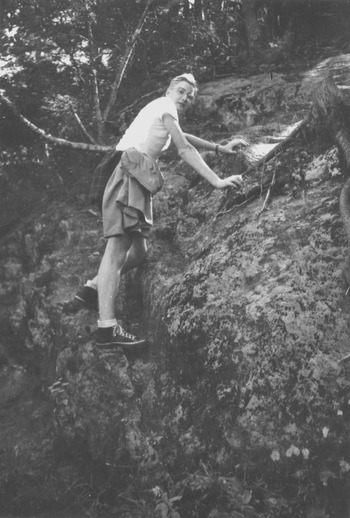
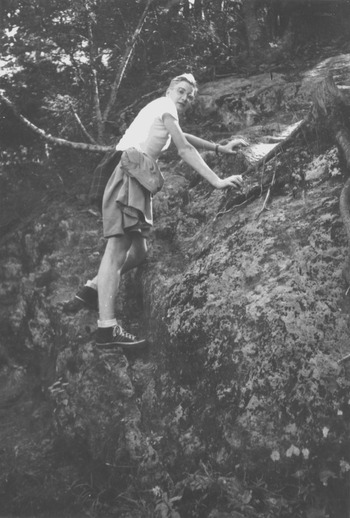
Later, as an adult, Peter would agree that all of the above was true, but would reliably mention that their lives at the time were not all gloom. Despite the difficult post-war conditions Peter did find opportunities for fun, such as hiking and rock climbing with his friends (Figure 6.1).