




Conceived and organized by Heiko Laß (Ludwig-Maximilians-Universität München), Margret Scharrer (Universität Bern) and Tobias C. Weißmann (Johannes Gutenberg-Universität Mainz) for the Rudolstädter Arbeitskreis zur Residenzkultur, this conference was held in cooperation with the Stiftung Thüringer Schlösser und Gärten. It aimed to explore the complex interrelationships among space, music and acoustics in early-modern European court architecture, focusing on the acoustic and sonic dimensions of representative areas in which musical performance played a central role. This means that the entire early-modern ensemble of castle, chapel and garden was taken into account. The special sonic qualities of various architectural spaces, including throne rooms, audience chambers, staircases and courtyards, were examined from a number of perspectives, incorporating disciplines such as architectural and art history, musicology and historical performance practice, sound studies, (archaeo)acoustics, digital engineering and tourism. Shedding light on venues whose acoustic qualities are not necessarily obvious, the conference addressed a topic that had not been present in previous research on sound-specific architecture, such as theatres, concert halls, chapels and churches.
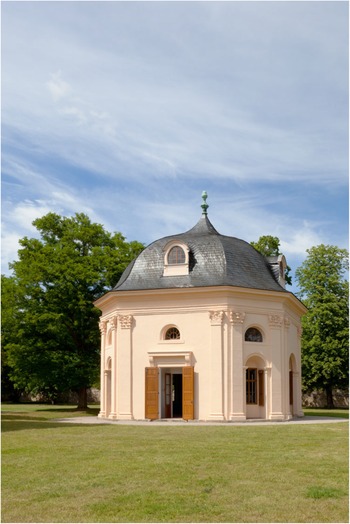
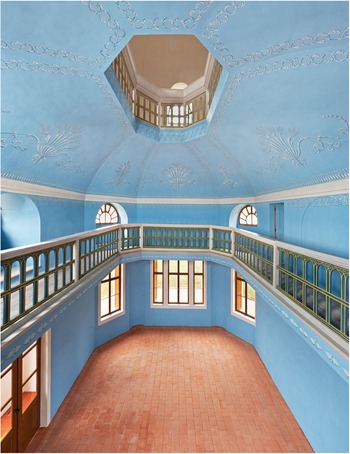
Particularly fortunate was the fact that the conference venue was located close to a preserved Schallhaus (sound house) from the eighteenth century (see Figures 1 and 2). Participants were able to visit the building on a guided tour and experience a musical performance inside.
The Schallhaus in the garden of Schloss Heidecksburg in Rudolstadt. Stiftung Thüringer Schlösser und Gärten. Photograph by Constantin Beyer. Used by permission

The interior of the Schallhaus with the ground-level garden hall, a gallery and the performance space for hidden music under the roof. Stiftung Thüringer Schlösser und Gärten. Photograph by Constantin Beyer. Used by permission

Early examples of architectural sound spaces were discussed by Ana Cláudia Silveira (Universidade Nova de Lisboa), who provided an insightful analysis of Portuguese court architecture during the transition from the fifteenth to the sixteenth centuries. She examined the acoustic, architectural and visual interplay of the court complexes in Lisbon and Évora, as well as the royal summer residence in Sintra, with an emphasis on how they served the purposes of princely representation.
Dirk Jansen (formerly Forschungszentrum Gotha der Universität Erfurt) examined the architecture and musical performance practice in two rooms of the pleasure palace Neugebäude near Vienna, whose construction began in the last third of the sixteenth century under Emperor Maximilian II. In a hall in the west pavilion and a chapel in its eastern counterpart, music was performed from an elevated position, thus fitting into the iconographical programme of cosmology and, more broadly, into the emperor’s political concepts. Drawing upon the ceremonial and performative use of the Palazzo Te in Mantua, built in the mid-sixteenth century, Iain Fenlon (University of Cambridge) discussed the original architecture and representative significance of the palace prior to its architectural transformation, which also had a substantial impact on the palace’s acoustic space.
An evening lecture from Arne Spohr (Bowling Green State University) on hidden musical performances in early-modern pleasure houses provided a comprehensive overview of the use and function of these architecturally and acoustically sophisticated buildings. Located in a room below the princely reception hall, the musicians, their instruments and the musical performance remained hidden from the eyes of the princely guests. However, their music was audible, as the sound was transmitted via technical installations such as pipes and shafts. In the roundel of the Bohemian castle Jindřichův Hradec, for example, the music performed in a cupola-like vaulted cellar room was transmitted via a sound channel to the richly decorated hall above and also outdoors. The deliberate dissociation of auditory and visual musical elements was intended to evoke wonder and admiration in the audience, while also permitting uninterrupted discourse among individuals of high rank.
Nevertheless, seeing and viewing played a decisive role in rooms filled with invisible music, emphasizing the importance of their decorative elements. For instance, the ceiling painting of the lavishly decorated Winter Room of Rosenborg Castle in Copenhagen – which also offered the possibility of listening to hidden music performed in the room below – incorporated visual representations of musicians. Kristoffer Neville (University of California Riverside) discussed the correlation between the decorative setting of the room, which was built on the orders of Christian IV of Denmark in the seventeenth century, and the music performed in and around it.
Matthias Müller (Johannes Gutenberg-Universität Mainz) focused on the effective interplay of sound and image in visitors’ perceptions in his presentation on a vaulted room in the Dresden Hausmannsturm that was connected to the Palace Chapel. During the reign of Elector Johann Georg I of Saxony, timpani and trumpets were set up in this room during high feasts, their sounds mingling with the music played in the chapel. For the high-ranking guests who were occasionally accommodated there, the sounds of these instruments merged with Gabriel Tola’s illusionistic wall frescos depicting the Apocalypse, culminating in a profound holistic experience.
In her analysis of the Rittersaal in the early seventeenth-century palace in Weikersheim, Kathrin Miriam Stocker (Staatliche Schlösser und Gärten Baden-Württemberg, Weikersheim) explored the architectural features that connected the hall with its antechambers via sound slits. She also examined the various performance scenarios of the court chapel, which was founded around the same time. Margherita Antolini (Politecnico di Torino) investigated the cultural impact of Cardinal Pietro Ottoboni in connection with the Palazzo della Cancelleria in Rome between 1689 and 1740. Using the examples of the theatre commissioned by Ottoboni, the Sala Riaria and the Church of San Lorenzo in Damaso, she examined the interrelationships among musical genres, architecture, staging, performance practice and audience, based on a variety of sources.
Jan-Friedrich Missfelder (Universität Basel) discussed the spatial, technological and political concepts that are evident in early-modern theories on the intertwining of acoustics and power. Drawing on Athanasius Kircher’s theories of sound amplification in Musurgia universalis (1650) and Phonurgia nova (1673), as well as on Sir Thomas Morland’s ‘Tuba Stentoro-Phonica’ (1671) – a precursor to the megaphone – he examined not just the fascination with sound transmission and projection in its own right but also the fantasies created by the conceptualization of powerful systems of eavesdropping, given the political importance of controlling the intricate acoustic landscape of the court. While the written accounts and accompanying illustrations of the technical concepts were intriguing, the practical implementation of them proved to be a major challenge.
Stefan Schweizer (Stiftung Schloss und Park Benrath) explored the original intention that architect Nicolas de Pigage pursued when conceptualizing a room in the Corps de Logis of Benrath Palace near Düsseldorf. Elector Carl Theodor of the Palatinate and Electress Elisabeth Augusta commissioned the palace, which was built in the mid-1750s, but they hardly ever used it. In the 1950s, the room used for music performances was discovered. The construction of the room with a wooden cupola, together with new source findings on architectural models and contemporary perception, allow us to conclude that its use as a sound space for hidden musical performances was already intended at the time of its creation.
Antje Spohr (Freies Institut für Bauforschung und Dokumentation, Marburg) and Matthias Kornitzky (BAK Bauarchäologie, Marburg) shared their findings on a sound space dating from the early eighteenth century that was rediscovered during archaeological excavations in the former Lusthaus auf dem Wall, close to the residential palace in Darmstadt. By analysing the structural means used for the transport and amplification of sound, they were able to contribute to the reconstruction of the vault’s original function, which had later been converted into an ice cellar.
Two contributions addressed the acoustic space of the Schallhaus in the garden of Schloss Heidecksburg (Figure 1), which was installed around 1730 in a late seventeenth-century garden pavilion. In a comparative analysis of historic sound spaces in central Germany, each characterized by a podium positioned above the auditorium, the conservator-restorer Thomas Werner (independent scholar, Weimar) emphasized the distinctive architectural features of the Schallhaus. Musicologist Silvia Bier (Forschungsinstitut für Musiktheater, Universität Bayreuth) addressed the diverse historical uses to which the Schallhaus had been put and suggested approaches for its appropriate employment in the present day.
On the evening of 21 June the Basel baroque ensemble Arcimboldo gave a concert at the Schallhaus, introduced by Margret Scharrer. Under the direction of Thilo Hirsch (viola da gamba), music by composers associated with the court of Rudolstadt, including Philipp Heinrich Erlebach (1657–1714), was performed by Anna-Lena Elbert (soprano), Mojca Gal (violin) and Tiago Leal (theorbo). To highlight the various acoustic conditions, the musicians played on three different levels of the hall (Figure 2). First, the performance took place in front of the audience seated in the garden hall, then in a gallery encircling the room. Finally, the music was performed in a cupola-shaped room under the roof, which is connected to the auditorium below only by an octagonal opening, so that the source of the sound was not visible to the audience. In addition to the special aesthetic quality, the sheer volume with which the music of the small ensemble descended on the audience from above was particularly impressive.
Simon Paulus (Leibniz Universität Hannover; Universität Stuttgart) focused on the lost sound space of a chapel in the residential palace of Wolfenbüttel, which dates back to the late sixteenth century and was demolished in 1796. In his reconstruction of the building he showed how the installation of an additional musicians’ gallery during a renovation affected the acoustic space by considering compositions created for the Wolfenbüttel court in the seventeenth century that emphasized echo and spatial sound effects.
Using the example of the virtual reconstruction of the former ‘Himmelsburg’ chapel in Weimar Stadtschloss, which was carried out as part of a tourism project, Martina Maaß (Thüringer Tourismus, Erfurt) provided an insight into how the technical sophistication and specific effects that were crucial to historical sound spaces can be conveyed to a modern audience. Based on architectural documents and making use of 3D visual simulations and auralizations, the spatial and acoustic dimensions of the venue where Johann Sebastian Bach served as organist were able to be experienced through virtual reality. María José de la Torre Molina (Universidad de Málaga) focused on an urban environment in her paper on the celebrations of the Andalusian nobility at the proclamation ceremonies of Carlos IV of Spain. As well as reconstructing the musical programmes that accompanied the various festivities, she demonstrated how the nobility acoustically occupied and redefined the civic space.
In addition to re-examining courtly architecture in terms of its sound-specific characteristics and functions, this conference offered new perspectives on hidden music and the intricate processes of sound transmission and amplification that were involved, along with the ways in which they were realized. Furthermore, it encouraged future research on historical court and urban architecture, and its performative and ceremonial use, suggesting that scholars from many fields might pay greater attention to acoustic conditions.

 Open access

