




Impact statement
We demonstrate how key economic concepts have the potential, if effectively applied, to be transformational in relation to the who, what, where and when of how water is used globally. This opportunity arises because much of the world suffers from either too much (flooding), too little (hydrological droughts) or too dirty water that shortens and diminishes the quality of life of billions of people and degrades environments. Business as usual for water must change, given the projected increase in the world’s population of about 2.5 billion over the coming decades, cascading risks from climate change with its myriad of interactions with water, rising global water use, declining aquifers in large food-producing regions, degrading riparian environment due to overextraction, and water pollution. Appropriately pricing and, separately, valuing water for economic efficiency and for more equitable and just outcomes, along with responses to long-standing water governance failures, offer potentially very large global benefits and would support the delivery of SDG 6, ‘water for all’.
‘…(s)upplies and demands for water are not absolutely determined by natural forces and engineering requirements but rather are to be measured in terms of the economic balance of all needs and resources of the community…Where water is scarce and expensive (in terms of other resources that must be sacrificed to make more water available), it becomes justifiable to construct elaborate facilitiesto minimize intake, to recirculate quantities withdrawn, and to avoid uses that are consumptive’.
Hirshleifer, De Haven and Milliman (Reference Hirshleifer, De Haven and Milliman1960, pp. 29-30)Introduction
Water management decision-making is frequently based on two key metrics: the price and the value of water. Both are treated as a measure of ‘worth’ and are, typically, expressed in monetary terms. Yet, the price (what is paid for access, use or consumption of water) and the value (the benefits derived from access, use or consumption of a volume of water or a water body) of water are different albeit related concepts. Understanding these differences is important for scholars and practitioners alike.
In this review, we focus on the price and value of drinking water from the perspective of both the supply for and the demand by households for safe and affordable water. Our review is intended for a broad readership across policy, research, practice, and intellectual disciplines. We synthesise the existing literature and draw from existing work including, but not limited to Goldstein (Reference Goldstein1986); Hanemann (Reference Hanemann, Rogers, Llamas and Martinez Cortina2006); Sultana and Loftus (Reference Sultana and Loftus2015); Garrick et al. (Reference Garrick, Hanemann and Hepburn2020); and Grafton et al. (Reference Grafton, Chu and Wyrwoll2020)).
Our approach illustrates theory through international examples to highlight concepts, practices, and outcomes. Our review is structured around five key questions: (1) Why water is (and is not) priced and valued?; (2) What are key economic concepts for the pricing of water?; (3) How is water priced and assets valued?; (4) Who bears the costs and enjoys the benefits of water use?; and (5) When is the price of water expected to change? The remainder of the introduction describes the world’s water crisis and formally defines the price and value of water.
The world’s water crisis
The world faces a water crisis. Whether it be too little, too much or too dirty water (e.g., Dixon, Reference Dixon1990; Fanaian, Reference Fanaian2022), freshwater consumption limits are rapidly approaching (Gerten et al., Reference Gerten, Hoff, Rockström, Jägermeyr, Kummu and Pastor2013) or may already have been exceeded (Rosa et al., Reference Rosa, Chiarelli, Tu, Rulli and D’Ordorico2019; Grafton et al., Reference Grafton, Biswas, Bosch, Fanaian, Gupta, Revi, Sami and Tortajada2023). The consequence is that up to four billion people currently face severe water scarcity at least 1 month each year (Mekonnen and Hoekstra, Reference Mekonnen and Hoekstra2016). Many regions of the world experience recurrent, and increasing, hydrological extremes either with floods or droughts (or both). In 2021, record-breaking floods were observed in Western Europe and in the northern Amazon. In 2022, weather extremes in terms of droughts (e.g., Europe, China, Horn of Africa and the American Southwest) (Kizer Whitt and Imster, Reference Kizer Whitt and Imster2022) and floods (e.g., South-eastern Australia and South Asia) (NASA Earth Observatory, 2022; NASA Science Mission Directorate, 2022) were observed in multiple regions.
The global water crisis has developed over decades (Grey et al., Reference Grey, Garrick, Blackmore, Kelman, Muller and Sadoff2013) because of: over-extraction of both surface and groundwater (Grafton et al., Reference Grafton, Pittock, Davis, Williams, Fu, Warburton, Udall, McKenzie, Yu, Che, Connell, Jiang, Kompas, Lynch, Norris, Possingham and Quiggin2013; Famiglietti, Reference Famiglietti2014; Haddeland et al., Reference Haddeland, Heinke, Biemans, Eisner, Flörke, Hanasaki, Konzmann, Ludwig, Masaki, Schewe, Stacke, Tessler, Wada and Wisser2014); failure to adequately balance investments across grey (human-made physical infrastructure), green (natural capital), and soft (governance and institutions) infrastructure (Wyrwoll and Grafton, Reference Wyrwoll and Grafton2022); water pollution (GEMS/Water, Reference GEMS/Water2022); degradation of riparian environments (Vörösmarty et al., Reference Vörösmarty, McIntyre, Gessner, Dudgeon, Prusevich, Green, Glidden, Bunn, Sullivan, Liermann and Davies2010); water’s potential impact on poverty (World Bank, 2022); and water injustice (Francis et al., Reference Francis, Hummes, Sorondo, Ainchil, Alberdi Altinbilek, Asinelli, Ayala, Bernal, Biswas, Bocanegra, Boelens, Bubas, Céspedes, Chandra, Cohen, Cortazzo, Cristofori, Custodio, Cutina, Del, Eckstein, Fantini, Fernández García, Ferreira, Ferro, Floriani, García, Garrido, Gleick, González, Grafton, Gupta, Hughes, Lanzarini, Liberman, Lorelli, Inglese, Lingeri, Martinez, Mattei, Maturana, Molden, Monfrini, Nolasco, Oliver, Pavanelli, Poletto, Romero, Sacco, Sultana, Tavela, Tortajada, Soto, van, Vattimo, Villanucci, Von, Wolf and Zagari2017; Sultana, Reference Sultana2018; Grafton et al., Reference Grafton, Fanaian, Sacco and Liberman2022b).These global challenges are magnified by climate change because of higher temperatures (NASA, 2022), greater variability in the magnitude and temporal distribution of precipitation (Satoh et al., Reference Satoh, Yoshimura, Pokhrel, Kim, Shiogama, Yokohata, Hanasaki, Wada, Burek, Byers, Schmied, Gerten, Ostberg, Gosling, Boulange and Oki2022), sea-level rise (IPCC, Reference Masson-Delmotte, Zhai, Pirani, Connors, Péan, Berger, Caud, Chen, Goldfarb, Gomis, Huang, Leitzell, Lonnoy, Matthews, Maycock, Waterfield, Yelekçi and Zhou2021), and increased frequency and magnitude of weather-related disasters (King et al., Reference King, Schrag, Dadi, Ye and Ghosh2016; WMO, 2022).
The consequences of the world’s water crisis are borne primarily by the poor and vulnerable and include: inadequate access to safe drinking water that affects at least 2 billion people (WHO et al., 2022); unsafe sanitation that affects more than 4 billion people (UNICEF and WHO, 2020); diminished ecosystem services (Green et al., Reference Green, Vörösmarty, Harrison, Farrell, Sáenz and Fekete2015; Sabater et al., Reference Sabater, Bregoli, Acuña, Barceló, Elosegi, Ginebreda, Marcé, Muñoz, Sabater-Liesa and Ferreira2018); and food insecurity (Hanjra and Qureshi, Reference Hanjra and Qureshi2010; Boelee et al., Reference Boelee, Atapattu, Barron, Bindraban, Bunting, Coates, Descheemaeker, Eriyagama, Finlayson, Gordon, Khaka, Lloyd, Molden, Muthuri, Nguyen-Khoa, Peden, Pert, Sinclair, Solowey, Sanford, Stentiford and Thiombiano2011; Grafton, Reference Grafton2017). It is in this context of a global emergency that alternatives to business as usual are urgently needed in terms of how, what, and when water is used, sourced, supplied, and consumed.
Multiple approaches, particularly in terms of ‘soft’ infrastructure (Grafton, Reference Grafton2017; Garrick et al., Reference Garrick, Hanemann and Hepburn2020) or governance, are required to overcome decades of failures in water governance (Tortajada, Reference Tortajada2010; OECD, 2015; World Bank, 2016). Among possible options are the pricing of water that fully considers its multiple values. Pricing and valuing water, improved water governance, and very large (grey and green) infrastructure investments (Strong et al., Reference Strong, Kuzma, Vionnet and Reig2020) would improve social and economic outcomes (United Nations, 2010), especially in relation to Sustainable Development Goal (SDG) Targets 6.3 (improve water quality), 6.4 (substantially increase water-use efficiency), and 6.6 (protect and restore water-related ecosystems). Importantly, and notwithstanding progress on SDG Targets 6.1 (safe and affordable drinking water) and 6.2 (adequate and equitable sanitation and hygiene) over the past few decades (Grafton et al., Reference Grafton, Gupta, Revi, Mazzucato, Okonjo-Iewala, Rockström, Shanmugaratnam, Aki-Sawyerr, Bárcena Ibarra, Cantrell, Espinosa, Ghosh, Ishii, Jintiach, Qui, Ramphele, Urrego, Serageldin, Damania, Dominique, Esty, Ovink, Rao-Monari, Selassie, Andersen, Beejadur, Bosch, von Burgsdorff, Fanaian, Krishnaswamy, Lim, Portal, Sami, Schaef, Bazaz, Beleyur, Fahrlander, Ghoge, Ragavan, Vijendra, Wankhade, Zaqout, Dupont, Lefaive and Réalé2023), without a change in business as usual, none of the SDG 6 targets will be achieved by 2030, or for decades to come (Boretti and Rosa, Reference Boretti and Rosa2019).
The price of water
A water price is the amount paid (typically in monetary units) by a water consumer (individual, household, business, etc.) for a given volume and quality of water at a particular place and time. How much a given water consumer is prepared to pay for water depends on their marginal willingness and ability to pay for an additional unit of water. Hence, their water demand is not uniform and will change across uses and in response to water availability over time. For someone dying of thirst, the water price that person might be prepared to pay to survive could be almost infinite (marginal willingness to pay), and what they could pay may equal the value of all their assets (marginal ability to pay).
In general, water demands are ‘price elastic or inelastic’ to changes in the water price depending on the use and the underlying tariff system (Dalhuisen et al., Reference Dalhuisen, Raymond, Henri and Nijkamp2003). For more essential water uses, say drinking and cooking, demands are highly price inelastic. That is, if the water price increases, their water use decreases by a smaller proportion than the change in the water price. However, non-essential uses, such as landscaping or car-washing, tend to be much more price responsive (Reynaud and Romano, Reference Reynaud and Romano2018). Typically, higher-income water consumers are more price inelastic, meaning they change their water consumption less with an increase in the water price. This is, primarily, because their total water cost is a smaller proportion of their income than for low-income households (Andrés et al., Reference Andrés, Saltiel, Misra, Joseph, Lombana Cordoba, Thibert and Fenwick2021, p. 56).
The volume of water that is supplied to meet a given water demand depends on the price charged by the supplier and paid by the consumer. If the aim of the water supplier is to maximise income, an incentive exists to increase prices, but not to the point of reducing total revenues. Typically, when the price consumers are prepared to pay for water is higher than the marginal cost of supply, there is an incentive for the supplier to expand the amount of water provided to increase its own revenue. If the price of water exceeds the marginal cost of supplying an additional volume of water of a given quality at a given time and place, then the water that is demanded at this price should eventually be supplied. When the water price is less than the marginal cost of supplying it, in the absence of a subsidy or transfers, then the water demanded at this price will not be supplied.
Ensuring water demands are met from the available water supplies at the lowest possible water price over time, while accounting for water scarcity, requires that the water price paid by water consumers equals the marginal cost of the water supply. This is marginal cost pricing and results in an ‘efficient’ water price that maximises the sum of the net benefits to both water consumers and suppliers. If the water price is greater than the marginal cost of supply, then the water supplier is receiving more than is necessary, at least in the short run, to provide the given water supply. If the water price is less than the marginal cost of supply, even if some water consumers have a marginal value for water that exceeds its marginal cost of supply, then the supplier’s revenues are insufficient to cover the water supply costs without transfers or subsidies (Grafton et al., Reference Grafton, Chu and Wyrwoll2020).
The marginal cost of water supply is an economic cost. This is a broader concept than the direct financial costs of a supplier providing water. That is, the marginal cost includes: all explicit private costs, such as the costs of maintaining water storages and the pumping, treatment, and distribution costs of supplying water to consumers; and implicit social costs, such as losses in ecosystems services and the loss of benefits in alternative uses, including in situ use, of the water. The social, environmental, and economic challenge is to ensure water demands are equitably met at the lowest possible water price, while ensuring that the revenue to water suppliers is sufficient to cover their economic marginal costs of supply, as well as their other legal, environmental, and social obligations.
The value of water
The value of water is the benefit water consumers derive from access, use, or consumption of water, such as drinking, food production, or cultural purposes (United Nations, 2021). The price and value of water are often mischaracterised as being equivalent. As Hanemann (Reference Hanemann, Rogers, Llamas and Martinez Cortina2006) has observed, the prices of water marketed as a commodity, such as bottled water, represent the interactions of supply and demand. By comparison, the value of water is, typically, more stable and determined, in part, by multiple individual and community determinants beyond markets.
Key to understanding the price/value divergence is the distinction between value in use versus value in exchange. The value in use results from intrinsic qualities or uses of the good or service in question, for example, water for drinking (Hanemann, Reference Hanemann, Rogers, Llamas and Martinez Cortina2006). The value in exchange of a good or service is its value in terms of what it can be exchanged for in terms of other goods and services. In certain circumstances such as open water markets, water can hold in use and exchange values, as it is traded both for consumption and as a financial asset (Loftus et al., Reference Loftus, March and Purcell2018; Seidl et al., Reference Seidl, Wheeler and Zuo2020).
For an individual, values in use vary by the kind of use and over time. For example, the value in use of safe drinking water (a basic need) is typically considered to be greater than non-essential uses, such as irrigating an ornamental shrub. Over time, the value of the same water use may also change, for example, the value to a householder from irrigating a shrub from a city’s supply network is likely to be much greater in a drought when it would die without watering than when rainfall is plentiful.
The most that an individual water consumer whould pay for an extra volume of water is the marginal willingness to pay or the marginal value of the water to the water consumer or consumer. If a water consumer’s marginal value for an extra volume of water exceeds (or is less than) the price of water, the water consumer will use more (or less) water if additional supply is available and affordable. The sum of the marginal values of water of every unit of water used, until the very last volume of water used, represents the total value of water for that individual.
Figure 1 shows the total value of water given by the area underneath an individual water consumer’s water demand. An individual water consumer’s demand is downward sloping because there is a decreasing marginal willingness to pay for water, after essential needs (e.g., consuming safe drinking water) are met, and water becomes increasingly used for discretional purposes (e.g., irrigating a garden). The total area underneath the demand curve, less the total price paid for all the water used by an individual (i.e., quantity used, K, multiplied by the price per unit of water used, $P), is called the ‘consumer surplus’ and represents the net (gross benefits less the total cost of water) benefits from consuming K units of water.
Value of water, water use, consumer surplus, and the price of water. Source: Adapted from Grafton et al. (Reference Grafton, Chu and Wyrwoll2020).

For many people, at least in middle- and high-income countries and the better off in low-income countries, the value of water is such that both their marginal willingness and ability to pay for water of sufficient quality for drinking purposes exceed the existing water price. That is, for these fortunate water consumers, there is a consumer surplus with respect to their demand for safe drinking water.
Unfortunately, for at least two billion people, the current water price they pay to obtain a volume of water of sufficient quality to meet their drinking water needs exceeds their marginal ability to pay for this volume of water. In other words, if safe drinking water were both accessible and affordable to them, they would increase their consumption of safe drinking water. But because many do not have access to safe drinking water of sufficient volume at prices that they can afford, two billion plus people lack a human right (UN OHCHR, UN Habitat & World Health Organisation 2010). According to the United Nations General Assembly Resolution 64/292, this Human Right to Water is essential to realise all other human rights (United Nations, 2010; Eckstein, Reference Eckstein2020).
Established under the International Covenant on Economic, Social and Cultural Rights (United Nations, 2003), the Human Right to Water encompasses seven key features: availability (sufficient and continuous supply for personal and domestic uses); safety (free from micro-organisms, chemical substances, and radiological hazards that pose threats to human health); acceptability (acceptable colour, odour, and taste for each personal or domestic use); physical accessibility (within safe physical reach for all sections of population and within or in immediate vicinity of each household, education institution, and workplace); affordability (direct and indirect costs and charges must be affordable); non-discrimination (water and water facilities must be accessible to all, including the most vulnerable and marginalised, without discrimination); and information accessibility (includes the right to seek, receive, and impart information concerning water issues). The World Health Organisation (WHO) has guidelines on specific requirements, such as 20 L/person/day and 100–1,000 m in distance or 5–30 minutes total collection time, in relation to basic water access adequate for personal drinking and cooking uses (Howard et al., Reference Howard, Bartram, Williams, Overbo and Geere2020).
A key feature of the Human Right to Water is affordability, the ability to pay for basic water services without ‘undue hardship’ (Patterson and Doyle, Reference Patterson and Doyle2021). One measure of hardship is the cost of services exceeding 5% of household income (Al-Ghuraiz and Enshassi, Reference Al-Ghuraiz and Enshassi2005). When households’ ability to pay falls below prices charged, consumers’ supply may be disconnected, which may be considered a violation of the Human Right to Water (Heller, Reference Heller2015). In many rural regions in low-income countries, undue hardship is measured by the time and effort it takes to acquire water from a water source. In some parts of the world, this may involve, for some household members, several hours per day, with much of this burden borne by women and girls (Caruso et al., Reference Caruso, Conrad, Patrick, Owens, Kviten, Zarella, Rogers and Sinharoy2022).
Achieving the Human Right to Water is not as simple as charging a lower water price to those lacking basic water needs for drinking, washing, and sanitation. In many places, especially in many poor and rural areas of the world, water services are not accessible even if water consumers were subsidised and could pay the price for the water. Overcoming this water injustice requires an understanding of the water pricing paradox, namely that ‘(t)he price of water almost never equals its value and rarely covers its costs’ (Grafton et al., Reference Grafton, Chu and Wyrwoll2020, p. 86). The paradox arises because: (1) for many, their marginal values of water exceed the marginal cost of supply, but the regulated water price provides an insufficient financial incentive for water suppliers to meet this unmet demand; (2) the marginal cost of supplying water fails to include ‘external’ costs imposed on others from water use, so water is ‘under-priced’ and ‘under-valued’ for particular uses such as in situ uses; and (3) people with different marginal values of water are physically unable to reallocate water among themselves while individual water consumers are restricted, because of the bulkiness of water, from equalising their different marginal values of water (e.g., indoor and outdoor water uses). As a result, the water allocation in many places in the world is neither efficient nor equitable.
Delivering ‘water for all’ requires, at a minimum, an understanding of water demands (Nauges and Whittington, Reference Nauges and Whittington2010), the possible goals for reallocation of water among competing water uses and users (Grafton, Reference Grafton2017), and additional investments in an appropriate mix of green, grey, and soft infrastructure (Williams et al., Reference Williams, Colloff, Grafton, Khan, Paydar and Wyrwoll2022) to ensure that water is accessible and, at least for basic needs, affordable for all. The allocation of costs to ensure ‘water for all’ also requires a consideration of what is the efficient price of water, and what is equitable and affordable for low-income water consumers (Grafton et al., Reference Grafton, Chu and Wyrwoll2020). To ensure equitable water outcomes, such that no one lacks the Human Right to Water, subsidies or transfers from governments or donors are required to those in most need rather than to those who use or consume the most water (Komives et al., Reference Komives, Foster, Halpern and Q2005; Whittington et al., Reference Whittington, Nauges, Fuente and Wu2015).
The why, what, how, who, and when of water
In the following sections, we provide a review of the why (section ‘Why is water priced (or not) and valued (or not)?’), what (section ‘What are the key economic concepts for the pricing of water?’), how (section ‘How is water priced and how are assets that supply water?’), who (section ‘Who bears the costs and enjoys the benefits of water use?’), and when (section ‘When is the price of water expected to change?’) with respect to the price and value of water. Wherever possible, we provide examples of the ‘where’ because the preferred approach to pricing water must be bespoke and account for differences in hydrology, history, culture, water use (withdrawal of water from a river, stream, aquifer, or water storage), and consumption (evapotranspiration or the transformation of water from liquid to vapour), social norms, and the institutional context (Grafton et al., Reference Grafton, Biswas, Bosch, Fanaian, Gupta, Revi, Sami and Tortajada2023). In section ‘Discussion’, we discuss insights from the review and offer possible directions towards water for all. Section ‘Conclusion’ concludes.
Why is water priced (or not) and valued (or not)?
Pricing and valuing water are two water management strategies that may serve to understand the ‘worth’ or ‘importance of water’. Establishing a price on water (pricing) and quantifying the value(s) of water (valuing) connect water use and/or consumption to a monetary metric. For this reason, price(ing) and value(ing) are frequently used interchangeably, but they are not equivalent terms (Savenije and van der Zaag, Reference Savenije and van der Zaag2002; Kallis et al., Reference Kallis, Gómez-Baggethun and Zografos2013). To clarify the differences and to illustrate when each is appropriate (or not), we elaborate on the reasons why, and the circumstances when, water is priced and when water is valued.
‘Values’ are a person’s ‘beliefs’, especially about ‘what is right and wrong and what is most important’ (Cambridge University Press, 2022). Thus, ‘water values’ are determined by individual convictions or judgements about how and why water is important. These go well beyond the utilitarian nature of water, such as its value for drinking, for cooking, and for cleaning. They may also include shared community values, say, around a lake in a city, or spiritual values around the sacredness of water in Holy Wells, or cultural values for a river that some people consider to be a living entity (Srivastav, Reference Srivastav2019). From an economic perspective, all of these values, be they intrinsic or extrinsic, matter (Jackson, Reference Jackson2006). Thus, all water values and how they interact and influence each other need to be considered when making decisions about how water is used over time, different geographies, and by whom or what.
For many decision-makers, only the utilitarian and market values of water are considered important (Jackson, Reference Jackson2006), and non-market values of water are frequently ignored (Grafton et al. 2023). Yet it may be that the intrinsic or non-market values of water are more important. For example, the Martuwarra-Fitzroy River in Australia’s North-West is regarded by its Indigenous Peoples as an ancestral living being – the Rainbow Serpent. Thus, to them, its continuing good health has a value that exceeds any market values of the water, such as for mining or irrigation (Poelina et al., Reference Poelina, Taylor and Perdrisat2019).
Water values
From the conceptual standpoint, ‘water values’ can be regarded as the multiple qualities and beneficial characteristics that make water desirable for humans and the environment. While there is no standard framework to characterise water values, common classifications are defined by the ‘use’ to which water is put, or the ‘reasons’ why water is valued (Bark et al., Reference Bark, Hatton MacDonald, Connor, Crossman, Jackson and Prosser2011). For example, the UN World Water Development Report (United Nations, 2021) describes water valuation through five key perspectives: (1) water resources and ecosystems; (2) water infrastructure; (3) water and sanitation services; (4) water as an input to production and the market economy; and (5) water as a socio-cultural value. Frequently used frameworks for water values are often based on three main value types: socio-cultural, environmental, and economic (Wilcox et al., Reference Wilcox, Nasiri, Bell and Rahaman2016).
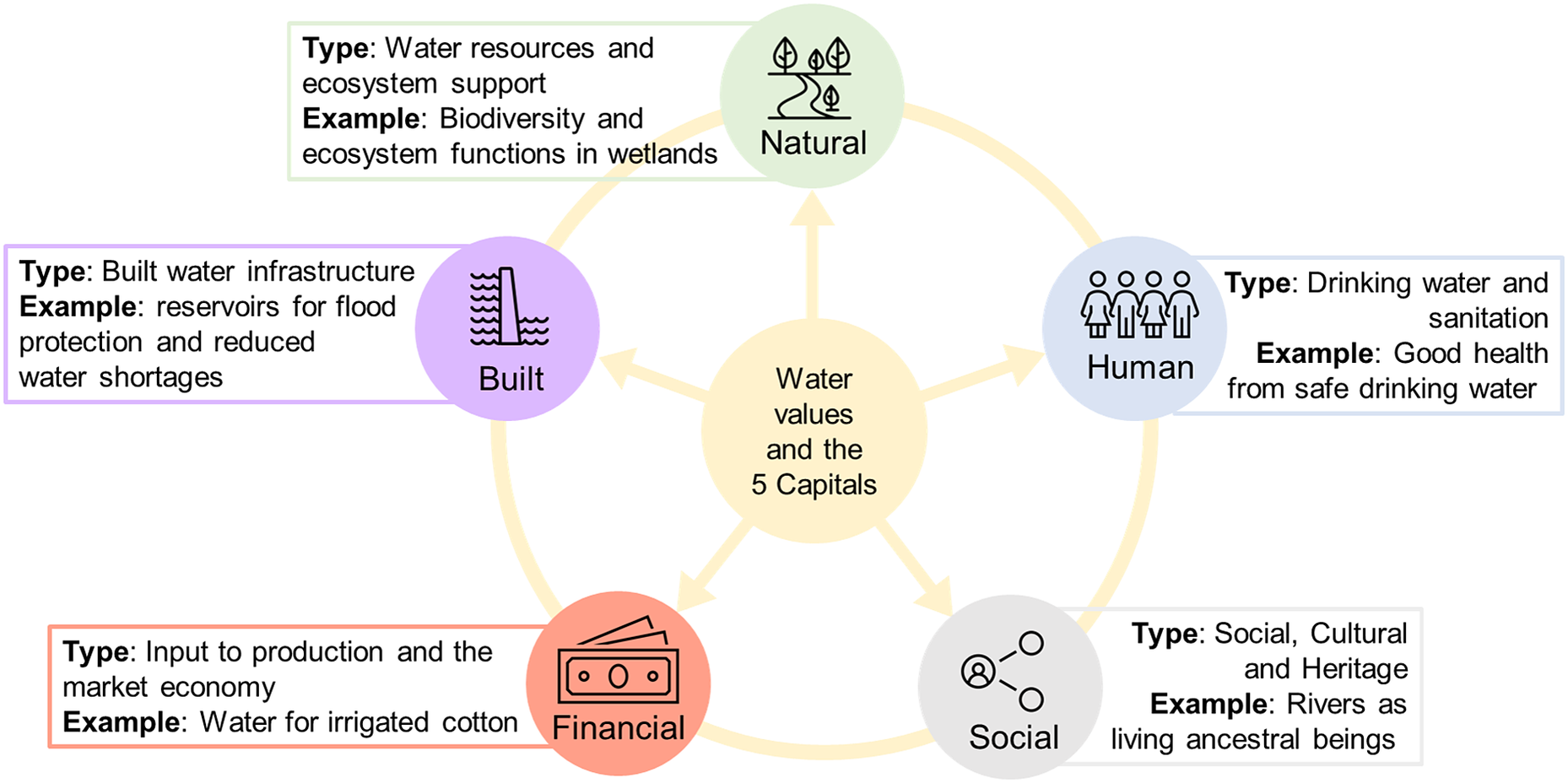
We summarise (see Figure 2) different conceptualisations of ‘water values’ consistent with the ‘five capitals’ framework (natural, human, social and cultural, financial, and built) (Viederman, Reference Viederman1994). ‘Natural’ water values are generally understood to be those supporting ecosystems functions, such as biodiversity and water-dependent ecosystems (Bark et al., Reference Bark, Hatton MacDonald, Connor, Crossman, Jackson and Prosser2011). From this perspective, good water quality (Cañedo-Argüelles et al., Reference Cañedo-Argüelles, Hawkins, Kefford, Schäfer, Dyack, Brucet, Buchwalter, Dunlop, Frör, Lazorchak, Coring, Fernandez, Goodfellow, Achem, Hatfield-Dodds, Karimov, Mensah, Olson, Piscart, Prat, Ponsá, Schulz and Timpano2016) and unmodified stream flows (Grafton et al., Reference Grafton, Chu, Kingsford, Bino and Williams2022a) can be regarded as two desirable water ‘values’ that prevent ecosystem losses from salinisation and hydrological droughts. ‘Human’ water values can be regarded as those directly supporting basic human needs, namely through the provision of safe drinking water and sanitation (United Nations, 2021). These are fundamental for living healthy (Lansbury Hall et al., Reference Lansbury Hall, Creamer, Anders, Slatyer and Hill2020) and dignified lives (Narsiah, Reference Narsiah2011), as pronounced by the Human Right to Water (United Nations, 2010). ‘Social’ water values may include those related to culture and heritage (Bark et al., Reference Bark, Hatton MacDonald, Connor, Crossman, Jackson and Prosser2011; United Nations, 2021), for example, rivers as living ancestral beings (Poelina et al., Reference Poelina, Taylor and Perdrisat2019). Importantly, in many Indigenous Peoples’ ontologies, water is not separate from land and sky. For Indigenous Peoples in Australia, everything exists as ‘Country’ (Moggridge and Thompson, Reference Moggridge and Thompson2021). Thus, ‘cultural or heritage’ values not only comprise water per se but also the relationships between water, people, and all other features of Country. ‘Financial’ water values refer to water as an input into the market economy (United Nations, 2021), including, among others, industrial processes, energy generation, or production of food and fibre (Wheeler and Garrick, Reference Wheeler and Garrick2020). The financial value of water is often expressed in monetary terms per unit of volume, for example, $/m3. ‘Built’ values refer to human-constructed infrastructure, such as water treatment plants and dams (Jeuland, Reference Jeuland2020), which may contribute to people’s welfare through the provision of safe drinking water or reduced risk of water shortages (United Nations, 2021).
Water values and the five capitals. Source: Authors.
While the classification of water values is helpful, it is important to consider the multiple and important interconnections between water values and the many relationships, processes, and connections between people and water (Jackson, Reference Jackson2006; Bark et al., Reference Bark, Hatton MacDonald, Connor, Crossman, Jackson and Prosser2011). For example, SDG 6 largely focuses on water for drinking, sanitation, and hygiene (WASH) purposes, and supporting water-based ecosystems. SDG 6, however, does not include cultural water values, nor is water’s role fully included in the market economy, even though these are fundamental for meeting many of the 17 SDGs (Di Baldassarre et al., Reference Di Baldassarre, Sivapalan, Rusca, Cudennec, Garcia, Kreibich, Konar, Mondino, Mård, Pande, Sanderson, Tian, Viglione, Wei, Wei, Yu, Srinivasan and Blöschl2019). Importantly, questions are emerging about the trade-offs between various SDG targets where water is fundamental, for example, 8.3 job creation and 2.3 agricultural productivity versus 15.1 ecosystem conservation and 11.4 conservation of cultural and natural heritage (Fader et al., Reference Fader, Cranmer, Lawford and Engel-Cox2018).
The economic value of water
A common assumption is that the value of water is its economic value (Young and Loomis, Reference Young and Loomis2014). A conclusion of the 1992 at the International Conference on Water and the Environment (ICWE, 1992) was that ‘Water has an economic value and should be recognized as an economic good, taking into account affordability and equity criteria’ (Savenije and van der Zaag, Reference Savenije and van der Zaag2002). We highlight that ‘economic’ value is not restricted to ‘financial’ or ‘monetary’ value but incorporates all the values of water. That is, the economic value of water is defined in terms of the trade-offs that individuals (households, firms, or other entities that use water) are willing to make (Hanemann, Reference Hanemann, Rogers, Llamas and Martinez Cortina2006), including both market and non-market goods and services (Dupont and Adamowicz, Reference Dupont, Adamowicz, Renzetti and Dupont2017), to use and/or consume water (including in situ).
For many decision-makers, water is a commodity that can be traded in markets for a given price. Both informal and formal property rights for water ‘access’ and ‘use’ (Whitford and Clark, Reference Whitford and Clark2007) have developed in many countries (Scott, Reference Scott2008; Wheeler, Reference Wheeler and Wheeler2021; Grafton et al., Reference Grafton, Chu, Kingsford, Bino and Williams2022a). Water markets exist for both surface and groundwater, and formal property rights to access and use water are tradable in a few countries, such as Australia, the United States, and Spain, among others (Wheeler and Garrick, Reference Wheeler and Garrick2020). One of the world’s most developed water markets is in Australia’s Murray-Darling Basin, which has two types of water rights: (1) water entitlements, an ongoing property right to access a share of water from a consumptive pool and (2) water allocations, physical volumes of water allocated each irrigation season to a water entitlement (Grafton and Horne, Reference Grafton and Horne2014; Wheeler et al., Reference Wheeler, Nauges and Grafton2023).
The market price for water rights (e.g., per million litres) is the market price of water. This market price of water is determined by the market supply and demand, but this is not the economic value of water. This is because water markets, as currently constituted, do not include future generations, nor do they adequately consider the non-market water values of in situ water uses, such as stream flows that provide a range of important ecosystems services, or the external costs imposed on others from water use (e.g., increased salinity, reduced stream flows). These ecosystem services include (1) provisioning services or direct use of water for drinking; (2) regulating services, such as moderating surface temperatures in the summer; (3) habitat services, such as an environment for fish and waterbirds; and (4) cultural services, such as places of spiritual significance like freshwater springs or ‘soaks’ (Grizzetti et al., Reference Grizzetti, Lanzanova, Liquete, Reynaud and Cardoso2016).
In the absence of water markets, economists have calculated the market value of water by determining its value as an input into a market production process, such as using water to irrigate crops (Ward and Michelsen, Reference Ward and Michelsen2002) or to generate electricity through hydropower (Kotchen et al., Reference Kotchen, Moore, Lupi and Rutherford2006). The more important water is in the production process, in terms of its value added, and the higher is the value of the output, then the larger will be the market value of water. For example, using water to grow some varieties of grapes in a semi-arid region, such as South Australia, has a higher additional value per litre than the additional value per litre, say, to grow grass for livestock feed. This is because grapes have a much higher price per kilogramme than grass and, in dry and hot locations, grape yields would be very low in the absence of irrigation (Savenije and van der Zaag, Reference Savenije and van der Zaag2002).
Non-market values and valuation
Many environmental ‘goods’ (e.g., rivers and lakes) and ‘services’ (e.g., climate regulation) are not traded in markets and, thus, have no market price. Nevertheless, these non-marketed goods and services do have an economic value (Colby, Reference Colby1989; Dupont and Adamowicz, Reference Dupont, Adamowicz, Renzetti and Dupont2017). To estimate non-market values, economists have developed multiple methods for ‘non-market valuation’ (Champ et al., Reference Champ, Boyle and Brown2017). Non-market valuation can be used to consider trade-offs when comparing, say, the non-market values that arise from keeping water in a stream or a river, such as the provision of ecosystem services (Akter et al., Reference Akter, Grafton and Merritt2014), against the market benefits from, say, growing irrigated cotton.
Two key types of values are frequently estimated with non-market valuation: (1) use values (Carson and Mitchell, Reference Carson and Mitchell1993) and (2) non-use values (Champ et al., Reference Champ, Boyle and Brown2017). Use values are observable from people’s behaviours and could include swimming in a lake or renting or buying a lake-side property to enjoy the aesthetic benefits of the view and easy use access. Non-use values, sometimes called passive use, are values that are not readily observable from people’s behaviours. Instead, non-use values are perceived values that may be discerned through measures of well-being and would include the value of knowing an environment, such as a pristine river, is maintained, even if the person with this ‘existence’ value were never to visit or use the river (Attfield, Reference Attfield1998). Use and non-use values, together, sum to the total economic value of water at a given place and time and may also include market values (see Figure 3).
Total economic value (TEV) framework and water values. Source: Authors.

In practice, non-market values are estimated in relation to marginal changes to an existing state of the world (Champ et al., Reference Champ, Boyle and Brown2017). For example, the change could be a proposed increase in water use for irrigation, and non-market values could be calculated to assess the loss of values from this change (Grizzetti et al., Reference Grizzetti, Lanzanova, Liquete, Reynaud and Cardoso2016). These non-market values could, for example, include the loss of use values (no more swimming in the river) and non-use values (loss of the existence of a pristine river).
An important distinction exists between marginal value and total value of water. The marginal value of water is the additional benefit obtained by a person (or organisation) from an incremental amount of water (Grafton et al., Reference Grafton, Chu and Wyrwoll2020). By contrast, the total value of water is the sum of all the value of all incremental amounts, including the last unit of water (Grafton et al., Reference Grafton, Chu and Wyrwoll2020). Typically, the marginal value of water increases as the availability of water declines (Hanemann, Reference Hanemann, Rogers, Llamas and Martinez Cortina2006). The total value of water in all its uses could be very high or even infinite – given that all life depends on water (United Nations, 2021).
Hanemann (Reference Hanemann, Rogers, Llamas and Martinez Cortina2006) explains that the marginal value of water will be equal to the market price only when there is a market price, and the water consumer is able to vary the quantity of the water purchased. In practice, price is rarely equal to value because water cannot be easily transferred across consumers with varying marginal values (Grafton et al., Reference Grafton, Chu and Wyrwoll2020), which is different to other markets, such as electricity in a national grid where electrons are able to move almost instantaneously anywhere within the grid and this transfer occurs at almost a zero marginal cost.
Value to whom? And which values?
Non-market valuation is anthropocentric or based upon the values held by people. Thus, while ecosystems (e.g., flora and fauna) can be valued through monetary estimates, their value is represented by people’s perceptions of environmental values. Importantly, people’s values differ, in part, by socio-economic factors, such as differences in age, gender, income, education, residence, among others. Collecting individual water user characteristics, along with people’s marginal willingness to pay for a change in the state of the world, is part of the method employed by non-market valuation to understand heterogeneities in peoples’ welfare derived from water.
A key issue with non-market valuation is whose values are estimated. At a minimum, the marginal values of people affected by a proposed change should be included in any non-market valuation used for decision-making purposes. This is important because: ‘(t)he fundamental question about value is, then, value to whom? Valuations often tend to target specific beneficiaries, while other stakeholders may benefit less or even be negatively impacted’ (United Nations, 2021, p. 154). This is particularly important within the context of Indigenous Peoples’ values (e.g., a sacred river), where many non-market valuation studies are based on the general population’s perceptions, thus possibly reflecting altruistic values, instead of values held by Indigenous Peoples themselves (Manero et al., Reference Manero, Taylor, Nikolakis, Adamowicz, Marshall, Spencer-Cotton, Nguyen and Grafton2022). Indeed, the results of valuation estimates can be very different, depending on whose values are being considered. For example, a study of freshwater ecosystems near Canterbury, New Zealand, found that Māori respondents derived significantly higher welfare (40% higher willingness-to-pay) from cultural outcomes, compared to non-Māori respondents (Miller et al., Reference Miller, Tait and Saunders2015).
Water equity fault lines are not exclusive to non-market valuation but include water service provision. For example, when Cape Town, South Africa – a city of nearly four million – was preparing for ‘Day Zero’ of no water supply in early 2018, water restrictions were being deployed to cut usage down to 50 L per person per day (Dugard, Reference Dugard2021). While restrictions were uniformly applied across the population, households in poorer living conditions suffered graver consequences (Dugard, Reference Dugard2021) because, for example, longer wait times at communal water-points and higher health risks (Maxmen, Reference Maxmen2018).
What are the key economic concepts for the pricing of water?
There are several key economic concepts that are relevant to the pricing of water, including the ‘laws of supply and demand’, externalities (external costs and benefits), and pricing mechanisms. Importantly, water prices should, in general, vary across geographies, over time and between water users. Here, we focus solely on two key economic concepts for the pricing of water: marginal and average prices (or costs). Understanding the differences between these two is critical to ensure water pricing is effective for its intended purpose, which may include efficient allocation of resources (Tremblay and Halley, Reference Tremblay and Halley2008), environmental conservation (Liu et al., Reference Liu, Cao, Li and Yu2018), social equity (Tsur et al., Reference Tsur, Dinar, Doukkali and Roe2004), and revenue generation for utilities, including cross-border water supply services (Banovec and Domadenik, Reference Banovec and Domadenik2017).
The economics of water pricing are reviewed in detail by Goldstein (Reference Goldstein1986), Hanemann and Kanninen (Reference Hanemann, Kanninen, Bateman and Willis2001), Olmstead and Stavins (Reference Olmstead and Stavins2009), OECD (2010), Nauges and Whittington (Reference Nauges and Whittington2017), and Grafton et al. (Reference Grafton, Chu and Wyrwoll2020), among others. Covering broader scopes, overviews of the economics of water are provided by Hirshleifer et al. (Reference Hirshleifer, De Haven and Milliman1960), Hanemann (Reference Hanemann, Rogers, Llamas and Martinez Cortina2006), Grafton and White (Reference Grafton, White, Grafton, Pittock, Tait and White2013), Garrick et al. (Reference Garrick, Hanemann and Hepburn2020), and others.
The term marginal describes the extra cost or price associated with an incremental change in the volume of water supplied or used, and the average is the total cost or price divided by the volume of water supplied or used. Thus, the marginal cost of water supply is the incremental cost of increasing the water supply by a marginal or incremental volume, while the average cost is the total cost of water divided by the total volume of water that is supplied.
To ensure an efficient water price, the price paid by water consumers should equal the marginal cost of the last unit of water supplied. This means that the volume and timing of water supply meet demand at the lowest possible cost. There are, however, two key challenges when implementing an efficient water price. First, the marginal costs of supplying water, even within the same city, can vary enormously and, thus, to avoid disadvantaging water consumers in high marginal cost locations, a ‘postage stamp’ price is frequently imposed so that all water consumers pay the same water price if they consume the same volume of water regardless of their location.
Second, supplying water, typically, requires expensive-to-build ‘grey’ infrastructure, such as dams to store water, treatment plants to ensure water is of an acceptable quality, and distribution systems to deliver water to water consumers and waste-water treatment. To ensure that water suppliers have all their costs covered, which is necessary to incentivise them to undertake future investments in water supply infrastructure, capital costs must be fully recovered (Rogers et al., Reference Rogers, De Silva and Bhatia2002). The marginal cost of water supply, however, does not include fixed or capital costs. Thus, water suppliers need an additional payment to cover the fixed costs of water supply infrastructure, over and above their marginal costs, to ensure future water supplies. This additional payment can be made by local, regional, or national governments in the form of a subsidy to the water supplier, or it can be paid for by water consumers in the form of a fixed charge or connection fee, or a mix of both.
When subsidies are provided out of general tax revenue, there is often a financial incentive for the entity providing the subsidy to make the payment as low as possible. If subsidies or expected revenues are insufficient for water suppliers to cover capital costs, there is a disincentive to either maintain existing capital or invest in additional capital. In this case, water infrastructure degrades over time and may be insufficient to meet future water demands, even when the water price equals the marginal cost of supply.
When a fixed charge per water consumer pays for the capital costs, all else equal, water consumers with the smallest volume of water used pay the highest average cost (marginal cost + fixed charge) for the water they use, if the fixed charge is a high proportion of the water tariff. Thus, in the absence of water rebates, households with lower water consumption could end up paying a much larger average price for their water than households with higher water consumption (Luby et al., Reference Luby, Polasky and Swackhamer2018). As a result, in some middle- and high-income countries, a water rebate is provided to some water consumers, typically based on income and independent of the water used, to partially, or to fully offset, the fixed water charge.
Intertemporal issues are also important in relation to water pricing. This is because most water infrastructure is long-lived and may take years to construct. Consequently, either under or overinvesting in water infrastructure can impose substantial costs on water consumers (Grafton et al., Reference Grafton, Chu, Kompas and Ward2014, Reference Grafton, Chu and Kompas2015). This is because if there is overinvestment in water infrastructure before it is needed (Grafton and Kompas, Reference Grafton and Kompas2007), water consumers end up paying a higher price for their water supply than is necessary. There is also an opportunity cost of overinvesting in water, given that such funds could have been dedicated to other welfare-centred initiatives, such as health care or education. If there is underinvestment in water infrastructure, there is insufficient water of the desired quality to supply water demand at the given water price. In this case of underinvestment, unless water prices increase, water consumers are rationed in terms of their water use, which reduces the well-being of water consumers relative to the case of optimal investment in water infrastructure (Grafton and Ward, Reference Grafton and Ward2008).
Economists use the terms ‘short run’ and ‘long run’ in the context of intertemporal decision-making. The long run is the time required to invest in water infrastructure to meet future water demands for a given level of reliability of supply (Andersson and Bohman, Reference Andersson and Bohman1985). In the short run, the capacity of the existing water infrastructure is fixed, and the efficient water price equals the short-run marginal cost of supply. In the long run, however, the capacity of water infrastructure changes over time due to depreciation and investments to maintain or augment the water supply infrastructure. Thus, in the long run, the efficient water price should equal the long-run marginal cost (Turvey, Reference Turvey1976; Mann et al., Reference Mann, Saunders and Warford1980). Long-run marginal cost pricing is efficient because it ensures both the lowest price of water for the current and future water supply and avoids under or overinvestment in water infrastructure.
How is water priced and how are assets that supply water valued?
A fundamental pillar of the Human Right to Water (UN OHCHR, UN Habitat & World Health Organisation, 2010) is affordable access to safe drinking water, cooking, and sanitation. Thus, a key consideration in ensuring ‘water for all’ is to understand how water is priced. In most urban centres with centralised water infrastructure, the water price charged to water consumers, principally households, is regulated by an independent authority. The regulated water price is frequently influenced by the capital cost of water suppliers’ grey infrastructure, which includes water storages, treatment plants, and piped distribution networks. The problem is there is often a mismatch between the costs of water supply and revenues generated through water charges, with costs typically exceeding revenues (Andrés et al., Reference Andrés, Saltiel, Misra, Joseph, Lombana Cordoba, Thibert and Fenwick2021). Recent reviews of water tariffs and infrastructure financing can be found in Fuente (Reference Fuente2019), Beecher (Reference Beecher2020), and Greer (Reference Greer2020), among others, while Choi et al. (Reference Choi, Shin, Nguyen and Tenhunen2017) observe that water utility charges across South Korea only cover about 80% of water production costs.
Water tariffs are the multiple charges paid for water that are, typically, provided through a centralised water distribution network in urban centres. A water tariff may include: (1) a fixed charge, sometimes called a connection charge, that is paid regardless of how much water is used and (2) a variable or volumetric charge or price that is the unit price for a given volume (e.g., one thousand litres) or for the entire volume of water that is used. In the absence of subsidies or transfers to water suppliers, the water tariff needs to recover all the costs of water supply; otherwise, there is a disincentive to either maintain or increase water supply. This is a major problem in many countries because, as reported in a recent global study of water supply costs and revenues, only 14% of water suppliers received sufficient revenue from their water tariff to cover both operating costs and future capital costs (Andrés et al., Reference Andrés, Saltiel, Misra, Joseph, Lombana Cordoba, Thibert and Fenwick2021).
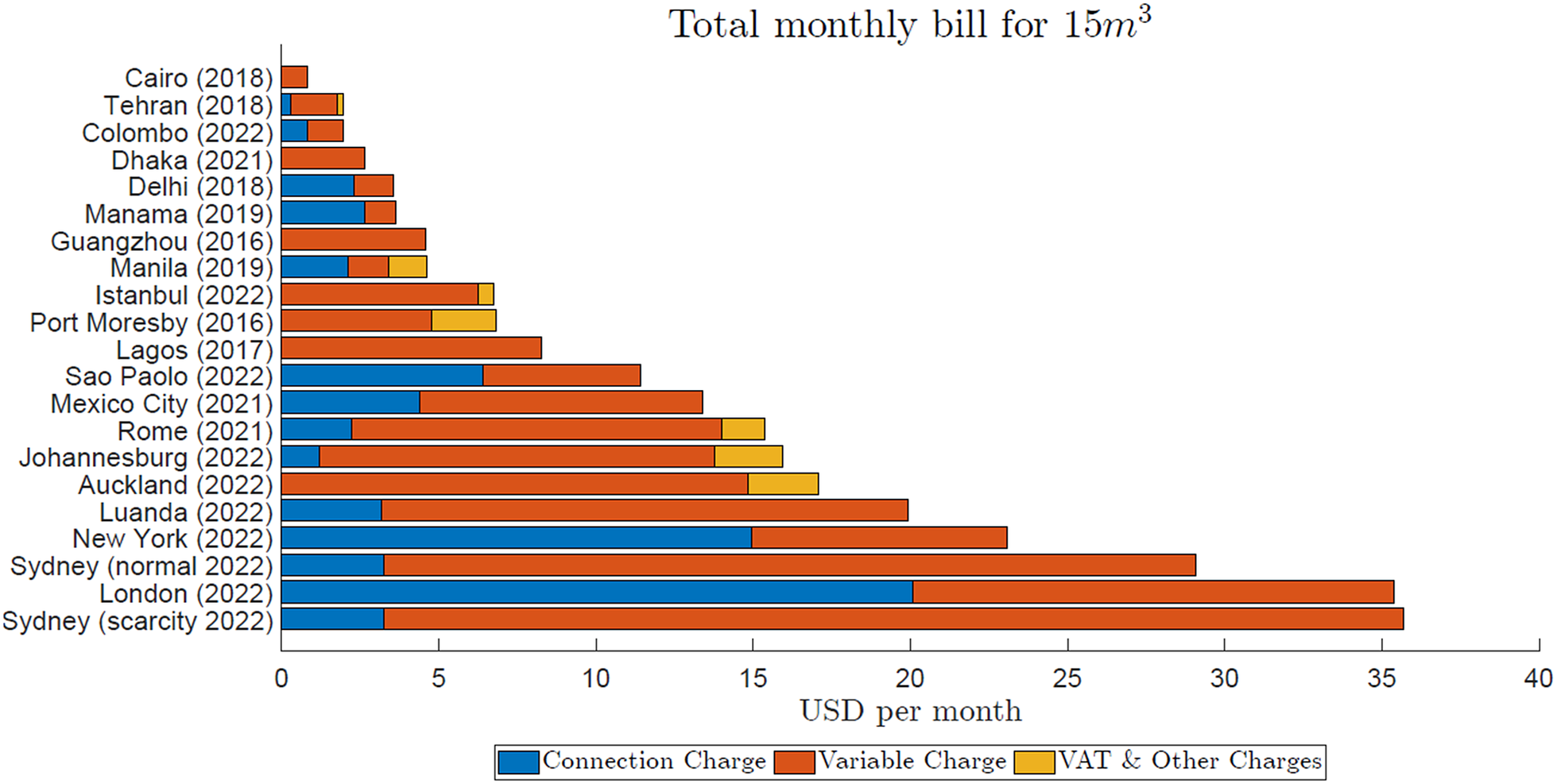
The fixed charge of a water tariff may vary over time and is intended to cover all or a proportion of the fixed costs of water supply, including capital depreciation and amortised additional infrastructure investments related to the water supply. The relative importance of fixed charges to the volumetric price in water tariffs in different cities of the world is shown in Figure 4. In Lagos, Nigeria, the entire monthly water tariff is variable and depends exclusively on the volume of water used. By comparison, in New York City, more than half the average monthly water tariff is a fixed charge that is independent of water consumption.
Composition of total monthly bills for urban water (21 cities): Source: IBNet https://tariffs.ib-net.org/.
The volumetric price should, at least, cover the marginal cost per unit of water supplied to consumers, to ensure sufficient revenue is received to recover the costs of water supply. The explicit marginal costs are costs that vary with the amount of water that is supplied, such as pumping and water conveyance costs, and the variable operations and maintenance that depend on the volume of water delivered in the water supply system. A common model for water services provision consists of water suppliers providing both potable water and sanitation (wastewater) services, and sometimes storm-water management as well. In these cases, the fixed water charges, such as those by the Manila Water Company (Philippines) (Global Water Intelligence, 2022), include two (or three) cost components that need to be recovered.
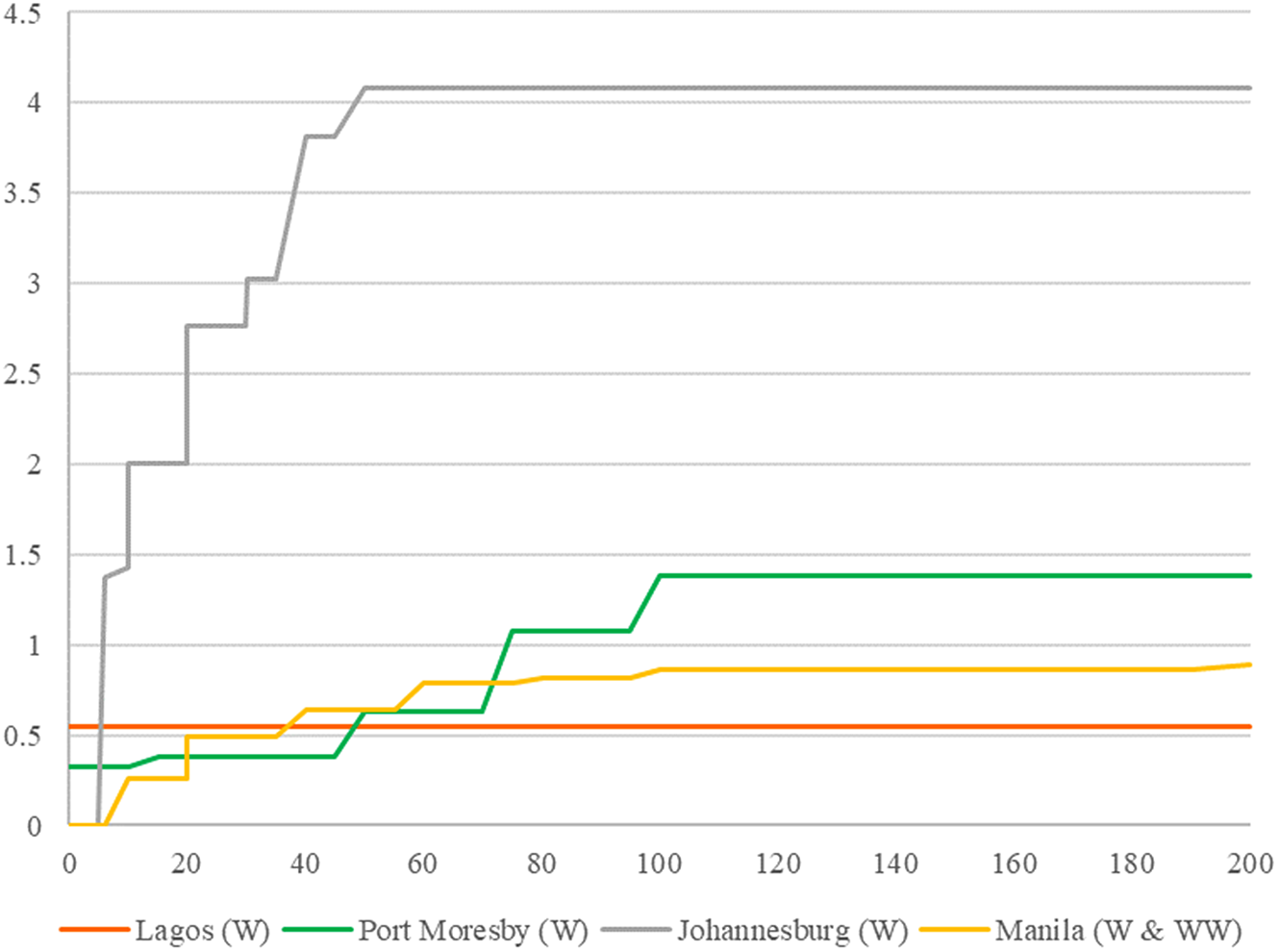
Where volumetric water prices vary, they usually increase with the volume or ‘block’ of water used by an individual water consumer and, hence, are called increasing block tariffs (IBTs). These have, as a minimum, two pricing blocks (e.g., Port Moresby, Papua New Guinea) but may have multiple blocks (e.g., Johannesburg, South Africa), and in some places an initial block may be provided at a zero price to meet basic water needs (e.g., Manila, Philippines), as shown in Figure 5.
Different volumetric water prices for urban water services. Tariff reference dates: Lagos (Water) 20 Nov 2017; Port Moresby (Water) 16 Feb 2016; Johannesburg (Water) 01 Jul 2022; Manila (includes Water and Wastewater) 01 Jan 2019. Source: IBNet https://tariffs.ib-net.org/.
Why different cities have different water tariffs depends, in part, on the objectives of the water suppliers or the government agencies that regulate the prices charged by water suppliers. Four key objectives for the pricing of water include (Boland, Reference Boland1993; Banerjee et al., Reference Banerjee, Foster, Ying, Skilling and Wodon2010; Whittington, Reference Whittington and Wilderer2011; Grafton et al., Reference Grafton, Chu and Wyrwoll2020):
-
(1) Full cost recovery: the economic costs of the water supplied are paid for through tariffs, taxes, or transfers (OECD, 2009), and there is an incentive to both invest in necessary additional infrastructure and maintain existing water infrastructure.
-
(2) Efficient water price: the price equals a transparent economic (including external costs) marginal cost of supply.
-
(3) Equitable outcomes: as many people as possible, regardless of income or circumstances, have their basic water needs met, and low-income households are not disadvantaged either in water access or in the price they pay for water.
-
(4) Water consumers are incentivised, through water prices, to reduce water use when water is scarce.
An IBT is not marginal cost pricing and, thus, is not an efficient water price because water consumers pay a different price for water that has the same marginal cost of supply. As a result, water consumers face different volumetric prices for water and, thus, their marginal values of water differ (Chu and Grafton, Reference Chu and Grafton2019). The commonly stated justification for an IBT is that it incentivises water consumers to conserve water as the more water used, beyond a given block, incurs a higher per unit cost. Typically, the higher volumetric price is only paid on the volume of water used above the previous block (e.g., Port Moresby, Papua New Guinea, and Manila, Philippines, in Figure 5) but can also be charged on all the previous blocks of water used; this is called a ‘jump tariff’.
Valuation of water infrastructure
The determination of the fixed charge and volumetric price of water in urban centres is frequently undertaken by a price regulator or a government rather than a private water supplier. This is because the provision of water supply in a centralised water system is a ‘natural monopoly’ (Hanemann, Reference Hanemann, Rogers, Llamas and Martinez Cortina2006); that is, the water supply costs are, typically, minimised if there is only one water supplier. This arises because grey water infrastructure (dams, water treatment plants, distribution network, etc.) has a high capital cost. Thus, the average cost per water consumer is reduced, the larger is the number of water consumers connected to a single water services network. Given the high capital costs of water infrastructure, unregulated competition among multiple water suppliers, each with their own distribution network, would tend to increase rather than decrease the average cost of water supplies.
If water supply costs are minimised by having a single water supply network, then, in the absence of water price regulations or controls, a single and profit-maximising water supplier would raise the water price, so long as the water demands were price inelastic, to maximise its profits. Thus, in the absence of any water price control, the monopoly water supplier would receive a rate of return greater than the minimum required to provide the water supply. It is for this reason that a maximum water price is frequently imposed on a single water supplier. This allows for the upside benefits of lower average costs from a natural monopoly but without the downside of monopoly profits.
What the maximum volumetric price should be, and the fixed charge, in a water tariff involves multiple factors. A key consideration is that there may be a community service obligation for the water supplier to deliver water to all who wish it in a defined geographic area, regardless of the cost. Thus, in this case, if there is ‘postage stamp’ water pricing where all customers pay the same per volumetric price regardless of location, the water price would need to be set sufficiently high elsewhere (e.g., in a large city) to compensate for the costs of providing water to places where costs exceed revenues (e.g., a small rural town).
A key consideration when regulating a water tariff is the incentives that it provides to the water supplier. If water suppliers were allowed to set a fixed charge to cover all their capital costs at a risk-adjusted rate of return greater than they would get elsewhere, they would have a financial incentive to ‘gold plate’ (Joskow and Noll, Reference Joskow, Noll and Fromm1981). That is, to overinvest in their water infrastructure to increase their returns without necessarily increasing the reliability of the water supply or water quality. Consequently, price regulators should only allow water suppliers to recoup the capital costs of necessary or required water infrastructure and the actual variable or operating costs of water supply. In areas where water services are mostly or exclusively provided by private companies, such as England and Wales, regulators must ensure that prices protect water consumers’ interests, while at the same time enabling operators to meet the required level of service and other legal obligations (e.g., environmental protection and social duties) (OFWAT, 2022).
In relation to privatised assets, partially or completely owned by private equity, infrastructure financial flows may be manipulated to increase shareholder returns but with no benefit to water consumers (Pryke and Allen, Reference Pryke and Allen2019). In the case of England, water utilities were privatised in 1989 (Helm, Reference Helm2020), and, subsequently, private equity owners have used the low-risk revenues that accrue to water supply companies to increase the debt-to-equity ratio through a process of ‘whole business securitisation’ whereby future revenues provide a form of security to pay the debt. Higher debts may be used to provide initially higher dividends to owners rather than being spent on investments to improve the reliability and quality of the water services. In the absence of regulatory controls, this can increase debts that need to be serviced but with no commensurate benefits to water consumers (Bayliss et al., Reference Bayliss, Van Waeyenberge and Bowles2023), particularly if they have no or limited other household water supply options.
What infrastructure is allowed to be reimbursed by a price regulator or government is, typically, subject to a review process that is called a ‘price determination’. After determining the regulated asset base that should receive a rate of return, a regulated rate of return is assigned that balances avoiding underinvestment in water infrastructure against encouraging overinvestment. The regulated rate of return is commonly defined by the weighted average cost of capital that considers not only the assets and debts of the water supplier but the rate of return on assets elsewhere in the economy (IPART, 2017).
Multiple methods are used to determine the ‘regulated asset base’, the water infrastructure that is considered necessary for the provision of a water supply that meets defined criteria in terms of reliability, water quality, and accessibility. Determining this regulated base is critically important to achieve SDG 6 because it is estimated that the required investment in water and sanitation infrastructure globally could be as much as US$1.5 trillion per year to 2030, of which some 70% would need to be invested in the Global South (United Nations, 2021).
An example of innovation in terms of increasing the urban water supply is Singapore’s 20-year provision of ‘NEWater’, that is, treated effluent from wastewater treatment plants that is used to supply industrial and commercial consumers, as well as supplement domestic uses (Wu et al., Reference Wu, Wang, Xue, Chen, Luo, Bai, Tong and Hu2022). Following advanced treatment through multiple systems, NEWater reaches a quality that exceeds the WHO drinking water guidelines, at a cost below USD 0.15/m3 (Bai et al., Reference Bai, Shan, Zhu, Xu, Wu, Luo, Wu, Hu and Zhang2020). Two added values or advantages of NEWater compared to traditional water imports from neighbouring Malaysia are a) increased supply security and self-reliance and b) ability to supply high-end industrial processes, like semiconductors, requiring ultrapure water (Tortajada, Reference Tortajada2006; Lee and Tan, Reference Lee and Tan2016).
Importantly, the quantity and quality of the water supply should not be only determined by investments in grey infrastructure. In particular, the state of the catchments where the water is sourced and how water is managed within urban centres – green infrastructure – are important determinants of water quality. Typically, the more pristine the catchment is, the higher the quality of water from which it is sourced and the lower are the treatment costs in ensuring water of sufficient quality for water users. Green infrastructure, however, can be degraded by unregulated or uncontrolled stormwater runoff, deforestation, soil erosion, contamination from toxic sites and/or waste dumps, and flooding that causes sewage overflows.
Investments in green infrastructure may include buying land, easements, and protection of upstream catchments. For example, New York City undertook a series of commitments and investments from 1992 to 2007, worth $US 1.5 billion, to further protect the Catskills-Delaware Catchments that are a key source of water for the city (Ashendorff et al., Reference Ashendorff, Principe, Seeley, LaDuca, Beckhardt, Faber and Mantus1997). The alternative to green infrastructure was for New York City to build additional water filtration plants at a capital cost of some US$6–8 billion with annual operating costs of US$ 300 million (Chichilnisky and Heal, Reference Chichilnisky and Heal1998).
In addition to investing in upstream catchments, green infrastructure can include urban planning and investments to reduce urban runoff, such as rain gardens, tree trenches, green roofs, and urban wetlands. Such investments in green, rather than grey, infrastructure are claimed to have saved the City of Philadelphia some US$7 billion, or more, in expenditures over 25 years (Stutz, Reference Stutz2018). These examples highlight the potential, and the possible cost savings, of valuing green infrastructure as a cost-effective way (Vörösmarty et al., Reference Vörösmarty, Stewart-Koster, Green, Boone, Flörke, Fischer, Wiberg, Bunn, Bhaduri, McIntyre, Sadoff, Liu and David Stifel2021) to help deliver SDG target 6.6: ‘…(p)rotect and restore water-related ecosystems, including mountains, forests, wetlands, rivers, aquifers and lakes’.
Who bears the costs and enjoys the benefits of water use?
While domestic water uses are universal – that is, all humans need water for drinking, hygiene, sanitation, and food preparation – large inequalities exist in terms of who bears the costs. Here, we explore factors that contribute to disparities in the cost burden and ability to pay for domestic water, including location, infrastructure availability, household size, and income. Understanding and correcting inequalities in access to domestic water are of critical importance, especially as per capita water scarcity is increasing in many parts of the world due to growing water demands and climate change (Flörke et al., Reference Flörke, Schneider and McDonald2018), among other reasons. While water inequalities are frequently highlighted in relation to low-income countries (e.g., Biswas and Tortajada, Reference Biswas and Tortajada2010; Keener et al., Reference Keener, Luengo and Banerjee2010), millions of rural and urban households in high-income countries suffer from insecure water access, frequently associated with insecure housing and systemic social inequalities (Meehan et al., Reference Meehan, Jurjevich, Chun and Sherrill2020).
Over the last two decades, two billion people have obtained access to safely managed water services (i.e., accessible on-premises, available when needed, and free from contamination) (UNICEF, 2021). Unfortunately, these gains (and the resulting gaps) are not evenly distributed. That is, there are stark disparities between urban and rural areas, and between high- and low-income countries (Hope et al., Reference Hope, Thomson, Koehler and Foster2020; WHO et al., 2022). Much of the extension of water services has occurred in large or megacities in countries with rapid population growth. Thus, despite an increase in the network of water services, the total number of city dwellers without safely managed drinking water has almost doubled since 2000 (United Nations, 2021). For example, in urban areas in sub-Saharan Africa, the percentage of people with access to safely managed water services increased from 40% to 53%, between 2000 and 2020. Yet globally, the number of people without such services increased from 1.2 billion to 2.11 billion over the same period (WHO/UNICEF Joint Monitoring Programme, 2022).
Disparities in access to safely managed drinking water mean that many city dwellers must rely on public water standpipes, informal vendors, or neighbours who have more reliable water supply (Zuin et al., Reference Zuin, Ortolano, Alvarinho, Russel, Thebo, Muximpua and Davis2011). Given public health and affordability concerns, water resale is sometimes prohibited, reportedly in cities such as Dakar (Senegal), Accra (Ghana), and Bamako (Mali) (Zuin et al., Reference Zuin, Ortolano, Alvarinho, Russel, Thebo, Muximpua and Davis2011). Elsewhere across low- and middle-income countries, the legal status of water resale is often ambiguous (e.g., Dar es Salaam, Tanzania, or Kampala, Uganda). That is, no laws explicitly prohibit the practice, or existing regulations against it are not enforced (Keener et al., Reference Keener, Luengo and Banerjee2010).
Volumetric water prices in informal markers tend to be much higher compared to those paid by households supplied by municipal systems, or who have access to their own water, for example, supplied through private bores (Keener et al., Reference Keener, Luengo and Banerjee2010). Water prices in so-called informal markets vary by the volume purchased and convenience of delivery. That is, the further the distance transported, and the smaller the volume delivered, the higher the unit price (Munro and Kweka, Reference Munro and Kweka2021), all else being equal.
Water trucks that operate in informal water markets (Grafton et al., Reference Grafton, Horne and Wheeler2022) often purchase water from standpipes or source it directly from nearby rivers or aquifers. Subsequently, truckers sell the water to resellers, typically upper- or middle-income households with large storage facilities, which may also be filled from private bores or municipal connections (Keener et al., Reference Keener, Luengo and Banerjee2010). In turn, these resellers may sell water onwards to mobile vendors, who provide service in difficult-to-reach areas where formal water supply services are dysfunctional or lacking.
Recently, Munro and Kweka (Reference Munro and Kweka2021) observed in Tanzania’s financial capital, Dar es Salaam, that residents have greater trust in informal vendors than in the public water utility. Reportedly, vendors adjusted their prices in response to signals from competitors and, in some cases, choose not to charge the highest possible rate, as they consider themselves responsible for providing an essential service to fellow residents where the water supply utility has failed to provide water services (Munro and Kweka, Reference Munro and Kweka2021). In some contexts, household systems such as rainwater tanks, domestic bores, or small solar-powered treatment plants may offer consumers greater security of supply and lower prices, given the savings in conveyance costs (e.g., pumping, re-chlorination, pipe maintenance, etc.) (Cole et al., Reference Cole, Sharvelle, Fourness, Grigg, Roesner and Haukaas2018; Hafeez et al., Reference Hafeez, Shamair, Shezad, Javed, Fazal, Rehman, Bazmi and Rehman2021). Nevertheless, the benefits and costs of centralised versus de-centralised (e.g., household) water infrastructure vary widely (Yerri and Piratla, Reference Yerri and Piratla2019), while hybrid systems offer more options to deliver water services (Sapkota et al., Reference Sapkota, Arora, Malano, Moglia, Sharma, George and Pamminger2015).
Importantly, innovative solutions are required to provide disadvantaged households with safely managed water. Impoverished households are often disconnected from municipal systems and so are unable to benefit from standard cross-subsidies and tariff rebates. This is because, under conventional tariff structures, subsidies are often directed at centralised, networked water services that benefit households who are, typically, wealthier than those without access to centralised water infrastructure (Andrés et al., Reference Andrés, Saltiel, Misra, Joseph, Lombana Cordoba, Thibert and Fenwick2021). Thus, a rebalancing is needed to correct distortions in water subsidy regimes (Andrés et al., Reference Andrés, Saltiel, Misra, Joseph, Lombana Cordoba, Thibert and Fenwick2021) that do not support the least fortunate who have no access to safer and affordable water. For instance, funds could be directed to extending the water network coverage to additional water consumers (Munro and Kweka, Reference Munro and Kweka2021), informing consumers of the benefits of reticulated systems and to support safer water supplied by water vendors. A study carried out in Laurent, Haiti (Whittington et al., Reference Whittington, Briscoe, Mu and Barron1990) showed how non-market valuation (Champ et al., Reference Champ, Boyle and Brown2017) is effective at predicting peoples’ willingness-to-pay for different water service options, including public stand posts and private connections. Such information, for instance, can be used to better inform infrastructure roll-out where uptake may vary depending on access to alternative sources and water consumers’ perceived values.
While the challenges of providing safe and affordable drinking water are formidable, they are not insurmountable, even for low-income countries. For example, the transformation in the water supply of Cambodia’s capital, Phnom Penh, is widely viewed as a global success of good governance (Biswas and Tortajada, Reference Biswas and Tortajada2010). Following two decades of political turmoil and socio-economic instability, in the early 1990s the Phnom Penh Water Supply Authority (PPWSA) and other public service agencies were not functioning effectively. Only an estimated 20% of the city’s population was serviced by the PPWSA, and the supply was intermittent, at best (Chan, Reference Chan2009). A transformation began after a trade embargo was lifted in 1992, and investments were made in water services planning and new infrastructure.
A crucial component of the success in improving the quality and the extent of water supply in Phnom Penh was the creation of an up-to-date consumer database and the careful management of water tariffs, which were kept low initially and gradually increased over time (Biswas and Tortajada, Reference Biswas and Tortajada2010). Given the substantial improvements in the level of service, including water quality and reliability, its residents were, and remain, largely supportive of the new ‘pay-for’ water provision. With revenues rising, and a well-devised investment programme, the PPWSA was able to offer payment instalments and subsidies for connection costs for poor households (Chan, Reference Chan2009). Per capital daily use of safe and clean water has increased – a sign of people’s willingness-to-pay for a higher quality of service. This also creates positive spill-overs for the health and well-being of Phnom Penh residents (Biswas and Tortajada, Reference Biswas and Tortajada2010).
When is the price of water expected to change?
Water service providers may choose to change water prices for several reasons, such as to encourage greater water conservation during a drought when water supplies are more scarce (Mohammad-Azari et al., Reference Mohammad-Azari, Bozorg-Haddad, Biswas and Bozorg-Haddad2021). Here, we review the reasons and circumstances for changing the price of water can (and ought to) be used as a water management strategy that achieves positive outcomes for consumers, water utilities, and the environment.
We highlight that when setting water prices, utilities and regulators should take account of multiple factors that modulate demand, such as temperatures and precipitation (Bell and Griffin, Reference Bell and Griffin2008), education, and awareness of water scarcity (Marzano et al., Reference Marzano, Rougé, Garrone, Harou and Pulido-Velazquez2020). At least in high-income countries, there is increasing use of ‘smart’ meters that collect households’ water use data on a minute or hourly basis, thus allowing greater flexibility and responsiveness in household water pricing (Vašak et al., Reference Vašak, Banjac, Baotié and Matuško2014; Marzano et al., Reference Marzano, Rougé, Garrone, Harou and Pulido-Velazquez2020).
Dynamic water pricing is an approach that accounts for water scarcity (Falkenmark and Lundqvist, Reference Falkenmark and Lundqvist1998; Grey et al., Reference Grey, Garrick, Blackmore, Kelman, Muller and Sadoff2013; Jaeger et al., Reference Jaeger, Plantinga, Chang, Dello, Grant, Hulse, McDonnell, Lancaster, Moradkhani, Morzillo, Mote, Nolin, Santelmann and Wu2013) and the intertemporal connections between present and future water use into current and future water prices (Dandy et al., Reference Dandy, McBean and Hutchinson1984; Grafton et al., Reference Grafton, Chu and Wyrwoll2020). That is, the water price changes over time in response to a range of factors that influence both water demand (e.g., change in population) and water supply (e.g., droughts and floods).
Several studies provide conceptual reviews and/or empirical evaluation of (dynamic) water pricing, including, for example, Whittington (Reference Whittington and Wilderer2011), Chu and Grafton (Reference Chu and Grafton2021), Mohammad-Azari et al. (Reference Mohammad-Azari, Bozorg-Haddad, Biswas and Bozorg-Haddad2021), and Li and Jeuland (Reference Li and Jeuland2023). Dynamic water pricing is especially important in locations where water availability is highly variable. They include arid and semi-arid places that rely on their water supply inflows into dams, such as large parts of Australia (Grafton and Kompas, Reference Grafton and Kompas2007). In such locations, reduced precipitation and/or higher temperatures during an extended meteorological drought (AghaKouchak et al., Reference AghaKouchak, Mirchi, Madani, Di Baldassarre, Nazemi, Alborzi, Anjileli, Azarderakhsh, Chiang, Hassanzadeh, Huning, Mallakpour, Martinez, Mazdiyasni, Moftakhari, Norouzi, Sadegh, Sadeqi, Van Loon and Wanders2021) can greatly diminish the available water supply. During such droughts, water demands increase for outdoor household use (e.g., watering gardens) and agriculture because of increased evapotranspiration (Mieno and Braden, Reference Mieno and Braden2011; Sebri, Reference Sebri2014; Ben Zaied and Binet, Reference Ben Zaied and Binet2015; Ghimire et al., Reference Ghimire, Boyer, Chung and Moss2016; Isselhorst et al., Reference Isselhorst, Berking and Schütt2018). As a result, water supply (which is below normal) and aggregate water demand (which is above normal) are ‘out-of-phase’ (Riley and Scherer, Reference Riley and Scherer1979). This may result in there being insufficient water supply at the current water price and, in the extreme and in the absence of other water conservation measures, may result in a ‘day zero’ event when, literally, there is no water available in the taps, such as almost happened in Cape Town, South Africa, in 2018 (Bischoff-Mattson et al., Reference Bischoff-Mattson, Maree, Vogel, Lynch, Olivier and Terblanche2020).
Different forms of dynamic pricing are practised in water-scarce regions and include seasonal pricing and peak-load pricing (Schuck and Green, Reference Schuck and Green2002; Pesic et al., Reference Pesic, Jovanovic and Jovanovic2013; Molinos-Senante, Reference Molinos-Senante2014). Such pricing is most commonly applied to household residential water use (Stephan and Stephan, Reference Stephan and Stephan2017). Whatever the dynamic pricing method used, the intent is to reduce current water demand by increasing the water price, such that prices are higher in dry seasons (seasonal pricing), when supply is most scarce, or when water demand is at its peak (peak-load pricing). Given that water demands for essential uses are highly price inelastic (see Section 1), the water price may have to rise substantially to ensure that water demand equals the available water supply.
In Sydney, Australia, a form of dynamic pricing (Grafton and Kompas, Reference Grafton and Kompas2007) has been implemented from 1 July 2020 based on the water available in the city’s water storages. In this pricing structure, water consumers pay A$ 3.18 per m3 for water when dam water storages are below 60% of full capacity and A$ 2.35 per m3 for water when dam water storages exceed 70% of full capacity (IPART, 2020). Thus, as water becomes scarcer in water storages, volumetric water prices will increase to reduce aggregate water demand. A rising water price, in turn, helps to ensure that the remaining water in Sydney’s dams is sufficient to meet future water demand without imposing water rationing.
A more sophisticated type of dynamic water pricing employs the risk-adjusted user cost (RAUC) method developed by Chu and Grafton (Reference Chu and Grafton2019) and Chu and Grafton (Reference Chu and Grafton2021). The RAUC increases the current volumetric water price by an amount that accounts for the impact of current water use on the future water supply. This type of pricing is especially useful when water consumers are dependent on one or a very limited number of water sources that are weather dependent, such as a dam that stores water for a community. In this context, water storages provide the connection from the present to the future because if inflows into the dam are less than outflows to water consumers the volume of water in the dam declines. Thus, if the volumetric water price can be raised sufficiently high enough to reduce current water demand, more water can remain in water storage and be available for later use. The associated risk premium should account for the connection between the reduced future water supply and current water demand, and other factors that influence demand (e.g., population growth) and supply (e.g., expected weather) (Chu and Grafton, Reference Chu and Grafton2021).
Dynamic water pricing, when combined with equitable policies to assist low-income and/or large households, offers a way to encourage less water use when water is scarce, and is an alternative to rationing or water-use restrictions (Grafton and Ward, Reference Grafton and Ward2008; Loehman, Reference Loehman2008; Madrigal-Ballestero et al., Reference Madrigal-Ballestero, Capitán, Salas and Córdoba2019). In the example of Sydney, the introduction of a dynamic, scarcity-based volumetric price was accompanied by a lower fixed charge in all periods with the aim that the total water bill for the typical Sydney household would not increase. More transparent volumetric water pricing and the use of smart meters that provide real-time pricing of the current use also assist water consumers to respond to higher water prices (Rougé et al., Reference Rougé, Harou, Pulido-Velazquez, Matrosov, Garrone, Marzano, Lopez-Nicolas, Castelletti and Rizzoli2018).
A higher water price when water is scarce can incentivise and increase the effectiveness of investments in water conservation (Grafton et al., Reference Grafton, Ward, To and Kompas2011), such that less water is used for a given water service (e.g., low-flow showerheads, dual-flush toilets, or high-efficiency sprinkler nozzles). Thus, dynamic water pricing can assist in achieving SDG Target 6.4: ‘(b)y 2030, substantially increase water-use efficiency across all sectors and ensure sustainable withdrawals and supply of freshwater to address water scarcity and substantially reduce the number of people suffering from water scarcity’ (UN-Water, 2021, p. 21).
Discussion
The price and the value of water affect the welfare of billions of people. While price and value can sometimes be related (or even equated), there are important differences between the two concepts. Understanding how they differ and their implications for water services has a big influence on the delivery, or not, of SDG 6: water and sanitation for all (the who of water pricing and valuation).
The price of water, determined either though markets or by regulators, is influenced by how much water is available and by how much consumers are prepared to pay for it. The value of water is the combined benefit obtained from access, use, or consumption of water in relation to a given volume or body of water (or resource), incorporating all market and non-market benefits (ICWE, 1992; Dupont and Adamowicz, Reference Dupont, Adamowicz, Renzetti and Dupont2017; United Nations, 2021).
In terms of what approaches to the pricing and valuation of water, we contend legal, policy, and management frameworks should include all water values, including human life and dignity. Importantly, when considering why water is being priced and valued, we highlight that the purpose is often for market or transactional purposes, which frequently ignore or underestimate non-market water values.
We highlight for the who that some impoverished communities face barriers to having their water values recognised (e.g., Indigenous communities and their cultural values) as well as being serviced with safe drinking water at an affordable price. The how of water pricing and water valuation requires that both the regulated and market prices of water value and consider all aspects of water. The when is about ensuring water availability and affordability intertemporally, which may mean paying a higher price of water today to ensure some water is available tomorrow.
Conclusion
The world faces a water crisis that encompasses inadequate access to safe water and sanitation for billions of people; substantial increases in morbidity and mortality; increasing water scarcity, especially in arid and semi-arid parts of the world; and deteriorating water-related ecosystems because of overuse and water pollution. While there are bio-physical contributors to this water crisis, the key causal factors are poor water governance and poverty. In the absence of transformational change that accounts for the multiple linkages between water and food, water and food trade, and climate change, this crisis will worsen.
We show, drawing on lessons learnt from multiple contexts and geographies across the world, that effective, efficient, and equitable pricing and valuation of water, if widely adopted by decision-makers, can mitigate the world water crisis. How to price and value water must be adapted to circumstances, but the key questions that must be answered by decision-makers are the same, namely the ‘Why, What, How, Who and When’ of both the price and the value of water. In our view, effective water pricing and appropriate valuation, coupled with improved water governance, collectively offer a pathway towards the delivery of water and sanitation for all while ensuring the sustainability of water-related ecosystems.
Open peer review
To view the open peer review materials for this article, please visit http://doi.org/10.1017/wat.2023.2.
Data availability statement
All data used in this research are cited and referenced in the text.
Acknowledgements
We acknowledge Indigenous Australians who have sustainably cared for their own Country since the beginning of time and who have been, and always will be, the Traditional Custodians of Australia’s waters including its aquifers, streams, and rivers.
Author contribution
R.Q.G.: Conceptualisation, writing – original draft, writing – review and editing, visualisation, supervision, and funding acquisition; A.M.: Writing – original draft, writing – review and editing, and visualisation; L.C.: Writing – original draft, writing – review and editing, and visualisation; P.W.: Writing – original draft, writing – review and editing, and visualisation.
Financial support
This research was undertaken under the auspices of the Water Justice Hub and was funded, in part, by the Australian Research Council grant FL190100164 ‘Water Justice: Indigenous Water Valuation and Resilient Decision-Making’.
Competing interest
The authors have no competing in relation to this work.
Ethics standard
This research did not entail primary data collection, and thus no ethics protocol was required


 Open access


Comments
Thank you for your 18 August 2022 invitation to submit an Overview paper for peer review and possible publication in Cambridge Prisms: Water.
Our submission is attached. Our review examines key economic concepts in relation to the price and value of water. That is, it responds to five key questions about water and how it is used:
(1) Why water is (or is not) priced and valued (or not)?;
(2) What are the key economic concepts for pricing water?;
(3) How is water priced and how are water supply assets valued for full cost recovery?;
(4) Who bears the costs and enjoys the benefits of water use?; and
(5) When should the price of water change?
Examples are provided to demonstrate the universality of the economic concepts while highlighting how their application must be bespoke and account for the socio-economic contexts and bio-physical conditions where water is supplied and demanded.
Thank you for the opportunity.