





1. Introduction
The integrated Land Ecosystems Atmospheric Processes Study (iLEAPS) was formed in March 2004 to build an international community of practice to investigate the interactions between terrestrial ecosystems and the atmosphere. Originally part of the International Geosphere-Biosphere Programme, iLEAPS became a global research network of Future Earth in 2014.
The first decade of iLEAPS had an emphasis on creating new ways to observe and model the land–atmosphere continuum. Suni et al. (Reference Suni, Guenther, Hansson, Kulmala, Andreae, Arneth, Artaxo, Blyth, Brus, Ganzeveld, Kabat, de Noblet-Ducoudré, Reichstein, Reissell, Rosenfeld and Seneviratne2015) highlighted the iLEAPS contribution to the support and development of networks of long-term flux stations and large-scale land–atmosphere observation platforms. iLEAPS promoted the integration of data from remote sensing, ground-based observations, and other sources into data cubes (Mahecha et al., Reference Mahecha, Gans, Brandt, Christiansen, Cornell, Fomferra, Kraemer, Peters, Bodesheim, Camps-Valls, Donges, Dorigo, Estupinan-Suarez, Gutierrez-Velez, Gutwin, Jung, Londoño, Miralles, Papastefanou and Reichstein2020) and products (e.g. FLUXCOM (Jung et al., Reference Jung, Schwalm, Migliavacca, Walther, Camps-Valls, Koirala, Anthoni, Besnard, Bodesheim, Carvalhais, Chevallier, Gans, Goll, Haverd, Köhler, Ichii, Jain, Liu, Lombardozzi and Reichstein2020)). The understanding gained contributed to advances in land–surface models that represent the role of land cover changes and land–atmosphere feedback processes in the Earth system.
In this second decade, the focus has shifted to the human influence on these ecosystem–atmosphere interactions and the implications for resource use and sustainable development. While the impact on the natural environment is still investigated (He et al., Reference He, Clifton, Felker-Quinn, Fulgham, Juncosa Calahorrano, Lombardozzi, Purser, Riches, Schwantes, Tang, Poulter and Steiner2021), socio-economic aspects are also needed to cover mitigation and adaptation to climate change. The role of iLEAPS is ever more important in bringing together scientists to advance the knowledge of the complex Earth system and the people within it. Here we outline the new challenges and opportunities that motivate a new decadal iLEAPS roadmap for land–atmosphere interaction research.
2. The environmental challenges
The growing human population, its increasing demand for natural resources and the transformation and releases of materials, often harmful, to air, water, and land, is outstripping the capacity of the natural world to replenish or process them. Land cover changes due to deforestation, forest degradation, and agricultural intensification are major drivers of biodiversity loss (IPBES, 2019).
Climate change, caused by anthropogenic emissions of greenhouse gases (GHGs) and other compounds that change the Earth's radiative balance, is one of the many human pressures on the Earth system (IPCC, 2021). Higher global temperature results in greater impacts on ecosystems (Figure 1) and more extreme weather events, which are becoming more frequent and their impacts more severe. Their nature and consequences vary across the globe, with each region or country exposed to a different combination of hazards and risks, and each with different capacities to respond, mitigate or adapt.
Key risks to terrestrial and freshwater ecosystems from climate change (Figure 2.11 in IPCC AR6 WGII [IPCC, 2022a]).

iLEAPS provides information, understanding, and coordination of the science of this complex system. The iLEAPS focus on how interacting physical, chemical, and biological processes transport and transform energy and matter through the land–atmosphere interface is critical in understanding the processes and impacts of climate and other planetary changes.
3. The policy and scientific response
The Paris Agreement of the UN Framework Convention on Climate Change (UNFCCC, 2015) signaled a change of focus from reducing emissions of GHG and near-term climate forcers to ‘holding the increase in global average temperature to well below 2 °C and pursuing efforts to limit the increase to 1.5 °C’. Meeting this goal requires immediate and sustained reductions in emissions, combined with CO2 removal, in which land-based measures – for example, ecosystem rehabilitation, afforestation (in appropriate systems), bioenergy, the latter combined with carbon capture and storage – play a pivotal role (IPCC, 2018). To inform the UNFCCC process, the Intergovernmental Panel on Climate Change (IPCC) has produced a series of assessment reports on climate change (e.g. IPCC (2021, 2022a, 2022b)) and topical special reports (e.g. IPCC (2018, 2019a, 2019b)), which highlight knowledge gaps and the need for improved information, for example, about glaciers, fire, and methane sources.
The UN Agenda for Sustainable Development has developed 17 Sustainable Development Goals (SDGs), which recognize that improving human life and reducing inequality must go hand-in-hand with tackling climate change and working to preserve oceans and forests. The UN Convention on Biological Diversity, inspired by the growing commitment to sustainable development, is another significant milestone. The complex and multiple connections between climate and biodiversity have been recognized in the international policy arena (Pörtner et al., Reference Pörtner, Scholes, Agard, Archer, Arneth, Bai, Barnes, Burrows, Chan, Cheung, Diamond, Donatti, Duarte, Eisenhauer, Foden, Gasalla, Handa, Hickler, Hoegh-Guldberg and Ngo2021). There is also increased interest in nature-based solutions, defined by the International Union for Conservation of Nature as actions to protect, sustainably manage, and restore ecosystems that address societal challenges.
In response, the international research community established Future Earth to bridge the historical divide between scientific knowledge and societal action by advocating research that supports global sustainability (van der Hel, Reference van der Hel2016). Future Earth has created new structures (Suni et al., Reference Suni, Juhola, Korhonen-Kurki, Käyhkö, Soini and Kulmala2016), in which global research networks such as iLEAPS play an important role, in identifying and addressing key scientific gaps.
4. ‘iLEAPS' facilitation
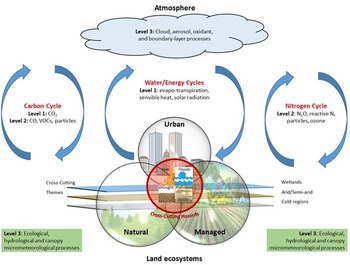
The iLEAPS science plan (included as Supplementary Material) focuses on three overlapping terrestrial systems: (a) natural, (b) managed land, and (c) urban, together with three critical cross-cutting themes: (d) cold regions (e) arid/semi-arid regions, and (f) wetlands. These are indicated schematically in Figure 2, which also shows the key land–atmosphere processes of these focal systems and themes. In the following sections, we identify the environmental problems that iLEAPS is currently addressing and where its efforts will be focused in the future.
(a) Natural ecosystems
Schematic of the three focal systems of interest to iLEAPS, their overlap, the three key cross-cutting themes, and the land–atmosphere processes involved.

More than 95% of the Earth's land surface is directly affected by human activities (Plumptre et al., Reference Plumptre, Baisero, Belote, Vázquez-Domínguez, Faurby, Jȩdrzejewski, Kiara, Kühl, Benítez-López, Luna-Aranguré, Voigt, Wich, Wint, Gallego-Zamorano and Boyd2021). Natural ecosystems, defined as land that has not been actively altered or managed for at least a generation, play a vital role in the Earth system. Forests have the greatest impact on climate, both directly through albedo and surface roughness, and the exchange of heat, energy and trace compounds, and indirectly via carbon storage. Forests also provide a vital range of ecosystem services, including habitat for biodiversity, food, and fiber for people. Forests cover 31% of the global land area but are not distributed uniformly (FAO, 2022). Their loss has serious implications for climate and ecosystem services. Natural grass systems also provide essential ecosystem services (e.g. below ground carbon sequestration (Dass et al., Reference Dass, Houlton, Wang and Warlind2018; Retallack, Reference Retallack2013; Ryan et al., Reference Ryan, Williams and Grace2011)), provide livelihoods for a significant proportion of the human population and support a unique and adapted biodiversity.
A study of historic losses of carbon due to land use change, mainly deforestation, suggests that global biomass could potentially be ~400 Pg carbon greater than at present (Erb et al., Reference Erb, Kastner, Plutzar, Bais, Carvalhais, Fetzel, Gingrich, Haberl, Lauk, Niedertscheider, Pongratz, Thurner and Luyssaert2018), equivalent to ~40 years of CO2 emissions at current levels. While this is an important rationale for promoting tree planting as a climate mitigation option (e.g. the Bonn Challenge, FAO (2022)), such solutions also need to balance the diverse ecosystem services that forests provide (Lewis et al., Reference Lewis, Mitchard, Prentice, Maslin and Poulter2019) or to avoid the unintended consequences of such actions on the ecosystem service provision in grassland systems (Bond et al., Reference Bond, Stevens, Midgley and Lehmann2019). Ryan et al. (Reference Ryan, Williams and Grace2011) estimate that the savannah regions of southern Africa store between 18 and 24 Pg of carbon (split evenly between the soil and woody vegetation), which is of a similar magnitude that stored in the Congo Basin rainforests (30 Pg C).
The iLEAPS community is at the forefront of investigating the many trade-offs between carbon storage and other ecosystem services and highlighting the consequences of tree species changes due to climate change as well as human deforestation and afforestation activities. In particular, iLEAPS scientists have emphasized the need to consider the interactions between vegetation, local microclimate, fire occurrence, air quality, and human health through the emissions of biogenic volatile organic compounds and bio-aerosols such as pollen or fungal spores.
(b) Managed land
Managed land refers to that cultivated for agricultural food crops, for agroforestry use, silviculture, plantations and pastures grown for biomass for energy, timber, industrial products (e.g. paper, rubber), and livestock and may include management interventions, harvesting, thinning, the use of fire, and application of soil improvers, for example, agrochemical nitrogen and phosphorous fertilizers or natural fertilizers (Ogle et al., Reference Ogle, Domke, Kurz, Rocha, Huffman, Swan, Smith, Woodall and Krug2018). Managed lands collectively represent one of the most dynamically changing components of the land–biosphere–atmosphere system, as they keep pace with the increased demands of food, shelter, and energy for the world's rapidly increasing population. Land management has direct impacts on carbon stocks, air quality (e.g. contribution to aerosols), and is associated with a range of GHG emissions and also the removal of such gases through uptake and deposition.
The global tree count census (Crowther et al., Reference Crowther, Glick, Covey, Bettigole, Maynard, Thomas, Smith, Hintler, Duguid, Amatulli, Tuanmu, Jetz, Salas, Stam, Piotto, Tavani, Green, Bruce, Williams and Bradford2015) neglected the presence of cropland trees across the globe and Bastin et al. (Reference Bastin, Finegold, Garcia, Mollicone, Rezende, Routh, Zohner and Crowther2019) excluded croplands while proposing reforestation as a tool for carbon sequestration. There is at least 45 million ha of agroforestry land, which is expected to expand with the ongoing tree planting initiatives in degraded land (FAO, 2022). Two-thirds of the chemistry-climate models used by the IPCC exclude cropland trees in their land-use land-cover module (Mishra et al., Reference Mishra, Sinha, Kumar, Barth, Hakkim, Kumar, Kumar, Datta, Guenther and Sinha2021). The ability to simulate dynamic land-use changes related to biomass production or agricultural crop rotation has yet to be undertaken by such chemistry-climate models and is currently reflected in site-based or regional-scale process models (Havermann et al., Reference Havermann, Ghirardo, Schnitzler, Nendel, Hoffmann, Kraus and Grote2022).
The impact of air pollution, such as ozone, acid deposition, and particulate matter, on agricultural crops has been assessed in modeling studies at the global scale (Van Dingenen et al., Reference Van Dingenen, Dentener, Raes, Krol, Emberson and Cofala2009). An important finding of the Tropospheric Ozone Assessment Report (Mills et al., [Reference Mills, Pleijel, Malley, Sinha, Cooper, Schultz, Neufeld, Simpson, Sharps, Feng, Gerosa, Harmens, Kobayashi, Saxena, Paoletti, Sinha and Xu2018]) is that some regions, in particular Africa and South America, have very limited air pollution monitoring, making a complete global assessment difficult. The importance of understanding these atmosphere–biosphere feedbacks is very relevant to the UN sustainable development goal on zero hunger.
(c) Urban
The majority of the world's population now lives within an urban environment. The combined effect of global climate change and rapid urban growth, in tandem with economic and industrial development, will induce or exacerbate a number of the urban environmental problems (Figure 3).
Schematic diagram of the impacts of urbanization on climate and air quality (adapted from Wang et al. [Reference Wang, Wu, Zhang, Cohen, Pang, Bouarar, Wang and Brasseur2017]).

Green infrastructure and other nature-based solutions are increasingly considered to provide co-benefits for urban areas. They can have benefits for carbon sequestration and adaptation to climate risks and to mediate air quality and heat (Grote et al., Reference Grote, Samson, Alonso, Amorim, Cariñanos, Churkina, Fares, Thiec, Niinemets, Mikkelsen, Paoletti, Tiwary and Calfapietra2016). However, in urban areas, there can also be trade-offs between adaptation and mitigation (Landauer et al., Reference Landauer, Juhola and Söderholm2015; Locatelli et al., Reference Locatelli, Pavageau, Pramova and Di Gregorio2015). The emissions of volatile organic compounds from urban vegetation in the presence of high NOx sources may increase ozone and secondary aerosol formation in the urban atmosphere.
The number of premature deaths from exposure to outdoor air pollution is projected to increase from ~3 million people globally in 2010 to 6–9 million in 2060. The distribution of these premature deaths across the globe is unequal, with the highest number of deaths in China and India (OECD, 2016). In addition, evidence suggests that air pollution may be linked to a decrease in life satisfaction, and an increase in associated negative mental health outcomes and therefore may have wider reaching impacts, both societally and economically (Lu, Reference Lu2020).
(d) Cold/high-elevation regions
The cryosphere is especially sensitive and changes could significantly impact on the natural environment and human society. The Arctic is warming faster than the global average (IPCC, 2021), causing perturbations to the terrestrial water and carbon cycles in this region. Warming may have already shifted some ecosystems from net carbon sinks toward carbon-neutral or carbon sources, although it remains a challenge to determine the net ecosystem response across the circumpolar scale (Schuur et al., Reference Schuur, Abbott, Commane, Ernakovich, Euskirchen, Hugelius, Grosse, Jones, Koven, Leshyk, Lawrence, Loranty, Mauritz, Olefeldt, Natali, Rodenhizer, Salmon, Schädel, Strauss and Turetsky2022). The interactions and feedbacks to the atmosphere, regional climate, and water resources, make quantitative forecasts challenging.
Understanding the consequences of mountain glacier retreat is vital, since glaciers store and supply fresh water to lowland areas (Meyer et al., Reference Meyer, Strayer, Wallace, Eggert, Helfman and Leonard2007). In addition, plant productivity is generally limited by low temperatures, short growing seasons, and aridity (Paquette & Hargreaves, Reference Paquette and Hargreaves2021). Current warming trends and decreasing precipitation in continental interiors would change the boundaries of these limitations, resulting in shifts of species (Gauthier et al., Reference Gauthier, Bernier, Burton, Edwards, Isaac, Isabel, Jayen, Le Goff and Nelson2014).
Warming can also have consequences for the permafrost in these regions, such that permafrost carbon, which is equivalent to about 40% (1,460– 1,600 Pg C, Schuur et al. (Reference Schuur, Abbott, Commane, Ernakovich, Euskirchen, Hugelius, Grosse, Jones, Koven, Leshyk, Lawrence, Loranty, Mauritz, Olefeldt, Natali, Rodenhizer, Salmon, Schädel, Strauss and Turetsky2022)) of total global carbon within soils and biomass (Friedlingstein et al. (Reference Friedlingstein, O'Sullivan, Jones, Andrew, Gregor, Hauck, Le Quéré, Luijkx, Olsen, Peters, Peters, Pongratz, Schwingshackl, Sitch, Canadell, Ciais, Jackson, Alin, Alkama and Zheng2022): permafrost = 1,400, soils = 1,700, vegetation = 450 Pg C) is projected to decrease (IPCC, 2021). Finally, wildfire, one of the most significant disturbance agents at high latitudes, is expected to increase in frequency and severity (UNEP, Reference Sullivan, Baker and Kurvits2022), exacerbating changes in these sensitive regions.
(e) Arid/semi-arid regions
Semi-arid regions are geographically located between the arid and humid regions, where land–atmosphere interactions are stronger because of abrupt change between moisture regimes. This makes them simultaneously more sensitive to climate change and more influential in terms of feedbacks to the global carbon and hydrological cycles (Ahlström et al., Reference Ahlström, Raupach, Schurgers, Smith, Arneth, Jung, Reichstein, Canadell, Friedlingstein, Jain, Kato, Poulter, Sitch, Stocker, Viovy, Wang, Wiltshire, Zaehle and Zeng2015; Poulter et al., Reference Poulter, Frank, Ciais, Myneni, Andela, Bi, Broquet, Canadell, Chevallier, Liu, Running, Sitch and van der Werf2014). They also exert powerful regional influences. Thus, the severe drought experienced across the center of North China has been attributable to stronger sensible heating in the western arid regions in addition to direct climate warming (Huang et al., Reference Huang, Zhou, Chen, Zhou, Wei, Zhang, Gao, Wei and Hou2013; Liu et al., Reference Liu, Li, Huang, Zhu and Wang2019).
The structure and carbon budget of semi-arid vegetation are also under the strong control of wildfire. Approximately 3% of the global land surface burns annually, which represents a significant but poorly understood mechanism for the exchange of energy and matter between the land surface and the atmosphere, and longer-term alterations to the characteristics of the land surface (Archibald et al., Reference Archibald, Lehmann, Belcher, Bond, Bradstock, Daniau, Dexter, Forrestel, Greve, He, Higgins, Hoffmann, Lamont, McGlinn, Moncrieff, Osborne, Pausas, Price, Ripley and Zanne2018). Earth system models examining the impact of altered fire regimes indicate the potential for significant increases in global mean surface air temperature, decreased net radiation, and latent heat (Li et al., Reference Li, Lawrence and Bond-Lamberty2017).
The geographical distributions, frequency, and intensity of wildfires are projected to change under current warming trends. A comparison of global ‘fire-on’ and ‘fire-off’ simulations shows that wildfire maintains vast areas of humid C4 grasslands and savannahs, especially in South America and Africa, against its climate potential to form forest (Bond et al., Reference Bond, Woodward and Midgley2005). Meta-analysis using data from savannahs across the world indicates that vegetation–fire–climate relationships differ across continents (Lehmann et al., Reference Lehmann, Anderson, Sankaran, Higgins, Archibald, Hoffmann, Hanan, Williams, Fensham, Felfili, Hutley, Ratnam, San Jose, Montes, Franklin, Russell-Smith, Ryan, Durigan, Hiernaux and Bond2014), but observational studies in Africa suggest that the existence of savannah ecosystems there requires intensive disturbances (fire, herbivory) (Sankaran et al., Reference Sankaran, Hanan, Scholes, Ratnam, Augustine, Cade, Gignoux, Higgins, Le Roux, Ludwig, Ardo, Banyikwa, Bronn, Bucini, Caylor, Coughenour, Diouf, Ekaya, Feral and Zambatis2005).
(f) Wetlands
Wetlands are ecosystems in which mineral or peat soils are water saturated or where surface inundation dominates the soil biogeochemistry and determines the ecosystem species composition (USEPA, 2010). They are concentrated in two broad latitudinal bands: one rich in peatlands that spans the boreal and subarctic zones and a second covering the tropics and sub-tropics that contain vast swamps and seasonally inundated floodplains (Kirschke et al., Reference Kirschke, Bousquet, Ciais, Saunois, Canadell, Dlugokencky, Bergamaschi, Bergmann, Blake, Bruhwiler, Cameron-Smith, Castaldi, Chevallier, Feng, Fraser, Heimann, Hodson, Houweling, Josse and Zeng2013). Wetlands are an important component of the global water and carbon cycles, influencing groundwater balance, and river flow (Melton et al., Reference Melton, Wania, Hodson, Poulter, Ringeval, Spahni, Bohn, Avis, Beerling, Chen, Eliseev, Denisov, Hopcroft, Lettenmaier, Riley, Singarayer, Subin, Tian, Zürcher and Kaplan2013), and collectively represent the largest natural source of methane (Saunois et al., Reference Saunois, Stavert, Poulter, Bousquet, Canadell, Jackson, Raymond, Dlugokencky, Houweling, Patra, Ciais, Arora, Bastviken, Bergamaschi, Blake, Brailsford, Bruhwiler, Carlson, Carrol and Zhuang2020). Boreal and subarctic wetlands store most of the global wetland soil carbon stock (Turetsky et al., Reference Turetsky, Kotowska, Bubier, Dise, Crill, Hornibrook, Minkkinen, Moore, Myers-Smith, Nykänen, Olefeldt, Rinne, Saarnio, Shurpali, Tuittila, Waddington, White, Wickland and Wilmking2014). In the tropics, trees subjected to permanent or periodic inundation have developed adaptive features to enhance oxygenation of their root systems, which facilitate the natural release of soil CH4 to the atmosphere (Pangala et al., Reference Pangala, Enrich-Prast, Basso, Peixoto, Bastviken, Hornibrook, Gatti, Marotta, Calazans, Sakuragui, Bastos, Malm, Gloor, Miller and Gauci2017).
Methane from wetlands, especially from the tropical wetlands, has been identified as a key driver of the increased concentrations of atmospheric methane and the shift in its isotopic composition (Oh et al., Reference Oh, Zhuang, Welp, Liu, Lan, Basu, Dlugokencky, Bruhwiler, Miller, Michel, Schwietzke, Tans, Ciais and Chanton2022). Increased wetland methane emissions will offset the climate benefits of any reductions in anthropogenic methane emissions (e.g. through the global methane pledge) (Comyn-Platt et al., Reference Comyn-Platt, Hayman, Huntingford, Chadburn, Burke, Harper, Collins, Webber, Powell, Cox, Gedney and Sitch2018; Zhang et al., Reference Zhang, Poulter, Feldman, Ying, Ciais, Peng and Li2023).
Substantial GHG emissions are released from forested peatlands in Southeast Asia that are being drained and replaced with perennial crops, such as oil-palm and pulpwood plantations (IPCC, 2019a). Restoring tropical peatlands has benefits not only for mitigating climate change but also for reducing fire risk and for biodiversity (Tan et al., Reference Tan, Carrasco, Sutikno and Taylor2022).
5. Future focus of iLEAPS and vision for 2035
The iLEAPS science plan (included as Supplementary Material) aims to provide a vision for the next decade and, for example, synergies with the SDG's, responses to the latest IPCC and IPBES assessment reports, and areas for further research. The science plan takes into account how research networks have matured over the past decade, as well as the emergence of novel measurement and monitoring from towers, aircraft, and space to inform model development, and the need to consider ‘big data’ approaches and data equity in addressing science questions related to climate change, climate mitigation and adaptation. Over the next decade, the science and applications vision for iLEAPS includes the following cross-cutting themes that advance the focal systems of interest in Figure 2:
• Global change: The iLEAPS community has played and continues to have a leading role in the global monitoring activities such as FLUXNET (Suni et al., Reference Suni, Guenther, Hansson, Kulmala, Andreae, Arneth, Artaxo, Blyth, Brus, Ganzeveld, Kabat, de Noblet-Ducoudré, Reichstein, Reissell, Rosenfeld and Seneviratne2015) and more recently in the Integrated Carbon Observing System (ICOS) and ecosystem monitoring activities, such as National Ecological Observatory Network. As we move towards the middle of the 21st century, long-term observations such as flux data from FLUXNET (Jung et al., Reference Jung, Koirala, Weber, Ichii, Gans, Camps-Valls, Papale, Schwalm, Tramontana and Reichstein2019; Jung et al., Reference Jung, Schwalm, Migliavacca, Walther, Camps-Valls, Koirala, Anthoni, Besnard, Bodesheim, Carvalhais, Chevallier, Gans, Goll, Haverd, Köhler, Ichii, Jain, Liu, Lombardozzi and Reichstein2020; Pastorello et al., Reference Pastorello, Trotta, Canfora, Chu, Christianson, Cheah, Poindexter, Chen, Elbashandy, Humphrey, Isaac, Polidori, Reichstein, Ribeca, van Ingen, Vuichard, Zhang, Amiro, Ammann and Papale2020) can now be used to track ecosystem responses to global change drivers (e.g. global warming, elevated CO2, etc….) and to investigate ecosystem resilience.
• Air pollution: The emissions from biomass burning and wildfires will continue to have impacts on human health. The rapid urbanization and increase in NOx emissions will increase ground-level ozone concentrations downwind of the urban center, leading to potential impacts on crops and vegetation. Acid deposition is still relevant to certain regions such as southern Africa (Conradie et al., Reference Conradie, Van Zyl, Pienaar, Beukes, Galy-Lacaux, Venter and Mkhatshwa2016). The nitrogen cycle and sustainable nitrogen management are becoming of increasing importance (UNEA, 2022).
• Novel entities: iLEAPS will use its expertise in measurements, monitoring, and modeling to identify and assess entities that are of current or future concern, for example, microplastics and invasive species.
• Land use: Through changes in land cover and land use, the land is both a contributor to global environmental change as well as a key component in effort to mitigate climate change, for example, through land-based carbon capture and storage measures: afforestation, bioenergy, and peatland restoration. iLEAPS has an important role to play in quantifying GHG emissions and demonstrating the long-term resilience of these carbon stores.
• New measurement and data analysis techniques: iLEAPS scientists provide expertise and support enabling land–atmosphere exchanges to be measured using multiscale and multisource approaches. At the forest stand level, advanced techniques including proximal sensing using LiDAR techniques (Hancock et al., Reference Hancock, Armston, Hofton, Sun, Tang, Duncanson, Kellner and Dubayah2019; Lausch et al., Reference Lausch, Borg, Bumberger, Dietrich, Heurich, Huth, Jung, Klenke, Knapp, Mollenhauer, Paasche, Paulheim, Pause, Schweitzer, Schmulius, Settele, Skidmore, Wegmann, Zacharias and Schaepman2018) and remote sensing of above-ground biomass (Hernando et al., Reference Hernando, Puerto, Mola-Yudego, Manzanera, Garcia-Abril, Maltamo and Valbuena2019), are reducing cost and making observations feasible in remote locations. At a broader scale, new remote sensing technologies can measure a wide range of ecosystem properties and vegetation traits (Lausch et al., Reference Lausch, Borg, Bumberger, Dietrich, Heurich, Huth, Jung, Klenke, Knapp, Mollenhauer, Paasche, Paulheim, Pause, Schweitzer, Schmulius, Settele, Skidmore, Wegmann, Zacharias and Schaepman2018; Shiklomanov et al., Reference Shiklomanov, Bradley, Dahlin, Fox, Gough, Hoffman, M Middleton, Serbin, Smallman, & Smith and K2019). These new datasets however require advanced software and computing facilities and the fusion of text, images, audio, or video, often in real time.
• iLEAPS Community and Collaboration: iLEAPS represents a vibrant community of scientists, including Early Career Scientists (ECSs), who not only participate through regional hubs but also as one community. iLEAPS has broadened its scope, both geographically and in research expertise. While maintaining existing collaborations (e.g. IGAC, AIMES, and WCRP-GEWEX), iLEAPS is building new partnerships to solve emerging challenges (e.g. SOLAS and MRI). iLEAPS will contribute to the training of the next generation of researchers by developing programs on international sustainability and Earth science.
6. Concluding remarks
As the planet experiences increasingly large-scale changes in atmospheric temperature, precipitation, and chemical composition, it is urgent that we understand the complex interactions of these changes with the land system to realize their full impact. Land–atmosphere interactions are central to a wide-ranging body of scientific enquiry, bringing vital understanding of small-scale processes (e.g. to create a healthier urban environment) through to managing large-scale landscapes (e.g. to unlock its climate mitigation potential) while maintaining essential ecosystem services. Any proposed changes to land use require us to understand the impact of atmospheric chemistry and meteorology on the functioning of the land-system.
With specialists and science leaders from across the world, and with expertise across the broad range of science covered by iLEAPS, this inclusive hub enables the international community to communicate and remain up to date with developments and concepts on this link in the earth-system chain. Covering critically important processes such as fire, forestry, wetlands, methane, urban areas, pollution, and climate change, it is evident that iLEAPS sits center stage of some of the most important and challenging environmental questions facing humanity.
Supplementary material
The supplementary material for this article can be found at https://doi.org/10.1017/sus.2024.3.
Acknowledgements
The iLEAPS Scientific Steering Committee (SSC) acknowledges the support of Future Earth to enable annual meetings of the SSC, which facilitated the preparation of this paper. The iLEAPS International Project Office (IPO) is grateful to the UK Centre for Ecology & Hydrology for hosting the IPO.
Author contributions
E.B., G.H., V.S., and B.P. conceived the idea of an iLEAPS paper. G.H. lead the preparation of the paper and all authors contributed to the writing of specific sections or to the review of the paper.
Funding statement
The iLEAPS Scientific Steering Committee acknowledges the grants received from Future Earth to cover the annual SSC meetings. Past and present members of the iLEAPS International Project Office (G.H., E.B., V.B., and V.S.S.) acknowledge the support of the UK Natural Environment Research Council (NERC), through: (a) its International Opportunities Fund, grant NE/P008615/1 and (b) the NC-International programme [NE/X006247/1] delivering National Capability. G.P. also acknowledges the support of the NERC International programme to UKCEH. K.A. is grateful to the Royal Society of London for their funding of her Dorothy Hodgkin Research Fellowship (DH150070).
Competing interest
The authors declare no conflict of interests.
Research transparency and reproducibility
No unpublished data or software has been used in this manuscript.
Figure 1 is taken from the IPCC AR6 WGII report. The IPCC allows reproduction of a limited number of figures or short excerpts of IPCC material free of charge and without formal written permission, provided that the material is not altered and the original source is properly acknowledged.



 Open access

