




Introduction
“I’m no scientist, but I am a keen observer.” This is the common refrain of James “Ooker” Eskridge, mayor of the Town of Tangier, in the Commonwealth of Virginia. I met Ooker in 2016 while conducting scoping research on Tangier Island, a small island of three connected ridges, just above sea level, in the middle of the Chesapeake Bay (Figure 1). Tangier is one of two remaining inhabited islands in the bay and is rapidly subsiding from all shorelines; scientists expect it to become uninhabitable by 2040 (Wu and Schulte Reference Wu and Schulte2021). I conducted ethnographic research, living on the island full-time for 13 months, using a set of mixed methods including participant-observation, iterative and oral-historical interviewing, and archival work.Footnote 1
Map of Tangier Island, 2017.

At the time of my field period, 2017–18, Tangier had approximately 420 full-time residents. Every year this number decreases, due to death and depopulation as residents die or move off the island. According to multiple sources, the island was most densely inhabited in the early decades of the Twentieth Century. In 1910, U.S. Census enumerators counted 1,173 residents. In a sense, those who remain in the Twenty-First Century—now less than 340, by my count—are prisoners of their own homes, with accompanying psychosocial consequences including anxiety, panic, and despair, which reflect and embody the predicament of their sinking island (Yarrington, Reference YarringtonForthcoming). While islanders like to think that federal and state governments might implement engineering solutions to save Tangier’s geophysical landmass, the archives show that government interactions—including regular harbor dredging since 1917, the creation of a channel through the island in 1966, and the placement of a seawall in 1990—were obsolete before they were complete and continually contribute to the island’s subsidence (Yarrington Reference Yarrington2024).
Anglo-Americans settled on the island in the 1770s, although narratives that islanders produce and those that are produced about them assert that Tangier was settled by Cornish or British sailors jumping directly from explorer John Smith’s ship in his earliest Chesapeake explorations in 1609 (Yarrington, Reference YarringtonN.d.). Since its settlement, Tangier’s residents have been aware of the risks of imminent displacement from their tiny island in the middle of the bay, making subsidence both a long-term and acute threat for those who continue to try to reproduce life there (Yarrington Reference Yarrington2024).Footnote 2 While confronting both the permanency of their claims to tenure on the island and, simultaneously, the ever-present imminent risk posed by the threat of displacement, Tangiermen profess a nearly homogeneous attitude of climate change denial and science skepticism. They contest the reasons for Tangier’s predicament.
This paper is about belief and the poetics of denial. First, I briefly consider why semiotics is the most appropriate frame for this analysis. Then, in turn, I explore the concept of denial and the analytic uses of poetics, following Roman Jakobson’s formulation. Finally, I apply both sets of analytics—denial and poetics—to the experiences and professed beliefs of Tangiermen living through the long, slow end of their island. In particular, I bring the analysis to bear on discourses centered on Tangiermen’s use of symbols of Zionism and anti-intellectualism, locating both poetic function and political positioning in the production of the climate denier stereotype. I suggest that the phenomenon of denial on Tangier provides a case to observe a poetics of contestation, conflict, and struggle, rather than elision, harmony, or complicity—providing terrain for a politics ordered by epistemology, creed, and the stereotype of the climate change denier.
I distinguish between the concepts epistemology, creed, and stereotype to add analytic traction that would be unavailable by making these concepts synonymous. By epistemology, I mean the beliefs held, described, or understood by informants to be their knowledge—about their island, for example. By creed, I mean the beliefs informants self-consciously profess as a position that informs their identity—as skeptics or deniers, for example. By stereotype, I mean the resulting identity category recognized in-interaction, served by the presuppositions and entailments of identity performance—as climate change deniers, for example. None of these terms can be synonyms in a careful semiotic analysis.
Additionally, I work to define denial and poetics in this paper, relying upon the theories of Peirce (and others) and Jakobson, respectively. In preparation, I define politics anthropologically, which is to say symbolically and interpretively, as a strategy in-interaction shaped by the conceptual context (i.e., ideological terrain) and constituting identity categories that work to essentialize and hierarchically order individuals and their groups.Footnote 3
Why semiotics?
The analytic frame of this paper is a semiotic one, taking as first principle the interpretation of culture as a system of symbols and meanings that is read and reread by the ethnographer (Geertz Reference Geertz1973). Looking at denial in this way, turning to the poetics of cultural sign systems, uncovers the politics of both epistemology as a belief system and creed as the profession of belief. What people believe and what they say they believe can be two different things; but, in a pragmatist’s view, the effects that a belief has may be the action or behavior including profession of belief (creed) that situates a person in a politics coextensive with and constitutive of a politics of cultural struggle. Semiotic analysis of denial offers a glimpse of cultural politics and positioning that discourse analysis or critique of ideology do not.
This work builds upon and departs from several bodies of literature. The political economy of climate denial, outlined by Dunlap and McCright (Dunlap and McCright Reference Dunlap, McCright and Lever-Tracy2010; Reference Dunlap, McCright, Dryzek, Norgaard and Schlosberg2011), demonstrates how organized interests have manufactured uncertainty by discrediting climate science. Yet, while their work accounts for the macro-political architecture of denial, it does not fully explain how epistemic positioning is experienced and expressed in-interaction. Norgaard (Reference Norgaard, Dryzek, Norgaard and Schlosberg2011a, Reference Norgaard2011b) complements this perspective by foregrounding the emotional, cultural, and structural mechanisms through which individuals and communities sustain “socially organized denial.” Norgaard’s ethnographic approach resonates with mine, although my analysis diverges by focusing not on avoidance, but on denial as discursively imposed identity category that islanders are forced to respond to and even adopt for themselves. Similarly, Crate (Reference Crate2011) and Kent and Brondo (Reference Kent and Brondo2019) call attention to local environmental knowledge, affective experience, and ecological grief. Albrecht et al. (Reference Albrecht2007) offer the concept of solastalgia to describe the affective toll of environmental change without displacement, a useful counterpoint to the stereotype of the climate refugee. Finally, Oreskes (Reference Oreskes2004) reminds us that claims about scientific consensus often serve political and discursive functions—here, providing the grounds upon which certain populations, like Tangiermen, are evaluated and categorized as so-called deniers.
Denial, epistemologically
I want to elaborate an operational definition of denial as an epistemic position. Denial presumes a grounding of true knowledge, an epistemic certainty based on the idea of a true-false dichotomy. For Person A to assert that Person B denies something is to say that Person A professes a belief in which Person B markedly does not. Denial is a phatic negation—an emphasis on the contradistinction that surfaces in disagreement.
Denial is not the same thing as doubt or skepticism. In Charles Sanders Peirce’s pragmatism, relativity of truth is replaced by experiment and experience by which a true, objective truth can be discovered. True beliefs are attained through struggle with doubt. As for experiment, Peirce required a structured engagement with the world and community outside of the individual’s mind. It is imperative to read Peirce (e.g., 1877) in dialogue with Rene Descartes (Reference Descartes and Cress1641 [1993]) methodological doubt and Immanuel Kant’s (Reference Kant, Guyer and Wood1781) understanding of human apperception—made social by the addition of a community of inquirers who provide confirmation and disconfirmation as they struggle toward truth, presumably together.Footnote 4 Humans attain knowledge through a struggle with doubt, using our perceiving organs (the brain and its concepts) alongside the communications and experiences of those around us.
Used discursively, in interaction, marking denial marks a presumed truth, and its dichotomy sets up categories for membership. Inclusion and exclusion are obligatory and, in the case of belief in contradistinction to denial, mutually exclusive. Belonging is made into a characteristic inherent in a person, similar to any other mode of distinction (Bourdieu Reference Bourdieu1984a), by their profession of belief. Likewise, membership via profession of belief happens on an interpersonal level, a negotiated identity based on presuppositions and entailments (Silverstein Reference Silverstein2003).Footnote 5 This may be the effect of asking someone their opinion. It can occur in higher-order structural levels, too, where constellations of memberships conspire for or against positions taken in other domains.
As soon as we recognize these politics, we may say that the struggle here is not Peirce’s struggle with doubt, but what Gramsci likened to a military conflict of struggle over ideological (conceptual) terrain. Epistemology is matched to blocs of people, parties, interests, and fed into the always-ongoing politics of struggle over resources among individuals and classes of individuals within a given population.
If denial is a position, and if it is not the same thing as doubt, then it can be studied only as a set of relations in and for a given population. In other words, to understand what is called denial, we must study politics—the ordering and naturalizing of hierarchy among the humans. What is the power of assertion and what is the power of denial? What do either of those do for (or to) groups and their members?
We exist in a world-historical moment when humans have structured much of their administration and governance on scientific precepts of rationality and calculation.Footnote 6 As Weber (Reference Weber, Gerth and Mills1946), among others, pointed out a century ago, modernity may be the advent of rationality and its bureaucratic (read: stratified) structures and infrastructures. Yet, from the Peircean perspective, despite the ideal universality of access to rationality and precepts of modernity (not to mention, the psychic unity of mankind), a bureaucratic system of qualifications has intervened to direct and constrain free inquiry and the pursuit of true truth. Experimentation among the community of inquirers is not something free of stratification or, indeed, cultural or other naturalized and naturalizing differentiators.Footnote 7 This is only one way in which politics comes to dictate knowledge production and use—it is a science saturated by a supposedly unselfconscious political economy. The community of inquirers is gated, with limited access, and around it is a thick hedge of institutional gatekeepers.
Following the nuclear accident at Chernobyl in 1986, Ulrich Beck (Reference Beck1987) elaborated a “risk society,” in which human science creates existential perils for humans that cannot be experienced by the individual using their perceiving senses. Beck says this is unprecedented, but it is in fact one more twist to Descartes, Kant, and Peirce. We return to Cartesian methodological skepticism as philosophical means to build an understanding of the world outside the human mind. However, instead of an Evil Genius directing a false reality, in Beck’s theory there are humans misdirecting or failing to control waking nightmares.Footnote 8 Kant’s apperception, the Enlightenment’s novelty of self-consciousness, is stripped of its power as the brain and senses are turned into a useless organ. The senses are impotent and only the power of rationality remains, to mull over imperceptible but conceivable risks. As for Peirce, there remains the community. Beck describes a necessary and necessarily blind reliance on the community of inquirers, the scientists who can mediate lack of sense experience and measurable risk. Specifically, he describes the science class as coextensive with the state and its media, who produce and disseminate knowledge about risks.Footnote 9
What happens to the community of inquirers when, as Beck suggests, those holding state power participate? Authorized production and use of knowledge is stratified and science becomes a power-laden, state-sanctioned kind of knowledge. Government also provides the structures for responses to risk. Risk thus turns into liability as it is translated into terms the state can understand: capital. The political economy feeds on the science of prediction and the art of prevention (Moore Reference Moore2015). As cases like Tangier’s make evident, prediction obtains for those whose resources afford them a modicum of certainty of when, what, and how; prevention obtains for those whose way of life or lifestyle merits redemption.
Just as other forms of stratification produce self-justifying hierarchies (Dumont Reference Dumont1966), the stratification of knowledge production and uses creates a class of the epistemologically powerful, the class of science producers. As Beck (Reference Beck1992, Reference Beck1999) describes, this class, or party, consists of professors (in the literal sense of those who profess) of knowledge, directors of production, and disseminators of information. We can expect uses of knowledge to follow the interests of those who control it, who have a certain distance from necessity. For other classes, without that distance from necessity and conceptualizing but not perceiving risks, it can appear that the science class is able but perhaps unwilling to help them. If nuclear weapons can be manufactured, surely their fallout could be contained. If Hurricane Katrina was predictable (to a certain degree of probability), surely the effective evacuation of New Orleans could have been organized. If the Dutch could dike and polder the Netherlands and various colonies, such as Suriname, for centuries, surely a small island like Tangier, 90 miles from the seat of American power, could be saved in the Twenty-First Century. That its salvation is not being actively engineered—or even considered—by politicians and government scientists such as the Army Corps of Engineers, indicates what some would call political will. It is the outcome of Tangiermen’s epistemic position within a politics of cultural struggle.
Poetics as an analytic frame
Poetics is useful for analyzing the politics of denial. I turn to Roman Jakobson (Reference Jakobson, Waugh and Monville-Burston1956), who analyzed the poetic function of language, a function that promotes the “palpability of signs” as signs. For Jakobson, this poetic function leads to diverse genres that depend on the message as a system of signs and a sign in itself. Jakobson did not limit this analysis to actual poetry, but encouraged analysis “outside of poetry, when some other function is superimposed upon the poetic function” (ibid., 79).
Following Jakobson (ibid.) and Linda Waugh (Reference Waugh, Pomorksa and Rudy1985), the key to poetics is to look at interpretive relations between signs. Jakobson suggests two modes of arrangement of signs: selection and combination. Selection uses equivalence, selecting one element from a list of possibilities. Combination uses contiguity and positionality, which highlights placement of elements (of different kinds) in relation to each other. Jakobson (Reference Jakobson, Waugh and Monville-Burston1956, 78) writes: “the poetic function projects the principle of equivalence from the axis of selection into the axis of combination.” In other words, poetics is the selection of placements, the choices of signs’ positions. This shifts our focus to the combinatory mode and the meanings that emerge from combinations. To analyze a poetics, we must look at the sequence as a unified combination and set of relationships.Footnote 10
In Jakobson’s semiotics, there are three levels of a sign: words, phrases, and discourses. The higher levels have an increasing flexibility in the rules and patterns for internal combinations. Poetics is the projection of equivalence from selection into combination at each of those levels. The message is a unified sign and all of the signs internal to it echo, as it were, off of itself and themselves, causing meanings to surface (Waugh Reference Waugh, Pomorksa and Rudy1985, 153). More simply: a message recognizes and provides meaning for itself.Footnote 11
I would like to apply poetics, politics, and my operationalized concept of denial to a population. My argument is that there is a surfacing of meaning that can be self-referential for those labeled as climate change deniers. To understand denial in the face of what the science class presents as facts, there must be investigation into spatial, temporal, and social science that combine for groups to profess differential and conflicting “fixations of belief.” There must be an understanding of the paradigm and combination relations between constitutive elements of what it means to be a “climate change denier.” To do this work, looking at the poetics on Tangier Island, I draw on two specific discourses revolving around the symbols, respectively, of Zionism (the Israeli flag, Star of David, etc.) and anti-intellectualism (anti-Ph.D., anti-science stances).
For Peirce (Reference Peirce1877), the fixation of belief is a conditioned choice. What are the conditions of the choice? The paradigm (Jakobson Reference Jakobson, Waugh and Monville-Burston1956, cf. Kuhn Reference Kuhn1962) and the surrounding doxa, which are the limits of the thinkable (Bourdieu Reference Bourdieu and Nice1977)? In what frame of variables are people positioning themselves as believers and of what beliefs? A belief that is inserted into politics by way of professing it publicly is a creed, which is one kind of differentiator that can contribute to a package of recognizable characteristics, a stereotype. The poetics, or interactive positioning, of creeds and other characteristics is the way in which a stereotype surfaces as a unified package of signs—one which recognizes itself as such.
Tangier’s politicians and poets
Tangier Island is one of the last inhabited islands of the Chesapeake Bay. Its total land mass is about one square mile, spread among three ridges just big enough for houses on each side of a one-lane, paved street. Inhabited land area is approximately 0.12 square miles. The town is incorporated in Accomack County, Virginia. At settlement in the 1770s, the island had more land mass. Before the boom in seafood harvesting, which began in the 1880s, the primary land use was for farming crops (Mariner Reference Mariner1999; Barnes Reference Barnes2025).
Yards have been shrinking for decades. Periodic flooding from normal tides and storm events has been increasing in intensity and frequency. An engineered jetty on the western edge of West Ridge affords the only reliably immobile piece of land, where the island’s sewer treatment plant and airstrip are located. Scientists forecast that Tangier will continue to subside, becoming uninhabitable in the next 15 years (Schulte, Dridge, and Hudgins Reference Schulte, Dridge and Hudgins2015; Wu and Schulte Reference Wu and Schulte2021). Tangiermen are self-identifying climate change deniers, professing disbelief in the reasons that scientists generally ascribe to anthropogenic global warming and sea-level rise.
For all the positions that Tangiermen say they do not believe, there are many which they do profess to believe. Almost all islanders profess to fear God and live within the moral precepts of fundamentalist Protestantism. Historically, Tangiermen have been passionate disciples of early American Methodism. Their Methodism has conflicted with that of the larger United Methodist Church several times. Theological and social disagreements with the conference led to the island’s first religious schism in 1946, which split the Swain Memorial United Methodist Church congregation and led to the creation of the nondenominational New Testament Church on Tangier. On a small island with (at the time) less than 1,000 residents, the schism was fraught, splitting families, husbands from wives, adult children from their parents. The split led to threats, violence, and destruction of property throughout 1947 (Richardson Reference Richardson1997). The wounds lasted for decades and were reopened a few years ago, in 2012, when new disagreements within the Methodist congregation led to another split. Another generation of Tangiermen left the Methodist Church to join the New Testament, renewing divisions and enmities that had been quietly festering.
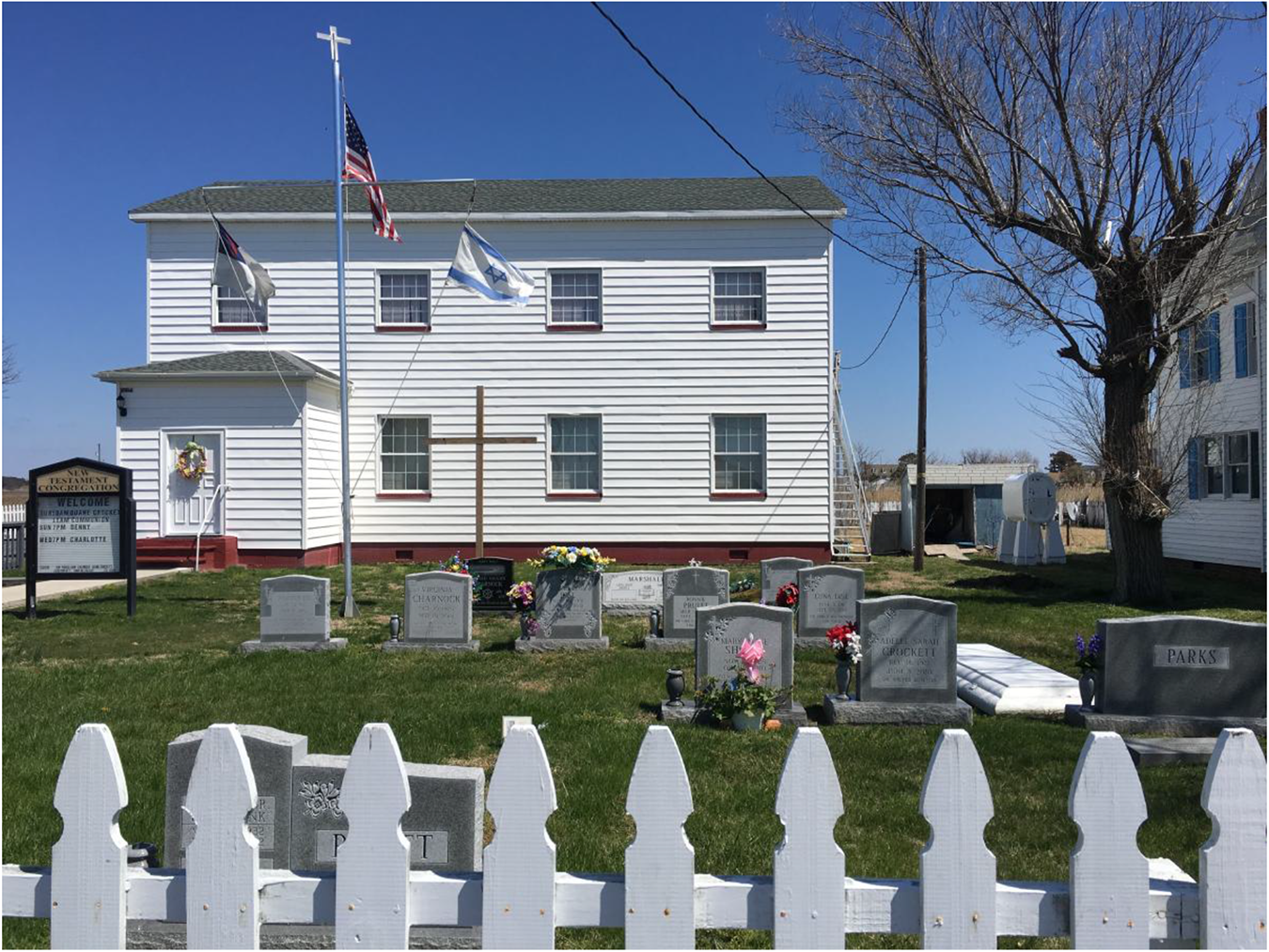
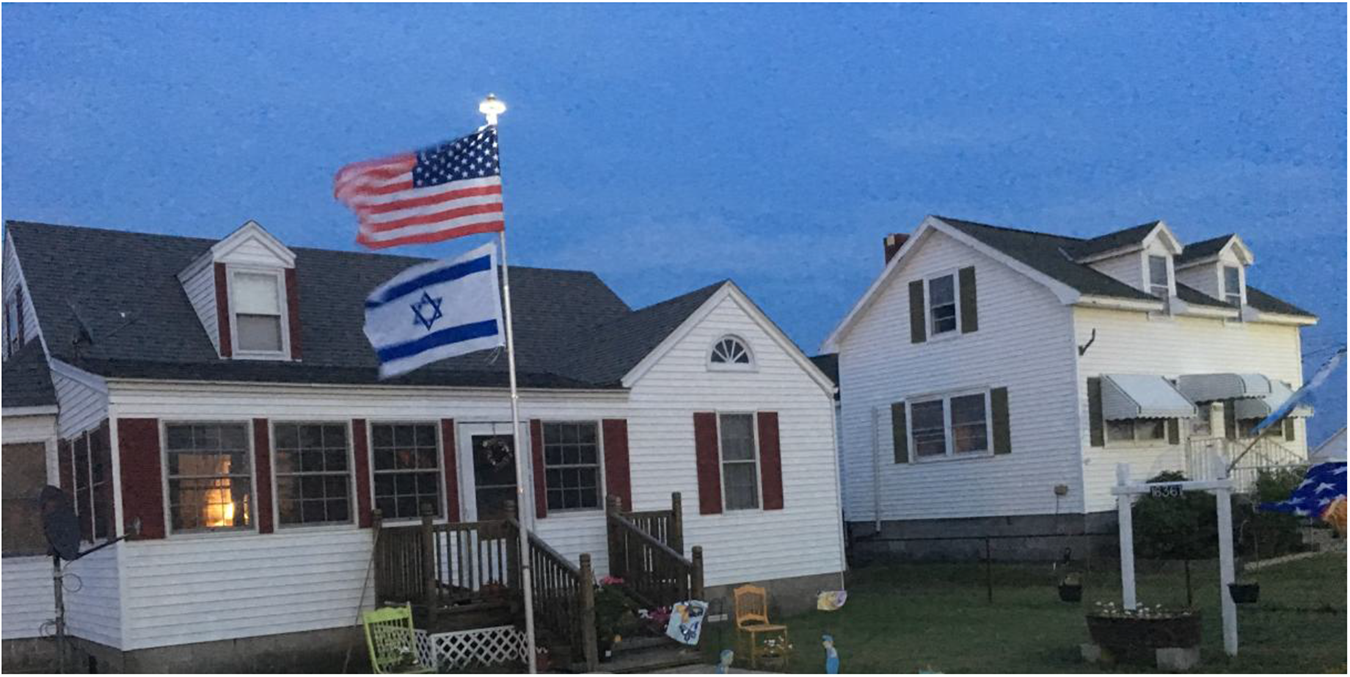
During the 2012 schism, when the Swain Methodists were reckoning with the conference’s reported support of Palestine (and other issues), a group of Tangiermen adopted (or, according to some accounts, rediscovered) a position as committed Zionists and began to fly the Israeli flag in their yards. The Star of David flies in front of the New Testament Church, in front of numerous houses, and above crab sheds in Tangier Harbor (Figure 2, Figure 3). The mayor has the Star of David painted on his boat and tattooed on his forearm. The symbol of Zionism has become, on Tangier, a sign system, a poetics of disunity among the two churches.
On April 8, 2018, three flags flew in front of the New Testament Congregation: the American flag, the flag of the Episcopal Church (despite the fact that the New Testament is self-described as nondenominational), and the flag of Israel. Photo by author.

A house on Tangier flying the Israeli flag on July 13, 2017. Photo by author.

Simultaneous with and inextricable from the discourse on Zionism and church belonging, Tangiermen traffic in a poetics to express their relationship with science and the science class. During my field period, among the many token incidents of this type of confrontation that I witnessed was an event that stands out as particularly illustrative. It was an evening “conversation” at the Fisherman’s Corner restaurant on Tangier, between Tangiermen as so-called climate (or science) deniers and a climate change activist who was also a conservative Republican and former U.S. Representative. The dinner was organized, funded, recorded, and mediated by media producers from Starbucks corporation. The filmed, unscripted dinner discussion laid bare the selections and combinations of signs within which Tangiermen, as deniers (and their alters, as believers) were working.
The context of summer 2017 helps to explain the interactions at the Starbucks dinner. Earlier that summer, about a month after I moved to the island, Tangier began appearing regularly in the national news for the professed position about climate change taken by its residents. Following a CNN story about a sinking island of climate change deniers, Donald Trump (early in his first term as president) personally telephoned Mayor Eskridge. Following that, Ooker was mentioned by name on evening talk shows and eventually traveled to New York City to participate in a town hall hosted by CNN, with Al Gore acting in that event as his interlocutor.
The Starbucks dinner happened in early August. A former Washington Post editor employed by Starbucks brought a three-person camera crew to Tangier to film a video for the company’s “Upstanders” short online documentary series (Schultz and Chandrasekaran Reference Schultz and Chandrasekaran2017). The crew arranged the dinner, allowed Ooker to invite 22 townspeople (and 1 anthropologist), and featured a discussion with Bob Inglis, former U.S. Representative from South Carolina, known for his position as a “conservative environmentalist” who had been recently voted out of office in his home district. In the final version of the 8-minute video, Inglis states his purpose for participating, which was to affect Tangiermen’s professed beliefs: “The idea is to try to help them hear it [climate change science] from a different source. If they heard it from their tribe, in their own language, they could say ‘yeah, we’re for that.’”
The townspeople arrived in couples. Laura Shores, a close informant friend of mine, and her husband sat next to me. She wore her Star of David earrings. The opportunity for provocation was not lost upon the Tangiermen, judging by their smiles and sideways glances, but they dined largely in silence, letting Inglis talk and Ooker reply. A couple of waiters shuffled to and from the kitchen, bringing out crab cakes. The daughter of the restaurant’s owner wore a tee-shirt reading “I’m on Island Time.” This was a window upon Tangiermen’s poetic performance of their creed in live time—just as the result, the edited video that curates those moments, remains a window into the alter they were dealing with.
One of the few townspeople to volunteer comments was Jack Pruitt, 69 years old and a member of the town council, sitting across the table from me.
I run the town museum. We had about 620 geologists, PhDs, come and, when they did, these questions were brought up. […] We were discussing and everyone was not sold. Archaeologists, geologists, marine biologists—so I asked my question […]. And they said, ‘Look, have you ever seen land sink?’ It was the first time I ever heard them use the words ‘surface erosion.’ I said, ‘What does that mean?’ They said, ‘That’s when you have severe storms wash up on low land. When the water goes back out it pulls sand particles off the top of the property.’ Over years, this looked like to people living there, ‘Oh, I remember that island there. It’s sinking.’ I said, ‘It’s deteriorating from the top. And it is not sea-level rise.’ And this was a big guy with a PhD, and I respect them all—but the thing that made sense, he said, ‘Your island is in jeopardy for one reason.’ And that was erosion.
Whether or not Jack’s recollection of this previous meeting was accurate was immaterial; at the moment, his reanimation constituted a creative example of another instance like the present, when he was called upon to perform the creed. Perhaps the effect was to present himself as loyal to Ooker and the town creed. (Jack had also, in fact, served as mayor for a short time in the 1990s.) In addition, the effect may have been to present to the Starbucks-Inglis crew proof of consistency.
Jack had playfully laughed with (at?) me about PhDs before. (“PhDs? I have two in my backyard. Post hole diggers!”) A few moments after his comment, I leaned over, smiling, and whispered, “But you remember I’m working on my PhD, right?” Unfazed, he winked and said, “You’re not one of them!” Jack was consistently skeptical of the stream of scientists making careers studying “seagrass, crabs, oysters, and ducks, but never the humans” of Tangier Island. This was why, he explained to me once in his living room, he was so supportive of my ethnographic research. He knew I was getting my own post hole digger, but he wanted someone to capture Tangier’s human story—so I was different.
Jack was living proof of how much the island’s environmental poetics had shifted in the last half-century. His father had held a Master’s degree in a science and had been the high school science teacher at Tangier Combined School for many years. I found many lengthy letters from the 1960s in the archives—written by Jack’s scientist father to lawmakers, documenting the island’s land loss.Footnote 12 If it weren’t for Jack’s father’s science, arguably, the island would never have received the 1990 seawall that saved the sewer treatment plant and airplane runway. By 2017, the unified poetic sign-in-itself had changed; rather than reproducing a scientific argument, Jack was arguing against the scientists.
In front of the cameras, Inglis pursued creed: “Why don’t conservatives typically listen to scientists?” This provoked a breathless response from Jenny Cooper, a longtime schoolteacher and one of the main agitators of the 2012 church schism.
No offense, but when a waterman who has experience goes down to the VMRC [Virginia Marine Resource Commission] and talks […] when we do go, we’re nothing. (.) Matter of fact, they fall asleep while we’re talking! They make fun, ridicule. But scientists talk and everybody listens. Science is fine but you’re forgetting the experience that people have. You don’t ever want to not listen to people with experience! You want to listen to them both. But we have never been listened to! But scientists rule. Whatever scientists say, goes.
In-law kin to Jenny, Ooker joked, “You’re said enough, Jenny,”Footnote 13 and added another iteration of his talking points. “I’m a keen observer. Watermen are observers. I can’t explain what I see, but I can tell you what I’m seeing. If I see the sea-level rising, I’m not going to lie about it. I’m just telling you what I see. I’m not lying or denying it.”Footnote 14, Footnote 15
Many Tangiermen take issue with the publicly professed causes for their island’s erosion, especially when national media focuses on them as deniers of science on this point (e.g., Gertner Reference Gertner2016, “Pro-Trump Mayor Disputes Al Gore on Sea Levels.” 2017, etc.). Like Tangiermen before him who systematically measured beach erosion, Ooker marks the water level on pilings at his crab house, closely observes and checks the beaches, and takes note of shifting sands to the south. As he explained to me, over 50 years of working on the water and a lifetime on Tangier, he observes “horizontal” changes, in locations of waterways, but has never needed to raise his crab house, meaning no observed changes in “vertical” variations in water level.
Conclusions
The message, a system of signs and a sign-in-itself, which is Tangier’s poetics, is the outcome of selection and combination of religious symbols, such as the Zionism that indexes intra-island politics, with signs professing a position on climate/land change science and scientists. What appears to outsiders as disparate sign systems are more than just related, but parts of the sign-in-itself that Tangiermen use to define themselves—the creed positioning them (and their property) as worthy (or not) of salvation in simultaneous religious and geophysical senses.
Inglis and the crew did not ask about daily experiences on Tangier. They didn’t ask about the seawall, hermit crabs in yards, saltwater encroachment killing flowers and trees, or the seasonal chore washing sea spray off windows. The event was not about epistemological belief, doubt, or even skepticism. It was about probing and exposing creed—eliciting an illustration of the denier stereotype.
One need not look far from Tangier to find the alter against which Tangiermen and their creed distinguish themselves. It’s much closer than Starbucks or the Republicans, visible from the northern side of Main Ridge, a smaller island to the northeast. Islanders used to call it East Point or The Pint. Until the early 1900s, it was inhabited by descendants of the same families as Tangier (as was land to the north of Main Ridge, called Uppards, consisting of multiple neighborhoods, abandoned by the 1920s). The Pint was bought and used as a summer home by an outsider family for several decades. In 1988, it was donated as “Port Isobel” to the Chesapeake Bay Foundation (CBF), a nonprofit environmentalist association based in Maryland. The property, now with about a dozen buildings for CBF tourists, was assessed for taxes at $1.6 million in 2014. While property values on Tangier continued to drop, including during my fieldwork, Port Isobel’s value increased—to $2.1 million in 2018. This and conflicts over waterman regulations, disposal of dredged spoils, and bay pollution over the years have sowed distrust and even feelings of enmity between Tangiermen and the CBF.
Like good politicians, Tangiermen are sensitive to the signs that form the package that has become their narrative to themselves about themselves and their representation to the rest of the state, country, and world. In another light, this poetics has become their stereotype prison. To many outsiders, Tangier is a “depressing place,” as one tourist told me in 2017, marked by disrepair and poverty. Early Twentieth-Century news articles depicted an island with spotty electricity, dirt roads, and outhouses dumping waste into the island inlets, subject to tidal movements. These images have not been forgotten. Empathetic physical scientists tried in 2015 to refresh Tangier’s brand by labeling islanders “the first climate change refugees in the continental USA” (Schulte, Dridge, and Hudgins Reference Schulte, Dridge and Hudgins2015). In 2016, islanders made and wore tee-shirts for their annual summer homecoming festival that read: “I refuse to be a climate change refugee.” In 2021, the scientists tried again, unselfconsciously using the concept of “exodus” to describe coming dispossession—without acknowledging the swirling signs that form the poetics of religious exodus as part of the islanders’ climate creed.
The poetics of denial on Tangier is a reverberating, self-conscious message at the center of struggle. The science class, just as far as Port Isobel, often provides words and phrases, but Tangier’s discourse is crafted and performed on Tangier into its people’s creed. On June 12, 2017, Ooker and his friend, Danny, described to me Ooker’s phone call that morning with the President of the United States. The exchange was an exercise in poetics accounting for and indexing their relationship, media discourses, and my own anthropological gaze:
Ooker: He [Trump] said “I’m helping the coal miners.”
Danny: We know that. And this witch hunt. We know it’s a witch hunt.
Ooker: Yep. I said “you’re for the military, Israel, and religious liberty.” I said “well, we all love you down here.” He said “well, you tell your family and the citizens that we love them back.” He said “and I saw the article [on CNN] and you said you love me like your family and I said I gotta talk to that mayor. He’s my kinda guy.”
[They laugh.]
Ooker: He said “so I’m glad to be able to talk with you.” He said “you’re a great guy, a great mayor. Your island looks like it’s in an ideal place. I’m sure you’re got a great view of the Bay.”Footnote 16 And he said “when you find yourself in Washington, you can come by and see me.”
Danny: How about that.
Ooker: Yep.
Danny: This is the only place—here and Smith Island is the only place like this in the world.
Ooker: Yeah! (.) Yeah!
JY: Mhm.
Danny: There’s no other place—no other—no other community in our situation.
Ooker: He said “I know you’ve got a lot of negative feedback.” He said “don’t pay any attention to those clowns.”
Danny: Yeah. We’re still getting it. Ain’t politically correct. I think they’re so rude. When they called me–when they called me and had something to say—
Ooker: Yeah, they called and harassed him.
Danny: What are you, a reporter or something?
JY: No, I’m an anthropologist.
Ooker: She’s here for the summer.
[Danny laughs.]
Danny: An anthropologist.
JY: People might study the ducks and the grass and stuff. [I offered Jack Pruitt’s discursive chunk.] I do the people.
Ooker: Yeah, she’s studying the people. I’m glad of it. I’m glad they’re studying the people and not just the animals.
Danny: Yeah! People! Somebody recognizes that there’s people here!
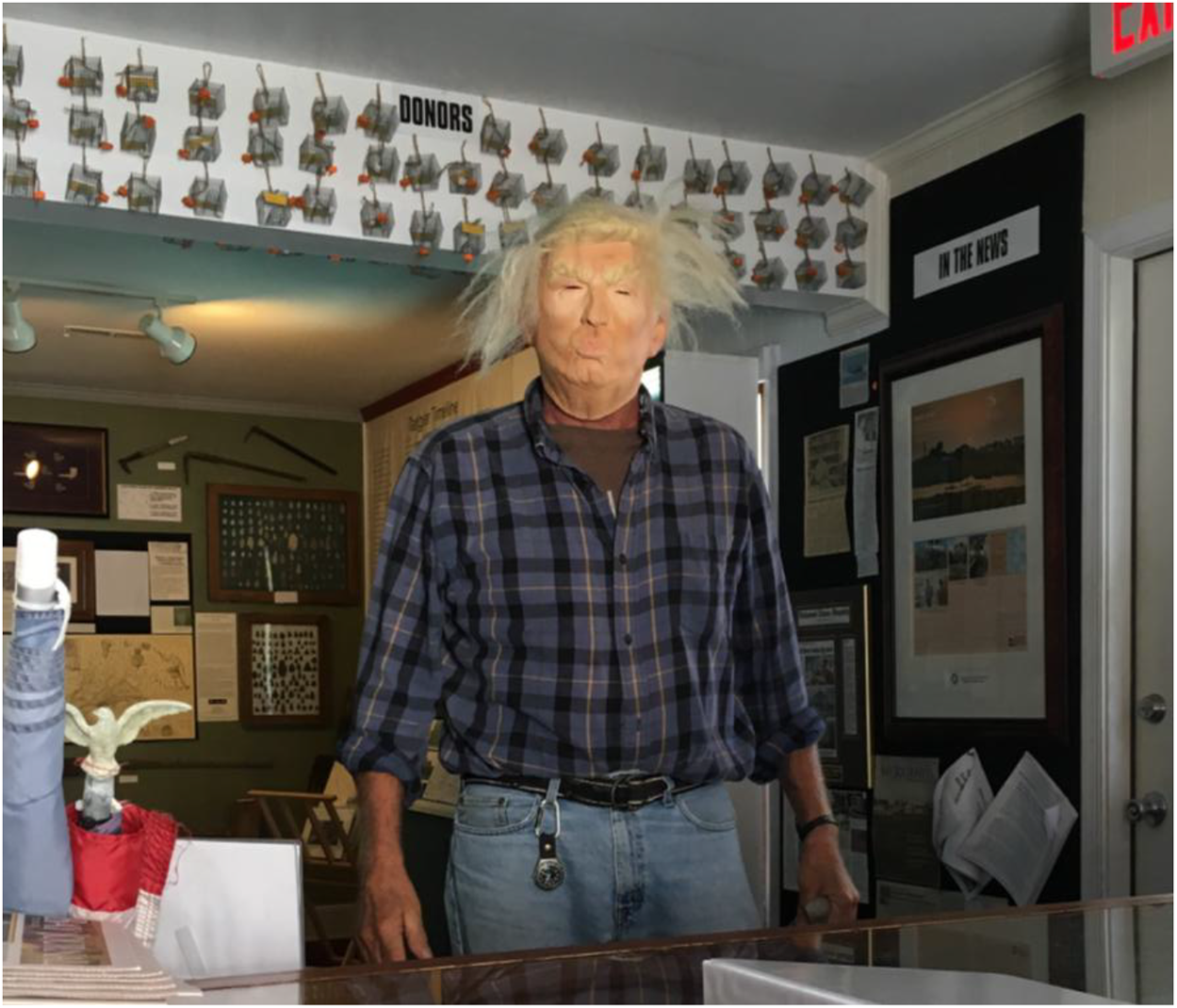
Tangiermen come to stand for a category of people, distinguished by their position, determined by their profession of belief. These poetic and political performances continued throughout my 13 months in the field. On Halloween, I was interviewing two elderly volunteers in the Tangier History Museum and Interpretive Cultural Center, when Ooker entered, wearing a plastic Trump mask over his face. I asked him if I could snap a photo (Figure 4). It was puzzling. Who had Ooker intended to see when he stopped by? He did not wear the mask to the town costume party that night. In hindsight, the mask was another poetic performance of refracting, self-referential meanings in interaction with alters, both on (including me) and off the island, worn to a space that was liminally both kinds of places, as a haunt of the outsiders who visited. Ooker was literally donning a politician’s face, an assertion of both farce and fact.
Ooker Eskridge at the Tangier History Museum, October 31, 2017. (Photo by author.).

But the prison that is the Tangierman’s stereotype is also their most powerful retort. Islanders’ creed is perhaps one of the few ways in which they are empowered to push back against the science class, convicted in knowledge, epistemologically, and in positionality, in contradistinction—a poetics of denial.
What does the concept of denial do for social science? Analytically, it achieves little. Denial cannot be usefully theorized as an analytic category; it is laden with the politics of science and reinscribes hierarchy as an emic label among informant populations. It deals blame for creed by entrenching stereotype. Science as knowledge and justification for action is controlled by those who live at a distance from necessity in America, however much that margin might continue to shrink as effects of climate change spread. There is a differential need for science to rescue. There is money to be made (also differentially) for science’s work and predictions. And yet, for a science of poetics, denial on Tangier shows that adjacency and combination of signs do not necessitate agreement. Tangier’s poetics and politics are about contestation and struggle—the negation that provides contradistinction. Identity through disagreement.Footnote 17
Denial’s poetics are the injuries of class (Sennett and Cobb Reference Sennett and Cobb1972), the mismatch of ideology and reality (Myrdal Reference Myrdal1944), and the struggle over terrain (Gramsci Reference Gramsci and Buttigieg1975), all so familiar to American social history—not Peirce’s struggle with doubt or Cartesian methodological skepticism. Most importantly, for populations needing protection from risk, the certainty of denial is a bloc buster. The positionality afforded by denial as an open option for sign selection and combination provides one more way in which the population can be torn from itself and from interests it may have in common with mainlanders. It provides a reason—in another light, an excuse—for not coming to Tangier’s rescue. The meaning that surfaces from the positioning of positions, the outcome of this poetics of denial, is this: Tangiermen’s stereotype traps them, but also feeds back to give them a picture of themselves they can recognize and shape.
Acknowledgements
Heartfelt thanks to my friends and informants on Tangier Island. Thank you to Landon Yarrington, Mary Hanna, and Nancy Yarrington. Some earlier forms of these ideas were presented in a paper for a conference panel in Boston organized by Chloe Ahmann and in a panel that I organized with discussant Frederick Damon in San Jose. I am grateful for those opportunities to develop and present related thoughts. Sincere thanks to commenters, readers, editor and reviewers.
Funding statement
This project was funded by Dissertation Grant #9567 from the Wenner-Gren Foundation for Anthropological Research. Analysis and write-up was funded by a Scholar Award from the International Chapter of the P.E.O. Sisterhood and by generous support of the Dean’s office in the College of Liberal Arts at Colorado State University.


 Open access

