


Impact statement
Drylands are an important global land type that support millions of people, yet large areas are currently degraded. We show how artificially constructed micro catchments in an arid rangeland have a moderating effect on soil surface temperature, reducing it under hot conditions but increasing it when temperatures are low. This moderating effect could have a substantial positive effect on plant growth and, therefore, make micro depressions a relatively inexpensive technique to restore arid rangelands.
Introduction
Drylands are critically important globally, covering about 40% of the terrestrial land area (Cherlet et al., Reference Cherlet, Hutchinson, Reynolds, Sommer and Von Maltitz2018) and supporting a similar percentage of the global population. Drylands also support most of the world’s livestock and are critically important for providing a substantial range of ecosystem goods and services such as climate regulation, water supply and other contributions to people (Eldridge et al., Reference Eldridge, Wang, Liu, Ding, Li, Wu and Li2024). Yet drylands are also subject to extreme degradation caused by resource overexploitation, overgrazing and unsustainable farming practices that reduce forage production, weaken ecosystem functions and accelerate erosion and the loss of critical resources. Restoration can reverse or alleviate degradation, but is often time-consuming, expensive and is reliant on suitable climatic conditions (Snyman, Reference Snyman and Tainton1999; Saayman et al., Reference Saayman, Cupido, Botha and Swart2017).
Mechanical soil surface treatments such as ploughing, ripping, discing, pitting and the creation of hollows, semi-circular bunds and micro catchments have been used globally to restore degraded rangelands (Gintzburger and Skinner, Reference Gintzburger and Skinner1985; Whisenant, Reference Whisenant1999). These techniques all share a unifying principle: the creation of a depression that traps runoff and sediment, reduces the erosive power of water and promotes the establishment of self-sustaining vegetation (Bothma and van Rooyen, Reference Bothma, Van Rooyen and Bothma2006; Mganga et al., Reference Mganga, Bosma, Amollo, Kloko, Kadenyi, Ndathi, Wambua, Kalndi, Musyoki, Musimba and van Steenbergen2022; Eldridge and Ding, Reference Eldridge and Ding2023; Johnston and Mann, Reference Johnston and Mann2024). Mechanical treatments range from large ponding banks that can occupy many hectares (Rhodes, Reference Rhodes1987) to small pits and furrows that have a short lifespan (Eldridge and Ding, Reference Eldridge and Ding2023). When combined with mulching, reseeding and grazing exclusion, these structures can accelerate ecosystem recovery (Bothma and van Rooyen, Reference Bothma, Van Rooyen and Bothma2006). The optimal type of structure, however, depends on soil texture, slope, rainfall regime and the availability of labour and mechanised equipment.
Rangelands in various stages of degradation cover about half of the world’s land area and 70% of South Africa’s land area (Hoffman et al., Reference Hoffman, Todd, Ntoshona and Turner1999). In the arid Karoo region of South Africa, micro catchments of different sizes have shown promise for promoting the establishment of perennial shrubs and grasses (Snyman, Reference Snyman2003; Milton and Coetzee, Reference Milton and Coetzee2022), but their effectiveness is thought to depend on their size. Field experience indicates that shallow, circular micro catchments of about 1 m in diameter and 20 cm in depth are effective traps for sediment and water without excessive siltation. Anecdotal evidence suggests that larger structures can flood or smother seedlings under deposited sediment. Smaller structures tend to fill rapidly with silt and become less effective (Coetzee, Reference Coetzee2005; Eldridge and Ding, Reference Eldridge and Ding2023). In a small-scale restoration trial at the Wolwekraal Nature Reserve near Prince Albert, South Africa, hand-dug, seeded and mulched micro catchments promoted vegetation recovery, even under prolonged drought conditions (Milton and Coetzee, Reference Milton and Coetzee2022). Minimal runoff and the absence of runoff suggest that factors other than surface water capture, possibly modified soil microclimate conditions, contributed to their success. The extent of any potential moderating effect of micro catchments on surface temperatures is not well understood. Temperature is important because it controls the effects of soil biota on plant growth (Heinze et al., Reference Heinze, Gensch, Weber and Joshi2017). Restoration interventions that buffer soil surface temperatures and reduce evaporation may therefore play a valuable role in improving plant establishment in a restoration environment (Esler et al., Reference Esler, Milton and Dean2006).
We used a field-based study to examine changes in temperature in moderately sized human-constructed micro catchments in arid rangelands in South Africa. Our aim was to compare temperatures at three microsites (base of the depression, hereafter ‘pit’, rim of soil surrounding the micro catchment, hereafter ‘mound’, control surface, ‘control’) across two seasons (summer, winter) and diurnal periods (morning, afternoon). The effect of restoration structures on temperature is important because it gives us insights into the potential for these human-constructed structures to support vegetation and therefore to restore degraded rangelands.
Methods
Study area
The study was conducted at three arid to semi-arid sites in the Western Cape Province of South Africa: Worcester Veld Reserve, Wolwekraal Nature Reserve near Prince Albert and Nortier Research Farm near Lambert’s Bay on the west coast. The Worcester and Nortier sites experience a Mediterranean climate, with mean annual rainfall of 257 mm and 197 mm respectively, while Prince Albert has an arid climate with mean annual rainfall of 175 mm (Western Cape Department of Agriculture, 2025).
The Worcester and Prince Albert sites are underlain by shallow, poorly developed soils dominated by the Mispah and Glenrosa soil forms. These soils are typically shallow, rocky and high in clay content. In contrast, the Nortier site consists of fine aeolian sands of the Namib soil form (Western Cape Department of Agriculture, 2025). At the Prince Albert site, January is the warmest month with a mean temperature of 22.2 °C, while February is the warmest month at Worcester (22.3 °C) and Nortier (19.7 °C) (Western Cape Department of Agriculture, 2025). July is the coldest month at all sites, with average temperatures of 10.8 °C, 11.0 °C and 12.9 °C for Prince Albert, Worcester and Nortier, respectively.
Experimental design and analyses
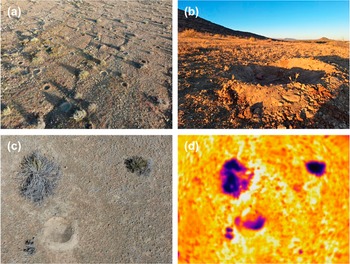
At each of the three sites, we constructed 20 micro catchments on a 5 x 4 grid, with individuals placed about 10 m apart. Each micro catchment was about 1 m in diameter with a concave base approximately 20 cm deep at the centre (Figure 1). Micro catchments were dug by hand, and the excavated soil heaped on the downslope side to form a small mound to retain any runoff water (Coetzee, Reference Coetzee2005).
Images of the micro depressions and surrounding area. (a) aerial view of micro depressions showing the 5 x 4 arrangement with depressions at 10 m spacings, (b) individual pit and mound, (c) drone image of a pit/mound complex and the surrounding control area taken at 14:00 at the Prince Albert site, and (d) same drone image taken with a Forward Looking Infrared (FLIR) camera showing the lower temperature in the pit microsites of the depressions and in the shrub hummock than the surrounding control surface. Darker colours correspond to lower temperature. Images taken in Austral summer (February 28, 2024).

We used a hand-held infrared thermometer to measure soil surface temperature in three microsites: 1) at the bottom of the pit, 2) on the top of the mound, and 3) a level site within 30 cm of the micro catchment (‘control’). Measurements were taken at dawn (06:00 in summer, 07:00 in winter) and at 14:00 (timing) during both summer and winter (season) to represent the coolest and warmest periods of the day and over the year. At all sites, we measured temperatures in the austral summer (late February-early March) and winter (late July–early August) as close as possible to avoid confounding weather conditions. Observations were restricted to days with minimal cloud cover and low wind speeds to reduce variation in soil temperatures. Two measurements were made of each combination of site x microsite x season x timing, and the mean value was used in the analyses. Thus, for the analysis, we had a total of 720 observations (20 measurements each of 3 microsites × 2 seasons × 3 sites × 2 times).
We used a mixed-models (syn. split-plot) approach using the package lme4 to examine the effect of Season, Timing, Microsite and their two-and three-way interactions on surface temperatures. The model had three residual terms. The first stratum considers Season, Timing and its interaction and the second stratum Microsite, and its two-and three-way interactions with Season and Timing. The third stratum was solely a residual (error) term that accounted for the variation among the 20 micro catchments at each site in relation to all four factors. The emmeans package in R (Lenth and Piaskowski, Reference Lenth and Piaskowski2025) was used to estimate the marginal means for different groups and to compare and contrast the levels of Microsite, Season and Timing. Model diagnostics using the plot() command in R revealed no evidence of overdispersion, zero-inflation or deviation from uniformity, and no influential outliers were detected.
Results
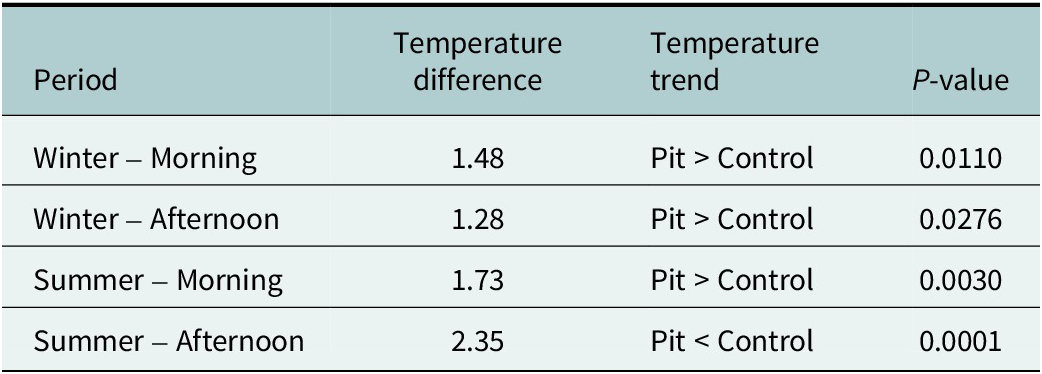
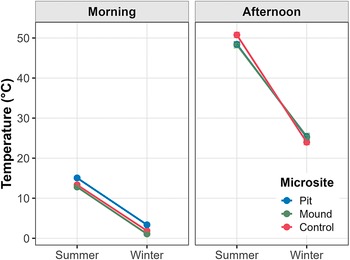
We found considerable variation in temperature across seasons and time of day, particularly in winter mornings on both mounds and controls (Table 1). Morning temperatures were predictably lower than those in the afternoon. Importantly, however, we found a significant three-way interaction among Microsite (pit, mound, control), Season (winter, summer) and Timing (morning, afternoon; F 1,16 = 4.06, P = 0.037). The three-way interaction indicated that temperatures at the base of the micro catchments were always greater than those in the controls in both summer and winter, but only in the morning when temperatures were relatively low (13-15 °C). In the afternoons, however, when diurnal temperatures ranged from about 24 to 51 °C, temperatures were lower in the base of the micro catchments (pits) in summer, but higher in the pits in winter. The greatest temperature difference was in summer in the afternoon (Table 2). There were no differences in temperature between the mounds created from spoil during pit excavation and the control surfaces, except in the afternoon in summer (P = 0.019), when mound temperatures were identical to those in the base of the micro catchments (Figure 2).
Mean and coefficient of variation (CV%) in temperature (°C) in relation to microsite, season and time of day

Summary of differences in temperature between pit and control surfaces

Mean (± SE) morning and afternoon soil surface temperatures (°C) in summer and winter for pits, mounds and adjacent controls.

Discussion
Our study demonstrates that artificially constructed micro catchments moderate soil surface temperatures compared with both control areas and the accretion mounds constructed from excavated material. Specifically, mounds reduced soil surface temperature during hotter periods but had the opposite effect when the ambient temperatures were cooler. The narrowing of the temperature range within the micro catchments likely provides a more suitable microclimate for seed germination and seedling establishment (Esler et al., Reference Esler, Milton and Dean2006; Milton and Coetzee, Reference Milton and Coetzee2022) and will likely contribute to vegetation establishment and survival.
Soil surface temperature is a major driver of ecosystem functions in drylands and has flow-on effects to a number of soil and ecological processes (Heinze et al., Reference Heinze, Gensch, Weber and Joshi2017). For example, lower summer afternoon temperatures in the micro catchments likely increase opportunities for plant growth and survival because of greater soil moisture due to reduced surface evaporation (Zhuo et al., Reference Zhuo, Han and Dai2017). Temperature changes in the pits and mounds could be due to differences in soil moisture, which is known to affect ambient temperature close to the surface (Alexander, Reference Alexander2011). Higher soil temperature in the matrix between micro catchments is likely indicative of a lower content of soil carbon, given the strong links between temperature and soil moisture, and therefore organic matter (Hartley et al., Reference Hartley, Hill, Chadburn and Hugelius2021). Higher surface temperature and greater solar radiation promote abiotic breakdown of organic matter, and a loss of carbon to the atmosphere rather than its sequestration into the soil organic pool (Austin and Vivanco, Reference Austin and Vivanco2006). The potential loss of soil organic matter can lead to an increased risk of erosion, and therefore reductions in soil productive potential (Sarah, Reference Sarah2006). Yet, by moderating soil surface temperatures, micro catchments can initiate feedback processes whereby there are further reductions in surface temperature as plants colonise the treated areas and the plant canopy helps to trap rainfall (O’Brien and Hatfield, Reference O’Brien and Hatfield2019). Increased plant growth in the micro catchments would be expected to ameliorate temperatures even more strongly, particularly when those plants are woody perennials. For example, temperatures have been shown to be lower beneath woody canopies in summer, but higher in winter under dryland conditions in the Iberian Peninsula (Lozano-Parra et al., Reference Lozano-Parra, Pulido, Lozano-Fondón and Schnabel2018). These predicted effects, although intuitive, would need to be tested by further empirically-based studies in micro catchments.
Soils that are more prone to large fluctuations in temperature may benefit less from restoration techniques such as pitting, furrowing and micro catchments if soil temperature amelioration is the restoration goal. Fine-textured soils have greater thermal conductivity than coarse-textured soils due to their finer pore structure and tendency to retain water much longer than coarser soils. Thus, the construction of micro catchments is likely to be more effective on finer-textured soils such as clays or silts (Akter et al., Reference Akter, Miah, Hassan, Mobin and Baten2015). Micro catchments have other advantages that relate more to the capture and storage of water in drylands. For example, small pits and furrows are commonly used in deserts and rangelands to trap water and support plant growth (Gintzburger and Skinner, Reference Gintzburger and Skinner1985; Friedel et al., Reference Friedel, Kinloch and Müller1996; Jahantigh and Pessarakli, Reference Jahantigh and Pessarakli2009; Strohmeier et al., Reference Strohmeier, Fukai, Haddad, Ainsour, Mudabber, Akimoto, Yamamoto, Evett and Oweis2021). Many of these structures are very small and therefore have a short longevity. Pits created by the Tyne pitter (Eldridge and Ding, Reference Eldridge and Ding2023) rapidly fill with sand and fail to act as sinks for water. Micro catchments in the current study, however, are relatively large and capture a large volume of water (~ 0.1 m3), so are likely to persist over long time periods.
Unlike machine-made structures, our micro catchments are relatively cheap to construct and require little regular maintenance. They are likely to be more practical in areas where machinery is unavailable, could damage remaining vegetation or is prohibitively expensive. Furthermore, we maintain that additional ecosystem benefits can result from the addition of mulch and brush material in the micro catchments (brush packing, Mangani et al., Reference Mangani, Mangani, Chirima, Khomo and Truter2022). This is likely to reduce wind chill, trap moisture and further enhance the prospects for vegetation establishment (Mangani et al., Reference Mangani, Mangani, Chirima, Khomo and Truter2022). For example, Neilly et al. (Reference Neilly, Cale and O’Sullivan2025) showed that placing woody debris on the soil surface increased plant cover and richness, and reptile abundance on eroded soils. Micro catchments may have an effect on the formation of dew, a critical water source in deserts (Yu et al., Reference Yu, Zhang, Lu, Chang and Liu2020). The micro catchment walls may experience greater dew deposition due to their height and size, thereby advantaging plants close to the edge of the depression.
Finally, our measurements were made when wind speeds were low, thereby removing anomalous temperatures lower than would be expected for a given season or time of day. Temperatures were measured under low wind speed conditions to reduce any confounding effects across microsites, seasons and times. Under high wind speed conditions, temperatures would likely be lower in the control sites, but this would need to be tested experimentally. Further, temperature was only measured in two seasons and at two times of the year, so more information would be needed to fully appreciate the extent of temperature change over an entire season and year to realise the potential effects of temperature on the restoration of degraded soils.
Ongoing studies have yet to determine the effects of micro catchments on plant germination and survival. Nonetheless, our results show that they provide warmer temperatures in winter, which would create microsites more conducive to plant growth. Notwithstanding these results, further studies are needed to understand the interactions between soil type and temperature, to investigate the depths over which temperature moderation occurs, and to document soil moisture responses to temperature differences in and out of micro catchments and the likely impacts of mulching and brush addition on plant establishment and survival.
Open peer review
For open peer review materials, please visit http://doi.org/10.1017/dry.2026.10028.
Data availability statement
The data are currently part of an ongoing project and will be uploaded to a relevant data repository on project finalisation.
Acknowledgements
This project was supported by the Western Cape Department of Agriculture, and the Wolwekraal Nature Reserve. We thank Dr Eve Slavich for statistical advice.
Author contribution
Rudi Swart: Writing – Conception, original draft preparation, review and editing. Nelmarié Saayman: review and editing. David Eldridge: analysis, review and editing, Sue Milton: review and editing.
Competing interests
The authors declare no competing interest.


 Open access


Comments
The Editors-in-Chief
PRISMS Drylands
Dear Editors
We would be grateful if you would consider our manuscript entitled Micro catchments moderate soil surface temperatures in an arid rangeland as a standard paper for the Special Issue on Walt Whitford in Prisms Drylands. It is an invited paper.
Our study examines changes in temperature in human-constructed structures in the rangelands in South Africa. It shows that artificially constructed depressions have a moderating effect on soil surface temperature; reducing temperature under hot conditions but increasing it when temperatures are low. This moderating effect makes depressions a potentially suitable and relatively inexpensive restoration technique to restore arid rangelands.
We believed that the manuscript would be well received by scientists and practitioners working on restoration of drylands.
The material presented here has not been submitted for publication elsewhere, and none of the authors has any perceived conflicts of interest.
Yours sincerely
Rudi Swart
For the authors
December 5, 2025