




Introduction
Kenaf (Hibiscus cannabinus L.) (Malvales: Malvaceae), an annual herbaceous is cultivated worldwide for its leaves, stems, and seeds (Giwa Ibrahim et al., Reference Giwa Ibrahim, Karim, Saari, Wan Abdullah, Zawawi, Ab Razak, Hamim and Umar2019; Kujoana et al., Reference Kujoana, Weeks, Van der Westhuizen, Mabelebele and Sebola2023). The seeds contain important bioactive compounds (Adnan et al., Reference Adnan, Oh, Azad, Shin, Wang and Cho2020), and are rich in nitrogen (21.4%), oil (20.4%), and potassium ash (6%) (Nyam et al., Reference Nyam, Tan, Lai, Long and Cheman2009). Kenaf oil extracted from the seeds contains a high level of unsaturated fatty acids, essential for health and normal growth, but also for lowering blood cholesterol levels. The oil contains 45.3% oleic acid, 23.4% linoleic acid, 14% palmitic acid, and 6% stearic acid (Webber and Bledsoe, Reference Webber and Bledsoe2002). Ethnobotanical surveys carried out by Kabré et al. (Reference Kabré, Kiébré, Savadogo, Sawadogo and Bationo-Kando2022) in Mossi and Gurunsi areas, two ethnic communities in Burkina Faso, have shown that among these two ethnic groups, fresh leaves were used in the preparation of local dishes known as ‘babenda’ and ‘kanzaga’ and in the pharmacopeia. According to Jin et al. (Reference Jin, Ghimeray, Wang, Xu, Piao and Cho2013), kenaf leaves are used to treat diabetes, bilious coughs. Stems are used to produce fibers only biodegradable composite material, which are mostly appreciated (Ochi, Reference Ochi2008).
Kenaf significantly contributes to household food security. However, during storage, the seeds showed perforations similar to those of S. niger on H. sabdariffa seeds. S. niger is a Chrysomelidae beetle that was first identified on Urena lobata (L.) (Malvales: Malvaceae) seeds in Vietnam (Borowiec, Reference Borowiec1991). In Burkina Faso, this insect has been identified as the main pest of Hibiscus sabdariffa L. (Malvales: Malvaceae) seeds in storage (Koussoubé et al., Reference Koussoubé, Mbaye, Mbacké Dia, Mbacké and Sanon2016; Sanon et al., Reference Sanon, Koussoube, Ba, Dabire-Binso and Sembène2017). This pest is also present in West Africa with considerable morphological and biological variations (Kabore et al., Reference Kabore, Koussoube, Kam, Sanon and Ilboudo2025). Without protecting, Amadou et al. (Reference Amadou, Baoua, Baributsa, Williams and Murdock2016) reported that, damages caused by S. niger on roselle seeds increased ten times after 6 months storage. Insects of the order Coleoptera and belonging to Chrysomelidae family possess great behavioural plasticity, enabling them to adapt to plants of the same or different families from those of their usual hosts (Huignard et al., Reference Huignard, Baehr, Desroches and Mandon1996).
This study aims to document for the first time the insects’ pests infesting kenaf seeds in storage. Adults of the pests emerged from samples seeds were then morphologically identified and their biodemographic parameters studied under controlled conditions.
Materials and methods
Identification of Spermophagus niger strain
Origin of samples
In November 2022, five batches of 1 kg kenaf seeds newly harvested were collected from farmers at four following locations: Bané (W 0°21ʹ29.6”/N 11°34ʹ40.5”), Gogo (W 0°57ʹ41.2”/N 11°33ʹ43.6”), Manga (W 001°05ʹ27.1”/ N 11°41ʹ39.1”), and Manni (W 0°12ʹ35.4”/N 13°15ʹ36.7”) (figure 1). These locations belong the province where cultivation of kenaf is more practiced (Kabré et al., Reference Kabré, Sawadogo, Kiébré, Kiébré, Nanema and Bationo-Kando2019). The seeds batches of each location were brought to Laboratory of Fundamental and Applied Entomology from Joseph Ki-Zerbo University, Ouagadougou (W 001°29ʹ51.3”/N 12°22ʹ43.0”).
Origin of insects studied. The red dots represent the sampling locations.

Monitoring of emergence
In the laboratory, the seeds of each location were transferred to plexiglass boxes (18 × 11 × 4 cm) and were then kept an incubator (32°C ± 0.1, 43% ± 1 r.h.). until the emergence of adult insects.The emerged insects were divided into two batches. The first batch was stored in tubes containing 70°C alcohol for identification. The second one was used for rearing.
Morphological identification
The insects kept into the tubes were transferred to Petri dishes, thoroughly inspected under a binocular loupe LEICA EZ4HD.Their various morphological characteristics were determined in comparison with those described by Borowiec (Reference Borowiec1991) and Sanon et al. (Reference Sanon, Koussoube, Ba, Dabire-Binso and Sembène2017) for S. niger. This includes body colouration, shape and number of antennae articles, shape of the pygidium, and shape of the femur and tibia.
Study of biodemographic parameters
Morphological characteristics of Hibiscus cannabinus seeds used
The seeds used came from Manga. In the laboratory, they were sorted and then placed in a freezer set at −18°C in order to eliminate possible infestation. The morphological characteristics of the seeds assessed were diameter, mass, texture, and colour. The diameter and mass of 150 seeds chosen randomly were individually assessed using an electronic calliper (Electronic Digital Calliper; precision: ± 0.03 mm) and a sensitive OHAUS (Analytical Standard scale precision: 10–3 mg), respectively. Texture was determined using touch and colour observations.
Rearing of selected strain
The strain S. niger used come from Manga location samples. This location was selected because it was observed that this location presented a more infestation level of seeds.
For rearing, 30 insects emerging from seed samples brought back from Manga were introduced into Plexiglas boxes (18 × 11 × 4 cm) in contact with 25 g of healthy H. cannabinus’s seeds from Manga for 48 h. The insects were then removed, and the infested seeds were kept into an incubator (32°C ± 0.1, 43% ± 1 r.h.) under total darkness and monitored until the emergence of adult insects.
Assessment of biodemographic parameters
Embryonic development
Five pairs of S. niger no more than 24 h old were placed in contact with 10 g of healthy H. cannabinus’s seeds in Petri dishes (9 mm diameter) and placed in an incubator (32 °C ± 0.1, 43% ± 1 r.h.) under total darkness. Three hours later, the insects were removed from the boxes, and 50 seeds bearing a single fresh egg were sorted and divided into five batches of 10 seeds in Petri dishes and then placed back into the incubator. Every day, we observed the eggs under a binocular loupe, and the number of hatched eggs was counted until the end of the hatching period. Hatched eggs were characterized by a reddish spot inside the egg corresponding to the head capsule of the neonate larva (Koussoubé, Reference Koussoubé2018).
Post-embryonic development
One pair of newly emerged S. niger, no more than 24 h old, was placed in contact with 30 healthy H. cannabinus’s seeds in Petri dishes (9 mm diameter) and placed in incubator (32 °C ± 0.1, 43% ± 1 r.h.) under total darkness. This experiment has been replicated 20 times. Seeds were daily renewed until each pair of insects died.
The seeds collected each day were kept into the incubator and 7 days later, they were removed, observed under a binocular loupe, and the hatched and unhatched eggs were counted. After counting the eggs, the seeds were returned to the incubator and monitored until emergence. The adult insects that emerged were sexed, counted, and removed each day from the Petri dishes. Sixty emerged adult insects, including 30 males and 30 females, were individually weighed using an OHAUS (Analytical Standard scale precision: 10–3 mg), and their sizes were determined using binocular loupe LEICA EZ4HD coupled with a desktop computer and LAS EZ software.
At the end of the monitoring, the following parameters were computed:
• lifespan of adults (male and female): it’s the time ranged between the insect’s emergence and the day it dies;
• number of eggs laid by the female throughout her life;
• number, size, and weight of insects (male and female) emerged;
• larval survival rate (S) which corresponds of the ratio between the number of insects that emerged and the number of eggs that hatched × 100;
• sex ratio determined by the following formula: $\left( {{\text{Number of males}}} \right) / \left( {{\text{Number of females}}} \right)$;
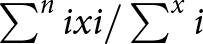
• development time (T): it’s the mean time between egg laying and emergence of the resulting adult. It was obtained through the following equation:
$\mathop \sum \nolimits^ nixi/\mathop \sum \nolimits^ xi$with: xi = number of insects emerged per day; ni = corresponding number of days;

The parameters such as females’ lifespan, number of eggs laid, larval survival rate, and development time were used to determine the following demographic growth parameters:
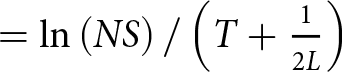
• intrinsic rate of natural increase (R m): the instantaneous growth expressed when the population is growing in an unrestricted environment and when the age structure has become stable (Mondedji et al., Reference Mondedji, Amevoin, Nuto and Glitho2002). It is estimated using the equation of Giga and Smith (Reference Giga and Smith1983):
• Rm
$ = \ln \left( {NS} \right)/\left( {T + \frac{1}{{2L}}} \right)$, where ln = Napierian logarithm, L = females’ lifespan; N = mean number of eggs laid per female; S = larval survival rate; T = development time;• population doubling time (DT): time required for the population size to double. It is obtained using the following equation (Ndoutoume-Ndong, Reference Ndoutoume-Ndong1996):
$DT = ln2/Rm$• finite rate of increase (λ): it is obtained using the following equation (Birch, Reference Birch1948; Carey, Reference Carey1993): (λ
$ = {e^{rm}}$);• generation time (GT): the mean time between the birth of the parents and the birth of their descendants. It is calculated using the following equation (Tricault, Reference Tricault1995):


GT = T (development time) + mean age of a female at the time of laying all her eggs.
Data analysis
Shapiro–Wilk test and Bartlett test were used to assess the normality and homogeneity of all data before applying parametric tests, respectively. Thus, we performed the one-sample Student’s t-test to compare the average number of hatchlings, average number of eggs laid, natural growth rate, population doubling time, finite rate of increase, generation time, and development time. Emergent body size, weight, and lifespan were tested with one-way analysis of variance followed by Tukey’post hoc test using ‘agicolae’ package (Mendiburu, Reference Mendiburu2021). The significance level was set at 5%, and the data were presented as mean ± standard error. All the analysis was performed using R software 4.2.2.
Results
Identity of emerged insects
All insects that emerged from H. cannabinus’s seed samples brought back from Bané, Gogo, Manga, and Manni belonged to the same species, namely S. niger (L.), as described by Borowiec (Reference Borowiec1991) and Sanon et al. (Reference Sanon, Koussoube, Ba, Dabire-Binso and Sembène2017). The emerging insects had dark brown body hairs. The antennae were filiform and composed of 11 articles. The elytra did not completely cover the abdomen. The pygidium is curved or straight in males and females, respectively. The legs were moreover dark brown, with strong tibia and femora in the hind legs.
Morphological characteristics of H. cannabinus seeds
Seeds diameter varied between 2.03 and 2.63 mm with an average of 2.24 ± 0.21 mm. The mass ranged from 15.2 to 29.60 mg, with an average of 24.08 ± 3.14 mg (table 1). In terms of physical characteristics, H. cannabinus’s seeds were rough and grey in colour.
Average (±SE) of the diameter and mass of 150 Hibiscus cannabinus seeds and physical characteristics (texture and colour)

SE: Standard error Min–Max: minimum and maximum values of the different measurements.
Lifespan of S. niger adults on H. cannabinus seeds
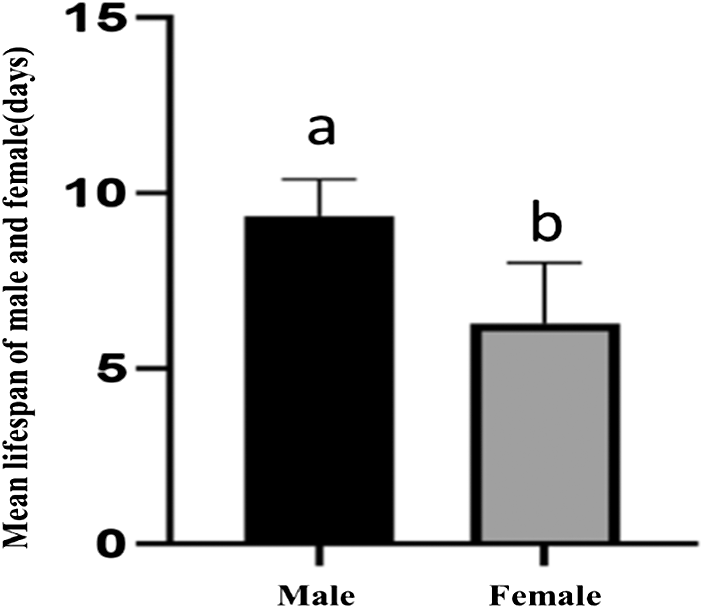
Males of S. niger brought into contact with H. cannabinus’s seeds had a significantly longer lifespan than females in the same conditions (F = 46.06; P = 4.79e−08) (figure 2). The lifespan of males ranged from 9 to 13 days with an average of 9.35 days, whereas that of females was ranged from 4 to 9 days with an average of 6.30 days (figure 2).
Average lifespan (days) of adults (male and female) of Spermophagus niger reared on Hibiscus cannabinus’s seeds in petri dishes. Histograms represent means and error bars correspond to standard errors. Different alphabetic letters on the bars indicate significant differences between the means according to Fischer’s LSD test at the 5% threshold.

Oviposition activity of the female S. niger
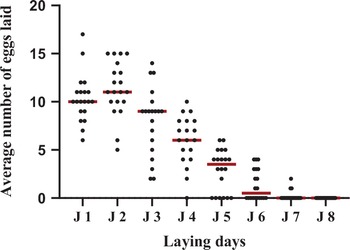
Spermophagus niger’s females when brought into contact with H. cannabinus’s seeds took an average of 7 days to lay all their eggs. The highest fecundity, observed on the second day, decreased progressively with time and was finally cancelled by the seventh day. It takes the female 4 days to lay 90% of her eggs (figure 3).
Evolution of the mean number of eggs laid per day (±standard error) throughout the life of Spermophagus niger’s female (n = 20 replicates) exposed to Hibiscus cannabinus seeds in petri dishes.

Number of eggs laid, egg hatching rate, larval survival rate, number of offspring, and sex ratio
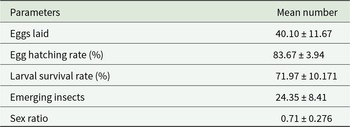
During its lifetime, the number of eggs laid by S. niger females in contact with H. cannabinus seeds varied from 13 to 57 eggs, with an average of 40.10 eggs (table 2). An average of 83.67% of the eggs laid were able to hatch, and at the end of post-embryonic development, 24.35 adult insects of the first generation were recorded, corresponding to an average larval survival rate of 71.97% (table 2). The offspring produced was in favour of the females (table 2).
Mean number (±standard error) of eggs laid, hatching and larval survival rates, number of emergents, and sex ratio of Spermophagus niger reared on Hibiscus cannabinus’s seeds under controlled conditions

Embryonic and total development time
The eggs freshly laid by S. niger female on H. cannabinus seeds took between 4 and 5 days to hatch, i.e. to produce a neonate larva, with an average duration of 5.75 days (table 3). The development time of S. niger from the egg stage to the adult stage took an average of 26.53 days, with a minimum and maximum duration of 25.12 and 28.83 days, respectively (table 3).
Embryonic and total development time of Spermophagus niger reared on Hibiscus cannabinus’s seeds in the petri dish under total darkness

Size and weight of emergents
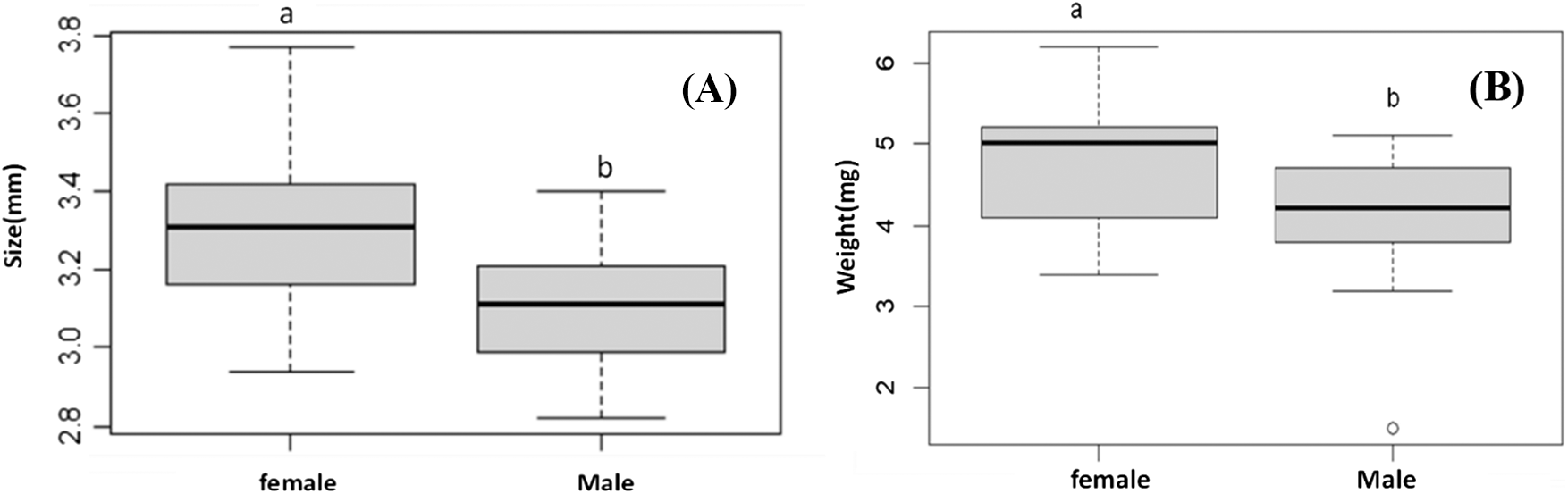
Spermophagus niger’s female emerging from H. cannabinus’s seeds had a significantly higher mean height and weight than males (F = 18.4, P = 6.87e−05; F = 11.46, P = 0.00128) (figure 4A, B).
Size (A) and weight (B) of adults (males and females) from the first generation of S. niger (n = 60) derived from H. cannabinus’s seeds. Bars represent means; error bars correspond to standard errors. Different alphabetic letters on the error bars indicate significant differences between means according to Fischer’s LSD test at the 5% threshold.

Demographic growth parameters
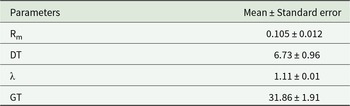
At the end of the development of S. niger on H. cannabinus seeds, the intrinsic rate of increase (Rm) was 0.105 ± 0.012 days (table 4). The population doubled (DT) in size every 6.73 ± 0.96 days and 31.86 ± 1.91 days for the generation time (GT). The finite rate of increase (λ) was 1.11 ± 0.01 (table 4).
Demographic growth parameters of Spermophagus niger rearing on Hibiscus cannabinus seeds. Rm, intrinsic rate of increase (days−1); DT, doubling time (days); λ, finite rate of increase; GT, mean generation time (days)

Discussion
Morphological identification showed that the insects emerged from H. cannabinus’s seeds belonged to S. niger species. The morphological characteristics correspond to those described by Borowiec (Reference Borowiec1991) and Sanon et al. (Reference Sanon, Koussoube, Ba, Dabire-Binso and Sembène2017). Spermophagus niger managed to complete its development cycle on H. cannabinus’s seeds, as demonstrated by Koussoubé et al. (Reference Koussoubé, Ilboudo, Waongo and Sanon2018) on H. sabdariffa’s seeds. This means that H. cannabinus’s seeds contain the quantity and quality of nutrients required for the development of various larval stages of the pest. The presence of proteins and carbohydrates in the seeds could justify this result, because according to Shazali (1989), these two compounds provide the essential nutrients for development of Bruchidae beetles.
To fend off insect herbivores, more than 200 000 specialized metabolites, with toxic, growth-reducing or anti-nutritive effects, are known to be produced by plant species (Mithöfer and Boland, Reference Mithöfer and Boland2012; Zhu-Salzman et al., Reference Zhu-Salzman, Luthe and Felton2008). The reproductive success of S. niger could be justified by the absence of toxic compounds such as tannins in H. cannabinus seeds, which according to Boughdad et al. (Reference Boughdad, Gillon and Gagnepain1986a, Reference Boughdad, Gillon and Gagnepainb) are highly toxic to Bruchid larvae. Furthermore, this development skill could be justified by an adaptation following detoxification of any toxic compounds present in the seeds by the larvae. Indeed, many insects have developed a variety of counter-adaptations to overcome chemical defence of plants, as demonstrated by Desroches et al. (Reference Desroches, El Shazly, Mandon, Duc and Huignard1995, Reference Desroches, Mandon, Baehr and Huignard1997). This result confirms those of Huignard et al. (Reference Huignard, Baehr, Desroches and Mandon1996), who showed that Coleoptera belonging to the Chrysomelidae family have great behavioural plasticity, enabling them to easily adapt to plants of the same family.
The average lifespan of adult males is significantly longer than that of females. These results corroborate those of Koussoubé et al. (Reference Koussoubé, Ilboudo, Waongo and Sanon2018), who had found that the average lifespan of female on Roselle’s seeds was shorter than that of males. The short lifespan of the female could be explained by the effort she expended during egg-laying. These results confirm with those of Nguyen et al. (Reference Nguyen, Hodges and Belmain2008), who considered the energy expended by females during oviposition, to be a crucial factor in regulating longevity. Spermophagus niger’s females in contact with H. cannabinus’s seeds laid an average of 40 eggs in 7 days. This fecundity was lower than that recorded by Koussoubé et al. (Reference Koussoubé, Ilboudo, Waongo and Sanon2018) for H. sabdariffa’s seeds of the Sabdariffa and Altissima’s varieties, which averaged 50 eggs in the same conditions. This difference in results could be explained by the difference in size between H. cannabinus and H. sabdariffa seeds, as the latter species are relatively larger. This result corroborates those of Teixeira and Zucoloto (Reference Teixeira and Zucoloto2003) on Zabrotes subfasciatus (Coleoptera: Chrysomelidae) and Yang and Fushing (Reference Yang and Fushing2008) on Callosobruchus maculatus (Coleoptera: Chrysomelidae), who showed that the size of the oviposition substrate available to the female influences the number of eggs laid. Spermophagus niger female has therefore reduced her fecundity on H. cannabinus seeds, as has already been observed in the female of C. maculatus, which has the ability to rapidly adjust its oviposition behavior in response to several host traits, such as host species and host size (Mitchell, Reference Mitchell1990). This difference could also be explained by the fact that the seeds of the two species have different chemical compounds on their surface, which, according to Parr et al. (Reference Parr, Tran, Simmonds, Kite and Credland1998), play an important role in egg induction. Hibiscus sabdariffa’s seeds would therefore have more chemical compounds conducive to the induction of S. niger’s eggs.
The results also showed that the average number of adult insects that emerged was 24.35 adults. This value was lower than the average value of 32 for H. sabdariffa’s seeds (Koussoubé et al., Reference Koussoubé, Ilboudo, Waongo and Sanon2018). The offspring produced are numerically in favour of females. It could be explained by parental selection. Indeed, for a given insect population, having more females may be advantageous because this increases the number of eggs laid and subsequently the chance of larval survival and emergence. Several authors who have worked on stored commodity insects, particularly Rhyzopertha dominica (Coleoptera: Bostrichidae) on maize (Waongo et al., Reference Waongo, Traore, Sankara, Dabire-Binso and Sanon2018), S. niger on roselle seeds (Koussoubé et al., Reference Koussoubé, Ilboudo, Waongo and Sanon2018) and Caryedon serratus (Coleoptera: Chrysomelidae) on tamarind (Ki et al., Reference Ki, Kam, Kabore, Sanon and Ilboudo2024), have confirmed a sex ratio in favour of females. Emerged female individuals were statistically superior to male individuals in terms of size and weight. This difference could be explained by the fact that during larvae stage, females accumulate enough nutrients reserves for her reproduction. Further studies will be interesting to confirm these hypotheses. However, the values of these two parameters were lower for H. cannabinus than H. sabdariffa seeds. Stillwell et al. (Reference Stillwell, Morse and Fox2007) showed that seed size is a factor likely to reduce the size of Stator limbatus (Coleoptera: Chrysomelidae). The larger size of H. sabdariffa’s seeds, which have greater nutrient reserves, could explain these results.
For growth parameters, we note that the intrinsic rate of natural increase was 0.105 with a population doubling time of 6.73 days. These values are nearly similar to those recorded by Koussoubé et al. (Reference Koussoubé, Ilboudo, Waongo and Sanon2018) at 30°C. With these high rates, accelerated degradation of seed stocks could be caused by S. niger population on H. cannabinus’s stored seeds.
Spermophagus niger L. is the pest found on H. cannabinus’ seeds stored in Burkina Faso. It completes its development cycle with a high larval survival rate. It has the potential to become a serious pest of H. cannabinus seeds. Although H. cannabinus and H. sabdariffa are plants of the same genus, the developmental performance of S. niger on H. sabdariffa seeds such as number of eggs laid, larval survival rate, and number of emerging insects are superior to that found on H. cannabinus seeds. In the world, there are around 200 to 300 species of plants in Hibiscus genus, mainly in tropical and subtropical regions (Yann, Reference Yann1998). Due to the behavioural plasticity of Chrysomelidae beetles, S. niger may not be restricted to H. sabdariffa and H. cannabinus seeds. It would be necessary to investigate in another cultivated genus. Furthermore, our study should pave the way for further investigations leading to the development of sustainable approaches for managing insect pests associated with Hibiscus seeds.
Acknowledgements
The authors gratefully acknowledge producers of Hibiscus cannabinus of, Bané, Gogo, Manga, and Manni for providing seed samples.
Competing interests
The authors declare that they have no conflict of interest.




 Open access

