

Introduction
On the early morning of July 28, 1931, 4,000 women lined up at the entrance of an employment agency in Tokyo, waiting to apply for a department store job. Three department stores, Matsuya, Shirokiya, and Mimatsu, had announced their recruitment of 2,000 female employees in total through the municipal agency. The number of applicants for the three stores amounted to more than 10,000.Footnote 1 This sheer number of job applicants indicates the popularity of department store jobs among Japanese women. While most of those hired would become sales clerks at women’s clothing and miscellaneous goods sections, many women worked as waitresses in department store restaurants. Matsuya, for example, recruited 200 restaurant waitresses along with 700 sales clerks and 100 clerical employees.Footnote 2
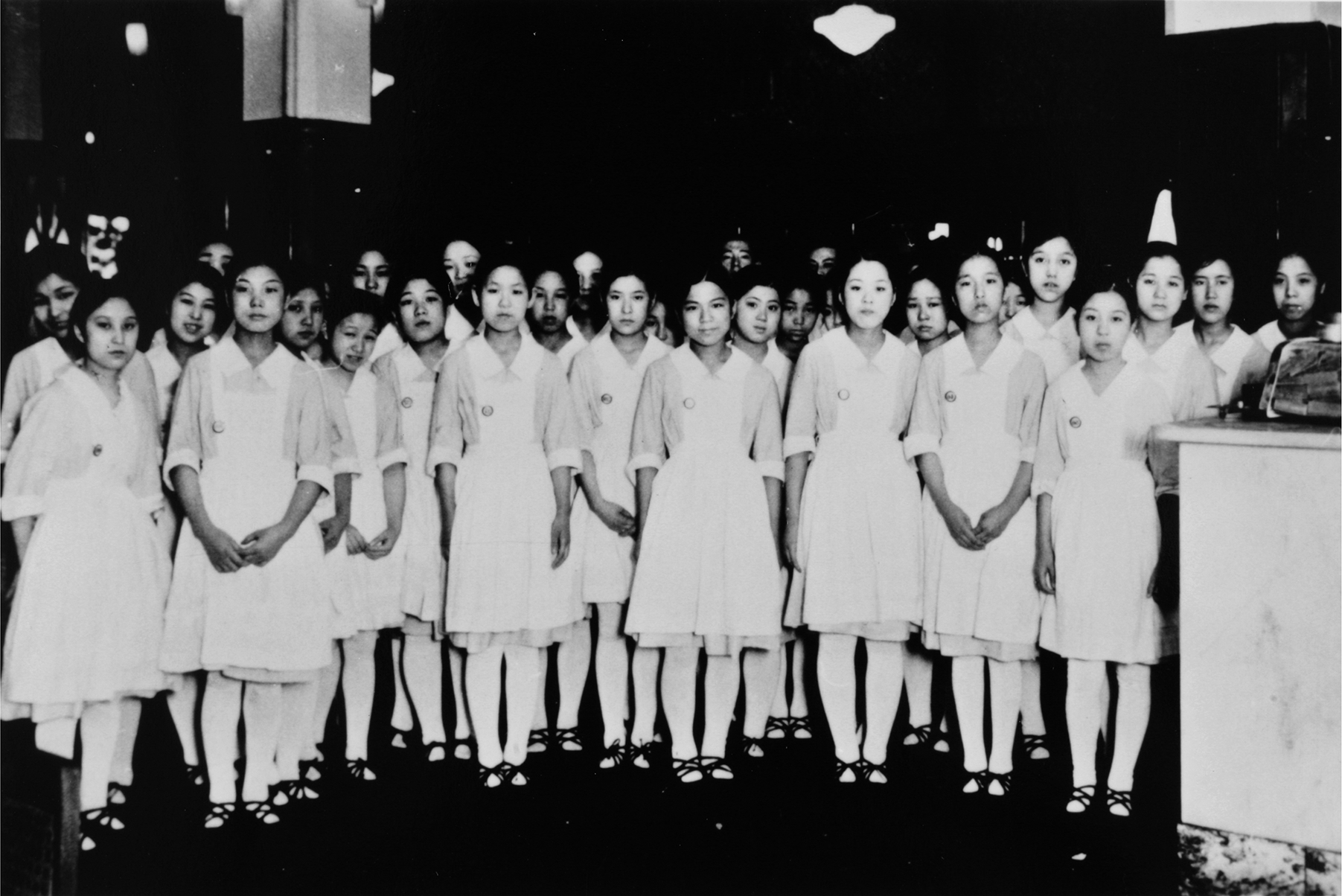
The beginning of Japanese department store restaurants can be traced back to 1904, when one of the oldest department stores in the country, Shirokiya, opened a small eating space inside the store.Footnote 3 Other department stores soon followed suit. In 1907, Mitsukoshi opened a restaurant that offered Japanese and Western dishes. During the 1920s and 1930s, when many department stores in Tokyo went through the major reconstruction of their buildings after the Great Kanto Earthquake of 1923, they established new restaurants, some of which could accommodate a few hundred people and occupied almost an entire floor, usually located on the upper level of the building.Footnote 4 Contemporary media, including newspapers and popular magazines, repeatedly featured articles reviewing department store restaurants. One of the common topics discussed was waitresses, or what the media called shokudō gāru or “restaurant girls” (shokudō means a restaurant or a dining space in Japanese), who were mostly 13 to 18 years old (Figure 1).
Restaurant girls at Mitsukoshi Department Store (1928).
Note: Mitsukoshi, Kabushikigaisha Mitsukoshi 85-nen no Kiroku [Mitsukoshi 85 years of record] (Tokyo: Self-published, 1990), 101. Courtesy of Isetan Mitsukoshi Holdings Ltd.

These waitresses were called “girls” not only because of their young age. It was common in Japan to use “girl” for young women in the professions during the 1920s and 1930s. There were, for example, “elevator girl” (erebētā gāru), “mannequin girl” (manekin gāru), “bus girl” (basu gāru), and “coffee shop girl” (kissa gāru).Footnote 5 These were new occupations often considered fashionable and modern, which were associated with young women who were mostly in their teens and twenties and often wore Western-style uniforms. The term “girl” as a “modern social and representational category” also came into use in other Asian and Western countries during the interwar years. It could reflect the contested status of young women who represented the rise of female professionals and social empowerment while also suggesting subversive attitudes toward traditional gender roles and societal norms.Footnote 6 Restaurant girls were among those modern professional working women sitting at the intersection of the conventional and the modern.
This article examines the role of restaurants in Japanese department stores during the early decades of their development from the 1900s to the 1930s. Few historians have paid sufficient attention to this unique eating space.Footnote 7 Yet, as this article argues, restaurants became a key element of both the shopping experience and the department store business. Department store restaurants helped facilitate the transformation of department stores and the establishment of mass consumer culture in early-twentieth-century Japan by introducing new food services and, more significantly, by offering emotional labor through their restaurant girls. These young female employees played an instrumental role in presenting the department store’s modern image in a highly gendered way.
During the 1920s and 1930s, major department stores in large cities, namely Tokyo and Osaka, began expanding their branches to provincial cities.Footnote 8 There were also small-scale local stores in these areas. It was not uncommon for those regional department stores to have restaurants.Footnote 9 However, their size varied significantly, and their workforce and hiring conditions were also likely to be different. As Rika Fujioka and Jon Stobart have observed, defining the department store is “notoriously difficult” because their definitions have changed over time, and they were different across countries and regions within a country.Footnote 10 In Japan, until 1937, when the Department Store Act stipulated the definition of the department store, there had been no agreement, at least in a legal sense, on its definition.Footnote 11 Even after the act was enacted, many people in provincial areas still referred to some stores that did not meet its definition as “department stores.”Footnote 12 This article focuses on department stores characterized by their large-scale operation, the diversity of their merchandise, and the adoption of the department system, which were located mainly in major cities, hence analyzing them as a symbol of modern urban culture.Footnote 13
European and American department stores, especially in large cities, commonly had restaurants within their premises.Footnote 14 But in contrast to Western counterparts, where the majority of customers were women, a substantial number of shoppers in Japan included men: nearly half the customers were reportedly male.Footnote 15 Particularly in commercial districts, white-collar male customers working nearby often had lunch at department store restaurants.Footnote 16 Shirokiya in Osaka, for example, located in an area with many offices and banks, was crowded with both male and female diners during the day. Its restaurant even began serving alcohol during dinner time to attract men.Footnote 17 This visibility of male customers constituted a unique commercial landscape where restaurant girls worked.
In analyzing restaurant girls’ emotional labor, I argue that their modernness rested on the nature of their work as much as on their appearance with Western dresses and hairstyles. As service providers, their dispositions, including charming and pleasant personalities associated with femininity, were significant prerequisites for employment. Once they were hired, the presentation of their feminine personality, particularly through a smile, was an important part of their job. In the modern commercial world, personality has become an important asset. Not only did the performance of personality become gendered, but it also became productive.Footnote 18 Emotional labor performed by restaurant girls can provide a useful insight into the transformation of sensibilities in the emerging commercial world and the working of emotions in business.
Business historians have recently started looking at emotions as a crucial factor in business activities, particularly concerning family business, labor, credit, religious affect, and gender.Footnote 19 Yet, as Mandy Cooper and Andrew Popp contended in their 2023 edited volume, The Business of Emotions in Modern History, “if historians of business have not ignored emotions they have tended to compartmentalize both emotions and the study of emotions, with emotions typically conceived of and treated as resources, competencies, or elements of a strategic repertoire that businesses possess or leverage.”Footnote 20 Rather than simply looking at emotional factors as an addition to business activities or juxtaposing a history of emotion and a history of business, it is important to pursue what Ludovic Cailluet, Fabian Bernhard, and Rania Labaki called a “business history of emotions,” or “business history with emotions.”Footnote 21 In this vein, Cooper and Popp propose to examine “what business (and scholars) have thought about how people think and act and the roles therein of reason and emotion.”Footnote 22 One way to do so would be to conceive of emotion as a context. As Alison Gibb and Niall MacKenzie have shown, analyzing “the emotional, social, and cultural context in which an economic pursuit was undertaken” allows for an in-depth understanding of how and why historical actors made certain decisions and business practices took shape.Footnote 23
Historians of work and labor have likewise stressed the significance of integrating emotions into historical analysis. Claire Langhamer asserted in her 2016 article that “while historians have developed new concepts for understanding emotions in the past,” “there has been little attempt, as yet, to use emotion as a category of analysis within the history of work in the late modern epoch.”Footnote 24 Building on Langhamer’s call for employing emotion as an analytical category, Feelings and Work in Modern History, coedited by Agnes Arnold-Forster and Alison Moulds in 2022, uses the history of emotions as a methodological framework to rethink the history of work and labor.Footnote 25
William Reddy’s work on emotions serves as a theoretical underpinning for Arnold-Forster and Moulds. Reddy’s conceptualization of “emotives” points to the role of emotional utterance (such as “I’m angry” or I’m happy”) in “changing, budling, hiding, intensifying emotions.”Footnote 26 He defines emotives as a type of “speech act,” which is neither performative nor constative but “managerial and exploratory” because an emotional expression is “an attempt to call up the emotion that is expressed; it is an attempt to feel what one says one feels.”Footnote 27 Emotives are a crucial part of what Reddy calls “emotional regimes,” or the “set of normative emotions and the official rituals, practices, and emotives that express and inculcate them; a necessary underpinning of any stable political regime.”Footnote 28 Arnold-Forster and Moulds draw on and revisit the idea of emotional regimes in conceptualizing workspaces “as sites that require or promote certain emotional expressions and experiences while suppressing others.”Footnote 29
Another valuable framework for analyzing emotions in business, work, and labor is the concept of "emotional communities," introduced by medieval historian Barbara Rosenwein. She defines emotional communities as “groups in which people adhere to the same norms of expression and value—or devalue—the same or related emotions.”Footnote 30 Like other social groups—families, neighborhoods, parliaments, or guilds—Rosenwein notes that multiple emotional communities coexist at any given time, and individuals can transition between them with ease.Footnote 31 This concept is particularly useful for, as Langhamer puts it, examining “the dominance of different occupational cultures in different temporal contexts.”Footnote 32 The flexible nature of emotional communities also allows scholars to analyze the complex and sometimes contradictory dynamics of social belonging and identity within a particular setting.
While building on the concepts of emotional regimes and emotional communities, this article explores the emotional labor of restaurant girls in department stores, engaging more directly with the notion of spatially defined emotions—specifically, what Benno Gammerl terms “emotional styles” and Andreas Reckwitz describes as “affective spaces.”Footnote 33 The frameworks developed by Reddy, Rosenwein, and other historians of emotions already suggest a spatial dimension of emotions.Footnote 34 But Gammerl’s and Reckwitz’s approaches further highlight the critical role of distinct spatial settings in shaping “diverging emotional patterns and practices.”Footnote 35 As explored in greater detail in the later sections, these concepts are particularly useful for understanding the restaurant girls’ work in department stores as a site of significant cultural and emotional meaning within the urban landscape of early-twentieth-century Japan.
The Modernization of Japanese Department Stores
Historians of business and consumer culture have examined department stores as important commercial and cultural forces that helped transform retailing, consumption, and public tastes.Footnote 36 Scholars have shown, for example, how various actors—both within and outside the store, including saleswomen, managers, governments, and customers—contributed to the creation of this economic, social, and cultural institution, beginning with the emergence of department stores in late-1840s Paris and soon after in other cities.Footnote 37 These studies offer valuable insights into the department store’s diverse roles and the people involved in the industry, though they are primarily focused on Western contexts.
The way Japan adopted the department store model and the meaning it held for its people were shaped by a distinct social context. As in Western countries, department stores in Japan became important public spaces, especially for upper- and middle-class women, giving them a sense of liberation by allowing them shop and occupy public spaces without male accompaniment.Footnote 38 However, in Japan, department stores initially mirrored American and European models, often drawing inspiration from John Wanamaker’s Department Store (the first in the United States) and the British store Harrods. As Paul Glennie contended, department stores were “pivotal sites of cultural appropriation and identity construction, through their ability to create the meanings of commodities and consumers.”Footnote 39 For middle- and upper-class Japanese shoppers, consumer goods—such as Western-style clothing, cosmetics, furniture, and food—were not merely material objects on display but as symbols of modernization and Westernization. These products embodied the commodified modernity that those with economic means could integrate into their everyday lives.Footnote 40
Japanese department stores “had to break out of the traditional retailer mold,” as shown by Rika Fujioka.Footnote 41 They did so by transforming business operations and images from a traditional textile store to the Western-style grand magasin. The origin of department stores in Japan is a kimono textile store called gofuku-ten (gofuku means kimono fabrics). For example, Mitsukoshi’s predecessor, Echigoya, was founded as a gofuku-ten in the 1670s and later changed its name to Mitsui Gofukuten. In 1904, when Mitsui Gofukuten was renamed to Mitsukoshi Gofukuten, the store published what they called “the department store announcement,” notifying its customers that it would expand its merchandise, including textiles, ready-made clothes, furniture, and other miscellaneous products (the store was renamed to Mitsukoshi in 1928). Store managers visited their counterparts in the United States, Britain, Germany, and France to learn about Western businesses. They sold Western goods ranging from clothing and cosmetics to food products, redesigned store architectures with a distinctively Western style, and introduced new facilities, including elevators, roof gardens, and restaurants. Moreover, since the main customers of traditional dry goods stores had been men, the Western products initially handled by department stores were primarily targeted at male customers. Beginning in the 1910s, department stores saw women and children as key customer segments.Footnote 42
Japanese department stores also had to localize Western goods to suit the tastes, lifestyles, and body sizes (in the case of clothing) of the Japanese people. The stores adopted Western goods for the Japanese market while also encouraging customers to embrace these goods. For example, they held furniture exhibitions showcasing products from Europe and the United States. In doing so, Japanese department stores helped educate their customers on how to incorporate Western goods into their homes, promoting a so-called “cultured life,” often referred to as bunka seikatsu in Japanese.Footnote 43
The increasing number of female employees can be seen as a part of this larger change in the Japanese department store industry during the first decades of the twentieth century. In 1900, the first-ever female employees started working as telephone operators and secretarial staff at Mitsui Gofukuten (the predecessor of Mitsukoshi).Footnote 44 The store hired three more women who just graduated from a women’s vocational school the following year.Footnote 45 Within three years, the number of female employees at Mitsukoshi grew to 26.Footnote 46 Other department stores also began hiring women in the early 1900s, and the number of female employees increased substantially over the years.Footnote 47 By the 1930s, department store jobs had become among the most popular professions for women.Footnote 48 One contemporary study found that nearly or more than half of the workforce were women at the three largest department stores in Osaka—many of them worked at the stores’ restaurants.Footnote 49
Department store restaurants revolutionized the eating out experience for Japanese women and children. While there were dining establishments—both high-end restaurants and more affordable diners—in the city, their primary customers were men. It was considered inappropriate for middle- and upper-class women to dine out alone or only with their children. A 1932 article published in a women’s magazine featuring restaurants in Tokyo warned its readers that women should not visit certain establishments alone.Footnote 50 Because shopping was regarded as the main purpose of visiting department stores, and dining there was considered part of the shopping experience, it was not seen as improper for women to have a meal without male accompaniment.Footnote 51 In his 1933 book on Tokyo’s restaurants, Masamitsu Shiraki observed that department store restaurants provided women with “training” to dine outside the home. He predicted that, thanks to department store restaurants, more women would soon feel comfortable dining out to eat, even at regular restaurants.Footnote 52
Department store restaurants were never a casual, everyday dining options for many people. Their menus were typically more expensive—usually 10 to 20 percent higher—than those at street diners and public eateries, which were established by municipal governments primarily for blue-collar workers.Footnote 53 However, they were affordable enough for many middle-class households to visit occasionally. With state-led industrialization, Japan’s economic growth helped expand the middle class. According to income tax records, roughly 2.3 percent of the total population belonged to the category of the middle class, with an annual income between five hundred and five thousand yen in 1903. This percentage grew to 6.5 percent in 1918 and 10 percent in 1921.Footnote 54 By the 1930s, some department stores began offering low-priced dishes to attract a broader customer base. Hankyu Department Store in Osaka, established in 1929, became famous for its curry and rice, priced at 20 sen (with the sen being 1/100th of a yen). Its 50-sen combo meal, which included hamburger steak, fried shrimp, fish, rice, coffee, and dessert, also appealed to customers with relatively modest financial means. In comparison, Mitsukoshi in Tokyo offered curry and rice for 40 sen, and Matsuya’s lunch plate was priced at 1 yen.Footnote 55 Those who could afford extra expenses became consumers by shopping at department stores, dining at restaurants, and attending theaters. Department store restaurants were one of these sites where an increasing number of Japanese consumers aspired to visit.
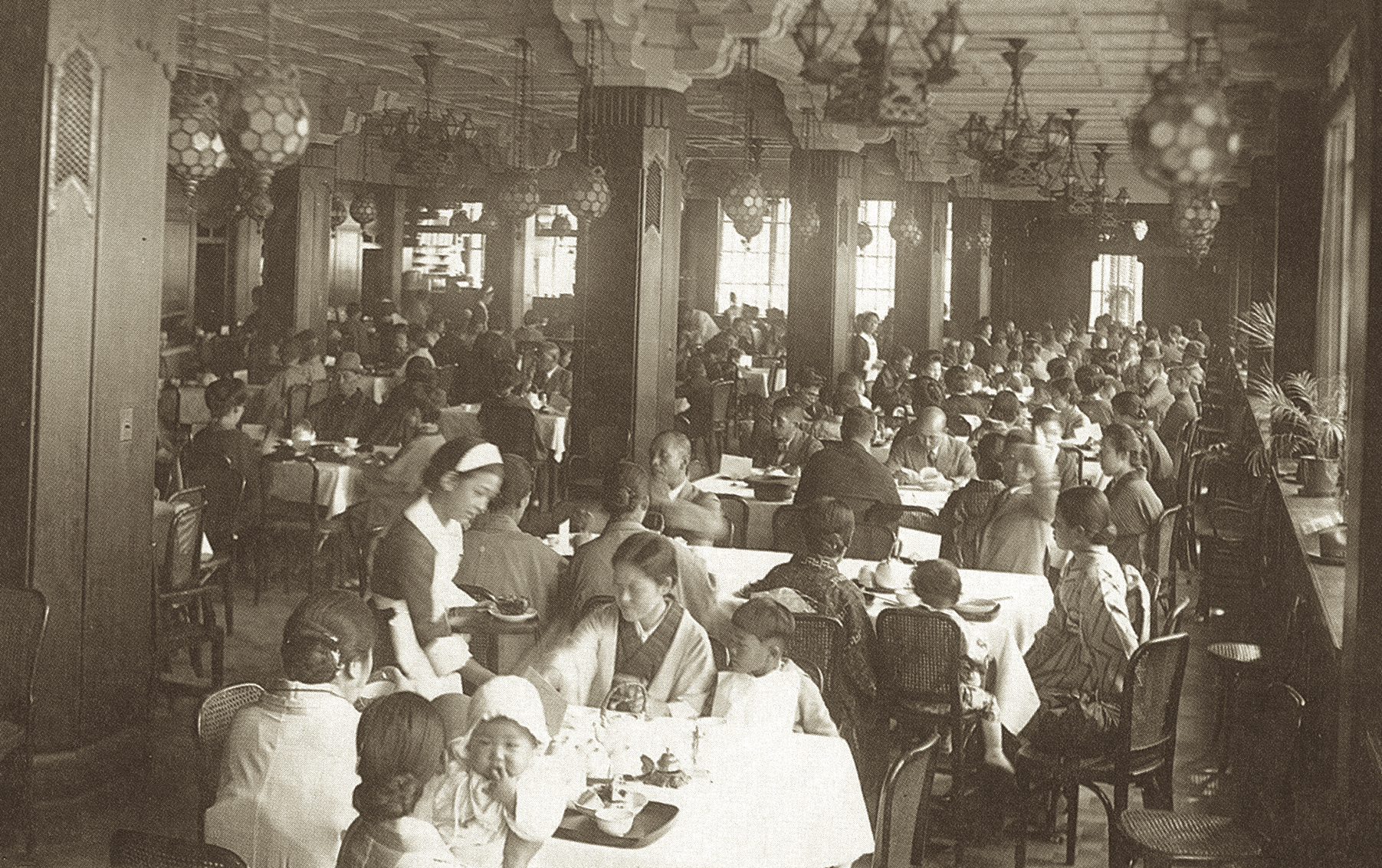
By the 1930s, department store restaurants had become a must-visit destination for many shoppers (Figure 2). At one department store, the number of daily diners accounted for roughly 25,000.Footnote 56 Some of the restaurants were so crowded that one journalist even wondered whether the main purpose of visiting a department store was shopping or dining at a restaurant.Footnote 57 Many diners, especially women, frequented department store restaurants to enjoy the rare experience of dining out and trying new dishes, including Western cuisine. While the increasing number of cookbooks and popular magazines began introducing Western-style dishes by the 1920s and 1930s, it was still rare to cook and eat them at home. Among the most popular dishes at department store restaurants were cutlets, croquettes, and curry (sushi was another popular dish).Footnote 58
A restaurant at Daimaru Department Store (c. 1937).
Note: Department store restaurants were often crowded with women, men, and children, during lunchtime. Japan Archives, https://jaa2100.org/entry/detail/059849.html. Used with permission.

Some department store restaurants began offering menus specifically for children, known as okosama lunch or “children’s meals,” which typically included Western foods, such as sandwiches, croquettes, salads, omelets, and pasta.Footnote 59 In 1930, Mitsukoshi introduced these menus for children, and other stores quickly followed suit. In fact, families with children became an important part of the customer base at Japanese department stores.Footnote 60 Department store restaurants served not simply as places to rest during shopping but also as landmarks for family gatherings, offering occasional dining-out experiences.
The number of restaurants increased, and the variety of cuisines expanded, due to the massive influx of Western culture during the first decades of the twentieth century, particularly in large cities. Like department stores, Shiseido Parlor and Sembikiya Fruit Parlor—both located in Ginza, one of Tokyo’s busiest districts—were well-known eateries offering a modern dining experience for both male and female customers. However, their menus were generally more expensive than those of department store restaurants. For example, Sembikiya charged 50 sen for a slice of melon, while a plate lunch at a department store could cost between 50 sen and 1 yen.Footnote 61 Furthermore, Shiseido Parlor’s regular clientele included geisha and upper-class women, whose presence likely made the space less family-friendly compared to the relatively more inclusive environment at department stores.Footnote 62
Department store restaurants served as a threshold into the new dining-out culture for many middle- and upper-class female customers. As Angel Kwolek-Folland noted in her study on gender and the service industry, the service sector was “not simply an aspect of public commerce; it also emerged from, and remained central to, the private, domestic economy and social relations.” Restaurants were venues where “household services functioned as a business activity.”Footnote 63 In this regard, department store restaurants were liminal spaces where domesticity was incorporated into a commercial sphere. Langhamer contends that “[t]hinking specifically about women’s work and emotion helps us to unpick contemporaneous understandings of public and private space and to trace the points where the apparently private bled into the public and where the ostensibly public bled into the private.”Footnote 64 The very act of restaurant girls serving a meal can be seen as an extension of the conventional gender role division, much like the preparation and serving of meals at home, which has historically (and still is) been considered a woman’s responsibility. Although the “public” and the “private” spheres were never entirely separate, Japanese department store restaurants illustrate how domestic ideology was a crucial component of the public space.
Restaurant Girls In-Between
Department store restaurants, as modern, relatively affordable, and family-friendly environments, provided a cultural and material context in which restaurant girls performed emotional labor and customers experienced new forms of consumption. Benno Gammerl has argued that “how specific emotions … are generated, handled, and expressed depends to a large degree on where they occur.” The supermarket, for instance, calls for a different “emotional repertoire compared to the beach or the office.” Gammerl calls this spatially defined emotion “emotional styles,” which encompass “the experience, fostering, and display of emotions” in a certain space. Emotional styles, contends Gammerl, entail “a higher degree of fluidity and malleability” and are “more easily pluralized” than other concepts like emotional regimes and emotional communities. The emotional style “restricts itself neither to identity-based concepts of personhood or culture nor to rules and models nor to the aesthetic dimension of expression.” This conceptualization of emotional styles helps us understand how different spaces—whether department stores, high-end restaurants, or bars—demand, foster, and shape specific emotional patterns and practices. It views emotions as “liminal phenomena” that are neither imposed by social structures nor autonomous responses ingrained in one’s psychology.Footnote 65
In incorporating the concept of the material in his analysis of the spatiality of emotions (in his words, “affect”), Andreas Reckwitz views emotions as integral to practices embedded in the ever-evolving network of human bodies and artifacts. Emotions occur not only between individuals but also between a person and material artifacts, with emotional relations between subjects—and between subjects and objects—“never isolated from … larger spatial arrangements, but are always embedded in them,” whether in homes, museums, restaurants, or stores.Footnote 66 The department store restaurant can be understood as an “affective space,” as Reckwitz describes it, with complex arrangements of human bodies (restaurant girls and customers), artifacts (costumes, foods, tables and chairs, lighting, and other decorative objects), forms of perception and sensation, and activities.
Restaurant girls were crucial components of these spatial and material constellations that informed and generated an emotional style in the department store restaurant, while also embodying the ambiguous nature of modernizing society. The early decades of the twentieth century were the time when gender norms, sociability, and sensibility changed dramatically in Japan. Western culture gradually entered people’s lives, though primarily in urban areas, as symbolized by “the neon lights, the cafes and dance halls, Western fashions, and the bobbed hair of the modern girl.”Footnote 67 The so-called modern girl (modan gāru in Japanese, often abbreviated as moga) became a symbol of the new culture. Yet the woman also embodied the “‘premodern’ figure of innocence and nostalgia,” as Michiko Suzuki argues. The woman was “a representation of gendered “sites” that produce or interrogate the meaning of modernity, such as the non-West, popular culture, the everyday, the spectacle, language, the city or country, and consumption.” In Japan, the woman became “a sign of such ambivalent simultaneity.”Footnote 68 Department store restaurants and women who worked there epitomized the “ambiguous simultaneity” of modernity, reflected in and projected onto the female body. Restaurant girls represented an in-between figure—straddling domesticity and the public sphere, childhood and adolescence, and tradition and new.
Restaurant girls embodied the liminal state of department store restaurants through their age, gender, and body. When women were hired, their first job at the department store was as a waitress. Because serving food at a restaurant did not require special sales skills, it provided a space where newly hired women learned basic service tasks, such as greeting customers. Unlike shop girls in fashion departments, restaurant girls did not have to persuade customers to make purchases. After learning the basic rules and skills over several years, their managers would reassign them to other sections.Footnote 69
Partly due to their young age and lack of experience, the job was low-paying. According to records from 1930 and 1931, salaries for restaurant girls in both Tokyo and Osaka were approximately 70 to 90 sen per day. After about three years, their salary was paid monthly rather than daily, with the average amount increasing slightly to 20 to 30 yen per month.Footnote 70 For comparison, an elementary school teacher’s starting salary at the time was about 50 yen a month, and a typist’s monthly salary was 39 yen.Footnote 71
Despite their low salary, restaurant girls’ jobs were physically demanding—they had to walk around the floor, bringing dishes to the tables. Contemporary job manuals and newspapers occasionally highlighted how challenging it was for women to work at department stores, despite the glamorous image associated with “department store girls.”Footnote 72 Their average working hours were 9 hours a day, with few days off—only 2 to 3 days per month. Furthermore, since department store restaurants were almost always crowded, particularly during lunchtime, one waitress was typically responsible for 8 to 10 tables at a time.Footnote 73 One newspaper article noted that the girls were “working like swallows,” running from table to table in a busy restaurant.Footnote 74
The fact that restaurant girls did not require sales skills or specialized knowledge did not necessarily mean their jobs were easy. What they were selling was simply different from, say, women’s clothing. By bringing dishes to the table and interacting with customers (however minimal those interactions might have been), restaurant girls were integral to the customers’ dining experience. Nonetheless, department store managers believed that restaurant service was a job inexperienced female employees could perform. In this way, the immaterial aspect of their work was undervalued and gendered.
The physical presence and image of restaurant girls were crucial in shaping department store restaurants as an appropriate eating space, even a haven, for female customers. Restaurant girls helped distinguish department store restaurants from other eating establishments intended for men—most notably the so-called “café,” or kafē in Japanese, which became popular in early-twentieth-century Japan. The café was a place where women served alcoholic drinks and some foods primarily to male customers, and waitresses sometimes provided sexual services. Media at the time presented café waitresses as symbols of modern urban life, associated with the image of flirting with male customers and flaunting their sexual appeal. One 1934 guidebook proclaimed: “If department stores are the stars of the day, cafés are undoubtedly the kings of the night.”Footnote 75
Restaurant girls, in contrast, did not evoke the image of overt modernity and sexuality, partly because their youth was more often associated with childlike innocence and cuteness. While reviewing the popularity of department store restaurants, a 1933 guidebook noted that waitresses at one department store restaurant were “well received for their Yamato Nadeshiko-like atmosphere” (Yamato Nadeshiko is a term used to describe a demure young woman with admirable traits); at another department store, restaurant girls wore “quite stylish aprons” and were described as “pleasant in every way" with "a girlish appeal.”Footnote 76 Observing restaurant girls at Shirokiya in Osaka, a 1931 article in the weekly magazine Sunday Mainichi noted likewise:
I can’t say it out loud, but the service girls are very pretty. […] Lovely children just out of elementary school swim between the tables like goldfish. They, of course, would never even dream of winking at you. This gives me great pleasure as I adore a pleasant restaurant.Footnote 77
The guidebook’s favorable comment about the “Yamato Nadeshiko-like atmosphere” and the Sunday Mainichi article’s description of restaurant girls as “goldfish” indicate those young women’s innocent and pure images associated with the conventional Japanese femininity, as compared to café waitresses for whom winking at customers was probably a part of their job.
The spatial differences between the department store restaurant and the café entailed distinct emotional styles, which called for different kinds of emotional labor that women were expected to perform. Some department stores intentionally trained restaurant girls to distinguish them from café waitresses. In the 1910s, when department stores began expanding their restaurant service, Mitsukoshi’s chairperson, Ōsuke Hibi, who had served as the store’s first senior managing director, noted that “women working at a restaurant and a rest space should not show their charm and treat customers without a smile.” If they smiled, “customers might tell a joke to them,” argued Hibi, suggesting that friendly service could lead male customers to converse easily with, and even flirt with, restaurant girls. Thus, Mitsukoshi instructed restaurant girls to respond only with “yes” or “no” to customers.Footnote 78 Department store restaurants implemented this strategy only in the early years and would eventually change their no-smile policy, as discussed later. Nor is it certain if, or to what extent, restaurant girls adhered to Hibi’s policy, or whether other department stores also trained their waitresses not to smile at customers. Nevertheless, Hibi’s concern indicates that female servers, whether working at a department store restaurant or a café, could evoke a sexualized image, especially when department stores first began offering restaurant services. Department store restaurants aimed to avert the male gaze to encourage women, as well as men, to dine without hesitation—unlike bars and cafés, which were almost exclusively male spaces.
Meanwhile, department store restaurants and restaurant girls were also associated with modernity, as this eating space was integrated into the very symbol of Western commercial spaces—the department store. These young women commonly wore Western dresses with white aprons, with a few exceptions. Although the Westernization of female fashion had already begun by the 1930s, it was still common for women to wear kimonos in public and at home. Restaurant girls’ distinctive Western appearance contributed to the spectacle of modernity at the department store.
Situated between childhood and adolescence, and between conventional domestic work and modern commercial service, restaurant girls played a key role in domesticating the modern shopping and dining experience at department stores. On the one hand, restaurant girls subverted the conventional social and gender norms that had restricted upper- and middle-class women from dining out alone. On the other hand, they were responsible for creating a pleasant dining space for both women and men not only by serving food but also by embodying an innocent and modest femininity, rooted in a patriarchal conception of gender.
Personality as a Productive Asset
If restaurant girls represented a liminal figure positioned between conventional gender ideologies of domesticity and the modern commercial sphere, their role in serving food and projecting an image of innocence and purity epitomized the former. Their connection to the latter stemmed from both their workplace—the department store as an emblem of “modern capitalism”Footnote 79—and their participation in emotional labor, which increasingly became institutionalized.
Arlie Hochschild’s 1979 sociological study of flight attendants, The Managed Heart, and Maurizio Lazzarato’s Reference Lazzarato, Virno and Hardt1996 essay on “immaterial labor” offer valuable frameworks for understanding emotional labor (emotional labor can be seen as a subcategory of immaterial labor).Footnote 80 Hochschild defines emotional labor as “the management of feeling to create a publicly observable facial and bodily display,” highlighting how individuals manage their emotions to elicit specific feelings in others.Footnote 81 Within the interplay of social and capital relations, as Hochschild argues,“the final commodity is not a certain number of smiles” flight attendants provide. Instead, the essence of the work lies in the ability to “coordinate self.”Footnote 82 As Lazzarato observes, the “‘raw material’ of immaterial labor is subjectivity and the ‘ideological’ environment in which this subjectivity lives and reproduces.”Footnote 83 Smiling hence shifts from a personal expression to a deliberate performance of “company feeling.”Footnote 84
Hochschild and Lazzarato analyzed emotional and immaterial labor in late-twentieth-century postindustrial society. By focusing on department store restaurants in early-twentieth-century Japan, in contrast, this article delineates emotional labor as part of a modernization process. “Capitalism’s dependence” on emotional labor is not a recent phenomenon, as Elspeth Brown contended. In her study on American and European fashion models from the late nineteenth to the early twentieth century, Brown illustrates that emotional labor became a necessary form of work to “expand existing markets and build new ones” in a mass production economy.Footnote 85 Brown’s work demonstrates emotional labor as a crucial part of what Eva Illouz called “emotional capitalism”—a “culture in which emotional and economic discourses and practices mutually shape each other.”Footnote 86 The examination of Japanese department store restaurants sheds light on a distinct trajectory of emotional capitalism compared to developments in other contexts, such as the American case highlighted by Brown. In Japan, the emotionalization of the economy not only facilitated the expansion of new markets and the development of new marketing strategies but also played a critical role in the broader national project of modernization and industrialization. These efforts were deeply interwoven with the creation of new commercial cultures and lifestyles.
In modern business, emotional labor extended beyond merely creating pleasant feelings for customers; an employee’s emotions and personality functioned as valuable assets. Scholars have observed that the rise of consumer culture brought about a significant cultural change that emphasized the importance of personality. Certain traits—such as flexibility, entrepreneurship, independence, productivity, and competitiveness—became essential for success.Footnote 87 In particular, personality served as an important tool in mass consumer society, enabling individuals to stand out in the crowd. During the interwar years in the United States, for example, mass-circulated advertisements, magazines, newspapers, advice manuals, and emerging industries like film, fashion, and cosmetics, emphasized cultivating specific personal dispositions and tastes.Footnote 88 Similarly, in early-twentieth-century Japan’s burgeoning consumer society, the focus on personality encouraged individuals to stand out and express their tastes and lifestyles while also shaping a unique type of crowd identity.
For many department stores, personality was one of the most important hiring criteria. At Shirokiya, for example, charm, elegance, and cheerfulness were primary qualifications for female employees.Footnote 89 Mitsukoshi sought individuals with a pleasant appearance and demeanor, strong will, and poise.Footnote 90 By defining personality traits as prerequisites for employment, department stores elevated personality into a productive asset—one that served both individuals and companies alike.
Applicants’ family backgrounds also played a significant role, as department store executives believed that individuals from unstable family situations or financial hardship were more likely to exhibit undisciplined or "rough" personalities. Although department stores did not explicitly require employees to belong to a specific social class, many preferred applicants who were legitimate children with both parents alive and whose families were not “too poor.”Footnote 91 In fact, many restaurant girls came from middle- or lower-middle-class households, with fathers working as government officials, bankers, company employees, or self-employed merchants.Footnote 92 Unlike migrant workers from impoverished rural areas, many female employees lived within commuting distance of their workplace. However, this did not mean that these women worked for leisure or mere curiosity. Many of them chose to work to contribute to their family’s expenses. Other motivations included saving money for future endeavors, such as supporting themselves, pursuing education, or preparing for marriage.Footnote 93
Other hiring criteria included educational background and appearance.Footnote 94 Initially, education was not a critical factor for employment; female applicants were generally expected to have completed at least primary education, typically an “ordinary [jinjo] elementary school” (first through sixth grades).Footnote 95 In the 1930s, however, many department stores began prioritizing women who graduated from jogakkō (women’s middle school). Applicants with only primary school diplomas were rarely hired, as they were deemed insufficiently intellectual.Footnote 96 The growing preference for women with higher education can also be attributed partly to the expansion of jogakkō and the increasing enrollment of women in middle schools after the 1920s.Footnote 97 Appearance was another important criterion for evaluation. Even when applicants’ educational qualifications were unremarkable, attractive candidates were often favored and included on the acceptance list.Footnote 98
Although department stores increasingly emphasized the importance of educational backgrounds, women’s personality and appearance remained key criteria for employment. Raichō Hiratsuka, a pioneering feminist and cofounder of the literary magazine Seitō (Bluestocking), criticized these hiring practices in a 1933 newspaper column. She argued, “What employers are looking for in professional women today is not so much essential, but rather peripheral, superficial qualities, such as a pretty face, charm, cuteness, cheerfulness, tactfulness, and wit, and little more.” Hiratsuka instead advocated for the importance of a healthy body. “If you think about it,” argued Hiratsuka, “you will realize how much physical energy it takes to stay pleasant, cheerful, and charming with many customers in the crowded, impure air of a first-rate department store.”Footnote 99 Another newspaper article echoed Hiratsuka’s view, providing a critical perspective on the rise of female professions. While affirming the importance of women’s economic empowerment, the author highlighted the potential “exploitation” of women, pointing to their lower wages compared to men and the growth of highly sexualized roles, including café waitresses.Footnote 100
In fact, female employees, including restaurant girls and saleswomen, confronted the gap between the glamorous image of department stores and the reality of their labor. One female employee, who began working as a sales clerk in 1932, recalled that working in a department store had been her “dream job.” But she soon realized the job was far more demanding than she had anticipated, and she now “continued her work reluctantly.”Footnote 101 As Hiratsuka indicated, department stores’ hiring criteria publicly reinforced the notion that personality and appearance were essential for professional women in certain roles. These recruitment practices not only shaped the image of department store employees but also influenced women’s expectations of their jobs as being associated with beauty, elegance, and charm.
Department store executives intentionally crafted this image by hiring women who fit their criteria and providing young female employees with meticulous instructions and training. This included guidance on everything from how to dress and style their hair to how to bow and serve food. For instance, when greeting a customer at the entrance, restaurant girls were expected to say “welcome” while slightly bending their bodies. When delivering a dish to a table, they were taught to clearly say, “thank you for waiting.” If a customer made an unreasonable request, they were instructed never to say “no” but instead to consult a restaurant manager for advice. Throughout their interactions, employees were expected to smile and treat customers with kindness. Even when a customer was overly demanding, the blame always fell on the waitress if an issue arose.Footnote 102
However, these instructions did not necessarily mean that department store managers sought to train employees in a highly standardized or regimented way. Restaurant girls were expected to become what Lazzarato called “active subjects,” incorporating their personality into the corporate organization and management.Footnote 103 In a 1936 newspaper interview, Ayako Kinoshita, a female restaurant manager at Matsuzakaya, noted that restaurant girls were expected to be “quick-witted and cheerful.” She acknowledged that it might appear they were simply bringing food from the kitchen to the table, but “they [were] not working mechanically.”Footnote 104 As Emma Dowling’s study of restaurant servers in the late-twentieth-century United States shows, companies aim to “enhanc[e] productivity whilst seeking to foster a subjectivity in which workers see the company’s interests as their own.”Footnote 105 Kinoshita’s description of restaurant girls reflects this decentralized yet strictly disciplined form of employee management. They were required to follow specific instructions on how to serve customers but were also expected to adapt to the situation, with their subjectivity becoming a productive resource for the company.
As personality became an asset, it was no longer merely a matter of personal disposition. The “private resource” transformed into “a company asset.”Footnote 106 In her study of flight attendants, Hochschild identified what she called the “company personality” of each airline. United Airlines, for example, cultivated the image of “the girl-next-door," akin to a "neighborhood babysitter grown up,” while Pan-Am projected a persona that was “upper class, sophisticated, and slightly reserved in its graciousness.” Recruiters were clear about the “type” of personality they sought, and flight attendants understood the "connection between the personality they were supposed to project and the market segment the company wants to attract.”Footnote 107 Similarly, in early-twentieth-century Japan, each department store cultivated its own distinct personality. According to a vocational manual for women, Mitsukoshi’s female employees were known for elegance, Shirokiya for charm, Matsuzakaya for solidity, and Matsuya for modern-look and intelligence.Footnote 108 This corporate personality could have made the profession self-selecting, as applicants gravitated toward department stores whose “personality” alignedwith their own.
Corporate personality was more than just a characteristic of the company. As women entered the workforce, they were consciously or unconsciously integrated not only into the corporate structure but also into its distinctive corporate personality. “What modern management techniques are looking for," argues Lazzarato, "is for the worker’s soul to become part of the factory."Footnote 109 Hence, personality became a product of corporate management and a productive asset for individuals. In the words of Lazzarato, “capitalism seeks to involve even the worker’s personality and subjectivity within the production of value.”Footnote 110
Modern Smile
Restaurant girls embodied and performed the corporate personality of the department store they worked for. The presentation of personality thus became a key aspect of their job. As noted earlier, Hibi opposed the idea of restaurant girls being overly friendly during his tenure as Mitsukoshi’s director in the 1910s. However, department stores, including Mitsukoshi, increasingly emphasized the importance of charming personalities for female employees, including restaurant girls. Mitsukoshi’s 1937 service manual instructed employees to “greet customers always with a smile and deference.” They were also encouraged to maintain both physical and mental health and remain cheerful at all times.Footnote 111 Similarly, Takashimaya in Osaka adopted “smiling service” as their motto.Footnote 112 Matsuzakaya outlined its service policy as follows: “Service first. Be courteous and friendly. Courtesy to see off, smiles to welcome.”Footnote 113 Shirokiya likewise underscored the value of an elegant and polished smile, stating, “A woman needs to be charming. But in the expression of that charm, they should not be vulgar, roaring with laughter. That is, a smile is important. This smile is crucial for serving customers.”Footnote 114
Whether smiling warmly or restraining their emotions, restaurant girls were expected to regulate their emotional expressions to create a specific emotional style in the workplace. A smile became what Alexandra Peat and Emily Ridge describe as a “surface symbol”—a commercial tool displayed on the face of a restaurant girl.Footnote 115 The management of emotion helped support the commercial ambitions of department stores but also reflected the gendered power imbalance between restaurant girls and customers. In their study of the Japanese whiskey brewer Nikka Whiskey, Gibb and MacKenzie highlighted the role of Rita Taketsuru, the founder’s Scottish wife, whose emotional labor contributed significantly to the firm’s success by providing emotional support to her Japanese husband. Her contributions, however, were rooted in unequal gender relations. With patriarchal social norms shaping both business practices and cultural expectations, emotion became a materialized product and tool of labor.
Smiling at a customer was not entirely new in early-twentieth-century Japan. However, this was a period when a smile—and the embodiment of emotions—became an essential component of consumer capitalism. While a smile may appear to be a universal facial expression across cultures and eras, as Christina Kotchemidova argues, “smile was adopted as a standard” shaped by specific social conditions.Footnote 116 Colin Jones conceptualized the smile as a political tool and a product of political and social change, illustrating how the “white-tooth smile” emerged as “a symbol of an individual’s innermost and most authentic self” in late-eighteenth-century Paris.Footnote 117 Similarly, Rosenwein asserts that emotion, including a smile, “can never be known out of context.”Footnote 118 The significance of a smile—how, when, and why it is expressed—depends on situational, cultural, and aesthetic factors, demonstrating that emotions are historically and culturally specific.
In Japan, women were traditionally not expected to display large smiles or show their teeth in public. Social norms emphasized emotional restraint, particularly for women.Footnote 119 This did not mean women were forbidden from smiling, but subtlety was paramount. A women’s magazine article of the time advised readers that charm was essential for an attractive woman. However, it highlighted differences between Japanese and Western expressions of charm. Japanese women were expected to embody modesty and reservation, often with an affable yet faint smile, while Western women were described as open and artless.Footnote 120
The emergence of the "white-tooth smile" also marked a shift in Japanese beauty standards. Until the early 1900s, the practice of ohaguro—blackening one’s teeth—was common, particularly among women of the elite class. Pitch-black teeth were considered beautiful, partly due to the cultural belief that black objects were aesthetically pleasing and partly because of limited understanding of dental hygiene. Blackened teeth helped mask stains and imperfections.Footnote 121
The introduction of Western culture fundamentally altered Japanese aesthetics. Popular magazines began featuring fashion and cosmetics from Europe and the United States, often showcasing images of women with smiles. Hollywood films, which gained popularity during this period, further propagated the Western beauty standard.Footnote 122 Some advertisements began emphasizing the importance of a smile and white teeth. Women’s magazines advised readers not only to maintain dental hygiene but also to keep their teeth clean as a means of enhancing feminine beauty.Footnote 123 Japanese advertisements and popular magazines presented an idealized image of Western women with smiles. The “West” as portrayed in Japan was not necessarily a true reflection of Western women, but rather an idealized vision of both Western femininity and the West itself. It was this idealized image that restaurant girls, dressed in Western attire and bearing smiles, embodied.
Customers soon came to expect—and even naturalize—the smiles of restaurant girls, which, in turn, influenced the overall reputation of department stores. A 1929 article in the women’s magazine Ryōri no Tomo (Cooking Friends) praised the “attentive service” and “bright smiles and charm” of restaurant girls at Matsuya, noting it was the best among all the department store restaurants in Osaka. The author remarked, “Perhaps this dainty little girl represents a part of Matsuzakaya’s faithful greetings to its customers.”Footnote 124 Another article in the same magazine likewise emphasized how the quality of a department store was heavily reliant on the service of its restaurant girls: “The quality of a department store depends largely on restaurant girls’ service, not to mention waitresses at diners and cafés.”Footnote 125 One newspaper column even described the experience of interacting with a restaurant girl as a “voice like the canary smiles at me.”Footnote 126 These restaurant reviews suggested that not only the taste of food but also the “surrounding decorations, the cleanliness of the tableware, and the impression of a server” all affected the dining experience.Footnote 127 Restaurant girls’ labor, in the words of Dowling, was “constituent not attributive.”Footnote 128 They were integral to the dining experience at department store restaurants, providing not only food but also smiles and pleasant greetings.
Partly because customers had come to expect restaurant girls’ service and smiles as a norm, complaints sometimes arose when the service fell short of expectations. Mitsukoshi, one of Japan’s oldest department stores, was renowned for the variety and quality of goods it sold. However, customers complained that the waitresses and female employees at Mitsukoshi were not as friendly as those at other department stores.Footnote 129 A reporter for the retail trade journal Shōten-kai recounted how a waitress at Mitsukoshi served him “mechanically,” as if following a manual. He noted that the girl should have interacted with him “with a subtle smile”; otherwise, their business would suffer. Even when she said “thank you,” he felt there was no sincerity.Footnote 130 These complaints, along with compliments found in popular magazines and newspapers, show how the public developed certain expectations about the appearance and service of restaurant girls. By providing information on department store restaurants, the media also played a role in constructing and reinforcing such expectations.
Emotional labor shaped the social relations between restaurant girls and customers, influenced by capital and gender dynamics that created complex power structures. What Dowling referred to as “the active presence and active intervention of capital” underpinned these relationships.Footnote 131 Customers were sometimes aware that capital mediated their interactions with restaurant girls. One reporter remarked that at Takashimaya, “all restaurant girls were beautiful.” It was the only department store where he wondered if he should give a tip to the servers because they were so well-trained.Footnote 132 In Japan, tipping was—and is—uncommon, except in specific cases, such as cafés where women served male customers. In fact, tipping was an important source of income for many café waitresses: a 1926 study on Tokyo café waitresses found that over 80 percent of the respondents received tips.Footnote 133 The reporter understood that a department store restaurant was not the place to tip female servers, while suggesting that their service and smiles could be exchanged with capital. Although there was no direct financial transaction between a restaurant girl and a customer, the smile, service, and pleasant feelings they evoked were essential elements of the dining experience that customers paid for.
Conclusion
A history of department store restaurants reveals how Japan’s modernization process, including the rise of consumerism, was closely tied to shifts in aesthetic sensibilities. Department store restaurants became one of the key apparatuses that both reflected and contributed to significant social changes in the the first decades of the twentieth century. The smiles and Western-style dresses of restaurant girls smacked of modernity, embodying the image of the department store. Newly imported Western goods, such as clothing and food, sold in these stores offered customers material objects that symbolized a modern lifestyle. At the restaurants, customers encountered modern sensibilities through sensory and emotional experiences—by tasting Western dishes, which were still rare to cook at home, and by interacting with waitresses who had Westernized appearances. Department store restaurants and restaurant girls, however, also embodied the ambiguity of modernity. Positioned between conventional domesticity and modern commercial service, restaurant girls played a crucial role in creating a dining space that appealed to women. Their liminal position was key in attracting customers, including women and families.
A crucial part of this dining experience was a new form of labor that restaurant girls provided. Their emotional labor in department stores involved the process of subjectification, where their personalities became productive assets—central criteria in the hiring process. By incorporating personality into business management, department stores also gendered labor, particularly emotional labor. Through recruitment policies that sought specific types of personalities based on contemporary gender norms, department stores categorized and selected “appropriate” women, thereby producing gender as a productive force. The expression of personality in a feminized manner became a crucial aspect of restaurant girls’ roles. The rise and expansion of consumer capitalism relied on both the rationalization of production and the emotionalization—and therefore gendering—of labor.

 Open access

