




INTRODUCTION
Besides the traditional applications of radiocarbon (14C) dating in archaeology, geochronology, and cultural heritage, different studies have shown the potential of the method in the forensic sciences. In this field, typical applications require the analysis of “recent” samples (at least in the 14C timescale), typically younger than 60–70 years, and high chronological resolutions of the order of a few years or better. Generally speaking, this is beyond the possibilities of 14C-dating which has, at best, resolution of the orders of decades. Indeed, the chronological resolution achievable by 14C-dating is determined by the combination of the uncertainty associated with the measurement of the 14C concentration in the samples (instrumental precision) and the effect of its calibration into calendar ages through the calibration curve. Furthermore, while instrumental precision levels of the order of 0.3% in 14C/12C ratio measurement are nowadays routinely achieved, the limitations related to the calibration procedures cannot be easily overcome as they are related to global-scale or even extraterrestrial complex phenomena. And if it is true that higher resolutions, even at the annual level, have been recently shown by using large and rapid excursions of the 14C atmospheric concentrations, they are limited to very particular situations in terms of sample material and time ranges (Wacker et al. Reference Wacker, Güttler, Goll, Hurni, Synal and Walti2014; Kuitems et al. Reference Kuitems, Panin, Scifo, Arzhantseva, Kononov, Doeve, Neocleous and Dee2020).
An example of the negative impact of the flat shape of the calibration curve on the achievable resolution is seen when samples 70–300 years old are dated. This is due to the fluctuations of the atmospheric radiocarbon concentration induced by anthropogenic causes, which make the 14C calibration curve flat in the period between the end of the 16th century and the middle of the 20th century. In other words, the uncertainty associated with 14C ages of samples falling in this range can be as large as three centuries.
The possibility to use 14C-dating in forensics is based on the detection of the excess of 14C released into the atmosphere by aboveground nuclear detonations tests carried out from the mid-1950s (Hua et al. Reference Hua, Barbetti and Rakowski2013). The curve representing the concentration of 14C in the atmosphere, often referred as the “bomb spike” or “bomb curve,” is very well known and reconstructed with high resolution through the analysis of terrestrial proxy records such as tree rings (Nydal Reference Nydal1968; Levin and Hesshaimer Reference Levin and Hesshaimer2000; Quarta et al. Reference Quarta, D’Elia, Valzano and Calcagnile2005; Levin et al. Reference Levin, Naegler, Kromer, Diehl, Francey, Gomez-Pelaez, Steele, Wagenbach, Weller and Worthy2010; Hua et al. Reference Hua, Barbetti and Rakowski2013) or even by direct atmospheric CO2 sampling in different locations around the globe. The curve has a steep rising part starting from 1955, reaching a maximum in 1964 CE (at least in the Northern Hemisphere) and then declining to the current level where it is approaching the pre-bomb values. Though the detailed analysis of the shape of the curve is beyond the aims of this paper, we recall here that in 1964 the 14C concentration had almost doubled the pre-bomb value (Hua et al. Reference Hua, Barbetti and Rakowski2013). After the 1963 ban on atmospheric nuclear tests (the Partial Nuclear Test Ban Treaty), the excess of 14C produced started to decline as it was distributed into different reservoirs such as the hydrosphere and the biosphere. It is also worth mentioning the effect of dilution of the 14C concentration due to the increasing release into the atmosphere of 14C-free carbon dioxide from fossil industrial sources over the same time (Graven Reference Graven2015).
In forensics, this curve can be used as reference to “calibrate” to calendar years the measured radiocarbon concentrations in a sample. The potential of bomb-spike 14C-dating has been shown by several studies in different fields ranging from medicine (Spalding et al. Reference Spalding, Arner, Westermark, Bernard, Buchholz, Bergmann, Blomqvist, Hoffstedt, Näslund, Britton, Concha, Hassan, Rydén, Frisén and Arner2008; Rinyu et al. Reference Rinyu, Janovics, Molnar, Zoltan and Kemeny-Beke2020), the fight against illicit drugs (Zoppi et al. Reference Zoppi, Skopec, Skopec, Jones, Fink, Hua, Jacobsen, Tuniz and Williams2004), and contemporary art authentication (Caforio et al. Reference Caforio, Fedi, Mandò, Minarelli, Pellicori, Petrucci, Schwartzbaum and Taccetti2014; Brock et al. Reference Brock, Eastaugh, Ford and Townsend2019; Hendriks et al. Reference Hendriks, Hajdas, Ferreira, Scherrer, Zumbühl, Küffner, Carlyle, Synal and Günther2019), which resulted also in a remarkable commitment of the 14C community (Hajdas et al. Reference Hajdas, Jull, Huysecom, Mayor, Renold, Synal, Hatte, Wan, Chivall, Beck, Liccioli, Fedi, Friedrich, Maspero and Sava2019). In particular, 14C-dating in forensic anthropology has been used at different levels of complexity, from the simple identification of the forensic interest of human remains to the estimation of the year of death or birth supplying information relevant, for example, for the identification of missing persons (Handlos et al. Reference Handlos, Svetlik, Horáčková, Fejgl, Kotik, Brychová, Megisova and Marecová2018). Indeed, studies have shown how the proper selection and analysis of tissues with different times of (radio)carbon fixation and different turnover rates increases the obtainable information in terms, for instance, of the achievable chronological resolution (Spalding et al. Reference Spalding, Buchholz, Bergman, Druid and Frisén2005; Cook et al. Reference Cook, Dunbar, Black and Xu2006; Calcagnile et al. Reference Calcagnile, Quarta, Cattaneo and D’Elia2013; Brock and Cook Reference Brock and Cook2017). Also, in wildlife forensics, 14C bomb-spike dating is extensively used to identify samples or artifacts of endangered species illegally imported by violating international trade bans or national laws. This is the case of the fight against illegal elephant ivory trade and of the legal enforcement of CITES, the Convention on International Trade in Endangered Species of Wild Fauna and Flora. In this case 14C-dating is the only method available to date, for instance, ivory, so it can be established whether it was obtained before or after the trade ban (Cerling et al. Reference Cerling, Barnette, Chesson, Douglas-Hamilton, Gobush, Uno, Wasser and Xu2016; Quarta et al. Reference Quarta, Braione, D’Elia and Calcagnile2019; Wild et al. Reference Wild, Kutschera, Meran and Steier2019).
Nevertheless, despite the significant advantages of the method, such as the low sensitivity to external, environmental, and context factors, it does not appear to be fully exploited in routine forensics practice. This is probably due to the need of dedicated laboratories, the expertise required in data analysis and interpretation and, partially, to the lack of a full awareness of the potential of the method among forensics professionals.
We present the results of an intercomparison exercise run under the auspices of the International Atomic Energy Agency (IAEA) and in the frame of the Coordinated Research Projects (CRP): Enhancing Nuclear Analytical Techniques to Meet the Needs of Forensic Sciences, which has a work-package (WP4) dedicated to accelerator mass spectrometry (AMS) 14C dating. The intercomparison exercise was performed on bone and ivory samples, which are among the sample materials more commonly involved in forensics for issues related to the analysis of skeletal remains in forensic anthropology and the fight against the trade of ivory obtained from endangered species.
The aim of the study was to show the level of achievable precision and the degree of accuracy of the results for the analysis of samples of forensics interest. It is worth mentioning that bone samples were included in different international intercomparison exercises (Scott et al. Reference Scott, Naysmith and Cook2017) and the subject of dedicated studies (Huels et al. Reference Huels, van der Plicht, Brock, Matzerath and Chivall2017) because the effective treatment of bones is of an interest to archaeology (Rubinetti et al. Reference Rubinetti, Hajdas, Taricco, Alessio, Isella, Giustetto and Boano2020). Here, however, we concentrate mainly on modern samples and an issue relevant in forensic studies.
MATERIALS AND METHODS
The presented study was designed to check the reproducibility of the measurements obtained at the three participating laboratories: CEDAD-Centre for Applied Physics, Dating and Diagnostics at the University of Salento, Lecce, Italy; the Laboratory of Ion Beam Physics at the ETH in Zurich, Switzerland; and the HEKAL-Hertelendi Laboratory of Environmental Studies, Institute for Nuclear Research, Debrecen, Hungary. The laboratories used different procedures to chemically process the samples, as better detailed in the following, and are based on different AMS instruments. In particular, HEKAL and ETHZ are based on a MICADAS (Mini Carbon Dating System) AMS system operated at 200 kV, while CEDAD is based on a 3 MV TandetronTM type accelerator.
Sample Material
Six bone and ivory samples were selected for this study as summarized in Table 1. The samples were selected to cover a chronological range spanning from background (older than 50 ka) to 2018. This was done to assess the level of background for the three laboratories and the measurement reproducibility for both “archaeological” samples and materials of potential forensics interest. Sample #1 was obtained at HEKAL from a mandible of a woolly mammoth (Mammuthus primigenius) found during a cleaning campaign, most probably during the second half of the 19th century, of the bed of the river Tisza (Major et al. Reference Major, Fut, Dani, Cserpák-Laczi, Gasparik, Jull and Molnár2019). This sample was included to assess the blank level of the three laboratories and its reproducibility. The sample is expected to have an age beyond the limit of the radiocarbon dating method (>50 ka) and should be completely depleted of 14C. Any measured level will then give a direct estimation of chemical processing and machine induced background. Sample #2 was a fragment of a Eurasian aurochs (Bos primigenius primigenius) already dated at HEKAL as part of a previous study to 6862 ± 40 BP, corresponding to a blank corrected 14C concentration of F14C = 0.4286 ± 0.0022 (Major et al. Reference Major, Fut, Dani, Cserpák-Laczi, Gasparik, Jull and Molnár2019).
List of the samples.

Ivory samples #3, #4, and #5 were submitted in the last three years to CEDAD at the University of Salento to be 14C dated and assess whether they were imported in Europe in violation of the CITES treaty. Sample #3 was taken from a rhino horn while #4 and #5 were elephant ivory. According to the information supplied by customers, sample #3 was expected to be “pre-bomb” whereas for the two samples #4 and #5 an age after 1955 CE was expected. The three samples were already dated at CEDAD in 2016, and the measured 14C contents resulted to be F14C = 0.9859 ± 0.0055, 1.5584 ± 0.0055, and 1.11322 ± 0.0052, for #3, #4, and #5, respectively. Sample #6 was a modern pig leg bone (Sus scrofa domestica) purchased in a local shop in Debrecen, Hungary, in 2018.
From each of the above-mentioned samples three pieces were obtained with masses ranging from 400 to 600 mg. The 18 samples were then distributed among the three participating laboratories once made anonymous. No information was supplied about the expected ages.
Sample Processing
The 18 samples were processed according to the different procedures in use in the three different laboratories and 14C content measured by using the different instruments as detailed in the following.
CEDAD Sample Processing
Collagen was extracted from bone and ivory samples according to Longin (Reference Longin1971) and then dried and vacuum-sealed in pre-evacuated quartz tubes together with CuO and silver wool. Sample material was then combusted to carbon dioxide at 900°C for 4 hr. Released CO2 was cryogenically purified and then reduced to graphite at 600°C by using H2 as reducing agent and 2 mg Fe powder as catalyst (D’Elia et al. Reference D’Elia, Calcagnile, Quarta, Rizzo, Sanapo, Laudisa, Toma and Rizzo2004). All the samples yielded an optimal quantity of ∼1 mg of graphite which was then pressed in the aluminum cathodes of the AMS system (3 MV TandetronTM Mod. HVEE 4130HC) for the measurement of the isotopic ratios (Calcagnile et al. Reference Calcagnile, Maruccio, Scrimieri, delle Side, Braione, D’Elia and Quarta2019). Measured 14C/12C ratios were then corrected for mass fractionation by using the δ13C term measured online with the AMS system and for machine and chemical processing background. Uncertainty in measured isotopic ratios was calculated by considering both the scattering of the 10 repeated determinations performed on each sample and the radioisotope counting statistics (Calcagnile et al. Reference Calcagnile, Quarta and D’Elia2005).
HEKAL Sample Processing
At HEKAL, all samples were processed in the same way using a procedure standardized for collagen extraction. Briefly, bone fragments are first ground and sieved to get the adequate size fraction of 0.5–1.0 mm. For chemical pretreatment, 600 mg of the ground grains is placed into special designed Omnifit™ glass columns, which can then be attached to a semi-automatic ABA cleaning system (Molnár et al. Reference Molnár, Janovics, Major, Orsovszki, Gönczi, Veres, Leonard, Castle, Lange, Wacker, Hajdas and Jull2013). Subsequently, the residual collagen is transferred into a test tube containing 5 mL of pH 3 aqueous solution, and it is put into a block heater at 75°C for 24 hr. Dissolved gelatin is then filtered via a 2-μm glass fiber filter (Milles AP20) into a vial precleaned by nitrogen gas, and after freezing, it is freeze-dried for at least 2 days. Approximately 4–5 mg of gelatin together with MnO2 reagent is then weighted in a mutual borosilicate tube for a modified sealed-tube combustion method. After sealing, the tubes are placed in a muffle furnace at 550°C for at least 12 hr. The CO2 produced is then purified from any other by-product gases and quantified using a dedicated vacuum line (Janovics et al. Reference Janovics, Futó and Molnár2018). For 14C dating by AMS, graphite targets from the purified CO2 samples are prepared using a customized sealed tube graphitization method (Rinyu et al. Reference Rinyu, Molnár, Major, Nagy, Veres, Kimák, Wacker and Synal2013). The 14C measurements reported below were performed using the EnvironMICADAS AMS instrument at HEKAL (Molnár et al. Reference Molnár, Janovics, Major, Orsovszki, Gönczi, Veres, Leonard, Castle, Lange, Wacker, Hajdas and Jull2013b). The overall measurement uncertainty for modern samples is < 3.0‰, including normalization, background subtraction, and counting statistics. The conventional 14C ages were evaluated by the “Bats” software package (version 3.66; Stuiver and Polach Reference Stuiver and Polach1977; Wacker et al. Reference Wacker, Christl and Synal2010a).
ETHZ Sample Processing
The ETH preparation of bones involves an ultrafiltration step, which follows the standard extraction and purification of collagen (Hajdas et al. Reference Hajdas, Bonani, Furrer, Mader and Schoch2007, Reference Hajdas, Michczynski, Bonani, Wacker and Furrer2009). The bones are first placed in MilliQ water and washed using an ultrasonic bath. This step of 15 min is repeated until the water is clear. The bones are then dried and crushed in a steel mortar. The powder is sieved and only fraction <710 µm is taken for preparation. The small portion (4–5 mg) of powder is weighed for combustion using Elemental Analyzer (Elementa varioMICRO) for the estimation of C% and N%. Samples with N%> 1% are considered for preparation, which then follows the protocol in Hajdas et al. (Reference Hajdas, Michczynski, Bonani, Wacker and Furrer2009). Briefly, 500–1000 mg of powder is placed in 50 mL Falcon© tubes and is treated with acid (40 mL, 1 M HCl, RT) for 20 min. After rinsing, a base wash is applied (40 mL, 0.1MNaOH, RT) for 30 min. Following the rinse, a gelatinization takes place at 100°C in 10–15 mL of 0.001M HCl, for at least 17 hr.
The resulting solution is transferred into the Millipore precleaned UF tubes (30 kDa) using a syringe and Millex Glasfaser filter. The cleaning of UF filters follows the protocol of Brock et al. (Reference Brock, Ramsey and Higham2007). The gelatin is centrifuged at 4400 rpm until through and the fraction >30kDa is transferred to the 15-mL Falcon© tubes and frozen prior to freeze drying. Around 3–3.5 mg of dry gelatin was then weighed into Al cups for EA combustion in the AGE system (Wacker et al. Reference Wacker, Nemec and Bourquin2010b). The graphitized samples were then analyzed using the MICADAS system at ETH (Synal et al. Reference Synal, Stocker and Suter2007).
RESULTS AND DISCUSSION
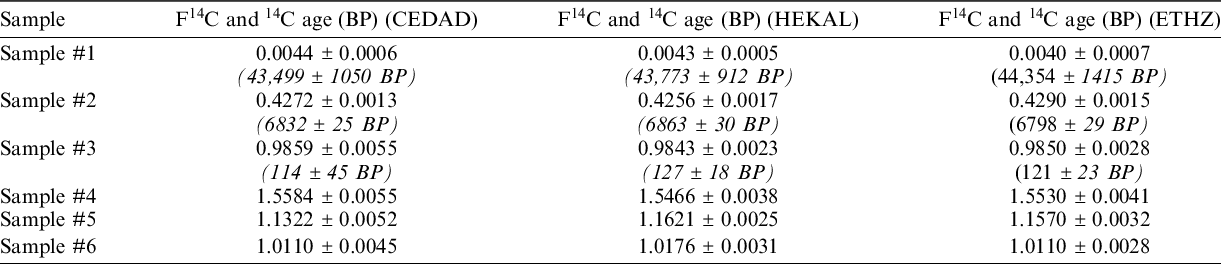
The results obtained for the 18 samples in the three laboratories are shown in Table 2. Figure 1a shows the results obtained for sample #1, which was expected to give an infinite age. We can see that the three laboratories gave consistent results overlapping within one standard deviation and corresponding to an average value of 0.00425 ± 0.0002 corresponding to 43.9 ka in the radiocarbon timescale. The measured 14C content is in agreement with previous determinations carried out at HEKAL on a large number of subsamples obtained from the same material (n = 60) and giving a F14C=0.0041 ± 0.0013. The results obtained are then a strong indication of good reproducibility and the capability of the three laboratories to keep the procedural blank under control also when the complex collagen extraction procedure is involved.
Measured 14C concentrations. Conventional 14C ages are given between bracket when positive. Quoted uncertainties refer to one standard deviation confidence level.
14C concentrations measured for sample #1 (a) and sample #2 (b).

Remarkable agreement at the one standard deviation level is obtained among the results also for sample #2 (Figure 1b). In this case, the average 14C age is 6830 ± 32 BP where the uncertainty is calculated as standard deviation of the three measured values. This value is consistent at the 1σ level with the expected age of 6862 BP, measured at HEKAL in a previous study involving a much larger set of samples.
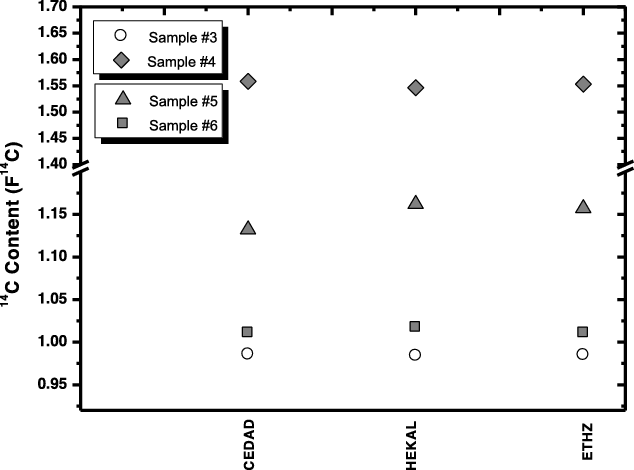
Samples #3–5 were already measured at CEDAD in 2016 and it was possible to make a comparison with previous results (Table 3). It can be seen that the values measured in 2019 agree within one standard deviation with previous measurements pointing towards a good repeatability of the measurement over time. The results of the intercomparison measurement on the last four samples are shown in Figure 2. For sample #3, all the laboratories measured consistent results corresponding to a combined pre-bomb age of 124 ± 14 yr BP and a relative uncertainty (calculated as standard deviation of the three measured values) of 0.8‰. In order to highlight the impact of calibration on the final uncertainty on the calendar age in periods where the curve shows plateaus (such as from the end of the 16th century to 1950 CE), we show that the even the measured uncertainty of only 14 years on 14C age would correspond to two possible intervals: 1686–1732 and 1806–1927. This demonstrates the limitations in resolution achievable by 14C-dating in this time range. Also, for sample #4 the results are fully consistent with an average post-bomb value of 1.5527 and a relative scattering of 0.37%.
Comparison between the radiocarbon concentrations measured at CEDAD in 2016 and 2019 for samples #3–5.

14C concentrations measured for samples #3–5 (error bars smaller than symbol sizes).
For ivory sample #5 the difference between the values measured by the laboratories seems larger than for the other samples and ranges from 1.1322 ± 0.0052 to 1.1621 ± 0.0025. A possible explanation for this may be variations of the radiocarbon concentration due to different time of formation and carbon fixation within the ivory. Indeed, the two values of 1.1322 ± 0.0052 to 1.1621 ± 0.0025 would correspond (Figure 3) to a dating to 1957 or 1957/1958 (then giving consistent ages) or to 1989–1990 and 1990–1994 with a difference of only two years which can be easily explained considering the dimension of the analyzed sample (6–7 cm) and the typical growing rate of elephant tusk of ∼4 cm/yr (Uno et al. Reference Uno, Quade, Fisher, Wittemyer, Douglas-Hamilton, Andanje, Omondi, Litoroh and Cerling2013).
Calibration obtained with the software OxCal v4.4 and the Northern Hemisphere zone 1 bomb curve of the measured 14C concentrations for sample #5.

Consistent results are obtained also for sample #6 (a modern pig leg) for which an average value of 1.0132 ± 0.0038 is obtained. This value shows a 14C atmospheric level approaching pre-bomb values and it is in good agreement with the value extrapolated for 2018 from monthly mean atmospheric values measured for the Northern Hemisphere (Hammer and Levin Reference Hammer and Levin2017).
A more detailed statistical analysis of the results was performed by using the z-score which give information about precision and accuracy of the results. For this reason, a z-score was calculated for each measurement as:
 $$z = \displaystyle{{{{x_m} - \overline {{x_m}} } \over {{\sigma _p}}}}$$
where ${x_m}$
is the measured value for a single laboratory,
${x_m}$
is the measured value for a single laboratory, ${\overline {{x_m}} }$
is the corresponding average value and
${\overline {{x_m}} }$
is the corresponding average value and ${\sigma _p}$
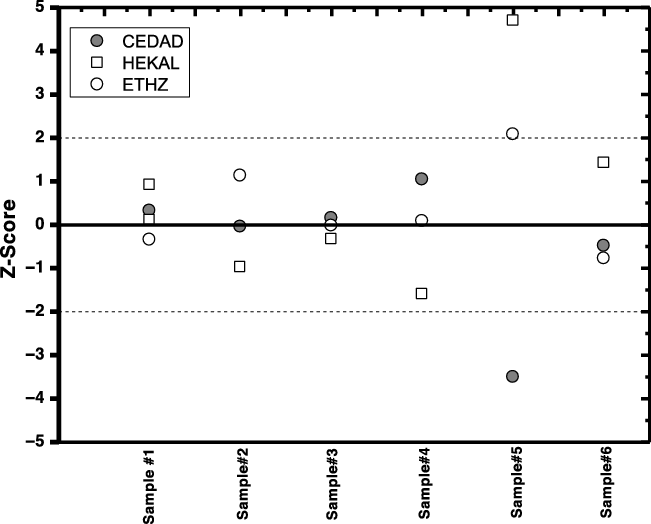
the associated uncertainty as reported by each laboratory. It is assumed that z should be normally distributed with zero mean and variance 1, where a z-score between –2 and +2 is considered as complying with fitness purposes (Scott et al. Reference Scott, Cook and Naysmith2010). The scatter plot of z-scores is shown in Figure 4 for all the analyzed samples and for the three participating laboratories. It can be noted that all the values lie within the ±2σ band, indicating a good statistical agreement between the results. The only exception is represented by the results obtained for the sample #5 of ivory for which a larger scattering of the data is observed. As it has been already discussed this is probably associated with a difference in the 14C content from different parts of the ivory sample. The average Z value is very close to 0 (0.16) and the variance is 1.67 (which becomes 0.8 when the data obtained for sample #5 are removed from calculations), pointing towards a very good consistency between the data obtained by the three laboratories.
${\sigma _p}$
the associated uncertainty as reported by each laboratory. It is assumed that z should be normally distributed with zero mean and variance 1, where a z-score between –2 and +2 is considered as complying with fitness purposes (Scott et al. Reference Scott, Cook and Naysmith2010). The scatter plot of z-scores is shown in Figure 4 for all the analyzed samples and for the three participating laboratories. It can be noted that all the values lie within the ±2σ band, indicating a good statistical agreement between the results. The only exception is represented by the results obtained for the sample #5 of ivory for which a larger scattering of the data is observed. As it has been already discussed this is probably associated with a difference in the 14C content from different parts of the ivory sample. The average Z value is very close to 0 (0.16) and the variance is 1.67 (which becomes 0.8 when the data obtained for sample #5 are removed from calculations), pointing towards a very good consistency between the data obtained by the three laboratories.
z-score scatter plot for all the analyzed samples and for the three participating laboratories.
CONCLUSIONS
In the framework and under the auspices of IAEA, an intercomparison exercise was designed and run to check the level of reproducibility achievable in the AMS 14C dating of ivory and bone samples of forensics interest. Six samples were selected with ages ranging from background to 2018 and sent to the three participating laboratories. Analysis of the results supports a high level of reproducibility of the measurements, which resulted to be consistent with expected results. The scatter of the data shows that uncertainty levels of 0.1–0.3% are routinely achieved in 14C dating. It is important to note that our intercomparison study has been performed on well-preserved bones, and conclusions do not necessarily apply to all archaeological samples. Further tests are in progress on other materials of forensics interest, such as paper, paintings, food, and bio-based products of industrial interest.
ACKNOWLEDGMENTS
The work was performed under the auspices of IAEA (International Atomic Energy Agency) in the frame of the CRP (Coordinated Research Projects): Enhancing Nuclear Analytical Techniques to Meet the Needs of Forensic Sciences.
The research was supported by the European Union and the State of Hungary, co-financed by the European Regional Development Fund in the project of GINOP-2.3.2-15-2016-00009 “ICER.”
The 14C analyses at ETH Zurich were supported by the Laboratory of Ion Beam Physics, ETH Zurich.


 Open access

