


Introduction
The intensification of food insecurity around the world arising from armed conflict and political instability, climate change, and economic hardships has increased the need for food assistance globally, with 2.4 billion people considered food insecure.Reference Dasgupta and Robinson1–3 In the short term, food aid can be a viable solution to sustain populations, particularly if the food basket is comprised of nutritious foods.Reference Iannotti, Kleban and Fracassi4 One example is fortified peanut butter pastes, which have been successfully used as food aid globally both in treatment and prevention of malnutrition,Reference Dewey, Stewart and Wessells5 including in Haiti, where this study team’s previous research demonstrated positive impacts on nutrition of young children and school-age children.Reference Iannotti, Dulience and Green6, Reference Iannotti, Dulience and Joseph7 Most US food assistance, however, is comprised of US-grown surplus commodities (corn, wheat, rice, soybean) which, when consumed in isolation, have inadequate nutritional value for vulnerable populations.Reference Schnepf8
Attempts have been made to improve the quality of food aid for nutritionally vulnerable groups. Historically, the term “blended foods” represented a set of products developed under the United States Agency for International Development (USAID) Food for Peace Program [US Public Law 480 (PL480)] designed to protect young children and pregnant/lactating women (PLW).Reference Ignowski, Volin and Cabrera9 These blended foods and fortified products under PL480 range in ingredients—cereals (corn, wheat, rice), legumes (peas, soy), and oils—and vary in nutritional quality.10 Some countries have incorporated other foods produced locally to enhance nutritional quality and support local production and economy.Reference Affonfere, Chadare and Fassinou11, Reference Agbemafle, Hadzi and Amagloh12 In recent years, there has also been a concerted effort to incorporate locally sourced foods into school feeding programs with some success.13 While progress has been made globally, this approach has not been widely applied in Haiti to date, where food aid has instead consisted of US-grown surplus commodities. More evidence is also needed on how food assistance can fill nutrient gaps for undernourished children and PLW.Reference Webb, Caiafa and Walton14
In response to this, a large-scale PL480 development program called Ayiti pi Djamn (ApD) or “Stronger Haiti” in Haitian Creole, was launched by USAID in 2022 and led by consortium partner, Catholic Relief Services (CRS).15 The broader goal of ApD was to improve food and nutrition security and enhance resilience to shocks. ApD’s programmatic interventions focused on sustainable management of natural resources through farmer education and demo plots, nutrition and water, sanitation, and hygiene (WASH) education within the community, and investment in local production infrastructure to address nutritional gaps through new blended food products.15 Washington University in St. Louis (WashU) was tasked with the formative research to generate evidence intended to inform programming and specifically, here, the development of these blended food products. The overall objective of this research was to develop two blended food products using a food aid commodity provided by USAID, combined with locally sourced ingredients that are nutritionally appropriate and acceptable to targeted communities.
Methods
Investigators from WashU collaborated with staff from CRS and GAPL, a local food production company in Haiti, to undertake this formative research. Approval was received from Le Comitè National de Bioèthique in Haiti (Rèf: 2223-16; 2223-42; 2324-12) and the WashU Institutional Review Board (IRB ID: 202212070) to conduct the human subjects research components. Informed consent was obtained from each participant before data collection commenced. Enumerators verbally read through each page of the consent form, which included sections on anonymity and confidentiality of participants; how participants’ data would be secured; and that their participation was voluntary and they could withdraw from the study at any time without penalty or fear of retribution. Once the recitation of the consent form was completed, the participants signed or marked their consent on the form, and the hard copies were stored in a secure location. A set of activities was then carried out to accomplish the overall objectives of the research. Given the short timeframe of this project, Objectives 1 and 2 were carried out concurrently, and Objective 3 followed. Since each one employs distinct methodological approaches, the sections are organized by study objective.
Objective 1: Identify optimal blended food recipe options using local flours. The blended food product was intended to be used in the food aid programming of CRS as well as brought to markets for sale. Prototype recipes were informed by nutritional needs in the community through feedback from program participants (see Objective 2), ingredient availability and cost, and stakeholder inputs from the matrix scoring. Representatives from the three partner institutions—GAPL, CRS, and WashU—contributed their expertise toward the final prototypes: GAPL provided technical advice in local food production and advised on the availability of locally sourced ingredients. CRS supplied the Title II food aid commodity (corn) to be used in all recipes. Additionally, CRS would provide investment in GAPL’s production capability to help GAPL scale the product for consumer consumption. WashU provided technical inputs into the nutritional value of potential ingredients and led the qualitative research in Objective 2 to help integrate program participant feedback. The final criteria included in the matrix scoring exercise were determined by consensus: processing feasibility; potential impact on young child nutrition; impact on maternal nutrition; preparation time; opportunity for local farmers; local availability; cost; shelf life; and do no harm. Additionally, the team compiled a comprehensive list of potential ingredients to be assessed using the criteria.
This study then applied a Matrix Scoring Exercise to a set of key stakeholders identified by CRS (program staff at NGOs, local producers, researchers; n = ~10) to rank and prioritize ingredients (Table 1). Included stakeholders were those in leadership positions and key staff involved in food assistance and production programs at GAPL, CRS, and WashU. Excluded individuals were those outside of these organizations and not involved in food assistance and production programs. An electronic copy of the Excel sheet matrix was sent to the stakeholders by email, asking them to return the sheet without identifiers so responses could be recorded anonymously. Stakeholders were presented with a list of ingredients and asked to evaluate each potential ingredient on a scale from 1 to 4 for each criterion, with 1 representing the worst or less favorable outcome and 4 representing the best or most favorable outcome for that criterion. These ingredients were then discussed on virtual biweekly calls over a 6-month period by the stakeholders to advance progress on the development of the two prototypes. GAPL conducted experimentation to determine the optimal proportions of ingredients for each of the blended food products, focusing on enhancing palatability. Marketing of products, including packages, label content, and messaging for promotion, was discussed.
Table 1. Matrix scoring exercise of potential ingredients

Once prototype recipes were finalized, the WashU team analyzed nutrient composition with the United States Department of Agriculture’s (USDA) FoodData Central, an integrated, comprehensive database providing nutrient profiles on a broad set of foods. Each ingredient in the prototype recipes was individually searched for in this database. The team selected the most appropriate form of each ingredient to align with the recipe’s composition. Nutritional data for macronutrients and micronutrients were extracted and adjusted based on each ingredient’s percentage contribution to the total product weight (145 g). The total weight was determined based on processing equipment specifications and cost constraints in production for GAPL. These adjusted values were summed to estimate the overall nutrient composition during preliminary analyses. This preliminary analysis was done to estimate the nutritional quality of the recipes. However, in the later stages of product development, it was necessary to test the final product to have accurate nutrient concentrations for labeling and marketing purposes.
Objective 2: Assess behaviors, attitudes, and practices around the use of blended foods among nutritionally vulnerable groups in Haiti. ApD defines “blended food” as a product made by combining a food aid commodity with locally grown ingredients, which are then processed into a flour that can be reconstituted into porridge. However, it was unclear whether this was consistent with the Haitian understanding of “blended food.” Focus group discussions (FGDs) comprised of 8–10 participants were conducted to understand current practices, attitudes, and behaviors related to blended foods currently used in Haiti, and provided an opportunity for participants to give feedback to GAPL on the prototypes being developed. Drawing on grounded theory, methodologies provided in the literature for consolidated criteria for reporting qualitative research were utilized (COREQ).Reference Tong, Sainsbury and Craig16
As a first step, communities within the planned ApD program catchment area were selected using purposive sampling. Selection criteria included having a high density of ApD programming, comparable socio-economic characteristics, and willingness to participate. Exclusion criteria were those communities outside the program catchment area and not involved in CRS programs. Four communities from the North East Department (Carice, Mombin Crochu, Mont Organisé, Sainte-Suzanne) and two from the South Department (Chardonnières, Roche-à-Bateau) were included (Figure 1). GAPL’s goal was to scale the prototype across Haitian markets. By selecting geographically diverse locations, FGDs would capture varied perspectives on blended foods, cooking practices and ingredients used, and products available in the local markets.

Figure 1. Map of study communities.
Enumerators were recruited and hired from the study sites and from the l’Université Publique du Nord au Cap-Haïtien (UPNCH)—a partner institution of WashU. Students and graduates from UPNCH came from the undergraduate degree program in public health, social work, and tropical medicine. Enumerator training took place in November and December 2022 over 2.5 days. Technical experts from WashU and CRS led the training, providing instruction on general human subjects ethical principles and formative research methods, along with reviewing all 4 scopes of work to be covered in the formative research.Footnote a During the training, enumerators also conducted practice focus groups first with each other and then with a group of volunteer mothers. The leaders of the training then provided feedback and processing.
Following the training, enumerator teams traveled to communities to begin recruitment processes. A mix of purposive and convenience sampling was used for recruitment. CRS provided the enumerator teams with lists of volunteers participating in other ApD programs, who were also living in the target communities. The initial list was reduced to encompass only those who fit the enrollment criteria for the focus groups: caregivers, both men and women, of young children ages 1-5 years (to ensure children were in the complementary feeding period or beyond) and PLW. Once this list was finalized, the enumerators contacted individuals by phone and in person during ApD programs to ask about their willingness and availability to participate. Those who agreed were consented and enrolled to participate in the focus group. A focus group guide, which was initially designed by investigators and further refined with feedback from the enumerator team and field director, provided the basis for discussion with additional probing by enumerators to allow conversations to flow in different directions as needed (Table 2). Focus groups were conducted in central community locations in a room separated from any non-participants. Field notes were taken in addition to the audio recordings.
Table 2. Focus group questions

Data preparation and analyses
Focus group discussions were conducted in Haitian Creole, audio-recorded, transcribed, and de-identified, and translated into English for thematic analysis. (Due to resource [time and funding] constraints, back translation to Haitian Creole was unable to be carried out for analyses.) Three investigators individually reviewed all the transcripts for themes and recorded them in Excel to create a comprehensive codebook. Once completed, they met together to discuss any discrepancies and finalize the codebook. One investigator then coded the full dataset using NVivo software to identify themes related to the primary research questions. Mention frequencies of foods used as ingredients in blended foods were counted and recorded. The 3 investigators reviewed the coding reports to ensure full agreement on how the data were coded.
Objective 3: Evaluate the nutrient composition of prototype blended food product relative to nutrient requirements for vulnerable groups. Drawing on data from Objectives 1 and 2, GAPL developed two blended food prototypes, one sweet and one savory. For the prototypes, corn was provided to GAPL by ApD as a Title II food commodity to be used as a base for the recipes. GAPL purchased all other produce, except for sweet potatoes, directly from local planters. Through GAPL’s partnership with AGRILOG17—a Haitian initiative to support local farmers in implementing innovative agricultural practices to improve livelihoods in Haiti—they were able to grow and harvest the sweet potato in the AGRILOG fields for the sweet blended food prototype.
The GAPL sweet blended food was selected based on the feasibility of scaled production and acceptability by participants to be tested for nutrient composition by Certified Laboratories. This was necessary in order to have accurate data for marketing and labeling products. Two pounds of the blended food product were shipped to Certified Laboratories in New York to compare with calculated estimates. A set of nutrients to be tested in the GAPL sweet blend was identified by WashU investigators, which took into consideration nutritional guidelines and their significance to maternal and child health, and tested using different assays (Table 3). All samples were homogenized prior to testing and were extracted as needed prior to analysis.
Table 3. Laboratory assays for nutrient composition analysis

Most macronutrients were measured using the Association of Official Analytical Chemists International’s (AOAC) standardized methods. Protein content was determined by the Kjeldahl method, measuring total nitrogen content and the appropriate conversion factor (6.25). Fatty acids were analyzed using AOAC Ce IJ-07 employing acid hydrolysis. Carbohydrates were profiled through a difference calculation (the residual weight after subtracting amounts of water, protein, fat, and ash found by analysis). For vitamin A, the AOAC 2001.13 and AOAC 938.04 were used to measure retinol and beta-carotene, respectively. Vitamin E was also measured through the AOAC 2001.13 method using saponification, extraction, and high-performance liquid chromatography (HPLC) with ultraviolet. B vitamins were assessed by R-Biopharm VitaFast, which employs microbiological assays. Vitamin D was measured via AOAC 2011.11 using liquid chromatography mass spectrometry (LC-MS/MS), and vitamin K analysis by HPLC involved extraction and chromatographic separation. Choline was quantified through the modified AOAC 999.14, using enzymatic digestion and fluorometric detection. Calcium, magnesium, and potassium were analyzed by the Food and Drug Administration’s (FDA) Elemental Analysis Manual (EAM) 4.4, and trace minerals including copper, iron, manganese, selenium, and zinc by FDA EAM 4.7, undergoing acid digestion and analysis by inductively coupled plasma optical emission spectroscopy (ICP-OES) through emission spectra.
Once the nutrient panel was complete, the nutritional quality of the product relative to the Dietary Reference Intakes (DRI)18 for 4 vulnerable population groups was evaluated: 7-12 m children; 1-3 yr children; pregnant women; and lactating women. For children, estimates were calculated for the percentage of Recommended Daily Allowances (RDA) or Adequate Intakes (AI) met by the product. No exact target percentage of calories for food aid baskets exists. Portion size was approximated using 25% of daily energy needs (to ensure the child receives other foods important developmentally for both meeting nutrient requirements and taste/texture exposures). For PLW, estimates for the RDA met were based on consumption of the entire product (145 g).
Results
Objective 1: Matrix scoring and optimal recipe design. Results from the Matrix Scoring Exercise appear in Table 1. Fish (2.95) and milk (2.9) powders received the highest average score, indicating favorability by the stakeholder groups, followed by insect powder (2.8) and eggs (2.55). Among the carbohydrates, corn (2.4) and cornmeal (2.35) ranked high, followed by breadfruit (2.3) and sweet potatoes (2.2). Vegetables scoring high were sweet potato leaves (2.3), spinach (2.1), and carrots (2.0). Fruits had lower scores, with only mango making the list at dried (1.95) and fresh (1.55). After several discussions with the blended food team, insect powder was removed from consideration due to cultural reasons. Although ranked highly, eggs were deemed challenging to source locally. The group agreed that leaves of various plants (sweet potatoes, spinach, cassava) could be mixed or used interchangeably.
The GAPL sweet blended food recipe was finalized and named, Fierte’m, Bébé Djanm (My Pride, Strong Baby) (Figure 2). This product (145 g) contains: 50% corn (Title II food aid commodity); 30% sorghum; 10% sweet potato; and 10% milk powder. GAPL has also produced a preliminary recipe for the savory blended food containing 50% corn; 30% fish powder (herring or cod); and 20% leaves (sweet potato, cassava, and spinach). Due to constraints in accessing fish powder, however, this product has not yet been produced at scale.

Figure 2. Fierte’m, Bébé Djanm (My Pride, Strong Baby) package.
Objective 2: Focus groups for behaviors, attitudes, and practices. Each focus group discussion comprised approximately 10 participants from all sections in the communes to ensure representation of diverse lived experiences. While traditional gender norms do exist in Haiti, enumerators took time to build rapport with the group and ensure each participant had a chance to share openly and were not discouraged in their responses. Additionally, participants had a level of familiarity with one another due to participation in other ApD programs, which lent to easier conversation throughout the FGDs. Focus groups were held in each of the communities: Carice, Mombin Crochu, Mont Organisé, Sainte-Suzanne, Chardonnières, and Roche-à-Bateau, with two conducted in Chardonnières. A total of 66 individuals participated across the 7 focus groups: Carice with 8 participants (6 women, 2 men), Mombin Crochu with 10 participants (8 women, 2 men), Mont Organisé with 8 participants (6 women, 2 men), Sainte-Suzanne with 10 participants (9 women, 1 man), Roche-à-Bateau with 10 participants (10 women), and two in Chardonnières with 10 participants in each (20 women). The findings are presented and organized by focus group discussion questions, highlighting recurring themes reached by saturation and illustrative quotes.
Consumption of Blended Foods
The enumerators inquired about the caregiver’s familiarity with blended foods, the types of blended foods that families consume, their beliefs about how healthy blended foods are, and whether participants’ children like them. Focus group findings showed that blended food (manje melanje in Haitian Creole) is commonly consumed across the study communities and was therefore a known commodity to participants. The FGDs suggested that participants consider the term “blended food” as meaning one of two general categories: porridge (also known as blended flour (farin melanje), like the GAPL prototypes), and soup (considered “blended” as they are made with a variety of ingredients and commonly consumed by infants during complementary feeding). Discussion centered mostly on the former type of blended food (farine melanje), referred to as “blended food” or “blended flour” throughout this paper, which is reconstituted with a liquid and mixed with other ingredients. In both the South and North East, carbohydrate-rich staples are the base of the blended flours and include corn, plantain, cassava, potato, sweet potato, yams, and other tubers, and rice.
Attitudes were generally positive toward blended foods in terms of both palatability and nutrition. Caregivers stated the overall acceptability of blended food by their children, with only one caregiver expressing that their child did not like to eat porridge. Caregivers considered them healthy and articulated several potential health advantages coming from these foods, including growth, development, and immune protection. Across the communities, caregivers communicated common Ministère de la Santé Publique et de la Population (MSPP or the Ministry of Population and Public Health in English) messages for particular food groups associated with the Haitian food pyramid: konstwi kὸ (animal-source foods (ASF) for “building the body”); bay fὸs (starch foods for “giving energy/strength”); and pwoteje kὸ (fruits and vegetables for “protecting the body”) (Figure 3).
these foods would be good for nourishing the child’s body. You would find this food protects their bodies, sustains their bodies, builds their bodies.

Figure 3. Haitian food pyramid.
The concept of balanced nutrition was communicated by caregivers, who shared that they used a variety of ingredients in the porridge. Several caregivers also mentioned vitamins in association with blended food.
blended food is food that is balanced food … Meaning it has the three kinds of things in it. Like, there are foods that give the body strength, that protect the body, that build the body.
because children, when you give them food and they eat it, they gain weight. That means the food is fortified and has other vitamins.
Some caregivers made connections between specific nutrients or particular foods and certain health conditions. In one community, caregivers recognized the importance of foods for health and preventing anemia. One mother astutely described the role of vitamin C in protecting gum health.
they prevent them from being sick, they keep them from being sick with…what is it called … the ones that the children have, but if I look for foods with vitamins it keeps them from getting sick, like anemia.
Things that have vitamin C are things that are sour. It is good for the children’s gums … Vitamin C protects the gums of children when they are teething.
Market Access
The enumerators also inquired about whether participants make the blended foods themselves or whether they purchase them. For purchased blended food products, further inquiries about the cost and where they could purchase them were made. The most commonly mentioned price from the market was 100 HTG per packet (USD 0.68), though quoted prices and quantities sold varied in some communities—50 HTG (USD 0.34), 75 HTG (USD 0.51), 200 HTG (USD 1.36).Footnote b
There were some differences in market access between the North East and South communities. In the North East, blended foods were often imported from the Dominican Republic and purchased in the markets or, to a lesser extent, made in Haiti and sold locally. In the South, purchased blended flours are sold in Les Cayes, a port city. Across all communities, caregivers shared that they often make their own blended foods for their children. However, they expressed a desire to purchase blended food packets to make porridge instead, but price and lack of financial means were barriers.
sometimes you might want to manage the child well, but you don’t have the financial means. There are some things that you can give the child to eat, but there is no possibility to buy them to give them. So [from] what you eat you, find a little something to give to the child that can help you feed the child.
other flours in the market, we don’t find them, we can’t buy them, we can’t afford them. We can’t buy in the market.
Preparation of Blended Foods
As part of the focus group discussions, participants were asked about how they made their own blended foods and what ingredients they used to prepare them for their children to eat. Participants were further asked about how blended foods can be improved nutritionally. Caregivers reported preparing blended flours themselves in labor- and time-intensive processes. The general sequence of preparation activities followed this pattern with some variation depending on the base food types: chopping, peeling, and/or grating → roasting → drying (in the sun) → grinding or pounding → straining. Caregivers described the use of sun for drying and risks with rain for spoilage. A dependency on environmental conditions was expressed by one mother.
when there is rain they cannot make the flours, it’s not that it’s not good for the body but it’s not easy to make without it spoiling, especially in periods of rain and you can’t dry the foods in the sun
Additional ingredients are not typically added to the blended flour while it is being prepared. However, focus group findings did suggest that there are cultural preferences for particular ingredients that are used while cooking porridge. Foods and spices added to blended foods were for: (1) nutrition and health reasons; and (2) for palatability and acceptance reasons. Of the ASFs, milk was most often reported added to porridge. Fruits were not common, with only ripe banana mentioned as an ingredient they could mash and add to the child’s porridge. A preference was expressed thematically for fish powder by caregivers as a product they would use if it was available and affordable to boost nutrition. Other flours made from spinach, sweet potato, sweet potato leaves, carrot, or mango were considered acceptable but not available or currently used as or in blended foods.
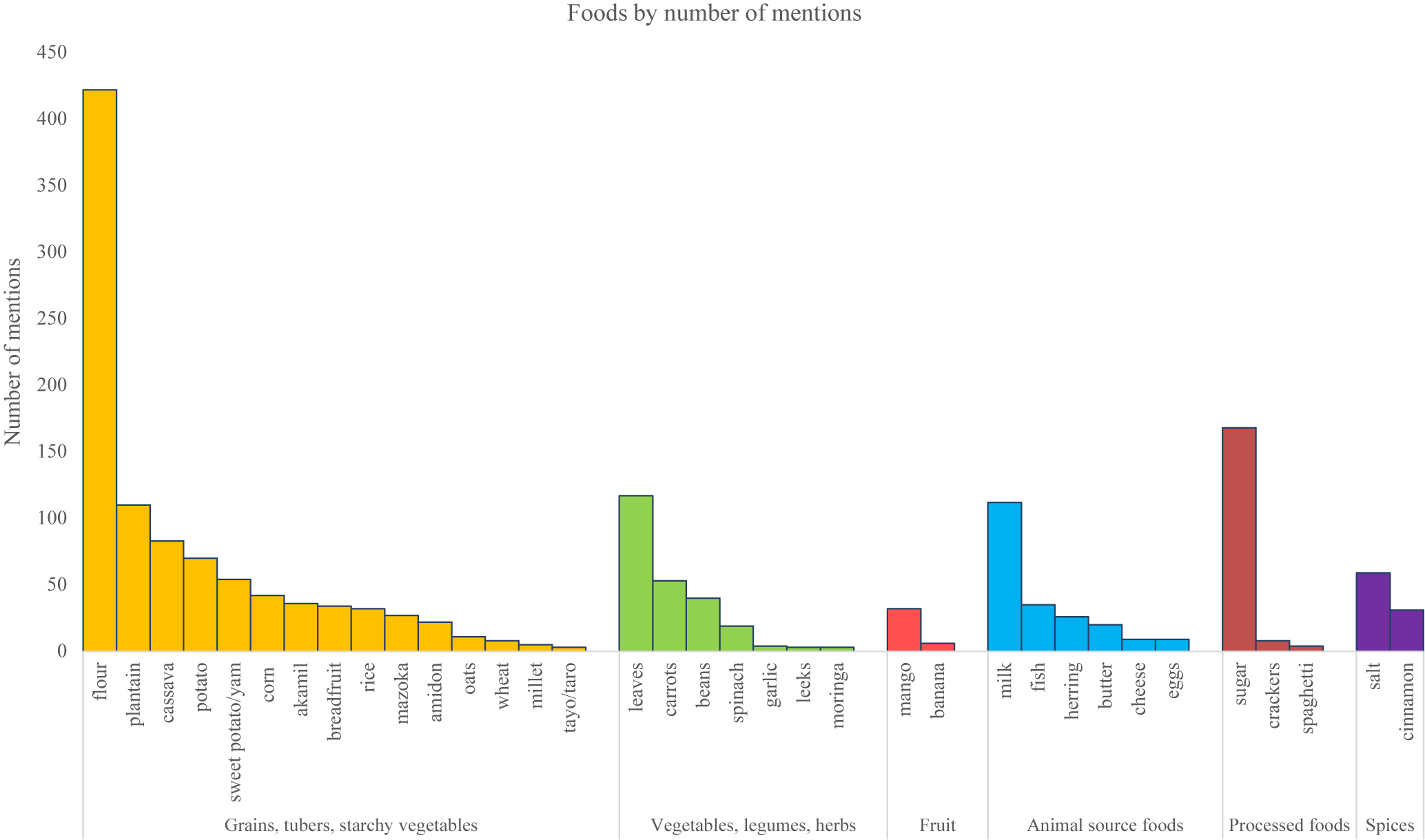
A common theme across all study communities was the use of sugar, salt, and cinnamon to increase palatability and consumption of porridges made from blended flours by young children. Sugar was mentioned more frequently than any other ingredient except the generic term, flour (Figure 4). Sugar was added to their own sweet porridges along with milk, and cinnamon was used for taste and color. Salt was used to make a savory porridge if milk and sugar were not available. Butter, cheese, and eggs were also mentioned as additives to make a porridge savory. Both were deemed important for child consumption.
You don’t give porridge without sugar.
you can add sugar, milk to make it better. You put salt, butter, yes that makes it better … it will give a good taste
add cinnamon and boil it, and to have milk and have a good color. That makes it tastier.

Figure 4. Mention frequency of ingredients added to blended foods.
Information Received About Blended and Fortified Foods
Toward the end of the focus group discussions, the enumerators posed questions about sources of information about blended foods. Responses were minimal, possibly due to fatigue or lack of comprehension regarding the question. Most of the caregivers responding to this question reported receiving information at community health centers and their associated rally posts, delivered by nurses and community health workers, ApD-specific care groups, or through the radio.
I find it in the health center, there are also nurses who pass by and when they return, they come with health agents who come and speak about these things.
well, during the training in the care group, they showed us how to make the food for the babies. They showed us how to prepare some small meals which should have three types of food in it.
Objective 3: Blended food nutrient composition and DRIs. For infants 7–12 m, the GAPL sweet blended food provided all nutrients at levels below the 25% RDA/AI except thiamin and riboflavin (Table 4). In the older child (1–3 y), carbohydrates, vitamins B6 and E, manganese, and zinc were present in moderate proportions between 25% and 50%, and remaining nutrients fell below 20% of the DRIs. Magnesium, thiamin, and riboflavin all exceeded 70%.
Table 4. % Dietary Reference Intakes (DRI) of Fierte’m, Bébé Djanm for vulnerable populations

* “NA” signifies that there is not sufficient data for a DRI of a nutrient for the referenced population.
For the pregnant woman, one packet (145 g) of the sweet porridge product provided substantial amounts of carbohydrates (69.1%), manganese (66.4%), thiamin (305.6%), and riboflavin (379.6%). Other nutrients met a smaller proportion of the DRIs (25–50%): vitamin B6, vitamin E, magnesium, potassium, and zinc. The product met similar DRI proportions for lactating women with carbohydrates (57.6%), magnesium (52.3%), and manganese (51.1%) in higher quantities; vitamin B6, vitamin E, iron, potassium, and zinc in modest amounts (25–50%). Thiamin and riboflavin, two B vitamins essential to cellular functions, were abundant in the GAPL sweet blended food product, with more than 100% in all categories. The risk of vitamin toxicity among these is very low. There are no well-documented toxic effects from consuming excess thiamin in food or from long-term oral supplementation due to its water-solubility.
Discussion
This mixed methods study applied evidence-based processes and community engagement to develop a culturally appropriate blended food product containing Haitian-grown ingredients and a Title II PL480 commodity, corn. The findings from the different methods directly associated with the study’s objectives were synthesized to present a unified narrative that guided the formative development of the blended food prototypes. Through consensus building and a quantifiable matrix scoring exercise, a set of local ingredients was prioritized that could protect vulnerable group nutrition, optimize production feasibility, and support Haitian farmers. Focus group discussions in communities showed generally positive attitudes toward blended foods in general in terms of healthy eating and balanced nutrition. Participants shared a willingness to purchase new blended food products made with local Haitian-grown ingredients, indicating a possible opportunity for local companies like GAPL to expand their markets.
Blended foods containing Title II commodities and locally and sustainably sourced ingredients may mitigate some of the harmful impacts on nutrition and local economies. Over the past 2 decades, efforts have been made to improve the quality of blended foods, including improving nutrient content and increasing viscosity for products for young children. The USAID Food Aid Quality Review (FAQR) project (2009–2021) was created to generate evidence-based recommendations for more nutritionally appropriate and cost-effective formulations for blended foods. It later expanded its mandate to examine programming from procurement to delivery and food matrices, bioavailability, and packaging.Reference Ignowski, Volin and Cabrera9 At the close of the project, FAQR convened experts to generate a set of consolidated priorities to improve food aid quality, some of which have relevance to the findings here: cost-effectiveness; sustainable change through food assistance; effectiveness at scale; and ASFs.Reference Ignowski, Volin and Cabrera9
The two GAPL prototype products that emerged from this research both contained ASFs but in minimal quality relative to the corn flour base. Both the sweet and savory blended food product recipes were comprised of 50% corn flour (provided by USAID to ApD), in large part due to the higher costs of sourcing and processing other ASF ingredients. Corn contains phytates that can interfere with mineral absorption and disrupt protein and lipid metabolism.Reference Castro-Alba, Lazarte and Bergenståhl19, Reference Kumar, Sinha and Makkar20 ASFs, by contrast, contain several bioavailable nutrients and can enhance mineral absorption and metabolism.Reference Shapiro, Downs and Swartz21, Reference Iannotti22 Nearly all participants indicated they add sugar or salt to their own blended foods for palatability, which likely would continue with a purchased product. This practice could have potential health implications. Adding whole ASF ingredients, like fish, egg, or milk powders, could greatly enhance nutritional qualityReference Borg, Sok and Mihrshahi23–Reference Upadhyay, Taneja and Strand25, and potentially increase the marketability of locally sourced blended food products. FGD findings indicated participant interest in these ingredients and should encourage local producers to continue to explore how to increase utilization of ASFs in their blended food products to fill nutrient gaps.
Several fruits and vegetables were considered in the design phase of the recipes, though ultimately little or no quantities of these food groups were included. The sweet blended food product selected for wide-scale production by GAPL contains sorghum and sweet potato, classified as cereal and tubers, respectively, and the savory blended food product contained leafy greens from sweet potato, cassava, and spinach plants. There is some evidence supporting the use of these foods or other legumes (e.g., cowpeas) to improve nutrition outcomes.Reference Adetola, Kruger and Ferruzzi26, Reference Delimont, Vahl and Kayanda27 Other types of nutrient-dense, abundant foods from plants from Haiti could further be explored—mango, citron, carrots, avocado, cashews, etc.—to enhance the nutritional quality and sustainability of the blended food.
Opportunities and challenges were evident in the common themes emerging from the focus groups with pregnant women and caregivers. Notably, participants expressed generally positive attitudes about the blended foods and the idea that a variety of ingredients conferred balance. Some referred to the MSPP food pyramid and particular foods that build strength, energize, and protect.28 This connection and knowledge base about dietary diversity could be reinforced on blended food packaging and behavior change communication channels.
Barriers to the use of blended foods purchased from markets were also expressed, with cost as the most common concern. The price of commonly found blended food products in markets averaged 100 HTG (USD 0.68)29 per packet, which constitutes a significant proportion of the average daily income of USD 4.64 (gross domestic product [GDP] per capita in 2023 was USD 1,694.10) and is likely to fluctuate with food price inflation in Haiti.30 Although findings from the matrix scoring rated ASFs high, cost, which was the major driving force behind the final recipe ingredients, was a barrier to its inclusion. This, coupled with inconsistent availability, drove down the quantity of ASFs and, consequently, nutrient quality.
Common across all communities in this study was the addition of sugar, salt, and cinnamon by participants to blended foods, whether homemade or purchased, to improve taste. This study team’s previous research in Cap-Haïtien similarly showed a common practice for giving sugar-sweetened foods to young children, potentially increasing risks for overweight/obesity and chronic diseases later in life.Reference Lesorogol, Jean-Louis and Green31 In Haiti, there is a national trend showing increasing overweight and obesity rates, especially among women, signaling a shift in nutrition habits, with 32% of women of reproductive age being overweight or obese.32, Reference Morshed, Becker and Delnatus33
Limitations
Some limitations were present for this research. Political and economic instability of the country impeded study team logistics, together with the high cost of fuel and border closures. For the qualitative research, focus groups were undertaken, but due to increased political insecurity impacting timeline and budget, the key stakeholder interviews were unable to be conducted (estimated to be around 8-10). Although initially GAPL planned for a savory product that could feasibly be brought to market, delays in accessing ingredients and costs prevented this product from moving forward to scale. Finally, the cost of ingredients was a limitation in terms of optimizing the nutritional quality criterion of the blended food.
Conclusions
Locally produced blended foods combined with food aid can help bridge the gap between humanitarian assistance and long-term food system resilience in Haiti. These types of products have greater potential to support the nutrition of vulnerable groups and improve the livelihoods of local farmers. This study showed opportunities in the common perceptions that blended foods are healthy and balanced and have the potential to reduce women’s time and labor burden of preparing their own blended flours, improving their chances of adoption in the local market. However, feasibility in terms of production costs and market prices remains a barrier to large-scale production.
Acknowledgments
This research would not have been possible without the generous support of the United States government through the United States Agency for International Development and the Bureau for Humanitarian Assistance, including technical guidance for all refinement studies. This work was supported by the Catholic Relief Services (subreceipt grant number No. HT.22.SUBAGR.20648.68906.01.00) under the United States Agency for International Development (USAID) Federal Award (FAIN No. 720BHA22CA00003).
We would like to acknowledge the hard work of the WashU field team: Sandia Saintilmond (supervisor Nord-Est); Kender Asmate (supervisor Sud); and all the enumerators. The authors of this report would like to express our gratitude to the Catholic Relief Services team for enabling the research: Beth Carroll (Chief-of-Party), Laura Phelan (Strategic Learning Advisor), Stephan Saoud, Stephan Jean-Pierre (Private Sector Engagement Advisor), Myrlande Feuille (MEAL Lead), and Blain Cerney (acting Strategic Learning Advisor). As well, we wish to thank the many partners involved, including and especially GAPL: Jean Pierre Rouzier, Maxwell Marcellin, and Charlotin Frednaud. A special note of appreciation is expressed to Dr. Joseline Marhone, Dr. Jean Denis, and Mrs. MacDaline Durosier, who offered valuable inputs into the research and participated in the final workshop. Lastly, we want to note our appreciation to the mothers, fathers, other caregivers, and various community members who engaged in the research with us.
Author contribution
Shirlie Jean Louis Dulience: Conceptualization, methodology, project administration, writing—original draft preparation, writing—review and editing. Rachel Zimmerman: Data curation, formal analysis, visualization, writing—original draft preparation, writing—reviewing and editing. Michelle Dorce: Methodology, project administration, visualization, writing—original draft preparation, writing—reviewing and editing. Ilana Seff: Conceptualization, methodology, supervision, writing—review and editing. Andrea Spray Bulungu: Methodology, Supervision—reviewing and editing. Patricia Kohl: Conceptualization, supervision—reviewing and editing. Carolyn Lesorogol: Conceptualization, methodology, supervision. Bazelais Dulience: Conceptualization, supervision, writing—reviewing and editing. Beth Carroll: Conceptualization, methodology, supervision, writing—review and editing. Myrlande Feuille: Conceptualization, methodology, supervision, writing—review and editing. Anne Gilot: Conceptualization, methodology, supervision, writing—review and editing. Lora Iannotti: Conceptualization, methodology, supervision, writing—original draft preparation, writing—review and editing.
Competing interests
None.




 Open access

