

Introduction
Guidelines published by the Society for Healthcare Epidemiology of America (SHEA) and Infectious Diseases Society of America (IDSA) have long advocated for infectious disease (ID) physician and pharmacist co-leadership in antibiotic stewardship programs. Reference Barlam, Cosgrove and Abbo1 Recognizing a gap in resources, the IDSA launched a core curriculum for antibiotic stewardship for use by clinical ID fellowship programs. Reference Luther, Shnekendorf and Abbo2 The course has been a success with over 159 programs adapting this material, high learner satisfaction, and the impending publication of an advanced antimicrobial stewardship curriculum. Reference Hojat, Patel and Ince3 However, subsequent qualitative work evaluating ID fellow learning preferences has suggested this foundation is insufficient in preparing trainees for stewardship practice and program leadership. The study identified a strong preference for “skills, not just knowledge” and opportunities for experiential learning in the day-to-day work of antimicrobial stewardship. Reference Wasson, Luther and Armstrong4
The Duke Center for Antimicrobial Stewardship and Infection Prevention (DCASIP) seeks to provide a robust, hands-on training experience for physician ID fellows. Training needs differ with certain fellows seeking basic competencies for ID clinical practice, while others aspire to a career in antimicrobial stewardship program leadership. To meet the needs of our ID fellows, we developed a list of core stewardship entrustable professional activities (EPAs) and tasks to facilitate competency, allowing differentiation for basic and advanced training.
EPAs are a commonly used tool in competency-based models of health professions education. EPAs are, “units of clinical practice that, as a whole, can be entrusted to a professional, or someone in training for that profession.” Assessment of competency attainment for EPAs can be performed using retrospective and prospective entrustment scales which can inform programmatic evaluations of readiness for independent clinical practice. Reference ten Cate, Hennus, ten Cate, Burch, Chen, Chou and Hennus5 We sought to create a tool to aid in the instruction and assessment of physician fellows at our institution and serve as a template for other ID physician training programs.
Methods
Antimicrobial stewardship core EPAs were identified based on published 2014 SHEA guidance for knowledge and skills required for antimicrobial stewardship leaders, CDC’s core elements of antimicrobial stewardship, and interviews with DCASIP faculty and fellowship program leadership. Reference Cosgrove, Hermsen, Rybak, File, Parker and Barlam6,7 We then identified specific tasks to be performed or resources to be discussed with mentors to facilitate competency attainment. EPAs were separated into skills we felt essential for all fellows in training (basic EPAs) and skills specific to trainees interested in stewardship program leadership as a career (advanced EPAs). Final stewardship EPAs were then mapped to Accreditation Council for Graduate Medical Education (ACGME) IDs milestones by consensus from the author group.
Results
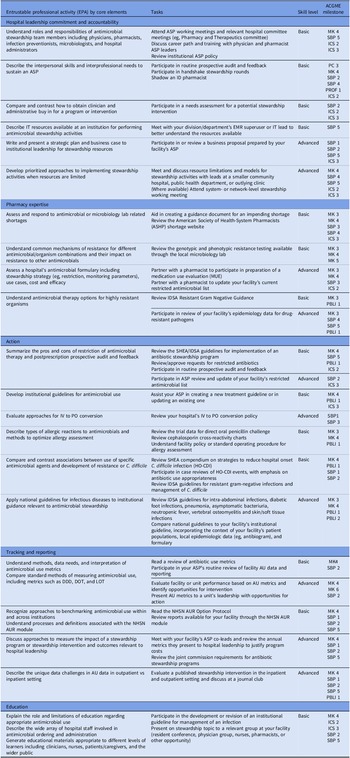
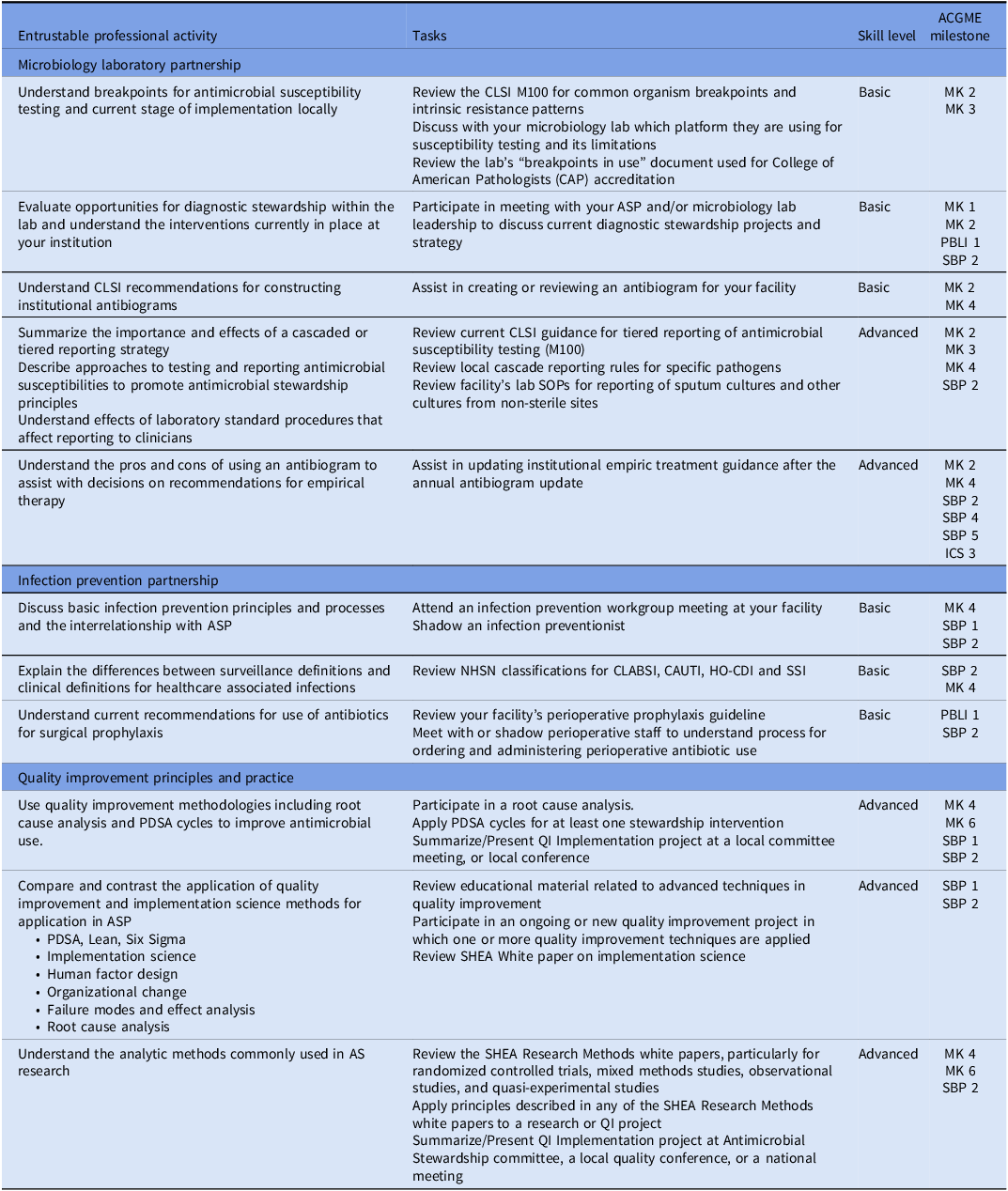
We identified 35 sets of activities (20 basic and 15 advanced) to facilitate competency attainment of EPAs needed for independent antibiotic stewardship practice. EPAs were organized around the CDC core elements of antimicrobial stewardship and key interdisciplinary partnerships. The information was organized into an easy-to-use table which we have used to track fellow development at ID fellow mentorship committee meetings. We adapted and generalized these activities to serve as a template document for other institutions to personalize with experiences at their own facilities. The final product is presented in Table 1 and Table 2.
Entrustable professional activities for antimicrobial stewardship practice, by CDC’s antimicrobial stewardship core elements

Table 1. Long description
The table presents 35 sets of activities categorized into basic and advanced levels to facilitate competency attainment for independent antibiotic stewardship practice. It is organized around the CDC core elements of antimicrobial stewardship and key interdisciplinary partnerships. The table includes columns for tasks, skill level, and ACGME milestones, with rows detailing specific activities and their corresponding skill levels and milestones. The table is divided into sections such as Hospital leadership commitment and accountability, Pharmacy expertise, Action, Tracking and reporting, and Education. Each section lists specific tasks and the required skill levels and milestones for each task. The table is used to track fellow development at ID fellow mentorship committee meetings and serves as a template for other institutions to personalize with their own experiences.
Note: Full ACGME milestone definitions and bibliography for referenced educational materials are available in the supplement.
ACGME, Accreditation Council for Graduate Medical Education; ASP, antibiotic stewardship program; ID, infectious diseases; IT, information technology; EMR, electronic medical record; NHSN, National Healthcare Safety Network; AUR, antibiotic use and resistance; DDD, defined daily doses; SOT, days of therapy; LOT, length of therapy; AU, antimicrobial use; PC, patient care; MK, medical knowledge; PBLI, practice-based learning and improvement; SBP, systems-based practice; PROF, Professionalism; ICS, interpersonal and communication skills.
Entrustable professional activities for antimicrobial stewardship partnerships and methodologic skills

Note: Full ACGME milestone definitions and referenced educational materials are available in the supplement.
ACGME, Accreditation Council for Graduate Medical Education; ASP, antibiotic stewardship program; CLSI, Clinical Laboratory Standards Institute; FDA, Food and Drug Administration; SOP, standard operating procedure; NHSN, National Healthcare Safety Network; CLABSI, central line-associated bloodstream infection; CAUTI, catheter-associated UTI; HO-CDI, hospital-onset Clostridioides difficile infection; SSI, surgical site infection; AUR, antibiotic use and resistance; PDSA, Plan Do Study Act; QI, quality improvement; PC, patient care; MK, medical knowledge; PBLI, practice-based learning and improvement; SBP, systems-based practice; PROF, Professionalism; ICS, interpersonal and communication skills.
Discussion
In the 12 years since the publication of the original SHEA white paper outlining skills for antibiotic stewards, our field has continued to grow and evolve. Reference Cosgrove, Hermsen, Rybak, File, Parker and Barlam6 Importantly, dedicated training in antibiotic stewardship is increasingly incorporated into clinical ID fellowship training with the ACGME including a core requirement that fellows demonstrate “sufficient knowledge in antimicrobial stewardship.” 8,9 As a tool for IDs fellowship programs, we created this framework of individual EPAs and suggested tasks to achieve them. Further, we suggest activities for fellows aiming to achieve basic competencies, differentiated from those suggested for advanced training to prepare fellows for careers in antimicrobial stewardship program leadership.
Previously published resources for training antimicrobial stewards have largely focused on curricula and ready-to-use educational materials such as lectures, case discussions, or role-playing exercises. Reference Luther, Shnekendorf and Abbo2 Although these are essential tools, they focus on introductory learners and foundational knowledge. We sought to build on this foundation and create a tool that could be used by faculty and program leadership for ongoing mentorship and assessment of trainees’ development within established ACGME frameworks. 9 Although the use of EPAs is well described for medicine residents, we could find no literature on use of EPAs for ID fellowship training and feel they could be a powerful tool to enhance trainee evaluation. Prior qualitative research on stewardship curricula identified a desire for experiential learning, interaction with multidisciplinary teams, and an emphasis on understanding programmatic features beyond antibiotic restriction and prospective audit and feedback. Reference Wasson, Luther and Armstrong4 We address this by providing fellows and faculty with discrete opportunities available at our program to develop these programmatic leadership skills. Importantly, these specific tasks allow ID fellows to work directly and learn from ID pharmacist champions, understanding the importance of co-leadership in implementation of antimicrobial stewardship. Further, these EPAs emphasize key clinical partnerships with microbiology and infection prevention teams and suggest specific skills in quality improvement and epidemiologic methods that have high value in assessing program needs and strategy.
Trainees may be considering employment where they will be expected to participate in stewardship activities or co-lead a program without clear knowledge of the experiences needed to lead a program successfully. Importantly our tool includes the development of “basic” and “advanced” pathways allowing the training program to adapt to individual needs. Though Duke is still early in the implementation of this tool, our fellows, faculty, and mentorship committees have found it advantageous in providing structure and identifying opportunities for growth. We hope that in sharing resources, we can collaborate with other institutions in preparing the next generation of leaders in antimicrobial stewardship.
These proposed EPAs have limitations. The tasks are based on experiences we have been able to offer trainees at a large academic tertiary care center or by participation in a large, collaborative stewardship network with robust data resources. Reference Moehring, Yarrington and Davis10 Thus, not all the suggested experiences may be feasible at other programs. We encourage readers to use this table as a template and then adjust activities that support competency attainment based on those available in their programs. The EPAs are based on the published literature and the expert opinion of our single-center expertise and are not intended to be all-encompassing. Currently, we do not have formal evaluative data of the proposed EPAs or their reception by trainees or faculty outside of our institution. Due to our small sample size of four fellows per year, we felt collection of such data would be infeasible in a timely manner and thus favored the benefit of sharing a potentially useful tool now. Despite these limitations, we feel the proposed EPAs and tasks could provide an example framework for local adaptation for fellowship programs seeking to provide greater structure for a differentiated approach to stewardship training during ID fellowship.
Antibiotic stewardship programs continue to grow outside of the traditional inpatient setting, serving outpatient clinics, nursing homes, and working within multiple layers of administration across increasingly large healthcare systems. Preparing our trainees to be successful in these diverse arenas will require thoughtful mentorship and curated experiences. Intentional tools such as ours and increased collaboration across centers to facilitate these experiences will be essential to meeting the challenge of antimicrobial resistance.
Supplementary material
The supplementary material for this article can be found at https://doi.org/10.1017/ash.2026.10767.
Acknowledgments
All other authors report no financial conflicts related to this work. The findings and conclusions in this document are those of the authors, who are responsible for its content, and do not necessarily represent the views of the VA or of the US government.
Funding statement
This was unfunded in-kind work by Duke faculty involved in our clinical infectious diseases fellowship.


 Open access

