

In the popular imagination, archaeology concerns itself with the study of temples, pyramids, and sacred geographies; archaeologists examine “lost” and “mysterious” civilizations that were steeped in a prerational, totalizing religious world (Reference WallaceWallace 2004). Such perspectives go hand in hand with romantic notions that the advancement of archaeological knowledge depends ultimately on the thrill of unanticipated discoveries as grand revelation. This popular image of archaeology departs rather dramatically from the scientific focus of the discipline that has traditionally set its sights on problems of technology, economy, and explaining long-term sociopolitical transformations. Archaeological remains are most commonly analyzed in conformance with research expectations and preconceived interpretive models. As such, grounding theory and method in the material record implies a systematic domestication and demystification of the data themselves. However, the unexpected find commonly stymies the application of impartial research designs and the deductive testing of hypothesis.
An important objective of this article is to demonstrate the resistance of certain material traces to objective appropriations and to show that special kinds of traces may significantly affect how archaeologists understand past landscapes. More specifically, the undertheorized epistemological problems of discovery and revelation in archaeology are brought to bear through an examination of the spectral or ghostly quality of graffiti etched onto the walls of the Moche ceremonial site of Huaca Colorada in northern Peru (CE 650–850). The graffiti demonstrate that traces are not created equal and that sacred sites in particular are semiotically dense and freighted with a palimpsest of different signs including, in particular, “interpretants.” I thus focus on an obvious kind of “tracing” that complicates analysis, for it presences the interpretations or revelations of past people as they themselves encountered symbolically charged places. Although eluding full interpretation, the graffiti appear to represent the materialization of the imaginings and even epiphanies of past Moche individuals; in a sense, the archaeological encounter with the tracings on the walls represents a discovery of the discoveries of long gone people who clearly regarded the temple with a fascination comparable to archaeologists or contemporary local communities who perceived the site as haunted and dangerous. Thus the analysis affirms that archaeological practice should be understood more as a process of encounter than of mere observation (Reference LucasLucas 2001). A consideration, then, of the spectral qualities of the graffiti encapsulates the power of the trace (both of the ruined architecture and the latter etchings) to alter particular attachments to place and create new memories and (mis)understandings. As discussed below, a focus on spectrality is appropriate, for it describes more than the graffiti of Huaca Colorada; locals living near the site experience the ruins as haunted. Furthermore, the semiotic ideologies of past Moche ritual specialists were based in part on manipulating invisible but immanently presenced agents and enchained signs. This is evident in the discovery of occluded sacrificial victims and other offerings found in association with terminated platforms at Huaca Colorada.
The main theoretical contribution of the case study is to demonstrate how a consideration of the distinct semiotic affordances of archaeological traces can provide insight on past and present interpretive processes. Encounters with such interpretants (sensu Peirce) directly influences archaeological reconstructions. The analysis will focus mainly on the graffiti but will also consider the buried platforms and sacrificial victims excavated at Huaca Colorada. The comparison will show that traces encountered by archaeologists are often made up of “a series of interpretive acts, or a chain of materialized interpretants.”Footnote 1 Therefore, archaeological analysis involves more than a search for the meaningful patterns created by the constellation of things, buildings, and organic remains within an archaeological site. The “material record” is not simply deciphered or decoded; rather, certain archaeological traces can directly affect and redirect the course of investigations (Reference CrosslandCrossland 2014). As Crossland notes, “the ability of the material world to ‘act back’ on human representations has been fundamental to the move to fully recognize the materiality of past lives” (16). However, how the material world can “act back” against archaeological representations has received less attention until recently. As the examination of the graffiti will demonstrate, the actual material representations of past agents (materialized interpretants) plays an especially powerful role in presencing (revealing) absent actors. As such, these particular traces hold the potential to significantly shape the subsequent decipherments and interpretations more commonly associated with archaeological research.
Religious and Archaeological Signs: Encounters with Ghostly Presence
The material traces upon which all research relies inevitably shape the course of investigations, and a central concern of archaeological theory has centered on the challenges of inferring absent lifeways, social institutions, and worldviews from present material remains. Despite their theoretical differences, Binford’s middle range theory, Schiffer’s formation processes, Hodder’s symbolic-contextual approach, and phenomenological reconstructions of past experience all endeavor to conjure invisible processes or structures from visible traces. However, the distinct semiotic affordances of these remains and the potential of certain material signs to disrupt the course of archaeological interpretation has received far less attention in the discipline until recently.Footnote 2 This general neglect also extends to post-processualist critics who argue that archaeologists actively construct meaning as opposed to simply recovering it (Reference BauerBauer 2002, 38). Moreover, scholars have rarely considered how archaeological inference compares to other domains of semiosis, including religious practice that is also concerned with the revelatory possibilities of the signs of invisible agents. A brief comparison of some of the parallels in the “evidentiary” epistemologies of archaeology and religious practice intends to demonstrate there is much to gain in making sense of the distinct semiotic affordances and effects of material traces. As discussed below, archaeologists increasingly argue that certain kinds of traces are more than passive signs that index the agents that made them. Instead, they recognize the evocative power of such material remains. Such evocations parallel the semiotic encounters of ritual practitioners as well as perceptions of archaeological sites by some nonspecialists. However, not all traces have the same power to affect, and differences in the capacity of certain traces to “presence” (conjure) the absent and redirect the course of analysis merits further exploration. An analysis of the graffiti of Huaca Colorada intends to demonstrate that an examination of traces as interpetants (and not simply indexes) can permit an improved appreciation of the varied semiotic properties of archaeological traces.
As an archaeologist interested in the study of past religious landscapes, I have long been intrigued by the implicit archaeological sensibilities of ritual practitioners who often invest a great deal of importance in material culture as a source of meaning, contemplation, and ultimately revelation. Archaeologists similarly set out to explore the mysteries of the human condition through an examination of the world of artifacts. We handle pieces of flint or lowly pot sherds with reverence and impart garbage with profound significance. Material remains are scrutinized to infer the immaterial in much the same way that a devotee curates a relic as a physical substitution of an absent (invisible) but possibly immanent power. Appadurai’s assertion that “religion” is most fruitfully understood “as a space of anxiety and indeterminacy about the relationship between the visible and invisible orders” could equally apply to the “space” of archaeological interpretation (Reference Appadurai2015, 224). If signs work within distinct semiotic ideologies to “mediate between the visible and invisible worlds” (Reference KeaneKeane 2007), then “archaeology is the exemplary discipline of signs, spinning narratives of past world around the material detritus left in the wake of human lives” (Reference CrosslandCrossland 2014, 3).
In a similar manner, “Carlos Ginzburg (Reference Ginzburg1983) … speaks of an ‘evidentiary paradigm’ informing modern historiography and sees its origins in hunting, medical diagnostics, divination, and other semiotic endeavors aiming to elucidate current states of affairs by scouring the surface of the present world for signs of transcendence—in this case, past eventuation” (from Palmié Reference Palmié2013b, 221; see also Reference CrosslandCrossland 2009, 71; Palmié Reference Palmié2013a). Just as many forms of ritual establish relations with the beyond and otherworldly through the manipulation of material media (or make them present through such material communicators), archaeologists also make present the absent though studying the material traces of the archaeological record (Reference WallaceWallace 2004; Reference ClarkClark 2010; Reference SwensonSwenson 2015b).
Comparable then to ritual encounters with signs, scholars have recently stressed that archaeology deals more with issues of presence and the evocation of memory than historical reconstruction (Reference OlivierOlivier 2004; Reference LucasLucas 2005; Reference ByrneByrne 2007; González-Reference González-RuibalRuibal 2014, 15). As Lucas argues (Reference Lucas2001, 16–17):
These traces are not mere impassive objects separated from us as subjects which we must interpret to get to the other subject behind, invisible, absent, gone. We encounter these traces materially and physically, they are real. … Indeed, this is perhaps the crucial meaning of the term “trace”—rather than being an object of interpretation, a foil for the subject, it rather mediates the hermeneutic, and provides the possibility of archaeological discourse through its materiality, its presence.
González-Ruibal (Reference González-Ruibal2008, 259) bemoans in turn “the deritualization of our world,” and he recognizes that the present traces constituting the archaeological record can have an uncanny quality that evokes spontaneous and even undesired memories (see also Reference ByrneByrne 2007; and Paulsen 2018, in this issue). Politically speaking, such Proustian evocations hold the potential to develop countermemories and to liberate occluded or sublimated histories (Reference ByrneByrne 2007; González-Reference González-RuibalRuibal 2014). This experience is analogous to Barthes’s notion of the power of certain things to act as a “punctum,” a material entity that unexpectedly wounds, stings, jars, or alters a subject in both body and mind. Punctum, as something “accidental,” is contrasted to the “intentional” “studium,” or the interpretation of objects following a shared cultural code (Reference BarthesBarthes 1981; Reference SentillesSentilles 2010, 517). In fact, Barthes describes the affective force of photography, the main subject of his study, in decidedly religious language (Reference ProsserProsser 2004; Reference SentillesSentilles 2010).Footnote 3 Similar to certain archaeological assemblages, photographs have the “ability to cross boundaries—to make the dead present, to allow viewers to ‘time travel’ and visit the past, to make visible what otherwise remains invisible” (Reference SentillesSentilles 2010, 508). However, the revelatory force of the punctum can also reinforce how things indexed in a trace, sign, or representation can become intensely unknowable or mysterious (Reference BarthesBarthes 1981, 87; Reference SentillesSentilles 2010, 514). This sense of mystery is all the more intensified when the trace is a materialization of an “interpretation” that elicits further interpretations such as jarring photographs or unauthorized graffiti on a temple wall.
The power of certain traces to generate interpretants parallels the perceptions of archaeological sites as spectral or ghostly by local communities living in or near the vicinity of ruins (Reference EdensorEdensor 2008; Reference DawdyDawdy 2010; Reference SwensonSwenson 2015a). Drawing from Derrida, Crossland notes that “spectrality as an anachronistic moment” entails the uncanny copresence of living and dead, a dialectic that can be emotionally destabilizing and even politically disruptive (Reference Crossland2014, 4). For many local communities in coastal Peru, traces of this kind imbue archaeological sites with a spectral aura, and they are commonly viewed as dangerous and haunted. Often located at the margins of agricultural fields or in deserted and ghostly pampas, archaeological site in northern Peru represent unsettling rends in the fabric of space-time—where space and time are uncannily enfolded or disjointed. As such, scholars increasingly recognize the heterotopic qualities of ruins, places of intense alterity variably associated with decidedly other times and peoples (Reference FoucaultFoucault 1986). In this regard, archaeological sites represent quintessential third spaces or “dialectical images,” evocative places that invite contemplation on both past and present realities—which in the Peruvian context ranges from the evanescence of life to the brutal legacy of Spanish colonialism. In employing the heuristics of heterotopia, third space, and dialectical image, I am wedding the theoretical insights of Michel Foucault, Edward Soja, and Walter Benjamin, respectively (for a fuller discussion of these geographic tropes, see Benjamin and Reference BenjaminTiedemann 1999; Reference SojaSoja 1996; Reference DawdyDawdy 2010; Reference SwensonSwenson 2012). Ruins of this kind arrest and incite contemplation (further interpretations) for the present traces index not so much the absent but the ghostly present.
Pre-Columbian ruins in Peru are frequently spaces of a compounded double othering; pre-Christian gentiles (specters) haunt archaeological sites along with foreign investigators and criollo Limeños (Reference SmithSmith 2005). Ruins in the Jequetepeque Valley in northern Peru, including the site of Huaca Colorada discussed below, are the subject of myth and legend, and they are commonly spaces of enchantment, intense memories, and ghostly specters (GündüReference Gündüzz 2001; Reference SwensonSwenson 2015a). Local laborers working at the site fear that it is haunted by malevolent spirits, and they recount stories of the ruin literally eating looters and trespassers. As a result, a ceremony (pagapu) is conducted by a local shaman during the course of the field season to dispel the illnesses and traumatizing nightmares induced by working at the site.
In light of the above discussion, the material traces of archaeologists are not simply converted into facts when woven into historical narrative, and interpretation does not inevitably or predictably move from Truillot’s “historicity I” to “historicity II.” The former signifies the “materiality of the socio-historical process,” while historicity II refers to the “sociopolitical management” or representation of this material process entailing its ordering, sequencing, narration, or silencing (Reference TrouillotTrouillot 1995, 29).Footnote 4 Instead, the revelatory power of material traces of sociohistorical processes can disrupt, overturn, or transform memory and historical narratives—for archaeologists and local populations alike. Shanks describes moments of discovery, or the encounter of present traces of the past, as “actuality”: “The footprint or vestige is not like a trace, a material presence; it will haunt, when it is found in the future and then witnesses the passing over of what is no more. Its time or temporality, therefore, is neither purely of the past nor the present, nor the re-presented past; it is the past-as-it-interrupts-the-present” (Reference Shanks2012, 134). Koselleck (Reference Koselleck2004) also recognizes the material immanence of the past in the present and contends that the triad of past-present-future should be replaced by memory-experience-expectation. Memories of different pasts are created by ongoing experiences with temporally disparate material worlds in the present, an engagement that sets the parameters for both novel apprehensions of the past and of expected futures to come. In this light, archaeological investigations have recently been described as topological, a “science of nearness and rifts,” because traces variably enfold different times in physical space (Serres and Reference SerresLatour 1995, 60; Reference LatourLatour 1999; Reference WitmoreWitmore 2007; Reference SwensonSwenson 2018).
Rethinking the Spectral Absent Presence: A Consideration of Peirce’s Interpretant
Shank’s footprint or Lucas and González-Ruibal’s material trace prove that memory, evocation, and presence significantly shape archaeological practice (and demonstrates parallels with aspects of religious semiosis). However, how can such an awareness actually advance interpretation (Reference BauerBauer 2002)? Approaching all archaeological remains as present, ghostly indexes of absent forces lacks nuance and overlooks the distinct semiotic possibilities of different kinds of traces. A footprint might be more haunting or “punctum-like” than a pile of discarded pot sherds given its iconic simulation of an invisible human foot (as in indexical icon of sorts). At the same time, a shell midden will likely not invoke the same response or emotions as a ruined temple mound. In coastal Peru, it was precisely elaborate religious architecture and cemeteries that were dreaded and deemed powerful. The amplified materiality of ruins as well as the myths and ongoing (re)interpretations of the sites account for their intensely third-space effects.
Certainly the above discussion affirms that there is much to be gained in examining how past landscapes created intense “sensorial regimes” that powerfully evoked memories and intense emotions (Harris and SøReference Harrisrensen 2010; Reference HamilakisHamilakis 2013). However, studies of this kind are rarely extended to the experiences and sensoria of the practicing archaeologist. At the same time, phenomenological analyses tend to ignore the historical context in which emotions or heightened sensory experience were generated by places and things.
In an attempt to overcome these limitations, archaeologists have turned to the theories of Charles Sanders Peirce to reconcile representationalist and phenomenological approaches and to improve interpretations of material traces as distinct semiotic media (see Reference PreucelPreucel 2006; Reference WattsWatts 2008; Reference CrosslandCrossland 2014, 73). Although space limitations preclude a detailed discussion of the complexities of Peirce’s sign relations (firstness, secondness, thirdness; sign-sign, sign-object, sign-interpretant; etc.), I focus briefly on his theories of the interpretant.
Peirce’s “semeiotics” is celebrated for transcending Saussurean signifier and signified dualisms and for recognizing the nonarbitrary properties of signs in relationship to their objects (or referents). Thus indexes are defined by the contiguity of sign and object wherein the latter directly affects or modifies the former. An index makes “present” the object it signifies differently than an iconic sign based on properties of resemblance; a weather vane moving with the direction of the wind is not equivalent to an iconic portrait based on mimesis or likeness. The third component of the indivisible semiotic triad, the interpretant, is a product or mediation of the initial relationship of the sign and the object (whether icon, index, symbol, etc.; CP 2.228; see also Reference SavanSavan 1987; Short 2007; Reference CrosslandCrossland 2014, 46; Reference ShortShort 2007). These “dynamic interpretants,” also triadically manifested (emotional, energetic, logical), designate responses, feelings, or affective reactions to sign-object relations. The interpretant thus refers to “the proper significate effect” and to new, often material signs that arise from encounters with sign-signs and sign-objects (and other sign-interpretants; CP 1.480, 2.228, 4.536, 5.473–75).Footnote 5 An individual fleeing a fire or genuflecting before a revered icon provide examples of a sign-interpretant. As Crossland argues (Reference Crossland2014), “Taking full account of the interpretant provides a powerful way to think about the process rather the structure of semeiosis” (46). She further notes: “One of the tasks of archaeology is also to reconstruct these intended interpretants, which may have been feelings and reactions as much as any more discursively recognized response” (264).
Of course, the perennial challenge—even when the search for past meaning ignores Peircean categories—is to identify the lost but “original intended interpretants of a sign-object relation” (Reference CrosslandCrossland 2014, 264). This problem is further exacerbated by the fact that all material traces are potentially interpretants, whether the color of a ceramic vessel or the shape of a tomb (Reference SavanSavan 1987, 43). However, the causal and affective power of a sign can be especially intense and potentially more amenable to inference when interpretants are sharply presenced and materialized, as in the case of graffiti discussed below. Once again, specialized religious sites commonly condense and amplify sign modalities, including interpretants as emotional (affective), energetic (reactive), and logical (or “habitual” as redefined by Crossland). Thus, it should come as no surprise that Peircean approaches are often applied to archaeological assemblages of a ritual nature, whether rosary beads, ancestral tombs in Madagascar, or the utopian architecture of religious reform movements in New England (Reference LeleLele 2006; Reference PreucelPreucel 2006; Reference CrosslandCrossland 2014; see also Reference YorkeYorke 2012). As the following case study demonstrates, ceremonial sites layered with a density of different signs, particularly aesthetically charged interpretants, create special “places of semiosis” (Reference JoyceJoyce 2012) conducive to the abduction (or misabduction) of agencies.
The Semiotic Ideology of the Ceremonial Center of Huaca Colorada, Peru
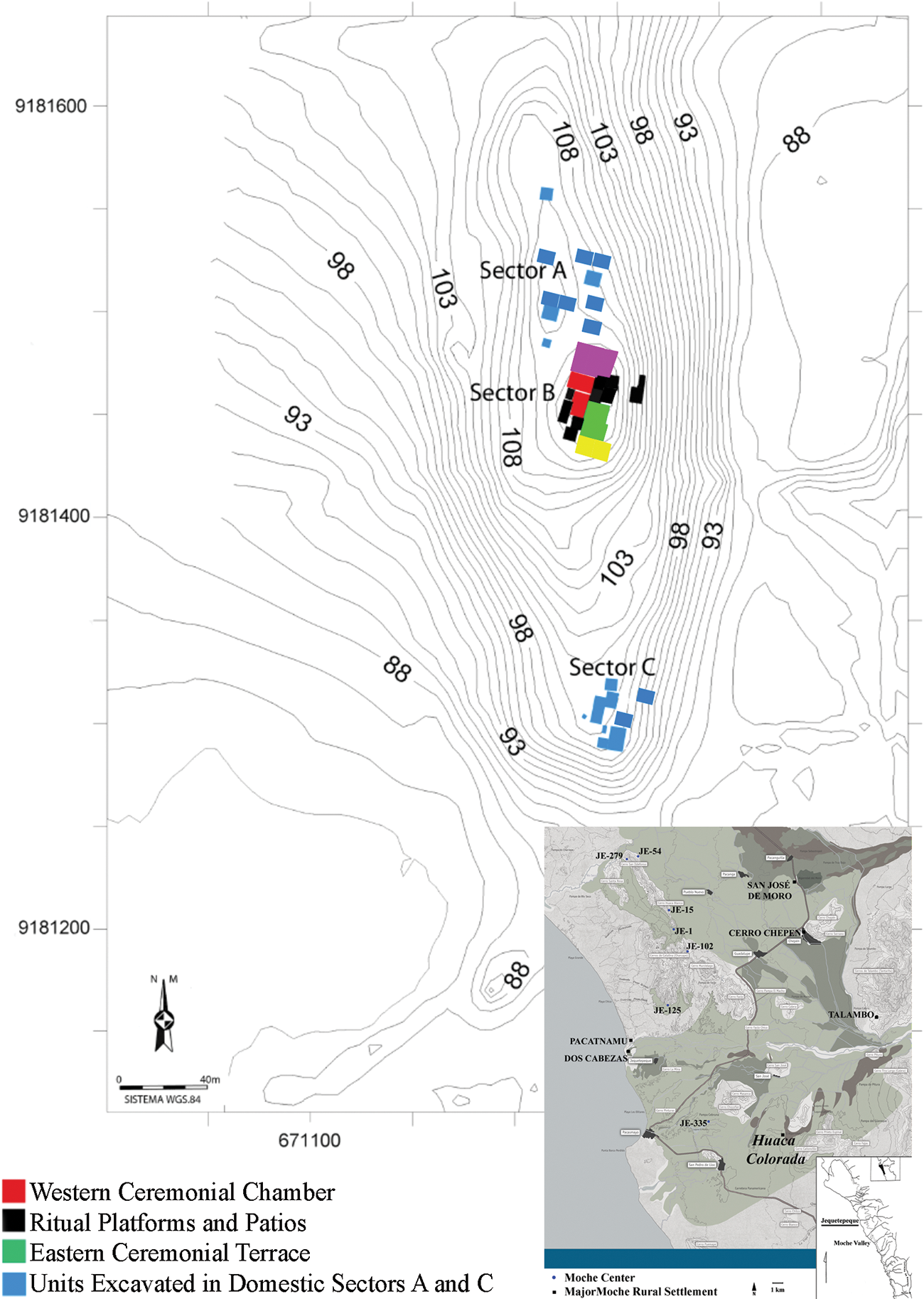
The graffiti of this case study were encountered at the ceremonial center of Huaca Colorada (CE 650–850), the largest Late Moche settlement located in the dry desert of the southern bank of the Jequetepeque valley in northern Peru (Reference SwensonSwenson 2012, Reference Swenson2015c; see fig. 1). The elaborate adobe constructions dominating the central and highest prominence of the main pyramid point to the presence of high status individuals. Huaca Colorada likely served as the ceremonial and political headquarters of a powerful cult that dominated the southern Jequetepeque valley. The pyramid mound was built to commemorate and worship a huaca (ancestral or other-than-human power) and possible oracle associated with the nearby mountain of Cerro Cañoncillo (Swenson and Reference SwensonWarner 2016). The recovery of copper ornaments, tools, and production debris in makeshift domestic constructions in the expansive residential areas surrounding the elevated temple complex suggests that metallurgy constituted an important task of the settlement’s inhabitants (Reference SwensonSwenson 2012; Swenson and Reference SwensonWarner 2012). This importance is further indicated by the discovery of offerings of prills and finished copper objects in conjunction with foundation sacrifices of human and animal victims in the ceremonial zone of the site. Evidence for metallurgical production derives from the non-elite sectors, and it is likely that itinerant artisans visited the huaca during specific seasons under the patronage of the site’s leaders. The high quantity of decorated feasting vessels unearthed in the expansive domestic and ceremonial sectors indicates that artisans, pilgrims, and full time residents of the site were prodigiously feted. Their labor, services, and offerings to the huaca were compensated with corn beer and protein rich meals of seafood and llama meat (Swenson and Reference SwensonWarner 2016).
Plan of the ceremonial center of Huaca Colorada indicating the location of ritual architecture in the central summit of the pyramid and the surrounding residential sectors. Author’s drawings, used courtesy of Proyecto Huaca Colorada.
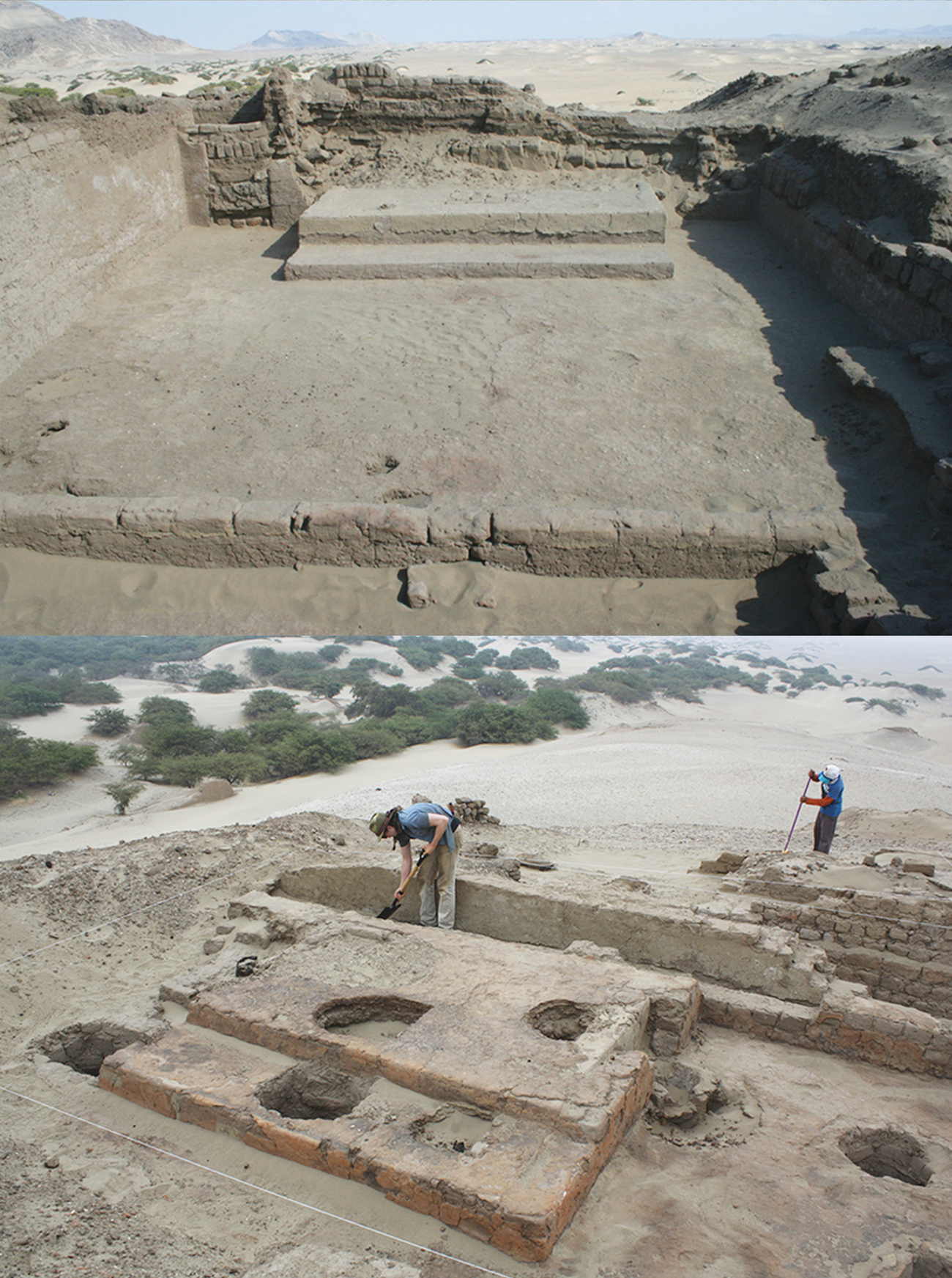
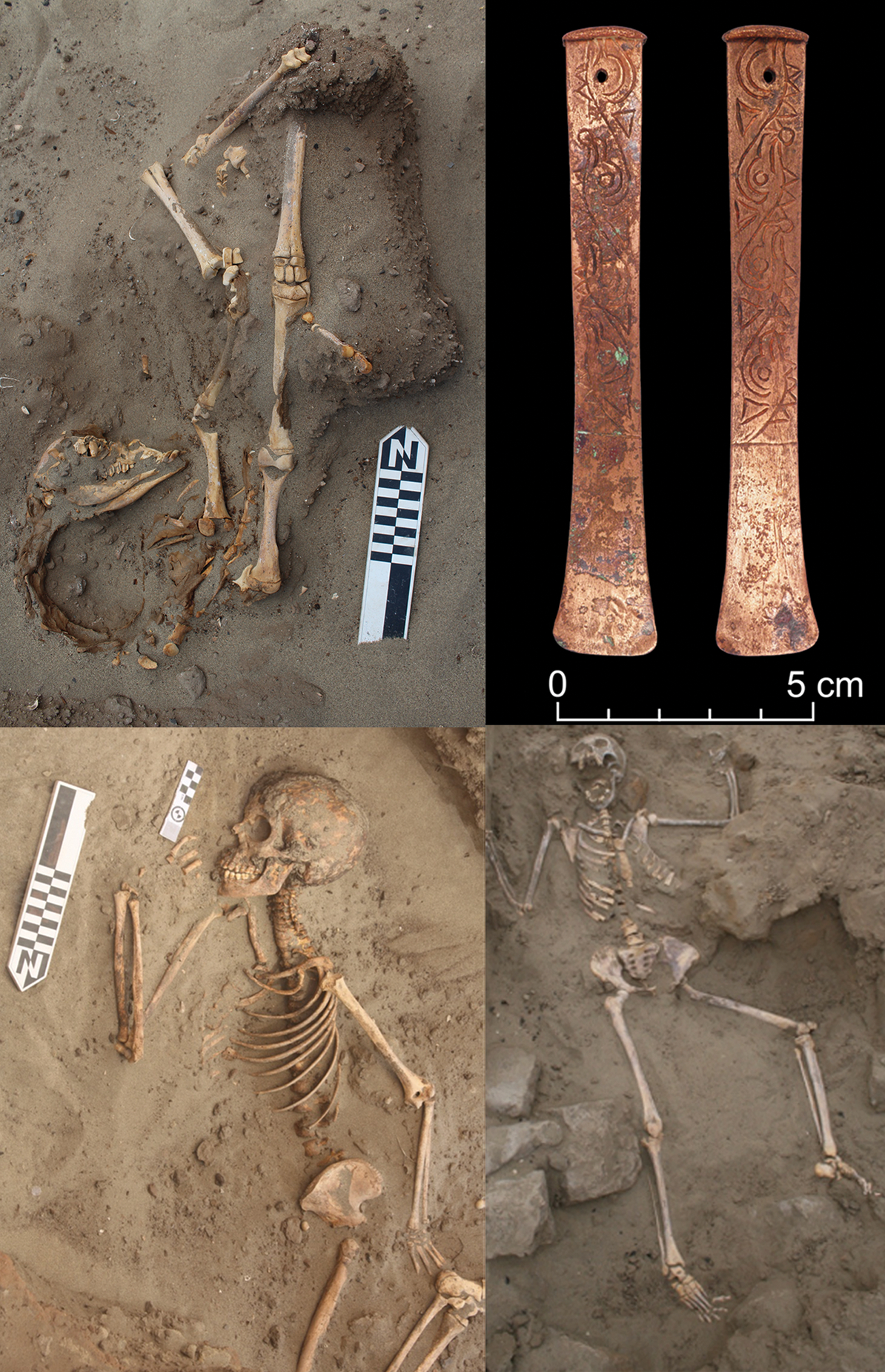
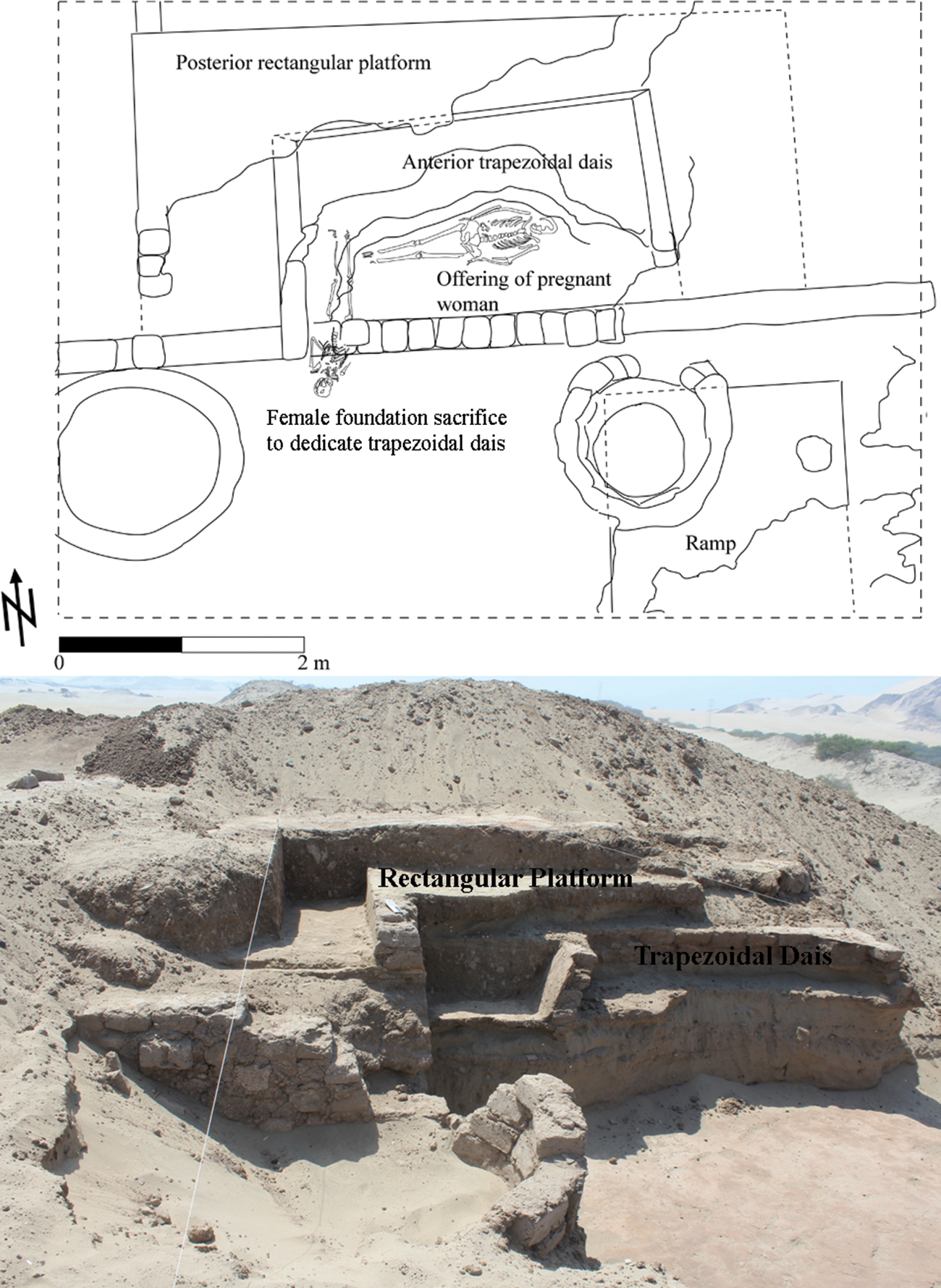
The principal religious constructions of the monumental core of Huaca Colorada consist of eight daises, all of which were ritually interred under floors or construction fill. One of the more prominent altars was unearthed in the southern end of a sunken and spacious chamber in the west half of the elevated temple complex. It supported two stuccoed columns and likely functioned as a stage for charged ritual encounters including the presentation and consumption of comestibles, including corn beer (fig. 2). Stepped daises of this kind also formed the backdrop for key ritual practices depicted in Moche iconography, especially feasting and sacrifice (Reference WiersemaWiersema 2010; Swenson 2012). The eastern terrace forms the dyadic counterpart to the western chamber. It was also anchored by an impressive altar at its south end that faced a spacious and roofed forecourt to the north (fig. 2). The perimeter walls of both the east and west precinct, along with their impressive stepped altars, were engraved with graffiti (see below). These two altars were both renovated and enlarged at least once. However, in a later phase they were decommissioned and replaced by subsequent altars and associated architecture (Spence Reference Spence MorrowMorrow 2018; Reference SwensonSwenson forthcoming). Therefore, the different platforms were not all in use simultaneously but were associated with distinct construction and occupation phases. In fact, the ceremonial precinct of the huaca was in a constant state of renovation, and it is evident that there was a religious expectation to ritually terminate and rededicate altars, rooms, and platforms, as likely dictated by a religious calendar or festival round (Reference SwensonSwenson 2015c). For instance, the western dais was buried in tons of clean sand, while its eastern counterpart was immolated in an intense fire before being sealed under its collapsed roof and a solid floor. The discovery of foundation sacrifices of young women, animals, and copper offerings, associated with both the closure and re-dedication of seven different altar platforms, corroborates this hypothesis (Reference SwensonSwenson 2012; see fig. 3). The recurring ritual renovations of the monumental chamber exemplifies a concern to control and regulate the movement of time, while the reconstructions point to an ontological continuum between people, places, and things in Moche worldviews (Reference SwensonSwenson 2015c).
The stepped platforms anchoring the southern ends of the Western Chamber (top) and the Eastern Terrace (bottom), the dyadic sectors forming the monumental nucleus of Huaca Colorada. Author’s photos, used courtesy of Proyecto Huaca Colorada.
Human, animal, and copper foundation sacrifices at Huaca Colorada. Author’s photos, used courtesy of Proyecto Huaca Colorada.
Buildings saturated with violence and the presence of other-than-human powers induce intense if varied emotions while emanating a gravitas that powerfully reorients behavior and subjectivity. In fact, the foundation sacrifices, coinciding with the ritual closure of altars, ramps, and chambers sealed under floors and tons of sand, indicate that the Moche of Huaca Colorada were keenly aware of the power of invisible but immanently present agents incorporated into architectural constructions (Reference SwensonSwenson 2015a). The discovery of an altar enclosing (terminating) an earlier dais, which in turn contained the remains of a sacrificed pregnant woman, reveals that a distinctive semiotic ideology defined the monument (Reference KeaneKeane 2003; see fig. 4). It seems to have been predicated on the nested codependence of visible/exteriorized and invisible/interiorized agents (nesting of baby in mother and altar in altar). The occlusion of offerings thus prefigured the revelation (rebirth, growth) of new altars and spaces, and this incorporation may have been understood as equivalent to ingestion or insemination (Reference WeismantelWeismantel 2004). These rituals appear to have symbolically recapitulated the agricultural cycle, sexual procreation, biological growth, the movement of astral bodies (entering and remerging from the underworld), copper production, and the reciprocal feeding of the mountain huaca. Indeed, the ritual practices seem to have been guided by an ideology comparable to the “sowing and dawning” so prominent in Mesoamerican understandings of cosmic process (Reference TedlockTedlock 1985, 74). Memories of buried structures, copper ornaments, graffiti, and people imbued extant altars with vitality and haunting authenticity, creating a third space of intense imaginings and emotion (Reference SwensonSwenson 2012, Reference Swenson2015a).
Plan and photograph of the lower foundation sacrifice, nested altars, and offering of pregnant woman discovered in the north-central zone of the East Terrace of Huaca Colorada. Author’s drawing and photo, used courtesy of Proyecto Huaca Colorada.
In sum, the formal renovations and nested offerings point to a semiotic ideology grounded in the manipulation of signs that can be compared to Peirce’s series of “infinite interpretants” (CP 2.292, 2.303). The palimpsest of interred sacrificial victims and platforms enchained a succession of interacting signs in the constantly metamorphosing edifice, and each successive offering was a precondition for a new construction. Savan states: “Any sign is an interpretant if (1) it instantiates a general habit (or rule) of transforming an antecedent sign into a consequent sign, and (2) signifies its object through some antecedent sign of that object” (Reference Savan1987, 48). Colapietro similarly notes that “the thing for which a sign stands is called its object; the thing to which a sign gives rise is its interpretant; and of course, that which mediates between an object and an interpretant is a sign” (Reference Colapietro1989, 107). As mentioned, the ritual renovations of the huaca intended in part to induce growth and reproduction (socially, cosmically, biologically, and agriculturally), and thus an explicit semiosis of enchained, multiplying signs accords well with this ideological program (and Peircean thought more generally). In this light, the buried corpses and enfolded altars should not be viewed simply as “indexes” of immanent, invisible agents but as a “connected web” of interpretants that arose from and would give rise in turn to new signs and their anticipated powers of transformation (Reference DanielDaniel 1984, 22). Ritual is commonly described as an “energetic interpretant,” a direct, material action in response to a sign, and this semiotic was dramatically materialized at Huaca Colorada (Reference SavanSavan 1987, 58). As explored in the next section, the proliferation of graffiti in the ritual precinct confirms that the center was “special place of semiosis” that continually spawned interpretants—but also of a seemingly unauthorized nature. As will then be discussed in the conclusion, this succession of interpretation continues with later archaeological encounters with the site.
The Graffiti of Huaca Colorada, Peru
Graffiti have long fascinated social scientists, and a slew of recent publications demonstrate its increasing interest to archaeologists who have interpreted it to understand everything from childhood socialization and popular religion to political resistance.Footnote 6 For Edward Soja (Reference Soja1996), graffiti inscription represents a quintessential third-space act that disrupts hegemonic built environments. In contemporary society, graffiti is commonly equated with fear, disorder, defacement, immorality, and vandalism, and the question commonly arises for archaeologists whether the graffiti they study, say in a British cathedral or the villas of Pompeii, acted against or in reverence to its surroundings (Reference OwenOwen 2010). Of course, context is of utmost importance, and the meaning and effects of graffiti varied considerably from culture to culture (Reference RodriguezRodriguez 2015, 29).Footnote 7 In a sacred site such as Huaca Colorada, graffiti likely served as “testament to the sanctity of the spaces in which people were literally moved and a statement of their desire to remain close to them” (Reference OwenOwen 2010, 35–36; see also Reference PleschPlesch 2015, 50). In this regard, Angelos Chaniotis (Reference Chaniotis2011) argues that because of their nonmonumental, private, and spontaneous nature, graffiti often reflect in a more direct way than other categories of inscription the thoughts and feelings of people, an “unedited mirror of culture” (Olton and Reference OltonLovata 2015, 14). Therefore, graffiti excites the archaeological imagination for they are expressive of a participatory aesthetics beyond elites or official priests. In this regard, they differ semiotically from normative genres of communication including writing or monumental commemoration. Graffiti are at once indexes of the people who inscribed them and an emotional interpretant of the force of the sanctuary itself that incited semiosis, intense emotional reactions, and contemplation. As nonofficial epigraphs, they speak to a certain spatial intimacy—the direct making of place by diverse agents who usually remain materially invisible (Reference FroodFrood 2013, 298). As Olton and Lovata note, “by its very technical nature, graffiti is subversive because it is applied to a surface where it technically does not belong, changing the built environment” (Reference Olton2015, 15; see also Reference FroodFrood 2013, 287). Graffiti thus commonly act to appropriate, ritualize, or reconfigure the meaning and experience of politically charged places (Reference FroodFrood 2013).
At Huaca Colorada, iconic depictions of buildings, hills that imitate the profile of the nearby mountain range, and stylized warriors formed a discourse about the temple itself and contextually referenced its power (Reference NoyNoy 2009, 423).Footnote 8 Both the inscription of the graffiti and its subsequent reading were likely guided by highly performative conventions that intensified the “semiotic attraction” of the temple while redoubling if complicating its “transformation” from “surface into stage” (424). As noted by scholars, graffiti often generate more graffiti, “producing graffiti spaces that are often quite contained and distinct” (Reference FroodFrood 2013, 294). As materializations of people’s desires to leave their mark on intensely meaningful places, graffiti saturate built environments with a phantasmagoric quality; similar to ghosts, they animate the spatial fabric of buildings as places charged with history, memory, and traumatic or life-changing experiences. Exposing the graffiti was as equally haunting and evocative as the discovery of the human sacrifices themselves. They reveal that we were not the first to try to make sense of the site. To a certain extent, we were excavating superimposed traces that compounded or doubled the present signs of absent subjects. The graffiti affirmed that “many histories occupy the same space” and that the potential to signify or re-signify the space was accordingly high. The graffiti thus “unsettled assured histories of the present,” both for the Moche and certainly for later archaeologists (Reference PilePile 2005, 8).
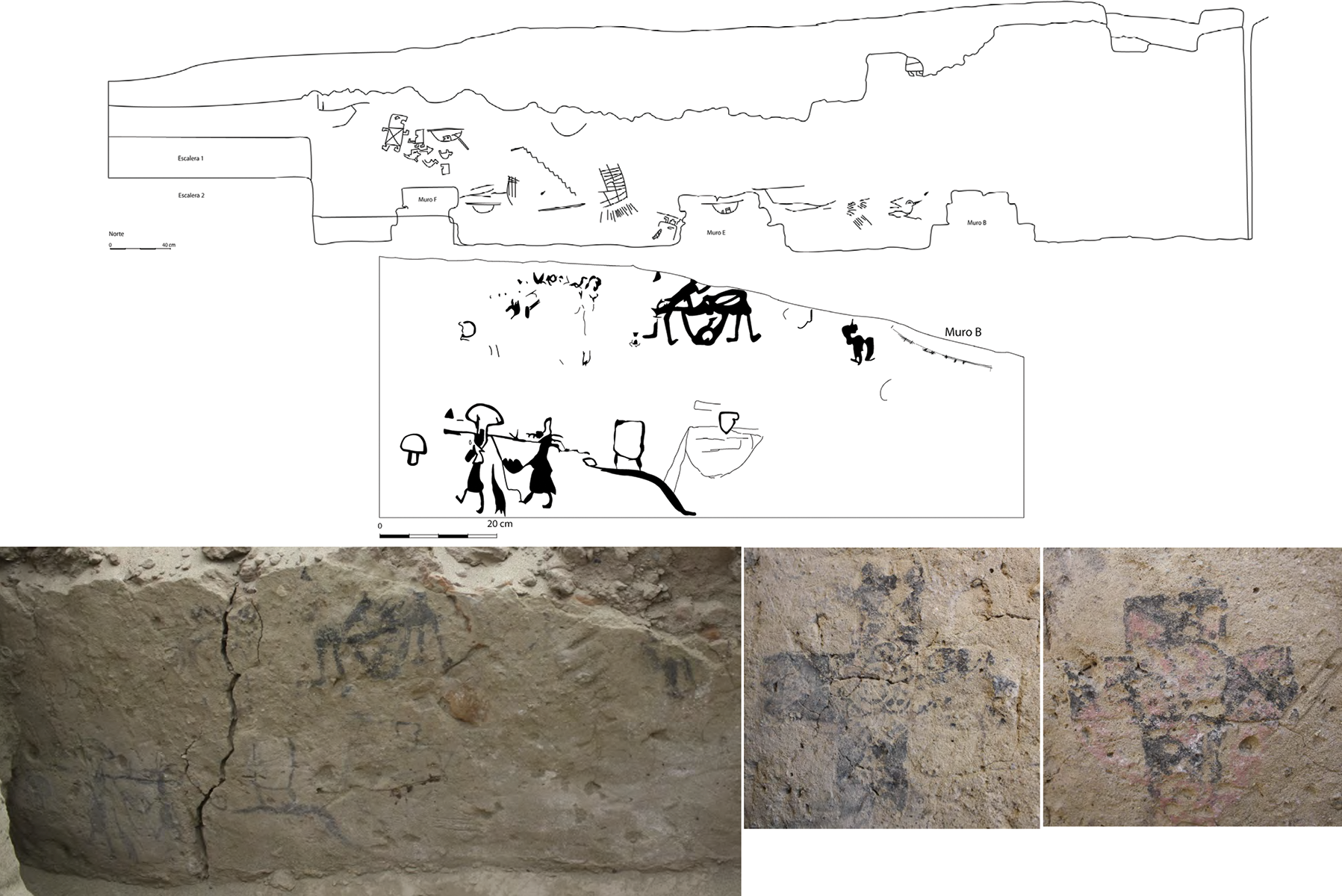
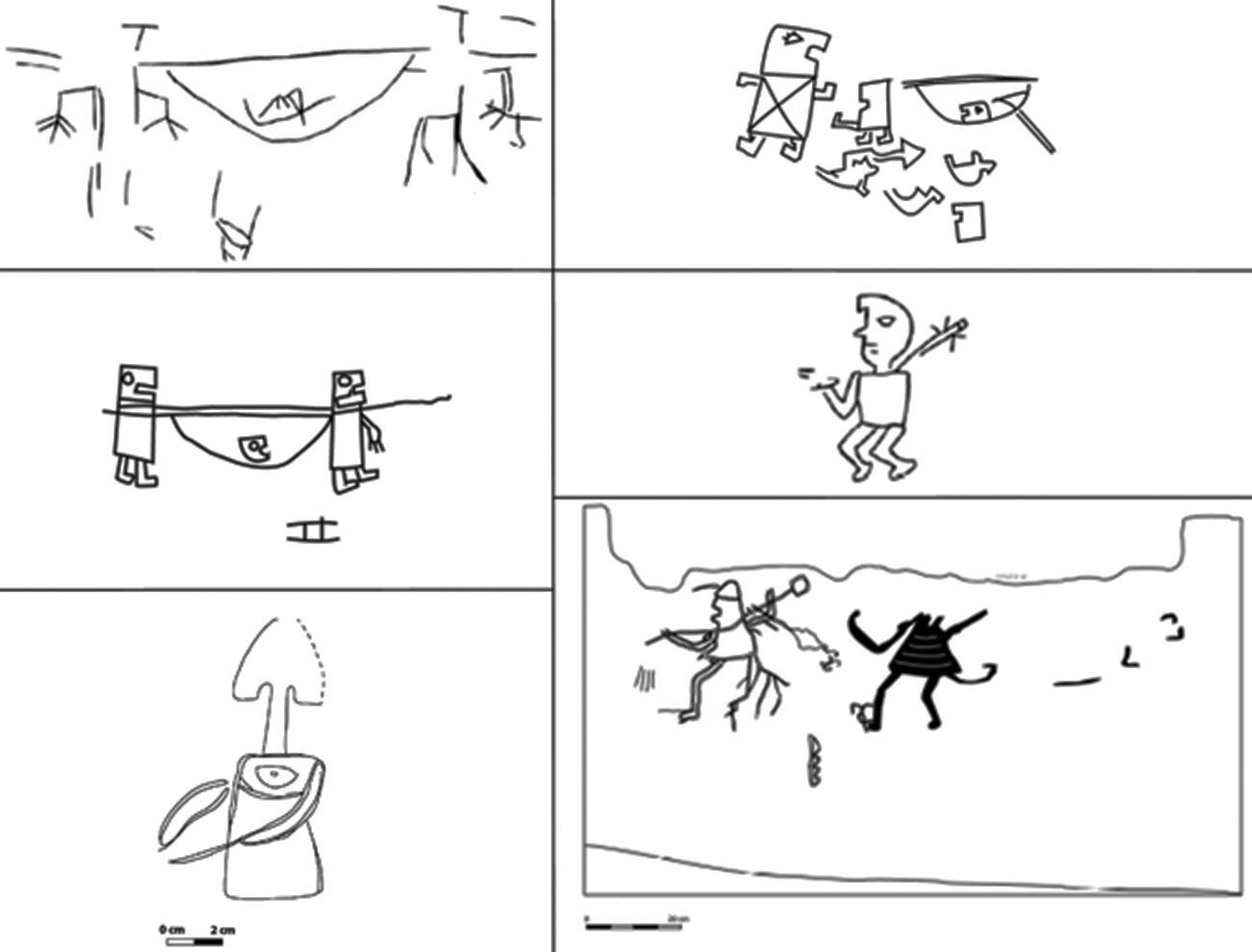
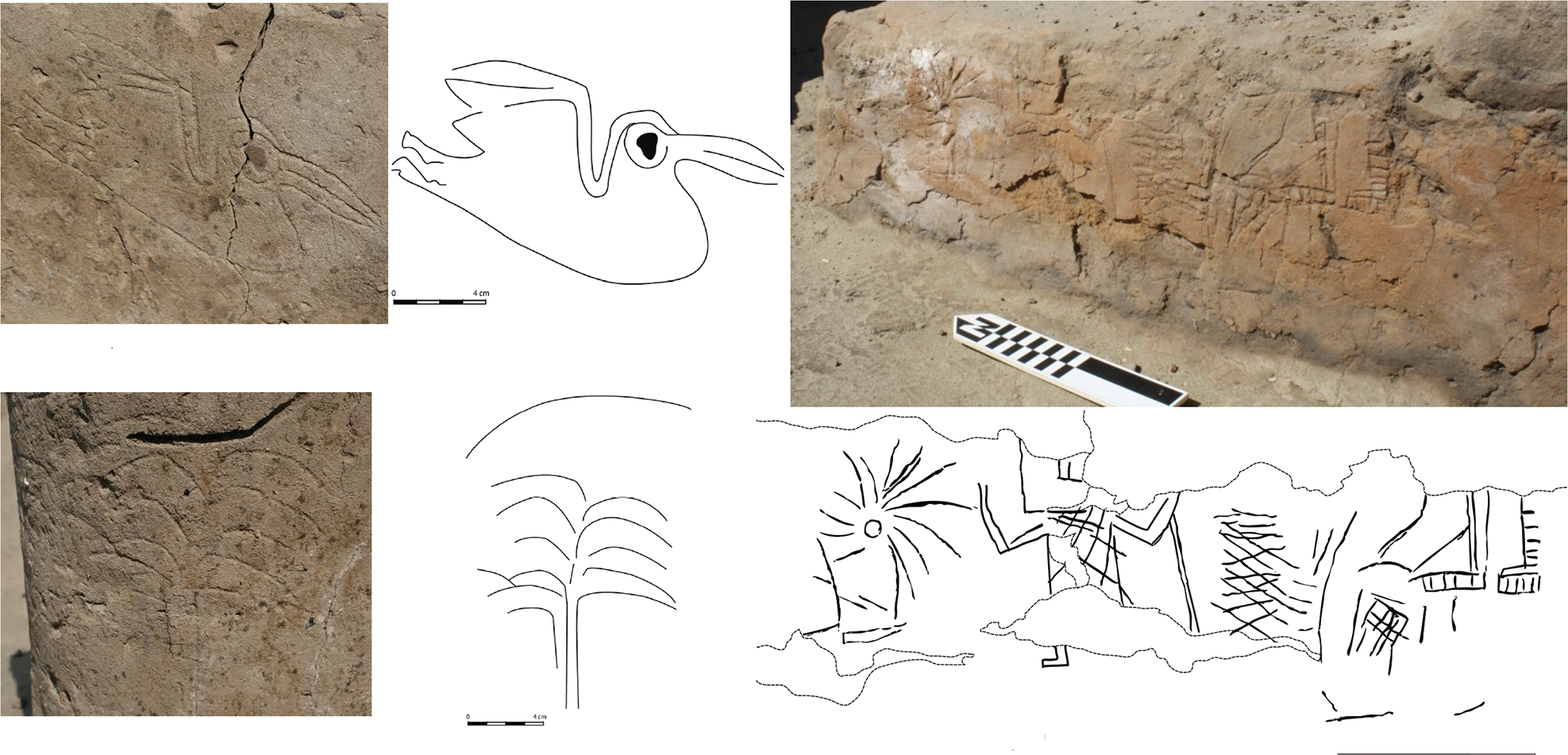
At Huaca Colorada, the graffiti largely conform to a shared style, but they are still notable for their diversity in form, design, and rendering. They include abstract hatchings and clusters of overlapping lines to figurative representations with boxy bodies and heads. Zoomorphs were also noted including birds, lizards, and aquatic creatures (figs. 5–7). The hundred or so graffiti range from just a few centimeters in area to larger tableaus that covered the entire sides of walls or altars. They were most likely drawn by scratching the plastered adobe walls of the temple with a pointed bone or copper stylus. In some instances, a fingernail may simply have been used, and the incised graffiti range in depth from just a millimeter to nearly a half centimeter deep. In rare instances, the graffiti were painted on the walls with black and other colored pigments (fig. 5). The graffiti were exposed on both the interior and exterior walls of chambers housing platforms, on doorjambs, and on altar surfaces. They were found at different elevations of the perimeters, sometimes near the floors or along the higher reaches of the surviving adobe walls. Therefore, the authors of the etchings must have adopted a number of different positions to mark walls and daises, from crouching near the floor to standing fully upright.
Top, the interior face of the final north wall of the West Chamber. Both geometric and figurative graffiti were etched onto this wall. Middle and bottom, rare instances of painted graffiti of possible food preparation and an “Andean cross” applied to the interior face of the west wall of the East Terrace. Author’s drawing and photos, used courtesy of Proyecto Huaca Colorada.
Graffiti at Huaca Colorada depicting human figures including warriors, litter bearers, and running figures. Author’s drawings, used courtesy of Proyecto Huaca Colorada.
Graffiti of animals (A) and architectural constructions and landscapes (B) etched on the walls of Huaca Colorada. Author’s drawings and photo, used courtesy of Proyecto Huaca Colorada.
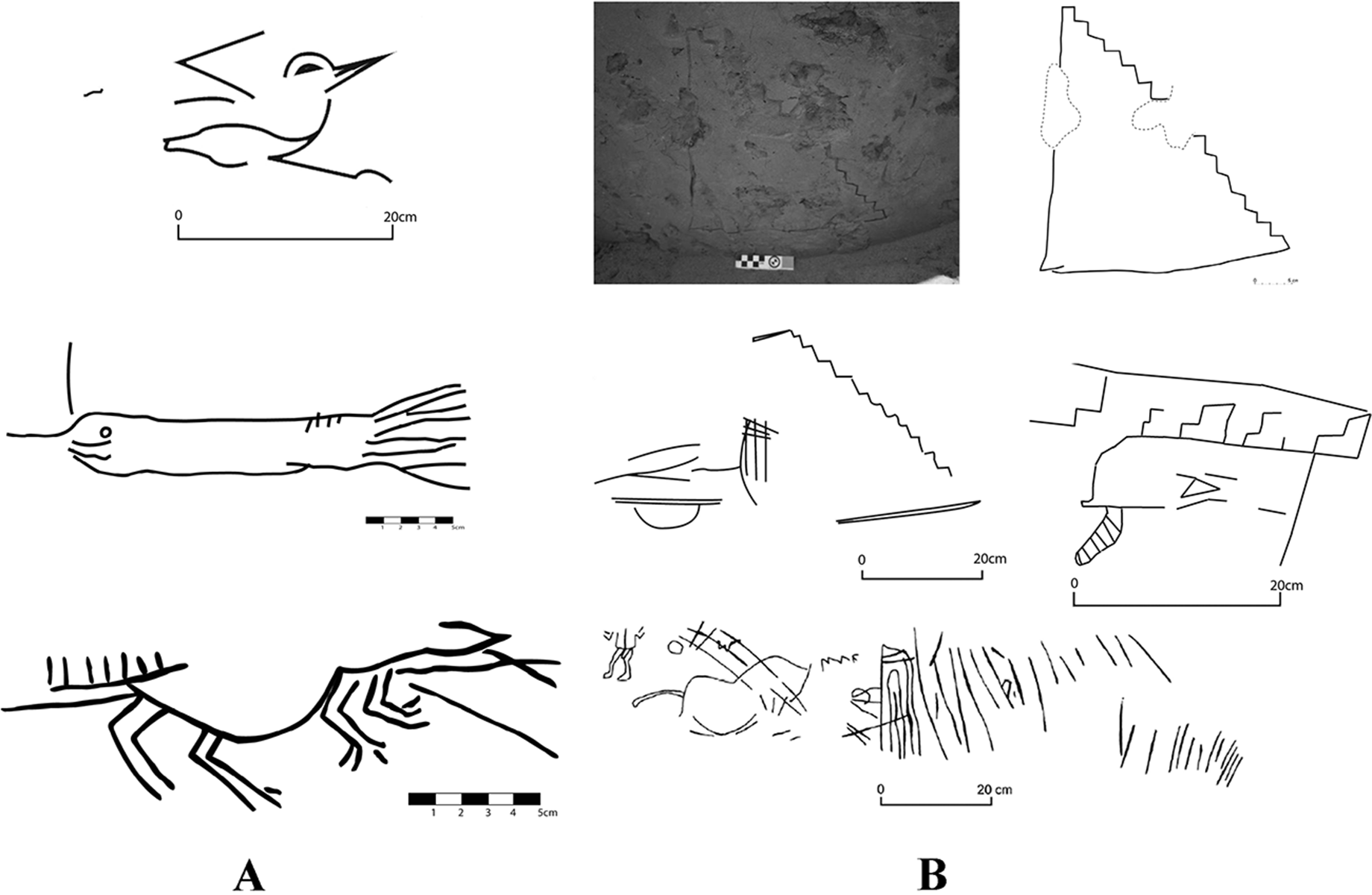
Most instances of graffiti appear to have been executed during the final use-phases of the different ritual constructions. They may even have been drawn as part of the decommissioning rite prior to the ritual closure of chambers and daises (Reference SwensonSwenson 2012). The depictions include crudely rendered warriors, multiple litter bearers carrying decapitated heads, birds, lizards, landscapes, fishing and maritime scenes, boats, and running figures (figs. 6–7). Many of the representations resonate with Moche religious themes centered on warfare and death, and the ritual context of their execution seems probable, as has been documented in other pre-Columbian ceremonial sites, including most notably Tikal (Haviland and Reference HavilandHaviland 1995). Therefore, the informal sketchings depart from contemporary connotations of graffiti as irreverent or transgressive. Nevertheless, the elites of Huaca Colorada clearly did not commission the artwork as integral to the overall architectural design and aesthetic plan of the monument, and the representations are haphazardly applied on the walls and door casings. At Huaca Colorada, individuals appear to have informally commemorated ritual activities staged within the ample ceremonial chamber. The figures express movement and transience, while their hurried applications are equally expressive of the momentary passage of the artists themselves, possibly analogous to religious tourists wishing to forever memorialize their fleeting encounters with the edifice. Indeed, this fleeting materialization comes across as decidedly spectral. The actual engraving of roofs and other architectural elements identified on the northern and eastern walls of the west precinct confirms that the huaca stimulated a critical contemplation of place—a quintessential third space of becoming and introspection enabled by the intimate experience of the ceremonial center (Reference SwensonSwenson 2012; see fig. 7).
The graffiti suggest that during certain phases of the temple’s occupation, the usually exclusive ceremonial precinct was rendered open and accessible. However, it remains to be determined whether the many etchings can be interpreted as indicating the conversion of a private space into a more public and contested arena (for an interpretation of graffiti in ancient Peru as expressive of subversion and resistance to centralized power, see Pozorski and Reference PozorskiPozorski 2015). They may be suggestive of the creativity of the monument to generate new and conflicting meanings that perhaps contradicted the intended religious rationale of the periodic spectacles of ritual homicide documented at the site (Reference SwensonSwenson 2012, Reference Swenson2015a).
Nevertheless, the evidence suggests that the graffiti were not intended to be subversive or index phases of abandonment and reoccupation by squatters. In terms of the distribution of the graffiti, it is telling that the etchings were confined to the ceremonial summit of the site and are absent on the walls of the surrounding domestic areas. Furthermore, it is remarkable that the graffiti were etched directly on the main walls and doorways of the ritual precincts and even on the steps of the principal altars (fig. 8). Therefore, these signs obviously differ from latrinalia or other kinds of graffiti scribbled in secluded places (see Reference MeadMeade 2015; Reference OltonOlton 2015). However, the graffiti of Huaca Colorada were not intended to be “durable symbols” for they were soon buried in termination and rededication rites along with the architecture they resignified. As mentioned, the temple was recurrently renovated with rooms and platforms painstakingly sealed under later floors and constructions. These rites likely followed a calendar round and were often accompanied with the sacrifice of young women and animals (especially llamas, but a dog, guinea pig, sea lion skull, and wild feline were also offered as foundation sacrifices). As such, the Moche of Huaca Colorada appear to have been deeply aware of the spectral power of the trace to not just mediate but to directly create place, time, and memory in a moving topology materialized by the temple itself. In fact, the power of the huaca seems to have been dramatized by the uncanny proximity of the hidden and manifest, as evidenced in the repeated interment of ceremonial architecture, human bodies, and graffiti. Perhaps the graffiti were drawn and made visible in short phases just prior to the decommissioning of the architecture in question, and such performances would have intensified the anticipation of the sacrifices to come. Therefore, the occluded and visible appear to have been cocausative—antecedent and consequent interpretants—and the extraordinary (re)cycling of signs between the superficial and subterranean domains speaks to an indigenous conception of memory and agency that was viscerally “archaeological.” As interpretants to the larger gravitas of the temple, the graffiti may have at once commemorated lived, emotionally charged memories of the huaca, while indexing the authors of the etchings. In this way, the tracings perhaps intended to ensure the communion of celebrants with the living monument across time, thus blurring an absolute distinction between past and present or ancestors and descendants. In the end, the force of the huaca was founded on its semiotic density; the complex layering of signs—that continually spawned new signs and interpretants—created a place of limitless discovery, revelation, and affect. If agents continue to act through their art work (causally or indexically linked, sensu Gell and Peirce), then the force field of the many icons, indexes, and interpretants of Huaca Colorada would have been overwhelming (see Reference GellGell 1998; Reference SchoenfelderSchoenfelder 2012, 153; Reference CrosslandCrossland 2014, 43).
Graffito of a tree incised onto the stucco column of the platform of the West Chamber (bottom, left). The pelican was found traced on the lower step of the same dais (top, left). Graffiti of a procession of figures and a possible star etched on the lower step of the immolated altar of the East Terrace (right, top and bottom). Author’s drawings and photos, used courtesy of Proyecto Huaca Colorada.
Conclusion
Archaeologists have recognized that “indexicality is particularly important in archaeological analyses” (Reference JoyceJoyce 2012, 183–84) for indexical signs facilitate the identification of the context of past practices and the agents who produced present traces. Certainly, the graffiti of Huaca Colorada unambiguously index the authors who made them. As the above analysis makes clear, however, the evocative power of the graffiti lies more in their role as interpretants. In fact, the graffiti remarkably compress the triad of Peirce’s dynamic interpretant (emotional, energetic, logical). The varied and symbolically rich depictions speak to the emotional reactions elicited by the monument, while the rapidly applied marks are a testament themselves to the direct energetic responses prompted by the initial affective stimulus. The seemingly unauthorized nature of the graffiti—incongruously juxtaposed with the much more formal and authorized signs of the layered offerings—also signals possible thoughts of doubt, uncertainty, even anxiety—preconditions of Peirce’s logical interpretant (Reference DanielDaniel 1984, 25–27; Reference ShortShort 2007, 45; Reference CrosslandCrossland 2014, 81–82). However, the superimposed proliferation of graffiti also reveals that these informal inscriptions became habituated and even accepted through time.Footnote 9 Therefore, the first graffiti at Huaca Colorada may have materialized ambivalent, unauthorized interpretations. Nevertheless, their later applications seem to have become expected and even authorized components of complex ritual sequences.Footnote 10
In the end, the graffiti are such exceptional signs for they materialize a “confluence of iconic, indexical, and symbolic functions” common in the interpretation process (Reference DanielDaniel 1984, 288–89). The strong responses and reactions they elicit from the archaeologists working at the site attests to their continued capacity to spawn more signs and interpretations. Floyd Merrell describes the distinctive semiotic effects of graffiti: “The graffiti monger via his ‘signature’ has now become the object of the sign. As such, the sign is the sign of the present absent of its author, and my thought-signs regarding the fact that he was here is the interpretant. I almost instinctively reflect with ire on this unknown defacer of public property, my cognitive contact with this absence being mediated by the presence of the sign or representamen, the graffiti” (Reference Merrell1997, 64).
In a similar manner, the graffiti disrupted the course of archaeological analysis by initially invoking “an unreflective recognition” of the etchings as “graffiti” (thus acting as an emotional or affective interpretant vis-à-vis the archaeologist) (Reference CrosslandCrossland 2014, 83–84). Peirce explicitly described signs that trigger emotional interpretants as “suggestive,” for they invoke familiarity, resemblance, and sympathy (Reference SavanSavan 1987, 59–61). In other words, their specific iconicity (haphazard scratching on the walls) gave rise to memories of “graffiti” familiar to the archaeologists in contexts beyond the huaca. Nevertheless, their incongruity on the formal temple walls, uncovered in an unexpected context, simultaneously acted as “percussive signs” (also called “shocking” by Peirce; CP 8.370) and thus as energetic interpretants as exemplified by the assiduous care of the archaeologists to record the graffiti in drawings, photographs, and field forms. In turn, this entire article can be understood as a logical interpretant in my attempts to order, domesticate, and derive greater meaning from the larger assemblage of graffiti at the center. In this regard, the admission now must be made whether the term “graffiti” is even the most accurate or best “representation” of the significance of these informal drawings. Nevertheless, this realization demonstrates how the distinct semiotic qualities of our data can dramatically affect the course of analysis and interpretation. Despite obvious differences in meanings and social context, the movement from emotional to logical interpretant appears to capture the semiotic experience of both the Moche graffiti artists and the archaeologists who are trying to make sense of these traces 1,300 years later.
This parallel process of semiosis can account in part for the spectral quality of the graffiti that dramatically presenced absent subjects by eerily reducing the temporal and physical distance between past and present interpreters. As discussed above, the absent presence is often more intensely felt in spaces shaped by deliberate acts of place making—such as ceremonially charged monuments as opposed to quotidian taskscapes (sensu Reference IngoldIngold 2000). In sum, the graffiti at Huaca Colorada represent such exciting traces not simply by materializing the likely emotions and musings of past agents. Rather, these low-relief etchings bring into remarkably high relief the importance of considering issues of discovery and the unanticipated both in the realm of archaeological research and for past communities under examination (see Reference CrosslandCrossland 2014, 265).
Such a realization brings us back to Ginzburg’s “evidentiary paradigms” discussed briefly in the introduction. It also forces us to acknowledge that not all traces are created equal or are amenable to the same level of “analytical domestication.” Certainly, my interpretation of the graffiti at Huaca Colorada constitutes a narrative project comparable to Trouillot’s historicity II—what Shanks would call “narratology” (Reference Shanks2012, 130–31). However, the nature of the graffiti—their context, deliberate execution, complex indexicality as interpretants, and spectral qualities—were at once unanticipated and revelatory in the way they intensified a past human presence. The graffiti were not so much tracings in the past, but striking images and instant memories made in the present that reinforced in the eyes of the archaeological team the profound meaning and historical importance of the ceremonial center. The graffiti thus constitute a rare data set, one that permits a consideration of the effects and semiotic potentiality of signs as intepretants in the tradition of Peirce.
Despite the secular and scientific foundation of archaeology, the Huaca Colorada case study intended to demonstrate that the search for meaning in the discipline can often parallel the ghostly encounters of religious divination and ritual communion. Ultimately, the distinct semiotic affordances that variably presence absent subjects and their interpretations should be acknowledged in understanding the differential valuation of archaeological finds, whether graffiti etched in a sanctuary, a foundation sacrifice, or a house midden.



