




The Chinese handgun, in all its varieties, generically referred to as the fast lance (kuaiqiang 快槍), constituted the first individual firearm that could be considered a true gun in world history. All its varieties sprang from an indigenous design tradition that dated back to the end of the Song dynasty (960–1278) but only found large-scale use in combat during the early Ming period (Andrade Reference Andrade2016, 52–72; Sinvany Reference Sinvany2019). Chinese handguns often assumed the form of a gun barrel mounted at the end of a wooden stick and was held out in front of the gunner when discharged (Andrade Reference Andrade2015a, 250–251). By the sixteenth century, it would encounter its first serious competitor in the harquebus, an individual firearm of European provenance that reached East Asia in the wake of Portuguese naval expansion. Compared to the handgun, it had a longer and thinner barrel mounted on a stock. This barrel permitted the projectiles to be fired with more force and accuracy, and the stock allowed for better aiming. A matchlock holding the fuse was added, which freed the gunner from having to load the weapon while holding a slow-burning fuse in one hand (Hall Reference Hall1997, 95–97).
In the aftermath of the Imjin War (1592–1598), a conflict that involved all three major East Asian states of the time, the rise of the harquebus in regional warfare seemed to be unstoppable. The Japanese came to rely so much on the weapon that, in some cases, up to thirty percent of various Japanese daimyō armies were equipped with it, a state of affairs which continued after the war ended (Chang Reference Hsiu-ming2016, 69, 80–82, 91). The Koreans, for their part, quickly appropriated the weapon during the war and made the harquebusier the central unit of their post-war armies (Andrade et al. Reference Andrade, Kang and Cooper2014; Kang Reference Kang2013; Reference Kang2020, 232–240; Siegmund Reference Siegmund and Filipiak2015; Reference Siegmund2018). Yet, in Ming China, the reception of the harquebus was much more ambivalent, even after the experience of the Imjin War. Ming China had been able to capture specimens from Sino-Japanese maritime raiders in the mid-sixteenth century, and famous military official Qi Jiguang (戚繼光, 1528–1588) integrated these weapons into his units. These units were trained to be capable of continuous volley fire and formed the blueprint for the postwar Korean army reforms (Andrade Reference Andrade2015b; Andrade et al. Reference Andrade, Kang and Cooper2014, 63–64; Sun Reference Sun, Kenneth and Andrade2018, 132). But whereas in post-war Japan and Korea, the harquebus progressively displaced all older projectile weapons, including the bow, the perseverance of the handgun in Chinese service seems to have been an exception.
This article will offer an explanation as to why this was so, relying on the perceptions of contemporary Ming observers, mainly military men, who wrote about firearms and their uses during the late Ming. Taking their perspective reveals the (perceived) positive characteristics of the handgun in greater detail, an aspect that is usually ignored in modern scholarship, which usually focuses only on the advantages of the harquebus vis-à-vis its predecessor. Furthermore, it forces us to abandon a Eurocentric teleology of technological innovation primarily based on the European experience with firearms development, which has often seen alternative developmental trajectories as aberrations caused by irrational conservatism and backwardness. To the contrary, this article assesses the different trajectory of Ming China in light of its particular historical experience that gave rise to it. Finally, this article will argue that eventually, early modern European and Ming Chinese design trajectories started to converge and tend towards a “universal gun” in the shape of a bayonet-equipped hand-held firearm, but that Ming Chinese and European militaries came to this solution via different routes.
The difference of Ming China
Military historians Geoffrey Parker and Kenneth Chase have mapped out paradigmatic trajectories of firearms development that were heavily based on the historical experiences and geographical uniqueness of Europe, respectively. These trajectories, posited by Parker and Chase, are largely complementary and still enjoy much acceptance among (military) historians. As such, they also constitute the most influential Eurocentric explanations of Ming China’s difference. According to Parker, European armies prior to the sixteenth century made use of types of handguns and sundry other projectile weapons but discarded all of them soon after the newer harquebus sufficiently improved range, accuracy, and penetration power (Parker Reference Parker1996, 16–18). As a result, the Chinese retention of the handgun, even after the harquebus made it to the shores of East Asia, seems irrational. Kenneth Chase explains this as resulting from a conservatism incentivized by geographical factors, mainly exemplified by the Ming Empire’s northern frontier adjoining the steppe. In Chase’s view, this frontier landscape, contested with hostile nomads, exerted selective pressures on the development of firearms. This led to a preference for designs which facilitated a high rate of fire, for example multiple-barreled guns capable of firing several projectiles at once or in rapid succession. Rate of fire and short-range stopping power were deemed essential against northern nomadic enemies in lieu of other characteristics like accuracy. This made sense against an enemy that was able to more rapidly close the distance to Ming military units compared with enemies relying on infantry (Chase Reference Chase2003, 145–150).
But even while Chase admits that the retention and further development of the handgun made sense from this geographical point of view, he still deemed it an inferior choice. According to Chase, the late Ming reliance on infantry using firearms operating from behind the protection of wagon fortresses should actually be seen as a step back from the cavalry-centric warfare that had dominated the early Ming dynasty. The latter had given its armies much more operational range and offensive striking power to combat the Mongols in the north. The Ming made the shift to infantry and firearms because costly setbacks against the Mongols in the mid-fifteenth century had deprived the dynasty of much of its capability to raise cavalry armies and put it on the defensive (Chase Reference Chase2003, 54–55). While Chase did acknowledge that infantry warfare was common in the south against inter alia Sino-Japanese Wokou pirates, he deemed it not significant enough to justify the overall Ming reliance on firearms, especially along the northern frontier. The Ottoman Empire and Muscovite Russia, by contrast, faced a more balanced collection of different threats from foes either primarily using cavalry or primarily using infantry. This state of affairs, in Chase’s view, did warrant their innovations in the area of firearms. In contrast, the Ming military inappropriately hedged its bets on firearms to defeat a nomadic foe, but was also doomed to not develop these firearms as fully as its Western European, Ottoman, and Muscovite peers because of inhibiting geographical factors. Crucially, this prevented Ming China from embracing the flintlock musket and bayonet that would come to dominate European infantry equipment from the seventeenth century onwards. This development has been singled out by many Western military historians as revolutionary in character. The flintlock musket dispensed with the inconveniences of the matchlock, increasing reloading speed and thus the rate of fire, and was more resistant to the vagaries of weather. The bayonet made it possible for the infantry to dispense with specialized polearm-wielding troops for defense, and equip the latter with flintlock muskets as well, greatly increasing infantry firepower (Black Reference Black1991, 20–22; Chase Reference Chase2003, 167, 171, 192–193, 200–201, 209).
Yet, in this article, I will argue instead that Chinese infantry firearm design trajectories tended in the same direction by the end of the Ming dynasty. However, Ming officials and designers arrived there via a different route. This route both entailed a longer service life for the handgun – in contrast to early modern Europe – and the evolution of both the handgun and the harquebus side-by-side as Chinese designers sought to preserve the best characteristics of both weapons. To explain this difference from the early modern European trajectory, I stress that three entangled factors were at play. First of all, following Chase, I foreground the importance of geography as a factor shaping the evolution of Ming Chinese infantry firearms, but will advance the hypothesis that the northern steppe exerted a much more positive influence on the development of associated technologies and tactics.
Second, timing was of the utmost importance. In contrast to early modern Europe, the harquebus arrived in China when the handgun had been in use for many centuries. As a result, the Ming army had inter alia already developed complex tactics involving volley fire with handguns along the northern frontier. In Europe, by contrast, the harquebus and the first large standing armies capable of complex tactics were conceived almost simultaneously. Volley fire was only reinvented there in the sixteenth century when the harquebus had already largely replaced its handgun predecessor (Andrade Reference Andrade2015a, 247–249). Moreover, the Chinese handgun had evolved to embrace a number of functionalities beyond its use as a projectile weapon, functionalities which could not easily be fulfilled by the harquebus. These functionalities will be dealt with in more detail below when I introduce the third factor. With short-range stopping power already provided by the handgun, the harquebus was thus appreciated for a characteristic less utilized in its original European context: its capability to deliver long-range accurate fire.Footnote 1 As a result, Ming gunners used to the handgun were faced with the challenge of “upskilling” to make optimal use of this capability, whereas in Europe the proliferation of the harquebus and large standing armies led to a “deskilling” of the infantry. The latter has been asserted by some modern Western scholars, like Bert Hall, because the harquebus mainly replaced the bow in early modern Europe, a weapon that required years of commitment to master. The usage of the harquebus in the European context also lacked the Chinese stress on accuracy, which meant that these weapons required a comparatively brief period of training (Hall Reference Hall1997, 234–235; Parker Reference Parker1996, 17). I will argue that these different demands placed on the acquisition of skills explain the different evolution of Ming infantry firearms as well.
Third, I will posit that we must take seriously the positive characteristics ascribed to the handgun by Ming contemporaries, and that the (initial) absence of these in the harquebus profoundly shaped its reception in China, as well as attempts by Ming designers to further develop both weapons. Besides its rate of fire, the handgun was valued by Ming officials and military men inter alia for its dual-use capability as a firearm and a melee weapon, as well as for facilitating the firing of multiple projectiles at once in high ballistic arcs. These were all characteristics of particular value in the context of warfare at the northern frontier. Because both the handgun and harquebus were thus thought to possess different, non-overlapping, but desirable characteristics, their respective design trajectories entered into a dialectical relationship of challenge and response with each other. This relationship also included the environments in which these weapons were deployed and the types of enemies they were meant to counter, which eventually pushed the two design trajectories towards a synthesis in the shape of a “universal gun” equipped with a bayonet. This development appears to have been further incentivized by the Ming experience of the Imjin War, when the empire’s military was confronted by a Japanese adversary armed with great quantities of hand-held infantry firearms as well. This provided the Ming military with a challenge more akin to those faced by early modern European militaries.
The thesis advanced in this article builds on a spate of new research and insights generated by the efflorescent field of East Asian military history. In the years since Parker and Chase’s respective books was published, our understanding of Ming warfare has evolved significantly and many of their original assumptions no longer hold as firmly.Footnote 2 Of importance to the argument advanced in this article in particular, our understanding of the positive role played by northern frontier warfare in the development of the handgun and its associated tactics in Ming service has become considerably more granular. This revisionism has proceeded hand-in-glove with a positive reevaluation of the variety and functionality of handgun designs, as well as their usefulness against especially northern opponents relying on cavalry. Tonio Andrade has argued that the nomadic military challenge pushed the development of Chinese guns in a different, but not necessarily inferior, direction. Northern guns had wider bores, facilitating faster reload speeds, which were often further enhanced by the presence of multiple barrels or multiple removable chambers. Li Bozhong has drawn attention to the fact that handgun designs were anything but static. Instead, they underwent continuous development prior to the introduction of the harquebus, and they possessed an important dual-use functionality as melee weapons (Li Reference Li2023, 135–138). Moreover, I have argued elsewhere that the threat posed by northern cavalry-centric enemies constituted the primary push factor behind the Chinese development of tactical innovations for infantry equipped with projectile weapons, most notably continuous volley fire (Andrade Reference Andrade, Andrade and Kenneth2018, 100, 109, 111; Noordam Reference Noordam2023). Far from constituting a brake on firearms development, then, the northern frontier actually functioned as an accelerant for innovation.
In comparison with Japan and Korea, therefore, the arrival of the harquebus did not seem to have kick-started innovations like the practice of continuous volley fire in China. Instead, many of these appeared to have already taken place during the early Ming, or even preceding dynasties. Mounting evidence suggests that well-drilled Ming infantry squads armed with handguns had been practicing volley fire in various forms, often intermixed with other projectile weapons, like bows, in integrated formations since at least the late fourteenth century (Andrade Reference Andrade2016, 157–159; Dardess Reference Dardess2020, 183–184; Noordam Reference Noordam2023; Sun Reference Sun2003, 500; Zhou Reference Wei-qiang2008, 76–79). Chase appears to have been unaware of this and denied that Ming China had produced significant bodies of well-drilled infantry capable of this (Chase Reference Chase2003, 147).
At the same time, Chase arguably underestimated the geographical variety of the threats faced by the Ming dynasty throughout its existence. The northern frontier was of exceptional importance, owing to its proximity to the capital Beijing, but many, if not most, conflicts took place in the south against inter alia pirates, peasant rebels, and ethnic minorities. All these wars were characterized by infantry warfare and were thus ideal for the deployment of handheld firearms (Swope Reference Swope, Carroll, Antony and Pennock2020; Tong Reference Tong1991, 6). For this reason, firearms were spreading rapidly across the late Ming Empire as well, not least in the southwest, where minority uprisings often took place. Whereas in the beginning of the dynasty the central government kept the production of firearms under tight control, by the sixteenth century (and later) production had become increasingly decentralized in provincial arsenals and private hands, as Chase already noted (Chase Reference Chase2003, 152, 198; Duan Reference Duan2018, 159–160; Swope Reference Swope and James2015, 171; Reference Swope2018, 26, 99, 172, 223). As a result, innovation became increasingly localized as well, as will be seen below.
While our understanding of the Ming Chinese northern frontier warfare and the development of the handgun has progressed significantly, the different reception and appropriation of the harquebus in East Asia have been the focus of recent research as well. This has been foregrounded by Tonio Andrade and Hyeok Hweon Kang in recent years and inter alia highlighted the different ways the Chinese valued the harquebus in comparison with early modern Europeans. In his manual, Qi Jiguang stressed the achievement of accuracy while training with the harquebus, something which also guided contemporaneous Japanese praxis according to earlier scholarship (Andrade Reference Andrade2015b, 122; Parker Reference Parker1996, 140). Although he was not able to answer the question of why East Asians prioritized accuracy with the harquebus, Hyeok Hweon Kang found similar tendencies in Korean training prescriptions, leading him to conclude that the East Asian approach represented a difference vis-à-vis the European route, which prioritized rate of fire (Kang 2022; Reference Kang2025, 203). The stress on accuracy might come as a surprise to Western historians because early modern hand-held firearms, in general, have been known for their inaccuracy. However, Kang explains that the different routes taken exerted selective pressures on the standards of manufacture in the two regions. European barrels became cruder while sights were neglected, whereas East Asian barrels were bored with precision while sights remained. Europeans concentrated on rapid reloading to facilitate volley fire, and for this reason, bullets did not have to match the barrel exactly or could even be crooked (Kang Reference Kang and Fissel2022, 34–35; Rogers Reference Rogers, Tallett and Trim2010, 212). As such, the harquebus came to play a slightly different role in East Asian warfare, which arguably significantly impacted the longevity of the handgun in Ming Chinese service, as I will further argue below. In short, recent research on the use of both the handgun and the harquebus by Ming armies has significantly advanced our knowledge base, but we lack a synthesis explaining the specific trajectory of Ming infantry firearms development as a whole.
By stressing the importance of the entangled factors of geography, timing, and weapon characteristics, this article will therefore argue that this trajectory can only be understood when the reception of both weapons is seen as taking place in a dialectical challenge and response relationship. This relationship encompassed both types of weapons, the different environments of the empire in which they were put to use, as well as the type of enemies they were meant to counter. A close reading of Ming military manuals reveals the differing, but complementary, expectations the handgun and harquebus were expected to fulfill, and to what extent these shaped and cross-fertilized their respective designs. Most Ming military professionals, confronted with these weapons, saw advantages and drawbacks in both, which was reflected in the policy proposals they made. In short, it was almost never seen by them as a case of an obviously superior technology replacing an outdated one. This article posits that studying the reception history of the handgun and the harquebus in Ming military writings reveals that Ming China was following its own developmental path rich in innovation, which might even have converged with the early modern European one, if not for the tumultuous Manchu conquest.
Qi Jiguang: the harquebus advocate
When the harquebus reached the shores of China and was appropriated in the fight against the Sino-Japanese Wokou 倭寇 raiders, it was thought to bring something new to the table. Both Tang Shunzhi (唐順之, 1507–1560) and Qi Jiguang, involved in fighting the Wokou, mentioned three advantages: range, accuracy, and penetration power. The harquebus was even explicitly compared with the handle gun (shoubachong 手把銃) and other Chinese handguns used on the northern frontier, to praise the greater range and overall superiority of the former. The sights for aiming, crucial for accuracy, were singled out for comment as well. Especially Qi dwelled on the fact that the harquebus had a stock, which allowed the soldiers to hold the weapon while aiming with their eyes along the sights on the barrels, while the match was already burning and ready for use, thanks to the matchlock mechanism. The sticks on which the handguns were mounted, on the other hand, had to be held with both hands because of the barrel’s weight, or tucked under an armpit, making it impossible to take aim (Zheng Reference Ruozeng and Zhizhong2007, 907–909).
Qi Jiguang is perhaps the most famous Ming general, and his claim to fame mainly rests on his successful campaigns fighting the Wokou pirates in the mid-sixteenth century. Afterwards, he was transferred from the southeastern coast to the northern frontier to help bolster the defenses there against the Mongols and other northern nomads. As such, he was cognizant of very different environmental conditions shaping operations, and this knowledge informed his writings. Qi wrote three manuals, all of which would have a major impact on military theory before, during, and after the Imjin War. The first one, the Ji xiao xinshu 紀效新書 (New Treatise on Recorded Efficacy), was published in 1560 and was based on his experiences raising and training a militia to fight against the Wokou maritime raiders in the southeast. The second one, the Lianbing shi ji 練兵實紀 (Practical Record of Training Troops), came out around 1570 and detailed Qi’s proposed reforms for the troops under his command at the northern frontier. In 1584, finally, a thoroughly revised version of his first manual appeared (Fan Reference Zhongyi2003, 329–345). As Andrade rightfully pointed out, Qi Jiguang was a strong advocate of the harquebus, instead of a conservative who found only limited use for them, as a few earlier modern scholars had suggested (Andrade Reference Andrade2015b, 117). When we view his manuals diachronically as a body of developing thought, it becomes clear that over time he became an ever-greater advocate of the weapon.Footnote 3
In his earliest manual, the continuous harquebus volley fire technique is depicted, and handguns are notable for their absence. Nevertheless, Qi Jiguang still stipulated that his harquebusiers should be supported by crossbows and rockets once the enemy came within close range of the volley-firing formation (Qi Reference Jiguang and Xinqi1995a, 982–983, 997). There are contemporary battle descriptions that seem to indicate Qi Jiguang indeed used volley-firing harquebusiers to great effect against Wokou formations in the early 1560s, but his troops were essentially newly raised mercenary units (Lim Reference Lim2010, 100–105; Reference Lim and Teddy Sim2017, 35–39; Sun Reference Sun, Kenneth and Andrade2018, 131–133). Qi would encounter problems exporting his harquebus methods to the northern frontier, because its entrenched military establishment was more resistant to change when he was posted there in the late 1560s. Qi was politically more constrained in subjecting the northern units to his vision, because a system of jiading, or “housemen,” had evolved there. These were elite soldiers and personal retainers of northern military officers whose loyalty was not primarily to Qi Jiguang. These jiading often had their own ways of fighting as well, serving in the vanguard as shock troops (Robinson Reference Robinson and Zürcher2014, 49–55). Despite these constraints on his authority, Qi Jiguang again planned to implement the harquebus, making optimal use of its accuracy.
For more than a decade, Qi controlled around 100,000 troops at the most critical part of the northern frontier, defending the capital city of Beijing. Despite Qi considering the harquebus superior in range, accuracy, and penetration power to the handgun and the bow, he could not dispense with either one of them. It appears that northern officers favored the bow, and Qi apparently lacked the authority to override their preferences (Qi Reference Jiguang and Xinqi1995b, 1110). Moreover, Qi held that stupidity and impatience made the soldiers hold on to the handgun, which he described as a crudely made firearm with an iron-welded barrel. These were often crooked and not an exact fit with the bullets they were meant to fire. The harquebus, on the other hand, had a long and wrought iron barrel which had been bored for a month to create a smooth and even interior (Qi Reference Jiguang and Xinqi1995b, 1171, 1195). Qi thus seems to have been aware that a long and smooth barrel imparted more force on the projectile and increased its accuracy. The handgun, in contrast, sometimes tended to explode upon firing, which cautioned the soldiers against holding it close to their faces to try to aim it. Qi criticized the handgun for all the factors that prevented soldiers from achieving any kind of accuracy with the weapon. This, in my view, also explains his complaints about the northern soldiers’ shortcomings in handling the harquebus. As translated and cited by Andrade: “Not all [soldiers] hold their guns level, or they don’t hold them to the side of their cheek, or they don’t use the sights, or they let their hands droop and [fail to] support it to hold it up, and one hand holds the gun and one hand uses the fuse to touch off the fire, thus failing to use the matchlock grip […] (Andrade Reference Andrade2015b, 129)” These all seem to be ingrained habits of men used to the handgun, an inaccurate weapon lacking a matchlock which was dangerous to hold close to the face when aiming. What Qi Jiguang interpreted as consequences of impatience and stupidity, however, could simply have been the result of a wish to maintain a high rate of fire against rapidly advancing nomadic cavalry.
The harquebus thus faced habitual and political, but likely also practical, obstacles preventing it from replacing older projectile weapons completely. Qi was therefore forced to integrate the harquebus with older handguns and bows in tactics which were nonetheless quite similar to those used against the Wokou. In his second manual, written at the northern frontier, Qi outlined his envisaged reforms, which included plans to equip 50% of the infantry gunners fighting from behind wagon forts with the harquebus, the other half equipped with the older Chinese handguns. In total, the gunners using either type would constitute 40% of his infantry combat units (Chang Reference Hsiu-ming2016, 92–93; Qi Reference Jiguang and Xinqi1995b, 1113). Operating from behind a wagon fort, harquebuses and handguns were generally deployed first against charging Mongol cavalry, firing volleys. The harquebusiers were, in addition, specifically instructed to pick individual targets before firing. They were backed up by rocketeers and archers, who sprang into action on command if the enemy kept advancing, with each firing one volley. Light artillery pieces could also join the fray with a single devastating volley, after which infantry armed with cold steel would storm out of the wagon fort and engage the enemy in hand-to-hand combat (Qi Reference Jiguang and Xinqi1995b, 1138–1139, 1142–1143, 1145).
Ultimately, Qi Jiguang’s 1584 revision of his first manual even portrayed the harquebus as the sole necessary hand-held projectile weapon, capable of replacing even the bow and crossbow in the southern reaches of the empire and backed up only by rockets. He did caution the reader that the troops had to be well-trained, or else they would easily lose to enemy harquebusiers and even archers. Fire discipline and skill were necessary to prevent inaccurate shots and soldiers running out of bullets and gunpowder. The latter mishap could even easily lead to the formation being overwhelmed by a quick enemy charge (Qi Reference Jiguang and Zhongyi2001, 66). Perhaps for this reason, Qi Jiguang still included sections on the bow and the crossbow.
In contrast to the northern units, the harquebusiers were to be organized in their own specialized units according to the new version of the Ji xiao xinshu. These units were allocated in a ratio of one to every four so-called “killing hands” units (sha shou 殺手), which used swords, shields, and diverse polearms in the famous “Mandarin duck” -formation. However, these “killing hands” were also simultaneously equipped with javelins, crossbows, and rockets, indicating that even now Qi Jiguang was not willing to rely entirely on the harquebus for long-range firepower (Qi Reference Jiguang and Zhongyi2001, 12, 66–68, 363).
The writings of Qi Jiguang have recently attracted much attention in global history research, because his ideas compare well with contemporaneous European developments in the realm of firearms. However, his generally positive view of the harquebus’ capabilities as a largely one-size-fits-all firearm was not universally shared by his colleagues.
The harquebus skeptics
This was, for example, noticeable in the writings of military official Wang Minghe (王鳴鶴, fl. 1599), like Qi Jiguang, a military official who had served at multiple frontiers of the empire. During the Imjin War, he prepared for a possible Japanese invasion near the mouth of the Yangzi River, which never came. He did fight at various other frontiers, including along both the northern and southwestern. Writing at the end of the sixteenth century, Wang Minghe no doubt had the benefit of hindsight and could consider the experiences of Ming armies using both the handgun and the harquebus against the Mongols at the northern frontier, against the Japanese in Korea during the Imjin War, and against the Miao minority during the Bozhou Rebellion (1589–1600) in the southwest (Swope Reference Swope2000; Reference Swope, Kenneth and Aung-Thwin2011). Qi Jiguang, in contrast, was an early adopter of the harquebus and should be considered an experimenter. In 1599, Wang finished compiling a large military encyclopedia, the Dengtan bijiu 登壇必究 (Necessary Investigations for Ascending the Platform), which included some of his knowledge on firearms (Will Reference Will2020, 999–1001; Xu Reference Baolin1990, 361–368). He also wrote another treatise specifically on using firearms called Huogong wenda 火攻問答 (Questions and Answers on Fire Attacks), which was written in the form of a dialog between himself and an unknown interlocutor. This treatise is preserved in two slightly different versions in two later military encyclopedias of the early seventeenth century (He Reference Rubin2000, 653–657; Wu et al. Reference Weixun, Mingqiu and Ruoli1994, 846–883). The first is the Bing jing 兵鏡 (Military Mirror), dating from 1620 and compiled by several military officials (Wu et al. Reference Weixun, Mingqiu and Ruoli1994, 1–3). The other one, Bing lu 兵錄 (Military Records) was compiled by hereditary military official He Rubin (何汝賓, fl.1606) and published in 1606, although the oldest extant version dates to 1632 (Will Reference Will2020, 1003–1005; Xu Reference Baolin1990, 368–372). The version of Wang Minghe’s treatise in He Rubin’s encyclopedia is unattributed, but the Bing jing attributes it to Wang Minghe (Wu et al. Reference Weixun, Mingqiu and Ruoli1994, 846). Furthermore, He Rubin’s version of the treatise is updated with newer information on a war junk armed with hongyipao 紅夷炮 (“red-haired barbarian cannons”) (He Reference Rubin2000, 656), a European type of cannon that would only be appropriated by Ming China in the 1620s (Andrade Reference Andrade2016, 197–202). This suggests that the version preserved in the Bing jing and attributed to Wang Minghe is the older original version.Footnote 4
The quote often attributed to He Rubin that the harquebus was more suitable for use in the south and the three-eyed gun or lance (sanyanchong or sanyanqiang) – a popular triple-barreled handgun – more suitable for use in the north is thus actually Wang Minghe’s position. This quote has been used by a few modern scholars as an example of Ming officials arguing for the specific geographical applicability of the harquebus and handgun (Andrade Reference Andrade2015b, 133; Chase Reference Chase2003, 147–148). Although Wang Minghe indeed stated he did not consider the harquebus suitable for the north, and the three-eyed gun not suitable for the south, he actually seems to advocate complementing longer-ranged firearms with shorter-ranged ones instead. Moreover, Wang stressed that a commander needed to let environmental circumstances guide his actions and deploy weapons according to the terrain (Wang Reference Minghe1990, 20–24:2103–2104). In his treatise Huogong wenda he therefore dwelled on the various strong points and shortcomings of the harquebus and the handgun, seemingly as an explanation for why they should be used together. Concerning the harquebus, he dwelled at length on the difficulty of achieving accuracy with the weapon, and how this related to recoil, aiming, and loading the correct amounts of powder and numbers of bullets of certain weights. He even compares the delicacy of this art to using the bow (author’s translation):
How could there be a reason for having excessive recoil? When the harquebus has no excessive recoil and the gunsights are also aimed at [the target]; how could there be a reason for not hitting the target? This is what is known as the weapon’s excellence depending on the powder’s excellence. An interlocutor asked: “Is the gun not having excessive recoil solely dependent on the powder?” I answered: “This is the first. It also depends on the gun barrel. If it is level, then there is no excessive recoil. If it is slightly raised, then there will be excessive recoil.” The interlocutor asked: “If the powder is inserted perfectly and the gun barrel is also level, but yet again I miss, why is that?” I answered: “[The gunsights] were not aligned.” The interlocutor said: “The gunsights were aligned, but I missed again. Why?” I replied: “This is a defect of the bullet. The method of bullets: the gun is just like a bow, and a bullet is just like an arrow. A good bow shoots straight arrows, and none will miss. If people who practice the gun nowadays entirely do not know how much powder to use, they will fire off bullets of various qian 錢 [units in weight]. This is just as a bow is able to launch arrows of various qian with various physical exertions. In accordance with proper pouring and proper hammering, they [the bullets] must fit. If they are small or defective, then they will not be accurate (Wu et al. Reference Weixun, Mingqiu and Ruoli1994, 876–877).
The Chinese focus on achieving accuracy with the harquebus made handling and reloading the weapon more complicated. Both Qi Jiguang and Wang Minghe’s writings suggest the harquebus made a new niche for itself with its accuracy, and that using it correctly required “upskilling” the extant gunners and not deskilling archers like in Europe. This explains Qi Jiguang’s frustration with his northern troops. To drive this point home, Wang even thought a comparison with archery was apt. Qi Jiguang advised his harquebusiers to measure out the needed gunpowder beforehand and store it in cartridges as a solution (Andrade Reference Andrade2015b, 126). Wang’s treatise would suggest this had not become standard practice later. To facilitate reloading, Wang instead composed a mnemonic rhyme to help gunners remember the correct proportions (author’s translation):Footnote 5
If the bullet is heavier than the powder,
Then it will most likely drop.
If the powder is stronger than the bullet,
The fire will melt the bullet and [it] jams.
If the bullet and powder constrain each other,
They will close off the barrel even more.
If the bullet and barrel opening have the same diameter,
Then the force of the powder will be at its strongest.
If the barrel opening is large and the bullet small,
Then the force of the powder will burn off upwards.
If the bullet is either slanted or crooked,
Then it must droop when it is emitted.
If the bullet is tainted by fire,
Then it definitely lacks accuracy.
Those who practice realize it. It is akin to a bow and arrow (Wu et al. Reference Weixun, Mingqiu and Ruoli1994, 876–877).
Moreover, Wang Minghe stressed the importance of keeping up steady volleys for firearms to be useful in battle, because it did not leave soldiers empty-handed at a critical moment (author’s translation):
In general, when encountering the enemy, they must fire by rank and in turns. Manage them by having a division between long-ranged and short-ranged. If you make their sound and force relentless, then the enemy will certainly fear them. If you see the enemy and immediately fire, then you will have ceased firing when the enemy comes near. You will be reloading urgently and not be prepared. What is the difference with empty-handed soldiers (Wu et al. Reference Weixun, Mingqiu and Ruoli1994, 845)?
Wang Minghe was not the only one concerned with gunners being caught reloading while the enemy came within striking distance. Qi Jiguang had already expressed a similar concern in 1584, as we have seen above, but he thought a sufficiently trained force could overcome this. Another anonymous manual, the Caolu jinglüe 草廬經略 (Plans and Operations of the Thatched Hut),Footnote 6 which probably dated to the late sixteenth century as well, sided with Wang Minghe’s solution of deploying mixed formations instead (Ralph Sawyer’s translation):
Gunpowder weapons are easy to fire but difficult to fabricate and often run out of ammunition when employed in battle, at which point the enemy will take advantage of our lack of ammunition to suddenly launch unstoppable attacks. It’s therefore necessary to produce and widely distribute lethal crossbows, strong [compound] bows, and catapults, and coordinate their employment. Then, when our forces deploy and employ gunpowder weapons, we won’t be concerned they will run out of ammunition (Anonymous 2020, 11–12).
This author was a crossbow partisan, and references to firearms in their manual are few and far between. The author praised the crossbow as the premier Chinese weapon against which no enemy would remain standing when deployed en masse, firing poisonous bolts. The crossbow is described in conjunction with the use of volley fire tactics. The infantry would have been deployed in three rotating ranks, which recalled the formations used during the Tang and Song dynasties (Andrade Reference Andrade2016, 149–160; Anonymous 2020, 423–424). The author was familiar with Qi Jiguang’s small unit (“Mandarin duck”) formations as well as the associated drilling techniques and mentions these, but omitted to include the sections on the harquebus (Anonymous 2020, 16–17, 184).Footnote 7 Where they did mention guns, the anonymous author wished to back up guns with projectile weapons not relying on gunpowder, in contrast to Wang Minghe, who envisioned formations only using gunpowder weapons, albeit of different types. For both authors, using projectile weapons of various kinds together stemmed from an anxiety that troops would lack the necessary fire discipline in battle to prevent being overrun. The harquebus, seen as a weapon requiring skill and patience to operate effectively, can only have played into this anxiety whenever it was considered deploying harquebusiers without supporting units. This mitigated against it being considered a universal replacement for all older projectile weapons.
The complementary approach advocated by Wang Minghe highlighted how the harquebus had opened up a new niche for itself, which created additional institutional problems in its turn. Because harquebusiers killed their quarry at long distances at the beginning of the battle, they did not have an opportunity to take the heads of the slain to claim rewards after the fight had subsided. To do so would risk breaking up the formation, making the harquebusiers vulnerable to counterattacks, and disrupting the provision of continuous long-range firepower. No prospect of fair rewards, on the other hand, diminished the harquebusiers’ motivation. Several officials in the last decades of the sixteenth century dwelt on this problem and offered tentative suggestions addressing this problem, for example, by ordering the unit commanders to keep score. This topic was addressed repeatedly by different officials, attesting to the endemic nature of the issue (Guo Reference Zizhang1997, 309; Tang Reference Shunzhi, Meixin and Yi2014, 3:875–876; Zhao Reference Shizhen and Keqiao2006, 430).
There were more structural limitations to using the harquebus, highlighted by Wang Minghe. Firing the latter was difficult on the northern steppe because of the fierce cold winds, which would blow both the fuse and the priming powder in the matchlock away. It also made handling the entire reloading process with the hands more difficult. Using a rolled fuse would spoil the flash pan touch hole. In addition, the harquebus could not be used as a hand-to-hand weapon to physically beat off the northern nomads once they came close. In the south, this was less of a problem because the Wokou and the Miao attacked much more slowly, and the harquebusiers would be defended by soldiers wielding polearms, swords, and shields. But there was another problem that arose: the tendency of the harquebus to overheat after firing three shots in rapid succession. It was thus necessary to use a damp cloth to cool down the barrel according to Wang Minghe (Wu et al. Reference Weixun, Mingqiu and Ruoli1994, 850–851). This problem of overheating was also mentioned by another military official who had experience fighting both the Wokou and northern nomads. He Liangchen (何良臣, fl. late 16th c.), who wrote Zhen ji 陣紀 (Record of Battle Arrays), confirmed the Chinese pre-occupation with the accuracy of the harquebus by describing in detail the target practice procedures, but also noted that the barrels of the gun tended to overheat after five to seven shots. It is possible that this problem was caused by the barrels still largely being constructed from cast bronze instead of forged iron, a theory that Japanese historians Hora Tomio and Takashi Kuba have proposed (Kuba Reference Kuba and Oka2022, 205). It could also simply have been inherent to striving for accuracy. The bullets needed to fit snugly in the barrel of the harquebus for this to be attained, but this caused more heat friction when they were fired. Indeed, this problem is not mentioned by any of the harquebus skeptics in relation to the handgun with its wider barrel and less stringent loading requirements. This also indicates that serious practical limitations to sustained harquebus volley fire existed and hence further explains the felt need to back the harquebus up with other projectile weapons (He Reference Liangchen and Bingcai1984, 113; Will Reference Will2020, 997–998).
The three-eyed gun and other handguns similarly had characteristics that were both better and less well suited to both the northern and southern battlefields. In general, Wang Minghe was an advocate of using the three-eyed gun and other handguns, like the single-barreled jiabachong 夾把銃 or jiabaqiang 夾把槍 (wedged-handle gun or lance), in the north. This handgun could load up to three bullets per barrel and fire relatively accurately at targets within 40 paces (about 60 meters). Handguns like the three-eyed gun had a shorter effective range than the harquebus, but that did not matter when facing a Mongol cavalry charge. In addition, they could be used as an effective club or a spear, and they could be equipped with a spear blade or a trident on one or both ends. The general designation of “fast lance” already betrayed these two important advantages the harquebus as of yet lacked: the ability to quickly generate firepower and be used as a melee weapon. However, the three-eyed gun in particular was deemed less useful against the Wokou in the south by Wang Minghe, because the gunners had to face the notoriously sharp Japanese swords while using their three-eyed guns as blunt clubs, which could breed fear among the soldiers. Perhaps other types of fast lances with different melee capabilities would have proved more suitable instead (Wang Reference Minghe1990, 20–24:2103–2104; Wu et al. Reference Weixun, Mingqiu and Ruoli1994, 850–852). Qi Jiguang recognized the harquebus’s lack of this dual-use functionality as well and stipulated that each harquebusier should also carry a two-handed sword as a backup in both the north and the south. In contrast, the handgunners in the north had to contend with a smaller dagger, presumably because they could already use their handguns as clubs (Qi Reference Jiguang and Xinqi1995b, 1113–1114; Reference Jiguang and Zhongyi2001, 50) (Figure 1).
A depiction of the jiabachong (wedged-handle gun) in He Rubin’s Bing lu, c. 1632. Note the spearpoint attached above the barrel and the club-like shape of the weapon in general, showcasing the dual-use functionality of the handgun. Courtesy of the National Archives of Japan 国立公文書館, Tokyo.

Overall, Wang occupied a very different position in the “debate” than Qi Jiguang, who stuck with the handgun only begrudgingly. For Wang, the harquebus was not a universal solution for all the problems the handgun had been designed to solve, and therefore, the complementary use of both types was necessary.
When we look at evidence more closely reflecting the praxis of warfare, it appears Wang Minghe’s ideas did not deviate far. A report detailing the war efforts to suppress the Bozhou Rebellion, a conflict Wang Minghe himself participated in, mentions troops using hundreds of both the harquebus and the three-eyed guns in the southwest against the Miao minority. Both types were thus used side by side, although there is no explicit mention of them being used together in integrated formations. The three-eyed gun was present in much larger numbers, although it is not clear whether pieces carried by the cavalry were also included (Li Reference Hualong1937, 3336–3339). During this conflict, these were the only two types of firearms which seem to have received additional production orders: 1,500 harquebuses and 1,000 three-eyed guns respectively. The projected cost was also recorded: seven qian (around 26 grams) of silver per harquebus and four qian eight li (around fifteen and a half grams) of silver per three-eyed gun (Li Reference Hualong1937, 471–472). Harquebuses were thus significantly more expensive, but no contemporary observer seems to have brought this forward as a reason to keep the handgun around. When Ming forces mobilized to intervene against the Japanese in Korea during the contemporaneous Imjin War, a similar mixture of harquebuses and three-eyed guns, as well as other types of fast lances and light artillery pieces, was requested for the land-based troops (Song Reference Yingchang2020, 30, 38, 46, 96, 104). The complementary approach thus seems to have been standard practice near the end of the sixteenth century.
The era of the Imjin War and the search for a universal gun
While fighting the Japanese forces in Korea during the Imjin War, Ming forces had to contend with hostile massed and accurate harquebus fire for possibly the first time. Ming observers were impressed with the accuracy and lethality of the Japanese weapons, as well as their ability to penetrate multiple layers of armor (Song Reference Yingchang2020, 30, 38, 79–80, 137, 203, 351). This renewed appreciation of the harquebus and the felt need to outclass the Japanese designs seems to have sparked a new series of handgun and harquebus innovations, eventually sparking a quest for a universal solution combining the best of both worlds.
Three civil officials active around the time of the conflict proposed plans to upgrade the three-eyed gun. These were Tu Zongjun (涂宗浚, 1551–1621), appointed Minister of War just after the Imjin War, together with Xu Sanwei (徐三畏, ?–1608) and Yu Maoheng (餘懋衡, ?–1629), who had been appointed as Supreme Commander and Grand Coordinator of Shaanxi Province respectively (Chen 2000, 62). Yu Maoheng stressed the need for troops to become well-versed with handguns, and stressed the need to attain accuracy with them (author’s translation):
Firearms are China’s special skill. When the weapons are practiced by the men in normal times, the rank and file will not have shaking hands when handling matters. We certainly should take special care to hold comparative trials. Order the firearms troops to select five soldiers from each team and use the wedged-handle lance fast lance and five dragon lance [wulongqiang 五龍槍, an unknown kind of handgun] to fire in turns. Those that are able to fire twice and hit with both [shots], as well as those that hit with one shot, are promoted to double rations. Numerous skilled hands will vie to appear. The three-eyed lance has a short barrel and slight force, and they are unable to reach far. It is more suitable to practice extensively with the wind chasing cannon [zhuifengpao 追風炮, a long-barreled heavy handgun or light cannon, see below] and the Frankish machine [folangji 佛朗機, a type of breech-loading light cannon derived from Portuguese examples (Andrade Reference Andrade2016, 135–143)], each piece having six removable chambers, which are rotated and fired. They are especially known for being convenient to carry (Chen 2000, 331).
The problem with the three-eyed gun was its short range when the bullet flew in a flat trajectory, and its lack of accuracy in untrained hands when firing in a high ballistic arc (author’s translation):
If the three-eyed gun is fired level, its force is exhausted when it reaches 50 paces [around 75 meters]. Moreover, the ones hitting the target are few. If it is fired in a high arc, it can reach far, but it cannot hit a target. It seems that the skills are not yet well-honed (Chen 2000, 314).
Firing shots in high ballistic arcs, sometimes with multiple projectiles loaded in the gun at once, was another capability the handgun had, which could not really be replicated by the harquebus with its longer and thinner barrel. In the sixteenth century, Tang Shunzhi recorded instructions on how to use these weapons to fire multiple projectiles in consecutively shorter ballistic arcs. Here I have singled out his instructions for using the hand-held handle gun in this manner (author’s translation):
Question: Suppose the enemy is around 100 paces [around 150 meters] away from the battalion, or 2-300 paces [around 300-450 meters], how much gunpowder do the cup-mouthed- [wankou 碗口 (Wang Reference Zhaochun1991, 86–87)], rapid succession- [lianzhu 連珠, a double-barreled rapid-fire cannon (Wang Reference Zhaochun1991, 133)], handle-, etc. guns use? How many projectiles should be put into place? How high or low should the firearms be raised? How many bullets on average for an attack? […] The handle guns use eight qian [around 30 grams] of quick powder [a type of gunpowder] per charge, load two bullets, each one is one liang 兩 and three qian [around 50 grams in total] heavy, and with your feet standing on the ground discharge it; the first bullet can reach 200 paces, the second can reach 100 paces. […] The handle guns: you only load one bullet, elevate the hand-held handle a little bit higher, and it can also reach 500 paces [around 750 meters]. So, although the expended gunpowder is the same, the [number of] bullets are different. Only the force of the first discharged ones is big, the force of the ones discharged later is small (Tang Reference Shunzhi and Xinqi1995, 1250–1251).
With this and other functionalities lacking, the harquebus was apparently not considered for use in Shaanxi at all, because it is nowhere mentioned in the deliberations by the three officials. They sketch the tactical conundrum facing their soldiers when fighting the Mongol cavalry, but instead of proposing the use of the harquebus, they seemed to have preferred adapting their existing handguns and cannons.
Well, when the Lu 虜 [the northern nomads] rush to charge and sweep us away, our cavalry cannot face them, and our soldiers wield wooden staffs, as well as three-eyed guns and bows and arrows in intermixed and strict formations to fight for their lives in that moment. The wooden staffs are barely able to strike the horses. Even if they hit them, they are unable to kill them. The three-eyed guns are too numerous. The barrels are too short, and the provided powder has no force. They shoot many [bullets] that do not hit. Bows and arrows are indeed the special skill of the Lu. Hence, when locking horns with them it is difficult to achieve victory (Chen 2000, 315).
Tu Zongjun added that the extant heavy artillery was no solution:
As for the previously manufactured exterminating caitiff [mielu 滅虜 (Wang Reference Zhaochun1991, 166)] and gushing beads [yongzhu 涌珠, an unknown type] cannons, they are heavy and difficult to carry. The three-eyed guns are short and do not go far. The heavy ones can be deployed in the camps but cannot be used to assault. Yet they will be kept in reserve. The shorter ones can be lengthened to also be able to reach further, all are perceptive observations (Chen 2000, 69).
So, it was suggested drastically lengthening the barrels of the three-eyed guns and even reducing the number of barrels to one as part of a larger plan to strengthen the defenses of the northern frontier. This part seems to have been Yu Maoheng’s idea.
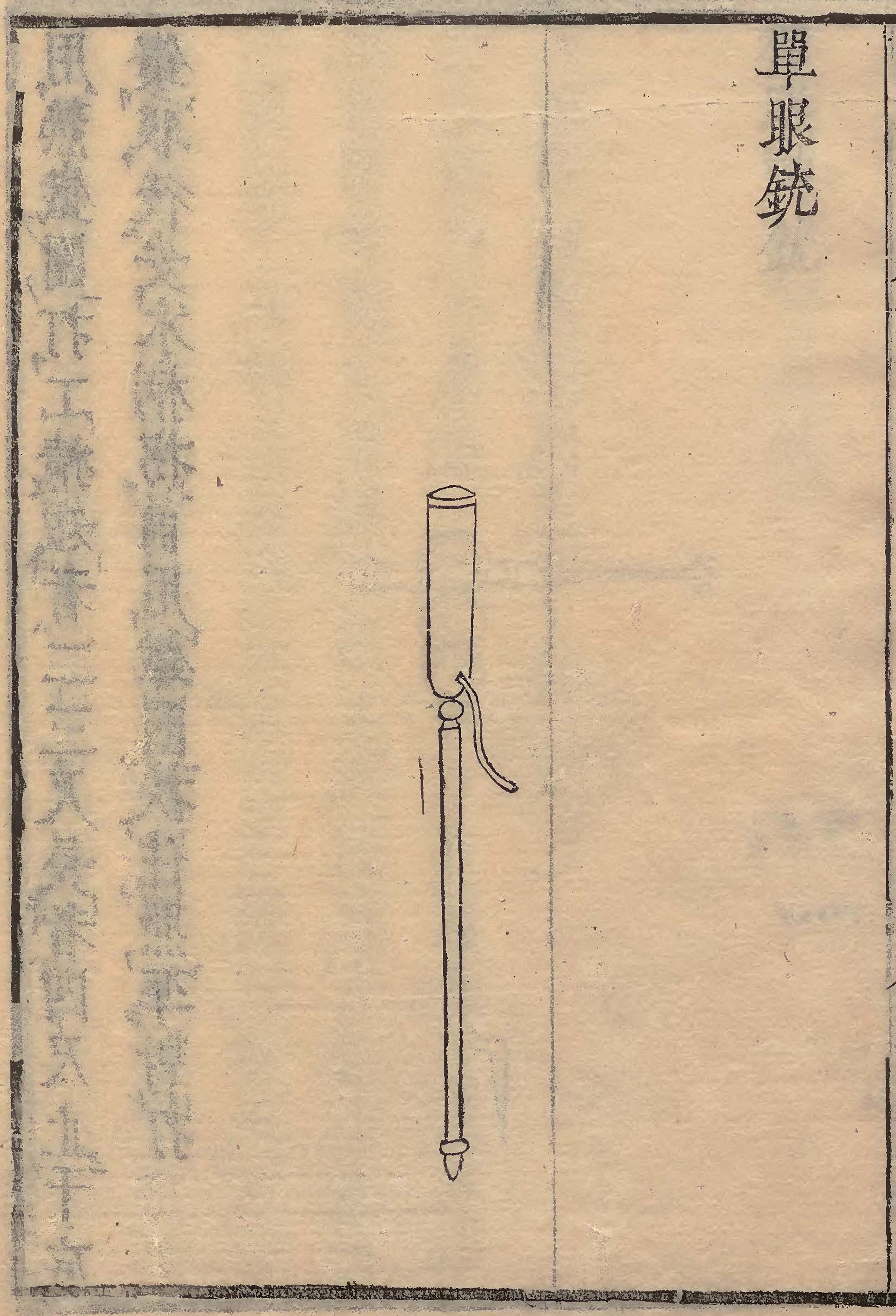
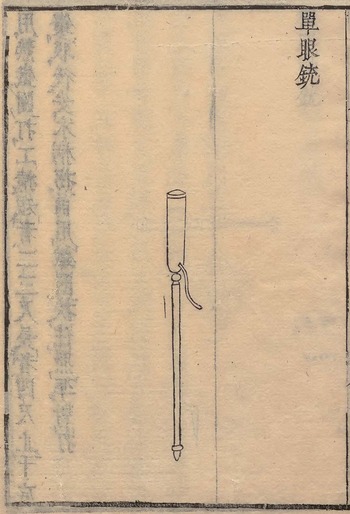
If you take the three-eyed gun and change it into a single-eyed gun; its iron barrel was formerly one chi 尺 [around 35 centimeters] but is changed to two chi [around 70 centimeters]. Moreover, on the top of the 1,000 barrels is a straight line. Relying on the line, observe the Lu and fire it. Those who are hit must be numerous. Because the powder and bullets are stowed deeply, where is reached must be far. Each gun is provided with one iron rod, the length according to the standard of the barrel, to pound the gunpowder in the barrel. The gun stock uses composite wood of around one chi [in length]. From far away you can launch a fire attack at the Lu, and from close by you can use the iron to beat the Lu. This your subject has considered and achieved (Chen 2000, 315) (Figure 2).
A depiction of the danyanchong 單眼銃 (single-eyed gun), the upgraded three-eyed gun proposed by Yu Maoheng and his colleagues. This depiction can be found in Mao Yuanyi’s (茅元儀, 1594–1640) Wubei zhi 武備志 (Treatise on Military Preparedness), the largest Ming military encyclopedia dating from 1621. The author notes the weapon was rare at this time. Courtesy of the National Archives of Japan, Tokyo.
This preoccupation with accuracy at longer ranges, even for handguns, might reflect experiences during the Imjin War, although none of the civil officials involved stated this explicitly. Nevertheless, the preoccupation with improving the three-eyed gun in this way occurred around the same time as the war. Notably is that no one suggested using the harquebus instead, even though the weapon must have been well-known by this time. Range and accuracy were desired, but modifying existing handguns was thought to be a better way to achieve this. Could this be attributed to the ingrained habits of northern soldiers, noted by Qi Jiguang? In this case, it seems that using the upgraded three-eyed gun would have forced these soldiers to adopt many of the necessary skills using a harquebus, also required anyway, including aiming and firing the weapon close to the face and taking more care with reloading. Increasing the range of handguns also meant they would now have to come equipped with an iron rod to aid in tamping down the gunpowder in the longer barrel, implying this was not necessary before. Perhaps because the new single-eyed guns no longer provided a concentrated burst of firepower at close range, Tu Zongjun thought it necessary to add more mobile light artillery, long swords, and shields to the formations (author’s translation):
For instance, cannons like the exterminating caitiff and the gushing beads have all been modified to be lighter and more convenient, the hundred bullet gun [baizichong 白子銃, a kind of muzzle-loading rapid firing light artillery gun (Wang Reference Zhaochun1991, 166)] and the wind chasing small divine lance [zhuifeng xiaoshenqiang 追風小神槍, probably similar to the zhuifengpao] have been newly manufactured. The shorter three-eyed lances have been lengthened. The battalions had horse-decapitating swords [zhanmadao 斬馬刀] in the past. Only rattan shields, convenient for use in the south, can be feasible to consider for manufacture (Chen 2000, 69).
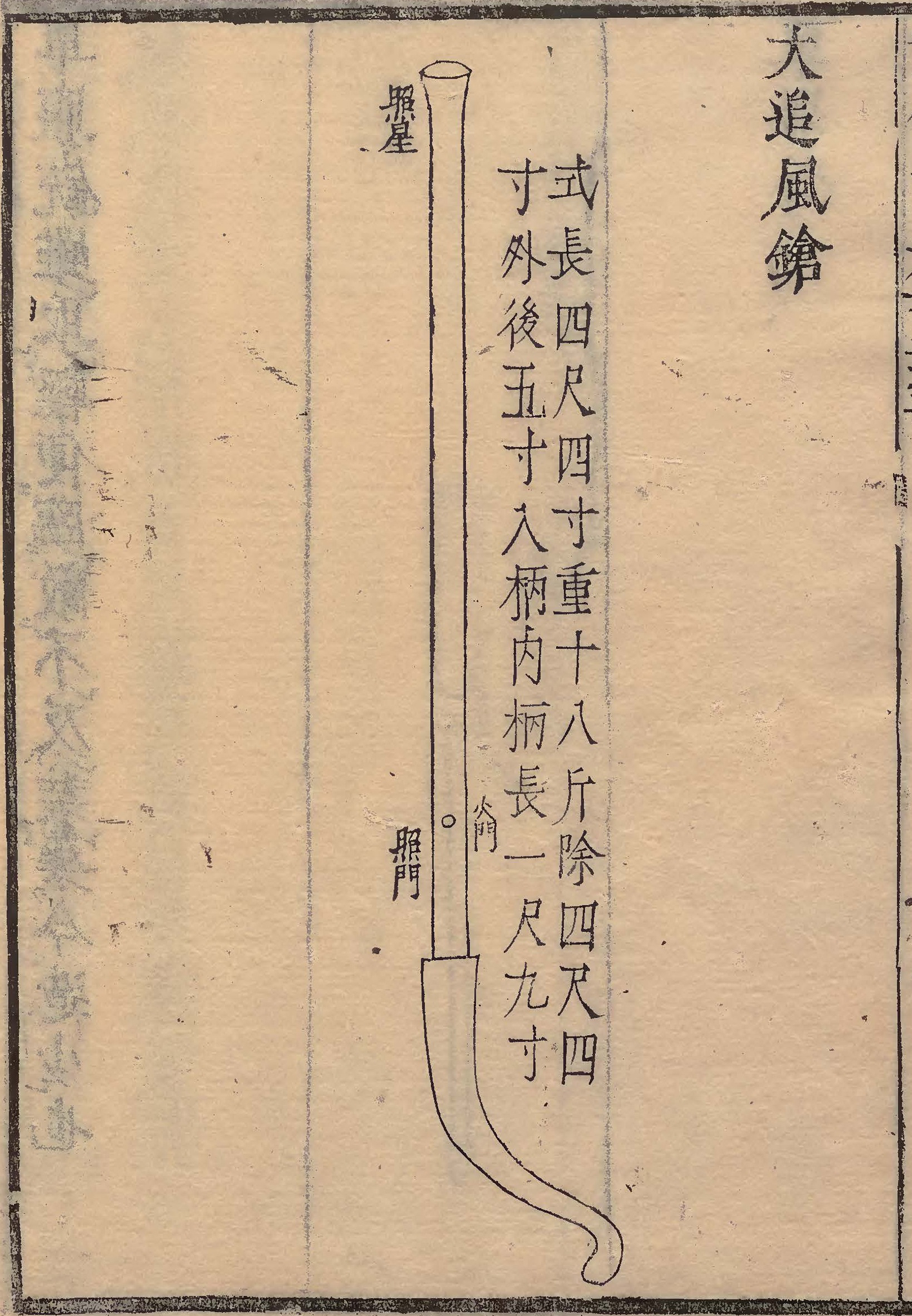
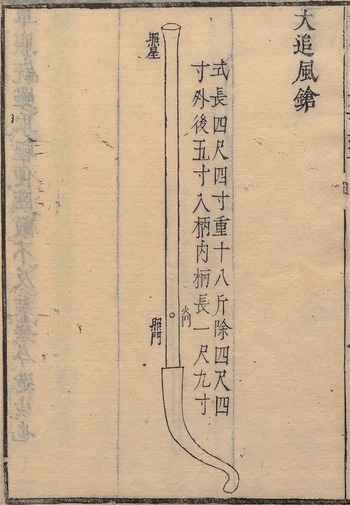
These proposals speak of a general preoccupation with accuracy and striking power at longer ranges. These presumably led to a decline of short-range stopping power, which would have been compensated by employing different kinds of light artillery, long swords, and shields. These reforms left no niche for the harquebus, as all the exclusive qualities the weapon normally brought to the table were now covered by the modified weapons. A weapon which was mentioned was the wind-chasing cannon, or wind-chasing small divine lance. This was also sometimes called the wind-chasing bird gun (zhuifeng niaochong 追風鳥銃; niaochong “bird gun” was a generic term for harquebus) in the sources. The latter was not a true harquebus, but a handgun with a long barrel, a harquebus-style stock, and gunsights, but lacked a matchlock. It was thus optimized for accuracy and range but did away with the cold wind problem by omitting the matchlock and adding a second operator to ignite the weapon’s charge with a hand-held fuse. The large version of the weapon could even reach 200 paces (around 265 meters) and was mounted on a tripod (Wang Reference Zhaochun1991, 156).
The harquebus was thus not regarded as a solution according to these officials, and instead, handguns were adapted in various ways to gain some of its desired characteristics. Strengthening the impression that these reforms were also inspired by the experiences during the Imjin War was the fact that these proposals lack mention of using battle wagons as protection for the infantry. Instead, more reliance would be placed on infantry armed with cold steel and shields, perhaps not coincidentally reflecting the tactics of the southern troops trained according to Qi Jiguang’s methods, which had proven more successful than the northern troops during the Imjin War. The combined efforts of the three civil officials also highlight the regionalization of firearms innovation in the late Ming Empire. The caption of Figure 2, depicting the single-eyed gun, lets us know that the weapon was never produced in any great quantities, however. But this did not mean others gave up on reaching a more universal solution (Figure 3).
A depiction of a big wind chasing gun da-zhuifengchong 大追風銃 in the Wubei zhi. It fulfilled the same tactical function as the harquebus, but it was perhaps preferred in the north because it lacked the vulnerable matchlock mechanism. Courtesy of the National Archives of Japan, Tokyo.
One enterprising and resourceful official tried to design more universally applicable guns. Zhao Shizhen (趙士楨, 1553–1611), a low-level civil official in Beijing, had been in contact with military subordinates of Qi Jiguang and was familiar with his usage of the harquebus against the Wokou (Craig Reference Craig2016, 157–164; Zhao Reference Shizhen and Keqiao2006, 362). He was also in touch with the military commander Chen Yin (陳寅, dates unknown), who experienced the power of Japanese harquebus fire up close in Korea while storming a Japanese stronghold in 1597. Chen Yin also demonstrated a Portuguese harquebus with a longer range than the Japanese models to Zhao and perhaps provided him with an incentive to seek out former members of an ostensibly Ottoman embassy. These had brought Ottoman harquebuses a few decades before, and these were also able to outrange their Japanese competitors, as Zhao discovered (author’s translation):Footnote 8
The Wonu 倭奴 [a derogatory term for the Japanese] are specialized in the harquebus, but beyond 2-300 paces [around 330-500 meters] all the Lumi 噜嘧 [Rumi, a term referring to the Ottoman empire] weapons are sufficient to dominate the enemy (Zhao Reference Shizhen and Keqiao2006, 407).
He also noted their precision at those distances and ability to penetrate enemy armor (Zhao Reference Shizhen and Keqiao2006, 380, 436). Zhao started enthusiastically advocating these weapons for this reason, but the court only heeded his memorials shortly after the war. The Ottoman harquebus thereafter saw service on the northern frontier against the nomads (Fidan Reference Fidan2011; Ma Reference Jianchun2007, 73–76; Needham et al. Reference Needham, Ho, G.-d. and Wang1986, 440–455; Noordam Reference Noordam2021, 127–131; Sun Reference Sun, Kenneth and Andrade2018, 121–124).
Even Zhao Shizhen, the Ottoman harquebus enthusiast, did not give up on the handgun entirely, but, on the contrary, proposed many improvements. He acknowledged the practical use of handguns like the three-eyed gun as hand-to-hand weapons. He seemed, however, mostly concerned with the accuracy of these handguns and thought of ways to make their usage more like that of the harquebus. Therefore, he designed a version of the three-eyed gun with a detachable matchlock mechanism, facilitating aimed fire, and a trident spear attached to the staff-end of the weapon. This was called the triple divine trident or triple divine gun (sanshentang 三神鎲 or sanshenchong 三神銃). This version could be used both in the south of the empire and along its northern frontier, especially in hilly or otherwise obscured terrain where distance was not an important factor (Zhao Reference Shizhen and Keqiao2006, 431–432). Zhao also proposed replacing the cast-iron wider barrels of the regular three-eyed gun with longer and thinner wrought-iron ones, similar to the ones used on the harquebus. Furthermore, wooden parts were placed between the three barrels to prevent them from heating each other during firing. It is unknown whether this had any consequences for the reload speed and the possibility of loading the barrel with multiple bullets. In addition, he was concerned about how well the bullets fit into the barrel of the existing three-eyed gun, because possible gas leakage also influenced the penetration power of the weapon vis-à-vis armor. Therefore, he proposed that the soldiers no longer carry the bullets around in belts, which deformed them. Zhao also made sure to add a blade to the weapon for hand-to-hand combat. A longer version for the infantry existed, and a shorter-barreled one was designed for the cavalry. Both were meant for the north (Zhao Reference Shizhen and Keqiao2006, 389, 415–416).
Other ideas matched desired firearms characteristics to different environments within the empire, although Zhao deplored the multiplicity of already extant weapon designs (Chase Reference Chase2003, 147–148; Zhao Reference Shizhen and Keqiao2006, 416). These included a harquebus equipped with a kind of protection cap to protect the matchlock and flash pan against the windy conditions in the north, as well as rain. Another design equipped an aimable multi-barreled handgun with a shield and spear at the end of the stock, as well as a detachable axe (Zhao Reference Shizhen and Keqiao2006, 402, 413, 432). The most persistent design seems to have been a kind of breech-loading harquebus, modeled on the folangji cannon. This was the chedianchong 掣電銃, or fast-as-lightning gun. The chambers containing the gunpowder and the projectile were detachable, and several of them could be loaded and prepared before battle. When the gun was fired, the gunner could easily remove the now-empty chamber and replace it with a new pre-loaded one. This significantly sped up the reloading process and prevented the harquebus from overheating, because the heat was mostly absorbed by the removable chambers (Feng Reference Zhenyu2012, 59–60; Zhao Reference Shizhen and Keqiao2006, 402–403). We lack data about existing physical examples to estimate their quality and dissemination during the Ming period. However, problems with gas leakage and loss of pressure were likely to have occurred, because it was difficult at this time to perfectly seal the breeches. This was a problem for which a technological solution did not exist yet. This issue would have diminished the force which was imparted on the projectile, and therefore also the range and power of the chedianchong compared to its conventional harquebus counterpart. Zhao seemed to be aware of this because he placed the weapon between the harquebus and the three-eyed gun in terms of advantageousness (Zhao Reference Shizhen and Keqiao2006, 377). Strangely enough, he seems to have regarded the quickly reloading and relatively accurate weapon as suitable for the south, and not the north (Zhao Reference Shizhen and Keqiao2006, 416).
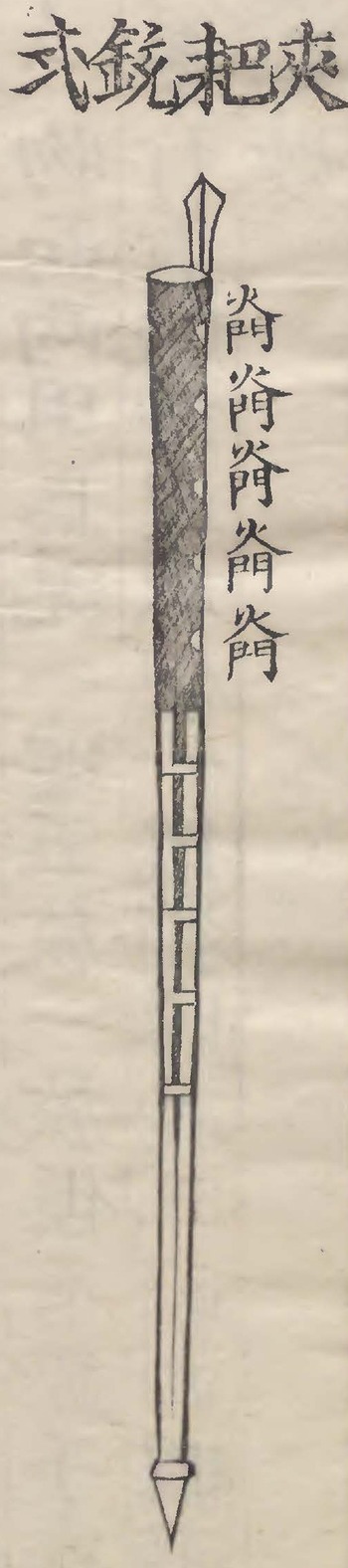
There is evidence that the design lived on in another military manual by the previously mentioned He Rubin. It contains a description of another breech-loading harquebus named the zimuchong 字母銃, or “child and mother gun.” The “child” was the removable chamber and the “mother” the harquebus (Chase Reference Chase2003, 147; He Reference Rubin2000, 664). The depiction of the breech-loading harquebus in He Rubin’s manual perhaps indicated the persistence of the search for a universal gun design. The zimuchong even provided a dual-use functionality as a melee weapon by having the possibility to be equipped with a plug bayonet. European infantry armed with the harquebus and its successors would only gain a similar functionality with this invention from the mid-seventeenth century onwards, whereas the handgun had provided Chinese infantry with this melee option for a long time. European bayonets were initially designed to be plugged into the barrel as well, transforming the weapon into a spear, but this blocked the simultaneous use of the weapon as a gun. A better solution was the socket bayonet, which simply attached the blade under the barrel, still enabling the discharge of the weapon. This became commonplace in European forces around 1700. As noted above, this development is heralded by many European military historians as a key innovation because it allowed the musketeers to dispense with the pikemen and replace them with even more musketeers. This increased infantry firepower and tactical flexibility considerably (Black Reference Black1991, 20; Chase Reference Chase2003, 200–201; Parrott Reference Parrott2012, 146).
The existence of the zimuchong makes a good case that the Ming Chinese anticipated this development. He Rubin’s manual depicts the zimuchong breech-loading harquebus with a plug bayonet. The bayonet depicted in He Rubin’s manual could have been a result of European influence, as the manual also contains translated parts of a Spanish military manual on artillery ballistics (Yin Reference Xiaodong2005). However, the date the oldest extant version of the manual was printed, 1632, still predates the earliest mention of the bayonet in a military context in Europe, which only appeared near the end of the Thirty-Years War (1618–1648) (Chandler Reference Chandler1976, 82–83). Pleading in favor of a Chinese invention is the fact that its emergence fits pre-existing patterns of Chinese firearms development, favoring dual-use capability. This capability could have provided a psychological boost, since it probably made soldiers wielding guns feel less vulnerable when facing a charging enemy. The harquebus’ initial lack of this dual-use function probably contributed to inhibiting its spread in especially the north, and could have triggered the invention of the bayonet.
A later military manual dating to the 1630s shows that the Ming Chinese were aware of the flintlock as well, at roughly the same time as the first feasible version of this technology appeared in Europe. This manual had been written by Bi Maokang 畢懋康 (1571–1645) (Wang Reference Zhaochun1991, 223–224). A bayonet-armed breech-loading matchlock or a muzzle-loading flintlock would have gone a long way towards ending Ming China’s search for a universal gun. Either of these design solutions would have combined almost all the desirable characteristics of both the handgun and the harquebus in one weapon system. The chaos caused by the wars against the Manchu and the simultaneously occurring internal rebellions likely obstructed the development and dissemination of this technology on a large scale. Nevertheless, the established trajectory of innovation would have made such a move a logical one (Figure 4).
The breech-loading harquebus preserved in He Rubin’s manual showcasing the plug bayonet designated as chong dao 銃刀, or “gun knife.” An accompanying description prescribes using it when the enemy came within two bu 步 (around three meters), meaning there was not enough time reload the weapon. In this case, it was to be handled like a spear. Courtesy of the National Archives of Japan, Tokyo.

To what extent the three-eyed guns and other traditional handguns were really upgraded and in what numbers are questions that require more research into the material remains of the Ming. The same holds for the harquebus and the numerous modifications officials like Zhao Shizhen proposed. Meanwhile, a brief look forward to the conflict with the Manchu shows a lasting preference for mixing long-range precision weapons, whether harquebuses or modified handguns, with short-ranged specimens with a high rate of fire in lieu of adopting a more universal solution. The preference for mixed integrated formations can be witnessed in the case of Sun Chengzong (孫承宗, 1563–1638), who was a civilian official in charge of combating the rising Manchu threat. If we look at his written proposals collected in his manual Che ying kouda hebian 車營扣答合編 (Compiled Questions and Answers about the Wagon Battalions), Sun seemed much less enthusiastic than Qi Jiguang about adapting the harquebus to northern wagon fortress tactics and instead favored the three-eyed gun. His standard infantry squad contained two harquebusiers but also consisted of six gunners using the three-eyed gun, two rocketeers, two archers, and one folangji cannon with a crew of six (Chang Reference Hsiu-ming2016, 92–93; Sun Reference Chengzong1994, 24). As for tactics, archers and handgunners were supposed to rotate, suggesting volley fire, whereas the folangji with their crew and the harquebusiers were to deploy in front of them. The latter lacked specific instructions, which meant they were perhaps to fire individually, taking aimed shots (Sun Reference Chengzong1994, 262–263). A memorial dated to March 1622 from the Supreme Commander of the Ji-Liao area facing the Manchu threat, Wang Xiangqian (王象乾, 1546–1630), also included a request for a mixed force of archers and gunners equipped with the three-eyed gun and the zhuifeng niaochong (wind chasing harquebus) mentioned above (Ming Xizong shilu 1966, 29:1440). In 1623, a Ming official named Peng Runan (彭汝楠, 1579–1638) stated in a memorial that the similar zhuifengpao was suitable for the attack, in contrast to the three-eyed gun, which could only be used defensively. According to him, the three-eyed guns were still the most numerous firearms, at least in the capital training divisions, but they were light, and their range was short (Ming Xizong shilu 1966, 35:1797). Peng Runan, Sun Chengzong, and Wang Xiangqian’s writings still seem to suggest a common practice of relying both on accurate long-ranged firearms and shorter-ranged weapons with a high rate of fire for short-range defense when the attackers came too close. More importantly, this complementary approach was utilized against both the northern Mongol and Manchu cavalry, as well as against the southern infantry of Sino-Japanese pirates and ethnic minorities. An ideal compromise embodied by a single type of weapon had not yet been found.
Conclusion
The survival of the handgun in Ming China was a manifestation of rational military practices and design priorities distinct from those of Europe, differences which were only partially determined by geography. Restricting the explanation to conservatism only serves to rely on a thought-terminating cliché. On the contrary, the harquebus’ reception by Ming officials ran the gamut from Qi Jiguang’s near-exclusive embrace of it to the Caolu jinglüe author’s continued advocacy of the crossbow. When we compare the early modern European and Chinese usages of the harquebus and seek to explain the differences, we must consider the issue of timing. When the harquebus was invented, the European armies had not yet implemented volley fire tactics with their predecessors, such as the crossbow or the handgun. In fact, the matchlock firearms and volley fire tactics would appear in Europe almost simultaneously. In China, by contrast, the handgun had co-evolved with similar tactical innovations, and the harquebus therefore came to occupy a tactical role based on qualities the handgun could not bring to the table: accuracy, range, and penetration power. The weapon, therefore, found a niche in Ming China it did not fill to the same extent in early modern European warfare: long-range precision firepower. Exploiting this niche required upskilling the Chinese gunners, instead of deskilling archers as happened in contemporaneous Europe. That it was a new niche is also evidenced by the lack of properly institutionalized incentives for the harquebusiers to practice their skills on the battlefield. A new system for dispensing rewards had to be conceived to accommodate the new functionalities the harquebus brought.
This difference also guaranteed the continued existence of the handgun, because its comparative crudeness brought many advantages: a high rate of fire enabled by quick reloading speeds, the ability to withstand various charges of gunpowder and be loaded with multiple bullets at once, the possibility of firing in high arcs, and the possession of a dual-use functionality as a melee weapon. Especially the latter two factors have been overlooked in judging the advantages of the handgun and establish that it was anything but a “dumb” weapon. Both firing in ballistic arcs and wielding the handgun effectively as a melee weapon required skill and experience. Faced with all these various desired functionalities, the harquebus could not help but fall short in providing all the needs the handgun already covered.
The Imjin War, in which the Ming army saw itself confronted with an opponent relying on infantry firearms as well, stimulated experiments by officials to upgrade both the handgun and the harquebus. Europeans, by contrast, downgraded their harquebuses and muskets to achieve higher rates of fire. Chinese upgrade priorities included weatherproofing harquebuses and increasing their rate of fire, as well as increasing the range, accuracy, and penetration power of both the harquebus and handgun. It is unknown to what extent these experiments bore fruit, although the twenty-year gap between the end of the Imjin War and the start of the conflict with the Manchu might have disincentivized further experiments towards a more universal gun. Notable, however, is the invention of the bayonet to finally provide harquebusiers with a dual-use weapon, a development fully in line with precedents. By the time the Manchu conflict began, officials pragmatically chose to include both types of weapons in mixed integrated formations, as Qi Jiguang had begrudgingly attempted and Wang Minghe later advocated. However, the juxtaposition of these later trends with Qi Jiguang’s earlier, more straightforward, embrace of the harquebus should, I argue, not be seen as a regression resulting from a lack of will to embrace superior technology. Instead, it resulted from a wish to retain the best of both worlds: rate of fire and dual-use functionality and ballistic fire and range and accuracy and penetration power.
This search for the elusive universal gun was reflected in the half-century of debate set down in writing, and experimentation implemented in practice, considered in this article. These reveal the existence of a dialectical challenge and response relationship between the handgun and the harquebus, the environments in which they were to be used, and the types of enemies they were meant to counter. The failure to find a satisfactory technological solution notwithstanding, the imagination and zest for experimentation were undeniably there. Had the Ming lasted longer, a solution akin to the European flintlock musket equipped with a socket bayonet might have been reached, but the collapse of the dynasty halted this development in its tracks. In the meantime, Ming officials chose not to choose as handguns and harquebuses were to be used simultaneously, in integrated formations, on all frontiers of the empire. Nor was the Ming behind the curve at the time of its fall in 1644: it took half a century more for the flintlock-cum-bayonet combination to become the dominant infantry weapon in European infantry warfare.
Funding statement
This project has received funding from the European Research Council (ERC) under the European Union’s Horizon 2020 research and innovation program (grant agreement no. 758347).


 Open access

