




1 Introduction
Let G be a Polish group acting on a Polish space in a Borel way. Let $E^X_G$
be the orbit equivalence relation induced by the action. In other words, for
$E^X_G$
be the orbit equivalence relation induced by the action. In other words, for $x,y \in X$
,
$x,y \in X$
,
 $$ \begin{align*}xE^X_Gy\,\,\Leftrightarrow\,\,\exists g\in G\,\,gx=y. \end{align*} $$
Let E and F be two equivalence relations on Polish spaces X and Y, respectively. A Borel function from X to Y is called a Borel reduction from E to F, if for any $x_1,x_2\in X$
, we have
$x_1,x_2\in X$
, we have
 $$ \begin{align*}x_1Ex_2\,\,\mbox{if and only if}\,\,f(x_1)Ff(x_2). \end{align*} $$
We say that E is Borel reducible to F if there is a Borel reduction from E to F and denote by $E\leq _B F$
.
$E\leq _B F$
.
It is natural to ask about the connection between the structure of a Polish group G and the complexity of the equivalence relations it induces. The connection is well-studied if G is countable. For example, if $G=\mathbb {Z}$
, then all actions induced by G are hyperfinite. In an important breakthrough, Gao and Jackson [Reference Gao and Jackson6] proved that all actions induced by countable Abelian groups are hyperfinite. Weiss conjectured that hyperfiniteness holds for all countable amenable group actions. This conjecture is still open so far.
$G=\mathbb {Z}$
, then all actions induced by G are hyperfinite. In an important breakthrough, Gao and Jackson [Reference Gao and Jackson6] proved that all actions induced by countable Abelian groups are hyperfinite. Weiss conjectured that hyperfiniteness holds for all countable amenable group actions. This conjecture is still open so far.
For every Polish group G, Becker and Kechris [Reference Gao5, Theorem 3.3.4] proved that there is a most complicated orbit equivalence relation induced by G, called a maximal G-action. In other words, there exists a G-action such that all G-actions are Borel reducible to it. Thus, the question regarding connections between a Polish group and its actions can be restated as the following: given a Polish group G, where is its maximal action located in the complexity hierarchy?
A Polish group G is universal if all Polish groups can be continuously embedded as closed subgroup of G. An equivalence relation E is complete in a class $\mathcal {C}$
of equivalence relations if E is in
$\mathcal {C}$
of equivalence relations if E is in $\mathcal {C}$
and all equivalence relations in
$\mathcal {C}$
and all equivalence relations in $\mathcal {C}$
are Borel reducible to E. Complete orbit equivalence relations exist. Indeed, the maximal action of any universal Polish group is a complete orbit equivalence relation by the Mackey–Hjorth extension theorem [Reference Gao5, Theorem 3.5.2]. There are also natural examples in topology and
$\mathcal {C}$
are Borel reducible to E. Complete orbit equivalence relations exist. Indeed, the maximal action of any universal Polish group is a complete orbit equivalence relation by the Mackey–Hjorth extension theorem [Reference Gao5, Theorem 3.5.2]. There are also natural examples in topology and $C^*$
-algebras (see, e.g., [Reference Sabok9, Reference Zielinski13]).
$C^*$
-algebras (see, e.g., [Reference Sabok9, Reference Zielinski13]).
It is natural to ask that if there is a connection between completeness of an orbit equivalence relation and the structure of the group which induces this equivalence relation.
In this article, we address the following question posed by Sabok in [Reference Buzzi, Chandgotia, Foreman, Gao, García-Ramos, Gorodetski, Le Maitre, Rodríguez-Hertz and Sabok1].
Question 1.1. [Reference Buzzi, Chandgotia, Foreman, Gao, García-Ramos, Gorodetski, Le Maitre, Rodríguez-Hertz and Sabok1] Does there exist a non-universal Polish group which induces a complete orbit equivalence relation?
We answer this question in the positive.
Theorem 1.2. There exists a non-universal Polish group which induces complete orbit equivalence relation.
In [Reference Ding2], Ding found an example of a surjectively universal Polish group. We note that such group can induce complete orbit equivalence relation, and we show that this group is not universal. As a matter of fact, in [Reference Sabok10], Sabok mentioned without proof that a surjectively universal but not universal Polish group could serve as an example for Question.Footnote 1 However, showing that a surjectively universal group which is not universal exists requires a proof and in the subsequent survey [Reference Buzzi, Chandgotia, Foreman, Gao, García-Ramos, Gorodetski, Le Maitre, Rodríguez-Hertz and Sabok1] Question 1.1 was stated as open.
2 Preliminaries
In this section we discuss the construction and some results about surjectively universal Polish groups from [Reference Ding2, Reference Ding and Gao4].
For a nonempty set X, let $X^{-1} =\{x^{-1}: x \in X\}$
be a disjoint copy of X, take
$X^{-1} =\{x^{-1}: x \in X\}$
be a disjoint copy of X, take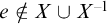 $e\notin X\cup X^{-1}$
. Denote
$e\notin X\cup X^{-1}$
. Denote $X\cup X^{-1}\cup \{e\}$
by
$X\cup X^{-1}\cup \{e\}$
by $\overline {X}$
. For
$\overline {X}$
. For $x\in X$
, by
$x\in X$
, by $(x^{-1})^{-1}$
we mean x, and by
$(x^{-1})^{-1}$
we mean x, and by $e^{-1}$
we mean e.
$e^{-1}$
we mean e.
We denote the set of nonempty words on $\overline {X}$
by
$\overline {X}$
by $W(X)$
, in other words
$W(X)$
, in other words $W(X)=\overline {X}^{<\omega }\setminus \{\emptyset \}$
. For
$W(X)=\overline {X}^{<\omega }\setminus \{\emptyset \}$
. For $w\in W(X)$
,
$w\in W(X)$
, $|w|$
is the length of w. A word
$|w|$
is the length of w. A word $w\in W(X)$
is irreducible if
$w\in W(X)$
is irreducible if $w=e$
or
$w=e$
or $w=x_0\ldots x_n$
such that
$w=x_0\ldots x_n$
such that $n\ge 0$
,
$n\ge 0$
, $x_i\ne e$
for every
$x_i\ne e$
for every $0\le i\le n$
and
$0\le i\le n$
and $x_i\ne x_{i+1}^{-1}$
for every
$x_i\ne x_{i+1}^{-1}$
for every $0\le i\le n-1$
. We denote the set of irreducible words in
$0\le i\le n-1$
. We denote the set of irreducible words in $W(X)$
by
$W(X)$
by $F(X)$
. For a word
$F(X)$
. For a word $w\in W(X)$
, the reduced form for w is the irreducible word obtained by successively replacing any occurrence of
$w\in W(X)$
, the reduced form for w is the irreducible word obtained by successively replacing any occurrence of $xx^{-1}$
in w by e where
$xx^{-1}$
in w by e where $x\in \overline {X}$
, and eliminating e from any occurrence of the form
$x\in \overline {X}$
, and eliminating e from any occurrence of the form $w_1ew_2$
, where at least one of
$w_1ew_2$
, where at least one of $w_1$
and
$w_1$
and $w_2$
is nonempty. Note that the reduced form of
$w_2$
is nonempty. Note that the reduced form of $w\in W(X)$
is independent from the order of eliminating e or replacing
$w\in W(X)$
is independent from the order of eliminating e or replacing $xx^{-1}$
to e, denote the reduced form for
$xx^{-1}$
to e, denote the reduced form for $w\in W(X)$
by
$w\in W(X)$
by $w'$
, then
$w'$
, then $w'\in F(X)$
. For
$w'\in F(X)$
. For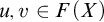 $u,v\in F(X)$
, let
$u,v\in F(X)$
, let $u\cdot v=(u^\smallfrown v)'$
, then
$u\cdot v=(u^\smallfrown v)'$
, then $(F(X),\cdot )$
is a group, named the free group on X. The neutral element of
$(F(X),\cdot )$
is a group, named the free group on X. The neutral element of $F(X)$
is e.
$F(X)$
is e.
To define a metric on $F(X)$
, firstly we assume that X is a metric space with a metric
$F(X)$
, firstly we assume that X is a metric space with a metric $d\le 1$
, that is,
$d\le 1$
, that is, $d(x,y)\le 1$
for every
$d(x,y)\le 1$
for every $x,y\in X$
. We can extend d to
$x,y\in X$
. We can extend d to $\overline {X}$
by defining
$\overline {X}$
by defining
 $$ \begin{align*}d(x^{-1}, y^{-1})=d(x,y),\quad d(x^{-1},y)=d(x,e)=d(x^{-1},e)=1\end{align*} $$
for every $x,y\in X$
. Then to get a metric on
$x,y\in X$
. Then to get a metric on $F(X)$
we need some more concepts.
$F(X)$
we need some more concepts.
Definition 2.1. (Ding–Gao [Reference Ding and Gao3], [Reference Gao5, Definition 2.3.2])
For $m,n\in \mathbb {N}$
and
$m,n\in \mathbb {N}$
and $m\le n$
, a bijection
$m\le n$
, a bijection $\theta $
on
$\theta $
on $\{m,\ldots ,n\}$
is a match if
$\{m,\ldots ,n\}$
is a match if
-
(1) $\theta ^2=\mathrm {id}$
;
$\theta ^2=\mathrm {id}$
; -
(2) there is no
$i,j\in \{m,\ldots ,n\}$
such that
$i<j<\theta (i)<\theta (j)$
.



Definition 2.2 (Ding–Gao [Reference Ding and Gao4]).
Let $\mathbb {R}_+$
be the set of non-negative real numbers. A function
$\mathbb {R}_+$
be the set of non-negative real numbers. A function $\Gamma : \overline {X}\times \mathbb {R}_+\rightarrow \mathbb {R}_+$
is a scale on
$\Gamma : \overline {X}\times \mathbb {R}_+\rightarrow \mathbb {R}_+$
is a scale on $\overline {X}$
if the following hold for any
$\overline {X}$
if the following hold for any $x\in \overline {X}$
and
$x\in \overline {X}$
and $r\in \mathbb {R}_+$
:
$r\in \mathbb {R}_+$
:
-
(i)
$\Gamma (e,r)=r$
,
$\Gamma (x,r)\ge r$
; -
(ii)
$\Gamma (x,r)=0$
iff
$r=0$
; -
(iii)
$\Gamma (x,\cdot )$
is a monotone increasing function with respect to the second variable; -
(iv)
$\mathrm {lim}_{r\rightarrow 0} \Gamma (x,r)=0$
.



If we take $\Gamma (x,r)=r$
for every
$\Gamma (x,r)=r$
for every $x\in \overline {X}$
and
$x\in \overline {X}$
and $r\in \mathbb {R}_+$
, then
$r\in \mathbb {R}_+$
, then $\Gamma $
is a scale on
$\Gamma $
is a scale on $\overline {X}$
, we call it the trivial scale on
$\overline {X}$
, we call it the trivial scale on $\overline {X}$
.
$\overline {X}$
.
Let G be a topological group with compatible left-invariant metric $d_G$
. Define
$d_G$
. Define $\Gamma _G:G\times \mathbb {R}_+ \rightarrow \mathbb {R}_+$
by
$\Gamma _G:G\times \mathbb {R}_+ \rightarrow \mathbb {R}_+$
by
 $$ \begin{align*}\Gamma_G(g,r) =\mathrm{max}\{ r,\mathrm{sup}\{d_G(1_G,g^{-1}hg):d_G(1_G,h)\le r\}\} .\end{align*} $$
It is easy to see that $\Gamma _G$
satisfies the conditions (i)–(iii) in the definition of a scale, and (iv) is from the compatibility of
$\Gamma _G$
satisfies the conditions (i)–(iii) in the definition of a scale, and (iv) is from the compatibility of $d_G$
. We will also call
$d_G$
. We will also call $\Gamma _G$
the scale on G.
$\Gamma _G$
the scale on G.
Then given a scale $\Gamma $
on
$\Gamma $
on $\overline {X}$
, we will define a metric on
$\overline {X}$
, we will define a metric on $F(X)$
related to
$F(X)$
related to $\Gamma $
.
$\Gamma $
.
Definition 2.3 (Ding–Gao [Reference Ding and Gao4]).
Let $\Gamma $
be a scale on
$\Gamma $
be a scale on $\overline {X}$
. For
$\overline {X}$
. For $l\in \mathbb {N}$
,
$l\in \mathbb {N}$
, $w\in W(X)$
with
$w\in W(X)$
with $|w|=l+1$
and
$|w|=l+1$
and $\theta $
a match on
$\theta $
a match on $\{0,\ldots ,l\}$
, define
$\{0,\ldots ,l\}$
, define $N^{\theta }_\Gamma (w)$
by induction on l as follows:
$N^{\theta }_\Gamma (w)$
by induction on l as follows:
-
(0) for
$l =0$
, let
$w =x$
and define
$N^\theta _\Gamma (w)=d(e,x)$
; -
(1) if
$l>0$
and
$\theta (0)=k<l$
, let
$\theta _1 =\theta \upharpoonright \{0,\ldots ,k\}$
,
$\theta _2=\theta \upharpoonright \{k+1,\ldots ,l\},$
and
$w =w_1^\smallfrown w_2$
where
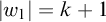
$|w_1|=k +1$
; define
$$ \begin{align*}N^{\theta}_\Gamma(w)=N^{\theta_1}_\Gamma(w_1)+N^{\theta_2}_\Gamma(w_2);\end{align*} $$
-
(2) if
$l>0$
and
$\theta (0)=l$
, let
$\theta _1 =\theta \upharpoonright \{1,\ldots ,l-1\}$
and
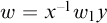
$w = x^{-1}w_1y$
where
${x,y \in \overline {X}}$
; then
$|w_1| =l-1$
. Define
$$ \begin{align*}N^{\theta}_\Gamma(w)=d(x,y)+\mathrm{max}\{\Gamma(x,N^{\theta_1}_\Gamma(w_1)),\Gamma(y,N^{\theta_1}_\Gamma(w_1))\}.\end{align*} $$













Then we take
 $$ \begin{align*}N_\Gamma(w)=\mathrm{inf}\{N^\theta_\Gamma(w^*):(w^*)'=w,\,\theta\;is\;a\;match\}\end{align*} $$
for $w\in F(X)$
, and we take
$w\in F(X)$
, and we take
 $$ \begin{align*}\delta_\Gamma(u,v)=N_\Gamma(u^{-1}v)\end{align*} $$
for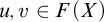 $u,v\in F(X)$
.
$u,v\in F(X)$
.
For a metric space $(X,d)$
and the trivial scale
$(X,d)$
and the trivial scale $\Gamma _0$
on
$\Gamma _0$
on $\overline {X}$
, we call
$\overline {X}$
, we call $\delta _{\Gamma _0}$
the Graev metric on
$\delta _{\Gamma _0}$
the Graev metric on $F(X)$
.
$F(X)$
.
For $u=x_0\ldots x_n$
and
$u=x_0\ldots x_n$
and $v=y_0\ldots y_n$
in
$v=y_0\ldots y_n$
in $W(X)$
, let
$W(X)$
, let
 $$ \begin{align*}\rho(u,v)=\Sigma_{0\le i\le n}d(x_i,y_i).\end{align*} $$
Given $w=x_0\ldots x_n\in W(X)$
and a match
$w=x_0\ldots x_n\in W(X)$
and a match $\theta $
on
$\theta $
on $\{0,\ldots ,n\}$
, let
$\{0,\ldots ,n\}$
, let
 $$ \begin{align*}x^\theta_i= \left \{\begin{array}{@{}lr@{}} x_i,&\theta(i)> i.\\ e,& \theta(i)=i.\\ x^{-1}_{\theta(i)},&\theta(i)< i. \end{array} \right.\end{align*} $$
and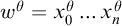 $w^\theta =x^\theta _0\ldots x^\theta _n$
. Then we have
$w^\theta =x^\theta _0\ldots x^\theta _n$
. Then we have
Theorem 2.4. (Ding–Gao [Reference Gao5, Theorem 2.6.5])
Let $(X,d)$
be a metric space,
$(X,d)$
be a metric space, $\Gamma _0$
is the trivial scale on
$\Gamma _0$
is the trivial scale on $\overline {X}$
, then
$\overline {X}$
, then
 $$ \begin{align*}\delta_{\Gamma_0}(w,e)=\mathrm{ min}\{\rho(w,w^\theta):\;\theta\, is\;a\;match\}\end{align*} $$
for every $w\in F(X)$
.
$w\in F(X)$
.
Then we have the following theorem in [Reference Ding and Gao4].
Theorem 2.5. (Ding–Gao [Reference Ding and Gao3, Theorem 2.6])
Let $(X,d)$
be a metric space,
$(X,d)$
be a metric space, $\Gamma $
is a scale on
$\Gamma $
is a scale on $\overline {X}$
, then the
$\overline {X}$
, then the $d_\Gamma $
is a left-invariant metric on
$d_\Gamma $
is a left-invariant metric on $F(X)$
extending d. Furthermore,
$F(X)$
extending d. Furthermore, $F(X)$
is a topological group under the topology induced by
$F(X)$
is a topological group under the topology induced by $\delta _\Gamma $
.
$\delta _\Gamma $
.
Denote the topological group $F(X)$
with the metric
$F(X)$
with the metric $\delta _\Gamma $
by
$\delta _\Gamma $
by $F_\Gamma (X)$
. Let
$F_\Gamma (X)$
. Let $\delta ^{-1}_\Gamma (u,v)=\delta _\Gamma (u^{-1},v^{-1})$
for
$\delta ^{-1}_\Gamma (u,v)=\delta _\Gamma (u^{-1},v^{-1})$
for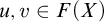 $u,v\in F(X)$
, and
$u,v\in F(X)$
, and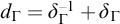 $d_\Gamma =\delta ^{-1}_\Gamma +\delta _\Gamma $
, then
$d_\Gamma =\delta ^{-1}_\Gamma +\delta _\Gamma $
, then $d_\Gamma $
is a compatible metric on topological group
$d_\Gamma $
is a compatible metric on topological group $F_\Gamma (X)$
. The completion of
$F_\Gamma (X)$
. The completion of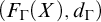 $(F_\Gamma (X),d_\Gamma )$
is a Polish group, denoted by
$(F_\Gamma (X),d_\Gamma )$
is a Polish group, denoted by $\overline {F}_\Gamma (X)$
. Then the main theorem in [Reference Ding2] says that such a group of this form can be a surjectively universal group.
$\overline {F}_\Gamma (X)$
. Then the main theorem in [Reference Ding2] says that such a group of this form can be a surjectively universal group.
We denote the Baire space $\omega ^\omega $
by
$\omega ^\omega $
by $\mathcal {N}$
, d is the standard metric on
$\mathcal {N}$
, d is the standard metric on $\mathcal {N}$
such that
$\mathcal {N}$
such that $d(x,y)=\mathrm {max}\{2^{-n}:x(n)\ne y(n)\}$
. For
$d(x,y)=\mathrm {max}\{2^{-n}:x(n)\ne y(n)\}$
. For $n\in \mathbb {N}$
, let
$n\in \mathbb {N}$
, let
 $$ \begin{align*}\mathcal{N}_n=\{x\in\mathcal{N}:\forall m\ge n,x(m)=0\},\end{align*} $$
and $\mathcal {N}_\omega =\bigcup _{n\in \mathbb {N} }\mathcal {N}_n$
. For
$\mathcal {N}_\omega =\bigcup _{n\in \mathbb {N} }\mathcal {N}_n$
. For $x\in \mathcal {N}$
, let
$x\in \mathcal {N}$
, let
 $$\begin{align*}\pi_n(x)(m)= \left\{\begin{array}{@{}lr@{}} x(m),&m<n.\\ 0,& m\ge n. \end{array} \right.\end{align*}$$
Then a scale $\Gamma $
on
$\Gamma $
on $\overline {\mathcal {N}}$
is regular if for every
$\overline {\mathcal {N}}$
is regular if for every $x\in \overline {\mathcal {N}}$
,
$x\in \overline {\mathcal {N}}$
, $r\in \mathbb {R}_+$
, and
$r\in \mathbb {R}_+$
, and $n\in \mathbb {N}$
, we have
$n\in \mathbb {N}$
, we have $\Gamma (x,r)\ge \Gamma (\pi _n(x),r)$
.
$\Gamma (x,r)\ge \Gamma (\pi _n(x),r)$
.
Theorem 2.6. (Ding–Gao [Reference Ding2, Example 4.9])
There is a regular scale $\Gamma $
on
$\Gamma $
on $\overline {\mathcal {N}}$
such that
$\overline {\mathcal {N}}$
such that $\overline {F}_\Gamma (\mathcal {N})$
is a surjectively universal Polish group.
$\overline {F}_\Gamma (\mathcal {N})$
is a surjectively universal Polish group.
The next theorem in [Reference Ding and Gao4] tells us how to get a continuous homomorphism from $\overline {F}_\Gamma (X)$
to another topological group.
$\overline {F}_\Gamma (X)$
to another topological group.
Theorem 2.7. (Ding–Gao [Reference Ding and Gao3, Lemma 3.7])
Let G be a topological group and $d_G$
a compatible left-invariant metric on G. Let
$d_G$
a compatible left-invariant metric on G. Let $\Gamma $
be a scale on
$\Gamma $
be a scale on $\overline {X}$
. Let
$\overline {X}$
. Let $\varphi :X\rightarrow G$
be a function. Suppose that for any
$\varphi :X\rightarrow G$
be a function. Suppose that for any $x,y\in \overline {X}$
and
$x,y\in \overline {X}$
and $r\in \mathbb {R}_+$
:
$r\in \mathbb {R}_+$
:
-
(1)
$\varphi (e)=1_G$
;
$\varphi (x^{-1})=\varphi (x)^{-1}$
; -
(2)
$d_G(\varphi (x),\varphi (y)) \le d(x,y)$
; -
(3)
$\Gamma _G(\varphi (x),r) \le \Gamma (x,r)$
.




Then $\varphi $
can be uniquely extended to a continuous group homomorphism
$\varphi $
can be uniquely extended to a continuous group homomorphism $\Phi :F(X)\rightarrow G$
such that for any
$\Phi :F(X)\rightarrow G$
such that for any $w \in F(X),$
 $$ \begin{align*}d_G(\Phi(w),1_G)\le N_\Gamma(w).\end{align*} $$
3 Proof of the main theorem
By [Reference Ding2], we can fix a regular scale $\Gamma $
on
$\Gamma $
on $\overline {\mathcal {N}}$
such that
$\overline {\mathcal {N}}$
such that $\overline {F}_\Gamma (\mathcal {N})$
is a surjectively universal Polish group, and
$\overline {F}_\Gamma (\mathcal {N})$
is a surjectively universal Polish group, and $\Gamma (x,\cdot )$
is continuous for every
$\Gamma (x,\cdot )$
is continuous for every $x\in \overline {\mathcal {N}}$
. Recall
$x\in \overline {\mathcal {N}}$
. Recall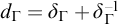 $d_\Gamma =\delta _\Gamma +\delta ^{-1}_\Gamma $
on
$d_\Gamma =\delta _\Gamma +\delta ^{-1}_\Gamma $
on ${F}_\Gamma (\mathcal {N})$
, by abusing the notation we also denote the extension of it on
${F}_\Gamma (\mathcal {N})$
, by abusing the notation we also denote the extension of it on $\overline {F}_\Gamma (\mathcal {N})$
by
$\overline {F}_\Gamma (\mathcal {N})$
by $d_\Gamma $
.
$d_\Gamma $
.
Lemma 3.1. Every surjectively universal Polish group induces a complete orbit equivalence relation.
Proof. Let E be a complete orbit equivalence relation induced by a continuous group action of H on X, where H is a Polish group and X is a Polish space. For every surjectively universal Polish group G, let $\pi :G\rightarrow H$
be a continuous surjective homomorphism. For
$\pi :G\rightarrow H$
be a continuous surjective homomorphism. For $g\in G$
and
$g\in G$
and $x\in X$
, let
$x\in X$
, let $g\cdot x=\pi (g)\cdot x$
, this defines a continuous group action of G on X that induces E.
$g\cdot x=\pi (g)\cdot x$
, this defines a continuous group action of G on X that induces E.
In the rest of this section we will show the group in Theorem 2.6 is not universal. It is mentioned in [Reference Ding2] that the group is abstractly isomorphic to a $\boldsymbol {\Pi }^0_3$
subgroup of
$\boldsymbol {\Pi }^0_3$
subgroup of $S_\infty $
, but we will verify that it is continuously embedded into a totally disconnected topological group.
$S_\infty $
, but we will verify that it is continuously embedded into a totally disconnected topological group.
Lemma 3.2. For every $n\in \mathbb {N}$
,
$n\in \mathbb {N}$
, $F(\mathcal {N}_n)$
is a discrete closed subgroup of
$F(\mathcal {N}_n)$
is a discrete closed subgroup of $\overline {F}_\Gamma (\mathcal {N})$
.
$\overline {F}_\Gamma (\mathcal {N})$
.
Proof. Let $\Gamma _0$
be the trivial scale on
$\Gamma _0$
be the trivial scale on $\overline {\mathcal {N}_n}$
. Note that for every
$\overline {\mathcal {N}_n}$
. Note that for every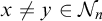 $x\ne y\in \mathcal {N}_n$
, we have
$x\ne y\in \mathcal {N}_n$
, we have $d(x,y)\ge 2^{-n}$
. Thus, for
$d(x,y)\ge 2^{-n}$
. Thus, for $u\ne v\in F(\mathcal {N}_n)$
, we have
$u\ne v\in F(\mathcal {N}_n)$
, we have $u^{-1}v\ne e$
and consequently
$u^{-1}v\ne e$
and consequently $\rho (u^{-1}v,(u^{-1}v)^\theta )\ge 2^{-n}$
for every match
$\rho (u^{-1}v,(u^{-1}v)^\theta )\ge 2^{-n}$
for every match $\theta $
. Then
$\theta $
. Then $\delta _{\Gamma _0}(u,v)=\delta _{\Gamma _0}(u^{-1}v,e)\ge 2^{-n}$
by Theorem 2.4. By [Reference Ding and Gao4, Lemma 3.6(i)],
$\delta _{\Gamma _0}(u,v)=\delta _{\Gamma _0}(u^{-1}v,e)\ge 2^{-n}$
by Theorem 2.4. By [Reference Ding and Gao4, Lemma 3.6(i)], $\delta _\Gamma (u,v)\ge \delta _{\Gamma _0}(u,v)$
. So
$\delta _\Gamma (u,v)\ge \delta _{\Gamma _0}(u,v)$
. So $d_\Gamma (u,v)\ge 2^{-n}$
for every
$d_\Gamma (u,v)\ge 2^{-n}$
for every $u\ne v\in F(\mathcal {N}_n)$
,
$u\ne v\in F(\mathcal {N}_n)$
, $F(\mathcal {N}_n)$
is a discrete closed subgroup of
$F(\mathcal {N}_n)$
is a discrete closed subgroup of $\overline {F}_\Gamma (\mathcal {N})$
.
$\overline {F}_\Gamma (\mathcal {N})$
.
We denote the topological group $F(\mathcal {N}_n)$
with the metric
$F(\mathcal {N}_n)$
with the metric $\delta _\Gamma $
by
$\delta _\Gamma $
by $F_\Gamma (\mathcal {N}_n)$
. Then
$F_\Gamma (\mathcal {N}_n)$
. Then $F_\Gamma (\mathcal {N}_n)$
is a discrete topological space by Lemma 3.2.
$F_\Gamma (\mathcal {N}_n)$
is a discrete topological space by Lemma 3.2.
Lemma 3.3. For every $w\in \overline {\mathcal {N}}$
and every
$w\in \overline {\mathcal {N}}$
and every $r\in \mathbb {R}_+$
, we have
$r\in \mathbb {R}_+$
, we have $\Gamma _G(w,r)\le \Gamma (w,r)$
where G is the group
$\Gamma _G(w,r)\le \Gamma (w,r)$
where G is the group ${F}_\Gamma (\mathcal {N})$
together the metric
${F}_\Gamma (\mathcal {N})$
together the metric $\delta _\Gamma $
.
$\delta _\Gamma $
.
Proof. By definition,
 $$ \begin{align*}\Gamma_G(w,r)=\mathrm{max}\{r,\mathrm{sup}\{N_\Gamma(w^{-1}uw):N_\Gamma(u)\le r\}\}.\end{align*} $$
We need to show that for every $u\in {F}_\Gamma (\mathcal {N})$
with
$u\in {F}_\Gamma (\mathcal {N})$
with $N_\Gamma (u)\le r$
, we have
$N_\Gamma (u)\le r$
, we have $N_\Gamma (w^{-1}uw)\le \Gamma (w,r)$
. For every
$N_\Gamma (w^{-1}uw)\le \Gamma (w,r)$
. For every $\epsilon> 0$
, by the definition of
$\epsilon> 0$
, by the definition of $N_\Gamma (u)$
, there is
$N_\Gamma (u)$
, there is $v\in W(\mathcal {N})$
and a match
$v\in W(\mathcal {N})$
and a match $\theta $
on
$\theta $
on $\{0,\ldots ,|v|-1 \}$
such that
$\{0,\ldots ,|v|-1 \}$
such that $v'=u$
and
$v'=u$
and $N^{\theta }_\Gamma (v)\le r+\epsilon $
. Let
$N^{\theta }_\Gamma (v)\le r+\epsilon $
. Let $\eta $
be a match on
$\eta $
be a match on $\{0,\ldots ,|v|+1 \}$
such that
$\{0,\ldots ,|v|+1 \}$
such that $\eta (0)=|v|+1$
and
$\eta (0)=|v|+1$
and $\eta (i)=\theta (i-1)+1$
for
$\eta (i)=\theta (i-1)+1$
for $1\le i\le |v|$
. Then by definition of
$1\le i\le |v|$
. Then by definition of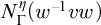 $N^\eta _\Gamma (w^{-1}vw)$
we have
$N^\eta _\Gamma (w^{-1}vw)$
we have
 $$ \begin{align*}N_\Gamma(w^{-1}vw)\le N^\eta_\Gamma(w^{-1}vw)=\Gamma(w,N^{\theta}_\Gamma(v))\le \Gamma(w,r+\epsilon).\end{align*} $$
When $\epsilon $
goes to
$\epsilon $
goes to $0$
, by continuity of
$0$
, by continuity of $\Gamma (w,\cdot )$
, we have
$\Gamma (w,\cdot )$
, we have $N_\Gamma (w^{-1}vw)\le \Gamma (w,r)$
. Since we also have
$N_\Gamma (w^{-1}vw)\le \Gamma (w,r)$
. Since we also have $r\le \Gamma (w,r)$
, we get
$r\le \Gamma (w,r)$
, we get $\Gamma _G(w,r)\le \Gamma (w,r)$
.
$\Gamma _G(w,r)\le \Gamma (w,r)$
.
Lemma 3.4. For every $n\in \mathbb {N}$
, the map
$n\in \mathbb {N}$
, the map $\pi _n$
can be uniquely extended to a continuous group homomorphism
$\pi _n$
can be uniquely extended to a continuous group homomorphism $f_n$
from
$f_n$
from $\overline {F}_\Gamma (\mathcal {N})$
to
$\overline {F}_\Gamma (\mathcal {N})$
to ${F}_\Gamma (\mathcal {N}_n)$
such that
${F}_\Gamma (\mathcal {N}_n)$
such that $d(g,h)\ge d(f_n(g),f_n(h)) $
for every
$d(g,h)\ge d(f_n(g),f_n(h)) $
for every $g,h\in \overline {F}_\Gamma (\mathcal {N})$
.
$g,h\in \overline {F}_\Gamma (\mathcal {N})$
.
Proof. Firstly we show that $\pi _n$
can be extended to a group homeomorphism
$\pi _n$
can be extended to a group homeomorphism $f_n$
from
$f_n$
from ${F}_\Gamma (\mathcal {N})$
to
${F}_\Gamma (\mathcal {N})$
to ${F}_\Gamma (\mathcal {N}_n)$
such that
${F}_\Gamma (\mathcal {N}_n)$
such that $N_\Gamma (u)\ge N_\Gamma (f_n(u))$
for every
$N_\Gamma (u)\ge N_\Gamma (f_n(u))$
for every $u\in {F}_\Gamma (\mathcal {N})$
. Let
$u\in {F}_\Gamma (\mathcal {N})$
. Let $\pi _n(e)=e$
and
$\pi _n(e)=e$
and $\pi _n(x^{-1})=(\pi _n(x))^{-1}$
. We will use Lemma 2.7 to extend
$\pi _n(x^{-1})=(\pi _n(x))^{-1}$
. We will use Lemma 2.7 to extend $\pi _n$
to a homomorphism. Items (1) and (2) of Lemma 2.7 are satisfied by definition, and item (3) follows from Lemma 3.3. Then we get such an extension
$\pi _n$
to a homomorphism. Items (1) and (2) of Lemma 2.7 are satisfied by definition, and item (3) follows from Lemma 3.3. Then we get such an extension $f_n$
.
$f_n$
.
Next we show that $f_n$
can be extended to
$f_n$
can be extended to $\overline {F}_\Gamma (\mathcal {N})$
. The group
$\overline {F}_\Gamma (\mathcal {N})$
. The group $\overline {F}_\Gamma (\mathcal {N})$
is the completion of
$\overline {F}_\Gamma (\mathcal {N})$
is the completion of ${F}_\Gamma (\mathcal {N})$
with the metric
${F}_\Gamma (\mathcal {N})$
with the metric $d_\Gamma $
such that for every
$d_\Gamma $
such that for every $u,v\in {F}_\Gamma (\mathcal {N})$
,
$u,v\in {F}_\Gamma (\mathcal {N})$
,
 $$ \begin{align*}d_\Gamma (u,v)=\delta_\Gamma(u,v)+\delta_\Gamma(u^{-1},v^{-1}),\end{align*} $$
and ${F}_\Gamma (\mathcal {N}_n)$
is a closed subgroup of
${F}_\Gamma (\mathcal {N}_n)$
is a closed subgroup of $\overline {F}_\Gamma (\mathcal {N})$
. We have that
$\overline {F}_\Gamma (\mathcal {N})$
. We have that
 $$ \begin{align} d_\Gamma(u,v)=N_\Gamma(u^{-1}v)+N_{\Gamma}(uv^{-1})\ge N_\Gamma(f_n(u^{-1}v))+N_{\Gamma}(f_n(uv^{-1}))\ge d_\Gamma(f_n(u),f_n(v)) \end{align} $$
for every $u,v\in {F}_\Gamma (\mathcal {N})$
. If
$u,v\in {F}_\Gamma (\mathcal {N})$
. If $(x_m)_{m\in \mathbb {N}}$
is a Cauchy sequence in
$(x_m)_{m\in \mathbb {N}}$
is a Cauchy sequence in ${F}_\Gamma (\mathcal {N})$
under the metric
${F}_\Gamma (\mathcal {N})$
under the metric $d_\Gamma $
, then
$d_\Gamma $
, then $(f_n(x_m))_{m\in \mathbb {N}}$
is a Cauchy sequence in
$(f_n(x_m))_{m\in \mathbb {N}}$
is a Cauchy sequence in ${F}_\Gamma (\mathcal {N}_n)$
under the metric
${F}_\Gamma (\mathcal {N}_n)$
under the metric $d_\Gamma $
. So
$d_\Gamma $
. So $f_n$
can be uniquely extended to a continuous group homomorphism from
$f_n$
can be uniquely extended to a continuous group homomorphism from $\overline {F}_\Gamma (\mathcal {N})$
to
$\overline {F}_\Gamma (\mathcal {N})$
to ${F}_\Gamma (\mathcal {N}_n)$
.
${F}_\Gamma (\mathcal {N}_n)$
.
Finally we argue that for this extension $f_n$
, we have
$f_n$
, we have $d(g,h)\ge d(f_n(g),f_n(h)) $
for every
$d(g,h)\ge d(f_n(g),f_n(h)) $
for every $g,h\in \overline {F}_\Gamma (\mathcal {N})$
. By (3.1), we know that
$g,h\in \overline {F}_\Gamma (\mathcal {N})$
. By (3.1), we know that $d(g,h)\ge d(f_n(g),f_n(h)) $
for every
$d(g,h)\ge d(f_n(g),f_n(h)) $
for every $g,h\in {F}_\Gamma (\mathcal {N})$
. Since
$g,h\in {F}_\Gamma (\mathcal {N})$
. Since ${F}_\Gamma (\mathcal {N})$
is dense in
${F}_\Gamma (\mathcal {N})$
is dense in $\overline {F}_\Gamma (\mathcal {N})$
and
$\overline {F}_\Gamma (\mathcal {N})$
and $f_n$
is continuous, we get that
$f_n$
is continuous, we get that $d(g,h)\ge d(f_n(g),f_n(h)) $
holds for every
$d(g,h)\ge d(f_n(g),f_n(h)) $
holds for every $g,h\in \overline {F}_\Gamma (\mathcal {N}).$
Theorem 3.5. There is a continuous embedding from $\overline {F}_\Gamma (\mathcal {N})$
to
$\overline {F}_\Gamma (\mathcal {N})$
to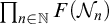 $\prod _{n\in \mathbb {N}}F(\mathcal {N}_n)$
.
$\prod _{n\in \mathbb {N}}F(\mathcal {N}_n)$
.
Proof. Let f from $\overline {F}_\Gamma (\mathcal {N})$
to
$\overline {F}_\Gamma (\mathcal {N})$
to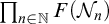 $\prod _{n\in \mathbb {N}}F(\mathcal {N}_n)$
map g to
$\prod _{n\in \mathbb {N}}F(\mathcal {N}_n)$
map g to $(f_n(g))_{n\in \mathbb {N}}$
for every
$(f_n(g))_{n\in \mathbb {N}}$
for every $g\in \overline {F}_\Gamma (\mathcal {N})$
. The map f is a continuous homomorphism, we just need to show that it is an injection.
$g\in \overline {F}_\Gamma (\mathcal {N})$
. The map f is a continuous homomorphism, we just need to show that it is an injection.
For $g\ne h\in \overline {F}_\Gamma (\mathcal {N})$
, let
$g\ne h\in \overline {F}_\Gamma (\mathcal {N})$
, let $0<\epsilon < d_\Gamma (g,h)/4$
. Since
$0<\epsilon < d_\Gamma (g,h)/4$
. Since $F(\mathcal {N}_\omega )$
is dense in
$F(\mathcal {N}_\omega )$
is dense in $\overline {F}_\Gamma (\mathcal {N})$
, we can take
$\overline {F}_\Gamma (\mathcal {N})$
, we can take $u,v\in F(\mathcal {N}_\omega )$
such that
$u,v\in F(\mathcal {N}_\omega )$
such that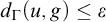 $d_\Gamma (u,g)\le \epsilon $
and
$d_\Gamma (u,g)\le \epsilon $
and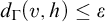 $d_\Gamma (v,h)\le \epsilon $
. There is
$d_\Gamma (v,h)\le \epsilon $
. There is $n\in \mathbb {N}$
such that
$n\in \mathbb {N}$
such that $u,v\in F(\mathcal {N}_n)$
, and since
$u,v\in F(\mathcal {N}_n)$
, and since $f_n$
entends
$f_n$
entends $\pi _n$
, we have
$\pi _n$
, we have $f_n(u)=u,f_n(v)=v$
. By Lemma 3.4, we have
$f_n(u)=u,f_n(v)=v$
. By Lemma 3.4, we have $d_\Gamma (f_n(g),u)\le \epsilon $
and
$d_\Gamma (f_n(g),u)\le \epsilon $
and $d_\Gamma (f_n(h),v)\le \epsilon $
, so
$d_\Gamma (f_n(h),v)\le \epsilon $
, so
 $$ \begin{align*}d_\Gamma(f_n(g),f_n(h))\ge d_\Gamma(u,v)-2\epsilon\ge d_\Gamma(g,h)-4\epsilon>0.\end{align*} $$
Then $f_n(g)\ne f_n(h)$
, so
$f_n(g)\ne f_n(h)$
, so $f(g)\ne f(h)$
, and hence f is an injection.
$f(g)\ne f(h)$
, and hence f is an injection.
Theorem 3.6. The group $\overline {F}_\Gamma (\mathcal {N})$
is not a universal Polish group.
$\overline {F}_\Gamma (\mathcal {N})$
is not a universal Polish group.
Proof. We argue that $(\mathbb {R,+})$
is not isomorphic to a closed subgroup of
$(\mathbb {R,+})$
is not isomorphic to a closed subgroup of $\overline {F}_\Gamma (\mathcal {N})$
. If
$\overline {F}_\Gamma (\mathcal {N})$
. If $(\mathbb {R,+})$
is isomorphic to a closed subgroup of
$(\mathbb {R,+})$
is isomorphic to a closed subgroup of $\overline {F}_\Gamma (\mathcal {N})$
, then by Theorem 3.5 there is a continuous embedding from
$\overline {F}_\Gamma (\mathcal {N})$
, then by Theorem 3.5 there is a continuous embedding from $(\mathbb {R,+})$
to
$(\mathbb {R,+})$
to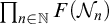 $\prod _{n\in \mathbb {N}}F(\mathcal {N}_n)$
. The topological space
$\prod _{n\in \mathbb {N}}F(\mathcal {N}_n)$
. The topological space $\mathbb {R}$
is connected but
$\mathbb {R}$
is connected but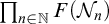 $\prod _{n\in \mathbb {N}}F(\mathcal {N}_n)$
is totally disconnected, a contradiction.
$\prod _{n\in \mathbb {N}}F(\mathcal {N}_n)$
is totally disconnected, a contradiction.
We also have the alternative proof which does use Theorem 3.5. As mentioned in [Reference Ding2, Example 4.9], $\overline {F}_\Gamma (\mathcal {N})$
is an abstract subgroup of
$\overline {F}_\Gamma (\mathcal {N})$
is an abstract subgroup of $S_\infty $
. The isometry group of the Urysohn space
$S_\infty $
. The isometry group of the Urysohn space $\mathrm {Iso}(\mathbb {U})$
cannot be continuously embedded to
$\mathrm {Iso}(\mathbb {U})$
cannot be continuously embedded to $\overline {F}_\Gamma (\mathcal {N})$
, because of the automatic continuity property [Reference Sabok11, Reference Sabok12] (see [Reference Malicki7, Reference Rosendal and Suarze8] for new proofs),
$\overline {F}_\Gamma (\mathcal {N})$
, because of the automatic continuity property [Reference Sabok11, Reference Sabok12] (see [Reference Malicki7, Reference Rosendal and Suarze8] for new proofs), $\mathrm {Iso}( \mathbb {U})$
cannot be embedded to
$\mathrm {Iso}( \mathbb {U})$
cannot be embedded to $S_\infty $
as an abstract subgroup since
$S_\infty $
as an abstract subgroup since $\mathrm {yy Iso}(\mathbb {U})$
is connected and
$\mathrm {yy Iso}(\mathbb {U})$
is connected and $S_\infty $
is totally disconnected.
$S_\infty $
is totally disconnected.
Acknowledgments
The authors would like to thank Su Gao and Marcin Sabok for valuable suggestions to an earlier version of this work. Also, the authors are grateful to the suggestions given by the anonymous referee.
Funding
The first author is partially funded by NSFC grant 12271264. The second author is partially funded by NSFC grant 124B2001.

 Open access

