


Depersonalisation disorder is characterised by a subjective sense of unreality and detachment from the self (Simeon et al, Reference Simeon, Gross and Guralnik1997, Reference Simeon, Knutelska and Nelson2003; Reference Baker, Hunter and LawrenceBaker et al, 2003). The disorder is diagnosed when depersonalisation is persistent or recurrent, causes marked distress or impairment, and is not part of another psychiatric or medical condition. The illness is often chronic and debilitating, and there is no known pharmacotherapy (Reference SimeonSimeon, 2004). A small controlled trial found no efficacy for lamotrigine (Reference Sierra, Phillips and KrystalSierra et al, 2003). Over the past decade there have been anecdotal reports of improvement in depersonalisation with selective serotonin reuptake inhibitors (Reference Hollander, Liebowitz and DeCariaHollander et al, 1990; Reference Fichtner, Horevitz and BraunFichtner et al, 1992; Reference Ratliff and KerskiRatliff & Kerski, 1995) or clomipramine (Reference Simeon, Stein and HollanderSimeon et al, 1998a ). The aim of our study was to evaluate systematically the efficacy of fluoxetine in a randomised, double-masked, placebo-controlled trial. We predicted that fluoxetine would be superior to placebo, and that improvement in depersonalisation would be independent of psychiatric comorbidity.
METHOD
Participants
People eligible for the study were adults aged 18–65 years, who met DSM–IV diagnostic criteria for current depersonalisation disorder by semi-structured clinical interview and by the Structured Clinical Interview for DSM–IV Dissociative Disorders (Reference SteinbergSteinberg, 1994). The DSM–IV criteria are essentially the same as the ICD–10 criteria (World Health Organization, 1992), and postulate persistent depersonalisation, with intact reality testing, not occurring exclusively in the context of another diagnosable disorder (American Psychiatric Association, 1994). Participants were self-referred by responding to newspaper advertisements for research (‘do you frequently feel unreal/detached, as if in a dream/fog?’). After a telephone screening, potentially suitable individuals were seen for an initial clinical evaluation. For inclusion in the study, individuals had to have taken no psychotropic medication for a period of at least 2 weeks (4 weeks for monoamine oxidase inhibitors or investigational drugs). Applicants were not eligible if they had previously undergone an adequate fluoxetine trial, defined as a minimum of 10 mg daily for 4 weeks, or if they reported fluoxetine intolerance or hypersensitivity. Written informed consent was obtained after a full explanation of the study by the principal investigator. About one participant was enrolled for every 15 people who were screened. There was no payment for participation in the research.
People with lifetime diagnoses of schizophrenia, schizoaffective disorder, bipolar disorder or organic mental disorder were excluded from the study, as were individuals with current substance use disorder or eating disorder. Lifetime Axis I disorders were assessed using the Structured Clinical Interview for DSM–IV Axis I Disorders (Reference First, Spitzer and GibbonFirst et al, 1995), and Axis II personality disorders were assessed with the Structured Interview for DSM–IV Personality Disorders (Reference Pfohl, Blum and ZimmermanPfohl et al, 1995). Participants were allowed to enter the trial if they had been receiving psychotherapy for at least 3 months, but those who had recently begun psychotherapy or were receiving specialised treatment such as cognitive–behavioural therapy and hypnosis were excluded. Individuals with acute or unstable medical illnesses, as well as those with a history of seizure disorder or major head trauma, were also excluded. All participants had a normal baseline routine laboratory evaluation with negative urine toxicology screenings. Women of childbearing age were required to use an effective birth control method; pregnant and lactating women were excluded.
Design
The study was a double-masked, randomised, parallel, flexible-dosage comparison of fluoxetine v. placebo for the treatment of depersonalisation disorder. After a 2-week single-masked placebo run-in phase, participants were randomised to receive identical-appearing fluoxetine or placebo capsules. Participants were assigned to the fluoxetine or placebo group by the institution's pharmacy on the basis of a standard randomisation table, unknown to the investigators. Fluoxetine dosage was 10 mg per day for the first week, flexibly increased to 20 mg, 40 mg or 60 mg per day over the following 3 weeks, according to tolerability. The wide dosage range was based on the previously anecdotally reported efficacy of higher dosages (Reference Hollander, Liebowitz and DeCariaHollander et al, 1990), but a dosage increase above 10 mg was not required if not tolerated. No concomitant medication was allowed for the entire duration of the trial.
Treatment visits occurred every 2 weeks, during which the treating psychiatrist (D.S.) evaluated clinical state, compliance and adverse effects, and adjusted the medication dose. Subsequently, the independent evaluator (O.G.), to whom participants had been requested to report all symptoms accurately but without references or attributions to medication, assessed the primary and secondary outcome measures.
Measures
The same measures were administered at each treatment visit. Three primary outcome measures were used, in order to give a comprehensive picture of patient-rated symptoms, clinician-rated symptoms and an overall clinical impression.
Clinical Global Impression
The Clinical Global Impression scale (CGI; Reference GuyGuy, 1976) is a standard clinician-rated, seven-point scale; the severity scale (CGI–S) was applied at the initial visit, and the improvement scale (CGI–I) was applied during all subsequent visits, specifically to rate change in depersonalisation.
Dissociative Experiences Scale
The Dissociative Experiences Scale (DES; Reference Bernstein-Carlson and PutnamBernstein-Carlson & Putnam, 1993) is by far the most widely applied measure of dissociation, having been used in over 250 research studies to date. It is a 28-item self-report questionnaire of dissociative experiences: each item is scored at 10% intervals from 0% to 100%, and the total score is the mean of all items. The DES has been shown to have good test–retest reliability (intraclass correlation coefficient 0.79–0.96), high internal consistency (Cronbach's α=0.95) and strong convergent, discriminant and criterion validity. The DES has also been used as a state measure in treatment settings, where patients are asked to rate their experience in the past week only; in this context it has been shown to be sensitive to treatment change (Reference Ellason and RossEllason & Ross, 1997; Reference Lubin, Loris and BurtLubin et al, 1998; Reference Simeon, Guralnik and SchmeidlerSimeon et al, 2001). Furthermore, factor analysis of the DES in people with depersonalisation disorder has yielded three factors – absorption, amnesia and depersonalisation/derealisation (Reference Simeon, Guralnik and GrossSimeon et al, 1998b ) – and in our study we use a depersonalisation score (DES–DP) based on the particular factor analysis (mean of DES items 7, 12, 13, 24 and 28).
Depersonalization Severity Scale
The Depersonalization Severity Scale (DSS; Reference Simeon, Guralnik and SchmeidlerSimeon et al, 2001) is a six-item, clinician-administered scale of depersonalisation experiences rated 0–3, applied to the past week, which takes into account both symptom frequency and intensity. It has been found to have excellent interrater reliability, moderate internal consistency, high convergent and divergent validity, and to be sensitive to treatment change (Reference Simeon, Guralnik and SchmeidlerSimeon et al, 2001).
Secondary outcome measures
The following secondary outcome measures were clinician-administered at each visit. Depression was measured using the 17-item Hamilton Rating Scale for Depression (HRSD; Reference HamiltonHamilton, 1960), and anxiety was measured with the standard Hamilton Rating Scale for Anxiety (HRSA; Reference HamiltonHamilton, 1959). Social phobia symptoms were measured with the Liebowitz Social Anxiety Scale (LSAS; Reference Heimberg, Horner and JusterHeimberg et al, 1999), a 25-item scale measuring both social anxiety and consequent avoidance. Obsessive–compulsive symptoms were measured using the Yale–Brown Obsessive Compulsive Severity scale (Reference Goodman, Price and RasmussenGoodman et al, 1989), a ten-item scale that measures obsessions and compulsions The Panic Attack Diary was a weekly subject-generated record of total number of panic attacks. In addition to these scales, CGI–I scores were applied to all existent comorbid disorders to measure treatment change in each.
Statistical analyses
An intention-to-treat analysis was performed, with last observation carried forward for participants who did not complete the trial. For each of the three primary outcome measures, two types of analyses of covariance (ANCOVAs) were performed, one not controlling and the other controlling for depression and anxiety variables. In the former ANCOVAs, baseline scores were used as the only covariate. The latter ANCOVAs included six additional covariates in order to control for baseline and treatment effects in anxiety, depression and social anxiety, using baseline HRSD, HRSA and LSAS scores, as well as change scores in these variables between baseline and week 10. Obsessive–compulsive and panic attack symptom scores were not included in the latter analyses because they were minimal (see Table 3). Specifically for the CGI–I analyses, the baseline CGI–S score was used as the covariate, and for the four people who did not reach the week 2 treatment visit, a CGI–I score of 4 was assumed. For two treatment groups, each consisting of 25 participants, to achieve a power of 0.80 in detecting group differences with a two-tailed test at the 0.5 level of significance, the effect size (difference between means divided by the common standard deviation) would have to be 0.81 (Reference CohenCohen, 1988).
A categorical analysis of responders v. non-responders was conducted using a χ2 test, defined as a CGI–I score of 2 or 1, combined with a decrease of at least 30% in the two depersonalisation symptom measures. Chi-squared tests were also used to compare demographic and clinical characteristics of the two groups where appropriate, as well as categorical treatment response in relation to the presence of Axis I or Axis II disorders. For all 2×2 χ2 tests with an expected value of less than 5 in any cell, continuity correction was employed. Independent sample Student's t-tests were used to compare demographic and illness variables between the two groups where appropriate. All statistics are two-tailed with a 0.5 level of significance.
RESULTS
Sample characteristics
Fifty-four people entered the placebo run-in period, of whom four were not randomised: two of them did not return for the subsequent visit, one experienced a complete resolution of depersonalisation symptoms, and one experienced severe adverse effects on placebo. Of the 50 participants randomised, 25 to fluoxetine and 25 to placebo, three-quarters (37) completed the trial, 16 on fluoxetine and 21 on placebo. The withdrawal rate in the two treatment groups did not significantly differ (χ2=2.60, d.f.=1, P=0.11). The mean daily dose reached in the study was 48 mg for fluoxetine and 46 mg for placebo (t=0.45, d.f.=48, P=0.65).
People withdrawing from the fluoxetine group were individually accounted for as follows: two persons before week 2, one to seek private treatment and one with worsening anxiety; three persons before week 4, one to attempt impregnation (CGI–I 5), one to seek private treatment (CGI–I 4) and one discontinued by the investigators for worsening depression (CGI–I 3); two persons did not return (without explanation) before week 8 (CGI–I 2 and 4); and two persons dropped out before the final visit, one who relocated (CGI–I 5) and one who did not return, without explanation (CGI–I 1). Withdrawals from the placebo group were individually accounted for as follows: two persons before week 2, one because of work schedule and one without an explanation; and two persons by week 4, one because of work schedule (CGI–I 4) and one non-compliant with treatment visits (CGI–I 4).
The demographic and illness characteristics of the 50 participants with DSM–IV depersonalisation disorder who composed the intention-to-treat sample are given in Table 1. Current comorbidity is summarised in Table 2. It can be seen that the two study groups did not differ on any demographic or clinical variables. There was a trend toward more people with depressive disorders in the fluoxetine group and more people with anxiety disorders in the placebo group, which did not reach statistical significance.
Demographic and clinical characteristics of the study sample (n=50)

| Fluoxetine group (n=25) | Placebo group (n=25) | Test statistic1 | P | |
|---|---|---|---|---|
| Age, years: mean (s.d.) | 34.5 (11.4) | 36.8 (10.1) | t=0.75 | 0.46 |
| Female, % | 52 | 32 | χ2=2.05 | 0.15 |
| Ethnicity, % | χ2=1.40 | 0.71 | ||
| White | 64 | 76 | ||
| African American | 16 | 12 | ||
| Hispanic | 12 | 4 | ||
| Asian | 8 | 8 | ||
| Marital status, % | χ2=2.31 | 0.32 | ||
| Single | 48 | 68 | ||
| Married | 32 | 16 | ||
| Divorced | 20 | 16 | ||
| Education, % | χ2=5.57 | 0.23 | ||
| High school or less | 12 | 20 | ||
| Some college | 88 | 80 | ||
| Employment, % | χ2=1.61 | 0.81 | ||
| Full-time | 60 | 60 | ||
| Part-time | 16 | 20 | ||
| Homemaker | 0 | 4 | ||
| Student | 4 | 4 | ||
| Unemployed | 20 | 12 | ||
| Depersonalisation disorder | ||||
| Age at onset, years: mean (s.d.) | 15.8 (9.2) | 15.3 (8.9) | t=0.22 | 0.83 |
| Duration, years: mean (s.d.) | 15.7 (14.1) | 19.6 (13.6) | t=1.00 | 0.32 |
| Type of onset, % | ||||
| Acute | 44 | 48 | χ2=0.08 | 0.78 |
| Insidious | 56 | 52 | ||
| Course, % | χ2=0.33 | 0.56 | ||
| Episodic | 36 | 44 | ||
| Continuous | 64 | 56 | ||
| Severity: mean (s.d.)2 | 4.7 (0.8) | 4.7 (0.7) | t=0.00 | 1.00 |
Current comorbidity in the study sample (n=50)

| Fluoxetine group (n=25) | Placebo group (n=25) | Test statistic1 | P | |
|---|---|---|---|---|
| Axis I disorders, n (%) | ||||
| Major depression | 6 (24) | 4 (16) | χ2=0.50 | 0.48 |
| Dysthymia | 8 (32) | 4 (16) | χ2=1.75 | 0.19 |
| Any depressive disorder | 14 (56) | 8 (32) | χ2=2.92 | 0.09 |
| Generalised anxiety disorder | 4 (16) | 5 (20) | χ2=0.00 | 1.00 |
| Panic disorder | 2 (8) | 5 (20) | χ2=0.66 | 0.42 |
| Obsessive–compulsive disorder | 1 (4) | 4 (16) | χ2=0.89 | 0.35 |
| Social phobia | 5 (20) | 9 (36) | χ2=1.59 | 0.21 |
| Specific phobia | 3 (12) | 0 (0) | χ2=1.42 | 0.23 |
| PTSD | 2 (8) | 0 (0) | χ2=0.52 | 0.47 |
| Any anxiety disorder | 9 (36) | 15 (60) | χ2=2.89 | 0.09 |
| Body dysmorphic disorder | 2 (8) | 1 (4) | χ2=0.00 | 1.00 |
| Adjustment disorder | 2 (8) | 1 (4) | χ2=0.00 | 1.00 |
| Axis II personality disorders, n (%)2 | ||||
| Paranoid | 3 (15) | 5 (21) | ||
| Schizoid | 0 (0) | 0 (0) | ||
| Schizotypal | 0 (0) | 1 (4) | ||
| Any cluster A | 3 (15) | 5 (21) | χ2=0.01 | 0.92 |
| Borderline | 3 (15) | 6 (25) | ||
| Histrionic | 3 (15) | 1 (4) | ||
| Narcissistic | 3 (15) | 5 (21) | ||
| Antisocial | 0 (0) | 1 (4) | ||
| Any cluster B | 6 (30) | 9 (38) | χ2=0.27 | 0.60 |
| Dependent | 3 (15) | 1 (4) | ||
| Avoidant | 6 (30) | 7 (29) | ||
| Obsessive–compulsive | 3 (15) | 7 (29) | ||
| Any cluster C | 7 (35) | 13 (54) | χ2=1.62 | 0.20 |
| Any personality disorder | 11 (55) | 16 (67) | χ2=0.63 | 0.43 |
| Personality disorders/subject: mean (s.d.) | 1.2 (1.5) | 1.4 (1.5) | t=0.48 | 0.64 |
Baseline and end-point primary and secondary outcome measures

| Fluoxetine (n=25) | Placebo (n=25) | Test statistic1 | P | |||||
|---|---|---|---|---|---|---|---|---|
| Baseline Mean (s.d.) | End-point Mean (s.d.) | Change (95% CI) | Baseline Mean (s.d.) | End-point Mean (s.d.) | Change (95% CI) | |||
| Primary outcome measures | ||||||||
| CGI–I | 2.9 (1.2) | 3.6 (0.9) | F (1.47)=6.02 | 0.02 | ||||
| F (1.41)=3.50 | 0.07 | |||||||
| DES–DP | 32.8 (24.1) | 25.3 (23.1) | 0.9 to 14.2 | 34.4 (15.9) | 23.4 (14.7) | 4.1 to 17.9 | F (1.47)=0.48 | 0.49 |
| F (1.41)=0.41 | 0.53 | |||||||
| DSS | 6.9 (3.0) | 5.0 (3.5) | 0.5 to 3.2 | 7.8 (3.2) | 6.4 (2.8) | 0.3 to 2.6 | F (1.47)=1.09 | 0.30 |
| F (1.41)=0.14 | 0.71 | |||||||
| Secondary outcome measures | ||||||||
| HRSD | 8.3 (4.6) | 7.2 (4.6) | -1.0 to 3.2 | 8.4 (5.8) | 8.2 (5.4) | -1.7 to 2.1 | F (1.47)=0.57 | 0.45 |
| HRSA | 9.2 (5.3) | 7.7 (4.7) | -0.8 to 3.8 | 11.9 (6.8) | 10.2 (5.9) | -0.6 to 3.8 | F (1.47)=0.87 | 0.36 |
| LSAS | 8.0 (11.0) | 7.0 (9.3) | -3.1 to 5.2 | 11.2 (11.2) | 8.0 (13.6) | -0.7 to 7.2 | F (1.47)=0.18 | 0.67 |
| BYOCS | 1.4 (4.7) | 0.6 (1.9) | -0.6 to 2.2 | 3.4 (7.9) | 3.8 (8.7) | -1.8 to 0.9 | F (1.47)=2.80 | 0.10 |
| Panic attacks | 0.04 (0.2) | 0.08 (0.3) | -0.2 to 0.1 | 0.3 (0.8) | 0.9 (3.2) | -1.7 to 0.5 | F (1.47)=0.01 | 0.94 |
Treatment outcome
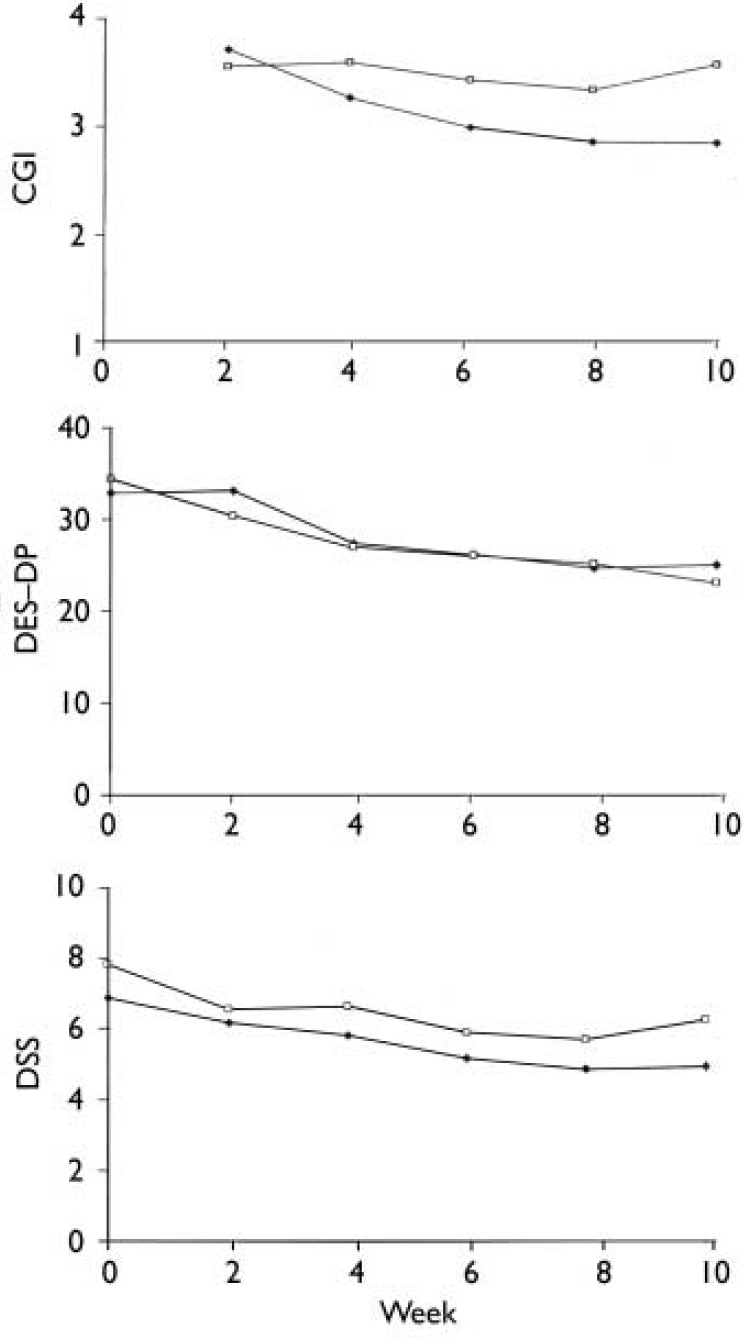
The six ANCOVA analyses of the three primary outcome variables revealed that fluoxetine was not superior to placebo in treating depersonalisation, with the exception of a statistically significant improvement in CGI–I score when not covaried for depression and anxiety (Table 3). The mean improvement in CGI score with fluoxetine was clinically modest (2.9), although statistically greater than the placebo mean improvement of 3.6. Bi-weekly changes in the three primary outcome measures are shown in Fig. 1. Finally, a categorical analysis of responder status revealed a 24% response rate on fluoxetine (n=6) and a 20% response rate on placebo (n=5) (χ2 0.12, d.f.=1, P=0.73).
Scores for the three primary outcome variables during the 10-week trial in 25 participants randomised to fluoxetine (♦) and 25 to placebo (□). CGI, Clinical Global Impression; DES–DP, Dissociative Experiences Scale – Depersonalisation; DSS, Depersonalization Severity Scale.
Baseline anxiety and depression scores were modest (Table 3), probably accounting for the absence of a differential improvement in anxious and depressive symptoms during treatment between the two groups as a whole. However, if the participants who had a diagnosis of depressive or anxiety disorder are considered alone (Table 2), those taking fluoxetine consistently tended to have better responses than those taking the placebo, as defined by CGI–I scores of 2 or 1 for the particular disorder: 50% v. 0% for major depression, 75% v. 25% for dysthymia, 50% v. 40% for generalised anxiety disorder, 100% v. 25% for obsessive–compulsive disorder, 50% v. 40% for panic disorder and 33% v. 13% for social phobia.
Finally, we specifically examined the depersonalisation disorder CGI–I score in relation to comorbidity, as this was the only primary outcome variable to show differential improvement on fluoxetine, prior to covarying for anxiety and depression. For the fluoxetine group, end-point CGI–I score for depersonalisation disorder did not significantly differ according to the presence or absence of clinical improvement (CGI–I) in comorbid depressive disorders (χ2=5.07, d.f.=4, P=0.28). However, end-point CGI–I for depersonalisation disorder did marginally differ according to the presence or absence of clinical improvement (CGI–I) in comorbid anxiety disorders (χ2=5.76, d.f.=2, P=0.06). In effect, of the nine persons in the fluoxetine group who did have comorbid anxiety disorder, the four who were anxiety disorder responders were all depersonalisation disorder responders by CGI–I. Of the five whose anxiety disorder did not respond to fluoxetine, only one was a depersonalisation disorder responder. Finally, within the fluoxetine group, depersonalisation responder status did not significantly differ in the presence or absence of personality disorder (χ2=0.00, d.f.=1, P=1.00).
Adverse events
Side-effects occurring at a frequency of at least 10% in at least one of the two study groups included decreased appetite (36% fluoxetine, 4% placebo), muscle stiffness or cramping (16% fluoxetine, 12% placebo), tremor (16% fluoxetine, 0% placebo), nervousness (28% fluoxetine, 40% placebo), excitation or hyperactivity (8% fluoxetine, 12% placebo), fatigue (48% fluoxetine, 16% placebo), sedation (20% fluoxetine, 0% placebo), headaches (28% both groups), diarrhoea (16% both groups), nausea (40% fluoxetine, 20% placebo), stomach ache (12% both groups), urinary frequency (20% fluoxetine, 8% placebo), palpitations (4% fluoxetine, 20% placebo), dizziness/lightheadedness (16% both groups), blurry vision (12% fluoxetine, 8% placebo), sweating (16% fluoxetine, 12% placebo), insomnia (48% fluoxetine, 24% placebo), decreased libido (48% fluoxetine, 20% placebo) and decreased sexual arousal (24% fluoxetine, 4% placebo). Only one person from the fluoxetine group discontinued the trial prematurely because of adverse effects, in this case heightened anxiety. Therefore, to our knowledge, the greater withdrawal rate in the medication arm was not due to adverse events.
DISCUSSION
Lack of efficacy of fluoxetine for primary depersonalisation
This first controlled study of serotonin reuptake inhibitor treatment for primary depersonalisation failed to support the possible efficacy suggested by earlier anecdotal data. Previous reports had found that improvement in depersonalisation was closely related to the presence of other symptoms responsive to serotonin reuptake inhibitors, such as panic or obsessions (Reference Hollander, Liebowitz and DeCariaHollander et al, 1990); furthermore, retrospective treatment reviews in depersonalisation disorder had reported only modest efficacy for serotonin reuptake inhibitor therapy (Simeon et al, Reference Simeon, Gross and Guralnik1997, Reference Simeon, Knutelska and Nelson2003).
Both clinician-rated and self-rated dissociation scores showed a modest decline in both treatment groups, which was clinically not noteworthy and statistically no different. The statistically significant improvement in depersonalisation by CGI–I score in the fluoxetine group, before correction for depression and anxiety effects, was also not clinically significant, as the average improvement score was approximately 3, i.e. minimal change. Indeed, a number of the participants who experienced some improvement on fluoxetine expressed this effect in words, stating that their symptoms had not really changed, but that they seemed somehow to take less notice or be less bothered by them. The study finding of slight improvement in CGI–I score without notable improvement in depersonalisation symptom ratings on fluoxetine mirrors these subjective experiences.
Comorbidity and treatment outcome
It is possible that some alleviation of comorbid anxiety and depression contributed to an overall more tolerable affective state, which led participants to experience their depersonalisation as less troubling although essentially unchanged. Indeed, a mediating effect of comorbid anxiety and depression is suggested by the loss of statistically significant improvement in CGI–I when covaried for baseline and change in anxiety and depression, as well as by the greater improvement in anxiety disorders in those whose depersonalisation responded to fluoxetine, compared with non-responders.
The relationship of depersonalisation to anxiety and depression has been debated for decades, and it would be fair to say that the issue remains controversial. Earlier investigators eloquently described the relationship of depersonalisation to phobic anxiety (Reference RothRoth, 1959), depression (Reference SedmanSedman, 1972) and obsessions (Reference TorchTorch, 1978). More recently, David and colleagues have favoured the view that depersonalisation disorder should be placed with the mood and anxiety disorders (Reference Baker, Hunter and LawrenceBaker et al, 2003). An alternative view, however, is that extreme emotional states such as severe depression or anxiety are one type of ‘traumatic stress’, among many others, that may trigger depersonalisation in individuals with an underlying vulnerability; in some cases, the depersonalisation may become chronic and autonomous of the precipitating stressor (Reference Simeon, Knutelska and NelsonSimeon et al, 2003). The lack of responsiveness of depersonalisation to fluoxetine supports the latter concept, that depersonalisation disorder is a distinct dissociative disorder. Indeed, as long ago as the 1930s Mayer-Gross (Reference Mayer-Gross1935) conceptualised depersonalisation as a universal preformed functional response of the brain to extreme stress.
Strengths and limitations of the study
Strengths of the study include the fluoxetine dosing and the trial duration; the use of well-validated dissociation measures, both clinician-rated and self-reported; the use of an independent evaluator masked to adverse events and medication adjustment to conduct the clinical ratings; and the stringent selection criteria for the participants with primary DSM–IV depersonalisation disorder. Limitations include the higher withdrawal rate in the fluoxetine arm, and the medium size of the sample.
Implications for treatment
Our study suggests that first-line use of serotonin reuptake inhibitors for the treatment of depersonalisation disorder is not indicated, except possibly in selected individuals with troublesome anxiety or depression; in such individuals, improved affective state might result in a somewhat better tolerance of their dissociative symptoms. Although negative, the findings of this study are important in light of the absence of any efficacious pharmacotherapy for depersonalisation, and the common clinical practice of the past decade of using serotonin reuptake inhibitors on the basis of promising early anecdotal reports and the frequent presence of comorbid anxiety and depression. In the future, investigating other classes of medications that may have anti-depersonalisation effects may prove fruitful.
Clinical Implications and Limitations
CLINICAL IMPLICATIONS
-
▪ Fluoxetine is not efficacious in treating primary depersonalisation.
-
▪ The widespread use of serotonin reuptake inhibitors to treat depersonalisation in clinical practice appears unfounded.
-
▪ The unresponsiveness of depersonalisation to fluoxetine supports the concept that depersonalisation disorder is a dissociative rather than a depression/anxiety spectrum disorder.
LIMITATIONS
-
▪ The sample size was modest.
-
▪ There was a higher withdrawal rate in the fluoxetine group.
-
▪ Many of the participants also had depressive and anxiety disorders.
Acknowledgements
This study was supported in part by NIMH grant MH055582 to D.S. The fluoxetine and placebo capsules were provided by Eli Lilly.




eLetters
No eLetters have been published for this article.