

INTRODUCTION
The Knaresborough hoard of late Roman copper-alloy vessels and iron implements was discovered around 1864 and originally filled either a ‘cart’ or a ‘large sack’ (fig 1).Footnote 1 It is one of the largest groups of late Roman bronze vessels and iron objects ever discovered in the British Isles and must have been comparable in size to some of the largest hoards from the European mainland (fig 2).Footnote 2 The intention of this paper is to provide a comprehensive and multidisciplinary re-evaluation of this exceptional find, using historical, archaeological and portable X-ray fluorescence to place this antiquarian discovery at the forefront of research into Romano-British metalwork hoards and hoarding traditions.
The Knaresborough hoard. Image: Yorkshire Museum.

The distribution of copper-alloy vessel hoards in Britain, Germany, Gaul and Raetia. Knaresborough is indicated by the open triangle. Demonstrably late Roman hoards in Britain are indicated by bullseyes. Image: after Feugère and Prilaux Reference Feugère and Prilaux1995, annexe 2, and Lundock Reference Lundock2015; with additions by the authors.

After discovery, the vessels were sent to the premises of Mr Thomas Gott, an iron founder operating in Knaresborough (North Yorkshire), and due to an unfortunate oversight by the foundry foreman the majority of the hoard was melted down.Footnote 3 Some of the iron tools were even reused in the foundry.Footnote 4 Eventually the remaining objects were given by Gott to what is now the Yorkshire Museum in 1864 and 1876.Footnote 5 As might be expected, a hoard of the size and importance of the Knaresborough discovery attracted antiquarian notice, particularly in relation to the discovery of the Irchester hoard in 1874.Footnote 6 Interest in the find then waned until the 1960s, when the discovery was summarised in Eggers’ survey of bronze vessels from Roman Britain.Footnote 7 Conservation work followed in the 1970s, but Egger’s summary has remained the standard account.Footnote 8 Due to this, the most recent review of copper-alloy vessels from Roman Britain misconstrues the nature of this extremely important find.Footnote 9
In 2017 the Yorkshire Museum listed the hoard as part of its ‘Old Collections, New Questions’ research initiative. Jessica DeMaso (née Petrie), under the supervision of James Gerrard, approached the Yorkshire Museum and undertook the first comprehensive study of the find as part of her MA degree at Newcastle University.Footnote 10 Much of the fruit of that collaboration is contained within this paper, which has been augmented by the inclusion of further work by Sally Gerrard exploring Thomas Gott’s life and the scientific analysis of the vessels by Marco Romeo Pitone.
This paper presents for the first time a comprehensive review of the extant objects and a discussion of the evidence for objects that no longer exist, along with a re-consideration of the findspot and the circumstances surrounding the discovery of the hoard. Combined with the analysis of the composition of the vessels, the authors are confident that the Knaresborough hoard can rightfully claim its place as one of the most important collections of late Roman metalwork from Britain and the western provinces of the Roman Empire.
THOMAS GOTT – THE MAN
In order to fully reconstruct and understand the circumstances of the hoard’s discovery, it is necessary to undertake a biographical study of Thomas Gott. The various antiquarian accounts of the hoard are sparing on the details regarding the finder, and this has obscured the position of Gott in Knaresborough society and his social networks, which are important for identifying a plausible findspot for the hoard. There are also aspects of Gott’s personal life that are of interest because they may demonstrate his approach to lawful behaviours. Finally, without Gott the Knaresborough hoard would not have been preserved. His part in the discovery of the hoard has been largely unsung and he deserves more recognition than he received during the late nineteenth century.
Thomas Gott was baptised on 13 November 1808 in Harrogate (North Yorkshire).Footnote 11 He was the eldest son of Robert Gott (a solicitor and iron merchant) and his first wife Elizabeth. Robert and Elizabeth had a second son, Robert Jr, who was born 26 August 1810 and baptised on 20 January 1811.Footnote 12
Thomas became an ironmonger, while by the age of thirty his younger brother, like their father, had become a solicitor.Footnote 13 In 1841 the brothers were living together with servants on the Market Place in Knaresborough.Footnote 14 Seven years later, in 1848, Thomas married the widow Mary Anne Drury (née Walker) in Scarborough,Footnote 15 and their family included Jane, Mary Anne’s daughter from her first marriage, and Mary Anne’s older sister, Emma Walker.Footnote 16 Both brothers were local notables, supporting the liberal candidate in the 1852 general election.Footnote 17 Thomas served as a Knaresborough Improvement Commissioner in the 1860s.Footnote 18
Mary Anne died in 1860 aged 47 and was buried in Knaresborough in January of that year.Footnote 19 Thomas then married Emma, his late wife’s sister, on 16 September 1861 at St Andrews Church, Holborn.Footnote 20 They gave their address as Thavie’s Inn in Holborn and, given the legal associations of this building, it may be surmised that Thomas’ brother, Robert Jr, was involved in the wedding arrangements. This is of particular interest because, although the marriage of a widower to his sister-in-law was customarily acceptable, it had been made illegal by the controversial Marriage Act 1835, and this prohibition was not over-turned until the Deceased Wife’s Sisters Act 1907. From this it may be presumed that Thomas and Emma married in London to escape scrutiny of their illegal act and Thomas’ brother Robert Jr was probably complicit in this.
In 1871 Thomas was described in the Census as a retired iron merchant and landowner.Footnote 21 In the 1873 Return he was listed as the owner of nine acres and thirteen perches of land with an estimated rental income of £166 8s.Footnote 22 He was elected as an honorary member of the Yorkshire Philosophical Society in 1876 and died on 31 May 1877, aged 68.Footnote 23 His last will and testament left money and property to the value of £16,000 to be divided between his wife and other parties. Thomas, presumably worried about the illegal nature of his marriage, had added a lengthy codicil to the will that clarified, ‘in case doubt or disputes should arise’ as to whether Emma was his ‘lawful wife’, she was to inherit under her maiden name.Footnote 24 The Yorkshire Philosophical Society wrote on his death that Thomas would be ‘remembered as a gentleman who took much interest in our Museum’.Footnote 25
From such bare bones it is difficult to reconstruct much of the character of the man. He was clearly a ‘gentleman’ from an educated and relatively affluent background and ran a successful business. His second marriage to Emma may have been born from a sense of obligation. It is interesting to note the lengths to which he and Emma went to circumvent the law. Of course, both may have considered themselves married in the sight of God as being more important than the prohibitions of their temporal lords.
AN ATTEMPT TO IDENTIFY THE PLACE OF DEPOSITION
The findspot of the Knaresborough hoard was described by Eggers as ‘zwischen Knaresborough und Aldborough’.Footnote 26 In this he was following the description given by the Yorkshire Philosophical Society’s 1891 museum handbook, in which the hoard was described as found by ‘some drainers between Knaresborough and Aldborough’.Footnote 27 The earliest accounts of the hoard’s discovery merely refer to it as being found ‘near Knaresborough’ or to the north of Knaresborough.Footnote 28 In 1876 Raine claimed that the hoard had been discovered by ‘some drainers a little to the north of Knaresbro’, at the depth of three to four feet, about the year 1860’.Footnote 29 By 1891 it was claimed that Gott had been unwilling to disclose the name of the farmer on whose land the hoard was discovered or the ‘exact site of the find’,Footnote 30 yet there are reasons for suggesting a more precise findspot for the hoard.
In 1874 the Irchester vessel hoard was discovered, and similarities between the two hoards were quickly recognised.Footnote 31 The 1876 publication of the Irchester discovery had a significant digression on the Knaresborough find, and the author, R Baker, corresponded with Gott.
I learn from Mr. Thos. Gott, of Knaresborough, who presented them [the Knaresborough vessels] to York, that they were found in digging a drain four feet deep, two miles north of Knaresborough [added emphasis]. Mr. Gott writes :- ‘I think it had been a Roman encampment by the variety of articles;-- brass plates, dishes, basins, strainers, vase, scale bottom, bridle bits with brass rings, a quantity of nails, an iron fire-grate, iron implements &c. The above were found near one another’.Footnote 32
A cursory glance at a map suggests that the nearest settlement two miles north of Knaresborough is the village of Farnham. The Yorkshire Gazette for 19 November 1864 carries an advertisement for a ‘Freehold estate at Farnham near Knaresborough’. It goes on to tellingly describe Farnham as:
distant from Knaresbro’ about Two Miles [added emphasis] … The tenants will Show the Premises, and further particulars may be obtained, and a Plan of the Property seen on application to Mr THOMAS GOTT, Market-Place, Knaresborough; THE AUCTIONEER; or Messrs. POWELL. Solicitors, Knaresbro’.Footnote 33
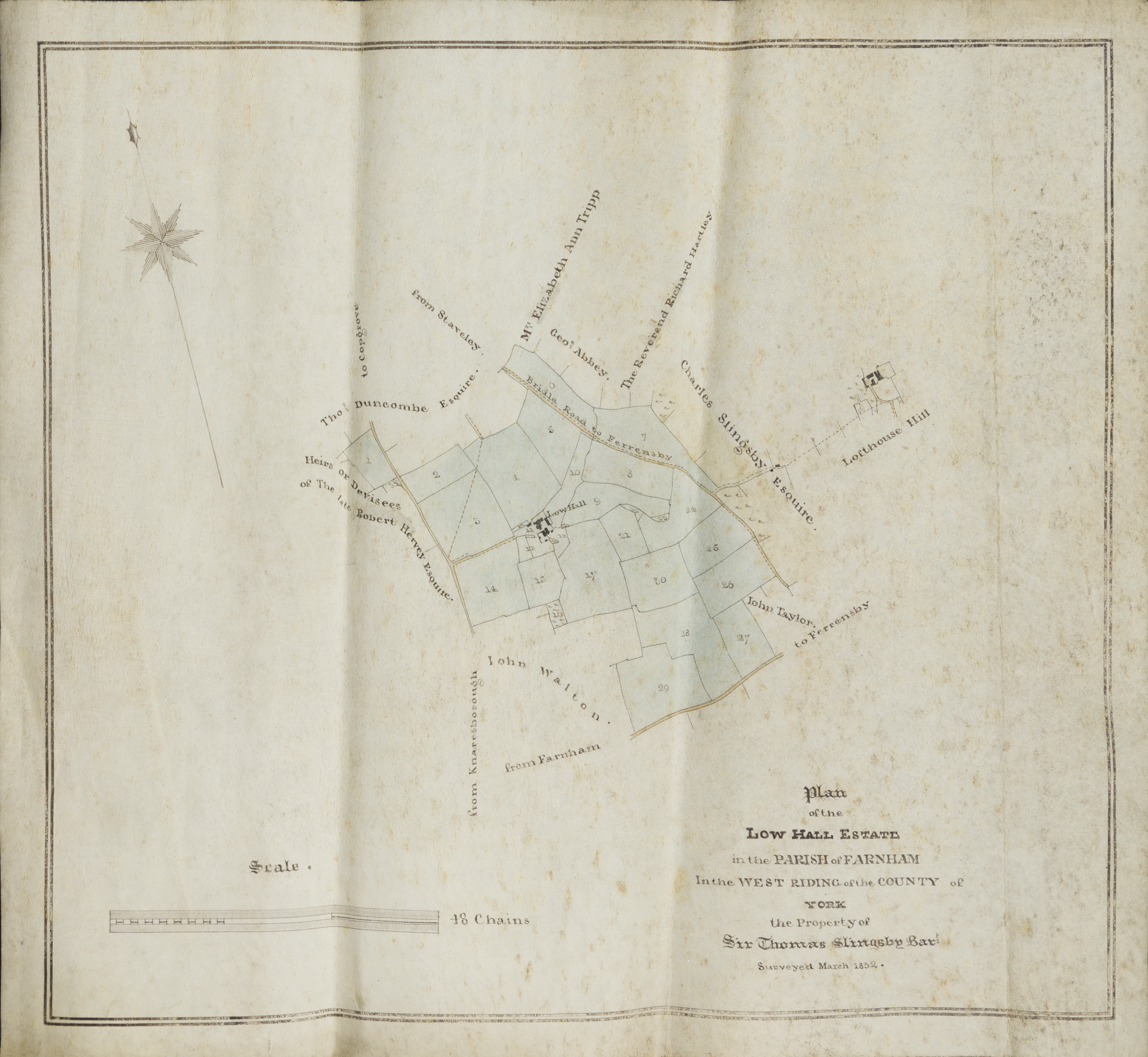
The advertisement also lists the names of tenants – Thomas Burton and William Baxter – both of whom can be located in Farnham using the 1861 Census.Footnote 34 Neither of these men tenanted land likely to require draining, but a little to the north east of the village is an area known as Low Hall (fig 3).Footnote 35 In 1864 the Low Hall estate was owned by Sir Charles Slingsby and encompassed a range of dwellings and farm buildings along with surrounding fields.Footnote 36 Immediately to the east of the farm was a marshy parcel of land known as ‘The Bottoms’.Footnote 37 A drainage system had already been installed in this land before 1864;Footnote 38 however, the Slingsby Estate Papers contain a schematic drawing by R O Hodgson of the proposed new, deeper drain laid across The Bottoms and dated 1863 (fig 4).Footnote 39 This drain is clearly marked on the 1891 Ordnance Survey map and was still visible in 1946.Footnote 40 The connection between The Bottoms and Thomas Gott comes via Sir Charles Slingsby’s land agent and estate manager at Low Hall: Frederick Hartley. Both Gott and Hartley were members of the Knaresborough Improvements Commission before 1864 and must have been more than passing acquaintances.Footnote 41
The Low Hall Estate plan. The Bottoms is labelled as ‘9’ on this diagram. Image: YAS/DD56/K/17 Slingsby Papers, Special Collections, Leeds University Library.
The section diagram of the proposed drain for The Bottoms at Low Hall by R O Hodgson, 1863. Image: YAS/DD56/ADD/1966/3/C7 Slingsby Papers, Special Collections, Leeds University Library.

We propose that drainers working for Slingsby and Hartley discovered the hoard in The Bottoms in 1863/1864. Hartley, recognising the objects, retained a ‘cup’ (see Catalogue below) for either himself or Slingsby. The rest of the items, including the iron tools, he probably thought would be of interest to his friend, the ‘ironmonger’ Thomas Gott. The objects may have been given to Gott, or money may have exchanged hands.Footnote 42 After the unfortunate loss of much of the hoard to the foundry’s melting pot, Gott went on to deposit the first group of objects in the Yorkshire Museum. His reticence to name either the findspot or the landowner may stem from a desire to either conceal the discovery from Slingsby, or to keep the baronet’s good name out of the limelight.
It is clear that Sir Charles had only limited antiquarian interests. His father had donated £50 towards the building of the Yorkshire Museum in 1827, but, perhaps tellingly, Sir Charles’ only dealings with the museum were restricted to depositing some mammoth bones from Pocklington in 1864.Footnote 43 Sir Charles drowned in a famous hunting accident in February 1869,Footnote 44 which was followed by his funeral in Knaresborough. Thousands of mourners watched the procession, in which the Knaresborough Improvement Commissioners, including Thomas Gott, walked behind the immediate friends and family mourning Sir Charles’ coffin.Footnote 45
Finally, Gott deposited the second group of objects in the Yorkshire Museum in 1876 after a visit to his home by Canon Raine, the curator of the Yorkshire Museum.Footnote 46 Between 1864 and 1876 the vessels were presumably on display in Gott’s home and the donation may have been prompted by a desire to tidy up his affairs as his end of days approached. Gott made his will in 1875 and died in 1877.
CATALOGUE OF VESSELS, TOOLS AND OTHER OBJECTS
This catalogue presents the thirty-one accession numbers given to the hoard by the Yorkshire Museum. For simplicity’s sake the objects are referred to by catalogue numbers presented thus <1>, with the accession number (prefixed by H144) presented in parentheses after. The accession numbers are associated with twenty-six copper-alloy objects, three iron objects, one missing iron object and an un-associated accession number. The vessels are illustrated in figs 5–12 and additional photographs of the vessels can be found in the online supplementary material. The copper-alloy objects represent a minimum of eighteen vessels and five other objects that together weigh 8.401kg. The three iron objects available for study weigh 1.708kg. The catalogue concludes with a consideration of the partial antiquarian accounts of the missing components of the hoard. It is impossible to determine how many vessels and other objects were lost to the error of Gott’s foundryman.
Large fluted bowl <1>. Image: Jessica DeMaso.

Large fluted bowl <1>. Image: Yorkshire Museum.

The strainers <2>, <4>, <5> and <7>. Image: Jessica DeMaso.

The Irchester bowls <8>–<11>. Image: Jessica DeMaso.

Irchester bowls <12>–<13>, plates <17>–<18>, scale pan <19>, strainer <20>, handled pan <21>. Image: Jessica DeMaso.

Plate <17>. Image: Yorkshire Museum.

Adze <22> (missing and drawn from a sketch by W Manning), small axe <23>, smith’s cross-pein hammer <24>, large axe <25>, rings <26>–<30> and cooking pot <31>. Image: Jessica DeMaso.

Cooking pot <31> shown inverted. Note the repair to the base. Image: Yorkshire Museum.

<1> (H144.1) A large, fluted leaded-bronze dish (figs 5 and 6). The scalloped design has twenty-seven petals radiating from a raised omphalos base. There are six concentric circles of repousse dots, and the vessel has a central lathe-mounting hole. Height: 103mm. Rim diameter: 488mm. Base diameter: 203mm. Weight: 2175g.
<2> and <6> (H144.2 and H144.6) (fig 7) A leaded-bronze strainer handle <2>, which was ‘restored’ by the British Museum and attached to rim fragment <6>. The handle conforms to Eggers’ Type 161.Footnote 47 The surviving strainer holes appear to form a scroll pattern underneath a linear border. Diameter: 186mm. Handle length: 121mm. Weight: 177.1g.
<4> (H144.4) A leaded-bronze strainer fragment (fig 7). The handle and upper part of the vessel survive, but the base is missing and may be <7>. The surviving vessel body is decorated with a perforated ivy-scroll design forming heart shapes below a border formed by a line of holes. The handle conforms to Eggers’ Type 161.Footnote 48 Diameter: 190mm. Handle length: 132mm. Weight: 199.5g.
<7> (H144.7) A base fragment from a leaded-bronze strainer (fig 7). A circle of holes surrounds a central lathe-mounting hole and this circle forms the centre of a flower with petals formed from overlapping arcs of holes. This fragment has been associated with the restored strainer <2>/<6>. Diameter: 152mm. Weight: 66.7g.
<3> and <5> (H144.3 and H144.5) A bent leaded-bronze strainer handle <3>, which was ‘restored’ by the British Museum and attached to body fragment <5> (fig 7). The handle is of Eggers’ Type 161.Footnote 49 The base of the vessel is decorated with a central circle of holes surrounding a lathe-mounting hole. This central circle is filled with four comma-like lines of holes arranged in whorl design. The gaps are occupied by triangular groups of holes. This decorative scheme forms the centre of a flower-like design with four petals created by holes. The centre of each petal is occupied by a swastika of holes with small triangular arrangements occupying the top of the arc and the bottom corners. The area between each petal is occupied by four vegetal lines of curvilinear holes with the remaining space occupied by small groups of three or four holes arranged in triangle or lozenge arrangements. The wall of the vessel is decorated with a linear border, beneath which there appears to be a scroll of comma-like lines of holes along with other curvilinear arrangements and triangular groups of three holes. Height: 98mm. Diameter: 189mm. Handle length: 148mm. Weight: 203.7g.
<8> (H144.8) A damaged leaded-bronze Irchester bowl with a large hole in its base (fig 8). The rim has been repaired in antiquity in two locations. Traces of riveted patches over cracks survive. Such repairs are common on Irchester bowls.Footnote 50 Height: 121mm. Rim diameter: 304mm. Weight: 868.8g.
<9> (H144.9) A damaged leaded-bronze Irchester bowl with a large hole in its base (fig 8). There are two rectangular marks on the rim that are probably the locations of ancient repairs, as in <8>. There are also two circular patches of solder that might indicate where a handle or escutcheon had been fitted. Height: 99mm. Rim diameter: 265mm. Weight: 393.8g.
<10> (H144.10) A damaged leaded-bronze Irchester bowl with a large hole in its base (fig 8). There are four shallow grooves running circumferentially around the exterior wall of the vessel. Height: 118mm. Diameter: 294mm. Weight: 449.6g.
<11> (H144.11) A leaded-bronze Irchester bowl with some damage to the rim (fig 8). The gunmetal base had become detached and has been repaired by the British Museum. Height: 103mm. Rim diameter: 247mm. Base diameter: 60mm. Weight: 370.3g.
<12> (H144.12) A damaged leaded-bronze Irchester bowl with a large hole in its base (fig 9). Height: 86mm. Rim diameter: 209mm. Weight: 246.3g.
<13> (H144.13) A damaged leaded-bronze Irchester bowl, missing a large fragment from the rim and wall of the vessel (fig 9). Height: 96mm. Rim diameter: 202mm. Base diameter: 90mm. Weight: 213.7g.
<14> (H144.14) This number is not currently associated with any object in the museum’s collections or accession registers. Kennett lists a bassin à bord godronné with a folded footFootnote 51 that was omitted by Eggers.Footnote 52 This vessel may be <14>, but it is more likely a case of mistaken identity because the museum holds two bassins à bord godronné that were found with the Finningley hanging bowls.Footnote 53 It is possible that this number should be associated with the lost iron spur.Footnote 54
<15> (H144.15) A body fragment from an indeterminate gunmetal vessel. Weight: 33g.
<16> (H144.16) A body fragment from an indeterminate leaded-bronze vessel. Weight: 34.1g.
<17> (H144.17) A shallow copper plate with footring (figs 9 and 10).Footnote 55 There is a central lathe-mounting hole and it is evident that the vessel has been folded up at some point. It may have been unfolded after its discovery, but if so this predated conservation by the British Museum. The folding elicits comparisons with packets of folded late Roman hacksilber.Footnote 56 Height: 42mm. Rim diameter: 286mm. Base diameter: 122mm. Weight: 409.9g.
<18> (H144.18) A shallow leaded-bronze plate with a central lathe-mounting hole, which has been filled (fig 9). Height: 32mm. Rim diameter: 228mm. Base diameter: 68mm. Weight: 326.8g.
<19> (H144.19) A leaded-bronze scale pan (fig 9). The pan has a filled central lathe-mounting hole and four rings for suspension. Height: 24mm. Rim diameter: 87mm. Weight: 57.2g.
<20> (H144.20) An unusual carinated leaded-bronze strainer (fig 9). The rim is flanged and decorated with a design reminiscent of a bassin à bord godronné.Footnote 57 The base is perforated by five rings of holes arranged around a central hole. Externally there are two patches of solder. The first of these is located just below the rim, the second is located beneath the first and just below the carination. These patches may indicate the position of a handle. Height: 63mm. Rim diameter: 181mm. Base diameter: 60mm. Weight: 117.5g.
<21> (H144.21) An incomplete leaded-bronze handled pan (fig 9). The handle survives and is ornamented with incised ‘X’s. The terminal has been bent over and there is a protrusion from the underside of the handle, which has broken off. This appears to be a unique feature and was presumably intended to support the vessel, allowing it to stand upright on a flat surface. The bowl of the pan is largely missing. Length of handle: 154mm. Weight: 350.4g.
<22> (H144.22) A lugged iron adze with a circular eye of Hanemann’s Type 3BA (fig 11). Curved bladed adzes are not uncommon.Footnote 58 Currently missing.
<23> (H144.23) A small, curved, francisca-like iron axe with lugs on either side of the underside of the shaft-hole; Hanemann’s Type 4 (fig 11).Footnote 59 Weight: 276g.
<24> (H144.24) A smith’s iron cross-pein hammer; Hanemann’s Type 3 (fig 11).Footnote 60 Weight: 329.1g.
<25> (H144.25) The larger of the two iron axes (see <23>) (fig 11). It has a slight curvature and lugs on either side of the shaft-hole; Hanemann’s Type 3b.Footnote 61 Weight: 1102.6g.
<26> (H144.26) A cast gunmetal ring (fig 11). Diameter: 84mm. Weight: 108.6g.
<27> (H144.27) A cast leaded-bronze ring with a small superficial hole (fig 11). Diameter: 71mm. Weight: 59.4g.
<28> (H144.28) A cast leaded-bronze ring (fig 11). Diameter: 95mm. Weight: 107.8g.
<29> (H144.29) A leaded-bronze ring (fig 11). Diameter: 49mm. Weight: 30.5g.
<30> (H144.30) A large cast leaded-bronze ring (fig 11). Diameter: 84mm. Weight: 62.0g.
<31> (H144.31) A leaded-bronze jar with an everted rim, seemingly an imitation of the pottery vessel form known colloquially in Romano-British studies as a ‘cooking pot’ (fig 12).Footnote 62 Eggers described this in error as a variant of the Østland type cauldron.Footnote 63 The base is missing, but had clearly been patched and repaired in antiquity. Twenty-seven rivets from this patching survive around the base of the vessel. There is also a hole in the body of the vessel that has been filled with resin. Height: 305mm. Rim diameter: 233mm. Weight: 1338.9g.
Additional items Antiquarian accounts mention a number of other objects (tables 1 and 2): a bronze ‘cup’, said to have been left in the possession of the landowner, a number of ‘9 inch plates’, ‘basins, dishes etc’ and ‘flat plates with handles, somewhat oval in form, and with rims slightly ornamented’.Footnote 64 There were also a number of additional iron objects, which include: a ‘fire grate with some four bars’, a ‘spur’, ‘bridle bits’, an ‘axe-hammer’, a ‘great quantity of nails’ and other ‘implements’.Footnote 65 The loss of all of these items (and others unrecorded) is to be regretted. The ironwork certainly feels, in combination with the extant objects, like the kind of late Roman iron hoard known from other sites in Yorkshire and beyond.Footnote 66 Fire-grates are unusual finds, but occasionally feature in hoards.Footnote 67 The iron spur is not out of place in a late Roman context and axe-hammers are known from the late Roman and early medieval periods.Footnote 68
A summary catalogue of the copper-alloy objects from the Knaresborough hoard. All objects are extant in the Yorkshire Museum with the exception of those in inverted commas, which are only known from antiquarian accounts.

A summary catalogue of the ferrous objects from the Knaresborough hoard. All objects are extant in the Yorkshire Museum with the exception of those in inverted commas, which are only known from antiquarian accounts.

CHRONOLOGY OF THE VESSELS AND OTHER OBJECTS
The large fluted dish <1> is an exceptional piece. It represents in copper alloy a form of vessel better known in silver. The most obvious parallels are the richly decorated fluted silver vessels from the Mildenhall and Kaiseraugst hoards, both of which date to the fourth century.Footnote 69 Similar copper-alloy vessels are known from Gallia Belgica and Noricum, where examples occur in contexts from the second century onwards, and also from a late Roman context in Tarroconensis.Footnote 70
The six Irchester bowls are a well-known late Romano-British vessel form <8>–<13>.Footnote 71 The few examples associated with meaningful dating evidence come from late fourth or early fifth-century contexts. The vessel form shares clear typological affinities to the earliest early medieval hanging bowls, which is suggestive of continued production and use into the fifth century.Footnote 72
The jar or ‘cooking pot’ <31> would appear to be a rendering in metal of a common form of late Roman pottery vessel. The origins of this form lie in Dorset Black Burnished ware, but the vessel shape was widely emulated.Footnote 73 A late Roman date is appropriate.Footnote 74
The colander <21> is another vessel paralleled in pottery. Colanders are never a common ceramic vessel form, but rare late Roman vessels are relevant.Footnote 75 The general form of the vessel, with its gadrooned rim, also places it within a late Roman milieu.
The two plates <17> and <18> are unusual vessels and we should note the absence of this form of vessel in Lundock’s catalogue.Footnote 76 Similar vessels equate to Eggers’ Type 116, dated to the early Roman period, although examples occur in third-century continental hoards.Footnote 77 Late Roman parallels include small silver and pewter plates,Footnote 78 but they differ in having complex rims.
The lost ‘flat plates with handles, somewhat oval in form, and with rims slightly ornamented’ may correspond to Eggers’ Type 121, which he dates to the late Roman period.Footnote 79
The strainers <2>–<7> are a common component of many Roman period bronze hoards. The Knaresborough strainers all conform to Eggers’ Type 161,Footnote 80 which is a late Roman form.Footnote 81 The discovery of a handle of this form, from either a strainer or a handled pan, at the Ingleby Barwick villa is a good example of the presence of these vessels in a late Roman context in northern Britain.Footnote 82 The unusual handled pan <21> with its ‘stand’ is unique, but it too should be of late Roman date.
The two axes <23> and <25> are both reasonably well paralleled within late Roman assemblages.Footnote 83 Curved, lugged axes occur at a number of late Roman sites including: Housesteads (Northumberland),Footnote 84 Beadlam (Yorkshire),Footnote 85 Burgh Castle (Norfolk),Footnote 86 Dorchester upon Thames (Oxfordshire)Footnote 87 and in a number of late Roman and early medieval continental graves.Footnote 88 This means that a late Roman date is plausible.
The final object of relevance to the dating of the hoard is the lost iron spur.Footnote 89 Roman spurs of any form are rare and the presence of an iron spur in a Roman hoard from Britain is exceptional.Footnote 90 Iron rivet spurs are thought to have been introduced in the last third of the fourth century.Footnote 91
In conclusion, the balance of evidence suggests that the hoard was deposited in the very late fourth century or later.
XRF ANALYSES OF THE COPPER-ALLOY ARTEFACTS
The copper-alloy objects from the Knaresborough hoard were examined in the Yorkshire Museum during 2020 using portable X-ray fluorescence spectroscopy (pXRF). This is a well-known non-invasive analytical method for determining which elements are present (qualitative) and can also provide some semi-quantitative information;Footnote 92 therefore, pXRF is seen as a suitable technique for conveniently examining archaeological materials in museum collections and similar situations. However, two important limitations should be emphasised: the technique is unsuited to detecting elements with a low atomic number, and the method can only determine the composition of a material to a depth of approximately 2mm.Footnote 93 The latter limitation is particularly challenging because archaeological objects are usually covered in layers of corrosion. Fortunately for this project, the artefacts studied here have been subjected to mechanical cleaning at various times in the past, exposing small areas of the metallic surface.
Superficially, many of the vessels appear to show metallic surfaces that are either unpatinated or very thinly patinated. Nevertheless, it is important to remember that a ‘shine’ does not always mean that uncorroded metal has been reached.Footnote 94 The corrosion of copper-alloys may also lead to a process known as decuprification, which may alter the surface composition and overly emphasise other constituent elements.Footnote 95 This means that these pXRF analyses, as in similar studies,Footnote 96 cannot be considered truly quantitative, but they have utility because they reveal the main components of the alloys used. For these reasons our results are referred to as ‘apparent concentrations’ as we effectively analysed patinas,Footnote 97 even if they were very thin and close in colour to the metallic phase of the alloy. Analysis of pure metal would have been possible only with further invasive mechanical treatment of the objects’ surfaces, which was not permitted by the museum.
The analysis was concerned primarily with addressing three broad questions:
-
1. What are the elemental compositions of the copper-alloys?
-
2. How do those compositions compare with other published analyses of Roman metal vessels?
-
3. Can ancient and modern repairs be identified?
To address these questions, each copper-alloy object was analysed using a Bruker Tracer iii-SD Handheld XRF Spectrometer.Footnote 98 At least two sample locations apparently free from corrosion were examined on each object and a minimum of three readings, each for 120 seconds, were carried out at each location.Footnote 99 The results, or ‘spectra’, were processed using industry standard software.Footnote 100 The final reported result for each analysed object is the mean value of three measurements conducted at each sample location.
The calibration method applied to this study is based on the principle of fundamental parameters calibration, where the XRF device compares the measured intensity for each element’s fluorescence from the sample and the calibration data coming from the analyses of certified reference materials (CRMs) to produce elemental concentrations.Footnote 101 Our calibration used CRMs produced by MBH Analytical Ltd.Footnote 102
It was clear from the calibrated data that the sample conditions had influenced the results. The apparent concentrations of copper appear to be lower than might be expected from Romano-British copper-alloys (brass, gunmetal, bronze and leaded-bronze) and other analyses of Roman metal vessels.Footnote 103 Decuprification might have occurred even on the apparently corrosion free sample locations. The apparent concentrations (AC) are presented in table 3.
Apparent chemical concentrations of the copper-alloy objects in the Knaresborough Hoard.

Almost the entirety of the assemblage can be classified as manufactured from leaded-bronze alloys (see table 3). Leaded-bronze is defined as a copper alloy containing at least 5 per cent Sn, no more than 5 per cent Zn and at least 1 per cent Pb.Footnote 104 The analysed leaded-bronze artefacts display Sn AC ranging from 5 per cent to 15 per cent. The Sn AC in the Irchester-type bowls <8>–<13> varies from 9 per cent to 13 per cent and is comparable with results from similar vessels in the Amersham hoard.Footnote 105 The dominance of leaded-bronze is in keeping with the broad pattern of leaded-bronze use in the late Roman Empire observed by Dungworth.Footnote 106
The small number of vessels made from other types of copper alloy include plate <17>. This is exceptional among the Knaresborough vessels in being manufactured from what Dungworth would consider ‘copper’.Footnote 107 In all likelihood this vessel was probably intentionally visually distinctive and would have appeared as red or red-brown in colour when new.Footnote 108
Three further objects can be considered as ‘gunmetal’: large ring <26>, fragment <15> and repair/modification <11>.
A number of vessels display various kinds of modifications and repairs that were subjected to additional analysis. The most compelling example is Irchester-type bowl <11>, where the base is a later replacement manufactured from gunmetal, in contrast to the leaded-bronze body. Irchester-type bowl <8> has a riveted patch typical of these vessels, with the rivet manufactured from a different alloy. Jar <31> also has a riveted repair to its base, which is a leaded-bronze with a higher zinc content than the body.
The strainers were in a fragmentary state and have been strengthened and conserved with joining elements united.Footnote 109 This was obvious in the case of <2> and <6> as well as <3> and <5>. In the latter case this conservation was supported by atomic absorption spectroscopy.Footnote 110 Our analysis confirms this earlier work and supports the unification of <2> and <6> as well. The pXRF would also support the identification of <4> and <7> as the same object.
The scale pan <19> proved to be the artefact with the highest Sn AC in the assemblage. Similar high Sn ACs were observed in the analysis of the Pewsey hoard scale pans, but, as these were not cleaned, the comparison should be discounted.Footnote 111
The highest Pb ACs have been detected in two of the cast rings (<27>: 18 per cent; <30>: 10.31 per cent). This is presumably because lead aided the fluidity of the metal in casting, but it has also been observed that casts contain a higher percentage of Pb compared to hammered surfaces.Footnote 112
An unusual 2 per cent Sb AC was detected in the handled pan <21>, which might be due to recycling of scrap metal.
In conclusion, the pXRF analysis has been successful in determining the alloys of the vessels and places them within the wider late Roman metalworking tradition. The analysis has also shed light on both ancient and modern repairs and modifications to some of the vessels.
THE KNARESBOROUGH HOARD: A BIOGRAPHICAL APPROACH
The hoard is a large and fascinating, if incomplete, assemblage. This final section is concerned primarily with attempting to provide a discursive biographical analysis of the production, use, disuse and rediscovery of these objects.Footnote 113 This discussion draws together the different strands of this multidisciplinary study to provide an interpretive and narrative framework to better situate the hoard within its archaeological context.
Each of the objects in the hoard began its life as metalliferous ores, which were smelted to produce the raw materials to manufacture the constituent elements of the vessels. As the hoard is of late Roman date, it is likely that the majority of the vessels were manufactured from recycled metals.Footnote 114 However, it is worth noting evidence for Late Iron Age copper mining near Scotch Corner and eighteenth-century attempts to exploit copper in Farnham.Footnote 115 Lead was also produced in the North Pennines and there are lead ingots of both early and late Roman date bearing the tribal/civitas name Brigantes.Footnote 116 Where the vessels and other objects in the hoard were manufactured must remain a mystery, but the widespread evidence for ferrous and nonferrous metal-working in Roman Britain suggests that they could have been produced locally.Footnote 117
The vessels appear to have performed a variety of functions. The majority of vessels seem to have served as tableware, with the plates presumably functioning to display and serve food. The large, fluted bowl and the Irchester-type bowls may have served in a similar fashion, but they could also have functioned as basins for handwashing at the table.Footnote 118 The handled pan may also have been used in ablutions. The consumption of infused beverages is indicated by the strainers, which seem to have been used to make flavoured beers and wines.Footnote 119 The jar and iron grate move this discussion away from the table and towards the preparation of foods in the kitchen.
The remaining objects offer insights into a wider range of activities. Commercial activities seem to be indicated by the scale pan, the small size of which would be unsuited to the kitchen or bulky commodities.Footnote 120 The adze and cross-pein hammer ought to be indicative of wood- and metal-working respectively, and the lost ‘implements’ suggest other forms of tool were present. The axes may also have been used for woodworking, although the small size of <23> means that it might have functioned as a weapon.Footnote 121 Equestrianism is indicated by the lost iron spur. The rarity of late Roman spurs and their unusual distribution, with concentrations in the north east and outliers in East Anglia and the West Country, has been seen as implying a connection with the army and high status individuals.Footnote 122 The Knaresborough spur thus fits a local distribution pattern and tentatively suggests the involvement of high status individuals in the hoarding process. Gott also describes lost ‘bridle bits with brass rings’Footnote 123 that may have been composite objects, like the snaffle bit from Wijchen (Netherlands).Footnote 124 Whether these ‘bridle bits’ are to be related to the large rings (<26>–<30>) is unclear. These rings may have served as harness components, or as vessel handles. They do not display any wear that would clinch an identification.
That these objects had use-lives is most clearly visible in the ancient repairs exhibited on vessels <8>, <9> and <31>. This is not unusual, such repairs are common, but they do indicate that the vessels had complex use-lives before they were deposited.Footnote 125 As we have demonstrated, it is likely that the hoard was deposited in The Bottoms, Low Hall, Farnham. This findspot is not ‘beyond reasonable doubt’, but the identification can be accepted on ‘preponderance of evidence’ and suggests that the objects from the hoard were probably drawn from individuals and/or communities in the local area.
The Bottoms is located on the western side of the Vale of Mowbray, an area of low-lying arable land, bounded on the east by the North York Moors and west by the Yorkshire Dales (fig 13).Footnote 126 It is drained by the Rivers Ure, Swale and Wiske and their tributaries, which flow southwards to become the River Ouse. The Vale is a major geographical feature and forms a major north–south communications route. During the Roman period two important Roman roads ran north–south: Cade’s Road, on the eastern side of the Vale, and Dere Street, on the western side.Footnote 127 Of these roads, Dere Street was the more significant and from York northwards there were a number of important settlements along this route: Isurium Brigantum (Aldborough)Footnote 128 , Healam BridgeFootnote 129 and Cataractonium (Catterick).Footnote 130
The hinterland of Low Hall, showing known Roman settlements and roads. Villas: 1) Bedale/Aiskew; 2) Thorpe; 3) Well; 4) Castle-Dykes; 5) Ripon; 6) Dalton Parlours. Image: Andrew Agate.

Dere Street passes some 7.6km to the east of The Bottoms on its way to Aldborough (figs 13 and 14). At Aldborough a spur road strikes out westwards, heading towards Ilkley, and passes 2.8km north of the probable hoard findspot.Footnote 131 For part of its route, this road follows a small water course known by various names (Ocanney Beck, Fleet Beck or River Tutt) that joins the Ure at Boroughbridge. Today, various agricultural ditches and drains flow northwards from the fields around The Bottoms to feed this watercourse. In the Roman period it may be supposed that the springs at The Bottoms fed a small bog or lake, which ultimately drained northwards and was one of the sources of the Tutt and therefore Ure.
Low Hall and its hinterland with all Roman finds reported to the PAS. Finds 1–3 are the three closest recorded objects to The Bottoms. Image: Andrew Agate.

The Victorian ‘drainers’ clearly struggled to drain The Bottoms. The 1863 plan was for a new, deeper drain. This seems to have been more or less successful, and aerial photography taken in 1946 shows the drain clearly with The Bottoms appearing to be rough pasture. Sometime before 2002, probably in the late 1990s or very early 2000s, The Bottoms were converted into an artificial lake. That is the current state of the land today and any further direct investigation of the location is thus precluded.
Archaeologically, the landscape in the hinterland of The Bottoms is poorly understood. It was clearly within the orbit of Isurium Brigantum, and the western edge of the Vale of Mowbray is characterised by a string of late Roman villas (fig 13, 1–5).Footnote 132 From the north running southwards are an almost evenly spaced group of villas running from Aiskew/Bedale to Ripon.Footnote 133 From Ripon to Dalton Parlours is a blank, but it would be foolish to assume that villa settlement did not continue into this area. Archaeological investigation in the vicinity of The Bottoms has been limited but has identified a Romano-British field system and trackway at Boroughbridge Road to the south.Footnote 134 Late Romano-British settlement evidence has been found at Allerton Park and Flaxby Quarries and also on Bayram Hill.Footnote 135
The excavated evidence can be set alongside the evidence of stray finds from the region. Figure 14 plots the Roman finds recorded by the Portable Antiquities Scheme (PAS) from the Harrogate district. This is an arbitrary area, but offers a useful and localised snapshot of activity. Major clusters of Roman finds are located, unsurprisingly, in the vicinity of Boroughbridge/Aldborough and also to the south of Knaresborough, where a late third-century coin hoard was found.Footnote 136 Burton Leonard, on the Aldborough to Ilkley road and 4.7km north west of The Bottoms, is the focus for a cluster of finds. The remainder of the objects, with the exception of a few minor clusters, are widely distributed. The coins provide a proxy for the chronology of this activity (fig 15).
All Roman coins reported to the PAS from the Harrogate district by Reece (Reference Reece1991) period (n = 809). Image: authors.

The fields around The Bottoms have seen no excavation and only three Roman finds reported to the PAS:Footnote 137 a republican denarius (fig 14, 1);Footnote 138 a Late Iron Age or early Roman vessel mount (fig 14, 2);Footnote 139 and a nummus of ad 364–78 (fig 14, 3).Footnote 140 None of these objects can be plausibly linked to the hoard. It is also important to acknowledge the limitations of PAS data.Footnote 141 It is a voluntary scheme and only a minority of metal-detected finds are reported by their finders. This is especially significant around The Bottoms as the fields immediately to the east are known to have been metal-detected and produced Roman material, none of which has been submitted to the PAS.Footnote 142
The evidence from the surrounding landscape suggests that the hoard was put together by individuals and/or communities inhabiting an important agricultural landscape, dominated in the late Roman period by villas, Dere Street and urban centres such as Aldborough and York. The origins of the hoard, or components of the hoard, could be sought at any of these sites. The metalwork could have come from a nearby villa estate, roadside settlement or a wealthy townhouse, craft district or religious complex within a town. It is impossible to determine which of these origins is most plausible, but this provides some context for the deposition of the hoard in The Bottoms.
Moving from the landscape back to the specific moment in the lifecycle of the objects when they were grouped together and deposited in the bog highlights just how unusual this hoard is. The surviving 8.4kg of copper-alloy and 1.7kg of iron objects are only the residue, as has been shown, of an assemblage that originally filled a sack or cart. There is little published data to compare, but the Amersham and Helmsdale hoards were 0.97kg and 1.45kg of copper alloy respectively.Footnote 143 Only the Drapers’ Gardens hoard, with its more than 15kg of copper alloy, is larger in terms of weight,Footnote 144 but that hoard is dominated by buckets and a cauldron, for which there is no evidence in the Knaresborough discovery. Moving the original assemblage to its place of deposition must have been an awkward task that may have required more than one person or multiple trips.
The unusual nature of this assemblage is further emphasised by comparison with other late Roman copper-alloy vessel hoards. Out of the eighteen hoards of this type that are of indubitably fourth- or fifth-century date, Knaresborough is the sole example, with the exception of the probably fifth-century hanging bowls from Newham Bog (Northumberland),Footnote 145 to come from a lake, bog or marsh. All the other late Roman copper-alloy vessel hoards come from dry land or fen edge contexts.Footnote 146 This pattern is reinforced by overviews of hoarding in Roman Britain that emphasise a decline in deposition in ‘natural’ wet contexts after the end of the early Roman period.Footnote 147 Indeed, it is striking that, in terms of composition and place of deposition, the best parallels for Knaresborough are the early Roman hoards of cauldrons and assorted ironwork from southern Scotland,Footnote 148 or the Prestwick Carr (Northumberland) find of copper-alloy vessels.Footnote 149
The iron objects also stand out as highly unusual elements in a late Roman vessel hoard.Footnote 150 More typically, such hoards are accompanied by iron cauldron chains or cooking and dining utensils.Footnote 151 The material from Knaresborough, with its apparent emphasis on tools and nails, compares well with early Roman hoards of ironwork and late Roman iron hoards from the region.Footnote 152 It is worth considering whether the Knaresborough finds are in fact two depositions (one of copper-alloy vessels and the other of iron objects) made in very close proximity to one another. Sandy (Bedfordshire) has produced a late Roman vessel hoard, a single Irchester bowl, a large late Roman ironwork hoard and a Theodosian coin hoard.Footnote 153 The relationship of these discoveries with one another is unclear, but it provides a possible parallel for a locus receiving different forms of deposits in the late Roman period. The vessels from Shapwick Heath on the Somerset Levels were also clearly deposited close to one another but not as a group.Footnote 154 Whatever the truth of the Knaresborough hoard, the combination of a mixed deposit of copper-alloy vessels and ironwork seemingly deposited in a bog is extremely unusual in a late Roman context in Britain.
What motivated the deposition of the hoard in the bog remains uncertain. The alleged irretrievability of hoards placed in such contexts,Footnote 155 as well as the ‘perceived numinosity associated with rivers bogs and pools’,Footnote 156 has encouraged such finds to be seen as votive or ritual deposits.Footnote 157 Yet, bogs and lakes might undergo seasonal fluctuations and not all objects hidden under water need be irretrievable.Footnote 158 The hoard was clearly a collection of valued objects and valuable materials, and it could have been concealed for safekeeping. Both iron and copper-alloys were widely recycled in the late Roman and early medieval periods, and this emphasises the value of ‘scrap’.Footnote 159
If the hoard was deposited for reasons other than safekeeping, then a votive or ritual explanation could still be appropriate. It might be valid to claim the hoard as a so-called ‘structured deposit’, although this term is not without its difficulties.Footnote 160 Close excavation and contextual analysis of late Roman copper-alloy vessel hoards, as at Drapers’ Gardens or the Vale of Pewsey and Wilcot finds, demonstrates that some of these discoveries underwent careful preparation and treatment as part of the depositional process.Footnote 161 This certainly implies something more than hurried concealment and may suggest that these actions had greater significance than the simple burial of objects. Unfortunately, and given the circumstances of its discovery, the Knaresborough hoard lacks any of this evidence.
After the deposition of the hoard it seems to have lain undisturbed until its discovery in c 1864. Here, the biographies of the objects comprising the hoard once again diverged. Some disappeared into the melting pot, to be recycled and recast as new, Victorian objects. One of the axeheads returned to use,Footnote 162 and the remaining objects were divided, with at least one vessel going to an unknown party. The others went to Gott, who gave some to the Yorkshire Museum, where they were appreciated as antiquities. The remainder stayed with Gott until 1876, when they too went to the museum. What Gott did with them in the intervening twelve years is a mystery. Were they displayed in his home? Did he reuse the vessels? Here it is worth remembering that the Bacchic silver platter from the Mildenhall treasure was not only displayed in the finder’s employer’s home, but also used to display food at Christmas before it passed, via the Treasure Trove law, into the hands of the British Museum.Footnote 163 From 1876 onwards, the surviving elements of the Knaresborough hoard were reunited as museum pieces, to be displayed, appreciated, studied and conserved. This is how they have functioned ever since, where they have been used most recently to illustrate aspects of Romano-British life, rather than telling the story of one of Roman Britain’s most important non-precious metal vessel hoards.
CONCLUSIONS
The antiquarian accounts strongly suggest that the Knaresborough discovery was the largest hoard of late Roman copper-alloy vessels and iron objects ever discovered in the British Isles and is comparable in scale to some of the larger European vessel hoards.Footnote 164 The discovery includes vessels, such as the ‘cooking pot’ and fluted bowl, that are unique in Britain and a wide range of other forms. The iron objects provide an additional aspect to the discovery that has been ignored in modern discussions of the hoard and blurs the division between late Roman copper-alloy vessel and ironwork hoards. The presence of an iron spur, otherwise unattested in late Romano-British metalwork hoards, but in keeping with the regional distribution of this object type, is noteworthy.
Typological analysis of the vessels indicates that a late Roman date is appropriate. Going beyond this broad statement is difficult, but the repairs exhibited by some vessels, the presence of Irchester bowls and the apparently very late fourth-century spur all suggest that this find could have been deposited as late as the fifth century. As such, the hoard deserves to be considered in discussions of the end of Roman Yorkshire and Britain. The scientific analysis confirms the late Roman date via the alloy compositions and means that the hoard can take its place in the growing body of literature investigating the metal economy of the Roman world.
The most remarkable discovery was the wealth of information relating to Thomas Gott. This has enabled his contribution to the hoard’s discovery to be more fully appreciated, and the identification of his social networks in nineteenth-century Knaresborough have shed light on the social context of antiquarian collecting. More importantly, it has allowed us to build a preponderance of evidence strongly suggestive of a findspot for the hoard. For the first time, the landscape context of the find can be considered, and its probable recovery from a bog is unusual in a late Romano-British context.
The multidisciplinary nature of this study has revealed a fascinating, if complex, story about this remarkable discovery. At a distance of more than a century and half we have demonstrated that there is genuine value in returning to study items in museum collections. Old collections can be used to answer new questions, and we hope that this study will be an inspiration to others to undertake similar work.Footnote 165
ACKNOWLEDGEMENTS
The authors would like to thank Lucy Creighton, Emily Tilley and Andrew Woods (Yorkshire Museum) for their assistance. The Special Collections librarians at the Brotherton Library, University of Leeds, granted access to archival papers and allowed them to be reproduced. Additional thanks must go to: Andrew Agate for preparing the maps; David Dungworth, who provided beneficial advice on the pXRF; Simon Esmonde-Cleary and Paul Booth, who both provided comments on an early draft of this paper; and Michael Baxter, who showed us the landscape of Farnham.
SUPPLEMENTARY MATERIAL
To view supplementary material for this article, please visit https://doi.org/10.1017/S0003581523000197.
ABBREVIATIONS AND BIBLIOGRAPHY
Abbreviations
- COW
-
Catalogue of Wills
- GRO
-
General Register Office
- LMA
-
London Metropolitan Archives
- LUL
-
University of Leeds Library Special Collections
- NAA
-
Northern Archaeological Associates
- NYRO
-
North Yorkshire County Records Office
- PAS
-
Portable Antiquities Scheme
- PRO
-
Public Records Office
- SAL
-
Society of Antiquaries of London
- WYACS
-
West Yorkshire Archive Service
- WYAS
-
West Yorkshire Archaeological Service
- YPS
-
Yorkshire Philosophical Society


 Open access

