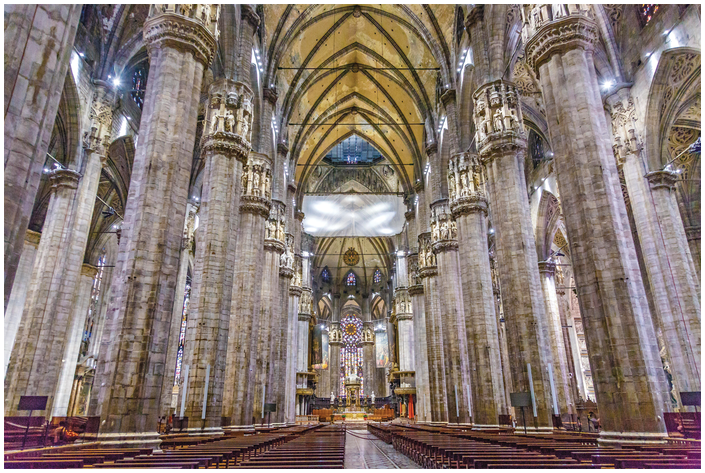
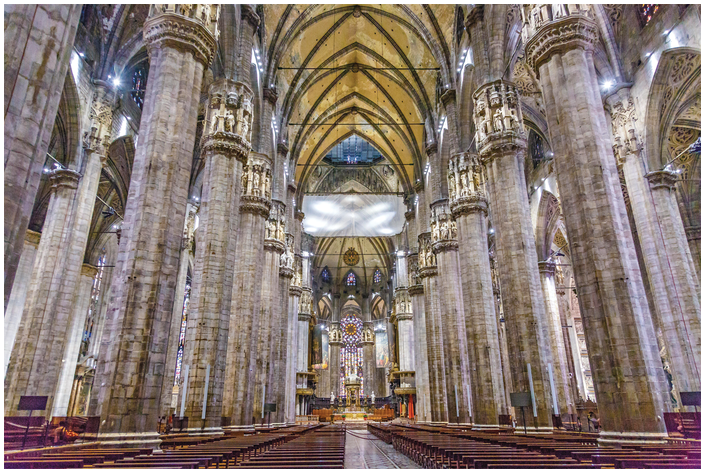
On the evening of June 25, 1566, Archbishop Carlo Borromeo began his first official inspection of the cathedral of Milan (Figure 1.1).1 After performing Mass and other solemnities, Borromeo and his assistants walked from one altar to the next, noting down everything from Mass obligations to missing windowpanes. They checked whether relics were properly stored in the sacristy or if any of the requisite liturgical books were missing. Some altars were found to be improperly placed, while others needed to be rededicated. The thorough inspection resumed the next day, resulting in an itemized fix-it list for the canons. With this event, Borromeo began his tireless campaign to reform the church interior. He had officially entered Milan as its new archbishop the year prior, intent on implementing the reforms of the Council of Trent, concluded in 1563. His policies addressed many aspects of religious life, from clerical education to confession. The spiritual health of the diocese, however, was also a material matter. Borromeo’s reforms entailed frequent calls to assess, clean, and repair the many objects within church walls. He considered these inspections, called visitations, to be one of a bishop’s most important pastoral duties.2 The cathedral was only the beginning. During his episcopacy, Borromeo would visit a vast number of churches both within Milan’s city walls and throughout the diocese’s expansive rural regions.
Interior of Milan Cathedral.
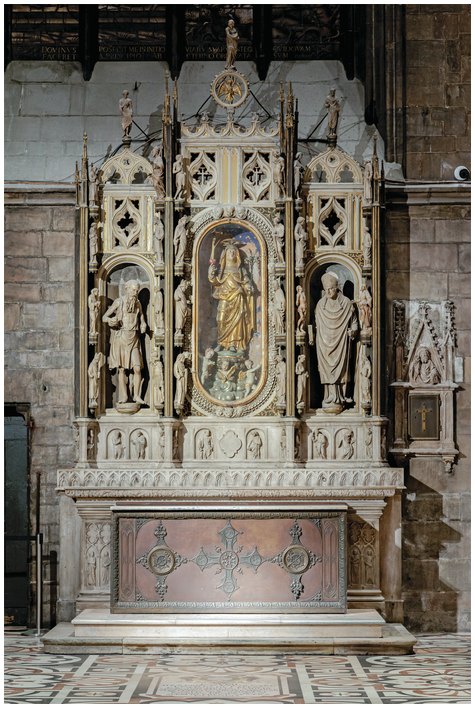
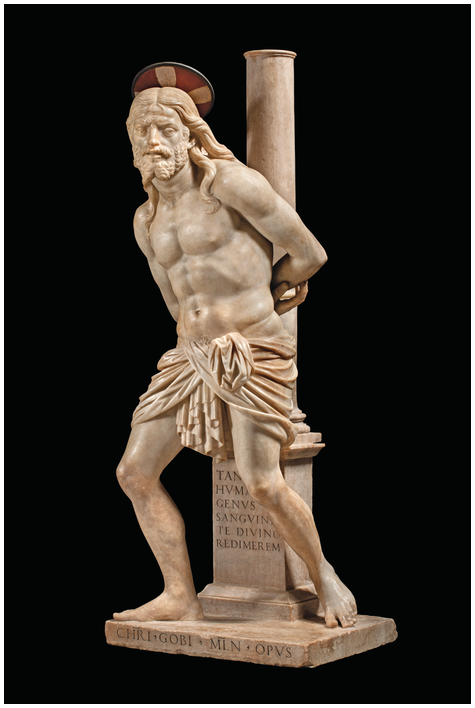
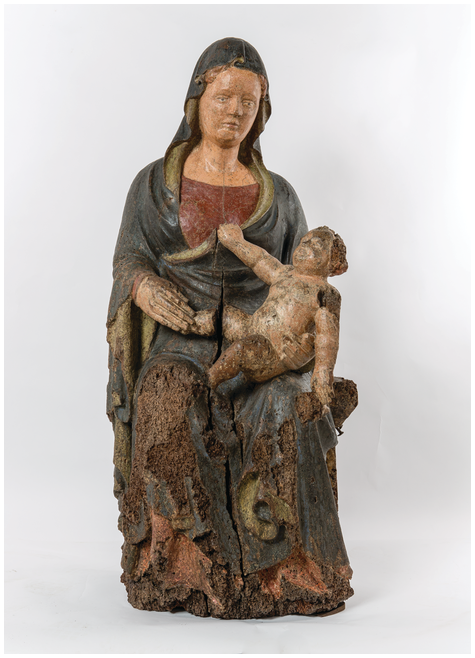
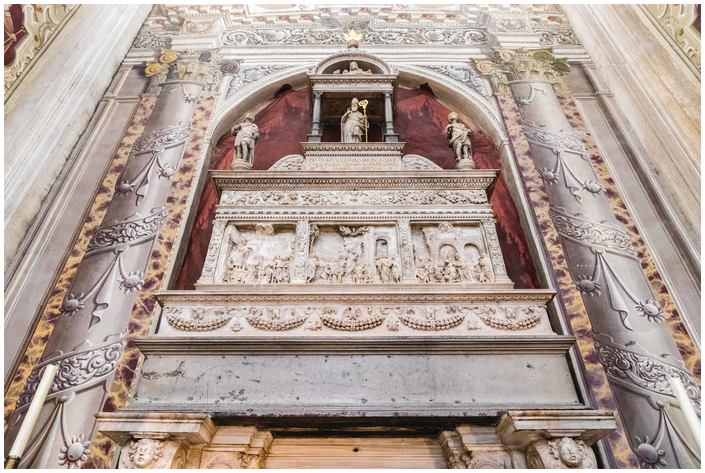
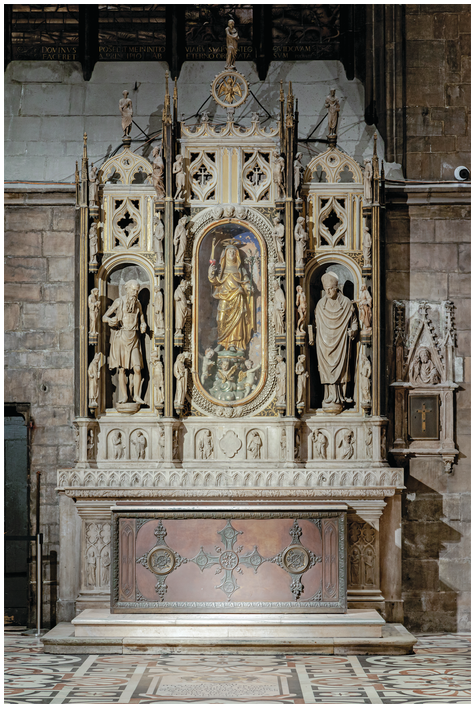
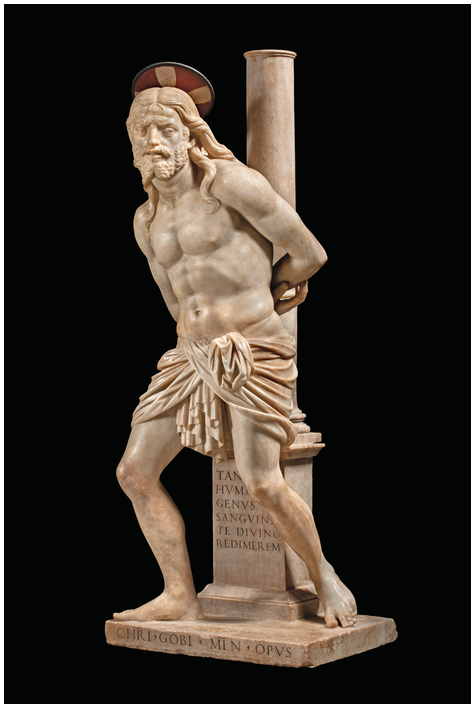
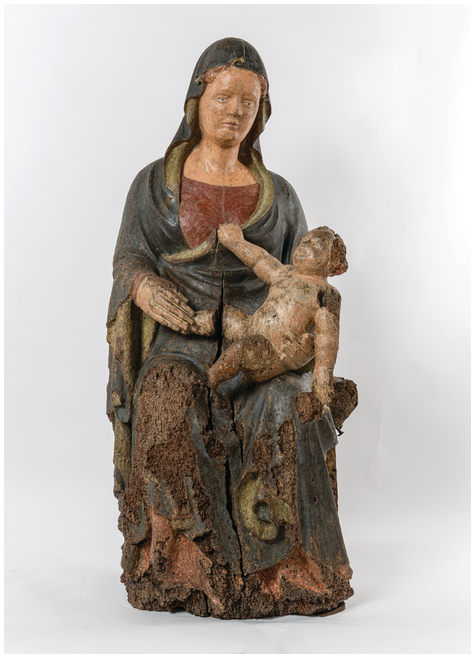
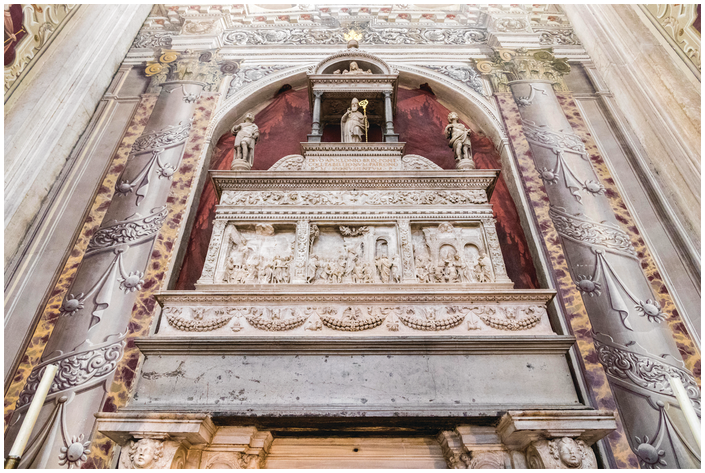
Borromeo encountered many images on this mission. In the cathedral alone, he witnessed an incredible array of altarpieces, tomb sculptures, and other forms of figural decoration. He inspected the altar of St. Catherine of Siena, a Gothic-style altarpiece with both stone and wooden sculptures (Figure 1.2), as well as Cristoforo Solari’s classicizing marble Christ at the Column from the early sixteenth century (Figure 1.3). There were recent panel paintings as well as older anonymous works. Some images were credited with miracles, as with the popular Madonna del Pilone, a statue located near a large pilaster in the left nave (Figure 1.4).3 As Borromeo continued his visitations throughout the diocese, he witnessed an even greater diversity of image types. He saw ornate marble tombs and bare Ottonian chapels, impressive shows of polychrome Renaissance statuary and spaces in grave disrepair, empty of artworks and victim to neglect (see Figures 1.5–1.8). He inspected miraculous Marian images in terracotta, wood, and fresco. Some were of recent manufacture, while one purportedly dated to the fourth century (see Figures 1.9, 1.13, and 1.15). Borromeo’s discerning interactions with these works, varied in medium, style, and era, prompt long-standing questions about reformers’ image preferences. Did they favor the archaic over the modern, or medieval over Renaissance? Did they value austerity over luxury, or prefer paintings to sculptures? Did they promote miracle-working imagery, or instead take issue with popular cults? What did a decorous sacred image look like to Borromeo?
Altar of St. Catherine of Siena, Cathedral of Milan.
Cristoforo Solari, Christ at the Column, early 16th c. Marble.
Madonna del Pilone (?), 2nd quarter of 15th c. (?). 118 × 45 × 40 cm. Polychrome wood. Museo del Duomo, Milan.
Gasparo Cairano (attr.), Ark of San Apollonio, early 16th c. New Cathedral of Brescia.
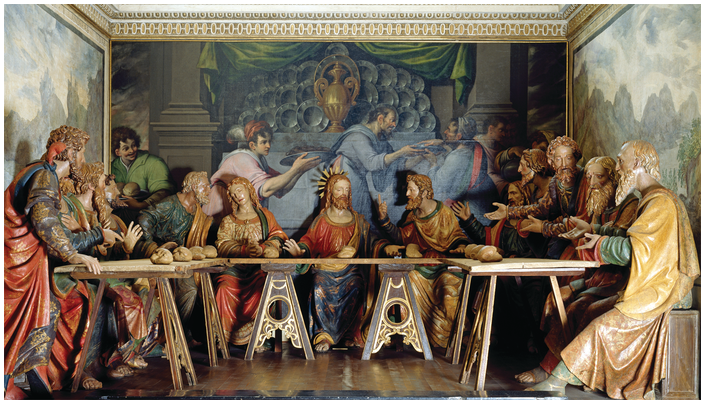
Andrea da Milano (with Alberto da Lodi), Last Supper, c. 1531. Polychrome wood with gilding. Paintings by Camillo Procaccini in 1596. Sanctuary of Our Lady of Miracles, Saronno.
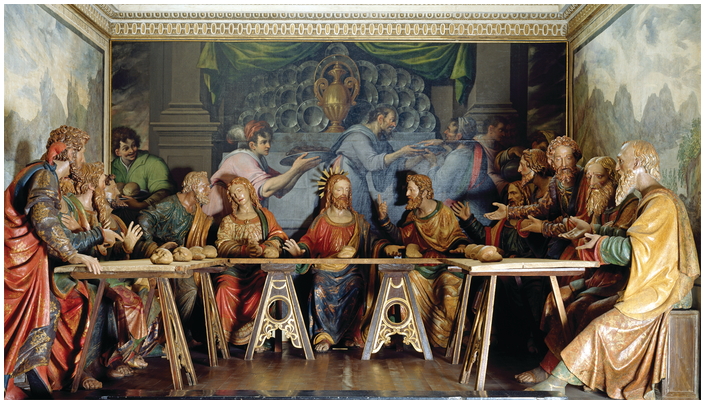
1.6 Long description
Lifesize, brightly painted sculptures of Christ and his twelve apostles sit on one side of a wooden table. Christ is at center. Behind him, an oil painting shows servants carrying plates. The chapel side walls are filled with landscape frescoes.
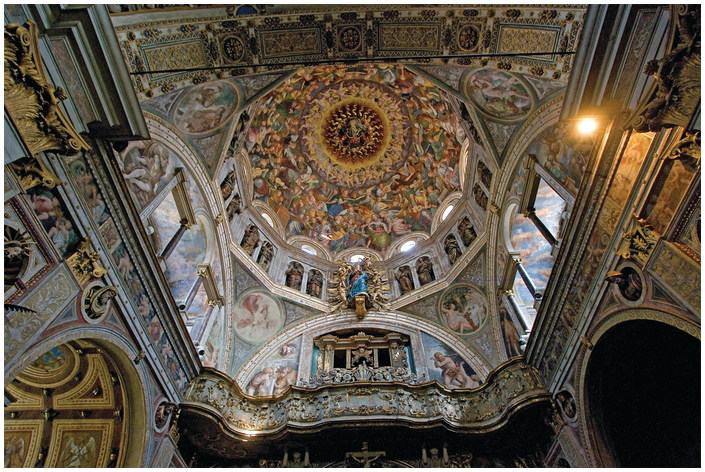
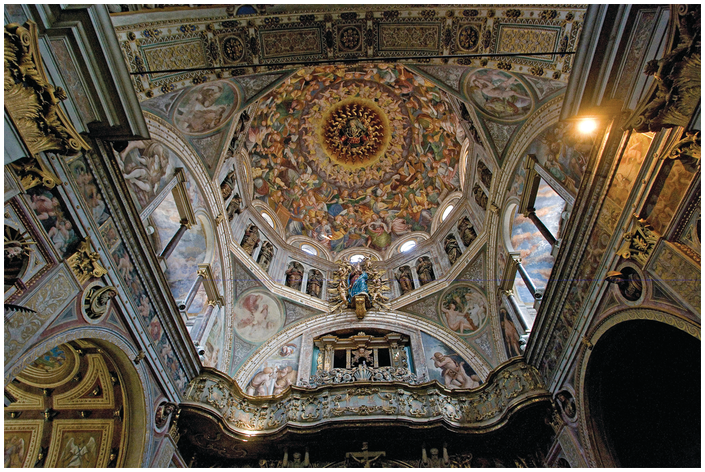
Dome of Sanctuary of Our Lady of Miracles, Saronno. Frescoes by Gaudenzio Ferrari, 1530s.
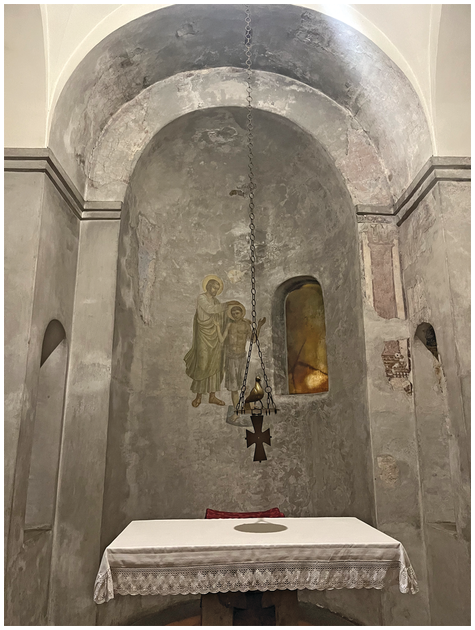
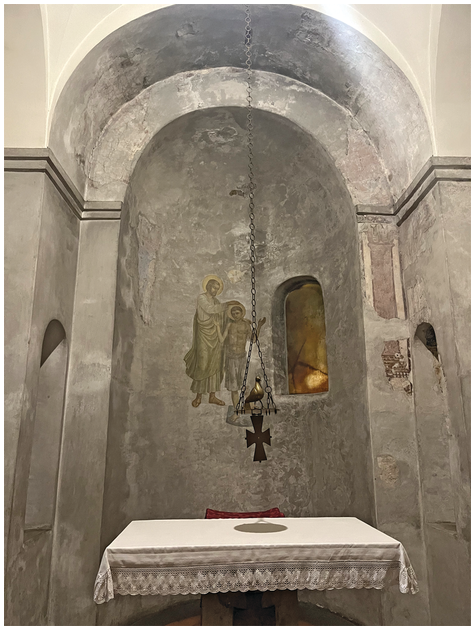
Basilichetta di San Lino, 10th c. Fresco traces from 13–15th c. Basilica of San Nazaro Maggiore, Milan.
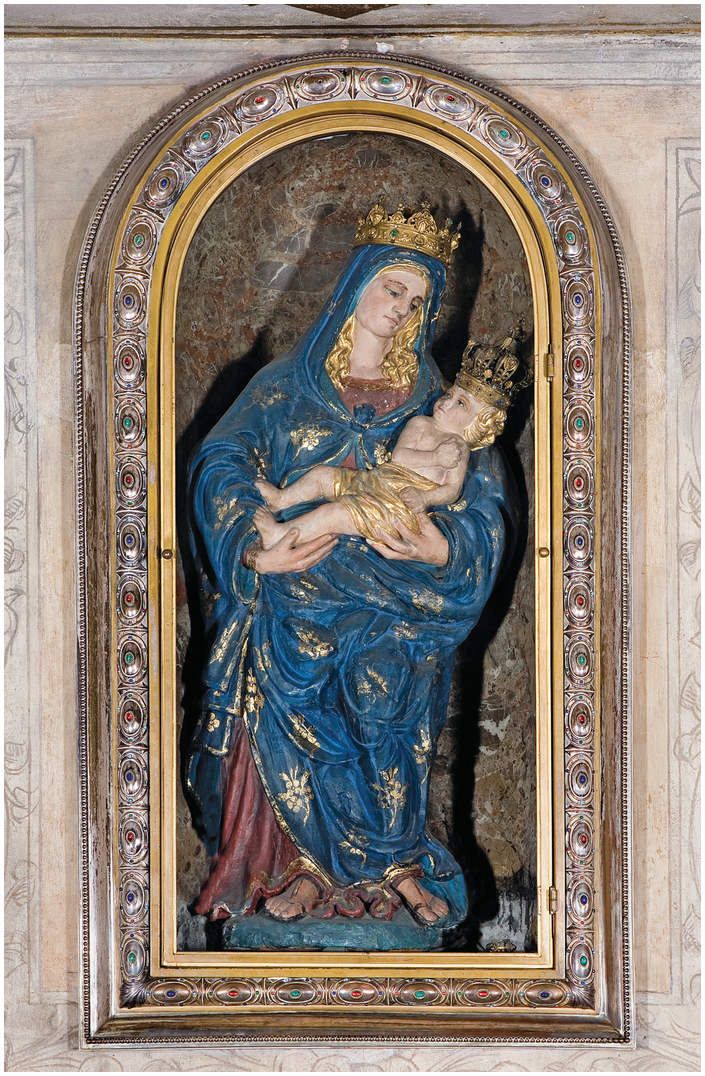
Madonna of Miracles, 15th c. (?). Painted terracotta. Sanctuary of Our Lady of Miracles, Saronno.
The visitation records, alas, do not behave in the way we might want. They rarely contain judgments on style and eschew descriptive adjectives, giving us little insight into our reformer’s artistic preferences. Instead, the impact of Catholic reform appears in the treatment of images. Borromeo’s actions demonstrated that images should be honored as sacred objects.4 This notion was far from settled doctrine. Theologians at the time were engaged in debates over the nature of an image’s holiness. They asked whether images should be honored solely for their representational capacity, or if an image’s sacrality could also derive from its material presence, its status as a sacred object used in a sacred space. Though left unresolved at the Council of Trent, this question conditioned Borromeo’s encounters with images. Borromeo and other visitors foregrounded matters of conservation, focusing on the physical integrity of images alongside other objects in the church interior. This concern also compelled reformers to implement framing strategies that physically protected images while permitting access to their visual form. Borromeo’s advocacy for objecthood had a third consequence as well. It altered his sense of the historicity of the image, which could evoke the distant past through its ritual use, its function within church walls, if not through its chronological date. Borromeo and many of his fellow reformers attended to the physical presence of sacred images, a move that endowed images of varying ages and styles – medieval and Renaissance, old miraculous statues and beautifully ornate contemporary works – with ancient authority.
The Visitor as Conservator
The decrees of the Council of Trent prescribed that bishops perform pastoral visitations at least every two years.5 This practice of church assessment, which involved surveying the material condition of the church as well as the spiritual status of its clergy and laity, had a much longer history, though it became especially popular as a tool of reform in the second half of the sixteenth century. Borromeo took up the charge with characteristic zeal, said to have thrown Milan into a state of near constant visitation.6 The diocesan archives in Milan possess well over 2,000 volumes of visitation records, many of which date from late sixteenth and seventeenth centuries.7 While it is not feasible here to perform an exhaustive or quantitative study of this corpus, a sampling taken from several major basilicas in Milan as well as one example from the diocese’s rural regions, or pievi, provides a window into how images were treated in Borromeo’s visitations. The records show that the visitor after Trent acted more as a conservator than an art theorist or a censor.
It is much easier to study the architectonic than the artistic in the visitation records. In Milan Cathedral, for example, Borromeo ordered the removal of secular tombs, the closing of the transept doors, and the construction of new choir stalls, all changes that would drastically transform the structural layout of the building.8 Meanwhile, the visitations include little information on Borromeo’s opinions of the myriad images in the same space. For the art historian, accustomed to a discipline invested in the powers of visual description, the visitations disappoint. They paid more attention to an altar’s dedication or benefices than to its altarpiece. The visitor tended to treat images as items on a checklist. When Borromeo stood in front of Solari’s sculpture in 1566, his secretary recorded only that the altar had “a marble image of our Lord Jesus Christ at the Column” (see Figure 1.3). He plainly described the imposing Gothic altarpiece at the Altar of St. Catherine of Siena as “a wooden altarpiece, partly gilded, with four marble images” (see Figure 1.2).9 In humbler churches, visitors often found a scarcity of imagery. The rural visitations contain frequent complaints about altars with no altarpieces and chapels without décor. When visitors do employ descriptive adjectives, they typically use either decens, meaning seemly or decent, or pulcher, beautiful.10 Both terms are general, with applications in medieval liturgical texts as well as humanist writings on decorum.11 It is difficult to discern whether the visitor is using these words aesthetically, to indicate an especially beautiful painting, or if they instead refer to physical condition. For example, while indecent (indecens) could suggest an inappropriate or ugly work of art, it is also used in the visitations to designate an image as abraded, too small, or pushed up improperly against a wall.12
Occasionally, artworks made enough of an impression that their special beauty registered even in the mundane bureaucratic genre of the visitation record. Borromeo noted in his inspection of the Basilica of San Pietro in Brescia that the Ark of Sant’Apollonio, an imposing marble construction by Gaspare Cairano, was “wrought with wonderful artistry” and ornamented with many sculptures (Figure 1.5).13 Other instances of artistic praise appear in the visitor’s records at the impressive Sanctuary of Our Lady of Miracles in Saronno. The church was amply ornamented even before its expansions in the late sixteenth and seventeenth centuries.14 Its chapels featured paintings by the Milanese Renaissance artist Bernardino Luini and a sculpted polychrome Last Supper by Andrea da Milano, carved in 1531 (Figure 1.6). The celebrated Gaudenzio Ferrari had fashioned a dizzying display of the celestial choirs in the crossing dome, which sat upon a drum containing polychrome statuary (Figure 1.7). Borromeo’s delegate admired this opulence in his 1569 visitation. He described the interior as “most precious and ingeniously constructed, very beautiful with many painted and gilded ornaments and figures both painted and sculpted.” The visitor referred to Gaudenzio’s dome frescoes as “excellently painted” and Andrea da Milano’s sculptural Last Supper as “very beautiful.”15 These rare instances of aesthetic impression suggest that visitors viewed ornament as essential to the dignity of church space, though this claim is so deeply entrenched in Christian theology that it provides little insight into post-Tridentine tastes.16
Yet the visitation records can tell us something important about the relations between reformers and images. Like inventories, visitation records can be understood as textual constructions rather than as collections of straightforward facts.17 Visitations, too, divulge values and beliefs when pressed. A holistic reading of these documents reveals a preoccupation with the physical condition of images. Material decorum mattered most to the post-Tridentine visitor. From urban Milan to the distant pievi, Borromeo commanded canons to restore, clean, and protect sacred images. In his visitation of Milan Cathedral, for example, he ordered the restoration of silver images at the base of a crucifix. Borromeo instructed that the “figures and altars” were to be cleaned every fifteen days.18 His image directives echoed those for other sorts of ecclesiastical objects. Borromeo gave orders to repair worn vestments and polish chalices. The Eucharistic tabernacle was to be kept free from dust.19 Images, like other furnishings in the church, needed to be protected from the sacrilege of dirt.
Visitations to other major churches in Milan show a similar concern for physical upkeep. At the Basilica of San Lorenzo, the altarpiece at the altar of San Nicolas was found to be “old and indecent,” damaged by the ravages of time. The paintings in the side chapel of San Sisto also showed indecorous signs of age.20 At the Basilica of Sant’Ambrogio, Borromeo called for the restoration of an image of a saint. One chapel’s walls needed plastering and repainting, a frequent problem. Borromeo specified that the monks were to pay for this repair.21 The Basilica of San Nazaro required many restorations, including calls to whitewash and repaint the walls. Borromeo noted the presence of four sculpted angels decorating a tabernacle that needed to be finished and gilded. At the tenth-century Altar of San Lino, decorated with mere remnants of a fresco cycle, the visitor noted that the chapel was missing its requisite ornamentation and that the pictures under the arch were badly aged (Figure 1.8). He called for the Fiorana Chapel to be painted as well, suggesting the project be funded by the sale of votive offerings in the church treasury.22
Visitors gave frequent orders to restore and repair images when evaluating the diocese’s rural churches as well. When Borromeo’s vicar traveled to the pieve of Nerviano, a region northwest of Milan, he found an aging statue of Saint Anthony in his eponymous church. Images at the nearby church of Sant’Ambrogio also showed signs of wear.23 At Santa Maria Nova, the crucifix over the main altar needed painting and gilding. The parish church of San Vittore had the same problem. An altarpiece in an oratory of Sant’Alessandro was old and needed to be immediately renovated or otherwise replaced.24
Conservational complaints recur throughout the visitations from this period. They appear in the apostolic visitations of Gerolamo Ragazzoni, sent to inspect the churches of Milan on papal authority in 1575. Ragazzoni called for several altarpieces and painted chapels to be renewed (innovari).25 When the pope sent Borromeo and his agents to the Swiss valleys, they found altarpieces “corroded” and “devoured” by age.26 Comparable comments can be found in contemporary visitations in Bologna and Rome.27 An early seventeenth-century set of instructions for visitors, based on Borromeo’s rules, instructs clerics to check whether images are in “a dirty location, in the light, or under windows, or in a place where nails are fixed, lest they be pierced.” They ask the visitor to ensure no images are corroded, broken, or dirty.28 Image conservation was a pervasive problem for the post-Tridentine visitor.
Despite this, Borromeo is often described as antagonistic to artistic freedom. This characterization stems in part from his printed guide to church furnishings, the 1577 Instructiones fabricae et supellectilis ecclesiasticae. The Instructiones, composed and edited largely by Borromeo’s collaborators Ludovico Moneta and Pietro Galesino, compiled the archbishop’s policies on the church interior.29 The Instructiones was widely circulated, especially after it was republished in 1582 as part of the Acta ecclesiae mediolanensis, a collection of Borromeo’s ecclesiastical legislation, which Simon Ditchfield has called the “practical ‘how to’ manual for the conscientious prelate.”30 Though included in Paola Barocchi’s edited collection of Cinquecento art treatises, Borromeo’s Instructiones was not intended as a work of art theory.31 It instead outlines policies for the church interior, addressing the proper form for each church furnishing, down to the missal bookmark. Its precise directives echo Borromeo’s wider reputation for stringency. The presbytery should have two steps in marble, stone, or, if necessary, brick, followed by a wooden predella. The partition window in a monastery should have holes no larger than the size of chickpeas, and the peg on which to hang the biretta should be no more than two cubits above the floor.32 Its second book, so dry that it is commonly left out of modern editions, includes lists of items necessary for the liturgy, the public rites and prayers of the Catholic Church. It is addressed to the post-Tridentine prelate rather than to those interested in theories of art or architecture.
It is only in the seventeenth chapter of the first book that Borromeo treats the topic of sacred images. He opens by threatening fines for artists who deviate from the rules. He cautions artists not to depict anything false, apocryphal, superstitious, profane, or lascivious, a passage that resonates with passages in Borromeo’s own conciliar legislation and in the decrees of the Council of Trent.33 He forbids contemporary portraits in religious paintings, as well as any extraneous animals, such as dogs or fish, that are not necessary to the narrative. Only saints should be shown with a halo and only martyrs with palm branches. Painters should depict neither grotesque masks, nor “small birds, nor the sea, nor green pastures, nor other things of this kind which are designed for pleasure’s sake.”34
It is no wonder that Borromeo has been characterized as a stern disciplinarian, hostile to artists and their inventions. In her 1977 English translation of the Instructiones, Evelyn Voelker saw in this text “the full force of the sixteenth-century Counter Reformation tide against the artistic freedom allowed Renaissance artists.”35 It has been used to cast Borromeo in opposition to the more imaginative strains of sixteenth-century Lombard mannerism. Artists like Aurelio Luini, Giuseppe Arcimboldo, or Gian Paolo Lomazzo, associated with the carnivalesque artistic academy of the Val di Blenio, have been assumed to suffer under his episcopacy.36 Yet Borromeo’s criticism of pictorial delights is more formulaic than novel. To borrow Michael Baxandall’s words regarding St. Antoninus of Florence’s fifteenth-century grievance about monkeys, dogs, and other painted curiosities, this was “a stock theologian’s complaint, voiced continually from St. Bernard to the Council of Trent.”37 The visitations show little evidence of the sort of stylistic suffocation sometimes envisioned by art historians. Instances of censorship are rare. In a handful of cases, Borromeo ordered the removal of profane elements from church décor. He criticized a painting of two laywomen beneath the main altar of a church in Castrezzato, near Brescia. He called for the removal of an image of Hercules decorating the border of an altar in the cathedral of Milan. Several visitors complained about the use of profane silver dishes in church rituals.38 In general, however, the visitors used the term “indecent” to complain of improperly treated pictures rather than offensive or curious ones.
The Instructiones reflects this concern for image care. The chapter on images contains a brief passage on their proper location. None should be placed where they might be trodden upon, nor should they be in a damp location or underneath windows. Borromeo recommended that floor tombs in church cemeteries avoid sacred pictures, lest they be susceptible to injury. Borromeo also forbid religious images on the floor.39 His chapter on oratories in the Instructiones prohibits sacred images on external walls, unless placed high and out of reach. Otherwise, the images could “be exposed to defilement with mud or dirt, or to improper and insulting treatment.”40 A similar injunction appears in print already in 1567 in an early summary of Borromeo’s furnishing rules, published in Brescia.41 Image decorum, to Borromeo and his collaborators, was more about protecting than policing, about searching for mistreatment rather than hunting down birds, dogs, and green pastures.
Images were to be treated like other ritual furnishings, sacred by virtue of location and function. Like chalices and vestments, sacred images should be blessed according to the instructions in the Pontifical or Ceremonial liturgical books, texts containing the rites and ceremonies of the Catholic Church.42 Borromeo’s Fourth Provincial Council in Milan in 1576 decreed that ruined images must be destroyed to avoid profanation. Damaged statues, meanwhile, should be buried underneath the church or in the cemetery.43 Borromeo’s policies reify the sacrality of an image’s physical substrate, even after the loss of its representational features. His concern for images as sacred objects reinvigorates older traditions. Borromeo’s rules on material profanation derive largely from medieval liturgical treatises like French bishop William Durand’s thirteenth-century Rationale divinorum officiorum and Bishop Sicardo of Cremona’s 1205 Mitrale. He owned contemporary editions of both.44 His directive on disposing of sacred things references the example of a Pope Clement (cited in Durand’s treatise), who commanded that altar hangings and other church textiles should be burned if deteriorated and the ashes placed under the pavement to avoid being stepped on.45 Borromeo reasserted this tradition in the post-Tridentine church interior, bringing attention back to the image’s sacred objecthood. Old traditions found new advocates. The Roman Curia, for example, supported this position when they published a decree in 1596 stating that damaged images must be removed from sacred places to avoid dishonoring them.46
Borromeo’s position on images was not a given after the Council of Trent. As Wietse de Boer has recently shown, the source of an image’s holiness was a matter of debate in the mid-sixteenth century. Following criticism of the cult of images in the wake of the Protestant Reformation, Catholic theologians vigorously debated if, why, and how images should be honored. In the first phase of the Council of Trent, opened in 1545, bishops and theologians worked to formulate a theological basis for the cult of images. Catholic scholars drew on Scholastic as well as Byzantine theories of the image’s divinity.47 One traditional strain of thought derived from Thomas Aquinas’s theory that reverence passed through the image to reach its prototype. In other words, to honor a picture of Christ was to honor Christ. In this model, images deserved the same divine reverence, called latria, as the heavenly Christ himself. Many theologians found this Thomist formulation too strong, fearing that it invited accusations of iconoclasm.
Another facet of sixteenth-century image debates focused on the image’s claim to holiness as an object, rather than as a representation. Some theologians argued that because an image was blessed, kept in sacred spaces, and used in religious rituals, it deserved the same honor as other church furnishings. The Dominican theologian Ambrogio Catarino Politi wrote in a 1552 disputation that in addition to an image’s representational holiness – a sacrality derived from its ability to point past itself – the sacred image was also divine by its functional participation in the rituals of the church. Images deserved to be honored in part because they were sacred objects “disposed to such sacred uses.”48 When images entered church space, their holy status shifted. Like Borromeo after him, Catarino’s prizing of sacred objecthood led to a concern for physical condition. He, too, insisted that images be kept off floors and placed in decorous locations.49
This debate continued in the final phase of the Council of Trent from 1562 until 1563. In his 1619 account of the council, the historian and theologian Paolo Sarpi wrote of a disagreement between the Dominican bishop Leonardo Marini and the Jesuit Diego Laínez, who argued over whether images in church spaces should be honored like other ritual objects.50 An early draft of the Council of Trent’s decree on saints, relics, and images, recently published by Wietse de Boer, included a section on protecting the physical integrity of sacred images. The draft decree discussed the abuse of negligence. This referred to relics and images being placed in dirty places, or images of saints “painted on floors,” or “when relics or images are left in squalor due to dust or other dirt, and when profane or even pagan images are allowed to be in churches.”51 The bishops ultimately purged this passage from the final decree, rushed through in the council’s last days, suggesting that they preferred to avoid debating the matter. The topic was discussed in Borromeo’s own circles. Borromeo worked as papal secretary during the final sessions of the Council of Trent. In 1563, he shipped the team at Trent a collection of texts on sacred images, gathered by his close associate, the protonotary Guglielmo Sirleto.52 Sirleto, as well as figures like the bishop and inquisitor Marcello Cervini, worked on these image questions in the same Rome in which Borromeo served as cardinal-nephew to Pope Pius IV. Thomist traditions and Byzantine image theory continued to hold sway in the post-Tridentine period, but so too did theories of an image’s material claim to holiness. In 1587, the Jesuit Robert Bellarmine cited Catarino as he argued for an image’s sacred presence by virtue of its role in divine worship. If, Bellarmine argued, the Second Council of Nicaea saw images deserving the same honor as the Gospels and ritual vessels, then “images are to be venerated in and of themselves and properly,” as objects, not just because of their representational capacity.53
Borromeo’s humdrum orders to fix faded paintings and bury ruined statues amount to the implementation of a theological viewpoint, if articulated through action rather than doctrine. His many encounters with sacred images in the name of reform might not betray any hidden artistic biases, such as a preference for the Gothic over the classical, or the painted over the sculpted.54 Borromeo instead shows how images of all styles should be treated, namely, as protected sacred objects in the church interior. Borromeo’s conservational actions deserve a place in discussions of image decorum during this period of Catholic reform. They had consequences beyond the scribbled manuscript pages of the pastoral visitations. A related concept, in fact, appears in Gregorio Comanini’s 1591 Il Figino, a treatise on art theory known for its engagement with contemporary religious issues. Comanini has one of his interlocutors ruminate at length on the honor due to sacred images. The speaker, the prelate Ascanio Martinengo, states that because images deserved to be honored like sacred vessels and the books of the Gospels, that is, as sacred objects, they are also to “be honored in and of themselves.” Comanini bases his discussion on Bellarmine’s 1587 publication, though this belief must also be connected, if implicitly, to Borromeo’s actions in church space two decades earlier.55 Borromeo’s rules for the church interior, like Comanini’s theoretical treatise and Bellarmine’s theological text, show how the Catholic reform movement of the later sixteenth century valued images as sacred objects.
Reform and Reframing
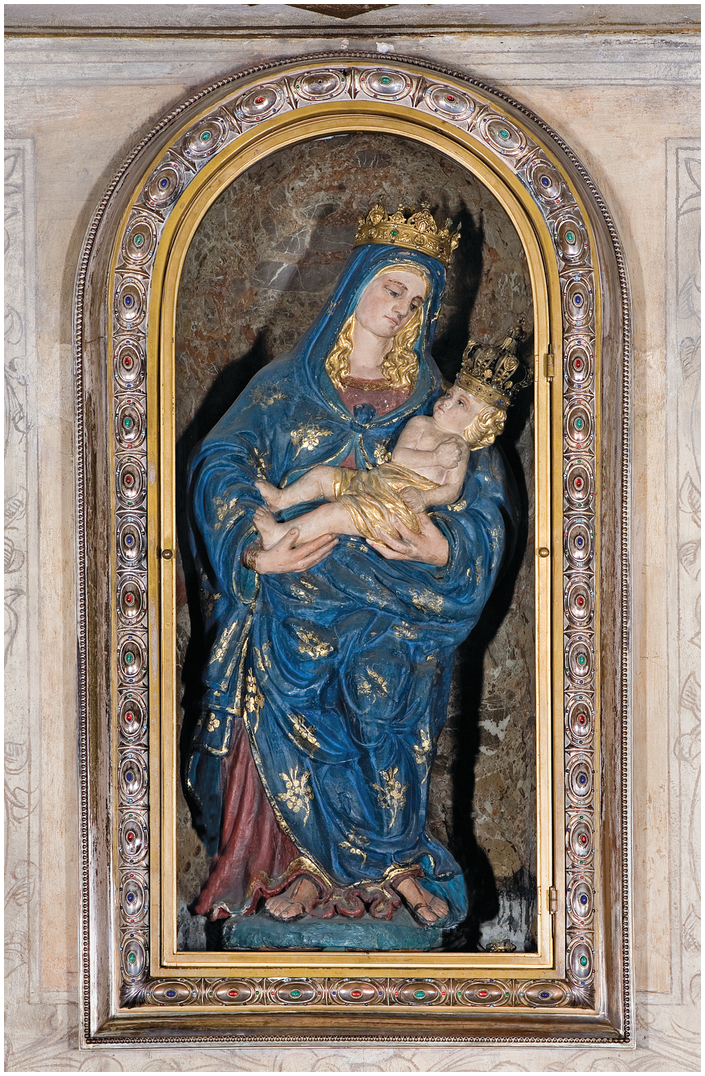
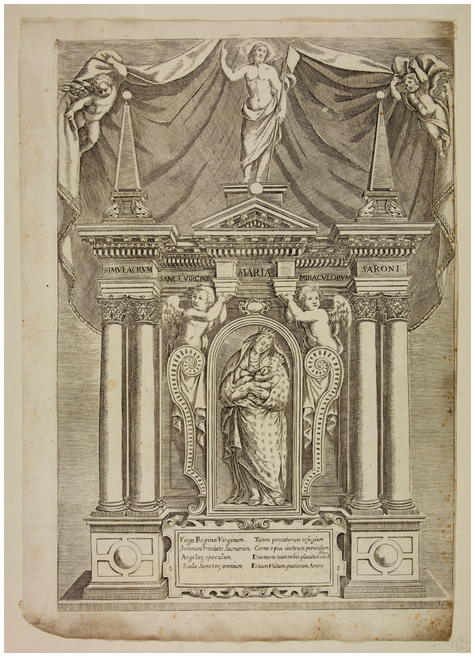
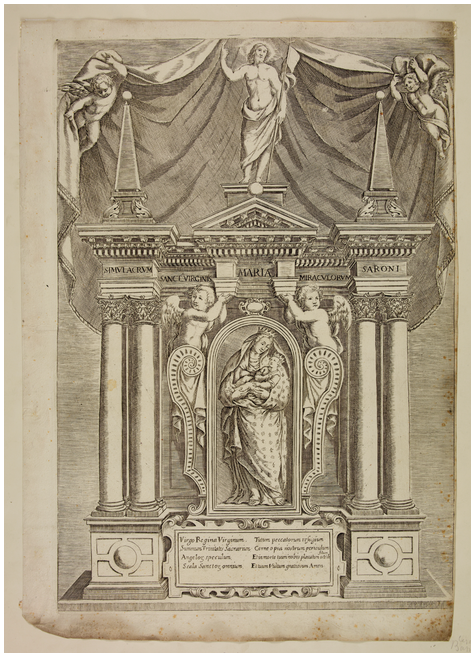
The ecclesiastical visitors trudging from church to church encountered images threatened by crowds, inclement weather, and humidity. In 1569, Borromeo’s delegate assessed the Sanctuary of Our Lady of Miracles in the Lombard town of Saronno. The visitor noted that an important devotional image, the “very beautiful” painted statue of the Virgin Mary, was placed over a small altar on the church’s exterior portico (Figure 1.9).56 Although honorably adorned and shielded by an iron grating, the so-called Madonna of Miracles was exposed to the elements. Eventually, a safer interior location was prepared for the statue. In 1581, with great fanfare and the concession of indulgences, Borromeo arrived to solemnly translate the Saronno Madonna into its new home, a marble architectural niche above the high altar (Figure 1.10). Borromeo’s published sermon for the occasion celebrated that the statue was now indoors in a “more decent place.”57 The setting served to display and safeguard, highlighting the Madonna’s preciousness while protecting it from injury. The solution in Saronno reflects changes happening more broadly in the post-Tridentine church interior. The visitor’s conservational efforts shifted the exigencies of display. On the one hand, sacred images deserved visual attention, inspiring visitors to place them in updated and often elaborate shrines. On the other, these objects required protection, which led to a focus on gratings, veils, and glass covers. The story of the Saronno Madonna of Miracles exemplifies the post-Tridentine reliance on the frame, a device that tended to both the visual and haptic needs of the sacred image.
Cesare Bassano, Madonna of Miracles in Saronno, c. 1620–50.
It became increasingly common in the second half of the sixteenth century to translate miraculous images indoors and place them over church altars.58 Borromeo oversaw translations at the shrine of the Madonna dell’Addolorata in Rho, as well as in Saronno. A visitor to the Church of Santi Gervasio et Protasio similarly recommended the removal of an entire piece of wall with a sacred image of the Madonna.59 This trend of moving miraculous images indoors increased clerical oversight, especially when the translation followed an episcopal examination of the miracles in question.60 However, it also bolstered Borromeo’s larger program of image care. Before the miraculous fresco at Rho could be translated into its recently constructed sanctuary, Borromeo insisted that it be guarded behind glass, suggesting that protection was part of his motivation.61 In the church of San Raffaele, he commanded that a metal grating be installed over a Marian image.62 In 1576, the apostolic visitor Ragazzoni urged that an image of the Virgin Mary in Milan’s Benedictine church of San Simpliciano be moved from the doorway to an interior chapel. If that was not possible, Ragazzoni asked that iron bars be placed over the image to “retain it with honor.”63 A few of the visitations also call for covers or veils to be placed over sacred images, including one reference to cover an altarpiece to avoid the accumulation of dust.64
Borromeo’s rules for church furnishings reflect this investment in protective devices. Iron bars guarded many things from the perils of profanation. The Instructiones insists on the use of railings at each altar to keep dogs and people out. All relics, especially those on the floors, should be covered with iron grilles. He legislated the use of wire and metal gratings over oratory and monastery windows. Monastic churches should display relics behind an iron grating and glass, as well as a curtain and doors, so that the relics could be revealed to the nuns but not touched by them. Borromeo participated in a post-Tridentine revival of the confessio, a subterranean tomb for a saint or martyr’s remains beneath the main altar of a church. The particular layout of these tombs gave devotees visual access to the holy remains, though typically through windows or grilles. Borromeo also promoted a confessional box that used a screened aperture to separate penitent and confessor.65 This design, a direct predecessor of the modern confessional, has been interpreted as an emblem of Borromeo’s project of social discipline, using screens as a mechanism of control. His screens and gratings regulate, but they also protect. Borromeo’s command to place saints’ corpses behind glass windows and metal grilles, for example, derived from the need to keep them “forever free from all dirt and dust.”66
Borromeo’s protective strategies, again, borrowed from older customs. It was traditional to cover altarpieces with veils or treated canvas. Important polyptychs and miracle-working images had long been kept hidden, unveiled only for special occasions. The confessio and its lattice grille were widespread in Carolingian churches; many Renaissance shrines covered miraculous images with iron gratings.67 Borromeo acknowledged the historical character of his calls to bar and cover. He described the confessio and its grated opening as ancient custom. He must have known that Durand mentioned the use of curtains to cover images in his thirteenth-century liturgical treatise.68 In the sixteenth century, the use of grilles became associated with reform. In a letter from Cardinal Marcantonio Maffei to Borromeo on July 10, 1575, the cardinal explicitly connects the use of iron or wooden gratings to the reforms of the Council of Trent and its mission to bring greater decency to the church interior.69 Borromeo’s attention to image protection transformed the church interior in the post-Tridentine period, making novel solutions from traditional concepts.
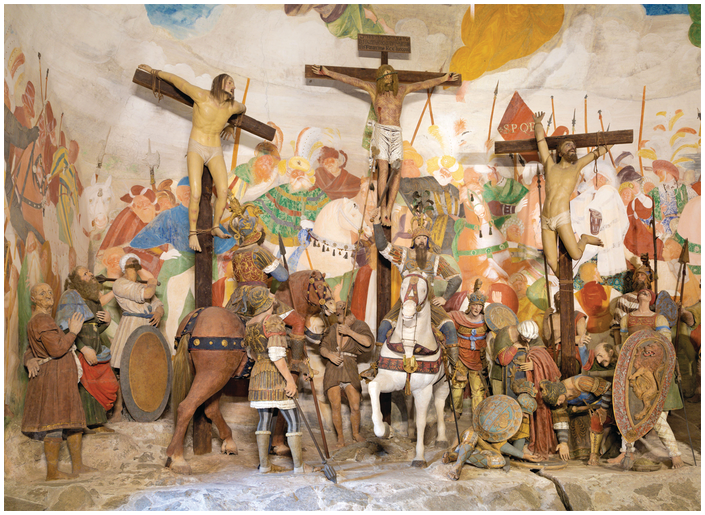
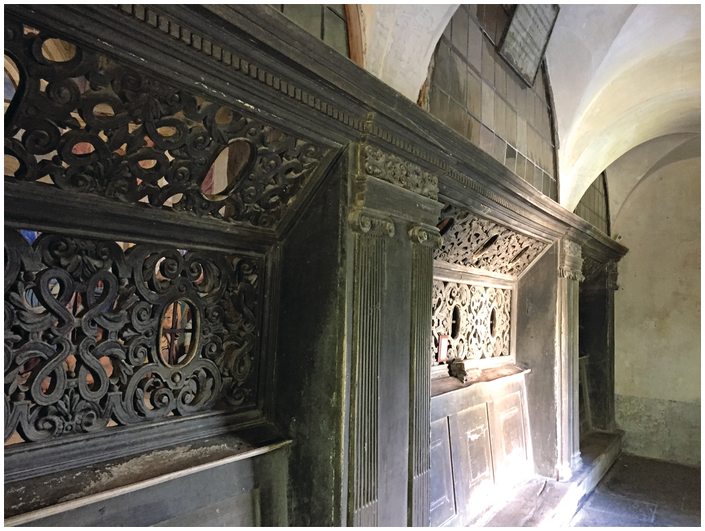
The implementation of grilles completely transformed one of Borromeo’s most beloved pilgrimage destinations, the Sacro Monte, or “Sacred Mountain,” of Varallo, a small village nestled in the green Sesia valley in Italy’s Piedmont region. The Sacro Monte was founded by the Franciscan Bernardino Caimi in 1486 as a replica of several important Holy Land shrines. It grew to include many colorful sculptures that illustrated biblical episodes. By the first quarter of the Cinquecento, the Sacro Monte contained roughly thirty sculpted scenes, such as Piedmontese artist Gaudenzio Ferrari’s celebrated portrayal of the Crucifixion (Figure 1.11).70 The post-Tridentine era brought many changes to the mount. Beginning in the 1560s, the architect Galeazzo Alessi designed new chapels that enclosed many of the sculptures behind various sorts of gratings and windows (Figure 1.12). To many scholars, these partitions epitomize the intrusion of Catholic reform at the Sacro Monte, which limited pilgrims’ access to the images in the name of social discipline. In this view, the gratings keep viewers at a safe distance from Varallo’s colorful plays of artistry and its hundreds of sculptural presences.71
Gaudenzio Ferrari, Chapel of the Crucifixion, c. 1521. Polychrome wood and terracotta with fresco. Sacro Monte of Varallo.
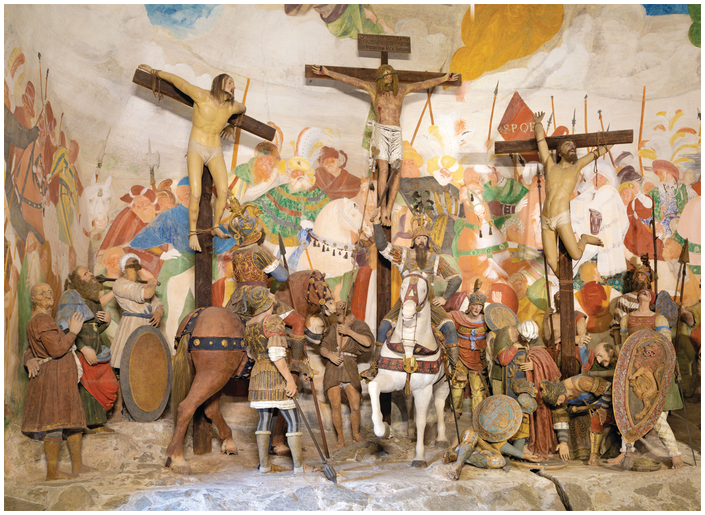
1.11 Long description
A painted sculptural scene of Christ's Crucifixion contains over a dozen lifesize sculptures. Christ is crucified in the cross at the center, with two other crucifixions on either side. A variety of sculpted figures, including Roman soldiers and their horses, react below. Several of the sculptures are decorated with real hair. A man with a large goiter at the center holds a lance at Christ's side wound. Additionally richly dressed bystanders appear on the frescoed walls behind.
Exterior of Chapels of the Healing of the Paralytic and the Son of the Widow of Nain. Sacro Monte of Varallo.
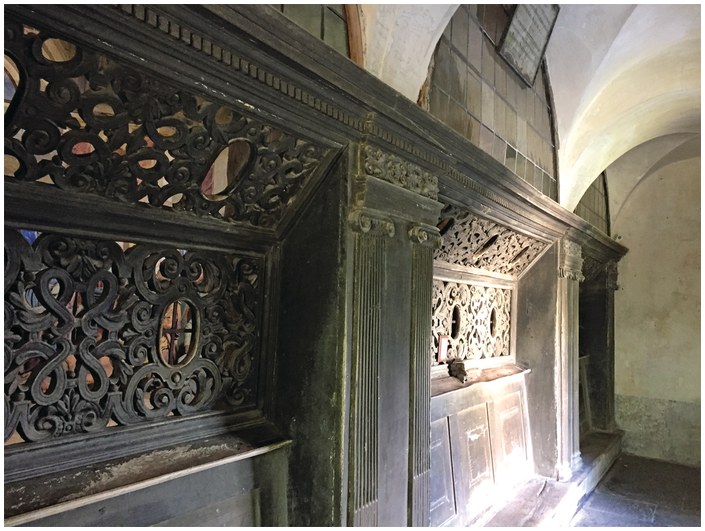
When viewed within the wider context of reforming church interiors, however, these same partitions provide another example of the post-Tridentine push to protect sacred images. The first pastoral visitations at the Sacro Monte’s chapels began in 1585, as discussed at length in Chapter 3. The presiding bishop of Novara, Cesare Speciano, and after 1593, his successor Carlo Bascapè, were both close collaborators of Borromeo who had assisted him with his pastoral visitations in Milan. Their visitations at Varallo express concern for the conservation of sacred images. Both bishops called for the repair of damaged statues and faded paintings. The clay, plaster, wood, and fabric required frequent repainting, dusting, and even replacing, as many of the chapels were partially exposed to the elements.72 Worse still, pilgrims had graffitied the frescoed walls and etched marks into the windowpanes. In 1594, Bascapè issued an edict threatening fines to those who defaced the images and chapels of the Sacro Monte. The senate of Varallo followed with another order in 1595 against any form of damage to the figures.73 The bishops at Varallo were trying to protect the sacred images from the pilgrims, not the other way around.
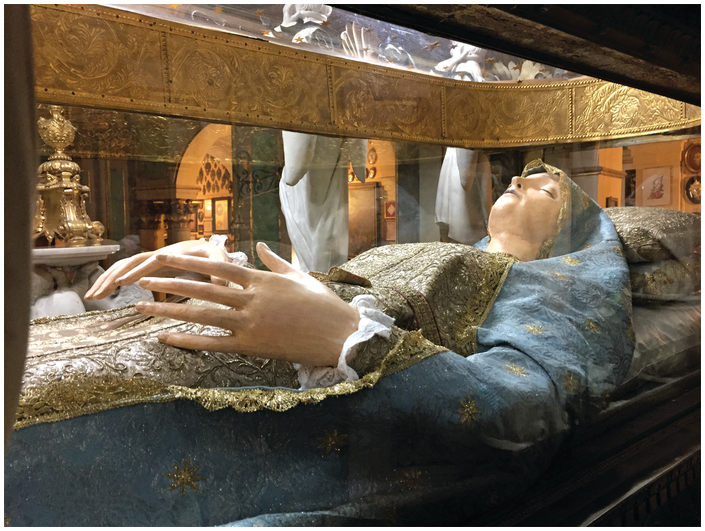
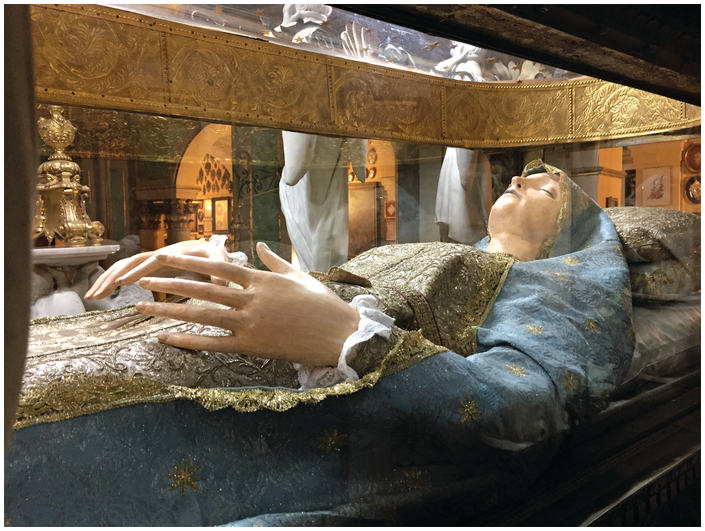
The visitors also called for changes to the display of a miracle-working sculpture in the Basilica of the Sacro Monte. The church housed a painted wooden statue of the Virgin Mary, known as the Sleeping Madonna (Figure 1.13). The sculpture was created in the late fifteenth century as part of a larger scene of the Virgin Mary’s Dormition. By 1498, locals credited the image with miraculous healings. By the late sixteenth century, the Sleeping Madonna was placed over a church altar and preserved like the corpse of a saint, covered in gems and votive offerings.74 Bishop Bascapè exhibited concern for the venerated statue and ordered that a veil be placed over its glass case. The veil could be lifted for devotees, who then no longer had to view the sacred image indecorously from behind.75 As at Milan, the visitors at Varallo celebrated and protected sacred images, from those in the narrative chapels to the miracle-working Marian statue that lay prostrate over a church altar.
Sleeping Madonna, late 15th c. (?). Polychrome wood with fabric. Basilica dell’Assunta, Sacro Monte of Varallo.
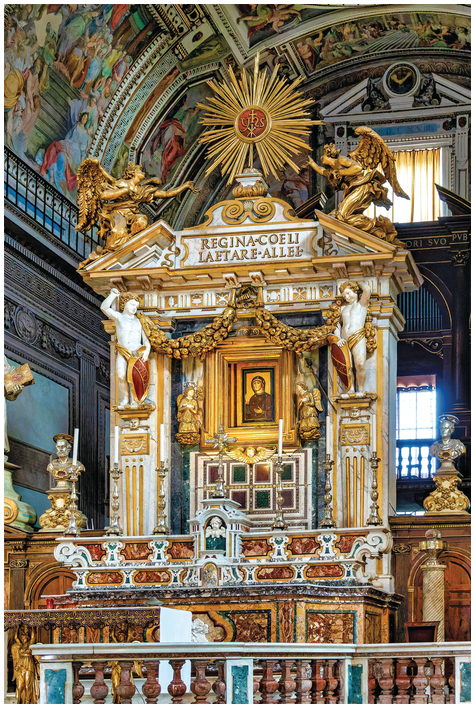
This investment in both the haptic and visual character of sacred images brings a different perspective to familiar instances of reframed images in post-Tridentine Rome. Beginning in the second half of the sixteenth century, many of the city’s most revered sacred images were reinstalled over high altars or in prominent side chapels. In 1565, for example, the canons of the Roman church of Santa Maria in Aracoeli transferred their medieval Italo-Byzantine image of the Madonna and Child to the high altar (Figure 1.14). Like many of the reframed images in Rome, such as the Madonna of Santa Maria Maggiore or that in Santa Maria del Popolo, the Aracoeli Madonna had an esteemed heritage and Byzantine-style formal characteristics, both of which contributed to its illustriousness. It was sometimes identified as a portrait by the Apostle Luke or as the very image carried by Pope Gregory I in a plague procession of 590.76 The conspicuous reframing of the Aracoeli Madonna and comparable Roman images demonstrates the renewed importance of these historic miraculous images during the period of Catholic reform.
High altar of Santa Maria in Aracoeli, Rome.
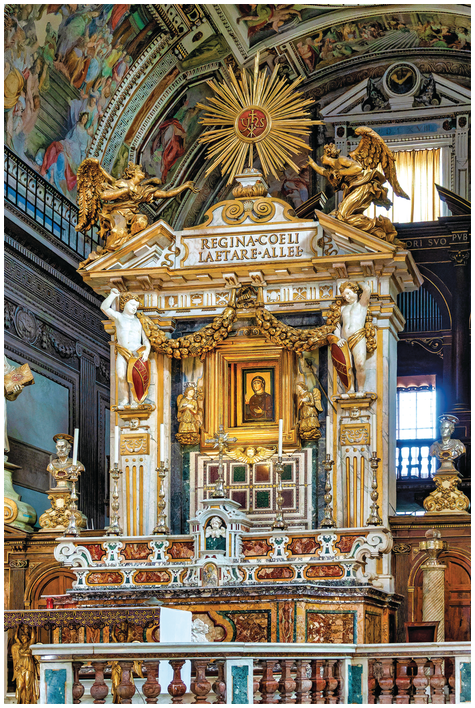
Infamously, the installation of the Aracoeli Madonna ousted a painting by the Renaissance artist Raphael, which had previously sat upon the high altar. The swap appears to set up a clash between an ancient miraculous image and a modern Renaissance painting, or to put it in Hans Belting’s influential terms, between icon and artwork. The episode, neatly timed just after the close of the Council of Trent and the death of Michelangelo, has been cast as a definitive end point to the Renaissance, when Catholic prelates moved away from Renaissance artworks to instead prefer the medieval, the Byzantine, or the miraculous.77 The visitations provide an alternative perspective. Marian Roman images like the Aracoeli Madonna were indeed revered in this period, but their reframing is part of a wider program of image care. Whether ancient Madonna or Renaissance altarpiece, the sacred image warranted display and protection. The reframing of Rome’s most illustrious ancient images, in other words, must be viewed alongside the rehousing of the fifteenth-century Madonna at Saronno or the veils ordered for the Renaissance Sleeping Madonna in Varallo’s church. The post-Tridentine period was defined by a preference for image protection rather than solely an inclination toward ancient Marian “icons.”
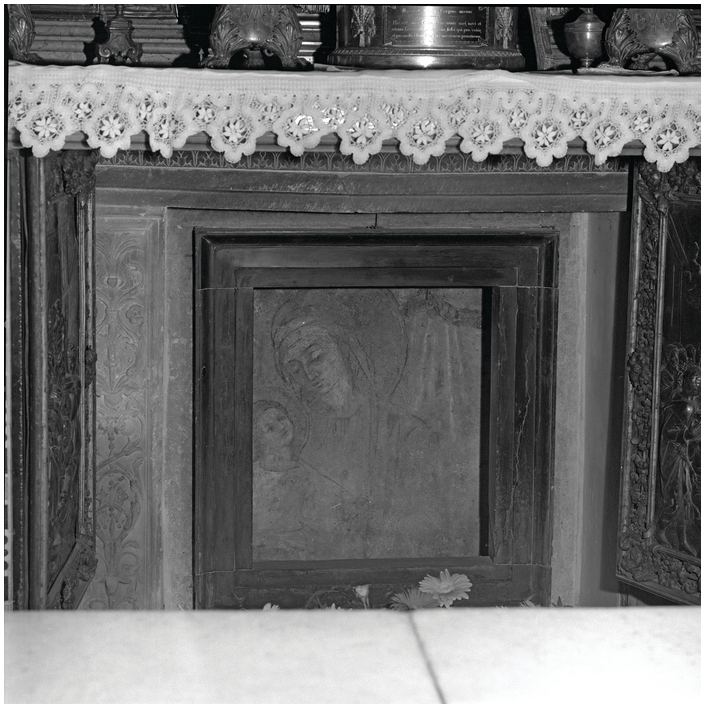
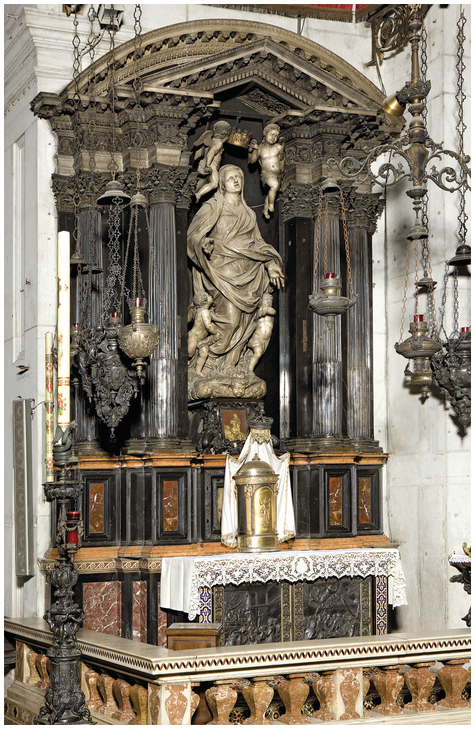
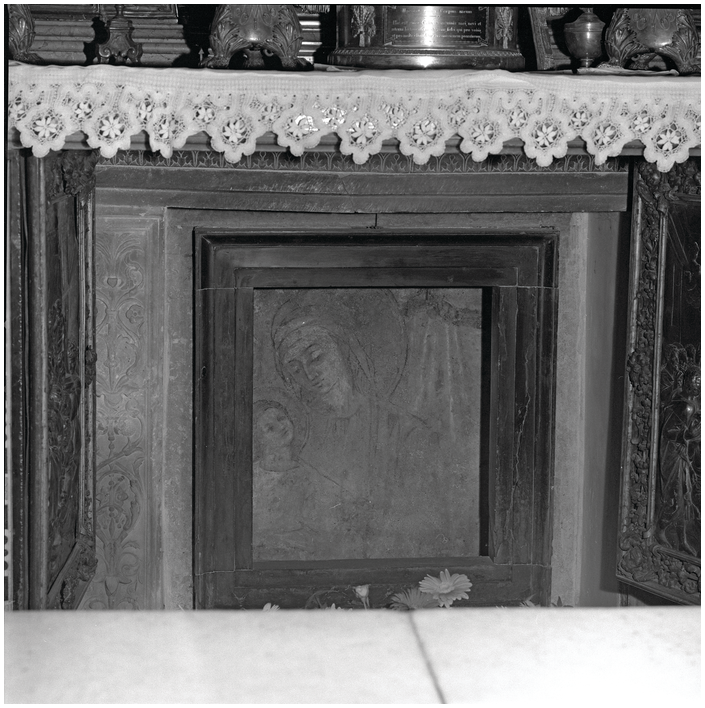
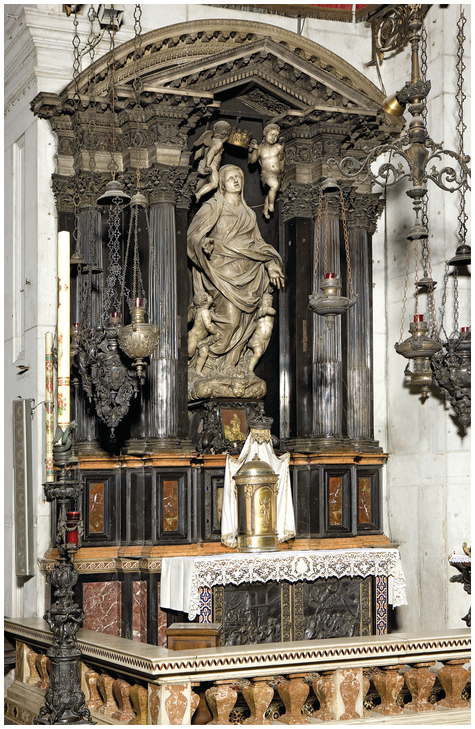
A case study of post-Tridentine reframing in Milan illustrates this need to display and protect without staging a standoff between old devotional images and new artworks. The church canons of Santa Maria dei Miracoli presso San Celso sought a solution for their miraculous but dilapidated fresco, the Madonna of Miracles (Figure 1.15). Ragazzoni had recommended in his visitation that the miracle-working fresco be more decorously conserved, as it was in poor condition and painted awkwardly at the base of a pilaster. However, the fresco could not be relocated, as it was believed to mark the burial spot of the first-century martyr San Nazaro.78 In 1583, the canons hired Martino Bassi to design an elaborate niche above the fresco, to be crowned with a white marble statue of the Madonna by the sculptor Annibale Fontana (Figure 1.16). The sacred fresco was nestled safely within the altar itself, though it was still accessible. The silver altar frontals could be opened to reveal the miraculous image, protected further still by iron bars.79 The creative solution used framing devices to both display and conserve, attending to the physical condition of the image as well as its visibility.
Madonna of Miracles. Santa Maria dei Miracoli presso San Celso, Milan.
Martino Bassi, with Annibale Fontana, Francesco Brambilla, and G. B. Busca, Altar of the Madonna of Miracles, 1583–86. Angels by Giulio Cesare Procaccini from early 17th c. Santa Maria dei Miracoli presso San Celso, Milan.
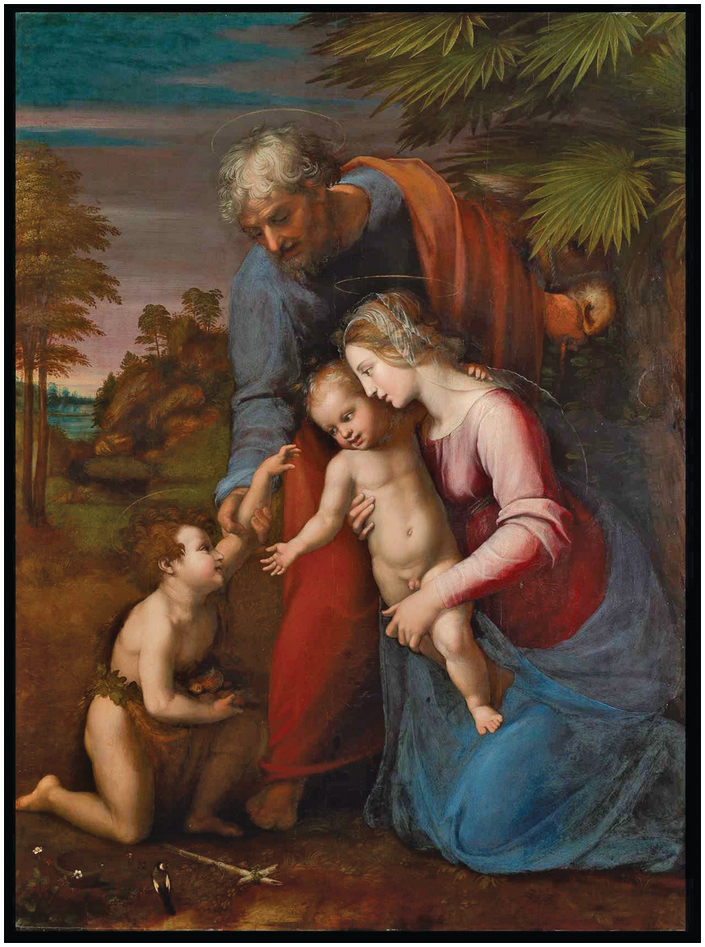
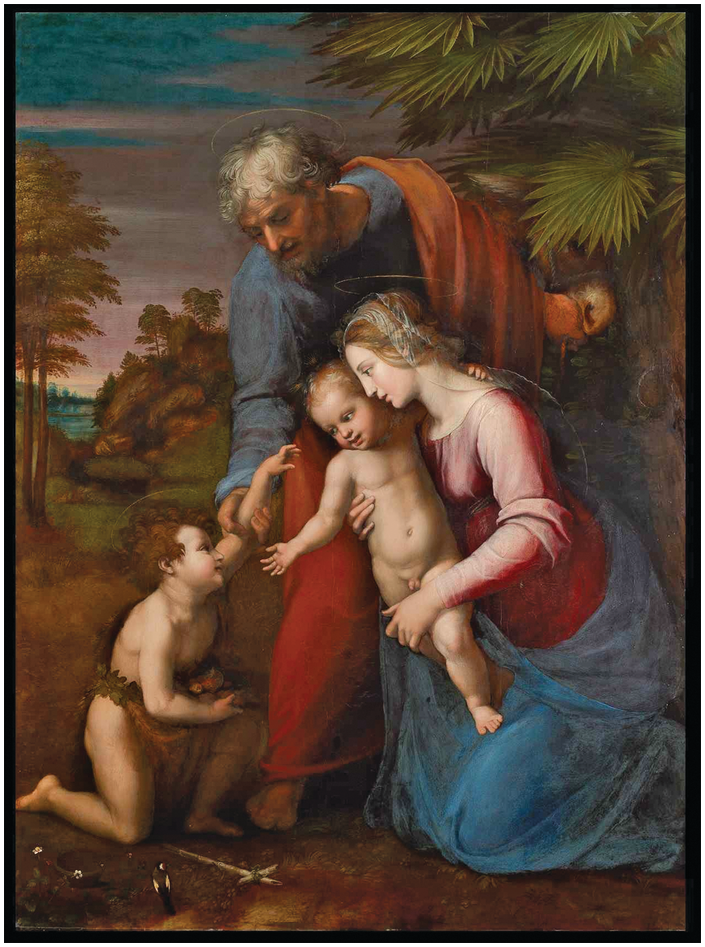
Before the completion of Annibale’s statue in 1589, the canons placed their prized painting of Raphael’s Holy Family (sold to them by none other than Borromeo) over the altar for greater adornment (Figure 1.17).80 The images play different roles than in the Roman case of the Aracoeli Madonna. This old miraculous Marian image banished neither Renaissance painting nor contemporary sculpture. Raphael and Annibale’s works instead helped to protect the aging fresco, meeting the demands for a decorous altarpiece when the fresco no longer could. In Milan, Raphael’s panel remained one of the church canons’ most cherished works, safely conserved in the sacristy after the installation of Annibale’s sculpture. One Milanese chronicler imagined in 1592 that Raphael’s Holy Family must be worth a thousand scudi.81 Raphael’s painting, the dilapidated miraculous fresco, and Annibale Fontana’s marble statue – just like the Aracoeli Madonna and the Raphael altarpiece it eventually replaced in Rome – were all understood by reformers like Borromeo to be sacred objects, worthy of honor by virtue of their presence in the church interior. It is this conviction that defined Catholic reformers’ relations with sacred images, altering their treatment, conservation, and display.
Raphael and workshop, Holy Family with the Young John, c. 1513–14. Pigment on wood. 154.5 × 114 cm. Kunsthistorisches Museum Wien.
The Age of Sacred Images
Time is a ruinous force in the visitation records. It causes colors to fade and paint to chip. Images often show signs of its consequences, darkened and damaged by accumulated exposure to candle smoke and humidity. Borromeo’s guidelines confirm that dilapidated images were especially improper in the church interior. Sacred images had a ritual function and consequently, a special brief to remain free from signs of deterioration. The sacred can alter the terms of restoration, as pointed out by Viennese art historian Alois Riegl in his classic 1903 essay on historical preservation, The Modern Cult of Monuments. Riegl parsed out the values inherent in divergent approaches to conservation. Some strategies respected the natural processes of aging, while others advocated for the removal of later accretions to return the artifact to its original historical form. Riegl saw the Catholic Church as especially inclined to newness-value, an insistence on aesthetic wholeness that necessitated frequent restoration and repair. Ecclesiastical artifacts, Riegl claims, “require complete integrity of form and color.”82 Religious images were rarely permitted to decay, especially when they served active functions in worship.
The post-Tridentine visitations corroborate Riegl’s observation in their frequent complaints about the negative effects of age. The visitor saw the Altar of San Lino’s faded pictures as “corroded by age” (vetustate) (see Figure 1.8). Another visitor found paintings “consumed by age” and a statue of John the Baptist “deformed by age.”83 Images could be impressively old, but they remained beholden to the rubric of formal integrity. A visitor in Valtellina, for example, saw one “very old” altarpiece as “very beautiful,” while another was instead “old and indecent.”84 Another church visitor, now in Rome, praised an “ancient mosaic” but found that it needed restoration.85 No matter the date of an image’s manufacture, it needed to meet certain standards of condition.
In a few cases, Borromeo introduces an altogether different understanding of an image’s age, one that complicates the visitor’s strict adherence to newness-value. In 1584, Borromeo published a pastoral letter for his institution of the Confraternity of the Rosary, associated with the altar of the Madonna dell’Albero in Milan Cathedral. The altar had a gilded wooden sculpture of the Virgin Mary above a tree with apostles and angels. Borromeo found the statue of Mary to be “antique and devout.”86 The term “antique” (antico) is used positively; this is not an object in need of restoration. Yet the Madonna dell’Albero statue, now lost, was also not all that old. It was first recorded in 1516, suggesting it was carved in the late fifteenth or early sixteenth century.87 Borromeo makes a similar comment in his pastoral letter celebrating the translation of the sculpted Madonna of Miracles in Saronno in 1581 (see Figure 1.9). Borromeo declared the Saronno Madonna to be “of most antique (antichissimo) devotion.”88 This sculpture is hardly older than the Madonna dell’Albero. It is first mentioned in relation to miracles in the second half of the fifteenth century, though heavy restorations have prevented art historians from dating it securely.
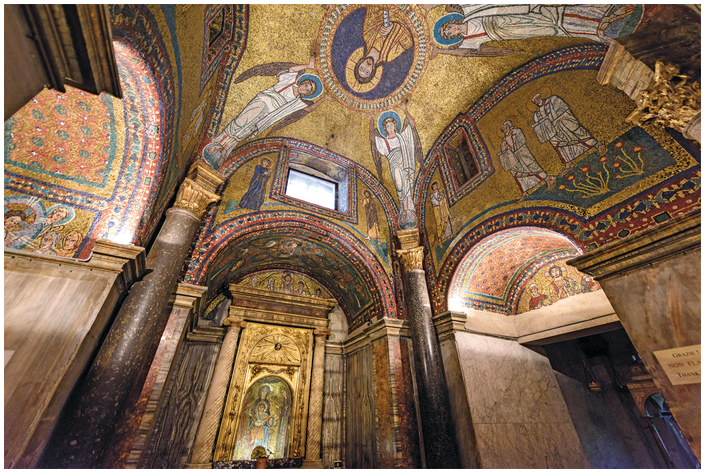
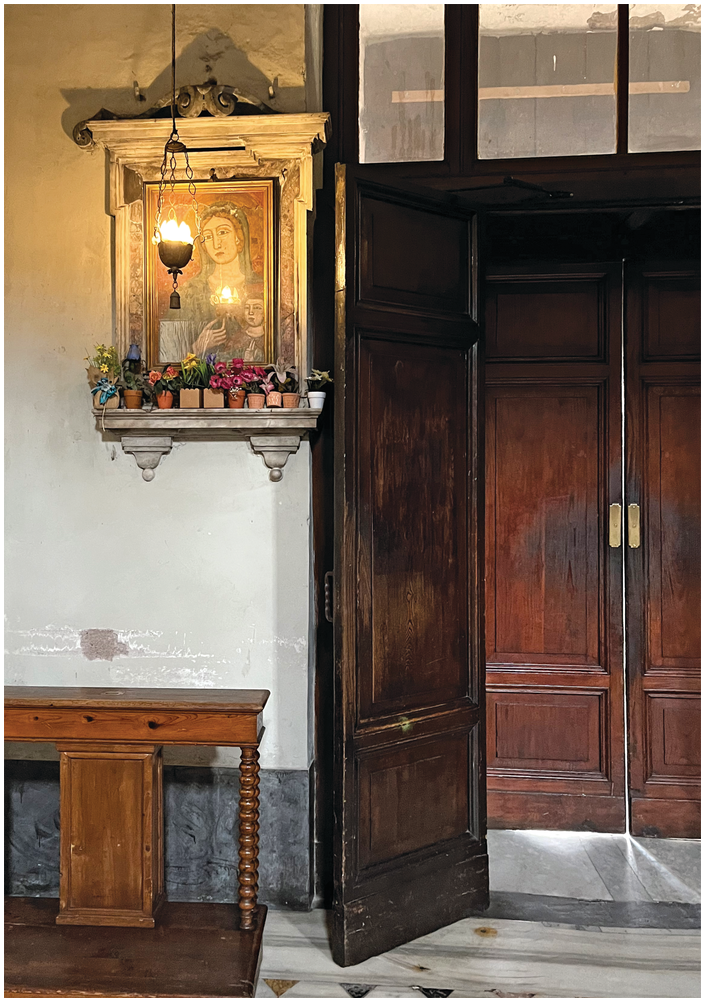
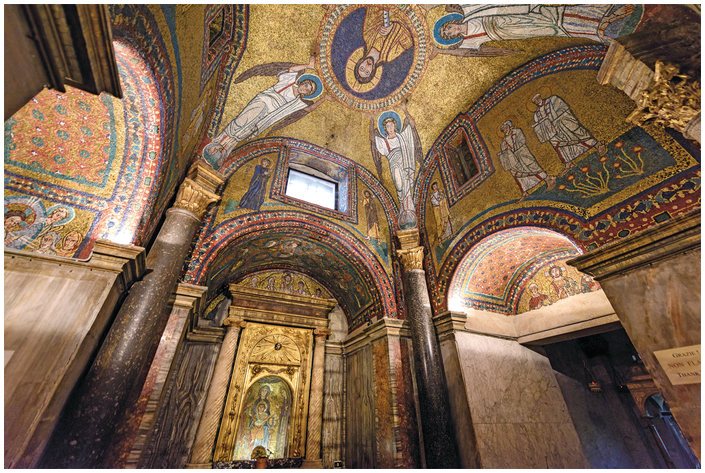
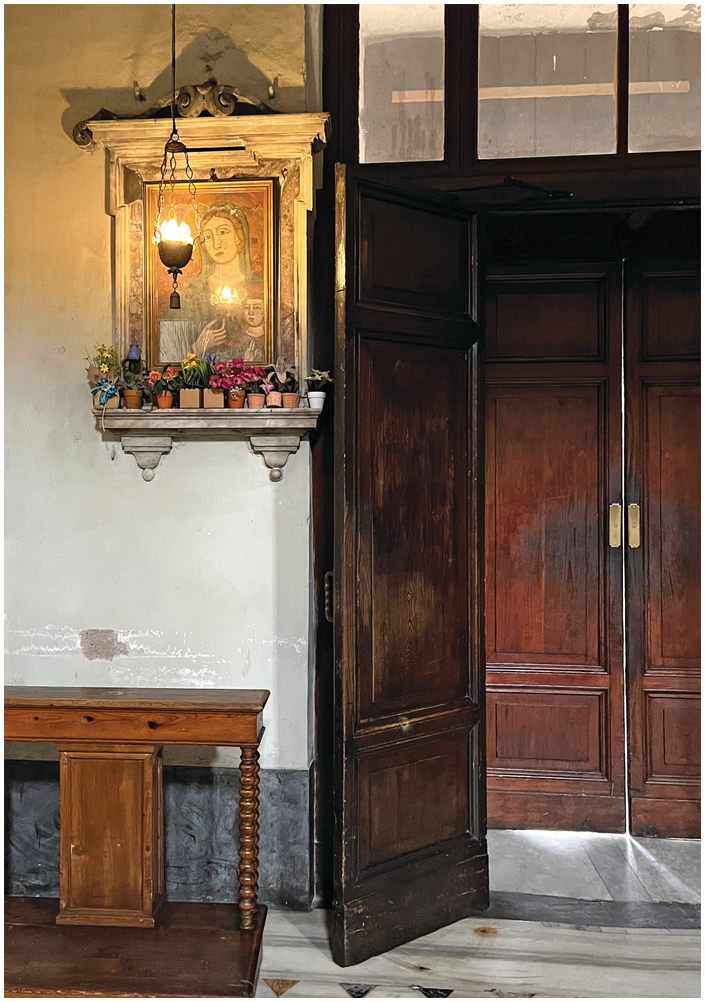
Borromeo’s comments about the Saronno Madonna’s “most antique” devotion and the “antique and devout” lost wooden statue in Milan Cathedral cannot be categorized as references to physical condition. These images were also not significantly older than many others in the same spaces. An apostolic visitation in Rome in 1624 echoes this usage of the word “antique.” This visitor inspected the church of Santa Prassede, which Borromeo had renovated several decades earlier as the church’s titular cardinal.89 Like modern tourists, the apostolic visitor in 1624 must have been impressed by Santa Prassede’s sumptuous ninth-century mosaics, which adorned the presbytery and the side chapel of San Zeno (Figure 1.18). Despite Santa Prassede’s venerably old mosaics, the visitor commented on the age of a very different sort of image. He noted that the unassuming fresco of the Madonna and Child adjacent to the church side door was “antique and devout” (Figure 1.19).90 The anonymously authored fresco, a fragmentary work of simple contours and uniform expanses of color, is an object of devotion still today, framed by lamps, flowers, and other tokens of favor. The date of the fresco is unclear, though it certainly postdated the church’s ninth-century mosaic by several centuries. This seventeenth-century visitor felt compelled to remark on the image’s age nonetheless.
San Zeno Chapel, Santa Prassede, Rome. Mosaics from 822.
Madonna della Salute, 13th–15th c. (?). Fresco. Santa Prassede, Rome.
1.19 Long description
A small bust-length portrait of the Madonna and Child is painted on the wall next to a closed set of doors. A wooden prayer bench is placed below. The fresco has a stone frame with potted flowers sitting along the bottom ledge. A brightly lit lamp hangs directly in front of the fresco.
These comments point to an antiquity that derives from an image’s cultic function, rather than its chronological age or its state of deterioration. The Santa Prassede fresco, like the Saronno Madonna or the Milan altarpiece, was not just antique, but also devout; the age marker was linked to religiosity. By positioning images within a larger framework of sacred objects put to sacred uses, to paraphrase Catarino, reformers endowed them with a distinct historicity, one that spoke to antiquity in ritual function, if not in date. Images revealed ancient traditions, even when manufactured in more recent years. Borromeo’s church-furnishing rules show that he viewed the history of many sacred objects in this way. He considered many furnishings to be antique, a flexible category that included fourth-century objects as well as their medieval or Renaissance derivatives. Like vestments and silver vessels, images could exhibit historically specific forms while evincing older precedents. It is this sense of age that Borromeo invoked when discussing the Saronno Madonna or the Madonna dell’Albero, the same intended in the Roman visitor’s claim that the humble Marian fresco at Santa Prassede was “ancient and devout.” Borromeo’s reaffirmation of sacred objecthood necessitated attention to the image’s formal integrity, to Riegl’s newness-value, but it simultaneously increased the capacity of many types of objects, including fifteenth-century cult images and late medieval church furnishings, to speak to Christian antiquity.
The Italian antico, like antique in English or the Latin antiquus, has many possible meanings. In the early modern era, antico could reference a distant historical age or merely designate something old, whether a person or thing.91 As Patricia Fortini Brown has shown in sixteenth-century Venetian inventories, some notaries made distinctions between antico, a positive adjective implying venerably old customs, and vecchio (old), a word suggesting the object was well used.92 “Antique” was frequently used relationally, to distinguish between an older church and a more modern one, or to juxtapose an inherited item of furniture in an inventory from its newer replacement. This relational sense of antico could be employed historically, as when it differentiated the sixteenth-century present from an ancient past. English-speaking readers are today more likely to interpret the term “antiquity” as a reference to classical Greece or Rome, while in early modern Italy, the term could refer readily to pagan antiquity or the early Christian era.
Borromeo’s designation of the Madonna dell’Albero or the Saronno Madonna as antico must be read in context, given the variable valences of the term. What did he hope to communicate by using that adjective, by attaching it to sacred images? The dating of an image could be a controversial act in the late sixteenth century. Catholic reformers strove to show that the cult of images extended back into the earliest years of Christianity, refuting Protestant accusations that Catholic image worship had strayed from ancient practice. Catholic scholars engaged in historical research on religious images, working to date Christian mosaics in Rome or Milan or the frescoes discovered in the Roman Catacombs of Priscilla in 1578. The histories of these images could prove the longevity of religious imagery in the Christian tradition. To provide one illustrative example, the protonotary Guglielmo Sirleto gifted Borromeo with a manuscript history of the Roman Basilica of Santa Maria Maggiore when he was elected as its archpriest as a young cardinal in 1562. Sirleto’s text detailed the illustrious history of the church, tying its origins to the fourth-century Pope Liberius. Sirleto informed Borromeo that the church’s famous miraculous image was “very old (vetustissima),” dating at least back to Pope Gregory I’s plague procession in 590 (see Figure 5.3).93 Back in Milan, a local chronicler also aimed to anchor a venerated image in time. The historian Paolo Morigia calculated in a 1592 treatise that the “antique” (antico) miraculous fresco in Santa Maria dei Miracoli was precisely 1,194 years old (see Figure 1.15).94 An image’s historical origin was an urgent matter in late sixteenth-century Italy. Borromeo’s references to antico, however, lack the historical specificities used by Sirleto or Morigia, suggesting that he was not intending to place tick marks on a chronological timeline.
The archbishop may have simply believed that the statues in Milan Cathedral and Saronno were much older than they really were. Borromeo, like many of his contemporaries (and like humans in many times and places), tended to erroneously backdate certain images. The presence of artifacts has a way of folding time, to borrow a phrase from Alexander Nagel and Christopher Wood.95 This phenomenon occurs frequently with architectural monuments, as with the famous case of Florence’s baptistery, a Romanesque structure that many early modern viewers dated to the Roman Empire. Misdating is not always as wrong as we like to believe. Buildings can be restored or rebuilt. They can sit upon earlier foundations, evoking their predecessors through place. They can substitute for earlier buildings through form. As with the legend of the Greek hero Theseus’s ship, conserved as an authentic artifact though each of its wooden planks was replaced over the centuries, monuments could argue an age older than the materials from which they were built.96 This principle allowed dates to recede further into the past. Like the Florentine Baptistery, the Basilica of San Lorenzo in Milan was imagined to have begun as a pagan structure. It is indeed very old, with roots in the fourth century, but Borromeo’s contemporaries pushed its origins still further back, describing it as a temple dedicated to Hercules two millennia before their own day.97 Borromeo himself referred to the Romanesque Old Cathedral of Brescia during his visitations as a very antique structure dating to the pagan era.98 His published instructions for the Milanese Jubilee in 1576 claimed that the city’s church of Sant’Ambrogio was so ancient that it, too, may have been constructed by pagan idolators.99
Images, too, slipped backward in time. Miraculous images substituted for lost originals and partook in the authority of their predecessors. Framed by an apparatus of votive offerings and veils, miraculous images evinced a certain “relic effect,” to again quote Nagel and Wood, that collapsed historical time.100 This contributed to Morigia’s profound misdating of the early Renaissance fresco at Santa Maria dei Miracoli in Milan, assigned to the fourth century rather than the fifteenth (see Figure 1.15). Its degraded surface and precious framing devices loosened the viewer’s chronological expectations. The same power led one guidebook from 1671 to attribute the miraculous Sleeping Madonna statue of the Sacro Monte of Varallo to the hand of the Apostle Luke himself, though the Sacro Monte was founded in the late fifteenth century (see Figure 1.13).101
Borromeo’s own writings on the church interior, however, suggest that there is more at play than misdating. When Borromeo referred to the Saronno statue as antico, he intended neither to fix its origins in time nor to fully give in to the temptations of substitution. Rather, the comment stems from his understanding of ancient custom. Antiquity was an operative concept in Borromeo’s reforms, one that guided his policies on the church interior. His contemporaries described his church renovations as revivals of Christian antiquity. Borromeo opened his Instructiones with an exhortation to imitate the ancient piety of the apostolic age, expressed in ancient sacred buildings and their furnishings.102 In this same preface, Borromeo declares the ritual objects of Catholicism to have ancient roots. He lists vestments, candlesticks, chalices, and other types of metalwork as objects prized in the most glorious ancient Christian cities, including Milan alongside Rome, Jerusalem, and Constantinople.103 These sacred objects were used by none other than St. Ambrose, Borromeo continues, his fourth-century predecessor as archbishop of Milan. Many of Borromeo’s rules advocated for a return to ancient customs or forms, such as his insistence that the bishop sit at the center of the choir stalls in Milan Cathedral. The archbishop relied on the advice of learned assistants, as when he requested further information about the “ancient usage of lamps” during his 1577 visit to the cathedral before finalizing his recommendations on lighting.104
Antiquity provided the rubric for Borromeo’s church reforms, though this was an antiquity informed by late antique, medieval, and even Renaissance evidence. Borromeo did cite many sources from the fourth century, sometimes referred to as the early Christian, late antique, or patristic age. When Borromeo ordered that images of obscure saints be labeled, he called on an early Christian source, writing, “That this was an ancient practice is confirmed in this verse by St. Paulinus.”105 His odd concession that church lamps could be ornamented with wooden dolphins “in common with ancient usage” comes from a passage in the Liber pontificalis, which tells how Constantine bestowed the Lateran basilica in Rome with a chandelier decorated with fifty gold dolphins.106 Borromeo called for a wooden partition in the nave to keep genders apart, writing that “it is an ancient institution and a custom attested to by the blessed Chrysostom,” a reference to the fourth-century Greek father John Chrysostom.107 Borromeo’s interest in the patristic age was shared by other prelates in the late sixteenth century, who fostered an early Christian revival. He was not the only cardinal to fashion his titular church after ancient models. In the 1590s, to cite the most well-known example, the historian Cesare Baronio evoked early Christian precedents in his restoration of the Roman church of Santi Nereo ed Achilleo. Like Borromeo, Baronio concerned himself with what patristic authors had to say about matters like gender partitions and church pavements.108
Yet Borromeo’s Instructiones also draws heavily on late medieval sources, like Durand’s Rationale and Sicardo’s Mitrale. His requirement that a crucifix hang over the presbytery, for example, appears in both thirteenth-century texts. Borromeo’s stress on veils and curtains is endorsed by both authors as well.109 His policy that each altar must have an altarpiece may also come from late medieval sources. Altarpieces are not obligatory for the celebration of Mass, but they do appear in canon law codes of the thirteenth century.110 For Borromeo, these later practices, too, counted as ancient, or antico. He also saw ancient custom in many passages of the liturgical books. Images, Borromeo writes, should be blessed according to the “ancient ecclesiastical rite” in the Pontifical or the Ceremonial books. He likely referenced these liturgical texts when he claimed that the “ancients” (antichi) referred to the sacristy as the secretarium.111 Borromeo, like other bishops and scholars in the post-Tridentine period, was keenly aware of the historical character of the liturgical books, amended and reformed over the ages.112 He understood the liturgy as venerably ancient, sanctioned by church rituals that evoked earlier sources even as they transmuted along the historical timeline. It is an antiquity of tradition, defined by a tension between atemporal ritual and historical change.113 It allowed Borromeo to designate many practices, such as common dormitory quarters in monasteries or the procession of the clergy to the altar before Mass, as “ancient custom.”114 Borromeo describes votives, gifts like wax body parts or painted tablets offered at a shrine in thanks for divine assistance, as “ancient practice and tradition,” leaving the reader to wonder if Borromeo would have imagined this custom originating in a pagan, apostolic, or more recent age.115 Borromeo’s antiquity is bound up with the complications of tradition, historical yet revelatory of ancient truths.
In a material corollary, the structures and décor of extant churches also provided evidence of ancient tradition. Borromeo and his assistants built a lexicon of ancient church forms from what they observed in Milan and Rome. In his Instructiones, Borromeo explicitly states that the still visible “remains” of ancient churches and their furnishings aided his project.116 A witness in Borromeo’s canonization trials would later recall seeing him go to “many antique churches both within and outside of the city to identify the ambones, baptisteries, bell towers, and other parts of the churches in order to complete his book,” the Instructiones.117 The churches in post-Tridentine Rome and Milan were layered monuments that pointed to earlier times through tradition. Borromeo saw an attribute of the ancient Temple of Solomon in the sculpted lions flanking the portals of many of Milan’s basilicas.118 His prescriptions for baptismal vases were based on what he “observed to be very ancient from the remains of ancient baptisteries.”119 The evidence of ancient buildings in Rome or Milan bolstered his rules about the separation of the choir space, the appearance of doorways, and the ideal floor plan.120 This information then guided Borromeo’s decisions on where the bishop should sit during Mass or what a proper baptistery looked like.121 Opaquely old things corroborated ancient tradition.
We can understand Borromeo’s comment on the antiquity of certain images within a framework of ancient custom. His policies on sacred buildings and furnishings reflect a consistent understanding of the antique that, like tradition and the liturgy, has both historical and atemporal facets. Borromeo’s pastoral letter on the Saronno Madonna (see Figure 1.9) describes the statue in this manner. After praising the work as “of most ancient devotion,” he continues that the veneration of sacred images is shown “in every era” and in “the continual custom” of the church.122 Borromeo places the statue in a historical arc that stretches back to the time of the apostles, which taught the tradition, cult, and veneration of images. His letter connects the image cult at Saronno with that begun by the Apostle Luke, who painted portraits of the Virgin, and with that furthered by Pope Gregory the Great, who carried an image of the Virgin in procession in the sixth century. Marian images, Borromeo claims, can be found in Asia, Africa, and Europe, though they are most frequently found in Italy, including not only Rome or Loreto, he specifies, but also in Milan. The Marian statue in Saronno did not evoke its precedents through mere formal reference, nor by forgetting its date of manufacture or substituting for a lost original. It claimed antiquity through its sacred use, which exemplified unbroken tradition. Borromeo’s antiquity was about ritual tradition as well as historical age, which helps to reconcile his designation of “antique and devout” images with their late medieval or Renaissance forms. Similarly, the visitor to Santa Prassede in 1624 saw ancient custom in the venerated Marian fresco by the church side door, a different sort of old than the glittering ninth-century mosaics in the next chapel (see Figures 1.18 and 1.19).
Tradition was polemically charged in the late sixteenth century, a point of deep disagreement in confessionalized debates on church history. The Magdeburg Centuries (1559–74), compiled largely by Lutheran theologian Matthais Flacius, portrayed Catholic practices as superstitious medieval accretions that had deviated sinfully from the customs of the early Christian church.123 The Catholic response, typified in works like Baronio’s Annales ecclesiastici, sought to demonstrate through fervent historical research that these alleged deviations from apostolic practice should be understood as venerable tradition. Borromeo’s policies, once again, show how monotonous church-furnishing rules could make polemical points. He expressed a post-Tridentine Catholic position by advocating for the antiquity of practices that may have looked more medieval than early Christian. To deny the antiquity of a cult statue or a sacred vestment, even if late medieval in form, was to misunderstand a Catholic understanding of historical time. Tradition loosened the chronological brackets of Borromeo’s antiquity.
Although sixteenth-century confessional controversies crystallized views of church history, there was not a single homogenous Catholic mode of understanding an image’s historicity. The Florentine painter Giorgio Vasari, a foundational figure in art historical writing and a rough contemporary of Borromeo, put forth a different model of the artwork’s time in the 1568 edition of his Lives of the Most Excellent Painters, Sculptors, and Architects, a collection of artist biographies. Vasari attempts a definition of antico in his preface. He writes that the term refers to artworks created prior to the reign of Constantine in the early fourth century. Examples of the antique, for Vasari, can be seen in cities like Athens or Rome or during the reigns of emperors like Nero or Vespasian. Vasari explains that the word “old” (vecchio) instead designates an era beginning with the election of Pope Sylvester I in 314, a Christian caesura but one that is at least a millennium away from being modern, which would occur only with the innovations of Duccio and Giotto in the early Renaissance.124 Vasari should not alone be blamed for the periodization of subsequent centuries, which would come to parse out a general structure of ancient, medieval, and modern (and his conception of medieval art is more complex than generally acknowledged).125 Yet Vasari puts forth a definition of antiquity that maps much more easily than Borromeo’s onto our current understanding of art historical progression.
Borromeo’s antico eschews a strictly chronological meaning, a challenge for a discipline invested in dating stylistic change and the notion of post-archaeological time.126 Vasari’s model poses fewer problems for the art historian, but it would draw many objections from a sixteenth-century Catholic reformer. Vasari’s art historical nadir coincides with the venerable apostolic age, with the church’s most respected patristic texts. For Borromeo, the medieval period cannot be a regression, which would only corroborate Protestant accusations that medieval rituals, vestments, and practices diverged from the truth of the early Christian era rather than revealing esteemed tradition. These divergent models of history should not be explained away as mere examples of the secular versus sacred, or the late Renaissance versus the early Counter-Reformation. They attest to the fact that images could play multiple roles – artwork, sacred image, sacred object, furnishing – even within the same period, peninsula, and confessional context. Borromeo’s attention to the sacred objecthood and ritual function of images emphasized one of their multiple occupations in the landscape of late sixteenth-century art. Ivan Gaskell incisively claimed that “being an artwork is an occasional attribute,” and so too is being a sacred object.127 This is not to circumscribe a permanent category of artworks, nor to insist that artworks are mere anthropological tokens. Rather, Borromeo’s advocacy of sacred images as holy objects reveals that an image’s status as a sacred thing or as an artwork is a conditional problem as well as a historical one.
Borromeo’s image policies offer something to a history of art and of reform. At this consequential moment in sixteenth-century Italy, when Vasari’s treatise circulated and art theoretical treatises proliferated, when theologians and bishops deliberated over the status of the image, Borromeo argued that images must be honored as sacred objects put to sacred uses. Though visible through visitations and fix-it tickets, in dry policies and furnishing instructions, Borromeo’s stance is essential to understanding the impact of Catholic reform on art. It necessitated an increased attention to the material integrity of sacred images, which must be perfected and protected while prominently displayed to devotees. This view invited many sorts of images, whether sculpted, ornamented, old, medieval, new, renowned, or miraculous, to speak to Christian antiquity through their sacred purpose. Our understanding of late sixteenth-century art must contend with Borromeo’s relations with images, with their transient roles not just as artworks or representations, but also as sacred objects.