

1. Introduction
Gauging the relative timing and absolute pace of language change in historical periods is typically limited by the existence of contemporary records. A novel way to estimate the pace of language change is by estimating the flow of loanwords by phonotactic extrapolation. If a succession of phonological processes arose, flourished, and then ceased to apply to new words, the result is that loanwords are partitioned into those that did or did not undergo each process. Importantly, words that matched the environment for a process are presumably borrowed alongside words that did not match the environment. If it is known how often the environment for the process occurs in the lexicon of the donor language, it is possible to extrapolate how many loans entered while the process was active, even though they happened to be ineligible for it. Phonotactic extrapolation thus estimates how many words were borrowed during each phase in the phonological history of a language. If cultural factors like a break in contact can be discounted, periods with fewer loans presumably lasted for shorter times, which can be evidence that sound changes were closely spaced or overlapping, or even that an individual sound change itself was short lived. The primary contribution of this paper is a demonstration of how an algorithm equipped with knowledge of phonotactic trends can resolve ambiguous data to reveal likely timelines of borrowing.
We also illustrate phonotactic extrapolation with an in-depth application to the early Latin loans in Irish (Celtic, Ireland), which sheds light on a particularly dynamic period of language change. Our method allows us to estimate the approximate amount of time that no less than six phonological processes were active within a roughly century-and-a-half span. The last of these processes was rhythmic syncope, the deletion of vowels in an even-odd pattern reminiscent of rhythmic stress. Rhythmic syncope has generated keen interest in phonological theory because serial theories of phonology, like Harmonic Serialism, can generate it (McCarthy Reference McCarthy2008), while parallel or single level theories of phonology, like classic OT, cannot (Kager Reference Kager and Roca1997, Blumenfeld Reference Blumenfeld2006, Hao & Bowers Reference Bowers2019). Strikingly, rhythmic syncope appears to be prone to rapid re-analysis and obsolescence, as seen especially clearly in Nishnaabemwin (Bowers Reference Bowers2019 and references therein), but also in Mojeño Trinitario (Rose Reference Rose2019), Southern Pomo (Kaplan Reference Kaplan2020, Reference Kaplan2022) and Eastern Slavic (Isačenko Reference Isačenko1970). It is not currently known how often rhythmic syncope systems collapse, making Irish a valuable data point in understanding the trajectory of rhythmic syncope systems.
It is already known that rhythmic syncope did not survive to Modern Irish, and that it and other processes were in flux even in the earliest Old Irish manuscripts (Armstrong Reference Armstrong1976, McCone Reference McCone1985, Reference McCone1997:164–69, 191ff.). However, there is a roughly 150 to 200 year gap between when rhythmic syncope is thought to have arisen and the Old Irish manuscripts, which raises the possibility that rhythmic syncope could have been productive for several generations. Our simulations find that very few loans should be allocated to the rhythmic syncope period of Irish, which is consistent with rhythmic syncope being only a brief blip in the history of Irish. At the very least, the lack of loanwords during the rhythmic syncope period fails to corroborate the opposing view that rhythmic syncope is diachronically stable and easy to acquire.
A couple brief notes on terminology, exposition, and assumptions.Footnote 1 This paper treats the development and interaction of several phonological mappings over a period of time. For ease of understanding, we illustrate their application with traditional derivations reminiscent of rule based phonology (Chomsky & Halle Reference Chomsky and Halle1968, Kenstowicz & Kisseberth Reference Kenstowicz and Kisseberth1979), and loan adaptations are illustrated in derivations proceeding from a faithful source language representation, though we apply Irish case suffixes and degeminate foreign consonants (see Appendix 1 and Appendix 3, Section 1; see also Boersma Reference Boersma1998 and Boersma & Hamann Reference Boersma, Hamann, Calabrese and Wetzels2009 for a more realistic approach to loan adaptation). We do not claim that rule-based derivations are an adequate, or even preferable, model of phonological competence. In light of this, we also eschew the term ‘rule’, opting instead to use ‘process’ as an accessible term for the mappings that are presumably best treated in a constraint-based approach. This paper treats diachronic developments as they unfolded synchronically. Note that our derivations generally reflect the historical progression, but fealty to the historical developments may be sacrificed for expository clarity (especially with respect to palatalization, which we do not treat; see the opening section of the Appendices). More importantly, there is the potential for confusion over whether we are discussing synchronic knowledge or diachronic events. To be clear, we assume that once a sound change occurs, it remains a part of synchronic knowledge as long as speakers have grammars that enforce its effects (see Bermúdez-Otero Reference Bermúdez-Otero, Honeybone and Salmons2015). The activity of this grammar may be observed in loan word adaptation, paradigmatic alternations, phonotactic restrictions, or other aspects of linguistic behavior.
The persistence of diachronic changes as synchronic grammatical knowledge is in line with the analyses common in the Irish studies literature. These analyses are generally in the structuralist paradigm, and may not explicitly commit to representing the knowledge of speakers (as opposed to the contents of a corpus). Nonetheless, they accept that (predictable) allophonic distributions exist after a sound change operates, and often point out when former allophones become (unpredictable) phonemes. When discussing loan adaptation, authors allow that loans could be adapted ‘to the phonetic system of Irish at the time’ (McCone Reference McCone1996:89), or that loans could undergo ‘assimilation to the native allophonic distribution’ (McManus Reference McManus1983:56). This presumably would be carried out by speakers enforcing their knowledge of allophonic patterns.
Phonotactic extrapolation estimates the number of loan words that entered a language while a process applied to new words, which can be a proxy for how long a process remained in speakers’ grammars. This depends crucially on the processes of interest ceasing to apply to loan words at some point, which indicates that they ceased to be a part of speakers’ grammars. Some processes, most notably palatalization, did not cease to apply to loans and so cannot inform our method (see also the opening remarks in the Appendices). For most processes in our case study, a process illustrated at stage $ n $
of a derivation ceased to apply to loans at stage
$ n $
of a derivation ceased to apply to loans at stage $ n+1 $
, allowing our model to sort loans into sequentially ordered bins, which correspond to individual phonological processes whose active periods in real time potentially partially overlapped (see Section 6). One process (vowel shortening), appears to have applied to loans past the immediately following stage (harmony) in the traditional presentation, plausibly ending with the development of compensatory lengthening (McManus Reference McManus1983:56, 59). Since we assume that speakers continue to acquire a grammar that enforces the sound patterns of their language, each point where these processes evidently passed from synchronic knowledge requires explanation. In Section 6 and in the Appendices, we typically tentatively ascribe the loss of processes to opacity, but we recognize that the psychological reality of opacity is an enduring question in phonological theory and we lack the space to litigate it here.
$ n+1 $
, allowing our model to sort loans into sequentially ordered bins, which correspond to individual phonological processes whose active periods in real time potentially partially overlapped (see Section 6). One process (vowel shortening), appears to have applied to loans past the immediately following stage (harmony) in the traditional presentation, plausibly ending with the development of compensatory lengthening (McManus Reference McManus1983:56, 59). Since we assume that speakers continue to acquire a grammar that enforces the sound patterns of their language, each point where these processes evidently passed from synchronic knowledge requires explanation. In Section 6 and in the Appendices, we typically tentatively ascribe the loss of processes to opacity, but we recognize that the psychological reality of opacity is an enduring question in phonological theory and we lack the space to litigate it here.
The paper will proceed as follows. Section 2 describes the method for allocating loans using phonotactic trends. Section 3 gives background on Irish and our collection of loans. Section 4 briefly sketches how the (non)-application of Irish phonological processes diagnoses the time of entry into Irish, with detailed discussion of the phonology appearing in the Appendices. Section 5 describes the results of our simulations, and Section 6 discusses their interpretation. Section 7 concludes.
2. Phonotactic extrapolation method
While borrowing is primarily driven by a need for new words to express new concepts, the new words are essentially a random sample of the phonotactic space of the donor language, due to the arbitrary relationship between sound and meaning. Accordingly, the words that enter a language during a particular time should reflect how often various phonotactic traits appear in the donor language. Our method leverages this intuition by identifying a series of phonological periods in the borrowing language, a collection of loans, and how often the structural descriptions for the relevant phonological processess are observed in the donor language. We then proceed to apportion the loans between phonological periods so that the phonotactic properties in each period best reflect the rate at which they appear in the donor language.
An important requirement is that the phonological processes that define the periods must have stopped applying to loan words, dividing the loan vocabulary between those words that underwent a process, and those that did not. This allows us to determine a window of time when a loan could have possibly entered. For instance, anticipating our discussion of the Latin loans in Irish, if loans were adapted by mapping [p] to [k], then loans that undergo the change must have entered before the end of the [p] $ \to $
[k] process, while loans that keep [p] faithfully must have entered after the end of it. By exploiting a suite of phonotactic properties, the phonotactic extrapolation method can give an estimate of how many loans entered at a particular time.
$ \to $
[k] process, while loans that keep [p] faithfully must have entered after the end of it. By exploiting a suite of phonotactic properties, the phonotactic extrapolation method can give an estimate of how many loans entered at a particular time.
Attempting to balance multiple phonotactic traits with a large number of loans over several phonological periods is a daunting task to accomplish by hand.Footnote 2 To manage this, we apply a non-linear optimization procedure known as the genetic search algorithm (Holland Reference Holland1975, De Jong Reference De Jong1975, Yang Reference Yang and Yang2021), which sifts through allocations of loans to phonological periods by scoring them for phonotactic balance. We provide a brief overview of genetic search in Section 2.1, before working through a toy example in Section 2.2, and giving a description of the specific aspects of our implementation in Section 2.3.
2.1. Genetic search description
Genetic search (Holland Reference Holland1975, De Jong Reference De Jong1975, Yang Reference Yang and Yang2021) is an abstract characterization of biological evolution, where organisms consisting of genes with particular alleles are selected for fitness before passing their genes to the next generation. In our case, the organisms are complete allocations of all loans, or timelines, the genes are the range of possible dates associated with each word, and the alleles are the particular time periods the words are assigned to. A major benefit of genetic search is that it maintains multiple competing hypotheses and so simultaneously explores multiple regions of the search space. Genetic search has been widely applied to problems such as graph coloring, the traveling salesman problem, and multi-objective engineering optimization.
2.1.1. Search procedure
Genetic search starts by creating a large gene pool of $ n $
competing ‘organisms’, or timelines in our case, by randomly assigning all words to a specific date within their allowable time spans. The specimens in the gene pool are then scored by an evaluation metric, and the specimens in the gene pool serve as the basis for the next generation. In our setting, the evaluation metric measures the balance of phonotactic trends from the donor lexicon, as mentioned above and more formally described below (see Section 2.3: ‘Fitness measure calculation’).
$ n $
competing ‘organisms’, or timelines in our case, by randomly assigning all words to a specific date within their allowable time spans. The specimens in the gene pool are then scored by an evaluation metric, and the specimens in the gene pool serve as the basis for the next generation. In our setting, the evaluation metric measures the balance of phonotactic trends from the donor lexicon, as mentioned above and more formally described below (see Section 2.3: ‘Fitness measure calculation’).
After initialization, genetic search alternates between ‘mutation’ and ‘recombination’ phases. In the mutation phase of our implementation, for every candidate timeline in the pool, a new collection of timelines is created by selecting sets of words with multiple possible dates of entry, and randomly picking an entry date from the possible dates of entry. If any of the mutated timelines are more fit than any of the $ n $
specimens in the gene pool, the mutated timelines are added to the gene pool, and the least fit specimens are removed from the gene pool. This is how the algorithm explores new regions in the search space, by taking previous successes and randomly changing only a few of their genes.
$ n $
specimens in the gene pool, the mutated timelines are added to the gene pool, and the least fit specimens are removed from the gene pool. This is how the algorithm explores new regions in the search space, by taking previous successes and randomly changing only a few of their genes.
In the recombination step, the specimens in the gene pool randomly swap alleles between each other, and the gene pool is updated to contain any improved specimens as before. Concretely, for each word where a pair of timelines differs in the assigned date, the new offspring will inherit one of the assigned dates from a randomly selected parent. Intuitively, the recombination step allows successes found in one area of the search space to propagate to other hypotheses. Recombination pushes the gene pool towards a single solution, as organisms/timelines become more similar to each other by sharing alleles/allocations from other hypotheses. The search proceeds by iterating between mutation and recombination phases until fitness no longer improves or a set number of generations has been reached.
2.1.2. Convergence concerns
As a non-linear optimization algorithm, genetic search is not guaranteed to converge on a globally optimal solution. However, the maintenance of a pool of hypotheses that interact via recombination provides some resilience against getting stuck in a local optimum. To be concrete, a timeline is in a local optimum if it is in an area of the hypothesis space where any mutation of some subset of its genes will harm its performance on the evaluation metric, but if a larger subset were to be changed, performance would improve. Above all else, the presence of other hypotheses makes it possible that even if a hypothesis is trapped in a dead end, some other hypothesis could be outside of the local optimum. Because the hypotheses share parameter settings during the recombination phase, hypotheses that lie outside of the local minimum can provide better alleles en masse, thereby allowing the descendants of the trapped hypothesis to escape the local minimum.
The following section gives a toy example to illustrate the application of the genetic algorithm to a loanword problem similar to our Irish case study.
2.2. Toy example
Our toy example features two phonological time periods, where the first covers the active period for a process mapping [p] to [k], and the second covers the post- [p] $ \to $
[k] period. We also assume that a second process leniting post-vocalic [t, k] to [θ, x] applies during the second period. Our borrowing language adapted four words from the donor language. One word entered during the [p]
$ \to $
[k] period. We also assume that a second process leniting post-vocalic [t, k] to [θ, x] applies during the second period. Our borrowing language adapted four words from the donor language. One word entered during the [p] $ \to $
[k] period, since it underwent [p]
$ \to $
[k] period, since it underwent [p] $ \to $
[k], and another must have entered during the later period since it was eligible for [p]
$ \to $
[k], and another must have entered during the later period since it was eligible for [p] $ \to $
[k] but failed to undergo it. Two further words could have entered during either period, because they are not eligible for [p]
$ \to $
[k] but failed to undergo it. Two further words could have entered during either period, because they are not eligible for [p] $ \to $
[k], though one did undergo lenition. This distribution of loanwords is schematized in 1, where ✓ marks a loan that is eligible for a process and undergoes it, X marks a loan that is eligible for a process and does not undergo it, and — marks a loan that is not eligible for a process.
$ \to $
[k], though one did undergo lenition. This distribution of loanwords is schematized in 1, where ✓ marks a loan that is eligible for a process and undergoes it, X marks a loan that is eligible for a process and does not undergo it, and — marks a loan that is not eligible for a process.

We assume that half of the words in the source language have [p], and that half are eligible for lenition. Accordingly, the optimal allocation is one where half of the words in a period have [p], and half are eligible for lenition. Anticipating the fitness model to be described in Section 2.3: ‘Fitness measure calculation’ and Section 4.2, for each process we obtain the probability that there would be $ n $
words eligible for the process out of
$ n $
words eligible for the process out of $ p $
total words in the period, given a rate of occurrence
$ p $
total words in the period, given a rate of occurrence $ r $
(in this case 50% for each process). These probabilities are then multiplied to produce the fitness measure of the entire allocation. For convenience, we summarize the fitness measures of every possible allocation in 2, where a higher fitness value is better.
$ r $
(in this case 50% for each process). These probabilities are then multiplied to produce the fitness measure of the entire allocation. For convenience, we summarize the fitness measures of every possible allocation in 2, where a higher fitness value is better.

Though the complete enumeration of hypotheses in 2 is small enough to be manageable, our sample run of the algorithm will not have access to it. In this toy example we limit the gene pool to two hypotheses. During the mutation phase, each specimen produces one offspring with one mutated gene. During the recombination phase, the pair of specimens in the pool produces one offspring. We initialize the gene pool as shown in 3:

Since initialization is effectively a mutation phase, in the first round the algorithm skips straight to the recombination phase. The two specimens differ in whether [til] $ \to $
[til] is assigned to period one or period two. The recombination process randomly selects period two for this word. This offspring scores better than one of the specimens in the gene pool, and so it replaces the less fit ancestor. The gene pool now appears as in 4:
$ \to $
[til] is assigned to period one or period two. The recombination process randomly selects period two for this word. This offspring scores better than one of the specimens in the gene pool, and so it replaces the less fit ancestor. The gene pool now appears as in 4:

The algorithm now enters the mutation phase. When the first specimen is mutated, [til] $ \to $
[til] is randomly selected as the mutation site, and period one is randomly selected as the value. This results in poorer performance on the evaluation metric than what is currently in the gene pool, so this specimen will not be added to the gene pool. For the second specimen, [lit]
$ \to $
[til] is randomly selected as the mutation site, and period one is randomly selected as the value. This results in poorer performance on the evaluation metric than what is currently in the gene pool, so this specimen will not be added to the gene pool. For the second specimen, [lit] $ \to $
[liθ] is the randomly selected mutation site, and it gets randomly assigned to period one. This results in a more fit specimen, which is added to the gene pool. The gene pool now contains the specimens shown in 5:
$ \to $
[liθ] is the randomly selected mutation site, and it gets randomly assigned to period one. This results in a more fit specimen, which is added to the gene pool. The gene pool now contains the specimens shown in 5:

In the subsequent recombination phase, the only word where the two specimens differ is [lit] $ \to $
[liθ]. In the recombined offspring, [lit]
$ \to $
[liθ]. In the recombined offspring, [lit] $ \to $
[liθ] is randomly assigned to period one. This specimen is more fit than the second specimen in the pool, and so the updated pool is shown in 6:
$ \to $
[liθ] is randomly assigned to period one. This specimen is more fit than the second specimen in the pool, and so the updated pool is shown in 6:

At this point, no further changes will be made by further mutations or recombinations, since all specimens are maximally fit. With no new changes occurring in the subsequent round, the algorithm will announce that it has converged. The algorithm has ensured that the context for lenition and [p] are present in half of the words in both periods, producing an estimate that the same number of words entered during both periods, as would be expected given the observed adaptations.
It is important to interpret the estimate at the level of period vocabulary instead of the allocations of individual words. Two of the words (those without [p] in the source language) can logically enter during either period, and we can be no more certain than that on the level of individual words. Which period a particular word is assigned to depends on unpredictable properties of other words. It just so happens that period one has a word that was eligible for [p] $ \to $
[k] but not lenition, which is best paired with a leniting word. Meanwhile, period two has a word that is eligible for [p]
$ \to $
[k] but not lenition, which is best paired with a leniting word. Meanwhile, period two has a word that is eligible for [p] $ \to $
[k] and lenition, so phonotactic balance is maximized by pairing it with a word that does not undergo lenition. To claim that a particular word with multiple possible entry dates had to enter at the time assigned by the simulation is to fail to recognize that the assignment is influenced by which phonotactic properties occur in other words in the period. Speakers presumably do not take such capricious factors into account when deciding to borrow a word. In contrast, we only make the more restricted claim that in the aggregate, borrowed vocabulary is more likely to match the source language phonotactic frequencies than not.
$ \to $
[k] and lenition, so phonotactic balance is maximized by pairing it with a word that does not undergo lenition. To claim that a particular word with multiple possible entry dates had to enter at the time assigned by the simulation is to fail to recognize that the assignment is influenced by which phonotactic properties occur in other words in the period. Speakers presumably do not take such capricious factors into account when deciding to borrow a word. In contrast, we only make the more restricted claim that in the aggregate, borrowed vocabulary is more likely to match the source language phonotactic frequencies than not.
We now turn to a technical description of our implementation for our case study.
2.3. Implementation summary
In our implementation, the gene pool contains the 100 most fit allocations of 531 Latin loans distributed over seven phonological periods of Irish (described in Section 4). The source code and data that we use for our simulations can be found at https://github.com/bowersd/lat2sgaloans.
In the mutation phase, each timeline was mutated 1,000 times.Footnote 3 During every round of the algorithm, the mutation phase produces 1,000*100 = 100,000 candidate allocations. These candidates and the gene pool are ranked by their score for the fitness measure (Section 2.3.1: ‘Fitness measure calculation’), and the 100 most fit candidates are retained for the next phase. The mutation rate starts at 5% of words with multiple possible dates of entry, and the rate halves each time the mutation phase fails to add new hypotheses (i.e. allocations that are more fit than any pre-existing member of the gene pool). This gradual reduction in the mutation rate allows the algorithm to initially re-allocate broad swathes of words and progressively narrow its focus as it approaches a good solution.
In the recombination phase, each member of the pool creates twenty offspring with each other member of the pool by randomly swapping dates of entry between them. Since the pairing of specimen $ x $
with specimen
$ x $
with specimen $ y $
is symmetric (the same as pairing member
$ y $
is symmetric (the same as pairing member $ y $
with member
$ y $
with member $ x $
), the recombination phase produces 50*99*20 = 99,000 candidate allocations. As in the mutation phase, these candidates and the gene pool are ranked by their score on the fitness measure (Section 2.3.1: ‘Fitness measure calculation’), and the 100 most fit candidates are retained for the next phase.
$ x $
), the recombination phase produces 50*99*20 = 99,000 candidate allocations. As in the mutation phase, these candidates and the gene pool are ranked by their score on the fitness measure (Section 2.3.1: ‘Fitness measure calculation’), and the 100 most fit candidates are retained for the next phase.
The algorithm halts when new members cease to be added to the gene pool and the mutation rate is too low to change any dates. In our case study, this typically occurs between the fortieth and the sixtieth generations.
2.3.1. Fitness measure calculation
The measure of timeline fitness evaluates phonotactic balance within each period. Informally, we need to extrapolate how often a phonotactic property should be observed in a period, given the total number of words in the period and the rate at which the phonotactic property is observed in the donor vocabulary. We then must assess how well the extrapolated expected count matches the number of times the property is observed in the words assigned to the period. We do this formally by equating the phonotactic probability $ {\Phi}_p $
of each period
$ {\Phi}_p $
of each period $ p $
in the timeline with the joint binomial probability of the various phonotactic properties. Joint binomial probability is the product of multiple binomial probabilities, which are computed using the number of words bearing each phonotactic property
$ p $
in the timeline with the joint binomial probability of the various phonotactic properties. Joint binomial probability is the product of multiple binomial probabilities, which are computed using the number of words bearing each phonotactic property $ f $
in the set
$ f $
in the set $ \phi $
of phonotactic properties, the total population of the period
$ \phi $
of phonotactic properties, the total population of the period $ p $
, and the rate
$ p $
, and the rate $ {r}_f $
at which phonotactic property is observed in the donor language. This is spelled out in the following formula.
$ {r}_f $
at which phonotactic property is observed in the donor language. This is spelled out in the following formula.
 $$ {\Phi}_p=\prod \limits_{f=1}^{\mid \phi \mid}\;\mathrm{binomial}\left({n}_f,|p|,{r}_f\right) $$
The fitness of a timeline $ T $
is the product of each probability
$ T $
is the product of each probability $ {\Phi}_p $
for all periods p.
$ {\Phi}_p $
for all periods p.
For our simulations, we base the phonotactic set ϕ on the structural descriptions for the Irish processes that were applied to loans. We now shift our attention to Irish, first providing background on the historical context and data sources in Section 3. In Section 4 we provide an overview of the phonological processes at work in the Latin loans, which are discussed in greater detail in the Appendices. See especially Section 4.2 for a description of how the Irish phonological processes are related to our phonotactic parameters.
3. Irish historical background
Our case study investigates the early Latin loans that entered prior to and during the Old Irish manuscripts. Irish is attested in a continuous tradition of writing in Latin letters dating to the seventh century CE (Thurneysen Reference Thurneysen1946:4–10), and still older stone inscriptions written in the Ogam alphabet (McManus Reference McManus1991). The historical phonology of Irish that this study draws on is well understood. Most importantly, the manuscript record has a solid phonological interpretation, despite the vagaries common in pre-modern orthographic systems. This interpretation rests on various streams of evidence, such as (a) Old Irish metrical forms, which have strict rules for syllable counts as well as rhyme and alliteration systems that are based on groupings of consonants and vowels according to phonological features (Murphy Reference Murphy1961), (b) regular correspondences between Irish written in the Ogam and Latin alphabets, (c) comparison of Old Irish to the writing system and phonology of Modern Irish, and crucially (d) the distribution and orthography of initial consonant mutation, especially in early medieval Brittonic from which Old Irish borrowed much of its spelling system (Harvey Reference Harvey1990a:178–80). Further inferences about Irish historical phonology can be drawn via comparison with other Celtic languages, particularly the other Insular Celtic languages, which include Scots Gaelic and the Brittonic languages, that is, Welsh, Cornish, and Breton.
There are some minor controversies over the orthography, such as whether some cases of orthographic <u> represent ‘u-coloring’ of a vowel or labialization of a consonant (Hock Reference Hock, Cennamo and Fabrizio2019), but our discussion does not hinge on any non-standard or disputed interpretations of the orthography. Similarly, there is debate over whether Insular Celtic is a geographic or genetic grouping (Schmidt Reference Schmidt1977, Koch Reference Koch and Le Menn1992, de Bernardo Stempel Reference de Bernardo Stempel2006, McCone Reference McCone1996, Schrijver Reference Schrijver1995, Schumacher Reference Schumacher2004, Sims-Williams Reference Sims-Williams, P.-Y. and G.-J.2007:309–354, esp. 323–333), but this does not affect our discussion. Our approach to the Latin loans in Irish follows the mainstream consensus in Irish historical linguistics, as represented by Jackson Reference Jackson1953 and McManus Reference McManus1983, with some updates to the understanding of the phonology following McCone Reference McCone1996.
Since our data is necessarily orthographic, we accompany phonological representations in [square brackets] with an attested orthographic forms in <angle brackets>. We reserve /slashes/ for explicitly discussing underlying representations. Derivations of Irish loans start from a representation that is roughly faithful to Latin, though Irish case suffixes are substituted for Latin case suffixes, and Latin geminates are simplified (see the Appendices for further discussion of suffix substitution and degemination). When providing citations for data, we provide both an author-year citation for the edition used and an abbreviation of the manuscript name with folio numbers.Footnote 4
For the reader who wishes to better understand Irish historical phonology, accessible student grammars of Old Irish include McCone Reference McCone2005, Stifter Reference Stifter2006, Tigges & Ó Bearra Reference Tigges and Béarra2006, and de Vries Reference de Vries2013. The standard reference and historical grammar remains Thurneysen Reference Thurneysen1946. For the interpretation of Old Irish and early medieval Brittonic orthography and its relation to the phonology, see Watkins Reference Watkins1966, Ó Buachalla Reference Ó Buachalla and Ahlqvist1982, Harvey Reference Harvey, Corráin, Breatnach and McCone1989, Reference Harvey1990a, Reference Harvey, Ball, Fife, Poppe and Rowland1990b, Reference Harvey1991, Reference Harvey, Glaser, Anna and Waldispühl2011, Sims-Williams Reference Sims-Williams1991, and Hamp Reference Hamp2000. References explicitly treating the phonological development of Irish include McCone Reference McCone1996 and Jaskuła Reference Jaskuła2006. Section 4 briefly reviews the phonology relevant to dating loans, which is more comprehensively illustrated in the Appendices.
3.1. Time period for borrowing
The Latin loan words we are most interested in are found in the manuscript record, but were adapted using phonological processes that predate it. Following Jackson Reference Jackson1953 and McManus Reference McManus1983, these processes include adaptation of the foreign phone [p] by [k], consonant lenition, vowel harmony, vowel shortening, compensatory lengthening, and rhythmic syncope. These processes developed in roughly the order given, and will be more closely reviewed in Section 4 and the Appendices. We summarize these phonological events and their relationship to historical dates and the manuscript record in the timeline in Figure 1. The remainder of this section elaborates the reasoning supporting this timeline.
Timeline of key events and sources. Positions above the line reflect approximate dates.

Some of the Latin loans could have entered via trade (Fomin Reference Fomin2018), but the great majority are ecclesiastical terms, and must therefore be connected with the introduction of Christianity. This allows us to narrow down the beginning of the borrowing period to around the early fifth century CE. We know this because Prosper of Aquitaine’s chronicle for the year 431/432 mentions that a missionary named Palladius was sent to a pre-existing Christian community in Ireland (Mommsen Reference Mommsen and Mommsen1892). Over the following centuries, the connection to the Latin world via Christianity deepened (Flechner & Ní Mhaonaigh Reference Flechner and Mhaonaigh2016), as evidenced by the beginning of the Irish monastic tradition in the sixth century, and the later Irish manuscripts found throughout continental Europe as a result of the Irish missions to the continent during the sixth and subsequent centuries of the early medieval era (Flechner & Meeder Reference Flechner and Meeder2017).
Prosper of Aquitaine’s chronicle also allows us to tentatively fix a date to some of the earliest phonology we will consider. Many Christian ecclesiastical loans undergo lenition. Assuming these loans entered with the introduction of Christianity, lenition presumably emerged shortly thereafter. If Christianity was accelerating in 431/432, then putting the date for lenition at around 450 (McManus Reference McManus1983) gives ample time for a body of ecclesiastical loans to accumulate before leniting.
Furthermore, a smattering of Christian ecclesiastical loans were adapted with Irish [k] for Latin [p], indicating that the [p] $ \to $
[k] adaptation was active when they were borrowed. However, most Latin loans preserve [p] faithfully, indicating that [p] was borrowed into Irish. Strikingly, there are Latin loans that preserve [p] and undergo lenition (see Section 4 for direct exemplification). These loans must have entered after [p] was legalized but still early enough to undergo lenition. Given these facts, we can conclude that [p] was legalized early on during the conversion to Christianity, perhaps before 431/432 (see also McCone Reference McCone1996:92 for a similar conclusion).
$ \to $
[k] adaptation was active when they were borrowed. However, most Latin loans preserve [p] faithfully, indicating that [p] was borrowed into Irish. Strikingly, there are Latin loans that preserve [p] and undergo lenition (see Section 4 for direct exemplification). These loans must have entered after [p] was legalized but still early enough to undergo lenition. Given these facts, we can conclude that [p] was legalized early on during the conversion to Christianity, perhaps before 431/432 (see also McCone Reference McCone1996:92 for a similar conclusion).
After [p] $ \to $
[k] and lenition, Irish developed height harmony targeting short vowels (dubbed ‘affection’ in the Irish studies literature), vowel shortening, and compensatory lengthening. McManus (Reference McManus1991) gives evidence from Ogam inscriptions that vowel harmony preceded compensatory lengthening. Shortening is thought to have ended when compensatory lengthening developed (McManus Reference McManus1983:56, 59), but it is thought to have begun before the end of vowel harmony (McCone Reference McCone1996:110), since shortened vowels harmonize in the native vocabulary.
$ \to $
[k] and lenition, Irish developed height harmony targeting short vowels (dubbed ‘affection’ in the Irish studies literature), vowel shortening, and compensatory lengthening. McManus (Reference McManus1991) gives evidence from Ogam inscriptions that vowel harmony preceded compensatory lengthening. Shortening is thought to have ended when compensatory lengthening developed (McManus Reference McManus1983:56, 59), but it is thought to have begun before the end of vowel harmony (McCone Reference McCone1996:110), since shortened vowels harmonize in the native vocabulary.
The last major milestone for loans is rhythmic syncope. Rhythmic syncope is generally thought to have emerged in the mid-to-late sixth century (Jackson Reference Jackson1953:143, McManus Reference McManus1983:31), although there is potential evidence for the early sixth century (Sims-Williams Reference Sims-Williams2003:346). Possible direct support for sixth century syncope is found in early syncopated poetry traditionally attributed to Colmán mac Lénéni (Carney Reference Carney1971), a poet who died in 606, although caution is required, since the poems could have been composed by a later author (Sims-Williams Reference Sims-Williams2016:164, 172–74). Syncope also appears in stone inscriptions dating to the early seventh century (McManus Reference McManus1986:2–4). This demonstrates that syncope could not have been initiated after the beginning of the seventh century.
Post-syncope loans into Irish continued to be adapted to the native phonological system, for instance, gaining the Irish distinction between between palatal/non-palatal consonants. However, these later loans are otherwise quite faithful to the Latin originals and do not reflect the progression of new Irish sound changes. This means that we must treat post-syncope loans as a uniform block, and can only give finer distinctions for pre-syncope loans.
In all, we have evidence for roughly a century to a century and a half elapsing between lenition and syncope, and at most a few decades of separation between any intervening processes.Footnote 5 We turn now to a closer examination of the manuscript sources that provide the data for this study.
3.2. Historical data sources
To get a meaningful picture of how many loans entered Irish at particular times in our period, we require a representative corpus of the early Latin loan vocabulary. Our primary source for this vocabulary is manuscripts containing Old Irish material. While there are multiple such manuscripts to choose from, most are in fact copies written much later than the Old Irish period. We set the tenth century as a cutoff point in order to exclude material that entered the language much later than syncope, and included all loans from the contemporary Old Irish manuscripts before that date.
Fortunately, there is a searchable web-based lexicon of pre-tenth cntury Irish, the Corpus Paleo-Hibernicum (Stifter et al. Reference Stifter, Bauer, Lash, Qiu, White, Barrett, Griffith, Bulatovas, Felici, Ganly, Nguyen and Nooij2021), henceforth abbreviated as CorPH. From CorPH, we draw on the material in the Milan (Stifter et al. Reference Stifter, Bauer, Lash, Qiu, White, Barrett, Griffith, Bulatovas, Felici, Ganly, Nguyen and Nooij2021, Stokes & Strachan Reference Stokes and Strachan1901) and St. Gall (Stifter et al. Reference Stifter, Bauer, Lash, Qiu, White, Barrett, Griffith, Bulatovas, Felici, Ganly, Nguyen and Nooij2021, Stokes & Strachan Reference Stokes and Strachan1903) manuscripts, which contain Old Irish glosses on Latin texts and a large number of loanwords from Latin. They are standardly dated to the late eighth or early ninth centuries and the mid-ninth century, respectively. We also draw from fifty-eight so-called ‘minor’ glossed manuscripts dated to the seventh to the tenth centuries (Lash Reference Lash2021) and the mid-eighth-century poems of Blathmac (Barrett Reference Barrett2021; see Stifter Reference Stifter and Riain2015 on the dating of Blathmac). To round out the picture of securely pre-tenth-century loans, we draw on the Thesaurus Paleohibernicus (Stokes & Strachan Reference Stokes and Strachan1901, Reference Stokes and Strachan1903) for manuscripts not found in CorPH, including the eighth-century Würzburg manuscript (of which Kavanagh Reference Kavanagh2001 provides a useful lexicon).
The above sources do not provide a complete sample of the early Irish loan vocabulary, because some loans in later sources have adaptations that clearly point to a pre-end-of-syncope entry date.Footnote 6 We draw many loans with early adaptations from McManus Reference McManus1983, which is a thorough, albeit non-exhaustive, collection. One loan that we include from McManus Reference McManus1983:65, Irish [saʟənd] <salland> ‘act of singing (psalms)’ from Latin [psalːendum], does not feature early adaptations. However, it could have entered Irish before syncope, and it appears in a securely dated Old Irish text, so it meets our other criteria for inclusion.
It may be possible that loans in later sources, but which were ineligible for early adaptations, nonetheless entered during our period. We choose to be conservative and do not include them. We leave the question of what our method would do on a data set that includes them to future research.
The contributions of each source to our corpus are shown in 7, where loans are only counted towards the earliest source in which they are attested.Footnote 7

3.2.1. Latin vs. Irish perspective
The corpus contains loans without Irish derivational morphology. For example, Irish borrowed [korp] <corp> ‘body’ (Stokes & Strachan Reference Stokes and Strachan1901:581, Wb. 3a4) from Latin [korpus], but we exclude Irish derivatives such as [korp-əx] <corpach> ‘corporeal’ (lit. ‘body-adj’) (Stokes & Strachan Reference Stokes and Strachan1903:148, Sg. 125a5). We also exclude multiple case forms of the same loan.
There is however some ambiguity in how to determine what counts as a separate loan. For instance Irish borrowed [uṽəldoːdj] <umaldóit> ‘humility’ (Stokes & Strachan Reference Stokes and Strachan1901:581, Wb. 13a17) from Latin [umilita:tem]. From the perspective of Irish, [uṽəldoːdj] must be a separate borrowing from the borrowing [uṽəl] <umal> ‘humble’ (Stokes & Strachan Reference Stokes and Strachan1901:532, Wb. 5d27), since there is no native suffix [-doːdj] that could create this noun. However, the Latin sources for [uṽəldoːdj] <umaldóit> and [uṽəl] <umal> are transparently related by regular morphology in Latin, making these words a single loan from the Latin perspective.
The conservative choice is to count loans from the Latin perspective, because our simulations rely on phonotactic frequencies drawn from the Latin nominal lexicon. For completeness, we also compiled the set of loans from the Irish perspective, resulting in twenty additional loans. The simulation results do not differ appreciably between these different collections.
3.2.2. Re-borrowed loans
An additional wrinkle is that the same Latin lexeme could be borrowed multiple times. For instance, Latin [apostol-us] ‘apostle-masc.nom.sg’ appears as a very early loan in Irish [axsəl] <axal> ‘apostle’ (McManus Reference McManus1983:48) and as a later loan in [abstəl] <apstal> ‘apostle’ (Stokes & Strachan Reference Stokes and Strachan1901:527, Wb. 5b17). In such cases we included both Irish words as separate borrowings.
3.2.3. Hand dating
Finally, sixty loans could not be dated purely mechanically by following the methodology laid out in Section 4 and the Appendices. This was usually because they had inconsistent phonological cues to their date of entry. A typical case is [uespəsjiən] <Uespisian> ‘Vespasian’ (Barrett Reference Barrett2021:S0005-114 at https://chronhib.maynoothuniversity.ie/chronhibWebsite/tables?page=0&limit=0&fprop=Text_Unit_ID&fval=S0005-114&dtable=morphology&ctable=sentences&search=false), which has no orthographic cues to the vowel length in Latin [wespasiaːn-us] ‘Vespasian-masc.nom.sg’, and so possibly underwent shortening (a pre-syncope change), but which is also clearly unsyncopated, which would place it after syncope. For each such inconsistent form we provided our best guess for the dates of entry by hand. In the case of [uespəsjiən] <Uespisian> ‘Vespasian’, we disregarded the putative shortening, attributing it the word being borrowed orthographically, since Latin orthography omitted length marking. Borrowing this word from a written form seems especially likely, since it is doubtful that a long-deceased Roman emperor was a frequent topic of oral conversation.
3.2.4. Local summary
This concludes our overview of the history of Irish and the historical sources we rely on for loans. With these general preliminaries on Irish in hand, we now return to the main narrative. In the next section we illustrate how the processes that were or were not applied to loans reveal when they entered Irish. This provides the raw data for our simulations, and plays a major role in the ultimate quantification of how many words entered Irish at particular times.
4. Irish phonology in Latin loans
Early Latin loans can be dated using nine Irish phonological processes. Six of these processes demarcate the boundaries between seven periods in the phonological history of Irish (one period for each of the six processes, plus the post-syncope period), while three of the processes are best thought of as subsidiary to the six major processes. We sketch the key facts briefly in this section, and because the referenced sources can be difficult for non-specialists in Irish, we provide an explicit walk-through of the phonological developments in the Appendices. The major milestones for dating the Latin loanwords in Irish are listed with brief descriptions in 8:

The subsidiary processes were primarily not independent sound changes of Irish, but presuppose one of the developments above. For instance, Irish never mapped [f] $ \to $
[s] in the native vocabulary, but Irish [f] comes from debuccalized †[sw], so we associate Latin loans where [f] is replaced with [s] with lenition. Similarly, the native Irish vocabulary prohibited [ks] and nasal-voiceless obstruent clusters, but these were re-introduced into surface forms by syncope. As a result, repairs to these clusters diagnose entry before rhythmic syncope, whether via [ks]
$ \to $
[s] in the native vocabulary, but Irish [f] comes from debuccalized †[sw], so we associate Latin loans where [f] is replaced with [s] with lenition. Similarly, the native Irish vocabulary prohibited [ks] and nasal-voiceless obstruent clusters, but these were re-introduced into surface forms by syncope. As a result, repairs to these clusters diagnose entry before rhythmic syncope, whether via [ks] $ \to $
[s], post-nasal voicing of stops, or the simplification of [ns, nf] clusters. In contrast, [st]
$ \to $
[s], post-nasal voicing of stops, or the simplification of [ns, nf] clusters. In contrast, [st] $ \to $
[s] was a sound change of Irish that pre-dated lenition, but it applied to at least one post-lenition loan. Due to this wide ambit, we allow any loan undergoing it to enter at any point prior to compensatory lengthening. See the Appendices for further discussion and exemplification of the subsidiary processes.
$ \to $
[s] was a sound change of Irish that pre-dated lenition, but it applied to at least one post-lenition loan. Due to this wide ambit, we allow any loan undergoing it to enter at any point prior to compensatory lengthening. See the Appendices for further discussion and exemplification of the subsidiary processes.
In the following sections, we demonstrate how these processes are exploited by the phonotactic extrapolation model. Section 4.1 shows how the (non)-application of a process can demarcate when a loan entered Irish, while Section 4.2 explicitly ties these processes to the phonotactic statements used in the fitness measure described in Section 2.3.
4.1. From phonology to date ranges
In order to estimate how many Latin loans entered during the rhythmic syncope period, we follow the method established by Jackson (Reference Jackson1953) and McManus (Reference McManus1983), which dates loans according to whether the processes listed above did or did not apply to them. When a process stopped applying to loan words, the result was an early group of loans that underwent the process, and a later group that did not undergo it. For instance, there are loans that underwent [p] $ \to $
[k], such as Latin [pluːm-a] ‘plumage-fem.nom.sg’, which became Irish [kluːṽ] <clúm> (McManus Reference McManus1983:48) by the derivation shown in 9. These loans must have entered before [p]
$ \to $
[k], such as Latin [pluːm-a] ‘plumage-fem.nom.sg’, which became Irish [kluːṽ] <clúm> (McManus Reference McManus1983:48) by the derivation shown in 9. These loans must have entered before [p] $ \to $
[k] ceased to apply.
$ \to $
[k] ceased to apply.

There are also numerous loans that retained Latin [p] faithfully. One such loan is Latin [pareːki-a] ‘parish-fem.nom.sg’, which avoided [p] $ \to $
[k] but underwent lenition of [k] to [x] (among other processes), as seen in Irish [parjxje] <pairche> (Stokes & Strachan Reference Stokes and Strachan1901:632, Wb 21a12). Clearly, [parjxje] <pairche> ‘parish’, must have entered between the end of [p]
$ \to $
[k] but underwent lenition of [k] to [x] (among other processes), as seen in Irish [parjxje] <pairche> (Stokes & Strachan Reference Stokes and Strachan1901:632, Wb 21a12). Clearly, [parjxje] <pairche> ‘parish’, must have entered between the end of [p] $ \to $
[k] and the end of lenition. The full derivation of this loan is spelled out in 10. We use ‘X’ to mark processes that do not apply because the loan entered too late. We also include two counterfactual derivations illustrating the expected outcome if the borrowing had happened earlier (column 2) or later (column 3). Note that while alternating stress certainly was not developed immediately before syncope, to limit clutter in the derivation we introduce it late.
$ \to $
[k] and the end of lenition. The full derivation of this loan is spelled out in 10. We use ‘X’ to mark processes that do not apply because the loan entered too late. We also include two counterfactual derivations illustrating the expected outcome if the borrowing had happened earlier (column 2) or later (column 3). Note that while alternating stress certainly was not developed immediately before syncope, to limit clutter in the derivation we introduce it late.

Less specific inferences about dates of entry can also be drawn. Remaining within the loans that retained Latin [p], there are cases where lenition was not applicable, but later processes were, so we conclude that the loan could have entered Irish after the end of [p] $ \to $
[k] and before the end of whichever process applied. For instance, vowel harmony is partially responsible for Latin [stupː-a] ‘flax-fem.nom.sg’ appearing as Irish [sop] <sopp> ‘wisp’ (McManus Reference McManus1983:37), forcing the conclusion that the loan entered after the end of [p]
$ \to $
[k] and before the end of whichever process applied. For instance, vowel harmony is partially responsible for Latin [stupː-a] ‘flax-fem.nom.sg’ appearing as Irish [sop] <sopp> ‘wisp’ (McManus Reference McManus1983:37), forcing the conclusion that the loan entered after the end of [p] $ \to $
[k] but before the end of vowel harmony. A roughly contemporaneous minor process of [st] cluster simplification (see Appendix 4.2) also applied, as did the later process of apocope, as is illustrated in 11.
$ \to $
[k] but before the end of vowel harmony. A roughly contemporaneous minor process of [st] cluster simplification (see Appendix 4.2) also applied, as did the later process of apocope, as is illustrated in 11.

It is of course also possible for a loan to not be bracketed by starting and ending information. For instance, the only useful dating criterion in Irish [ofj_rjənd] <oifrend> ‘office of the Mass’ from Latin [of:erendum] (McManus Reference McManus1983:62) is syncope. In such a situation we can only conclude that the loan entered sometime prior to the process that applied. Furthermore, nearly a quarter of our data is like Latin [oleum], which was eligible for no informative changes en route to becoming Irish [ole] <olae> ‘oil’ (Stokes & Strachan Reference Stokes and Strachan1901:410, Ml 121c4). Such loans are maximally undetermined, and so could have entered at any point during our timeline. We provide the distribution of loans across all possible date ranges in 12.

In the next section we describe how the structural descriptions of the Irish processes furnish the phonotactic frequency parameters for the fitness measure in our search algorithm.
4.2. From phonology to fitness measure parameters
Recall from Section 2.3 that in the search algorithm the fitness measure evaluates the degree to which the loans assigned to each time period match the phonotactic trends of Latin. This is done by tabulating whether or not each Latin source word in a period matches each member of a set of phonotactic statements, and then calculating the probability that the number of matches would be observed, given the number of words in the period and the rate at which the phonotactic configuration appeared in Latin. The observed rates were calculated from a database of Latin nouns provided by Adam Albright, featuring the 1,965 nouns with a lemmatized frequency count of five or greater in a corpus of approximately 800,000 words (see Albright Reference Albright, Downing, Hall and Raffelsiefen2005:29–30).
In principle, we could track any phonotactic property of Latin in the fitness measure. However, our data is structured by the structural descriptions of Irish phonological processes, since the possible dates of entry for loans are determined by which Irish phonological processes the loans were eligible for. Consequently, it is best if the model at least tracks the phonotactic statements that diagnose membership in phonological periods. Failure to track these statements will make the model less sensitive to the fundamental factors for assigning loans to periods.
For the sake of simplicity, we track only these phonotactic statements. This results in a total of eleven parameters. Six of these parameters track the major phonological developments mentioned in Section 4 ([p] $ \to $
[k], lenition, harmony, shortening, compensatory lengthening, and syncope). Three parameters track the minor processes ([f]
$ \to $
[k], lenition, harmony, shortening, compensatory lengthening, and syncope). Three parameters track the minor processes ([f] $ \to $
[s], [st]
$ \to $
[s], [st] $ \to $
[s], and modifications to clusters that were ultimately re-legalized by syncope). Two additional parameters accommodate sub-cases of [p]
$ \to $
[s], and modifications to clusters that were ultimately re-legalized by syncope). Two additional parameters accommodate sub-cases of [p] $ \to $
[k] ([pt] clusters) and lenition (post-vocalic [b, d, g, m]) that required special treatment in assigning dates to loans, as discussed in the Appendices.
$ \to $
[k] ([pt] clusters) and lenition (post-vocalic [b, d, g, m]) that required special treatment in assigning dates to loans, as discussed in the Appendices.
4.2.1. Adjustments for parameter overlap
Ideally, the parameter set would be sufficient if it directly represented the structural descriptions of these processes. However, syncope, harmony, and shortening all have polysyllabic contexts, and thus are positively correlated with each other in Latin. Specifically, syncope occurs in roots of three or more syllables, while harmony and shortening occur in roots of two or more syllables.Footnote 10 This overlap means that words that match the structural description for one process are disproportionately likely to match for the other two.
The search algorithm operates under the assumption that fitness parameters are independent of each other, so potential violations of this assumption must be addressed. We address this by creating an adjusted parameter set to be used for comparison with the unadjusted parameter set, which represents all structural descriptions faithfully. The next section will show that the adjusted parameter set addresses a real concern, but ultimately in the loan data excessive overlap in the unadjusted parameter set is not observed. Nonetheless, the difference between the adjusted and unadjusted parameter sets does produce minor differences in the estimates produced by the model, so both sets of results will be reported in Section 5.
The adjusted set attempts to remove overlap between parameters. For instance, the sequence [aɡl] satisfies the structural description for lenition because it has a post-vocalic stop, and also satisfies the structural description for compensatory lengthening because the post-vocalic [g] precedes [l]. For the adjusted parameter set, we carve out exceptions from the more general structural description so that there is no overlap. Extending our example, post-vocalic stops preceding [l, n, r, m] are excluded from lenition, and are only counted towards compensatory lengthening. Additionally, the adjusted set broadens the parameters tracking harmony and shortening to look only for the targets of the processes (non-low short vowels in initial syllables for harmony, and long vowels for shortening), without imposing conditions on neighboring syllables. This ensures that only the syncope parameter directly tracks polysyllables.
4.2.2. Validation
With the parameters in hand, the appropriateness of the modeling strategy and the parameter sets can be assessed. Recall that the model rests on the central assumption that loan words may be treated as random draws from the phonological lexicon of the donor language, ignoring how borrowing is motivated by a need for new words for new concepts. If this is true, the phonotactic trends of the donor language should be mirrored in the loan vocabulary. As shown by Figure 2, the rates of attestation for the phonotactic parameters in the Latin lexicon closely predict the rates of attestation in the loan corpus. Indeed, the points in the graph frequently lie almost on the white dashed line representing perfect agreement with the rates in the Latin lexicon, though the rate in loans is slightly under the rate in Latin.
Portion of loan vocabulary that matches phonotactic statements in the loan vocabulary against the portion of matches in the overall Latin vocabulary, for each parameter set. Circles mark unadjusted parameters (summarized with a solid line), while crosses mark adjusted parameters (summarized with a black dashed line). The dashed white line marks perfect agreement between Latin and the loan vocabulary.

Figure 3 illustrates the correlations between parameters in the adjusted and unadjusted sets. Specifically, the figure plots the portion of words that match the conjunction of pairs of parameters against the expected portion of matches assuming independence between the parameters. The correlations in the Latin lexicon and the loan corpus are broken out into separate panels.
Portion of vocabulary matching both members of a pair of phonotactic expressions, for both the Latin nominal lexicon and the loan vocabulary, plotted against the expected amount of overlap given the raw probabilities obtained from the Latin nominal lexicon and the assumption that phonotactic expressions are independent of each other. Circles mark parameter pairs from the unadjusted parameter set (summarized with a solid line), while crosses mark parameter pairs from the adjusted parameter set (summarized with a black dashed line). The dashed white line marks perfect agreement between the expected amount of overlap and the observed amount of overlap.

Examining the Latin lexicon (top panel of Figure 3), the concern over correlation in the unadjusted parameters is valid, and the adjustments to the parameter set are effective. As expected, a subset of the unadjusted parameters are positively correlated with each other, as shown by the upward bend in the solid line. This upward bend is not observed for the adjusted parameters, indicating that the adjustments were generally successful. The downward bend for the adjusted parameters at the right edge of the plot is driven by one pair of parameters, which is a tolerable idiosyncrasy for present purposes.
While overlap is seen in the Latin lexicon, it is not observed in the loan vocabulary. In the loan data (bottom panel of Figure 3), the upward bend in the unadjusted parameters is not present, and in general both parameter sets show slightly negative correlations. We suspect the trend towards negative correlations stems from the slight trend towards underattestation of the parameters in the loan data relative to the observed rates in the Latin lexicon (illustrated above; see Section 4.2: ‘Validation’). While the loan vocabulary is not a perfect facsimile of the Latin lexicon, the fit is so close that no further modifications to our parameter set seem necessary.
5. Results
We report the results of twenty simulations, ten simulations each for the adjusted and unadjusted parameters. The two sets of parameters behave similarly in the simulations. In simulations using the adjusted parameter set, a small number of words were shifted from the harmony period to the post-syncope period of the language, but the results were otherwise identical (see Figure 4). This is likely due to the relaxation of the harmony parameter in the adjusted parameter set, which made it possible to balance the population of the harmony period with fewer loans. This highlights some imprecision in determining the duration of the harmony period and the post-syncope period, but we otherwise assign no special significance to this divergence, and take the general agreement between the parameter sets to be an encouraging result.Footnote 11
Phonological periods over number of accumulated loans. Lines connect the mean value over 10 simulations for each period in the phonotactic extrapolation model with adusted and unadjusted parameters; the naive model values (white dashed line) were obtained by direct calculation in (13). Points represent allocations for individual simulations, and are semi-transparent to overcome overplotting. The gray background shape demarcates the possible space of loan allocations.

A more instructive comparison pits the estimates produced by the phonotactic extrapolation model against a naive allocation, which evenly assigns loans over the periods in which they could have entered Irish. This results in a fairly equal allocation of loans to each period, as shown in 13. Such a result would be expected if the rate of borrowing was constant and all periods had the same duration.

Figure 4 shows that phonotactic extrapolation and the naive allocation diverge radically for the shortening, compensatory lengthening, and syncope periods, with only a very small number of loans being assigned to these periods under phonotactic extrapolation. The likely reason that the naive allocation and the allocations from phonotactic extrapolation diverge is that different periods have relatively more or fewer loans that must enter during or around that time. Most prominently, as shown in 12, seventy loans can only enter during the post-syncope period, primarily because they were eligible for syncope but failed to undergo it. Since around a third of the Latin vocabulary was eligible for syncope, balance on the syncope parameter is achieved if the post-syncope period receives around 140 loans that are not eligible for syncope. This is the the lion’s share of the 257 loans that are eligible to enter before or during the post-syncope period. With such a strong claim being staked for so many loans, the remaining periods are left to search for scraps.
Approaching the question from the opposite angle, 12 shows that only three loans are constrained to enter during the span encompassing the post-harmony shortening period and the syncope period, while the [p] $ \to $
[k], lenition, and harmony periods are much better attested. In the competition for limited loans, the earlier periods thus won out over the post-harmony shortening, compensatory lengthening, and syncope periods.
$ \to $
[k], lenition, and harmony periods are much better attested. In the competition for limited loans, the earlier periods thus won out over the post-harmony shortening, compensatory lengthening, and syncope periods.
6. Discussion
Figure 4 shows something of a zigzag pattern, with many loans entering during the [p] $ \to $
[k], harmony, and post-syncope periods, and vastly fewer loans entering during the lenition, post-harmony shortening, compensatory lengthening, and syncope periods. Setting aside the small number of loans in the lenition period, which have a benign explanation (see Section 6.1:‘Brief blips via overlap’), this revives a view of the Latin loans that was thought to be defunct. Early work recognized two groups of loans, roughly a pre-syncope and a post-syncope group (Sarauw Reference Sarauw1900, MacNeill Reference MacNeill1931, Thurneysen Reference Thurneysen1946:565–76, Jackson Reference Jackson1953:122ff.). McManus (Reference McManus1983:32), citing historical evidence of continuous contact and the existence of loans that entered before some processes but after others, argued for continuous borrowing, which could be compatible with more or less equal numbers of loans entering at any particular time. Our simulations follow McManus’s phonological methodology but they still find a gap between two groups of loans by dint of greater computational effort and sensitivity to phonotactic trends in Latin.
$ \to $
[k], harmony, and post-syncope periods, and vastly fewer loans entering during the lenition, post-harmony shortening, compensatory lengthening, and syncope periods. Setting aside the small number of loans in the lenition period, which have a benign explanation (see Section 6.1:‘Brief blips via overlap’), this revives a view of the Latin loans that was thought to be defunct. Early work recognized two groups of loans, roughly a pre-syncope and a post-syncope group (Sarauw Reference Sarauw1900, MacNeill Reference MacNeill1931, Thurneysen Reference Thurneysen1946:565–76, Jackson Reference Jackson1953:122ff.). McManus (Reference McManus1983:32), citing historical evidence of continuous contact and the existence of loans that entered before some processes but after others, argued for continuous borrowing, which could be compatible with more or less equal numbers of loans entering at any particular time. Our simulations follow McManus’s phonological methodology but they still find a gap between two groups of loans by dint of greater computational effort and sensitivity to phonotactic trends in Latin.
Any period with few loans attributed to it can be explained by (a) a reduced rate of borrowing from Latin, (b) the period having a short duration relative to the more well populated periods, or (c) a combination of the two. We refer to the first explanation as the ‘reduced rate’ hypothesis, and the second as the ‘brief blip’ hypothesis.
The reduced rate and brief blip hypotheses are difficult to conclusively disambiguate. Nonetheless, the available evidence points to consistent, and increasing, contact between Irish and Latin, as the Christian community expanded, founded monasteries and churches, and Irish settlements were formed in Britain (see Bauer Reference Bauer2015:5–8 for a recent review of the Irish presence in Britain). This leads us to emphasize the brief blip hypothesis.
6.1. Brief blip hypothesis
A period can be a brief blip either because part of its active period overlapped with the prior period, or because the process itself only lasted for a short time. Overlaps are possible because we can generally only detect whether a loan enters before or after the end of a period. Concretely, a loan that underwent lenition, like Irish [baxəl] <bachall> ‘staff’, from Latin [bakul-um] entered some time before lenition ceased, while a loan like Irish [parjxje] <pairche> ‘parish’ from Latin [pare:kia] entered after [p] $ \to $
[k] but before the end of lenition. In contrast, no loan can bear signs that would disentangle when lenition began relative to the end of [p]
$ \to $
[k] but before the end of lenition. In contrast, no loan can bear signs that would disentangle when lenition began relative to the end of [p] $ \to $
[k]. As a result, our periodization only truly marks the end of a period and the end of the next. Unless the onset of one process terminates the application of the prior process, we do not have information on the beginning of a period. The phonological periods that we discuss are thus best understood as the periods where a process applied independently of the prior process, leaving open the possibility that the process and the prior process overlapped for some amount of time.
$ \to $
[k]. As a result, our periodization only truly marks the end of a period and the end of the next. Unless the onset of one process terminates the application of the prior process, we do not have information on the beginning of a period. The phonological periods that we discuss are thus best understood as the periods where a process applied independently of the prior process, leaving open the possibility that the process and the prior process overlapped for some amount of time.
On the other hand, a process may simply be short lived, possibly because it is difficult to learn. Implicit in this reasoning is the idea that language change may inform phonological theory, since phonological theories differ in what patterns are predicted to be difficult (McCarthy Reference McCarthy2007, Baković Reference Baković2007, Reference Baković, Goldsmith, Riggle and Alan2011). However, the external evidence of what patterns are not learned can be mixed. Opaque phonology is often argued to be difficult to learn (Kiparsky Reference Kiparsky and Dingwall1971, Sanders Reference Sanders2003, Zhang, Lai, & Sailor Reference Zhang, Lai, Sailor and Pak2009, Zhang Reference Zhang2016, Reference Zhang, Stockwell, O’Leary, Xu and Zhou2019, Kawahara Reference Kawahara2015a, Reference Kawahara2015b, Nagle Reference Nagle2020), but learners have also evidently made errors with transparent phonology (Hale Reference Hale1973, Reference Hale1991) and there are documented cases of robust opacity (Jurgec Reference Jurgec2019, Andersson Reference Andersson2018).
In light of this controversy, explanations via overlap should have preference over appeals to brief duration, all else being equal. This is the case for the low numbers of loans assigned to the lenition period and the post-harmony shortening period, as we will show in in the next section. However, for the compensatory lengthening and the rhythmic syncope periods, overlap is difficult or impossible to maintain, forcing an explanation via brief duration in the subsequent section.
6.1.1. Brief blips via overlap
The low population of loans in the lenition period is easily explained by overlap with the [p] $ \to $
[k] period. As shown in Figure 4, the population of the lenition period is dwarfed by the population of the [p]
$ \to $
[k] period. As shown in Figure 4, the population of the lenition period is dwarfed by the population of the [p] $ \to $
[k] period. There is nothing that weighs against lenition existing for some time while [p]
$ \to $
[k] period. There is nothing that weighs against lenition existing for some time while [p] $ \to $
[k] was still active. In this scenario, [p]
$ \to $
[k] was still active. In this scenario, [p] $ \to $
[k] overshadowed lenition, getting credit for loans that entered while both processes were active. If lenition only applied independently for a short while after [p]
$ \to $
[k] overshadowed lenition, getting credit for loans that entered while both processes were active. If lenition only applied independently for a short while after [p] $ \to $
[k] ceased, it would not have had substantial time to accrue loans to its own account.
$ \to $
[k] ceased, it would not have had substantial time to accrue loans to its own account.
Lenition was a chain shift (see the Appendices), and a chain shift in Modern Bengali has been shown to be underlearned (Nagle Reference Nagle2020). This could certainly have helped bring about the end of lenition, but we do not know how quickly or in what circumstances this underlearning is manifested. If such details can be determined, it may be possible to estimate how long lenition was active in Irish.
Overlap is also the likely reason that the shortening period has few loans attributed to it. It is already believed that shortening began before the end of harmony, since there are long vowels that underwent shortening and thus became eligible for harmony. As discussed in the appendix, harmony applied to these shortened vowels, which would be expected if shortening overlapped with harmony.
The only additional stipulation suggested by the phonotactic extrapolation results is that the post-harmony shortening period must have been short. Assuming that the development of compensatory lengthening ended shortening (McManus Reference McManus1983:56, see the Appendices for more discussion), this is tantamount to compressing the post-harmony shortening period by moving the onset of compensatory lengthening and the end of harmony towards each other.
One benefit of the overlap scenario is that it relaxes the tight timeline of phonological developments, which had several major processes developing within approximately 100 years (see Figure 1). With leniting loans being overwhelmingly assigned to the [p] $ \to $
[k] period and the end of lenition coming shortly after the end of [p]
$ \to $
[k] period and the end of lenition coming shortly after the end of [p] $ \to $
[k], it may be possible to move the estimated date of lenition closer (or even prior) to the Palladian mission of 431 CE, instead of the current estimated date of 450 CE. Though approximately twenty to thirty years is a modest adjustment on an absolute scale, this is a substantial portion of our period. See Figure 5 below for an illustration of how the loan populations may be mapped to period durations in absolute time.
$ \to $
[k], it may be possible to move the estimated date of lenition closer (or even prior) to the Palladian mission of 431 CE, instead of the current estimated date of 450 CE. Though approximately twenty to thirty years is a modest adjustment on an absolute scale, this is a substantial portion of our period. See Figure 5 below for an illustration of how the loan populations may be mapped to period durations in absolute time.
Possible timeline of phonological period duration where period duration is proportional only to the volume of loans allocated by the phonotactic extrapolation model with unadjusted parameters. The end of [p] $ \to $
[k] and syncope are arbitrarily set to 431 and 600 CE, respectively. Dotted lines mark periods where we explicitly posit overlap with a prior process, solid lines mark periods of independent application.
$ \to $
[k] and syncope are arbitrarily set to 431 and 600 CE, respectively. Dotted lines mark periods where we explicitly posit overlap with a prior process, solid lines mark periods of independent application.

6.1.2. True brief blips
This section establishes that compensatory lengthening and rhythmic syncope cannot be brief blips due to overlap, and so they must have been only a flash in the pan. Compensatory lengthening may have been a brief blip because syncope created many clusters that were eligible for compensatory lengthening, but that failed to undergo it. As for rhythmic syncope, subsequent opacity is also not out of the question, but recent literature has shown that a rapid rise and fall may be a trait of rhythmic syncope systems.
The low number of loans assigned to compensatory lengthening and rhythmic syncope cannot be attributed to overlap with a prior period. This is because the nearest populated period before these processes is the harmony period, but compensatory lengthening and rhythmic syncope cannot be easily made to overlap with the harmony period. At best, as discussed in the Appendices, the beginning of compensatory lengthening may have overlapped with the end of shortening, and since harmony overlapped with the beginning of shortening, it is logically possible that compensatory lengthening and harmony may have overlapped. Nonetheless, this tenuous overlap between compensatory lengthening and harmony could not have covered the bulk of the compensatory lengthening period, since compensatory lengthening must have persisted after the end of shortening. Given that rhythmic syncope occurred even later than compensatory lengthening, overlap also cannot explain the dearth of loans attributed to rhythmic syncope.
The rapid onset and decline of compensatory lengthening could be due to a dearth of alternations to support learning the process or the rapid arrival of counterevidence from syncope. Compensatory lengthening may have been difficult to learn, since there were few alternations in Irish to support the existence of an underlying cluster after a surface long vowel (see the Appendices for further discussion).Footnote 12 Compensatory lengthening could also have been ended abruptly by rhythmic syncope developing shortly after it. Rhythmic syncope created a large number of consonant clusters in surface forms that matched the target for compensatory lengthening but were not simplified. Children encountering this data would thus have had apparent counterevidence against compensatory lengthening and could have failed to learn it.
Rhythmic syncope may have begun and ended quickly of its own accord, since it has been a brief blip in other languages. The modern Algonquian language Nishnaabemwin began rescinding rhythmic syncope alternations within the space of a generation (Bowers Reference Bowers2019 and references therein). Furthermore, in Mojeño Trinitario, rhythmic syncope developed sometime between 1898 and 1957, but it is no longer productive in the modern language and it fails to apply to approximately 40% of eligible vowels (Rose Reference Rose2019).Footnote 13 Isačenko (Reference Isačenko1970, see especially pp. 95–96) argues that rhythmic syncope in Eastern Slavic collapsed immediately after it arose. In Southern Pomo, dates for the development of rhythmic syncope are not available, but Kaplan (Reference Kaplan2020, Reference Kaplan2022) highlights innovative deletion patterns that suggest speakers carried out a re-analysis. It is not known whether all cases of rhythmic syncope are intrinsically unstable and only persist for the blink of an eye, but Irish would be in good company if rhythmic syncope were only a flash in the pan.
If the quick collapse of parallel rhythmic syncope cases is not accepted as evidence that Irish syncope was intrinsically short lived, it is also possible to attribute the collapse of syncope to subsequent opacity. After syncope occurred, epenthetic vowels were inserted before sonorants that were not adjacent to vowels. This can be seen in the native word †[forkjedl] ‘teaching’, which became [forkjədəl] <forcedal> (Thurneysen Reference Thurneysen1946:70) and did not undergo syncope to become *[(ˈforjkj_)(ˌdjəl)] <forcdal>. Examples such as these may have undermined rhythmic syncope in time to prevent many words from being borrowed during the syncope period.Footnote 14
6.1.3. Local summary
The lack of loans in the lenition and shortening periods can be plausibly explained by overlap with preceding periods, while compensatory lengthening and rhythmic syncope must be true brief blips. This has important implications for the absolute timeline of developments in this period. Figure 5 integrates these interpretations into a single timeline where loan population is mapped directly to period duration, with the end of [p] $ \to $
[k] and syncope being arbitrarily set to 431 CE and 600 CE, respectively.
$ \to $
[k] and syncope being arbitrarily set to 431 CE and 600 CE, respectively.
The dates in Figure 5 are not certainties, and they could be revised to reflect the adjusted parameter set, different termination dates, the development of apocope, the reduced rate hypothesis, or other factors. However, they should not be rejected out of hand. In particular, allocating a mere breath of time to the rhythmic syncope period is not out of the realm of possibility if it touched off a learner-driven morphophonological restructuring as in modern Nishnaabemwin (Bowers Reference Bowers2019, Rhodes Reference Rhodes1985). To be clear, the innovation of rhythmic syncope involves a cohort of speakers with such severe reduction that it is prone to be analyzed as categorical deletion. Under the strongest reading of the modern Nishnaabemwin events, once severe reduction crossed into incipient rhythmic syncope, a cohort of speakers with restructured grammars emerged. In our Irish case, recent loans where accessible Latin originals were still in circulation would be prone to be adapted without syncope by these speakers with restructured grammars. As a result, the mark of syncope in the loan data would end scarcely after it started, even while the speakers with incipient rhythmic syncope were still alive. At the risk of redundancy, similar instability for compensatory lengthening need not be assumed, since the short duration of compensatory lengthening could be a consequence of rhythmic syncope developing shortly after it.
Importantly, these conclusions are only as strong as our confidence that the rate of borrowing was constant. The next section discusses whether there is reason to believe that the rate of borrowing dropped.
6.2. Reduced rate hypothesis
The overriding concern at this juncture is whether the lack of loans during the syncope and compensatory lengthening periods can be explained without recourse to the potentially controversial brief blip hypothesis. Of course, the number of loans that enter during a period depends on the rate of borrowing as well as the duration of the period. A reduced rate of borrowing can occur due to a break in cultural contact, or saturation of the vocabulary needs of the borrowing language. More insidiously, borrowing may carry on unperturbed but the loan words may simply not be nativized, making their entry undetectable by our phonological method. The availability of both the brief blip and the reduced rate hypotheses introduces a fundamental uncertainty into the interpretation of loan word allocations. We cannot fully resolve the ambiguity, but every potential reduced rate scenario has at least some difficulties. As a result, we advocate for cautious acceptance of the brief blip hypothesis.
6.2.1. Lack of contact
Lack of contact with Latin was dismissed by McManus (Reference McManus1983:32), and there is no need to revise his argument. The available evidence shows that Ireland enjoyed increasing cultural contact with the Latin-speaking world through the fifth, sixth, and later centuries (Moore Reference Moore1970, Thomas Reference Thomas1971, Laing Reference Laing2006). During this time, Christianity spread in Ireland, monasteries were founded and increasing numbers of students were formally trained in Latin.
It may be tempting to point to the traditional date for the fall of of the Western Roman empire in 476 CE as sufficient evidence of cultural turmoil during the shortening-syncope period. However, this is a red herring, primarily because Ireland was outside the Roman empire and Irish contact with Latin was through the Christian church. Importantly, the Christian church was relatively untroubled by the military breakup of Rome (Brown Reference Brown1989). Furthermore, the actual dates for the decline of the Roman empire in the neighborhood of Ireland do not align well with this period, since imperial Roman authority ceased in Britain in 410 CE, and was tenuous in Gaul even before it catastrophically collapsed in 455 CE.
6.2.2. Vocabulary saturation
One possibility is that demand for loans became saturated. That is, once all of the new words that were useful for a growing Christian community had been borrowed, there would be no need for additional terms (see McManus Reference McManus1983:25 for discussion of similar speculation on when particular concepts would need to be borrowed). The chief obstacle to this explanation is that both the pre-syncope and post-syncope loans are predominately ecclesiastical, indicating that demand for Christian words was not satisfied. Indeed, the most remarkable thematic division occurs within the earliest loans, where a number of terms for trade items can be found (McManus Reference McManus1983:43–45).
6.2.3. Non-nativization
A close cousin of changes to the supply or demand for loans is a failure to nativize loans. Since non-nativized words escape diagnostic phonology, they would be especially likely to be assigned to the final period in the simulation, even if they potentially entered earlier. This scenario quite likely applies at least to some extent for the Latin loans in Irish. The post-syncope loans are predominately literary, and most likely entered Irish through formal scholastic settings using written Latin. The cultural setting also matches the lull in borrowing around the syncope period, since monastic communities were established throughout the sixth century.
However, it is not completely straightforward to assume that putatively post-syncope loans entered during or before the syncope period. This is because the later loans were not completely immune to native phonological processes. An especially prominent adaptation that features throughout the later loans is palatalization, which dates from the pre-harmony era and is an enduring feature of even Modern Irish. The later loans are also rife with vowel quality reduction, a probable post-syncope development. It would be remarkable for loans to enter during the heyday of rhythmic syncope and undergo contemporary or later processes, but still escape syncope. A more cogent view is that the apparently post-syncope loans entered after syncope, phones were mapped into the palatalization system as they entered, and once vowel quality reduction developed, it applied to the new loans.
Assuming that the compensatory lengthening and rhythmic syncope periods were not brief blips but were actually populated by non-nativized loans also comes at a cost. The simulation results divide the loans roughly equally into a pre-syncope and a post-syncope group, and the pre-syncope and post-syncope borrowing periods both cover around 200 years (see Figure 1). This would be consistent with a generally stable rate of borrowing. Padding the compensatory lengthening period and the syncope period with apparently post-syncope loans necessarily reduces the number of loans attributed to the post-syncope period. If the padding is used to move the start dates of compensatory lengthening and syncope earlier, there must be a corresponding explanation for why borrowing decreased during the post-syncope period. If the padding is used to extend the end dates of compensatory lengthening and rhythmic syncope later, the analysis must contend with evidence from the manuscript record indicating that these processes were prone to apparent exceptions and had lost productivity (Thurneysen Reference Thurneysen1946:68–69), including in texts dating from shortly after the presumed late sixth century end of syncope (see for instance McManus Reference McManus1986:2–4, fn. 5, on the name Fechureg).
7. Conclusion
We have defined a procedure that estimates the number of loans that entered a borrowing language during a sequence of phonological periods, by extrapolating the phonotactic trends of the donor language. The results can be interpreted under the brief blip hypothesis, which concerns the learnability and productivity of phonological processes, and so can inform phonological debates. It is dogged by the reduced rate hypothesis, a competing, but not mutually exclusive, explanation for a lack of loans in a period. Depending on the availability of further cross-linguistic or cultural evidence, these hypotheses enable rough conclusions to be drawn about the intensity of contact or the duration of the phonological periods in a language. We expect that this methodology could be productively applied to other cases of sustained contact, including Sanskrit or Mandarin loans into neighboring languages.
The phonotactic extrapolation procedure was illustrated with the Latin loans in early Irish. The method spreads an early group of loans over several periods, before entering a pronounced lull during the shortening-rhythmic syncope phase, and finally resuming borrowing in the post-syncope period. The small numbers of loans placed in the compensatory lengthening period and especially the rhythmic syncope phase are especially noteworthy for phonological theory. These small numbers suggest that compensatory lengthening and rhythmic syncope quickly ignited and burned out, either due to subsequent opacity or intrinsic instability. Importantly, the reduced rate hypothesis could still be true despite the objections raised to the various scenarios in Section 6.2, since we do not have direct evidence of what occurred in early medieval Ireland. Nonetheless, it is worth noting that the opposite result does not hold, where large numbers of loans were allocated to rhythmic syncope and the other processes. Such a result would have been a strong sign that these processes persisted for an appreciable amount of time.
Acknowledgements
The authors would like to thank David Stifter, Bruce Hayes, Kie Zuraw, two anonymous reviewers and the editorial team for extensive, and very helpful comments on this work. We would also like to acknowledge Jim McCloskey for encouraging the questions that led to this work. We would like to thank Matt Pearson and Mike Hammond for providing institutional support to the first author at various stages during the preparation of this article. No large language models or other forms of artificial intelligence were consulted as this study was performed and written. All errors are our own.
Competing Interests
The authors report none.
Funding disclosure statement
The research for this article was completed with funding provided by the Chronologicon Hibernicum (Maynooth University ERC Consolidator Grant 2015, H2020 #647351) and DFG Project number 450039117:”Ellipsis and Information Structure in early Irish [Ellipsis und Informations-struktur im frühen Irischen] extended starting 2024 under the title: Case Marking, Wh-Dependencies and Quantification in Old Irish [Kasusmarkierung, Wh-Konstruktionen und Quantifikation im Altirischen].
Ethics Statement
Ethical approval was not required.
Data Availability
No new data were created or analyzed in the creation of this study. However, the data we have collated and the code used to carry out the simulations is available at https://github.com/bowersd/lat2sgaloans.
Appendices: Major processes in loans
These appendices provides a more thorough description of the processes that provide dates for Latin loans. We give special attention to loans that can be limited to a single period because the corresponding process applied even though the immediately preceding one did not apply. These loans are important because they establish that the bins used in our simulations are discrete.
This is not an exhaustive treatment of Old Irish phonology, or even the phonology that developed during the period between [p] $ \to $
[k] and syncope (see the sources referenced in Section 3 for fuller discussion). We limit ourselves to the phonology that has a clear division between application and non-application in loans. Processes that did not cease to apply during the loan period cannot be used to obtain dates of entry and so are not relevant for our simulations. In particular, palatalization and apocope (whether Irish apocope or the more aggressive British apocope) applied in all loans and so do not distinguish classes of loans from each other. For our purposes, we have elected to simply ignore palatalization and apocope, though a more sophisticated approach may be possible. More generally, while it is clearly of great interest to understand why some phonological processes cease to apply while others continue, such questions lie beyond the scope of this paper. We simply apply the evidence supplied by the loans to draw inferences about the existence of discrete phonological periods and the number of loans that accrued during the periods.
$ \to $
[k] and syncope (see the sources referenced in Section 3 for fuller discussion). We limit ourselves to the phonology that has a clear division between application and non-application in loans. Processes that did not cease to apply during the loan period cannot be used to obtain dates of entry and so are not relevant for our simulations. In particular, palatalization and apocope (whether Irish apocope or the more aggressive British apocope) applied in all loans and so do not distinguish classes of loans from each other. For our purposes, we have elected to simply ignore palatalization and apocope, though a more sophisticated approach may be possible. More generally, while it is clearly of great interest to understand why some phonological processes cease to apply while others continue, such questions lie beyond the scope of this paper. We simply apply the evidence supplied by the loans to draw inferences about the existence of discrete phonological periods and the number of loans that accrued during the periods.
This appendix is organized as follows. Appendix 1 gives a brief overview of our practice of replacing Latin case suffixes with Irish ones. The rest of the appendix proceeds essentially chronologically, with Appendices 2–7 discussing the [p] $ \to $
[k] process, lenition, harmony, shortening, compensatory lengthening, and syncope.
$ \to $
[k] process, lenition, harmony, shortening, compensatory lengthening, and syncope.
Our data reflects additional processes besides the relevant ones discussed here (see McCone Reference McCone1996:Chs. 3–4), most prominently palatalization and the later reduction of word-medial syllables or closed word-final syllables. These orthogonal processes are included in derivations to preserve the relationship with the observed orthography, but further attention will not be given to them.
Appendix 1. Suffix substitution
One of the initially more surprising aspects of the Latin loans in Irish is that roots, rather than whole inflected words, were borrowed. We know this because many loans show phonological effects that would only be possible if Latin suffixes were removed and Irish suffixes applied in their place (McManus Reference McManus1984). The key phonological process responsible for this is a harmony process targeting vowel height, described in further detail in Appendix 4. The evidence for suffix substitution setting up the harmony environment is somewhat indirect because by the time these loans were captured in writing, an apocope process had been developed, which counter-bled the harmony process by removing the suffix.
By way of example, the original Latin form [kipː-us] ‘stump-masc.nom.sg’ is harmonic for vowel height, so we would not expect to see any changes to the root vowel if it was borrowed into Irish with the Latin suffix. However, vowel harmony appears to have lowered the root vowel in Irish, as seen in [kjep] <cepp> (McManus Reference McManus1983:37). The solution to this is that Irish speakers applied the native case suffix [-as] or its later lenited variant [-ah] to this word. The result was a disharmonic sequence †[kip-as] or †[kip-ah] ‘stump-masc.nom.sg’. The disharmonic sequence was repaired as illustrated in A1. In light of examples like these, we substitute Latin suffixes with the appropriate Irish suffix in examples.

Ultimately, suffix substitution reveals an ability to morphologically parse Latin words and assign new words to declension classes. We do not attempt to explain which morphological classes loans were assigned to in this paper, though this is an interesting question worthy of further pursuit. The ability to parse Latin words may not be highly surprising, because early Irish was an obviously close cousin of Latin, Greek, and Sanskrit. More to the point, however, it is well known that educated Irish speakers of the early medieval period were steeped in grammatical learning and possessed a highly developed literacy in Latin (Law Reference Law1982, Reference Law1997, Esposito Reference Esposito1988, Johnston Reference Johnston2013, Hayden & Russel Reference Hayden and Russell2016). This deep engagement with Latin and the general interest in linguistic modes of analysis on the part of the Irish probably played a role in the suffix substitution phenomenon.
More importantly, the evidence for morphological effects potentially clouds our ability to assign loans to particular time periods. As a reviewer suggests, the phonological analysis of loan adaptation presented here could be recast into a morphological one where Latin [kipː-us] ‘stump-masc.nom.sg’ was adapted to Irish [kep] to satisfy a constraint banning short [i] in the masculine singular of o-stem words (the class of words that took †[-as] as a masculine singular nominative case suffix as shown in A1). While this is a cumbersome analysis, something like it may explain harmony alternations observed in the manuscript record, long after harmony had lost productivity under our account. The upshot for the current topic is that under a morphological account of loan adaptation, the application or non-application of harmony could often be due to morphological class assignment regardless of time of entry. Note that the morphological proposal predicts the same set of forms as a phonological analysis where underlying /kip-as/ underwent harmony. Absent a compelling reason in favor of the morphological account, we use the apparently simpler phonological analysis.
Appendix 2. [p] $ \to $
[k]
$ \to $
[k]

Several sound changes characteristic of Celtic languages resulted in Irish completely lacking /p/ prior to contact with Latin. As a result, Latin [p] was illegal in Irish and was replaced with [k] for some time, as illustrated by the adaptation of Latin [pa:sk-a] ‘Easter-neut.nom.pl’ in example A2, drawn from McManus (Reference McManus1983:48).Footnote
15 Eventually /p/ became a marginal phoneme of Irish (presumably due to sustained exposure to Latin, McCone Reference McCone1996:129–30) and the [p] $ \to $
[k] replacement was no longer enforced.
$ \to $
[k] replacement was no longer enforced.

When determining timelines, we conclude that a loan entered during this first period if Latin [p] is adapted as [k], its lenited variant [x] (except before [t], where [p] also changed to [x] in Vulgar Latin), or [ɣ], which is a later variant of [x] in unstressed syllables. Latin [p] that is adapted as [p] indicates that the loan entered after the [p] $ \to $
[k] period.
$ \to $
[k] period.
Appendix 3. Lenition
The adaptation of Latin loans was affected by a confluence of consonant lenitions that originated not only in Irish, but also in Brittonic and even Proto-Celtic (McCone Reference McCone1996:81–98 and references therein; see Iosad Reference Iosad, Ackema, Bendjaballah, Bonet and Fábregas2023 for discussion of the modern morphological lenition systems of Celtic languages). Lenition in the Celtic family appears to have developed in three waves. The first wave mapped post-vocalic voiced singleton stops [b, d, ɡ, m] to [v, ð, ɣ, ṽ] in an early ancestor of several attested Celtic languages. The second wave debuccalized post-vocalic [s, sw] to [h] and †[hw] in only Irish and Brittonic (†[hw] ultimately became [f] in Irish and [xw] in the descendants of Brittonic). During the third wave, postvocalic voiceless stops [t, k] were spirantized to [θ, x] in Irish. In Brittonic, the stop inventory included [p] from †[kw], and postvocalic [p, t, k] were voiced to [b, d, g] by the third wave of lenition.
The lenition of voiceless stops is the most useful for dating loans, since that is the only phase that not only is unique to Irish but is certainly contemporary with the period of contact with Latin. Irish spirantizing lenition is observed in many loans, as in example A3, which illustrates the adaptations of Latin [bakul-um] ‘staff-neut.nom.sg’ to Irish [baxəʟ] <bachall> (Bieler & Kelly Reference Bieler and Kelly2004 [1979]:176, §13.5) and Vulgar Latin †[siːtul-a] ‘vessel-fem.nom.sg’ to Irish [sjiːθəl] <síthal> (Lash Reference Lash2021:S0050-82 at https://chronhib.maynoothuniversity.ie/chronhibWebsite/tables?page=0&limit=0&fprop=Text_Unit_ID&fval=S0050-82&dtable=morphology&ctable=sentences&search=false).

In each section discussing a particular process below, it will be our practice to provide a derivation demonstrating that the process was active after the earlier processes. The separation between lenition and [p] $ \to $
[k] was already shown by the derivation of [parjxje] <pairche> ‘parish’ from Latin [par:ekia] in 10, so we will not repeat it here.
$ \to $
[k] was already shown by the derivation of [parjxje] <pairche> ‘parish’ from Latin [par:ekia] in 10, so we will not repeat it here.
Our general practice is to count loans that underwent Irish spirantizing lenition of [k] $ \to $
[x] or [t]
$ \to $
[x] or [t] $ \to $
[θ] as entering before the end of lenition, while loans that failed to undergo lenition of [t, k, b, d, ɡ, m] are counted as entering after the end of lenition. This divergent treatment is primarily due to complications introduced by loans showing Brittonic lenition instead of Irish lenition, which we discuss in the next section. The divergent treatment is also required by the orthographic ambiguity between lenited and unlenited [m], which were often both written as <m>, while unlenited [m] could be written as <mm>. This means that it is only possible to detect some post-lenition cases of [m].
$ \to $
[θ] as entering before the end of lenition, while loans that failed to undergo lenition of [t, k, b, d, ɡ, m] are counted as entering after the end of lenition. This divergent treatment is primarily due to complications introduced by loans showing Brittonic lenition instead of Irish lenition, which we discuss in the next section. The divergent treatment is also required by the orthographic ambiguity between lenited and unlenited [m], which were often both written as <m>, while unlenited [m] could be written as <mm>. This means that it is only possible to detect some post-lenition cases of [m].
Appendix 3.1. Loans with Brittonic lenition
Brittonic voicing lenition is very prominent in the loan data, as in Latin [pa:triki-us] ‘Patrick-masc.nom.sg’, which appears as [paːdrəɡj] <Pátraic> (McManus Reference McManus1983:69), with Latin [t] and [k] being mapped to [d, ɡ], respectively. The appearance of Brittonic lenition in Latin loans to Irish is standardly attributed to Irish borrowing Latin loan words from British varieties of Latin. Because so many loans show Brittonic voicing lenition and because other evidence of close cultural contact is so strong (see Bauer Reference Bauer2015:5–8 and references therein), most Latin loans in Irish probably arrived via British Latin, though borrowing from Continental Latin can be difficult to rule out in all cases.
Since Brittonic lenition was not an Irish process, we cannot conclude that a loan showing its effects entered Irish before any particular point in Irish history. We can only be certain that loans showing Brittonic voicing lenition arrived in Irish after lenition happened in Brittonic. However, since Brittonic lenition redirected Latin [p] to [b], in order for [p] $ \to $
[k] to be able to apply in Irish, we must conclude that loans with Brittonic lenition arrived after [p]
$ \to $
[k] to be able to apply in Irish, we must conclude that loans with Brittonic lenition arrived after [p] $ \to $
[k]. McCone (Reference McCone1996:92) further concludes that loans with Brittonic lenition entered after Irish lenition ceased to apply in loans. As the next sections will show, whether loans with Brittonic lenition entered Irish after [p]
$ \to $
[k]. McCone (Reference McCone1996:92) further concludes that loans with Brittonic lenition entered after Irish lenition ceased to apply in loans. As the next sections will show, whether loans with Brittonic lenition entered Irish after [p] $ \to $
[k] or after lenition is somewhat contingent on the status of geminates in Irish.
$ \to $
[k] or after lenition is somewhat contingent on the status of geminates in Irish.
To foreshadow the ultimate result, simulations reflecting both a post-[p] $ \to $
[k] and a post-lenition entry for words with Brittonic lenition were run. Simulations that assumed a post-[p]
$ \to $
[k] and a post-lenition entry for words with Brittonic lenition were run. Simulations that assumed a post-[p] $ \to $
[k] entry had an even allocation of loans between the harmony and lenition periods, and simulations that assumed a post-lenition entry had a small number of loans assigned to the lenition period, as reported in the main paper.
$ \to $
[k] entry had an even allocation of loans between the harmony and lenition periods, and simulations that assumed a post-lenition entry had a small number of loans assigned to the lenition period, as reported in the main paper.
Appendix 3.2. Late Brittonic lenition scenario
A straightforward interpretation of loans with Brittonic lenition of voiceless stops is that Irish lenition ceased to apply productively to new vocabulary, and that these loans were borrowed during the aftermath of Irish lenition. This accounts for the striking failure of the post-vocalic voiced stops [d, ɡ] derived by Brittonic lenition to lenite further to [ð, ɣ] in Irish. That is, under this interpretation of loans with Brittonic lenition, the development of Latin [nota] through British Latin †[noda] and ultimately Irish [nod] <not> ‘mark, sign’ (Stokes & Strachan Reference Stokes and Strachan1903:52, Sg. 3b17) follows the left-hand column of A4 instead of the counter-factual right hand column.

The plausibility of this interpretation rests on when post-vocalic singleton obstruents became legal in Irish. It is possible that Irish lenition was a chain shift, whereby singleton stops became fricatives and geminate stops simplified to singletons. Under this view, post-vocalic singleton obstruents were legal as soon as lenition developed. Importantly, if this happened, British Latin loans like [paːdrəɡj] <Pátraic> ‘Patrick’ would not violate any phonotactic bans once lenition occurred.
However, that situation is ultimately speculative, since it is not known when original geminates degeminated. We can only be certain that by the early twentieth century former geminate obstruents were no longer phonetically long (Wheatley & Iosad Reference Wheatley and Iosad2021). Unfortunately, the spellings in the manuscript record cannot distinguish original singletons from original geminates, as single or double consonants could be used to represent both categories (Sims-Williams Reference Sims-Williams, Bammesberger and Wollman1990).
Note that data from modern languages shows that even if a chain shift occurs in the alternation system of a language, it is liable to be underlearned (Zhang et al. Reference Zhang, Lai, Sailor and Pak2009, Zhang Reference Zhang2016, Reference Zhang, Stockwell, O’Leary, Xu and Zhou2019, Nagle Reference Nagle2020). Even if loan adaptation occurs by applying native phonology to a representation that is essentially faithful to the source language, as argued by La Charité and Paradis (Reference LaCharité and Paradis2002, Reference LaCharité and Paradis2005 et seq.), this underlearning means that a lenition chain shift may not be enforced in loan words once it developed. So long as loans with Brittonic lenition entered after an Irish lenition chain shift began, the voiced stops from Brittonic lenition should not be expected to be modified in Irish.
Appendix 3.3. Early Brittonic lenition scenario
Given that we only have evidence that loans with Brittonic lenition entered after [p] $ \to $
[k], it is also possible that loans with Brittonic lenition entered before or during Irish lenition.Footnote
16 Because post-vocalic voiced singleton stops had been mapped to fricatives by the first wave of lenition, the post-vocalic voiced singleton stops from Brittonic lenition would violate an exceptionless phonotactic constraint in Irish prior to the degemination of voiced geminates. Since the British Latin singleton voiced stops did not spirantize in Irish, we must conclude that if they entered before degemination, then they must have been adapted as geminate voiced stops. That is, instead of British Latin †[paːdriɡ] ‘Patrick’ being faithfully borrowed as [pa:driɡ], it would have been borrowed as [paːdːriɡː].
$ \to $
[k], it is also possible that loans with Brittonic lenition entered before or during Irish lenition.Footnote
16 Because post-vocalic voiced singleton stops had been mapped to fricatives by the first wave of lenition, the post-vocalic voiced singleton stops from Brittonic lenition would violate an exceptionless phonotactic constraint in Irish prior to the degemination of voiced geminates. Since the British Latin singleton voiced stops did not spirantize in Irish, we must conclude that if they entered before degemination, then they must have been adapted as geminate voiced stops. That is, instead of British Latin †[paːdriɡ] ‘Patrick’ being faithfully borrowed as [pa:driɡ], it would have been borrowed as [paːdːriɡː].
While degemination could have been part of Irish lenition, it was not necessarily so, and later dates have been proposed.Footnote 17 For instance, Stifter (Reference Stifter, Klein, Joseph and Fritz2017:1199) lists degemination as occurring after syncope. However, Stifter’s claim does not concern the date of an actual phonetic sound change, but when the ancestral geminate/singleton contrast must give way to the Old Irish unlenited/lenited contrast at the structuralist morphophonological level (David Stifter, p.c.).Footnote 18 We doubt a post-syncope date for degemination, since there are syncopated loans with unlenited [m] like Latin [kamisi-a] ‘shirt-fem.nom.sg’, which appears as Irish [kamjsje] <caimmse> (McManus Reference McManus1983:39) or Latin [memori-a] ‘death.monument-fem.nom.sg’, which appears as [memre] <membræ> (Lash Reference Lash2021:S0027-20 at https://chronhib.maynoothuniversity.ie/chronhibWebsite/tables?page=0&limit=0&fprop=Text_Unit_ID&fval=S0027-20&dtable=morphology&ctable=sentences&search=false).Footnote 19 Because [m] is unlenited and syncope occurred, these loans presumably entered after lenition and before syncope.
Nonetheless, not wishing to prejudice the case, we ran simulations reflecting both scenarios. In late Brittonic lenition simulations, the timeline is fairly neat, with loans that undergo Irish lenition entering before the end of Irish lenition and loans undergoing Brittonic voicing lenition (or that otherwise fail to lenite) entering after Irish lenition. In early Brittonic lenition simulations, loans that undergo Brittonic voicing lenition, or otherwise fail to lenite, may enter before Irish lenition, but not before the end of [p] $ \to $
[k]. Ultimately, early Brittonic lenition simulations produced time lines where the lenition period and the harmony period had roughly equal numbers of loans, a minimal difference from what is reported in the main body of the paper. For the sake of simplicity, further discussion will proceed under the assumption of the late Brittonic lenition scenario.
$ \to $
[k]. Ultimately, early Brittonic lenition simulations produced time lines where the lenition period and the harmony period had roughly equal numbers of loans, a minimal difference from what is reported in the main body of the paper. For the sake of simplicity, further discussion will proceed under the assumption of the late Brittonic lenition scenario.
Appendix 3.4. [f]
$ \to $
[s]

Eleven loans with [f] in Latin appear in Irish with [s], as in Irish [suːst] <súst> ‘flail’ (McManus Reference McManus1983:29), from Latin [fuːstis]. These adaptations could have arisen by Latin [f] being mapped to Irish †[sw], which had [f] as a lenited allophone, and which was eventually delabialized to [s].Footnote 20 These adaptations could also have been the result of [f] being directly mapped to [s].
Unfortunately, the current understanding of lenition as a gradually developed process makes it very difficult to date these loans. Recall that the lenition of [s] and †[sw] is common to both the Brittonic languages and Irish. Taking these shared traits as evidence of inheritance puts the lenition of [s] to [h] and †[sw] to †[hw] in the ancestor of Irish and Brittonic.Footnote 21 After this common development, there were many Irish-specific sound changes, many of which were not applied to Latin loans and so presumably happened before Irish began to borrow from Latin.
The upshot of this is that the lenition of sibilants was too remote to give precise dates for these loans. While it is plausible that there were active alternations between †[sw] and [f], or only static restrictions on where [f] could occur during the time of contact with Latin, we only know that mapping [f] to a sibilant could have been early. In fact, the best move is to limit [f] $ \to $
[s] loans to the early portion of our timeline. This is because all three of the [f]
$ \to $
[s] loans to the early portion of our timeline. This is because all three of the [f] $ \to $
[s] loans that were eligible for lenition or harmony, underwent those processes.Footnote
22 Accordingly, we treat loans that underwent this adaptation as entering no later than the immediately post-harmony period described in Appendix 5.
$ \to $
[s] loans that were eligible for lenition or harmony, underwent those processes.Footnote
22 Accordingly, we treat loans that underwent this adaptation as entering no later than the immediately post-harmony period described in Appendix 5.
Appendix 4. Vowel harmony
The next major process after lenition was vowel harmony (see Appendix 5 for discussion of shortening, which at least overlapped with harmony, and may have begun before harmony). Vowel harmony applied from left to right across the word, causing non-low short vowels to agree with the following syllable for the feature [±high]. There were two restrictions on this process. First, [e, eː] did not trigger agreement in the preceding syllable. Second, [i, iː, u, uː] only triggered agreement in initial syllables, and could be blocked by an intervening voiceless consonant or consonant cluster (McCone Reference McCone1996:110).Footnote 23 Harmony is illustrated in A5, which shows the mapping from Latin [pult-em] ‘porridge.fem-acc.sg’ to [kolt] <colt> (McManus Reference McManus1983:48).Footnote 24

The fact that harmony applied iteratively from left to right, while targets were to the left of their triggers, meant that it was a self-counterfeeding process. In particular, high vowels in initial syllables could be followed by derived cases of the lowering trigger [o]. For example, an ancestral stage of Irish is thought to have had a form †[berur-as] ‘watercress-nom.sg’ (cf. Welsh [berur] <berwr>), which developed to the observed form [birər] <biror> (Russell et al. Reference Russell, Arbuthnot and Mórán2017:Y.121) as shown in A6.

Somewhat paradoxically, the left-to-right application of the harmony process produced a disharmonic form †[birorah], as opposed to the ungrammatical (but fully harmonic) *[beroras]. Note that the subsequent development of apocope further opacated harmony by deleting many harmony triggers, as shown in (A5–6).
As mentioned in the main body of the paper, a substantial literature discusses whether opacity is underlearned (Sanders Reference Sanders2003, Kawahara Reference Kawahara2015b, Andersson Reference Andersson2018, Jurgec Reference Jurgec2019), and Kaplan (Reference Kaplan2008) argues specifically that self-counter-feeding opacity is unattested as a phonological phenomenon. However, we refrain from asserting that this self-counter-feeding opacity triggered underlearning of all aspects of the harmony process. That said, even if it was fully learned, Irish speakers had to permit some disharmonic sequences in surface forms. As was the case for lenition, the presence of surface disharmonic sequences opens the door to not adapting disharmonic loans that entered while harmony was being developed. For the sake of simplicity, we treat all disharmonic sequences as being faithfully adaptable at the same time, and do not assume that [i/u…o] sequences were accepted before other disharmonic sequences.
Due to the later application of vowel reduction in word-medial syllables, only initial syllables and word-final open syllables (after apocope) are informative for whether a word underwent vowel harmony.Footnote 25 To be concrete, we conclude that a loan was borrowed before the end of harmony if the conditions for harmony were met in the initial or final syllable (after apocope) and harmony applied. If the conditions for harmony were met, but harmony did not apply, we conclude that the loan was borrowed after the end of harmony. Because Latin case suffixes were replaced by Irish case suffixes, Latin monosyllabic stems may or may not have met the harmony environment once Irish suffixes were applied. If harmony applied in Irish to monosyllabic stems, we assume that the environment for harmony was met. If, however, harmony did not apply in a monosyllabic stem, we assess the morphological paradigm of the loan to determine whether the environment for harmony could have been met, and date the loan accordingly.
Appendix 4.1. Separating lenition and harmony
Loans with Brittonic lenition began to enter Irish before harmony was completed. For instance, Latin [kokwiːn-a] ‘kitchen-fem.nom.sg.’ was adapted as [kuɡən] <cucann> (McManus Reference McManus1983:59). We can explain the raising of Latin [o] to Irish [u] as being the result of the harmony process enforcing raising due to the following high vowel.
The derivations in A7 illustrate the development of Irish [kuɡən] <cucann> ‘kitchen’, as well as the counterfactual derivations illustrating the expected outcome if the word had been borrowed before lenition (column 2), or after harmony (column 3). These derivations follow the assumption that Brittonic voicing lenition only appeared in loans borrowed after Irish lenition (see Appendix 3.1). If that assumption is abandoned, then we can only conclude that loans of this type entered Irish after [p] $ \to $
[k] and before harmony.
$ \to $
[k] and before harmony.

Note that the shortening of Latin [iː] to Irish †[i] is not informative for dating this word, because shortening began before the end of harmony (McCone Reference McCone1996:110–15), and continued through harmony and apocope before being ended by the development of compensatory lengthening (McManus Reference McManus1983:56; and see Appendix 5). The long duration of shortening is also the reason that in the second counterfactual derivation shortening has been applied in the apocope stage.
Appendix 4.2. [st]
$ \to $
[s]

In the native vocabulary, inherited †[st] clusters became †[sː] and were subsequently degeminated to [s]. Many Latin loans were adapted similarly, as in Irish [kasjəl] <caisel> ‘castle’, from Vulgar Latin †[kastilːum] (McManus Reference McManus1983:58), or Irish [sraθər] <srathar> ‘pack-saddle’ (Stokes & Strachan Reference Stokes and Strachan1903:290, Sg. 229a), from Vulgar Latin †[stratu:ra]. Though it would be natural to date such words as entering before lenition, Latin [straːt-a] ‘street-fem.nom.sg’ appears as Irish [sra:dj] <sráit> (McManus Reference McManus1983:54), with simplification of [st] to [s] but showing the potentially post-Irish lenition feature of Brittonic lenition of the stem-final consonant.
In order to preserve the intuition that [st] $ \to $
[s] simplification was early, while not limiting these loans to entering before lenition, this trait is taken as evidence of adaptation before harmony in the simulations. Faithful maintenance of [st] clusters is not taken as evidence of any date of entry (McManus Reference McManus1983:54).
$ \to $
[s] simplification was early, while not limiting these loans to entering before lenition, this trait is taken as evidence of adaptation before harmony in the simulations. Faithful maintenance of [st] clusters is not taken as evidence of any date of entry (McManus Reference McManus1983:54).
Appendix 5. Shortening
Vowel shortening targeted vowels in non-initial syllables except before [h] (McCone Reference McCone1996:110–12). This process pre-dates the end of vowel harmony and is usually presented before it in derivations, since Latin long vowels were shortened and harmonized as in A7. Despite this early beginning, vowel shortening is thought to have persisted until compensatory lengthening re-introduced long vowels in word medial syllables (McManus Reference McManus1983:56, 59).
Appendix 5.1. Separating shortening and harmony
The fact that nothing stood in the way of shortening continuing to apply until compensatory lengthening appeared raises the possibility that some loans could have entered too late for harmony to apply, but early enough for shortening to have applied. The only uncontroversial loan that could exemplify this is Irish [komən] <comman> ‘communion’ (McManus Reference McManus1983:29, 59), from Latin [komːuːnio]. This word must have entered after harmony, since the mid vowel in the initial syllable was eligible for harmony due to the following high vowel, but harmony did not apply.Footnote 26 Moreover, the [uː] was shortened, indicating that the word entered while shortening was still active. The progression of this word is spelled out in A8 as well as counterfactual derivations illustrating the expected outcome if the word had been borrowed before or after shortening.

Two further examples potentially could establish a post-harmony shortening period beyond a doubt. These are Irish [iðənj] <idain> ‘pure.pl’ (Stokes & Strachan Reference Stokes and Strachan1901:700, Wb. 31c13), which is potentially from Latin [idoːneus], and Irish [fjirjmjənjtj] <firmint> ‘firmament’ (Stokes & Strachan Reference Stokes and Strachan1901:115, Ml. 42b22), from Latin [firmaːmentum]. Unfortunately, proceeding under that assumption would be controversial. Despite McManus (Reference McManus1983:59) attributing a Latin origin to [iðənj], this is not a widespread conclusion (cf. the entry for <idan> in eDIL 2019 at https://www.dil.ie/27179). Regarding <firmint>, it is noteworthy that the more common form is [fjirməməntj] <firmimint> (Stokes & Strachan Reference Stokes and Strachan1901:116, Ml. 42b24; cf. also the entry in eDIL 2019 at https://www.dil.ie/22208), with the preserved medial vowel suggestive of a post-syncope loan. A reviewer helpfully points out that the Milan glosses contain several cases of apparent haplology, which raises the possibility that <firmint> is a copying error, or at least an idiosyncrasy of the scribe. If true, this form would provide no evidence for post-harmony shortening.
Appendix 6. Compensatory lengthening
After the development of vowel harmony, Irish deleted dental and velar fricatives before consonantal sonorants [r, l, m, n], and lengthened the preceding vowel, as in the native word [kjenjeːl] <ceneel> ‘race’ (Stokes & Strachan Reference Stokes and Strachan1901:681, Wb. 28b1), from †[keneθl] (where the †[θ $ < $
t] has a reflex in Old Welsh [kenedl] <kenetl> McCone Reference McCone1996:122). Example A9 illustrates this in the loan vocabulary for Latin [siɡn-um] ‘sign-neut.nom.sg.’ (Lash Reference Lash2021:S0022–78 at https://chronhib.maynoothuniversity.ie/chronhibWebsite/tables?page=0&limit=0&fprop=Text_Unit_ID&fval=S0022-78&dtable=morphology&ctable=sentences&search=false).
$ < $
t] has a reflex in Old Welsh [kenedl] <kenetl> McCone Reference McCone1996:122). Example A9 illustrates this in the loan vocabulary for Latin [siɡn-um] ‘sign-neut.nom.sg.’ (Lash Reference Lash2021:S0022–78 at https://chronhib.maynoothuniversity.ie/chronhibWebsite/tables?page=0&limit=0&fprop=Text_Unit_ID&fval=S0022-78&dtable=morphology&ctable=sentences&search=false).

Only about 4% of Latin loanwords met the environment for compensatory lengthening. Compensatory lengthening is instead a major milestone for dating Latin loans because it overrode vowel shortening. Latin loans that preserve vowel length must have entered during or after this development.Footnote 27 For instance, Latin [altaːre] ‘altar’, after undergoing the later Brittonic change of [aː] to [ɔː] (Stifter Reference Stifter, Klein, Joseph and Fritz2017:1200), maintained vowel length when it was adapted into Irish as [altoːrj] <altóir> (Stokes & Strachan Reference Stokes and Strachan1901:527, Wb. 5b6).
Appendix 6.1. Separating shortening and compensatory lengthening
In previous sections the loan vocabulary directly established a separation between two periods. We cannot provide such an example here, most likely due to the rarity of compensatory lengthening. A relevant example would require a form that underwent compensatory lengthening and was eligible for shortening, but failed to undergo it. Since only about 4% of loans were eligible for compensatory lengthening alone, it is not surprising that there are no examples that were eligible for both compensatory lengthening and shortening.
However, there is evidence beyond the loan vocabulary for the position of compensatory lengthening in our timeline. The Ogam stone inscriptions establish that compensatory lengthening occurred after harmony (see McManus Reference McManus1991:94–95, who refers to compensatory lengthening as ‘the vocalization of fricatives before resonants’), and that it developed before syncope (McManus Reference McManus1991:96). Given that compensatory lengthening occurred after harmony, and that harmony began after the beginning of shortening (as discussed above), compensatory lengthening must have begun after shortening. Furthermore, because shortening and compensatory lengthening had opposite effects on vowel length, the fact that lengthened vowels exist in the native vocabulary is evidence that compensatory lengthening chronologically followed shortening. Under the alternative sequence of events, where shortening developed after compensatory lengthening, we would expect there to be no lengthened vowels in non-initial syllables. Our earlier example, [kjenjeːl] <ceneel> ‘race’, shows the alternative version of events to be false.
There may have been a transitional period when fricative-sonorant cluster simplification occurred, but shortening overrode the nascent compensatory lengthening. The evidence for this comes from anomalous syncope of vowels in the compensatory lengthening context. Ordinarily, vowels in the context for compensatory lengthening do not syncopate, as in [ɡavaːl-e] <gabálae> ‘taking-gen.sg’, from †[ɡavaɡl-e], or [kjenjeːl-əvj] <cenélaib> ‘races’, from etymological †[kjenjeθl-ovj] (McCone Reference McCone1996:123). However, some vowels that historically preceded voiced fricatives may also fail to appear, as can be seen in [do=riɣeːni] <do:rigéni> ‘has done’ (where ‘=’ marks a proclitic boundary in the phonological representation), from †[de=roɣeɣni], which has a syncopated variant [do=riɣ_ni] <do:rigni> (McCone Reference McCone1996:123).
Because syncope is the endpoint of increasingly extreme reduction, we are reluctant to claim that syncope directly removed long vowels (which would also require optionality or analogy to explain unsyncopated long vowels). Rather, the vowels that were deleted should have gone through a phase where they were short before finally succumbing to complete occlusion. Since shortening was active at least immediately before compensatory lengthening, a simple analysis is that voiced fricative-sonorant clusters began to simplify while shortening was active. This would produce short vowel variants that would be susceptible to syncope, while long vowel variants would emerge after shortening was overridden by lengthening.
This account can be naturally extended to explain a further fact as well. Vowels before voiceless fricative-sonorant clusters never deleted and always gave rise to long vowels. If we assume that voiceless fricatives were phonetically stronger and deleted later than voiced fricatives, then the cluster simplification could have taken place once shortening was no longer active. This scenario would uniformly produce long vowels before etymological voiceless fricative-sonorant clusters instead of the scattershot pattern of syncope and long vowels that we find before etymological voiced fricative-sonorant clusters.Footnote 28
Other timelines have been proposed to account for these data. Instead of positing that compensatory lengthening and shortening overlapped, McCone (Reference McCone1996:123–24) proposes that syncope developed in the middle of the compensatory lengthening period. Under this account, syncope developed after the simplification of voiced fricative-sonorant clusters, but before the simplification of voiceless fricative-sonorant clusters. The long vowels that were left by voiced fricative-sonorant cluster simplification are assumed to have been eligible to delete, and those that did not delete are assumed to have been restored by analogy. Meanwhile, the vowels before voiceless fricative-sonorant clusters are argued to have been protected from syncope by constraints on permissible consonant clusters. This approach has the advantage of explaining an apparent case of rhythmic syncope applying out of turn before voiceless fricative-sonorant cluster simplification. However, it also falsely predicts that voiceless fricative-sonorant clusters created by syncope would simplify. For this reason, we do not modify the relative order of compensatory lengthening and syncope, and leave a full account of the interaction of compensatory lengthening and syncope for further research.
Appendix 6.2. Recoverability of compensatory lengthening
Compensatory lengthening may not have been learned as a productive process after it was initiated. Whether it was learned hinges in part on whether speakers of Irish could recover deleted fricatives. If speakers of Irish did not recover the deleted fricative at the time of compensatory lengthening, the process would be lost and vowel length would become contrastive, possibly only in the pre-sonorant environment. On the other hand, if Irish speakers were aware of the deleted fricative, they could have maintained a grammar that enforced shortening and restricted long vowels to arising via compensatory lengthening.
It is unlikely that Irish speakers recovered the underlying fricatives and maintained productive compensatory lengthening. The primary paradigmatic context that speakers could use to recover the process was quite specialized. Some verbs beginning with stop-sonorant clusters formed the past tense via initial consonant reduplication, which set up a CVCR sequence that triggered compensatory lengthening to CVːR. This can be seen in the past tense of [kre-n-əðj] <crenaid> ‘s/he buys’, which in the first person past tense became [keː-r] <cér> ‘I bought’ (Thurneysen Reference Thurneysen1946:428). The historical progression leading to [keːr] <cér> ‘I bought’ is laid out in A10.

By the time of the Old Irish manuscripts we find innovative reduplicated forms. These provide concrete evidence that compensatory lengthening was not acquired, and thus that vowel length outside the initial syllable must have become contrastive. For instance, the reduplicating verb meaning ‘dig’ appears without consonant loss or a long initial syllable, so that /RED-klað-adar/ appears as [kexləðədər] <cechladatar> ‘they dug’ (Stokes & Strachan Reference Stokes and Strachan1901:526, Wb. 5a24), instead of compensatorily lengthened *[keːləðədər] or its syncopated version *[keːldədər].Footnote 29
Unfortunately, we do not know if compensatory lengthening had expired and long vowels had become contrastive (and thus could be borrowed faithfully) before the development of rhythmic syncope. However, for the sake of simplicity, we assume that compensatory lengthening had expired, and tacitly claim that Irish speakers had grammars that enforced a length contrast in all word-medial syllables before syncope. That is, we analyze word-medial vowels that undergo shortening as entering the language before the beginning of compensatory lengthening. Furthermore, we conclude that a loan was borrowed before the end of compensatory lengthening if the Latin original meets the environment for compensatory lengthening and it is carried out. Meanwhile, loanwords that maintain vowel length word-medially are classified as entering after the beginning of compensatory lengthening. Finally, if a Latin original has a cluster that was made illegal by compensatory lengthening, and that cluster is not simplified, we conclude that it was borrowed after the end of compensatory lengthening. That is, such a loan must have entered during or after the syncope period, which re-created these consonant clusters.
Appendix 7. Syncope
Rhythmic syncope in Irish removed even-numbered non-final syllables when counting from left to right. Primary stress was assigned to the first syllable (Thurneysen Reference Thurneysen1946:27–31, Stifter Reference Stifter2006:21–22). Initial stress, and the alternating character of deletion, are consistent with left-aligned trochaic feet. In familiar phonological terms, syncope targeted the weak branch of all non-final feet. See McCarthy Reference McCarthy2008 for a thorough discussion of how phonological rhythmic syncope should be implemented. The derivation in A11 illustrates the application of syncope to Latin [apostol-us] ‘apostle-masc.nom.sg.’ to create Irish [axsəl] <axal> (McManus Reference McManus1983:48).

The first verbal proclitic, if any, was omitted from the stress calculation, which set up paradigmatic alternations in the native vocabulary. In these examples, we mark proclitic boundaries with ‘=’. For instance, consider the native verb /to=ro=xar-adar/ ‘they fell’ (Bieler & Kelly Reference Bieler and Kelly2004 [1979]:176, §13.7) and its form with a further proclitic /ko+voi=to=ro=xar-adar/ ‘until they fell’ (Stokes & Strachan Reference Stokes and Strachan1901:93, Ml. 36d13), which surfaced as illustrated in A12.Footnote 30

Notice that the addition of a proclitic at the leading edge of the stress domain causes a ripple of deletion and non-deletion throughout the word. Such paradigmatic alternations are the calling card of rhythmic syncope.
There were few phonotactic factors that influenced syncope. Syncope was blocked before /xt/ clusters, as seen by the imperviousness of the second syllable in [kuṽəxtax] <cumachtach> ‘mighty’ *[kuṽ_xtəx] (Thurneysen Reference Thurneysen1946:67). When /xt/ clusters blocked deletion of a preceding vowel, the following syllable was apt to delete, as in [kuṽəxtx-u] <cumachtchu> ‘mightier’. McCone (Reference McCone1996:123) suggests that clusters of [θ, x] followed by [l, r, n] also may have blocked syncope of a preceding vowel, but this is contingent on a controversial analysis of compensatory lengthening (see Appendix 6.1). Without further evidence, we do not implement these additional blocking conditions in our model.
In simulations, we take the removal of vowels from even-numbered non-final syllables as evidence that a word entered Irish before or during the syncope period. Vowels may be deleted from other syllables, as in /kon=to-ro-xar-adar/ $ \to $
[kon=torxradar] <con-torchratar> ‘they fell together’ (discussed in Appendix 7.3), or more commonly, may fail to be removed from the expected syllables. Either of these deviations are taken as evidence of entry after the syncope period. See Appendix 7.2 for further dating criteria using the adaptation of consonant clusters.
$ \to $
[kon=torxradar] <con-torchratar> ‘they fell together’ (discussed in Appendix 7.3), or more commonly, may fail to be removed from the expected syllables. Either of these deviations are taken as evidence of entry after the syncope period. See Appendix 7.2 for further dating criteria using the adaptation of consonant clusters.
Appendix 7.2. Separating syncope and other processes
At least two loans may have entered between the beginning of compensatory lengthening and before the end of syncope. Latin [kandel-aːri-us] ‘candle-agen-masc.nom.sg.’ appears in Irish as [kanjdjljoːrj] <caindl(e)óir> ‘candle-bearer’ (Stokes & Strachan Reference Stokes and Strachan1901:703, Wb. 24b32). This word shows both syncope and the retention of the long vowel [aː], which had been rounded to [ɔː] in Brittonic before becoming Irish [oː]. The adaptation of this word is illustrated in A13, alongside counterfactual derivations for early (column 2) and late (column 3) entry. We use $ \downarrow $
to mark a possible point of entry where the listed process does not apply.
$ \downarrow $
to mark a possible point of entry where the listed process does not apply.

However, whether this word entered after compensatory lengthening is controversial, because [kanjdjljoːrj] <caindleóir> may have been formed within Irish from borrowed morphemes, rather than the whole word being borrowed directly from Latin. That is, Latin [kandeːla] ‘candle’ was borrowed into Irish as [kanjdjəl] <caindel> (Lash Reference Lash2021:S0027-57 at https://chronhib.maynoothuniversity.ie/chronhibWebsite/tables?page=0&limit=0&fprop=Text_Unit_ID&fval=S0027-57&dtable=morphology&ctable=sentences&search=false), where the shortening of Latin [eː] indicates that it entered Irish before compensatory lengthening. Furthermore, the suffix [-oːrj] ‘agen’ was extracted from other Latin loans and was applied even to native roots, such as the word [foxjlj-oːrj] <foichleóir> ‘curator’ from [foxjəl] <fochell> ‘attention, heed, caring for’ (Thurneysen Reference Thurneysen1946:172).Footnote 31 Concatenating /kanjdjel/ and the suffix /-oːrj/ produces /kanjdjel-oːrj/, which would undergo syncope to become [kanjdj_lj-oːrj] <caindleóir>. Although our model does not treat Irish-internal neologisms, in this case the distinction between borrowing and neologism is so faint that we include this word in our simulations.Footnote 32
The second loan that could have entered in this time span is Latin [deprekaːtio:] ‘deprecation’, which appears either as Irish [djebrjəɡoːdj] <deprecóit> (McManus Reference McManus1983:68) or [djibjərɡo:dj] <dibercoit> (eDIL 2019 https://www.dil.ie/15240). Though at first blush neither form would seem to comply with the expected output of syncope, the vocalism of the latter is the expected outcome of epenthesis repairing sonorants stranded between consonants by syncope (Thurneysen Reference Thurneysen1946:70). Furthermore, similar variation is seen in the clearly pre-syncope loan of the Latin name [paːtriki-us] ‘Patrick-masc.nom.sg’, which appears both as [koθrəɣje] <Cothrige> (Thurneysen Reference Thurneysen1946:571) and [kaθjərjɣje] <Cathirge> (McManus Reference McManus1983:62, fn. 122). We date [djebrjəɡoːdj] <deprecóit> ‘deprecation’ to either the syncope or compensatory lengthening periods.Footnote 33
Appendix 7.2. Juxtaposed consonants
The deletion of vowels via syncope created consonant clusters, some of which had been illegal in Irish and were repaired when they appeared in loanwords. McManus (Reference McManus1983:60–62) points out that some loanwords do not undergo these repairs, which is plausibly attributable to syncope having legalized them. Specifically, faithful adaptation of [ns, nf, ks] diagnoses entry after syncope, while a repair of Latin [nf] to Irish [v] diagnoses a pre-syncope loan. However, Irish and Vulgar Latin both repaired [ns, ks] to [s], making it impossible to determine anything about date of entry from these repairs.
Importantly, nasal-voiceless stop clusters [ŋk, nt] were often repaired by voicing the stop (see McManus Reference McManus1983:61 for discussion). We analyze cases of voicing as evidence that a word entered the language before syncope. We cannot draw any conclusions from the failure of voicing to apply, because there are early loans that do not show voicing. For instance, Latin [intelːekt-us] ‘intellect-masc.nom.sg’ appears in Irish as [injtjljuxt] <intliucht> (McManus Reference McManus1983:62), instead of *[injdjljuxt]. Syncope has applied to this form (as has another pre-syncope process known as u-coloring or u-affection (Hock Reference Hock, Cennamo and Fabrizio2019, McCone Reference McCone1996:111–12)), so it must have entered before the end of syncope, despite not having voiced the [t] in the cluster.
In addition to the consonant clusters discussed by McManus (Reference McManus1983), syncope re-legalized the consonant clusters that were simplified by compensatory lengthening. Latin originals with these clusters are extremely rare in our loan data, but if they were faithfully adapted, it would be evidence for adaptation that occurred after syncope.
Appendix 7.3. Evidence of non-productivity
In prior sections we have been able to show that a process ended during the borrowing period by adducing loans that failed to undergo the process but underwent later processes. As the last process in our sequence, this option is not available. Nonetheless, there is evidence that rhythmic syncope lost productivity at some point. Old Irish manuscripts contain indications that rhythmic syncope was no longer productive at the time they were written (Thurneysen Reference Thurneysen1946:68, Armstrong Reference Armstrong1976, McCone Reference McCone1985). The vast majority of these manuscripts were composed some time after syncope began, and so cannot reveal how quickly syncope decayed.
That rhythmic syncope was eventually abandoned in Irish is well established. Even a casual overview of the textual record highlights the decline of syncope in Irish. The Old Irish manuscripts, composed from the seventh to tenth centuries, largely abide by rhythmic syncope patterns, though numerous exceptions occur. Middle Irish, generally held to have begun in the mid-tenth century, also attests many prominent deviations from the historically expected syncope patterns (see McCone Reference McCone1997:163ff. for a general overview of Middle Irish verbs). Finally, in the twelfth century the classical modern literary standard emerged, which featured widespread paradigm leveling to remove rhythmic syncope alternations. Indeed, ‘there are very few genuine survivals’ of many characteristic Old Irish alternations, including rhythmic syncope alternations, in any variety of the modern language (McCone Reference McCone1997:191).
It would be a mistake to read the general adherence to rhythmic syncope patterns in Old Irish manuscripts as evidence that rhythmic syncope was still active in the seventh through tenth centuries. The Würzburg and Milan glosses (Stokes & Strachan Reference Stokes and Strachan1901) are strongly representative of the standardized language of the eighth century (Lash Reference Lash2017:147–51). Nonetheless, they contain a number of deviations from the expected norm (Armstrong Reference Armstrong1976). For instance, in A14 we align the segments of [ko=dor_xər_dər] <con torchartar> ‘until they fell’ (repeated from example A12) with a related form [kon=tor_x_rədər] <con-torchratar> ‘they fell together’ (Stokes & Strachan Reference Stokes and Strachan1901:148, Ml. 48c28) with a divergent vocalism.

While [ko=dor_xər_dər] <con torchartar> ‘until they fell’ follows the expected pattern of rhythmic vowel loss, [kon=tor_x_rədər] <con-torchratar> ‘they fell together’ has deletion in adjacent syllables and an unexpected vowel in the fourth syllable of the stress domain. This vocalism cannot be derived by application of rhythmic syncope.
According to McCone (Reference McCone1985, Reference McCone1997), these deviations are in fact early instantiations of innovative patterns that flourished in Middle Irish, and that were ultimately standardized in Modern Irish. This strongly suggests that Old Irish records partially reflect an ‘artificially fostered learned and literary standard’ (McCone Reference McCone1997:167). It is impossible to know what the living spoken language of the Old Irish period was, but it is not beyond the realm of possibility that the innovations were already displacing the old patterns or had even become regular.





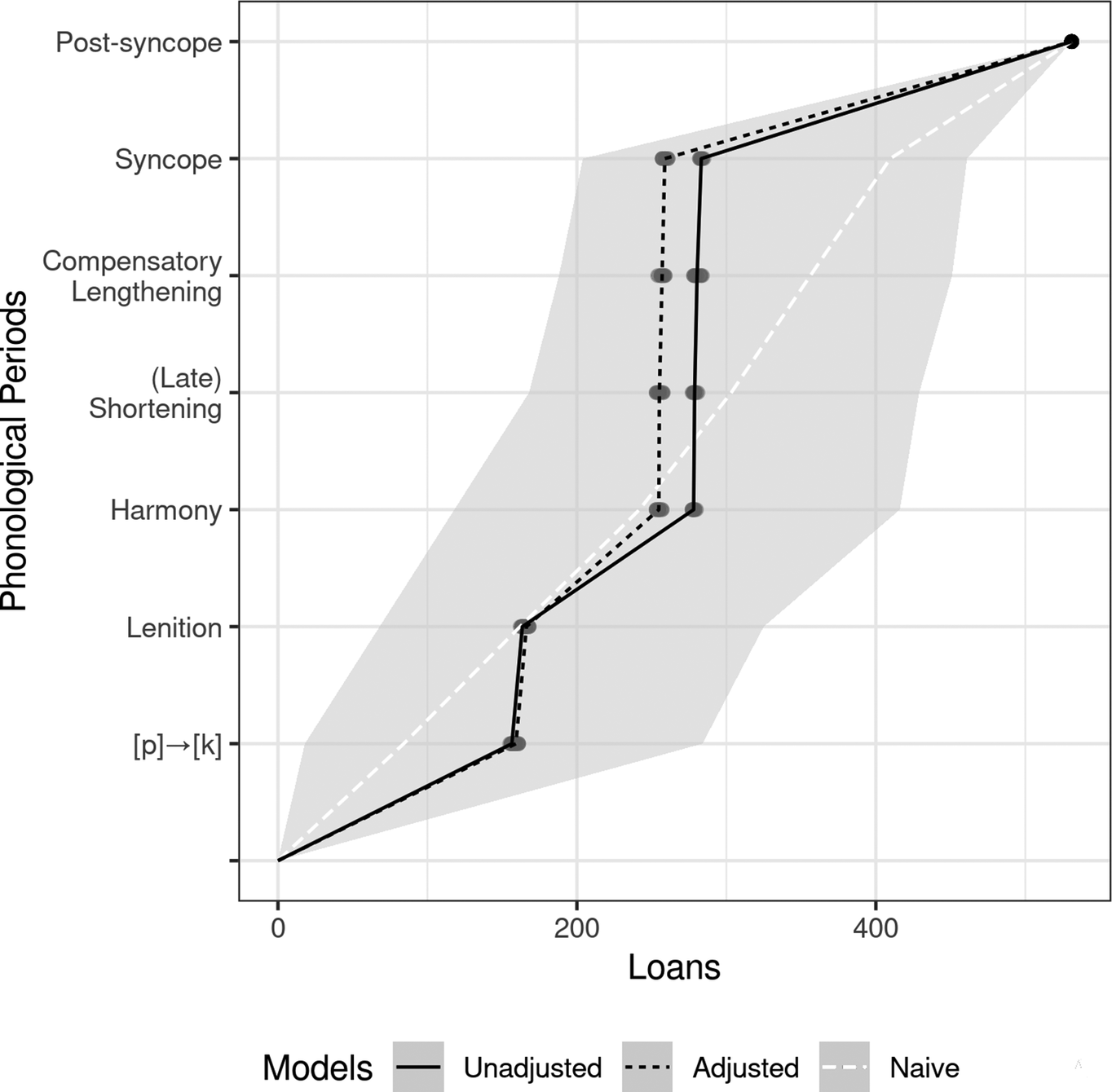
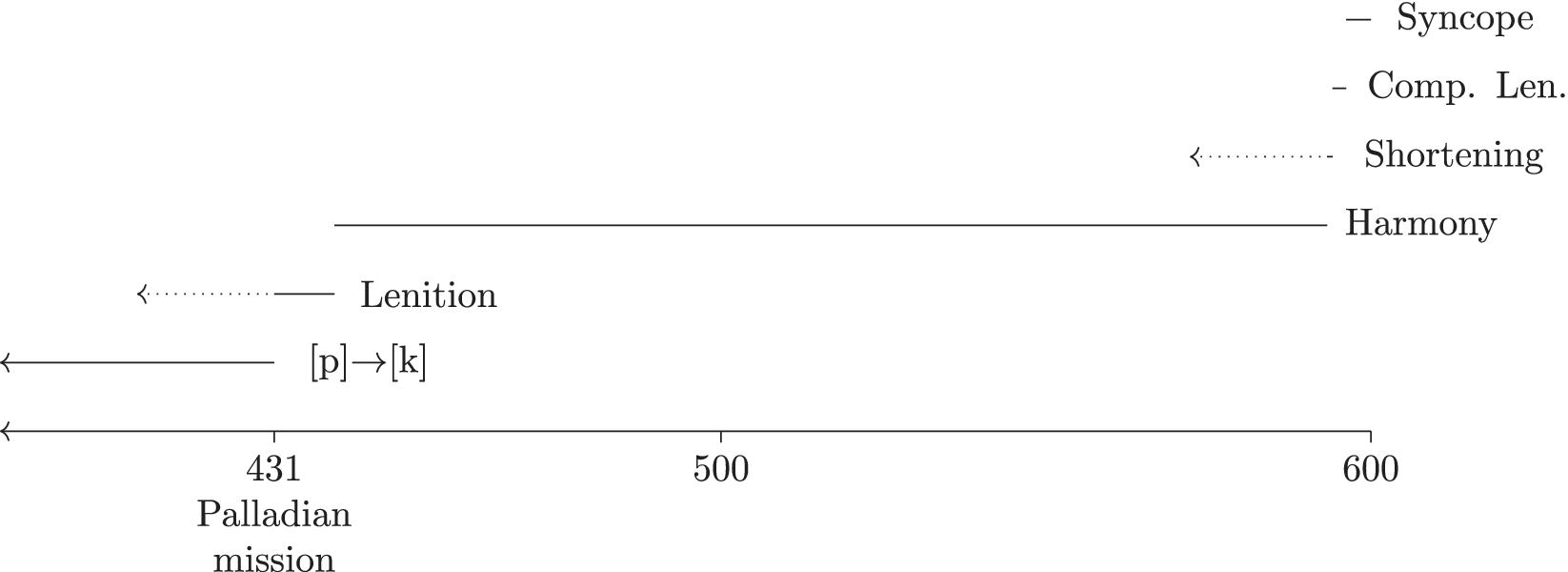


 Open access

