




Introduction
“Besides Bangkok, there is nowhere else as good and as friendly as Java.” (quote attributed to H.M. the Late king Chulalongkorn of Thailand, 1901).
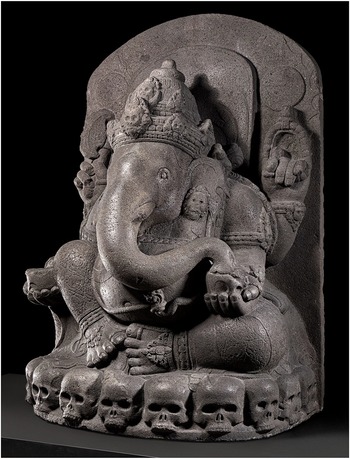
On July 6th, 2023, the Dutch government honored the request of the Indonesian government to return 478 cultural objects to Indonesia and Sri Lanka.Footnote 1 These objects, part of the collection of the Dutch National Museum for World Cultures or Ethnographic Museums (Nationaal Museum van Wereldculturen or NMVW, specifically Wereldmuseum Leiden) and the Rijksmuseum, were gathered during the Dutch colonial occupation of Indonesia between 1814 and 1942, and have since been transferred to the National Museum in Jakarta (Museum Nasional).Footnote 2 Among the 478 cultural objects, there are four statues that traditionally marked the entrance to the Indonesia room of Wereldmuseum Leiden and were crucial in the construction of the Dutch imaginary of Indonesia, which overemphasised the Buddhist-Hindu antique past of Java at the expense of the cultural and religious diversity of Indonesia, including the fact that Indonesia is the largest Islamic nation in the world (Bloembergen Reference Bloembergen2002; Lunsingh Scheurleer Reference Lunsingh Scheurleer2005; Quist Reference Quist2022; Scott 2016: 10-11; Shatawani 2024). These four statues include the goddess Durga, the guardians Mahakala and Nandiswara, and Ganesha (Figure 1; RV-1403-1622 to 1624; RV-1403-1681) are from Candi Singosari, a temple located in East Java; originally a Hindu-Buddhist funerary temple for the last ruler of the Singosari dynasty that dates back to the 13th century. ‘Discovered’ by the Dutch either in 1804 or 1808, these statues were bestowed to the National Museum of Antiquities (Rijksmuseum van Oudheden, founded in 1823) in 1828 and were used to show to demonstrate common ancestry between the Greco-Roman and the Hindu-Buddhist world (Halbertsma Reference Halbertsma2003); In 1903, in line with the changing idea that Dutch colonialism should aid to ‘civilise’ and educate the inhabitants of the Indonesian archipelago (Ethische Politiek), the Rijks Ethnographisch Museum acquired the statues to introduce the Dutch public to the ancient civilisation and ‘original and cultural unity’ (‘oorspronkelijke en culturele eenheid’) that once was pre-Islamic Dutch East-Indies (Bloembergen Reference Bloembergen2002: 86; Shatawani 2024).
The Ganesha statue that used to be at Wereldmuseum Leiden.

Despite these statues being in possession of the museum for 120 years, the history of these objects has been researched primarily within the locus of art history; only recently, with increasing debates on colonial repatriation, there has been more attention to the provenance of these objects. However, existing reconstructions are far from complete and ignore the complexity of the situation of colonial collecting of Javanese antiquities and its wider implications. This as the scope of research tends to be limited to European collectors, specifically the Dutch and British in the Dutch East-Indies, which ignores actors that fall outside of the dichotomy of coloniser and colonised. In other words, by focusing only on European collectors, a colonial lens of collecting emerges that frames only these colonial collectors as highly conscious and professional, ignoring local and other foreign collectors that were not agents of the colonial powers.
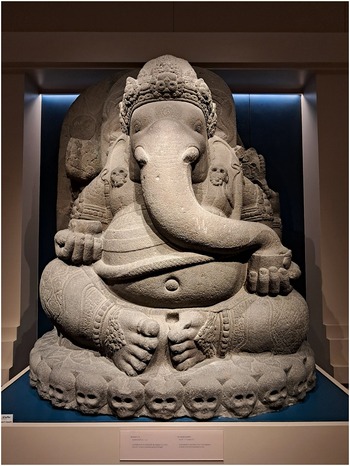
The case of a Ganesha statue, dotingly referred to in Dutch as the ‘Trunk King’ (Koning Slurf) from Candi Singosari, at the centre of this article challenges this discourse: it is often forgotten that there were not one but two Ganesha statues, of which the second is on current display at the Bangkok National Museum (Phiphitthaphanthasathan Haeng Chat Phra Nakhon) (Inventory number SRIVJ01; see Figure 2). The reason it is currently in Bangkok is because of Chulalongkorn (1853-1910, r. 1868-1910). Also known as Rama V or as the ‘Lord of Life’ (Jao Chivit), he is remembered as the great beloved father of the country who prevented the colonisation of Siam (Chakrabongse Reference Chakrabongse2020; Jackson Reference Jackson2022: 180; Lim Reference Lim2009; Stengs Reference Stengs2009).Footnote 3 As such, he is credited as the king who modernised Siam, not merely politically but also culturally, including the implementation of museum systems to ‘fabricate’ Western modernity (Peleggi Reference Peleggi2013: 1521-1524). The concept of taking ideas and systems from abroad has been well testified, but the role of actual ‘foreign’ objects on display, objects that are not from within the borders of the newly-constructed nation that was Siam, is yet to be considered. This is odd, given the importance of this Javanese Ganesha statue in the museum: it stands at the end of the display of Buddhist and Hindu antiquities in the Mahasurasinghanta building, while artifacts of the Candi Borobudur that Chulalongkorn also collected are just located in a small room towards the exit. In 2023, this Ganesha statue was named the fourth most important Ganesha statue in Thailand. Today, it attracts visitors who pray and offer gifts to the statue in the museum as Ganesha is the remover of barriers or obstacles, often commonly mistranslated as ‘luck’ (Agarwal and Jones Reference Agarwal and Jones2018; Chanthawit Reference Chanthawit2007; Jackson Reference Jackson2022; Kitiarsa Reference Kitiarsa2012; McDaniel Reference McDaniel2011; Thongdeng Reference Thongdeng2023).
The Ganesha statue as displayed in the Bangkok National Museum.

This article also argues that this case study provides a new perspective on both Dutch and Siamese colonial collecting practices by emphasising their transnational character, their intertwinement, and the role of (foreign) artifacts to establish identities of modern nationhood. The connection between the Dutch East-Indies and Siam is one that deserves more attention, as Java is the place that Chulalongkorn visited the most and longest, namely in 1872, over two months in 1896, and again in 1901; the first trip to Java and Singapore in 1872 was unique as it was the first time a Siamese ruler left his territory. Historical research tends to focus on his trips to Western Europe, Scandinavia and Russia in 1897 and 1907, connecting Siamese modernisation with Westernisation. However, Chulalongkorn implemented modernisation reforms right after his return from Java in 1872; the modern national administrative apparatus of Thailand today is thus based on the colonial system of Java, something not always acknowledged in scholarship on Thai modernisation and Westernisation (Teeraviriyakul Reference Teeraviriyakul2014: 68-114). This trip is also where Siam started modern diplomatic relations with the Netherlands (Dutch East-Indies) and the United Kingdom (Singapore). Moreover, we also witness the establishment of the first modern museum upon his return, inspired by his visit to the museum of the Batavian Society (established in 1868 and the current national Museum of Indonesia) (Sartraproong Reference Sartraproong2004: 236). This trip continues to have symbolic meaning in Indonesia as well, as a Siamese elephant statue donated by Chulalongkorn in 1872 is still in front of the National Museum of Indonesia, giving the museum its nickname ‘Elephant Museum’ (Museum Gajah).Footnote 4
As historical research considers the trip to Java in 1872 more and more and he visited Europe in 1897, paradoxically, the two other trips to Java are forgotten more and more. However, his second time to Java in 1896 was unique in several ways: first, it was the longest that the king spent in a foreign territory, totaling over 64 days in Java alone out of 95 days in total for the trip (Chulalongkorn Reference Chulalongkorn2012: 1-3; Imthip 2012: x-xiii).Footnote 5 Second, the trip holds weight as a clear goal was to reflect upon the insights of the first trip and implement further changes. Siamese museums are a case in point, as they became more professionalised by 1897 as Chulalongkorn detailed the observed changes of the museum of the Batavian Society since 1872. Third, it is unique as it was the first time the Siamese king utilised the colonial setting of a country to collect himself (Fine Arts Department 2004: 15-29). Bloembergen and Eickhoff (Reference Bloembergen and Eickhoff2013a; Reference Bloembergen and Eickhoff2019) are among the first to investigate the collecting practices of Chulalongkorn in Java, although they limit themselves to objects of Candi Borobudur and base their analysis on an incomplete French translation of Chulalongkorn’s diary. In addition, they focus primarily on the religious purposes of these objects in the way they reformed the Sangha (governing body of Buddhism) and do not consider the colonial implications and afterlives of these objects to Siamese cultural and national identity, as well as in the Siamese museum system. Studies on objects from Candi Singosari, in turn, have yet to consider this Siamese context as well (Kinney Reference Kinney2003: 142; Lunsingh Scheurleer Reference Lunsingh Scheurleer2005). This research, therefore, is one of the first to examine how a Siamese king could navigate colonial contexts to acquire a wide variety of objects and how Javanese cultural objects became an essential component in the construction of Siamese national identity.
This article does this by taking the Ganesha statue from Candi Singosari in Bangkok and, in conjunction with its Leiden/Jakarta counterpart, using it as a case study to demonstrate the transnational and colonial intertwinement in the construction of Siamese national modernity and identity under the monarchy. First, it analyses the trip of Chulalongkorn between May 25 and July 28, 1896, in Java and the colonial conditions that he encountered and could use to collect an unknown number of Javanese cultural objects, based on his journal from the trip and Dutch colonial archives.Footnote 6 Second, this research analyses the role of the Ganesha statue at Wat Phra Kaeo (‘Temple of the Emerald Buddha’) in 1896 and the Bangkok National Museum in 1926. Here, we must consider the failed efforts of the Dutch archaeologist Theodoor van Erp (1874-1958) to reclaim the objects for the Dutch state in 1926, who has since established image of Chulalongkorn as a thief and the trip as a ‘regrettable mistake’ for the Dutch East-Indies; this incident and subsequent imagery is rectified in this article and instead is understood as a wider trend of the frustration of and with Dutch experts and laymen on Javanese culture, history, and archaeology as discussed in this article. Therefore, the ‘regrettable mistake’ of Van Erp is, rather, an opportunity to see how the intertwinement of religion and monarchy in the construction of Siamese national identity was set in stone via the Ganesha statue.
‘Closest to Siam’: Chulalongkorn’s Second Trip to Java, May 25 to July 28, 1896
In 1871, Chulalongkorn was only seventeen years old when he wrote history by becoming the first Siamese monarch to visit a foreign country. Only on the throne for three years following the sudden death of his father, king Mongkut (1804-1868, r. 1851-1868), his position of power was far from secure, especially with the perceived threat of Western countries such as Great Britain and France. As such, the need to gain more knowledge from abroad seemed acute. The regent Sri Suriyawongse (1808-1883), who ruled in the name of the young king, however, forbade him to travel to Europe; as such, a compromise was made in the form of Singapore and Java, as it was closer. In 1871, Chulalongkorn embarked on this unprecedented trip by visiting Singapore for nine days, Batavia for five, and Semarang for four. Of the reforms initiated by Chulalongkorn, most have been attributed to his European travels in 1897 and 1907.
Yet, as this article argues, it was these three trips to Java that were the most formative of his reign. Singapore and Java, although his second trip demonstrates Java was the king’s favourite, provided his first impression of the global world: here it is where he witnessed modern (colonial) administration and technology, and where he first needed to emphasise Siamese independence when he formed international relations with colonial powers such as the Netherlands and France. Chulalongkorn’s trips are understood as catalysts for reforming Siam not merely politically but also culturally with the adoption of Western symbolism and practices (Peleggi Reference Peleggi2002: 2-15; Wongsurawat Reference Wongsurawat2019: 3-6).Footnote 7 As Cary (Reference Cary and Taylor2000: 134-138) argues, this adoption should be understood as a project of national integration and the creation of a ‘drama of state’, which includes the national integration of Buddhism and the establishment of museums. However, as the trips to Europe in 1897 and 1907 are studied in favor of the trips to Java, this Western influence is misunderstood: I argue that this influence is of a transnational and colonial nature, as it is not an adoption but an adaptation or refraction of Western symbolism and practices through other Southeast Asian countries at the time, specifically the Dutch East-Indies and, to a lesser extent, Singapore.
Here, we need to consider how Chulalongkorn remembered and imagined Java. In his journal, he notes that one of the main reasons he travels to Java is that ‘there is not a place closer than Java’ (‘cheung ja ha hai glai prathaet rao gwa showa mai mi’) (Chulalongkorn Reference Chulalongkorn2012: 1).Footnote 8 Here, he insinuates Java to be culturally closest to Siam, which seems odd at first, given the majority of people are Muslim. However, when we look at the itinerary of his travels, we can read this as him reading Java through a Hindu-Buddhist religious lens. To the Dutch, the trip was understood to be solely a private journey for the king to recover from illness. Specifically, he had requested to stay a month in the hill station of Garut, a touristic centre of the Dutch colony, hence the Dutch did not prepare a state visit or detailed itinerary for the king (ANRI 1896).Footnote 9 In the end, he only stayed in Garut for eleven days (June 6 to 16) out of 64. The places that he visited throughout Java have thus been chosen by himself, which is also confirmed by the designated official who was to care for Chulalongkorn during his stay, A.J. Quarles de Quarles (1855-1914). He notes the keen interest of Chulalongkorn to choose the places himself, which all have in common that they are Hindu and/or Buddhist sites. These include spending three days at Candi Borobudur, a day at Candi Prambanan, and visiting Tosari on Mount Bromo, which was one of the last few Buddhist strongholds on Java at the time (ANRI 1896; ANRI 17.07.1896; NA 2.10.02.6241). In his diary, he describes these sites and their history in detail, how they fit into his understanding of Buddhism, and how they compare to Siam (‘klua ja reuang bon bon klan yang chen ban rao’) (Chulalongkorn Reference Chulalongkorn2012: 39-40). Chulalongkorn also enjoys cultural performances throughout his trip: these also have a Hindu-Buddhist focus, such as attending a concert with Maha Vishnu and Laksmi songs in Garut on June 11 and enjoying Wayang performance, as well as meeting local Buddhist populations (cf. Chulalongkorn Reference Chulalongkorn2012: 100, 101, 123, 337).
The interaction between Chulalongkorn and Dutch residents and other civil servants caused tension, especially with the Dutch who claimed to be experts on Javanese culture and antiquity. The most notable example is the king’s interaction with Isaäc Groneman (1832-1912) in Yogyakarta. Groneman joins the king to Candi Prambanan (June 28) and Candi Borobudur (June 30 to July 2). Chulalongkorn notes his frustration with the Dutch, who perceive their knowledge of Buddhism as superior to his and do not acknowledge their responsibilities for the Buddhist heritage of Java. His opinion of Groneman becomes increasingly unfavorable later in the trip, as he believes that Groneman depends too much on his Christian understanding of religion and, thus, does not understand Java and Buddhism at all (‘tae thi tee gee mai ru reuang rao an dai nai phra phuttha sasana loei’) (Chulalongkorn Reference Chulalongkorn2012: 237; see also 215). During their visit to Candi Prambanan, Chulalongkorn and Groneman have several disagreements, and Chulalongkorn finds Groneman stubborn and someone who refuses to listen; Groneman gives the king a book on Javanese culture and traditions, of which Chulalongkorn notes he will not read it (‘ja kanae taa gaw mai nae jai du nai samut nan di gwaa’ (Chulalongkorn Reference Chulalongkorn2012: 196). In turn, when they visit the Borobudur together, Chulalongkorn invites him to Bangkok as he would benefit from visiting a Buddhist country (Chulalongkorn Reference Chulalongkorn2012: 237; see also 173; 191-197; 213-244). This example, thus, shows the frustration that the Siamese king had with so-called Dutch Buddhist experts. As noted by Bloembergen (2000: 201), this was a feeling not exclusive to Chulalongkorn, as by 1900 it came to light that he plundered and mistreated several Javanese antiquities from Candi Prambanan – known today as the Groneman’s incident (‘Geval Groneman’), destroying his reputation.
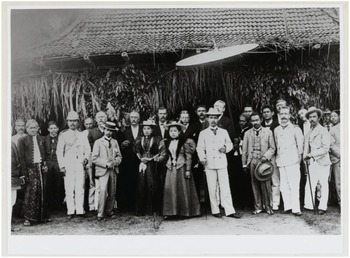
There was also a second element to the trip: to redo the first. With the first trip of 1872 in mind, the second visit to Java in 1896 had another advantage, namely, to be able to see the development of the island. Given that reforms in Siam continued after 1896, this proved information that visits to Europe, Sri Lanka, and India could not give. In this regard, it is worthy to note that he had brought his favourite wife, Queen Saovabha Phongsri (1864-1919), who would become regent in his name during his absence to Europe a year later, and his younger brother Prince Damrong Rajanubhab (1862-1943) as part of his entourage (see Figure 3). Upon their return from Java, Damrong would lead the administrative reform and be the leading actor in the creation and further professionalisation of the National Library and Museum. During the trip, they visited factories, military camps, prisons, schools, and botanical gardens. Throughout his visits, he develops a negative understanding of the Dutch presence in Java, which he states is one of injustice (‘mai ben uttithaam khong wilanda’) (Chulalongkorn Reference Chulalongkorn2012: 213). On his way to Borobudur on June 30, for example, he notes how the state of roads is insufficient as the two governors do not care about investing in them but rather prefer to blame the Sultanate as greedy. On his visit to a Dutch and Javanese school, he is surprised to learn that the Javanese do not learn Dutch (‘tae mai dai soon pasa wilanda’) (Chulalongkorn Reference Chulalongkorn2012: 122). To some extent, he also doubts this act of segregation by the Dutch when he learns that the Dutch forbid the local population to dress as Westerners (Chulalongkorn Reference Chulalongkorn2012: 305-306). As such, we see that Chulalongkorn develops a critical mind of Dutch colonisation of Java and also of Westernisation in itself.
King Chulalongkorn (the fourth on the right in front, dressed in white) with his entourage and Dutch officials before visiting Candi Borobudur, 1896.

In the development of museums, this intersection of Hinduism/Buddhism and development becomes apparent, marking it as a clear goal of Chulalongkorn. His first activity on the first day (May 25) was to visit the Museum of the Batavian Society and the library. He had already visited the museum in 1871, which became the basis of the Department of Royal Servants, whose responsibility was to organise the annual grand royal exhibition since 1880. As king Mongkut, Chulalongkorn’s father, was an avid collector himself, these royal exhibitions at the Wat Phra Kaew primarily showcased Mongkut’s collection. By 1885, following the abolishment of the viceroy system, the ‘Front Palace’ (Wang Na) was designated as a museum space, which is where the Bangkok National Museum is still today. With the museum as an institution thus being relatively new, Chulalongkorn was inspired to create a modern museum based on the one in Batavia (current Jakarta). He notes in his diary how he was impressed with the objects on display and notes the presence of his previous gift, the elephant statue still found in front of the Bangkok National Museum today (Chulalongkorn Reference Chulalongkorn2012: 37-39). That the museum remained an example for the later National Museum in Bangkok also becomes clear after the trip, when the director at the time, Nai Rajanathaninhar (unknown dates), sends a letter of gratitude following the trip and proposes a collaboration and exchange of literature for the benefit of both institutions (ANRI 25.07.1896).
A museum, however, is nothing without its objects; and the actions of Chulalongkorn show that the collection of Javanese cultural and antique objects was at the premise of this trip. Following his visit to the Batavian Museum, he met the governor-general Aart van der Wijck (1840-1914) and almost immediately inquired about the possibility of collecting Javanese artifacts, specifically from Candi Borobudur. Chulalongkorn wrote that they replied he ‘should ask the next time we meet, as they still had to be confirmed’ (‘rao book ko phra put rup thi boroputto toklong yoom hai modt pudt kan theung reuang thi ja dai pop kan yik tou pai yik yang mai bpen thi toklong nae’) (Chulalongkorn Reference Chulalongkorn2012: 43). This passage indicates he directly asks for these objects, and it has not been previously discussed or agreed upon; archival sources from the Netherlands, Indonesia, or Thailand do not indicate any prior discussion or promise of such objects to Chulalongkorn. In fact, the Dutch Ministry of Colonies decreed in December 1840 that the export of Javanese objects was prohibited without direct permission of the governor-general, which was only partially successful and constituted a need to further protect such objects.Footnote 10 Chulalongkorn noted that he expected to receive permission during his stay in Garut (June 6 to 16), although neither he nor the archival sources state when he received such permission exactly (ANRI 1896; Chulalongkorn Reference Chulalongkorn2012: 43). The report by A.J. Quarles de Quarles in 1896 and correspondence between politician Jan Willem IJzerman (1851-1932) and civil servant A. Loudon (1857-1921) indicate that the Dutch residents and Javanese sultans had already received prior permission by the governor-general to gift any objects to Chulalongkorn as they or the king pleased. This was for two reasons: first, the governor-general required the residents and sultans to reciprocate any gifts they would receive from Chulalongkorn; second, the gifts were part of an effort to provide Chulalongkorn with ‘a correct imagery’ (‘een juist denkbeeld te geven’) of the colony (ANRI 1910; NA 2.10.02.6241; NA 2.10.02.5438). With this, the Dutch saw this trip, despite it being a private journey of the king, as a way not to merely strengthen diplomatic relations but also to showcase their justification of their presence in the Dutch East-Indies, namely as one that developed the colony and brought it law, order, and prosperity; this should be understood in the changing nature of Dutch colonisation, culminating in the announcement of the Dutch ‘debt of honor’ (‘eereschuld’) towards the colony and the announcement of the ‘Ethical Policy’ (‘Ethische Politiek’) by 1901.
As such, the policy of gift-giving and reciprocity did something other than just make an impression on the king: it created space, albeit limited, for Chulalongkorn to become an active collector. Some of these objects he bought directly from Javanese vendors, such as several kris (Javanese ritual daggers) and a variety of batik (traditional Javanese textiles).Footnote 11 Regarding Hindu-Buddhist statues and archaeological objects, he acquired them with permission from residents and assistant-residents he visited throughout the island. Here, he was an active actor, as the reason they gave the objects to him was because Chulalongkorn would directly ask for them. As such, the nature of the collecting was rather informal and dependent on the willingness of Dutch civil servants. Only a few times his request would be unfulfilled: such an example was his visit to the governor of Yogyakarta on June 27, 1896. Here, Chulalongkorn expressed interest in multiple Buddha-statues at the governor’s residence; the governor, however, could not fulfil his request. Here, the governor based his position on two reasons. First, he stated they were not his personal possession and therefore needed permission from the Ministry of Education, Religion, and Industry of the Dutch East-Indies. Second, these statues were too damaged as the Ministry had ordered that the governors were not allowed to gift objects with aesthetic imperfections, and thus these statues were not suitable to be presented to the king. This order appealed to the notion of ‘correct imagery’, as they needed to impress the king, which damaged objects could not do. As such, Chulalongkorn was free to choose objects at the residence of the governor in Yogyakarta himself, as that would ensure he would be pleased and fitted the idea of a ‘correct image’ (ANRI 1896; ANRI 17.07.1896; Chulalongkorn Reference Chulalongkorn2012: 182-185).
A Serendipitous Encounter: The Ganesha Statue and Chulalongkorn at Candi Singosari, June 27, 1897
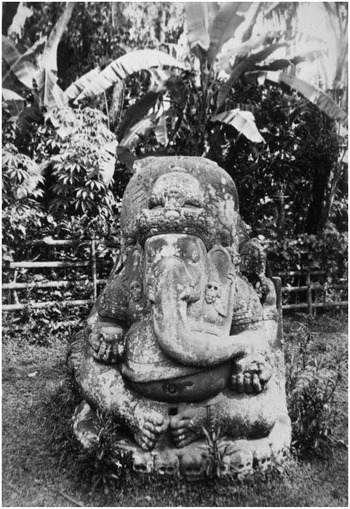
How does the Ganesha statue from Candi Singosari fit into this dynamic? Simply put, it was a matter of coincidence and an opportunity for Chulalongkorn in the relatively free space he had to collect objects, which becomes clear when looking at the practice of Dutch colonial collecting thus far. Candi Singosari was ‘discovered’ in 1808; the four statues mentioned in the introduction ended up in the Netherlands by the 1820s, where they became praised as some of the most aesthetic objects from Java.Footnote 12 As such, the temple was visited several times, and multiple objects have been taken, albeit the amount is unknown. This was possible due to the lack of professionalisation and government control of antiquities; serious archaeological interest or preservation efforts lacked as well (Blom Reference Blom1939: 14-18: Chutiwong Reference Chutiwong, Bacus, Glover and Sharrock2008: 100-121; Kinney Reference Kinney2003: 137-138). The Ganesha statue that Chulalongkorn would later acquire was never taken: the likely reason behind this is that it was damaged on the upper left corner and had been abandoned at the alun-alun (public square at the temple) (Figure 4; compare with Figures 2 and 5).
A picture of the Ganesha statue at Candi Singosari taken by Fransz Kronecker (1856-1919); most likely, this is how Chulalongkorn encountered the statue a year later.

Photo taken by the Royal Thai Survey Department of the Ganesha statue at Wat Phra Kaeo in 1921. Reproduced with permission of the National Archives of Thailand).

In his diary entry on June 27, Chulalongkorn mentions Singosari, showing he was aware of its existence; however, he notes that it was highly unlikely he would visit it. That he would not visit was also emphasised in the report of Quarles de Quarles (Chulalongkorn Reference Chulalongkorn2012: 185 and 346; NA 2.10.02.6241). However, on July 22, 1896, Chulalongkorn and his entourage descended from Tosari on Mount Bromo and ended in Malang, unexpectedly. Given that Malang is only a few kilometers south of Candi Singosari, they spared 30 minutes to visit the temple impromptu; here, they mostly encountered ruins. Chulalongkorn saw the Ganesha statue and noted in his diary how he had a great desire to acquire it, asking for it on the spot (‘yak ja krai dai’).Footnote 13 The resident of Pasuruan, who accompanied Chulalongkorn at the time, contacted the governor-general on request of Chulalongkorn to receive permission for the bestowment: Van Wijck and the resident both had ‘no objections’ (‘geen bezwaar’), given that the resident had previously ordered the demolition of existing statues at Singosari and that the ‘statue is not a part of any existing monument at Singosari’ (‘dat het beeld geen deel uitmaakt van enig bestaand monumentje te Singosarii’) (ANRI 17.07.1896). Although the object was not perceived to be of the highest ‘aesthetic value’, this lack of Dutch interest provided the necessary context for Chulalongkorn to obtain it. Four days later, he handwrites a personal letter to the governor-general in English to thank him all the objects he received, stating that ‘for these figures, I have not only to thank the Netherland Indian Government for myself, but also in the name of the Siamese nation, whose high appreciation of them will always remind them of the giver’ (ANRI 1896; Chulalongkorn Reference Chulalongkorn2012: 346; NA 2.10.02.6241; NA 2.10.02.5438).Footnote 14
The trip of over two months in Java by Chulalongkorn, therefore, was not only of convalescence as told to the Dutch; rather, it provided an opportunity to do more, specifically to connect Siam to a larger Buddhist world and to incorporate the changes and critiques of Westernisation that he witnessed through the development of Java. Research has already shown the connection between Chulalongkorn’s fascination with religion and the modernisation and unification of the state, such as via the state-control of the Sangha by 1902 (Cary Reference Cary and Taylor2000: 138; Thongdeng Reference Thongdeng2023: 31). His trips abroad to Southeast Asia strengthen this pattern, as he visited places and collected objects out of personal fascination but also intend to be displayed for the larger Siamese public and create a more apparent Buddhist link with the larger world, especially between Siam and Java. Given that there is no knowledge of whether Chulalongkorn collected objects on his first visit in 1872, the fact that exhibitions and museums were already established, this research indicates that his collection practices during the trip of 1896 are something he also wished to redo from his first trip and part of the locus of development. Here, he is inspired by Dutch colonial museum practices embodied by the Batavian Museum, partially, as his itinerary suggests. However, he does much more, as the (dis)organisation of Dutch colonial practices strengthened his ability to collect: a lack of systemic record keeping, government control, and overarching organisation facilitated a convoluted scattering of objects, of which civil servants and sultans were eager to bestow them on the king to impress him. His own knowledge of Hinduism and Buddhism allowed him to see beyond the mere ‘aesthetic value’ that most Dutch scholars of the time favored. The Ganesha statue, one encountered by accident, is a case in point, as the next section analyzes how the statue and other Javanese cultural objects were situated at the Royal Palace and the National Museum as a way to create legitimacy for the Siamese state as a modern Buddhist nation under the patronage of the monarchy.
‘The Regrettable Mistake of 1896’: The Ganesha Statue Situated in Bangkok, 1896-1927
Chulalongkorn returned to Siam on August 12, 1896, with at least eight ‘Javanese oxcarts’ (‘Javaansche ossenkarren’) of artifacts, if not more (Van Erp Reference Van Erp1917: 287; see also Bloembergen and Eickhoff Reference Bloembergen and Eickhoff2019: 80-81). Several Hindu and Buddhist statues, including the Ganesha from Candi Singosari, were placed within the royal grounds near the entrance of the Wat Phra Kaeo. Although there was a tradition of using the grounds of the temple as an exhibition space between 1874 and 1887, the location should also be read in the light of using the Buddhist-Hindu tradition as a source of the king’s legitimacy (Cary Reference Cary and Taylor2000: 142; Peleggi Reference Peleggi2013: 1527). Photographic evidence from the Siamese government on request of the Dutch government in the 1920s shows us how it was displayed (see Figure 5); here, the statue played a religious function as it was placed on an elevated lotus-pedestal facing the direction of the Emerald Buddha and worshipped with incense. In addition, it was surrounded by Chinese statues that king Mongkut acquired. As Peleggi (Reference Peleggi2002: 86-87) shows through the example of the Buddha images at Wat Benchamapobhit (known as the Marble Temple), the assemblage of artifacts by Mongkut and Chulalongkorn was a common practice in emphasising the presence and continuance of the monarchy in the development of Bangkok in colonial, urban, and religious terms (cf. Damrong Reference Rachanubhap1928). These Chinese statues can still be found at the royal palace and other temples in Bangkok today.
The religious function of the statue changed in 1925 with the professionalisation and subsequent refurbishment of the National Museum. Here, we see that the mission of the statue to connect Siam to a larger Hindu-Buddhist world through the monarchy has been cemented, which is illustrated through the failed attempt of Theodoor van Erp (1874-1958) to retrieve these objects for the Dutch state. Van Erp is best known today as leading the first restoration of Candi Borobudur between 1907 and 1911. He was very much a product of his time: just a few years after Chulalongkorn had visited Java the second time in 1896, the professionalisation of Dutch scholarship and interest in Javanese antiquities accelerated. This was partly motivated by the new tropes that underpinned the legitimacy of colonial rule (‘Ethische Politiek’) and also the representation of the Dutch colony at world exhibitions such as in Paris in 1900 (Exposition Universelle) (cf. Bloembergen Reference Bloembergen2002); the first committee for archaeological research (Commissie in Nederlandsch-Indië voor Oudheidkundig Onderzoek van Java en Madoera), the later Archaeological Society of the Dutch-East Indies (Oudheidkundige Dienst in Nederlandsch-Indië), was established by 1901; this was partly in response to critiques by civil servants who criticised the ‘plundering’ of antique sites like Candi Borobudur (cf. NA 2.10.02.5438).
Van Erp, however, was the first to direct this criticism of plundering to the Siamese king. For his monograph on Candi Borobudur, he was one of the first to reconstruct an overview of the objects that Chulalongkorn held in his possession in Bangkok. Here, Van Erp (Reference Van Erp1917: 285) criticises the eagerness of Chulalongkorn to collect Javanese antiquities, arguing they should not be in his possession and should be returned to the Dutch state. This signals the colonial attitude towards the people of the Dutch East-Indies, who he saw as unfit to take care of the objects themselves. Given there seemed to be little response, Van Erp used his contacts at the Koninklijk Instituut voor Taal-, Land- en Volkenkunde (currently the Royal Netherlands Institute of Southeast Asian and Caribbean Studies, or KITLV) to have the Dutch consulate in Bangkok collect pictures of the Borobudur artifacts that were in Bangkok in 1920. The Siamese Minister of Foreign Affairs, Devawongse Varodaya (1883-1943), ordered the Royal Siamese Survey Department on May 22, 1921, to take photographs of the Javanese artifacts in Bangkok. Of these photographs, there were several that fell outside the scope of the request but were included regardless (‘nook banchi thi racha thut hollanda ko ma’); with a photograph (Figure 5) of the Ganesha statue as one of these (Thai National Archives R. 6, B 38; see also Van Erp Reference Van Erp1923: 492).Footnote 15 Following this diplomatic response to the Dutch request, Van Erp wrote another opinion piece in 1923 where he denotes these gifts as ‘the regrettable mistake of 1896’ (‘de betreurenswaardige vergissing van 1896’) (Van Erp Reference Van Erp1923: 492), a sentiment that has been reiterated in contemporary literature (cf. Lunsingh Scheurleer Reference Lunsingh Scheurleer2005: 47). Van Erp even calls on Prince Damrong, as a representative of the Siamese state and of cultural affairs in the country, to return the artifacts ‘stolen’ by Chulalongkorn. His request to return these “gifts” to the Netherlands instead of the Dutch East-Indies is telling of Van Erp’s colonial mindset, in which he sees a superior role for Dutch scholars and the role for Indonesians as unfit, an attitude connected to the Ethnic policies. There is no documentation that Damrong responded, given that the article was written in Dutch. Members of the Batavian Society responded with dismay: Quarles de Quarles refuted the insinuation that the king stole the objects, stating: ‘he has been given what he asked for!’ (‘Hem heeft gekregen wat hij vroeg!’) (underlined by Quarles de Quarles) (ANRI KBG 1006).
Here, we need to emphasise the paradoxes in the logic of Van Erp, which the Ganesha statue illustrates. In his article, Van Erp claimed that the Ganesha statue was actively worshipped at Candi Singosari up until the day Chulalongkorn arrived, where the local population revered it dotingly as the “Trunk king” (Radjah Talalie/Koning Slurf). Then, Van Erp sketches the arrival of Chulalongkorn, accompanied personally by the governor-general Van der Wijck, where he cunningly asked in plain sight for the bestowment of the statue, to which the governor-general could only ‘silently protest’ to painstakingly avoid the humiliation in front of his peers (‘onder stil protest van Gouv. Gen. van der Wijck, die zijn residenten moeilijk te deze aanzien kon desavoueeren’) (Rouffaer, quoted in Van Erp Reference Van Erp1923: 513). As such, the image of Chulalongkorn as a thief who abused the hospitality he was shown to get what he wanted was established by Van Erp. However, the paradox lies in the fact that Van Erp argues that the Ganesha in Bangkok, upon comparison with its Leiden counterpart, is preserved with so much car and dignity, that ‘that one should be at peace would it remain there’ (‘het thans waardig is opgesteld en goed verzorgd wordt in den Koninklijken lusthof te Bangkok, dan heeft men er waarlijk vrede mee dat het daar blijft’) (Van Erp Reference Van Erp1923: 517). Given he was not there and did not cite the people present, it is clear he dramatised the acquisition of the Ganesha statue. Given Van Erp’s request was only for the Borobudur artifacts, we can interpret the Ganesha statue as a willing sacrifice to get the Ganesha artifacts.
However, Van Erp’s public plea and sketch of Chulalongkorn were met without any result; as such, in 1926, he encouraged the Archaeological Society to send P.V. van Stein Callenfels (1883-1938) on a diplomatic mission to Bangkok to take photographs of the Javanese artifacts in the Bangkok National Museum and negotiate for their retrieval. The subsequent description of this negotiation shows how the statue had been imbued with the royal authority of Chulalongkorn, and its role in Siamese cultural identity was cemented. According to Callenfels (quoted in Van Erp Reference Van Erp1927: 503-504), Damrong was sympathetic to the request of returning several artifacts, which is illustrated by the trade of three reliefs of Prambanan for four Hindu-Javanese bronzes from the Batavian Museum (quoted in Van Erp Reference Van Erp1927: 503-504). The Ganesha statue, however, could not be returned: according to the director of the Siamese museum at the time, George Coedès (1886-1969), the statue was now a ‘donation to the nation by Chulalongkorn to which the people were emotionally intertwined with’ (‘verknochtheid van Koning en volk aan Chulalongkon’s “geschenken aan de natie”.’) (quoted in Van Erp Reference Van Erp1927: 512). As such, the statue was no longer just a statue but was worshipped as it ‘shared in his holiness’, in other words, partaking in the sanctity of Chulalongkorn (‘deelen in zijn heiligheid’) (quoted in Van Erp Reference Van Erp1927: 512-513). At the same time, the position of Callenfels was weakened as the Batavian Society, independent of the Archaeological Society, had found the missing upper left fragment of the statue at Candi Singosari, and which they had the Dutch government present it as a gift to Prajadhipok (Rama VII, 1893-1941; r. 1925-1935) (Royal Batavian Society 1928: 32-33).Footnote 16
Paradoxically, the diplomatic missions of 1925 created more attention to the Ganesha statue; following its renovation and refurbishment, it was then placed in the Itsawawinitchai hall until 1967, arguably the most important hall of the museum as it was the former reception hall of the viceroy-king (Coedès Reference Coedès1928; Hinata Reference Hinata2012: 43-44; Rachabanthittayaasapha 1929: 11-22). This logic of holiness accruing to the statue, in turn, was not comprehended by Van Erp, who became disappointed and started to reframe the display of the Ganesha statue as he had seen from the photograph of 1921 as ‘hideous’ (‘foeileelijk’) and propagating the idea of Chulalongkorn as a thief further (Van Erp Reference Van Erp1927: 511). Since then, the statue has been barely mentioned in Dutch and international scholarship on Javanese objects, in a sense lost to the colony and now part of Chulalongkorn’s Siam.
How must we understand the framing as presented by Coedès, Damrong, and the Siamese government, and what does it tell us about the other Javanese objects collected by Chulalongkorn during and after his death? Existing scholarship has proven the refiguration of the image of Chulalongkorn at the end of his reign and in the reign of his successors (cf. Jackson Reference Jackson2022: 180; Nidhi Reference Eoseewong2003: 11; Stengs Reference Stengs, Houtman and Meyer2012: 137-140). This has been emphasised through the connection between the constitution of the notion ‘civilisation’ (siwilai) and the erection of a notion of ‘Thainess’ (Khwam bpen Thai) for Siam (Peleggi Reference Peleggi, Ravi, Rutten and Goh2004: 134-135; Thongchai Reference Thongchai2000: 544). As Peleggi argues, this discourse is connected to the notions of mission civilisatrice (or in Dutch ‘beschavingsmissie’) that underpinned colonialism. Archaeological artifacts were, in particular, helpful to help establish a historical past following Western models and create a genealogy to support the legitimacy of the ruling Chakri dynasty and Chulalongkorn in particular (Coedès Reference Coedès1928: 17; Hinata Reference Hinata2012: 34-45; Peleggi Reference Peleggi, Ravi, Rutten and Goh2004: 142-153, Reference Peleggi2013: 1540-1543). King Chulalongkorn was reimagined not merely as the great moderniser but as the ‘standard-bearer for newly defined categories of art and culture’ whose benevolent objective it was to enlarge the aesthetic and artistic education of his subjects, specifically to make them loyal Thai subjects (Damrong Reference Rachanubhap1928: 211; Cary Reference Cary and Taylor2000: 134). At the same time, the Ganesha statue being a religious object emphasises the religious role of monarch in the reforms of Buddhism, emphasising that he is the only true Buddhist-Hindu king left.
This research, by emphasising the ‘foreign’ objects from Java that the transnational history of Siam needs to be considered more in the creation of its modern nation-state, the idea of Thainess, and the legitimation of the Thai monarchy. The Ganesha statue exemplifies this, as it was a ‘gift’ to Chulalongkorn, who in turn bestowed it upon his people; as such, it is an object that represents royal control over not merely Siam but the Buddhist world and Southeast Asia at large. In other words, through the statue of Ganesha—worshipped as the remover of barriers—it is Chulalongkorn who is remembered as the remover of the barriers in Siam that prevented civilisation and participation in the larger modern world. Here, Siam, as the nation that avoided colonisation under Chulalongkorn, of which the monarchy continues to be the head of the Sangha and a divine figure in itself, all comes together in an object from the land that Chulalongkorn felt was the closest to his own: Java. As such, it became impossible for the Siamese state to return the Ganesha statue.
Offerings to the Ganesha statue for the Maha Kanapati Bucha, held at the Bangkok National Museum from September 16 to 19, 2023.

Conclusion
This article proved that non-Siamese artifacts are not merely items in the collection practices of Chulalongkorn but rather essential pieces to construct Siamese national identity and royal legitimacy. As such, the case study of the Ganesha statue from Candi Singosari found in the Bangkok National Museum today shows not merely a meaningful link between Siam and Java but also how colonial legacies resonate in the collection practices of Chulalongkorn. Historical scholarship has discussed the role of museums and collections before but has rarely considered this specific, colonial yet non-colonial transnational context before. As such, the prominence of Javanese objects in Siam is rectified, as well as the insinuation that Chulalongkorn had stolen objects from Java. As shown above, Chulalongkorn was an actor with support from Dutch colonialists who utilised the cracks in the system to gather these objects, as a form of diplomacy, gift-making, but also through serendipity, given the late professionalisation of the Dutch interest in Javanese antiquity.
With the debates that try to critically assess and deconstruct the colonial origin of museums and their objects, the stories that we tell about these objects and the meaning we give to them become increasingly crucial (cf. MacKenzie 2009: 1-17; Nakamura and Sutherland Reference Nakamura and Sutherland2019: 52-3). The Ganesha statues, both the one in Bangkok and the one that was in Leiden until 2023, reveal that both these objects diverge based on the meanings they are given. For the Ganesha sent to the Netherlands, its religious significance became a colonial one as it supported orientalist visions of Java through the depiction of the ancient, non-Muslim past and perceived unity of the Dutch colony (cf. Shatawani 2024). In Dutch scholarship, this colonial entanglement of Dutch orientalism and Indonesian Hindu-Buddhist antiquities has received more attention specifically since 2002, but continues to be (partially) defined by colonial structures and legacies (cf. Ter Keurs Reference Ter Keurs2009: 148-150; Mooren, Stutje and Van Vree Reference Mooren, Stutje and van Vree2022; Swirc Reference Swirc2022). In Siam/Thailand, however, the Ganesha of Candi Singosari acquired a completely different layer of meaning: through its entanglement with king Chulalongkorn himself and his efforts at religious nation-building, in which Buddhist rationalism was inclusive of diversity and existing Hindu and Chinese frameworks, the statue became an object of active worship within one of the most holy sites within the Siamese kingdom (Wong Reference Wong2001; Jackson Reference Jackson2022). Almost paradoxically, it was a non-Thai object that supported this national image as they consolidated the idea of Chulalongkorn as a true ‘Buddhist-Hindu’ king and the last Theravada Buddhist monarchy in the world. By 1926, when the Dutch and Siamese contexts met once more, the statue was too cemented in the Siamese context to be even considered to be ‘returned’ to Dutch scholars.
Currently, we see that the afterlives of both the Ganesha statues are continuing to change. For the statue in Leiden, we see this with its restitution to the National Museum in Jakarta, where it will gain a new context, albeit it will also be connected to its colonial past. Given that at the time of this research, the museum was closed for renovation, it is yet to be seen how the museum deals with these complex legacies. In Bangkok, the statue continues to live a life of religious importance. From September 16 to 19, 2023, for example, the Bangkok National Museum organised a special ceremony for the statue (Maha Kanapati Bucha) in honor of Ganesha Chaturthi, the Hindu festival to celebrate Ganesha’s birth. Here, visitors gave offerings to the statue similar as if they were in a temple, while artists sold Ganesha-related or inspired merchandise. Following a mini-quest, participants received a special amulet of the Javanese statue (see Figure 6); in the accompanying exhibition text, the connection with king Chulalongkorn was highlighted once again. This testifies that the religious afterlife of the statue upon its arrival continues to be reverberated in the museum context, not necessarily as the ‘Trunk king’ but rather as a part of the ‘Lord of Life’ who both are removers of barriers for its visitors.
Acknowledgements
This research was presented at the International Conference on Asian Studies (ICAS 13), held in Surabaya between July 28 and August 1, 2024, for which the author received financial support from the University of Wisconsin-Madison to attend this conference. The researcher wishes to thank Bansomdej Chaophraya Rajabhat University for the support in the initial preparation for this research, as well as Professor Shinsuke Hinata (Osaka University) in helping identify relevant literature and for the fruitful discussions on the developments of museums within Siam/Thailand. The researcher is grateful for the help received from the staff at the National Archives in Bangkok, The Hague, and Jakarta. Special thanks go to Preedaporn Iamchae who helped navigate the archives in Thailand and Tom Quist from the National Museum of World Cultures in Leiden, the Netherlands, for supplying provenance reports and museum resources. Lastly, this article would not be possible without the help of Juan Fernandez (University of Wisconsin-Madison) for his support in finetuning and editing the article, as well as the reviewers and editors of this journal.


 Open access

