


The prodrome and the early phase of psychosis has yielded intensive clinical and research efforts, such as the setting up of specialised National Health Service (NHS) out-patient services in the UK and the nationwide research network in Germany. This ‘core task for general psychiatry’ (Reference WhitwellWhitwell, 2001) aims to avoid the biological and psychosocial deterioration at the earliest possible stage of the illness (Reference Simon, Ferrero and MerloSimon et al, 2001). Aside from the affected, however, relatives are experiencing the fatal effects of psychosis. They are intensively involved in the support system of people with psychosis (Reference Bengtsson-Tops and HanssonBengtsson-Tops & Hansson, 2001) and thus in the last decade, the perspective of relatives has become increasingly important for professionals.
However, there are only a few studies on the carers' attitude to the early detection of psychosis. A survey among a Swiss self-help group for relatives of patients with psychosis showed that carers have ambiguous attitudes: they support research efforts concerning early detection in general, but they also express considerable doubts about it (they might fear possible consequences for the affected, such as stigmatisation due to the diagnosis or the emphasis on psychotropic treatment without additional psychosocial support) (Reference Lauber, Schmid Diebold and RösslerLauber et al, 2001). In this paper, we focus on the carers' opinion about specialised out-patient services for early detection of psychosis and the consequences of an early diagnosis for carers and affected individuals.
Method
A semi-structured questionnaire was sent by mail to 480 relatives of mentally ill patients, all members of the Swiss organisation for relatives of psychotic patients. A total of 214 questionnaires were returned (45% response rate), but 14 questionnaires were excluded because they were not filled out. 78.5% of the remaining 200 respondents were female. The median age was 60.4 (s.d.=11.73) years. Of the respondents, 78% were parents and 13% were spouses; 60% were married, 18% were divorced and 14.5% were widowed. The median age of affected individuals was 38.65 (s.d.=12.24) years and their first symptom occurred at an average age of 22.4 years. The sample is described in detail elsewhere (Reference Lauber, Schmid Diebold and RösslerLauber et al, 2001).
We asked the following questions:
-
(a) Would you have made use of an out-patient service for early detection if you had had the opportunity? — Possible answers were ‘yes, certainly’, ‘yes, probably’, ‘uncertain’ or ‘not at all’.
-
(b) Would you have preferred to be informed earlier about the diagnosis of the illness from which your relative suffers? — Possible answers were ‘yes, certainly’, ‘yes, probably’, ‘uncertain’ or ‘not at all’.
-
(c) Would an earlier diagnosis have changed anything for your relative? — Possible answers were ‘yes, much’, ‘yes, somewhat’, ‘not much’ or ‘nothing’.
-
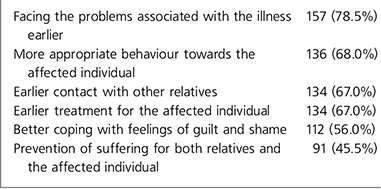
(d) Which consequences would you have expected if the diagnosis had been established earlier? — Every appropriate answer out of a list could be chosen (see Table 2).
‘Which consequences would you have expected for you and your affected if the diagnosis had been established earlier?’ (every appropriate answer out of a list could be chosen; n=200)
| Facing the problems associated with the illness earlier | 157 (78.5%) |
| More appropriate behaviour towards the affected individual | 136 (68.0%) |
| Earlier contact with other relatives | 134 (67.0%) |
| Earlier treatment for the affected individual | 134 (67.0%) |
| Better coping with feelings of guilt and shame | 112 (56.0%) |
| Prevention of suffering for both relatives and the affected individual | 91 (45.5%) |
Results
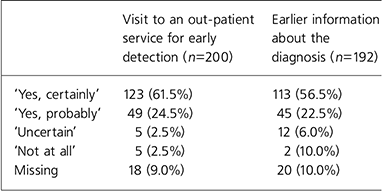
Table 1 shows whether the relatives would have visited the out-patient service for early detection if they had had the opportunity: 123 (61.5%) would have done so ‘certainly’ and another 49 (24.5%) ‘probably’. Of the relatives of psychotic patients who answered the question of whether they would have preferred to be informed earlier about the diagnosis of psychosis, 113 (56.5%) replied ‘yes, certainly’ and 45 (22.5%) replied ‘yes, probably’.
The answers of relatives to two hypothetical questions
| Visit to an out-patient service for early detection (n=200) | Earlier information about the diagnosis (n=192) | |
|---|---|---|
| ‘Yes, certainly’ | 123 (61.5%) | 113 (56.5%) |
| ‘Yes, probably’ | 49 (24.5%) | 45 (22.5%) |
| ‘Uncertain’ | 5 (2.5%) | 12 (6.0%) |
| ‘Not at all’ | 5 (2.5%) | 2 (10.0%) |
| Missing | 18 (9.0%) | 20 (10.0%) |
Fifty-nine relatives (29.5%) thought that an earlier diagnosis would have changed ‘much’ for their affected relative, and another 63 (31.5%) considered that it would have changed ‘somewhat’. For 26 (13%), ‘not much’ would have changed and for 6 (3%), ‘nothing’ would have changed.
Possible consequences of an earlier diagnosis are listed in Table 2. For 78.5% (n=157) of the interviewees, an earlier diagnosis would have enabled them and their affected relative to face the problems associated with the illness sooner. For 136 (68%), a more appropriate behaviour towards the relative would have been possible. A total of 134 (67%) mentioned that earlier contact with other relatives would have been possible. Another 134 (67%) of the relatives thought that their affected relative would have been treated earlier, 112 (56%) assumed that they would have dealt with feelings of guilt and 91 (56%) thought that an earlier diagnosis could have prevented both the affected individual and other relatives from suffering. Because multiple answers were possible, the sum of the percentages is more than 100%.
Discussion
This is, to the best of our knowledge, the first study analysing attitudes of relatives of patients with psychosis towards specialised services for early detection of psychosis and the consequences of an early diagnosis for carers and the affected individual. To summarise, more than half of the interviewees wanted to be informed earlier about the diagnosis. A third assumed that an earlier diagnosis would have changed much and another one-third supposed a change to some extent. ‘Facing the problems associated with the illness earlier’ was the most commonly-mentioned consequence of an earlier diagnosis. Moreover, more appropriate behaviour towards the affected individual, earlier contact with other relatives and earlier treatment would have been possible if the illness had been diagnosed earlier. Most of the interviewees would have visited an out-patient service for early detection of psychosis if they had had the opportunity.
Limitations of this analysis
Limitations of our study arose from the problems that research on public attitude in general deals with, such as the socially ‘desired’ answers. Our study asked for attitudes. Thus, we can only speculate on how the respective behaviour would have been. The response rate was low, but analogous to other studies (e.g. Reference Semele and ManningSemele & Manning, 2000). This may have led to a selection bias towards more communicative relatives. However, our sample is comparable with other studies (Reference Magliano, Fadden and MadianosMagliano et al, 1998; Reference Bengtsson-Tops and HanssonBengtsson-Tops & Hansson, 2001). Moreover, the sample just includes participants of a self-help group, thus, focusing on the most heavily-burdened care-giver (Reference Winefield and HarveyWinefield & Harvey, 1993). Finally, the time between the first symptoms of the illness and our data assessment was often more than 16 years. Most questions, however, focused on an assumed behaviour at the beginning of the illness. The time difference may have led to a recall bias.
Differences in mental health services between the UK and Switzerland and their possible influence on the results of this analysis must be discussed. In contrast to the UK, two-thirds of Swiss psychiatrists are engaged in private practice (Reference Guimón, Goerg and FischerGuimón et al, 2000). Most of them are psychoanalytically oriented and do not participate in the health care of the severely mentally ill. The latter were treated mainly within public out-patient services comparable with the mental health NHS trusts. A difference between the two countries, however, is the allocation of financial resources, which is not as restricted in Switzerland as it is in the UK. In Switzerland, for example, buildings and equipment are better maintained and the staff—patient ratio is higher. Thus, practical differences between the two mental health systems could have influenced the results of this study.
Relatives of patients with psychosis are favourable to early diagnosis
The favourable answers concerning early diagnosis of psychosis and the visit in a respective out-patient service are surprising and in contrast to the often-expressed opinion that relatives warn against early detection and diagnosis. The findings support the need to tell patients their diagnosis as early as possible (Reference Clafferty, Mccabe and BrownClafferty et al, 2001). Our results are noteworthy because relatives who are organised in a self-help group are likely to have a critical attitude to psychiatry (Reference Winefield and HarveyWinefield & Harvey, 1993). But these results are in line with our previous findings that relatives have a positive attitude to psychiatric research in general, and particularly to research with respect to early detection of psychosis (Reference Lauber, Schmid Diebold and RösslerLauber et al, 2001).
Consequences of early diagnosis
Our findings are unexpected, because early diagnosis has immediate and far-reaching consequences concerning social life, work or education and relationships for both the affected individual and their relatives (Reference Magliano, Fadden and MadianosMagliano et al, 1998). The latter, however, have a pragmatic view about the importance of an earlier diagnosis for the affected individual and for themselves. Only one-third assume that much would have changed for the affected individual. Relatives focus instead on disburdening activities, such as facing the problems related to the illness or contacting other persons in the same situation earlier.
Implications of these results
Early detection and intervention are intended to diminish the suffering of both the affected individual and their carers (Reference Harvey, Burns and SedgwickHarvey et al, 2001). Being mostly favourable to early diagnosis and detection, relatives are supporting partners for psychiatrists in convincing hesitant or ambivalent patients for diagnostic procedures and treatment. Psychiatrists, therefore, should involve carers in the care planning. Moreover, relatives give us useful clues with respect to the possible consequences of early diagnosis. Professionals must consider the carers' suggestions and refer relatives of newly-diagnosed patients with psychosis to supporting organisations such as self-help groups. An excellent example of carers' willingness and ability to cooperate is the recently launched website ‘Rethink’ of the National Schizophrenia Fellowship (www.nsf.org.uk) that provides carers, affected individuals and professionals with helpful and balanced information (this, however, is seen from a continental perspective).
Declaration of interest
None.
Acknowledgements
We thank the relatives for their participation in this study and Mrs Heidi Schmid Diebold for data collection and statistical analyses. We thank also the unknown reviewer for her/his helpful suggestions for improvement of our manuscript, especially with respect to UK characteristics.


 Open access


eLetters
No eLetters have been published for this article.