Hostname: page-component-68c7f8b79f-fcrnt Total loading time: 0 Render date: 2025-12-24T10:21:50.868Z Has data issue: false hasContentIssue false

Dedication to Edward Sturgis Grew

Published online by Cambridge University Press:  19 December 2025

Robert M. Hazen*
Affiliation:
Earth and Planets Laboratory, Carnegie Institution for Science, Washington DC, USA
Rights & Permissions [Opens in a new window]

Abstract

Information

Type
Editorial
Copyright
© The Author(s), 2025. Published by Cambridge University Press on behalf of The Mineralogical Society of the United Kingdom and Ireland.

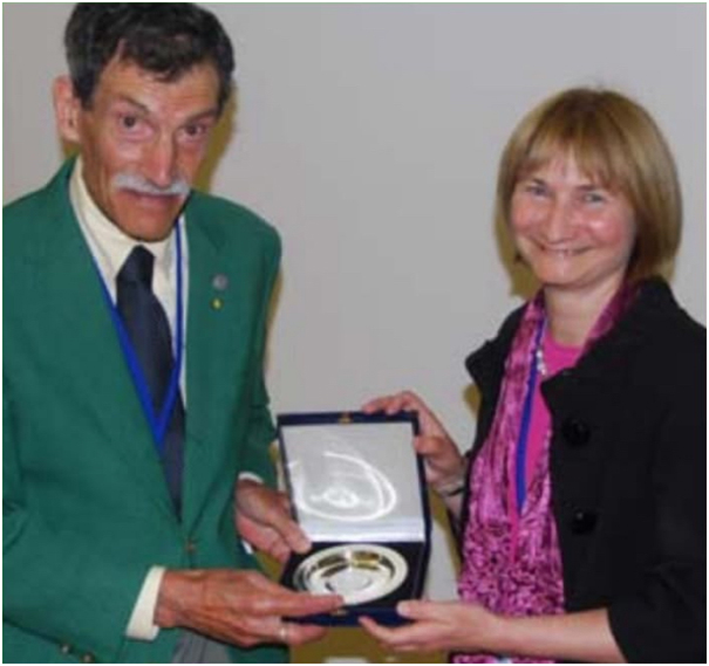
This volume of Mineralogical Magazine is dedicated to Edward Sturgis Grew in celebration of his 80th birthday. My colleagues and I are grateful for the chance to honour Ed’s long and distinguished career through this collection of contributions. A decade ago, Kristiansen (Reference Kristiansen2015) summarized the storied first half-century of Edward Grew’s academic life—a remarkable span that saw many of his seminal contributions to field studies on five continents; to the mineralogy and petrology of lithium, beryllium and boron minerals; and to the education of a generation of students at the University of Maine (Fig. 1). Throughout this distinguished research career Ed has focused on ‘petrologic mineralogy’—the meticulous study of minerals in their paragenetic context.

Figure 1. Ed Grew receiving the Collins medal for scientific excellence in mineralogy and its applications by Frances Wall, the President of the Mineralogical Society of the UK and Ireland in 2015.

Ed Grew’s outsized influence is manifest in more than 250 publications spanning 55 years. Perhaps best known are his numerous contributions to the mineralogy of beryllium, boron, and lithium (e.g. Grew, Reference Grew1981a, Reference Grew1982a, Reference Grew1986, Reference Grew1988, Reference Grew1998, Reference Grew2020; Grew and Hazen, Reference Grew and Hazen2014; Grew and Hinthorne, Reference Grew and Hinthorne1983; Grew and Sandiford, Reference Grew and Sandiford1984; Grew et al., Reference Grew, Chernovsky, Werding, Abraham, Marquez and Hinthorne1990, Reference Grew1998, Reference Grew, Yates, Barbier, Shearer, Sheraton and Shiraishi2000, Reference Grew, Suzuki and Asami2001, Reference Grew, Yates, Shearer, Hagerty, Sheraton and Sandiford2006, Reference Grew, Graetsch, Pöter, Yates, Buick, Bernhardt, Schreyer, Werding, Carson and Clarke2008a, Reference Grew, Bada and Hazen2011, Reference Grew, Carson, Christy and Boger2013a, Reference Grew, Dymek, De Hoog, Harley, Boak, Hazen and Yates2015, Reference Grew, Krivovichev, Hazen and Hystad2016, Reference Grew, Hystad, Hazen, Krivovichev and Gorelova2017, Reference Grew, Hystad, Toapanta, Eleish, Ostroverkhova, Golden and Hazen2019; Bloodaxe et al., Reference Bloodaxe, Hughes, Dyar, Grew and Guidotti1999; Buick et al., Reference Buick, Grew, Armbruster, Medenbach, Yates, Bebout and Clarke2008; Cempirek et al., Reference Cempírek, Grew, Kampf, Ma, Novák, Gadas, Škoda, Galiová, Pezzotta, Groat and Krivovichev2016; Dobrzhinetskaya et al., Reference Dobrzhinetskaya, Wirth, Yang, Green, Hutcheon, Weber and Grew2014; Hughes et al., Reference Hughes, Ertl, Dyar, Grew, Shearer, Yates and Guidotti2000; Tagg et al., Reference Tagg, Cho, Dyar and Grew1999), including the encyclopaedic Boron (Grew, Reference Grew1996) and Beryllium (Grew, Reference Grew2002) volumes 33 and 50, respectively, of the Reviews in Mineralogy and Geochemistry. Thanks to the collective impact of these and many other publications by Ed Grew, we have a remarkably comprehensive understanding of Be and B minerals.

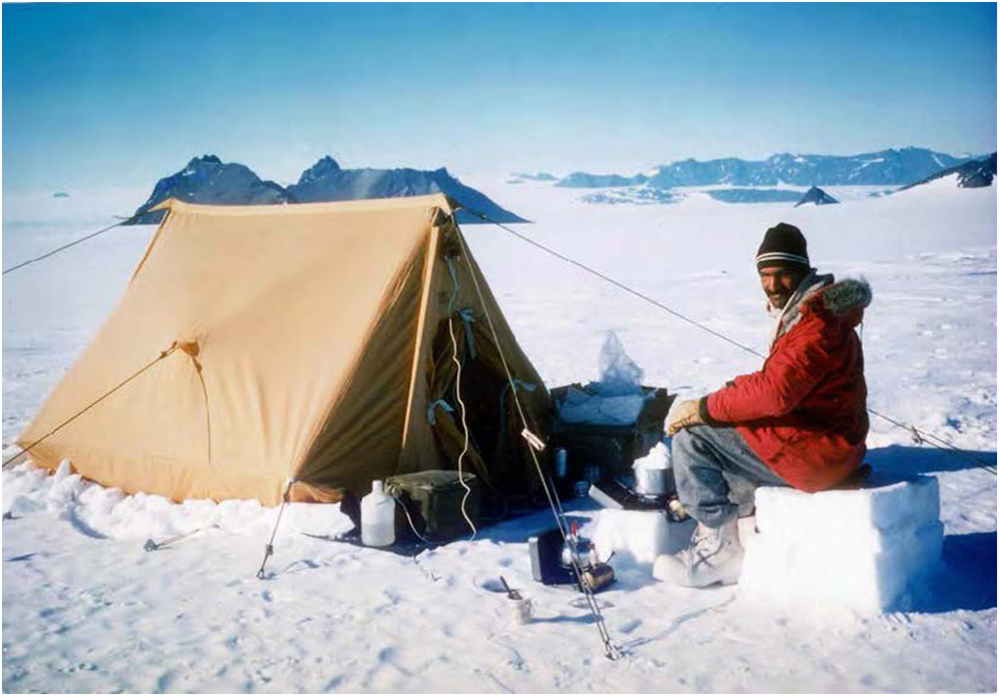
Edward Grew’s mineralogical efforts also included decades of research on the igneous and metamorphic petrologic mineralogy of Antarctica, where he was part of nine research expeditions between 1972 and 2004 (Grew, Reference Grew1978, Reference Grew1980, Reference Grew1981a, Reference Grew1981b, Reference Grew1982b, Reference Grew, A.E.M and F.G1982c, Reference Grew1983, Reference Grew1998; Grew and Hinthorne, Reference Grew and Hinthorne1983; Grew and Manton, Reference Grew and Manton1979; Grew and Sandiford, Reference Grew and Sandiford1984; Grew et al., Reference Grew, Kleinschmidt and Schubert1984, Reference Grew1988, Reference Grew1998, Reference Grew, Yates, Barbier, Shearer, Sheraton and Shiraishi2000, Reference Grew, Suzuki and Asami2001, Reference Grew, Yates, Shearer, Hagerty, Sheraton and Sandiford2006, Reference Grew, Armbruster, Medenbach, Yates and Carson2007, Reference Grew, Carson, Christy, Mass, Yaxley, Boger and Fanning2012, Reference Grew, Carson, Christy and Boger2013a; Asami et al., Reference Asami, Suzuki and Grew2002, Reference Asami, Suzuki and Grew2005; DePaolo et al., Reference DePaolo, Manton, Grew and Halpern1982; Manton et al., Reference Manton, Grew, Hofmann and Sheraton1992; Fig. 2). Of special interest were Ed’s many publications on the high-pressure metamorphism of late Archean and early Proterozoic rocks and associated complex pegmatites—rocks that contained a host of unusual phases.

Figure 2. Camping at Dallwitz Nunatak during an Australian Antarctic Expedition in January 1978. Site of the first world discovery of an ultra-high temperature sapphirine and quartz assemblage.
Added to these publications are fundamental contributions to systematic mineralogy, including the definitive statements regarding nomenclature of the sapphirine and surinamite groups (Grew et al., Reference Grew, Hålenius, Pasero and Barbier2008b) and the garnet supergroup (Grew et al., Reference Grew, Locock, Mills, Galuskina, Galuskin and Hålenius2013b). Ed Grew has also been involved in the discovery and characterization of 31 new minerals, including dissakisite-(Ce) [CaCe(Al2Mg)(Si2O7)(SiO4)O(OH); Grew et al., Reference Grew, Essene, Peacor, Su and Asami1991]; hyttsjöite [Pb18Ba2Ca5Mn2Fe2Si30O90Cl.6H2O; Grew et al., Reference Grew, Peacor, Rouse, Yates, Su and Marquez1996]; boralsilite [Al16B6O30(Si2O7); Grew et al., Reference Grew, McGee, Yates, Peacor, Rouse, Huijsmans, Shearer, Weidenbeck, Thost and Su1998, Reference Grew, Graetsch, Pöter, Yates, Buick, Bernhardt, Schreyer, Werding, Carson and Clarke2008a]; khmaralite [Mg4(Mg3Al9)O4(Si5Be2Al5O36); Barbier et al., Reference Barbier, Grew, Moore and Su1999; Grew et al., Reference Grew, Hålenius, Pasero and Barbier2008b]; ominelite [(Fe,Mg)Al3BSiO9, Hiroi et al., Reference Hiroi, Grew, Motoyoshi, Peacor, Rouse, Matsubara, Yokoyama, Miyawaki, McGee, Su, Hokada, Furukawa and Shibasaki2001]; chopinite [Mg3(PO4)2; Grew et al., Reference Grew, Armbruster, Medenbach, Yates and Carson2007]; boromullite [Al9BSi2O19,; Buick et al., Reference Buick, Grew, Armbruster, Medenbach, Yates, Bebout and Clarke2008]; menzerite-(Y) [CaY2Mg2(SiO4)3; Grew et al., Reference Grew, Marsh, Yates, Lazic, Armbruster, Locock, Bell, Dyar, Bernhardt and Medenbach2010]; qingsongite [BN; Dobrzhinetskaya et al., Reference Dobrzhinetskaya, Wirth, Yang, Green, Hutcheon, Weber and Grew2014]; vránaite [Al16B4Si4O38; Cempírek et al., Reference Cempírek, Grew, Kampf, Ma, Novák, Gadas, Škoda, Galiová, Pezzotta, Groat and Krivovichev2016]; khesinite [Ca4Mg2Fe3+10O4(Fe3+10Si2)O36; Galuskina et al., Reference Galuskina, Galuskin, Pakhomova, Widmer, Armbruster, Krüger, Grew, Vapnik, Dzierażanowski and Murashko2017]; and badengzhuite (TiP) and zhiqinite (TiSi2; Xiong et al., Reference Xiong, Xu, Mugnaioli, Gemmi, Wirth, Grew, Robinson and Yang2020).

Ed’s past 15 years have been devoted in large measure to new research directions in the fields of mineral evolution, mineral ecology, and mineral informatics—studies undertaken at a time when most scholars would have retired to less demanding pursuits. I had the great good fortune to collaborate with Ed Grew starting in 2010, shortly after a group of us had introduced research on the changing diversity and distribution of minerals through 4.5 billion years of Earth history—a field we called ‘mineral evolution’. Ed not only embraced these ideas, but he was instrumental in transforming what were initially qualitative descriptions of several stages of mineral evolution into rigorous, data-driven, quantitative explorations. We joined forces as we tackled new projects on the mineral evolution of lithium, beryllium, boron, mercury, and the Anthropocene epoch (Grew et al., Reference Grew, Bada and Hazen2011, Reference Grew, Krivovichev, Hazen and Hystad2016, Reference Grew, Hystad, Toapanta, Eleish, Ostroverkhova, Golden and Hazen2019; Grew and Hazen, Reference Grew and Hazen2014; Hazen et al., Reference Hazen, Bekker, Bish, Bleeker, Downs, Farquhar, Ferry, Grew, Knoll, Papineau, Ralph, Sverjensky and Valley2011, Reference Hazen, Golden, Downs, Hysted, Grew, Azzolini and Sverjensky2012, Reference Hazen, Liu, Downs, Golden, Pires, Grew, Hystad, Estrada and Sverjensky2014, Reference Hazen, Grew, Origlieri and Downs2017a). In every investigation, Ed scrutinized hundreds to thousands of mineral/age/locality data, checking and rechecking every data point. The resulting exacting analyses definitively demonstrated three key aspects of Earth’s evolving mineralogy: (1) the episodicity of mineralization correlated with intervals of supercontinent assembly; (2) the explosion of mineral diversity following the Great Oxygenation Event; and (3) the co-evolution of the geosphere and biosphere.

In 2015, Ed Grew played key roles in developing another new data-driven direction—‘mineral ecology’, or the quantitative investigation of changing mineral associations and distributions through deep time (Grew et al., Reference Grew, Hystad, Hazen, Krivovichev and Gorelova2017, Reference Grew, Hystad, Toapanta, Eleish, Ostroverkhova, Golden and Hazen2019; Hazen et al., Reference Hazen, Grew, Downs, Golden and Hystad2015a, Reference Hazen, Hystad, Downs, Golden, Pires and Grew2015b, Reference Hazen, Hystad, Golden, Hummer, Liu, Downs, Morrison, Ralph and Grew2017b, Reference Hazen, Downs, Elesish, Fox, Gagné, Golden, Grew, Hummer, Hystad, Krivovichev, Li, Liu, Ma, Morrison, Pan, Pires, Prabhu, Ralph, Runyon and Zhong2019; Hystad, Reference Hystad, Downs, Grew and Hazen2015). An important finding of these studies is that the distribution of known minerals and their localities can be used to predict the number of ‘missing minerals’—species that occur on Earth but have yet to be discovered and described. Ed applied these statistical methods to the minerals of his three favourite elements—lithium, beryllium and boron—to demonstrate that hundreds of minerals containing these essential elements are waiting to be characterized.

On a personal note, I owe Ed Grew an immense debt of gratitude. At a time when some prominent Earth scientists rejected the precepts of mineral evolution and questioned the application of informatics to describe and explain complex mineral systems, Ed embraced these alternative approaches. His decades of experience in petrologic mineralogy, his deep understanding of mineral-forming environments, his sustained service to the mineralogical community, and his uncompromising demand for rigor set our nascent studies on a sustainable path of discovery that continues today with a new generation of dynamic mineralogists.

Thank you, Ed!
Footnotes

This paper is part of a collection in tribute to the work of Edward Grew at 80

References

Asami, M., Suzuki, K and Grew, E.S. (2002) Chemical Th-U-total Pb dating by electron microprobe analysis of monazite, xenotime and zircon from the Archean Napier Complex, East Antarctica: evidence for ultra-high-pressure metamorphism at 2400 Ma. Precambrian Research, 114, 249275.CrossRefGoogle Scholar
Asami, M., Suzuki, K and Grew, E.S. (2005) Monazite and zircon dating by the chemical Th-U-total Pb isochron method (CHIME) from Alasheyev Bight to the Sor Rondane Mountains, East Antarctica: a reconnaissance study of the Mozambique Suture in Eastern Queen Maud Land. The Journal of Geology, 113, 5982.CrossRefGoogle Scholar
Barbier, J., Grew, E.S., Moore, P.B. and Su, S. (1999) Khmaralite, a new beryllium-bearing mineral related to sapphirine: a superstructure resulting from partial ordering of Be, Al, and Si on tetrahedral sites. American Mineralogist, 84, 16501660.CrossRefGoogle Scholar
Bloodaxe, E.S., Hughes, J.M., Dyar, M.D., Grew, E.S. and Guidotti, C.V. (1999) Linking structure and chemistry in the schorl-dravite series. American Mineralogist, 84, 922928.CrossRefGoogle Scholar
Buick, I.S., Grew, E.S., Armbruster, T., Medenbach, O., Yates, M.G., Bebout, G.E. and Clarke, G.L. (2008) Boromullite, Al9BSi2O19, a new mineral from granulite-facies metapelites, Mount Stafford, central Australia: a natural analogue of a synthetic “boron-mullite.” European Journal of Mineralogy, 20, 935950.CrossRefGoogle Scholar
Cempírek, J., Grew, E.S., Kampf, A.R., Ma, C., Novák, M., Gadas, P., Škoda, R., Galiová, M.V., Pezzotta, F., Groat, L.A. and Krivovichev, S.V. (2016) Vránaite, ideally Al16B4Si4O38, a new mineral related to boralsilite, Al16B6Si2O37, from the Manjaka pegmatite, Sahatany Valley, Madagascar. American Mineralogist, 101, 21082117.CrossRefGoogle Scholar
DePaolo, D.J., Manton, W.I., Grew, E.S. and Halpern, M. (1982) Sm-Nd, Rb-Sr, and U-Th-Pb systematics of granulite facies rocks from Fyfe Hills, Enderby Land, Antarctica. Nature, 298, 614618.CrossRefGoogle Scholar
Dobrzhinetskaya, L.F., Wirth, R., Yang, J., Green, H.W., Hutcheon, I.D., Weber, P.K. and Grew, E.S. (2014) Qingsongite, natural cubic boron nitride: The first boron mineral from the Earth’s mantle. American Mineralogist, 99, 764772.CrossRefGoogle Scholar
Galuskina, I.O., Galuskin, E.V., Pakhomova, A.S., Widmer, R., Armbruster, T., Krüger, B., Grew, E.S., Vapnik, Y., Dzierażanowski, P. and Murashko, M. (2017) Khesinite, Ca4Mg2Fe3+10O4[(Fe3+10Si2)O36], a new rhönite-group (sapphirine supergroup) mineral from the Negev Desert, Israel - natural analogue of the SFCA phase. European Journal of Mineralogy, 29, 101116.CrossRefGoogle Scholar
Grew, E.S. (1978) Precambrian basement at Molodezhnaya Station, East Antarctica. Geological Society of America Bulletin, 89, 801813.2.0.CO;2>CrossRefGoogle Scholar
Grew, E.S. (1980) Sapphirine + quartz association from Archean rocks in Enderby Land, Antarctica. American Mineralogist, 65, 821836.Google Scholar
Grew, E.S. (1981a) Surinamite, taaffeite, and beryllium sapphirine from pegmatites in granulite-facies rocks of Casey Bay, Enderby Land, Antarctica. American Mineralogist, 66, 10221033.Google Scholar
Grew, E.S. (1981b) Granulite-facies metamorphism at Molodezhnaya Station, east Antarctica. Journal of Petrology, 22, 297338.CrossRefGoogle Scholar
Grew, E.S. (1982a) Sapphirine, kornerupine, and sillimanite + orthopyroxene in the charnokitic region of South India. Journal of the Geological Society of India, 23, 469505.CrossRefGoogle Scholar
Grew, E.S. (1982b) Osumilite in the sapphirine-quartz terrane of Enderby Land, Antarctica: implications for osumilite petrogenesis in the granulite facies. American Mineralogist, 67, 762787.Google Scholar
Grew, E.S. (1982c) The Antarctic margin. Pp. 697755 in: The Ocean Basins and Margins – The Indian Ocean (A.E.M, Nairn and F.G, Stehli., editors). Springer, USA.CrossRefGoogle Scholar
Grew, E.S. (1983) Sapphirine-garnet and associated parageneses in Antarctica. Antarctic Earth Science, 4, 4043.Google Scholar
Grew, E.S. (1986) Petrogenesis of kornerupine at Waldheim (Sachsen), German Democratic Republic. Zeitschrift fur Geologische Wissenschaften, 14, 525558.Google Scholar
Grew, E.S. (1988) Kornerupine at the Sar-e-Sang, Afghanistan, whiteschist locality; implications for tourmaline-kornerupine distribution in metamorphic rocks. American Mineralogist, 73, 345357.Google Scholar
Grew, E.S. (editor) (1996) Boron: Mineralogy, Petrology, and Geochemistry. Reviews in Mineralogy, Vol. 33. Mineralogical Society of America, Washington DC, 862 pp.Google Scholar
Grew, E.S. (1998) Boron and beryllium minerals in granulite-facies pegmatites and implications of beryllium pegmatites for the origin and evolution of the Archean Napier Complex of East Antarctica. Memoirs of the National Institute of Polar Research, 53, 7492.Google Scholar
Grew, E.S. (editor) (2002) Beryllium: Mineralogy, Petrology, and Geochemistry. Reviews in Mineralogy and Geochemistry, Vol. 50. Mineralogical Society of America and the Geochemical Society, Chantilly, Virginia, USA, 691 pp.CrossRefGoogle Scholar
Grew, E.S. (2020) The minerals of lithium. Elements, 16, 235240.CrossRefGoogle Scholar
Grew, E.S. and Hazen, R.M. (2014) Beryllium mineral evolution. American Mineralogist, 99, 9991021.CrossRefGoogle Scholar
Grew, E.S. and Hinthorne, J.R. (1983) Boron in sillimanite. Science, 221, 547549.CrossRefGoogle ScholarPubMed
Grew, E.S. and Manton, W.I. (1979) Archean rocks in Antarctica: 2.5-billion-year uranium-lead ages of pegmatites in Enderby Land. Science, 206, 443445.CrossRefGoogle ScholarPubMed
Grew, E.S. and Sandiford, M. (1984) A staurolite-talc assemblage in tourmaline-phlogopite-chlorite schist from northern Victoria Land, Antarctica, and its petrogenetic significance. Contributions to Mineralogy and Petrology, 87, 337350.CrossRefGoogle Scholar
Grew, E.S., Kleinschmidt, G. and Schubert, W. (1984) Contrasting metamorphic belts in north Victoria Land, Antarctica. Geologisches Jahrbuch. Reihe B, Regionale Geologie Ausland, 253263.Google Scholar
Grew, E.S., Manton, W.I. and James, P.R. (1988) U-Pb data on granulite facies rocks from Fold Island, Kemp Coast, east Australia. Precambrian Research, 42, 6375.CrossRefGoogle Scholar
Grew, E.S., Chernovsky, J.V., Werding, G., Abraham, K., Marquez, N. and Hinthorne, J.R. (1990) Chemistry of kornerupine and associated minerals, a wet chemical, ion microprobe, and X-ray study emphasizing Li, Be, and F contents. Journal of Petrology, 31, 10251070.CrossRefGoogle Scholar
Grew, E.S., Essene, E.J., Peacor, D.R., Su, S.-C. and Asami, M. (1991) Dissakisite-(Ce), a new member of the epidote group and the Mg analogue of allanite-(Ce), from Antarctica. American Mineralogist, 76, 19901997.Google Scholar
Grew, E.S., Peacor, D.R., Rouse, R.C., Yates, M.C., Su, S.-C. and Marquez, N. (1996) Hyttsjöite, a new, complex layered plumbosilicate with unique tetrahedral sheets from Långban, Sweden. American Mineralogist, 81, 743753.CrossRefGoogle Scholar
Grew, E.S., McGee, J.J., Yates, M.G., Peacor, D.R., Rouse, R.C., Huijsmans, J.P.P., Shearer, C.K., Weidenbeck, M., Thost, D.E. and Su, S. (1998) Boralsilite (Al16B6Si2O37): a new mineral related to sillimanite from pegmatites in granulite-facies rocks. American Mineralogist, 83, 638651.CrossRefGoogle Scholar
Grew, E.S., Yates, M.G., Barbier, J., Shearer, C.K., Sheraton, J.W. and Shiraishi, K. (2000) Granulite-facies beryllium pegmatites in the Napier Complex in Khmara and Amundsen bays, western Enderby Land, East antarctica. Polar Geoscience, 13, 140.Google Scholar
Grew, E.S., Suzuki, K and Asami, M. (2001) CHIME ages of xenotime, monazite, and zircon from beryllium pegmatites in the Napier Complex, Khmara Bay, Enderby Land, East Antarctica. Polar Geoscience, 14, 99118.Google Scholar
Grew, E.S., Yates, M.G., Shearer, C.K., Hagerty, J.J., Sheraton, J.W. and Sandiford, M. (2006) Beryllium and other trace elements in paragneisses and anatectic veins of the ultrahigh-temperature Napier Complex, Enderby Land, East Antarctica: the role of sapphirine. Journal of Petrology, 47, 859882.CrossRefGoogle Scholar
Grew, E.S., Armbruster, T., Medenbach, O., Yates, M.G. and Carson, C.J. (2007) Chopinite, [(Mg,Fe)3](PO4)2, a new mineral isostructural with sarcopside, from fluorapatite segregation in granulite-facies paragneiss, Larsemann Hills, Prydz Bay, East Antarctica. European Journal of Mineralogy, 19, 229245.CrossRefGoogle Scholar
Grew, E.S., Graetsch, H.A., Pöter, B., Yates, M.G., Buick, I., Bernhardt, H.-J., Schreyer, W., Werding, G., Carson, C.J. and Clarke, G.L. (2008a) Boralsilite, Al16B6Si2O37, and “boron-mullite:” Compsitional variations and associated phases in experiment and nature. American Mineralogist, 93, 283299.CrossRefGoogle Scholar
Grew, E.S., Hålenius, U., Pasero, M. and Barbier, J. (2008b) Recommended nomenclature for the sapphirine and surinamite groups (sapphirine supergroup). Mineralogical Magazine, 72, 839876.CrossRefGoogle Scholar
Grew, E.S., Marsh, J.H., Yates, M.G., Lazic, B., Armbruster, T., Locock, A., Bell, S.W., Dyar, M.D., Bernhardt, H.J. and Medenbach, O. (2010) Menzerite-(Y), a new species, {(Y,REE)(Ca,Fe2+)2}[(Mg,Fe2+)(Fe3+,Al)](Si3)O12, from a felsic granulite, Parry Sound, Ontario, and a new garnet end-member, {Y2Ca}[Mg2](Si3)O12, The Canadian Mineralogist, 48, 11711193.CrossRefGoogle Scholar
Grew, E.S., Bada, J.L. and Hazen, R.M. (2011) Borate minerals and the origin of the RNA world. Origins of Life and Evolution of the Biosphere, 41, 307316.CrossRefGoogle ScholarPubMed
Grew, E.S., Carson, C.J., Christy, A.G., Mass, R., Yaxley, G.M., Boger, S.D. and Fanning, C.M. (2012) New constraints from U–Pb, Lu–Hf and Sm–Nd isotopic data on the timing of sedimentation and felsic magmatism in the Larsemann Hills, Prydz Bay, East Antarctica. Precambrian Research, 206, 87108.CrossRefGoogle Scholar
Grew, E.S., Carson, C.J., Christy, A.G. and Boger, S.D. (2013a) Boron- and phosphorus-rich rocks in the Larsemann Hills, Prydz Bay, East Antarctica: tectonic implications. Geological Society of London Special Publications, 383, 7394.CrossRefGoogle Scholar
Grew, E.S., Locock, A.J., Mills, S.J., Galuskina, I.O., Galuskin, E.V. and Hålenius, U. (2013b) Nomenclature of the garnet supergroup. American Mineralogist, 98, 785811.CrossRefGoogle Scholar
Grew, E.S., Dymek, R.F., De Hoog, J.C.M., Harley, S.L., Boak, J.M., Hazen, R.M. and Yates, M.G. (2015) Boron isotopes in tourmaline from the 3.7–3.8 Ga Isua Belt, Greenland: Sources for boron in Eoarchean continental crust and seawater. Geochimica et Cosmochimica Acta, 163, 156177.CrossRefGoogle Scholar
Grew, E.S., Krivovichev, S.V., Hazen, R.M. and Hystad, G. (2016) Evolution of structural complexity in boron minerals. The Canadian Mineralogist, 54, 125143.CrossRefGoogle Scholar
Grew, E.S., Hystad, G. Hazen, R.M. Krivovichev, S.V. and Gorelova, L.A. (2017) How many boron minerals occur in Earth’s upper crust? American Mineralogist, 102, 15731587. DOI: 10.2138/am-2017-5897.CrossRefGoogle Scholar
Grew, E.S., Hystad, G., Toapanta, M., Eleish, A., Ostroverkhova, A., Golden, J. and Hazen, R.M. (2019) Lithium mineral evolution and ecology: Comparison with boron and beryllium. European Journal of Mineralogy, 31, 755774. DOI: 10.1127/ejm/2019/0031-2862.CrossRefGoogle Scholar
Hazen, R.M., Bekker, A., Bish, D.L., Bleeker, W., Downs, R.T., Farquhar, J., Ferry, J.M., Grew, E.S., Knoll, A.H., Papineau, D., Ralph, J.P., Sverjensky, D.A. and Valley, J.W. (2011) Needs and opportunities in mineral evolution research. American Mineralogist, 96, 953963.CrossRefGoogle Scholar
Hazen, R.M., Golden, J.J., Downs, R.T., Hysted, G., Grew, E.S., Azzolini, D. and Sverjensky, D.A. (2012) Mercury (Hg) mineral evolution: A mineralogical record of supercontinent assembly, changing ocean geochemistry, and the emerging terrestrial biosphere. American Mineralogist, 97, 10131042.CrossRefGoogle Scholar
Hazen, R.M., Liu, X.-M., Downs, R.T., Golden, J.J., Pires, A.J., Grew, E.S., Hystad, G., Estrada, C. and Sverjensky, D.A. (2014) Mineral evolution: Episodic metallogenesis, the supercontinent cycle, and the coevolving geosphere and biosphere. Society of Economic Geologists Special Publication, 18, 115.Google Scholar
Hazen, R.M., Grew, E.S., Downs, R.T., Golden, J. and Hystad, G. (2015a) Mineral ecology: Chance and necessity in the mineral diversity of terrestrial planets. The Canadian Mineralogist, 53, 295323. DOI: 10.3749/canmin.1400086.CrossRefGoogle Scholar
Hazen, R.M., Hystad, G., Downs, R.T., Golden, J., Pires, A. and Grew, E.S. (2015b) Earth’s “missing” minerals. American Mineralogist, 100, 23442347. DOI: 10.2138/am–2015–5417.CrossRefGoogle Scholar
Hazen, R.M., Grew, E.S., Origlieri, M and Downs, R.T. (2017a) On the mineralogy of the “Anthropocene Epoch.” American Mineralogist, 102, 595611.CrossRefGoogle Scholar
Hazen, R.M., Hystad, G., Golden, J.J., Hummer, D.R., Liu, C., Downs, R.T., Morrison, S.M., Ralph, J. and Grew, E.S. (2017b) Cobalt mineral ecology. American Mineralogist, 102, 108116.CrossRefGoogle Scholar
Hazen, R.M., Downs, R.T., Elesish, A., Fox, P., Gagné, O., Golden, J.J., Grew, E.S., Hummer, D.R., Hystad, G., Krivovichev, S.V., Li, C., Liu, C., Ma, X., Morrison, S.M., Pan, F., Pires, A.J., Prabhu, A., Ralph, J., Runyon, S.E. and Zhong, H. (2019) Data-driven discovery in mineralogy: Recent advances in data resources, analysis, and visualization. Engineering, 5, 397405. DOI: 10.1016/j.eng.2019.03.006.CrossRefGoogle Scholar
Hiroi, Y., Grew, E.S., Motoyoshi, Y., Peacor, D.R., Rouse, R.C., Matsubara, S., Yokoyama, K., Miyawaki, R., McGee, J.J., Su, S., Hokada, T., Furukawa, N. and Shibasaki, H. (2001) Ominelite, (Fe,Mg)Al3BSiO9 (Fe2+ analogue of grandidierite), a new mineral from porphyritic granite in Japan. American Mineralogist, 87, 160170.CrossRefGoogle Scholar
Hughes, J.M., Ertl, A., Dyar, M.D., Grew, E.S., Shearer, C.K., Yates, M.G. and Guidotti, C.V. (2000) Tetrahedrally coordinated boron in a tourmaline: Boron-rich olenite from Stoffhutte, Koraipe, Austria. The Canadian Mineralogist, 38, 861868.CrossRefGoogle Scholar
Hystad, G., Downs, R.T., Grew, E.S. and Hazen, R.M. (2015) Statistical analysis of mineral diversity and distribution: Earth’s mineralogy is unique. Earth and Planetary Science Letters, 426, 154157.CrossRefGoogle Scholar
Kristiansen, R. (2015) A tribute to Edward Sturgis Grew on the occasion of his 70th birthday. The Canadian Mineralogist, 53, 179184.CrossRefGoogle Scholar
Manton, W.I., Grew, E.S., Hofmann, J., and Sheraton, J.W. (1992) granitic rocks of the Jetty Peninsula, Amery ice shelf area, Eat antarctica. Pp. 179189 in: Recent Progress in Antarctica Earth Science. Terra Scientific Publishing, Tokyo.Google Scholar
Tagg, S.L., Cho, H., Dyar, M.D. and Grew, E.S. (1999) Tetrahedral boron in naturally occurring tourmaline. American Mineralogist, 84, 14511455.CrossRefGoogle Scholar
Xiong, F., Xu, X., Mugnaioli, E., Gemmi, M., Wirth, R., Grew, E.S., Robinson, P.T. and Yang, J. (2020) Two new minerals, badengzhuite, TiP, and zhiqinite, TiSi2, from the Cr-11 chromitite orebody, Luobusa ophiolite, Tibet, China: Is this evidence for super-reduced mantle-derived fluids? European Journal of Mineralogy, 32, 557574.CrossRefGoogle Scholar
Figure 0

Figure 1. Ed Grew receiving the Collins medal for scientific excellence in mineralogy and its applications by Frances Wall, the President of the Mineralogical Society of the UK and Ireland in 2015.

Figure 1

Figure 2. Camping at Dallwitz Nunatak during an Australian Antarctic Expedition in January 1978. Site of the first world discovery of an ultra-high temperature sapphirine and quartz assemblage.