


1. Introduction
The transformation toward a circular economy is fundamentally reshaping product design and end-of-life strategies in the automotive sector. Emerging regulatory frameworks, such as the revised End-of-Life Vehicles (ELV) Directive and the Circular Economy Action Plan, require significant improvements in disassemblability, material separability, and overall recyclability (European Commission, 2020; 2023). In addition, increasing emphasis is placed on higher-priority R-strategies such as reuse, refurbishment, and extending the functional lifetime of components. But it is not only regulatory pressure that drives this transformation: shifting market and customer expectations, driven by concepts such as mobility-as-a-service, are also accelerating the demand for highly adaptable and functional products, further reinforcing the relevance of modular, durable, and reconfigurable design strategies from the outset of development.
In this context, functional smart surfaces offer significant innovation potential to address both regulatory and market-driven demands in the automotive sector. By enabling features such as self-healing, self-cleaning, stimulus-responsive debonding, customizable aesthetics, and seamless sensor integration, these surfaces can actively support circular product strategies, such as reuse, refurbish, and modular upgrade, while simultaneously enhancing adaptability, aesthetics, and user-specific functionalities in the vehicle interior without compromising performance or visual quality.
However, despite their high innovation potential, functional surfaces face critical challenges in product development: their role in circularity is barely addressed (Reference Cherrington, Marshall, Alexander and GoodshipCherrington et al., 2022), and no methodological bridge exists between system-level design processes and micro-scale surface engineering. From a material science perspective, research typically follows a bottom-up process-structure-property-performance (PSPP) logic, focusing on tailoring chemical composition and microstructure to achieve target properties such as adhesion or resistance. In contrast, product development is guided by top-down models such as the V-model, operating within predefined constraints, functional targets, and life-cycle requirements, often without mechanisms to systematically incorporate surface functionalities into early design decisions. (Reference Nellippallil, Allen, Gautham, Singh and MistreeNellippallil et al., 2020)
This methodological separation leads to a disconnect in the requirement chain: functional features needed to achieve circularity goals such as residue-free debonding, selective reversibility, or easy-to-clean behavior cannot be specified and developed reliably and effectively unless the relationship between process control in surface treatment and the resulting structural parameters is understood and made traceable. Without such integration, development cycles become inefficient, solutions are difficult to reuse or adapt, and surface innovations remain isolated from system-level implementation.
It is important to emphasize that the focus must lie not just on the circularity of the designed product but equally on the sustainability of the manufacturing processes used to create functional surfaces. Concepts such as design for serviceability, disassembly, and recycling must therefore be complemented by design for manufacturing. Achieving this requires close collaboration between product developers, who specialize in system-level design and lifecycle integration, and surface engineers or researchers, who contribute expertise in chemical structures, process engineering, and microscale functionality.
2. Contribution of paper
Building on the aspects outlined above, the persistent shortcomings in functional surface development can be condensed into the following:
-
• Insufficient empirical and transferable models to understand and predict process-structure-property relationships.
-
• Dominance of trial-and-error practices in surface modification processes (e.g., plasma treatment, thin-film deposition, polymer coatings), which hampers efficiency, reproducibility, and scalability.
-
• No integrated, design-oriented methodology that connects microstructural surface design with system-level product development and lifecycle requirements.
-
• Absence of a systematic classification of functional surface mechanisms, stimuli, and material properties relevant to circular product strategies (particularly in automotive applications)
To address these challenges, this paper proposes an integrated development approach that bridges system-level product design and surface-level material engineering. Such a framework must enable the alignment of functional requirements, lifecycle goals, and manufacturing constraints, linking system-level targets with microstructural design and process control from the outset of development.
Against this background, the following research questions guide this study:
-
• RQ1: How can functional surfaces be systematically developed to meet both technical performance requirements and circularity-driven sustainability constraints, while being consistently integrated into system-level product design?
-
• RQ2: What are suitable methods and tools to support such a development approach?
It is important to mention that, unlike general integrated material and product design approaches that primarily emphasize co-design integration across scales (often discussed in the context of ICME and materials engineering), our framework proposed an explicit design-synthesis abstraction layer tailored to functional surface engineering: working-principle analogues and effect catalogues that structure chemical surface effects as reusable “design prior”. Building on PSPP and Design of Experiments (DoE) as established foundations, and drawing from integrated material and product design/co-design literature, the novelty is twofold: (i) we transfer synthesis-oriented, goals–means design logic from the engineering design domain to surface effects at the micro-chemical level, and (ii) we operationalize the coupling between circularity-driven system design and PSPP through explicit decision artefacts (effects, working principles and solution catalogue) that enable traceable end-to-end mapping from system requirements to feasible process–structure–property windows and validation planning.
3. Theoretical background
As mentioned earlier, this research combines two complementary disciplines to develop a feasible structured procedural model: system design and surface engineering. To provide a foundation, methodological approaches from both perspectives are outlined in this section.
3.1. System design
Product development and engineering design is rooted in systematic methodologies that guide the transition from problem definition to solution realization. Starting from the desired system behaviour or explicit requirements, the design process progressively decomposes the overall task into sub-functions, which can then be addressed by identifying and combining suitable solution principles. This top-down approach is often structured according to established development models such as VDI 2221, which builds on earlier work by Reference Pahl and BeitzPahl and Beitz (1977) as well as Reference RothRoth (1994). In addition, Reference Ponn and LindemannPonn and Lindemann (2008) introduced the Product Concretization Model, which supports the systematic transition from abstract requirements to concrete product concepts as a structured problem-solving process. In recent years, system-level development approaches have become increasingly established, particularly through the formalization of Systems Engineering (SE). SE is defined by INCOSE as “a transdisciplinary and integrative approach to enable the successful realization of complex systems” (INCOSE, 2015), and has been codified in international standards such as ISO/IEC/IEEE 15288. A key process model in SE is the V-Model, which structures the development process into two complementary branches: decomposition and specification on the left, and integration and verification on the right. In the context of technical system design, this approach has been adapted and formalized in the VDI 2206 guideline. VDI 2206 integrates domain-specific development paths (mechanical, electrical, software) into a unified, iterative framework with synchronization points across abstraction levels (Reference Gräßler, Hentze, Hesse, Preuß, Thiele, Wiechel, Bothen, Bruckmann, Dattner, Ehl, Hawlas, Krimpmann, Lachmayer, Knöchelmann, Mock, Mozgova, Schneider and StolltGräßler et al., 2021).
Beside such cross-disciplinary approaches as Systems Engineering, domain-specific methodologies remain essential. A further methodological contribution worth mentioning is the CPM/PDD approach, which provides a consistent framework for product development and uses a terminology that aligns well with that commonly used in materials science, particularly the distinction between characteristics and properties (Reference WeberWeber, 2005). In the context of engineering design, this distinction refers to two quantities: on the one hand, design parameters (characteristics) that can be directly influenced by the developer; on the other hand, functional attributes (properties) that emerge as a result of these characteristics. For example, design parameters such as length or diameter (l, d) are distinguished from functional quantities such as force, moment, or stress (F, M, σ), which are determined by those parameters. This differentiation is fundamental for product development, as it enables systematic controllability and logical reasoning about how design decisions translate into system behaviour. (Reference InkermannInkermann, 2016)
In the engineering design, ‘working principles’ (German: Wirkprinzipien) refer to the fundamental effect or mechanism by which a technical function is realized. Working principles are abstract, solution-neutral descriptions of how an intended function can be physically achieved, for example, through mechanical leverage or thermal expansion (Reference Pahl and BeitzPahl & Beitz, 1977). They form a key intermediate layer in the transition from functional requirements to concrete design solutions. Identifying suitable working principles enables designers to systematically explore alternative concepts before committing to specific geometries, materials, or manufacturing processes. This conceptual structure is particularly relevant in system design processes, where problems are first defined and then progressively addressed through step-by-step development of solution elements. Reference RothRoth (1994) contributed significantly to this understanding by introducing a structured classification of solution types (design catalogues), which supports engineers in navigating the solution space during conceptual design activities.
3.2. Material and surface engineering
While the top-down process in system design represents a synthesis-oriented and inductive approach aimed at increasing efficiency in exploring design options, materials science follows a bottom-up, analytical and deductive logic. (Reference Nellippallil, Allen, Gautham, Singh and MistreeNellippallil et al., 2020) The objective there is not primarily the exploration of the design space, but rather the prediction of cause-and-effect relationships, moving from processing conditions to resulting structures and their properties. The so-called PSPP approach (Processing–Structure–Properties–Performance) is a well-established framework for systematically analysing causal links along the process chain. It examines how targeted variations in process parameters, such as temperature, exposure time, energy input, or atmospheric conditions, generate specific micro- or nanostructures, how these structures influence material properties, and how these properties ultimately determine macroscopic performance in the application context. This approach follows a deductive, bottom-up logic with particular emphasis on predictive accuracy across multiple scales, ranging from quantum-chemical modelling to component-level behaviour (Reference OlsonOlson, 1997).
A central emphasis of the PSPP approach lies on the transition from Processing to Structure, i.e., the controlled generation of functionally effective micro- or nanostructures through process engineering. This link is increasingly investigated in materials science using statistical experimental design. To identify relevant influencing factors and quantify both main effects and interactions on structural parameters, screening designs such as Plackett–Burman are used first, followed by full factorial or fractional factorial designs to resolve interactions, and Response Surface Methodology to model curvature and optimise key variables. Sensitivity analysis complements DoE to assess robustness and rank factor importance, for example via variance-based or derivative-based measures.
The goal is to identify relevant influencing factors and to quantify both their main effects and interactions on structural parameters. On this basis, empirically grounded structural models emerge that enable targeted process control to generate defined surface properties, which can be applied in surface research and development. For example, plasma power directly influences surface roughness and activation energy; gas composition determines the type and density of functional groups introduced; exposure time affects coating thickness and crosslinking; and substrate pretreatment can modify morphology or adhesion behaviour. Together, these relationships form the basis for predictive control of functional surface properties and performance.
3.3. Integrated Material & Product Design
Integrated Material and Product Design has emerged as a distinct research field that aims to design materials, products and manufacturing processes simultaneously. It is understood as an inverse, goal-oriented synthesis in which material structures and processing paths are derived directly from product- and process-level requirements (Reference Nellippallil, Allen, Gautham, Singh and MistreeNellippallil et al., 2020). Current developments highlight ICME-based vertical and horizontal model integration, multiscale process–structure–property linkages and uncertainty-robust design exploration, all indicating that material development must be treated as an integral part of early product design rather than a downstream optimisation task. Methodologically, this is supported by top-down design exploration and inverse mapping approaches that enable the direct derivation of material and process parameters from system requirements.
This integrated perspective is directly transferable to surface engineering. Work on functional thin-film systems demonstrates how process–structure–property relationships can be modelled and embedded into methodical development procedures to achieve defined sensitivities and functional performance (Reference SchottSchott, 2025). Additional research has shown that material characteristics, manufacturing technologies and design functions can be linked already in conceptual development, enabling materials and surfaces to act as functional carriers rather than passive elements (Reference LütkepohlLütkepohl, 2006). Together, these contributions confirm that surface properties, functional mechanisms and processing routes can be treated as explicit design variables from the outset, allowing surface solutions to be systematically derived instead of being appended in later development stages.
3.4. Regulatory & circularity background
The increasing relevance of circular economy principles and sustainable product development is reflected in both regulatory frameworks and industry roadmaps. At the European level, the Circular Economy Action Plan, as part of the European Green Deal, sets the strategic foundation for reducing environmental impacts across product life cycles. (European Commission, 2019, 2020) In this context, product design plays a central role in enabling durability, reparability, and recyclability from the outset.
A key regulatory instrument affecting product design in the mobility sector is the End-of-Life Vehicles Directive. Its upcoming revision emphasizes material separation, avoidance of hazardous substances, and traceability of components, thereby demanding a more systematic integration of circularity considerations into engineering processes.
From a methodological perspective, these developments require early integration of circular design strategies, commonly known as R-strategies (e.g., Reuse, Repair, Remanufacture, Recycle), into product development models. Design approaches such as Design for X (DfX) are being extended toward Design for Circularity, Disassembly, or Material Recovery. This shift calls for a closer coupling of regulatory knowledge, material science, and systems engineering, especially in domains such as functional surfaces, coatings, and reversible joining techniques, where material selection and structural design directly affect recyclability and lifecycle impact.
3.5. Terminology alignment
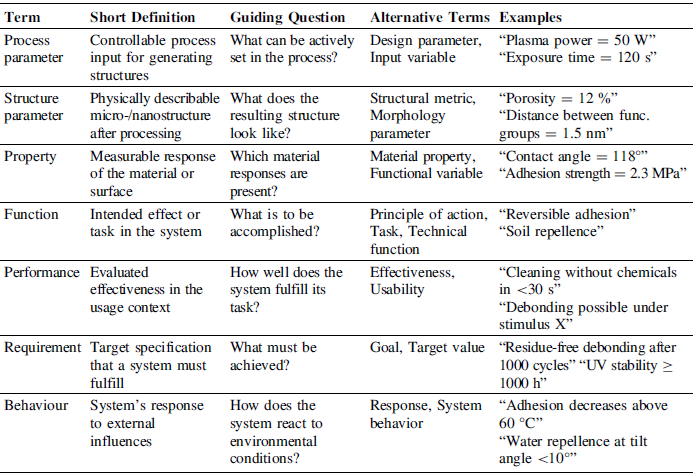
For interdisciplinary collaboration between surface development and system design, a clear differentiation and consistent linkage of the central terms is essential, since system designers and surface developers in the context of materials design have different disciplinary backgrounds and conceptual understandings, and thus may not share the same terminology (Reference Nellippallil, Allen, Gautham, Singh and MistreeNellippallil et al., 2020). The definitions of these terms, along with examples, are provided in the Table 1.
In surface and materials science, process parameters denote the controllable inputs of a manufacturing or surface-treatment process, such as plasma power, exposure time, precursor concentration or temperature. These parameters determine how matter is transformed during processing. In system design, comparable concepts exist in the form of adjustable manufacturing parameters that specify how a product is ultimately realized. The structure parameter refers to the physically describable micro- or nanostructure that results from the chosen process parameters. In materials science, this corresponds to morphology metrics such as porosity, roughness, crystallinity or the spacing of functional groups, which describe the structure after processing. In system design, this notion aligns with the idea of characteristics in the CPM/PDD terminology: characteristics are developer-influenced variables that define the system’s configuration and enable reasoning about downstream effects.
Properties are the measurable responses of the material or surface that emerge from its structure. Examples include contact angle, adhesion strength, friction coefficient or effective diffusivity. This corresponds directly to the CPM/PDD definition of properties as system responses that result from the chosen characteristics. Thus, structure parameters (characteristics) are actively selectable within the design space, whereas properties arise as a consequence of these selections and cannot be assigned independently. Function describes the intended physical or technical effect the surface is expected to achieve, such as reversible adhesion, hydrophobicity or soil repellence. In system design, a function is understood as an input–output transformation that specifies how energy, material, or information is changed or transferred, independent of any concrete physical embodiment. This abstraction clarifies what must be achieved, while leaving how it is realised open. Properties therefore serve as the link between the realised structural state of the surface and the ability to fulfil the intended function.
Definitions of core terms across surface science and system design

Performance denotes how effectively the system or surface fulfils its intended function within a specific usage context. While materials science commonly evaluates performance through metrics such as durability, stability or cycling behaviour, systems engineering uses performance to judge the degree to which functional expectations are met under defined operational conditions. A requirement specifies the target value or boundary condition the system must achieve, for example residue-free debonding or UV stability. This interpretation is consistent across both disciplines: requirements express quantifiable expectations for the system. Behavior plays a mediating and dynamic role: it describes how the system responds over time and under environmental influences, making visible how properties manifest under realistic conditions. Behavior therefore differs from function: it reflects the actual system response, not the intended effect. This leads directly to the notion of performance, which denotes the evaluated effectiveness of the system in its application context. Only by observing behavior under operational conditions can it be assessed whether performance targets, such as long-term stability or consistent anti-fouling action, are met.
Together, these definitions establish a common terminology for linking process parameters, structure parameters, properties, functions, performance criteria, requirements and behavioural responses. Without a unified, cross-disciplinary understanding of these terms, there is a high risk that system designers and surface developers will interpret the same term differently, with serious consequences for requirements analysis, function description, and the derivation of material and process parameters.
4. Methodical framework for the design of functional surfaces
A methodical framework for functional surface design begins by establishing analogies to working principles and design catalogues in mechanical engineering, enabling surface-related chemical and microstructural phenomena to be systematized in the same way as classical solution principles. Building on this abstraction layer, the framework links regulatory requirements, functional targets, and PSPP-based cause–effect relationships to translate system-level needs into controllable surface structures and process parameters.
4.1. Working-principle analogues for microstructural and chemical surface effects
We propose that, in analogy to mechanical design, where physical phenomena and associated working principles are systematically abstracted and catalogued to support function fulfilment, a similar logic can be transferred to functional surfaces at micro level with chemical phenomena. In mechanical design, catalogues of working principles provide systematic collections of solution patterns and physical effects that support the identification of suitable solutions. (Reference Pahl and BeitzPahl & Beitz, 1977; Reference RothRoth, 1994). Following this logic, micro-level effect models for functional surfaces can be organized into similar catalogues that describe how specific process configurations generate characteristic structural states, which in turn define the resulting surface properties. These properties enable functions such as reversible adhesion, hydrophobicity, or stimuli-responsive behaviour through underlying chemical and physical phenomena, analogous to how mechanical working principles and effects (such as lever effect) support function fulfilment in classical design. Such catalogued effect models establish a methodological bridge from functional demands to structure-related requirements and eventually to process implementation, thereby reducing reliance on empirical trial-and-error and supporting more systematic, transferable surface development.
As mentioned in Section 3.1, in mechanical design, quantities such as diameters or lengths (design parameters or variables) are explicitly chosen by the designer, despite the fact that they are ultimately realized through manufacturing operations. A similar relationship applies in surface engineering: surface structure parameters such as film thickness t, arithmetic roughness Ra, pore diameter dp, solid surface fraction φs or density of functional groups Γ are treated as structure variables, yet they cannot be set directly. Instead, they emerge from controllable process parameters such as energy input, temperature, exposure time, gas composition, precursor concentration, deposition rate, or plasma power. In other words, the structure parameters at the micro-chemical level correspond to design parameters in mechanical design and are achieved through coating or surface-treatment processes rather than specified as numerical values.
The functional variables correspond to measurable surface properties that arise only indirectly from these structure parameters, for example the work of adhesion or interfacial shear strength, the friction coefficient μ, the effective diffusivity Deff, the electrical conductivity σ, or the static contact angle θ. As in classical mechanics, where functional quantities such as force, moment, or pressure are interdependent and follow from selected geometrical variables, the properties in materials science are likewise coupled and cannot be specified independently of the underlying structure generated by the process. These properties are functionally coupled through shared structural parameters. Wetting and adhesion, for example, are directly linked via the Young–Dupré relation, where a lower contact angle yields higher adhesion. Tribological behavior is likewise connected to these parameters: friction often increases with higher adhesive interaction or surface roughness, reflecting the classic adhesion–friction coupling described in contact mechanics (Reference Bowden and TaborBowden & Tabor, 1950). Chemical surface composition further ties these effects together, as polar functional groups simultaneously increase surface energy, wettability and adhesion (Reference Owens and WendtOwens & Wendt, 1969). Consequently, surface properties cannot be specified independently but emerge as interdependent outcomes of the same structural and chemical design variables.
According to Reference Messer, Panchal, Allen, McDowell and MistreeMesser et al. (2007), systematic conceptual design requires identifying the underlying phenomena and the associated solution principles and organizing them in design catalogues to support structured exploration of solution spaces. Building on this, the same rationale extends to functional surface design. Once phenomena, structure variables and property couplings are explicitly formalised, they can be arranged into modular, cross-linked effect catalogues that mirror the logic of mechanical design catalogues. Such catalogues do not merely list effects but define the admissible ranges of structure parameters, the sensitivities to specific process inputs, and the resulting implications for functional performance. In this way, they act as an intermediate modelling layer that links functional targets to feasible structural states, and feasible structural states to the corresponding process windows. This enables designers to navigate the solution space systematically, select suitable effect mechanisms, and identify the process configurations that realise them, rather than relying on empirical optimisation. Consequently, surface development becomes a structured, knowledge-based activity in which microstructural and chemical phenomena are treated analogously to classical working principles, supporting reproducible and transferable design decisions.
4.2. Proposed framework
The development of functional surfaces and coatings should follow a methodological framework that systematically links regulatory, technological, and product-specific requirements (Figure 1). The starting point is a comprehensive stakeholder analysis, capturing the interests of OEMs, suppliers, recycling companies, and regulatory authorities. In parallel, relevant European directives such as the End-of-Life Vehicles Directive, the Circular Economy Action Plan, and REACH must be analyzed and translated into concrete requirements for components and their surfaces. These are then converted into measurable targets, which, in line with the PSPP approach, are expressed as performance criteria, for example recovery rates, disassembly times, or contamination thresholds.
In the next step, functional target values for the surface are derived. These include properties such as adhesion, barrier performance, reversible debonding, aging stability, or stimuli-responsive behavior. The requirements are consolidated into a target matrix that integrates both the perspective of product developers and that of surface engineers. At the same time, a technological search space is established, systematically capturing potential processes (e.g., plasma polymerization, wet-chemical methods, UV-induced processes) and mechanisms (thermal, pH-sensitive, enzymatic, photo- or electro-activated), which are then evaluated against sustainability criteria. Here, energy consumption, resource use, and environmental impact are considered at an early stage.
Building on this, experimental exploration is envisaged using statistical design of experiments. In an initial screening phase, the main influencing factors are intended to be identified, followed by advanced experimental designs (e.g., central composite or Box–Behnken designs) to analyse interactions and non-linear effects. Sensitivity analyses are planned to evaluate the robustness of the results and their transferability to different substrates or application environments. Based on these investigations, empirically grounded models are intended to be developed that formalise the process–structure–property–function relationships and support the systematic identification of feasible process corridors corresponding to the required property windows. The resulting models serve as decision-support tools for surface engineers: product developers define the required functions and corresponding properties, while surface engineers translate these into admissible structure-parameter ranges and feasible process windows based on the validated PSPP relations. Rather than merely providing abstract predictions, the DoE-based models enable identification of process corridors that are expected to generate the required property windows under defined constraints. This establishes a closed feedback loop between requirements, structure, and process, enabling targeted surface development and systematically reducing reliance on empirical trial-and-error approaches.
Integrated multi-level framework for functional surface design

Figure 1 can be read from two complementary perspectives: in a research-build view, staged DoE campaigns are required to populate the effect catalogue, quantify PSPP links, and validate manufacturable solution corridors, whereas in an engineering-use view the resulting knowledge base enables traceable navigation from circularity and regulatory targets to feasible process windows. At the current stage, this paper contributes the methodological concept and an initial structuring of bonding/debonding micro-effects as working-principle analogues, but it does not yet report completed DoE campaigns or empirically validated corridors; the example below therefore illustrates the intended pipeline and decision logic that will be fully instantiated once the catalogue is populated with evidence (hypothesised → validated).
The method is exemplified using a PE-based foil interface in an automotive interior, requiring both reliable assembly and circularity-driven end-of-life separation. Stakeholder needs and regulatory drivers are translated into meso-level circular strategies and then into component-level requirements such as minimum joint integrity, temperature budget ≤ 85 °C, solvent-free processing, and a debond-on-demand pathway. These requirements are operationalised through a target matrix structured per interface/use case containing: context and constraints (substrates, environment/lifetime), required functions, measurable performance criteria with acceptance windows (e.g., disassembly time, residue threshold, material-stream purity), and the corresponding surface-relevant property windows (e.g., 90° peel force in-use and after ageing, debonding force/energy at a defined trigger, residue after separation). Candidate solutions to achieve the required property windows for specific surfaces are identified using an effect catalogue, represented as a library of standardised effect entries. Each entry defines the effect and its working-principle analogue (chemical micro-effect with structural descriptors), supported functions and coupled properties, applicability constraints, and implementation routes (material/chemistry classes × process families). Crucially, it provides an explicit PSPP window linking feasible process-parameter corridors (e.g., plasma power/duty cycle, gas/precursor concentration, exposure time, bonding temperature/pressure) to structure-descriptor ranges (e.g., FTIR/XPS markers, roughness, thickness proxies) and the resulting achievable property windows, under a defined test method and evidence level. Selection is executed by filtering entries against constraints (e.g., PE compatibility, max. 85 °C, solvent-free), matching required functions, and retaining only those entries whose PSPP window contains a process corridor where all required min/max property limits are satisfied simultaneously, yielding candidate process windows and mechanism routes. In this paper, preliminary experiments provide seed evidence (Atmospheric pressure plasma functionalisation with GMA/HMDSN followed by peel testing and interphase characterisation) and are recorded with evidence level “preliminary”; staged multi-response DoE is the intended next step to quantify interactions and trade-offs, refine corridor boundaries, and upgrade entries to “validated”.
5. Discussion
The integration of the PSPP approach with design catalogues within system-oriented design methodologies for integrated surface development reveals both significant opportunities and methodological constraints. On the one hand, the bottom-up analysis of processing-structure-property-performance relationships provide a scientifically grounded basis for predicting functional surface behaviour. This is essential for reducing trial-and-error in the development of functional surfaces applications such as reversible coatings and adhesive-free joining technologies.
The structured use of DoE enables the identification of dominant process variables and their interactions, providing reproducibility and transferability beyond individual experiments. In addition, the DoE results can serve as a basis for building a design catalogue that links specific parameter adjustments to characteristic structural states of the surface. Such a catalogue helps identify how process settings activate or suppress defined chemical or physical phenomena at the interface, and how these phenomena, in turn, shape the resulting surface properties. By deliberately configuring process parameters to induce the desired interfacial phenomena, surfaces can be systematically modified to achieve targeted property profiles. In this way, an effect-based working principle catalogue, analogous to mechanical working principles in classical engineering design, could be established, allowing the realisation of intended functions at the component level.
On the other hand, the inherently reductionist nature of PSPP can lead to fragmentation when it is not adequately connected to system-level requirements. While process–structure models describe the local behavior of surfaces in detail, their translation into architectural and functional design decisions remains challenging. This gap reflects the different logics of bottom-up materials research and top-down engineering design. Bridging these perspectives requires not only methodological alignment but also interdisciplinary communication and shared abstractions.
The proposed framework addresses this challenge by combining a catalogue of mechanisms, a morphological parameter model, and a DoE-based validation strategy. However, its applicability will depend on how well empirical surface data can be mapped to functional requirements in system models. Uncertainties in scale transfer, long-term durability, and environmental influences remain critical issues. Furthermore, regulatory drivers such as the EU End-of-Life Vehicles Directive create a moving target: requirements for recyclability and disassembly are likely to tighten, demanding continuous adaptation of design guidelines. Overall, the approach shows potential to evolve functional surface engineering from an empirical, discipline-specific field into an integrated component of product development for circular automotive systems. Yet, this requires iterative refinement, validation through industrial case studies, and the establishment of cross-domain standards that make PSPP-based insights actionable within design processes.
6. Conclusion & outlook
This paper offers a conceptual methodical framework that integrates the PSPP approach with system-oriented design methodologies to support the development of functional surface systems. By linking process parameters, structural characteristics, and functional performance to higher-level system requirements, and by proposing the use of design catalogues for solution identification at the chemical and microstructural level, the framework suggests a structured alternative to purely empirical trial-and-error approaches. The envisioned combination of a catalogue of functional surface mechanisms, a morphological parameter model, and DoE-based validation could enable systematic exploration of design spaces and prioritization of influential factors.
Future research will focus on developing the PSPP-based surface model and the proposed catalogues for reversible surface mechanisms, validating the framework in industrial case studies, and extending the catalogue to include a broader spectrum of stimuli-responsive and bio-inspired systems. A key challenge is ensuring reliable scale transfer from laboratory experiments to real automotive applications, including durability, aging, and environmental effects. Furthermore, integrating PSPP-based surface models into digital engineering environments and system architectures remains an open task. Addressing these challenges will allow the proposed approach to mature into a transferable methodology that bridges materials science and engineering design, enabling functional surfaces to play a central role in sustainable and circular mobility systems.


 Open access

