




1 Introduction
Betweenness relations—well-known from geometry—are probably the most deeply investigated ternary relations in logic and mathematics. The origin of the studies can be traced back at least to the works of Huntington and Kline [Reference Huntington20, Reference Huntington and Kline21], through the seminal contributions of Tarski [Reference Tarski and Givant27], up to the results of Altwegg [Reference Altwegg1], Sholander [Reference Sholander26], Düvelmeyer and Wenzel [Reference Düvelmeyer and Wenzel11], and Düntsch and Urquhart [Reference Düntsch and Urquhart10].
At least as early as in the seminal papers of Jónsson and Tarski [Reference Jónsson and Tarski23], the connection between ( $n+1$
)-ary relations and n-ary operators on Boolean algebras was established in the form of Jónsson–Tarski duality for Boolean algebras with operators. The developed techniques turned out to be particularly successful in the study of modal logics and their algebraic semantics.
$n+1$
)-ary relations and n-ary operators on Boolean algebras was established in the form of Jónsson–Tarski duality for Boolean algebras with operators. The developed techniques turned out to be particularly successful in the study of modal logics and their algebraic semantics.
The abstract approach of Jónsson and Tarski can be made concrete by focusing on a relation (or relations) of particular choice, betweenness in the case of the approach from our work. As observed by van Benthem and Bezhanishvili [Reference van Benthem, Bezhanishvili, Aiello, Pratt-Hartmann and Benthem3], a ternary betweenness relation B gives rise to the binary modal operator $\mathop{\langle B\rangle _{}}$
whose relational semantics is given by the following condition:
$\mathop{\langle B\rangle _{}}$
whose relational semantics is given by the following condition:
 $$\begin{align*}x\Vdash\mathop{\langle B\rangle_{}}(\varphi,\psi)\;\mathrel{\mathord{:}\mathord{\longleftrightarrow}}\;(\exists\,{y,z\in U})\,(B(y,x,z)\ \text{and}\ y\Vdash\varphi\ \text{and}\ z\Vdash\psi)\,, \end{align*}$$
where $B(y,x,z)$
is interpreted as point x is between points y and z. Our intention is to investigate the algebraic properties of
$B(y,x,z)$
is interpreted as point x is between points y and z. Our intention is to investigate the algebraic properties of $\mathop{\langle B\rangle _{}}$
within the framework of Boolean algebras with operators.
$\mathop{\langle B\rangle _{}}$
within the framework of Boolean algebras with operators.
In Section 2 we recall basic facts about possibility and sufficiency operators which will find their application in the sequel. In Section 3 we commit ourselves to a particular notion of betweenness by choosing what we see as the core axioms for the reflexive version of the geometric relation. Section 4 justifies our approach via possibility and sufficiency operators as we show that the class of the so-called betweenness frames is neither modally nor sufficiency axiomatic. In Section 5 rudimentary facts about complex algebras of betweenness frames are established. These serve as «rôle models» for first-order axioms for what we call betweenness algebras in Section 6. In Section 7 we prove that the class of betweenness algebras is closed under canonical extensions, and in Section 8 we examine the connections between complex and abstract betweenness algebras, in particular, we show where they differ. Section 9—which rounds off the paper—points to possible extensions of our work and open problems that we are going to tackle in further installments to the work we present herein.
In the paper, $-X$
is the set-theoretical complement of X with respect to a fixed domain. For an element x of an ordered set
$-X$
is the set-theoretical complement of X with respect to a fixed domain. For an element x of an ordered set $\langle U,\leq \rangle $
,
$\langle U,\leq \rangle $
,  . We assume that unary operators always bind stronger than n-ary operators with $n\geqslant 2$
. Throughout, algebras are assumed to be non-trivial (i.e., have at least two elements), and
$n\geqslant 2$
. Throughout, algebras are assumed to be non-trivial (i.e., have at least two elements), and $\langle A,+,\cdot ,-, \mathbf{0}, \mathbf{1} \rangle $
is a non-trivial Boolean algebra (BA). To avoid notational cluttering we shall usually identify Boolean algebras with their universe; in particular,
$\langle A,+,\cdot ,-, \mathbf{0}, \mathbf{1} \rangle $
is a non-trivial Boolean algebra (BA). To avoid notational cluttering we shall usually identify Boolean algebras with their universe; in particular, $2^U$
denotes the power set algebra of U. Furthermore,
$2^U$
denotes the power set algebra of U. Furthermore, $\mathrm{At}(A)$
is the set of atoms of A and
$\mathrm{At}(A)$
is the set of atoms of A and $\mathrm{Ult}(A)$
the set of its ultrafilters.
$\mathrm{Ult}(A)$
the set of its ultrafilters.
Our general references are [Reference Blackburn, de Rijke and Venema4] for modal logic, [Reference Koppelberg, Monk and Bonnet24] for Boolean algebras, and [Reference Burris and Sankappanavar5] for universal algebra.
2 Boolean algebras with operators
Boolean algebras with operators (BAOs) were introduced by Jónsson and Tarski [Reference Jónsson and Tarski23], arising from Tarski’s work on relation algebras. It turned out later that BAOs were intimately connected to the semantics of modal logics; for details the reader is encouraged to consult [Reference Goldblatt16, Section 3.3]. An extensive treatment of duality theories for BAOs was presented by Givant [Reference Givant14].
In this section we shall outline the properties of BAOs as we need them, and augment them by a theory of sufficiency algebras.
Definition 2.1. A mapping $f\colon A^n\to A$
(where
$f\colon A^n\to A$
(where $n\geqslant 1$
) is an n-ary possibility operator if and only if it satisfies the following conditions:
$n\geqslant 1$
) is an n-ary possibility operator if and only if it satisfies the following conditions:
-
(P1) If there is i such that $1\leqslant i\leqslant n$
and
$x_i=\mathbf{0}$
, then
$f(x_1,\ldots ,x_n)=\mathbf{0}$
(normality).
$1\leqslant i\leqslant n$
and
$x_i=\mathbf{0}$
, then
$f(x_1,\ldots ,x_n)=\mathbf{0}$
(normality). -
(P2) If
$\langle x_1, \ldots , x_n \rangle $
and
$\langle y_1, \ldots , y_n \rangle $
are n-termed sequences in A such that
$x_i = y_i$
for all
$i \neq k$
, then
$f(x_1,\ldots , x_k, \ldots ,x_n)+f(y_1, \ldots , y_k, \ldots ,y_n)=f(x_1, \ldots , x_k+y_k, \ldots , x_n)$
(additivity).






Observe that a possibility operator is monotone in each argument.
Suppose that $1 \leqslant n$
and
$1 \leqslant n$
and $f\colon A^n \to A$
is a possibility operator on A. The possibility canonical frame of
$f\colon A^n \to A$
is a possibility operator on A. The possibility canonical frame of 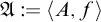 is the structure
  where
where $Q_f$
is the (
$Q_f$
is the ( $n+1$
)-ary relation on
$n+1$
)-ary relation on $\mathrm{Ult}(A)$
defined by
$\mathrm{Ult}(A)$
defined by
 $$ \begin{align} Q_f(\mathscr{U}_1, \ldots, \mathscr{U}_{n+1}) \;\mathrel{\mathord{:}\mathord{\longleftrightarrow}}\; f[\mathscr{U}_1 \times \cdots \times \mathscr{U}_n] \subseteq \mathscr{U}_{n+1}. \end{align} $$
The choice of the $n+1^{\text {st}}$
entry as special is arbitrary; any other index would have done. Indeed, when considering the binary operators on betweenness algebras arising from ternary relations we shall use the middle component.
$n+1^{\text {st}}$
entry as special is arbitrary; any other index would have done. Indeed, when considering the binary operators on betweenness algebras arising from ternary relations we shall use the middle component.
Suppose that  is a frame where Q is an $(n+1)$
-ary relation on U. We define an n-ary operator
$(n+1)$
-ary relation on U. We define an n-ary operator $\langle { Q \rangle }\colon \left (2^U\right)^n \to 2^U$
by
$\langle { Q \rangle }\colon \left (2^U\right)^n \to 2^U$
by

It is well known that $\langle { Q \rangle }$
is a complete possibility operator [Reference Jónsson and Tarski23]. The structure
$\langle { Q \rangle }$
is a complete possibility operator [Reference Jónsson and Tarski23]. The structure $\langle 2^U, \langle { Q \rangle } \rangle $
is called the full possibility complex algebra over
$\langle 2^U, \langle { Q \rangle } \rangle $
is called the full possibility complex algebra over $\mathfrak{F}$
, denoted by
$\mathfrak{F}$
, denoted by $\operatorname {{\mathsf{Cm}}}^p(\mathfrak{F})$
. Each subalgebra is called a possibility complex algebra over
$\operatorname {{\mathsf{Cm}}}^p(\mathfrak{F})$
. Each subalgebra is called a possibility complex algebra over $\mathfrak{F}$
. If
$\mathfrak{F}$
. If $\mathfrak{F}$
is understood we shall just speak of possibility complex algebras.
$\mathfrak{F}$
is understood we shall just speak of possibility complex algebras.
The following result is decisive for the theory of BAOs and generalizes Stone’s theorem of representing Boolean algebras:
Theorem 2.2 [Reference Jónsson and Tarski23, Theorem 3.10]
If  is a Boolean algebra with an n-ary possibility operator f, then the Stone map $h\colon h \hookrightarrow 2^{\mathrm{Ult}(A)}$
, defined by
$h\colon h \hookrightarrow 2^{\mathrm{Ult}(A)}$
, defined by  is an embedding of $\mathfrak{A}$
into
$\mathfrak{A}$
into $\operatorname {{\mathsf{Cm}}}^p(\operatorname {{\mathsf{Cf}}}^p(\mathfrak{A}))$
.
$\operatorname {{\mathsf{Cm}}}^p(\operatorname {{\mathsf{Cf}}}^p(\mathfrak{A}))$
.
The algebra $\operatorname {{\mathsf{Cm}}}^p(\operatorname {{\mathsf{Cf}}}^p(\mathfrak{A}))$
is called the possibility canonical extension of
$\operatorname {{\mathsf{Cm}}}^p(\operatorname {{\mathsf{Cf}}}^p(\mathfrak{A}))$
is called the possibility canonical extension of $\mathfrak{A}$
, denoted by
$\mathfrak{A}$
, denoted by $\operatorname {{\mathsf{Em}}}^{p}(\mathfrak{A})$
. For details of the origin and theory of BAOs see the survey by Jónsson [Reference Jónsson, Rosenberg and Sabidussi22].
$\operatorname {{\mathsf{Em}}}^{p}(\mathfrak{A})$
. For details of the origin and theory of BAOs see the survey by Jónsson [Reference Jónsson, Rosenberg and Sabidussi22].
Starting with an ( $n+1$
)-ary frame
$n+1$
)-ary frame  there is also a representation theorem:
Theorem 2.3. $\mathfrak{F}$
can be embedded into the canonical frame of its full possibility complex algebra.
$\mathfrak{F}$
can be embedded into the canonical frame of its full possibility complex algebra.
Proof This is a generalization of [Reference Orłowska, Radzikowska and Rewitzky25, Theorem 3.2.7]. Define $k\colon \mathfrak{F} \to \mathrm{Ult}(\operatorname {{\mathsf{Cm}}}^p(\mathfrak{F}))$
by
$k\colon \mathfrak{F} \to \mathrm{Ult}(\operatorname {{\mathsf{Cm}}}^p(\mathfrak{F}))$
by  , that is, $k(x)$
is the principal filter of
$k(x)$
is the principal filter of $2^U$
generated by
$2^U$
generated by $\{x\}$
; clearly, k is injective. We define
$\{x\}$
; clearly, k is injective. We define $\langle { R \rangle }$
as in (2), and
$\langle { R \rangle }$
as in (2), and $Q_{\langle { R \rangle }}$
as in (1).
$Q_{\langle { R \rangle }}$
as in (1).
Let $x_1, \ldots , x_{n+1} \in U$
. Then:
$x_1, \ldots , x_{n+1} \in U$
. Then:
 $$ \begin{align*} Q_{\langle { R \rangle}}(k(x_1), \ldots, k(x_{n+1})) &\longleftrightarrow \langle { R \rangle}\left[\mathop{\uparrow}\{x_1\}, \ldots, \mathop{\uparrow}\{x_n\}\right] \subseteq \mathop{\uparrow}\{x_{n+1}\} \\ &\longleftrightarrow (\forall X_i)\,(x_i \kern1.3pt{\in}\kern1.3pt X_i, 1 \kern1.3pt{\leq}\kern1.3pt i \kern1.3pt{\leq}\kern1.3pt n \kern1.3pt{\rightarrow}\kern1.3pt \langle { R \rangle}(X_1, \ldots X_n) \kern1.3pt{\in}\kern1.3pt \mathop{\uparrow}\{x_{n+1}\}) \\ &\longleftrightarrow (\forall X_i)\,(x_i \in X_i, 1 \leq i \leq n \rightarrow x_{n+1} \in \langle { R \rangle}(X_1, \ldots X_n)) \\ &\longleftrightarrow (\forall X_i)(x_i \in X_i, 1 \leq i \leq n \rightarrow\\ &\phantom{(\forall X_i)(x_i \in X_i,}(\exists u_i \in X_i)R(u_1, \ldots, u_n,x_{n+1}))\,. \end{align*} $$
If $R(x_1, \ldots , x_{k+1})$
, we choose
$R(x_1, \ldots , x_{k+1})$
, we choose  ; this shows that $Q_{\langle { R \rangle }}(k(x_1), \ldots , k(x_{n+1}))$
. Conversely, if
$Q_{\langle { R \rangle }}(k(x_1), \ldots , k(x_{n+1}))$
. Conversely, if $Q_{\langle { R \rangle }}(k(x_1), \ldots , k(x_{n+1}))$
, choosing
$Q_{\langle { R \rangle }}(k(x_1), \ldots , k(x_{n+1}))$
, choosing  shows that the tuple $\langle x_1, \ldots , x_{k+1} \rangle $
is in R.
$\langle x_1, \ldots , x_{k+1} \rangle $
is in R.
The relational semantics of classical modal logics is limited in expression since it can talk about (some) properties of a binary relation R but not about properties of $-R$
. A “sufficiency” counterpart of the modal necessity operator
$-R$
. A “sufficiency” counterpart of the modal necessity operator $\Box $
was independently suggested by Humberstone [Reference Humberstone19] with
$\Box $
was independently suggested by Humberstone [Reference Humberstone19] with $\blacksquare $
and Gargov et al. [Reference Gargov, Passy and Tinchev13] with ◫.Footnote
1
The algebraic properties of such an operator and representation properties were investigated in a sequence of papers by Düntsch and Orłowska [Reference Düntsch and Orłowska6, Reference Düntsch and Orłowska7] and Düntsch, Orłowska, and Tinchev [Reference Düntsch, Orłowska and Tinchev9].
$\blacksquare $
and Gargov et al. [Reference Gargov, Passy and Tinchev13] with ◫.Footnote
1
The algebraic properties of such an operator and representation properties were investigated in a sequence of papers by Düntsch and Orłowska [Reference Düntsch and Orłowska6, Reference Düntsch and Orłowska7] and Düntsch, Orłowska, and Tinchev [Reference Düntsch, Orłowska and Tinchev9].
Definition 2.4. A mapping $g\colon A^n\to A$
is an n-ary sufficiency operator if and only if g meets the following two constraints:
$g\colon A^n\to A$
is an n-ary sufficiency operator if and only if g meets the following two constraints:
-
(S1) If there is i such that
$1\leqslant i\leqslant n$
and
$x_i=\mathbf{0}$
, then
$g(x_1,\ldots ,x_n)=\mathbf{1}$
(co-normality). -
(S2) If
$\langle x_1, \ldots , x_n \rangle $
and
$\langle y_1, \ldots , y_n \rangle $
are n-termed sequences in A such that
$x_i = y_i$
for all
$i \neq k$
, then
$g(x_1,\ldots , x_k, \ldots ,x_n) \cdot g(y_1, \ldots , y_k, \ldots ,y_n)=g(x_1, \ldots , x_k + y_k, \ldots , x_n)$
(co-additivity).



Note that a sufficiency operator is antitone in each argument.
The pair  is called a sufficiency algebra. While unary possibility algebras are algebraic models of the logic $\mathsf{K}$
, the unary sufficiency algebras are algebraic models of its counterpart
$\mathsf{K}$
, the unary sufficiency algebras are algebraic models of its counterpart $\mathsf{K^*}$
[Reference Tehlikeli28]. The sufficiency canonical frame is the system
$\mathsf{K^*}$
[Reference Tehlikeli28]. The sufficiency canonical frame is the system $\langle \mathrm{Ult}(A), S \rangle $
where S is the
$\langle \mathrm{Ult}(A), S \rangle $
where S is the $(n+1)$
-ary relation on
$(n+1)$
-ary relation on $\mathrm{Ult}(A)$
defined by
$\mathrm{Ult}(A)$
defined by
 $$ \begin{align*} S(\mathscr{U}_1, \ldots, \mathscr{U}_{n+1}) \;\mathrel{\mathord{:}\mathord{\longleftrightarrow}}\; g[\mathscr{U}_1 \times \cdots \times \mathscr{U}_n] \cap \mathscr{U}_{n+1} \neq \emptyset, \end{align*} $$
denoted by $\operatorname {{\mathsf{Cf}}}^s(\mathfrak{A})$
. Conversely, If
$\operatorname {{\mathsf{Cf}}}^s(\mathfrak{A})$
. Conversely, If  is an
is an $(n+1)$
-ary frame we define an n-ary operator
$(n+1)$
-ary frame we define an n-ary operator $[[ S ]]$
on
$[[ S ]]$
on $2^U$
by
$2^U$
by

The algebra $\langle 2^U, [[ S ]] \rangle $
is called the full sufficiency complex algebra of
$\langle 2^U, [[ S ]] \rangle $
is called the full sufficiency complex algebra of $\mathfrak{F}$
, denoted by
$\mathfrak{F}$
, denoted by $\operatorname {{\mathsf{Cm}}}^s(\mathfrak{F})$
. Each subalgebra is called a sufficiency complex algebra over
$\operatorname {{\mathsf{Cm}}}^s(\mathfrak{F})$
. Each subalgebra is called a sufficiency complex algebra over $\mathfrak{F}$
. If
$\mathfrak{F}$
. If $\mathfrak{F}$
is understood we shall omit the reference to
$\mathfrak{F}$
is understood we shall omit the reference to $\mathfrak{F}$
. It is well known that
$\mathfrak{F}$
. It is well known that $[[ S ]]$
is a complete co-additive operator on
$[[ S ]]$
is a complete co-additive operator on $2^U$
[Reference Düntsch and Orłowska6, Proposition 5]. In analogy to possibility algebras we have
$2^U$
[Reference Düntsch and Orłowska6, Proposition 5]. In analogy to possibility algebras we have
Theorem 2.5 [Reference Düntsch and Orłowska6]
-
(1) If a mapping g is an n-ary sufficiency operator on
$\mathfrak{A}$
, the Stone map
$h\colon \mathfrak{A} \to 2^{\mathrm{Ult}(A)}$
is an embedding of
$\mathfrak{A}$
into
$\operatorname {{\mathsf{Cm}}}^s(\operatorname {{\mathsf{Cf}}}^s(\mathfrak{A}))$
. -
(2) If
is an
$(n+1)$
-ary frame the map
$k\colon \mathfrak{F} \to \mathrm{Ult}(\operatorname {{\mathsf{Cm}}}^s(\mathfrak{F}))$
such that is an embedding.




 is an
is an 

 is an embedding.
 Any algebra  such that A is a BA and f and g are—respectively—a possibility and a sufficiency operator of the same arity will be called a Possibility–Sufficiency-algebra (PS-algebra). Since the mappings h and k are the same as in Theorems 2.2 and 2.3 we can define the PS–canonical frame of $\mathfrak{A}$
as
$\mathfrak{A}$
as $\langle \mathrm{Ult}(A), Q_f, S_g \rangle $
and denote it by
$\langle \mathrm{Ult}(A), Q_f, S_g \rangle $
and denote it by $\operatorname {{\mathsf{Cf}}}^{ps}(\mathfrak{A})$
. The algebra
$\operatorname {{\mathsf{Cf}}}^{ps}(\mathfrak{A})$
. The algebra $\operatorname {{\mathsf{Cm}}}^{ps}(\operatorname {{\mathsf{Cf}}}^{ps}(\mathfrak{A}))$
is called the canonical extension of
$\operatorname {{\mathsf{Cm}}}^{ps}(\operatorname {{\mathsf{Cf}}}^{ps}(\mathfrak{A}))$
is called the canonical extension of $\mathfrak{A}$
, denoted by
$\mathfrak{A}$
, denoted by $\operatorname {{\mathsf{Em}}}^{ps}(\mathfrak{A})$
. The structure
$\operatorname {{\mathsf{Em}}}^{ps}(\mathfrak{A})$
. The structure $\operatorname {{\mathsf{Cf}}}^{ps}(\operatorname {{\mathsf{Cm}}}^{ps}(\mathfrak{F}))$
is the canonical extension of
$\operatorname {{\mathsf{Cf}}}^{ps}(\operatorname {{\mathsf{Cm}}}^{ps}(\mathfrak{F}))$
is the canonical extension of $\mathfrak{F}$
denoted by
$\mathfrak{F}$
denoted by $\operatorname {{\mathsf{Ce}}}^{ps}(\mathfrak{F})$
.
$\operatorname {{\mathsf{Ce}}}^{ps}(\mathfrak{F})$
.
From the outset, there is no connection between the possibility operator f and the sufficiency operator g. To enhance the expressiveness of the combined corresponding logics, Düntsch and Orłowska [Reference Düntsch and Orłowska6] introduced the class of mixed algebras (MIAs) which are PS-algebras  which satisfy the condition $Q_f = S_g$
; in the unary case this is equivalent to
$Q_f = S_g$
; in the unary case this is equivalent to
 $$ \begin{align} (\forall \mathscr{U}_1,\mathscr{U}_2 \in \mathrm{Ult}(A)) \left(f[\mathscr{U}_1] \subseteq \mathscr{U}_2 \longleftrightarrow g[\mathscr{U}_1] \cap \mathscr{U}_2 \neq \emptyset\right)\,. \end{align} $$
It was shown that the class of MIAs is not first-order axiomatizable and that the canonical extension of a MIA is isomorphic to the full complex algebra $\langle 2^U,\langle { R \rangle }, [[ R ]] \rangle $
of a frame. For an overview and examples of mixed algebras with unary operators see [Reference Orłowska, Radzikowska and Rewitzky25, Section 3.6]. Subsequently, Düntsch, Orłowska, and Tinchev [Reference Düntsch, Orłowska and Tinchev9] introduced a first-order axiomatizable proper subclass of mixed algebras, called weak MIAs, which satisfy in the unary case the axiom:
$\langle 2^U,\langle { R \rangle }, [[ R ]] \rangle $
of a frame. For an overview and examples of mixed algebras with unary operators see [Reference Orłowska, Radzikowska and Rewitzky25, Section 3.6]. Subsequently, Düntsch, Orłowska, and Tinchev [Reference Düntsch, Orłowska and Tinchev9] introduced a first-order axiomatizable proper subclass of mixed algebras, called weak MIAs, which satisfy in the unary case the axiom:
 $$ \begin{align} a \neq \mathbf{0} \rightarrow g(a) \leq f(a). \end{align} $$
It turned out that the equational class generated by the weak MIAs are the algebraic models of the logic $K\tilde {~}$
, presented by Gargov et al. [Reference Gargov, Passy and Tinchev13]. We shall see later that the axioms of betweenness relations can be algebraically expressed in weak MIAs, but not by possibility or sufficiency operators alone.
$K\tilde {~}$
, presented by Gargov et al. [Reference Gargov, Passy and Tinchev13]. We shall see later that the axioms of betweenness relations can be algebraically expressed in weak MIAs, but not by possibility or sufficiency operators alone.
3 A definition of betweenness
In the sequel, we will focus on relational systems $\langle U,B\rangle $
such that B is a ternary relation on a non-empty set U. Such systems will be called 3-frames.
$\langle U,B\rangle $
such that B is a ternary relation on a non-empty set U. Such systems will be called 3-frames.
Definition 3.1. Let $\langle U,B\rangle $
be a 3-frame. B is called a betweenness relation if it satisfies the following (universal) axioms:
$\langle U,B\rangle $
be a 3-frame. B is called a betweenness relation if it satisfies the following (universal) axioms:
 $$ \begin{align} B(a,a,a)\,, \end{align} $$
 $$ \begin{align} B(a,b,c)\rightarrow B(c,b,a)\,, \end{align} $$
 $$ \begin{align} B(a,b,c)\rightarrow B(a,a,b)\,, \end{align} $$
 $$ \begin{align} B(a,b,c)\wedge B(a,c,b)\rightarrow b=c\,\,. \end{align} $$
Note that (BT0)–(BT2) are expanding in the sense that they require certain triples to be in a betweenness relation, while (BT3) is contracting, since it prohibits triples to be in B.
Definition 3.2. A ternary relation B is a weak betweenness if it satisfies (BT0)–(BT2) and
 $$ \begin{align} B(a,b,a)\rightarrow a=b\,. \end{align} $$
The following example shows that (BTW) is strictly weaker than (BT3):
Example 3.3. Set  and define

Then, (BTW) is vacuously true, and $\langle 0,1,2 \rangle , \langle 0,2,1 \rangle \in B$
.
$\langle 0,1,2 \rangle , \langle 0,2,1 \rangle \in B$
.
To show the difference consider the following condition:
 $$ \begin{align} \#\langle a,b,c\rangle\rightarrow (\langle a,b,c\rangle\notin B\vee \langle a,c,b\rangle\notin B)\,. \end{align} $$
Here, $\#\langle a,b,c \rangle $
if and only if
$\#\langle a,b,c \rangle $
if and only if $\vert \{a,b,c\}\vert = 3$
.
$\vert \{a,b,c\}\vert = 3$
.
Proposition 3.4. Assume B satisfies (BT2). Then, B satisfies (BT3) if and only if it satisfies (BTW) and (C).
Proof ( $\rightarrow $
) For (BTW) consider
$\rightarrow $
) For (BTW) consider
 $$ \begin{align*} B(x,y,x) \overset{({\scriptstyle BT2})}{\longrightarrow} B(x,x,y) \overset{({\scriptstyle BT3})}{\longrightarrow} x = y. \end{align*} $$
If $B(x,y,z)$
and
$B(x,y,z)$
and $B(x,z,y)$
, then
$B(x,z,y)$
, then $y = z$
by (BT3), and thus, not
$y = z$
by (BT3), and thus, not $\#\langle x,y,z \rangle $
.
$\#\langle x,y,z \rangle $
.
( $\leftarrow $
) Suppose that
$\leftarrow $
) Suppose that $B(x,y,z)$
and
$B(x,y,z)$
and $B(x,z,y)$
; then, not
$B(x,z,y)$
; then, not $\#\langle x,y,z \rangle $
by (C). If
$\#\langle x,y,z \rangle $
by (C). If $y = z$
, there is nothing more to show. If
$y = z$
, there is nothing more to show. If $x = z$
, then
$x = z$
, then $B(x,y,x)$
, and
$B(x,y,x)$
, and $x = y$
by (BTW); hence,
$x = y$
by (BTW); hence, $y = z$
. Similarly, if
$y = z$
. Similarly, if $x = y$
, then
$x = y$
, then $B(x,z,x)$
and therefore
$B(x,z,x)$
and therefore $x = y = z$
.
$x = y = z$
.
Definition 3.5. B is a strong betweenness if B meets the following stronger version of (BT2):
 $$ \begin{align} B(a,a,b). \end{align} $$
Clearly, (BT2s) implies (BT2). In the presence of symmetry in the form of (BT1), the axiom (BT2s) is equivalent to Tarski’s axiom 12 from [Reference Tarski and Givant27].
The choice of the axioms is by no means arbitrary, but embodies what can be seen as the core axioms for reflexive betweenness. Reflexivity in the form of (BT0) is equivalent to Axiom 13 of Tarski and Givant [Reference Tarski and Givant27]. Symmetry, which is (BT1), is taken as Postulate A by Huntington and Kline [Reference Huntington and Kline21]Footnote 2 and Axiom 14 by Tarski and Givant. (BT2) in the presence of symmetry can be seen as a weakening of Tarski’s reflexivity axiom (Axiom 12) and is one of the axioms for betweenness obtained from binary relations (see [Reference Altwegg1]). (BT3) arises naturally in the context of—again—betweenness induced by binary relations and has a clear and natural geometric meaning. (BTW) is present in Tarski’s system as Axiom 6.
For more on the motivation for the choice of (BT0)–(BT3) the reader is invited to consult [Reference Düntsch and Urquhart10].
 such that

4 Non-definability of betweenness relations
In the algebraic approach to betweenness, we are going to engage both possibility and sufficiency operators. This is justified by the fact that betweenness is neither possibility nor sufficiency axiomatic (i.e., the relation cannot be grasped by means of either possibility or sufficiency operator alone). We devote this section to the proofs of the aforementioned phenomena.
4.1 Bounded and co-bounded morphisms
The standard notion of a bounded morphism for binary relations has a natural generalization to n-ary ones. We restrict ourselves to $3$
-frames since this is all we require.
$3$
-frames since this is all we require.
Definition 4.1. If $\langle U,R\rangle $
and
$\langle U,R\rangle $
and $\langle V,S\rangle $
are 3-frames, then a mapping
$\langle V,S\rangle $
are 3-frames, then a mapping $f\colon U\to V$
is a bounded morphism if:
$f\colon U\to V$
is a bounded morphism if:
-
(1)
$R(x,y,z)$
, then
$S(f(x),f(y),f(z))$
(i.e., f preserves R, i.e., satisfies the forth condition); -
(2)
$S(f(w),x,y)$
, then
$(\exists u,v\in U)(f(u)=x\wedge f(v)=y\wedge R(w,u,v))$
(i.e., f satisfies the back condition) [Reference Blackburn, de Rijke and Venema4, p. 140].



 $f\colon U\to V$
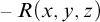
is called a co-bounded morphism if for all
$f\colon U\to V$
is called a co-bounded morphism if for all $x,y,z\in U$
and
$x,y,z\in U$
and $t\in V$
:
$t\in V$
:
-
(a)
$-R(x,y,z)$
, then
$-S(f(x),f(y),f(z))$
(i.e., f preserves
$-R$
); -
(b)
$-S(f(w),x,y)$
, then
$(\exists u,v\in U)(f(u)=x\wedge f(v)=y\wedge -R(w,u,v))$
(i.e., f satisfies the back condition).




Since in the case of betweenness relations the middle argument plays a distinguished role, we allow ourselves to modify the definition accordingly when we need it without spelling it out explicitly.
The following two theorems are crucial for the sequel.
Theorem 4.2 [Reference Goldblatt and Thomason17, Theorem 3]
Let $\tau $
be a modal similarity type. A first-order definable class of
$\tau $
be a modal similarity type. A first-order definable class of $\tau $
frames is possibility definable if and only if it is closed under taking bounded homomorphic images, generated subframes, disjoint unions, and reflects ultrafilter extensions.
$\tau $
frames is possibility definable if and only if it is closed under taking bounded homomorphic images, generated subframes, disjoint unions, and reflects ultrafilter extensions.
Theorem 4.3 [Reference Düntsch and Orłowska6, Section 5]
Let $\tau $
be a sufficiency similarity type. A first-order definable class of
$\tau $
be a sufficiency similarity type. A first-order definable class of $\tau $
frames
$\tau $
frames $\langle U,R\rangle $
is sufficiency definable if and only if the class of its complementary frames
$\langle U,R\rangle $
is sufficiency definable if and only if the class of its complementary frames $\langle U,-R\rangle $
is possibility definable.
$\langle U,-R\rangle $
is possibility definable.
4.2 Non-definability
For the first of the two non-definability results (and for several examples in the sequel), we invoke relevant facts about betweenness relations obtained from binary ones. If $\langle U,R\rangle $
is a binary frame, then it induces a «natural» ternary relation B on U:
$\langle U,R\rangle $
is a binary frame, then it induces a «natural» ternary relation B on U:
 $$\begin{align*}B_R(x,y,z)\;\mathrel{\mathord{:}\mathord{\longleftrightarrow}}\; x\mathrel{R} y\mathrel{R} z\vee z\mathrel{R} y\mathrel{R} x\,. \end{align*}$$
For these, we mention only one more definition and two basic facts:
Definition 4.4. A binary relation $\mathrel{R}$
on U is called strongly antisymmetric if and only if
$\mathrel{R}$
on U is called strongly antisymmetric if and only if
 $$\begin{align*}x\mathrel{R} y\mathrel{R} z\mathrel{R} x\rightarrow y=z. \end{align*}$$
Proposition 4.5 [Reference Gruszczyński and Menchón18]
A reflexive $\mathrel{R}\ \subseteq U^2$
is strongly antisymmetric if and only if
$\mathrel{R}\ \subseteq U^2$
is strongly antisymmetric if and only if $B_R$
is a betweenness relation.
$B_R$
is a betweenness relation.
Corollary 4.6. If $R\subseteq U^2$
is a partial order relation, then
$R\subseteq U^2$
is a partial order relation, then $B_R$
is a betweenness relation.
$B_R$
is a betweenness relation.
Among the betweenness axioms, (BT0) and (BT1) have modal correspondents which is proved below in Theorem 6.6. However, in general, we have
Theorem 4.7 [Reference Düntsch and Orłowska8]
The class of weak betweenness relations is not modal axiomatic.
Proof We are going to show that the class of weak betweenness relations is not closed under bounded morphisms. To this end, consider the set  of all integers with the relation $B_{\leqslant }$
induced by the standard linear order
$B_{\leqslant }$
induced by the standard linear order $\leqslant $
on
$\leqslant $
on  . By Corollary 4.6 we have that $B_{\leqslant}$
is a betweenness relation, and so,
$B_{\leqslant}$
is a betweenness relation, and so,  is a b-frame. On the other hand,
  where
where $w_0\neq w_1$
and
$w_0\neq w_1$
and  is not even a weak b-frame, as R does not satisfy (BTW).
Let  be such that

Since R is the universal ternary relation on $\{w_0,w_1\}$
, f preserves
$\{w_0,w_1\}$
, f preserves $B_{\leqslant }$
, so to show that f is indeed a bounded morphism all that is left is to prove that f satisfies the back condition:
$B_{\leqslant }$
, so to show that f is indeed a bounded morphism all that is left is to prove that f satisfies the back condition:

The proof will be done by cases: Suppose $R(u,f(x),v)$
. In case
$R(u,f(x),v)$
. In case $f(x)=w_0$
, we have that x is even, and there are the following possibilities:
$f(x)=w_0$
, we have that x is even, and there are the following possibilities:
-
(1)
$u=v=w_0$
: Set . We have
$B_{\leqslant }(x,x,x)$
and
$f(y)=w_0$
and
$f(z)=w_0$
. -
(2)
$u=v=w_1$
: Set and . Thus
$B_{\leqslant }(x-1,x,x+1)$
and
$f(x-1)=w_1$
and
$f(x+1)=w_1$
. -
(3)
$u=w_0$
and
$v=w_1$
: Set and . Thus
$B_{\leqslant }(x,x,x+1)$
and
$f(x)=w_0$
and
$f(x+1)=w_1$
. -
(4)
$u=w_1$
and
$v=w_0$
: Set and . We have that
$B_{\leqslant }(x-1,x,x)$
and
$f(y)= w_1$
and
$f(z)=w_0$
.

 . We have


 and
and  . Thus




 and
and  . Thus


 and
and  . We have that


The proof for the case $f(x)=w_1$
is analogous.
$f(x)=w_1$
is analogous.
Theorem 4.8. The class of betweenness relations is not sufficiency axiomatic.
Proof In light of Theorem 4.3 it is enough to show that the class of complementary 3-frames for betweenness frames is not possibility definable. This is the same as showing that the class of betweenness frames is not closed under co-bounded morphisms. Thus, we exhibit two 3-frames $\langle U,R\rangle $
and
$\langle U,R\rangle $
and $\langle V,S\rangle $
as well as a co-bounded surjective morphism
$\langle V,S\rangle $
as well as a co-bounded surjective morphism $p\colon U\to V$
such that
$p\colon U\to V$
such that $\langle U,R\rangle $
is a betweenness frame and
$\langle U,R\rangle $
is a betweenness frame and $\langle V,S\rangle $
is not.
$\langle V,S\rangle $
is not.
Let  and
and  ; then R is a betweenness relation. Furthermore, set
  and
and  ; then $-S=\{\langle x,x,x\rangle \}$
and S is not a betweenness relation since it does not satisfy (BT0).
$-S=\{\langle x,x,x\rangle \}$
and S is not a betweenness relation since it does not satisfy (BT0).
Obviously, there is a unique surjection $p\colon U\to V$
given by
$p\colon U\to V$
given by  , and it is a bounded morphism between $\langle U,-R\rangle $
and
$\langle U,-R\rangle $
and $\langle V,-S\rangle $
. It preserves
$\langle V,-S\rangle $
. It preserves $-R$
as it is constant, and it satisfies the back condition since if, e.g.,
$-R$
as it is constant, and it satisfies the back condition since if, e.g., $-S(x,p(a),x)$
, then
$-S(x,p(a),x)$
, then $-R(b,a,b)$
and
$-R(b,a,b)$
and $p(b)=x$
.
$p(b)=x$
.
The proof reflects the fact that reflexivity of a binary relation is not definable by a unary sufficiency operator.
5 Complex algebras of b-frames
To motivate the choice of axioms for abstract algebras of betweenness we will focus on b-frames and their complex algebras. We are going to show that axioms of b-frames correspond to algebraic properties of their complex algebras, and the latter will serve in the next section as «role models» for the axioms expressed within the framework of PS-algebras.
For a $3$
-frame
$3$
-frame  we define its complex operators by


 $$\begin{align} ={}& \{u \in U\mid X \times \{u\} \times Y \subseteq B\}. \nonumber \qquad\quad\end{align} $$
Thus, $\operatorname {{\mathsf{Cm}}}^{ps}(\mathfrak{F})=\langle 2^U,\langle { B \rangle },[[ B ]]\rangle $
is the full complex algebra of
$\operatorname {{\mathsf{Cm}}}^{ps}(\mathfrak{F})=\langle 2^U,\langle { B \rangle },[[ B ]]\rangle $
is the full complex algebra of $\mathfrak{F}$
. We will prove that the following conditions for complex algebras correspond to relational axioms for betweenness:
$\mathfrak{F}$
. We will prove that the following conditions for complex algebras correspond to relational axioms for betweenness:
 $$\begin{align} X\subseteq\langle { B \rangle}(X,X)\,, \end{align}$$
 $$\begin{align} \langle { B \rangle}(X,Y)\subseteq\langle { B \rangle}(Y,X)\,, \end{align} $$
 $$\begin{align} [[ B ]](X,Y)\subseteq[[ B ]](Y,X)\,, \end{align} $$
 $$\begin{align} Y\cap\langle { B \rangle}(X,Z)\subseteq\langle { B \rangle}(X\cap\langle { B \rangle}(X,Y),Z)\,, \end{align} $$
 $$\begin{align} \langle { B \rangle}(X,[[ B ]](X,-Y)\cap Y)\subseteq Y\,, \end{align} $$
 $$\begin{align} [[ B ]](X,X)\subseteq X\,,\ \text{for all}\ X\neq\emptyset\,, \end{align} $$
 $$\begin{align} X\subseteq\langle { B \rangle}(X,Y)\,,\ \text{for all}\ Y\neq\emptyset\,. \end{align} $$
Note that all of these are universal, so they hold in all subalgebras of $\operatorname {{\mathsf{Cm}}}^{ps}(\mathfrak{F})$
.
$\operatorname {{\mathsf{Cm}}}^{ps}(\mathfrak{F})$
.
Theorem 5.1. Let  be a 3-frame. Then, $\mathfrak{F}$
satisfies (BTi) if and only if
$\mathfrak{F}$
satisfies (BTi) if and only if $\operatorname {{\mathsf{Cm}}}^{ps}(\mathfrak{F})$
satisfies (BT
$\operatorname {{\mathsf{Cm}}}^{ps}(\mathfrak{F})$
satisfies (BT $i^\mathfrak{c}$
), for any
$i^\mathfrak{c}$
), for any $i\in \{0,1_f,1_g,2,3,\mathrm{W},2\mathrm{s}\}$
.
$i\in \{0,1_f,1_g,2,3,\mathrm{W},2\mathrm{s}\}$
.
Proof ( $i=0$
) Let
$i=0$
) Let $\mathfrak{F}$
satisfy (BT0) and take
$\mathfrak{F}$
satisfy (BT0) and take $x\in X$
. Since
$x\in X$
. Since $B(x,x,x)$
, it is the case that
$B(x,x,x)$
, it is the case that $(X\times \{x\}\times X)\cap B\neq \emptyset $
, as required.
$(X\times \{x\}\times X)\cap B\neq \emptyset $
, as required.
Conversely, given $x\in U$
, we have
$x\in U$
, we have $\{x\}\subseteq \langle { B \rangle }(\{x\},\{x\})$
, which means that
$\{x\}\subseteq \langle { B \rangle }(\{x\},\{x\})$
, which means that $B(x,x,x)$
.
$B(x,x,x)$
.
( $i=1_f$
) Suppose
$i=1_f$
) Suppose $\mathfrak{F}$
meets (BT1). If
$\mathfrak{F}$
meets (BT1). If $x\in \langle { B \rangle }(X,Y)$
, then
$x\in \langle { B \rangle }(X,Y)$
, then $(X\times \{x\}\times Y)\cap B\neq \emptyset $
, and from (BT1) we obtain
$(X\times \{x\}\times Y)\cap B\neq \emptyset $
, and from (BT1) we obtain $(Y\times \{x\}\times X)\cap B\neq \emptyset $
, i.e.,
$(Y\times \{x\}\times X)\cap B\neq \emptyset $
, i.e., $\langle { B \rangle }(Y,X)$
.
$\langle { B \rangle }(Y,X)$
.
For the reverse implication, suppose that $\mathfrak{A}$
satisfies (BT1𝔠
f
). If
$\mathfrak{A}$
satisfies (BT1𝔠
f
). If $B(x,y,z)$
, then
$B(x,y,z)$
, then $(\{x\}\times \{y\}\times \{z\})\cap B\neq \emptyset $
, i.e.,
$(\{x\}\times \{y\}\times \{z\})\cap B\neq \emptyset $
, i.e., $y\in \langle { B \rangle }(\{x\},\{z\})$
. By (BT1𝔠
f
)
$y\in \langle { B \rangle }(\{x\},\{z\})$
. By (BT1𝔠
f
) $\langle { B \rangle }(\{x\},\{z\})\subseteq \langle { B \rangle }(\{z\},\{x\})$
, so
$\langle { B \rangle }(\{x\},\{z\})\subseteq \langle { B \rangle }(\{z\},\{x\})$
, so $(\{z\}\times \{y\}\times \{x\})\cap B\neq \emptyset $
, and so (BT1) holds for
$(\{z\}\times \{y\}\times \{x\})\cap B\neq \emptyset $
, and so (BT1) holds for $\mathfrak{F}$
.
$\mathfrak{F}$
.
( $i=1_g$
) If
$i=1_g$
) If $z \in [[ B ]](X,Y)$
, then
$z \in [[ B ]](X,Y)$
, then $X\times \{z\}\times Y\subseteq B$
. (BT1) implies that
$X\times \{z\}\times Y\subseteq B$
. (BT1) implies that $Y\times \{z\}\times X\subseteq B$
, and thus
$Y\times \{z\}\times X\subseteq B$
, and thus $z\in [[ B ]](Y,X)$
.
$z\in [[ B ]](Y,X)$
.
Assume now that $[[ B ]](X,Y) \subseteq [[ B ]](Y,X)$
for all
$[[ B ]](X,Y) \subseteq [[ B ]](Y,X)$
for all $X,Y \subseteq U$
. If
$X,Y \subseteq U$
. If $B(x,z,y)$
, then
$B(x,z,y)$
, then $z\in [[ B ]](\{x\},\{y\})$
, and in consequence
$z\in [[ B ]](\{x\},\{y\})$
, and in consequence $z\in [[ B ]](\{y\},\{x\})$
. Therefore
$z\in [[ B ]](\{y\},\{x\})$
. Therefore $B(y,z,x)$
.
$B(y,z,x)$
.
( $i=2$
) Assume (BT2), and let
$i=2$
) Assume (BT2), and let $y\in Y\cap \langle { B \rangle }(X,Z)$
. This means that there are
$y\in Y\cap \langle { B \rangle }(X,Z)$
. This means that there are $x\in X$
and
$x\in X$
and $z\in Z$
such that
$z\in Z$
such that $B(x,y,z)$
. By the axiom,
$B(x,y,z)$
. By the axiom, $B(x,x,y)$
, so
$B(x,x,y)$
, so $x\in \langle { B \rangle }(X,Y)$
. Therefore,
$x\in \langle { B \rangle }(X,Y)$
. Therefore,
 $$\begin{align*}\left[(X\cap\langle { B \rangle}(X,Y))\times\{y\}\times Z\right]\cap B\neq\emptyset\end{align*}$$
and in consequence we have
 $$\begin{align*}y\in\langle { B \rangle}(X\cap\langle { B \rangle}(X,Y),Z) \end{align*}$$
as required.
We now assume the inclusion $Y\cap \langle { B \rangle }(X,Z)\subseteq \langle { B \rangle }(X\cap \langle { B \rangle }(X,Y),Z)$
and that
$Y\cap \langle { B \rangle }(X,Z)\subseteq \langle { B \rangle }(X\cap \langle { B \rangle }(X,Y),Z)$
and that $B(x,y,z)$
. Thus
$B(x,y,z)$
. Thus $y\in \{y\}\cap \langle { B \rangle }(\{x\},\{z\})$
. Thus, it must be the case that
$y\in \{y\}\cap \langle { B \rangle }(\{x\},\{z\})$
. Thus, it must be the case that
 $$\begin{align*}y\in\langle { B \rangle}(\{x\}\cap\langle { B \rangle}(\{x\},\{y\}),\{z\}) \end{align*}$$
which in particular means that
 $$\begin{align*}\Bigl(\bigl[\{x\}\cap\langle { B \rangle}(\{x\},\{y\})\bigr]\times\{y\}\times\{z\}\Bigr)\cap B\neq\emptyset\,. \end{align*}$$
On the other hand, this entails that $\{x\}\cap \langle { B \rangle }(\{x\},\{y\})\neq \emptyset $
, and thus
$\{x\}\cap \langle { B \rangle }(\{x\},\{y\})\neq \emptyset $
, and thus $B(x,x,y)$
.Footnote
3
$B(x,x,y)$
.Footnote
3
( $i=3$
) Assume (BT3) for
$i=3$
) Assume (BT3) for $\mathfrak{F}$
. Let
$\mathfrak{F}$
. Let $z\in \langle { B \rangle }(X,[[ B ]](X,-Y)\cap Y)$
. Then, there are
$z\in \langle { B \rangle }(X,[[ B ]](X,-Y)\cap Y)$
. Then, there are $x\in X$
and
$x\in X$
and $a\in [[ B ]](X,-Y)\cap Y$
such that
$a\in [[ B ]](X,-Y)\cap Y$
such that $B(x,z,a)$
. Since a is in
$B(x,z,a)$
. Since a is in $[[ B ]](X,-Y)$
, for all
$[[ B ]](X,-Y)$
, for all $x'\in X$
and
$x'\in X$
and $b\notin Y$
it is the case that
$b\notin Y$
it is the case that $B(x',a,b)$
. If
$B(x',a,b)$
. If $z\notin Y$
, then
$z\notin Y$
, then $B(x,a,z)$
and so (BT3) entails that
$B(x,a,z)$
and so (BT3) entails that $z=a$
and
$z=a$
and $z\in Y$
. Therefore
$z\in Y$
. Therefore $z\in Y$
as required.
$z\in Y$
as required.
Let $\mathfrak{A}$
satisfy (BT3𝔠
). Assume
$\mathfrak{A}$
satisfy (BT3𝔠
). Assume $B(x,y,a)$
,
$B(x,y,a)$
, $B(x,a,y)$
, and
$B(x,a,y)$
, and $a\neq y$
. Take
$a\neq y$
. Take  and
and  . Since $\{x\}\times \{y\}\times \{a\}\subseteq B$
we have that
$\{x\}\times \{y\}\times \{a\}\subseteq B$
we have that $y\in [[ B ]](\{x\},\{a\})\cap -\{a\}$
. Thus,
$y\in [[ B ]](\{x\},\{a\})\cap -\{a\}$
. Thus,
 $$\begin{align*}a\in\langle { B \rangle}\left(\{x\},[[ B ]](\{x\},\{a\})\cap-\{a\}\right). \end{align*}$$
This yields a contradiction, as (BT3𝔠
) entails that $a\in -\{a\}$
.
$a\in -\{a\}$
.
( $i=\mathrm{W}$
) Let
$i=\mathrm{W}$
) Let $\mathfrak{F}$
satisfy (BTW). If
$\mathfrak{F}$
satisfy (BTW). If $y\in [[ B ]](X,X)$
, then
$y\in [[ B ]](X,X)$
, then $X\times \{y\}\times X\subseteq B$
. But there is
$X\times \{y\}\times X\subseteq B$
. But there is $x\in X$
, so
$x\in X$
, so $B(x,y,x)$
and by the axiom assumed, we have that
$B(x,y,x)$
and by the axiom assumed, we have that $x=y$
, i.e.,
$x=y$
, i.e., $y\in X$
.
$y\in X$
.
If (BTW𝔠
) holds for $\mathfrak{A}$
and
$\mathfrak{A}$
and $B(x,y,x)$
, then
$B(x,y,x)$
, then $\{x\}\times \{y\}\times \{x\}\subseteq B$
, so
$\{x\}\times \{y\}\times \{x\}\subseteq B$
, so $y\in [[ B ]](\{x\},\{x\})$
and in consequence
$y\in [[ B ]](\{x\},\{x\})$
and in consequence $y\in \{x\}$
, as required.
$y\in \{x\}$
, as required.
( $i=2\mathrm{s}$
) Assume
$i=2\mathrm{s}$
) Assume $B(a,a,b)$
. Let
$B(a,a,b)$
. Let $x\in X$
. Since there is
$x\in X$
. Since there is $y\in Y$
and
$y\in Y$
and $B(x,x,y)$
by the assumption, we have that
$B(x,x,y)$
by the assumption, we have that $x\in \langle { B \rangle }(X,Y)$
, as required.
$x\in \langle { B \rangle }(X,Y)$
, as required.
For the reverse implication, $\{x\}\subseteq \langle { B \rangle }(\{x\},\{y\})$
for any x and y; therefore, we have that
$\{x\}\subseteq \langle { B \rangle }(\{x\},\{y\})$
for any x and y; therefore, we have that $B(x,x,y)$
.
$B(x,x,y)$
.
Complex algebras satisfy a property which connects $\langle { B \rangle }$
and
$\langle { B \rangle }$
and $[[ B ]]$
and which will become important in the next section:
$[[ B ]]$
and which will become important in the next section:
Lemma 5.2. If $ X,Y \neq \emptyset $
, then
$ X,Y \neq \emptyset $
, then
 $$\begin{align} [[ B ]](X,Y) \subseteq \langle { B \rangle}(X,Y) \,. \end{align} $$
Proof Suppose that $X, Y \neq \emptyset $
, and that
$X, Y \neq \emptyset $
, and that $u \in [[ B ]](X,Y)$
; then,
$u \in [[ B ]](X,Y)$
; then, $X \times \{u\} \times Y \subseteq B$
by definition of
$X \times \{u\} \times Y \subseteq B$
by definition of $[[ B ]]$
. Since
$[[ B ]]$
. Since $X,Y \neq \emptyset $
, there are
$X,Y \neq \emptyset $
, there are $x \in X$
,
$x \in X$
, $y \in Y$
with
$y \in Y$
with $B(x,u,y)$
. This shows that
$B(x,u,y)$
. This shows that $u \in \langle { B \rangle }(X,Y)$
.
$u \in \langle { B \rangle }(X,Y)$
.
Let us observe that the betweenness relation of a b-frame $\mathfrak{F}$
can be characterized by means of the sufficiency operator of the full complex algebra of
$\mathfrak{F}$
can be characterized by means of the sufficiency operator of the full complex algebra of $\mathfrak{F}$
:
$\mathfrak{F}$
:
Proposition 5.3. If  is a betweenness frame and $\operatorname {{\mathsf{Cm}}}^{ps}(\mathfrak{F})$
is its full complex betweenness algebra, then
$\operatorname {{\mathsf{Cm}}}^{ps}(\mathfrak{F})$
is its full complex betweenness algebra, then
 $$\begin{align*}B=\bigcup_{\langle X,Y\rangle\in 2^U\times 2^U}X\times[[ B ]](X,Y)\times Y\,. \end{align*}$$
Proof ( $\subseteq $
) If
$\subseteq $
) If $B(x,y,z)$
, then
$B(x,y,z)$
, then $y\in [[ B ]](\{x\},\{z\})$
; hence,
$y\in [[ B ]](\{x\},\{z\})$
; hence,
 $$\begin{align*}\langle x,y,z\rangle\in \{x\}\times [[ B ]](\{x\},\{z\})\times\{z\}\,. \end{align*}$$
( $\supseteq $
) Now assume that X and Y are subsets of U such that
$\supseteq $
) Now assume that X and Y are subsets of U such that
 $$\begin{align*}\langle x,z,y\rangle\in X\times[[ B ]](X,Y)\times Y. \end{align*}$$
Therefore, $x\in X$
,
$x\in X$
, $y\in Y$
, and
$y\in Y$
, and $z\in [[ B ]](X,Y)$
. From the last condition we obtain
$z\in [[ B ]](X,Y)$
. From the last condition we obtain
 $$\begin{align*}X\times\{z\}\times Y\subseteq B, \end{align*}$$
which implies $B(x,z,y)$
.
$B(x,z,y)$
.
6 Betweenness algebras
Theorem 5.1 motivates our choice of axioms towards an abstract algebraization of betweenness, i.e., we translate the counterparts of the betweenness axioms for 3-frames in the «obvious» way:
Definition 6.1. A PS-algebra  is a betweenness algebra (b-algebra for short) if $\mathfrak{A}$
satisfies the following axioms:
$\mathfrak{A}$
satisfies the following axioms:
 $$ \begin{align} x\leq f(x,x)\,, \end{align} $$
 $$\begin{align} f(x,y)\leq f(y,x)\,, \end{align} $$
 $$\begin{align} g(x,y) \leq g(y,x)\,, \end{align} $$
 $$ \begin{align} y\cdot f(x,z)\leq f(x\cdot f(x,y),z)\,, \end{align} $$
 $$ \begin{align} f(x,g(x,-y)\cdot y)\leq y\,, \end{align} $$
and
 $$ \begin{align} x \neq \mathbf{0} \text{ and } y \neq \mathbf{0} \rightarrow g(x,y) \leq f(x,y). \end{align} $$
It can be shown that (wMIA) is independent of the other axioms. Moreover, let us observe that (ABT0) is equivalent to
 $$\begin{align*}x\cdot y\leq f(x,y). \end{align*}$$
Proof From (ABT0) we obtain $x\cdot y\leq f(x\cdot y,x\cdot y)$
, and so monotonicity of f entails that
$x\cdot y\leq f(x\cdot y,x\cdot y)$
, and so monotonicity of f entails that $x\cdot y\leq f(x,y)$
.
$x\cdot y\leq f(x,y)$
.
The following example shows that (ABT1 f ) and (ABT1 g ) are independent of each other:
Example 6.2. Consider  and
and  where A is the four element Boolean algebra with atoms $a,b$
, and
$a,b$
, and $f_1, f_2$
and
$f_1, f_2$
and $g_1,g_2$
are given by the tables below:
$g_1,g_2$
are given by the tables below:
 $$\begin{align*}\begin{array}{c|cccccc|cccc} f_1 & \mathbf{0} & a & b & \mathbf{1} &&g_1& \mathbf{0} & a & b &\mathbf{1} \\ \hline \mathbf{0} & \mathbf{0} & \mathbf{0} &\mathbf{0} &\mathbf{0} && \mathbf{0} & \mathbf{1} & \mathbf{1} & \mathbf{1} & \mathbf{1} \\ a & \mathbf{0} & \mathbf{1} & \mathbf{1} & \mathbf{1} && a & \mathbf{1} & \mathbf{0} & b & \mathbf{0}\\ b &\mathbf{0} &\mathbf{1} & \mathbf{1} &\mathbf{1} && b &\mathbf{1} &\mathbf{0} &b &\mathbf{0}\\ \mathbf{1} & \mathbf{0} &\mathbf{1} &\mathbf{1} &\mathbf{1} && \mathbf{1} &\mathbf{1} &\mathbf{0} &b &\mathbf{0} \end{array}\qquad \begin{array}{c|cccccc|cccc} f_2 & \mathbf{0} & a & b & \mathbf{1} & &g_2& \mathbf{0} & a & b &\mathbf{1} \\ \hline \mathbf{0} & \mathbf{0} & \mathbf{0} &\mathbf{0} &\mathbf{0} & & \mathbf{0} & \mathbf{1} & \mathbf{1} & \mathbf{1} & \mathbf{1} \\ a & \mathbf{0} & a & a & a & & a & \mathbf{1} & \mathbf{0} & \mathbf{0} & \mathbf{0}\\ b &\mathbf{0} &\mathbf{1} & \mathbf{1} &\mathbf{1} & & b &\mathbf{1} &\mathbf{0} &\mathbf{0} &\mathbf{0}\\ \mathbf{1} & \mathbf{0} &\mathbf{1} &\mathbf{1} &\mathbf{1} & & \mathbf{1} &\mathbf{1} &\mathbf{0} &\mathbf{0} &\mathbf{0} \end{array} \end{align*}$$
We can see that $f_1(x,y)=f_1(y,x)$
for all x and y, but
$f_1(x,y)=f_1(y,x)$
for all x and y, but $g_1(a,b) \neq g_1(b,a)$
in
$g_1(a,b) \neq g_1(b,a)$
in $\mathfrak{A}_1$
, and
$\mathfrak{A}_1$
, and $g_2(x,y) = g_2(y,x)$
but
$g_2(x,y) = g_2(y,x)$
but $f_2(a,b) \neq f_2(b,a)$
in
$f_2(a,b) \neq f_2(b,a)$
in $\mathfrak{A}_2$
. This example justifies the inclusion of both (ABT1
f
) and (ABT1
g
) in the set of postulates for betweenness algebras. Both axioms are counterparts of the symmetry axiom (BT1).
$\mathfrak{A}_2$
. This example justifies the inclusion of both (ABT1
f
) and (ABT1
g
) in the set of postulates for betweenness algebras. Both axioms are counterparts of the symmetry axiom (BT1).
Definition 6.3. If $\mathfrak{A}$
satisfies (ABT0)–(ABT2) and
$\mathfrak{A}$
satisfies (ABT0)–(ABT2) and
 $$ \begin{align} a\neq\mathbf{0}\rightarrow g(a,a)\leq a\,, \end{align} $$
then $\mathfrak{A}$
is a weak betweenness algebra. If
$\mathfrak{A}$
is a weak betweenness algebra. If $\mathfrak{A}$
satisfies (ABT1
f
), (ABT3), (wMIA), and
$\mathfrak{A}$
satisfies (ABT1
f
), (ABT3), (wMIA), and
 $$\begin{align} b\neq\mathbf{0}\rightarrow a\leq f(a,b)\,, \end{align} $$
then it will be called a strong betweenness algebra.
Proposition 6.4. Every betweenness algebra is a weak betweenness algebra.
Proof Let $x\neq \mathbf{0}$
; we will show that
$x\neq \mathbf{0}$
; we will show that $g(x,x)\leq x$
. It follows from (ABT3) that
$g(x,x)\leq x$
. It follows from (ABT3) that $f(x,g(x,x)\cdot -x)\leq -x$
, and by (ABT2) we have
$f(x,g(x,x)\cdot -x)\leq -x$
, and by (ABT2) we have
 $$\begin{align*}-x\cdot g(x,x)\cdot f(x,x)\leq f\bigl(x\cdot f(x,-x\cdot g(x,x)),x\bigr)\leq f(x\cdot -x,x)=\mathbf{0}\,. \end{align*}$$
Thus, $-x\cdot g(x,x)\cdot f(x,x)=\mathbf{0}$
. Since
$-x\cdot g(x,x)\cdot f(x,x)=\mathbf{0}$
. Since $x\neq \mathbf{0}$
by the assumption, we apply (wMIA) to obtain that
$x\neq \mathbf{0}$
by the assumption, we apply (wMIA) to obtain that $g(x,x)\leq f(x,x)$
. Thus
$g(x,x)\leq f(x,x)$
. Thus $-x\cdot g(x,x)=\mathbf{0}$
, i.e.,
$-x\cdot g(x,x)=\mathbf{0}$
, i.e., $g(x,x)\leq x$
.
$g(x,x)\leq x$
.
Proposition 6.5. (ABT2
s
) entails both (ABT0) and (ABT2) $;$
therefore, every strong betweenness algebra is a betweenness algebra.
$;$
therefore, every strong betweenness algebra is a betweenness algebra.
Proof (ABT0): If $x=\mathbf{0}$
, then immediately
$x=\mathbf{0}$
, then immediately $x\leq f(x,x)$
. If
$x\leq f(x,x)$
. If $x\neq \mathbf{0}$
, then from the assumption we obtain
$x\neq \mathbf{0}$
, then from the assumption we obtain $x\leq f(x,x)$
.
$x\leq f(x,x)$
.
(ABT2): Fix arbitrary $x, y$
and z. We have two possibilities, either
$x, y$
and z. We have two possibilities, either $y=\mathbf{0}$
or
$y=\mathbf{0}$
or $y\neq \mathbf{0}$
. In the former, we have
$y\neq \mathbf{0}$
. In the former, we have $\mathbf{0}=y\cdot f(x,z)\leq f(x\cdot f(x,y),z)$
. In the latter, directly from (ABT2
s
) we obtain
$\mathbf{0}=y\cdot f(x,z)\leq f(x\cdot f(x,y),z)$
. In the latter, directly from (ABT2
s
) we obtain $x=x\cdot f(x,y)$
so
$x=x\cdot f(x,y)$
so $y\cdot f(x,z)\leq f(x,z)= f(x\cdot f(x,y),z)$
.
$y\cdot f(x,z)\leq f(x,z)= f(x\cdot f(x,y),z)$
.
From Lemma 5.2 and Theorem 5.1 we see that the axioms hold in complex algebras of b-frames:
Theorem 6.6. If $\mathfrak{F}$
is a
$\mathfrak{F}$
is a $($
weak, strong
$($
weak, strong $)$
betweenness frame, then
$)$
betweenness frame, then $\operatorname {{\mathsf{Cm}}}^{ps}(\mathfrak{F})$
is a
$\operatorname {{\mathsf{Cm}}}^{ps}(\mathfrak{F})$
is a $($
weak, strong
$($
weak, strong $)$
betweenness algebra.
$)$
betweenness algebra.
The definition of sufficiency operator implies that $g(\mathbf{0},a) = g(a,\mathbf{0}) = \mathbf{1}$
for all
$g(\mathbf{0},a) = g(a,\mathbf{0}) = \mathbf{1}$
for all $a \in A$
. Our next result shows under which other conditions
$a \in A$
. Our next result shows under which other conditions $g(a,b) = \mathbf{1}$
is possible:
$g(a,b) = \mathbf{1}$
is possible:
Theorem 6.7. Suppose that  is a b-algebra, $\mathbf{0} \not \in \{a,b,c\} \subseteq A$
, and
$\mathbf{0} \not \in \{a,b,c\} \subseteq A$
, and $g(a,b) = \mathbf{1}$
. Then
$g(a,b) = \mathbf{1}$
. Then $:$
$:$
-
(1)
$\vert A \vert = 2$
or
$a \cdot b = \mathbf{0}$
. -
(2)
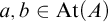
$a,b \in \mathrm{At}(A)$
. -
(3) If
$g(a,c) = \mathbf{1}$
, then
$b = c$
.




Proof 1. Suppose that $a \cdot b \neq \mathbf{0}$
. Then, by (ABTW) and the fact that g is antitone,
$a \cdot b \neq \mathbf{0}$
. Then, by (ABTW) and the fact that g is antitone,
 $$ \begin{align*} \mathbf{1} = g(a,b) \leq g(a \cdot b, a\cdot b) \leq a \cdot b, \end{align*} $$
which implies $a = b =\mathbf{1}$
. If
$a = b =\mathbf{1}$
. If $0 \lneq d \leq \mathbf{1}$
, then
$0 \lneq d \leq \mathbf{1}$
, then $\mathbf{1}= g(\mathbf{1},\mathbf{1}) \leq g(d,d) \leq d$
which shows that
$\mathbf{1}= g(\mathbf{1},\mathbf{1}) \leq g(d,d) \leq d$
which shows that $\vert A \vert = 2$
.
$\vert A \vert = 2$
.
2. If $\vert A \vert = 2$
, then
$\vert A \vert = 2$
, then $a = b = \mathbf{1} \in \mathrm{At}(A)$
. Thus,
$a = b = \mathbf{1} \in \mathrm{At}(A)$
. Thus, $a \cdot b = \mathbf{0}$
by 1. above. Suppose that
$a \cdot b = \mathbf{0}$
by 1. above. Suppose that $0 \leq d \lneq b$
; then
$0 \leq d \lneq b$
; then $0 \neq b\cdot -d\neq \mathbf{0}$
, and hence
$0 \neq b\cdot -d\neq \mathbf{0}$
, and hence $\mathbf{1} = g(a,b)\leq g(a,b\cdot -d)\leq f(a,b\cdot -d)$
by (wMIA). Furthermore,
$\mathbf{1} = g(a,b)\leq g(a,b\cdot -d)\leq f(a,b\cdot -d)$
by (wMIA). Furthermore, $\mathbf{1} = g(a,b) \leq g(a,d)$
; therefore,
$\mathbf{1} = g(a,b) \leq g(a,d)$
; therefore, ${b\cdot -d\leq -d = g(a,d)\cdot -d}$
. Using (ABT3) and the fact that f is monotone, we obtain
${b\cdot -d\leq -d = g(a,d)\cdot -d}$
. Using (ABT3) and the fact that f is monotone, we obtain
 $$ \begin{align*} \mathbf{1}=f(a,b\cdot-d)\leq f(a,g(a,c)\cdot-d))\leq-d, \end{align*} $$
which implies $d = \mathbf{0}$
. It is shown analogously that a is an atom.
$d = \mathbf{0}$
. It is shown analogously that a is an atom.
3. If $g(a,b) = g(a,c) = \mathbf{1}$
, then both b and c are atoms by 2. above and
$g(a,b) = g(a,c) = \mathbf{1}$
, then both b and c are atoms by 2. above and $g(a,b) \cdot g(a,c) = g(a, b+c) = \mathbf{1}$
. Again by 2. above we obtain that
$g(a,b) \cdot g(a,c) = g(a, b+c) = \mathbf{1}$
. Again by 2. above we obtain that $b+c$
is an atom, which implies
$b+c$
is an atom, which implies $b = c$
(see Figure 1).
$b = c$
(see Figure 1).
Corollary 6.8. Suppose that  is a b-algebra. Then $:$
$:$
-
(1) If A has at most one atom, then
$g^{-1}[\{\mathbf{1}\}]=(\{\mathbf{0}\}\times A)\cup (A\times \{\mathbf{0}\})$
. -
(2) If
$M\subseteq (A\setminus \{\mathbf{0}\})\times (A\setminus \{\mathbf{0}\})$
and
$g[M]=\{\mathbf{1}\}$
, then
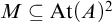
$M\subseteq \mathrm{At}(A)^2$
and M is an antichain in the product order of
$A^2$
.




Example 6.9. With respect to Theorem 6.7(3) we will exhibit a b-algebra $\mathfrak{A}$
such that
$\mathfrak{A}$
such that $g(a,b)=\mathbf{1}=g(c,d)$
, none of the four arguments is zero, and they are pairwise disjoint, i.e., the theorem is as strong as it can be. To this end, let
$g(a,b)=\mathbf{1}=g(c,d)$
, none of the four arguments is zero, and they are pairwise disjoint, i.e., the theorem is as strong as it can be. To this end, let  , take all triples

and close M under axioms (BT0)–(BT3) to obtain B. Such closure does not lead to a contradiction, that is, no pair of triples $\langle x,y,z \rangle $
and
$\langle x,y,z \rangle $
and $\langle x,z,y \rangle $
such that
$\langle x,z,y \rangle $
such that $y\neq z$
is contained in B. In consequence,
$y\neq z$
is contained in B. In consequence,  is a b-frame. In $\operatorname {{\mathsf{Cm}}}^{ps}(\mathfrak{A})$
we have
$\operatorname {{\mathsf{Cm}}}^{ps}(\mathfrak{A})$
we have $[[ B ]](\{a\},\{b\})=U=[[ B ]](\{c\},\{d\})$
. The situation is depicted in Figure 2.
$[[ B ]](\{a\},\{b\})=U=[[ B ]](\{c\},\{d\})$
. The situation is depicted in Figure 2.
The situation excluded by Theorem 6.7(3).

As Example 6.9 shows, there may be disjoint pairs of atoms for which g takes the value $\mathbf{1}$
.
$\mathbf{1}$
.

Figure 2. Long description
At the bottom is node 0. Three solid lines extend upward from node 0 to three separate nodes arranged horizontally in the middle. The left and right middle nodes are enclosed in separate ellipses. Dotted vertical lines extend upward from each middle node. At the top center is node 1. Two curved arrows labeled g extend from node 1 to the left and right ellipses, indicating a mapping or function. The overall structure forms a layered, hierarchical directed graph.
Theorem 6.10. Suppose that $\langle A,g \rangle $
is a binary sufficiency algebra which satisfies (ABTW). If
$\langle A,g \rangle $
is a binary sufficiency algebra which satisfies (ABTW). If $g(a,b) \neq \mathbf{0}$
, then
$g(a,b) \neq \mathbf{0}$
, then $a \cdot b \leq g(a,b)$
. If, additionally,
$a \cdot b \leq g(a,b)$
. If, additionally, $a\cdot b\neq \mathbf{0}$
, then
$a\cdot b\neq \mathbf{0}$
, then $g(a,b) = a \cdot b$
and
$g(a,b) = a \cdot b$
and $a \cdot b$
is an atom.
$a \cdot b$
is an atom.
Proof Assume that $a \cdot b \not \leq g(a,b)$
. Then,
$a \cdot b \not \leq g(a,b)$
. Then, ${a \cdot b \cdot -g(a,b) \neq \mathbf{0}}$
, and (ABTW) implies that
${a \cdot b \cdot -g(a,b) \neq \mathbf{0}}$
, and (ABTW) implies that
 $$ \begin{align*} g(a \cdot b \cdot -g(a,b),a \cdot -g(a,b)) \leq a \cdot b \cdot -g(a,b). \end{align*} $$
Since g is antitone we obtain
 $$\begin{align*}g(a,b) \leq g(a \cdot b \cdot -g(a,b),a \cdot b \cdot -g(a,b)) \leq a \cdot b \cdot -g(a,b) \leq -g(a,b), \end{align*}$$
and thus $g(a,b) =\mathbf{0}$
. If, in addition,
$g(a,b) =\mathbf{0}$
. If, in addition, $a \cdot b \neq \mathbf{0}$
, then
$a \cdot b \neq \mathbf{0}$
, then $g(a \cdot b, a \cdot b) \leq a \cdot b $
by (ABTW), and thus
$g(a \cdot b, a \cdot b) \leq a \cdot b $
by (ABTW), and thus $g(a,b) = a \cdot b$
.
$g(a,b) = a \cdot b$
.
Finally, suppose that $\mathbf{0} \lneq c \leq a \cdot b$
. Using (ABTW) and the fact that g is antitone, we obtain
$\mathbf{0} \lneq c \leq a \cdot b$
. Using (ABTW) and the fact that g is antitone, we obtain
 $$ \begin{align*} \mathbf{0} \neq c \leq a \cdot b \leq g(a,b) \leq g(a \cdot b, a \cdot b) \leq g(c,c) \leq c. \end{align*} $$
It follows that $c = a \cdot b$
; thus,
$c = a \cdot b$
; thus, $a \cdot b$
is an atom of A.
$a \cdot b$
is an atom of A.
Example 6.11. Consider the b-frame  where
where $[0,1]$
is the closed unit interval of the real numbers and
$[0,1]$
is the closed unit interval of the real numbers and $B_{\leqslant }$
is induced by the standard order
$B_{\leqslant }$
is induced by the standard order $\leqslant $
. In
$\leqslant $
. In $\operatorname {{\mathsf{Cm}}}^{ps}(\mathfrak{F})$
we have
$\operatorname {{\mathsf{Cm}}}^{ps}(\mathfrak{F})$
we have $[[ B_{\leqslant } ]](\{0\},\{1\})=[0,1]$
, and clearly
$[[ B_{\leqslant } ]](\{0\},\{1\})=[0,1]$
, and clearly $\{0\}$
and
$\{0\}$
and $\{1\}$
are disjoint atoms of the complex algebra of
$\{1\}$
are disjoint atoms of the complex algebra of $\mathfrak{F}$
. It is easy to see that if
$\mathfrak{F}$
. It is easy to see that if $[[ B_{\leqslant } ]](X,Y)=[0,1]$
, then
$[[ B_{\leqslant } ]](X,Y)=[0,1]$
, then $\{X,Y\}=\{\{0\},\{1\}\}$
.
$\{X,Y\}=\{\{0\},\{1\}\}$
.
On the other hand, for the subframe  of
of $\mathfrak{F}$
, we have that
$\mathfrak{F}$
, we have that
 $$\begin{align*}[[ B_{\leqslant}^\ast ]]^{-1}\left[\{[0,1)\}\right]=\left(\{\emptyset\}\times 2^{[0,1)}\right)\cup\left(2^{[0,1)}\times \{\emptyset\}\right), \end{align*}$$
although $\mathfrak{F}^\ast $
has uncountably many atoms.
$\mathfrak{F}^\ast $
has uncountably many atoms.
Lemma 6.12. Let  be a PS-algebra. In the presence of (ABT0), (ABT2), and (ABT3) the axiom (ABTW) is equivalent to
 $$ \begin{align} (\forall a,b \in A)[a \cdot b \neq \mathbf{0} \rightarrow g(a,b) \leq f(a,b)]. \end{align} $$
A b-algebra satisfying strong b-axioms, (5), but not (wMIA). For simplicity, $xy$
is
$xy$
is $x+y$
.
$x+y$
.

Table 1. Long description
The top row lists column headers: algebra property, strong b-axioms, w M I A, and notes. The first column identifies the b-algebra. The second column indicates satisfaction of strong b-axioms, referencing equation five. The third column shows non-satisfaction of w M I A, referencing equation twenty-seven. The fourth column provides notes clarifying that x y equals x star y. Each subsequent row details specific algebraic instances, with values and remarks aligned under their respective headers. Mathematical notation is preserved exactly as shown, including x y equals x star y.
Proof ( $\rightarrow $
) Suppose
$\rightarrow $
) Suppose $a\cdot b\neq \mathbf{0}$
. Then, using (ABTW) and (ABT0), we have
$a\cdot b\neq \mathbf{0}$
. Then, using (ABTW) and (ABT0), we have
 $$\begin{align*}g(a,b)\leq g(a\cdot b,a\cdot b)\leq a\cdot b\leq f(a,b)\,. \end{align*}$$
( $\leftarrow $
) Suppose
$\leftarrow $
) Suppose $a\neq \mathbf{0}$
. By (ABT3) it is the case that
$a\neq \mathbf{0}$
. By (ABT3) it is the case that $f(a,g(a,a)\cdot -a)\leq -a$
, and (ABT2) entails that
$f(a,g(a,a)\cdot -a)\leq -a$
, and (ABT2) entails that
 $$\begin{align*}-a\cdot g(a,a)\cdot f(a,a)\leq f(a\cdot f(a,g(a,a)\cdot-a),a)\leq f(\mathbf{0},a)=\mathbf{0}\,. \end{align*}$$
Since (5) entails that $g(a,a)\leq f(a,a)$
, we have
$g(a,a)\leq f(a,a)$
, we have $-a\cdot g(a,a)=\mathbf{0}$
, as required.
$-a\cdot g(a,a)=\mathbf{0}$
, as required.
Clearly, (wMIA) implies (5), but the converse does not hold as the algebra with atoms $a,b,c$
of Table 1 shows.
$a,b,c$
of Table 1 shows.
Algebras that satisfy (wMIA) are binary instances of the weak MIAs introduced in Section 2. A remarkable property of such algebras is the fact that they are discriminator algebras in the sense of Werner [Reference Werner29]. Here, the unary discriminator on a Boolean algebra A is the mapping $d\colon A \to A$
such that for all
$d\colon A \to A$
such that for all $a \in A$
 $$ \begin{align*} d(a) = \begin{cases} \mathbf{0}, &\text{if } a = \mathbf{0}, \\ \mathbf{1}, &\text{otherwise.} \end{cases} \end{align*} $$
As the lemma below demonstrates, the result can be strengthened to a larger class of PS-algebras in which (wMIA) is weakened to (5).
Lemma 6.13. Suppose that  is a binary PS-algebra. Then ${d}{:}\ A \to A$
as defined above is the unary discriminator if and only if
${d}{:}\ A \to A$
as defined above is the unary discriminator if and only if $\mathfrak{A}$
satisfies (5).
$\mathfrak{A}$
satisfies (5).
Proof ( $\rightarrow $
) Suppose that d is the discriminator, and let
$\rightarrow $
) Suppose that d is the discriminator, and let $a,b \in A, a \cdot b \neq 0$
. Then,
$a,b \in A, a \cdot b \neq 0$
. Then, $d(a \cdot b) = f(a \cdot b, a \cdot b) + - g(a \cdot b, a \cdot b) = \mathbf{1}$
, i.e.,
$d(a \cdot b) = f(a \cdot b, a \cdot b) + - g(a \cdot b, a \cdot b) = \mathbf{1}$
, i.e., $g(a \cdot b, a \cdot b) \leq f(a \cdot b, a \cdot b)$
. Now,
$g(a \cdot b, a \cdot b) \leq f(a \cdot b, a \cdot b)$
. Now,
 $$ \begin{align*} g(a,b) \leq g(a \cdot b, a \cdot b) \leq f(a \cdot b, a \cdot b) \leq f(a,b), \end{align*} $$
since g is antitone and f is monotone.
( $\leftarrow $
) Let
$\leftarrow $
) Let $a \in A, a \neq \mathbf{0}$
. Then,
$a \in A, a \neq \mathbf{0}$
. Then, $g(a,a) \leq f(a,a)$
by the hypothesis, which implies that
$g(a,a) \leq f(a,a)$
by the hypothesis, which implies that $f(a,a) + -g(a,a) = \mathbf{1}$
.
$f(a,a) + -g(a,a) = \mathbf{1}$
.
Furthermore, observe that—due to the facts that g is antitone and f is monotone—(5) is equivalent to
 $$\begin{align*}a \neq \mathbf{0} \rightarrow g(a,a) \leq f(a,a)\,.\end{align*}$$
Collecting all the facts above we have the following:
Theorem 6.14. Suppose that  is a PS-algebra that satisfies (ABT0), (ABT2), and (ABT3). Then, $d\colon A \to A$
defined by
$d\colon A \to A$
defined by  is the unary discriminator if and only if $\mathfrak{A}$
satisfies (ABTW).
$\mathfrak{A}$
satisfies (ABTW).
Proof ( $\rightarrow $
) Suppose that d is the discriminator, and let
$\rightarrow $
) Suppose that d is the discriminator, and let $\mathbf{0} \neq a \in \mathfrak{A}$
. Then,
$\mathbf{0} \neq a \in \mathfrak{A}$
. Then, $d(a) = f(a,a) + -g(a,a) =\mathbf{1}$
which implies
$d(a) = f(a,a) + -g(a,a) =\mathbf{1}$
which implies $g(a,a) \leq f(a,a)$
. So (5) holds which entails (ABTW), by Lemma 6.12.
$g(a,a) \leq f(a,a)$
. So (5) holds which entails (ABTW), by Lemma 6.12.
( $\leftarrow $
) Let
$\leftarrow $
) Let $a \in A, a \neq \mathbf{0}$
. Then,
$a \in A, a \neq \mathbf{0}$
. Then, $g(a,a) \leq f(a,a)$
by the hypothesis, which implies that
$g(a,a) \leq f(a,a)$
by the hypothesis, which implies that $f(a,a) + -g(a,a) = \mathbf{1}$
.
$f(a,a) + -g(a,a) = \mathbf{1}$
.
Corollary 6.15. Each weak b-algebra is a discriminator algebra.
Since a discriminator algebra is simple by [Reference Werner29, Theorem 2.2] this implies
Proposition 6.16. The class of weak b-algebras is not closed under products.
Since every b-algebra is a weak b-algebra we obtain
Corollary 6.17. Each b-algebra is a discriminator algebra.
7 Representation of b-algebras
In this section we shall show that the class of b-algebras is closed under canonical extensions. Suppose that  is a PS-algebra. Modifying the notation in Section 2 for our purpose we designate the middle column as special and define canonical relations on $\mathrm{Ult}(A)$
by
$\mathrm{Ult}(A)$
by
 $$\begin{align} Q_f(\mathscr{U}_1,\mathscr{U}_2,\mathscr{U}_3) &\;\mathrel{\mathord{:}\mathord{\longleftrightarrow}}\; f[\mathscr{U}_1 \times \mathscr{U}_3] \subseteq \mathscr{U}_2, \qquad\end{align} $$
 $$\begin{align} S_g(\mathscr{U}_1,\mathscr{U}_2,\mathscr{U}_3) &\;\mathrel{\mathord{:}\mathord{\longleftrightarrow}}\; g[\mathscr{U}_1\times\mathscr{U}_3]\cap\mathscr{U}_2\neq\emptyset. \end{align} $$
So, $\operatorname {{\mathsf{Cf}}}^{ps}(\mathfrak{A})=\langle \mathrm{Ult}(A),Q_f,S_g\rangle $
is the canonical frame of
$\operatorname {{\mathsf{Cf}}}^{ps}(\mathfrak{A})=\langle \mathrm{Ult}(A),Q_f,S_g\rangle $
is the canonical frame of $\mathfrak{A}$
.
$\mathfrak{A}$
.
The weak MIA axiom (wMIA) shows that the canonical relations are not independent:
Lemma 7.1. $\mathfrak{A}$
satisfies (wMIA) if and only if
$\mathfrak{A}$
satisfies (wMIA) if and only if $S_{g} \subseteq Q_{f}$
. In particular,
$S_{g} \subseteq Q_{f}$
. In particular,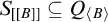 $S_{[[ B ]]}\subseteq Q_{\langle { B \rangle }}$
for every
$S_{[[ B ]]}\subseteq Q_{\langle { B \rangle }}$
for every $\operatorname {{\mathsf{Cm}}}^{ps}(\mathfrak{F})$
of a b-frame
$\operatorname {{\mathsf{Cm}}}^{ps}(\mathfrak{F})$
of a b-frame $\mathfrak{F}$
.
$\mathfrak{F}$
.
Proof ( $\rightarrow $
) Suppose that
$\rightarrow $
) Suppose that $S_{g}(\mathscr{U}_1,\mathscr{U}_2,\mathscr{U}_3)$
. Then,
$S_{g}(\mathscr{U}_1,\mathscr{U}_2,\mathscr{U}_3)$
. Then, $\mathscr{U}_2 \cap g[\mathscr{U}_1 \times \mathscr{U}_3] \neq \emptyset $
, say,
$\mathscr{U}_2 \cap g[\mathscr{U}_1 \times \mathscr{U}_3] \neq \emptyset $
, say, $x \in \mathscr{U}_1, y \in \mathscr{U}_3$
and
$x \in \mathscr{U}_1, y \in \mathscr{U}_3$
and $g(x,y) \in \mathscr{U}_2$
. We need to show that
$g(x,y) \in \mathscr{U}_2$
. We need to show that $f[\mathscr{U}_1 \times \mathscr{U}_3] \subseteq \mathscr{U}_2$
. Let
$f[\mathscr{U}_1 \times \mathscr{U}_3] \subseteq \mathscr{U}_2$
. Let $s \in \mathscr{U}_1,$
and
$s \in \mathscr{U}_1,$
and $t \in \mathscr{U}_3$
; then,
$t \in \mathscr{U}_3$
; then, $\mathbf{0} \neq x \cdot s \in \mathscr{U}_1$
and
$\mathbf{0} \neq x \cdot s \in \mathscr{U}_1$
and $\mathbf{0} \neq y \cdot t \in \mathscr{U}_3$
. By (wMIA) we have
$\mathbf{0} \neq y \cdot t \in \mathscr{U}_3$
. By (wMIA) we have $g(x \cdot s,y \cdot t) \leq f(x \cdot s, y \cdot t)$
. Using
$g(x \cdot s,y \cdot t) \leq f(x \cdot s, y \cdot t)$
. Using $g(x,y) \in \mathscr{U}_2$
and the facts that g is antitone and f is monotone we obtain
$g(x,y) \in \mathscr{U}_2$
and the facts that g is antitone and f is monotone we obtain
 $$ \begin{align*} g(x,y) \le g(x \cdot s, y \cdot t) \leq f(x \cdot s, y \cdot t) \leq f(s,t) \in \mathscr{U}_2. \end{align*} $$
( $\leftarrow $
) Let
$\leftarrow $
) Let $x,y \neq \mathbf{0}$
and assume that
$x,y \neq \mathbf{0}$
and assume that $g(x,y) \not \leq f(x,y)$
, i.e.,
$g(x,y) \not \leq f(x,y)$
, i.e., $g(x,y) \cdot -f(x,y) \neq \mathbf{0}$
. Choose ultrafilters
$g(x,y) \cdot -f(x,y) \neq \mathbf{0}$
. Choose ultrafilters $\mathscr{U}_1,\mathscr{U}_2,\mathscr{U}_3$
such that
$\mathscr{U}_1,\mathscr{U}_2,\mathscr{U}_3$
such that $x \in \mathscr{U}_1, y\in \mathscr{U}_3$
, and
$x \in \mathscr{U}_1, y\in \mathscr{U}_3$
, and $g(x,y) \cdot -f(x,y) \in \mathscr{U}_2$
. Then,
$g(x,y) \cdot -f(x,y) \in \mathscr{U}_2$
. Then, $g[\mathscr{U}_1 \times \mathscr{U}_3] \cap \mathscr{U}_2 \neq \emptyset $
, and therefore
$g[\mathscr{U}_1 \times \mathscr{U}_3] \cap \mathscr{U}_2 \neq \emptyset $
, and therefore $f[\mathscr{U}_1 \times \mathscr{U}_3] \subseteq \mathscr{U}_2$
, in particular,
$f[\mathscr{U}_1 \times \mathscr{U}_3] \subseteq \mathscr{U}_2$
, in particular, $f(x,y) \in \mathscr{U}_2$
. This contradicts
$f(x,y) \in \mathscr{U}_2$
. This contradicts $-f(x,y) \in \mathscr{U}_2$
.
$-f(x,y) \in \mathscr{U}_2$
.
The crucial observation about canonical frames of b-algebras is the following result:
Lemma 7.2. If  is a betweenness algebra, then its canonical frame $\operatorname {{\mathsf{Cf}}}^{ps}(\mathfrak{A})=\langle \mathrm{Ult}(A),Q_f,S_g \rangle $
has the following properties:
$\operatorname {{\mathsf{Cf}}}^{ps}(\mathfrak{A})=\langle \mathrm{Ult}(A),Q_f,S_g \rangle $
has the following properties:
 $$\begin{align} Q_{f}(\mathscr{U},\mathscr{U},\mathscr{U})\,, \end{align} $$
 $$\begin{align} Q_{f}(\mathscr{U}_1,\mathscr{U}_2,\mathscr{U}_3)\rightarrow Q_{f}(\mathscr{U}_3,\mathscr{U}_2,\mathscr{U}_1)\,, \end{align} $$
 $$\begin{align} S_g(\mathscr{U}_1,\mathscr{U}_2,\mathscr{U}_3)\rightarrow S_g(\mathscr{U}_3,\mathscr{U}_2,\mathscr{U}_1)\,, \end{align} $$
 $$\begin{align} Q_{f}(\mathscr{U}_1,\mathscr{U}_2,\mathscr{U}_3)\rightarrow Q_{f}(\mathscr{U}_1,\mathscr{U}_1,\mathscr{U}_2)\,, \end{align} $$
 $$\begin{align} Q_{f}(\mathscr{U}_1,\mathscr{U}_2,\mathscr{U}_3)\wedge S_{g}(\mathscr{U}_1,\mathscr{U}_3,\mathscr{U}_2)\rightarrow\mathscr{U}_2=\mathscr{U}_3\,. \end{align} $$
If $\mathfrak{A}$
is a strong betweenness algebra, then
$\mathfrak{A}$
is a strong betweenness algebra, then $\operatorname {{\mathsf{Cf}}}^{ps}(\mathfrak{A})$
additionally satisfies
$\operatorname {{\mathsf{Cf}}}^{ps}(\mathfrak{A})$
additionally satisfies
 $$\begin{align} Q_f(\mathscr{U}_1,\mathscr{U}_1,\mathscr{U}_2)\,. \end{align} $$
If $\mathfrak{A}$
is a weak betweenness algebra, then
$\mathfrak{A}$
is a weak betweenness algebra, then $\operatorname {{\mathsf{Cf}}}^{ps}(\mathfrak{A})$
meets
$\operatorname {{\mathsf{Cf}}}^{ps}(\mathfrak{A})$
meets
 $$\begin{align} S_g(\mathscr{U}_1,\mathscr{U}_2,\mathscr{U}_1)\rightarrow\mathscr{U}_1=\mathscr{U}_2\,. \end{align} $$
Proof (BT0
Cf
): Fix an ultrafilter $\mathscr{U}$
. If
$\mathscr{U}$
. If $x,y\in \mathscr{U}$
, then, since
$x,y\in \mathscr{U}$
, then, since $x\cdot y\leq f(x,y)$
, it is the case that
$x\cdot y\leq f(x,y)$
, it is the case that $f[\mathscr{U}\times \mathscr{U}]\subseteq \mathscr{U}$
, as every ultrafilter is closed under meets.
$f[\mathscr{U}\times \mathscr{U}]\subseteq \mathscr{U}$
, as every ultrafilter is closed under meets.
(BT1
Cf
g
): Let $S_g(\mathscr{U}_1,\mathscr{U}_2,\mathscr{U}_3)$
, i.e.,
$S_g(\mathscr{U}_1,\mathscr{U}_2,\mathscr{U}_3)$
, i.e., $g[\mathscr{U}_1\times \mathscr{U}_3]\cap \mathscr{U}_2\neq \emptyset $
. Pick
$g[\mathscr{U}_1\times \mathscr{U}_3]\cap \mathscr{U}_2\neq \emptyset $
. Pick $x\in \mathscr{U}_1$
and
$x\in \mathscr{U}_1$
and $y\in \mathscr{U}_2$
such that
$y\in \mathscr{U}_2$
such that $g(x,y)\in \mathscr{U}_2$
. By (ABT1
g
) it is the case that
$g(x,y)\in \mathscr{U}_2$
. By (ABT1
g
) it is the case that $g(y,x)\in \mathscr{U}_2$
, and, since
$g(y,x)\in \mathscr{U}_2$
, and, since $\langle y,x\rangle \in \mathscr{U}_3\times \mathscr{U}_1$
, we have
$\langle y,x\rangle \in \mathscr{U}_3\times \mathscr{U}_1$
, we have $S_g(\mathscr{U}_3,\mathscr{U}_2,\mathscr{U}_1)$
.
$S_g(\mathscr{U}_3,\mathscr{U}_2,\mathscr{U}_1)$
.
(BT2
Cf
): Suppose that $Q_{f}(\mathscr{U}_1,\mathscr{U}_2,\mathscr{U}_3)$
, i.e.,
$Q_{f}(\mathscr{U}_1,\mathscr{U}_2,\mathscr{U}_3)$
, i.e., $f[\mathscr{U}_1 \times \mathscr{U}_3] \subseteq \mathscr{U}_2$
. Let
$f[\mathscr{U}_1 \times \mathscr{U}_3] \subseteq \mathscr{U}_2$
. Let $x \in \mathscr{U}_1$
and
$x \in \mathscr{U}_1$
and $y \in \mathscr{U}_2$
; we need to show that
$y \in \mathscr{U}_2$
; we need to show that $f(x,y) \in \mathscr{U}_1$
. Suppose, on the contrary, that
$f(x,y) \in \mathscr{U}_1$
. Suppose, on the contrary, that $-f(x,y)\in \mathscr{U}_1$
. First, note that due to monotonicity of f we have
$-f(x,y)\in \mathscr{U}_1$
. First, note that due to monotonicity of f we have
 $$\begin{align*}x\cdot -f(x,y)\cdot f(x\cdot -f(x,y),y)\leq x\cdot -f(x,y)\cdot f(x,y)=\mathbf{0}.\end{align*}$$
By the assumption, $y\cdot f(x\cdot -f(x,y),\mathbf{1})\in \mathscr{U} _2$
, but (ABT2) implies
$y\cdot f(x\cdot -f(x,y),\mathbf{1})\in \mathscr{U} _2$
, but (ABT2) implies
 $$\begin{align*}y\cdot f(x\cdot -f(x,y),\mathbf{1})\leq f(x\cdot -f(x,y)\cdot f(x\cdot -f(x,y),y),\mathbf{1})=f(\mathbf{0},\mathbf{1})=\mathbf{0}, \end{align*}$$
which is a contradiction. It follows that $f(x,y)\in \mathscr{U}_1$
.
$f(x,y)\in \mathscr{U}_1$
.
(BT3
Cf
): Assume $f[\mathscr{U}_1\times \mathscr{U}_3]\subseteq \mathscr{U}_2$
and
$f[\mathscr{U}_1\times \mathscr{U}_3]\subseteq \mathscr{U}_2$
and $g[\mathscr{U}_1\times \mathscr{U}_2]\cap \mathscr{U}_3\neq \emptyset $
. Let
$g[\mathscr{U}_1\times \mathscr{U}_2]\cap \mathscr{U}_3\neq \emptyset $
. Let $x\in \mathscr{U}_2$
and
$x\in \mathscr{U}_2$
and $-x\in \mathscr{U}_3$
. Furthermore, let
$-x\in \mathscr{U}_3$
. Furthermore, let $a\in \mathscr{U}_1$
and
$a\in \mathscr{U}_1$
and $b\in \mathscr{U}_2$
be such that
$b\in \mathscr{U}_2$
be such that $g(a,b)\in \mathscr{U}_3$
. Since g is antitone we have that
$g(a,b)\in \mathscr{U}_3$
. Since g is antitone we have that $g(a,b\cdot x)\in \mathscr{U}_3$
. Since also
$g(a,b\cdot x)\in \mathscr{U}_3$
. Since also $-b+-x\in \mathscr{U}_3$
, it follows that
$-b+-x\in \mathscr{U}_3$
, it follows that $g(a,b\cdot x)\cdot (-b+-x)\in \mathscr{U}_3$
, and from (ABT3) we obtain
$g(a,b\cdot x)\cdot (-b+-x)\in \mathscr{U}_3$
, and from (ABT3) we obtain
 $$\begin{align*}\mathscr{U}_2\ni f(a,g(a,b\cdot x)\cdot(-b+-x))\leq-b+-x\in\mathscr{U}_2\,. \end{align*}$$
But $b\cdot x\in \mathscr{U}_2$
, a contradiction. So it must be the case that
$b\cdot x\in \mathscr{U}_2$
, a contradiction. So it must be the case that $\mathscr{U}_2=\mathscr{U}_3$
, as required.
$\mathscr{U}_2=\mathscr{U}_3$
, as required.
(BT2s
Cf
): We need to show that $f[\mathscr{U}_1\times \mathscr{U}_2]\subseteq \mathscr{U}_1$
. If
$f[\mathscr{U}_1\times \mathscr{U}_2]\subseteq \mathscr{U}_1$
. If $x\in \mathscr{U}_1$
and
$x\in \mathscr{U}_1$
and $y\in \mathscr{U}_2$
, then
$y\in \mathscr{U}_2$
, then $y\neq \mathbf{0}$
and by (ABT2
s
) we obtain that
$y\neq \mathbf{0}$
and by (ABT2
s
) we obtain that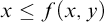 $x\leq f(x,y)$
. Therefore
$x\leq f(x,y)$
. Therefore $f(x,y)\in \mathscr{U}_1$
, as required.
$f(x,y)\in \mathscr{U}_1$
, as required.
(BTW
Cf
): Assume that $S_g(\mathscr{U}_1,\mathscr{U}_2,\mathscr{U}_1)$
, that is,
$S_g(\mathscr{U}_1,\mathscr{U}_2,\mathscr{U}_1)$
, that is, $g[\mathscr{U}_1\times \mathscr{U}_1]\cap \mathscr{U}_2\neq \mathbf{0}$
. Let
$g[\mathscr{U}_1\times \mathscr{U}_1]\cap \mathscr{U}_2\neq \mathbf{0}$
. Let $y_1,y_2\in \mathscr{U}_1$
be such that
$y_1,y_2\in \mathscr{U}_1$
be such that $g(y_1,y_2)\in \mathscr{U}_2$
. So, from the fact that g is antitone we obtain that
$g(y_1,y_2)\in \mathscr{U}_2$
. So, from the fact that g is antitone we obtain that $g(y_1\cdot y_2,y_1\cdot y_2)\in \mathscr{U}_2$
. If
$g(y_1\cdot y_2,y_1\cdot y_2)\in \mathscr{U}_2$
. If $x\in \mathscr{U}_1$
, then using the property one more time we obtain that
$x\in \mathscr{U}_1$
, then using the property one more time we obtain that $g(x\cdot y_1\cdot y_2,x\cdot y_1\cdot y_2)\in \mathscr{U}_2$
. However,
$g(x\cdot y_1\cdot y_2,x\cdot y_1\cdot y_2)\in \mathscr{U}_2$
. However, $x\cdot y_1\cdot y_2\neq \mathbf{0}$
; therefore, from (ABTW) we obtain
$x\cdot y_1\cdot y_2\neq \mathbf{0}$
; therefore, from (ABTW) we obtain
 $$\begin{align*}g(x\cdot y_1\cdot y_2,x\cdot y_1\cdot y_2)\leq x\cdot y_1\cdot y_2\,, \end{align*}$$
and so x is in $\mathscr{U}_2$
. Thus,
$\mathscr{U}_2$
. Thus, $\mathscr{U}_1=\mathscr{U}_2$
by maximality of ultrafilters.
$\mathscr{U}_1=\mathscr{U}_2$
by maximality of ultrafilters.
We now have the following representation theorem:
Theorem 7.3. Suppose that  is a
is a $($
weak, strong
$($
weak, strong $)$
betweenness algebra. Then, the Stone map
$)$
betweenness algebra. Then, the Stone map $h\colon \mathfrak{A} \hookrightarrow \operatorname {{\mathsf{Em}}}^{ps}(\mathfrak{A})$
is a
$h\colon \mathfrak{A} \hookrightarrow \operatorname {{\mathsf{Em}}}^{ps}(\mathfrak{A})$
is a $($
weak, strong
$($
weak, strong $)$
betweenness algebra embedding.
$)$
betweenness algebra embedding.
Proof $h\colon \mathfrak{A} \hookrightarrow \operatorname {{\mathsf{Em}}}^{ps}(\mathfrak{A})$
is a PS-algebra embedding by Theorems 2.2 and 2.5, and we need to show that
$h\colon \mathfrak{A} \hookrightarrow \operatorname {{\mathsf{Em}}}^{ps}(\mathfrak{A})$
is a PS-algebra embedding by Theorems 2.2 and 2.5, and we need to show that $\operatorname {{\mathsf{Em}}}^{ps}(\mathfrak{A})$
is a (weak, strong) betweenness algebra; we will use Lemma 7.2. Suppose that
$\operatorname {{\mathsf{Em}}}^{ps}(\mathfrak{A})$
is a (weak, strong) betweenness algebra; we will use Lemma 7.2. Suppose that $\emptyset \neq X,Y,Z \subseteq \mathrm{Ult}(A)$
. Let us begin with the proof for a betweenness algebra
$\emptyset \neq X,Y,Z \subseteq \mathrm{Ult}(A)$
. Let us begin with the proof for a betweenness algebra $\mathfrak{A}$
.
$\mathfrak{A}$
.
(ABT0): Let $\mathscr{U} \in X$
. By (BT0
Cf
) we have
$\mathscr{U} \in X$
. By (BT0
Cf
) we have $Q_f(\mathscr{U},\mathscr{U},\mathscr{U})$
, and
$Q_f(\mathscr{U},\mathscr{U},\mathscr{U})$
, and $\mathscr{U}\in X$
implies that
$\mathscr{U}\in X$
implies that $(X \times \{\mathscr{U}\} \times X) \cap Q_f \neq \emptyset $
. It follows that
$(X \times \{\mathscr{U}\} \times X) \cap Q_f \neq \emptyset $
. It follows that $\mathscr{U} \in \langle { Q_f \rangle }(X,X)$
.
$\mathscr{U} \in \langle { Q_f \rangle }(X,X)$
.
(ABT1
f
): Let $\mathscr{U}\in \langle { Q_f \rangle }(X,Y)$
. Then,
$\mathscr{U}\in \langle { Q_f \rangle }(X,Y)$
. Then, $(X \times \{\mathscr{U}\} \times Y) \cap Q_f \neq \emptyset $
, say,
$(X \times \{\mathscr{U}\} \times Y) \cap Q_f \neq \emptyset $
, say, $\mathscr{U}_1 \in X, \mathscr{U}_2 \in Y$
are such that
$\mathscr{U}_1 \in X, \mathscr{U}_2 \in Y$
are such that $Q_f(\mathscr{U}_1, \mathscr{U},\mathscr{U}_2)$
. By (BT1
Cf
f
),
$Q_f(\mathscr{U}_1, \mathscr{U},\mathscr{U}_2)$
. By (BT1
Cf
f
), $Q_f(\mathscr{U}_2,\mathscr{U},\mathscr{U}_1)$
which shows that
$Q_f(\mathscr{U}_2,\mathscr{U},\mathscr{U}_1)$
which shows that $(Y \times \{\mathscr{U}\} \times X) \cap Q_f \neq \emptyset $
, i.e.,
$(Y \times \{\mathscr{U}\} \times X) \cap Q_f \neq \emptyset $
, i.e., $\mathscr{U}\in \langle { Q_f \rangle }(Y,X)$
.
$\mathscr{U}\in \langle { Q_f \rangle }(Y,X)$
.
(ABT1
g
) Suppose $\mathscr{U}\in [[ S_g ]](X,Y)$
, that is,
$\mathscr{U}\in [[ S_g ]](X,Y)$
, that is, $X\times \{\mathscr{U}\}\times Y\subseteq S_g$
. If
$X\times \{\mathscr{U}\}\times Y\subseteq S_g$
. If $\mathscr{U}_1\in Y$
and
$\mathscr{U}_1\in Y$
and $\mathscr{U}_2\in X$
, then
$\mathscr{U}_2\in X$
, then $S_g(\mathscr{U}_2,\mathscr{U},\mathscr{U}_1)$
and this with (BT1
Cf
g
) entail that
$S_g(\mathscr{U}_2,\mathscr{U},\mathscr{U}_1)$
and this with (BT1
Cf
g
) entail that $S_g(\mathscr{U}_1,\mathscr{U},\mathscr{U}_2)$
. Since our choices were arbitrary, we have that
$S_g(\mathscr{U}_1,\mathscr{U},\mathscr{U}_2)$
. Since our choices were arbitrary, we have that $Y\times \{\mathscr{U}\}\times X\subseteq S_g$
, i.e.,
$Y\times \{\mathscr{U}\}\times X\subseteq S_g$
, i.e., $\mathscr{U}\in [[ S_g ]](Y,X)$
.
$\mathscr{U}\in [[ S_g ]](Y,X)$
.
(ABT2): Let $\mathscr{U}\in Y \cap \langle { Q_f \rangle }(X,Z)$
, i.e.,
$\mathscr{U}\in Y \cap \langle { Q_f \rangle }(X,Z)$
, i.e., $\mathscr{U} \in Y$
and there are
$\mathscr{U} \in Y$
and there are $\mathscr{U}_1 \in X, \mathscr{U}_2 \in Z$
such that
$\mathscr{U}_1 \in X, \mathscr{U}_2 \in Z$
such that $Q_f(\mathscr{U}_1,\mathscr{U},\mathscr{U}_2)$
. By (BT2
Cf
) we have
$Q_f(\mathscr{U}_1,\mathscr{U},\mathscr{U}_2)$
. By (BT2
Cf
) we have $Q_f(\mathscr{U}_1,\mathscr{U}_1,\mathscr{U})$
, so
$Q_f(\mathscr{U}_1,\mathscr{U}_1,\mathscr{U})$
, so $\mathscr{U}_1\in \langle { Q_f \rangle }(X,Y)$
. Thus,
$\mathscr{U}_1\in \langle { Q_f \rangle }(X,Y)$
. Thus, $\mathscr{U}_1\in X\cap \langle { Q_f \rangle }(X,Y)$
. As
$\mathscr{U}_1\in X\cap \langle { Q_f \rangle }(X,Y)$
. As $\mathscr{U}_2$
is in Z, we obtain
$\mathscr{U}_2$
is in Z, we obtain
 $$\begin{align*}\mathscr{U}\in \langle { Q_f \rangle}(X\cap\langle { Q_f \rangle}(X,Y),Z), \end{align*}$$
as required.
(ABT3): Suppose that $\mathscr{U} \in \langle { Q_f \rangle }(X, [[ S_g ]](X,-Y) \cap Y)$
. Then, there are
$\mathscr{U} \in \langle { Q_f \rangle }(X, [[ S_g ]](X,-Y) \cap Y)$
. Then, there are $\mathscr{U}_1 \in X, \mathscr{U}_2 \in [[ S_g ]](X,-Y) \cap Y$
such that
$\mathscr{U}_1 \in X, \mathscr{U}_2 \in [[ S_g ]](X,-Y) \cap Y$
such that $Q_f(\mathscr{U}_1, \mathscr{U}, \mathscr{U}_2)$
. Now,
$Q_f(\mathscr{U}_1, \mathscr{U}, \mathscr{U}_2)$
. Now,
 $$ \begin{align*} \mathscr{U}_2 \in [[ S_g ]](X,-Y) \longleftrightarrow (X \times \{\mathscr{U}_2\} \times -Y) \subseteq S_g. \end{align*} $$
Assume that $\mathscr{U} \not \in Y$
; then,
$\mathscr{U} \not \in Y$
; then, $S_g(\mathscr{U}_1,\mathscr{U}_2,\mathscr{U})$
and (BT3
Cf
) implies that
$S_g(\mathscr{U}_1,\mathscr{U}_2,\mathscr{U})$
and (BT3
Cf
) implies that $\mathscr{U} = \mathscr{U}_2 \in Y$
, a contradiction.
$\mathscr{U} = \mathscr{U}_2 \in Y$
, a contradiction.
For a weak betweenness algebra $\mathfrak{A}$
we need to show that (ABTW) holds in
$\mathfrak{A}$
we need to show that (ABTW) holds in $\operatorname {{\mathsf{Em}}}^{ps}(\mathfrak{A})$
. To this end, suppose that
$\operatorname {{\mathsf{Em}}}^{ps}(\mathfrak{A})$
. To this end, suppose that $\emptyset \neq X \subseteq \mathrm{Ult}(A)$
, and
$\emptyset \neq X \subseteq \mathrm{Ult}(A)$
, and $\mathscr{U} \in [[ S_g ]](X,X)$
; then,
$\mathscr{U} \in [[ S_g ]](X,X)$
; then, $(X \times \{\mathscr{U}\} \times X) \subseteq S_g$
. Since
$(X \times \{\mathscr{U}\} \times X) \subseteq S_g$
. Since $X \neq \emptyset $
, there is some
$X \neq \emptyset $
, there is some $\mathscr{V} \in X$
, and
$\mathscr{V} \in X$
, and $S_g(\mathscr{V},\mathscr{U},\mathscr{V})$
. (BTW
Cf
) now implies
$S_g(\mathscr{V},\mathscr{U},\mathscr{V})$
. (BTW
Cf
) now implies $\mathscr{U} = \mathscr{V}$
, thus,
$\mathscr{U} = \mathscr{V}$
, thus, $\mathscr{U} \in X$
.
$\mathscr{U} \in X$
.
Finally, for a strong betweenness algebra $\mathfrak{A}$
we need to prove (ABT2
s
) for
$\mathfrak{A}$
we need to prove (ABT2
s
) for $\operatorname {{\mathsf{Em}}}^{ps}(\mathfrak{A})$
. Yet this is straightforward, since if
$\operatorname {{\mathsf{Em}}}^{ps}(\mathfrak{A})$
. Yet this is straightforward, since if $\emptyset \neq Y\subseteq \mathrm{Ult}(A)$
and
$\emptyset \neq Y\subseteq \mathrm{Ult}(A)$
and $\mathscr{U}_1\in X$
, then by (BT2s
Cf
) we have that
$\mathscr{U}_1\in X$
, then by (BT2s
Cf
) we have that $Q_f(\mathscr{U}_1,\mathscr{U}_1,\mathscr{U})$
for some
$Q_f(\mathscr{U}_1,\mathscr{U}_1,\mathscr{U})$
for some $\mathscr{U}\in Y$
. This entails that
$\mathscr{U}\in Y$
. This entails that $\mathscr{U}_1\in \langle { Q_f \rangle }(X,Y)$
.
$\mathscr{U}_1\in \langle { Q_f \rangle }(X,Y)$
.
What we have proven in this section so far is the following: For any b-algebraFootnote
4
 its canonical frame $\operatorname {{\mathsf{Cf}}}^{ps}(\mathfrak{A})=\langle \mathrm{Ult}(A),Q_f,S_g\rangle $
behaves in such a way that the relations
$\operatorname {{\mathsf{Cf}}}^{ps}(\mathfrak{A})=\langle \mathrm{Ult}(A),Q_f,S_g\rangle $
behaves in such a way that the relations $Q_f$
and
$Q_f$
and $S_g$
in a certain way «simulate» betweenness axioms. Furthermore, the standard Stone mapping embeds
$S_g$
in a certain way «simulate» betweenness axioms. Furthermore, the standard Stone mapping embeds $\mathfrak{A}$
into
$\mathfrak{A}$
into $\operatorname {{\mathsf{Em}}}^{ps}(\mathfrak{A})=\langle 2^{\mathrm{Ult}(A)},\langle { Q_f \rangle },[[ S_g ]]\rangle $
. Nonetheless, neither
$\operatorname {{\mathsf{Em}}}^{ps}(\mathfrak{A})=\langle 2^{\mathrm{Ult}(A)},\langle { Q_f \rangle },[[ S_g ]]\rangle $
. Nonetheless, neither $\operatorname {{\mathsf{Cf}}}^{ps}(\mathfrak{A})$
is necessarily a b-frame, nor
$\operatorname {{\mathsf{Cf}}}^{ps}(\mathfrak{A})$
is necessarily a b-frame, nor $\operatorname {{\mathsf{Em}}}^{ps}(\mathfrak{A})$
is necessarily a complex b-algebra. Of course, if
$\operatorname {{\mathsf{Em}}}^{ps}(\mathfrak{A})$
is necessarily a complex b-algebra. Of course, if $\mathfrak{A}$
is an MIA, i.e.,
$\mathfrak{A}$
is an MIA, i.e., $Q_f=S_g$
, then we can take the reduct of
$Q_f=S_g$
, then we can take the reduct of $\operatorname {{\mathsf{Cf}}}^{ps}(\mathfrak{A})$
to
$\operatorname {{\mathsf{Cf}}}^{ps}(\mathfrak{A})$
to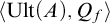 $\langle \mathrm{Ult}(A),Q_f\rangle $
which is a b-frame, and we can embed
$\langle \mathrm{Ult}(A),Q_f\rangle $
which is a b-frame, and we can embed $\mathfrak{A}$
via Stone mapping into the complex b-algebra
$\mathfrak{A}$
via Stone mapping into the complex b-algebra $\langle 2^{\mathrm{Ult}(A)},\langle { Q_f \rangle },[[ Q_f ]]\rangle $
. The problem is—as we will see in the next section in Theorem 8.7—that there are no infinite b-algebras that are MIAs.
$\langle 2^{\mathrm{Ult}(A)},\langle { Q_f \rangle },[[ Q_f ]]\rangle $
. The problem is—as we will see in the next section in Theorem 8.7—that there are no infinite b-algebras that are MIAs.
Unfortunately, the question whether for any given b-algebra $\mathfrak{A}$
there exists a b-frame
$\mathfrak{A}$
there exists a b-frame  such that $\mathfrak{A}$
can be embedded into
$\mathfrak{A}$
can be embedded into $\operatorname {{\mathsf{Cm}}}^{ps}(\mathfrak{F})$
has a negative answer. This will be proven in the next section in the form of Example 8.4.
$\operatorname {{\mathsf{Cm}}}^{ps}(\mathfrak{F})$
has a negative answer. This will be proven in the next section in the form of Example 8.4.
8 B-algebras and b-complex algebras
In this section we will investigate the connections between b-complex algebras and (abstract) b-algebras and exemplify some instances in which they differ. Let us start with the following definitions:
Definition 8.1. The class of b-algebras is denoted by $\mathbf{Abtw}$
. An algebra
$\mathbf{Abtw}$
. An algebra $\mathfrak{A} \in \mathbf{Abtw}$
is a b-complex algebra or representable if there exists a b-frame
$\mathfrak{A} \in \mathbf{Abtw}$
is a b-complex algebra or representable if there exists a b-frame $\mathfrak{F}$
such that
$\mathfrak{F}$
such that $\mathfrak{A}$
is isomorphic to a subalgebra of
$\mathfrak{A}$
is isomorphic to a subalgebra of $\operatorname {{\mathsf{Cm}}}^{ps}(\mathfrak{F})$
. The class of b-complex algebras is denoted by
$\operatorname {{\mathsf{Cm}}}^{ps}(\mathfrak{F})$
. The class of b-complex algebras is denoted by $\mathbf{Cbtw}$
. As earlier,
$\mathbf{Cbtw}$
. As earlier, $\mathfrak{A}$
is a full b-complex algebra when it is isomorphic to
$\mathfrak{A}$
is a full b-complex algebra when it is isomorphic to $\operatorname {{\mathsf{Cm}}}^{ps}(\mathfrak{F})$
of a b-frame
$\operatorname {{\mathsf{Cm}}}^{ps}(\mathfrak{F})$
of a b-frame $\mathfrak{F}$
.
$\mathfrak{F}$
.
Let us briefly recall the situation. For a b-algebra $\mathfrak{A}$
we start with operators
$\mathfrak{A}$
we start with operators $f,g$
which lead to ternary relations
$f,g$
which lead to ternary relations $Q_f$
and
$Q_f$
and $S_g$
on the ultrafilter frame which, in turn, lead to operators
$S_g$
on the ultrafilter frame which, in turn, lead to operators $\langle { Q_f \rangle }$
and
$\langle { Q_f \rangle }$
and $[[ S_g ]]$
, and the embedding of
$[[ S_g ]]$
, and the embedding of $\mathfrak{A}$
into
$\mathfrak{A}$
into $\operatorname {{\mathsf{Em}}}^{ps}(\mathfrak{A})$
is straightforward (Section 7). This direction does not involve b-frames.
$\operatorname {{\mathsf{Em}}}^{ps}(\mathfrak{A})$
is straightforward (Section 7). This direction does not involve b-frames.
From frames to algebras we start with a single relation B on U which leads to a b-algebra on $2^U$
with operators
$2^U$
with operators $\langle { B \rangle }, [[ B ]]$
which, in turn, give us two relations
$\langle { B \rangle }, [[ B ]]$
which, in turn, give us two relations $Q_{\langle { B \rangle }}$
and
$Q_{\langle { B \rangle }}$
and $S_{[[ B ]]}$
which, in general, are not equal. One might ask into which one, if any, can we embed our B. The answer is: It does not matter. The reason for this is the fact that the mapping
$S_{[[ B ]]}$
which, in general, are not equal. One might ask into which one, if any, can we embed our B. The answer is: It does not matter. The reason for this is the fact that the mapping $k\colon U \to \mathrm{Ult}(\operatorname {{\mathsf{Cm}}}^{ps}(\mathfrak{F}))$
of Theorem 2.3 sends points of U to principal ultrafilters of
$k\colon U \to \mathrm{Ult}(\operatorname {{\mathsf{Cm}}}^{ps}(\mathfrak{F}))$
of Theorem 2.3 sends points of U to principal ultrafilters of $2^U$
, and the relation
$2^U$
, and the relation $\{\langle k(x), k(y), k(z) \rangle \mid x,y,z \in U\}$
is isomorphic to B; it is contained in both
$\{\langle k(x), k(y), k(z) \rangle \mid x,y,z \in U\}$
is isomorphic to B; it is contained in both $Q_f$
and
$Q_f$
and $S_g$
. This holds for any 3-frame, so the observation is not particular to b-relations.
$S_g$
. This holds for any 3-frame, so the observation is not particular to b-relations.
We first describe the b-algebras on the set of constants:
Example 8.2. Suppose that  , and let $a,b \in A$
. If
$a,b \in A$
. If $a =\mathbf{0}$
or
$a =\mathbf{0}$
or $b =\mathbf{0}$
, then the values of
$b =\mathbf{0}$
, then the values of $f(a,b)$
and
$f(a,b)$
and $g(a,b)$
are determined by the normality and co-normality of, respecitvely, f and g; furthermore,
$g(a,b)$
are determined by the normality and co-normality of, respecitvely, f and g; furthermore, $f(\mathbf{1},\mathbf{1}) = \mathbf{1}$
by (ABT0).
$f(\mathbf{1},\mathbf{1}) = \mathbf{1}$
by (ABT0).
If $g(\mathbf{1},\mathbf{1}) = \mathbf{1}$
, then the corresponding algebra
$g(\mathbf{1},\mathbf{1}) = \mathbf{1}$
, then the corresponding algebra $\mathfrak{A}_0$
is isomorphic to the smallest full b-complex algebra: Let
$\mathfrak{A}_0$
is isomorphic to the smallest full b-complex algebra: Let  where
where  and
and  . Then,
 $$\begin{align*}\begin{array}{c|ccccc|cccc} \langle { B \rangle} & \emptyset & U &&& [[ B ]] & \emptyset & U \\ \hline \emptyset & \emptyset & \emptyset &&& \emptyset & U & U \\ U & \emptyset & U &&& U & U & U \end{array} \end{align*}$$
and $Q_{\langle { B \rangle }} = \{\langle \{U\}, \{U\}, \{U\} \rangle \} = S_{[[ B ]]}$
. This algebra is special in the sense that it is not a proper subalgebra of a b-algebra by Theorem 6.10(2).
$Q_{\langle { B \rangle }} = \{\langle \{U\}, \{U\}, \{U\} \rangle \} = S_{[[ B ]]}$
. This algebra is special in the sense that it is not a proper subalgebra of a b-algebra by Theorem 6.10(2).
Finally, let $g(\mathbf{1},\mathbf{1}) = \mathbf{0}$
; then, f and g are as below:
$g(\mathbf{1},\mathbf{1}) = \mathbf{0}$
; then, f and g are as below:
 $$\begin{align*}\begin{array}{c|ccccc|cc} f & \mathbf{0} & \mathbf{1} &&&g& \mathbf{0} & \mathbf{1} \\ \hline \mathbf{0} & \mathbf{0} & \mathbf{0} &&& \mathbf{0} & \mathbf{1} & \mathbf{1} \\ \mathbf{1} & \mathbf{0} & \mathbf{1} &&& \mathbf{1} & \mathbf{1} & \mathbf{0} \end{array} \end{align*}$$
It is easy to see that  is a strong b-algebra, and $Q_f(\{\mathbf{1}\}, \{\mathbf{1}\}, \{\mathbf{1}\})$
, but not
$Q_f(\{\mathbf{1}\}, \{\mathbf{1}\}, \{\mathbf{1}\})$
, but not $S_g(\{\mathbf{1}\}, \{\mathbf{1}\}, \{\mathbf{1}\})$
as
$S_g(\{\mathbf{1}\}, \{\mathbf{1}\}, \{\mathbf{1}\})$
as $g[\{\mathbf{1}\}\times \{\mathbf{1}\}]\cap \{\mathbf{1}\}=\emptyset $
. Obviously,
$g[\{\mathbf{1}\}\times \{\mathbf{1}\}]\cap \{\mathbf{1}\}=\emptyset $
. Obviously, $\mathfrak{A}_1$
is not isomorphic to
$\mathfrak{A}_1$
is not isomorphic to $\operatorname {{\mathsf{Cm}}}^{ps}(\mathfrak{F})$
, and so cannot be isomorphic to the full complex algebra of any b-frame. On the other hand,
$\operatorname {{\mathsf{Cm}}}^{ps}(\mathfrak{F})$
, and so cannot be isomorphic to the full complex algebra of any b-frame. On the other hand, $\mathfrak{A}_1$
is a b-complex algebra by Theorem 8.3 below.
$\mathfrak{A}_1$
is a b-complex algebra by Theorem 8.3 below.
Theorem 8.3. Every b-algebra $\mathfrak{A}$
with at least four elements contains an isomorphic copy of the two-element algebra
$\mathfrak{A}$
with at least four elements contains an isomorphic copy of the two-element algebra $\mathfrak{A}_1$
of Example 8.2 as a subalgebra.
$\mathfrak{A}_1$
of Example 8.2 as a subalgebra.
Proof Suppose that  has at least four elements, and let $\mathord{\mathbf{2}} $
be the subalgebra of
$\mathord{\mathbf{2}} $
be the subalgebra of $\mathfrak{A}'$
generated by
$\mathfrak{A}'$
generated by $\{\mathbf{0},\mathbf{1}\}$
. Then,
$\{\mathbf{0},\mathbf{1}\}$
. Then, $\mathord{\mathbf{2}} $
is isomorphic to
$\mathord{\mathbf{2}} $
is isomorphic to $\mathfrak{A}_0$
or
$\mathfrak{A}_0$
or $\mathfrak{A}_1$
of Example 8.2, and it is not isomorphic to
$\mathfrak{A}_1$
of Example 8.2, and it is not isomorphic to $\mathfrak{A}_0$
since
$\mathfrak{A}_0$
since $\mathfrak{A}$
has at least four elements.
$\mathfrak{A}$
has at least four elements.
We know from Theorem 6.6 that the full PS-complex algebra of a b-frame is a b-algebra, i.e., that $\mathbf{Cbtw} \subseteq \mathbf{Abtw}$
. The natural question arising at this point is whether the converse inclusion holds, that is, whether every b-algebra is a complex algebra.
Footnote
5
As the following example shows, this is not necessarily the case.
$\mathbf{Cbtw} \subseteq \mathbf{Abtw}$
. The natural question arising at this point is whether the converse inclusion holds, that is, whether every b-algebra is a complex algebra.
Footnote
5
As the following example shows, this is not necessarily the case.
Example 8.4. Let A be the eight-element Boolean algebra with atoms $\{a,b,c\}$
and f and g be as below (for the brevity of presentation we write
$\{a,b,c\}$
and f and g be as below (for the brevity of presentation we write $xy$
instead of
$xy$
instead of $x+y$
):
$x+y$
):
 $$\begin{align*}\begin{array}{c|ccccccccccc|cccccccc} f & \mathbf{0} & a& b&c&ab&ac&bc & \mathbf{1} &&&g& \mathbf{0}& a& b&c&ab&ac&bc & \mathbf{1} \\ \hline \mathbf{0} & \mathbf{0} & \mathbf{0} & \mathbf{0} & \mathbf{0} & \mathbf{0} & \mathbf{0} & \mathbf{0} & \mathbf{0} &&& \mathbf{0} & \mathbf{1} & \mathbf{1}& \mathbf{1}& \mathbf{1}& \mathbf{1}& \mathbf{1}& \mathbf{1}& \mathbf{1} \\ a & \mathbf{0} & a & \mathbf{1}& \mathbf{1}& \mathbf{1}& \mathbf{1}& \mathbf{1}& \mathbf{1} &&& a & \mathbf{1} & a& a& \mathbf{0}& a& \mathbf{0}& \mathbf{0}& \mathbf{0}\\ b & \mathbf{0} & \mathbf{1} & b& bc& \mathbf{1}& \mathbf{1}& bc& \mathbf{1} &&& b & \mathbf{1} & a& \mathbf{0}& \mathbf{0}& \mathbf{0}& \mathbf{0}& \mathbf{0}& \mathbf{0}\\ c & \mathbf{0} & \mathbf{1} & bc& c& \mathbf{1}& \mathbf{1}& bc& \mathbf{1} &&& c & \mathbf{1} & \mathbf{0}& \mathbf{0}& \mathbf{0}& \mathbf{0}& \mathbf{0}& \mathbf{0}& \mathbf{0}\\ ab & \mathbf{0} & \mathbf{1} & \mathbf{1}& \mathbf{1}& \mathbf{1}& \mathbf{1}& \mathbf{1}& \mathbf{1} &&& ab & \mathbf{1} & a& \mathbf{0}& \mathbf{0}& \mathbf{0}& \mathbf{0}& \mathbf{0}& \mathbf{0}\\ ac & \mathbf{0} & \mathbf{1} & \mathbf{1}& \mathbf{1}& \mathbf{1}& \mathbf{1}& \mathbf{1}& \mathbf{1} &&& ac & \mathbf{1} & \mathbf{0}& \mathbf{0}& \mathbf{0}& \mathbf{0}& \mathbf{0}& \mathbf{0}& \mathbf{0}\\ bc & \mathbf{0} & \mathbf{1} & bc& bc& \mathbf{1}& \mathbf{1}& bc& \mathbf{1} &&& bc & \mathbf{1} & \mathbf{0}& \mathbf{0}& \mathbf{0}& \mathbf{0}& \mathbf{0}& \mathbf{0}& \mathbf{0}\\ \mathbf{1} & \mathbf{0} & \mathbf{1} & \mathbf{1}& \mathbf{1}& \mathbf{1}& \mathbf{1}& \mathbf{1}& \mathbf{1} &&& \mathbf{1} & \mathbf{1} & \mathbf{0}& \mathbf{0}& \mathbf{0}& \mathbf{0}& \mathbf{0}& \mathbf{0}& \mathbf{0}\\ \end{array} \end{align*}$$
 is a PS-algebra, and by routine calculationsFootnote
6
we can check that it is a b-algebra. We will demonstrate that
is a PS-algebra, and by routine calculationsFootnote
6
we can check that it is a b-algebra. We will demonstrate that $\mathfrak{A}$
cannot be embedded into the full complex algebra of a b-frame, and therefore it is not a b-complex algebra.
$\mathfrak{A}$
cannot be embedded into the full complex algebra of a b-frame, and therefore it is not a b-complex algebra.
Assume towards a contradiction that it is. Then, there exists a b-frame $\mathfrak{F} =\langle U,B \rangle $
such that
$\mathfrak{F} =\langle U,B \rangle $
such that $\mathfrak{A}$
is isomorphic to a subalgebra S of
$\mathfrak{A}$
is isomorphic to a subalgebra S of $\operatorname {{\mathsf{Cm}}}^{ps}(\mathfrak{F})$
. Let
$\operatorname {{\mathsf{Cm}}}^{ps}(\mathfrak{F})$
. Let $i\colon A\to S$
be an isomorphism of b-algebras. Thus,
$i\colon A\to S$
be an isomorphism of b-algebras. Thus, $i(a)\neq \emptyset $
, and
$i(a)\neq \emptyset $
, and $[[ B ]](i(a),i(a))=i(a)$
, that is
$[[ B ]](i(a),i(a))=i(a)$
, that is $[[ B ]](i(a),i(a))\neq \emptyset $
. It follows from Theorem 6.10 that
$[[ B ]](i(a),i(a))\neq \emptyset $
. It follows from Theorem 6.10 that $i(a)$
is a singleton, i.e., there is
$i(a)$
is a singleton, i.e., there is $x\in U$
such that
$x\in U$
such that $i(a)=\{x\}$
. On the other hand, we have
$i(a)=\{x\}$
. On the other hand, we have $\langle { B \rangle }(i(a),i(c))=U$
and
$\langle { B \rangle }(i(a),i(c))=U$
and $[[ B ]](i(a),i(c))=\emptyset $
. We will show that this is not possible because
$[[ B ]](i(a),i(c))=\emptyset $
. We will show that this is not possible because $x\in [[ B ]](i(a),i(c))$
. Let
$x\in [[ B ]](i(a),i(c))$
. Let $y\in i(c)$
. Since
$y\in i(c)$
. Since $y\in \langle { B \rangle }(i(a),i(c))$
, there exists
$y\in \langle { B \rangle }(i(a),i(c))$
, there exists $z\in i(c)$
such that
$z\in i(c)$
such that $\langle x,y,z \rangle \in B$
. By (BT2),
$\langle x,y,z \rangle \in B$
. By (BT2),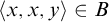 $\langle x,x,y \rangle \in B$
. Thus,
$\langle x,x,y \rangle \in B$
. Thus, $i(a)\times \{x\}\times i(c)\subseteq B$
by arbitrariness of y, and we obtain a contradiction.
$i(a)\times \{x\}\times i(c)\subseteq B$
by arbitrariness of y, and we obtain a contradiction.
The weak MIA axiom (wMIA) implies that $S_g \subseteq Q_f$
, and one may ask under which conditions equality
$S_g \subseteq Q_f$
, and one may ask under which conditions equality $Q_f = S_g$
holds, and, if so, whether
$Q_f = S_g$
holds, and, if so, whether $Q_f$
is a b-relation; we shall answer this question below. In analogy to the unary case (3) we say that
$Q_f$
is a b-relation; we shall answer this question below. In analogy to the unary case (3) we say that $\mathfrak{A}$
is a mixed algebra (MIA), if
$\mathfrak{A}$
is a mixed algebra (MIA), if $Q_f = S_g$
, i.e.,
$Q_f = S_g$
, i.e., $f[\mathscr{U}_1 \times \mathscr{U}_3] \subseteq \mathscr{U}_2$
if and only if
$f[\mathscr{U}_1 \times \mathscr{U}_3] \subseteq \mathscr{U}_2$
if and only if $g[\mathscr{U}_1 \times \mathscr{U}_3] \cap \mathscr{U}_2 \neq \emptyset $
.
$g[\mathscr{U}_1 \times \mathscr{U}_3] \cap \mathscr{U}_2 \neq \emptyset $
.
Our next result implies that full finite b-complex algebras are MIAs:
Proposition 8.5. Assume that $\mathscr{U}_1, \mathscr{U}_2,\mathscr{U}_3$
are principal ultrafilters of
$\mathscr{U}_1, \mathscr{U}_2,\mathscr{U}_3$
are principal ultrafilters of $2^U$
. Then
$2^U$
. Then $Q_{\langle { B \rangle }}(\mathscr{U}_1, \mathscr{U}_2,\mathscr{U}_3)$
implies
$Q_{\langle { B \rangle }}(\mathscr{U}_1, \mathscr{U}_2,\mathscr{U}_3)$
implies $S_{[[ B ]]}(\mathscr{U}_1, \mathscr{U}_2,\mathscr{U}_3)$
. In particular, if U is finite, then
$S_{[[ B ]]}(\mathscr{U}_1, \mathscr{U}_2,\mathscr{U}_3)$
. In particular, if U is finite, then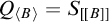 $Q_{\langle { B \rangle }}=S_{[[ B ]]}$
.
$Q_{\langle { B \rangle }}=S_{[[ B ]]}$
.
Proof Let $\mathscr{U}_1 = \mathop{\uparrow }\{x\}, \mathscr{U}_2 = \mathop{\uparrow }\{y\}, \mathscr{U}_3 = \mathop{\uparrow }\{z\}$
, and
$\mathscr{U}_1 = \mathop{\uparrow }\{x\}, \mathscr{U}_2 = \mathop{\uparrow }\{y\}, \mathscr{U}_3 = \mathop{\uparrow }\{z\}$
, and $Q_{\langle { B \rangle }}(\uparrow \{x\},\uparrow \{y\},\uparrow \{z\})$
. Then
$Q_{\langle { B \rangle }}(\uparrow \{x\},\uparrow \{y\},\uparrow \{z\})$
. Then $\langle { B \rangle }[\uparrow \{x\} \times \uparrow \{z\}] \subseteq \uparrow \{y\}$
, in particular,
$\langle { B \rangle }[\uparrow \{x\} \times \uparrow \{z\}] \subseteq \uparrow \{y\}$
, in particular, $\langle { B \rangle }(\{x\},\{z\}) \in \mathop{\uparrow }\{y\}$
, which implies
$\langle { B \rangle }(\{x\},\{z\}) \in \mathop{\uparrow }\{y\}$
, which implies $B(x,y,z)$
. It follows that
$B(x,y,z)$
. It follows that $y \in [[ B ]](\{x\}, \{z\})$
; hence,
$y \in [[ B ]](\{x\}, \{z\})$
; hence, $[[ B ]](\{x\}, \{z\}) \in \mathop{\uparrow }\{y\}$
, and therefore
$[[ B ]](\{x\}, \{z\}) \in \mathop{\uparrow }\{y\}$
, and therefore $[[ B ]][\uparrow \{x\} \times \uparrow \{z\}] \cap \mathop{\uparrow }\{y\} \neq \emptyset $
, i.e.,
$[[ B ]][\uparrow \{x\} \times \uparrow \{z\}] \cap \mathop{\uparrow }\{y\} \neq \emptyset $
, i.e., $S_{[[ B ]]}(\uparrow \{x\},\uparrow \{y\}, \uparrow \{z\})$
.
$S_{[[ B ]]}(\uparrow \{x\},\uparrow \{y\}, \uparrow \{z\})$
.
On the other hand, there are finite b-complex algebras in which the equality $Q_f=S_g$
fails such as the algebra
$Q_f=S_g$
fails such as the algebra $\mathfrak{A}_1$
of Example 8.2. Our next example exhibits an infinite full complex b-algebra which is not an MIA. Theorem 8.7 below shows that this is no accident.
$\mathfrak{A}_1$
of Example 8.2. Our next example exhibits an infinite full complex b-algebra which is not an MIA. Theorem 8.7 below shows that this is no accident.
Example 8.6. By Corollary 4.6, the relation $B_{\leqslant }$
obtained from the natural ordering
$B_{\leqslant }$
obtained from the natural ordering $\leqslant $
of
$\leqslant $
of $\omega $
is a betweenness relation, i.e.,
$\omega $
is a betweenness relation, i.e.,  is a b-frame. Let $X,Y \subseteq \omega $
be infinite; then, both X and Y are cofinal, i.e., for every
$X,Y \subseteq \omega $
be infinite; then, both X and Y are cofinal, i.e., for every $n \in \omega $
there are
$n \in \omega $
there are $k \in X, m \in Y$
such that
$k \in X, m \in Y$
such that $n \leqslant k,m$
. Hence,
$n \leqslant k,m$
. Hence, $n \in \langle { B_{\leqslant } \rangle }(X,Y)$
if and only if
$n \in \langle { B_{\leqslant } \rangle }(X,Y)$
if and only if $\min {X} \leqslant n$
or
$\min {X} \leqslant n$
or $\min {Y} \leqslant n$
, and it follows that
$\min {Y} \leqslant n$
, and it follows that $\langle { B_{\leqslant } \rangle }(X,Y) = \mathop{\uparrow }\min (X \cup Y)$
. In particular,
$\langle { B_{\leqslant } \rangle }(X,Y) = \mathop{\uparrow }\min (X \cup Y)$
. In particular, $\langle { B_{\leqslant } \rangle }(X,Y)$
is cofinite, and therefore
$\langle { B_{\leqslant } \rangle }(X,Y)$
is cofinite, and therefore $\langle { B_{\leqslant } \rangle }[\mathscr{U}_1 \times \mathscr{U}_2] \subseteq \mathscr{U}$
for all free ultrafilters
$\langle { B_{\leqslant } \rangle }[\mathscr{U}_1 \times \mathscr{U}_2] \subseteq \mathscr{U}$
for all free ultrafilters $\mathscr{U}_1,\mathscr{U}_2,\mathscr{U}$
of
$\mathscr{U}_1,\mathscr{U}_2,\mathscr{U}$
of $\omega $
. On the other hand,
$\omega $
. On the other hand, $[[ B_{\leqslant } ]](X,Y) = \emptyset $
. Assume that
$[[ B_{\leqslant } ]](X,Y) = \emptyset $
. Assume that $k \in [[ B_{\leqslant } ]](X,Y)$
. Since
$k \in [[ B_{\leqslant } ]](X,Y)$
. Since $X,Y$
are cofinite, there are
$X,Y$
are cofinite, there are $n \in X, m \in Y$
such that
$n \in X, m \in Y$
such that $k<n,m$
which implies that
$k<n,m$
which implies that $\langle n,k,m \rangle \not \in B$
, a contradiction. Therefore
$\langle n,k,m \rangle \not \in B$
, a contradiction. Therefore $Q_{\langle { B_{\leqslant } \rangle }}\neq S_{[[ B_{\leqslant } ]]}$
, and the full complex algebra of
$Q_{\langle { B_{\leqslant } \rangle }}\neq S_{[[ B_{\leqslant } ]]}$
, and the full complex algebra of $\mathfrak{N}$
is not an MIA.
$\mathfrak{N}$
is not an MIA.
Let us point out an analogy holding between $\mathfrak{N}$
and the standard ultrafilter extension of the binary frame
$\mathfrak{N}$
and the standard ultrafilter extension of the binary frame  . In case of the latter, principal ultrafilters correspond to the natural numbers, and free ultrafilters are clustered at infinity, in the sense that every free $\mathscr{U}$
is accessible from every principal
$\mathscr{U}$
is accessible from every principal $\mathscr{U}'$
, and the accessibility relation is universal on the set of free ultrafilters. In case of
$\mathscr{U}'$
, and the accessibility relation is universal on the set of free ultrafilters. In case of $\mathfrak{N}$
the situation is somewhat analogous, since as we have seen
$\mathfrak{N}$
the situation is somewhat analogous, since as we have seen $Q_{\langle { B_{\leqslant } \rangle }}$
is universal on free ultrafilters, and for any
$Q_{\langle { B_{\leqslant } \rangle }}$
is universal on free ultrafilters, and for any $n,m \in \omega $
such that
$n,m \in \omega $
such that $m\leqslant n$
, and any free
$m\leqslant n$
, and any free $\mathscr{U}$
we have
$\mathscr{U}$
we have $Q_{\langle { B_{\leqslant } \rangle }}(\uparrow \{m\},\uparrow \{n\},\mathscr{U})$
. Indeed, as we have seen above,
$Q_{\langle { B_{\leqslant } \rangle }}(\uparrow \{m\},\uparrow \{n\},\mathscr{U})$
. Indeed, as we have seen above, $\langle { B_{\leqslant } \rangle }(X,Y) = \mathop{\uparrow }\min (X \cup Y)$
, and since
$\langle { B_{\leqslant } \rangle }(X,Y) = \mathop{\uparrow }\min (X \cup Y)$
, and since $m\in X\cup Y$
,
$m\in X\cup Y$
, $\min (X \cup Y)\leqslant n$
. Therefore,
$\min (X \cup Y)\leqslant n$
. Therefore, $n\in \mathop{\uparrow }\min (X \cup Y)$
, as required. Thus
$n\in \mathop{\uparrow }\min (X \cup Y)$
, as required. Thus $Q_{\langle { B_{\leqslant } \rangle }}$
may be viewed as a relation that puts a large cluster of free ultrafilters at infinity in case of the 3-frame
$Q_{\langle { B_{\leqslant } \rangle }}$
may be viewed as a relation that puts a large cluster of free ultrafilters at infinity in case of the 3-frame $\mathfrak{N}$
.
$\mathfrak{N}$
.
Theorem 8.7. No infinite b-algebra is an MIA.
Proof We will proceed in three steps:
-
(1) No infinite full b-complex algebra is an MIA: Let
$\mathscr{U}$
be a free ultrafilter on
$2^U$
. Then,
$Q_{\langle { B \rangle }}(\mathscr{U},\mathscr{U},\mathscr{U})$
by Lemma 7.2. Assume that
$S_{[[ B ]]}(\mathscr{U},\mathscr{U},\mathscr{U})$
. Then, there are
$X,Y \in \mathscr{U}$
such that
$[[ B ]](X,Y) \in \mathscr{U}$
. Since
$X \cap Y \in \mathscr{U}$
and
$\mathscr{U}$
is a free ultrafilter,
$X \cap Y$
is infinite. This contradicts Theorem 6.10. -
(2) No infinite subalgebra of a full b-complex algebra is an MIA: Let
be an infinite subalgebra of
$\operatorname {{\mathsf{Cm}}}^{ps}(\mathfrak{F})$
, and
$\mathscr{U}$
be a free ultrafilter of D. Observing that
$\mathbf{Abtw}$
is a universal class, we see that
$\mathfrak{S}$
is a b-algebra, and therefore
$Q_{\langle { B \rangle }_D}(\mathscr{U},\mathscr{U},\mathscr{U})$
, again by Lemma 7.2.Assume that
$S_{[[ B ]]_D}(\mathscr{U},\mathscr{U},\mathscr{U})$
, i.e.,
$[[ B ]]_D[\mathscr{U} \times \mathscr{U}] \cap \mathscr{U} \neq \emptyset $
. Let
$X,Y \in \mathscr{U}$
be such that
$[[ B ]]_D(X,Y) \in \mathscr{U}$
; then,
$[[ B ]]_D(X,Y)\neq \emptyset $
and
$X \cap Y$
is infinite.
$[[ B ]]_D(X,Y) = [[ B ]](X,Y)$
, so again, we have a contradiction with Theorem 6.10. -
(3) No infinite b-algebra is an MIA: Suppose
is an infinite MIA. Then
$Q_f=S_g$
, and the reduct of
$\operatorname {{\mathsf{Cf}}}^{ps}(\mathfrak{A})$
to
$\langle \mathrm{Ult}(A),Q_f \rangle $
is a b-frame by Lemma 7.2. Hence,
$\operatorname {{\mathsf{Em}}}^{ps}(\mathfrak{A})$
is a full b-complex algebra, and by Theorem 7.3,
$\mathfrak{A}$
is isomorphic to a subalgebra of
$\operatorname {{\mathsf{Em}}}^{ps}(\mathfrak{A})$
. It follows from the previous results that
$\mathfrak{A}$
is not an MIA.


 be an infinite subalgebra of








 is an infinite MIA. Then

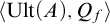


This concludes the proof.
The next example is an algebraic explanation of the non-definability result of Theorem 4.7.
Example 8.8. Let  be as in Theorem 4.7 and consider its full complex algebra $\operatorname {{\mathsf{Cm}}}^{ps}(\mathfrak{Z})$
. Let E and O be the sets of even and odd integers, respectively. Then,
$\operatorname {{\mathsf{Cm}}}^{ps}(\mathfrak{Z})$
. Let E and O be the sets of even and odd integers, respectively. Then,  is a Boolean subalgebra of
  , and we shall show that it is a PS-subalgebra of $\operatorname {{\mathsf{Cm}}}^{ps}(\mathfrak{Z})$
. If
$\operatorname {{\mathsf{Cm}}}^{ps}(\mathfrak{Z})$
. If  , then there are even and odd numbers below and above x which shows that
  . Furthermore, there are odd and even numbers strictly greater than x, and it follows that $[[ B ]](E,E) = [[ B ]](E,O) = [[ B ]](O,E) = [[ B ]](O,O) =\emptyset $
. Thus,
$[[ B ]](E,E) = [[ B ]](E,O) = [[ B ]](O,E) = [[ B ]](O,O) =\emptyset $
. Thus,  is a PS-subalgebra of $\operatorname {{\mathsf{Cm}}}^{ps}(\mathfrak{Z})$
.
$\operatorname {{\mathsf{Cm}}}^{ps}(\mathfrak{Z})$
.
On the other hand consider the full complex algebra of the frame $\langle U,R \rangle $
, where R is the ternary universal relation on
$\langle U,R \rangle $
, where R is the ternary universal relation on  . There, $[[ R ]](X,Y) = U$
for all
$[[ R ]](X,Y) = U$
for all $X,Y \subseteq U$
, contrasting the considerations above.
$X,Y \subseteq U$
, contrasting the considerations above.
The algebra $\operatorname {{\mathsf{Cm}}}^{ps}(\mathfrak{Z})$
has yet one more interesting property. Since for any
$\operatorname {{\mathsf{Cm}}}^{ps}(\mathfrak{Z})$
has yet one more interesting property. Since for any $X,Y\in 2^U$
,
$X,Y\in 2^U$
, $[[ B ]](X,Y)$
is always finite, if
$[[ B ]](X,Y)$
is always finite, if $[[ B ]][\mathscr{U}_1\times \mathscr{U}_2]\cap \mathscr{U}\neq \emptyset $
,
$[[ B ]][\mathscr{U}_1\times \mathscr{U}_2]\cap \mathscr{U}\neq \emptyset $
, $\mathscr{U}$
must be a principal filter, i.e., for some
$\mathscr{U}$
must be a principal filter, i.e., for some $x\in U$
,
$x\in U$
, $\mathscr{U}=\uparrow \{x\}$
. Therefore,
$\mathscr{U}=\uparrow \{x\}$
. Therefore, $Q_{\langle { B \rangle }}(\mathscr{U},\mathscr{U},\mathscr{U}) $
and not
$Q_{\langle { B \rangle }}(\mathscr{U},\mathscr{U},\mathscr{U}) $
and not $S_{[[ B ]]}(\mathscr{U},\mathscr{U},\mathscr{U})$
for all free ultrafilters of
$S_{[[ B ]]}(\mathscr{U},\mathscr{U},\mathscr{U})$
for all free ultrafilters of  .
.
As can be seen from the proof above, the only property of  that was needed to obtain both conclusions was its order type, which is $\omega ^\ast +\omega $
.
$\omega ^\ast +\omega $
.
Example 8.9. In Example 8.8 we saw a full complex algebra for which the relation $S_{[[ B ]]}$
is empty on the set of triples of free ultrafilters. We will show now that this does not have to be the case. To this end, consider the strong b-frame
$S_{[[ B ]]}$
is empty on the set of triples of free ultrafilters. We will show now that this does not have to be the case. To this end, consider the strong b-frame  induced by the standard dense linear order $\leqslant $
on the set of rational numbers
$\leqslant $
on the set of rational numbers  . Consider three intervals
  ,
,  and
and  . Let
. Let $\mathscr{U}_X,\mathscr{U}_Y$
, and
$\mathscr{U}_X,\mathscr{U}_Y$
, and $\mathscr{U}_Z$
be free ultrafilters containing the respective intervals. In this case we have that
$\mathscr{U}_Z$
be free ultrafilters containing the respective intervals. In this case we have that $[[ B ]](X,Z)=Y$
and so
$[[ B ]](X,Z)=Y$
and so $[[ B ]][\mathscr{U}_X\times \mathscr{U}_Z]\cap \mathscr{U}_Y\neq \emptyset $
. Generally, for any pair
$[[ B ]][\mathscr{U}_X\times \mathscr{U}_Z]\cap \mathscr{U}_Y\neq \emptyset $
. Generally, for any pair $\mathscr{U}_1,\mathscr{U}_2$
of free ultrafilters such that
$\mathscr{U}_1,\mathscr{U}_2$
of free ultrafilters such that $(r,p)\in \mathscr{U}_1$
,
$(r,p)\in \mathscr{U}_1$
, $(q,s)\in \mathscr{U}_2$
, and
$(q,s)\in \mathscr{U}_2$
, and $r<p<q<s$
there is a free ultrafilter
$r<p<q<s$
there is a free ultrafilter $\mathscr{U}$
such that
$\mathscr{U}$
such that $S_{[[ B ]]}(\mathscr{U}_1,\mathscr{U}_2,\mathscr{U})$
, i.e., any such ultrafilter which contains the open interval
$S_{[[ B ]]}(\mathscr{U}_1,\mathscr{U}_2,\mathscr{U})$
, i.e., any such ultrafilter which contains the open interval $(p,q)$
.
$(p,q)$
.
9 Summary and further work
We have put forward—well justified—axioms for an algebraic treatment of reflexive betweenness relations. The resulting class $\mathbf{Abtw}$
of b-algebras turned out to have some «good» properties such as closure under canonical extensions, and some «bad» ones, too, such as non-b-representability. In the context of the latter, the most pressing questions now are the following:
$\mathbf{Abtw}$
of b-algebras turned out to have some «good» properties such as closure under canonical extensions, and some «bad» ones, too, such as non-b-representability. In the context of the latter, the most pressing questions now are the following:
-
(1) Is there for any b-algebra
$\mathfrak{A}$
a 3-frame such that
$\mathfrak{A}$
is embeddable into the complex PS-algebra of
$\mathfrak{F}$
? We know from Example 8.4 that
$\mathfrak{F}$
cannot be a b-frame, but it may be possible that there is a larger class of 3-frames that can give us representability. Basically we ask if we can prove an analog of Theorem 8.5 from [Reference Düntsch, Orłowska and Tinchev9] or the Important Lemma from [Reference Gargov, Passy and Tinchev13]. -
(2) Which, if any, axioms can we add to (ABT0)–(ABT3) and (wMIA) to obtain a subclass of
$\mathbf{Abtw}$
that is b-representable?

 such that


We also investigated properties of the possibility and sufficiency operators in the context of b-algebras, and although initially it seemed that our axioms say little about g, we were able to prove—especially in Section 6—quite a number of strong properties, some of them limiting in nature. Also, we knew that f and g should be bounded by certain axioms to cooperate fruitfully, but to our surprise, it turned out in Theorem 8.7 that the cooperation cannot be too strong. Still, we believe that there are new connections to be discovered, which will result in further insights into algebraic aspects of betweenness.
What we entirely left out of this paper—but by no means neglected—are problems of axiomatizations of various subclasses of $\mathbf{Abtw}$
such as
$\mathbf{Abtw}$
such as $\mathbf{Cbtw}$
. These we are going to pursue in future installments of the work presented here.
$\mathbf{Cbtw}$
. These we are going to pursue in future installments of the work presented here.
Funding
This research was funded by the National Science Center (Poland), grant number 2020/39/B/HS1/00216, “Logico-philosophical foundations of geometry and topology.”

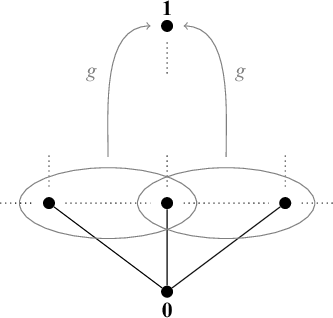
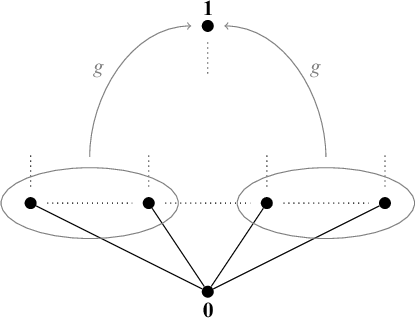

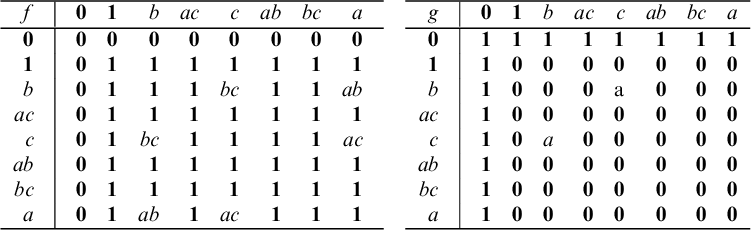


 Open access

