



 Open access

Crossref Citations

This article has been cited by the following publications. This list is generated based on data provided by Crossref.
Ochu, Chinwe Lucia
Akande, Oluwatosin Wuraola
Ihekweazu, Vivianne
Kaduru, Chijioke
Akomolafe, Oreoluwa
Egwuenu, Abiodun
Anueyiagu, Chimezie
Agenyi, Jeremiah
Ejibe, Ukwori
Falola-Anoemuah, Yinka
Umar-Farouk, Olayinka
Oyebanji, Oyeronke
Fagbemi, Babafunke
Oguanuo, Chukwuemeka
Ojumu, Tijesu
Saad, Hadiza
Mohammed, Tarik
Disu, Yahaya
and
Ihekweazu, Chikwe
2021.
Responding to a Pandemic Through Social and Behavior Change Communication: Nigeria's Experience.
Health Security,
Vol. 19,
Issue. 2,
p.
223.
Fatumo, Segun
Yakubu, Aminu
Oyedele, Olubukunola
Popoola, Jumi
Attipoe, Delali Attiogbe
Eze-Echesi, Golibe
Modibbo, Fatima Z
Ado-Wanka, Nabila
Osakwe, Yemisi
Braimah, Onome
Julius-Enigimi, Eramoh
Akindigh, Terver Mark
Kusimo, Bolutife
Akpulu, Chinenye
Nwuba, Chiamaka
Ebong, Ofonime
Anyika, Chinyere
Adewunmi, Oluwatimilehin
Ibrahim, Yusuf
Kashimawo, Janet
Osifo, Ogochukwu Francis
Nkwocha, Chidi
Iyitor, Peter
Abiwon, Temi
Adeleye, Adeola
Ode, Abayomi
Ayo-Lawal, Anjola
Akpabio, Kasiena
Edu, Emame
Njoku, Chiemela
Ballew, Bari
Palmer, Cameron
Musa, Abdullahi
Mujtaba, Abdulrasheed M.
Popoola, Abiodun
Bello, Abubakar M.
Anyanwu, Anthony
Yusuf, Ashiru
EL Bozimo, Gesiye
Bassey, Goddy
Bala, Hadiza
Bosan, Istifanus Bala
Edah, Jemimah
Jimoh, Mutiu Alani
Nwankwo, Kenneth
Ojo, Olalekan
Inyama, Marcus
Apanpa, Maryam
Mustapha, Mohammed
Ali-Gombe, Musa
Ojo, Olubukola
Adeyemi, Oludare
Ajayi, Samuel
Bala, Sanusi
Ojo, Temitope
Aliyu, Usman Malami
Raji, Yemi
Tanko, Zainab
Mohammed, Amina
Oladele, David
Hamzat, Muhammed
Agaba, Emmanuel
Nwankwo, Emeka
Ulasi, Ifeoma
Musa, Jonah
Odidika, Umeora
Salako, Omolola
Nashiru, Oyekanmi
Salako, Babatunde L
O’Dushlaine, Colm
and
Ene-Obong, Abasi
2022.
Promoting the genomic revolution in Africa through the Nigerian 100K Genome Project.
Nature Genetics,
Vol. 54,
Issue. 5,
p.
531.
Adenaike, Omolara
Olabanjo, Olufemi Emmanuel
and
Adedeji, Ayansewa Adeleke
2023.
Integrating computational skills in undergraduate Microbiology curricula in developing countries.
Biology Methods and Protocols,
Vol. 8,
Issue. 1,
Akande, Oluwatosin Wuraola
Disu, Yahya
Kaduru, Chijioke
Anueyiagu, Chimezie
Oguanuo, Emeka
Ojumu, Tijesu
Akomolafe, Oreoluwa
Eziechina, Sunday Obiajunwa
Ejibe, Ukwori
Ihekweazu, Vivianne
Ochu, Chinwe Lucia
and
Ihekweazu, Chikwe
2023.
Risk communication during health emergencies in Nigeria: What are its challenges?.
Journal of Public Health in Africa,
Vol. 14,
Issue. 1,
p.
5.
Owolabi, Paul
Adam, Yagoub
and
Adebiyi, Ezekiel
2023.
Personalizing medicine in Africa: current state, progress and challenges.
Frontiers in Genetics,
Vol. 14,
Issue. ,
Ogamba, Chibuzor F.
Roberts, Alero A.
Ajudua, Sharon C.
Akinwale, Mosopefoluwa O.
Jeje, Fuhad M.
Ibe, Festus O.
Afolayan, Moses M.
and
Kuyinu, Yetunde A.
2023.
Perceptions of Nigerian medical students regarding their preparedness for precision medicine: a cross-sectional survey in Lagos, Nigeria.
BMC Medical Education,
Vol. 23,
Issue. 1,
Adetunji, Charles O.
Olaniyan, Olugbemi T.
Adeniyi, Mayowa J.
Omoruyi Pius, Omosigho
Ghazanfar, Shakira
and
Adeyomoye, Olorunsola
2023.
Blockchain Technology in Healthcare - Concepts, Methodologies, and Applications.
p.
129.
Olaniyan, Olugbemi T.
Adeniyi, Mayowa J.
Adetunji, Charles O.
Omoruyi Pius, Omosigho
Ghazanfar, Shakira
Ajmal, Wajya
and
Adeyomoye, Olorunsola
2023.
Blockchain Technology in Healthcare - Concepts, Methodologies, and Applications.
p.
188.
Adetunji, Charles O.
Olaniyan, Olugbemi T.
Adeniyi, Mayowa J.
Omoruyi Pius, Omosigho
Ghazanfar, Shakira
Ajmal, Wajya
and
Adeyomoye, Olorunsola
2023.
Blockchain Technology in Healthcare - Concepts, Methodologies, and Applications.
p.
77.
Carneiro, Céline M.
Shields‐Estrada, Analisa
Boville, Alexandra E.
Alves‐Ferreira, Gabriela
Xu, Tianyi
Arnott, Ryan L. Wong
Allen‐Love, Chloé M.
Puertas, Micaela
Jacisin, John J.
Tripp, Hannah Chapman
Basham, Edmund W.
Zamudio, Kelly R.
and
Belasen, Anat M.
2025.
Toward a Global Science of Conservation Genomics: Coldspots in Genomic Resources Highlight a Need for Equitable Collaborations and Capacity Building.
Molecular Ecology,
Vol. 34,
Issue. 23,
Panji, Sumir
Ras, Verena
Gichoya, Judy
Julius, Rolanda
Maslamoney, Suresh
Motshegwa, Tshiamo
Sharaf, Abdoallah
Skelton, Michelle
Tunga, Mahadia
and
Mulder, Nicola
2026.
Unleashing potential: assessing Africa’s readiness for the data science revolution to impact health.
Nature Communications,
Oluwamakinde, Esther P.
Akpofure, Oghenefejiro D.
Adeniran, Samson O.
and
Fagbenro, Olukunle Silas
2026.
Integrating advanced molecular biotechnology tools into toxicological research infrastructure for sustainable development in Nigeria.
Discover Toxicology,
Vol. 3,
Issue. 1,
Hussein, Juma
and
Myovela, Hawa
2026.
Reframing bioinformatics capacity development in Africa: from training supply to research-driven demand.
Journal of Community Genetics,
Vol. 17,
Issue. 2,
Gbadegesin, O. A.
and
Akintola, S.
2026.
Bridging the Governance Gap: A Case for an Indigenous Jurisprudential Framework for Genomic and Biobanking Research in Nigeria.
Journal of Bioethical Inquiry,
Vol. 23,
Issue. 1,
p.
67.
Jose, Jithu K.
2026.
Implementing Genomics in Conservation: Gaps, Disparities and Need for Interdisciplinary Collaborations and Capacity Building in the Global South.
Diversity and Distributions,
Vol. 32,
Issue. 2,
Jjingo, Daudi
Walakira, Andrew
Hashim, Suhaila
Cheickna, Cisse
Galiwango, Ronald
Kibet, Caleb
Kivunike, Florence N
Mboowa, Gerald
Kakembo, Fredrick Elishama
Ayodele, Babajide
Entfellner, Jean-Baka Domelevo
de Villiers, Santie
Wambui, Karen
Fatumo, Segun
Chikowore, Tinashe
Mukisa, John
Ssekagiri, Alfred
Bbosa, Nicholas
Mulindwa, Julius
Kyobe, Samuel
Nsubuga, Mike
Kebirungi, Grace
Katagirya, Eric
Mwesigwa, Savannah
Lujumba, Ibra
Kamulegeya, Rogers
Kirimunda, Samuel
Kanyerezi, Stephen
Kiyaga, Shahiid
Sserwadda, Ivan
Kiberu, Davis
Bagaya, Bernard S
Okwir, Julius
Nabisubi, Patricia
Nabakooza, Grace
Atwine, Mugume Twinamatsiko
Sserunjogi, Ricard
Julius, Rolanda
Quiñones, Mariam
McCarthy, Meghan
Cruz, Phillip
Noble, Karlynn
Whalen, Christopher J
Hurt, Darrell
Giovanni, Maria Y
Tartakovsky, Michael
Ssemwanga, Deogratius
Kitayimbwa, John M
Reynolds, Steven J
Whalen, Christopher C
Kambugu, Andrew
Hanchard, Neil A
Jian, Li
Amoako-Yirenkyi, Peter
Mardon, Graeme
Jordan, I King
Salifu, Samson Pandam
Wele, Mamadou
Adebiyi, Ezekiel
Shaffer, Jeffrey G
Doumbia, Seydou
Kateete, David Patrick
Skelton, Michelle
Mulder, Nicola
Kayondo, Jonathan K
and
Masiga, Daniel
2026.
Pathways, outputs and impact of NIH-supported bioinformatics and genomics graduate trainees in Africa.
Briefings in Bioinformatics,
Vol. 27,
Issue. 1,
Introduction
Over the past two decades, there have been major advances in genomic studies globally with the most significant efforts aimed at investigating the genetic basis of human diseases [Reference Naidoo, Pawitan, Soong, Cooper and Ku1–Reference Collins, Morgan and Patrinos5]. Many of these studies have emphasised the central importance of Africa to the human origins, disease susceptibility, agriculture, and biodiversity conservation [Reference Gomez, Hirbo and Tishkoff6]. Nigeria is the most populous and most diverse country in Africa and thus plays a prominent role in population genetics in Africa and the world at large, owing to its 250 ethnic groups and over 500 different native languages, which are characterised by greater levels of genetic diversity and broad population substructure. Since the inception of the significant initiative such as Human Heredity and Health in Africa (H3Africa) consortium (http://h3africa.org) [Reference Rotimi, Abayomi, Abimiku, Adabayeri, Adebamowo, Adebiyi, Ademola, Adeyemo, Adu, Affolabi and Agongo7], the amount of genomic data generated in Africa has surged. Given the leading roles, many Nigerians play in emerging genomic projects and low footprints of Nigerian trained Genomicists and Bioinformaticians [Reference Fatumo, Adoga, Ojo, Oluwagbemi, Adeoye, Ewejobi, Adebiyi, Adebiyi, Bewaji and Nashiru8,Reference Rotimi9]. Therefore, the newly inaugurated Nigerian Bioinformatics and Genomics Network (NBGN) becomes necessary to facilitate collaborative activities amongst Nigerian bioinformatics and genomics investigators. NBGN aims to advance and sustain the fields of genomics and bioinformatics in Nigeria by serving as a vehicle to foster collaboration, provision of new opportunities for interactions between various interdisciplinary subfields of genomics, computational biology and bioinformatics, provide opportunities for the early career researchers.
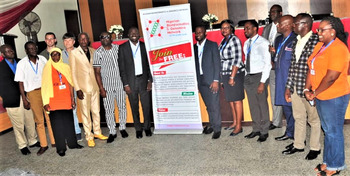
The NBGN was inaugurated on 26 June 2019 at the Nigerian Institute of Medical Research (NIMR), Lagos, Nigeria (Fig. 1) during the Nigerian's premier bioinformatics conference. The inauguration featured presentations by current executives about the activities of the network since inception and goodwill messages by invited dignitaries and leaders of affiliate societies such as Genetics Society of Nigeria (GSN), Biotechnology Society of Nigeria (BSN), Nigerian Society of Bioinformatics and Computational Biology (NiSBCB), Nigerian Bioinformatics and Education Research Network (NBREN) and Nigerian Society for Human Genetics (NiSHG). Two keynote presentations were given by Prof. Oyekanmi Nashiru and Prof. Ezekiel Adebiyi. One of the highlights of the inauguration ceremony was a special recognition award presented to Prof. Oyekanmi Nashiru and Prof. Ezekiel Adebiyi by the NBGN executives in recognition of their excellent leadership and pioneer effort in driving bioinformatics research and training in Nigeria amidst minimal infrastructure and several other challenges.
NBGN inauguration ceremony. Picture of NBGN pioneer executives, keynote speakers, invited dignitaries, and some members of NBGN taken during the inauguration ceremony on Wednesday 26 June 2019.
Bioinformatics and genomics are relatively new scientific disciplines, with surge of interest only in the last two decades. In Nigeria, there has also been considerable engagements by investigators, and the role of Nigeria in these initiatives has previously been reported [Reference Fatumo, Adoga, Ojo, Oluwagbemi, Adeoye, Ewejobi, Adebiyi, Adebiyi, Bewaji and Nashiru8,Reference Adeyemo, Amodu, Ekure and Omotade10]. A metrics for the measurement of this surge of interest could be seen in the increased amount of publications affiliated with Nigerian institutions over the last 5 years (online Supplementary Fig. S1). For instance, a search on PubMed using the same search query between 2014 and 2019 retrieved a total 368 publications with 2014 having the least number of publications of 34 (online Supplementary Fig. S1). The results are indeed expected as a number of research and capacity building interventions and funding have happened over the past 5 years with an increased research, education and collaborations within the Nigerian bioinformatics and genomics community. For instance, several bioinformatics and genomics research projects have recently been launched such as the Centre for Genomics Research and Innovation (CGRI) at the National Biotechnology Development Agency (NBDA), Genomic Characterization and Surveillance of Microbial Threats in West Africa at Redeemer's University, Ede, Nigeria, the African Collaborative Centre for Microbiome and Genomics Research (ACCME), and the Cassava and Yam projects at the International Institute of Tropical Agriculture (IITA), Ibadan, Nigeria. Aside from the heavily funded bioinformatics and genomics projects, several other bioinformatics and genomics communities have emerged to build capacity at their institutional and organisational levels at the grassroot levels. For instance, these groups include, Nnamdi Azikiwe University Bioinformatics and Genomics Consortium (NBGC), the Bioinformatics Training at Adeleke University, Ede, as well as the Molecular Docking and Training workshops at Bayero University, Kano. This list of bioinformatics and genomics funded projects and communities in Nigeria does not aim to be exhaustive, but to provide an initial insight into the state of the national bioinformatics and genomics community. Therefore, the NBGN aims to build connections and promote collaboration between these increasing activities in Nigeria that will help in accelerating research and innovation in the field of genetics, genomics, bioinformatics, and computational biology within Nigeria, continental Africa, and the global regions.
Organisation, leadership, and memberships
NBGN is currently made up of the identified pioneering leadership, identified society representative slots (e.g. Nigeria Society of Computational Biology and Bioinformatics, Biotechnology Society of Nigeria, Genetic Society of Nigeria, Nigeria Society for Human Genetics, etc.) – all of these make up the governing council which currently being driven by the pioneering leadership. All positions are currently vacant apart from the pioneering leadership which is made up of the founder and President (Segun Fatumo), Vice President – Communications & Operations (ThankGod Ebenezer), and Vice President – Finance & Logistics (Chinwe Ekenna) (http://www.nbgnetwork.org). There are provisions for a Network Advisory Board (NAB) which will be made up of senior scientists with sufficient scientific research, policy, and leadership experience.
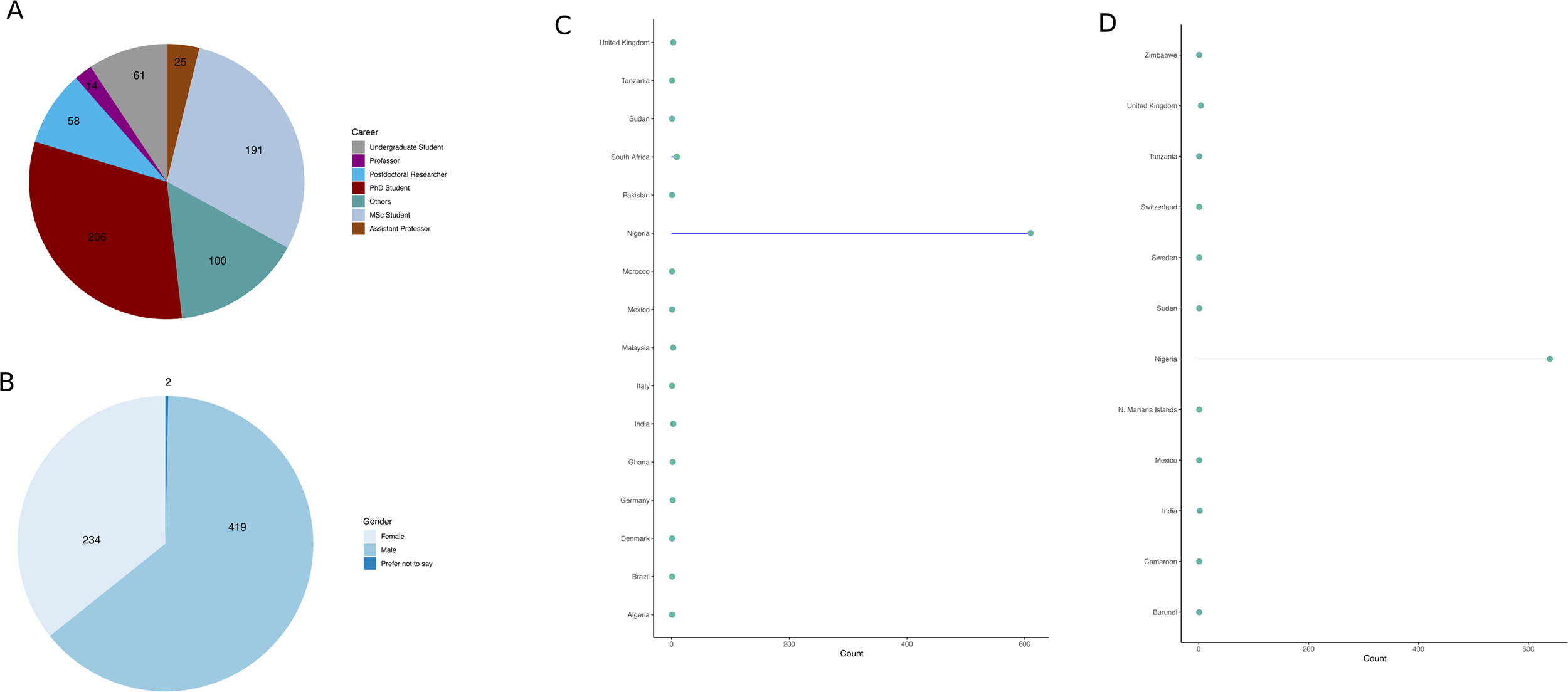
NBGN engages the public through social media such as Facebook, Telegram, Instagram, and LinkedIn as well as through membership subscription-based system. There are two membership streams: individual and partners. All membership streams are free until June 2020 with up to 655 current members (individual membership stream) with Ph.D. students recording the highest number of memberships (Fig. 2A). Membership also cuts across up to 16 countries of affiliations (Fig. 2C) and up to 12 nationalities (Fig. 2D).
Membership distribution of NBGN members. Panel A depicts NBGN membership across career stages. Legends correspond to undergraduates, Ph.D. students, M.Sc. students, professor, postdoctoral researcher, assistant professor, and others, respectively. Ph.D. students recorded the highest number of memberships. Panel B depicts NBGN membership across gender. Legends correspond to male, female, and prefer not to say. There are fewer females than males. Panel C depicts membership NBGN distributions across countries of affiliations. Coloured node suggests intersect between number of members and respective countries of affiliations. There are currently 16 countries of affiliations within NBGN. The y-axis corresponds to countries of affiliations; the x-axis corresponds to the number of members. Panel D depicts membership NBGN distributions across countries of nationalities. Coloured node suggests intersect between number of members and respective countries of nationalities. There are currently 12 groups of nationalities within NBGN. The y-axis corresponds to countries of nationalities; the x-axis corresponds to the number of members. Note that figures were plotted using ggplot2 in R.
The opportunities proffered by the NBGN
Advances in genome technology has led to the establishment of various societies, organisations, and networks that sought to share ideas, face challenges, and prosper solutions to human problems through bioinformatics and computational biology applications. In any network or organisational space, there is usually a provision of shared opportunities for its members community and immediate society to bring about benefit. Bioinformatics networks and societies play a vital role in the promotion and capacity building of many scientists across the world, including Nigerian state, through collaborations and networking. By fostering this networking, a number of many human problems that include health-related issues, agriculture and environment were remarkably addressed [Reference Ginsburg11–Reference Lyall13]. NBGN therefore aims to provide several opportunities for scientists, early career researchers as well as students with passionate interest in bioinformatics, genomics, and computational biology-related studies in Nigeria. Engaging and participating in NBGN activities offer networking and collaborations with other local scientists who might be working in the field of your research interest in Nigeria, Africa, and the rest of the world.
The recent first Nigerian bioinformatics conference (FNBC) organised by NBGN has demonstrated how the network helped in bridging the knowledge gap, fostering research collaborations, and providing peer support within the field of bioinformatics and computational biology [Reference Ebenezer, Isewon, Oladipo, Awe, Adebiyi, Ajamma, Afolabi-Balogun, Toye, Fasesan, Kashim, Oluwagbemi, Oyelade, Ogbole, Benthai, Asilebo, Abraham, Oduwole, Adamolekun, Adetunji, Ahmad, Tijjani, Akinleye, Osamor, Onwuamah, Amoo, Taiwo, Iwalokun, Ekenna, Salako, Adebiyi, Nashiru and Fatumo14]. Bioinformatics and genomic trainings in the form of workshops, seminars, short courses, and symposia are offered by NBGN to support and provide basic bioinformatics skills to Nigerian scientists working in the field of biomedical and life sciences as well as clinical settings in our local institutions, research centres, and hospitals. The training will provide strong foundation and enhance the knowledge of our local scientists and researchers on bioinformatics and computational genomics with the hope to step down the training to their various institutions and organisations. NBGN hopes to ensure that an integral part of the undergraduate programmes in life sciences, biomedical, medical, and biological sciences curricula covered some bioinformatics courses and is looking forward to collaborate with the local institutions to develop a specialised M.Sc. and Ph.D. degree programmes in bioinformatics.
Discussion and conclusion
The current state of genomic and bioinformatics in Nigeria in terms of resources, expertise, and infrastructure is still far from meeting its research needs, diversity and the Nigeria population. The NBGN is geared towards bridging knowledge gap, fostering research collaboration, and provide opportunities to strengthen genomics and bioinformatics in Nigeria.
NBGN is at a take-off point where the coalition of diverse researchers has the potential to put Nigeria on the map with regards to quality research undertakings in Africa and the rest of the world. The establishment of NBGN pushes the frontier on what can be achieved with a well-designed and organised network. The recently concluded First Nigerian Bioinformatics Conference (FNBC) [Reference Ebenezer, Isewon, Oladipo, Awe, Adebiyi, Ajamma, Afolabi-Balogun, Toye, Fasesan, Kashim, Oluwagbemi, Oyelade, Ogbole, Benthai, Asilebo, Abraham, Oduwole, Adamolekun, Adetunji, Ahmad, Tijjani, Akinleye, Osamor, Onwuamah, Amoo, Taiwo, Iwalokun, Ekenna, Salako, Adebiyi, Nashiru and Fatumo14] was a success and serves as a proof of concept to the rising need for a strong coalition and collaboration framework in Nigeria with a potential to extend beyond its frontiers. The rise on the membership counts for NBGN pinpoints to the human capacity available, which we hope the framework will harness.
NBGN organised two well attended pre-conference workshops with trainers from the European Bioinformatics Institute and University of Cape Town [Reference Ebenezer, Isewon, Oladipo, Awe, Adebiyi, Ajamma, Afolabi-Balogun, Toye, Fasesan, Kashim, Oluwagbemi, Oyelade, Ogbole, Benthai, Asilebo, Abraham, Oduwole, Adamolekun, Adetunji, Ahmad, Tijjani, Akinleye, Osamor, Onwuamah, Amoo, Taiwo, Iwalokun, Ekenna, Salako, Adebiyi, Nashiru and Fatumo14]. The FNBC organised by NBGN recorded 195 online registered participants, and 186 actual participants; comprising eight keynote speakers, six invited speakers, 25 oral presenters, 83 poster presenters, and up to 73 non-presenting participants including 16 international attendees [Reference Ebenezer, Isewon, Oladipo, Awe, Adebiyi, Ajamma, Afolabi-Balogun, Toye, Fasesan, Kashim, Oluwagbemi, Oyelade, Ogbole, Benthai, Asilebo, Abraham, Oduwole, Adamolekun, Adetunji, Ahmad, Tijjani, Akinleye, Osamor, Onwuamah, Amoo, Taiwo, Iwalokun, Ekenna, Salako, Adebiyi, Nashiru and Fatumo14]. NBGN having started on a strong footing, has continue to be driven by the pioneering leadership as well as some societal representative drawn from each of the aforementioned scientific and professional societies.
Finally, looking into the near future the entire leadership of the network will be made up of earnest researchers willing to open doors to international collaborations, attract quality opportunity that will potentially lead to the best practice research within the NBGN community.
Supplementary material
The supplementary material for this article can be found at https://doi.org/10.1017/gheg.2020.3.
Acknowledgements
We acknowledge the African Partnership for Chronic Disease Research (APCDR), the Covenant University Bioinformatics Research (CUBRe), Ota Nigeria and the Center for Genomics Research and Innovation (CGRI) Abuja Nigeria for the funding to kick starting the activities of the Network and organising eventsx. SF receives salary support from NIH grant U01MH115485 and the Makerere University-Uganda Virus Research Institute Centre of Excellence for Infection and Immunity Research and Training (MUII). MUII is supported through the DELTAS Africa Initiative (grant 107743). The DELTAS Africa Initiative is an independent funding scheme of the African Academy of Sciences (AAS), Alliance for Accelerating Excellence in Science in Africa (AESA), and supported by the New Partnership for Africa's Development Planning and Coordinating Agency (NEPAD Agency) with funding from the Wellcome Trust (107743) and the U.K. government. TEE is funded through the Biotechnology and Biological Sciences Research Council (BBSRC) Designing Future Wheat (DFW) Programme at the Earlham Institute.
Author contributions
All authors read and approved the final version of the manuscript.
Conflict of interest
None.