


1. Introduction
Developing new factories and production systems is effectively a design task, involving a magnitude of stakeholders. In this paper a study on how to foster the important communication and engagement with all relevant partners is presented. Preceding research has shown that the criteria used to select and acquire new machinery has not been sufficiently captured (Reference Hagström, Bergsjö, Blomberg and HåkanssonHagström et al., 2022; Reference Hane HagströmHane Hagström, 2021; Reference Hane Hagström, Bergsjö, Furborg and AasHane Hagström et al., 2022). This has shown to be one important factor, resulting in that many practical conditions need to be solved in a phase where many decisions have already been made, and room for change is limited. This is well known in design literature, yet when developing industrial manufacturing systems, its importance for a well-functioning project communication has been underestimated. Reference Huang, Gheorghe, Handley, Pazos, Pinto, Kovacic, Collins, Keating, Sousa-Poza, Rabadi, Unal, Cotter, Landaeta and DanielsHuang et al. (2020) describe digitalisation as “the process of adopting digital technology with the aim of improving a company’s performance across a multiple of factors and to gain access to new business opportunities”. Digitalisation can enhance quality of production by assigning repetitive and monotonous tasks to robots/machines and the tasks which need critical thinking to the humans (Reference Maddikunta, Pham, B, Deepa, Dev, Gadekallu, Ruby and LiyanageMaddikunta et al., 2022). Communication and employee motivation are boosted by interactive knowledge environments (Reference AdelAdel, 2022). This is also valid for the engineers and other white-collar tasks such as HR, business control or quality organisations.
There are various reasons why a company would like to invest in new machinery, including increasing capacity, introducing new products or phasing out obsolete spare parts. The industrialisation of this equipment is managed by projects. According to Reference RamsingRamsing (2009), the majority of problems that arise in projects are due to inferior communication. Succeeding in communication is considered a challenging task and the complexity of communication increases when more people are involved in a project and when the goal and scope of the project are more ambiguous (Reference GalliGalli, 2020). Application of communications theory to projects is commonly referred to as project communication. Lately the emphasis on using digital tools for communication in projects has increased (Reference Nyandongo and DavidsNyandongo & Davids, 2020). Visual planning is used for planning and executing projects and exploits the advantages of visualisation to improve the development process, among other things by strengthening communication (Reference LindlöfLindlöf, 2014). Physical visual boards have traditionally been used as an aid to visual planning in projects, but nowadays digital tools are available and the use of these is referred to as digital visual planning. By digitalising the visual planning process, the aim is to increase the efficiency of the process further and improve the ability to work and collaborate remotely (Reference Stenholm, Bergsjö and CaticStenholm et al., 2016). As a result, increased visualisation could potentially improve the efficiency of project communication. The aim of this study is to understand the barriers to efficient project communication and the ways in which digital visual planning can address these barriers. The following three research questions have been formulated:
-
RQ1: Which are the barriers to efficient communication in projects which are not using digital visual planning tools?
-
RQ2: Which are the barriers to efficient communication in projects already using digital visual planning tools?
-
RQ3: How can digital visual planning software address the barriers to efficient communication in projects?
2. Frame of reference
Communication plays a vital role in most settings where several individuals are supposed to be working towards a common goal (Reference ZulchZulch (2014). According to Reference RamsingRamsing (2009), there is a perception that as many as 95% of all problems that occur during collaborations are due to a lack of communication or incorrectly conducted communication. Project communication is the application of communications theory in projects, but the literature on this topic is quite limited (Reference Samáková, Sujanová and KoltnerováSamáková et al., 2013). For product development projects, for example Reference Sicotte and DelerueSicotte and Delerue (2021) state that communication and information sharing, both within the project team and with external actors, have a major impact on the project performance metrics. De Weck et al. (2011) point out that “Today, working in an engineering system, that same engineer must interact with a host of socioeconomic complexities and ‘externalities’ – impacts, either positive or negative, that are not a direct part of the artifact or even a self-contained system or process under consideration. Reference Natarajan, Kumar, Chaudhuri, Ramanujam, Banerjee, Banerjee and PatwariNatarajan et al. (2019) mention that “as engineers, we manage complexity operationally by using our (partly tacit) understanding by creating overall system models, multiple domain-specific models and views and maintaining and managing consistency among all of them”. At the same time, engineering is also a process and a social practice, involving various social actors who have specific roles in the practice and act at different stages in the process.
Reference Nyandongo and DavidsNyandongo and Davids (2020) state that project communication can be considered as all interactions within a project. Reference MuszyńskaMuszyńska (2016) defines a technical approach to project communication as “the right information to the right person at the right time”. Reference Berggreen and KampfBerggreen and Kampf (2015) are aware of this view but are sceptical of this unilateral technical definition of project communication. Instead, they argue that project communication is a socio-technical system, where relations, discussions, documents and tools need to be considered in combination with each other. Reference GalliGalli (2020) states that project communication must be carefully adjusted for the specific receivers of the information that is being communicated. When people receive information that they consider irrelevant, they experience that their time is being wasted, but too little communication will lead to misunderstandings. In addition, choosing the best form of communication and channel can be difficult. Some information is more efficiently spread in written form, some as pictures and symbols or as charts. Reference GalliGalli (2020) also states that face-to-face is the richest method for communicating since it allows for a simultaneous combination of verbal and nonverbal communication. When collaborating in a virtual environment, the non-verbal aspect is more limited which makes communication more difficult. In addition, virtual project communication is more prone to be distracted and distorted by noise. The noise can be caused by many things, for example, different levels of understanding in the language used for communication, and technical issues causing delays. Sometimes face-to-face communication during meetings is required and, for other matters, distributing a written document might be more efficient. Reference Lohikoski, Kujala, Haapasalo, Härkönen and Ala-MursulaLohikoski et al. (2015) present a list of frequent barriers to effective communication in product development projects involving virtual global teams. This framework is used for the analysis of this study.
-
Egocentrism: Considering one’s own team and site the most efficient
-
Mistrust: Potential previous unresolved issues cause mistrust
-
Information-sharing behaviour: Large numbers of emails, unstructured and lengthy messages and meeting, data-sharing problems
-
Previous interactions: Prior negative experiences of collaboration
-
Communication distortions: Competition between sites, information hoarding
-
Equivocality and ambiguity: Difficulty in understanding messages due to difference in technical background and competence. Language issues, including where native speakers dominate meetings
-
Asynchronicity and noise: Time zone differences, technical tool problems
Visual planning is frequently applied in lean product development as a means of increasing the efficiency of the product development process (Reference Stenholm, Bergsjö and CaticStenholm et al., 2016). The method can either be applied in a traditional setting, where physical tools and artefacts are used, or in a digital environment where software is utilised to enhance and simplify the visualisation as well as enable remote collaboration (Reference Stenholm, Bergsjö and CaticStenholm et al., 2016). Reference LindlöfLindlöf (2014) states: “Managers and engineers tend to be confronted with a large amount of information, thus creating an ‘information overload’. This can easily happen in knowledge-intensive organisations, and an effective strategy for coping with this is to use visualisation of the information”.
Digital visual planning is distinguished from visual planning by the fact that its concepts are applied in a virtual environment. Instead of physical artefacts, such as boards with notes, different types of software can be used to recreate a corresponding setting. Digital visual planning is most widely used by globally dispersed teams, where the distance between the team members does not allow them to work with physical visual planning (Reference Lindlöf and SöderbergLindlöf & Söderberg, 2011). By combining software that provides a visual planning board with a service for video calls, both the main elements of visual planning can be deployed remotely (Reference Stenholm, Bergsjö and CaticStenholm et al., 2016). Furthermore, Reference Pedo, Brandalise, Viana, Tzortzopoulos, Formoso and Whitelock-WainwrightPedo et al. (2020) have identified seven aspects that should be considered for digital visual planning systems to be successful. These are simplicity of functioning, information standardisation, autonomy to plan and control, right amount of information available, easy information accessibility, flexibility and information traceability. However, according to Reference Stenholm, Bergsjö and CaticStenholm et al. (2016), the digitalisation of visual planning risks reducing the amount and frequency of communication between team members. Reference Stenholm, Bergsjö and CaticStenholm et al. (2016) highlight the risk of too much attention being given to the technical aspects of the software when using digital visual planning and mentions that the cost is higher than using physical boards. On the other hand, Reference Jansson, Viklund and LidelöwJansson et al. (2016) describe how the storage and sharing of information are hindered by physical boards. Consequently, digital tools can address these challenges, by offering more space for notes, easy storing of information and the option of accessing information independently of geographical location. Furthermore, Reference Brady, Tzortzopoulos, Rooke, Formoso and TezelBrady et al. (2018) describe how digital management systems can enhance the information flow and the transparency of planning and control activities within a project. However, even if digital visual planning has the potential to increase process transparency in the design stage, in order to support collaboration and communication and facilitate the transfer of information, (Reference Pedó, Formoso, Viana, Tzortzopoulos, Brandalise and Whitelock-WainwrightPedó et al., 2022) state that literature concerning the implementation to support design management is still scarce.
3. Research methodology
The case company in the study is a global player in the heavy truck industry with about 100,000 employees worldwide. Several brands are represented in the portfolio and also a variety of vehicles, from excavators to buses and trucks. The company consists of multiple organisations which all interact on an operational level. The company has factories in 18 countries around the world. In addition to its production sites, its global industrial operations include several product development centres and several parts distribution and logistics centres. Furthermore, there are assembly plants operated by independent companies at 10 locations around the world. In addition to the case company, a research project managed by a university and a project of another automotive company were included as control projects or reference.
-
Project X – the main case – is located in one of the manufacturing plants of the case company and it is a product adaptation project. In the function where this project belongs, the project managers handle several projects simultaneously and therefore communicate with many people. The aim of implementing the software in the study was to facilitate the management of these projects by decreasing the number of collaborative tools and increasing the intuitiveness of collaboration and communication. The projects are run in a sequential way according to the stage-gate methodology and have clearly defined goals and a formalised and explicit structure.
-
Project Y – reference case – is a recently started research project which involves a collaboration among several industrial companies with the aim to research how digital flows between industrial partners in different business scenarios could be improved. In the part of the project that was studied, two companies and one university are involved. From these three organisations, there are in total seven people working on the project and all of these were included as participants in the study. This project does not follow an explicit or defined project management model, but some similarities to the agile methodology were identified during the study. The project is loosely defined and open-ended. Innovations need to be introduced for the project to achieve its objective.
-
Project Z – reference case – is based in another manufacturing company and has been using the digital visual planning software for three years. The project consists of a team working on updates to the product configurator at the company. There are two people in this team and both are included as participants of this study. In contrast to projects X and Y, this project has already implemented the software and has been using it for several years. The software is used in this project to make day-to-day work easier by structuring upcoming deliverables and activities, both for short-term and long-term planning purposes. As a result of this, the project adheres to a large extent to the visual planning methodology.
-
Software A – the digital visual planning tool studied – was introduced in 2014. Building on lean principles, the tool is an enabler for digital visual planning to support project management. It visualises project work in a digital format on a project board and allows for communication and collaboration within the team. Meetings, deliverables, questions and activities are visualised in the format of coloured notes on the board and these can be assigned to specific people, since each project team member has their own row. These notes are accessible to all members of the team. Figure 1 shows the digital virtual planning board from Software A.
The digital virtual planning board from software A. blurred for confidentiality reasons

A literature review was conducted with the search terms “project management”, “communication”, “project communication” “Stage-gate”, “lean product development”, “agile product development”, “visualization”, “visual planning”, “digital visual planning”, “change management”, and “resistance to change”. In the case study, the researchers have interviewed the project team to understand the barriers and then developed a visual planning tool which was tested and evaluated. As control groups, two other cases were also studied: one research project which had recently been started and which therefore had no established project communication structure and one mature case which has been using the same visual planning tool for several years. However, an upgraded version of the software was available, which is why all three projects include demonstrations. The research process used in this study is a combination of a prescriptive and a descriptive approach, as seen in Figure 2.
Overview of the research approach

The approach is adapted from the DRM framework developed by Reference Blessing and ChakrabartiBlessing and Chakrabarti (2009),. Empirical data was collected using semi-structured interviews and participant observations. In addition, qualitative secondary data was collected through literature reviews. In total twelve semi-structured interviews were conducted and interviews were held with the members of all three case projects. For the observations the researchers took part in project meetings, workshops and field trips as passive participants and made notes. The researchers also observed the users in their usage of the digital visual planning software, after providing them with training on it. In total, 13 observations were conducted during the study. Demonstrations of the software were used as an opportunity to obtain important feedback. During the demonstrations, the researchers presented the software and taught the participants how to use it. In addition, the project team members had the opportunity to ask questions and share their opinions. Demonstrations were held until the project team members considered that the planning board in the software had been adapted sufficiently to suit their project. In Project X three demonstrations were conducted and in Project Y and Z two demonstrations each were conducted. A theoretical framework regarding barriers to efficient communication was utilised for comparison with the findings from the thematic analysis. To minimise the impact of subjectiveness during the thematic analysis, a guide by Reference Nowell, Norris, White and MoulesNowell et al. (2017) was followed. This guide contains six steps. The first step is to structure and become familiar with the data. In the second step, initial coding is conducted by highlighting interesting aspects of the data. Step three is to identify themes in the initial codes, and the fourth step is to review these themes by once again reviewing the raw data. Step five is to define and name the themes that have been identified and reviewed, and the last step is to write up the findings from the thematic analysis. For validation the set of validation criteria known as trustworthiness was used. This consists of four dimensions that are important to consider when designing a research method, namely credibility, transferability, dependability, and confirmability (Reference Lincoln and GubaLincoln & Guba, 1985). The analysis of the empirical data was conducted by the two of the researchers independently. The results of the analysis were then compared, with the aim of uncovering and discussing potential differences and establishing consensus.
4. Results
The results are presented as per research question and all RQs are summarised in the end of the chapter.
RQ1: What are the barriers to efficient communication in projects which are not using digital visual planning tools?
Egocentrism and mistrust
Neither Project X nor Project Z mentioned egocentrism and mistrust during interviews. Project Y, on the other hand, had identified trust as a key enabler in terms of trusting that information is shared within the organisation. A member of Project Y stated that a large and important task is to ensure that all the members of the project get to know each other. In connection with this, the respondent emphasised the need to establish a sense of trust between the members of the project, since a large part of the project is about collaboration and sharing data between companies in the value chain.
Equivocality and ambiguity
Project X stated that with the hierarchy in communication, functional leaders interpret information provided by the project owner before it is transmitted to members. The respondent recalled one occasion when a leader misinterpreted information from the project owner. The respondent further added that even though the project execution process is clearly defined, there are sometimes some difficulties in retaining the information needed. This is described as due to the lack of transparency and difficulty in collaborating in the tools and documents used to manage the projects. Project Z did not mention this as a barrier during interviews while Project Ydid identify these aspects. The members of Project Y all originate from different organisations and are collaborating to achieve a common goal defined by the project. One of the participants with the role of project leader stated that since Project Y aims to create new and innovative solutions, a long timeframe and a less rigid and defined planning structure are necessary. However, one project member held the opinion that the project is too vaguely defined and that this leads to confusion regarding what needs to be done, which slows down the project. the transparency of information was mentioned. The leader supported this: “I do not think the project communication is transparent for the project members. For me it is quite transparent, because I am the leader.”
Interaction capability
Neither Project X nor Project Z mentioned interaction capability during interviews. Project Y touched upon it in terms of the ability to speak Swedish and English. The fact that there are people from several organisations working on the project leads to some challenges when communicating, according to one project member. In addition, the respondent said that some members of the team know each other from previous projects and some do not. This sometimes leads to a situation where communications with different members are on different levels of formality.
Asynchronicity and noise
According to a member of Project X, the Software A is used for managing the project and conducting communication. The respondent stated that the current configuration of tools and documents for managing the project is not transparent. The individual lacked access to some of the important documents which were only available during meetings. One member of Project Z mentioned that cyber security is one of the challenges involved in using email for sending documents, that sometimes the documents disappear and that emails need to be sent each time the project plan has been revised. By using Software A, the respondent felt that the number of emails is reduced and that this leads to less stress. Another member of this project does not completely agree, since a lot of emails are still used for communicating with other departments within the company. However, this respondent agrees that increasing the use of Software A to communicate with other teams could result in a reduction in the number of emails. All the respondents said that they like this set-up and the frequency of the meetings. However, they express the wish that more people would utilise Software A so that they could scale up the benefits that they experience from using the software. Respondents from Project Y stated that there have been some technical issues with the communication channels because the members come from different organisations. One example that was provided by a respondent is that access to different systems has been a problem if the system is on the intranet of a specific company. One project member said that some tools for communication and planning are not intuitive and are difficult to learn.
Information-sharing behaviour
An issue brought up by Project X was the difficulty in collaborating with the current configuration of tools. Several idnividuals stated that the current configuration with several tools and repositories is not intuitive nor efficient and that they need a solution that consists of only one tool. The existing solution for managing the projects consists of many different repositories and documents used in combination. By reducing the complexity, they hope to decrease the time needed for administrative tasks relating to project planning and communication and, therefore, to free up more time for actual development work with more interactive and transparent communication. For Project Z, one problem that was mentioned is that one of the actors who is collaborating closely with the team is unwilling to use the software and prefers email and regular meetings instead. Another problem was that different project members have different preferences concerning the frequency of communication in the project. Project Y also mentioned that the preferred communication channel varies between different members of the project.
RQ2: Which are the barriers to efficient communication in projects already using digital visual planning tools?
As only Project Z has been using a digital visual planning tool for a longer period, the responses from the two team members are described in this section. One respondent described how digital visual planning helps to make it easier to track which actions have been taken. This decreases the time spent reading through emails and ultimately improves efficiency. “I would absolutely say that Software A helps to make our work more efficient. If someone asks me ‘Have we completed this change request?’, then I can easily look back over the Software A board and check that it has already been revised.” The other team member explained that the software helps to make communication more transparent. The simplicity of the software is said to be the key to this. It allows other people to easily keep track of what work needs to be done. “I would say that information and communication are more transparent with Software A. And I believe that the key is that it is so simple. Since we write in the schedule exactly what needs to be done for each larger deliverable, it is very clear and easy to follow for everyone who is affected.” A team member said that Software A makes the management of planning easier. They use the software when they collaborate with one of the other functions involved in their daily work, both managers and team leaders. The respondent stated that the software provides benefits in terms of easy planning of tasks and activities as well as insightful visualisations, which can be displayed during meetings as a basis for discussion. In addition, one team member explained that using Software A has increased the quality of their deliveries to the stakeholders. Software A is said by one team member to be collaborative. “Since all the team members have access to the board and can access the changes made by other people, it is easy to follow who is in charge of what. This makes it easier to know who to contact when more information is needed” In addition, since the software utilises visualisation to a large extent, it is easy to get a quick understanding of how much work each team member has each day, which, according to one respondent, is beneficial because the workloads can be balanced more effectively.
According to one team member, Software A is easy to access. “As long as you have an email address, you can add new users who need to access the information in Software A”. The other team member said that they do not currently use Software A to communicate with external actors such as consultants and suppliers who are also a part of the Project Z community but that is their intention, The respondent hoped that, by doing this, they can plan and communicate a larger proportion of their work in the software, while also taking cyber security into consideration. One respondent stated that fewer emails meant fewer stressful searches for information in unstructured email threads. All the respondents highlighted how simple the software is to use. Because of this ease of use, one respondent explained that the threshold for learning Software A is low. Another respondent said similarly that the simplicity of Software A means that everyone who starts to use it continues to do so.
RQ3: How can digital visual planning software address the barriers to efficient communication in projects?
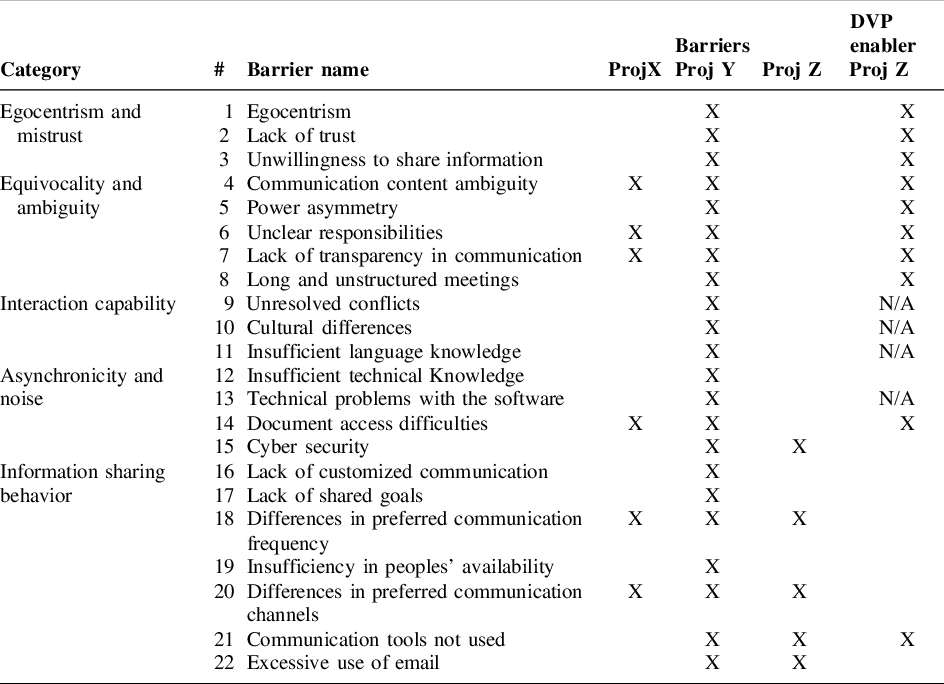
The findings show that digital planning software supports mainly in the categories of Egocentrism and Mistrust, Equivocality and Ambiguity and less in Interaction Capability, Asynchronisity and Noise and Information-sharing Behaviour as can be seen in Table 1.
Summary of identified barriers to communication in projects and the barriers that can be addressed by digital visual planning (DVP) tools

5. Discussion
In our small sample of projects, egocentrism and mistrust do not depend on whether there is digital visual planning software in place. However, from the interviews, Project Z identified the software as an enabler for mitigating this category of barriers. An alternative explanation is that Project X has addressed this in other ways; they are a small and close-knit team located together in one physical office. Regarding equivocality and ambiguity, the digital visual planning software could have had an impact, as only Project X brought up this category. In this sense, digital visual planning tools can overcome barriers such as content ambiguity, unclear responsibilities and lack of transparency in communication. Project X did not mention interaction capability as a barrier and in Project Z this was not applicable, according to the interviews. The participants did not mention unresolved conflicts. They are also working in the same country and communicating in the same language. As far as asynchronicity and noise are concerned, Project X mentioned that they had problems in accessing some documents, while this seemed to be mitigated by the software in Project Z. Cyber security was only mentioned by Project Z, which could mean that the team members are more aware of the issues involved. The information-sharing behaviour category highlights the fact that both projects have problems with preferred communication frequency and channels. This means that the digital visual planning software does not solve this issue. Also, an interesting note from Project Z is that even though the tool is implemented, not everyone is using it, which means that there is a parallel world where emails are sent.
Digital visual planning software was shown to be incapable of addressing several of the identified barriers to efficient project communication. This fact is not per se a challenge or drawback. Many of the barriers are highly related to organizational and managerial issues and will, therefore, not be able to be addressed by only implementing a new software and methodology. In contexts where changes are about to be implemented, challenges often arise. As described by Reference Thomas and HardyThomas and Hardy (2011), the topic of change management becomes apparent in these circumstances. When a new software or way of working is implemented, project members need to spend time and energy learning the new way of working. This could be perceived as a threshold for the individuals and, thus, a limiting factor in their willingness to devote the time needed to learn. This fact will, according to Reference StrebelStrebel (1996), come with the challenge of resistance to change. Some actors will not, because of different reasons, like the change. It could for example be that it is more comfortable to continue according to the old state. However, the reason for people resisting a change might, according to Reference Ford and FordFord and Ford (2010) very well also be because they consider the new tool or way of working to be inferior compared to the current one. Due to this possibility, it is therefore important to listen to the individuals who are going to use the tool and to remember that they are often the ones with the most knowledge about the process at hand.
6. Recommendations for further research
The projects studied are long-term in nature. There was only a limited period to carry out a formal and structured assessment of the impact of implementing digital visual planning using software. As a result of this, no project performance metrics were analysed, which means that no objective conclusions could be reached regarding the impact of the digital visual planning software on the project communication and project performance. Later, it is recommended not only studying three projects that are in different phases of the implementation of digital visual planning, but also following one or more projects throughout the entire implementation, from the initial phase through to the development phase and into the follow-up phase. It would also be beneficial to use the Lohikoski barriers already in the interviews and ask participants to indicate which problems they have encountered. Regarding the generalisability of the findings of this study, there are some limitations. Three case projects have been studied and several companies have been included in the study. However, all the companies and projects in this study are manufacturing organisations. In addition, it is a qualitative study and this is considered to be less suitable for generalisation than, for example, quantitative research (Reference Bell, Bryman and HarleyBell et al., 2019). Since this study builds upon and is limited to qualitative research, the findings could be strengthened by including elements of quantitative research. As stated by (Reference Maddikunta, Pham, B, Deepa, Dev, Gadekallu, Ruby and LiyanageMaddikunta et al., 2022), digitalisation comes with limitations, to start with, acceptance of technology and trust in the technologies are critical. Challenges to study going forward could be security, privacy, lack of skilled workers, time-consuming process, and how to mitigate the large budget required to scale up digitalisation for engineering processes.



 Open access

