


Hong Kong witnessed a rising tide of suicides in the period following the transition from British rule in 1997. The population suicide rate rose from 13.3 per 100 000 in 1998 to 15.1 per 100 000 in 2001 (Reference Yip, Law and LawYip et al, 2003). By 2003 the suicide rate had continuously increased to 16.4 per 100 000, its historic high. The surge in suicide rate was more prevalent among the middle-aged group and was paralleled by the emergence of a new suicide method – charcoal-burning (Reference Lee, Chan and LeeLee et al, 2002). In November 1998 a middle-aged woman killed herself by burning charcoal on a barbecue grill inside her small, sealed bedroom. This self-invented carbon monoxide chamber was vividly publicised by the media, and the method quickly became a fashionable way to end one's life (Reference Chung and LeungChung & Leung, 2001; Reference Chan, Lee and LeeChan et al, 2003). Within 2 months, charcoal-burning had become the third most common method of suicide in Hong Kong (Reference Chan, Lee and LeeChan et al, 2003). The upward suicide trend and the charcoal-burning epidemic closely mirrored the economic recession that caught Hong Kong unprepared in 1997. The exact pathways that articulate between the economic downturn and the lived experience that preceded the suicides, however, were intriguing. Using quantitative and qualitative methods in tandem, we examined how the post-transition economic and socio-cultural landscape shaped the new suicide pattern in Hong Kong.
METHOD
Design
We retrospectively reviewed coroner's records of 160 cases of suicide by charcoal-burning and an equal number of age- and gender-matched controls. We also conducted an ethnographic study of the charcoal-burning suicide phenomenon. The research methodology was approved by the human research ethics committee of the Chinese University of Hong Kong.
Coroner case record study
The first 160 cases of charcoal-burning suicide (ICD-10 code E952.1, World Health Organization, 1992) were identified from the Coroner's Court registry and the case records examined. Socio-demographic, medical and psychiatric data were extracted from the records, in addition to information about the psychosocial circumstances that surrounded the suicide; including credit commitment, excessive drinking, and gambling behaviour, as well as the extent of preparation. Suicidality was assessed using Part 1 of the Suicidal Intent Scale (Reference Beck, Schuyler and HermanBeck et al, 1974).
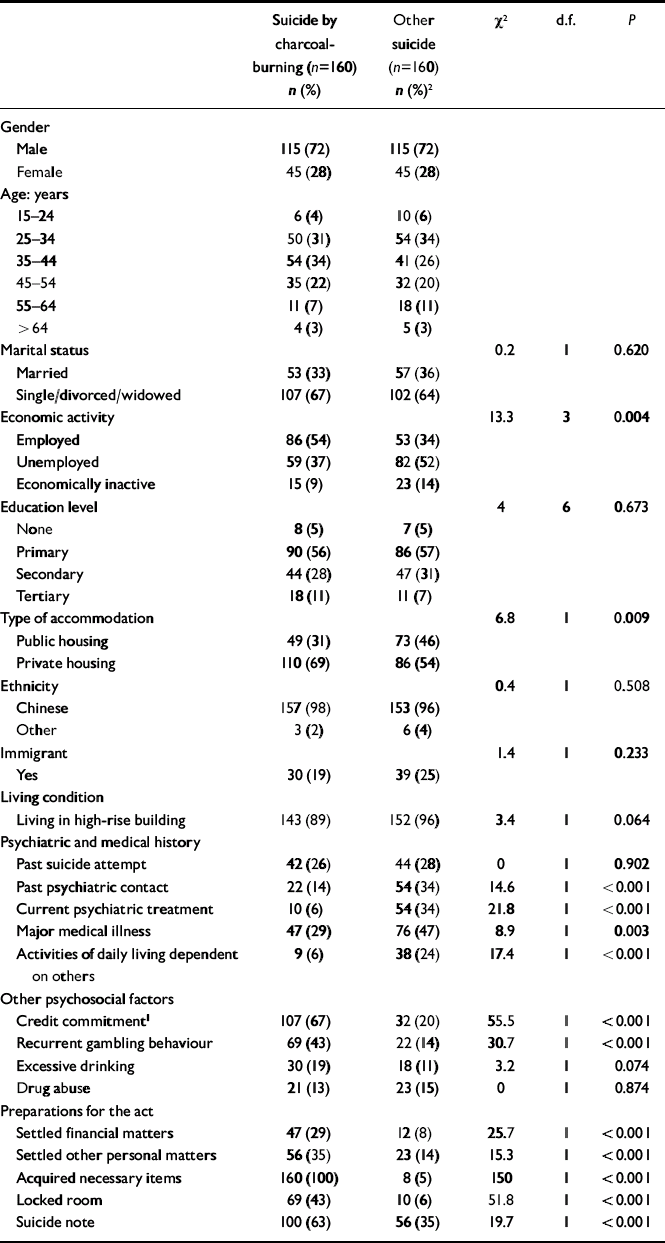
To provide control comparison, 160 cases of suicide by other means, matched for age (±5 years) and gender, occurring during the same time span (November 1998 to January 2000), were examined using the same protocol. A single trained research assistant was responsible for the case record review and data collection for both the cases and controls. The case–control comparison aimed to identify the factors and circumstances that were associated with charcoal-burning (vis-à-vis other suicide methods). Based on the pilot study and informed clinical experience, we selected 16 putative risk factors for examination (see Table 1).
Socio-demographic, medical and psychiatric profiles of case record study sample: charcoal-burning suicide v other suicide
| Suicide by charcoal-burning (n=160) n (%) | Other suicide (n=160) n (%)2 | χ2 | d.f. | P | |
|---|---|---|---|---|---|
| Gender | |||||
| Male | 115 (72) | 115 (72) | |||
| Female | 45 (28) | 45 (28) | |||
| Age: years | |||||
| 15-24 | 6 (4) | 10 (6) | |||
| 25-34 | 50 (31) | 54 (34) | |||
| 35-44 | 54 (34) | 41 (26) | |||
| 45-54 | 35 (22) | 32 (20) | |||
| 55-64 | 11 (7) | 18 (11) | |||
| > 64 | 4 (3) | 5 (3) | |||
| Marital status | 0.2 | 1 | 0.620 | ||
| Married | 53 (33) | 57 (36) | |||
| Single/divorced/widowed | 107 (67) | 102 (64) | |||
| Economic activity | 13.3 | 3 | 0.004 | ||
| Employed | 86 (54) | 53 (34) | |||
| Unemployed | 59 (37) | 82 (52) | |||
| Economically inactive | 15 (9) | 23 (14) | |||
| Education level | 4 | 6 | 0.673 | ||
| None | 8 (5) | 7 (5) | |||
| Primary | 90 (56) | 86 (57) | |||
| Secondary | 44 (28) | 47 (31) | |||
| Tertiary | 18 (11) | 11 (7) | |||
| Type of accommodation | 6.8 | 1 | 0.009 | ||
| Public housing | 49 (31) | 73 (46) | |||
| Private housing | 110 (69) | 86 (54) | |||
| Ethnicity | 0.4 | 1 | 0.508 | ||
| Chinese | 157 (98) | 153 (96) | |||
| Other | 3 (2) | 6 (4) | |||
| Immigrant | 1.4 | 1 | 0.233 | ||
| Yes | 30 (19) | 39 (25) | |||
| Living condition | |||||
| Living in high-rise building | 143 (89) | 152 (96) | 3.4 | 1 | 0.064 |
| Psychiatric and medical history | |||||
| Past suicide attempt | 42 (26) | 44 (28) | 0 | 1 | 0.902 |
| Past psychiatric contact | 22 (14) | 54 (34) | 14.6 | 1 | <0.001 |
| Current psychiatric treatment | 10 (6) | 54 (34) | 21.8 | 1 | <0.001 |
| Major medical illness | 47 (29) | 76 (47) | 8.9 | 1 | 0.003 |
| Activities of daily living dependent on others | 9 (6) | 38 (24) | 17.4 | 1 | <0.001 |
| Other psychosocial factors | |||||
| Credit commitment1 | 107 (67) | 32 (20) | 55.5 | 1 | <0.001 |
| Recurrent gambling behaviour | 69 (43) | 22 (14) | 30.7 | 1 | <0.001 |
| Excessive drinking | 30 (19) | 18 (11) | 3.2 | 1 | 0.074 |
| Drug abuse | 21 (13) | 23 (15) | 0 | 1 | 0.874 |
| Preparations for the act | |||||
| Settled financial matters | 47 (29) | 12 (8) | 25.7 | 1 | <0.001 |
| Settled other personal matters | 56 (35) | 23 (14) | 15.3 | 1 | <0.001 |
| Acquired necessary items | 160 (100) | 8 (5) | 150 | 1 | <0.001 |
| Locked room | 69 (43) | 10 (6) | 51.8 | 1 | <0.001 |
| Suicide note | 100 (63) | 56 (35) | 19.7 | 1 | <0.001 |
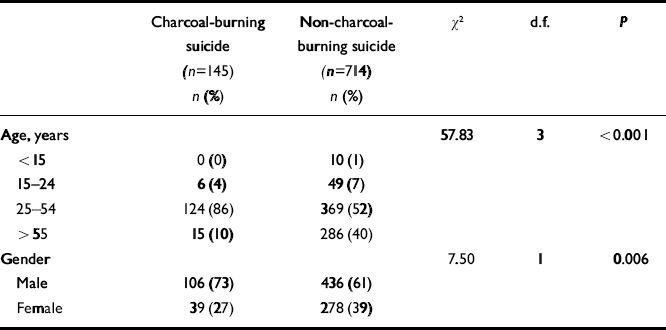
Since the cases and controls were matched for age and gender, we were unable to determine age and gender effects in the case–control comparison. To overcome this limitation, we examined the population-based suicide data collected by the Hong Kong Census Department (Reference Yip, Law and LawYip et al, 2003), comparing the age and gender of all those who killed themselves by charcoal-burning in 1999 with those who had completed suicide by other means in the same year.
Statistical analysis
Statistical analyses were performed using the Statistical Package for the Social Sciences, SPSS for Windows version 11.0. The characteristics of cases of charcoal-burning suicide were summarised using descriptive statistics. In the univariate analysis, McNemar tests were used to examine for associations between categorical risk factors and suicide by charcoal-burning. For continuous variables, paired-samples t-tests were used.
Ethnographic study
An ethnographic study was conducted to complement the case–control study. Ethnography, an anthropological research method, is the close study of a local world – a village, an urban neighbourhood, an institution or a network; it privileges local language, conceptual categories, values, meaning and practices (Reference KleinmanKleinman, 2000). We began by reviewing the media reports of charcoal-burning suicides in 1998 and early 1999, reflecting on the messages conveyed in the textual and pictorial materials. We then searched the internet, professional literature as well as the lay culture, attempting to delineate the origin and spread of the new method. Next, to understand the lived experience and the circumstances that preceded suicide by this method, we conducted in-depth ethnographic interviews with people who had survived serious suicide attempts involving charcoal-burning. Last, as the enquiries and analyses unfolded, it became apparent that credit card debts and financial strain were overrepresented among people who had died by this method. To understand why there was a culture of overspending and over-indebtedness in the peritransitional period, we interviewed four key informants from the lending and banking sectors.
Ethnographic interviews
We interviewed 25 persons who had survived a serious attempt to kill themselves by charcoal-burning. These informants were recruited consecutively from three district general hospitals between December 2000 and January 2002. All informants scored more than 12 on Beck's Suicidal Intent Scale (Reference Beck, Schuyler and HermanBeck et al, 1974). They were interviewed, with their written informed consent, within 3 weeks of admission. A key relative was also interviewed if both the participant and the relative consented.
The interviews were conducted and audiotaped by one of the investigators (K.P.M.C.), a research psychiatrist who had received training in ethnography. The interviews, guided by a list of topical questions, followed an iterative process whereby questions about topics and sometimes the topics themselves changed as the formulation of the meaning developed. At the end of the interview, the Chinese version of the Structured Clinical Interview for DSM–III–R (SCID–III–R; Reference Spitzer, Endicott and RobinsSpitzer et al, 1978; American Psychiatric Association, 1987) was administered to ascertain psychiatric diagnosis. The interviewer was masked to the case–control study findings.
Data analysis
All ethnographic interviews were transcribed into Cantonese for narrative analysis. The data were analysed manually with notes written at the margins of the transcripts. The notes in the margins enabled the categorisation of the data into similar subject areas in a process known as ‘coding’. An inductive process of coding the data was employed, and analytical categories were identified as they emerged from the transcribed data (Reference Hammersley and AtkinsonHammersley & Atkinson, 1995; Reference Strauss and CorbinStrauss & Corbin, 1998). Analysis involved the identification of themes in line with the guiding questions, along with the new categories that emerged from the data. Coding was done by the interviewer (K.P.M.C.), and validated independently by another investigator (D.T.S.L.) who too had received training in ethnography.
RESULTS
Coroner case record study
The socio-demographic and clinical characteristics of the cases investigated are summarised in Table 1. People who killed themselves by charcoal-burning, compared with those who used other methods of suicide, were more likely to have been economically active and living in private housing, and were less likely to have had a mental illness or a debilitating physical condition. People aged 25–54 years were overrepresented among this group (Table 2), as were men, and they were more likely to have planned the suicide act in advance. Alcohol was consumed by 45% before the suicide act, and 9% overdosed themselves with other drugs.
Age and gender distribution: charcoal-burning v. non-charcoal burning suicide, Hong Kong, 1999 (Reference Yip, Law and LawYip et al, 2003)
| Charcoal-burning suicide (n=145) n (%) | Non-charcoal-burning suicide (n=714) n (%) | χ2 | d.f. | P | |
|---|---|---|---|---|---|
| Age, years | 57.83 | 3 | <0.001 | ||
| <15 | 0 (0) | 10 (1) | |||
| 15-24 | 6 (4) | 49 (7) | |||
| 25-54 | 124 (86) | 369 (52) | |||
| > 55 | 15 (10) | 286 (40) | |||
| Gender | 7.50 | 1 | 0.006 | ||
| Male | 106 (73) | 436 (61) | |||
| Female | 39 (27) | 278 (39) |
Indebtedness was significantly more common in the charcoal-burning suicide group compared with the controls (see Table 1). Credit card debt was the most common form of credit commitment in this group (50%), followed by loans from a finance company (36%) and personal loans from a high-street bank (30%). Only 23% of this group had borrowed from loan sharks. About 42% had had more than one credit commitment; in addition, half (51%) had borrowed from families and a third (31%) from friends. Gambling behaviour – but not other addictive disorders – was more common among this group.
Ethnographic study
Origin and spread of the charcoal-burning method
At the time of the study we could only identify one website that described the method of charcoal-burning (http://ash.spaink.net/co.html). We did not encounter any other descriptions of charcoal-burning suicide in the professional and lay materials we reviewed, including the famous Japanese suicide handbook (Reference TsurumiTsurumi, 1993). It is possible that the first person to use this method of suicide in Hong Kong invented it herself, by reason of her chemical engineering background.
We found that the person in the index case did not have financial troubles. However, in five of the nine subsequent cases, and in many other cases in the ensuing weeks, the individuals were neck-deep in debt. Thus, charcoal-burning was quickly connected with indebtedness and financial troubles in the newspaper reports. More importantly, the media vividly and colourfully described the method: newspapers carried pictures of the scene, the paraphernalia and the necessary arrangements. Overall, these reports conveyed an implicit message that charcoal-burning is an easy, painless and effective means of ending one's life, especially in the face of business failure or insurmountable debts (Reference Chan, Lee and LeeChan et al, 2003). Nearly all the survivors we interviewed reported that they learnt of, and were reminded of, the method from the newspapers (see Appendix). Through newspaper reports, charcoal-burning has also spread to Chinese communities in Macau, southern coastal China and Taiwan (Reference Lee, Chan and LeeLee et al, 2002).
Ethnographic interviews
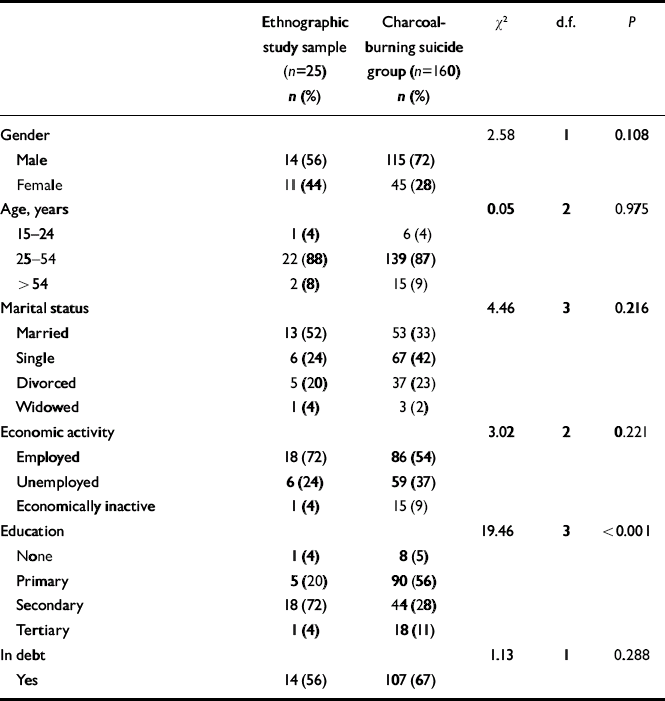
Twenty-five persons who had survived a suicide attempt by charcoal-burning and seven of their relatives were interviewed. All interviews took place within 3 weeks (mean 10 days) of the failed attempt. The socio-demographic characteristics of the survivor informants are summarised in Table 3. About half of the participants (44%) were admitted to an intensive care unit after the attempt. The mean Beck Suicidal Intent Scale score of all survivor informants was 22 (s.d.=3). The socio-demographic characteristics of the informants were similar to those of the first 160 cases of charcoal-burning suicide (Table 3).
Socio-demographic characteristics: ethnographic study sample v. cases of charcoal-burning suicide
| Ethnographic study sample (n=25) n (%) | Charcoal-burning suicide group (n=160) n (%) | χ2 | d.f. | P | |
|---|---|---|---|---|---|
| Gender | 2.58 | 1 | 0.108 | ||
| Male | 14 (56) | 115 (72) | |||
| Female | 11 (44) | 45 (28) | |||
| Age, years | 0.05 | 2 | 0.975 | ||
| 15-24 | 1 (4) | 6 (4) | |||
| 25-54 | 22 (88) | 139 (87) | |||
| > 54 | 2 (8) | 15 (9) | |||
| Marital status | 4.46 | 3 | 0.216 | ||
| Married | 13 (52) | 53 (33) | |||
| Single | 6 (24) | 67 (42) | |||
| Divorced | 5 (20) | 37 (23) | |||
| Widowed | 1 (4) | 3 (2) | |||
| Economic activity | 3.02 | 2 | 0.221 | ||
| Employed | 18 (72) | 86 (54) | |||
| Unemployed | 6 (24) | 59 (37) | |||
| Economically inactive | 1 (4) | 15 (9) | |||
| Education | 19.46 | 3 | <0.001 | ||
| None | 1 (4) | 8 (5) | |||
| Primary | 5 (20) | 90 (56) | |||
| Secondary | 18 (72) | 44 (28) | |||
| Tertiary | 1 (4) | 18 (11) | |||
| In debt | 1.13 | 1 | 0.288 | ||
| Yes | 14 (56) | 107 (67) |
The diagnostic interviews showed that a third of these survivors (n=8) had a major depressive disorder, five had an adjustment disorder with depressed mood, and five reported pathological gambling. Other psychiatric diagnoses included schizoaffective disorder, alcohol misuse and heroin misuse (one case each). Among the informants with major depressive disorder, two had comorbid pathological gambling and one misused alcohol. Seven informants had no psychiatric diagnosis.
The ethnographic account helped us understand the evolution of an indebtedness culture in post-transition Hong Kong. Before the handover, Hong Kong had experienced a decade-long economic boom: during this period the property market rose by over 600% (Reference WoodroffeWoodroffe, 1997; Reference PangPang, 1999) and the stock market by over 400% (Hong Kong Stock Exchange, 1999). Fuelled by a sense of inflated wealth, a segment of the population overspent by shopping impulsively, investing speculatively or gambling precariously (see Appendix).
Such ‘irrational exuberance’ was not sustainable after the post-1997 economic downturn, during which unemployment eventually reached a historic high of 8.3% in 2003. In 1997, however, few were able to foresee that the recession would last more than a few years, and that the property and stock markets would eventually plummet by more than 50%. Hence, many Hong Kong residents initially maintained their spending pattern and continued to take on credit. Some compensated for salary reductions, inadequate employment or even transient unemployment by borrowing through personal loans and credit cards.
Many informants we interviewed were initially unaware of the high interest rate charged for credit-card debt. Even worse, as the debts snowballed at an interest rate of around 30% and the larger economic climate did not improve, many applied for additional cards to cover their growing debt. At that time, it was easy for people to be granted a number of credit cards from different banks and lenders (see Appendix); our informants in this study each had an average of four credit cards. The most extreme case was that of a man who had 15 credit cards and a credit limit of 400 000 Hong Kong dollars (approximately £ 28 000), 33 times his monthly income. From a population perspective, the refinancing crisis reached its climax in the first quarter of 2002 when the rollover amount of all credit card lending amounted to HKD 15 819 (about £ 1130) per household, about 85% of the median household income (Hong Kong Monetary Authority, 2003). For most people this re-financing and overindebtedness trajectory would carry on until the minimum monthly payment of all cards and loans together exceeded the household's disposable income. Alternatively, the trajectory would come to an end when the debtor became unemployed. When repayments failed, a record would be filed in the negative credit databank, and no further card or loan could be applied for, this ended the re-financing spiral, and before long the debt collectors would be called in. The debtors soon became hopeless and suicidal, especially when they realised that they would not be able to clear the mountains of debt in the foreseeable future. The suicidal thoughts eventually turned into action, often precipitated by relentless harassment from the debt collectors. Also, Hong Kong financial institutions (including banks and credit companies) have the highest interest rates in the world (Hong Kong Consumer Council, 2002).
DISCUSSION
It is generally accepted that economic recession is associated with increased rates of suicide (Reference Platt and HawtonPlatt & Hawton, 2000). Few researchers, however, have examined the pathways and processes that connect macro-economic changes with the lived experience that surrounds individual suicide. In our study we addressed this important gap by showing how historical, socio-political and economic forces shaped an overindebtedness culture in peritransitional Hong Kong, and how the bursting of the overlending bubble was linked to suicide by charcoal-burning.
Before the 1997 handover, the chief worries of many Hong Kong residents had been political unrest or the loss of personal rights and freedom. Carried away by the political discussion and negotiation, most people in Hong Kong were unaware of the regional economic crisis, which had by then undermined most Asian economies. Even when the recession finally hit Hong Kong in late 1997, many residents were reluctant to accept that a decade of prosperity and affluence had ended. Instead, some maintained their careless spending or buffered their reduced income by repeated cycles of borrowing. At that time, credit card and personal loan re-financing was welcomed by the lenders, who were eager to find alternative channels of lending amid the troubled economy. The lack of a positive credit database and the extraordinary profitability of the credit card business catalysed the lending bubble by permitting the debtors to deny – and the lenders to ignore – their pre-existing credit commitments. Eventually the over-indebtedness bubble burst. The media inadvertently drew the desperate debtors to consider charcoal-burning by depicting the method as an easy and painless way out.
Socio-political connotations of charcoal-burning
From a sociological point of vantage, the collective use of charcoal-burning by those in financial troubles may carry some deeper meaning. The charcoal-burning method, by being distinctive and eye-catching, served as a means by which the debtors could turn their private, anomic experience of suicide into a public, collective call for assistance. Imbued in the ritualistic act may also be the symbolic protest and resistance staged by the debtors, many of whom had carelessly or unknowingly fallen into the over-indebtedness trap.
Above and beyond these social meanings, it is pertinent to ask if the emergence of charcoal-burning suicide in the post-transition period had any political undertone. Hong Kong had encountered economic recessions before, but none of these recessions was associated with a new suicide method. What is more, many Asian economies also encountered recession around 1997: indeed, South Korea had a similar credit card overindebtedness crisis (Reference Lee, Chan and LeeLee, 2002). Yet charcoal-burning appeared in no other time or place than post-colonial Hong Kong. Had the handover and reunification rendered the subsequent recession any different? Did the positional change from subject to citizen render this period particularly stress-provoking? Did the sensitivity over press freedom render it difficult to exert control on the excessive reporting of the new suicide method? These enticing questions are beyond the scope of this discussion, but are none the less essential to a better understanding of the psycho-politics of suicide.
Media and cohort effects
Previous studies have demonstrated that the media have a profound effect on suicidal behaviour (Reference Hawton and WilliamsHawton & Williams, 2002). Imitation effects, in which newspaper reports of suicide cases are followed by the subsequent appearance of similar suicides, have been examined in Western societies (Reference Etzersdorfer and SonneckEtzersdorfer & Sonneck, 1998; Reference Schmidtke and SchallerSchmidtke & Schaller, 2000; Reference Fekete, Schmidtke and TakahashiFekete et al, 2001; Reference GoldneyGoldney, 2001; Reference Pirkis, Francis and BloodPirkis et al, 2002). Excessive and dramatic reporting of suicides can prompt vulnerable individuals to attempt such acts themselves. The charcoal-burning epidemic powerfully demonstrated how inappropriate and excessive reporting can popularise a novel suicide method. Many news reports on the charcoal-burning deaths were excessive and the majority did not comply with the guidelines recommended by the World Health Organization (2000).
Methodological considerations
The study had several limitations that deserve discussion. First, without psychological autopsy, we were unable to ascertain the psychopathological state of those who died by suicide. We attempted to minimise this limitation by administering a diagnostic interview to participants in the ethnographic study. Second, the informants in the latter study were survivors rather than victims of suicide attempts. Their demographic characteristics resembled those of the charcoal-burning suicide group in the case–control study, except that individuals with secondary education were overrepresented in the ethnographic cohort.
Last, many quantitative researchers may consider that the ethnographic sample was rather small. However, it is important to note that ethnography provides rich data. Hence ethnographic research requires smaller sample sizes than most quantitative studies. Our sample size was comparable to the average size of conventional ethnographies (e.g. see Reference Carrese and RhodesCarrese & Rhode, 1995). We were also satisfied that the data collection had reached saturation (i.e. no additional themes could be generated from the last few informants), a criterion commonly used to judge sample adequacy in qualitative research (Reference Strauss and CorbinStrauss & Corbin, 1998).
One author (D.T.S.L.) has already described how social theory and ethnographic insight can benefit the design and analysis of quantiative studies (Reference Lee, Yip and LeungLee et al, 2004). Our multimethod study illustrates a higher level of engagement between qualitative and quantitative methods. Using the two methods in tandem permitted ethnographic contextualisation of the quantitative figures, while the case–control study and the hypothesis-testing it entailed lent credibility to the ethnographic observations. The triangulation of the insightful narratives with poignant statistics enhanced our understanding of the political economy surrounding the phenomenon of charcoal-burning.
Implications for Western societies
Although suicide by charcoal-burning is a local phenomenon, we feel that there is a larger message for the global community. In many parts of the world, overindebtedness is more serious than ever. For instance, in the USA consumer credit totalled $1976 billions in the third quarter of 2003 (Federal Reserve, 2003). In the UK, the growing concern about levels of debt has led to a recent proposal to revise the Consumer Credit Act; the White Paper states that about 10% of households reported payment problems with their unsecured debt (Secretary of State for Trade and Industry, 2003). Another study by the Department for Work and Pensions in the UK showed that a third of families on low to moderate incomes were unable to meet repayments on at least one bill or credit commitment (Reference Kasparova, Marsh and VegerisKasparova et al, 2001). Overindebtedness, apart from fuelling poverty and social exclusion, has a long-neglected mental health dimension. In the UK, the Citizens’ Advice Bureau reported that, at the time of seeking advice, a quarter of their overindebted clients were already seeking treatment from their general practitioner for stress, depression and anxiety (Citizens’ Advice, 2003). Research on the relationship among consumer credit, debt experience, suicide and other psychopathology is clearly in order. More research is also needed to work out the best approach to help patients resolve their debt troubles.
APPENDIX
Excerpts from narrative data
On popularisation of charcoal-burning:
‘Iread a lot about charcoal-burning suicides in the newspapers. I thought it would not be painful. If you took hypnotics and drank alcohol at the same time, it's like going to sleep.’ (informant 17)
‘I read about this method in the papers. I know it's easy. Jumping and wrist cutting needs more courage.’ (informant 2)
On causes of over-indebtedness:
‘We didn't have much money when we first bought the property [down payment borrowed from mother-in-law], it was about HKD 500 000 [about £ 35 700] when we bought it, and we only had a card loan of tens of thousands then. We thought we could manage. And then it was gambling, we applied for one card after another. When we did not have enough money, we re-financed our mortgage, the flat priced over HKD 1 million [about £71 400] during the peak of the market... Now, it became negative equity.’ (informant 15)
I had an overdraft for my wedding, that was about 5 years ago, I did not have the money to hold a wedding. Then, the expenditure was higher after I got married... I did not manage my finance well... I also bet on horseracing, bought clothes and had fun. I could bet up to a few thousand on a racing day. My wife also speculated on the stock... I also had to pay for the car mortgage, over HKD 3000 a month [about £210]... I earned about HKD 15 000 [about £1100] at that time. I had loans of over HKD 200 000 [about £ 14 300] when I filed for bankruptcy.’ (informant 12)
‘I had loans of HKD 1 million when I attempted to kill myself. It was from the loan companies and some [illegal] sources. I used to have seven to eight credit cards. They were cancelled by the banks 3 years ago as I failed to make the payments. I then repaid the card loans, partly covered by other loans... There were several reasons for the debt: extravagant spending, speculation in the stock market and gambling... I like to dress nicely, had good meals... I bet on horseracing, sometimes up to HKD 10 000 to HKD 20 000 [about £710–1400] a racing day.’ (informant 10)
‘My last card with HKD 40 000 [about £2900] credit limit was spent at one go... over half spent on bags, shoes and clothes, the rest was to pay my debt.’ (informant 16)
On the over-lending bubble:
‘It was always easy. They [card companies] did not check. What I needed were ID card and address proof. If you are asked about having any credit cards, just tell them “no”, they will not check. Therefore it's not difficult at all. As an example, my husband will make his payment today and apply for a few new cards the same day. They will not be aware [of any negative credit history].’ (informant 15)
‘I used to have three cards. I had to produce my salary proof for my first cards... Six months ago, the fourth card was sent to me... It was from a financial institution affiliated with an insurance company... I bought a life insurance plan there [the card company had no idea about the participant's current employment and financial status]... This new card brought me into deep trouble, I almost used it up at one go... Later on I found that I could not make up for the monthly payment.’ (informant 16)
Clinical Implications and Limitations
CLINICAL IMPLICATIONS
-
▪ Overindebtedness is reportedly associated with depression and anxiety; our study showed that it is also associated with suicide.
-
▪ Macro-level socio-economic changes shape the trend and pattern of suicide.
-
▪ Charcoal-burning as a method of suicide is spreading to other Chinese communities.
LIMITATIONS
-
▪ The case–control study was retrospective and record-based.
-
▪ Ethnographic accounts obtained from those who survived attempted suicide by charcoal-burning might not be representative of those who completed suicide.
-
▪ The sample size for the ethnographic interview was relatively small.
Acknowledgements
The authors gratefully acknowledge the assistance of the Hong Kong. Coroner's Court in facilitating the review of coroner's records. and of the Census and Statistics Department in providing data on suicide. statistics. The authors thank Anne Becker, Edwina Chan, Sandra Chan, H. M. Chiu, Brian Ip, Arthur Kleinman, Jenny Lam, Sunny Liu, Y. K. Ng, W. N. Tang. and Anthony Yeung for their input to the study. The study was supported by the. Health Care and Promotion Fund (grant 214005) and the Hong Kong Jockey Club. Charities Trust.




eLetters
No eLetters have been published for this article.