


The process and structure of training in psychiatry is constantly under review. The Royal College of Psychiatrists has just finished developing a set of explicit core competencies for specialist registrars (SpRs) and there are potential changes to the current 3-year period of higher specialist training. With these changes in mind it is important to review the training structure. Currently a fifth of all higher specialist training time is allocated to research activities. The stated position of the College is set out in the Higher Specialist Training Handbook (Royal College of Psychiatrists, 1998):
‘There is probably no better way to obtain insight into these matters (i.e. research) than to undertake a piece of original research…’ (p. 12)
Since this statement was made there have been many changes in training, with the ‘evidence-based medicine’ (EBM) movement having taken up a central role in all medical specialities throughout the UK. We sought to obtain a national picture of the research day from the perspective of both trainers and trainees and to ask what sort of changes might improve the use of the day.
Method
We obtained a list of all the higher training schemes in general and old age psychiatry in the UK from the Royal College of Psychiatrists, and a short questionnaire was posted to each programme director. This enquired about their views on the research day and asked them to identify an SpR peer group representative. Up to three reminders were sent to programme directors. Through personal contacts within the College Trainees' Committee (CTC) one of the authors (E.D.) was able to obtain further information about the identity of SpR peer group representatives. A similar questionnaire was then sent by post or e-mail to the SpRs identified.
Results
We identified 26 schemes through the College, and received 24 replies from programme directors (92%) and 20 from the SpRs (77%).
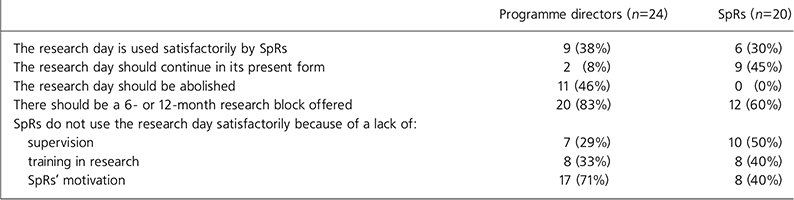
The table demonstrates that only a minority of trainees and trainers felt that the research day was currently being used satisfactorily. The most common reason cited by programme directors was a lack of motivation, whereas lack of supervision was the commonest reason chosen by the trainees. Fifty-four per cent of the programme directors (13/24) reported that SpRs had to seek out research supervision themselves. All schemes offered training or workshops in research techniques. Eighteen (75%) of the schemes ran academic programmes targeted at SpRs in particular; in one rotation these ran weekly, in 14 monthly and in three schemes yearly. Eighteen of the 24 schemes (75%) monitored research and output by tracking publications by SpRs. In two schemes over 75% of trainees were reported as having a publication by their CCST date, in three schemes 50-75% had a publication, in six schemes 25-50% had published and in five schemes less than 25% had done so.
Respondents were also able to add comments to the questionnaire, and it became clear that considerable thought has been given to this issue in many parts of the country. In Scotland there has been a national debate as to the value of the research day, and in Manchester the Postgraduate Dean has been persuaded to fund a research tutor to meet with trainees regularly and supervise their research.
What programme directors and specialist registrars (SpRs) think of the research day
| Programme directors (n=24) | SpRs (n=20) | |
|---|---|---|
| The research day is used satisfactorily by SpRs | 9 (38%) | 6 (30%) |
| The research day should continue in its present form | 2 (8%) | 9 (45%) |
| The research day should be abolished | 11 (46%) | 0 (0%) |
| There should be a 6- or 12-month research block offered | 20 (83%) | 12 (60%) |
| SpRs do not use the research day satisfactorily because of a lack of: | ||
| supervision | 7 (29%) | 10 (50%) |
| training in research | 8 (33%) | 8 (40%) |
| SpRs' motivation | 17 (71%) | 8 (40%) |
Discussion
We surveyed a group of trainers and trainees; the response rate from programme directors (who arguably have the best overview of the use of the research day in each scheme) was high. It is not clear how representative the trainees' views were, but the questionnaire was sent to individuals that were likely to have talked to many of their colleagues about this issue. We did not question programme directors or trainees in the other subspecialities of psychiatry, and there is a possibility that their views might be very different. However, the authors believe this to be very unlikely.
Over a 3-year period the cost of the research day for one SpR is likely to be at least £18 000 (based on the mid-point of an SpR's salary). This is a significant expense for the NHS, which is required to spend its money on providing the best care for patients. As the postgraduate deaneries take over the full funding of SpR posts they will want to make sure this money is being used effectively and in particular may want to know why higher training in psychiatry differs from training in other medical specialities. The replies to the questionnaire suggested that many regions are already examining the value of the research day, and other authors have also posed similar questions. Deahl & Turner (Reference Deahl and Turner1998) have asked whether the time spent doing research might be better used in other activities more specifically linked to preparing trainees to become consultants. The CTC has also explored the issue in some depth and concluded that there is a case for re-examining the function of the research day (Reference Ramchandani, Corby and GuestRamchandani et al, 2001). They argue that less emphasis must be placed on research while protecting the time available for developing a range of other important skills, including those linked to the process of EBM. The motion that ‘the research day is an anachronism’ was recently passed at the 2001 annual College tutors' and postgraduate directors' conference by a majority of the 138 delegates, thus confirming a general dissatisfaction with the way the research day is currently organised.
Our survey found that many programme directors feel that the research day is not always used as it should be and the trainees shared this view. Interestingly, not one of the SpRs agreed with nearly half of the programme directors that the research day in its present form should be abolished, perhaps reflecting a fear that its replacement would contain no research time. There are many ways in which the situation could be improved. A working party of the CTC concluded that the research day should become an ‘academic day’, encompassing a variety of different activities (Reference Ramchandani, Corby and GuestRamchandani et al, 2001). In line with this suggestion, the research day could become an option taken up by only a small group of research-orientated trainees. Other SpRs may wish to use the day for further clinical work, management training, training to teach, audit, or the development of EBM skills. Alternatively, trainees could be given the option of a properly supervised 6- or 12-month research slot instead of 1 day a week, a process that is already happening in the West Midlands in some other medical specialities. If the research day does continue in its present form the infrastructure for research supervision should be improved, and the Manchester scheme may be a useful model.
We believe the time has come to look again at the role of the research day for SpRs, and our survey appears to confirm that this view is shared by a large number of trainers and trainees. However, whatever changes are made to the research day, we recommend that the following broad principles need to be taken into account:
-
(a) clear objectives for use of the time need to be agreed with each trainee;
-
(b) these objectives and the outcomes from them need to be reviewed with each trainee;
-
(c) if trainees have to undertake research, then some form of support is necessary to enable them to meet their objectives in terms of training and supervision.
Declaration of interest
None.


 Open access


eLetters
No eLetters have been published for this article.