

Introduction
In May 2021, U.S. President Joe Biden signed the anti-Asian hate crimes bill. Among other things, the COVID-19 Hate Crimes Act created a position in the Department of Justice to investigate acts of hate related to COVID-19. The bill’s passage was a response to a rise in anti-Asian hate crimes during 2020 (Center for the Study of Hate and Extremism 2021) and the fatal shootings in March 2021 of eight women in Atlanta, six of them of Asian origin (New York Times 2021). These trends coincided with growing online expressions of anti-Asian sentiment (e.g., Pei and Mehta Reference Pei and Mehta2020).
Why have Asian Americans been targets of increasingly hostile behavior during the pandemic? According to behavioral immune system theory (BIS), during disease outbreaks, hostility toward foreigners stems from fears of contagion (Schaller Reference Schaller2006). In 2020, these fears took aim at people of Asian origin, particularly those from China, where COVID-19 originated. BIS would predict that those Americans who were most vulnerable to the health (and possibly economic) effects of COVID-19 would be most likely to discriminate against Asian Americans, and especially Chinese Americans. However, as China ceased to be a hotspot of COVID-19, fears of contagion should have shifted away from people of Chinese or Asian origin (potentially toward those from other places with severe COVID-19 outbreaks).
Hostile behavior toward Asian Americans also may have surged as anti-Asian sentiments were legitimated by stigmatizing rhetoric from public figures (Reny and Barreto Reference Reny and Barreto2020), most notably Donald Trump, who repeatedly used terms like “Chinese virus,” “China virus,” and “kung flu” to describe COVID-19 (Reny and Barreto Reference Reny and Barreto2020). Stigmatizing rhetoric could endorse discriminatory behavior even in the absence of a change in underlying attitudes toward Asians (Daniels et al. Reference Daniels, DiMaggio, Mora and Shepherd2021). If stigmatizing rhetoric is a driver of hostile behavior, discrimination should persist as long as it is normatively sanctioned by elites, especially among those Americans most receptive to this rhetoric. Discrimination may also persist among those Americans because they hold stronger anti-Asian sentiments to begin with.
This study uses a give-or-take dictator game (DG) to document discriminatory behavior toward Chinese- versus U.S.-born Americans. It is, to our knowledge, one of the first studies to use an experimental design to document differential treatment toward Chinese Americans during the COVID-19 pandemic. Its focus is on a quotidian form of discrimination, which Asian Americans may have been more likely to encounter than hate crimes, including those involving physical violence. As such, our study answers recent calls for research on the exclusionary practices that Asian Americans routinely face (Lee and Huang Reference Lee and Huang2021). Our objective resembles that of a recent vignette experiment that investigates prejudice and discriminatory intent in the context of roommate selection during the pandemic (Lu et al. Reference Lu, Kaushal, Huang and Gaddis2021).
Specifically, we fielded a give-or-take DG with a representative sample of 2,142 Americans at two points during the pandemic: May and October 2020. We examine the association between game behavior and personal and local vulnerabilities—both health and economic—related to COVID-19. We also examine the association between behavior and personal and community receptiveness to anti-Asian and right-wing messaging, as captured by Republican identification and county vote margins. Republican identification may also capture preexisting anti-Asian sentiments.
Briefly, we find that the average American gave significantly less to Chinese- versus U.S.-born Americans in May 2020. Discrimination was not consistently associated with personal or local health or economic conditions, as predicted by BIS. Participants who identified as Republicans, that is, those who may have held stronger anti-Asian sentiments to begin with and who were probably more receptive to stigmatizing messaging from right-wing figures, discriminated more against Chinese-born Americans. By October 2020, the average American gave comparable amounts to Chinese- and U.S.-born Americans. As in May, discrimination was not consistently moderated by personal and local health or economic conditions. Republicans, however, continued to discriminate against Chinese-born Americans, even though China had ceased to be a major hotspot or source of COVID-19 infections (Hessler Reference Hessler2020).
The findings may suggest that hostile behaviors toward Asian Americans could have been an outgrowth of preexisting prejudices, of stigmatizing rhetoric that legitimated those prejudices, or both. They were not only a reflection of fears of contagion among vulnerable Americans. Those Americans who probably held stronger anti-Asian sentiments and who were more receptive to stigmatizing, right-wing rhetoric continued to discriminate against Chinese-born Americans well after the objective link between COVID-19 and travel from China had been broken.
This paper makes three key contributions: (1) it uses a behavioral measure with a representative sample of Americans to detect everyday discrimination toward Chinese-born Americans; (2) it documents how discrimination changed over time by leveraging panel data; (3) it provides evidence that discrimination was more likely the result of stigmatizing elite rhetoric and/or preexisting prejudice than that of contagion fears among vulnerable Americans.
Anti-Asian Hostility during COVID-19
In the United States, where COVID-19 has claimed the lives of more than one million people (as of June 9, 2022, Centers for Disease Control and Prevention 2022) and ushered in an unprecedented economic recession (Bauer et al. Reference Bauer, Broady, Edelberg and O’Donnell2020), the pandemic has had another symptom: increasingly hostile behavior toward Asian Americans (Chen et al. Reference Chen, Zhang and Liu2020). According to police data from 15 large U.S. cities, anti-Asian hate crimes rose 166% between early 2020 and early 2021 (Center for the Study of Hate and Extremism 2021). Similarly, Stop AAPI Hate saw anti-Asian hate incidents reported on its site rise dramatically between March 2020 and March 2021 (Jeung et al. Reference Jeung, Yellow Horse and Cayanan2021).
These trends coincided with rising expressions of anti-Asian sentiment online. Multiple studies looking at the first half of 2020 documented increasingly Sinophobic language on English language and U.S. Twitter (Lu and Sheng Reference Lu and Sheng2022; Nguyen et al. Reference Nguyen, Criss, Dwivedi, Huang, Keralis, Hsu, Phan, Nguyen, Yardi, Glymour, Allen, Chae, Gee and Nguyen2020; Pei and Mehta Reference Pei and Mehta2020; Stechemesser et al. Reference Stechemesser, Wenza and Levermann2020; Tahmasbi et al. Reference Tahmasbi, Schild, Ling, Blackburn, Stringhini, Zhang and Zannettou2021), Reddit (Zhang et al. Reference Zhang, Keegan, Lv and Tan2021), and 4chan (Tahmasbi et al. Reference Tahmasbi, Schild, Ling, Blackburn, Stringhini, Zhang and Zannettou2021). These trends picked up in response to certain news events, including a speech on March 16 2020 in which President Trump first referred to COVID-19 as the “Chinese virus” (Lu and Sheng Reference Lu and Sheng2022; Pei and Mehta Reference Pei and Mehta2020; also see Rizzuto Reference Rizzuto2020).
Asian Americans themselves are aware of and unnerved by these trends (Tavernise and Oppel Jr. Reference Tavernise and Oppel2021; also see He et al. Reference He, He, Zhou, Nie and He2020). In a June 2020 survey by the Pew Research Center, 39% of Asian Americans reported that people had acted as if they were uncomfortable around them since the coronavirus outbreak. Another 31% reported having been subjected to slurs or jokes, and 26% feared that someone might threaten or physically attack them (Ruiz et al. Reference Ruiz, Horowitz and Tamir2020). By comparison, smaller proportions of Black and Latino Americans reported similar fears over the same period.
Anti-Asian behaviors and expressions might have corresponded with increasingly negative implicit attitudes toward this group. Indeed, Darling-Hammond and colleagues document a rise in implicit anti-Asian attitudes starting in March 2020, reversing a decades-long decline. Notably, the reversal was more pronounced among conservatives, who were presumably more likely to consume right-wing media, where coverage of COVID-19 adopted an increasingly anti-Asian tone starting in March 2020 (Darling-Hammond et al. Reference Darling-Hammond, Michael, Allen, Chae, Thomas, Nguyen, Mujahid and Johnson2020; Rizzuto Reference Rizzuto2020).
With respect to explicit attitudes, by contrast, Daniels and colleagues (Reference Daniels, DiMaggio, Mora and Shepherd2021) report that experimentally priming California voters to think about COVID-19 did not affect reported anger or fear toward Asian Americans. It did, however, reduce support for a pathway to citizenship for undocumented immigrants (among conservatives) and appreciation for diversity (among liberals). According to this work, pandemic coverage can normatively sanction anti-Asian behavior, without necessarily altering explicit attitudes toward this group.
Exclusion and Disease: Fear of Contagion or Stigmatization?
Throughout U.S. history, immigrants have been subjected to public opprobrium for outbreaks of disease. During the 1800s and early 1900s, polio was blamed on Italian immigrants, cholera on Irish and later Jewish immigrants—who were also blamed for tuberculosis—and smallpox and bubonic plague were blamed on Chinese immigrants (Kraut Reference Kraut1994; Markel Reference Markel1999). More recent examples abound. In the early years of the AIDS epidemic, Haitian and central African immigrants were banned from donating blood (Fairchild and Tynan Reference Fairchild and Tynan2011). Public discourse around the 2003 SARS epidemic stigmatized Chinese immigrants (Eichelberger Reference Eichelberger2007). And in 2014, U.S. media coverage of Ebola focused overwhelmingly on cases associated with travel from Africa (Dionne and Seay Reference Dionne and Seay2015).
Fears of contagion may be responsible for outgroup hostility following disease outbreaks. The BIS refers to a set of evolutionary mechanisms, primarily disgust, designed to identify and avoid risks of contagion (Oaten et al. Reference Oaten, Stevenson and Case2009; Schaller Reference Schaller2006). People who are seen as foreign can cue perceived disease risk (1) because contact with previously unknown groups can transmit contagious disease and (2) because foreignness is associated with unfamiliar customs related to diet, hygiene, and sex. As Schaller explains, “We not only stigmatize people who really are sick; we also stigmatize people who may be perfectly healthy but who—on the basis of some superficial feature—appear to pose a risk” (Schaller Reference Schaller2006: p. 96). The association of foreignness with disease should be stronger among those living under “chronic and contextually aroused feelings of vulnerability” (Faulkner et al. Reference Faulkner, Schaller, Park and Duncan2004: p. 333). Empirically, attitudes toward unfamiliar immigrant groups have been linked to perceived vulnerability to disease (Faulkner et al. Reference Faulkner, Schaller, Park and Duncan2004) and disgust sensitivity (Aarøe et al. Reference Aarøe, Petersen and Arceneaux2017; Kam Reference Kam2019).
With regard to the COVID-19 pandemic, the BIS perspective would predict that those who are more vulnerable to COVID-19, either personally or in their communities, should behave in more exclusionary ways. Although the most general formulation of BIS theory focuses on foreigners at large, BIS theorists have also highlighted how vulnerability may be “contextually aroused” (Faulkner et al. Reference Faulkner, Schaller, Park and Duncan2004: p. 333), for example, by “superficial features” (Schaller Reference Schaller2006: p. 96) associated with contagion risk. In the case of COVID-19, a Chinese or Asian identity could constitute such a feature. Therefore, and in line with prior research on BIS during the COVID-19 pandemic (Devakumar et al. Reference Devakumar, Shannon, Bhopal and Abubakar2020; He et al. Reference He, Zhang and Xie2022; Mandalaywala et al. Reference Mandalaywala, Gonzalez and Tropp2021), we focus on discrimination toward Chinese Americans.
In sum, in our empirical setting, we predict:
H1a Americans who are personally or locally vulnerable to the health effects of COVID-19 will discriminate more against Chinese-born Americans.
In light of COVID-19’s substantial and highly publicized economic impacts, in addition to health vulnerability, we also look at economic vulnerability, and we predict:
H1b Americans who are personally or locally vulnerable to the economic effects of COVID-19 will discriminate more against Chinese-born Americans.
Outgroup hostility might also coincide with disease outbreak as a result of mass prejudice, perhaps especially if preexisting prejudice is “activated” by stigmatizing rhetoric from elites (Reny and Barreto Reference Reny and Barreto2020). In the United States, right-wing politicians and media outlets tapped into well-worn stereotypes of Asian Americans as perpetual foreigners in order to frame COVID-19 in anti-Asian, and especially anti-Chinese, terms (Tessler et al. Reference Tessler, Choi and Kao2020; Rizzuto Reference Rizzuto2020). Donald Trump’s language is a case-in-point. In March 2020 alone, the then-president used the expression “Chinese virus” more than 20 times;Footnote 1 in June 2020, he added “kung flu” to his repertoire (Chinese Americans Civil Rights Coalition vs. Donald J. Trump 2021). Other Republican politicians, including Representatives John Cornyn (Texas) and Paul Gosar (Arizona), used similarly stigmatizing language to describe COVID-19 (Noori Farzan Reference Noori Farzan2020; Shepherd Reference Shepherd2020). And leading up to the 2020 election, the Senate GOP released a documentary that blamed China for the pandemic (Axelrod Reference Axelrod2020).
Why did Republican elites propagate anti-Asian rhetoric, especially leading up to the 2020 general election? The Republican Party has strategically mobilized racial appeals to garner support among White voters since the 1960s (Haney López Reference Haney López2014). Contemporary appeals are often coded in the language of symbolic racism; that is, they merge racial animus with the valuation of individualism and concerns about government intervention (Sears and Henry Reference Sears, Henry and Mark2005).
Individuals—and perhaps especially those who were attentive to rhetoric from right-wing elites—may have fused anxiety about COVID-19 with prejudice toward people of Asian, and especially Chinese, origin, “a stigmatized group framed as responsible for the disease” (Reny and Barreto Reference Reny and Barreto2020: p. 2). Supporting this account, Lu and Sheng (Reference Lu and Sheng2022) find that each additional tweet related to China and COVID-19 from Donald Trump in one hour predicted a 20% increase in tweets that used a slur for Chinese people in the following four hours (also see Pei and Mehta Reference Pei and Mehta2020). In addition, each such tweet from Donald Trump predicted an 8% increase in hate incidents reported to Stop AAPI Hate the following day.
Relatedly, Reny and Barreto (Reference Reny and Barreto2020) find that Americans who reported being worried about COVID-19 also reported colder feelings toward Chinese people and Asian Americans, but not Black or Latino Americans. And, Americans who reported colder feelings toward Asian Americans also reported stronger preferences for staying away from foreigners and for avoiding spaces associated with Asians, like Asian restaurants. Importantly, these associations were stronger among Americans who reported paying attention to politics, that is, those who may have been more exposed to anti-Asian rhetoric.
Most studies of anti-Asian hostility during COVID-19, including Reny and Barreto (Reference Reny and Barreto2020) and Lu and Sheng (Reference Lu and Sheng2022), are based on data from early 2020, when China was still a COVID-19 hotspot and thus when fears of contagion might have played a leading role. However, and in spite of China’s progress curbing the COVID-19 outbreak, Trump and other right-wing figures continued to use stigmatizing language toward Chinese people throughout 2020 and into 2021. In a March 2021 Fox News interview, for example, Trump again referred to COVID-19 as the “China virus” (Chinese Americans Civil Rights Coalition vs. Donald J. Trump 2021). If hostile behavior toward Chinese Americans is fueled by preexisting prejudice or related rhetoric, then it should have persisted later into the pandemic among those who, like Republicans, held stronger anti-Asian sentiments, were more receptive to messaging by right-wing figures, or both.
Republicans should be more receptive to right-wing rhetoric through one or both of two possible pathways: persuadability and exposure. Regarding persuadability, in polarized settings, endorsements from copartisan figures affect individuals’ opinions more strongly than endorsements from non-copartisan figures (Druckman et al. Reference Druckman, Peterson and Slothuus2013). Regarding exposure, a recent survey confirms that Democrats and Republicans turn to different sources for political news (Grieco Reference Grieco2020), with Republicans turning to sources that featured right-wing politicians’ anti-Asian rhetoric (Rizzuto Reference Rizzuto2020). Relatedly, individual Republicans may be more attentive to right-wing rhetoric, and attentive individuals are more susceptible to influence by political elites (Zaller Reference Zaller1992). Specifically, in the context of our study we predict:
H2 Republicans will discriminate more against Chinese-born Americans than will non-Republicans in May 2020.
H3 Republicans will discriminate more against Chinese-born Americans than will non-Republicans in October 2020.
We fielded two waves of a give-or-take DG online with over 2,000 U.S. Americans who were asked to split an endowment with another person who lives in the United States. The other person was born either in the United States or in China. Our approach resembles that of recent work by Bartos and colleagues (Reference Bartos, Bauer, Cahlíková and Chytilová2020), who used another behavioral experiment to show that COVID-19 salience (which they manipulated) magnified hostile behavior toward foreigners, and especially Asian foreigners, in a Czech sample.
Data and Methods
DG
We embedded a behavioral game, or incentivized experiment, in an online omnibus survey fielded between April 30 and May 11 2020 with a representative sample of 2,142 U.S. Americans (hereafter, “May sample”). We followed up with these same participants between October 14 and November 2 2020 (hereafter, “October sample”). 1,499 of 2,142 original participants (70%) participated in the October survey. See unweighted sample statistics in Table S1 and weighted sample statistics in Table S2.
Participants played the role of the dictator in a one-shot, give-or-take DG. In a classic DG, one player, the “dictator” or “allocator,” receives an endowment which they are then asked to split with a “recipient.” In a give-or-take DG, both players receive the same endowment: in our case, 10 tokens, equivalent to $.50. The dictator can choose to give to the recipient from their own endowment, to take from the recipient’s endowment, or to neither give nor take. After reading the DG instructions, participants were also asked two comprehension check items to ensure they understood the rules of the game (not shown in Figure 1). Those who did not answer one or both items correctly were shown the correct responses to reinforce comprehension prior to playing the game. Contributions, which fall in the range [−10,10], are our outcome of interest.Footnote 2 Because dictators have no incentive to contribute anything, their contributions are regarded as an indicator of altruism or prosociality more generally (Baldassarri and Grossman Reference Baldassarri and Grossman2013). DG contributions are strongly and positively associated with real-world prosocial behavior (e.g., Benz and Meier Reference Benz and Meier2008; Franzen and Pointner Reference Franzen and Pointner2013).
Facsimiles of give-or-take DG instructions

The gap between DG contributions to members of different groups has been widely used as a measure of discrimination and interpreted as an indicator of group preference (Abascal Reference Abascal2015; Habyarimana et al. Reference Habyarimana, Humphreys, Posner and Weinstein2007; Lane Reference Lane2016; Whitt and Wilson Reference Whitt and Wilson2007). In a meta-analysis, Engel shows that DG contributions are consistently lower between allocators and recipients who are socially distant, concluding that “the radically simple design of the game makes it a powerful tool for the systematic variation of conditions that moderate sociality” (2011: p. 26). The give-or-take DG may be especially useful for studying discrimination, because two features of its design mitigate social pressures to give equitably. The first is the fact that decisions involve real, monetary stakes. The second is the fact that allocators can take from recipients, and not simply give to them (Cappelen et al. Reference Cappelen, Nielsen, Sørensen, Tungodden and Tyran2013; Bardsley Reference Bardsley2008).
Behavioral game measures of discrimination are not without shortcomings, however. Most recently, in Kenya and Uganda, Blum and colleagues (Reference Blum, Hazlett and Posner2021) did not find evidence of ethnic discrimination using behavioral games, whereas misattribution tasks and observed ethnic conflict suggest otherwise.Footnote 3 Our aim is to capture people’s tendency toward interpersonal, day-to-day discrimination—rather than ethnic violence, which is less common though more publicized, or hostility on social media platforms, which may also be attributable to relatively few, visible users. A behavioral game measure is therefore well suited to our purpose. Following Blum et al. (Reference Blum, Hazlett and Posner2021), however, we note the effects we observe might be conservative estimates; future work could investigate similar questions using other behavioral game measures in combination with misattribution tasks to address this question. Additionally, measures of individual-level disgust sensitivity, which were not included in our survey, could also strengthen our proposed interpretation.
All participants were told that their recipient was another study participant living in the United States. In reality, no participants were assigned to the role of recipient. Deception was unavoidable, because it was not possible to recruit approximately 1,000 Chinese American survey panelists.Footnote 4 All participants were debriefed about the deception after the October survey. Before making their DG decision, participants learned that their recipient was born either in the United States (U.S.-born condition) or in China (Chinese-born condition).Footnote 5 All participants had reported their country of birth on the first page of the survey. We considered manipulating recipient racial/ethnic identification, rather than birthplace. However, we needed to manipulate identity using responses to an item that appeared before the DG, whereas racial/ethnic identification, along with partisanship, were solicited at the end of the survey in order to avoid priming responses to other activities in the omnibus survey. Each participant was assigned to the same treatment condition in May and October. The DG instructions, with birthplace manipulation, are presented in Figure 1.
Because we did not signal the race/ethnicity of U.S.-born recipients, theoretically, some participants could have inferred that U.S.-born recipients were in fact Asian American.Footnote 6 However, this was probably infrequent, given the strong association between Americanness and Whiteness coupled with widespread “Asian American identity denial,” that is, skepticism about Asian Americans’ Americanness (Cheryan and Monin Reference Cheryan and Monin2005). If, indeed, a non-trivial share of participants inferred that U.S.-born recipients were Chinese or Asian American, the following estimates of discrimination would be conservative.
In addition to recipient’s birthplace, our other independent variables capture health vulnerability to COVID-19 and partisanship. And, although prior work on BIS has focused on the role of health vulnerability, we also consider economic vulnerability to COVID-19. We describe these measures in the next section.
Data Collection
We collected data as part of an omnibus survey carried out by researchers at Columbia University, New York University, New York University Abu Dhabi, the University of Maryland, and the University of Pennsylvania. YouGov, a survey research company, used a quota system to field the survey with a sample that is representative of U.S.-resident adults in terms of region, age, gender, race/ethnicity, and educational attainment. YouGov computed weights for participants in the May survey wave; in the October wave, weights were calculated using the same quotas that YouGov employed for sampling purposes by applying the rake() function in R. In what follows, we report unweighted results. However, we replicate the main analyses using survey weights (Figure S2), and our findings are substantively similar. The study was approved by the NYUAD Institutional Review Board (#HRPP-2020-46) and was deemed to be minimal risk.
Measures
In addition to recipient’s birthplace, our independent variables include health and economic vulnerabilities, as well as partisanship. These are operationalized at two levels: that of the participant and that of the participant’s community, defined as the participant’s county of residence, assigned based on the 5-digit ZIP code reported by the participant in May.
Participant-level Independent Variables
Individual health vulnerability is captured by health conditions (e.g., cancer, hypertension, high body mass index, smoking history) that are associated with an elevated risk of severe illness from contracting COVID-19, according to the U.S. Centers for Disease Control and Prevention (CDC) (2021).Footnote 7 Specifically, we assigned participants to three categories—low, medium, and high risk of getting severely ill from COVID-19—relying on participants’ body mass index (calculated from self-reported height and weight), smoking history, and self-reported current and past medical conditions diagnosed by a doctor. Participants are classified as medium risk if they meet any of the conditions that might be associated with elevated risk (e.g., hypertension) and high risk if they meet any of the conditions that are associated with elevated risk (e.g., cancer). Approximately three-quarters of our sample counts as high-risk partly due to the prevalence of overweight and obese people in the United States.Footnote 8 Because health-related questions are considered sensitive, participants were allowed to skip any of these questions. Participants who chose not to respond to one or more questions and whose other answers did not indicate they were high risk are excluded from analyses that rely on individual health vulnerability measures (247 individuals, 11.53% of our May sample).Footnote 9
Individual economic vulnerability is captured by having experienced an adverse employment status change since January 2020—for example, from full-time to part-time employment or from part-time employment to unemployment. Our measure resembles the measure used in another study of employment status during the pandemic (Reichelt et al. Reference Reichelt, Makovi and Sargsyan2021). Participants who experienced an adverse employment status change between January and May, but who regained employment by October, are still considered economically vulnerable, because they lost income for some period of time since January (this describes 30 participants, 1.4% of our May sample).
We treat partisanship as an indicator of receptiveness to the anti-Asian messaging of right-wing political and media figures. Participant are classified as Republicans if they identified as “Strong Republican,” “Not very strong Republican,” or “Lean Republican”; they are classified as non-Republicans if they identified as “Strong Democrat,” “Not very strong Democrat,” “Lean Democrat,” “Independent,” or “Not sure.”
County-level Independent Variables
Survey data were linked to participants’ counties of residence using self-reported 5-digit ZIP codes. Counties were assigned to ZIP codes using the Geographic Correspondence Engine from the University of Missouri’s Census Data Center (Missouri Census Data Center 2016). When multiple counties were matched with one ZIP code, we assigned the participant to the county with the largest population.Footnote 10 Participants who did not enter a valid ZIP code (9 in May and 25 in October) are omitted from the analyses.
Community health vulnerability was measured in two ways: average daily new COVID-19 diagnoses per 100 county residents in the 30 days prior to taking the survey and as average daily new COVID-19 deaths per 1,000 county residents in the same period. These data are from the COVID-19 tracker developed by researchers at Johns Hopkins University (Dong et al. Reference Dong, Du and Gardner2020).
We operationalized county economic vulnerability as the percentage of low-income jobs (<$40,000 salary) lost in the county. We used the estimated low-income job loss due to COVID-19 up until May 12 and October 12 for the May and October samples, respectively. These data are from the Urban Institute (Urban Institute 2020).
County-level receptiveness to right-wing rhetoric was captured by the share of votes cast for Donald Trump, the Republican presidential candidate, in 2016. These data are publicly available from the MIT Election Data and Science Lab (MIT Election Data and Science Lab 2018).
Our primary measures of health and economic vulnerability reflect objective, as opposed to subjective or perceived, vulnerability. Theoretically, perceived vulnerability is the more proximate predictor of responses to disease outbreak; it is also the focus of empirical research on BIS (e.g., Faulkner et al. Reference Faulkner, Schaller, Park and Duncan2004). We therefore replicate the analyses with available proxies for subjective individual health and economic vulnerability. Importantly, we would expect objective and perceived vulnerability to be correlated. In addition, prior work finds that responses to COVID-19 are associated with indicators of objective vulnerability, like county-level infection and death rates (Ruisch et al. Reference Ruisch, Moore, Samoya, Boggs, Ladanyi and Fazio2021) and the timing of the first community COVID-19 diagnosis (Lu and Sheng Reference Lu and Sheng2022). We acknowledge, however, that our primary vulnerability measures serve as an imperfect test of BIS, and we return to this issue in the discussion.
Control Variables
In contrast to recipient’s birthplace, health vulnerability, economic vulnerability, and partisanship are not assigned experimentally. Our multiple regression models therefore control for other differences at the participant and county levels.
Participant-level controls include gender identification (male, not male), age (18–24, 25–34, 35–44, 45–54, 55–64, 65 years and older), racial/ethnic identification (non-Hispanic white, Black, Hispanic, and all other races, including Asian), educational attainment (high school or less, some college or associate’s degree, BA degree or more than BA), and 2019 family income (less than $10,000, $10,000-$19,999… $150,000 or more, and did not disclose).
County-level controls are taken directly from or calculated based on the data from the American Community Survey 2015–2019 (5-year estimates) (U.S. Census Bureau 2019). Specifically, we control for log-transformed county population density, log-transformed adjusted median household income, percentage of non-Hispanic Asian residents, and percentage of residents living in the same house for at least one year (a proxy for stability).
Analytical Strategy
To examine whether participants treated Chinese-born and U.S.-born recipients differently, we estimate the following linear models:
 $$DG = {\beta _0} + {\beta _1}{X_{bp}} + {\beta _2}{X_v} + \sum\limits_{j = 3}^k {\beta _j}{{\bf{X}}_{{\bf{ij}}}} + {\varepsilon _i}$$
where DG is a participant’s DG contribution; ${X_{bp}}$
is a binary variable that takes the value 1 for participants paired with a Chinese-born recipient and 0 otherwise; and
${X_{bp}}$
is a binary variable that takes the value 1 for participants paired with a Chinese-born recipient and 0 otherwise; and ${\beta _1}$
is the estimate of interest that captures unequal treatment towards Chinese- versus U.S.-born recipients.
${\beta _1}$
is the estimate of interest that captures unequal treatment towards Chinese- versus U.S.-born recipients. ${X_v}$
is a measure of a COVID-19 vulnerability or partisanship, with its corresponding regression coefficient
${X_v}$
is a measure of a COVID-19 vulnerability or partisanship, with its corresponding regression coefficient ${\beta _2}$
, and
${\beta _2}$
, and ${{\bf{X}}_{{\bf{ij}}}}$
is a vector of individual- and county-level controls. This model is estimated separately for health vulnerability, economic vulnerability, and partisanship, which yields seven different models. These models are estimated separately for the May and October waves.
${{\bf{X}}_{{\bf{ij}}}}$
is a vector of individual- and county-level controls. This model is estimated separately for health vulnerability, economic vulnerability, and partisanship, which yields seven different models. These models are estimated separately for the May and October waves.
In a second set of models, we assess the moderating effects of health vulnerability, economic vulnerability, and partisanship on the effect of recipient birthplace. Specifically, we estimate the following linear models, which contain an interaction term:
 $$DG = {\beta _0} + {\beta _1}{X_{bp}} + {\beta _2}{X_v} + {\beta _3}{X_{bp}}{X_v} + \sum\limits_{j = 4}^k {\beta _j}{{\bf{X}}_{{\bf{ij}}}} + {\varepsilon _i}$$
where ${X_{bp}}{X_v}$
represents the interaction between recipient birthplace and our moderators of interest and
${X_{bp}}{X_v}$
represents the interaction between recipient birthplace and our moderators of interest and ${\beta _3}$
represents its regression coefficient. This again yields seven different models, which are estimated separately for the May and October waves.
${\beta _3}$
represents its regression coefficient. This again yields seven different models, which are estimated separately for the May and October waves.
Results
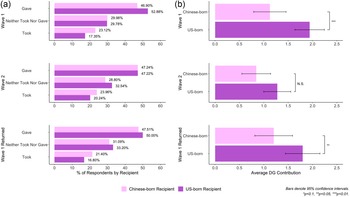
How did Americans treat Chinese-born Americans in May 2020, during the first wave of the COVID-19 pandemic? Panel A in Figure 2 reports the distributions of contributions in the give-or-take DG by recipient’s birthplace; panel B compares mean contributions to U.S.- and Chinese-born recipients. In May, U.S.-born recipients received 1.94 tokens on average, whereas Chinese-born recipients received just 1.13 tokens on average. The difference (.81 tokens) is statistically significant ( $p \lt .01$
, two-sided t-test). This difference is partly driven by a higher share of participants taking from Chinese-born recipients. Specifically, 17.35% of participants took from a U.S.-born recipient, whereas 23.12% of participants took from a Chinese-born recipient. The difference of 5.77 percentage points is statistically significant (
$p \lt .01$
, two-sided t-test). This difference is partly driven by a higher share of participants taking from Chinese-born recipients. Specifically, 17.35% of participants took from a U.S.-born recipient, whereas 23.12% of participants took from a Chinese-born recipient. The difference of 5.77 percentage points is statistically significant ( $p \lt .001$
, two-sided t-test).
$p \lt .001$
, two-sided t-test).
Distribution of contributions and mean contributions in the give-or-take DG by the recipient’s birthplace

Did the unequal treatment of Chinese-born Americans persist into October 2020, although China was no longer a COVID-19 hotspot? In October, U.S.-born recipients received 1.28 tokens on average, and Chinese-born recipients received .85 tokens on average. The difference (.43 tokens), however, is not statistically significant ( $p = .126$
, two-sided t-test). The reduced difference reflects more comparable shares of participants taking tokens from Chinese- and U.S.-born recipients. Specifically, 20.24% of participants took from a U.S.-born recipient and 23.96% of participants took from a Chinese-born recipient (3.72 percentage-point difference,
$p = .126$
, two-sided t-test). The reduced difference reflects more comparable shares of participants taking tokens from Chinese- and U.S.-born recipients. Specifically, 20.24% of participants took from a U.S.-born recipient and 23.96% of participants took from a Chinese-born recipient (3.72 percentage-point difference, $p \lt .1$
, two-sided t-test). Importantly, the reduced difference is also driven by less generous contributions to U.S.-born recipients in October than in May. Average contributions to U.S.-born recipients in October are significantly lower than average contributions to U.S.-born recipients in May (−0.52 tokens,
$p \lt .1$
, two-sided t-test). Importantly, the reduced difference is also driven by less generous contributions to U.S.-born recipients in October than in May. Average contributions to U.S.-born recipients in October are significantly lower than average contributions to U.S.-born recipients in May (−0.52 tokens, $p \lt .05$
, two-sided t-test).
$p \lt .05$
, two-sided t-test).
These results are confirmed in multiple regressions in which we control for participant and county characteristics (Figure 4, also Tables S3–S6). Importantly, the more equitable treatment of Chinese-born recipients in October is not attributable to differences in sample composition across waves. We replicated the bivariate comparisons and multiple regression models for May among participants who completed the October survey (which we label “Wave 1 Returned”) and find similar results (Figures 2 and S3). We also find that attrition between May and October was not correlated with any of the covariates we examined, as reported in Figure S1.
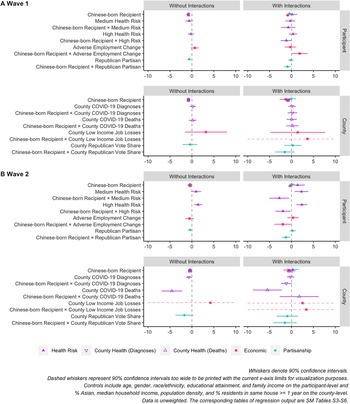
BIS theory would predict that those Americans who view themselves or their communities as more vulnerable to COVID-19 would discriminate more against Chinese-born recipients (H1a, H1b). Figure 4 reports the results of multiple regression models in which we interact recipient birthplace with indicators of health and economic vulnerabilities individually. Indicators of health vulnerability include conditions associated with an elevated risk of contracting COVID-19 (participants) and standardized COVID-19 diagnoses and deaths (counties). Indicators of economic vulnerability include adverse employment change (participants) and percentage of low-income jobs lost (counties).
In May 2020, none of the indicators of health or economic vulnerability significantly moderate the effect of recipient’s birthplace on DG contributions in the direction that we hypothesized. This result holds using a proxy for subjective, personal health vulnerability available in the survey: self-rated health (Table S7), as well. It also holds using a proxy for personal economic vulnerability: needing to borrow goods or money to “make ends meet” during the month prior to taking the survey (Table S8).
In October 2020, participants who are physically vulnerable—that is, whose health conditions put them at risk of severe illness from contracting COVID-19—did give relatively less to Chinese- than U.S.-born recipients ( $p \lt .05$
for medium vs. low risk, and
$p \lt .05$
for medium vs. low risk, and $p \lt .1$
for high vs. low risk). These significant interaction terms notwithstanding, the differences between predicted contributions to U.S.- and Chinese-born recipients within medium- and high-health risk participants are not statistically significant. The predicted contribution of medium-risk participants to Chinese-born recipients is .40 tokens, compared to 1.80 tokens to U.S.-born recipients.Footnote
11
Controlling for participant- and community-level variables, this difference is not statistically significant (
$p \lt .1$
for high vs. low risk). These significant interaction terms notwithstanding, the differences between predicted contributions to U.S.- and Chinese-born recipients within medium- and high-health risk participants are not statistically significant. The predicted contribution of medium-risk participants to Chinese-born recipients is .40 tokens, compared to 1.80 tokens to U.S.-born recipients.Footnote
11
Controlling for participant- and community-level variables, this difference is not statistically significant ( $p = .652$
).Footnote
12
The predicted contributions of high-risk participants to Chinese-born recipients are 1.29 tokens, compared to 1.87 tokens to U.S.-born recipients. This difference is not statistically significant either (
$p = .652$
).Footnote
12
The predicted contributions of high-risk participants to Chinese-born recipients are 1.29 tokens, compared to 1.87 tokens to U.S.-born recipients. This difference is not statistically significant either ( $p = .553$
). Furthermore, contributions to Chinese-born recipients across health risk groups are similar. The predicted DG contributions of medium-risk participants to Chinese-born recipients are just .51 tokens lower than those of low-risk participants to Chinese-born recipients. And, the predicted DG contributions of high-risk participants to Chinese-born recipients are .39 tokens higher than those of low-risk participants to Chinese-born recipients. Neither difference is statistically significant, based on multiple comparisons of the marginal effects controlling for participant- and community-level variables (
$p = .553$
). Furthermore, contributions to Chinese-born recipients across health risk groups are similar. The predicted DG contributions of medium-risk participants to Chinese-born recipients are just .51 tokens lower than those of low-risk participants to Chinese-born recipients. And, the predicted DG contributions of high-risk participants to Chinese-born recipients are .39 tokens higher than those of low-risk participants to Chinese-born recipients. Neither difference is statistically significant, based on multiple comparisons of the marginal effects controlling for participant- and community-level variables ( $p = .996$
for both differences). Additionally, self-rated health does not moderate the effect of recipient birthplace on contributions. Taken together with the non-significant interaction between health vulnerability and recipient birthplace in May, these results do not lend strong support to H1a.
$p = .996$
for both differences). Additionally, self-rated health does not moderate the effect of recipient birthplace on contributions. Taken together with the non-significant interaction between health vulnerability and recipient birthplace in May, these results do not lend strong support to H1a.
In October 2020, participants who are vulnerable to the economic impact of COVID-19 also gave relatively less to Chinese- than U.S.-born recipients ( $p \lt .1$
). The difference between predicted contributions to U.S.-born recipients (2.01 tokens) and Chinese-born recipients (-.26 tokens) among economically vulnerable participants is sizeable but not statistically significant (
$p \lt .1$
). The difference between predicted contributions to U.S.-born recipients (2.01 tokens) and Chinese-born recipients (-.26 tokens) among economically vulnerable participants is sizeable but not statistically significant ( $p = .200$
). Additionally, although the predicted DG contributions to economically vulnerable participants to Chinese-born recipients are 1.63 tokens lower than those of non-vulnerable participants to Chinese-born recipients, the difference is not statistically significant (
$p = .200$
). Additionally, although the predicted DG contributions to economically vulnerable participants to Chinese-born recipients are 1.63 tokens lower than those of non-vulnerable participants to Chinese-born recipients, the difference is not statistically significant ( $p = .253$
). Taken together, these results do not lend strong support to H1b.
$p = .253$
). Taken together, these results do not lend strong support to H1b.
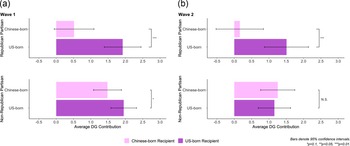
Turning to average contributions by recipient’s birthplace and partisanship, we find that non-Republicans contributed 1.95 tokens to U.S.-born recipients and 1.48 tokens to Chinese-born recipients on average in May 2020 (Panel A of Figure 3). The difference (.47 tokens) is statistically significant, but at $p \lt .1$
(two-sided t-test). By comparison, Republicans contributed 1.92 tokens to U.S.-born recipients and .52 tokens to Chinese-born recipients on average. The difference (1.40 tokens) is strongly significant (
$p \lt .1$
(two-sided t-test). By comparison, Republicans contributed 1.92 tokens to U.S.-born recipients and .52 tokens to Chinese-born recipients on average. The difference (1.40 tokens) is strongly significant ( $p \lt .001$
, two-sided t-test). Further, the interaction between partisanship and recipient birthplace is significant (
$p \lt .001$
, two-sided t-test). Further, the interaction between partisanship and recipient birthplace is significant ( $p \lt .1$
, two-way ANOVA), indicating that Republicans discriminated against Chinese-born recipients more than did non-Republicans, for whom evidence of discrimination is not especially strong in May.
$p \lt .1$
, two-way ANOVA), indicating that Republicans discriminated against Chinese-born recipients more than did non-Republicans, for whom evidence of discrimination is not especially strong in May.
Mean contributions in the give-or-take DG by recipient’s birthplace and participant partisanship

Effects of recipient’s birthplace, health vulnerability, economic vulnerability, partisanship, and interactions on give-or-take DG contributions

Panel B of Figure 3 reports the average contributions by recipient’s birthplace and partisanship in October, when non-Republicans contributed 1.16 tokens to U.S.-born recipients and 1.25 tokens to Chinese-born recipients on average. The difference (-.09 tokens) is not statistically significant ( $p = .787$
, two-sided t-test). By contrast, Republicans contributed 1.51 tokens to U.S.-born recipients and .16 tokens to Chinese-born recipients on average. The difference (1.35 tokens) is statistically significant (
$p = .787$
, two-sided t-test). By contrast, Republicans contributed 1.51 tokens to U.S.-born recipients and .16 tokens to Chinese-born recipients on average. The difference (1.35 tokens) is statistically significant ( $p \lt .01$
, two-sided t-test). Further, the interaction between partisanship and recipient birthplace is significant (
$p \lt .01$
, two-sided t-test). Further, the interaction between partisanship and recipient birthplace is significant ( $p \lt .05$
, two-way ANOVA), indicating that Republicans discriminated more against Chinese-born recipients than did non-Republicans, for whom there is no evidence of discrimination in October.
$p \lt .05$
, two-way ANOVA), indicating that Republicans discriminated more against Chinese-born recipients than did non-Republicans, for whom there is no evidence of discrimination in October.
Importantly, the reduced difference among non-Republicans is driven by less generous contributions to U.S.-born recipients in October compared to contributions in May. Average contributions by non-Republicans to U.S.-born recipients in October are significantly lower than average contributions to U.S.-born recipients in May (-.79 tokens, $p \lt .01$
, two-sided t-test). By contrast, average contributions by Republicans to U.S.-born recipients are comparable in October and May (-.41 tokens,
$p \lt .01$
, two-sided t-test). By contrast, average contributions by Republicans to U.S.-born recipients are comparable in October and May (-.41 tokens, $p = .329$
, two-sided t-test).
$p = .329$
, two-sided t-test).
Partisanship, which is not experimentally assigned, is plausibly associated with other characteristics, like age and race/ethnicity. We therefore confirm these results using multiple regressions in which we control for participant and community characteristics (Figure 4, also Table S3). The interaction between recipient’s birthplace and Republican identification is marginally significant in May ( $p \lt .1$
) and significant in October (
$p \lt .1$
) and significant in October ( $p \lt .05$
). These regressions compare Republicans to non-Republicans (the reference category). Moreover, comparing Republicans to Democrats, Republican identification remains a significant moderator of the effect of recipient birthplace on DG contributions in May (
$p \lt .05$
). These regressions compare Republicans to non-Republicans (the reference category). Moreover, comparing Republicans to Democrats, Republican identification remains a significant moderator of the effect of recipient birthplace on DG contributions in May ( $p \lt .1$
) and October (
$p \lt .1$
) and October ( $p \lt .05$
). Further, our categorical operationalization of contributions—which distinguishes participants who gave, took, or neither gave nor took—reveals that observed differences between Republicans and non-Republicans are driven primarily by Republicans taking from Chinese-born recipients (Figures S4–S5).
$p \lt .05$
). Further, our categorical operationalization of contributions—which distinguishes participants who gave, took, or neither gave nor took—reveals that observed differences between Republicans and non-Republicans are driven primarily by Republicans taking from Chinese-born recipients (Figures S4–S5).
Although individual partisanship moderates the effect of recipient’s birthplace on DG contributions, community receptiveness to right-wing rhetoric, as proxied by 2016 presidential election vote share, does not (Figure 4, also Table S6). In May 2020, however, the difference between predicted DG contributions to Chinese- and U.S.-born recipients in counties is sizable. In counties where the Republican vote share was at least one standard deviation above the mean ( $ \approx 63\% $
Republican votes), the predicted contribution to a Chinese-born recipient is 1.00 token and the predicted contribution to a U.S.-born recipient is 2.28 tokens, a difference of 1.28 tokens (
$ \approx 63\% $
Republican votes), the predicted contribution to a Chinese-born recipient is 1.00 token and the predicted contribution to a U.S.-born recipient is 2.28 tokens, a difference of 1.28 tokens ( $p = .171$
). In October 2020, this difference is .80 tokens (
$p = .171$
). In October 2020, this difference is .80 tokens ( $p = .844$
). Additionally, the difference in predicted DG contributions to Chinese-born recipients between high- and low-Republican vote share counties is not significant, either in May (
$p = .844$
). Additionally, the difference in predicted DG contributions to Chinese-born recipients between high- and low-Republican vote share counties is not significant, either in May ( $p = .748$
) or October (
$p = .748$
) or October ( $p = .945$
). In sum, we do not find evidence that community receptiveness to right-wing rhetoric—perhaps a proxy for ambient anti-Asian sentiments—moderate the effect of recipient’s birthplace on DG contributions.
$p = .945$
). In sum, we do not find evidence that community receptiveness to right-wing rhetoric—perhaps a proxy for ambient anti-Asian sentiments—moderate the effect of recipient’s birthplace on DG contributions.
Taken together, and in line with H3 and H4, our findings suggest that Republican participants discriminated against Chinese-born recipients not only in May but also October. In May, non-Republican participants gave slightly more to U.S.- than Chinese-born recipients, although this difference is significant only at $p \lt .1$
; in October, non-Republican participants gave comparable amounts to U.S.- and Chinese-born recipients.
$p \lt .1$
; in October, non-Republican participants gave comparable amounts to U.S.- and Chinese-born recipients.
Discussion
In May 2020, Americans discriminated against Chinese-born Americans, but Republicans discriminated more than did non-Republicans. In October 2020, Republicans continued to discriminate against Chinese-born Americans; non-Republicans did not. These patterns are consistent with complementary explanations: Republicans held stronger anti-Asian sentiments to begin with and/or stigmatizing rhetoric from right-wing figures legitimated anti-Asian behavior among this group. These factors may have worked in tandem, as “elite blame-rhetoric […] activated pre-existing xenophobia and anti-Asian sentiment” (Reny and Barreto Reference Reny and Barreto2020: p. 2). Without having measured attitudes or behavior prior to the pandemic, we cannot definitively conclude that stigmatizing, right-wing rhetoric related to COVID-19 played a role. Two considerations, however, suggest it did. First, stable discrimination against Chinese-born Americans among Republicans coincided with declining discrimination among non-Republicans. In other words, the drive to discriminate against Chinese-born Americans did not weaken among Republicans, as it should have had it not been sustained by a force that acted uniquely on this group. The steady stream of anti-Asian rhetoric from right-wing figures throughout 2020 could have been such a force. Second, other research has documented an increase in anti-Asian behaviors and expressions coinciding with stigmatizing rhetoric during the pandemic, which supports this interpretation of observed discrimination (e.g., Center for the Study of Hate and Extremism 2021; Lu and Sheng Reference Lu and Sheng2022).
Like other studies on COVID-19 (He et al. Reference He, Zhang and Xie2022; Mandalaywala et al. Reference Mandalaywala, Gonzalez and Tropp2021), the current study is limited to examining the treatment of a single group: people living in the United States who were born in China. Naturally, many Chinese Americans were not born in China, and many Asian Americans do not have Chinese ancestry. However, our results may generalize to Chinese Americans and even Asian Americans, regardless of their ancestry or birth countries. Chinese Americans, like Asian Americans generally, have been framed as perpetual foreigners (Tessler et al. Reference Tessler, Choi and Kao2020), and their American identities are routinely questioned, even today (Cheryan and Monin Reference Cheryan and Monin2005; Hua and Junn Reference Hua and Junn2021). Combined with the unquestioned Americanness of Whites (Cheryan and Monin Reference Cheryan and Monin2005), we are confident that the discrimination we observed reflects, in large part, differences in the treatment of people viewed as Chinese American versus White American.
Relatedly, BIS theory may carry implications for immigrants and groups regarded as “foreign” more generally, not only those of Chinese or Asian origin. In a similar vein, discrimination during the pandemic may have spilled over onto other non-Whites, including Black and Latino Americans (Christiani et al. Reference Christiani, Clark, Greene, Hetherington and Wager2021). These questions are beyond the scope of the current study, which sought to document discrimination against those people who were linked most directly and immediately to COVID-19 in U.S. public discourse: people born in China who are in the United States. We hope other research will fill these gaps.
Conclusion
Early in the COVID-19 pandemic, Americans, but especially Republicans, discriminated against Chinese-born Americans. By October 2020, however, non-Republicans treated Chinese- and U.S.-born Americans comparably. Notably, reduced discrimination among non-Republicans was driven by less generous contributions to U.S.-born recipients, rather than more generous contributions to Chinese-born ones. We did not anticipate a decline in contributions toward U.S.-born recipients, and it merits further investigation. This trend, however, resembles the decline in prosocial behavior documented by Brañas-Garza et al. (Reference Brañas-Garza, Jorrat, Alfonso-Costillo, Espín, Garcia and Kovářík2020) in Spain during a period when COVID-19 cases and deaths rose, as was the case between May and October 2020 in the United States.
Republicans, by contrast, continued to treat Chinese-born Americans worse than U.S.-born Americans in October. Persistent discrimination by Republicans, especially in the face of increasingly equitable treatment by other Americans, suggests that anti-Asian sentiments, right-wing rhetoric, or both factors may have played a key role in sustaining discrimination toward Chinese-born Americans throughout 2020. Persistent discrimination by Republicans is also especially striking given that Republicans reported being less concerned about COVID-19 than other Americans (Ruisch et al. Reference Ruisch, Moore, Samoya, Boggs, Ladanyi and Fazio2021).
In general, Americans who were personally or locally vulnerable to the health or economic effects of COVID-19 were not more likely to consistently discriminate against Chinese-born Americans. We captured vulnerability using objective traits, like health conditions and adverse employment events, whereas scholarship on BIS has theorized and investigated the role of subjective or perceived vulnerability. Importantly, we replicated our analyses using more subjective proxies of individual health and economic vulnerability available in our survey, but these measures did not significantly moderate the effect of birthplace on contributions. We acknowledge, however, that a mismatch between objective and perceived vulnerability could explain why we did not observe an association between behavior, on the one hand, and vulnerability measures, on the other.
Other research on the COVID-19 pandemic has documented a rise in anti-Asian hate incidents (Center for the Study of Hate and Extremism 2021; Jeung et al. Reference Jeung, Yellow Horse and Cayanan2021) and online expressions of anti-Asian sentiment (Lu and Sheng Reference Lu and Sheng2022; Nguyen et al. Reference Nguyen, Criss, Dwivedi, Huang, Keralis, Hsu, Phan, Nguyen, Yardi, Glymour, Allen, Chae, Gee and Nguyen2020; Pei and Mehta Reference Pei and Mehta2020; Stechemesser et al. Reference Stechemesser, Wenza and Levermann2020; Tahmasbi et al. Reference Tahmasbi, Schild, Ling, Blackburn, Stringhini, Zhang and Zannettou2021; Zhang et al. Reference Zhang, Keegan, Lv and Tan2021). Our findings document a more quotidian form of discrimination, resembling the kinds of behaviors that Chinese and Asian Americans are more likely to encounter than physical violence. This type of behavior may have been concentrated, especially as the pandemic progressed, among the subset of Americans who are likely to be more receptive to rhetoric from right-wing figures. In March 2020, the executive director of the World Health Organization’s Emergencies Program called on leaders to avoid stigmatizing language, like “Chinese virus,” to describe COVID-19 (Gstalter Reference Gstalter2020). Our findings, which extend earlier research on the first wave of the pandemic, illustrate the possible consequences of such language. Our findings also suggest that group-based stigma can be sustained absent any objective link between group membership and the stigmatized trait, or after that link has been severed. This is equally true for many other groups, including U.S. immigrants generally, who continue to be the subjects of widespread and inaccurate myths (e.g., that they commit more crimes or do not pay taxes) (Abascal et al. Reference Abascal, Huang and Tran2021; Lajevardi and Oskooii Reference Lajevardi and Oskooii2018; Nassar Reference Nassar2020).
Possibly, stigmatizing rhetoric gave rise to unequal treatment by changing underlying sentiments toward Asian Americans, including Chinese Americans. This is consistent with the documented increase in implicit anti-Asian attitudes (Darling-Hammond et al. Reference Darling-Hammond, Michael, Allen, Chae, Thomas, Nguyen, Mujahid and Johnson2020). However, other research has failed to uncover a clear increase in explicit anti-Asian attitudes (Daniels et al. Reference Daniels, DiMaggio, Mora and Shepherd2021). Our findings are also consistent with preexisting prejudices against Asian Americans among some Americans as well as with the account in Daniels et al. (Reference Daniels, DiMaggio, Mora and Shepherd2021), according to which anti-Asian rhetoric sanctioned hostile behavior among those Americans who held such prejudices (also see Reny and Barreto Reference Reny and Barreto2020). We do not aim to adjudicate between these accounts here; we simply point out that, in any case, rising anti-Asian behavior could persist as long as anti-Asian sentiments and rhetoric circulate unchallenged.
Supplementary Material
To view supplementary material for this article, please visit https://doi.org/10.1017/rep.2022.28
Data Availability Statement
The data and code necessary to reproduce the analyses reported are available at: https://osf.io/eqr95/?viewonly=46b1481e99e746439267223ceaa7ead5.
Acknowledgements
We thank Eugen Dimant, Michele Gelfand, Malte Reichelt, Anahit Sargsyan, and Alex Sphenev for feedback on the study design. Jinyi Kuang provided research support. For valuable comments on previous drafts, we are grateful to Paul DiMaggio, Nahoko Kameo, and Carly Knight.
Author Contributions
M.A. and K.M. designed the research and collected the data. K.M. and Y.X. analyzed the data. M.A., K.M., and Y.X. wrote the paper, the revision, and Supporting Material.
Funding Declaration
This research was supported by the NYUAD Center for Interacting Urban Networks (CITIES), funded by Tamkeen under the NYUAD Research Institute Award CG001; the NYUAD COVID-19 Facilitator Research Fund Grant; and discretionary research funds from Maria Abascal, Michele Gelfand, Kinga Makovi, and Malte Reichelt.
Competing Interests Declaration
The author(s) declare none.
Ethical Statement
The study was approved by the NYUAD Institutional Review Board (#HRPP-2020-46) and was deemed to be minimal risk.



 Open access

