

Economic and social crises have historically ushered in massive expansions in the scope of government protection. The economic crisis of the 1890s spawned the creation of universalistic, tax-financed social policies in Northern Europe. The Great Depression of the 1930s created the preconditions for the New Deal policies that provided income support and enhanced employment protection. A commonality across these cases is that increased exposure to risks has translated into higher demand for expanded government programs.
Is risk exposure likely to increase demand for social protection in an era in which populist messages are prominent? The Covid-19 pandemic dramatically increased exposure to health and economic risk around the world. But an important difference distinguishing the current political environment from previous crises is the unprecedented prominence of populist politicians and populist political rhetoric. Following the emerging consensus in the literature, we define populism as an ideology that seeks to appeal to ordinary people who feel their concerns are disregarded by established elite groups (Hawkins et al., Reference Hawkins, Riding and Mudde2012; Mudde, Reference Mudde, Kaltwasser, Taggart, Espejo and Ostiguy2017; Urbinati, Reference Urbinati2019; Margalit, Reference Margalit2019b). Populists develop their political appeals through the vilification of foreign and domestic elites, which allows them to uphold claims to be the authentic representative of the people.
By this definition, populism is compatible with a variety of positions on questions of redistribution and economic policy. Previous studies have shown that the redistributive policies of populist parties span from “libertarian to socialist, with different shades of welfare-chauvinism in between” (Rovny, Reference Rovny2013; Afonso and Rennwald, Reference Afonso, Rennwald, Manow, Palier and Schwander2018, 171). Even so, we contend that the basic logic of populism, which privileges “the people” by vilifying domestic and foreign elites, has consequences for redistributive demands. These rhetorical strategies establish different frames that influence voters' subjective perceptions about the magnitude of risks and their capacity to respond to crisis without government assistance. In short, populist politicians have the capacity to shape redistributive demand even without taking explicit positions on questions of redistribution. To understand popular demand for redistribution in the aftermath of the Covid-19 pandemic, we need to characterize the intervening role of these populist frames.
The theoretical goal of our paper is to characterize the potentially distinct redistributive consequences of two types of elites targeted by populists. We document two broad types of rhetoric deployed by populist politicians during the Covid-19 pandemic: attacks on technocrats, including the scientific community and domestic technocratic elites, and attacks on foreign enemies. In the context of the pandemic, the first strategy involved attacking the scientific community for proposing lockdowns and social distancing policies, and the second involved blaming foreign countries for deliberate actions that caused the pandemic.
In contrast to previous research on populism, which has focused largely on explaining when populism emerges and whether it is a response to socioeconomic dislocation (Mutz, Reference Mutz2018; Margalit, Reference Margalit2019a, Reference Margalit2019b), we are interested in assessing the effects of populism on demand for social protection. We contend that “anti-elite” and “anti-foreign” rhetorical strategies have different implications for the subjective perceptions of voters that experience either health or economic shocks during the pandemic. Specifically, we argue that anti-elite rhetoric reduces subjective perceptions of economic and health risks of exposed individuals by undercutting technocratic expertise, thereby lowering demand for policies that enhance social protection of vulnerable groups. Anti-foreign rhetoric has the opposite effect. Due to its emphasis on the foreign origin of these threats, these messages augment the perceived threat associated with exposure to the new virus, and frame the threats as posing risks that individuals are unlikely to mitigate on their own. In augmenting these perceptions of threats, anti-foreign messages may increase demand for social protection of individuals who experience either employment or health shocks during the current pandemic.
We test these propositions in a study conducted in the United States six months after the onset of the Covid-19 pandemic. The American case has two important features from a research design perspective. First, significant numbers of Americans were exposed to economic and health risks during the early Covid waves. Second, President Trump and a variety of US governors used both anti-elite and anti-foreign populist messages to respond to the challenges of the Covid crisis. This makes the United States a naturalistic context for comparing the effects of the two types of rhetoric, but we expect the results to have implications for a wide range of contexts insofar as these rhetorical strategies are widely representative of the messages used by populist leaders around the world, as illustrated in Table 1 below. In a survey experiment, we varied whether respondents were presented with technocratic, populist anti-elite frames (evoking conflict with domestic elites) or populist anti-foreign frames (emphasizing an international dimension to the crisis), and then measured respondents' expressed demand for social protection.
Classification of populist rhetorical strategies during the pandemic

Notes: See Appendix A for more details and citations for these examples.
Consistent with our expectations, we find that the two types of populist messages interact differently with risk exposure. Amongst respondents exposed to pandemic risk, anti-foreign frames augment demand for social protection, while populist anti-elite frames depress it. Thus, to understand the consequences of populism for the relationship between risk and social protection, we need to disaggregate among different types of populist rhetorical strategies and examine their implications for subjective perceptions of risk and demand for redistribution.
We begin by discussing the findings of the literature linking risk shifts and the transformation of the welfare state. Next, we present an analytic classification of populist rhetoric during the Covid-19 pandemic, noting that anti-elite and anti-foreign rhetoric differently frame the magnitude of economic and health risks. Finally, we present a survey experiment designed to assess the effects of these risk frames on voters' social policy preferences in the United States.
1. Risk shifts and demand for social policy
Risk shocks—understood as sudden increases in economic or health risks—have been a driving force behind the expansion of governmental programs. Some of the most dramatic policy innovations of modern welfare states have emerged in the aftermath of massive economic dislocations. Examples include the adoption of universalistic social policy in Scandinavia during the economic crisis of the 1890s and the enactment of the New Deal in the United States during the Great Depression (Amenta et al., Reference Amenta, Clemens, Olsen, Parikh and Skocpol1987; Baldwin, Reference Baldwin1990). The existing literature has examined the implications of risk exposure for the size of the welfare state, the political coalitions that support social policy expansion, and individual-level redistributive demands. We begin by reviewing these studies to establish baseline expectations about the relationship between risk and demand for social policy expansion.
Cross-national evidence links external volatility—especially volatility in the terms of trade—to the scope of the public sector. This positive relationship between external risks and larger public sectors holds for both advanced industrialized economies (Cameron, Reference Cameron1978; Katzenstein, Reference Katzenstein1985) and developing economies (Rodrik, Reference Rodrik1998). Higher levels of external risk are also correlated with higher levels of social policy coverage, not just higher aggregate social expenditures (Mares, Reference Mares2005). Scholars of health policy have also documented how public health crises—such as outbreaks of cholera or smallpox—have changed the form of public health intervention. Baldwin (Reference Baldwin2005) documents how 19th-century public health crises led to increased public investment when governments adopted “sanitationist” (versus “quarantinist”) models of public health.
Other studies show how changes in risk reconfigure political coalitions that support or oppose social policies. During the interwar period, risk exposure increased the bargaining power of sectors facing higher risk (Amenta et al., Reference Amenta, Clemens, Olsen, Parikh and Skocpol1987), translating into more redistributive social policies only if the high-risk group was politically pivotal (Mares, Reference Mares2004). In previous periods, heightened risk has also contributed to more centralized social policy, pooling risk across regional units in cases of low regional inequality (Beramendi, Reference Beramendi2012). The unevenness in risk exposure can also create conflicts within political parties between constituencies that face a high incidence of risk and therefore demand policy expansion, and constituencies that oppose changes to the status quo. Häusermann (Reference Häusermann2010) shows the “coalitional flexibility” of different parties to forge compromises across groups with different risk exposure is higher in countries with proportionate electoral rules.
Related studies have examined the effects of heightened insecurity on demand for social policy using individual-level data. Rehm (Reference Rehm2009) documents that higher occupational risks translate into support for more redistributive social policies, and Hacker et al. (Reference Hacker, Rehm and Schlesinger2013) show that exposure to economic and health shocks increases support for redistributive policies. Walter (Reference Walter2017) documents that trade shocks increase perceptions of labor market risk and demand for protection among low-skilled voters. Mares and Carnes (Reference Mares and Carnes2015) show that higher employment insecurity translates into higher support for redistribution. However, not all studies find a correlation between heightened insecurity and support for more redistribution (Mughan, Reference Mughan2007). Margalit (Reference Margalit2013) documents a large initial increase in support for more redistributive social policy caused by economic insecurity experienced during the Great Recession, but it quickly dissipated as economic opportunities improved.
The existing literature has demonstrated risk shocks increase demand for redistributive policies. Our paper contributes to this literature by examining how populist parties' rhetorical frames alter the relationship between experiences of insecurity and voters' demand for social policy. Despite heightened interest in populist phenomenon in recent years, our understanding of the ways in which populist parties affect demand for social policy is limited. The current pandemic provides us with a unique opportunity to examine the consequences of populist rhetoric for redistributive demands. On the one hand, the current pandemic has contributed to dramatic increases in both economic and health risks. On the other hand, populist politicians have responded to the pandemic using a variety of messages which have different consequences for voters' perceptions about the magnitude of health and economic risks in their communities and countries. In the following section, we present an analytic typology of populist rhetorical strategies and examine their implications for demand for redistribution.
2. An analytic typology of populist rhetoric during the pandemic
The current political environment is distinctive in the prominence of populist politicians, with populists occupying political office and enjoying sizeable political support at unprecedented levels around the world. Following Müller (Reference Müller2016) and Mudde (Reference Mudde, Kaltwasser, Taggart, Espejo and Ostiguy2017), we define populism as an ideology that is potentially compatible with diverse (and inconsistent) positions on economic redistribution. Instead, the essence of populism is its portrayal of the people as virtuous and essentially homogeneous, and its advocacy of popular sovereignty. As Urbinati (Reference Urbinati2019, 112) has emphasized, populists build the concept of “the people” through a parallel process of exclusion. Populists create villains against which they position themselves and without which they cannot exist.
In their claim to be unique and privileged representatives of the people, populists can vilify different types of enemies. The first type of enemies are domestic elites. Such domestic elites can include politicians, technocrats, scientists, or medical experts, whose expertise and experience are portrayed as liabilities rather than virtues. The second type of enemies are foreign enemies, who are alleged to exert illegitimate influence on political outcomes.Footnote 1 These enemies may include international organizations, such as the World Bank, the WHO, the IMF, or foreign countries.
Scholars debate whether anti-foreign and anti-globalization discourse is properly conceived as a manifestation of populism (Art, Reference Art2022). We view rhetoric that seeks to blame foreign outsiders as a manifestation of populism insofar as it seeks to construct the people vis-à-vis an excluded category. We acknowledge that many populist politicians that use this type of rhetoric have also adopted anti-immigrant and anti-globalization policy positions that have “thicker” connotations (Neuner and Wratil, Reference Neuner and Wratil2022).Footnote 2 For our purposes, the main point is that neither anti-elite nor anti-foreign rhetoric is intrinsically linked with politicians' positions on economic redistribution.Footnote 3 The mix between foreign and domestic enemies vilified by populist politicians is likely to vary across countries and time. In this paper, our focus is not on explaining the prevalence of the two types of vilification strategies, but on characterizing them as two divergent manifestations of populism and on analyzing their effects.
For example, consider the strategies pursued by President Trump in response to the rising dislocation of the pandemic. President Trump engaged in sustained conflict with members of the medical community and government technocrats over the appropriate response to the crisis, repeatedly downplaying the health and economic risks of the pandemic with comments like his 28 February 2020 statement to the press: “It's going to disappear one day. One day, it's like a miracle, it will disappear” (Collinson, Reference Collinson2020). At the same time, Trump vilified foreign enemies and endorsed theories that blamed foreign actors for the pandemic. “The World is at War with a hidden enemy,” Trump tweeted on 17 March 2020. Addressing laid off workers via Twitter on 23 March 2020, Trump wrote, “the onslaught of the Chinese Virus is not your fault.”
Other populist leaders also used rhetorical strategies that combined attacks on foreigners and technocratic elites, including the medical community. In Brazil, Jair Bolsonaro attacked the media for creating hysteria and panic about the virus. Referring to lockdowns as a curse that is worse than the disease, Bolsonaro urged Brazilians to go back to work (Reporters without Borders, 2020). At the same time, Bolsonaro endorsed theories suggesting that China had developed the Coronavirus in a lab and disseminated it as a tactic of biological welfare (Ribeiro, Reference Ribeiro2021).
We provide further examples in Table 1, in which we present an analytic classification of populist rhetorical responses to the pandemic. We classify these strategies by distinguishing the enemies targeted by populist politicians as part of their claims to represent the people—foreign actors or domestic elites—and then derive the distinct implications of each type of message for citizens' risk perceptions. Importantly, we do not classify populist politicians based on the redistributive policies they explicitly espouse, instead emphasizing the implicit effects of the choice to target domestic elites or foreign enemies.
In Table 1, we also explicitly describe the ways different rhetorical strategies have manifested in discussions of economic and health risks during Covid-19, providing specific examples of populist politicians who have used a particular frame in italics at the bottom of each cell. The Trump administration has used a particularly wide mix of frames throughout the pandemic. However, examples from Austria, Belarus, Brazil, Germany, Hungary, India, Italy, Mexico, and Spain demonstrate that other populists around the world have also employed these frames, with some minimizing perceptions of economic and health risks (by calling citizens back to work and resisting lockdowns), and some enhancing perceptions of economic and health risks (by suggesting foreign actors were deliberately using the pandemic to threaten the country's economy and health).
The key point is that anti-elite and anti-foreign rhetorical strategies frame the magnitude of the health and economic risks associated with the pandemic differently. These different frames are likely to impact voters' subjective perceptions about the magnitude of these risks and have different consequences for social policy demands. Our framework implies that populist strategies pursued without clear redistributive objectives have, nevertheless, consequences for redistributive preferences.
Thus, the pandemic provided opportunities for populists to either augment or mitigate risk perceptions depending on the enemy that they targeted. In this paper, we focus on the effects of these targets, examining whether the two types of populist messages differentially affect public opinion toward government expansion in response to the Covid-19 pandemic. Our hypotheses build on existing research on the determinants of social policy preferences, which has highlighted the importance of subjective perceptions in connecting objective risk and preferences for redistribution (Boholm, Reference Boholm1998; Rehm, Reference Rehm2016). Our conjecture is that populist anti-elite and anti-foreign frames differentially impact citizens' subjective perceptions of risk, potentially changing the relationship between exposure to health or labor market shocks and demand for redistribution.
In particular, anti-elite frames downplay the severity of the economic/health risks and the benefits of risk pooling. As a result, this frame is likely to lower subjective risk perception, reducing demand for social policies that pool risk amongst individuals exposed to shocks. Individuals exposed to this rhetoric are less likely to view government social protection as beneficial in mitigating risks to which they have been exposed. In contrast, anti-foreign frames may heighten subjective perceptions of insecurity by presenting the new virus as the product of malevolent intentions of foreign actors. We hypothesize that these heightened subjective perceptions of insecurity translate into demand for social policies that expand coverage in order to provide adequate protection. Individuals exposed to this rhetoric are more likely to view government social protection as desirable in mitigating risks to which they have been exposed.
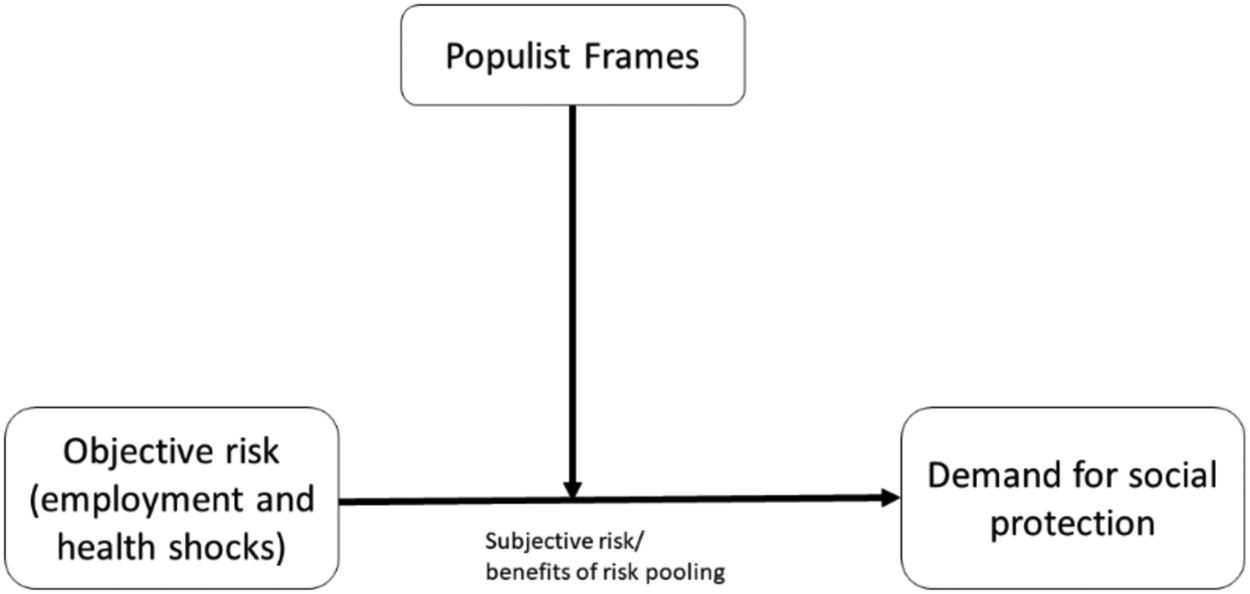
Figure 1 summarizes our theoretical expectations.Footnote 4 We conjecture that populist frames moderate the translation of objective risks into subjective risks for individuals, modifying preferences for risk pooling for individuals exposed to health or employment shocks. By altering subjective perceptions of risk, anti-foreign messages are likely to enhance demand for social policies that pool more groups and redistribute risks, and anti-elite messages are expected to lower demand for redistributive social policies. We do not expect populist frames to impact the social policy preferences of individuals that have experienced low levels of objective risk during the pandemic, as citizens are not anticipated to have fluid social policy preferences without changes in risk exposure.
Interaction effect between populist frames and risk on social policy demand.
3. Research design
We test these hypotheses using a survey experiment administered to a sample of 2000 American adults in September 2020, six months into the Covid-19 pandemic in the United States. This context allows us to study the differential effects of anti-elite and anti-foreign populist rhetoric within one country when exposure to economic and health risks was high and both types of populist appeals were common.Footnote 5 The online sample was recruited by LUCID Survey Sampling Services, ensuring that the gender, age, racial, and geographic distribution was broadly representative of the country as a whole. LUCID samples have been found to return experimental results similar to those obtained on truly random samples (Coppock and McClellan, Reference Coppock and McClellan2019), and the attention rates measured in this survey compare favorably to other online surveys.Footnote 6
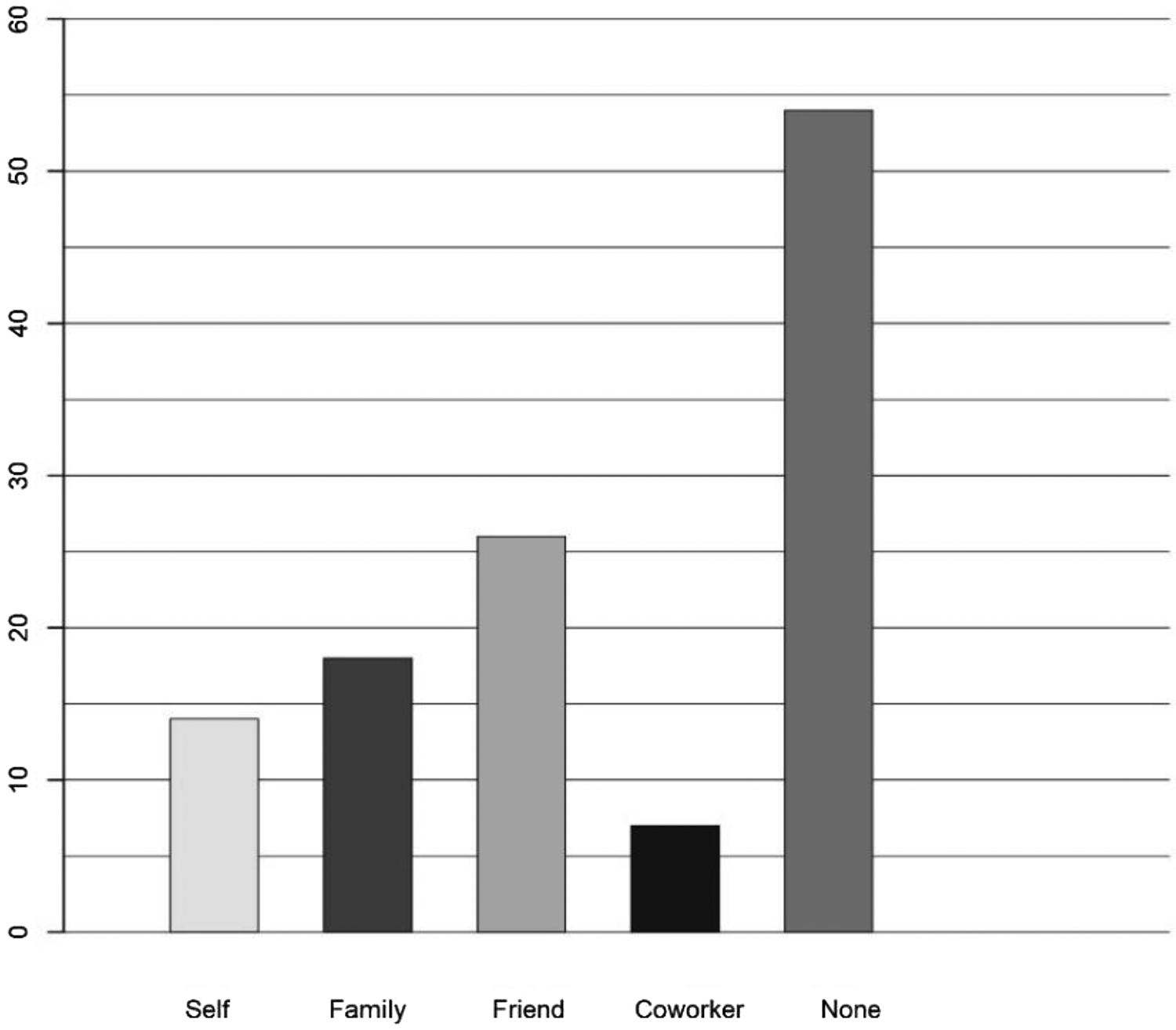
We measured respondents' exposure to health and employment shocks in advance of the survey experiment. To measure exposure to health shocks, respondents were asked whether they had been diagnosed with the novel coronavirus (Covid-19) in the past year, and whether they knew a family member, friend, and/or co-worker who had been diagnosed. Figure 2 shows the proportion of the sample that had personal and/or social exposure to health shocks from Covid-19: 14 percent of our respondents reported that they had experienced Covid-19, while 18 percent had family members, 26 percent had friends, and 7 percent had coworkers who had Covid-19. Using these responses, we create an index of exposure to health shocks that takes a value of 1 if the respondent had been diagnosed, 0.5 if he or she had not been diagnosed but knew someone who had been (whether family, friend or co-worker), and 0 if he or she did not know anyone who had been diagnosed. Due to overlap in the categories of personal and social exposure, the last non-exposed category contains 54 percent of respondents. This index has a mean of 0.30, and a standard deviation of 0.36.
Respondent exposure to health shocks: contact with Covid-19.
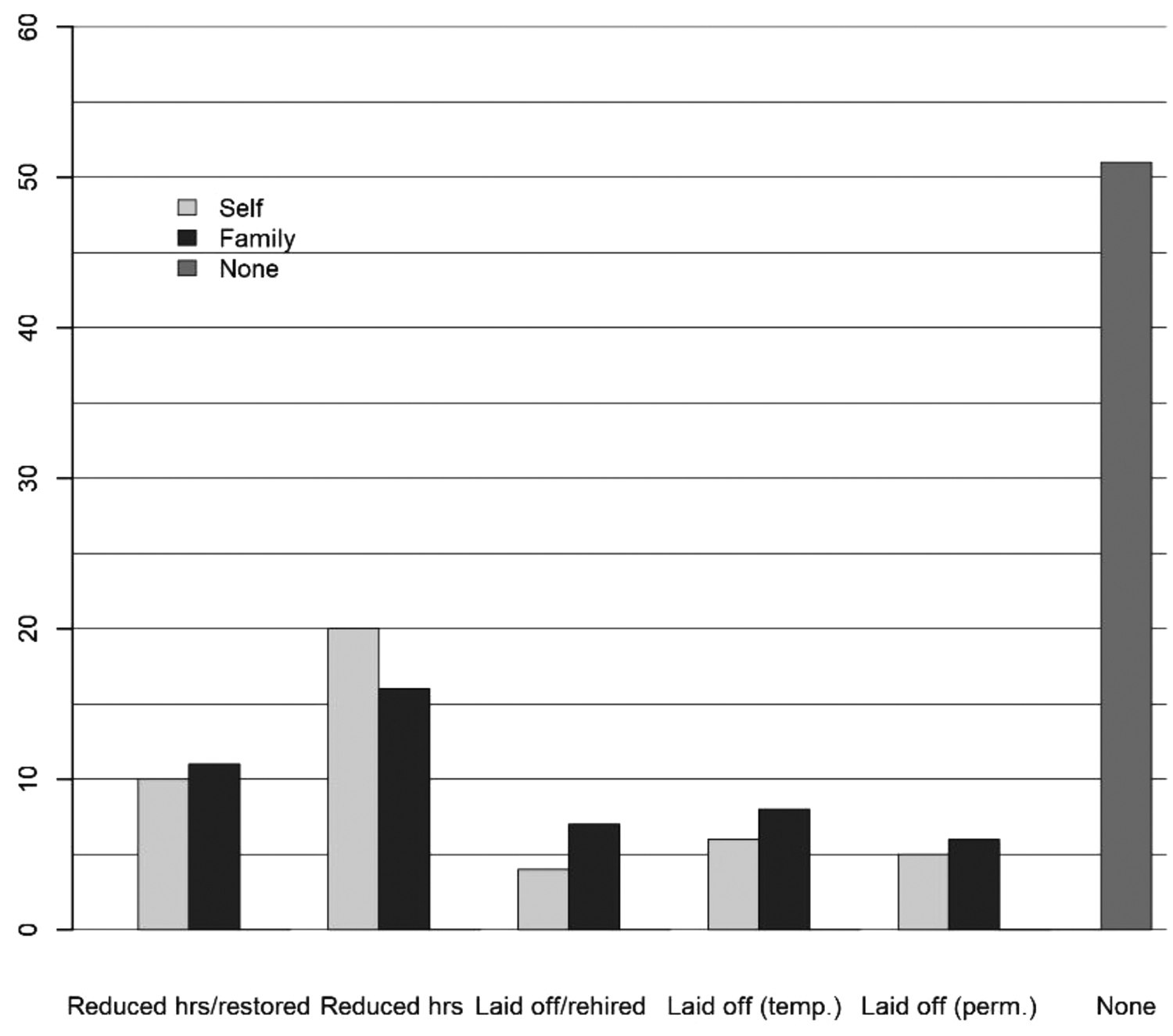
To measure employment shocks, respondents were asked about how their work status had changed this year as a result of the coronavirus pandemic, with listed responses including “My hours have been reduced,” “My hours were reduced but they have been restored,” “I have been temporarily laid off,” “I was temporarily laid off, but have now been rehired,” and “I lost my job.” Respondents were also asked how family members' work status had changed, with an equivalent list of possible responses. The most common employment shock is reduced hours (personally experienced currently by 20 percent of respondents, with 10 percent saying they had had their hours previously cut but that they were now restored). Figure 3 shows the proportion of respondents who reported experiencing various employment shocks due to the pandemic, personally and/or within their families.
Respondent exposure to various employment shocks.
In creating an index of exposure to employment shocks, we were motivated by a desire to give greater weight to larger shocks (i.e. being laid off likely imposes greater economic dislocation than reduced hours) without having to manually specify the precise weight of one shock vis-à-vis another.Footnote 7 Our approach is to instead let the data speak for themselves, creating respondent-level measures of aggregate economic risk exposure by averaging respondents' standardized z-scores on each type of economic shock. This generates a measure of economic risk that gives greater weight to shocks that are rarer (have smaller standard deviations) without externally imposing a scale to quantify the relative dislocation caused by each type of employment shock.Footnote 8 The employment shock index ranges from 0 (respondents who had not experienced any shocks) to 3.1 (respondents who had experienced all shocks) with a mean of 0.26 and a standard deviation of 0.36.
We examine the correlates of health and economic risk in our sample in Table F1 in Appendix F. The correlations in this data suggest the drivers of risk in our sample are similar to those that existed in the United States at this time, with younger people and minorities having greater exposure to economic and health shocks, giving us confidence in the external validity of our findings. We address issues of internal validity—particularly whether our treatments interact with a correlate of risk, rather than risk itself—in various ways in our robustness checks.
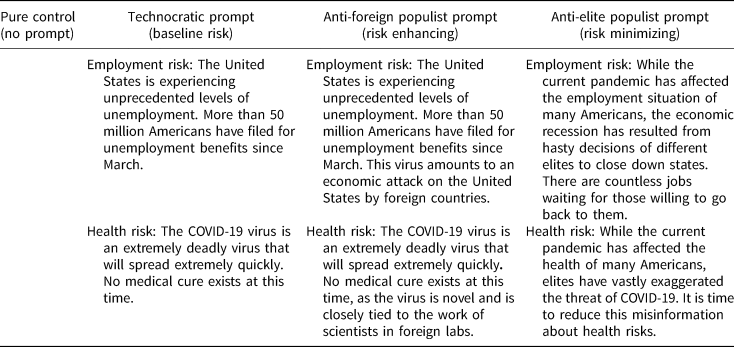
We subsequently randomly assigned respondents to read technocratic or populist messaging about the Covid-19 pandemic, providing different frames for understanding the extent of economic and health risk it posed. The first arm was a control condition, in which respondents were not provided with any further information on the risks associated with the pandemic. The remaining arms exposed respondents to messages about risks from the pandemic that varied the political frame employed (technocratic, anti-foreign, anti-elite) and the domain of risk (employment or health). The different treatments are described in full in Table 2.
The experimental treatments randomized the political frame employed, and concomitantly conveyed varying levels of risks. The prompts were designed to mimic combinations of rhetoric that we empirically observed in the United States during the first six months of the pandemic, which affirm our classification scheme in Table 1.Footnote 9 In particular, attacks on foreign leaders affirmed the health and economic costs of the pandemic, while attacks on domestic elites and technocrats downplayed their expertise and therefore pandemic risk. This design choice does not permit us to examine all combinations of elite targets and presentation of pandemic facts that are possible in the abstract. Our results should be interpreted as the full effects of particular rhetorical frames, rather than as the isolated effects of demonizing a particular type of elite.
One set of respondents read technocratic messages that conveyed baseline risk by presenting facts about either the unemployment or health risks presented by the pandemic. In eras and locations in which populist politicians have less influence, we would expect this to be the dominant type of messaging regarding risk; as a result, the technocratic condition provides a useful benchmark for the anti-elite and anti-foreign effects. We expect its neutral risk presentation to generate moderate support for redistribution among risk-exposed respondents, falling between the two populist messages.Footnote 10 Another set of respondents were presented with messages that emphasized the anti-foreign current of populism. By linking the crisis to actions by foreign actors, this frame potentially increased citizens' sense of the pandemic being beyond their control and augmented risk, generating higher support for redistribution. A third set of respondents were presented with messages that emphasized the anti-elite aspect of populist rhetoric and, in doing so, potentially minimized risks associated with the pandemic and generated lower support for government solutions. Within each type of frame, half of respondents received the economic risk frame and half received the health risk frame.
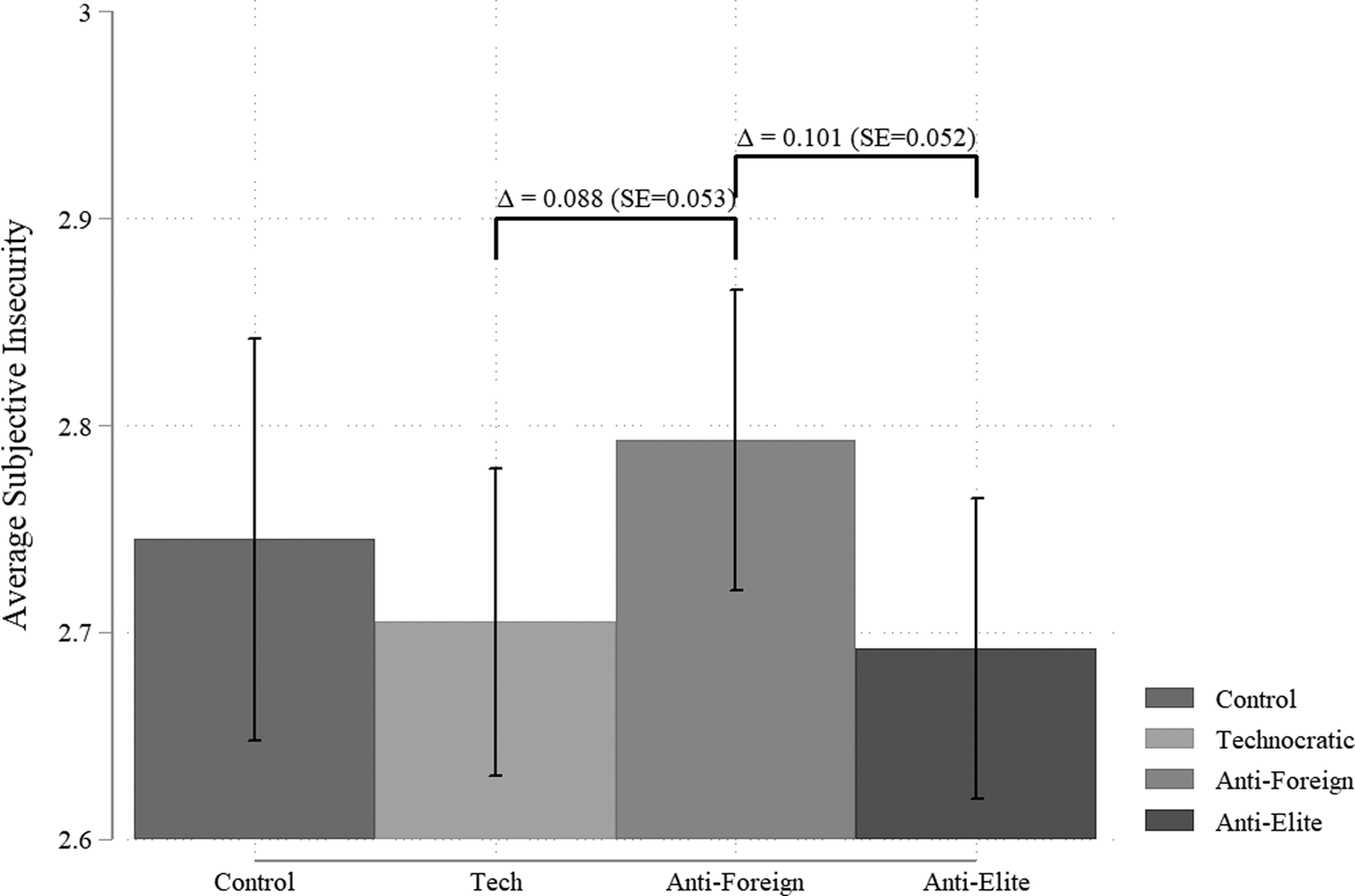
Following our theoretical expectations, we characterize the anti-elite rhetoric as risk minimizing and the anti-foreign rhetoric as risk maximizing. In a supplementary survey, fielded just after our main survey, we verified that the treatments had different effects on respondents' level of concern about their health and economic situations, measured on a 1–4 scale, with results displayed in Figure 4.Footnote 11 As hypothesized, respondents in the anti-foreign condition expressed considerably greater concern about their health and economic situations than respondents in either the technocratic or anti-elite conditions (with both differences statistically significant at the 90 percent confidence level). Respondents in the anti-elite condition expressed only slightly less concern than respondents in the technocratic condition, and this difference was not statistically significant.
Respondent subjective insecurity by treatment.
Each of the treatment arms in Table 2 were randomized with equal probability across respondents. In Table F3 in Appendix F, we show that our experimental arms are well-balanced on demographic variables associated with attitudes toward redistribution—gender, age, race, ethnicity, household income, partisanship, and education levels—as well as on exposure to shocks. We present the results without covariate adjustment in the tables below, showing that the results are robust to controlling for covariates in various ways in Appendix F.
Experimental treatments
After reading these messages, respondents in all treatment conditions were told, “As the pandemic is unfolding, Congress is considering additional policies to mitigate the hardships associated with the crisis. We would like to hear your opinion about these policies.” They were then asked to indicate their level of support—on a five-point scale—for five policies. Two of these policies involved increasing unemployment benefits (by widening eligibility or extending duration), two involved increasing health benefits (by providing free testing or treatment for the novel Coronavirus) and one involved the extension of social security. The last question was included to assess whether the messages changed support for the welfare state beyond government assistance programs directly related to the employment and health risks generated by the pandemic.Footnote 12 As part of each question, respondents were cued to think about the trade-offs involved in increasing government assistance in particular areas, specifically that the expenditures would require higher taxes in the future. We subsequently combine the questions into a measure of support for unemployment benefits (average of two unemployment questions), a measure of support for health care benefits (average of two health questions) and a measure of pandemic-related social protection (average of all unemployment and health questions). We have only one question about expanding social security.
After answering these questions, respondents were immediately debriefed on the importance of containing the spread of Covid-19. They were asked to follow the advice of public health officials and to continue to practice social distancing. We also provided a link to the CDC website on Covid-19 safety measures and provided a phone number and e-mail for a research assistant to contact if they had questions about the research. We provide a full ethics statement in Appendix C.
4. Effects of populist messages on demand for social protection
Our survey experiment allows us to estimate the causal effects of different populist messages on demand for social protection. From a theoretical perspective, we are particularly interested in whether populist messages alter support for redistribution among respondents exposed to health and employment shocks, thereby modifying the relationship between risk exposure and demand for redistribution observed in previous historical periods. Our main theoretical expectation is that the anti-foreign treatment should lead to higher support compared to the anti-elite treatment for respondents exposed to risk. Our theoretical framework also suggests that the anti-foreign treatment should lead to higher support compared to the technocratic treatment and the anti-elite treatment should lead to lower support compared to the technocratic treatment for these respondents. We investigate these hypotheses by considering the interactions between populist messages and individual experience of health and employment shocks during the pandemic.
To give an initial sense of the patterns, we create bar graphs indicating average support for redistribution by treatment and categorical measures of risk exposure. Figure 5 shows the experimental results by exposure to health risk, with low risk indicating respondents with no exposure to Covid (54 percent), medium risk indicating respondents with indirect exposure only (32 percent), and high risk indicating respondents who had personally been exposed to Covid (14 percent). Consistent with expectations, the type of rhetoric to which respondents are exposed significantly influences support for redistribution among respondents personally exposed to Covid. Support for redistribution is highest among respondents exposed to anti-foreign messages. The difference between respondents exposed to anti-foreign and anti-elite messages is large (+0.51 points, SE = 0.18) and statistically significant at the 99 percent confidence level, with support for redistribution in the technocratic condition falling in between.Footnote 13
Average support for redistribution by health shock exposure.
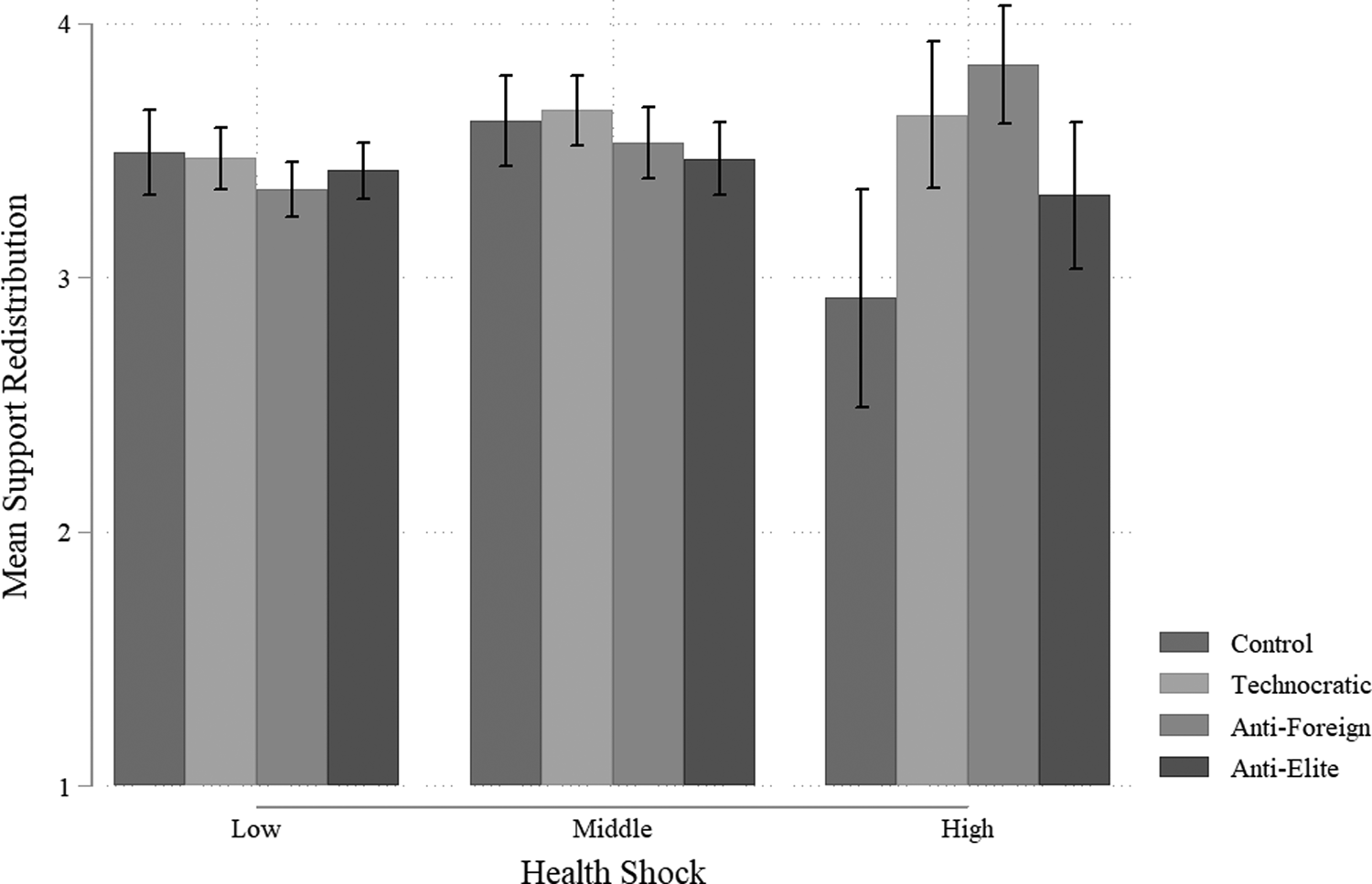
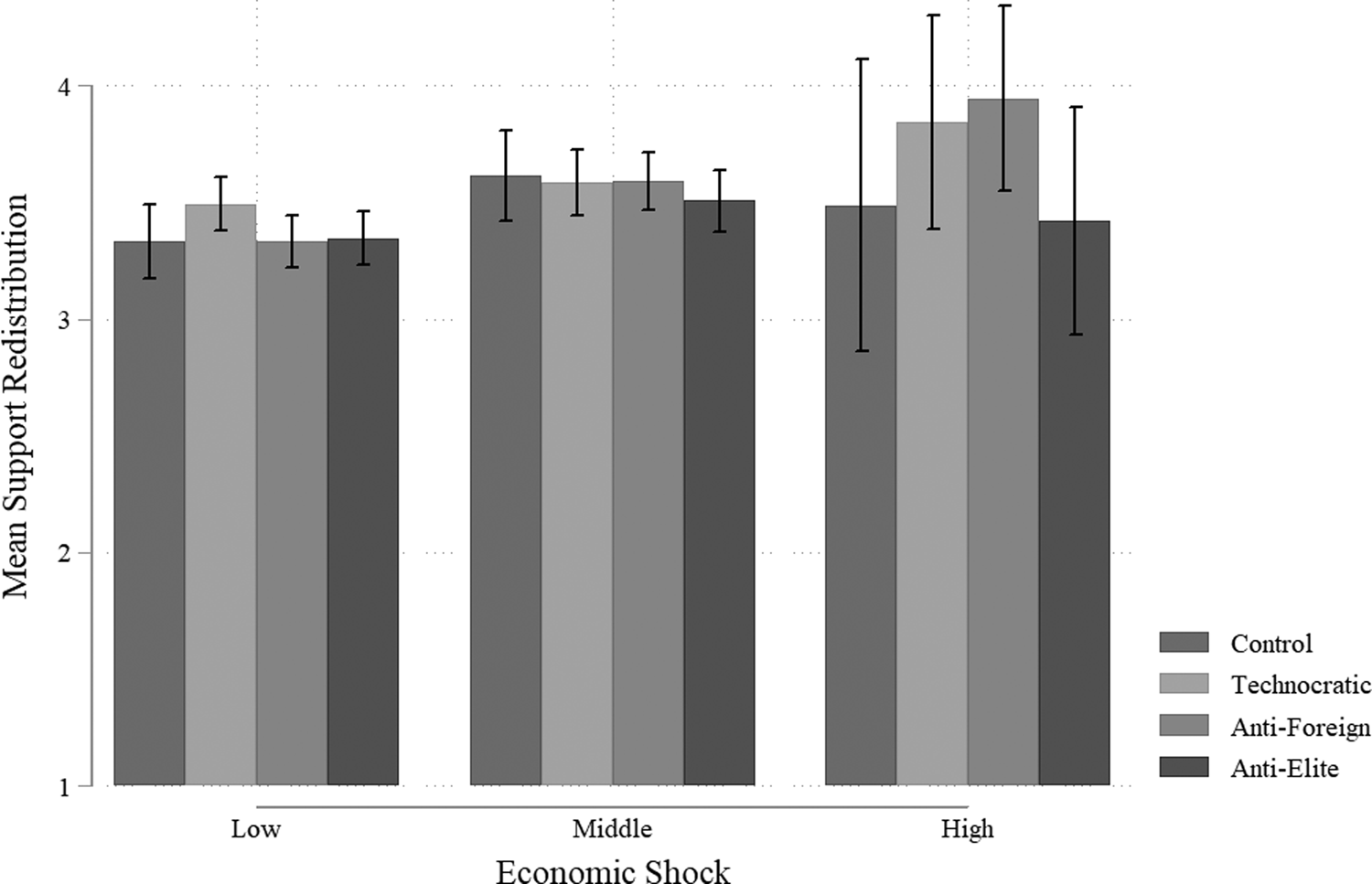
Figure 6 shows equivalent results dividing economic risk exposure into three categories, where low risk indicates respondents with no exposure to employment risks (51 percent), medium risk indicates respondents with some exposure to employment risks (44 percent), and high risk indicates respondents with very high exposure (5 percent).Footnote 14 Again, the type of rhetoric to which respondents are exposed significantly influences support for redistribution among respondents with greatest exposure to employment risks. Support for redistribution is highest among respondents exposed to anti-foreign messages, support for redistribution is lowest among respondents exposed to anti-elite messages, and the differences between these two groups are large (+0.52, SE = 0.30) and statistically significant at the 90 percent confidence level. These bar graphs present initial evidence that populist messages modify demand for social policy amongst those exposed to risk as hypothesized, with anti-foreign messages augmenting and anti-elite messages depressing support for redistribution within this group.
Average support for redistribution by employment shock exposure.
Next we consider how the populist messages interact with risk exposure to influence preferences for redistribution using the following ordinary least squares regression model with robust standard errors:
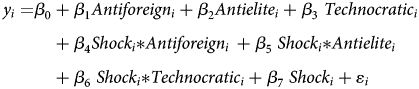
where y i indicates respondent i's support for redistribution, Antiforeign indicates respondent i was exposed to a populist anti-foreign message about either the health or employment situation in the United States, Antielite indicates respondent i was exposed to a populist anti-elite message about the health or employment situation, and Technocratic indicates respondent i was exposed to a technocratic message about the health or employment situation. Shock denotes a health shock experienced by respondent i in some models and an employment shock experienced by respondent i in others. In the results in the main tables, we do not include additional covariates. In Appendix F, we provide a variety of sensitivity analyses.
Our expectation is that anti-foreign populist and anti-elite populist messages result in different levels of support for redistribution among respondents exposed to risk. As a result, formal tests of our hypotheses involve comparing combinations of coefficients from Equation 1. In particular, our main theoretical expectation is that anti-foreign populist messages will result in higher support for redistribution than anti-elite populist messages for respondents with high risk exposure (H1:(β 1 + β 4) − (β 2 + β 5) > 0). Our framework also has secondary implications for the magnitude of support compared to technocratic messages, hypothesizing that anti-foreign messages will result in higher support for redistribution than technocratic messages (H2a: (β 1 + β 4) − (β 3 + β 6) > 0), and anti-elite messages will result in lower support for redistribution than technocratic messages (H2b: (β 2 + β 5) − (β 3 + β 6) < 0) for these respondents.
In Table 3, we examine the relative effects of the different messages on respondents' aggregate support for pandemic-related social protection. Our measure of support for pandemic-related social protection is the average level of support for the expansion of unemployment and health benefits, measured on a 1–5 scale.Footnote 15 In model 1, we estimate the average effects of populist anti-foreign, populist anti-elite, and technocratic messages on support for social protection across the entire sample, irregardless of exposure to risk. Anti-foreign and anti-elite messages are not statistically distinguishable from one another, although anti-elite messages do have a significantly more negative effect as compared to technocratic messages (statistically significant at the 95 percent confidence level). Model 1 also shows that, across all experimental arms, personal exposure to a Covid-19 health shock is associated with a 0.14 point increase in support for social protection (statistically significant at the 90 percent confident level); this finding is consistent with expectations from the existing literature, which has found that either individuals or interest groups representing sectors exposed to risks are more likely to favor an expansion of social policy coverage.
Effects of populist messages on support for pandemic social protection

Standard errors in parentheses.
+p < 0.10, *p < 0.05, **p < 0.01.
In Model 2, we introduce interactions between exposure to health shocks and the three types of messages to test our theoretical expectations about the conditional average treatment effects for respondents exposed to risk. The interaction coefficients suggest that the treatments have distinct effects on support for redistribution among respondents exposed to Covid-19 health shocks, and we formally test our hypotheses by calculating the statistical significance of linear combinations of the coefficients at the bottom of the table. Consistent with expectations, we observe higher support for redistribution (+0.41 points) among respondents with high exposure to Covid-19 if they received the anti-foreign treatment as compared to the anti-elite treatment, and this difference is statistically significant at the 99 percent confidence level. This is a substantively large shift on our four-point scale, more than two times the size of the difference in attitudes between respondents exposed to low and high health risk in model 1. We also observe higher support for redistribution (+0.09 points) if risk-affected respondents received the anti-foreign treatment compared to the technocratic treatment, but this difference is not statistically significant. Finally, we observe lower support for redistribution (−0.32 points) if risk-affected respondents receive the anti-elite treatment compared to the technocratic treatment, a difference that is statistically significant at the 95 percent confidence level. Together, these results are highly consistent with our theoretical expectations.
Models 3 and 4 in Table 3 examine the relationship between employment shocks and support for redistribution. Model 3 re-runs Model 1, replacing health shocks with employment shocks. The employment shock variable has the same standard deviation but a wider range than the health shock variable, ranging from 0 to 3.1. Across the entire sample, a one-point increase in exposure to employment risk is associated with a 0.21 point increase in support for social protection, which is statistically significant at the 99 percent confidence level.
In model 4, we examine how the three types of messages interact with employment risk to affect support for social protection. Again, we formally test our hypotheses about the effects of different treatments on risk-exposed individuals at the bottom of the table. In the table, we present the effects for respondents whose employment risk equals 1, which is the 96th percentile for employment risk exposure but well-below the maximum value of 3.1, presenting the relative effects of populist messages across the full-range of the employment shock variable in Figure 7. Consistent with expectations, we observe higher support for redistribution (+0.30 points) among respondents with high risk if they received the anti-foreign treatment as compared to the anti-elite treatment, and this difference is statistically significant at the 90 percent confidence level. This is also a substantively large shift, larger than the size of the difference in attitudes between respondents exposed to low and high employment risk in model 3. We also observe higher support for redistribution (+0.10 points) if risk-affected respondents received the anti-foreign treatment compared to the technocratic treatment and lower support for redistribution (−0.19 points) if risk-affected respondents receive the anti-elite treatment compared to the technocratic treatment, but neither of these differences are statistically significant at conventional levels. The results are broadly consistent with our expectations about how the treatments should differentially affect respondents exposed to employment risk, although some differences are measured with considerable error.
Difference in the effects of populist messages by health and economic shocks.
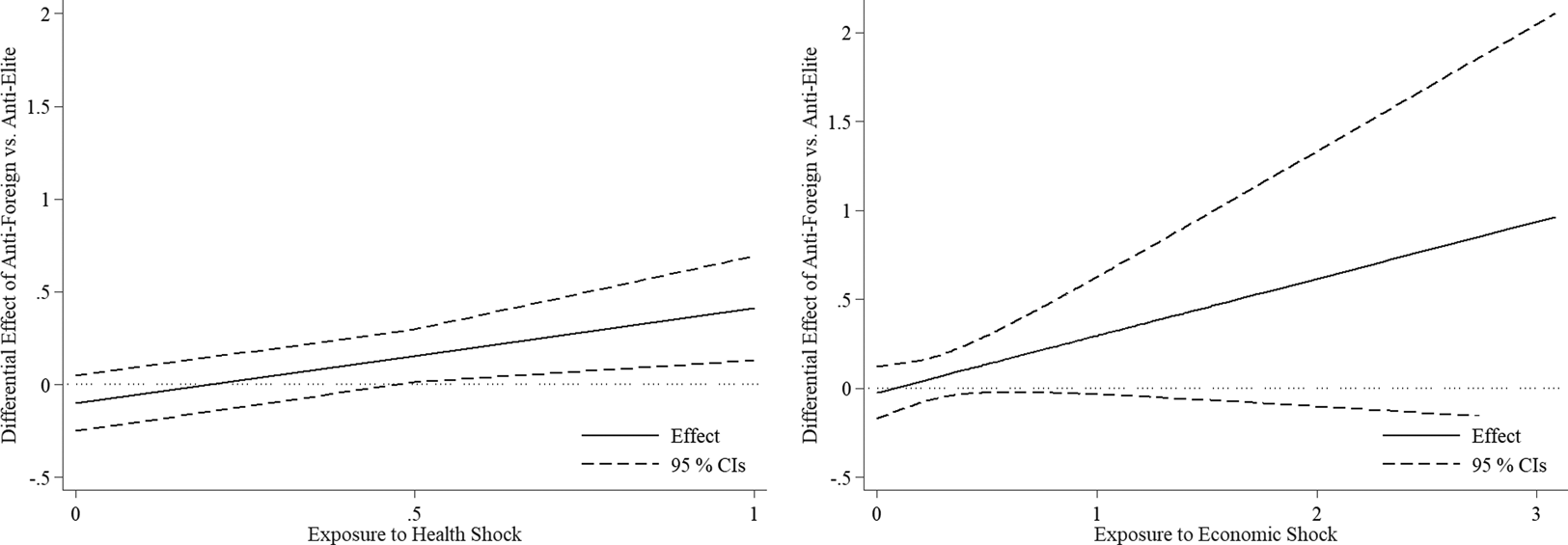
Figure 7 provides an additional graphical display of how populist anti-foreign and anti-elite messages differentially interact with health and employment risks to influence support for social protection. The two figures graphically plot the differences in the effect of anti-foreign and anti-elite populist messages on demand for redistribution by exposure to risk, as calculated in model 2 and model 4 of Table 3. The x-axis of the graphs displays the level of exposure to risk, with the left graph showing exposure to health shock (model 2) and the right graph showing exposure to economic shock (model 4). The y-axis of the graphs displays the difference in the effect of anti-foreign and anti-elite messages [(β 1 + β 4x) − (β 2 + β 5x)].
The graph on the left shows that anti-foreign and anti-elite messages have similar effects on demand for redistribution among respondents who have not been exposed to health risk. However, among respondents who have experienced Covid during the recent pandemic, anti-foreign messages have significantly larger positive effects on demand for redistribution. The right-hand panel shows a similar pattern according to whether respondents have experienced high employment risk during the current pandemic. Again, there is little difference in the effect of these messages among respondents who have not experienced an employment shock. Among respondents with high exposure to employment risk, anti-foreign messages are estimated to have much larger positive effects than anti-elite messages, although the difference is estimated with high levels of uncertainty. Thus, different populist messages differentially modify the relationship between health and labor market risks and demand for social policy expansion. Among respondents exposed to risk, demand for social policy depends critically on the types of populist messages being employed. Anti-foreign messages augment demand for redistribution compared to anti-elite messages.
The interaction effects between risk exposure and populist messages are robust to accounting for possible correlates of health and economic shocks, such as partisanship, education, and income. We show this in Tables F6–F9 in Appendix F by re-running the models in Table 3 by demographic subgroups who would be expected to have different redistributive preferences: respondents who support and do not support Trump, college-educated respondents and non-college-educated respondents, wealthier and poorer respondents, and Republican party supporters and Democratic party supporters. The differential effects of anti-foreign and anti-elite messages on support for redistribution among risk-exposed respondents never disappear across both subgroups when we divide the data this way, indicating it is not an artifact of a particular covariate of risk exposure.
In Table G1 in Appendix G, we disaggregate support for different types of social protection, considering whether our experimental conditions differentially affect support for unemployment benefits, health benefits, and social security expansion among risk-exposed respondents. We consistently observe higher support for redistribution among risk-exposed respondents if they received the anti-foreign treatment as compared to the anti-elite treatment, reinforcing our findings in Table 3. Thus, the empirical evidence provides considerable support for our theoretical framework, with particularly consistent support for our primary hypothesis that anti-foreign populist messages increase demand for redistribution compared to anti-elite populist messages among risk-exposed individuals.
5. Conclusion
Do populist messages affect demand for redistribution? Previous research has noted wide variability in the positions of populist parties on questions of redistribution. Some studies have attributed these differences to changes in the class composition of far-right parties (Afonso and Rennwald, Reference Afonso, Rennwald, Manow, Palier and Schwander2018), while others have emphasized the electoral incentives of populist parties to blur their positions on economic issues (Rovny, Reference Rovny2013).
This study proposes a distinct pathway linking populism and demand for redistribution. We argue that the internal logic of populism—which follows the imperative to construct internal or external enemies—has consequences for redistributive demand. The populist logic which creates fictitious targets against which populist politicians position themselves generates variation in attitudes about the optimal level of redistribution: populist rhetoric can affect subjective perceptions of risk and, in doing so, alter demands for social policy. By positioning themselves against internal elites, populists may weaken beliefs of vulnerable citizens in the desirability of government intervention and reduce redistributive demand. By contrast, the decision of populists to invoke “foreign enemies” increases demand for the expansion of social programs by citizens with high-risk exposure.
Drawing on a survey experiment embedded in an American public opinion survey conducted six months into the Covid-19 pandemic, we have shown that populist anti-elite and populist anti-foreign messages have differential effects on popular support for social protection among risk-exposed respondents. However, insofar as the types of populist rhetoric we study in this context are widely used around the world, we believe the study has broader implications for comparative cases.
Our study suggests that the insecurity caused by the Covid-19 pandemic may generate demand for stronger welfare states, but this is conditional not just on exposure to populism but the precise form of populist rhetoric. Widespread use of anti-establishment populist rhetoric is likely to depress demand for redistribution. Paradoxically, the widespread use of anti-foreign rhetoric by populist leaders during the current pandemic may have augmented demand for redistribution among citizens that have been exposed to various Covid risks. Insofar as this risk-enhancing rhetoric increases popular attachment to the welfare state, it may ultimately become a source of electoral vulnerability for populist politicians if they combine these appeals with calls for policy retrenchment.
Our study points to the need to consider the independent effects of populist rhetoric on policy preferences. We encourage future scholarship to document how the mix between anti-elite and anti-foreign messages varies in different contexts and to understand the consequences of combinations of these messages on citizens' demand for redistribution.Footnote 16 Populist rhetoric may also have implications for preferences in other policy areas, including trade and globalization. Our paper opens up new avenues for research on the consequences of populist rhetorical frames.
Supplementary material
The supplementary material for this article can be found at https://doi.org/10.1017/psrm.2022.43.
To obtain replication material for this article, please visit https://doi.org/10.7910/DVN/YVFD9A
Acknowledgements
We thank Moritz Bondeli, Matthew Graham, David Rueda, Shikhar Singh, and two anonymous reviewers for helpful comments on previous drafts.
Conflict of interest
None.


 Open access

