

Introduction
The 1949 Geneva Conventions and other treaties of international humanitarian law (IHL), as well as customary IHL, require States to implement IHL into their domestic legislation.Footnote 1 To facilitate this process, several States have established national committees and similar bodies on IHL (national IHL committees, or NIHLCs) since 1973,Footnote 2 with different configurations and mandates, but in almost every case, with a responsibility to support States’ efforts to implement IHL.
As of July 2025, according to the International Committee of the Red Cross (ICRC), there were 121 NIHLCs worldwide.Footnote 3 Some are located in countries where armed conflicts are currently ongoing or have recently occurred, but many others are not. Thus, a common question is: in countries without armed conflicts, why is an NIHLC necessary? The answer to this question is simple: IHL also has a preventive approach, and every High Contracting Party to the Geneva Conventions has the obligation to respect IHL, to implement IHL at the national level, and to use its influence to ensure that IHL is respected in all conflicts.
Reaching this objective requires an environment where the humanitarian roots of IHL are recognized and supported by military and civilian actors. Internalizing the notion that wars are subject to a set of humanitarian rules and principles is not always straightforward, as many assume that armed conflicts are – or should be – guided only by other factors such as strength, military necessity or even vengeance, focusing on the idea of total war.Footnote 4 However, the idea of total war clearly goes against the very existence of IHL and in particular against the principle which establishes that the right of the parties to the conflict to choose methods and means of warfare is not unlimited.Footnote 5
Supporting respect for IHL rules is not only a legal matter; it also relates to culture, politics and traditions that people follow not just because it is the law, but because they have internalized them as part of their own behaviour. In this regard, the ICRC’s Roots of Restraint in War study states that “[t]he role of law is vital in setting standards, but encouraging individuals to internalize the values it represents through socialization is a more durable way of promoting restraint”.Footnote 6 This process of IHL socialization cannot start only when armed conflict begins; it must be enacted permanently, according to each society’s culture. It should utilize all available tools and be pursued as a matter of public policy. To achieve this, High Contracting Parties to the Geneva Conventions have considered it useful to create NIHLCs. This article will analyze how the different mandates and compositions of NIHLCs in Latin America impact their work and allow them to reach the objective of creating an environment that fosters respect for IHL.
From a treaty ratification perspective, Latin America is a strong supporter of IHL, with a high ratification rate. In some countries, such as Costa Rica, Panama and Uruguay, all main IHL treaties have been ratified.Footnote 7 However, despite the large number of ratified treaties, IHL sometimes seems distant from governments and academics in the region and is not always implemented at the national level. The experience of NIHLCs in Latin America helps to demonstrate the relevance of always having these bodies active, but also their challenges in a region where, with exceptions such as Colombia, armed conflicts have not been common in the last thirty years.
From a methodological aspect, the research focuses on the NIHLCs of the Spanish-speaking countries of the Americas, plus Brazil. In this sense, it will refer to this selection of countries as Latin America or, in other cases, simply as the “region”. It does not include the English- or French-speaking countries of the continent. The selection is based on the strong cultural and historical ties, similar legal frameworks and active interaction between these countries, as well as having Spanish as their common language (except for Brazil). Furthermore, there is a strong presence of NIHLCs in the region under analysis, which is an important difference from the English- and French-speaking countries of the Americas, where the only country with a permanent NIHLC is Canada.Footnote 8
The time frame of the analysis spans from 1992, the year when the first two NIHLCs of the region were established,Footnote 9 to the first quarter of 2026, when this study was concluded. Latin American countries have other milestones related to IHL implementation and dissemination prior to 1992 that could be highlighted, but the history of NIHLCs in the region starts in 1992.
The research methodology primarily involved open sources from StatesFootnote 10 and other entities that promote the work of the NIHLCs, such as the ICRC. This research was complemented by interviews conducted with different persons who are or have been members of NIHLCs, using a questionnaire specifically designed for this article,Footnote 11 as well as by the professional experience of the authors in working with NIHLCs. The selection of the States that the article focuses on was based on various reasons, including the level of activity of the NIHLC, success stories that can be used as examples for other committees,Footnote 12 and, from a practical point of view, the authors’ access to the required information and to the officials interviewed. The study includes examples from countries in North, Central, and South America, as well as from Spanish-speaking countries in the Caribbean. Lastly, the article presents a brief analysis of a good practice involving Ecuador and Peru, two active and relevant NIHLCs in Latin America, which illustrates the potential role that NIHLCs can play and the outcomes they can achieve.
This article does not intend to be a comprehensive diagnostic of all NIHLCs in the region, but by analyzing some of them through interviews and publicly available information such as voluntary reports on IHL, it will attempt to summarize some of the region’s best practices and propose some recommendations that could strengthen the role of these entities. Increasing the impact of the NIHLCs’ work could reinforce a culture of respect for IHL in the region and beyond.
National IHL committees in Latin America: Creation, composition and relationship with non-governmental actors
The process of NIHLCs’ creation in Latin America
The creation of many NIHLCs over the past thirty-five years has been an important step toward promoting respect for IHL in Latin America. The first two NIHLCs in the region, those of Bolivia and Uruguay, were established in 1992,Footnote 13 and the two most recent are Cuba in June 2025Footnote 14 and Colombia in March 2026.Footnote 15 As a result, all eighteen Spanish-speaking countries on the continent have an NIHLC, as does Brazil. This fact is a significant achievement and reflects the region’s commitment to respecting IHL.
In the inter-American context, it is worth noting that the establishment of NIHLCs has also been encouraged by multilateral efforts such as those under the Organization of American States (OAS). In 2000, a resolution of the OAS General Assembly on “Promotion of and Respect for International Humanitarian Law” urged
member states that have not yet done so to study, with the support of the International Committee of the Red Cross, the advisability of establishing national committees or commissions to implement and disseminate international humanitarian law.Footnote 16
This was the first time that the establishment of NIHLCs was mentioned in an OAS General Assembly resolution. A similar text can be found in other resolutions on promotion of and respect for IHL, including the most recent one on the topic, adopted in 2024.Footnote 17
The composition and structure of NIHLCs in Latin America
NIHLCs in Latin America differ in their composition and structure. For the sole purpose of differentiating them, this article classifies them as small (up to seven members), medium-sized (between eight and eleven members) and large (twelve or more members). Of the nineteen NIHLCs in the region, the majority are medium-sized, with seven NIHLCs, followed by six large committees and six small ones.Footnote 18
The number of members in a committee is a relevant aspect to consider. There are two opposing arguments in the discussion of the appropriate committee size: smaller committees may be more practical for decision-making and advisory roles, while larger committees allow more enriching discussions, with multisectoral brainstorming and decision-making based on national consensus-building from all relevant stakeholders. Balancing the number of members to create an efficient and useful NIHLC is an important challenge.
The level of activity of NIHLC members will depend on different factors, and the number of members is only one of them; however, it is possible that larger commissions face the risk of having more inactive members, which can have an impact on the NIHLC’s work. To overcome this risk, and based on the authors’ experience, two suggestions are proposed in this article: first, the creation of subcommittees, and second, the establishment of a “core group” composed of key members for the ongoing work of the NIHLC, usually in the presidency, vice-presidency and secretariat, in many cases with support from one or more components of the International Red Cross and Red Crescent Movement.
The creation of subcommittees implies dividing the NIHLC’s members into working groups that can be more closely aligned with each member’s respective mandate. These groups may be created by the NIHLC’s constitutive law or by its regulations, usually when they are permanent, or by specific agreements made during committee sessions, mainly for specific tasks.
The Costa Rican NIHLC is a good example of working through subcommittees. This large committee has sixteen members from the executive, legislative and judicial branches, as well as from academia, the Costa Rican Red Cross and other sectors. The Costa Rican NIHLC has three subcommittees: one on legislation, one on dissemination and capacity-building, and one on cultural property.Footnote 19 Each subcommittee is coordinated by a designated member. This structure has generated more dynamism in the NIHLC’s work, as each member focuses on topics closer to their expertise, and technical discussions are held in smaller groups for initial analysis and then presented to the NIHLC in a plenary session.Footnote 20
Large NIHLCs may also decide to establish core groups, which can be created by law or per customary practice. This decision creates a main group on which the committee may rely to operate, reach quorum for meetings or vote when necessary, and at the same time, a larger group that may be relevant for specific topics. In the Latin America region, the Ministry of Foreign Affairs and Defence or its equivalent is present in all NIHLCs, and usually its representatives hold relevant positions in the presidency, vice-presidency or secretariat.Footnote 21 These ministries are usually part of the NIHLC core groups.
Furthermore, some committees are composed of full and non-full members, the latter usually being referred to as observers.Footnote 22 Although full members can be either governmental or non-governmental depending on the context, observers are usually non-governmental institutions. In this sense, observers are usually National Red Cross and Red Crescent Societies (National Societies), non-governmental organizations (NGOs)Footnote 23 or academia, but in other situations they are also representatives of State entities whose work relates to IHL only occasionally, or members of other branches of State or institutions that for different reasons prefer not to be included as full voting members (as could be the case with the Ombudsman’s Office due to its principle of independence). The ICRC is also an observer member of some NIHLCs in the region.Footnote 24
Peru’s NIHLC is an interesting example to analyze regarding the number of members and how they can have different rights as full and non-full members. For years, this NIHLC had five full members (Ministries of Justice, Foreign Affairs, Defence, Interior, and Education) and four non-full members (the Ombudsman’s Office, the Congress, the ICRC, and an NGO, the National Coordinator for Human Rights). A reform of the NIHLC’s decree in 2021Footnote 25 added four new members to the committee;Footnote 26 this was a response to the experience of the NIHLC, which showed the need for coordination with additional institutions.Footnote 27 While the reform eliminated the distinction between the plenary and non-plenary members, it maintained a distinction between members with voting rights and members without them, which retains the main historical difference between the members in this NIHLC. This example shows one option for expanding the members of an NIHLC with the objective of increasing the number of voices included in discussions, while maintaining a core group – members with voting rights, in this case – that will be responsible for directing the committee’s decisions.
While managing large committees presents its challenges, small or medium-sized committees face their own hurdles too. One of the main challenges for smaller committees is reaching all of the key stakeholders and gathering them together. The absence of key actors during NIHLCs’ discussions could make their work more difficult when implementing and disseminating IHL. Furthermore, some issues might never make it onto a committee’s agenda because the interested party is not there to bring them up.
Having fewer members can also create difficulties in the relationship between NIHLCs and other national institutions beyond the executive branch. Aside from the Panamanian committee, the small NIHLCs in the region happen to be composed only of members of the executive branch, while the medium-sized and large NIHLCs usually include the legislative branch, the judiciary or the national prosecutors’ offices. This relationship with other national institutions beyond the executive branch can be highly relevant in specific cases. On a related note, more than half of the NIHLCs in the region have the legislative branch as a member of the committee,Footnote 28 and according to interviews conducted by the present authors, there are some benefits to this, particularly for the ratification of treaties and their implementation. For example, having legislative representatives or advisers in NIHLCs was relevant for the promotion of treaty ratification in cases such as Additional Protocol III to the Geneva Conventions and the Convention on the Non-Applicability of Statutory Limitations to War Crimes and Crimes against Humanity in Ecuador,Footnote 29 and for the adaptation of the Criminal Code to the Rome Statute of the International Criminal Court (Rome Statute) regarding international crimes, including war crimes in Panama.Footnote 30 While the parliamentary debate on the drafting of a law will take place later, the prior discussion on the topic within the NIHLC, which is a technical body, will benefit the legislative branch because it will receive a first bill based on sound technical advice. On the other hand, the NIHLC benefits from the presence of legislative members or advisers during its sessions, as it receives relevant inputs on legislative technique and analysis of the current environment in the Parliament. However, it is important that NIHLC leadership stress at all times the technical approach of the committee’s advice on IHL in order to avoid politicizing the discussions.
There are also debates about whether to include the National Prosecutor’s Office or the judiciary in the NIHLCs.Footnote 31 These institutions are often vital for building respect for IHL, as their members could be the ones who invoke or apply IHL. Therefore, considering them for the NIHLC activities is relevant, and having some representatives in the committee may guarantee the success of those activities as well as the future application of IHL by these actors. This added value can be reflected in increased internal support for advancing the agenda of dissemination activities, for advocacy with key stakeholders to promote training opportunities (e.g., with national judicial training entities), or for promoting awareness among the target population about the importance of participating in such training programmes and the application of IHL by prosecutors and judges. At the same time, members of these institutions could significantly support the implementation of the NIHLC’s objectives by sharing their expertise, particularly when regulations concern criminal law.
Therefore, although experience in Latin America has demonstrated the need to have a wide variety of institutions included in the NIHLC, if not permanently then at least for specific periods of time, based on the interviews conducted for this study it is also true that the number of active members is usually no more than five, though this may vary according to the NIHLC’s agenda and the context at the time. Nonetheless, a strength of NIHLCs is their capacity to bring together different institutions for compliance with IHL at the national level, so whether through permanent membership or ad hoc request, the main actors must be present for IHL discussions.
In larger committees, as noted, the creation of subcommittees can be an alternative to help keep NIHLCs active and efficient. The creation of a core group composed of at least the presidency, the vice presidency and the secretariat of the NIHLC is another possibility for monthly coordination and later holding plenary sessions to discuss major updates, monitor the main activities and decide on next steps, including voting. Dividing members between full and non-full members (or observers) can be an additional or alternative strategy. In smaller NIHLCs, one possible solution is to have ad hoc “guests” for specific sessions, depending on the agenda, and this may include members of branches of government other than the executive branch (such as the legislative branch in cases where debates are held for the implementation of IHL). In some cases, these ad hoc guests may be invited for extended periods if needed. In smaller NIHLCs, selecting and assembling the appropriate institutions for each committee session will be a particularly relevant task for the NIHLC leadership in order to keep the debates in small groups but with the presence of the key actors involved in the discussion taking place.
The role of the components of the International Red Cross and Red Crescent Movement
The obligation to respect and ensure respect for IHL falls on the State, and NIHLCs are mechanisms for implementing it.Footnote 32 However, it is also relevant to consider the role of the components of the International Red Cross and Red Crescent Movement (the Movement), particularly the ICRC and National Societies, in promoting the effective functioning of NIHLCs. While the importance of keeping the leadership of NIHLCs in the hands of government institutions to avoid the risk of full dependence on external actors was indicated during the interviews,Footnote 33 it is also true that all interviewees unanimously highlighted the fundamental role that National Societies and/or the ICRC have played in strengthening NIHLCs in the region.
Due to the role of the ICRC as the “guardian of IHL”Footnote 34 and its support to States through its Advisory Service on IHL,Footnote 35 and the auxiliary role of National Societies in helping public authorities to meet humanitarian needs (in accordance with the Fundamental Principles of the Movement),Footnote 36 the following section focuses on cases where components of the Movement have influenced the work of NIHLCs in Latin America.
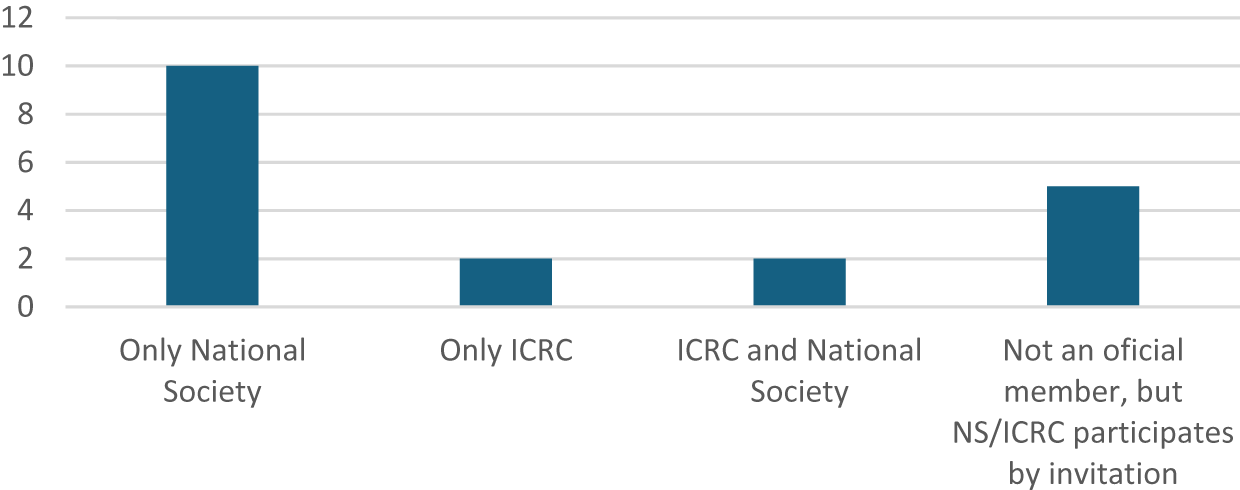
Fourteen of the nineteen NIHLCs in the region have a National Society or the ICRC representative as a full member or as an observer.Footnote 37 Of those fourteen, twelve include National Societies,Footnote 38 with two of them having both the ICRC and a National Society.Footnote 39 Only two NIHLCs in the region include the ICRC without the participation of a National Society.Footnote 40 Even without formal membership, various NIHLCs regularly invite the ICRC, the National Society or both to participate in their sessions as guests. This invitation may be based on the committee’s law, as in Colombia, Panama or Venezuela,Footnote 41 or on customary practice, as in Bolivia, where the ICRC is frequently invited to the NIHLC’s sessions and the National Society is a member of the committee (see Figure 1).Footnote 42
International Red Cross and Red Crescent Movement participation in NIHLCs in Latin America. Source: ICRC, National Committees and Similar Bodies on International Humanitarian Law, Geneva, 2025, available at: www.icrc.org/sites/default/files/2025-08/Final%20version%20NCIHLs%20table_en%202025_1.pdf.

Figure 1 Long description
X axis categories: Only National Society; Only I C R C; I C R C and National Society; Not an oficial member, but N S slash I C R C participates by invitation. Y axis tick labels: 0, 2, 4, 6, 8, 10, 12. Bar values: Only National Society equals 10. Only I C R C equals 2. I C R C and National Society equals 2. Not an oficial member, but N S slash I C R C participates by invitation equals 5.
One additional value of the National Society’s active role in the NIHLC is its function as the committee’s institutional memory. Bearing in mind that government officials may change constantly, in some contexts the presence of National Societies can provide continuity to the work of the NIHLC. Furthermore, the participation of National Societies’ legal advisers or IHL focal points in various workshops and activities promoted by the ICRC or other organizations permits them to be updated on IHL topics, including current challenges, providing useful information for the NIHLC’s work. Furthermore, National Societies are in a good position to support NIHLCs’ preparation for international meetings such as the International Conference of the Red Cross and Red Crescent and others promoted or supported by the Movement.
The added value of National Societies may increase when they have a particular role within the NIHLC. In the Latin America region, some National Societies that have a particular role at the NIHLC include the EcuadorianFootnote 43 and Cuban Red Cross,Footnote 44 which serve as the secretariats of their respective NIHLCs. These appointments are defined by the regulation of each committee. Another example in the region is the Dominican Red Cross, which has been appointed to the second vice-presidential role of the NIHLC – a position that rotates every two years – and has been recognized for its active role within the committee.Footnote 45 However, even when no specific role within the NIHLC has been appointed to the National Society, it can still play a relevant advisory role in promoting IHL dissemination and implementation; this has happened in Costa Rica, as was clearly highlighted in the first IHL voluntary report of the country.Footnote 46
In other cases, even when the National Society is not a member of the NIHLC, as in Panama, it can still play a relevant role as an ad hoc adviser. The Panamanian Red Cross was part of the NIHLC from its creation until the reform of its decree in 2022, which reduced the number of members, establishing the role of the Panamanian Red Cross and the ICRC as external advisers to the NIHLC.Footnote 47 This advisory role of the National Society is also recognized by the recent Panamanian Red Cross Law, issued by the government in 2024, which legally establishes the National Society’s authority to advise the State on matters of IHL as part of its humanitarian function as an auxiliary entity to the Panamanian government.Footnote 48 In this capacity, the Panamanian Red Cross has played a very active role in the reactivation of the NIHLC, which formally took place in July 2025Footnote 49 following an initial working session in 2024.Footnote 50
In the case of the ICRC, its support to the NIHLCs of the region has also been crucial, even when it is commonly not a formal member of the committees and lacks a permanent physical presence in many of the countries of the continent. The ICRC’s legal advisory role on IHL – provided directly or together with National Societies – was highlighted as an essential support for the adequate functioning of NIHLCs by all public officials during interviews conducted as part of the research for this article, and is also stressed in the four voluntary reports published up to the first quarter of 2026.Footnote 51 This legal support has taken the form of, for example, giving advice and sharing commentaries on draft regulations, agendas for workshops, elaboration of reports (such as voluntary reports on IHL), and sharing good practices applied in other contexts. Other forms of support, such as the organization of international, regional and national meetings, dissemination activities (for example, courses for national authorities or diplomats, or IHL competitions) and even human and economic resources, were also highlighted during the interviews.
In conclusion, Movement support may be fundamental for the success of NIHLCs and is highly appreciated by public officials. In the case of the National Societies, their knowledge on humanitarian topics and proximity to the needs of each context, as well as their auxiliary role in supporting States, makes them an important added value to the work of NIHLCs. National Societies’ participation in NIHLCs could be even more relevant in peace contexts where IHL is not commonly a main topic on the daily agenda. In these scenarios, the National Societies can keep humanitarian discussions active to create an environment that supports respect for IHL. Finally, ICRC support to NIHLCs through its Advisory Service on IHL has been important for the development of many NIHLCs of the region and is highly appreciated by States.
The relationship between the Latin American NIHLCs and academia
In the region, six of the nineteen NIHLCs have academic institutions as members,Footnote 52 in particular the law faculties of one or more universities. Having universities as members of the NIHLC does not guarantee active participation of those universities in the NIHLC (because they can be passive members), but it can create an opportunity for increasing partnership between the NIHLC and academia in order to promote a culture of respect for IHL.
An added value of academia in promoting respect for IHL, particularly in peace contexts, is its ability to keep IHL on the public agenda through research and teaching, which promotes the importance of IHL among present and future generations. While the participation of academics, and other members of civil society, could be seen as limiting the ability of some NIHLC members to debate matters of internal policy, it is important to keep in mind that, as a governmental body, final decisions will ultimately rest with the government authorities represented on the committee. In that sense, there are examples in the region where the inclusion of academia in the NIHLC has improved the level of debates rather than limiting them.
A great example of collaboration between universities and NIHLCs in the region took place in Ecuador, where the IHL clinic of San Francisco de Quito University (Universidad San Francisco de Quito, USFQ) supported the drafting of Executive Decree 1343 containing the general regulations for the Law on the Use and Protection of the Red Cross and Red Crescent Emblems.Footnote 53 Professor Hugo Cahueñas of USFQ highlighted this experience as a good practice that benefited both parties, as the legal clinic students were not only able to share their legal expertise on the subject but also gained knowledge and experience from NIHLC officials. This complementarity resulted in a first draft that directly contributed to the long-awaited regulation.Footnote 54
The Costa Rican NIHLC, with two universities as members and a subcommittee on dissemination and teaching, has a long history of collaboration with academia, both in terms of organizing activities (such as the 2021 Inaugural Lesson on Contemporary Challenges for International Criminal Justice, with the National University of Costa RicaFootnote 55) and developing doctrine (including a forthcoming publication entitled Costa Rica and International Humanitarian Law Footnote 56). This relationship with academia has been highly productive for the NIHLC, particularly for dissemination activities organized by the committee.Footnote 57
Finally, other NIHLCs in the region have shown their interest in strengthening their collaboration with academia by promoting IHL teaching at universities. This is the case for the Dominican NIHLC, which has prioritized the inclusion of IHL in the curricula of public international law courses as one of its main objectives and has organized activities in different universities to that end.Footnote 58
Main competences and tasks of national IHL committees in Latin America: Achievements and challenges
Main topics covered by NIHLCs in Latin America
The topics covered by NIHLCs in the region are many and can vary from country to country. However, an interesting characteristic of many Latin American NIHLCs is that they have included the relationship between IHL and international human rights law (IHRL) as a priority in their agendas. In a region with a significant case law on the relationship between IHL and IHRL, mainly ruled by the Inter-American Court of Human Rights (IACtHR),Footnote 59 this issue has been commonly included in NIHLCs’ dissemination activities. Furthermore, some committees have opted to also analyze IHRL topics that have some kind of connection to IHL, such as law enforcement standards and their differences with the rules on the conduct of hostilities,Footnote 60 and standards for the search for missing persons, including the promotion of the ratification of the International Convention for the Protection of All Persons from Enforced Disappearance.Footnote 61
While sometimes covering some IHRL topics can create confusion about the main work and mandate of an NIHLC, when similarities and differences are well established, it is also an opportunity to disseminate information about the relationship between these two branches of international law. In contexts where debates on how to deal with criminal groups or gangs are gaining prominence on the public agenda and with increasingly frequent discussions about the possible application of IHL to fight against these groups,Footnote 62 being clear about when IHL conduct-of-hostilities standards apply and when law enforcement standards apply is important.Footnote 63 NIHLCs can play an important role in disseminating the differences between those two standards.
In addition to the relationship between IHL and IHRL, based on interviews and voluntary reports, it is worth highlighting other key topics addressed by NIHLCs in Latin America, particularly for implementation purposes, such as the protection of the Red Cross emblem, the implementation of the Rome Statute, and the protection of cultural property in armed conflict under the 1954 Hague Convention. The latter is one of the topics mostly covered by NIHLCs in the region, being on the agenda of the committees in Mexico,Footnote 64 Argentina,Footnote 65 the Dominican RepublicFootnote 66 and Costa Rica,Footnote 67 among other countries.
On the other hand, one issue that has not been frequently included in the agenda of many NIHLCs in Latin America is the implementation of weapons-related treaties. The reasons why topics related to weapons are not commonly on the agenda of NIHLCs in Latin America are multiple, but one of them is the mandate of the appointed members – these individuals are often part of human rights offices rather than disarmament or security units, which are usually the ones in charge of such topics. While IHL weapons-related issues are often part of the multilateral agenda on IHL of Latin American countries and are discussed by their permanent missions in New York or Geneva, legal analysis and discussions of weapons are often not included in the agendas of NIHLCs. As entities created for internal coordination and constructive debate that can recommend solutions on the different points of view among the ministries and other actors involved in the issues under their analysis, the empowerment of NIHLCs on weapons-related topics would also be relevant to guaranteeing better dissemination and implementation on these topics at the national level.
There are some possible recommendations for keeping NIHLCs in the loop in discussions on means and methods of warfare. First, the specific inclusion of means and methods into the mandate of NIHLCs (rather than a general mention of IHL issues) should be promoted. Second, the institutions or offices in charge of these files should be designated as members of the NIHLC (or invited ad hoc). Finally, the committee chair and secretariat should be encouraged to proactively include weapons-related issues on the NIHLC agenda on a regular basis. Working on this thematic issue will strengthen the role of the NIHLC but will also provide a powerful intersectoral platform for implementation on the issue at the national level. Unlike the IHL–IHRL relationship or other topics mentioned above, some IHL subjects may be seen as somewhat absent from the daily discussions taking place in some countries not experiencing armed conflicts. However, it is relevant that these multilateral discussions can be reflected also at the national level, and NIHLCs can play a relevant role in this regard.
Between dissemination and implementation, what should be the main focus of NIHLCs?
The creation of an NIHLC is a relevant achievement in itself, but keeping it active is often the biggest challenge. While governmental institutions are in a better position to maintain regular work when armed conflicts are not taking place, implementing or disseminating IHL in peacetime is not an easy task. Often, urgency becomes a big enemy of relevance. While there may be a broad consensus on the importance of working on IHL topics in peacetime, they are not frequently seen as urgent.
With regard to NIHLC activity, the interviews conductedFootnote 68 revealed that the average frequency of NIHLCs’ regular meetings is between two and five per year. This can vary on special occasions when some specific topic is being discussed, such as the drafting of a regulation or before the participation of the State in specific events such as the International Conference of the Red Cross and Red Crescent. However, drafting the agenda for a meeting that will bring the attention of many sectors is not always easy, and keeping a balance of both dissemination and implementation activities usually allows the NIHLC to be perceived as the most accurate platform for IHL discussions and activities at national level. Keeping the NIHLC active will also make it easier to convene it during moments when implementation or other issues, such as ratification of treaties, need to be worked on.
To keep themselves active, some NIHLCs of the region have established an annual IHL course, which offers numerous benefits. From a practical standpoint, maintaining an annual activity ensures regular meetings to discuss the topics to be disseminated, the location where it will take place, and the audience, among other issues. Furthermore, an annual course creates a unique platform where governmental officials can receive relevant information about IHL, its rules, its challenges, and what can be done from their own function. Annual courses organized by NIHLCs with more than five editions completed, and that are currently ongoing, are held in Bolivia,Footnote 69 Costa Rica,Footnote 70 Ecuador,Footnote 71 Guatemala,Footnote 72 MexicoFootnote 73 and Peru,Footnote 74 among others.
Courses organized by NIHLCs cannot replace the academic training of military schools, diplomatic academies or universities, but they have become an important tool for dissemination of IHL where they exist. For example, one of the most consolidated courses organized by am NIHLC in the region is the annual Miguel Grau IHL course in Peru. This course has had nineteen editions since 2006 and has become a tradition for IHL dissemination in Peru, one of the main activities of its NIHLC, and one of the most prestigious IHL courses in the country. The course has a main edition in Lima, with a topic that varies from year to year, as well as some other editions occurring periodically in different cities of the country. Depending on the year, it has had editions with virtual and in-person phases. Its consolidation is evidenced by the fact that it has been held almost uninterruptedly for the past twenty years.Footnote 75
Annual courses have shown to be an effective tool for keeping NIHLCs active with a permanent scheduled activity and for increasing the role of these committees as a reference point for the promotion of IHL at the national level. Furthermore, ad hoc courses or seminars are also relevant, in particular for raising awareness of specific topics or strengthening the NIHLC’s relationship with certain actors, such as academia. In this sense, dissemination is relevant for maintaining knowledge of IHL (particularly among key stakeholders), highlighting the need for working on the ratification of treaties as well as their national implementation, and discussing IHL’s current challenges. In peacetime contexts, where IHL is not at the top of the public agenda and is usually not well known, NIHLCs can be the only institution responsible for carrying out this task.
Despite the importance of disseminating IHL, however, an NIHLC cannot relegate its role of supporting IHL implementation. NIHLCs in Latin America offer relevant examples of measures of IHL implementation on different topics, but a big challenge that they face is positioning themselves as the most appropriate forum for discussing the implementation of IHL measures at the national level. Two strong arguments exist to demonstrate NIHLCs’ added value in this regard. First, as was previously highlighted, they provide a platform for collaboration between different government IHL file holders and non-governmental expert institutions such as academia and members of the Movement. Second, they facilitate the exchange and coordination of the various strategies and initiatives adopted by government agencies in the field of IHL and related norms, which is key to maintaining internal coherence in a multi-actor and multidisciplinary field such as IHL.Footnote 76 Furthermore, most IHL measures will eventually require coordination between different national stakeholders, and it is best to implement this from the very beginning at the NIHLC, taking into consideration and empowering a “whole of government” approach.
To take advantage of the benefits that an NIHLC brings, some further actions could be relevant. First, it is useful for the NIHLC to promote and support the elaboration of a compatibility study between IHL and the national legal framework, because this will be the main guideline for defining what is missing and what could be improved for better national IHL implementation. Based on available sources, in the last decade only Ecuador has completed and published a compatibility study between IHL obligations and national legislation.Footnote 77 However, the initiative for the elaboration of voluntary reports on IHL,Footnote 78 promoted by the ICRC and some States, has created a good opportunity to collect the existing national regulations on IHL, or at least an important part of them. For example, Costa Rica’s voluntary report presented in 2024 was a relevant exercise for establishing a historical record regarding IHL implementation and the NIHLC’s work in the country.Footnote 79
Second, political will and good coordination among actors are fundamental for increasing the role of NIHLCs in IHL implementation, rather than focusing solely on dissemination. To this aim, as discussed in the previous section, the active role of the presidency, vice-presidency and secretariat of the NIHLC will be key for showing the added value of the discussions under the umbrella of the committee, identifying and gathering the key stakeholders (even if they are not members of the committee), and defining an ad hoc plan of action, sometimes with specific working groups that may be needed. It would also be helpful to receive support from components of the Movement.
Third, the inclusion of an explicit mandate for providing advice on IHL (preferably established in the committee’s regulation), as well as a procedure for sharing that advice with others, is also important. According to interviews conducted for this study, NIHLCs’ decisions are not binding, and the committees usually lack a legal procedure for sharing their decisions with other institutions. Therefore, it could be relevant to lay down in the NIHLC’s regulations the mandate for advising on IHL and a formal procedure for sharing such advice according to national legislation. Having clear guidelines regarding the advisory role of the NIHLC, and sharing them with key stakeholders, will facilitate the committees’ work on implementation. Furthermore, the mandates of NIHLCs could also include provisions granting the committees themselves the prerogative to advise on IHL without needing to wait for another actor to request it, thus strengthening NIHLCs’ advisory role.
An interesting example of implementation measures discussed under the umbrella of an NIHLC was Legislative Decree 1095 in Peru, the law that governs the use of force that can be exercised by the armed forces under an IHL conduct-of-hostilities paradigm and under IHRL law enforcement standards.Footnote 80 The law entered into force in 2010 and was confirmed by the Peruvian Constitutional Tribunal in 2015. The draft of the regulation was submitted by the Ministry of Defence to the NIHLC and, after twenty-six working sessions during 2017 and 2018, where members of the NIHLC and other experts participated in the debate, a final draft was approved by the NIHLC and sent back to the Ministry of Defence. The regulation was issued in 2020, largely retaining the content of the draft prepared by the NIHLC.
Additional examples of implementation where NIHLCs have played an active role include the reform of the Criminal Code of Panama to include war crimes,Footnote 81 and the already mentioned regulations for the law on protection of the red cross emblem in Ecuador.Footnote 82 All these success stories have things in common that make NIHLCs the most appropriate forums for this work. First, the quality of the regulation was improved due to the contributions of various members from different sectors through a collaborative platform. Second, it was a space where experts of the armed forces, academia and members of the National Society and ICRC were invited to contribute. Finally, members of the “core group” of the NIHLC (the chairman, vice chairman and/or secretariat) played a vital role in including IHL issues in the national agenda through the NIHLC.
The role of NIHLCs in the promotion of treaty ratification
Promoting the ratification of IHL treaties is a frequent objective of many NIHLCs in the Latin America region. However, formal ratification processes are usually established at the constitutional or statutory level, and do not include consultation with NIHLCs; therefore, authorities can see the discussion of ratification processes at the NIHLC level as an unnecessary double effort. Nevertheless, the inclusion of ratification discussions on the NIHLC’s agenda gives a unique platform for socialization and debate regarding a particular treaty, a space where government file holders on the topic can advocate for joining the treaty, and also for developing a national position regarding its content.
An NIHLC is an ideal forum where the State’s multilateral goals can be enriched by diverse government officials with perspectives from security, social or legal approaches, among others, as well as from non-governmental actors as was mentioned in the previous section. Even in cases where the concerned authority or stakeholder is not a member of the NIHLC, the capacity to invite different State representatives during the process, even from other State branches such as the legislative branch, or experts from academia, armed forces or international organizations, among others, confirms the added value of bringing the ratification discussions into the NIHLC. A few examples of treaty ratification discussed at NIHLCs or promoted by them are Additional Protocol III to the Geneva Conventions in Peru and Ecuador; the Kampala Amendments to the Rome Statute in Peru, Bolivia, Ecuador, Argentina and Costa Rica; the Convention on the Non-Applicability of Statutory Limitations to War Crimes and Crimes against Humanity in Ecuador and Costa Rica; and the Rome Statute in Panama.Footnote 83
Serving as platforms for exchanging information and best practices on IHL
NIHLCs are tasked with creating an environment that fosters respect for IHL at the national level by advocating for treaty ratification, national implementation and IHL dissemination. Consequently, facilitating the exchange of information and best practices among these entities is crucial, as it underpins the development of a global culture of respect for IHL. The importance of such activity is reflected in its inclusion in resolutions of both the 33rdFootnote 84 and 34th International Conference of the Red Cross and Red Crescent;Footnote 85 however, this task is often challenging as each country has its own priorities, culture and legal framework, which naturally influences its NIHLC, as well as different resource constraints. Although Latin America benefits from some advantages for information exchange, such as similar legal systems and shared cultural traits (including a common language spoken throughout most of the region), it is also true that the region is vast, with diverse subregions and various challenges.
In this regard, the main platform for sharing information and best practices has been the Regional Meeting of National Committees on IHL and Other Similar Entities of the Americas (Regional Meeting), organized by the ICRC and a host country which varies from edition to edition. The Regional Meeting is held every two years, with the most recent taking place in July 2025 in Brazil. Its participants come from North, Central and South America as well as the Caribbean. Depending on the edition, the meeting may conclude with a declaration, as it did in 2021.Footnote 86
The relevance of the Regional Meeting, as one of the few platforms of its kind, was highlighted during the interviews conducted for this study. However, it was also stated that there is a need for further exchange and that the duration of the meeting is insufficient for in-depth analysis of some topics and for learning from other experiences, particularly from countries facing similar needs.Footnote 87 Suggestions included promoting the exchange of information in smaller groups based on geographical proximity or in thematic sessions, as well as through bilateral meetings or using regional international organizations to promote NIHLC discussions in those spaces.Footnote 88 Increasing the frequency of meetings, even by combining in-person and virtual formats, was also proposed. Finally, while online platforms such as the Online Community for NIHLCsFootnote 89 are relevant, increasing interaction with them – perhaps through subgroups organized by geographical distribution or by other factors such as language – was highlighted as a key action to improve the success of these efforts.
The exchange of information between NIHLCs has been achieved in the region mainly due to the much needed and well-established activity of the Regional Meeting. However, considering the relevance of regularly exchanging information and the potential for further enhancing collaboration in a region rich in best practices and opportunities, strengthening these efforts remains a valuable goal for the coming years.
A task under increasing development: Advisory for international forums
A significant role that many NIHLCs in Latin America have assumed in recent years is serving as a platform for discussing their State’s position in preparation for international forums. In the case of Peru, for example, a protocol was issued in 2020 stating that any request for information regarding the implementation of the Geneva Conventions or their Additional Protocols would be coordinated through the NIHLC.Footnote 90 This mandate has also been included in the Peruvian NIHLC’s new constitutive decree, issued in 2021.Footnote 91 Decisions like this can be very useful in providing a formal basis for NIHLCs, thereby making them spaces for national discussion on IHL issues that will then be debated at the international level.
One of the main forums for the international debate on IHL is the International Conference of the Red Cross and Red Crescent (International Conference), which takes place every four years. Although different humanitarian challenges and opportunities are discussed at the International Conference, an important part of its agenda is related to IHL, both because resolutions on the topic are discussed and because States and other participants take part in different events and round tables on IHL. Participants can also submit pledges on IHL issues before, during and after the International Conference. These pledges are “voluntary (not legally binding) humanitarian commitments that show a willingness and readiness to take action”,Footnote 92 and they offer members and observers a flexible way to make concrete, measurable, action-oriented commitments that respond to the realities of the member or members involved in the pledge.Footnote 93
While the resolutions approved at the International Conference are not binding, they serve as a significant reference point for international trends in IHL and the degree of agreement among States on certain topics.Footnote 94 The last two International Conferences have adopted resolutions highlighting the relevance of NIHLCs and the need to strengthen their work. Resolution 1 of 2019 acknowledges the effective role of NIHLCs,Footnote 95 while Resolution 1 of 2024 goes one step further, inviting
States to enhance the capacity of their committees to, as appropriate, formulate and submit recommendations to their national authorities on areas that need to be further developed and incorporated domestically, disseminate IHL, monitor developments and progress in their contexts, and strengthen cooperation between such committees, including through regular peer exchanges.Footnote 96
Participation of States in the International Conference is usually through their diplomatic personnel; however, the preparation for the forum, as well as measures to implement the adopted resolutions and pledges, can be discussed at the national level within the NIHLC. Some countries in Latin America have already adopted this practice. Argentina,Footnote 97 Costa Rica,Footnote 98 EcuadorFootnote 99 and PeruFootnote 100 are among the countries in the region that have already included the International Conference in the agendas of their NIHLCs in order to coordinate information-gathering, convene preparatory meetings, conduct thorough reviews of draft resolutions and prepare the pledges to be submitted.
It is also important to highlight the implementation of the pledge submission process within the NIHLC’s framework, as well as its follow-up. Pledges may be specific (closed to additional signatories) or open (available for others to sign after submission).Footnote 101 One relevant example, which will be examined in detail in the next section of this article, is the open pledge jointly submitted by Peru and Ecuador to the 33rd International Conference in 2019, to promote and strengthen the work of NIHLCs and to facilitate the exchange of information among them.Footnote 102
Specific pledges have also become increasingly useful for promoting the work of NIHLCs in the region; some recent examples presented at the last International Conference are worth mentioning here. The first of these is the Costa Rican pledge to continue adapting domestic law to IHL and international criminal law within the framework of the NIHLC, in particular through its Subcommittee on Legal Norms.Footnote 103 Second is the Mexican pledge for the elaboration of the State’s first voluntary report on IHL within the framework of its NIHLC.Footnote 104 ChileFootnote 105 and PeruFootnote 106 submitted pledges to strengthen their NIHLCs, with specific commitments outlined in the action plans for each pledge, and lastly, Brazil submitted a pledge to promote regional exchange among NIHLCs,Footnote 107 a commitment fulfilled with the organization of the last Regional Meeting in July 2025.Footnote 108
The experience of undertaking the preparation steps for, as well as the follow-up to, the International Conference, including the pledges submitted, has become more frequent among NIHLCs in the Latin American region during the last few years. As platforms created to facilitate exchange and coordination among actors responsible for the application of IHL at the national level, NIHLCs seem to be well suited to host this task, and it may be relevant to incorporate it into their action plans and even their legal frameworks.
A good practice: The work of the NIHLCs of Peru and Ecuador, from the joint pledge at the 33rd International Conference to the Global IHL Initiative and beyond
As previously discussed, the NIHLCs of Ecuador and Peru – the National Commission for the Application of International Humanitarian Law in Ecuador (Comisión Nacional para la Aplicación del Derecho Internacional Humanitario en el Ecuador, CONADIHE) and National Commission for the Study and Application of International Humanitarian Law (Comisíon Nacional de Estudio y Aplicación del Derecho Internacional Humanitario, CONADIH) respectively – have worked steadily for several years and have achieved significant milestones in the implementation and dissemination of IHL. They have also been actively involved in regional NIHLC meetings and play an important role in preparing their States for the International Conference. This sustained effort ultimately resulted in the presentation of a joint pledge at the 33rd International Conference in 2019,Footnote 109 which was also signed by nine States (in addition to Ecuador and Peru)Footnote 110 and seven National Societies.Footnote 111 Both NIHLCs continued working with renewed commitment after submitting the joint pledge, as will be discussed in this section.
The joint pledge starts by recognizing in its preamble the work carried out by NIHLCs and their achievements in promoting the knowledge, dissemination and implementation of IHL, as well as their importance as technical assistance platforms for the realization and application of IHL. It also emphasizes the significance of IHL training for diverse actors, including armed forces, police forces, prosecutors, judges, public officials and academics. With this background in mind, the pledge presents three objectives: IHL implementation within domestic legal frameworks, dissemination of IHL, and exchange of information. For each goal, there are specific actions that signatories are encouraged to undertake, most of which are traditional in the work carried out by NIHLCs, while others introduce a certain degree of novelty.
The first step: Maintaining and enhancing existing activities
One of the main efforts that both the Ecuadorian and Peruvian NIHLCs continued and strengthened following the open pledge was the dissemination of IHL through their annual IHL courses, which remained almost uninterrupted even during the COVID pandemic. At the time of writing this article (finalized in April 2026), Ecuador has successfully organized seventeen editions of the Mariscal Antonio José de Sucre IHL course,Footnote 112 and Peru, as was mentioned before, has organized nineteen editions of the Miguel Grau IHL course,Footnote 113 as well as several decentralized editions.
Regarding cooperation with academia to promote the study of IHL, CONADIHE has reinforced its support for the Manuel Muñoz Borrero Competition,Footnote 114 an increasingly prestigious academic contest focused on IHL and other related international law branches that aims to take IHL beyond theoretical considerations by immersing students in hypothetical yet realistic armed conflict scenario-based simulations and role-playing exercises.Footnote 115 Over the years, participation has expanded from Ecuador to include teams from Bolivia, Brazil, Colombia and Peru.
Although the competition is organized by the Ecuadorian Red Cross, the Centre for Research and Promotion of Humanitarian Studies and the ICRC, the presidency and vice-presidency of CONADIHE have played a significant role in its development. First, the opening ceremony has been held regularly at the Ministry of Foreign Affairs and has traditionally included the participation of high-level authorities.Footnote 116 Furthermore, the Ministry of National Defence has promoted the participation of military academies in the competition as a means to strengthen IHL education among military academies.Footnote 117 The competition is preceded and complemented by academic conferences and seminars, held in cooperation with different academic institutions, addressing contemporary and emerging issues in IHL, ranging from autonomous weapons and artificial intelligence to IHL’s application in outer space and environmental protection, among others.Footnote 118 This activity demonstrates the significant impact of coordinated efforts between NIHLCs, Movement components and civil society in the promotion of IHL, as was highlighted in the previous sections.
Regarding the regional and universal presence of CONADIH and CONADIHE, both committees attended the most recent universal NIHLC meetingFootnote 119 and the latest Regional Meetings.Footnote 120 Moreover, the 2021 Regional Meeting of National Committees on IHL and Other Similar Entities of the Americas was co-organized by CONADIHE virtually (due to COVID-19),Footnote 121 and both CONADIH and CONADIHE are members of the NIHLC online community,Footnote 122 where they have regularly shared information with their peers, including their efforts and accomplishments, positioning them as strong NIHLCs with good practices that benefit the regional and universal forums.
Finally, on IHL implementation, as mentioned above, CONADIH successfully participated in the process for the adoption of Legislative Decree 1095, which regulates the employment and use of force by the armed forces. The technical reading of the Peruvian NIHLC was crucial in producing an internationally compliant text, which was subsequently approved and published.
Additionally, in 2019, CONADIH published the Compilation of IHL and Human Rights Standards on the Use of Force, which has been updated several times, most recently in 2025.Footnote 123 This study reunites the most recent legislation, military and police manuals and protocols, relevant doctrine, and jurisprudence from both national courts and the IACtHR,Footnote 124 as well as the customary IHL rules presented by the ICRC, among other documents. The Compilation has become a reference tool for military personnel and police officers, and a valuable resource for the trainings organized by the IHL and Human Rights Centre of the Armed Forces.Footnote 125
A challenging endeavour: Voluntary reports on IHL implementation
Although, IHL does not have a mandatory reporting mechanism for States party to the main IHL treaties, attention has increased on the potential role and benefits of compatibility studies and voluntary reports on domestic implementation.Footnote 126 Voluntary reports find their basis in the aforementioned Resolution 1 of the 33rd International Conference, which encourages States to assess the areas in which further domestic implementation is needed and calls upon States to exchange examples and good practices relating to national measures adopted to fulfil their obligations under IHL.Footnote 127 As with other States from the region,Footnote 128 Peru and Ecuador have worked on their voluntary reports, and in their case the action plan of the joint pledge was a solid starting point.Footnote 129
Resolution 1 of the 33rd International Conference was reinforced by an open pledge submitted by the United Kingdom, later endorsed by sixteen signatories (eight States and eight National Societies), which specifically encouraged the voluntary publication of national reports on IHL implementationFootnote 130 and presented a toolkit to support States in their efforts.Footnote 131
With Peru being one of the States that signed the UK’s open pledge,Footnote 132 CONADIH worked intensively to conclude its voluntary report. By convening most of the concerned institutions and having pre-established working mechanisms, the Peruvian NIHLC was the ideal forum for discussing the content of the voluntary report drafted by the Technical Secretariat of CONADIH and adopted in 2024, prior to the State’s participation in the 34th International Conference.Footnote 133
In the case of Ecuador, as previously outlined, a compatibility study was developed by the IHL clinic of USFQ to serve as a basis for the preparation of a voluntary report. CONADIHE then held meetings and workshops to review USFQ’s studyFootnote 134 and has since completed a voluntary report, which is expected to be published soon by the State.
The most recent opportunities: Coordinating Ecuador and Peru’s participation in the International Conference and the Global IHL initiative
Both NIHLCs played a pivotal role in preparing their States for the 34th International Conference, coordinating information-gathering, convening preparatory meetings and conducting thorough reviews of draft resolutions. Ecuador presented a report on the joint pledgeFootnote 135 and on other pledges and resolutions, while Peru presented a new pledge centred on CONADIH’s work.Footnote 136 Both committees are expected to continue spearheading preparations for the 35th International Conference, which will take place in 2028.
On September 2024, just a few weeks before the 34th International Conference, Brazil, China, France, Jordan, Kazakhstan and South Africa, together with the ICRC, launched the Global Initiative to Galvanize Political Commitment to International Humanitarian Law (Global IHL Initiative), with the aim of reinvigorating global adherence to humanitarian norms amid a growing erosion of compliance in contemporary armed conflicts.Footnote 137 The Global IHL Initiative seeks to make IHL a political priority at the global, regional and domestic levels.
Ecuador and Peru are among the States that have formally joined the Global IHL Initiative,Footnote 138 and both States have coordinated their efforts towards the initiative through their NIHLCs. Moreover, Peru serves as co-chair of the NIHLCs workstream,Footnote 139 alongside Germany, the Philippines and the United Kingdom. This position underscores Peru’s active engagement in the promotion of NIHLCs. At the same time, Ecuador’s and Peru’s participation in the Initiative reinforces their commitment to IHL, as expressed in the 2019 joint pledge.
In the case of both States, having strong and active NIHLCs helped them to organize their participation in the Global IHL Initiative in a coordinated manner, thereby recognizing the IHL expertise of their respective committees and enabling them to undertake additional tasks beyond the traditional ones.
Nonetheless, challenges lie ahead. For consolidated NIHLCs (such as Ecuador’s and Peru’s), sustaining the momentum built over decades is a challenge that requires high-level political commitment beyond government changes and stable funding to ensure operational continuity. Boosting institutional visibility is equally necessary – for example, through accessible publications and reports that would allow not only concerned actors but also the public in general to follow the work being done.
Going forward, both committees must remain at the forefront of national and regional discussions on emerging humanitarian issues. Proactive engagement with current IHL challenges will be essential for maintaining the relevance and effectiveness of CONADIH and CONADIHE. The commitment made at the 33rd International Conference with the joint pledge has turned into concrete actions for the promotion of IHL, which demonstrates the potential that NIHLCs have for IHL implementation and dissemination in a rapidly changing humanitarian landscape that demands more commitment towards this body of law.
Conclusions
NIHLCs are effective platforms for fostering an environment that promotes respect for IHL. Over the past few decades, during which armed conflicts have been relatively uncommon in Latin America, NIHLCs have demonstrated their importance even in peacetime contexts. Their contribution, through various dissemination and implementation measures, is key in keeping IHL on the agenda across the continent and in promoting its compliance. However, their path has not been without challenges, and many valuable lessons can be drawn from their experience.
First, regarding the compositions of NIHLCs, Latin America’s experience demonstrates that no size is perfect for this kind of mechanism. Nevertheless, several key ideas are worth considering. Larger committees tend to work better when they have working groups, subcommittees or at least a “core group” of members that keep them active and efficient. In contrast, for smaller NIHLCs, selecting and assembling the appropriate institutions for each session will be particularly important. In these cases, NIHLC leadership should be prepared to invite ad hoc participants or special “guests”, depending on the specific topics under discussion.
Additionally, the support of National Societies and the ICRC has been key for many NIHLCs across the region. National Societies, as auxiliary entities to governments, can play a significant role within the NIHLC, and some strong examples have been presented here. Finally, building robust relationships with academia, as members of the committee or as ad hoc guests, can provide an excellent source of technical support for the NIHLC – for example, IHL clinics and similar academic entities could constitute excellent partners for achieving the committee’s objectives.
Regarding their competences and main tasks, NIHLCs should find a balance between implementation and dissemination activities depending on the moment and needs of each context. Both dimensions are relevant: dissemination will keep the committee more active, position it as the national reference point for IHL matters, and spread IHL knowledge among key stakeholders; meanwhile, implementation (as well as treaty ratification) through NIHLCs will provide the State with a unique platform for dialogue and consolidation of a “whole of government” approach for IHL discussions and advisory. When these activities are carried out under NIHLCs, they contribute to fostering an environment that promotes respect for IHL.
The growing role of NIHLCs in preparing for and following up on the International Conference of the Red Cross and Red Crescent is an interesting experience to highlight in the region. As multisectoral platforms, NIHLCs are a perfect fit for these activities and have proven to provide a clear added value. Institutionalizing this best practice within NIHLC regulations and extending it to other IHL international meetings or reporting processes could be a valuable next step.
While some progress has been made in sharing experiences, particularly through regional NIHLC meetings, there is still room for further development on this matter. Given Latin America’s shared culture and language, identifying effective mechanisms for exchanging best practices among NIHLCs should be prioritized as a primary objective in the near future, including through bilateral or small-group exchanges combining online and in-person modalities. Opportunities to exchange outside the region should always be welcomed, as there is plenty of space to strengthen intraregional collaboration.
The elaboration of voluntary reports presents several opportunities for NIHLCs and States. First, just by working on their voluntary report, authorities send a strong message regarding the importance of IHL implementation and their commitment to IHL obligations. Moreover, such initiatives can significantly strengthen the role of NIHLCs, paving the way for active cooperation among domestic stakeholders. Finally, the adoption of a voluntary report could be understood not as an endpoint but rather as a new beginning, since authorities and NIHLCs can use the document to identify potential areas for future work to continue fulfilling their mandate.
The Ecuador/Peru joint pledge from 2019 exemplifies how States and NIHLCs can commit to IHL dissemination and implementation and strengthen their activities. Furthermore, it also demonstrates the relevance of collaboration between NIHLCs. The support the pledge received, even from outside the region, shows the influence that Latin American NIHLCs could have in the promotion of respect for IHL. The number of accomplishments by both NIHLCs after the adoption of the pledge, such as the participation of Ecuador and Peru in the Global IHL Initiative (including the role of Peru as co-chair of the NIHLC workstream) and the two States completing their voluntary reports on IHL, proves that the momentum started with the pledge in 2019 has not been wasted but is rather an opportunity to keep positioning the NIHLCs as institutional bodies of reference on IHL at the national level.
NIHLCs in Latin America can continue to evolve and strengthen their work, and this article has highlighted a range of good practices that may be adopted both within and beyond the region. Despite the challenges they face, the mandates, compositions, roles and activities of NIHLCs offer valuable insights and practical lessons, underscoring the importance of continued investment in these committees as a means of promoting respect for IHL.

 Open access

