

Introduction
Map showing location of the study area.

Archaeological research in Comarca Andina del Paralelo 42° (CA42, NW Chubut Province and SW Río Negro Province, NW Patagonia, Argentina) began in 1995 (Map). At first the main concern was to record and preserve endangered rock art sites discovered in that area (Bellelli et al. 1998 and 1999, Podestá et al. 2000). Later, archaeological research was developed in order to answer questions about the role of the Andean Patagonian forests in past hunter-gatherers' adaptive strategies.
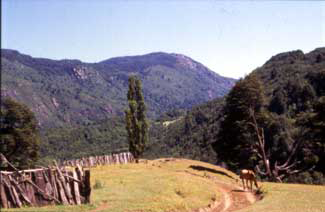
Research was focused at the south of CA42, in the Cholila locality (Map). The first step comprised geomorphological, taphonomical and distributional studies as well as prospection and survey (Bellelli et al. 2000 a and b, Fernández 1999, Reference ScheinsohnScheinsohn 2001). As a forest/steppe ecotone, the area has severe visibility problems that merited the development of special methodologies (Reference ScheinsohnScheinsohn 2001, Scheinsohn & Matteucci 2004) (Fig 1).
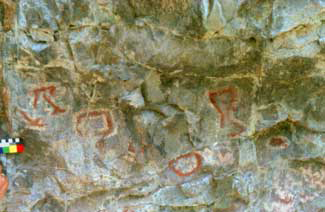
Eleven archaeological sites and many isolated artefacts were found. Six sites corresponding to concentrations of lithic artefacts were found on deflation surfaces (Los Guanacos 1 to 4 and Juncal de Calderón 1 to 3, Calderón 1, see Bellelli et al. 2000 a, b). Three others consist of rock shelters (Cerro Pintado, Raimapu, El Peñasco, see Bellelli et al. 2000 a, b) located between 600 and 750 metres above sea level, in an forest/steppe ecotone environment. Rock art of these sites is included in the abstract and geometric style typical of the populations that occupied Patagonia in the late Holocene. This style developed from 1400/1300 years BP until the European colonization (Fig 2). The rock art analysis of the three sites is now complete. (Podestá & Tropea 2001). Lithic raw material and pigments sources studies were performed (Bellelli & Pereyra 2002, Wainwright et al. 2000, 2002).
Typical landscape of the forest at the study area.

Rock art at Cerro Pintado site.

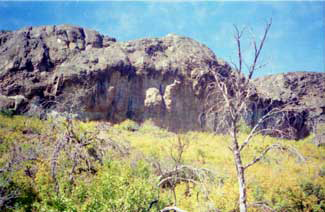
A view of Cerro Pintado site.

Excavations and rock art at Cerro Pintado site.

Excavations took place at Cerro Pintado site (CP-Fig 3). This rock shelter contains a 95m long panel of rock art. Radiocarbon dates from the excavated deposits range from 1870 ±80 BP to 680 ±60 BP (Bellelli et al. 2003) (Fig 4). Among the taxa identified were guanaco (Lama guanicoe, american Camelidae), huemul (Hippocamelus bisulcus, native Cervidae, which is not frequent in Patagonian archaeofaunal record) and various rodents. Among lithic tools, small projectile points are dominant, most of them reactivated and with signs of fire damage, as well as the abundant pottery fragments found there. Also shell beads, rock with pigments and pigments fragments were recovered. From the analysis of archaeological materials it can be said that among other agents, the integrity of the record was affected by fire damage, probably caused by natural agents (Bellelli et al. 2003, Reference CarballidoCarballido 2001, Fernández 2001).
The typological characteristics of artefacts and rock art style from these sites suggest that they all belong to the same temporal span (Bellelli et al. 2003). Rock art and other archaeological materials show stylistic and technical similarities to steppe sites and neighbouring forest sites of a comparable late Holocene age (Bellelli et al, 2003). This information plus obsidian procedence studies (Bellelli & Pereyra 2002), suggests the existence of wide circulation networks that relates this area to others (Bellelli et al. 2003).
http://www.inapl.gov.ar/invest/comarca.htm [URL no longer available, checked 2018]