

Introduction
The functional differentiation of society and its increased complexity require expertise in policymaking (Mayntz Reference Mayntz2016), which increases the need for multi-step governance arrangements, including specialised agencies, private actors’ capacities or both in combination. These arrangements have become prevalent in such diverse domains as the European satellite navigation program (Mörth Reference Mörth2009), toy security (Gehring and Kerler Reference Gehring and Kerler2008) and accounting (Mattli and Büthe Reference Mattli and Büthe2005).
As the integration of administrative and private actors into governance often establishes long delegation chains, these procedures frequently include public participation (Organisation for Economic Co-Operation and Development 2001; Rasmussen Reference Rasmussen2015, 272). Citizens – as the ultimate principal – are only remotely connected to policymakers, and problems of transparency may arise. Public participation – often in the form of written consultations – is thought to ameliorate this democratic deficit by increasing transparency, making decisionmaking accessible to citizens and bringing expertise into policymaking.
This article investigates how the information provided in consultation statements is used by consulting actors. Knowing which consultation statements are considered in multi-step consultation procedures is relevant because it sheds light on these procedures, and because it tells us who is influential and why. Only if consultation participants can influence decisionmaking can the procedure improve input as well as output legitimacy.
There is a plethora of literature on interest groups that explains the differing lobbying success of various organisations. This literature uses exchange theory to conceptualise interactions between consulting organisations and the public (Bouwen Reference Bouwen2004; Klüver Reference Klüver2013). The idea is that consulting organisations make their decision-making processes available in exchange for information provided by the public.Footnote 1 We combine exchange theory with a principal-agent framework to account for the fact that public participation is integrated into multi-step governance systems. The United States (US) literature on Congress-agency relations argues that the principal of the consulting organisation uses the information generated in the consultations of its agent to control this agent (Balla Reference Balla1998). Thus, we should see the effect of consultations in the reaction of the consulting organisation as well as in the actions of the consulting organisation’s principal.
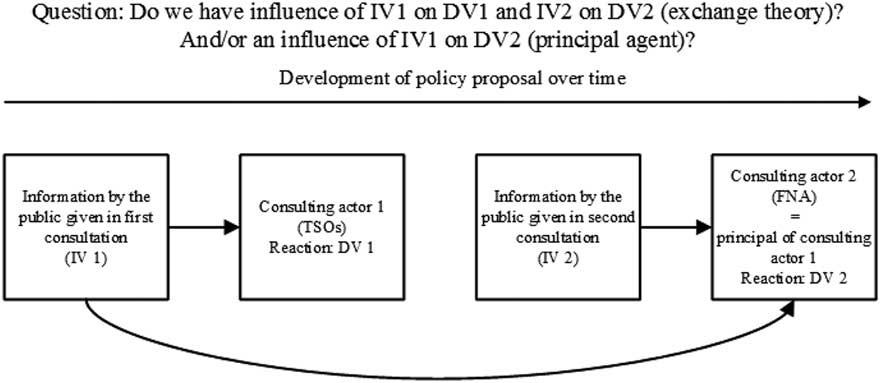
We use the German energy grid planning procedure to test our arguments. First, the German regime is a typical case of complex governance arrangements with public participation. An agent – the private firms charged with building the energy grid – develops a plan and consults with the public. Its principal – the German energy regulator [German Federal Network Agency (FNA)] – consults this plan a second time and approves its policy measures. We thereby have a delegation chain with a distribution of tasks and consultations by both the agent and the principal, which allows us to elucidate whether the private firms as agents react to the contributions to their consultations (as exchange theory predicts), whether the regulator – as the firms’ principal – reacts to the contributions to its own consultation (as exchange theory predicts), and/or whether the regulator reacts to the contributions to the consultation of the agent (as the principal-agent perspective holds).Footnote 2 Second, the policy under consideration and the consultation are highly structured, which allows us to trace the influence of consultation contributions. We have successive versions of a policy as well as numerous consultation contributions to assess the relation between the latter and the former (see Figure 1).
Causal model. Note: IV=independent variable; DV=dependent variable; TSOs=Transmission System Operators; FNA=Federal Network Agency.
The submissions were both hand-coded and dictionary-coded. In effect, we tested whether the decisions of the principal and the agent can be explained by the amount and kind of submissions they receive in their consultations.
There are two major results. First, the private firms and the regulator FNA seem to only be mildly influenced by public participation. Regression models display no relation between the amount of submissions received that oppose grid-expansion projects and changes in project descriptions. Qualitative analyses corroborate this null finding. Not even the well-established result that business interests dominate consultation procedures (Yackee Reference Yackee2006; Rasmussen Reference Rasmussen2015) can be corroborated. Second, there is evidence that the FNA’s decision is influenced by the submissions to the consultation by the firms. The more submissions with ecological arguments against a given project that the firms receive during their consultation, the more likely it is that the FNA rejects the project. The quantitative results in this regard are not entirely conclusive. However, a qualitative analysis supports the quantitative results and suggests that the timing of the consultation and the mandate of the FNA to conduct an environmental impact assessment (EIA) can explain this pattern.
These results suggest that a combination of exchange logic and the principal-agent perspective is appropriate for the analysis of multi-step consultation arrangements. If we only considered the exchange between the firms and the public (or the FNA and the public), we would conclude that public participation does not influence policies. However, by using the principal-agent perspective, we see how contributions may influence not the consulting organisation, but rather, its principal.
Our analysis underlines the often-made argument that the purpose of consultations must be clearly communicated. The German case reveals a misunderstanding between Transmission System Operators (TSOs) and citizens regarding the kind of questions asked. In addition, proponents of public participation often argue that it must be included in policy-making processes as early as possible. Our analysis reveals that early consultations are no panacea. Moreover, the time frame of the consultations must be appropriate. In our case, the FNA has only three weeks to prepare its decision after the end of its consultation period; otherwise, it has to prepare its decision while the consultation is ongoing. Neither option is desirable. Combining these critiques, the radical option would be to abolish the TSO or the FNA consultation in favour of a longer consultation by one of the actors.
The article is structured as follows: the second section describes the German procedure of network planning. The third section develops hypotheses explaining how public participation influences public policies. The fourth section discusses the research design. The fifth section comprises the empirical analysis, and the sixth section presents our conclusions.
The institution: public participation in German grid planning
In 2011, the German legislator redesigned the institutions of electricity grid planning, amended the Energy Industry Law (EnWG), and introduced the Grid Expansion Acceleration Law (NABEG). These laws oblige the energy regulator FNA and the four private German Transmission Systems Operators Amprion, Tennet, TransnetBW and 50 Hertz to conduct consultations when planning grid projects. The planning regime is part of the German “Energiewende”, a process through which Germany endeavours to transform its energy system to renewable energies. In order to integrate renewable energies, new high-voltage lines are needed. Previous experience has shown that local resistance is considerable (Steinbach Reference Steinbach2013a); thus, the legislator sought a method of simultaneously accelerating grid planning and increasing public acceptance (Fink and Ruffing Reference Fink and Ruffing2017).
The German procedure is a typical case of a multi-step consultation regime: first, the technical character implies the necessity of including diverse actors in the decision-making process: private actors provide technical expertise, whereas decisionmaking remains in the hands of administrative and political actors (Devine-Wright Reference Devine-Wright2014; Stoutenborough et al. Reference Stoutenborough, Bromley-Trujillo and Vedlitz2015). Second, public participation is used to improve the public acceptance of decisions, as is often the case particularly in technical domains. Empirically, we can identify several consultation procedures that share characteristics with the German planning procedure: since the reform of the German Administrative Procedure Act, double consultations by private organisations and public authorities have become standard in many domains in Germany, and similar procedures can be identified in other European countries. The two-step consultation procedure by private actors and national public authorities in grid planning is obligatory according Directive 2009/72/EU.Footnote 3 Two-step consultations are also prevalent at the European level: in many Comitology procedures, decision proposals are developed by European agencies, made available for public consultation, and submitted to the European Commission, which consults civil society again before it feeds the proposal to the Comitology Committee (Busuioc et al. Reference Busuioc, Groenleer and Trondal2012).
Within this population of cases, the German grid planning procedure is a typical case of a two-step consultation. Compared with other procedures, it is particularly open and attracts above-average numbers of statements, which provides a broad basis for an empirical analysis. The selection of typical cases is particularly fruitful because of their “potential to generalize to comparable cases” (Rohlfing Reference Rohlfing2012, 67).
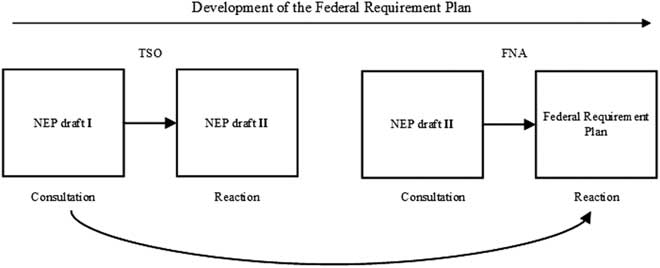
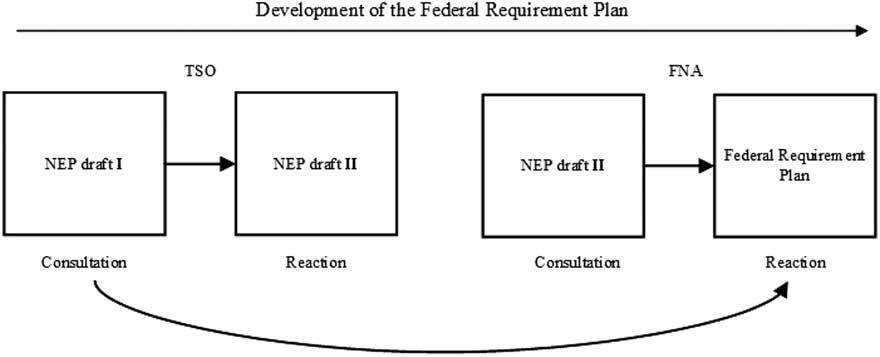
Our empirical analysis focuses on the demand planning procedure in Germany (see Figure 2). First, the TSOs develop a draft for the network development plan (Netzentwicklungsplan; NEP) based on assumptions about energy production. The network development plan defines which places in Germany need to be connected by power lines. The first draft of this plan is open for consultation, and the TSOs have to take the public’s submissions into account when revising the plan. Second, this draft is submitted to the FNA, which can approve the plan after a second round of public consultations and send it to the federal legislator, who translates the plan into law. Only those power lines that are in the plan can be built. Thus, the TSOs and the FNA interact with the public on two occasions. However, the extent to which the TSOs and the FNA are influenced by the public’s submissions remains an empirical question.
Grid demand planning procedure in Germany (simplified overview). Note: TSOs=Transmission System Operators; FNA=Federal Network Agency.
Exchange or principal-agent logic?
As the manner by which the TSOs and the FNA have to process the public’s submission is not institutionally defined, there are several hypotheses regarding how they may do this.
The first perspective is exchange theory from interest group research (Bouwen Reference Bouwen2004; Klüver Reference Klüver2013). The argument is that consultations institutionalise exchange between policymakers and the public. Policymakers do not have enough information to design policies; instead, organised interests and the broader public offer this information but demand access to the policy process. According to this perspective, consultations are institutionalised arenas of political exchange (Broscheid and Coen Reference Broscheid and Coen2007; Bunea and Thomson Reference Bunea and Thomson2015). In principle, the theory only assumes that policymakers get information that they need and offer access to decisionmaking in return, which raises the question of which type of information they need. Empirical studies using exchange theory usually only differentiate between technical and political information. Whereas political information is, for example, needed for successful negotiations in policy-making procedures, technical information is needed for “good” decision making and – in the case of agencies – for securing the fulfilment of a mandate. A more nuanced categorisation of information can draw a more fine-grained picture of consultation effects; however, this categorisation cannot be deduced from exchange theory and instead requires an analysis of the decision making context. For example, it is plausible to assume that consulting actors are sensitive to legal arguments and try to avoid decisions that can be challenged in courts. Administrative actors might also be sensitive to environmental arguments if environmental protection is part of their mandate, and private actors can be expected to be sensitive to economic arguments. Information about preferences is particularly relevant if the consulting actor faces problems influencing other actors (Bunea and Thomson Reference Bunea and Thomson2015) or anticipates problems in implementation. Therefore, it is plausible to apply a more refined list of information types to ensure that the effects of the exchange logic are not blurred in the empirical analysis.
For our case, the theory predicts that the TSOs use their consultation to obtain information about grid expansion projects. If a planned project receives critical comments hinting at public opposition or technical problems, the TSOs will change the plan of the project. If, on the other hand, the public remains silent on a project, the project will be seen as “unproblematic”, and its plan will remain unchanged. Similarly, for the FNA, the exchange logic argues that the agency uses the submissions it receives during its consultation to obtain information that helps it to decide which projects to approve.
(H1a) Exchange theory: The more submissions opposing a grid project that the TSOs receive in their consultation, the more the TSOs will change the plan for this project.
(H1b) Exchange theory: The more submissions opposing a grid expansion project that the FNA receives in its consultation, the less likely the FNA will be to approve this project.
Exchange theory is focussed on the relationship between the consulting actors and the consultation participants. However, consulting organisations are often part of a chain of delegation. This perspective is prevalent in research on the “notice and comment” procedure in US administrative law (Balla Reference Balla1998; Yackee Reference Yackee2006). In the US, Congress delegates decisionmaking to agencies but risks that these agencies exploit information asymmetries inherent to their relationships to make proposals that are not in the principal’s interest (McCubbins and Schwartz Reference McCubbins and Schwartz1984). The “notice and comment” procedure is therefore used as a fire alarm mechanism to inform the principal about the agent’s behaviour (McCubbins and Schwartz Reference McCubbins and Schwartz1984). This situation is typical when administrative organisations launch consultations while under the auspices of political actors. However, the delegation chain can be longer when private actors are integrated into the policy process (Mattli and Büthe Reference Mattli and Büthe2005; Eberlein Reference Eberlein2008). In the German case, the FNA delegates the drafting of the network development plan to the TSOs, which are commercial actors and have an incentive to plan more power lines than necessary. Building power lines requires large investments, and network users have to pay grid fees to the TSOs. These fees are calculated by the FNA, which takes the investments into account. The TSOs are therefore less concerned with the costs of power lines, but have incentives to plan more lines than necessary. As network users have to bear the costs of unnecessary power lines, the FNA has to control whether the TSOs act in accordance with the legal requirement of only building necessary power lines. Therefore, the FNA has to assess the technical appropriateness of the plan but has less technical expertise than the TSOs. At this point, the consultations of the TSOs may function as fire alarms (Lupia and McCubbins Reference Lupia and McCubbins1994). The public comments on the grid projects, and the FNA can use this information to inform its decisions.Footnote 4 This fire alarm is activated not only if the TSOs ignore their legal obligation to propose only necessary power lines, but also if they ignore other legal obligations such as environmental protection, or the procedural requirements of the consultation. The logic is similar to exchange-theoretical logic, but the principal of the consulting organisation uses the information generated in the consultations.
We hypothesise that the submissions to the consultation of the TSOs influence the FNA’s decision. If only a few submissions criticise a grid project in the TSOs’, consultation, the FNA approves the project; however, if many submissions criticise a project, the FNA is less likely to approve the project.
(H2) Principal-agent theory: The more submissions opposing a given grid expansion project that the TSOs receive in their consultations, the less likely the FNA will be to approve this project.
The null hypothesis is that we observe no relation between consultation submissions and the decisions of either the TSOs or the FNA. The planning of electricity grids could be determined by economic and technical criteria. Public participation is formally conducted but has little influence.Footnote 5
(H0) Null Hypothesis: There is no systematic relationship between the submissions received that oppose a given grid expansion project and the reaction of the TSOs and the FNA.
Design, data and methods
The hypotheses make claims about the relation between submissions to the consultations and the reaction of consulting actors. This article tests these hypotheses using data obtained from the first consultation of a network development plan in Germany in 2012.
The dependent variable is the behaviour of the TSOs and the FNA. We construct dependent variables using the two drafts of the network development plan and the FNA’s decision (FNA 2012; TSOs 2012a, 2012b). All three documents contain a list of grid expansion projects. Each project can contain multiple grid expansion measures. The narrow structure of the planning process allows for the construction of variables that assess the impact of the written consultations. First, the policy only deals with the list of grid projects, and there are no additional issues. If there is policy change, it is reflected in the list of projects. Second, the law stipulates that changes between draft number one and two must be in light of the consultation (EnWG Art. 12 b). Thus, we can observe policy change and link it to the consultations.
For the TSOs, we measure the extent to which they change their descriptions of the grid expansion projects between the two versions of the plan. Each project has a title and several paragraphs describing it. To assess the extent to which the TSOs change the descriptions, we use the variable TEXT_PERCENTCHANGED.Footnote 6
 $$TEXT_{{PERCENTCHANGED}} {\equals}{{Words\,added{\plus}Words\,deleted} \over {No.{\rm }\,of\,words\,in\,first\,draft}}$$
It is plausible that the TSOs change their description of a project more (e.g. that they use more words to justify a grid project) the more submissions that they receive concerning this project. The literature suggests that submissions are nearly always critical of the projects (Steinbach Reference Steinbach2013a). Our coding corroborates this argument. Less than 1% of the submissions support a grid project. To ensure that a small amount of changed text does not imply substantial changes, we also take an in-depth look at the two versions of the network development plan to assess which grid projects have changed.
Table 1 displays the descriptive statistics for TEXT_PERCENTCHANGED. In the first draft, the project descriptions have 178 words on average and range from 67 to 601 words. In the second draft, the project descriptions are 16 words longer on average. Between the first and the second draft, the TSOs have changed on average 40% of the text. Some descriptions remain unchanged, and others experience a word change of 200%. We thus have variation in need of explanation.
Descriptive statistics for the dependent variable TEXT_PERCENTCHANGED

The FNA assesses the proposed measures and approves or rejects grid expansion measures after having conducted its own consultation.Footnote 7 The binary dependent variable FNA_APPROVAL thus indicates whether the FNA approves a given measure. In our data set, the FNA examined 69 measures and approved 46 of them.Footnote 8 Thus, there is again variation in need of explanation.
The independent variables were generated using the 1,006 submissions to the consultation of the TSOs and the 2,905 submissions to the consultation of the FNA. We coded both sets of submissions to assess (a) what kinds of arguments are made, (b) against which grid project, (c) by what kind of actors. We used a combination of hand-coding and dictionary-coding to code the submissions. We used a dictionary approach to elucidate which grid project a submission is directed against. The dictionary contains the project code and the place names given in the description of the power line as keywords.Footnote 9 Moreover, using a newspaper analysis, we identified the places most likely to be affected by a grid project and added these place names.Footnote 10 The kinds of arguments made were coded using a dictionary that indicates key words for legal, political, technical, economical, ecological and health safety/medical arguments.Footnote 11 The type of actor was hand-coded by student assistants and the project leaders.Footnote 12 The categories are citizen, citizen’s initiative, company, industry association, local government, Länder government, federal government, science, parties, districts and other. As the coding unit is the submission, a single submission may be directed against several grid projects and contain multiple kinds of arguments but can only be from one actor type. Our intuition is that the number of submissions opposing a project determines the reaction of the TSOs and the FNA, but that submissions by certain actors or those that display certain types of arguments may carry more weight as they provide more valuable exchange goods (see e.g. Klüver Reference Klüver2013; Bunea and Thomson Reference Bunea and Thomson2015).
Thus, we use a data set containing (a) the list of grid projects in the network development plan and their technical properties, (b) the number of submissions to the consultations of the TSOs and the FNA that criticise these grid projectsFootnote 13 and (c) the reaction of the TSOs and the FNA to these submissions. Following Hypotheses 1 and 2, we should observe a systematic relationship between the number of submissions received against a grid project and the decisions of the TSOs and the FNA regarding this project.Footnote 14
The variables enter ordinary least squares and logit regression models. Although the observational design cannot exclude the possibility of omitted-variable bias (e.g. characteristics of the TSOs or of specific grid projects), this design helps us to better understand the effect of the amount of submission statements on text changes. As control variables, we added the length of the grid project and whether the grid project is a new construction project or if an existing power line is being expanded. Although each grid project is unique, these two variables capture most of the characteristics of grid projects, at least as they are apparent at this stage of planning.Footnote 15 Furthermore, we add a dummy variable for the TSO responsible and estimate a multilevel model with random effects for the TSOs. Both reduce the risk of biased estimators due to the omission of a TSO-specific variable.
Analysis
Our analysis of the consultations to the network development plan 2012 begins with an overview of the involved participants. First, both consultations mainly attract citizens (Table 2), which is remarkable as the documents are technical, and organised interests have more resources to draft their opinions. For example, the consultations of the Europe-wide 10-year network development plan exclusively attract companies and associations. Administrative lobbying in the US is also dominated by organised interests (Yackee Reference Yackee2006; Boehmke et al. Reference Boehmke, Gailmard and Patty2013).
Participants in the consultations
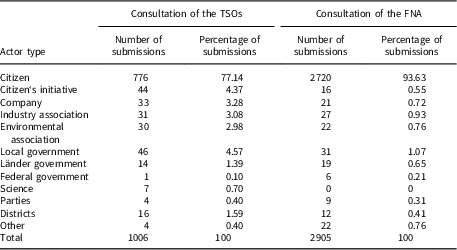
Note: TSOs=Transmission System Operators; FNA=Federal Network Agency.
Second, it is important for our analysis that many submissions refer to specific grid projects. This fact is pivotal because we assume that submissions concerning a specific grid project influence the TSOs’/FNA’s decision regarding these grid projects. Of the 1,006 submissions to the consultation of the TSOs, 462 mention specific grid projects; of the 2,905 submissions to the consultation of the FNA, 2,657 mention specific grid projects.
Third, if we examine the submissions by grid projects, several phenomena of interest become apparent. The mean number of submissions per grid project in the TSO consultations is 25; however, the median is only 6, which suggests that the distribution is skewed: The mean is driven by an outlier (Project P25, with 164 submissions). Similarly, the mean number of submissions by grid project in the FNA consultations is 90, but the median is 2. The skewness here results from the project Korridor A and its subprojects, against which a mass protest was mobilised and 2,152 submissions were received. Table 3 displays the top ten “most criticized projects” in both consultations and reveals little correlation (formally, r is only 0.16). The two consultations do not attract the same kind of criticism, and the FNA consultation is no simple replication of the TSO consultation. This result may be due to the tight schedule of the consultations. Some citizens may have missed the deadline for the TSO consultation, an interpretation that is supported by the increase in citizen contributions to the FNA consultation. Alternatively (or additionally), citizens put more trust in the FNA as an administrative body.Footnote 16 More than half of the consultation statements received by the FNA mention one or all of the TSOs,Footnote 17 which indicates that the consultation participants regard the FNA consultation as a mechanism through which they can complain to a principal – the FNA – about the behaviour of its agents – the TSOs. An in-depth examination of the consultation documents corroborates this result. Many consultation statements contain substantial or procedural monita with regard to the TSO consultation and call on the FNA to find a remedy.
Top 10 most criticised projects in both consultations
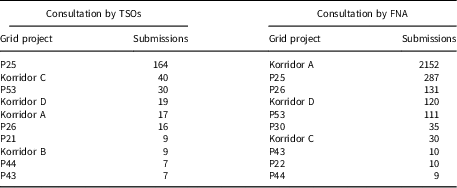
Note: TSOs=Transmission System Operators; FNA=Federal Network Agency.
Table 3 displays the number of submissions received against a given grid project by the TSOs and the FNA. The first regression model investigates whether there is a relation between the first independent variable and the TSOs’ reactions. Did the TSOs change their plans for grid projects as a reaction to the submissions they had received?
Table 4 indicates a null finding. There is no relation between the number of submissions and changes between the two drafts of the network development plan. Neither the total number of submissions nor the number of submissions with legal, political, technical, economical, ecological or medical arguments is related to the amount of text changed.Footnote 18
Relation between submissions to the consultation of the Transmission System Operators and percentage of words changed between draft plans 1 and 2

Note: Standard errors in parentheses.
**p<0.05, *p<0.1.
This result is surprising. On the one hand, the development of a network plan is a technical process, and input by the public may not change the technical necessities. On the other hand, our design is a most-likely design for finding an impact of consultation contributions: according to our design, all that TSOs have to do to appear “responsive” is to use more words to justify contentious projects. Hence, we should see more text revisions the more submissions a given grid project receives; however, this is not the case, and we can thereby repudiate exchange-theoretical Hypothesis 1. The consultation submissions have no effect on the revision of the network development plan. In the long run, there may even be a paradoxical effect: the consultations were designed to reduce citizens’ resistance against power lines, but if citizens feel that their comments have no impact, their resolve against power lines may strengthen.
One approach to explain this lack of responsiveness is the structure of the German energy industry. Formerly part of vertically integrated monopolists, the TSOs may have no culture of responsiveness to societal demands. However, one of the TSOs is Tennet, a Dutch-owned company that was never part of the German energy producers. There is no evidence that Tennet is more responsive than its German counterparts.Footnote 19
A qualitative study of the network development plan corroborates the quantitative results. If we examine the explanations the TSOs give in their second draft, they see the purpose of the consultations in explaining their plans, but not in giving access to the planning procedure (Focht Reference Focht2011; TSOs 2012b, Chapter 7). The TSOs argue that many submissions contain political statements that have no impact on grid planning (TSOs 2012b, 176). From their point of view, participants misunderstand the consulation (TSOs 2012b, 176), and contribute submissions that oppose concrete routes for power lines despite the fact that the plan concerns the need for a power line between two points without specifying concrete routes. Thus, from the TSOs’ perspective, the statements do not entail a valuable exchange goods.
An analysis of the revised projects reveals that revisions mostly explain the lack of alternatives without any relation to the comments received. Overall, there is no systematic pattern of changes discernible. Some projects that receive few comments are extensively justified in the second draft, some other uncontentious projects remain unchanged. Similarly, some projects that receive many comments are justified more in the second draft, other contentious projects remain unchanged. For example, 205 submissions were directed against Project P25, but this project was only split into subprojects without changing the description of each subproject.Footnote 20 Only one project was substantially changed: Project P33 now entails the modification of an existing power line instead of the construction of a new power line. However, only one submission criticised this project (suggesting a buried line instead of overhead cable).
Thus, a qualititative analysis corroborates the notion that changes in grid projects are not related to consultation statements. However, the qualitative analysis does not suggest an omitted variable that explains the variation of text changes. The only pattern that emerges is that one TSO – 50 Hertz – adds more justifications to all its projects independently of the number of comments received. 50 Hertz had the shortest project descriptions in the first version of the plan (145 words on average as compared with 310 words for the other TSOs). In the second version of the plan, this difference decreased to 195 versus 273 words. Thus, the text changes might be due to editorial streamlining in an attempt to provide the same amount of information for each project.
In summary, the consultation of the network development plan by the TSOs is an institutionalised misapprehension. While citizens have the impression that the procedure is a method of voicing their objections to route proposals for power lines, its actual goal is to determine the need for connecting two points on the electricity grid. Conversely, the TSOs do not use the number of submissions to identify projects that need more justification. This pattern supports the null hypothesis. Formally, a consultation is held, but it has little impact on the policy, which demonstrates the difficulty of designing consultation institutions (Eversole Reference Eversole2011, 57). These results suggest that using a simple “the-earlier-the-better” logic is inadequate in the design of consultation procedures. Apparently, the German consultation occurs too early in the policy-making process to produce meaningful exchanges, and consultations at a later stage of planning could prove more constructive.
However, there is evidence that the FNA uses the submissions received by the TSOs in its consultation. Table 5 displays the results of logit regression models. The model now contains two variables that measure the number of submissions. The FNA can use the submissions to the consultation performed by the TSOs. This corresponds with the principal-agent argument, which states that the principal (the FNA) uses the information generated in consultation with its agent (the TSOs) to control the agent. Additionally (or alternatively), the FNA can use the submissions to its own consultation, which corresponds with the exchange-theoretical idea.Footnote 21
Determinants of Federal Network Agency (FNA) decision to approve (1) or disapprove (0) a grid measure

Note: Standard errors in parentheses.
TSOs=Transmission System Operators.
**p<0.05, *p<0.1.
Table 5 reveals first that the exchange-theoretical hypothesis does not hold. There is no relation between the number of submissions that the FNA receives against a grid project and its decision to approve this project. This result holds for the total number of submissions as well as for the number of submissions with different arguments.Footnote 22
We complemented this analysis with a qualitative approach: in its final decision, the FNA explains how the consultation statements have been taken into account. According to the German Energy Law, the FNA approves grid projects that are “necessary for a secure and reliable network operation” (EnWG, § 12b, own translation). The FNA’s decision document first discusses whether each grid project fulfils these requirements, with reference to two expert reports (one by experts from the University of Graz and one by a consultancy). This first part almost exclusively discusses load flows. On this basis, the FNA comes to a decision regarding whether to approve a grid project. In the second part, the FNA discusses the consultation statements. In two-thirds of all cases, this part only states that no specific or energy-industry-related issues were raised in the consultation. This indicates that such arguments are particularly relevant to the FNA’s decision. In the remaining cases, the discussion refers to consultation statements. However, only in two cases does the FNA report that a decision has (also) been made in reaction to consultation statements: the rejection of measure 69 and the approval of measure 61. For measure 69, the report states that the necessity of the grid measure was doubted by consultation participants. In addition, the TSOs were not able to present conclusive data on the necessity of measure 69. Measure 61 entails an upgrade of an existing electricity line. The FNA reports that the content of the submissions regarding this measure is reflected in the decision. Examining the submissions, only one of them addressed measure 61 and welcomed the proposal to include this project upgrade in the network development plan. In all other cases, the discussion only indicates why the submissions are not relevant to the FNA’s decision (e.g. because they refer to line routings, which are decided on later) or why the critique is obsolete because the FNA rejected the grid project for other reasons (usually load-flow issues). In other words, the FNA sticks to its legal mandate to ensure a reliable electricity grid. The information provided in the consultation is hardly helpful in reaching this goal.
However, a second conclusion of Table 5 is that the results encourage us to pursue the principal-agent argument further. The results can be due to chance, but the coefficient indicates that the FNA might be influenced by the number of ecological arguments submitted to the consultation of the TSOs. Figure 3 illustrates this result. If the TSOs receive no submission with ecological arguments, the probability of a project’s being approved by the FNA is about 0.8; however, the approval probability decreases with each submission with ecological arguments. With five submissions with ecological arguments, the probability of a project’s being approved is close to 0.Footnote 23
Influence of ecological arguments Note: TSOs=Transmission System Operators; CI=confidence interval.
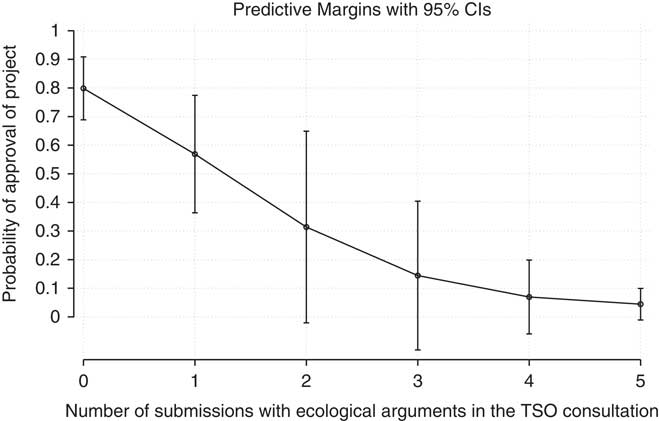
As the quantitative results are inconclusive, we need to find qualitative evidence on two questions: first, why is the FNA’s decision correlated with the number of submissions to the TSOs consultation but not with the submissions to its own consultation? Second, why are ecological arguments correlated with the FNA’s decision? We think that the answer to both questions – and evidence for the principal-agent argument – can be found in the institutional details of the consultation.
To explain why the FNA’s decision is correlated with the submissions to the consultation of the TSOs but not with the submissions to its own consultation, the time frame is important. The TSOs presented the first draft of the network development plan on 30 May 2012, and the consultation was held until 10 July. From then on, all the submissions to the TSOs’ consultations were available. The TSOs submitted the revised draft to the FNA on 15 August, and the FNA immediately began assessing the validity of the grid projects and conducting its own consultation from 3 September to 2 November. The final decision was published on 25 November. Thus, there were only three weeks between the closing of the FNA’s consultation and the publication of its decision. Most of the assessment of grid projects must have occurred beforehand. The submissions to the consultation of the TSOs had been available from the beginning of the assessment period. Thus, it is plausible that the FNA used the information available when it began its assessment but could not properly process the contributions to its own consultation. The FNAs reaction was thus shaped by the timeframe: if the FNA consultation had appeared earlier in the procedure, the agency would have had more of its “own” information, whereas the current regime forces it to use the information provided in the TSOs’ consultation.
To explain why ecological arguments have leverage over the FNA’s decision, we need to consider the decision criteria. According to the Energy Law, the FNA has to determine whether a power line is effective, demand-oriented, and necessary. Effectiveness refers to the question of whether a power line prevents an overload of the grid, being demand-oriented refers to the question of whether a power line will be used to capacity, and necessity refers to the question of whether the power line is necessary given varying assumptions about electricity production (FNA 2012, 105–109). Thus, the FNA should base its decision primarily on technical criteria.Footnote 24 However, not all cases can be decided on the basis of technical criteria. As the FNA states in its decision: “All these cases leave room for interpretation of the results. The analyses are not definite. […] This suggests that we need additional criteria and justifications to approve a project” (FNA 2012: 115, own translation) As the FNA is bound by its legal mandate, the only place that further criteria can come from is the EIA that the FNA conducts as part of the project approval process. The purpose of the EIA is to collect data about the environmental impact of grid projects and to inform the FNA’s decision on the network development plan (Steinbach Reference Steinbach2013b, 91). What makes ecological arguments so special is that they have an institutionally sanctioned way of entering the FNA’s decision – the FNA can use them to fulfil its mandate.Footnote 25
To connect the links of the causal chain, we have to show that (a) the number of submissions to the consultation of the TSOs is correlated with the environmental assessment of a grid project and (b) the environmental assessment of a grid project influences a project’s approval. A regression analysis using ordered probit models reveals that the first link holds. The environmental assessmentFootnote 26 of a grid project is more critical (on the low/moderate/extensive scale) the more that submissions with ecological arguments are received during the consultation of the TSOs. Again, the submissions to the FNA’s consultation have no impact (Table 6).
Relation between ecological arguments and assessment of a power line in the environmental impact assessment

Note: Ordered probit models, Project P25 omitted for data reasons. Standard errors in parentheses.
TSOs=Transmission System Operators; FNA=Federal Network Agency.
**p<0.05,
The second link in the causal chain does not hold in quantitative models. Regression models show no relation between the EIA of a project and its likelihood of approval. However, the network development plan contains power lines that can be seen as equivalent.Footnote 27 If we analyse these power lines, it becomes apparent that the FNA approves the power line with less environmental impact. A case in point are the two power lines through Schleswig-Holstein. The “Ostküstentrasse” received far more submissions with ecological comments and was considered to have a worse environmental impact than its twin, the “Westküstentrasse”. In turn, the Westküstentrasse was approved, while the Ostküstentrasse was not. Whether this decision was due to the critical submissions is an open question, but the FNA states that “[d]uring the consultation, the projects in East Schleswig Holstein were discussed very critically” (FNA 2012, 291).
As the planning process is iterated each year,Footnote 28 there is qualitative evidence for a steering effect beyond the immediate nonapproval of grid projects. The TSOs can resubmit their grid projects, and the FNA often makes very transparent why it does not approve a given project yet.Footnote 29 These signals are taken seriously by the TSOs: in their 2013 planning, they have improved the justification of their project descriptions, and several projects that were not approved in 2012, were approved in 2013.Footnote 30 Thus, the FNA steers the TSOs towards better justifying their grid projects in light of the legal criteria.
In summary, we can refute Hypothesis 1. The consultation of the German network development plan does not follow an exchange logic. Neither the TSOs nor the FNA offers access to their decisions in exchange for information. The consultation of the TSOs supports the null hypothesis as there is no relation between submissions to the consultation and plan changes by the TSOs. Moreover, there is no impact of the type of actor that makes a contribution (see the Online Appendix). This finding does not necessarily mean that the assumptions of exchange-theory are invalid. The information provided in the consultation procedure may not be a valuable exchange good for the consulting actors: participating actors will only deliver “new” technical information for the TSOs under exceptional circumstances, because most of the statements refer to single electricity lines, whereas the TSOs need to know whether a particular line is necessary for the grid as a whole. The fact that the TSOs ignore political arguments is more surprising. However, for the TSOs, the whole planning process is decisionmaking under uncertainty: a grid measure that is uncontroversial at this early point can become controversial later on. Therefore, there may be no point in changing controversial lines at the beginning of the policy process.
The FNA might be more in need of information generated by consultation participants. Some argue that this kind of information is a power resource (Bunea and Thomson Reference Bunea and Thomson2015), but the FNA is not in need of additional resources. The contentiousness of the grid-building endeavour prevents German legislators from unpacking the catalogue of measures adopted by the FNA. At the same time, the FNA is one of the most independent German agencies, operating detached from the political process (Ruffing Reference Ruffing2014). However, the FNA is still bound to its legal mandate, in our case, the mandate to only approve technically sound grid projects, and to conduct an EIA.
Hypothesis 2 cannot be rejected. The number of submissions received by the TSOs is correlated with the FNA’s decision to approve or reject a power line. The more submissions with ecological arguments oppose a power line, the less likely the FNA is to approve this power line. Although the quantitative evidence is not conclusive, qualitative evidence suggests that the FNA uses the submissions by the public to inform its EIA and its decision to authorise a power line. At the very least, it is a fruitful endeavour to look into the effects that consultation statements may have in principal-agent relations.
Conclusion and discussion
All in all, although public participation in German grid planning might have some merit in increasing the transparency of decisionmaking, it is not very effective. The only effect we find is that the German energy regulator possibly reacts to environmental arguments made in the TSOs’ consultation, and this effect needs further research to support the causal chain.
Based on this finding, we can draw several conclusions. Applications of exchange theory usually assume that consultation statements provide information for the consulting actor. This assumption is plausible as actors open their decision-making processes to the public if they expect the provision of valuable information. However, whether such information is provided is an empirical question. Our results indicate that research should be more sensitive to the question of what kind of information is valuable to a consulting actor. In our case, the TSOs’ feedback statements indicate that the consultation provided no valuable information to them. The FNA, however, seems to be in need of environmental information.
Our study demonstrates that the combination of exchange theory and principal-agent theory is a fruitful approach to the analysis of multi-step consultation procedures. These procedures become prevalent as policymaking becomes more complex. Exchange theory focusses only on the relation between the consulting organisation and the consultation participants. However, in complex governance arrangements, this is only part of the picture. If we had applied only the exchange perspective, we would not have seen any consultation impact.
Although we took the prevalent research design one step further, our results are only part of a larger picture: governance arrangements often involve even more decisionmakers. Further research needs to develop theoretical accounts for more complex participation regimes, for which information travels along a whole delegation chain.
In terms of policy advice, our argument is twofold: first, the point that the purpose of consultations must be clearly communicated is often made, but our case reveals that misunderstandings still occur. The TSOs, the FNA and citizens had different notions about what the purpose of the consultation was. Second, the time frame for consultations must be long enough to allow decisionmakers to wait for the consultation to finish before beginning their decisionmaking. In our case, the FNA has only three weeks to decide after its consultation ends. By combining both critiques, it might be possible to suggest abolishing the TSO or the FNA consultation in order to allow for a longer consultation. This may appear to be less public participation, but it could in fact be better public participation.
Supplementary material
To view supplementary material for this article, please visit https://doi.org/10.1017/S0143814X1800020X
Data
Replication data are available here: https://dataverse.harvard.edu/dataset.xhtml?persistentId=doi%3A10.7910%2FDVN%2FELYTJ3&version=DRAFT
Acknowledgements
The authors thank the participants of the panels “Output Democracy? Bureaucracy as Locus for Public Participation” at the 24th IPSA World Congress and “Politics of Energy Transformations” at the ECPR Joint Sessions 2016, Fabrizio Gilardi, and three anonymous reviewers for their helpful and constructive comments on earlier versions of the article.