


1 Introduction
Societies reveal their values through the behaviors they praise and punish. Although societies may vary markedly, most appear to highly value one fundamental trait in others: prosociality. Selfless actions are publicly praised around the world, such as Warren Buffet’s contractual commitment to donate 99 percent of his wealth to charity and by Mahatma Gandhi and Mother Teresa’s lifetime of self-sacrifice for others. In Christianity, generosity is exalted as a spiritual virtue. In Buddhism, generosity is likewise considered one of the two characteristics necessary for enlightenment. Western and Eastern philosophies both consider generosity to be a virtue and a goal for one’s moral development, as the writings of both Aristotle and Confucius reveal. In literature, Charles Dickens’ A Christmas Carol (1843) is as popular in the Western hemisphere as the Chinese children’s story Kong Rong Giving Up Pears (1778/2011)—a story about a boy sharing his pears with his older siblings—is in the Eastern hemisphere. And in one of the largest cross-cultural studies focusing on gender differences in mate preferences ever conducted (Reference BussBuss, 1989), researchers nevertheless found a striking similarity: the prosocial trait of “kind-understanding” was consistently among the most highly valued traits by both genders in all cultures. For one’s reputation in the mind of others, around the world, it pays to be nice.
Recent research, however, suggests that it may not pay markedly more for one’s reputation to be really nice. That is, whereas increasingly selfish behavior is judged increasingly negatively by others, increasingly selfless behavior—actions that benefit others more than the self—is not judged markedly more positively by others. Instead of a monotonic increase in evaluations across the entire spectrum of prosocial behaviors ranging from completely selfish to completely selfless, there appears to be an asymmetry in evaluations of relatively selfish versus selfless behavior. In one experiment (Reference Klein and EpleyKlein & Epley, 2014, Experiment 1a), concertgoers judged another person who donated less than the suggested donation amount for the concert to be less warm (e.g., less sincere, good-natured, and caring) than someone who donated the suggested amount, but did not judge a person who gave more than the suggested amount any more favorably than the person who gave only the suggested amount. In another experiment (Reference Klein and EpleyKlein & Epley, 2014, Experiment 4a), participants evaluated a person who kept money for himself from a bag found on the street increasingly more negatively as the person kept an increasingly larger share of the money before turning it into the police. Participants did not, however, judge a person who gave away award money to a charity increasingly more positively as the person gave away an increasingly larger share of the money. Increasing selfishness led to an increasingly negative reputation, but increasing selflessness did not lead to an increasingly positive reputation. In another experiment (Reference Gray, Ward and NortonGray, Ward & Norton, 2014), people indirectly reciprocated either a selfish or equitable action from another person in kind, but did not reciprocate another person’s generous action with an equivalent degree of generosity. Instead, they reciprocated a generous action with a merely fair action. Selfishness was repaid in kind measure, but selflessness was not. Additional research similarly finds that actions that go beyond equitable distributions are often not evaluated any more positively than equitable actions (Reference Loewenstein, Thompson and BazermanLoewenstein, Thompson & Bazerman, 1989; Vesleý, 2015). These results suggest an important asymmetry in the reputational value of prosocial behavior, such that increasing selfishness leads to an increasingly negative evaluations but increasing selflessness does not lead to an equivalent increase in positive evaluations. It pays to be nice, but not really nice.
These results reflect more than ceiling effects (whereby people want to evaluate selflessness more positively than fairness but are artificially limited by a bounded measurement scale) because similar results are obtained in unbounded measures, such as estimations of a person’s annual charitable donations. Rather, these results reflect relative insensitivity to magnitude when evaluating generous actions but high sensitivity to magnitude when evaluating selfish actions. When prosocial actions were judged in comparison to each other rather than in isolation, the asymmetry in evaluations disappeared and increasingly generous actors were evaluated increasingly favorably (Reference Klein and EpleyKlein & Epley, 2014, Experiments 4b and 5). These results suggest that people can appreciate increasing generosity in others when different levels of generosity are explicitly compared against each other, but that judgments of prosocial actions in isolation do not elicit these spontaneous comparisons and therefore do not reflect this appreciation. These results seem to reflect a basic pattern of human judgment in which evaluations are sensitive to magnitude, or scope, when they elicit comparisons to similar alternatives but are insensitive to scope when they do not (Reference Hsee and ZhangHsee & Zhang, 2010). A selfish action, according to evidence from Reference Klein and EpleyKlein and Epley (2014), enables a person to think of more or less selfish counterfactuals and thereby keep a given selfish action in perspective. A selfless action, in contrast, does not seem to elicit the same kind of comparative thinking, rendering evaluations of selfless actions less sensitive to the magnitude of selflessness.
Here we do not investigate further the underlying mechanism guiding this asymmetry, but instead report experiments conducted in 7 countries that test the robustness of this asymmetric pattern of reputational inferences across varying economic and social conditions. Understanding the cross-cultural robustness of this pattern matters because evaluations of prosociality may be critical for encouraging cooperation between unrelated individuals within societies. A willingness to help others even without the possibility of direct reciprocity is critical for creating the levels of trust and cooperation necessary for sustaining complex modern societies and markets (Reference BarclayBarclay, 2004; Reference Bowles and GintisBowles & Gintis, 2003; Reference Fehr and SchmidtFehr & Schmidt, 1999; Reference HamiltonHamilton, 1964; Reference TriversTrivers, 1971). Today’s large and relatively impersonal societies make the close-knit bonds that draw together small communities difficult to form (e.g., Reference Grossmann and VarnumGrossmann & Varnum, 2015; Reference Henrich, Heine and NorenzayanHenrich et al., 2010; Reference Uskul, Kitayama and NisbettUskul, Kitayama & Nisbett, 2008).
In lieu of direct reciprocity, the reputational benefits that come from prosocial actions are thought to create a motivation to behave prosocially, because of a universal desire to gain social approval (Reference Baumeister and LearyBaumeister & Leary, 1995; Reference Cialdini and GoldsteinCialdini & Goldstein, 2004; Reference DeWall and BaumeisterDeWall & Baumeister, 2006; Reference Twenge, Baumeister, DeWall, Ciarocco and BartelsTwenge et al., 2007; Reference Willer, Feinberg, Irwin, Schultz and SimpsonWiller et al., 2010; Reference Williams, Cheung and ChoiWilliams, Cheung & Choi, 2000). However, the connection between prosocial behavior and reputational benefits is currently thought to be fairly straightforward—if a person helps others, then his or her reputation will benefit commensurably. In contrast, if people across cultures fail to differentiate between small and large prosocial actions, such a result would add important complexity to existing research.
Understanding how social systems could motivate prosocial behavior requires comparing evaluations of prosociality across cultures. Existing findings on evaluations of prosocial actions were obtained from exclusively American samples, raising concerns that broad conclusions about human prosociality cannot be drawn due to the idiosyncratic nature of North American cultures (Reference Henrich, Heine and NorenzayanHenrich, Heine & Norenzayan, 2010; Reference Nisbett, Peng, Choi and NorenzayanNisbett et al., 2001). If prosocial actions are evaluated differently across cultures, then culture-specific mechanisms, such as values or norms, may underlie the reputational consequences of prosociality. If, however, prosocial actions are evaluated similarly across cultures, then relatively basic and universal mechanisms, such as relative scope insensitivity, would seem to be guiding reputational inferences.
Existing research on prosociality across cultures does not offer a clear prediction about reputational inferences because it typically focuses on variance in prosocial behavior rather than in inferences from that behavior. For example, a recent study examined how people rewarded or punished others’ prosocial behavior in a repeated public goods game (Reference Herrmann, Thöni and GächterHerrmann, Thöni & Gächter, 2008). Whereas participants in all cultures paid a personal price to punish another person’s selfishness, participants in some cultures also paid a personal price to punish—instead of reward—another person’s extremely generous behavior. This suggests that some cultures may not value or admire prosocial behavior, and may instead disdain generosity. This possibility implies cultural variability in reputational inferences from prosociality. In some cultures it may actually hurt one’s reputation to be really nice. However, punishing extreme prosociality does not necessarily indicate negative inferences about prosocial actors. In Hermann et al. (2008), punishing another person’s generosity could also reflect a strategic attempt to counter social pressure to contribute to the public pool. More generally, prosocial behavior can stem from many different mechanisms, ranging from admiration of another person to strategic attempts to exploit or manipulate others in specific situations (Reference SpenceSpence, 1973; Reference Zahavi and ZahaviZahavi & Zahavi, 1997). Understanding the reputational consequences of prosocial behavior requires measuring the reputational costs and benefits that emerge in evaluations of others’ prosocial behavior across the entire spectrum of outcomes, from completely selfish to completely selfless.

In the “Participant pool” column, “Various” refers to online surveys that sampled from various cities and locations within each country. The social capital variables are from the World Values Survey. The variable “Norms of civic cooperation” includes three questions from the World Values Survey about disapproval of free-riding by evading paying taxes or public transit fares; higher values indicate stronger norms. GDP per capita, in unites of $1,000 PPP) is taken from the International Monetary Fund. The strength of the Rule of Law was taken from the World Bank. Data for Democracy are ranks of 150 countries taken from the World Audit. Power distance, individualism, masculinity, and uncertainty avoidance data are taken from Reference Hofstede and HofstedeHofstede & Hofstede (2005). Survival (an abbreviation for “Survival(−) vs. Self-expression(+)” and traditionalism (“Traditionalism(−) vs. Secular-rational(+)”) data are taken from Reference Inglehart and NorrisInglehart & Norris (2003). The format of this table is similar to Herrmann et al., 2008, Table S1.
1.1 Overview
Previous research suggested an asymmetry in people’s evaluations of another person’s prosocial behavior (Reference Klein and EpleyKlein & Epley, 2014). In one experiment (Reference Klein and EpleyKlein & Epley, 2014, Exp. 3), participants evaluated a person who was given $6 in an experiment and was offered the opportunity to give some of it to another participant, with no possibility for reciprocity. Here we use a similar procedure to test the robustness of this asymmetry in reputational inferences across 7 different countries that vary widely in economic and social variables, and that have also been studied in prior research on prosociality across cultures (Hermann et al., 2008).
Although a person’s reputation may vary along many different dimensions, existing research suggests that a person’s reputation typically varies only along two fundamental dimensions: warmth and competence (Reference Fiske, Cuddy and GlickFiske, Cuddy & Glick, 2007; Reference Willis and TodorovWillis & Todorov, 2006; Reference Wojciszke and AbeleWojciszke & Abele, 2008). Warmth is related to other-oriented outcomes (e.g., friendliness, trustworthiness, morality), whereas competence is more closely related to self-oriented outcomes (e.g., intelligence, talent, skill). Because prosocial actions are more relevant to one’s treatment of others than for one’s competence, we predicted that warmth judgments are more likely to be affected by prosociality, consistent with previous research (Reference Klein and EpleyKlein & Epley, 2014). Nevertheless, measuring perceived competence enabled us to test whether people view giving without the possibility of being paid back as a sign of incompetence.
2 Method
2.1 Participants
We sought to capture cross-cultural variability on several social and economic dimensions. Our selection of 7 countries captures variability in social capital, economic prosperity, democracy and laws, and cultural value dimensions (Table 1). We also selected our cultures to capture variability in the tendency to reward or high degrees of prosociality as found in a previous study (Reference Herrmann, Thöni and GächterHerrmann et al., 2008).
2.2 Procedure

The table presents rotated component matrices using Oblimin rotation. The lefthand column in each culture presents loadings on factor 1 and the righthand column in each culture presents loadings on factor 2. Bolded numbers in the lefthand column in each culture indicate the traits included in factor 1 (the warmth dimension). Bolded numbers in the righthand column in each culture indicate the traits included in factor 2 (the competence dimension). The bottom two rows present the reliabilities (Cronbach’s α) for the result warmth and competence composites for each culture.


The table presents standardized coefficients of regressions. The “All Actions” row presents regressions of all possible giving amounts on warmth and competence composites. The “Selfish Actions” row presents regressions of giving amounts of 0–3/6 of the endowment. The “Generous Actions” row presents regressions of giving amounts of 3/6–6/6 of the endowment. Asterisked coefficients are significant at p < .05.
The experiments were conducted between May 2013 and September 2014. All materials in non-English speaking countries were translated and back-translated to ensure semantic accuracy. Austrian participants were recruited through a student email list at the University of Salzburg. Chinese participants were recruited through the online panel company Sojump. Danish participants were recruited through a student email list at Aarhus University. Russian participants were recruited in a classroom at Novosibirsk State University ( n = 73) and through a psychology students’ email list ( n = 122) at Novosibirsk State University and Novosibirsk State Technical University. Turkish participants were recruited in a law course at Dogus University. British participants were recruited through a departmental participant pool at the University of Kent. American participants were recruited via Amazon.com’s M-Turk online panel. American and Chinese participants, as well as Russian participants recruited through the students’ email list were paid nominal amounts. All other participants received course credit for participating.
The procedure was identical across all of the experiments. Participants read about two men who came to a research institution to participate in a study in which one of them was given a small amount of money and decided how much of it to give to another man (as in a “dictator game,” following Experiment 3 by Reference Klein and EpleyKlein & Epley, 2014). We used locally common names for the actor and referred to the receiver as “the other person” (see Table 3 for procedural details). Participants read the two men had never met each other prior to the experiment. Participants then read that the giver was free to decide on any amount to give, from nothing to the entire endowment. The endowment itself was denominated in the local currency. To minimize confounds related to the available endowment, we equated its purchasing power across cultures to that of 6 American dollars.
We manipulated the amount the giver decided to give to be either 0, 1/6 of the endowment, 2/6, 3/6, 4/6, 5/6, or the entire endowment. This manipulation was fully between-subjects. Behaving equitably by splitting the allocation benefits the self as much as it benefits the other. Giving less than half benefits the self more than the other person, and so is by definition relatively selfish. Giving more than half of a finite endowment benefits the other person more than the self, and so is by definition relatively selfless. Participants then evaluated the giver on traits related to warmth (sincere, warm, good-natured, caring, tolerant) and competence (competent, confident, independent, intelligent, competitive; Reference Fiske, Cuddy, Glick and XuFiske et al., 2002; Reference Klein and EpleyKlein & Epley, 2014). All ratings were made on 7-point scales ranging from 1 (not at all) to 7 (very much).
Our sample sizes appear in Table 3, and are as follows: Austria, n = 214; China, n = 215; Denmark, n = 181; Russia, n = 195; Turkey, n = 148; U.K., n = 123; U.S.A., n = 164. Variation in sample sizes was due to the ease or difficulty of finding participants in each country. Actual sample sizes were determined based on time and funding constraints—we simply collected as many data points as possible under these constraints.

The table presents mean warmth and competence evaluations of giving half of the endowment and the entire endowment. The “difference” rows present independent-samples t-test tests. Asterisks represent significant differences at p < .05.
2.3 Construct validity
To assess construct validity, we conducted principal components analyses on the 10 traits we measured in every culture, using Oblimin rotation (Table 2). In all cultures we created the warmth composite by averaging the 5 traditionally used traits (sincere, warm, good-natured, caring, tolerant) and the competence composite by averaging the other 5 traits (competent, confident, independent, intelligent, competitive).Footnote 1 As Table 2 shows, the warmth and competence composites generally produced high reliabilities, with one exception.
3 Results
3.1 Warmth evaluations
We first tested whether prosociality affects reputations across the entire spectrum of possible actions. For each culture, we conducted two sets of linear regressions—one with the amounts of money given predicting warmth evaluations (Figure 1), and the other with the amount of money given predicting competence evaluations.
As Table 4 indicates, across all cultures, giving more leads to a more favorable reputation of warmth. This result suggests that prosociality has consistent reputational benefits. However, these reputational benefits were largely asymmetric. We tested this asymmetry using three different analyses of our data, all of which yield similar conclusions.
In the simplest test, we compared evaluations of giving half of the endowment (3/6) against the most selfish (0/6) and most selfless (6/6) actions (giving none versus giving all). As shown in Table 5, participants in all countries judged the most selfish person more negatively than the fair person; only in one of the countries (China) was the most selfless person judged more favorably than a merely equitable person. In 5 out of 7 countries, no statistically reliable differences emerged in evaluations of the fair person and the most selfless person, and in one (Turkey) giving the entire amount was judged more negatively than giving half. We will return to the latter observation in the discussion.
Evaluations of prosociality across cultures.

In another test of the asymmetry, we conducted 3 separate linear regressions for each culture: First, a regression with all giving amounts predicting warmth; second, a regression with only selfish actions (giving 3/6 to 2/6 to 1/6 to none of the endowment) predicting warmth; and third, a regression with only generous actions (giving 3/6 to 4/6 to 5/6 to all of the endowment) predicting warmth. Table 4 presents the results. In all 7 countries, increasingly more selfish actions led to significantly more negative warmth evaluations. In contrast, increasingly more selfless actions did not lead to significantly more positive evaluations of warmth in 5 of the 7 countries. Even in the 2 out of 7 cultures in which increasing generosity led to significantly more positive evaluations, sensitivity to gradations in selfish actions was higher than sensitivity to gradations in generous actions. In the U.S., increasing generosity was evaluated more positively (β = .24, t = 2.33, p = .022), but still not as much as increasing selfishness was evaluated more negatively (β = -.71, t = 14.95, p < .0001), z = 4.33, p < .0001. In China, the sensitivity to increasingly generous actions was also almost significantly lower than the sensitivity to increasingly selfish actions, z = 1.76, p = .078.
A final set of analyses sought to better understand the role of culture in evaluations of prosociality. We therefore tested whether culture interacts with the magnitude of prosocial actions. An ANOVA of warmth evaluations on all amounts given and culture revealed a main effect for amount given, F(6, 1191) = 187.78, p < .0001, ηp 2 = .070, a main effect for culture, F(6, 1191) = 18.06, p < .0001, ηp 2= .015, qualified by an interaction, F(36, 1191) = 3.41, p < .001, ηp 2= .093.
To further understand this interaction, we conducted analyses for selfish and generous actions separately. For generous actions (giving 3/6—6/6 of the endowment), an ANOVA of warmth evaluations revealed no main effect of amount given, F(3, 691) = .46, p = .71, a main effect of culture, F(6, 691) = 25.57, p < .001, ηp 2= .090, and an interaction, F(18, 691) = 2.03, p = .007, ηp 2= .050. These results indicate some cultural variation in evaluations of generous actions. As Table 4 shows, cultural variation in sensitivity to generous actions emerged from differences in the direction of the effect of generosity on warmth evaluations. Chinese and American participants, for example, were most likely to view greater generosity more favorably (regression βs = .36 and .24, respectively), whereas Turkish participants viewed greater generosity more negatively (regression β = -.22). Participants in other cultures were not sensitive to magnitude in generous actions, as none of the other relevant regression βs were statistically significant.
For selfish actions (giving 0–3/6 of the endowment), an ANOVA of warmth evaluations revealed a main effect of amount given, F(3, 677) = 175.36, p < .0001, η p 2= .053 a main effect of culture, F(6, 677) = 6.06, p < .001, ηp 2= .025, and an interaction, F(18, 677) = 2.35, p = .001, ηp 2= .059. These results indicate some cultural variation in evaluations of selfish actions. As Table 4 shows, in some cultures the sensitivity to gradations in selfish actions was higher than in others. American participants, for example, were the most sensitive to gradations in selfish actions (regression β = .71), whereas Austrian participants were least sensitive (regression β = .53). However, unlike generous actions, which had effects in both directions, increased selfishness always led to more negative evaluations. Overall, these results indicate that cultural differences were observed both in evaluations of selfish actions and generous actions, but the impact of these cultural differences on evaluations differed between selfish and generous actions. Whereas greater selfishness always reduced evaluations, greater generosity either increased, reduced, or did not affect evaluations. We return to this topic in the Discussion.
Overall, these results demonstrate a high degree of similarity in the asymmetry between relatively selfish and generous actions. Participants’ evaluations of others’ prosocial actions were consistently more sensitive to gradations in selfish than in generous actions. These results hold across cultures that differ markedly on other dimensions between these seven countries. People, among different cultures, are generally more sensitive to gradations of selfish behavior than to gradations of selfless behavior. This consistent pattern was also moderated somewhat by differences across the cultures we studied. We speculate on the meaning of these differences amidst the broader similarity we observed in the Discussion.
3.2 Competence evaluations
The reputational consequences of prosocial behavior were less clear-cut when examined in terms of competence evaluations (Table 4). The composite measure of competence was consistently less reliable than the composite measure of warmth across cultures, but we retain the composite because in most cultures scale reliabilities were acceptable (α > .70; see Table 2 for details) and to maintain continuity with both the existing empirical literature and across our samples.
In 5 cultures (Austria, Denmark, Russia, Turkey, U.K.), greater giving led to significantly lower evaluations of competence across the range of possible outcomes. This result may have occurred because in our experiments there was no possibility of reciprocity, which is one of the rationales for generous giving. Participants may therefore have perceived greater giving as naïve, unwise, or that the person simply misunderstood the nature of the situation. In the U.S., greater giving had no statistically reliable relationship to evaluations of competence. Finally, in China greater giving led to more favorable competence evaluations. Examining selfish actions and generous actions separately eliminates most of the statistically reliable relationships between giving and competence (Table 4). In particular, generous actions (giving more than half of the endowment) did not affect competence evaluations, suggesting that participants did not associate extreme generosity with incompetence.
Overall, giving more does not appear to increase evaluations of competence. If anything, it tends to decrease competence evaluations in this particular context.
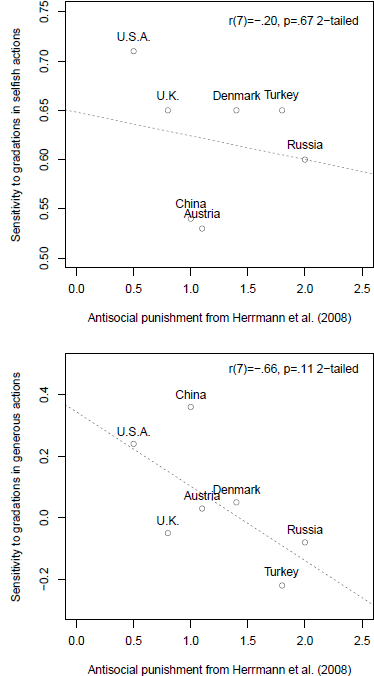
Anti-social punishment and evaluations of selfish (top) and generous (bottom) actions across cultures.
4 Discussion
Successful societies require cooperation between unrelated individuals in order to function effectively. Such prosocial behavior is encouraged, at least in part, by the reputational benefits an individual receives from being kind towards others and from the reputational costs one incurs when being unkind towards others. Those who behave prosocially earn reputations that encourage future trust and cooperation from others. Those who behave antisocially earn reputations that create distrust and avoidance. While we cannot generalize our findings to cultures and subcultures not tested here, we provide evidence for an asymmetry in these reputational costs and benefits across 7 cultures. Whereas increasingly selfish actions were judged increasingly negatively in all cultures we surveyed, increasingly selfless actions—giving progressively more to others than to the self—were not judged increasingly positively. In terms of one’s reputation, it pays to be nice, but pays no more to be really nice. These findings, while not drawing conclusions about any specific culture, were nevertheless comparable across cultures that vary on a wide range of social and economic dimensions. Moreover, prosocial actions also do not earn reputational benefits in terms of competence evaluations—in Russia, in fact, generosity led to decreased evaluations of competence.
These results replicate and extend previous findings among American participants (Reference Klein and EpleyKlein & Epley, 2014). This replication therefore addresses concerns about unjustifiably broad conclusions that could otherwise be drawn from experiments using samples from only a single culture (Reference Henrich, Heine and NorenzayanHenrich, Heine & Norenzayan, 2010). This replication also addresses recent concerns about the reproducibility of findings in psychological science (Reference Simmons, Nelson and SimonsohnSimmons, Nelson & Simonsohn, 2011), offering 7 additional exact replications of previously published results.
Despite overarching similarities across cultures in the asymmetry between evaluations of selfish and generous actions, potentially interesting cultural differences did emerge in these results. Participants in some cultures were more sensitive to gradations of selfish and generous actions than in others. Understanding why this is the case and how cultural differences in evaluations are related to cultural differences in prosocial behavior (e.g., Henrich et al., 2010) is a productive avenue for future research. For now, we tentatively raise the possibility that evaluations of prosocial actions might be related to anti-social punishment—decisions to punish extremely prosocial others (Reference Herrmann, Thöni and GächterHerrmann et al., 2008). Figure 2 plots anti-social punishment as reported by Herrmann et al. (2008) along with our participants’ sensitivity to selfish and generous actions (taken from our Table 4). Across cultures, anti-social punishment correlates negatively—but not significantly—with sensitivity to gradations in evaluations of selfish and selfless actions. This negative correlation could point to an interesting connection between judgment of others’ prosocial actions and behavior towards prosocial others. Our ability to test this possibility is limited because our data contain only 7 cultures, too small a number to establish meaningful conclusions. Future research can measure both evaluations and punishment decisions to definitively test whether the two are causally related.
Notwithstanding these possible cultural differences, the overarching cross-cultural similarities may imply that the psychological mechanisms underlying asymmetric evaluations of prosocial actions may also be relatively similar across cultures. These mechanisms may therefore be basic cognitive or affective processes that are relatively independent of culturally conditioned input. Two potential mechanisms have been documented in American samples and are potential candidates for future investigation. The first is that people are insensitive to magnitude when evaluating generous actions because selfish actions are more common and therefore can be more easily evaluated than generous actions (Reference Klein and EpleyKlein & Epley, 2014). Existing research finds that familiarity with a stimulus enables people to notice finer gradations of this stimulus (Reference Hsee and ZhangHsee & Zhang, 2010; Reference Morewedge, Kassam, Hsee and CarusoMorewedge et al., 2009). The same psychological process can apply in evaluations of prosocial actions. The second potential mechanism is the asymmetric affective consequences of prosocial and selfish actions—generous actions may not increase positive affect as much as selfish actions of the same magnitude increase negative affect (Reference Gray, Ward and NortonGray, Ward & Norton, 2014).Footnote 2 Future research is needed to test whether these mechanisms explain the asymmetric pattern of evaluations of prosocial actions across cultures.
More broadly, the nature of the reputational inferences we uncover can have important implications for understanding how reputational inferences may motivate prosocial behavior. The reputational inferences we have documented suggest strong reputational incentives for modestly prosocial and cooperative behavior because such behavior provides the maximum reputational benefit to the actor without incurring the personal cost of an extremely selfless action. Regardless of the precise psychological cause of an asymmetry in evaluations of prosociality, the functional outcome may be to create social incentives that promote cooperative behavior. Existing research emphasizes the punishment of non-cooperators as a necessary mechanism for cooperation (e.g., Balliet & Van Lange, 2013; Reference Fehr and SchmidtFehr & Schmidt, 1999). However, the cooperative behavior necessary for sustaining complex modern societies may also result from the lack of incentives for very generous prosocial actions, which in turn incentivizes actors to engage in modestly nice actions. Reputational inferences could nudge societies composed of unrelated individuals into being modestly nice, enabling the cooperation necessary for successful societies, without having to overcome the challenge of motivating people to be really nice. From an individual’s perspective, behaving in modestly prosocial ways—but not necessarily extremely prosocial ways—appears to be the most personally beneficial course of action. It pays for one’s reputation to be nice, apparently around the globe, but it does not consistently pay more to be really nice.


 Open access

