

INTRODUCTION
This article investigates the presence of women in the Augustan military base and the Flavio-Trajanic fortress on the Hunerberg in Nijmegen, the Netherlands, and explores whether it is possible to ‘gender’ certain brooch types found in the north-western provinces.Footnote 1 From historical sources we know that Augustus banned serving soldiers from entering into a legitimate marriage (matrimonium iustum) and that this ban was only dissolved by Septimius Severus two centuries later.Footnote 2 It is commonly held that at least the senior officers’ wives were allowed to live with their husbands. Historical texts, monumental inscriptions and writing tablets indicate that legates and tribunes could bring their families when serving in the provinces and could live with them inside the fortress.Footnote 3 It is less certain whether centurions could do the same, but tombstones of centurions erected by their wives or by their wives and children do point in this direction.Footnote 4
Many common soldiers maintained long-term relationships, although these unions were not legally recognised and any resulting children were illegitimate.Footnote 5 There is no historical or epigraphic evidence, however, of common soldiers living with a partner inside a fortress. Of course, as Simon James points out, ‘non-combatants were intimately integrated into the life of soldiers and regiments, in a variety of capacities’.Footnote 6 As such, we should not equate women living in or visiting a fortress solely with military wives or partners. For example, soldiers may have been accompanied by their widowed mothers, minor siblings or unmarried female relatives,Footnote 7 and some soldiers may also have owned female slaves.Footnote 8 Finally, independent female sutlers and craftswomen may have lived either in the fortress or in a nearby settlement, being allowed access to particular areas of the camp at particular times only.Footnote 9
Relatively recently, there has been a spate of publications and conference sessions on the way in which archaeology can help us identify the presence of women in Roman forts. The debate seems to be centred to a large degree on Roman Britain, with one notable exception being Penelope Allison's work on the forts and fortresses of the German frontier area.Footnote 10
The purpose of this paper is twofold. Firstly, it provides a brief critical review of previous works that aim to identify women in military contexts and, secondly, it examines the Nijmegen assemblage to investigate the presence of women in the Augustan and Flavio-Trajanic military bases on the Hunerberg. The methodology (in terms of both gendering brooches and exploring deposition on military sites) is of relevance to scholars of Roman Britain, where many of the same brooch types occur.
ARCHAEOLOGICAL INDICATORS FOR WOMEN IN FORTS AND FORTRESSES
Much of the recent debate has been focused on the distribution and interpretation of gendered finds in and around Roman forts and fortresses. These gendered artefacts can be divided into three main categories: female- and child-sized footwear, infant burials and gendered small finds such as hairpins and spindle whorls.
One of the earliest contributions to the debate was made by Carol van Driel-Murray, who argued for Roman camp-concubinage based on the find of female-sized footwear in a barrack building at Vindolanda. As an explanatory model, she used the nineteenth-century Royal Netherlands East Indies Army, which banned common soldiers from marrying but did condone them living with local Indonesian concubines or so-called ‘housekeepers’.Footnote 11 Elizabeth Greene continued this line of research, examining a larger sample of shoes from Vindolanda and placing these in a framework of evidence for the presence of women in auxiliary forts in the north of Britain and along the German limes.Footnote 12 Greene's research also extended to the Dutch part of the frontier, although her focus was on the waterlogged sites in the west of the country and Valkenburg in particular, which have yielded large numbers of leather objects. Nijmegen, with its sandy soil being unfavourable to the preservation of organic materials, was not included.
Infant burials in fort interiors have also been used as evidence for the presence of children, and by extension women, in Roman forts, but such finds are quite rare. Infant burials have been found at South Shields,Footnote 13 Vindonissa (Windisch, Switzerland)Footnote 14 and Ellingen (Germany),Footnote 15 although the context of the latter find is questioned by some, as discussed below.
On most sites, small finds tend to be more numerous than the previous two categories of evidence, which is why these have featured in many studies into the presence of women in Roman military bases.Footnote 16 For example, spindle whorls, hairpins, needles, nail cleaners and tweezers are often seen as indicators for the presence of women. For some of these gendered objects, like decorated hairpins, we can assume that this attribution will be correct in most cases.Footnote 17 For other objects, like needles, nail cleaners and tweezers, however, this is less certain. As Lindsay Allason-Jones points out, Roman soldiers surely also needed to mend their clothes, clean their nails and remove splinters. As an example, she makes a comparison to World War II British soldiers, who were issued with sewing kits to do simple repairs such as reattaching buttons.Footnote 18 Interestingly, some also argue that in the late Roman period tweezers were typically military items, as they have been found attached to military belts.Footnote 19
An important critique of many studies on this topic is that the gendered artefacts used as evidence for the presence of women are often unstratified finds or have been recovered from secondary layers or fills unrelated to the occupational phase of the fort. For example, Nick Hodgson points out that the barrack building at Vindolanda no longer served that function when the aforementioned female-sized shoes were deposited, since the frontal colonnade had been walled up by that time.Footnote 20 Marcus Reuter suggests that the shoes, along with other rubbish, may have been imported from elsewhere as levelling material.Footnote 21 Similarly, Hodgson points out that the infant burials from Ellingen, also noted above, were linked to the barracks through their spatial distribution only, but that there was no clear stratigraphical connection to the building. As there was no destruction or demolition deposit, it is unknown whether human occupation of the site ceased when the fort was abandoned.Footnote 22 As such, the infant burials could very well have been deposited after the troops had left. Thomas Becker raises the same issue, stating that ‘GIS-based mapping of small finds always omits the third dimension’, i.e. whether these finds were actually lost and deposited at the spot where they were eventually recovered or whether they were transported there from elsewhere through some post-depositional process.Footnote 23
Given that many of the finds used as evidence for the presence of women in forts and fortresses are unstratified, Hodgson concludes that for Britain there are virtually no indications of women living in barracks, adding that it is doubtful that future study of the available find assemblages could ever change the paucity of evidence.Footnote 24 Others take a less pessimistic view. Andrew Birley, for example, who studied more recent finds from Vindolanda for which solid contextual information is available, concludes that there is a clear spatial patterning within the fort barracks of activities related to non-combatants, such as the deposition of beads, spindle whorls and bracelets.Footnote 25 Becker also feels that rethinking the presence of women in Roman forts is worthwhile, but emphasises that it is imperative that a careful and well-grounded assessment of the methods is undertaken in order to ensure that conclusions are sound.Footnote 26
The reality is that unstratified finds are often all we have available to work with. In such cases, it is especially important to assess properly the strengths and weaknesses of these objects as evidence. This paper discusses both stratified and unstratified finds. I have made an effort to take into account the contexts of the finds and have, when relevant, included these in my discussion.
METHODOLOGY AND SELECTION OF FINDS
In this article I use the spatial distribution of female-associated brooches to investigate the presence of women in the Augustan and Flavio-Trajanic fortresses on the Hunerberg. I have chosen to focus on brooches, because these are the most numerous type of gendered artefact from the research area.Footnote 27
As we can expect to find military (male) brooches in significant numbers in a military complex, their distribution can act as a background against which to plot the distribution of the female-associated brooches. For this reason, female-related brooches will be mapped alongside those linked to military personnel. This is important methodologically, to assess whether any potential spatial or contextual associations are the result of some areas being more intensively excavated, or of features with better metal preservation and recovery, or of areas of ancient deposition.
In the following, I present an overview of the brooch types selected for the study. For each type a critical overview is given of the arguments that have been used in the past to identify it as either a female or a military type. This has sometimes been done in very general terms, identifying entire groups of brooches as either male or female based on assumptions around construction elements or cultural-dress traditions. There has also been a strong thread of scholarship focused on gendering individual brooch types using burial evidence. When possible, I examine the presence of these brooch types in burial assemblages for which anthropological evidence is available regarding the sex of the individual. Anthropological evidence is drawn largely from two cemeteries: the Museum Kamstraat cemetery at Nijmegen and the cemetery at Krefeld-Gellep (Germany). The Museum Kamstraat cemetery is particularly relevant because of its proximity to the Hunerberg fortresses (see figs 1.3 and 3), while the Krefeld-Gellep cemetery is one of the largest cemeteries in the northern Empire that has been published in detail and for which anthropological evidence is available.
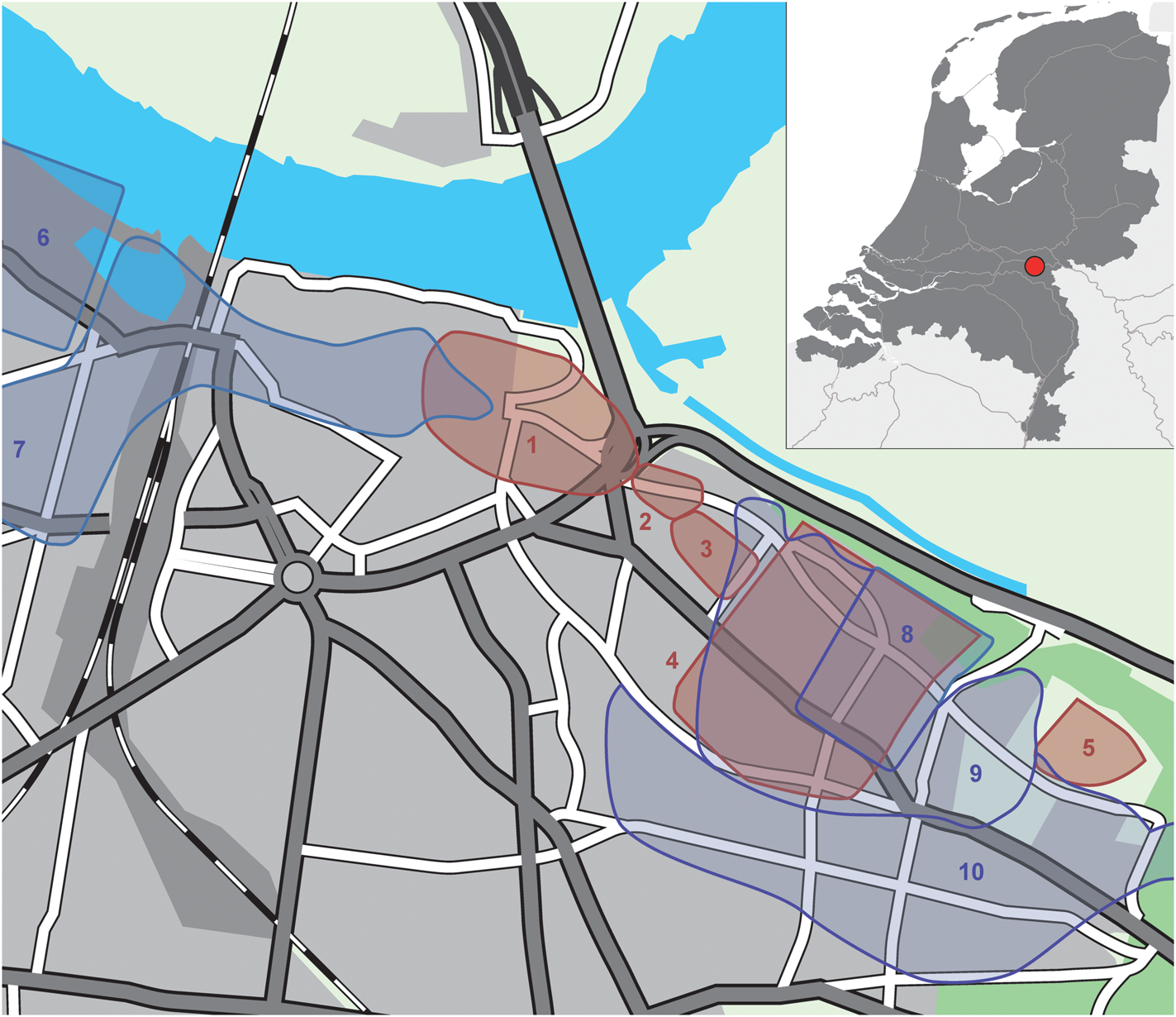
The main early and middle Roman archaeological complexes on the Hunerberg and the Kops Plateau. 1–5: pre-Flavian. 1: Oppidum Batavorum; 2: Trajanusplein fort; 3: cemetery; 4: Augustan military base; 5: Kops Plateau fort. 6–10: Flavian and later. 6: Ulpia Noviomagus; 7: cemetery; 8: legionary fortress (castra); 9: extramural settlement (canabae legionis); 10: cemetery (adapted from van Enckevort and Heirbaut Reference van Enckevort and Heirbaut2010, figs 29, 151).
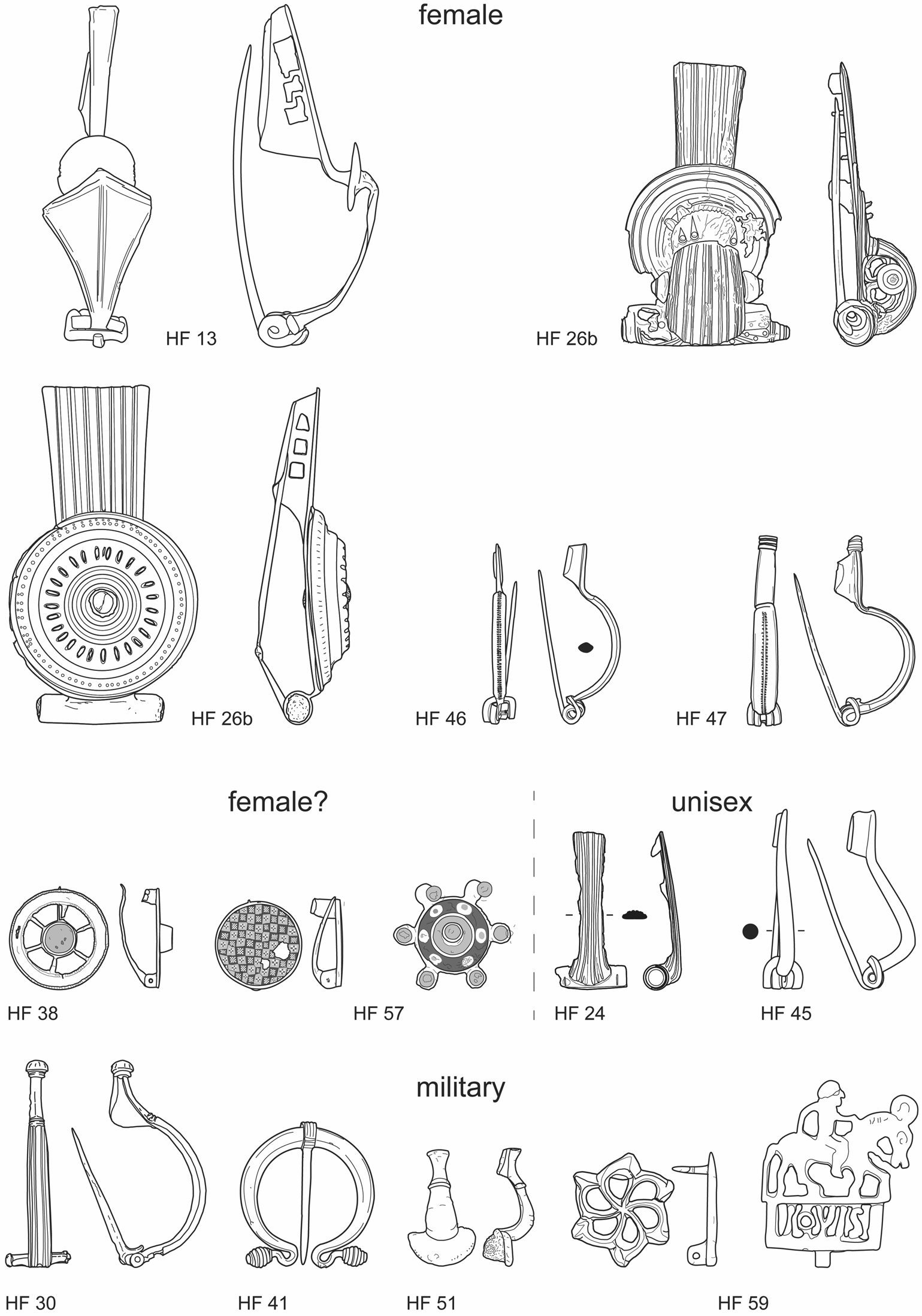
Overview of the ‘female’, ‘possible female’, ‘unisex’ and ‘military’ brooch types listed in table 1 (drawings after Heeren and van der Feijst Reference Heeren and van der Feijst2017; with permission of the authors).
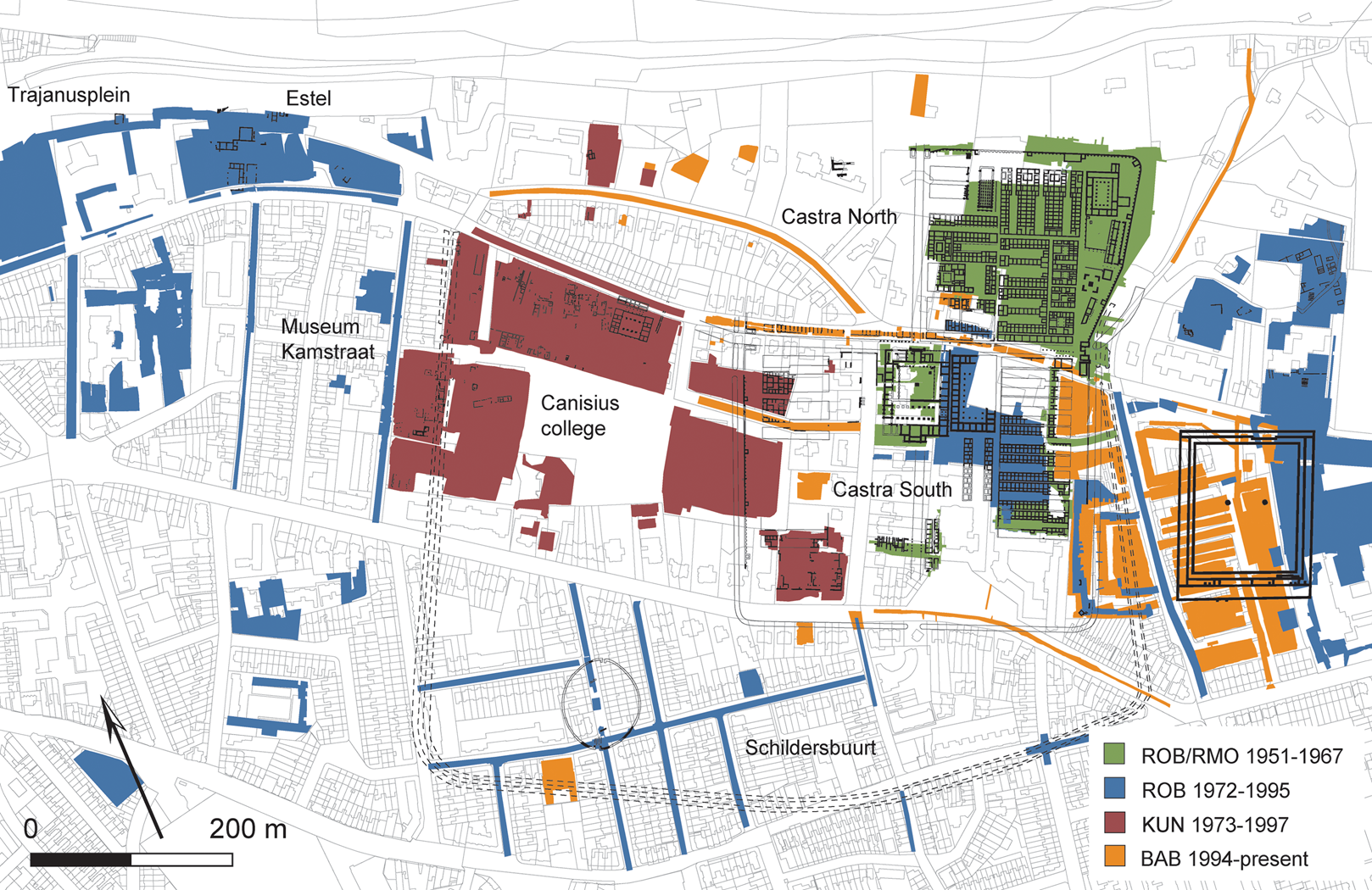
Excavations on the Hunerberg at Nijmegen, with the main toponyms used in the excavation reports. The main Flavio-Trajanic structures are shown, as well as the defensive ditch of the Augustan military base (dotted line).
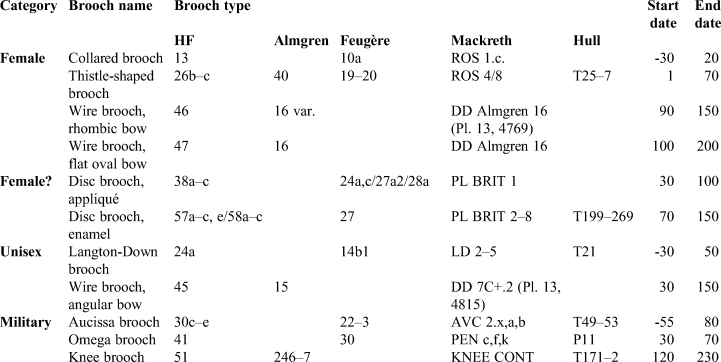
On the basis of the available evidence I have labelled the selected brooch types as ‘female’, ‘female?’, ‘unisex’ or ‘military’. This information is summarised in table 1. This table also provides a concordance of the typologies used in Britain and on the Continent, bridging the gap between two different research traditions. It should be noted, however, that the start dates and end dates of the brooches mentioned throughout this paper are those relevant for the Germanic provinces and may differ from those used for Britain.
CONCORDANCE TABLE OF THE EARLY AND MIDDLE ROMAN BROOCH TYPES DISCUSSED.
Abbreviations can be found at the start of the bibliography. The start dates and end dates presented here are those relevant for the Germanic provinces; they may differ from those used for other parts of the Empire, including Britain.
RESEARCH AREA
Before turning to a description of the selected brooch types, it is useful first to summarise briefly the occupational history of the research area and Roman Nijmegen in general. The research area is located on the Hunerberg in Nijmegen, on a plateau raised 25–45 m above the river plain to its north and separated from it by a steep natural slope. Roman activity goes back as far as the Augustan period, when a large operational base was situated here (fig. 1.4), serving as a springboard for campaigns across the Rhine. Coin finds indicate that this early base was in use between c. 19 and 16/12 b.c.Footnote 28 Perhaps a small maintenance crew resided in the camp for a brief time thereafter, but by the middle of the first century a.d. the eastern ditch no longer had a defensive function.Footnote 29
After the camp on the Hunerberg had been abandoned, around 10 b.c. a new military post was built on the Kops Plateau, immediately east of the research area (fig. 1.5). Additionally, smaller encampments were built to the west of the former Augustan base between a.d. 10 and 20 (fig. 1.2). The research area encompasses one other largely pre-Flavian complex: the Museum Kamstraat cemetery (fig. 1.3). This cemetery may have been in use throughout the first century a.d.,Footnote 30 but had a strong floruit between a.d. 10 and 70.Footnote 31
After the Batavian Revolt of a.d. 69/70, the Kops Plateau fort was abandoned and a new legionary fortress (castra) was built on the Hunerberg (fig. 1.8). It was built in the north-eastern part of the former Augustan military base and was less than half its size. At some point after a.d. 70, a civil settlement started to develop around the fortress, usually referred to as the canabae legionis (fig. 1.9). The Museum Kamstraat cemetery and the Trajanusplein fort to its west were each built over during this time. Both the legionary fortress and its civil settlement were abandoned probably somewhere around a.d. 125–30.Footnote 32
In this paper, brooches from three of these complexes will be discussed: the Augustan military base (fig. 1.4), the Flavio-Trajanic fortress (fig. 1.8) and its extramural settlement (fig. 1.9).
FEMALE BROOCHES
In the past, several brooch types have been interpreted as female dress accessories. Generally speaking, there are two main arguments for a gendered interpretation of a particular brooch type: its construction and its occurrence in sexed burial assemblages. Each argument will be discussed in turn. For greater ease of understanding, British typological information is provided alongside the typologies more commonly used on the Continent (see table 1). It should be noted again, however, that the chronological information presented in this article is applicable to the Netherlands and may differ somewhat from the dates relevant for Roman Britain.
CONSTRUCTION AND DRESS TRADITIONS
Most researchers specialising in Roman dress or brooches in particular agree that there is a difference in the way that brooches were worn by men and women. The cloak worn by men was fastened with a single brooch on the right shoulder, while women's clothing required two, one on each shoulder. Sometimes a third brooch was used to close the neck opening.Footnote 33 There is some evidence that men of Germanic origin occasionally may have worn sets of brooches as wellFootnote 34 (discussed in more detail below). On the whole though, we can assume that in Germania Inferior women wore two or three brooches, while men wore only one.
This distinction has led some to argue that, as the heavy cloak worn by men was fastened by a single brooch, this brooch needed to have a large space between the pin and the body in order to hold the folds of fabric. As women wore lighter fabrics fastened by multiple brooches, these did not need as much space between the pin and the body.Footnote 35 Thus, larger bow brooches with ample room between the pin and the body would have been worn exclusively by men. Smaller bow brooches and disc brooches with little room between the pin and the body, on the other hand, would have been worn by women. Sculptural evidence, however, clearly shows that disc brooches were also worn by soldiers and high-ranking officials from at least the Flavian period onwards.Footnote 36
Allison differentiates between disc brooches that are enamelled or decorated with other metal decoration or coating, which she considers female, and undecorated disc brooches, which she considers possibly female.Footnote 37 However, the belts worn by Roman soldiers were often very lavishly decorated with enamel, niello, tinning or silvering,Footnote 38 and the presence of such decoration on a brooch is therefore not enough to label it as solely female. For the purpose of this study, I have therefore chosen to include disc brooches decorated with appliqué or enamel, but to label them as ‘female?’.
Another argument concerns the presence of an eyelet on the brooch head. The two shoulder brooches worn by women were connected sometimes by a small chain, and some brooches feature an eyelet for attachment to such a chain. It has been argued that all brooches with an eyelet, even if the chain is no longer present, can be considered female brooches.Footnote 39 Others, however, have pointed out that these eyelets could also have been used to fasten the brooch to the fabric, so that the cloak could be put aside leaving the brooch tied to the garment. This practice of leaving the brooch fastened to the cloak when not worn is attested in sculpture.Footnote 40 As this would apply to both women and men, the presence of an eyelet cannot be considered unequivocal proof that a particular brooch was worn by a woman.Footnote 41 Brooches with eyelets therefore are not included in this study.
FEMALE BURIAL ASSEMBLAGES
Some brooch types appear predominantly in female burial assemblages and are therefore considered to have been worn mostly by women. However, as we will see, the majority of the burial assemblages identified as female have not been sexed on the basis of the anthropological remains. Instead, most are interpreted as such on the basis of gendered burial gifts or the presence of sets of brooches, as this is considered a female dress tradition (see above). There is also a complication in that for cremations there is often poor information on any distinction between (primary, often scorched) pyre goods and secondary (unburnt) grave goods, both of which could be gifts made by mourners rather than a direct reflection of the identity of the buried individual.
For the Museum Kamstraat cemetery on the Hunerberg (see figs 1 and 3 for its location), anthropological evidence is available regarding the sex and age of many of the cremation burials.Footnote 42 The same is true for the cemetery at Krefeld-Gellep. In the following sections, I critically discuss those brooch types that are most commonly cited in the literature as female. These are the thistle-shaped brooch, collared brooch, the wire brooches Almgren 15 and 16 and the Langton-Down brooch. The quality of the arguments to label them as female dress accessories will be considered and, whenever possible, these will be discussed in relation to the sexed grave evidence from the two cemeteries at Nijmegen and Krefeld-Gellep. The results are summarised in table 1.
The thistle-shaped brooch (Distelfibel) is commonly cited to be found almost exclusively in female graves and is therefore often considered the typical female brooch of the first half of the first century a.d.Footnote 43 However, Astrid Böhme-Schönberger points out that at Miesau and Diersheim (south-western Germany), as well as outside the Roman Empire, pairs of thistle-shaped brooches have been found in Germanic weapon burials. The presence of weapons is taken as evidence that these were male burials.Footnote 44 Böhme-Schönberger therefore argues that thistle-shaped brooches were occasionally worn by Germanic men, but that in the western provinces of the Roman Empire they were worn predominantly by women.Footnote 45 There is evidence that at Nijmegen the thistle-shaped brooch was worn more commonly, although perhaps not exclusively, by women. Five of the burials from the Museum Kamstraat cemetery contain thistle-shaped brooches. On the basis of the human remains, one is certainly female, one is probably female, one is possibly female and one is possibly male.Footnote 46 The first two burials each contain three thistle-shaped brooches with a flat plate (type HF 26c), the third again contains a brooch of type HF 26c and one of unknown type. The possibly male burial contains two pairs of thistle-shaped brooches, which seems more in line with a female burial.Footnote 47 Finally, the fifth burial containing a thistle-shaped brooch comprised the remains of four individuals, one probably male, one probably female and two children of unidentified gender.Footnote 48 Evidence for thistle-shaped brooches at Krefeld-Gellep is limited. One burial contains a pair of thistle-shaped brooches, but the sex of the remains could not be determined.Footnote 49 The presence of a pair of matching brooches would suggest a female burial.
Overall, the majority of the evidence suggests that thistle-shaped brooches were much more commonly worn by women than men. For this study, I have therefore labelled the type as female.
According to Böhme-Schönberger, the so-called collared brooch (Kragenfibel) seems to have been worn by both men and women in its late La Tène and pre-Roman form. In its Roman form, however, she states that it was worn predominantly by women. Collared brooches have been found in burial assemblages in sets of two or three. These assemblages sometimes also contain other probably female grave goods such as mirrors. Böhme-Schönberger therefore argues that for the Roman period collared brooches can be considered female.Footnote 50 Only one burial from the Museum Kamstraat cemetery contains a single collared brooch, but the human remains could not be sexed as they belong to an infant.Footnote 51 No brooches of this type were found at Krefeld-Gellep. As more recent evidence is scarce, I have followed Böhme-Schönberger's research and labelled this brooch type as female.
The simple wire brooch with angular bow, Almgren 15, has been known commonly as the Soldatenfibel or soldier's brooch since the early twentieth century. This is because wire brooches are common finds in the forts and fortresses along the limes, which were then the major focus of excavation. Research in the last few decades has shown that the Almgren 15 occurs in vast numbers at every site type, including cities and rural settlements. Accordingly, it is no longer maintained in academic literature that these brooches were worn exclusively by soldiers, although, confusingly, the name has stuck.Footnote 52
Some go even further and argue that the wire brooch with angular bow was worn exclusively by women, as they are frequently found in sets of two or three in burial assemblages. Stijn Heeren and Lourens van der Feijst specifically list graves in Tönisvorst, Krefeld-Gellep (Germany) and Thuin (Belgium). With the exception of Krefeld-Gellep (see below), most of the examples provided seem not to have been sexed by anthropological means.Footnote 53 One of the cremation burials at the Museum Kamstraat contains a single brooch of this type. It belonged to a female aged 23–40.Footnote 54 Several burials at Krefeld-Gellep contain brooches of type Almgren 15. The human remains of four of these burials can be sexed as probably female and one as probably male. One burial contained the remains of both a male and a female, while five more belonged to children of unidentified sex.Footnote 55 Twelve otherwise unsexed burials also contain sets of Almgren 15 brooches, suggesting that these are female burials.Footnote 56
The burial evidence suggests therefore that the Almgren 15 brooch was worn more commonly by women. It seems unlikely, however, that it was worn exclusively by women when we consider that it is by far the most common brooch type in the Netherlands. It makes up 18 per cent of Heeren and van der Feijst's datasetFootnote 57 and 27 per cent of all Roman brooches recorded in the online database of the Portable Antiquities of the Netherlands (https://www.portable-antiquities.nl).Footnote 58 This makes it much more likely that it was worn by women and men, soldiers and civilians alike. It could thus be argued that this brooch type should be excluded from this study, but I have chosen to include it and label it as ‘unisex’. I have done so for two reasons. Firstly, as this type is particularly numerous it can serve as a background to the other, more securely gendered brooches. This will hopefully make it possible to distinguish between primary distribution patterns and patterns caused by, for example, better or worse preservation of metal objects in certain areas. Secondly, comparing its distribution to that of brooch types more certainly associated with either women or soldiers may lend additional weight to the argument of labelling it as unisex.
The wire brooch Almgren 16 has long been considered the contemporary female equivalent of the so-called Soldatenfibel.Footnote 59 While we now know that the original interpretation of the latter is incorrect, most scholars still agree that the Almgren 16 was worn exclusively by women.Footnote 60 This is because, again, they are frequently found in sets of two or three in burial assemblages.Footnote 61
No Almgren 16 brooches were found in the Museum Kamstraat cemetery that could provide additional evidence for this conclusion. At Krefeld-Gellep, only one burial containing an Almgren 16 brooch could be sexed with certainty as female.Footnote 62 Three other burials were identified as possibly maleFootnote 63 and a further two belonged to a child and two adolescents of unidentified gender.Footnote 64 Two burials could not be sexed by their human remains, but one contained a matching pair of Almgren 16 broochesFootnote 65 and one contained an Almgren 16 brooch paired with an Almgren 15,Footnote 66 which would suggest that these were female burials. If we exclude the three uncertain male burials, we are left with one certain female burial and two burials that are probably female on the basis of the presence of a pair of brooches. It would seem therefore that the Krefeld-Gellep assemblage does not contradict the interpretation of the Almgren 16 being a female brooch, even if it does not unequivocally bear it out either. For the purpose of this study, I have therefore labelled this brooch type as ‘female’.
Langton-Down brooches are also often, although not exclusively, found in female burials.Footnote 67 In the Museum Kamstraat cemetery, three Langton-Down brooches were found with cremation remains that could be sexed. The first was found with the remains of a possible female aged between 23 and 40.Footnote 68 This burial contained only one brooch, rather than the expected two or three. Two other Langton-Down brooches were found, along with an eye brooch (Augenfibel) and a Hod-Hill brooch (Scharnierfibel mit ungeteiltem Bügel), in a double burial belonging to a certain male of 20–30 years and a possible female of 19–28 years.Footnote 69 It is tempting to attribute the two Langton-Down brooches to the female, although this cannot be said with certainty. No Langton-Down brooches were found at Krefeld-Gellep.
At the King Harry Lane cemetery at Verulanium (St Albans), the numbers seem fairly evenly split. Four burials containing Langton-Down brooches were found with human remains that could be sexed.Footnote 70 One burial of a possible female contained three Langton-Down brooches,Footnote 71 while another burial of a possible female contained a single brooch of this type.Footnote 72 One burial of a certain male contained one Langton-Down brooch,Footnote 73 while a burial of a possible male contained two.Footnote 74
Of special note in this discussion is an inhumation burial from West Thurrock of a certain male aged over 50 which contained an uncommon variant of the Langton-Down brooch similar to the Feugère 14b1a, together with four other brooches. The Langton-Down brooch had been placed, open and upside down, on a terra sigillata platter together with two other brooches treated in the same way. They had probably been stuck into a piece or bundle of fabric/garment which had then been placed on the platter in this way.Footnote 75
In conclusion, the evidence suggests that the Langton-Down brooch was worn by women and men alike. For the same reasons as for the Almgren 15 brooch discussed above, I have chosen not to discard it from the analysis, but to label it as ‘unisex’.
MILITARY BROOCHES
The distribution of female brooches gains more meaning when it is compared to the distribution of an opposing category, in this case military (male) brooches. As we can expect to find military brooches in significant numbers in a military complex, their distribution can act as a background image on which we can map brooches associated with women. This can not only inform us about the spaces in forts that women moved in, but also flag areas where post-depositional processes have had a bigger impact on distribution and the overall number of finds.
Below, the most commonly cited military brooch types for the Augustan and Flavio-Trajanic periods will be discussed in much the same way as the female brooches, above. This is done in a more succinct manner, however, for two reasons: first of all, the military brooches are not the focus of this article's research questions. Secondly, identifying military burials is much more difficult than identifying gender, because for this period it was less common for soldiers to be buried with military equipment. The military connotation of the brooches described in this section will therefore rely more heavily on site context.
As we have seen, the Soldatenfibel Almgren 15 should no longer be classified as a military brooch. That does not mean, however, that there are no brooches with a strong military association. For this study, the Aucissa brooch, the knee brooch and the Omega brooch have all been labelled as ‘military’.
The Aucissa brooch is generally considered the typical military brooch of the early Roman period. Although Aucissa brooches are also found in towns and rural settlements, it has been noted that in forts and fortresses in Germany and the Netherlands they often represent a very large proportion of all brooches, up to 64 per centFootnote 76 or even 80 per cent.Footnote 77 The military connotation of the Aucissa brooch holds true for Britain as well, although there they are also quite common finds in urban centres and even smaller rural sites.Footnote 78 Perhaps the occurrence of military Aucissa brooches in towns can be related to the practice of billeting soldiers in civilian dwellings. A similar explanation has been hinted at for the presence in Roman towns of items more directly identifiable as military equipment, such as scabbard- and belt-fittings.Footnote 79
The knee brooch (Kniefibel) has long been associated with the Roman army and particularly with Germanic (auxiliary) troops, as it is often regarded as a Roman development of a northern Germanic type.Footnote 80 For Britain, Hella Eckardt has shown that there is a strong association between the knee brooch and military sites. This association is considerably more marked than for the Aucissa brooch, although, again, knee brooches are not exclusive to military contexts.Footnote 81
The Omega brooch, a type of penannular brooch, originated on the Continent, perhaps on the Iberian peninsula,Footnote 82 and later reached Britain from Gaul.Footnote 83 It has a very long period of use ranging from the Iron Age well into the late Roman period.Footnote 84 Late Roman examples can usually be distinguished from earlier ones, as they tend to be larger and are also often executed in silver. In the Netherlands, Omega brooches can usually be dated to between a.d. 30 and 70.Footnote 85 Due to the possible Iberian origin of the brooch, they are regarded by some as evidence for Roman troops with an Iberian background.Footnote 86 No Omega brooches are known from the Museum Kamstraat cemetery, but one was found at Krefeld-Gellep. It comes from a horse burial dated to the period of the Batavian Revolt,Footnote 87 which may perhaps support the military character of this brooch type.
A COMPARISON OF TWO ASSEMBLAGES
Turning to the distribution of the selected brooch types across the research area, I will now compare the ratio of female to military brooches in the Augustan (c. 19–16/12 b.c.) military base and the Flavio-Trajanic (c. a.d. 70–104/125) legionary fortress and its extramural civil settlement on the Hunerberg. To do so, I will analyse the assemblages of two large-scale excavations. These excavations, which will be referred to as ROBFootnote 88 and KUNFootnote 89 (see fig. 3), both have an Augustan and a Flavio-Trajanic phase. For the Augustan phase, both excavations concern the same large military base. For the Flavio-Trajanic period, ROB corresponds to the legionary fortress and KUN to the extramural civil settlement.
To compare the two assemblages, I compiled lists of brooch types for each phase (Augustan and Flavio-Trajanic) for each excavation, resulting in four separate lists.Footnote 90
Many of the brooch types have circulation dates that extend beyond these two phases. Therefore, if a brooch could not be dated by its context, I used the following method to attribute it to one of the phases. Brooches with an initial date before 12 b.c. and an end date before a.d. 70 were attributed to the Augustan phase. Their end date precludes them from belonging to the Flavian period and, as there was fairly limited activity in the area between the Augustan and the Flavio-Trajanic periods, these brooches will most likely have been deposited in the Augustan period. On the other hand, brooches with an initial date after 12 b.c. and an end date after a.d. 70 were attributed to the Flavio-Trajanic phase. These brooches did not circulate during the Augustan occupational phase but did in the Flavio-Trajanic period. Again, as there was only limited activity in the area between the Augustan and the Flavio-Trajanic periods, these brooches most likely belong to the latter. I excluded the very few post-Trajanic brooches from the dataset, as well as fragments that could not be dated. I then compiled tables for both phases, comparing the numbers of female and military brooches (tables 2 and 3).
‘FEMALE’, ‘UNISEX’ AND ‘MILITARY’ BROOCHES FROM THE AUGUSTAN MILITARY BASE FOUND DURING THE ROB AND KUN EXCAVATIONS

‘FEMALE’, ‘POSSIBLE FEMALE’, ‘UNISEX’ AND ‘MILITARY’ BROOCHES FROM THE FLAVIO-TRAJANIC PERIOD

It should be noted at this point that the date of the military Aucissa brooch is somewhat problematic. The long date range of this type means that it could belong to both the Augustan and the Flavio-Trajanic phases. However, Heeren, who studied the brooches from the KUN excavations, suggests that the Aucissa brooches from this complex can perhaps be dated to the first half of the first century a.d.Footnote 91 For the purpose of this study, I have included the Aucissa brooches in the tables of both phases, other than three examples that could be assigned to the Flavio-Trajanic phase by their context. However, even in these cases the original date of deposition is not entirely beyond doubt. A brooch from a Flavio-Trajanic feature that cuts an older one may seem to be linked to the former period, although it may originally have been deposited in the latter.
Within the assemblage of the Augustan military base (table 2), only one female brooch occurs: a collared brooch. Another six brooches, all of Langton-Down type, have been labelled as ‘unisex’. The 14 military Aucissa brooches represent 18.4 per cent of the assemblage. It should be mentioned, however, that some of these may in fact be post-Augustan in date.
In comparison, the proportion of female brooches for the Flavio-Trajanic legionary fortress (table 3) is slightly higher, although still modest at 5.1 per cent. The unisex brooches are disregarded for now but will be discussed later. Augustan burial evidence is comparatively scarce compared to that for later periods, which means that specialists have not been able to attribute a gender to many of the earlier brooch types. The discrepancy in the number female brooches between the two periods may therefore be (partially) the result of limited evidence for the Augustan period, rather than an increase in the number of women present in the Flavio-Trajanic period.
One could also argue, however, that during the conquest period civilians were more strictly excluded from the military domain than in the Flavio-Trajanic period, when the military situation is likely to have been more stable. Conversely, the argument could also be made that if any civilians travelled with the army during the early conquest period, they would have to have been housed inside the camp, as there would have been no surrounding housing facilities. If the latter is assumed, one would expect the percentage of female brooches in the Augustan base to be substantially higher.
For the Flavio-Trajanic period, another thing to notice is that the percentage of female brooches is not that much higher for the civil settlement than for the fortress (8.4 and 5.1 per cent, respectively). One would expect this difference to be more substantial. It should be kept in mind, however, that the ROB fortress assemblage is relatively small, so this observation should perhaps not be given too much weight. Another thing to notice is that possibly female disc brooches are a rarity on the Hunerberg. None was found inside the fortress, while only six were found in the settlement, representing just 1.7 per cent of the assemblage.
The difference between the percentages of military brooches for the fortress and the civil settlement is much more pronounced. Two types of military brooches were found: the Aucissa and the Omega. Combined, these represent 24.2 per cent of the fortress assemblage, but only 2.4 per cent of the extramural assemblage.Footnote 92
The legionaries clearly were not restricted to the confines of the fortress and could visit the civil settlement to purchase food and other goods, to visit local taverns and so on. What the locations of the brooches suggest, however, is that they did spend the majority of their time inside the fortress. It should be remembered, however, that not all the Aucissa brooches necessarily belong to the Flavio-Trajanic phase. Thus the true difference between the fortress and the settlement may not, therefore, be as marked as it appears here.
It could be suggested that the presence of military brooches in the civil settlement might be related to the production of these brooches. There is ample evidence for metalworking in the canabae in the form of large amounts of slag, crucible fragments and some semi-finished copper-alloy objects,Footnote 93 although no semi-finished brooches are known from the area. It seems more likely, therefore, that the military brooches in the civil settlement were lost or deposited by visiting legionaries.
Another observation is that the unisex wire brooch with an angular bow (HF 45/Almgren 15) is by far the most numerous brooch type in both the fortress and the civil settlement. The argument that this type was worn by soldiers and civilians alike, including women, is reflected by the fact that more than half (53.4 per cent) of the brooches from the Nijmegen legionary fortress are of this type. Even if we halve this number – as it is generally held that women wore two brooches, while men wore only one – their proportion is still higher than that of the military Aucissa and Omega brooches combined. This, as well as the overall ubiquity in the Netherlands of the wire brooch with angular bow, should be sufficient evidence to label it as unisex.
SPATIAL DISTRIBUTION OF FEMALE AND MILITARY BROOCHES
A more detailed analysis of the spatial distribution of the finds was made to see if any significant patterns could be discerned within the Augustan base, the Flavio-Trajanic fortress and its settlement. For this analysis, I plotted the selected female, unisex and military brooches in GIS, differentiating between the Augustan and the Flavio-Trajanic phases. In addition to the brooches from the ROB and KUN excavations described above, I also included brooches from other published excavations.Footnote 94 The finds from the Museum Kamstraat cemetery mentioned earlier were not included, as most of the burials are not contemporaneous with either phase.
Starting with the Augustan phase again, it should be noted that the overall number of finds is very limited. We should not, therefore, attribute too much significance to the resultant map (fig. 4), as the distribution of the finds is likely to have been influenced by post-depositional processes. However, it is possible to make some general observations.
Distribution of the Augustan brooches identified as ‘female’ (red), ‘unisex’ (light blue) and ‘military’ (dark blue) across the Augustan military base and its immediate vicinity. Excavation trenches are indicated in grey.
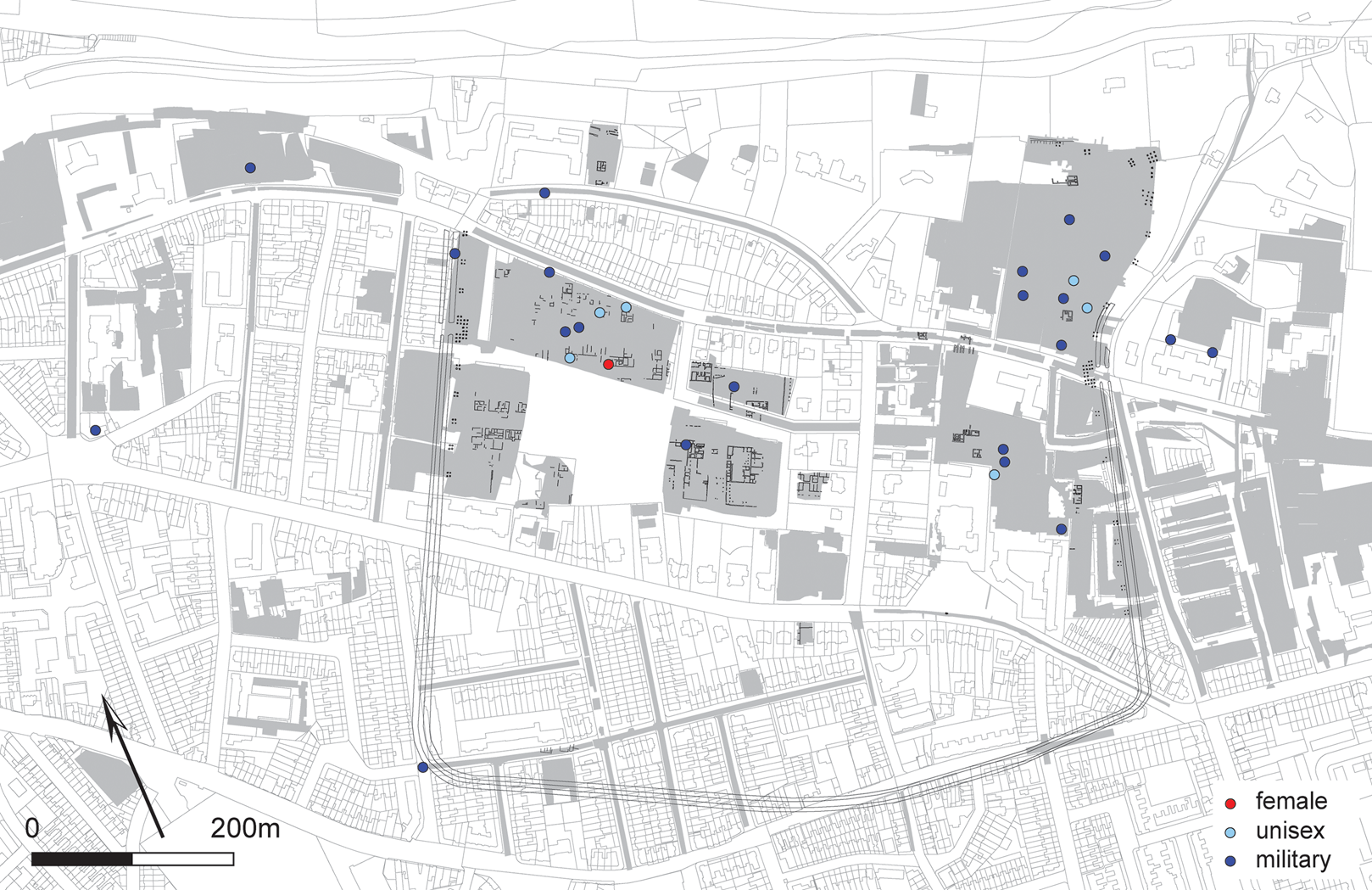
First of all, we see that the collared brooch, the only female brooch dated to this period, was found at the location of a rectangular structure that was most likely the centurion's quarters of a partially preserved barracks block to its north.Footnote 95 There is no direct relation between the brooch and the structure, as the brooch was recovered from the topsoil when the excavation trench was opened. It is tempting to interpret the brooch as belonging to a female member of a centurion's household, although this can remain no more than a suggestion given the find context. However, as the brooch was found well within the confines of the camp (approximately 150 m from the western gate), it may be an indication of female presence in the Augustan base, even when taking into account some post-depositional movement in the topsoil.
Given their small number, the unisex Langton-Down brooches seem to be fairly evenly distributed across the research area. However, they are noticeably absent from the two large courtyard buildings in the central area of the Augustan base, as are female brooches. It is unclear whether the building on the right should be interpreted as the commander's residence (praetorium) or whether it was, like the building next to it, part of the lodgings for the higher-ranking officers below the level of commander.Footnote 96 In any case, as it is generally accepted that senior officers were allowed to live with their wives, this would be the place to expect female brooches. The absence of female or unisex brooches seems to be caused by poor preservation of finds in this area generally, rather than by any primary deposition patterns. This can be suggested on the basis that the overall number of finds from this area is very small compared to those from the surrounding excavation trenches.Footnote 97
Like the Langton-Down brooches, the military Aucissa brooches are also distributed fairly evenly across the research area.
For the Flavio-Trajanic period two things are immediately obvious (fig. 5). Firstly, there are considerably more Flavio-Trajanic finds than Augustan ones and, secondly, they are distributed far from evenly across the research area. The latter is not just true for brooches, but for finds of almost all categories, and this can be explained to a large degree by differences in excavation techniques and collection strategies between the older excavations in the fortress and the more recent ones in the civil settlement. The legionary fortress was excavated before the widespread use of metal-detecting and the topsoil was not as thoroughly searched for finds as is common today.Footnote 98 Conversely, during the KUN excavations in the western settlement, particular emphasis was placed on the use of metal-detectors at all stages of the fieldwork and on the systematic collection of finds, including those from the topsoil.Footnote 99 Within the fortress, the brooches tend to cluster to the east. This appears to be the result of a larger excavated surface area and better preservation of the finds and features in this part of the fortress.Footnote 100
Distribution of the Flavio-Trajanic brooches identified as ‘female’ (red), ‘possibly female’ (orange), ‘unisex’ (light blue) and ‘military’ (dark blue) across the legionary fortress and its extramural settlement. Excavation trenches are indicated in grey.
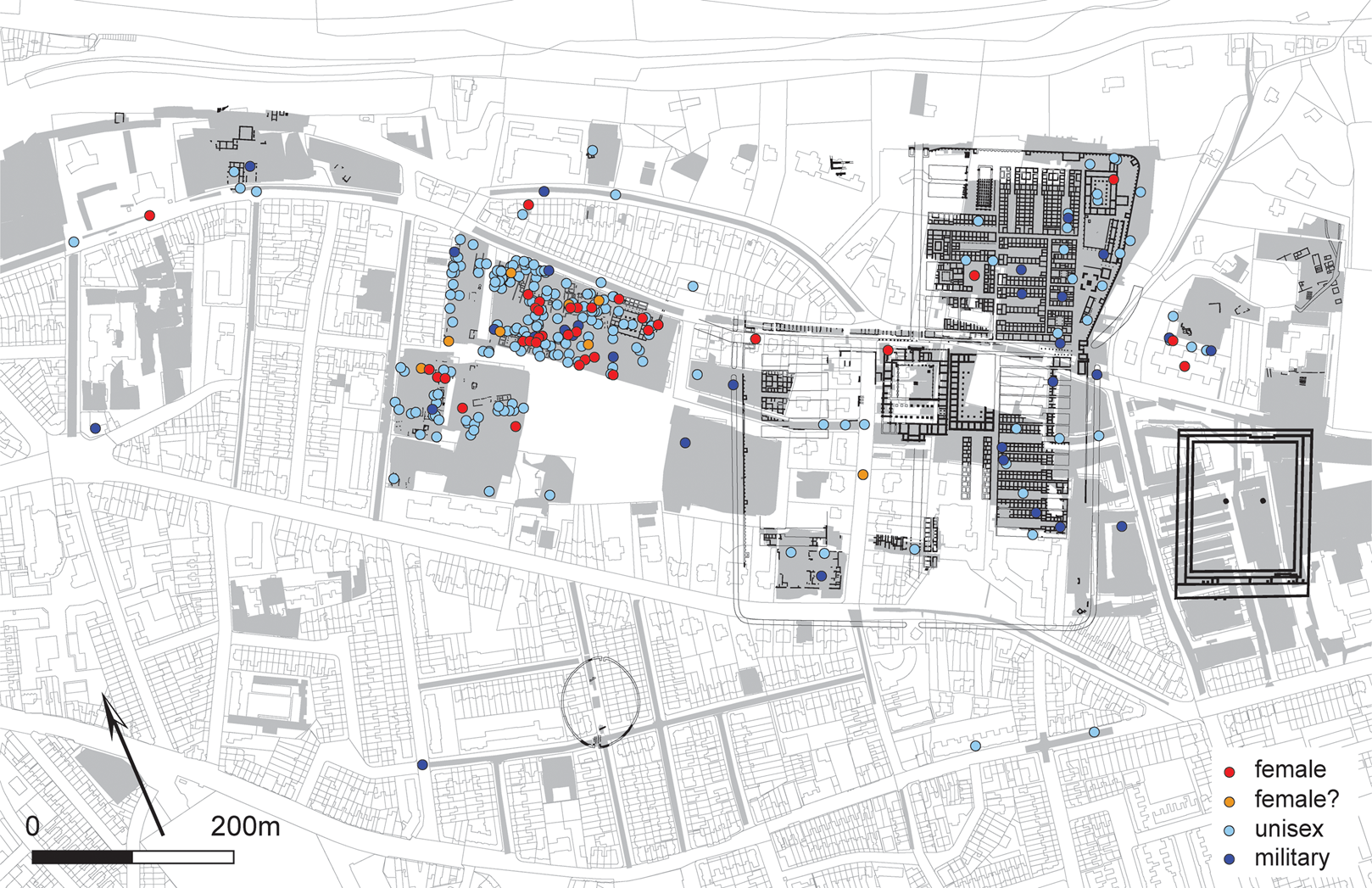
Putting that aside, the distribution map shows that the Flavio-Trajanic fortress yielded four female brooches, one possibly female brooch, 32 unisex brooches and 14 military brooches. The unisex HF 45/Almgren 15 brooches have been discussed in sufficient detail above and their distribution serves simply as a background against which to view the distribution of the other brooch types. The main trend revealed is that within the fortress the majority of the finds come from the eastern half. This is likely the result of a larger continuous surface area having been excavated in this area. Other contributing factors may be better preservation of the finds and/or a more thorough collection strategy in this area.
The spatial distribution of the four female brooches merits further discussion. Two were found in areas associated with senior officers. The first is a thistle-shaped brooch recovered from a small pit in the north-western corner of the principia. The second is a wire brooch with a rhombic bow (Almgren 16 var.) found in a pit in the area of the officers’ quarters to the north of the principia. The find-spots of the two brooches and the elaborate nature of the thistle-shaped brooch suggest that they belonged to the wives or other female relatives of senior officers, rather than to female slaves or sutlers, although, of course, this cannot be stated as fact.
Two other brooches may have belonged to women beyond the households of officers, although it should be noted that their find contexts are such that they may not have been found in their original place of deposition. Both brooches are, again, wire brooches with rhombic bows. One was found in a dark layer that filled one of the rooms of the large magazine or workshop in the north-eastern industrial extension of the fortress. Other finds from this layer include terra sigillata sherds, some glass, an amphora sherd and many bricks stamped by legio X Gemina. As the brooch was found in a possible workshop, it is tempting to associate it with craftswomen working there. However, it was found in a layer rather than a feature, and as such could easily be the result of secondary deposition rather than loss during active use. The fourth female brooch came from the area around the west gate of the fortress. It was found during building works, so no exact context is available.
One possibly female brooch, an enamelled disc brooch, was found in the south-western quarter of the fortress. Like the previous brooch, it was found during construction works and so cannot be linked to a building or structure.
An interesting observation regarding the distribution of the military brooches inside the fortress is that almost all were located in the area of the soldiers’ accommodation and the centurions’ quarters, both situated in the eastern half of the fortress. As noted above, it may be that finds from this area are overrepresented due to the fact that a larger continuous surface area has been excavated here and possibly also because of the more favourable preservation of finds and a more thorough collection strategy.
When the distribution of the military brooches is compared to that of the other brooch types, it becomes clear that the industrial annex in the north-eastern corner of the fortress has yielded a female brooch as well as several unisex brooches, while only one military Aucissa brooch was found there. This Aucissa brooch was recovered from a pit cut by a foundation trench associated with the latest, stone building phase of the Flavio-Trajanic fortress. The brooch was therefore deposited prior to this phase, but it is unclear whether it should be attributed to one of the previous wooden phases of the Flavio-Trajanic fortress or to the earlier Augustan military base.
On the basis of this patterning of military brooches in the area of the soldiers’ accommodation and centurions’ quarters, and their virtual absence from the industrial annex, which yielded a female brooch and several unisex brooches, it can be suggested that the industrial annex was open to civilians, including women, who worked there alongside the soldiers, but that the barracks were more strictly reserved for the soldiers. However, considering that the overall number of military brooches from the fortress is very small – 12, not counting those found in the outer defensive ditch – this remains no more than a suggestion.
In the civil settlement outside the fortress walls, there appear to be no clear clusters of female or military brooches, which might suggest that there were no buildings or areas restricted to either group. It should be noted, however, that the overall distribution of the brooches in the western settlement seems to follow closely the distribution of all metal objects in that area.Footnote 101
CONCLUSION
Great care should be taken when trying to attribute a gender to a particular brooch type. It has been shown above that such attributions are based often on the occurrence of one or at most a handful of examples in burial assemblages. As the human remains themselves – particularly those from older excavations – frequently have not been sexed, the majority of these graves are assigned a gender by their burial goods, such as hairpins, mirrors, etc. In many of these cases, burials have been labelled as female based on the presence of sets of two or three brooches, as this is considered a female dress tradition, effectively creating a circular argument. However, the burial evidence discussed in this paper shows that this was never a hard and fast rule. For example, a female burial from the Museum Kamstraat cemetery contained a single Langton-Down brooch, rather than the expected two or three. Furthermore, a burial from the King Harry Lane of a possible male contained two brooches, while the grave from West Thurrock of a certain male contained a total of five.
Bearing these considerations in mind, the distribution analysis presented here seems to indicate that women were present in Roman military bases, although it cannot offer any definitive proof. Evidence for women in the Augustan base is limited to one female collared brooch found in the area of the centurion's quarters of a barracks block. Although it cannot be linked stratigraphically to this building, it is tempting to interpret it as the property of a female member of the centurion's household, whether that be his wife, a female relative or female slave.
For the Flavio-Trajanic period there is slightly more evidence of women living in or visiting the fortress: four female brooches and one possibly female brooch. Starting with the former, two were found in areas associated with senior officers. The first is a thistle-shaped brooch from the principia and the second is a wire brooch with a rhombic bow found in the area of the officers’ quarters to the north of the principia. Another female wire brooch with a rhombic bow was found in a large magazine or workshop in the north-eastern industrial extension of the fortress. The industrial annex also yielded several unisex wire brooches with angular bows, but only one military Aucissa brooch. Although the evidence is limited, it may be suggested tentatively that civilians including women worked in the industrial area of the fortress alongside the soldiers. One possibly female enamelled disc brooch was found in the south-western quarter of the fortress, but it cannot be linked to a particular building or structure, as it is a stray find.
Military Aucissa brooches seem to cluster predominantly in the barrack blocks in the eastern half of the fortress. While a fair number of unisex brooches were found in the barrack blocks, no female brooches were found there. Given the lack of female brooches in the barracks, it remains uncertain whether women lived with the common soldiers.
ACKNOWLEDGEMENTS
I would like to thank my PhD supervisors, E. Moormann and M. Polak, for their very helpful suggestions and comments during the writing of this article. I am also grateful to S. Heeren for his feedback on the text and for kindly providing me with the technical drawings of the brooches depicted in fig. 2. Finally, I would like to thank B.S. van der Meulen-van der Veen for her helpful comments on an early draft of this paper.


 Open access

