


IntroductionFootnote 1
The stability of citizens’ support for democracy and endorsement of democratic principles in democracies is well-established (Chu et al. Reference Chu, Williamson and Yeung2024; Hernández Reference Ferrín and Kriesi2016; Wuttke et al. Reference Wuttke, Gavras and Schoen2022).Footnote 2 Yet since 1991, the most common path to autocratization has not been military coups or mass uprisings, but rather incumbent executives gradually consolidating power (Svolik Reference Svolik2015). Between 1973 and 2018, such incumbent-led subversions accounted for 88 of the 197 cases where countries were downgraded in Freedom House’s status, making it the primary cause of democratic decline (Svolik Reference Svolik2019). Notable examples include the actions of Hugo Chavez and Nicolas Maduro in Venezuela, Recep Tayyip Erdogan in Turkey, and Donald Trump in the United States. Strikingly, many of these autocratization events occurred with public support for the very leaders who undermined democratic norms (Bermeo Reference Bermeo2016). This raises a crucial question: Why are electoral winners – supporters of the winning party – more willing to support violations of democratic principles? Footnote 3
One influential strand of literature explains this phenomenon as a result of rational calculation: winners knowingly accept norm violations because they prioritize partisan gains or policy advantages (Cohen et al. Reference Cohen, Smith, Moseley and Layton2023; Mazepus and Toshkov Reference Mazepus and Toshkov2022; Singer Reference Singer2018; Simonovits et al. Reference Simonovits, McCoy and Littvay2022). This view assumes that winners are aware that the elites are violating democratic norms but consciously decide that the benefits outweigh the costs. Drawing on research on intergroup discrimination and intragroup dissonance (Brewer Reference Brewer, Sibley and Barlow2016; Glasford et al. Reference Glasford, Pratto and Dovidio2008; Glasford et al. Reference Glasford, Dovidio and Pratto2009), I present an alternative explanation. Electoral victory affirms partisan identity and thus increases in-party favoritism (Andrews and Huang Reference Andrews and Huang2025). As a result, winners are more likely to interpret their party’s norm violations as legitimate, fair, or even democratic (Krishnarajan Reference Krishnarajan2023). This response reflects a perceptual shift rather than a calculated trade-off: heightened in-party favoritism helps reduce the psychological discomfort that arises when democratic self-concepts conflict with in-party behavior. Winners thus support norm-eroding actions not because they reject democratic values but because they fail to recognize these actions as undemocratic.
This paper tests a mediation framework to assess the extent to which the effect of electoral victory on citizens’ democratic perceptions of norm erosion and their support for such erosion is driven by increased in-party favoritism, by conducting a mediator blockage survey experiment in the United States a few weeks before the 2024 election (N = 1,155). Respondents exposed to a ‘winning signal’, a vignette suggesting that their party would likely win the presidency and control both houses of Congress, exhibited significantly higher levels of in-party favoritism. In contrast, respondents who received the same winning signal but were also asked to complete a writing task reflecting on things they disliked about their own party showed no such increase. The writing task effectively blocked the rise in in-party favoritism, indicating that the experiment successfully manipulated the mediator, in-party favoritism.
The causal mediation analysis shows that it is the heightened in-party favoritism, induced by the winning message, that drives winners’ increased tendency to perceive norm-eroding policies proposed by their party as democratic, and to support these policies. Importantly, this phenomenon is not confined to strong partisans. Even those with weak or no prior partisan identification can develop a minimal group attachment once they decide whom to support during an election; when that attachment is affirmed by a perceived victory, it can trigger the same dissonance-reduction process. This points to an underappreciated source of democratic vulnerability: even temporary, situational identities formed during elections can have consequential downstream effects on support for norm violations. Crucially, this effect is not explained by strategic reasoning: respondents in the winning condition were significantly less likely to view these policies as politically advantageous.
While electoral victories are typically seen as a healthy outcome of democratic competition, this paper highlights an unintended consequence: winning can deepen voters’ emotional investment in their party’s success, making them more likely to excuse or endorse undemocratic policies. In other words, what is often regarded as a positive feature of democracy – heightened in-party favoritism that encourages political engagement (Bankert Reference Bankert2021) – can also erode democratic norms. This is not to say that elections themselves trigger democratic backsliding, but rather that the very structure of democratic competition, by producing winners and losers, creates psychological conditions under which norm erosion becomes more acceptable and more easily rationalized, especially if political elites exploit moments of heightened affect to advance anti-democratic reforms.
This paper contributes to the growing discussion of why voters who value democracy may still enable democratic backsliding (Braley et al. Reference Braley, Lenz, Adjodah, Rahnama and Pentland2023; Jacob Reference Jacob2025; Krishnarajan Reference Krishnarajan2023). Extending research on partisan-motivated reasoning (Lodge and Taber Reference Lodge and Taber2013), this study shows that electoral victory can serve as a distinct activation condition for motivated reasoning, leading supporters to resolve dissonance by reinterpreting their party’s norm-violating behavior as democratically legitimate. The paper also speaks to debates over whether affective polarization fuels backsliding (Broockman et al. Reference Broockman, Kalla and Westwood2023; McWagner and Kidd Reference McWagner and Kidd2025; Voelkel et al. Reference Voelkel, Chu, Stagnaro, Mernyk, Redekopp, Pink, Druckman, Rand and Willer2023), offering causal evidence that heightened in-party favoritism, an often overlooked component of affective polarization (Andrews and Huang Reference Andrews and Huang2025), can itself create fertile ground for democratic erosion.
Literature Review and Theory
Winners’ Tendency in Supporting Democratic Norm Erosion
To elucidate why certain citizens, despite supporting democracy and endorsing abstract democratic principles (Chu et al. Reference Chu, Williamson and Yeung2024; Hernández, Reference Ferrín and Kriesi2016; Wuttke et al. Reference Wuttke, Gavras and Schoen2022), reject democracy in practice, much of the literature emphasizes the significance of ‘losers’ consent’ in democratic consolidation and stability (Anderson et al. Reference Anderson, Blais, Bowler, Donovan and Listhaug2005). Numerous studies consistently show that losers exhibit lower satisfaction with democracy, weaker trust in democratic institutions, and more negative sentiments regarding government responsiveness and political efficacy than winners (Anderson et al. Reference Anderson, Blais, Bowler, Donovan and Listhaug2005; Janssen Reference Janssen2024). However, another strand of literature documents a striking asymmetry: although winners are more satisfied with democracy, they are often less committed to defending democratic principles than losers.
Moehler’s (Reference Moehler2009) influential study of African elections illustrates this pattern. While winners exhibit greater trust in political institutions than losers, they are less likely to identify violations of democratic norms and/or defend democratic institutions than losers. Recent research extends these findings across contexts. In Brazil, Cohen et al. (Reference Cohen, Smith, Moseley and Layton2023) show that voting for the winning candidate increases voters’ support for democracy while also amplifying their endorsement of ‘institutional ruptures’ contributing to the consolidation of the winning party’s or candidate’s power. Analyzing survey data from eighteen Latin American countries between 2006 and 2012, Singer (Reference Singer2018) finds that supporters of the ruling party, while favoring democracy and opposing coups, also support constraints on critical actors and opposition parties and are open to allowing the president to bypass the legislature and the court (see also Albertus and Grossman Reference Albertus and Grossman2021). Similar patterns appear in Europe, where citizens who voted for winning parties are less supportive of checks and balances than those who voted for losing parties (Mazepus and Toshkov Reference Mazepus and Toshkov2022), and in the United States, where citizens are more likely to endorse norm-eroding policies when their own party is in power than when it is out of power, a phenomenon Simonovits, et al. (Reference Simonovits, McCoy and Littvay2022) term ‘democratic hypocrisy’.
To explain the divergence between winners and losers in their commitment to democratic norms, much of the literature attributes it to instrumental reasoning: winners are more likely to compromise democratic principles when doing so serves their political interests (Bryan Reference Bryan2023; Cohen et al. Reference Cohen, Smith, Moseley and Layton2023; Graham and Svolik Reference Graham and Svolik2020; Mazepus and Toshkov Reference Mazepus and Toshkov2022; Singer Reference Singer2018; Simonovits et al. Reference Simonovits, McCoy and Littvay2022). Accordingly, winners’ tolerance of norm violations is understood as a form of hypocrisy: they knowingly support actions that violate democratic norms either because they believe doing so advances other policies that indirectly benefit their party and themselves or because they perceive the cost of withdrawing support as too high (Graham and Svolik Reference Graham and Svolik2020; Song and Kim Reference Song and Kim2025).
In-Party Favoritism as the Mechanism
Contrary to accounts that explain winners’ support for democratic norm violations primarily as the result of strategic calculations about political gain, research in social psychology highlights the role of psychological attachment to the in-group as an alternative explanation.Footnote 4 Rather than weighing costs and benefits, citizens often evaluate political actions through the lens of group identity, favoring their own side in ways that shape judgment and interpretation.
Brewer (Reference Brewer, Sibley and Barlow2016) conceptualizes in-group bias as differential evaluation, affect, or treatment of in-group versus out-group members and shows that it can take three distinct forms, each corresponding to a different type of intergroup discrimination. Of these, Type 1 bias, positive discrimination in favor of the in-group without corresponding hostility towards the out-group, is the most common in everyday social life (see also Greenwald and Pettigrew Reference Greenwald and Pettigrew2014). Discrimination in this form arises because trust, legitimacy, or more permissive evaluative standards are extended to in-group members but withheld from others. Ingroup favoritism shapes decisions about whom to help (Van Leeuwen et al. Reference Van Leeuwen, Ashton-James and Hamaker2014), trust (Foddy et al. Reference Foddy, Platow and Yamagishi2009), and collaborate with (Balliet et al. Reference Balliet, Wu and De Dreu2014); about their judgments of fairness (Ng Reference Ng1984); and about who deserves the benefit of the doubt (Halabi et al. Reference Halabi, Statman and Dovidio2015), often independently of outgroup hostility. Individuals favor their own group not because they deeply dislike the out-group, but because maintaining a positive in-group identity satisfies basic psychological needs for inclusion and distinctiveness (Brewer Reference Brewer, Sibley and Barlow2016).
This framework helps clarify why support for democratic norm violations by one’s own party can be understood as a form of intergroup discrimination. Following Kingzette et al. (Reference Kingzette, Druckman, Klar, Krupnikov, Levendusky and Ryan2021), democratic norm violations include actions that undermine constitutional constraints, such as checks and balances, as well as political tolerance, such as equal rights for all citizens, including political adversaries. In this paper, I examine support for five such norm-eroding policies: altering the size of the supreme court to shift its ideological balance, disregarding court decisions, prosecuting journalists who criticize political leaders, disqualifying allegedly disloyal candidates, and restricting protests.
Support for these actions reflects preferential leniency towards the in-party. Citizens apply more permissive evaluative standards to actions taken by their own party than they would to identical behavior by political opponents, even when those actions undermine democratic institutions and disproportionately disadvantage the out-party. In this sense, support hinges on who is acting rather than simply on who is harmed. Importantly, this pattern does not require animosity towards the opposition. Consistent with Brewer’s Type 1 bias, discrimination arises because supporters grant their party greater trust, legitimacy, and the benefit of the doubt, while withholding those same considerations from political others. Harm to the out-party thus follows from this asymmetry in evaluation rather than from an explicit desire to punish or exclude opponents.
This interpretation fits well with how democratic norm violations typically unfold in practice. As Lührmann and Lindberg (Reference Lührmann and Lindberg2019) note, contemporary democratic erosion most often occurs through incumbents gradually weakening democratic norms without dismantling democratic institutions outright. Such actions are rarely presented as attacks on political opponents per se. For example, Recep Tayyip Erdoğan’s constitutional changes weakening judicial independence and media freedom in Turkey were frequently portrayed, even by some critics, as cutting through an entrenched system with a ‘democratizing edge’ (Bermeo Reference Bermeo2016, 12). In such cases, public support rests not on these actions harming political opponents, but on trust in the governing party itself, a hallmark of in-party favoritism rather than out-party hostility.
Recent political science research points in the same direction. Partisan bias is more consistently expressed through protecting or benefiting co-partisans than through directly harming opponents (Lelkes and Westwood Reference Lelkes and Westwood2017), and democratic accountability problems are most acute when citizens are unwilling to sanction co-partisan norm violators (Graham and Svolik Reference Graham and Svolik2020; Jacob Reference Jacob2025). Consistent with this pattern, individuals with stronger in-party warmth are more likely to endorse anti-democratic measures (McWagner and Kidd Reference McWagner and Kidd2025). By contrast, evidence that out-party animosity itself drives democratic backsliding is limited: even intense out-party hostility does not necessarily weaken democratic commitments (Broockman et al. Reference Broockman, Kalla and Westwood2023), and efforts to reduce such hostility have had only modest effects in curbing anti-democratic attitudes (Voelkel et al. Reference Voelkel, Chu, Stagnaro, Mernyk, Redekopp, Pink, Druckman, Rand and Willer2023).
Taken together, these findings point to in-party favoritism as a central mechanism underlying citizens’ support for democratic norm violations by governing parties. Identifying favoritism as the driver, however, does not by itself explain why citizens, who often endorse democratic principles in the abstract (Hernández Reference Ferrín and Kriesi2016; Chu et al. Reference Chu, Williamson and Yeung2024), are willing to accept norm-eroding actions by their own side when it is in power. In-party favoritism explains whose actions receive lenient evaluation, but it does not explain how individuals reconcile such leniency with their democratic self-understandings. The next section addresses this question by drawing on intragroup dissonance theory to explain how in-party favoritism operates psychologically in this process.
Winners’ Support and Intragroup Dissonance
Prior research shows that citizens across democracies, including the United States, broadly endorse core democratic principles such as free and fair elections, civil liberties, and limits on executive power (see, for example, Chu et al. Reference Chu, Williamson and Yeung2024; Hernández Reference Ferrín and Kriesi2016). If these commitments are taken seriously, observing one’s preferred party engaging in democratic norm violations should create psychological discomfort. To conceptualize this response, I draw on intragroup dissonance theory, which defines dissonance as the discomfort that arises when an in-group’s behavior conflicts with one’s values (Glasford et al. Reference Glasford, Pratto and Dovidio2008; Glasford et al. Reference Glasford, Dovidio and Pratto2009). This perspective maps closely onto the behaviors examined here. Actions such as altering court composition, restricting protests, pressuring journalists, or limiting electoral competition place democratic self-understandings in tension with loyalty to the partisan in-group.
Importantly, intragroup dissonance can arise without an accompanying increase in negative evaluations of the in-group. If individuals had fully recognized and endorsed the judgment that their group acted wrongly, we would expect heightened emotions such as anger or dissatisfaction towards the group. Yet, in experiments by Glasford et al. (Reference Glasford, Pratto and Dovidio2008), exposure to in-group value violations increased psychological discomfort without raising anger, disgust, or dissatisfaction with the group. This pattern is consistent with social identity theory: positive attachment to the in-group is psychologically primary and group members are motivated to preserve its positive distinctiveness (Allport Reference Allport1954; Tajfel and Turner Reference Tajfel, Turner, William and Stephen1979). This suggests that dissonance often operates at a pre-condemnatory, affective stage, before individuals clearly label the behavior as normatively wrong. This distinction is crucial for understanding winners’ responses to democratic erosion: dissonance need not follow fully articulated recognition or strategic override of violations. The key theoretical question is therefore how this discomfort is reduced, and why such reduction appears especially likely among winners.
How In-Party Favoritism Reduces Dissonance among Winners
I argue that winners’ support of democratic norm violations is driven primarily by post-election identity affirmation, which operates through increased in-party favoritism and facilitates dissonance reduction. Electoral victory is not merely an informational signal about political outcomes. It affirms the value and legitimacy of the partisan in-group. Research on social identity further suggests that identification with voluntary or acquired groups is especially sensitive to changes in group status, as such identities typically evoke stronger attachment than purely assigned ones (Barreto and Ellemers Reference Barreto and Ellemers2002), making electoral victory a particularly powerful source of partisan identity affirmation.
Evidence from both US and comparative studies supports this claim. Using post-election survey data from 37 countries, Andrews and Huang (Reference Andrews and Huang2025) show that supporters of winning parties exhibit higher levels of affective polarization than losers, a difference driven mainly by increased warmth towards the in-party rather than greater hostility towards the out-party.Footnote 5 Although this gap narrows over time, winners’ affective polarization remains elevated for several months due to persistently higher in-party favoritism. Randomized survey experiments in the United States yield similar findings (Hamrak Reference Hamrak2025). Parallel patterns appear in social psychology. In an experiment where participants were randomly assigned to hypothetical winning or losing scenarios in a soccer game, Scheepers et al. (Reference Scheepers, Spears, Doosje and Manstead2003) found that when one’s own team (in-group) is performing well, situations that reinforce and secure the positive image of the in-group lead to verbal discrimination as a means of confirming their team identity. In a winning situation, participants are more likely to suggest singing a song to showcase their team’s excellence rather than derogating the opposing team. Similar findings are reported in Wann and Grieve’s (Reference Wann and Grieve2005) survey study of a college basketball game, where supporters of the winning team expressed higher in-group favoritism than supporters of the losing team.
These findings collectively suggest that in competitive contexts revolving around social identity, such as partisanship or sports fandom, winning itself is polarizing. This polarization manifests through individuals’ psychological attachment to their own group, reinforced and secured when their group’s value is affirmed by winning.
Hypothesis 1: Winning an election increases supporters’ in-party favoritism.
Once electoral victory heightens in-party favoritism, it changes how supporters process information that threatens their democratic self-concept. Intragroup dissonance research identifies two strategies for reducing such discomfort. One is identity enhancement, which reaffirms the positive distinctiveness of the in-group. Experimental work shows that group affirmation reduces dissonance-related discomfort by strengthening reliance on group membership as part of one’s self-concept, making restoration of the group’s positive image especially effective (Glasford et al. Reference Glasford, Dovidio and Pratto2009). The other is value reinterpretation, in which individuals adjust the meaning or importance of the violated norm in ways that reduce the perceived discrepancy between their values and their group’s behavior (Glasford et al. Reference Glasford, Pratto and Dovidio2008). Both strategies are especially plausible in democratic politics. Electoral victory provides a ready source of identity affirmation, while democratic norms themselves are often abstract, contested, and open to interpretation. As Hernández (Reference Ferrín and Kriesi2016) notes, democracy lacks the moral clarity of universally condemned behaviors such as violence or deception, creating space for motivated reinterpretation.
Importantly, I argue that these two strategies interact: identity enhancement at the group level makes individual-level value reinterpretation more likely. This is consistent with works on partisan motivated reasoning: individuals process information in identity-protective ways (Lodge and Taber Reference Lodge and Taber2013; Solaz et al. Reference Solaz, De Vries and de Geus2019). Heightened in-party favoritism following electoral victory facilitates a specific dissonance-reduction pathway: democratic rationalization (Krishnarajan Reference Krishnarajan2023). Rather than concluding that their party is acting undemocratically and then choosing to tolerate that behavior for instrumental reasons, winners become more likely to reinterpret the behavior itself as democratically legitimate. In Krishnarajan’s (Reference Krishnarajan2023) terms, this occurs through processes of ‘democratic transmission’, projecting policy or partisan agreement onto democratic evaluations, and ‘democratic elevation’, in which democracy is redefined away from procedural constraints towards what is perceived as being good for the country. While Krishnarajan (Reference Krishnarajan2023) focuses on ideological congruence, I argue that the same logic operates along partisan lines. Electoral victory strengthens in-party favoritism, which in turn motivates supporters to resolve intraparty dissonance by reclassifying norm-eroding actions as compatible with democracy. Actions that might otherwise be seen as violations are instead interpreted as necessary, responsible, or democratically justified when undertaken by one’s own party.
In this account, intragroup dissonance theory provides the theoretical basis for understanding winners’ reactions to democratic norm violations. Prior research shows that citizens generally endorse core democratic principles to some degree. When a winning party engages in norm-eroding behavior, this generates psychological discomfort among supporters with such commitments. Electoral victory strengthens partisan identity and heightens in-party favoritism, which in turn facilitates dissonance reduction through democratic rationalization. Winners do not simply overlook norm violations; they become more inclined to reinterpret them as democratically legitimate. In-party favoritism thus plays a central role by enabling citizens to preserve a democratic self-image while supporting actions that erode democratic norms.
Hypothesis 2: Winning an election (1) facilitates democratic rationalization and (2) increases support for norm erosion via increased in-party favoritism.
Research Design
Overview
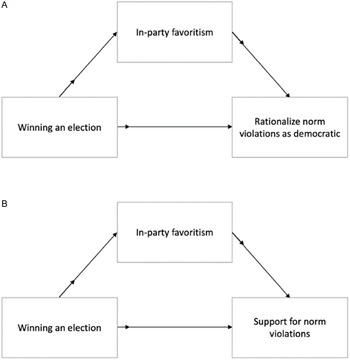
My theoretical argument centers on a mediation process. In the proposed mediation framework, as presented in Figure 1, the treatment variable (one’s party winning the election) leads to changes in two outcomes (democratic rationalization of norm violations and support for norm violations) through an intervening variable or mediator (in-party favoritism). In other words, the key objective of this paper is to estimate the mediation effect via in-party favoritism, specifically, to determine how much of the effect of winning on democratic rationalization and support for norm violations can be attributed to changes in in-party favoritism resulting from an electoral victory.
Theoretical mediation framework.

To fully test if the causal effect of winning on the inclination to rationalize undemocratic actions and support these actions is mediated by increased in-party favoritism, I conducted a pre-registered mediator blockage survey experiment with a representative sample from 18 to 20 October 2024 in the United States via Prolific (N = 1,155).Footnote 6 Before the randomization procedure, all participants answer pre-treatment questions, including gender, race, age, education, political interest, political ideology, partisanship, and partisan strength.
Case Selection
I test the theory in the United States for several reasons. Research on affective polarization in the United States shows that increasing polarization is driven primarily by dislike and distrust of the opposing party (Iyengar and Westwood Reference Iyengar and Westwood2015). Although American affective polarization is not the most extreme cross-nationally, the rapid increase in out-party hostility since the mid-1990s is notable among Western democracies (Gidron et al. Reference Gidron, Adams and Horne2020). This makes the United States a hard test case: if in-party favoritism shapes support for norm violations even in a context dominated by out-party animus, its role is likely to be consequential elsewhere as well.
Randomization
Participants are randomly assigned to one of three groups.Footnote 7 In the control group (C), serving as a baseline outside the electoral context, participants are assigned to read a placebo passage unrelated to the 2024 election.Footnote 8 In the first treatment group (T1), participants read a short passage describing a scenario in which the candidate/party from their own party is leading by a significant margin over the opponent in the upcoming 2024 US national election for both the presidency and both houses of Congress. For participants who self-identify as Republicans, the vignette is tailored to depict the Republican Party as highly likely to achieve a sweeping victory in the 2024 election; for Democrats, the vignette portrays the Democratic Party’s strong chances of winning the 2024 election. The content of the vignette is presented in the online supplementary material (SM).
One key strength of this experimental design is its timing: the study was conducted before the 2024 election, during a period of uncertainty regarding the election outcome. This context made the treatment vignettes feel realistic and relevant to participants. Unlike many existing studies that rely on hypothetical or abstract scenarios (Jacob Reference Jacob2025; Simonovits et al. Reference Simonovits, McCoy and Littvay2022), my approach was grounded in the actual political climate of the time. By embedding the treatment within the ongoing electoral context, I am able to capture more authentic psychological effects arising from real expectations of victory.
The primary objective of this paper is to test whether winning an election heightens in-party favoritism, subsequently making winners more likely to rationalize democratic norm violations as legitimate and to support these violations. To estimate the causal mediation effect of in-party favoritism, I not only manipulated participants’ perceptions of their party’s likelihood of winning the 2024 election but also indirectly influenced their in-party favoritism following the winning signal. In the second treatment group (T2), participants read the same passage as those in the first group but were also asked to reflect on any aspects or actions of their supported party that they dislike. This writing task was designed to block the increase in in-party favoritism by disrupting the systematic variance in in-party favoritism triggered by the winning signal (Pirlott and MacKinnon Reference Pirlott and MacKinnon2016).Footnote 9 Approximately 85% of respondents assigned to T2 clearly articulated at least one aspect of their preferred party that they disliked, suggesting a high level of engagement with the task.Footnote 10
The rationale behind this design is that if in-party favoritism truly mediates the effect of the winning message on democratic rationalization and support for norm erosion, we should observe a significant causal mediation effect in T1 (where in-party favoritism is not blocked) but an insignificant effect in T2 (where in-party favoritism is suppressed through the in-party dislike writing task) when comparing with the control group. Additionally, we should find a significant causal mediation effect when T1 is compared directly with T2. Furthermore, when controlling for respondents’ levels of in-party favoritism, we should observe little to no direct effect of the winning message itself on the outcomes. This would indicate that the winning message only facilitates democratic rationalization and increases support for norm erosion when it successfully heightens in-party favoritism. If the writing task effectively blocks favoritism, it should disrupt the link between the winning message and the outcomes, demonstrating that heightened in-party favoritism is the critical mediator in this process.
Post-treatment Dependent Measures
After randomization, the mediator, in-party favoritism, is measured using the standard feeling thermometer questions. Participants rated their feelings towards the Republican and Democratic parties on a scale of 0 to 100. In-party favoritism is assessed based on the party that participants identify with and the score they assign to their in-party.Footnote 11
Adapting from Carey et al. (Reference Carey, Clayton, Helmke, Nyhan, Sanders and Stokes2022), Kingzette et al. (Reference Kingzette, Druckman, Klar, Krupnikov, Levendusky and Ryan2021), and Simonovits et al. (Reference Simonovits, McCoy and Littvay2022), I employ five norm-eroding policy choices to gauge participants’ support for the violation of democratic norms post-randomization. Participants express agreement or disagreement with statements such as: (1) the newly elected legislative majority should alter the size of the Supreme Court to swing its ideology; (2) the newly elected president should have the authority to ban protests; (3) the newly elected president should possess the rights to prosecute journalists who accuse the president of misconduct; (4) the newly elected president should be empowered to disqualify candidates disloyal to the country from running for office; and (5) newly elected government officials can disregard court decisions if they are politically biased. These policy choices reflect democratic norms related to constitutional bounds, checks, and balances; civil liberties; and minority rights. Participants indicate their level of agreement with these policy choices on a scale from 0 to 100. The responses to these five items are then averaged into a single composite measure.
To measure the extent to which participants rationalize norm-eroding policies as democratic, I follow Krishnarajan’s (Reference Krishnarajan2023) approach to capturing democratic rationalization. Alongside each norm-eroding policy statement, participants are asked whether they perceive proposed action by their in-party as making the country more or less democratic on a scale from 0 to 100.Footnote 12 Responses are then averaged to form an aggregate index.Footnote 13
Table S2 presents the descriptive statistics for all pre-treatment covariates and post-treatment dependent variables. On average, the sample shows relatively low support for democratic norm violations and is less likely to perceive these violations as democratic. The mean value for aggregate support for norm-eroding policies is 22.57. Similarly, the mean value for aggregate perceptions of norm-eroding policies as making the country more democratic is 24.94. These relatively low mean values, given the outcome range of 0 to 100, indicate that Americans, as represented in our sample, are generally aware that norm-eroding policies are undemocratic. This widespread recognition makes it particularly interesting to examine how increased in-party favoritism induced by our winning treatment might alter individuals’ perceptions of democracy and lead them to rationalize such norm violations as democratic and provide support for violations.
Experimental Results
To ensure a broad and representative sample, all analyses include pure independents – respondents who report not feeling close to any party. This choice reflects the fact that even pure independents can develop a meaningful, albeit temporary, political in-group simply by deciding which party or candidate to support during an election. Research on intergroup discrimination demonstrates that in-group favoritism can emerge even when group identities are minimal and externally imposed (Balliet et al. Reference Balliet, Wu and De Dreu2014). Supporting a political party during an election therefore meets a minimal threshold for group identification. Following Simonovits et al. (Reference Simonovits, McCoy and Littvay2022), I assign independents to vignette conditions based on the party they believe better handles the issues most important to them, capturing their most likely electoral preference.Footnote 14
Effect of Winning on In-Party Favoritism
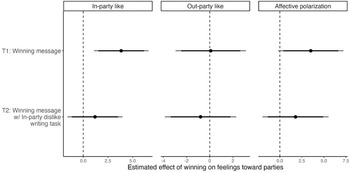
I begin by comparing respondents’ feelings towards parties across treatment and control groups to examine the effect of winning on in-party favoritism. The upper panel of Figure 2 confirms the expectation that winning increases identity affirmation with the supported party but does not affect feelings towards the out-party. This leads to significantly greater in-party liking (b = 3.840; p = 0.006) and higher affective polarization (b = 3.514; p = 0.064). These effects represent a 5% and 7% increase, respectively, over the control group mean for in-party liking and affective polarization. As expected, respondents in the treatment group assigned an in-party dislike writing task (T2), designed to block in-party favoritism, did not exhibit significantly higher in-party liking or affective polarization. The lower panel of Figure 2 shows that all point estimates for the winning message group with the in-party dislike writing task are indistinguishable from the control group.Footnote 15
Effect of winning on feelings towards parties. Note: point estimates are surrounded by 90% (thick tails) and 95% (thin tails) confidence intervals. All estimates are derived using ordinary least squares (OLS) regression, controlling for pre-registered covariates. Complete results reported in Table S3.

Figure 2 thus confirms Hypothesis 1 and demonstrates that the blockage experimental design effectively manipulates respondents’ levels of in-party favoritism.
Association between In-Party Favoritism and Outcomes
To investigate the relationship between in-party favoritism, democratic rationalization, and support for norm erosion, I first estimate a regression model in which the outcome variable is predicted based on the treatment conditions, standardized in-party favoritism, and pre-registered covariates. As shown in Table 1, the coefficient for in-party favoritism is positive and statistically significant. Specifically, a one standard deviation increase in in-party favoritism is associated with a 3.172-unit increase in viewing norm-eroding policies as making the country more democratic and a 2.911-unit increase in supporting these policies. These effects represent approximately 13% of the mean value of both outcomes under the control group, demonstrating that heightened in-party favoritism, as induced by the winning message, exerts a tangible impact on both democratic perceptions of norm violations and support for such violations.
Association between in-party favoritism and outcomes

Note: entries are OLS coefficients with standard errors in parentheses. In-party favoritism is standardized and ranges continuously from 0 to 1. Complete results reported in Table S4. *** p < 0.001.
However, it is important to note that this coefficient reflects an association rather than a direct causal effect, despite the successful manipulation of in-party favoritism. This distinction arises because in-party favoritism is a post-treatment variable, and including it in the regression model alongside the treatment groups can introduce post-treatment bias (Montgomery et al. Reference Montgomery, Nyhan and Torres2018). Although the writing task effectively blocked the increase in favoritism in the second treatment group, the coefficient itself does not isolate the causal impact of in-party favoritism on the outcomes.
Causal Mediation Effect through In-Party Favoritism
To move beyond mere associations and accurately estimate the causal effect of in-party favoritism as a mediator, I employ Imai et al.’s (Reference Imai, Keele, Tingley and Yamamoto2011) mediation analysis framework. Although this mediation analysis was not specified in the pre-analysis plan, it is necessary for evaluating the hypothesized mechanism advanced in this paper.Footnote 16 This framework allows me to estimate two key effects: the average causal mediation effect (ACME) and the average direct effect (ADE). These measures help identify how much of the effect of winning on democratic perceptions of norm erosion and support for norm erosion is indirectly transmitted through in-party favoritism (ACME) and how much is directly caused by the winning message itself (ADE).
To estimate ACME and ADE, in the first stage, I model in-party favoritism, the mediator, as a function of treatment assignment, and pre-registered control covariates. This model allows us to estimate levels of in-party favoritism under both two treatment conditions and a control condition for: $M_{i}=\alpha _{1}+\beta _{1}T_{1i}+\gamma _{1}T_{2i}+\rho X_{i}+e_{1i}$
where M i is each respondent’s in-party favoritism; T 1i and T 2i indicate treatment assignment; and X i includes the pre-registered covariates.
In the second stage, I use the predicted in-party favoritism to estimate democratic perceptions of norm erosion and support for norm erosion, holding treatment assignment constant while varying the mediator based on its predicted values under the two treatment and control conditions: $Y_{i}=\alpha _{2}+\beta _{2}T_{1i}+\gamma _{2}T_{2i}+\theta M_{i}+\pi X_{i}+e_{2i}$
where Y i is each respondent’s level of viewing norm erosion as democratic and support for norm erosion.
Specifically, the ACME quantifies how much respondents’ democratic perceptions of norm erosion and support for norm erosion change when their in-party favoritism changes as a result of the winning message, while keeping the treatment group fixed. Mathematically, the ACME is expressed as: $ACME\left(t_{1}\ vs\ t_{2}\right)=E[Y_{i}\left(t_{1},M_{i}\left(t_{1}\right)\right)-Y_{i}(t_{1},M_{i}(t_{2}))]$
where Y i (t 1, M i (t 1)) represents the expected outcome when in-party favoritism changes as a result of the treatment (t 1 = T 1 or T 2), while Y i (t 1, M i (t 2)) represents the expected outcome when in-party favoritism is under the control group or suppressed in T2 (t 2 = Control or T 2). Essentially, the ACME captures the indirect effect of the treatment via in-party favoritism.
The ADE, on the other hand, measures how the treatment itself directly influences the outcomes, independent of any change in in-party favoritism: $ADE\left(t_{1}\ vs \ t_{2}\right)=E[Y_{i}\left(t_{1}, M_{i}\left(t_{1}\right)\right)-Y_{i}(t_{2}, M_{i}(t_{1}))]$
This formula calculates the difference in the expected outcome when the treatment is applied versus not applied, while holding the mediator at the level it would take under the given treatment condition.
To interpret ACME and ADE as causal effects, it is essential that the sequential ignorability assumption holds (Imai et al. Reference Imai, Keele, Tingley and Yamamoto2011). This assumption has two key components. First, the treatment assignment must be random, ensuring that any differences between groups are attributable to the treatment itself rather than pre-existing differences between groups. My experiment meets this criterion as participants were randomly assigned to one of the three groups: the control group (placebo message), T1 (winning message only), or T2 (winning message + in-party dislike writing task).
Secondly, after accounting for the treatment and pre-treatment covariates, the mediator, in-party favoritism, should not be influenced by unmeasured factors that also affect the outcome. My experiment partially meets this criterion because I effectively manipulated in-party favoritism in both treatment groups. As shown in Figure 2, in T1, the winning message significantly increased respondents’ in-party favoritism, while in T2, the in-party dislike writing task successfully blocked this increase despite the same message exposure. This direct manipulation makes the comparison between T1 and T2 the most robust causal interpretation.
It is important to note that in the control group, in-party favoritism was not actively manipulated, allowing for natural variation that could be influenced by unmeasured confounders. This limitation suggests that comparisons involving the control group (between T1 and T2, respectively) may reflect associative rather than purely causal relationships. Despite this, these comparisons still offer valuable insights into whether the effect of the winning message on democratic perceptions and support for norm erosion can be partly attributed to increased in-party favoritism compared to a placebo message baseline. This perspective adds contextual depth, illustrating how in-party favoritism triggered by the winning message compares to a neutral setting.
Accordingly, I estimate ACME and ADE for three comparisons, as shown in Table 2.
Average causal mediation effect (ACME) and average direct effect (ADE) formulas for each comparison

Based on my experimental design and theoretical rationale, I expect the ACME for T1 v. Control Group to be significant and positive, indicating that the increase in in-party favoritism due to the winning message contributes to greater rationalization of norm erosion and support for norm erosion compared to a placebo message baseline. In contrast, I expect the ACME for T2 v. Control Group to be insignificant because the in-party dislike writing task suppresses the increase in favoritism, thereby disrupting the link between the message and the outcomes. The most robust and theoretically informative comparison is the ACME for T1 v. T2. I expect this ACME to be significant, demonstrating that heightened in-party favoritism (unblocked by the writing task) is a critical mediator through which the winning message increases democratic rationalization of norm erosion and support for norm erosion. This pattern of findings would substantively confirm Hypothesis 2 that heightened in-party favoritism drives the increased rationalization of democratic violations and the endorsement of norm-eroding actions. Figure 3 presents the ACME and ADE for each comparison.
Average causal mediation effect (ACME) and average direct effect (ADE) for each comparison. Note: the ACME estimates are surrounded by 90% (thick tails) and 95% (thin tails) confidence intervals based on quasi-Bayesian approximation with 1,000 resamples.

As expected, I find that the ACME for T1 v. Control Group is significantly positive for both outcomes (ACME = 0.450 and 0.490, respectively).Footnote 17 The increase in in-party favoritism induced by the winning message accounts for 24% and 25% of the total effect of winning on democratic perceptions of norm erosion and support for norm erosion, respectively. Furthermore, when breaking down the results by partisan strength, the ACME remains significantly positive not only among those with pre-existing partisan identification but also among those who had no prior partisan identification but expressed a party preference during the election (see Figures S7 and S8).
Secondly, as expected, the ACME for T2 v. Control Group is insignificant. This result indicates that when in-party favoritism is actively suppressed through the in-party dislike writing task, the indirect effect of the winning message via in-party favoritism does not significantly increase the perception of norm-eroding policies as democratic or support for these policies. This finding demonstrates that heightened in-party favoritism is essential for the indirect pathway through which the winning message translates into increased endorsement of norm-eroding actions.
Thirdly, the ACME for T1 v. T2 is also significantly positive for both outcomes (ACME = 0.302 and 0.330, respectively). This difference highlights that when in-party favoritism is allowed to rise (as in T1) compared to being suppressed (as in T2), there is a significant rise in democratic rationalization and support for norm erosion. This comparison confirms the causal mediation role of heightened in-party favoritism, reinforcing the idea that the winning message leads to democratic rationalization and norm erosion support when it effectively boosts in-party favoritism.Footnote 18
In contrast, the ADE values for all comparisons are insignificant, suggesting that the winning message itself does not directly lead to democratic rationalization or increase support for norm erosion when in-party favoritism levels are held constant. This finding implies that the direct effect of the winning message is minimal, and the increased democratic rationalization and support for norm-eroding actions is primarily channeled through heightened in-party favoritism rather than through the winning message itself.
Additionally, I examine whether democratic rationalization operates as a downstream mechanism linking increased in-party favoritism to support for democratic norm violations. As shown in Figure S9, the estimated mediation effect is positive and statistically significant (ACME = 0.078), accounting for 71% of the total effect of in-party favoritism on support for norm erosion.
Summary
Overall, the mediator blockage experiment causally demonstrates that winners are more likely to support democratic norm violations because winning increases their in-party favoritism. This heightened favoritism promotes a dissonance-reducing strategy in which individuals reinterpret their party’s actions as democratically acceptable, thereby increasing support for such violations.Footnote 19 Importantly, this phenomenon is not confined to those with strong partisan ties; it also occurs among those with weak or no prior partisan identification.
Alternative Mechanism
An alternative explanation for why winners are more likely to support democratic norm violations by the governing party is that they strategically trade off democratic principles for political gain (Bryan Reference Bryan2023; Graham and Svolik Reference Graham and Svolik2020; Singer Reference Singer2018). According to this view, winners recognize these violations as undemocratic but tolerate them because they believe they will benefit, either directly or indirectly, from the violations. To test this mechanism, I included a survey question asking participants to rate, on a scale from 0 to 100, the extent to which they believe each norm-eroding scenario would advance their party’s political goals and benefit themselves. This measure is designed to capture strategic calculations: not whether winners see the violations as inherently beneficial, but whether they believe accepting these violations as part of broader policy advancements indirectly benefits their party. In other words, it assesses whether political gain arises not from the violation itself but from the broader political advantages it enables.
Figure 4 shows the estimated effect of winning on strategic calculations for political gain, compared to the control group. Respondents in both treatment groups report significantly lower strategic calculations than those in the control group, with decreases of 5.389 and 5.291 units, respectively, equivalent to 20% of the standard deviation in perceived political benefits within the sample. Figure S12 further examines the effect of winning conditioned on partisan strength and finds that the negative effect on strategic calculations is even stronger among those with stronger partisan identification.Footnote 20
Effect of winning on strategic calculations for political gain. Note: point estimates are surrounded by 90% (thick tails) and 95% (thin tails) confidence intervals. All estimates are derived using OLS regression, controlling for pre-registered covariates.

This is not to suggest that instrumental reasoning is irrelevant to citizens’ tolerance of democratic norm violations. In some contexts, particularly during the election stage, individuals may knowingly accept norm erosion because they anticipate partisan or policy benefits (see Graham and Svolik Reference Graham and Svolik2020; Jacob Reference Jacob2025). The claim advanced here is narrower. In the post-election context examined in this study, the evidence suggests that winners’ support for norm erosion is driven less by strategic calculation than by identity affirmation. While instrumental and identity-based processes may coexist, the latter appears to play the more central role in this setting.
Discussion and Conclusion
This study contributes to the literature on the winner–loser gap in support for democratic norm violations (see, for example, Simonovits et al. Reference Simonovits, McCoy and Littvay2022) by offering a psychological explanation for why winners are willing to forsake democratic principles. I find that winners’ support for norm erosion by the governing party is not driven by calculated political gain but by heightened in-party favoritism following electoral victory, which leads them to rationalize violations as democratically legitimate. The theory also has clear implications for losers. Because losers do not experience the same post-election affirmation of partisan identity and because norm violations are committed by an out-party, such actions do not generate intragroup dissonance or trigger dissonance-reduced rationalization. Instead, losers should be more likely to evaluate these violations by the governing party in line with their democratic commitments.
My findings are robust and causal, supported by the mediator blockage survey experiment conducted a few weeks before the 2024 US election. The design included an in-party dislike writing task to manipulate in-party favoritism, enabling a causal estimation of how much winning-induced favoritism influences democratic rationalization and support for norm erosion. Importantly, the winning vignette provided only a microdose treatment, suggesting that the observed mediation effect likely represents a lower-bound estimate. Moreover, because the comparison group faced electoral uncertainty rather than losing an election, the design constitutes a conservative test; effects in real-world post-election contexts may therefore be stronger. Finally, the robust causal mediation effect observed in the US context, where out-party dislike is often considered the dominant factor, highlights the critical role of in-party favoritism in shaping attitudes towards norm violations. While the US context is informative, future research should explore whether in-party favoritism similarly drives winners’ support for norm violations in other democracies and whether institutional settings with more zero-sum electoral competition (that is, majoritarian systems) amplify the mediating role of in-party favoritism.
One limitation of this study is that the post-treatment measures of democratic norm violations focus on attitudes towards individual norm-eroding policies, rather than examining whether support wanes or persists when violations accumulate (see Werner et al. Reference Werner, Bertsou and Marien2025). This leaves open the question of how in-party favoritism might mediate support when multiple norm violations occur. Another limitation is that the study focuses exclusively on norm violations available to the governing party, such as banning protests or expanding the Supreme Court, overlooking the potential for losers to support norm violations outside formal power structures. Although this paper does not directly test this possibility, the theoretical framework suggests that similar dynamics could emerge when losers experience strong in-party affirmation from other sources (for example, elite rhetoric). Under such conditions, heightened in-party attachment may likewise facilitate dissonance reduction through democratic rationalization. In this sense, the theory is not limited to winners per se, but to contexts in which partisan identity is sufficiently reinforced to activate in-party favoritism.
By focusing on elections, the cornerstone of liberal democracy, I show that affective polarization is a natural byproduct of democratic systems and that electoral victories themselves amplify polarization by increasing in-party favoritism. While scholars continue to debate whether greater affective polarization directly causes democratic backsliding (Broockman et al. Reference Broockman, Kalla and Westwood2023), there is little doubt that it creates a fertile ground for backsliding to occur (Gidron et al. Reference Gidron, Margalit, Sheffer and Yakir2026). Most existing research emphasizes the dangers of negative partisanship (that is, out-party dislike) for democracy (Iyengar et al. Reference Iyengar, Lelkes, Levendusky, Malhorta and Westwood2019); however, I highlight the equally significant risks posed by positive partisanship (that is, in-party favoritism). If support for norm violations is driven in part by in-party favoritism, strategies that focused solely on reducing out-party hostility may be insufficient (see Voelkel et al. Reference Voelkel, Chu, Stagnaro, Mernyk, Redekopp, Pink, Druckman, Rand and Willer2023), underscoring the need to rethink remedies for affective polarization.
Supplementary material
Supplementary material for this article can be found at https://doi.org/10.1017/S0007123426101574.
Data availability statement
Replication data for this paper can be found at https://doi.org/10.7910/DVN/FAIOHS.
Acknowledgments
I would like to thank James Adams, Josephine Andrews, Timea Balogh, Cheryl Boudreau, Noam Gidron, Stephen Goggin, Marc Jacob, Evan Sandlin, Juan Tellez, and Bianca Vicuña, as well as the UC Davis CP Lab and audiences at the 2025 APSA, MPSA, WPSA, and TPSA conferences for their helpful feedback. I also thank four anonymous reviewers for their valuable comments. In addition, I am grateful to Yi-long Chen and Talia Conn for their very capable research assistance.
Financial support
This work was supported by a grant from the University of California, Davis, the Rapoport Family Foundation, and the Ministry of Science and Technology, Taiwan (Grant number: 114-2410-H-004-187-MY2, PI: Yu-Shiuan Huang).
Competing interests
The author declares none.
Ethical standards
The research was conducted in accordance with the protocols approved by the Institutional Review Board of the University of California, Davis (IRB ID: 2183448-1).


 Open access

