




Introduction
Georgia has been a country with an emigrating population since it regained independence in 1991. The share of the foreign-born population in Georgia in mid-2010s was at approximately 2%. This was not as high as, for instance, the average share of foreign-born population in the EU, which was at 10–12% (United Nations 2019). The EU countries with the most similar share of immigrant population to Georgia include Bulgaria, Romania (both 2.4%), and Poland (1.7%). At no point did immigration experience a significant surge since Georgia in the last three decades. Nevertheless, far-right movements sprang up in Georgia in 2016 and organized several rallies demanding the deportation of “illegal immigrants” (Civil Georgia 2020; Eurasianet 2018; OC Media 2017). These far-right demonstrations combined elements of ethno-religious nationalism, anti-liberalism, and in some cases, fascism (Sandro Tabatadze Reference Tabatadze2019, 208). They securitized the immigration issue and antagonized refugees, referring to the negative consequences of accepting refugees in Europe (Gozalishvili Reference Gozalishvili2022a, 481). During these anti-immigrant demonstrations, several Turkish and Arab-owned restaurants were targeted. A Molotov cocktail was thrown into one of these restaurants while the customers were inside. The far-right groups and individuals were active not just during the demonstrations. Black people were physically abused on the streets on numerous occasions. The number of criminal prosecutions under Article 1421 of the Criminal Code of Georgia (racial discrimination) increased from zero cases in 2014 to three cases in 2015 and 14 cases in 2016, only to fall back to zero in 2017 (Tolerance and Diversity Institute 2019, 14–20).
The emergence of anti-immigrant rhetoric in Georgia largely coincided with the far-right populism wave that swept across Europe in the context of the refugee crisis. Prior research has suggested that far-right actors found new prospects for action not just in the EU countries that received large numbers of refugees, but also in the countries aspiring to become European Union members, such as Georgia, Ukraine, or Armenia (Gordon Reference Gordon2020). The main ideological basis of such movements in Georgia lies in nationalist, conservative values, underpinned by the strong role of Orthodox Christianity in the national identity. Nevertheless, the recent emergence of far-right parties and movements deserves special attention as (1) far right as an actor that positions itself in opposition to the mainstream political parties had never been present in the Georgian public sphere before, (2) despite the widespread xenophobia in the country, an explicit opposition to immigration had never been emphasized by Georgian nationalist parties or politicians before, and (3) Georgia did not suffer from the so-called “refugee crisis,” as the country was not a main destination for people fleeing the Syrian civil war. Interestingly, the organizations that featured in the wave of far-right rallies in and around 2016, while subscribing to the core values of the Georgian national identity, also modeled themselves after anti-immigration parties in Europe, such as Fidesz or Alternative for Germany (Gordon Reference Gordon2020). This is evidenced by their narratives, which often coincided with the anti-Western propaganda disseminated by Russian propagandist media. Thus, in this paper, I investigate the following research question: How can the rise of the Georgian far right be explained?
I argue that the enmity towards immigrants, especially Muslims, demonstrated by the far-right rallies in Georgia has roots not just in Georgian nationalism but also in the strong identification with Europe. The latter factor is more important as it explains the rise of the far right in 2016 despite the absence of significant events or processes that could have affected the attitudes towards Muslims in the run-up to 2016. Building up on this premise, I also argue that the emergence of the Georgian far right in and around 2016 and its active presence in the public sphere cannot be attributed to actual immigration figures or an increased hostility towards ethnically or religiously different foreigners, but is rather a phenomenon that came to existence, among other things, through: (1) the transnational diffusion of far-right ideas and practices from the populist radical right-wing politicians in the EU, (2) successful appeals to the pre-existing ethno-nationalist sentiments, (3) manipulated and false information disseminated by mostly non-institutional media, which often relied on Russian sources, and (4) the exploitation of anti-liberal sentiments by the ruling party.
While separate aspects of the said argument have been laid out by various authors, a systematic and theoretical assessment of the rise of the Georgian far right in that period is missing from academic literature. I quantitatively analyze two factors—economic and cultural—that traditionally serve as predictors of far-right success in academic literature. However, as significant changes in economic indicators or survey-based cultural attitudes are not supported by empirical data, I propose domestic and external factors that could explain the rise of the far right. The analysis of these factors is based on a secondary discourse analysis of the academic literature, media articles, and pre-existing data such as interviews, speeches, and multimedia data. In what follows, I will present a systematic and theory-driven investigation of the reasons behind the rise of the far right in Georgia in and around 2016.
I begin by discussing the incidents that illustrate the rise of the far right in Georgia and describe Georgian nationalism in a comparative perspective. I then present the theoretical approach, the data, and the methods used for the analysis. In the main part of this paper, I analyze the economic, cultural, domestic, and foreign factors that could have theoretically contributed to the rise of the far right and present the supporting evidence (or the lack thereof) for each explanation. I conclude by summarizing my findings and pointing out the limitations, as well as the possibilities for future research.
History of the Georgian Far Right
Being detached from the historic processes that triggered the emergence of many contemporary far right movements and parties in Western Europe, such as the fascist past, mass immigration, and white supremacy, the far right only emerged in the Georgian public sphere around 2016. I consider the 2016 parliamentary election campaign of the right-wing populist Alliance of Patriots of Georgia (AoP) and the subsequent results of the said election as a turning point that invigorated media attention to informal far-right groups and brought about the popularization of far-right ideas in Georgia. The AoP is a right-wing populist party (Samkharadze Reference Samkharadze2021), which entered the Parliament of Georgia in 2016 by surpassing the electoral threshold by 0.01% (88,097 votes or 5.01% of all votes). It ran on a “Georgia first” campaign, inspired by Western populist right-wing politicians such as Donald Trump, Marine Le Pen, and Nigel Farage (Kucera Reference Kucera2016). Its members claimed that “multiculturalism is broken” and made calls to counter liberalism with the Georgian national identity and Orthodox Christian values. Despite promoting a political platform that did not explicitly target immigrants, the party was known for its xenophobic rhetoric and its particularly strong anti-Turkish stance (Stephan Reference Stephan2018, 3). In the 2020 parliamentary election, the AoP lost two out of six seats in the parliament, whereas in 2024 it received only 2.5% of the votes (in an election disputed by the liberal opposition) and lost all its seats.
While the emergence of the AoP can be considered as the canary in the coal mine in the context of the rise of the Georgian far right, its ideology can only be defined as radical right-wing populism. However, in the same period, various extreme right organizations were founded or appeared in the public sphere:
-
• Non-institutionalized anti-immigrant/anti-liberal extreme right groups have been present in the Georgian public sphere since 2015. They criticized the mainstream politicians and parties for not being nationalist enough and were involved in several cases of ethnic violence. The group that gained the most prominence is Georgian Power (Kobakhidze Reference Kobakhidze2017, 37), which, together with its associate groups—Edelweiss, Bergman, and Dinamo Tbilisi ultras—came to prominence through various cases of violence against Black people, intimidation of foreign nationals on Aghmashenebeli Avenue in Tbilisi, and its members’ involvement in a murder case (Tolerance and Diversity Institute 2019, 14–20). In 2016, they organized a rally on Aghmashenebeli Avenue in Tbilisi, targeting the restaurants they claimed were owned by Arabs, Iranians, and Turks, breaking banners and throwing flares into their facilities (Voice of America 2016). A discourse analysis of Georgian Power revealed that the group “frames Georgia’s Europeanness vis-à-vis Islam and Russia” and portrays European far-right groups as role models (Kobakhidze Reference Kobakhidze2017, 60–61).
-
• A self-described fascist organization National Socialist Movement, Georgian National Unity, was founded in 2016 (Sandro Tabatadze Reference Tabatadze2019, 208). Since its foundation, the organization has gained prominence by organizing rallies in support of Viktor Orbán, aggressively persecuting a pride rally on the International Day Against Homophobia, Transphobia, and Biphobia on May 17, 2018, and by creating a “popular guard” or “blackshirt detachments to be deployed against liberals.” Its founder, an openly fascist individual named Giorgi Chelidze, claimed that the “globalist and Masonic” powers seek to populate Georgia with “foreign scum” and warned against intermarriage with foreigners. In 2018, Chelidze was sentenced to three-and-a-half years in prison for the illegal purchase, storage, and carrying of firearms. He left the prison in 2022 (OC Media 2022).
-
• Georgian March, an “umbrella” organization that combined various ultranationalist, nativist groups, was founded in 2017. It features several conservative, explicitly anti-liberal, and xenophobic activists such as Sandro Bregadze, Gia Korkotashvili, and Dimitri Lortkipanidze, and is the only officially registered far-right organization in Georgia (Transparency International Georgia 2018), which became a political party in 2020. On July 14, 2017, the Georgian March organized the first iteration of its nationalist, anti-liberal rally (“march of Georgians”) calling for deportation of illegal immigrants from the country, toughening of the immigration law, imposing restrictions on granting residence permits to foreigners, and banning foreign funding to civil society organizations (Civil Georgia 2020). It saw over 2,000 ultranationalists demonstrate on Aghmashenebeli Avenue, a street known for its Arab, Iranian, and Turkish restaurants (Stephan Reference Stephan2018, 4). In March 2018, the Georgian March announced the creation of vigilante groups that would serve as an alternative to police and “expose violations committed by foreigners in specific locations,” but it did not materialize as the Ministry of Internal Affairs prohibited this practice (Liberali 2018). In December 2018, members of the Georgian March blocked the entrance to the Public Service Hall in Tbilisi to protest the ruling by the Constitutional Court of Georgia that lifted the ban on agricultural land sales to non-citizens for five days; the AoP joined the protest too (Netgazeti 2018a). In the 2020 parliamentary election, Georgian March received just 0.25% of votes.
A Brief Overview of Georgian Nationalism
Academic accounts of European far-right movements often rely on economic, political, and media-related explanations (Ellinas Reference Ellinas2010; Mudde Reference Mudde2019). Against this background, the role of religion has been downplayed. This is underpinned by the assumption that since modern Western societies have progressed beyond religion, the latter has become less relevant for public affairs and politics. By associating nationalism with modernity and thinking of modernity as inherently secular, nationalism research has largely disregarded the effect of religion on nationalism (Rieffer Reference Rieffer2003). However, modern Georgia, being a post-socialist nation, does not fit the Western model. What makes the Georgian far right distinct from the Western European far-right movements is an extraordinarily strong connection to the Church, which wields political influence on its own, compared to other religious organizations in the country as well as to the other dominant religious institutions (provided such an institution exists) in the rest of Europe. Most Western European far-right movements and parties are only culturally or nominally Christian. They consider Christianity part of their national culture. Only in rare cases does the link between the far right and Christianity extend from the ideological to the strategic or pragmatic area (that is, direct involvement of clerics, public prayers, displaying icons at rallies, etc.), and when this is the case, usually an Eastern European country is concerned, such as Poland, Romania, or Russia (Mudde Reference Mudde2019).
Against this background, the Georgian far right has eagerly adopted the narrative of the Georgian Orthodox Church (GOC), while the latter, tacitly or openly, support some of the actions taken by the former, such as, for example, the persecution of religious minorities (that is, Jehovah’s Witnesses) and the LGBT community with the aim of keeping them excluded from public sphere. If we compare the Georgian and the other far-right movements in predominantly Orthodox Christian European countries, the Romanian case would be quite different, as the church and the state are more strongly separated there. In Ukraine, the rhetoric of allegedly defending traditional values, backed by the Orthodox Church of Ukraine, is indeed used by the far right, but religious denominationalism is the prevalent picture, as the state does not back any of the larger churches, resulting in a compartmentalization of Orthodox Churches into pro-Ukrainian and pro-Russian nationalisms (Brylov, Kalenychenko and Smytsnyuk Reference Brylov, Kalenychenko, Smytsnyuk and Mascolo2023). This makes it different from the GOC, which has enjoyed preferential treatment from the state since Georgia became independent from the Soviet Union (Metreveli Reference Metreveli2016). The state and the Orthodox Church are more closely aligned in Russia, where the Orthodox Church enjoys a privileged position due to its political support of the regime and due to the state’s instrumentalization of the so-called traditional values and Orthodox Christianity. However, unlike the Georgian case, the Russian far right is not as intertwined with the Church. It also has a strong imperialist ideology (“Russian world,” “third Rome,” etc.), which the Georgian far right lacks (Bacon Reference Bacon2018).
Arguably, the most similar far-right movements to Georgia would be those of Armenia and Greece. Orthodox Christianity serves as the main pillar of the Greek far-right movements’ ideology (Ellinas Reference Ellinas2010, 137). The head of the Popular Orthodox Rally, a religious nationalist Greek party, Georgios Karatzaferis, has made many references to Orthodoxy and the Greek Church as the “mother of the modern Greek state.” The emphasis on the role of the Church in the national identity, as well as the phrase “mother church” (Gurchiani Reference Gurchiani and Merdjanova2021, 123), points to a striking similarity between the Greek and the Georgian nationalisms. Another similarity is related to the importance of religion and ethnicity in public affairs: both in Greece and Georgia there were protests at the end of 1990s against removing the information on individual’s religion, in case of Greece (Ellinas Reference Ellinas2010, 153), and ethnicity, in case of Georgia (Reisner Reference Reisner, Companjen, Marácz and Versteegh2010), from ID cards. Finally, Georgians, Armenians, and Greeks are leaders among the European nations in terms of being religious, seeing religion as a key component of national identity, regarding their culture as superior to others, and being unwilling to accept Muslims as part of their family (Pew Research Center 2018). In addition, Georgian dissidents, who were fighting for the country’s independence from the Soviet Union, are believed to have been inspired by models of liberation utilized in Greece (Jones Reference Jones2003, 91). The similarity between the Georgian and the Armenian nationalisms, apart from the above-mentioned figures, is also demonstrated in statements by Armenian clerics, who emphasize the role of Orthodox Christianity in the national identity and argue that being Armenian means being Orthodox Christian (Siekierski Reference Siekierski and Agadjanian2016). The far right as a political force was not so present in Armenia by the time the Georgian far right emerged in 2016–2017. However, in 2019, an ultraconservative party, Adekvad, was founded in Armenia, which, similar to the Georgian far right, has promoted the so-called traditional values, militant masculinity, and anti-Western sentiments, including the opposition to George Soros, which has become the scapegoat of populist far right in Eastern Europe and beyond (Ziemer and Roberts Reference Ziemer and Roberts2024). The Armenian Orthodox Church has also played a significant role in the 2024 Armenian anti-government protests, which were led by an archbishop (Khulian, Galstian and Stephanian Reference Khulian, Galstian and Stepanian2024).
Several researchers have already pointed out the religious nature of Georgian nationalism (Kekelia et al. Reference Kekelia, Gavashelishvili, Ladaria and Sulkhanishvili2013; Minesashvili Reference Minesashvili2021; Zedania Reference Zedania2011; Crego Reference Crego1994). When it comes to the role of religion in nationalism, Georgian nationalism can theoretically be placed between what Rieffer (Reference Rieffer2003) refers to as instrumental pious nationalism and religious nationalism. Rieffer points out three types of interaction between religion and nationalism: secular/anti-religious nationalism, instrumental pious nationalism, and religious nationalism. I argue that the secular/anti-religious nationalism is largely inapplicable to the Georgian context, as the GOC gets preferential treatment from the state, and at no point since regaining independence has the Georgian state or any nationalist organization or movement had an anti-religious or even secular agenda. The interaction between the GOC and the far right is largely instrumental. Both mainstream and marginal parties have continuously pledged their allegiance to Orthodox Christianity and emphasized their respect towards the leader of the GOC, Patriarch Ilia II. This arguably puts Georgian nationalism into the category of instrumental pious nationalism. This argument is further supported by the fact that the only post-Soviet/Orthodox Christian state in Rieffer’s taxonomy (Russia) is classified as instrumental pious nationalism, as both Gorbachev and Yeltsin “attempted to use the Russian Orthodox church’s position in Russian society to solidify the nation” (Rieffer Reference Rieffer2003, 230–231). She contrasts the Russian case with the Polish one. In Poland, she argues, abortion was banned and (Catholic) religion was taught in schools. At no point has abortion been banned in Georgia, whereas teaching the history of religion was removed from the Georgian schools’ curricula in 2005 (Shalva Tabatadze Reference Tabatadze2018). However, there are some arguments in favor of classifying Georgian nationalism as religious nationalism too.
Georgian nationalism fits the definition of religious nationalism by at least three out of five criteria, pointed out by Rieffer (Reference Rieffer2003). The first criterion is that it often occurs when the population of a territory is religiously homogeneous—about 80% of Georgians self-identified as Orthodox Christian in 2017.Footnote 1 Secondly, a religious group’s territory may offer an additional impetus for religious nationalism by claiming that the territory on which the ethnic group resides is sacred. Mother of God is considered by the GOC, as well as the majority of Orthodox Christians in Georgia, as the major protector of Georgia. Moreover, Georgians (and a few other nations) consider Saint George to be their patron saint, with hundreds of St. George churches spread out across the country (Kublashvili and Kublashvili Reference Kublashvili, Kublashvili and Katsoni2015, 146–148). Thirdly, an experience of living with another religious group (or groups) may promote religious nationalism. This criterion is not met, as the Georgian population is mostly religiously homogenous. Muslim Georgians mostly live in Adjara and Kvemo Kartli regions and represented ca. 13% of the population in 2017. In Tbilisi, where the rise of the far right unfolded, 92% of the residents identified as Orthodox Christian and only 2% identified as MuslimFootnote 1. Fourthly, when a religious group is surrounded by a different religious denomination (Rieffer cites Israel, India, and Sri Lanka as examples here), the perceived or actual threat may foster the spread of religious nationalism. This criterion only partially fits Georgia’s current political geography, as two out of four neighbors of Georgia (Armenia and Russia) are Orthodox Christian countries, whereas Turkey and Azerbaijan are Muslim countries. However, the Muslim “other” is widely used in Georgian historiography to define what is truly Georgian. Neighboring Muslim powers are often portrayed as backward in comparison with Russia and Europe in the Georgian history books, in an attempt to portray Georgia as a historical Christian barrier to the Muslim East (Jones Reference Jones2013, 251). The problematic past with the Muslim powers in the past is widely reflected in the Georgian educational system, especially in courses such as History and Georgian Literature (Sanikidze Reference Sanikidze, Muratova and Akhmetova2023), promoting the narrative of Muslims being “historical enemies” of Georgians (Tolerance and Diversity Institute 2017). Lastly, Rieffer points out that religious nationalism often arises together with liberation movements. The repression of religion in the Soviet Union and the embrace or instrumentalization of Orthodox Christianity by the national liberation movement, as well as by the first government of post-Soviet Georgia (which included politicians from the said liberation movement) has led to a recurring cycle of instrumentalizing religion. Therefore, it would be reasonable to place Georgia between instrumental pious nationalism and religious nationalism.
Brubaker (Reference Brubaker2012) proposes his own taxonomy of the connection between religion and nationalism, which includes: (1) religion and nationalism as analogous phenomena, (2) religion as a cause or explanation of nationalism, (3) religion as imbricated or intertwined with nationalism, and (4) religious nationalism as a distinctive kind of nationalism. I argue that Georgia fits Brubaker’s third model. When religion is imbricated or intertwined with nationalism, the religious and national boundaries coincide. Under this type, Brubaker classifies various archetypical combinations of religion and nationalism, but the most fitting one to the Georgian case is the “nationalist inflection of the religious discourse,” which comes into existence through the interaction of supraethnic, universal religions, such as Christianity or Islam, by their encounter with nationalism and the nation -state. This kind of imbrication happens typically with Christianity (as is the case in Georgia), as its spread has typically been tied to a “translation” process of the religion to adapt it to the local cultural and ethnic environment. This factor also applies to Georgia, as Christianity entered Georgia through the Byzantine Empire in the 4th century AD, resulting in a fusion of what was to become a universal religion with local linguistic, cultural, and ethnic traits.
Understanding the nature of Georgian nationalism and its history is crucial if an attempt at explaining the rise of the far right in Georgia in and around 2016 is made. The rapid mobilization of supporters by newly established movements can be attributed to their successful securitization of Georgian national identity. Religion, as one of the main elements of this identity, played an important role, as the “threat” posed by immigration matched the religious lines and the pre-existing conception of Georgia as the “historical Christian barrier to the Muslim East.” It was the religion of the foreigners, among other things, which made many Georgians feel threatened. The threat was hardly real, as there were no preconditions, but the insecurities of many Georgians were.
Theoretical Framework
The sudden surge in far-right rallies and violent acts, the electoral success of a right-wing populist Alliance of Patriots in 2016, as well as the gradual disappearance of these actors from the Georgian public sphere after 2018 gives rise to the research question of this paper: How can the rise of the Georgian far right be explained?
In his taxonomy of debates on the causes of far-right success in the West, Mudde (Reference Mudde2019) discusses four debates: protest vs support, economic anxiety vs cultural backlash, global vs local, leader vs organization. Ellinas (Reference Ellinas2010), based on his comparative research on the Western European far-right parties, points out two main factors that determine their success: mainstream parties and mass media behavior. Building on this theoretical foundation, incorporating the role of media and keeping the distinct Georgian context in mind, I propose four factors that could explain the rise and the disappearance of the Georgian far right:
-
- Economic factors
-
- Cultural factors
-
- Domestic factors
-
- External factors
The first two explanations relate more to the opposition to immigration among the supporters of the far right. Economic and cultural factors relate to the perceived insecurities of natives when they think of immigration (Valentino, Brader and Jardina Reference Valentino, Brader and Jardina2013). Therefore, the study of economic and cultural factors behind the rise of the far right is usually based on survey items investigating the perceived fears/insecurities of respondents with regard to immigration. In terms of the economic factors, the analysis of macroeconomic indicators, such as the unemployment rate or the tax rate, complements the picture.
Economic and cultural explanations focus on the demand side of the far right, which risks overlooking crucial supply-side factors necessary to explain the emergence and the disappearance of political actors in a post-Soviet hybrid regime such as Georgia (Gherghina and Volintiru Reference Gherghina and Volintiru2023). Various domestic factors can also explain the political developments in the country. Features such as informal/oligarchic rule (Samadashvili Reference Samadashvili2022; Zurabashvili Reference Zurabashvili2022; Lebanidze and Kakachia Reference Lebanidze and Kakachia2017), clientelism (Jikia Reference Jikia2023; Aprasidze and Siroky Reference Aprasidze and Siroky2020), and illiberalism/anti-liberalism (Andguladze Reference Andguladze2023) significantly affect political processes in Georgia. Lastly, foreign influence needs to be taken into account, as both the role of the Russian soft power (Wales Reference Wales2017; Burkadze Reference Burkadze2022) and the diffusion of the European far-right narratives (Gozalishvili Reference Gozalishvili2022a) have been pointed out in the academic literature.
Data and Methods
In the subsequent four sections, I will use mixed research methods to study the causes of the increase and the decrease in the far right’s popularity in Georgia in the period between 2016 and 2018. For the economic explanations, the analysis will involve a quantitative analysis of economic indicators and immigration figures. My goal is to understand whether any economic indicators, traditionally mentioned in the literature on the far right, as factors that facilitate the popularization of the far right, were present in Georgia in the run-up to 2016.
For the cultural explanation, I analyze the Caucasus Barometer data by the Caucasus Research Resource Center—a biennial household survey about socio-economic issues and political attitudes conducted by the CRRC in the South Caucasus countries, including Georgia. I aim to verify whether attitudes towards foreigners, especially Muslims, worsened prior to the march of far-right groups. The 2017 edition of Caucasus Barometer includes 2379 respondents from Georgia. The study population includes adults (18 years old and over), excluding the populations living in the occupied territories (South Ossetia and Abkhazia). The sample design is based on multi-stage cluster sampling with preliminary stratification, and the survey is carried out via computer-assisted personal interviews (CAPI).
I approach the domestic and external factors with a qualitative methodological toolkit, as a systematized archive of Georgian media articles, reports, and (especially) Facebook posts on this topic does not exist. Academic literature, NGO reports, and media articles do include links (URLs) to media reports where the statements of the far-right politicians and activists can be found. However, these sources are individual media reports that are not systematized by date or topic, so coding them using a quantitative content analysis approach is not possible. In addition, there is a high degree of the so-called “link rot” (hyperlinks not working anymore). Due to these reasons I conduct a discourse analysis of secondary data (interviews, media reports, Facebook posts). I rely on a secondary analysis of interviews, speeches, and multimedia data analyzed in the academic literature to investigate the plausibility of the domestic factors—for example, informal governance or external factors, such as diffusion or Russian soft power—that have led to the rise of the far right.
Economic Factors: Upward Trends and Minimal Immigration
Concerns about the economic situation in the country were rarely voiced during the far-right rallies in 2016–2018. Nevertheless, it is worth looking at economic indicators, as well as immigration figures to find out whether any economic or demographic trends, traditionally associated with the popularization of far-right ideology, were present at the time. These insecurities are traditionally sorted into two categories: fiscal burdens and market competition (Valentino, Brader and Jardina Reference Valentino, Brader and Jardina2013). The first insecurity is associated with the perceived risks towards the tax money expenditure on allegedly unemployed immigrants or asylum seekers. The second one is connected to the concerns about a possible increase in the job market competition for specific sectors. To this end, I analyze the statistical data on various economic indicators from the National Statistics Office of Georgia.
The unemployment rate and the absolute poverty rate have been on a steady decline in Georgia in the run-up to 2016. The share of those living under the absolute poverty line decreased from 37% in 2010 to 22% in 2016 (and to 20% in 2018). The unemployment rate decreased from 27% in 2010 to 22% in 2016 (and to 19% in 2018). The share of the population below 60% of median consumption experienced a slight decline, as it changed from 23% in 2010 to 21% in 2016 and 21% in 2018. The Gini coefficient also improved in these years from 0.42 to 0.39 and then to 0.37, indicating decreasing economic inequality.
Austerity measures are frequently mentioned in the economic causes of the far-right popularity. Georgia has had a fixed income tax (20%) since 2011, notwithstanding income. There is an almost universal non-contributory basic pension coverage in the country (Nutsubidze and Nutsubidze Reference Nutsubidze and Nutsubidze2017), meaning that workers usually do not pay into their own pension fund. A universal pension fund, which is funded by taxing gross income at 2%, was only introduced in 2018, but it is not mandatory for the self-employed, which comprise ca. 50% of the total employed population. Finally, the share of those employed in the public sector increased between 2013 and 2018 (Arabuli Reference Arabuli2024). To sum up, the analysis of statistical data shows that the economic challenges, traditionally mentioned in the literature on economic explanations of the far right, were indeed present in Georgia. However, all these macroeconomic indicators were showing positive trends by the time far-right actors emerged. As no austerity measures have been implemented by the government and as macroeconomic indicators do not show any deterioration of the economic situation in the run-up to 2016, the economic explanation of the rise of the far right can be discarded.
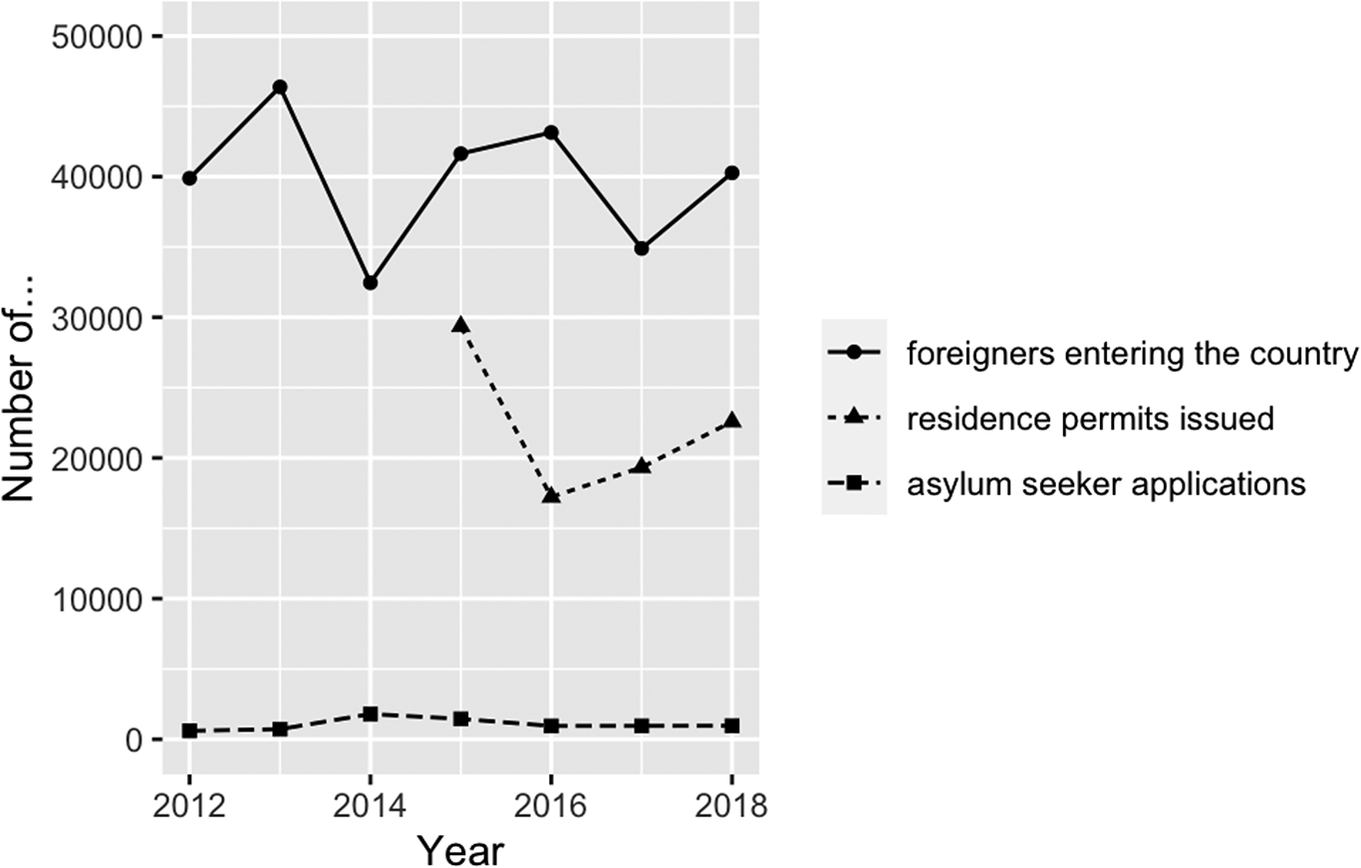
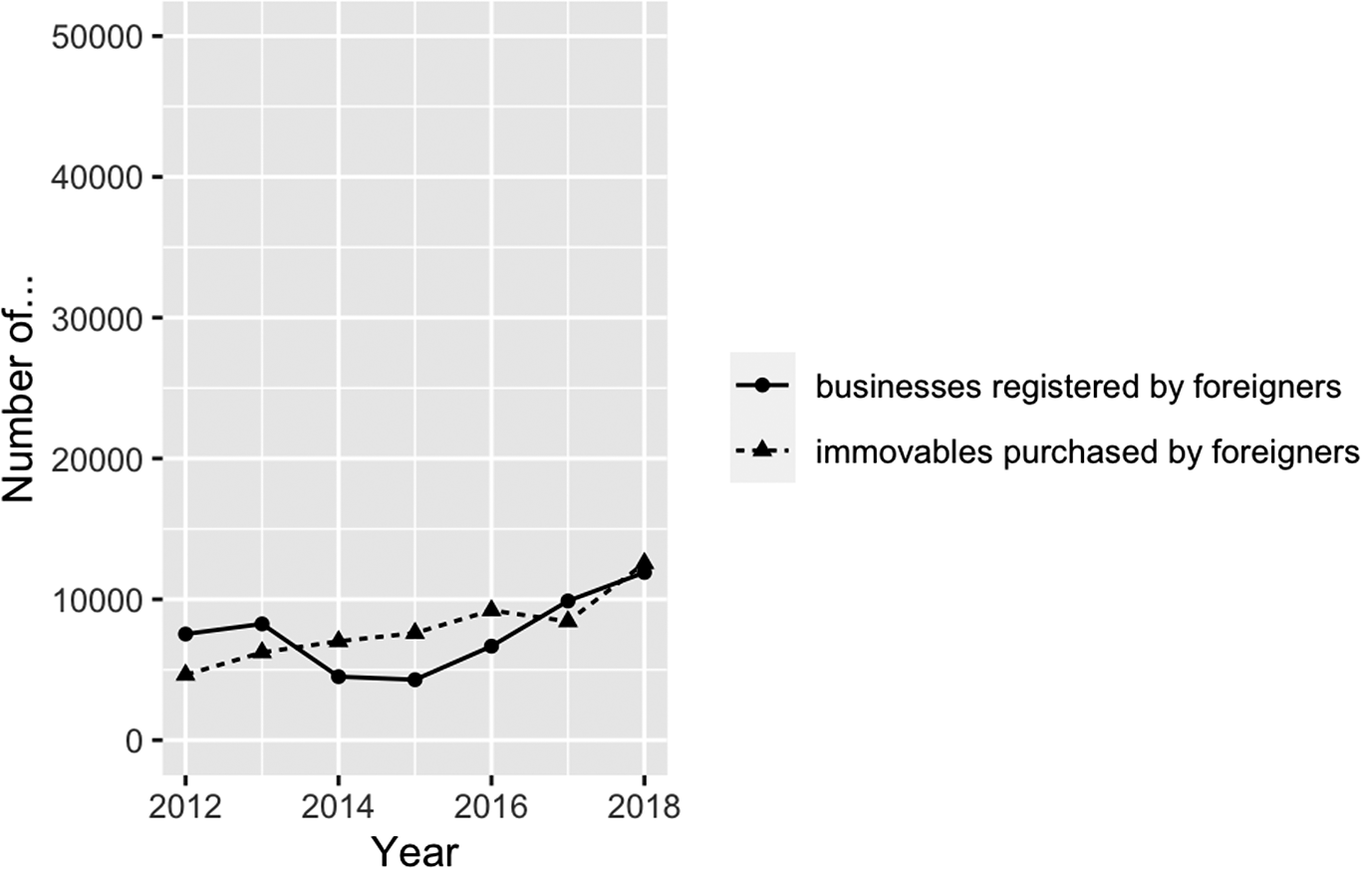
As for the immigration figures, according to the United Nations database (2019), the share of the foreign-born population in Georgia was 2% in 2019 and 1.9% in 2015. Net migration has remained negative in Georgia since the country became independent from the Soviet Union in 1991, as more people left the country than moved there. While the net migration has remained negative, approximately forty thousand foreigners entered Georgia each year.Footnote 2 In 2015–2018, which coincides with the rise of the Georgian far right, there was no drastic change in the number of non-Georgian immigrants that entered the country (Figure 1). The number of residence cards issued to foreign citizens in Georgia increased, but merely by 22%, mostly at the expense of temporary residence cards, as the number of permanent residence cards issued increased by just 6%. Moreover, most of the permanent residence cards were issued to Russians, Ukrainians, and Armenians, who accounted for approximately 50% of the permanent residence cards issued in this period. While the change of Georgia’s visa regime only allows for a comparison to be made for residence cards issued between 2015 and 2018, the number of foreign founders of business entities increased by 58% between 2012 and 2018, while the number of registrations for the ownership of immovable property by foreigners increased 2.7 times in the same period (Figure 2). The number of asylum seekers increased from 599 in 2012 to 1,792 in 2014, but then experienced a decline and remained at approximately 950 applications per year in 2016–2018. The rejections on the grounds of state security jumped from 4–5% in 2015–2016 to 26% in 2017, with most of such rejections falling on the citizens of Iraq, Egypt, Turkey, and Bangladesh. Moreover, the share of asylum seekers in total non-Georgian immigration was minimal. The lowest share, 1.5%, was recorded in 2012, whereas the highest share (5.5%) was recorded in 2014. In Germany, for example, the share of asylum seekers in the total non-German immigration in the same period varied between 8% (in 2012) and 43% (in 2015).Footnote 3 , Footnote 4 In 2015, the five largest immigrant groups that entered Georgia were from Russia (25% of all immigrants), Turkey (14%), Armenia (10%), Ukraine (7%), and Azerbaijan (7%). In 2016, the top five countries remained unchanged, except Azerbaijan, which switched places with Ukraine.Footnote 5
Immigration statistics in Georgia (State Commission on Migration Issues 2019).

Businesses and immovables of immigrants in Georgia (State Commission on Migration Issues 2019).

Georgian immigration regulation is quite liberal and allows citizens of more than 100 countries to stay visa-free for up to 12 months, upon the expiry of which they can simply leave the country and return on the next day to reset the 12-month term (Mestvirishvili and Mestvirishvili Reference Mestvirishvili and Mestvirishvili2018, 2). Moreover, 24 countries that are on the EU visa-required list (including Georgia’s neighbours or regional countries like Russia, Turkey, Iran, Azerbaijan, and Armenia) were still visa-exempt for Georgia as of 2023.Footnote 6 Visa regime violation cases in Georgia vary between 3 and 8 thousand cases a year and are mostly attributed to Russian, Iranian, Armenian, Azerbaijani, and Turkish nationals, all of which enjoy a visa-free travel with Georgia for the duration of twelve months, as they all belong to the list of 90 countries, whose citizens can stay in Georgia without a visa. Iranians are allowed to stay for up to 45 days, whereas the citizens of the remaining four countries are allowed to stay for up to a year (State Commission on Migration Issues 2019). Despite such attractive conditions for immigration, the total non-Georgian immigration has remained low. The number of foreigners expelled from Georgia was fewer than or equal to 100 each year in the period between 2015 and 2018 (State Commission on Migration Issues 2019). To sum up, statistical data show that the rise of the far right in Georgia was not preceded or paralleled by a surge in immigration, legal or illegal.
Cultural Factors: Xenophobia as a Constant
As discussed above, the share of immigrants in Georgia has not experienced any significant changes, and the economic indicators did not show any deterioration in the run-up to 2016. In contrast to the European context, where the mediated images of arriving refugees were used by the populist far right to instill fear in the public (Berry, Garcia-Blanco and Moore Reference Berry, Garcia-Blanco and Moore2016; Castelli Gattinara Reference Castelli Gattinara and della Porta2018; Hinger, Daphi and Stern Reference Hinger, Daphi, Stern, Rea, Martiniello, Mazzola and Meuleman2019), similar immigration dynamics were not present in Georgia. Even though Georgia experienced a decrease in the number of asylum seekers during the so-called “refugee crisis” in the EU, the far right still emerged and successfully mobilized many to rally against foreigners. While there was never any official discussion on accepting people fleeing from Syria (partly because the majority of them were not fleeing to Georgia), outright aggression towards Muslims, as well as the opposition to the prospect of accepting people fleeing the Syrian civil war took place on various occasions (Kobakhidze Reference Kobakhidze2017, 44).
As mentioned in the review of Georgian nationalism earlier, it has strong religious underpinnings, and Orthodox Christianity is one of the core values of the Georgian far right (Gozalishvili Reference Gozalishvili2022b, 19). Previous studies have shown that attitudes towards non-Christians (especially Muslims) are less favorable in countries with predominantly Orthodox Christian populations as compared to Western European countries (Pew Research Centre 2018). In addition, more people in countries where Orthodox Christianity is the dominant religion believe that their culture is superior to others and that ancestry is important to the national identity. In Georgia, the share of people who are willing to accept Muslims as members of their family is 17% (by contrast, this indicator is at 21% in Hungary and 33% in Poland), while the support to the cultural superiority and ancestry statements is 85% and 90%, respectively (Pew Research Centre 2018). Being a foreigner, especially a Muslim, is equated with being non-Georgian, as 81% of Georgians believe that it is very or somewhat important to be an Orthodox Christian to truly share their national identity (Tolerance and Diversity Institute 2017). Georgian Muslims, who comprise approximately 10% of the population, are being omitted from the dominant ethnocentric discourse. This puts Iranians, Turks, and other non-Christian foreigners who were targeted by the far right in an underprivileged position due to Georgian ethno-religious exclusivism. Attitudes towards Turks and Chinese are often determined by the fears of economic expansion, with anti-Turkish attitudes being reinforced by the “historical enemy” argument (Tolerance and Diversity Institute 2017). The importance of religious difference can also be seen when comparing Georgians’ attitudes towards ethnic outgroups. In a study, conducted in three regions of Georgia—Tbilisi, Samegrelo, and Adjara—more than half of the respondents expressed positive attitudes towards Abkhazians (63% on average) and Russians (62%), while the same indicator was lower for Turks (42%) and Chinese (34%) (Tughushi et al. Reference Tughushi, Kachkachishvili, Gagua, Kalatozishvili, Rekhviashvili and Potskhishvili2020). This is especially striking considering the history of ethnic conflict in Abkhazia in 1991–1993 and the fact that approximately 20% of Georgian sovereign territory is still under a Russian military occupation. Against this background, Turkey is Georgia’s biggest import partnerFootnote 7 and a member state of NATO, a military alliance that Georgia aspired to become a member of until the anti-Western turn by the ruling Georgian Dream (GD) party in 2023. The economic relations between China and Georgia have been steadfastly intensifying in the last decade (Smolnik Reference Smolnik2018), with Chinese companies getting contracts for various large-scale infrastructural projects in Georgia, including the country’s main highway and the first deep-sea port (Standish and Pertaia Reference Standish and Pertaia2024).
In order to understand whether the attitudes towards religiously and culturally dissimilar others worsened prior to the events around 2016, I analyse the data from the Caucasus Barometer. According to the Caucasus Barometer data, 27% of Georgians had good or very good attitudes towards foreigners who come to Georgia and stay for longer than three months, whereas 18% had bad or very bad attitudes towards them in 2017. It is noteworthy, however, that 72% of the respondents reported never having contact with foreigners, so the attitudes likely suffer from stereotypes and perceptions prevalent in the respondents’ social surroundings.
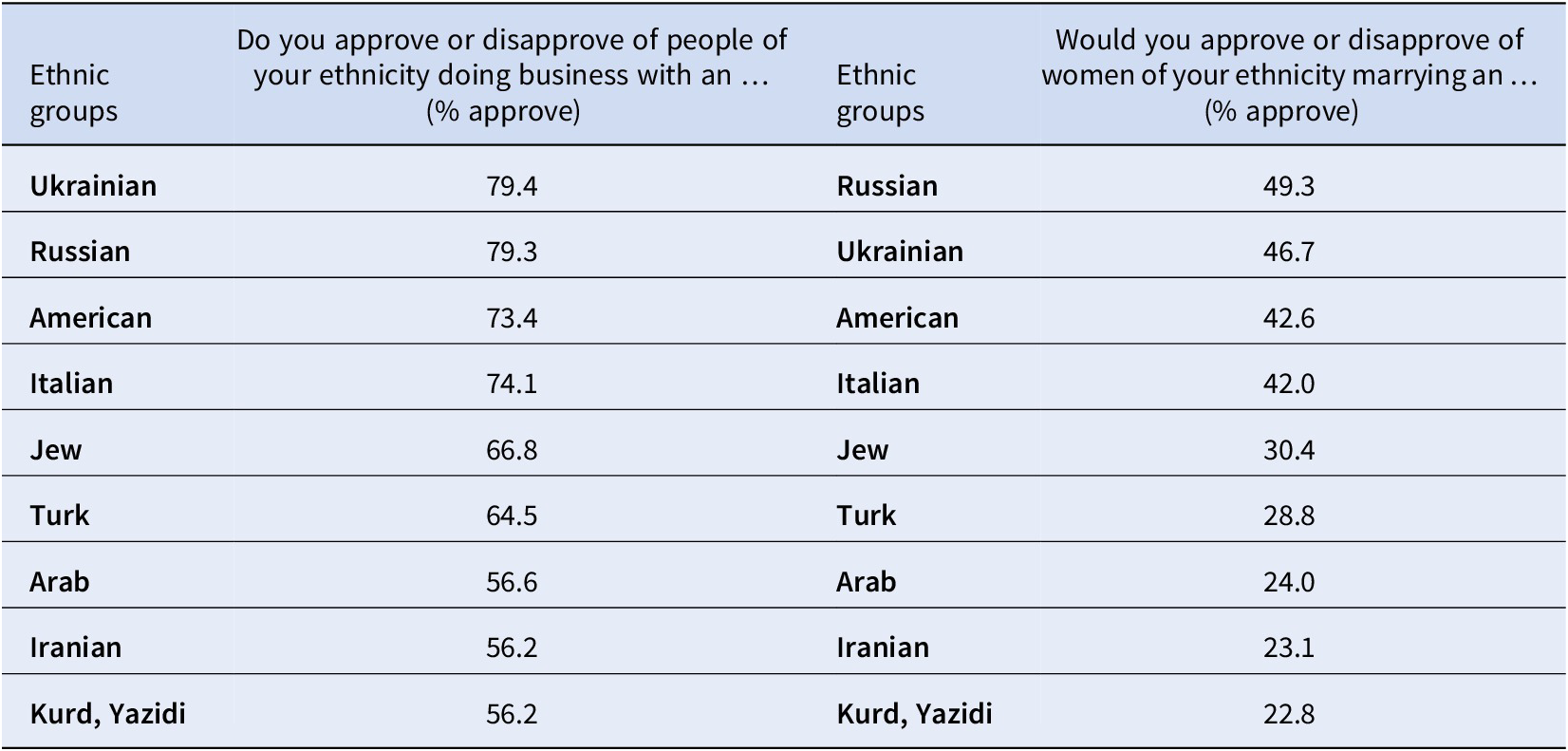
Unlike the generalized immigration attitudes, ethnicity-specific survey items show a clear preference for ethnic outgroups from Western countries. As can be seen in Table 1, the attitudes (acceptance of doing business and marriage) towards predominantly Christian ethnic groups were more favorable than towards the predominantly non-Christian ones, especially towards Muslims.
Attitudes towards various ethnic groups in Georgia (CRRC Caucasus Barometer 2017).

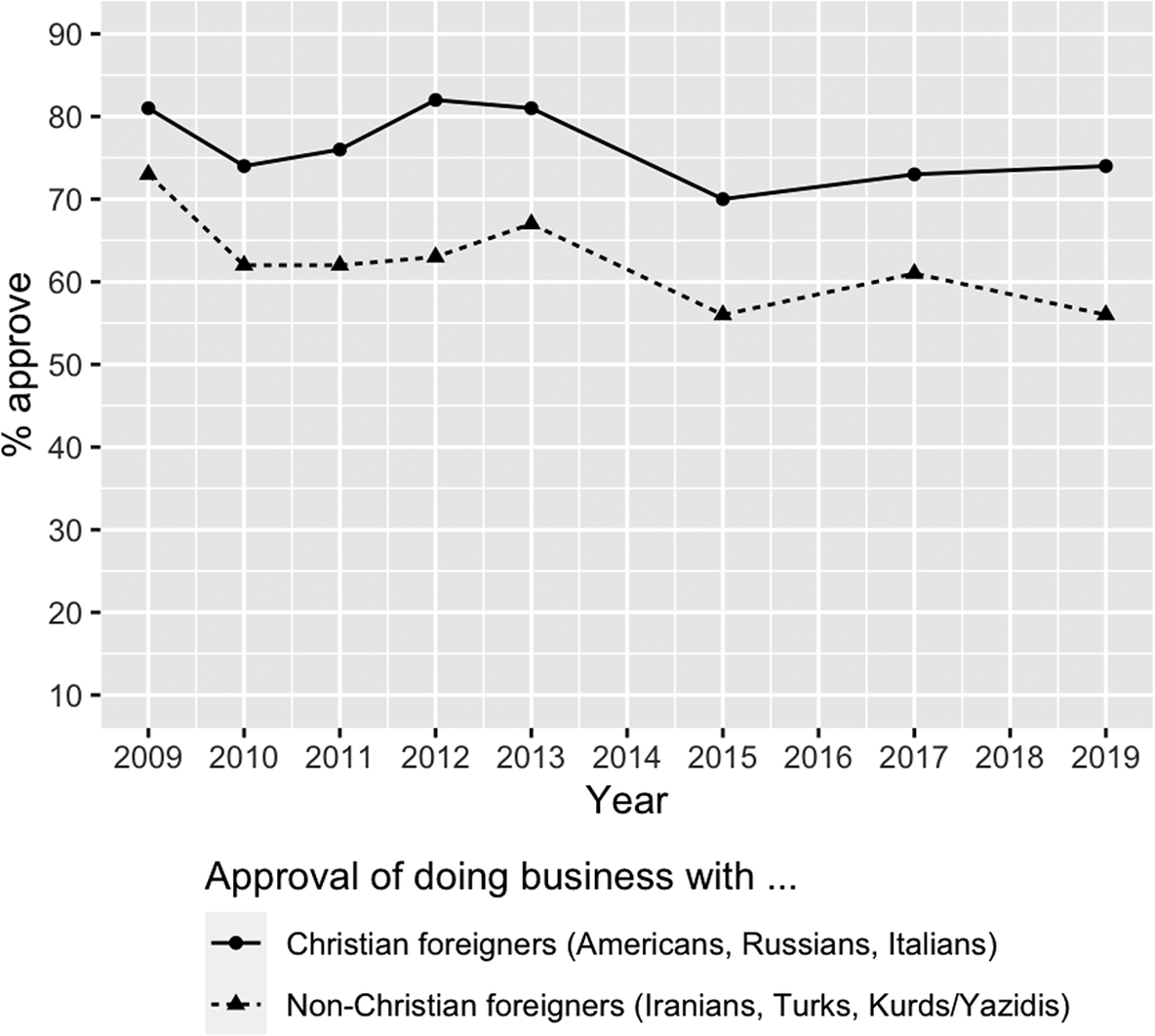
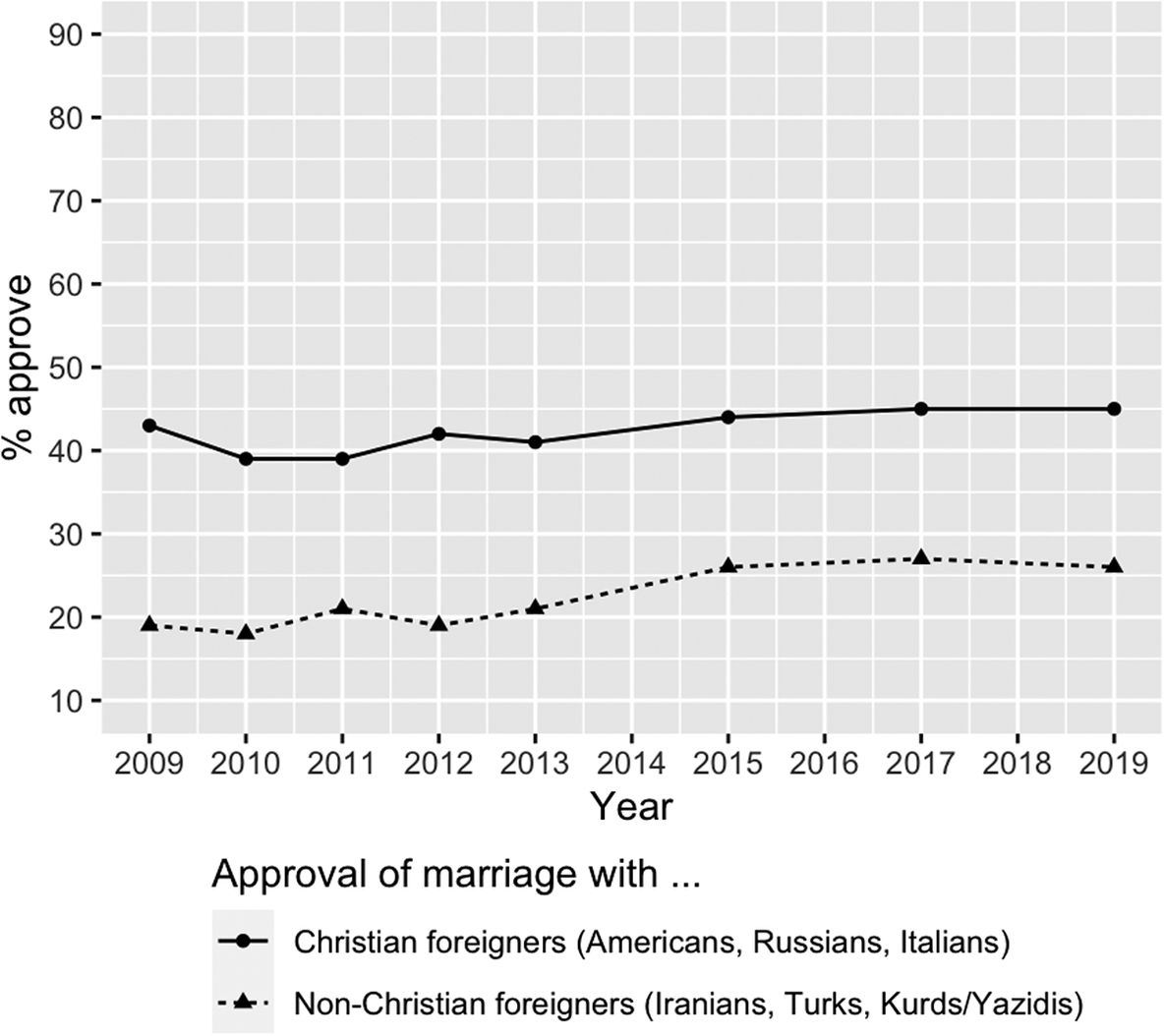
Most importantly, time series of the Caucasus Barometer show no significant changes in favorability towards predominantly non-Christian ethnic groups in the run-up to 2016. The gap between the attitudes towards predominantly non-Christian and Christian ethnic groups exists in the longitudinal data too. The item asking about the approval of doing business and marriage with various ethnic outgroups was asked in several iterations of the Caucasus Barometer from 2009 to 2019. The average approval rate for doing business with predominantly non-Christian ethnic groups (Jews, Turks, Iranians, Kurds/Yazidis) throughout the entire 11-year period was 64%. For predominantly Christian ethnic groups (Greeks, Russians, Americans, Italians), it was 76%. The average approval rate for marriage was 24% for predominantly non-Christian ethnic groups and 42% for predominantly Christian ethnic groups. Prior to 2016, there were both increases and decreases in the favorability towards culturally dissimilar ethnic outgroups. As Figure 3 shows, the approval of doing business with predominantly non-Christian ethnic outgroups (including Iranians and Turks, the two out of three ethnic groups targeted the most during the 2017 rallies and assaults) decreased between 2013 and 2015, but there was no such common tendency in the period between 2015 and 2017, as Georgians became more approving of doing business with Turks. In addition, between 2013 and 2017, Georgian respondents became more approving of women marrying Turks, Iranians, Kurds, and Yazidis (Figure 4).
Approval of doing business with predominantly Christian and non-Christian foreigners (CRRC Caucasus Barometer 2017).

Approval of women of one’s own ethnicity marrying with predominantly Christian and non-Christian foreigners (CRRC Caucasus Barometer 2017).

Evidence of the widespread ethnic and religious intolerance in Georgia comes from studies carried out in the early 2000s as well. A representative survey in 2003 showed that 80% of one thousand surveyed Georgians in three large cities (Tbilisi, Kutaisi, Gori) believed that “it would be better for Georgia, if every Georgian were an Orthodox Christian.” The study also showed a sorting of attitudes from the most positive to the most negative when asked about their attitudes towards members of other religions: Georgians were most favorable towards Catholics (76% responded with positive or rather positive than negative), followed by Jews (59%), Muslims (49%), Protestants (48%), Baptists (20%), Pentecostalists (18%), and Jehovah’s Witnesses (16%) (Nizharadze et al. Reference Nizharadze, Dzhgerenaia, Kachkachishvili, Mshvidobadze and Khutsishvili2004, 50). The latter three were subject to a demonization campaign both in the Soviet and the post-Soviet Georgia. The Communist Party of the Soviet Union considered these “sects” far more dangerous than Orthodox Christianity. Following the dissolution of the Soviet Union, after the GOC secured its privileged position, the situation for the said denominations did not improve, if not deteriorate. In 1999, the GOC was cited by a newspaper, Resonance, stating that dozens of “anti-Christian sects” operated in Georgia, including satanists and Jehovah’s Witnesses, under a veil of non-governmental organizations. Not only did the GOC refrain from denying the statements, but its representative even supported the creation of a special police force to fight “occult and mystic sects.” In the subsequent years, this was followed by the acts of violence against the Baptists, Pentecostalists, and Jehovah’s Witnesses (Adelkhanov Reference Adelkhanov2004, 38–40), putting the GOC’s religious intolerance in a long-term perspective.
Preference towards predominantly Christian ethnic groups was also evident when the respondents were asked about their attitudes towards ethnic groups instead of religious groups. In a 2004 study, in response to the question of whether Georgians should enjoy greater privileges than other ethnic groups, 48% of the respondents gave a positive answer, 27% gave a negative answer, and the rest were undecided. Foreigners from Europe (Italians, Germans, English, and Spanish) were considered more acceptable and viewed in a more positive light than predominantly non-Christian ethnic groups such as Turks, Iranians, or Chechens (Gabinashvili Reference Gabinashvili2005).
To summarize the evidence found in survey data, interviews, and reports, Georgians do tend to have more favorable attitudes towards predominantly Christian ethnic groups, and derogate non-Christian, especially Muslim ethnic groups. While the studies from the 2000s suffer from the lack of external validity due to their small and non-representative samples, there is no indication that, at any point since 1991, the level of xenophobia among the titular ethnic group in Georgia used to be significantly lower than it was around 2016. In addition, as shown in the previous section, there were no significant changes in the number of immigrants that entered the country in that period. This lends support to the argument that the rise of the far right was not preceded or paralleled by any significant changes in the public opinion towards culturally dissimilar foreigners, as the attitudes towards them have been negative since the 2000s. Nevertheless, as the attitudes towards Muslims have traditionally been negative in Georgia, the anti-immigrant rhetoric in the context of the mass emigration from Syria served as a successful mobilizing narrative for the far right.
Domestic Factors: Party Dynamics and Social Media
As noted in the theoretical discussion, prior research has pointed out the role of mainstream parties and media in determining the success of the far right. However, these explanations are based on empirical analyses of the Western European far right. The first problem, arising from an attempt at theoretically analyzing the Georgian political parties with a Western European prism, is the fact that the cases (Austria, Germany, Greece, France, the Netherlands, etc.) analyzed by Ellinas (Reference Ellinas2010) and Mudde (Reference Mudde2019) include the countries that were labeled as “free” in the Freedom in the World index, and scored an average of 0.88 out of 1 in the Electoral Democracy Index in 2016. In the same year, Georgia was labeled as “partly free” in the Freedom in the World Index and scored 0.69 in the Electoral Democracy Index. Nevertheless, I argue that the mainstream party’s behavior did play a role in the emergence of far-right movements and parties in Georgia.
The party system in Georgia in 2016 resembled that of Hungary, with a conservative incumbent party that held a constitutional majority in the parliament, thereby having effective control over the legislative and executive branches. Both Fidesz and GD had effective control over the judiciary (Nakashidze Reference Nakashidze2020; Kovács and Scheppele Reference Kovács and Scheppele2018) and were making efforts to control the media space with the aim of restricting media freedom of the opposition, with Fidesz being more advanced on that path than the GD (Griffen Reference Griffen2020). However, unlike Hungary, immigration and refugees were not emphasized as important issues by the mainstream politicians in Georgia, possibly due to the absence of refugee influx or refugee-related incidents, such as the border clashes on the Serbian-Hungarian border (Kenyeres and Szabó Reference Kenyeres and Szabó2016).
Ellinas (Reference Ellinas2010, 26) points out that “if mainstream parties can sufficiently address growing fears over the loss of national identity, they can prevent the defection of mainstream voters to the extreme Right or, even, broaden their electoral base.” The Orbán administration instrumentalized the fears related to identity and culture by portraying refugees as physically and culturally dangerous, thereby securitizing the immigration issue (Mészáros Reference Mészáros, Gorak-Sosnowska, Pachocka and Misiuna2019). His party embraced far-right narratives, such as the purity of the nation, a line that Fidesz still follows as of 2025. This also meant that there has been no niche left for far-right parties to occupy or for such new movements to emerge. In Georgia, national identity-related fears were not instrumentalized by the mainstream parties as immigration was not an issue. This also meant that, unlike the Hungarian mainstream media (Benczes and Ságvári Reference Benczes and Ságvári2022; Kenyeres and Szabó Reference Kenyeres and Szabó2016), the Georgian mainstream media did not report negatively about refugees. The rare cases when the manipulated or false information about foreigners in Georgia was disseminated via mainstream media can be attributed to the lack of journalistic expertise (Kintsurashvili Reference Kintsurashvili2017, 38).
Despite mass immigration being a non-issue, non-institutionalized online media (including some Facebook pages associated with far-right groups) shared various pieces of manipulated or false information about foreigners (Gelashvili Reference Gelashvili2017; Gurgenashvili Reference Gurgenashvili2017; Kintsurashvili Reference Kintsurashvili2019; Netgazeti.ge 2018b; Kobakhidze Reference Kobakhidze2017). Examples include an Iranian individual allegedly trying to rape a Georgian teenager and two Indian individuals tricking five teenagers into taking nude photos of them. According to an online newspaper affiliated with Georgian ultraconservative movements, these two cases triggered one of the biggest far-right rallies on July 14, 2017 (Georgia and World 2017). The information about the two cases was never verified or confirmed by official sources. While a direct causal link between the manipulated viral information on Facebook and the rise of the far-right is difficult to establish, prior research (although in the US context) has shown that anger increases opposition to racial and immigration policies among whites who score high in ethnocentrism (Banks Reference Banks2016). As explained under cultural factors, the level of xenophobia in Georgia has been high at least since the 2000s.
Manipulative or false media reports and xenophobic narratives, disseminated via anti-liberal online media (mostly Facebook pages), securitized the issue of refugees in particular and foreigners in general. These reports included claims that liberalism, imposed by the West, threatens Georgian national identity. Moreover, a piece of disinformation, disseminated in February 2016, claimed that the EU had an agreement with Georgian authorities on readmission of Syrian refugees (Kintsurashvili Reference Kintsurashvili2017, 41). This arguably helped mobilize ideologically far-right individuals, who, in turn, encouraged far-right groups to assert their presence in the public sphere to demonstrate dominance. The fact that foreign-owned businesses had opened on Aghmashenebeli Avenue in Tbilisi created a perfect venue for the anti-immigrant rallies. These factors also created a certain competition between the far-right groups on who would “defend the Georgian national identity” better. Seeing the popularization of nativism and anti-immigrant sentiments, and the securitization of the national identity, the underground fascist movement National Socialist Movement – Georgian National Unity appeared in the public sphere too. The emergence of far-right movements and parties in Georgia matches Ellinas’ (2010, 28) account of the party dynamics behind the rise of the far right: “politicization of national identity sets in motion a process of intense political competition […] which often materializes as a clash between defenders of different conceptions of the national collective.”
The informal rule by Bidzina Ivanishvili, an oligarch who earned a fortune in Russia, needs to be taken into account, too. Ivanishvili and the GD have followed a harsh line against the former ruling party, the United National Movement (UNM), and its leader Mikheil Saakashvili since coming to power in 2012. Oppositional politicians and activists have been imprisoned (Caliskan Reference Caliskan2023, 391–392) and subject to surveillance (Kakulia Reference Kakulia2023, 36–41). The GD did not strongly endorse or condemn the far-right rallies. However, according to Burkadze (Reference Burkadze2022), the GD used the momentum to further restrict the playing field for the UNM. Clientelism, an inherent part of Georgian politics, is also evidenced by the fact that the leader of the AoP, Irma Inashvili, had provided the GD with prison tapes that largely skewed the election results in its favor in the 2012 Parliamentary Election that saw the GD come to power. In addition, Sandro Bregadze, the founder of the first and the only openly far-right political party in Georgia, served as the Deputy State Minister on Diaspora Issues in the GD government in 2014–2016. Bregadze and his Georgian March had, besides the nationalist ideological core, a strongly pronounced opposition towards the UNM. Soon after the first “March of Georgians,” former members of the newly fragmented UNM organized a counter-rally called “No to Russian fascism,” accusing the Georgian March of strengthening Russia’s positions in Georgia by facilitating illiberalism (Civil Georgia 2017). The Georgian March responded with violence targeted at the protesters. Georgian March subsequently continued its transformation from an anti-immigrant into a broader anti-liberal party, but it did not achieve any electoral success. Arguably, their opposition to the UNM and liberalism overlapped too much with the ideological niche that Ivanishvili wanted the GD to occupy.
During the rise of the far right, the GD was not in a position to openly antagonize the EU by exploiting the niche created by the fears of refugees and the activated anti-Muslim sentiments. The ruling party, which had a constitutional majority in the parliament, was pursuing a “fence-sitting” policy by trying to improve relations with Russia without compromising the country’s EU integration. In the context of the full-scale invasion of Ukraine by Russia in 2022, however, the GD had to clarify its loyalties. After the GD-ruled Georgia did not join the sanctions against Russia and after Prime Minister Gharibashvili blamed the war on NATO enlargement policy, it disclosed its pro-Russian foreign policy (Civil Georgia 2023). Since then, the ruling party has embraced many of the calls voiced by the extreme right groups (alliance with Viktor Orbán, crackdown on liberalism, and spreading conspiracies such as “globalist powers” secretly trying to take Georgia down) and the far-right Georgian March (banning foreign funding to Western-funded civil society organizations). The last two prime ministers of Georgia, Irakli Gharibashvili (2021–2024) and Irakli Kobakhidze (2024–to date), have served as keynote speakers at the Conservative Political Action Conference (CPAC) in 2023, 2024, and 2025 in Budapest, cracking down on liberalism and condemning forces that are destroying “the traditional family values and coercing false freedoms (Genté Reference Genté2023).” Orbán visited Gharibashvili in Georgia in 2023. Both Gharibashvili and Orbán claimed that the two countries are united by their devotion to “traditional and eternal values” (Interpressnews 2023). The reasons behind the GD’s gradual switch to strongly EU-critical and anti-liberal polices is a separate research question, but the fact is that the GD has increasingly adopted the ideology of the Georgian far right, leaving hardly any room for its electoral success.
In fact, the gradual transformation of the GD from a supporter of Georgia’s EU integration into a vocal critic of the EU, liberalism, and a disseminator of conspiracies about the “deep state” and the “global war party” (Civil Georgia 2025) can partly explain the disappearance of far-right groups and politicians from the public sphere. The other important reason is the decrease in the number of asylum-seekers in the EU, which resulted in a shift of media attention away from this issue (Heidenreich et al. Reference Heidenreich, Lind, Eberl and Boomgaarden2019), including in Georgian media. Nevertheless, despite the recent surge in anti-immigrant rhetoric in the context of Donald Trump’s second presidential term and the hitherto unprecedented ratings of far-right parties in the EU, no far-right organization (be it a party or a movement) is active in the Georgian public sphere as of 2025. In the run-up to the 2024 parliamentary election, an anti-liberal party, Alt-Info, founded by a former member of the AoP (Konstantine Morgoshia), was denied registration by the Central Election Commission. Alt-Info members then joined the AoP to bypass the block but missed out on parliamentary seats as the AoP only received 2.44% in a controversial election that saw voter intimidation, pressure on public employees, vote buying, and electoral violence against the liberal opposition. Considering the disappearance of the far-right groups and politicians from the public sphere, as well as the adoption of many of their ideological elements by the GD since then, one can allege a certain kind of exploitation of the far-right momentum by the GD.
External Factors: Europe and Russia
Prior research has suggested that the emergence of the Georgian far right was driven by a diffusion process that saw Georgian far-right movements borrow national-populist discourse from their European counterparts (Gozalishvili Reference Gozalishvili2022a). This matches the earlier findings demonstrating the internationalization of the extreme right. The easing of borders in Europe and the advance of digital media facilitated transnational exchanges between far-right groups (Whine Reference Whine, Mammone, Godin and Jenkins2012). As a result, it has become easier for the far-right groups in geographically distant countries to adopt successful discursive frames, despite differing national contexts.
Understanding the diffusion process between the European and Georgian far-right organizations requires understanding the role of Europe (and the West, in general) in Georgia. In the late years of the USSR, the abstract “West” in Soviet Georgia was associated with freedom, a tradition of Christianity, and, most importantly, opposition to the Soviet system (Gozalishvili Reference Gozalishvili2022b, 18). In 1995, Article 78 (Integration into European and Euro-Atlantic structures) was entered into the Constitution of Georgia: “The constitutional bodies shall take all measures within the scope of their competences to ensure the full integration of Georgia into the European Union and the North Atlantic Treaty Organization.” As of 2023, most of the Georgian parties were pro-European (Andguladze Reference Andguladze2023, 78). While one way to demonstrate pro-Europeanness would be through supporting human rights, social justice, and welfare policies, the far right embarked on a different path. It promoted the conservative, traditionalist, and Christian image of Europe. It explicitly opposed liberalism, non-white immigrants and the LGBT community (Kobakhidze Reference Kobakhidze2017, 16) and expressed vocal support for the policies of European right-wing populist politicians (Gozalishvili Reference Gozalishvili2022b, 19). The Georgian far right thus picked up on Orbán’s “two Europes” narrative: They supported a civilizational, Christian Europe rooted in history, which the likes of Orbán, Salvini, and Le Pen stood for and created the image of the enemy, which was a mercantile, technocratic, and elitist EU that does not speak to average Europeans’ hearts and souls (Coman and Leconte Reference Coman, Leconte, Brack, Coman and Crespy2021).
This narrative of anti-liberal Europe was ushered in by various newly established anti-liberal websites and Facebook pages, connected to the far-right groups (Kobakhidze Reference Kobakhidze2017). In many cases, the source of narratives for these pages were media outlets such as Sputnik Georgia, Georgia and World, Newsfront Georgia, and Sakinformi. The materials, published by such anti-liberal websites and Facebook pages, were usually translated from the Kremlin’s propagandist media outlets such as News Front, Sputnik, RT, ria.ru, or regnum.ru (Mkheidze Reference Mkheidze, Moldogaziev, Brewer and Kellough2021; Myth Detector 2017). Besides reiterating the European right-wing populists’ fearmongering messages on the alleged loss of the “historical Europe” (Andguladze Reference Andguladze2023, 90), these media outlets were engaged in the securitization of immigration by spreading similar messages in the Georgian context. The cultural fearmongering messages included the alleged loss of the Georgian national identity if the country were to get more integrated with the EU, or the fear that the emigrating Georgian population would be replaced by foreigners because of a secret deal with the EU (Kintsurashvili Reference Kintsurashvili2017, 41). In these reports, Georgia was praised as a beacon of Orthodox Christianity, and Russia was praised as a defender of Christianity and traditional values (Mkheidze Reference Mkheidze, Moldogaziev, Brewer and Kellough2021, 43). Economic fearmongering could be identified in disinformation such as “70% of apartments in Tbilisi are bought by Iranians” or “the EU drains the Georgian middle-class workforce and forces Georgia to take in migrants” (Kintsurashvili Reference Kintsurashvili2019). Finally, the security-related fearmongering was evident in misleading or false reports involving alleged crimes committed by non-European foreigners—such as individuals from India, Iran, or Arab countries—in Georgia and Europe (Gelashvili Reference Gelashvili2017; Gurgenashvili Reference Gurgenashvili2017; Netgazeti.ge 2018b).
Besides launching the Georgian branches of propagandist media outlets and providing narratives for the anti-liberal/anti-Western media and politicians, Russian propagandists have also had strong personal or business ties with Georgian anti-liberal activists. One example is a businessman, Levan Vasadze, who has sponsored Alt-Info since 2019. Vasadze made his fortune in Russia and has strong connections with the far-right Russian ideologue Aleksandr Dugin. In 2020, the ties between the Kremlin and the AoP were revealed in a journalistic investigation by Dossier (Andguladze Reference Andguladze2023, 84). As for the extreme right, such as the Georgian Power and its affiliate groups, during the period of their activity in and around 2016, they were trying to avoid being associated with Russia, as they considered it the enemy of Georgia (Kobakhidze Reference Kobakhidze2017, 38–42).
The popularization of anti-immigration rhetoric in Europe, Brexit, and the victory of Donald Trump in the 2016 US presidential election sent a strong signal to the Georgian right-wing populist and far-right groups that the said anti-liberal Europe was gaining traction. Even though Georgia did not experience an influx of refugees like many EU countries did, Georgian March and other far-right groups translated the fears over the loss of European identity, voiced by the European anti-immigration actors, into fears over the loss of Georgian identity. The supporting evidence for this diffusion of the far-right rhetoric from the West to Georgia comes from interviews with the far-right politicians and activists (Tabatadze Reference Tabatadze2019), the content analysis of the online media affiliated with the far right (Andguladze Reference Andguladze2023), and the discourse analysis of the Georgian March (Gozalishvili Reference Gozalishvili2022a; Cole Reference Cole2020).
The adoption of proven populist narratives brought the far right its popular support, as many Georgians identify as (anti-liberal) Europeans, demonstrate high levels of patriotism, and xenophobia. The increased demand for cultural protectionism, in line with the theoretical model of Ellinas (Reference Ellinas2010, 28), set in motion a process of intense political competition between defenders of different conceptions of the national identity. In this competition, the most patriotic, culturally and religiously conservative actors emerged as winners and gained the support of those made insecure by the anti-immigrant and anti-liberal propaganda. This explains the appearance of diverse far-right groups, both institutionalized and non-institutionalized, which, in some cases, even disagreed on issues like attitudes towards Russia (Kobakhidze Reference Kobakhidze2017, 38–41). What united these groups was the ostracization of non-Georgian and non-Christian foreigners by securitizing immigration and referring to the negative stereotypes about immigrants. These negative imaginaries, due to their absence in Georgia, had to be borrowed from the European far right (diffusion), manipulated/made up in the Georgian context, or translated from the Russian media.
Conclusion, Limitations, and Future Research
The aim of this article was to explain the rise of the Georgian far right by examining the period preceding the far-right rallies, xenophobic violence, and the electoral success of the right-wing populist AoP. Public opinion polls in the run-up to the events of 2016 did not show any deterioration of attitudes towards immigrants or non-Christian foreigners in particular. The attitudes towards them remained stable (and worse, compared to white and Christian foreigners) over time. The analysis of the empirical data showed that public opinion on immigration cannot explain the emergence of the Georgian far right in 2016. The analysis of economic indicators did not show any negative macroeconomic trends in the run-up to 2016 either, as the trends were rather favorable. Immigration figures, fiscal burdens, and market competition were all stable and low in that period.
The rise of the Georgian far right can therefore be explained only by analyzing other domestic and external factors in the run-up to 2016: (1) The transnational diffusion of far-right ideas and practices from Europe, (2) successfully appealing to the (stable) pre-existing ethno-nationalist sentiments, (3) the role of the Russian soft power and propaganda, which advertently or inadvertently penetrated the Georgian media system, especially the Georgian-speaking Facebook, and (4) the exploitation of anti-liberal sentiments by the ruling party without being affiliated with the far right. The emergence and the activities of the far-right movements and parties can be seen as a rather top-down process, in which ideologically and politically motivated far-right actors mobilized the already existing (but not growing) xenophobic (especially Islamophobic) attitudes in the public. This process was aggravated by the unverified viral reports about immigrants and the anti-liberal messages disseminated directly or indirectly by the Russian propaganda. To my knowledge, there is no study that analyses the rise of the Georgian far right by investigating the two traditional predictors—economic and cultural—of the far-right success and the domestic and external factors, specific to the Georgian context.
Nevertheless, this study has several limitations. The primary limitation is that it is based on the analysis of secondary data. It was not possible to analyze economic and cultural factors using a single survey. The analysis of domestic and external factors, which are central predictors of the Georgian far right’s success, suffers from a similar limitation, as no comprehensive archive of statements of far-right politicians or media reports can be found in the Georgian context. In this part of the analysis, I largely relied on peer-reviewed publications that study the far-right narratives using discourse analysis, content analysis, and interviews.
In addition, items that measure attitudes towards foreigners in the CRRC dataset are suboptimal for this study. Standard operationalizations of intergroup ethnocentrism include a battery of four questions that measure preference, superiority, purity, and exploitativeness (Bizumic et al. Reference Bizumic, Duckitt, Popadic, Dru and Krauss2009, 880; Bizumic and Duckitt Reference Bizumic and Duckitt2012, 896; Gelovani et al. Reference Gelovani, Theocharis, Koc-Michalska and Bimber2025, 602). To measure the socio-economic fears associated with immigration, researchers usually include more specific questions, such as “how likely it is that immigration will have a negative impact on jobs for [insert nationality] citizens” (Valentino, Brader and Jardina Reference Valentino, Brader and Jardina2013, 153). However, ethnic outgroup stereotypes can be measured by asking the respondents about their attitudes towards different stereotypes of immigrants, such as eager to assimilate, lazy, lawful, etc. (Konitzer et al. Reference Konitzer, Iyengar, Valentino, Soroka and Duch2019, 5). Future studies could potentially use these items to measure attitudes towards cultural, religious, or ethnic outgroups instead of asking about the acceptance of doing business or marriage.
Another limitation lies in the lacking robustness of the longitudinal analysis. Older data about the attitudes of Georgians towards ethnic outgroups over time come from various sources and rarely represent the entire Georgian population. In addition, these older studies are based on rather small and non-representative samples, so the results have a limited external validity. Even though Georgia has been an ethnically diverse country for many decades, researchers in the 2000s almost exclusively studied the attitudes of the titular ethnic group towards foreigners or ethnic outgroups.
Future research in this direction would benefit from a more in-depth, qualitative look at the immigration attitudes in Georgia. While the Caucasus Barometer data allowed for informative insights, the applicability of the secondary data is limited. A survey that includes more detailed questions about ethnicity and religion, as well as the frequency and the nature of contact with foreigners, is needed to potentially test whether certain predictors, such as optimal intergroup contact (Pettigrew and Tropp Reference Pettigrew, Tropp, Dovidio, Glick and Rudman2005; Allport Reference Allport1954), news consumption (Valentino, Hutchings and White Reference Valentino, Hutchings and White2002; Valentino, Brader and Jardina Reference Valentino, Brader and Jardina2013), or social media use (Asimovic et al. Reference Asimovic, Nagler, Bonneau and Tucker2021) are correlated with attitudes towards ethnic outgroups. Ellinas (Reference Ellinas2010, 223) points out the importance of studying how political agents try to mobilize and profit from social sentiments. Therefore, a closer investigation of individual leaders of the far-right movements and their political activities may become a valuable addition to the studies on the far right in the Georgian context. It is, however, important to account for the features of the Georgian political system, as power is concentrated in the hands of an informal oligarchic ruler, Bidzina Ivanishvili (Aprasidze and Siroky Reference Aprasidze and Siroky2020). Therefore, comparative studies should, on the one hand, account for the fact that generalizing one country’s experience on others may be misleading (Merkl and Weinberg Reference Merkl and Weinberg, eds2003, 5), and, on the other hand, consider the fact that the Georgian far right, as well as political parties and movements in general, cannot be compared with their Western European counterparts without accounting for the context-specific factors such as informal rule, the role of religion, and Georgia’s position within the Russian sphere of influence, the so-called “near abroad”.
Disclosure
None.

 Open access

