





INTRODUCTION
Throughout the prehistory of Europe, larger cultural changes and developments are mirrored by changing forms and meanings of burial practices. One of the major characteristics of the change taking place in the Early Bronze Age of Central Europe was the differentiation of burial rites. Already in the Final Neolithic, i.e., first half of the third millennium BC, the appearance of individual burials with the Corded Ware Culture and Bell Beakers was accompanied by the disappearance of collective burials (e.g., Czebreszuk Reference Czebreszuk, Bogucki and Crabtree2008; Heyd Reference Heyd, Fokkens and Harding2013; Vander Linden Reference Vander Linden, Fokkens and Harding2013; Furholt Reference Furholt2014; Bourgeois and Kroon Reference Bourgeois and Kroon2017; Włodarczak Reference Włodarczak2017). In mass burials, the use of a single structure for burying multiple individuals led to the depersonalization of grave goods, linking them to the collective of individuals buried inside. This particular phenomenon originated in Middle Neolithic communities, where “collective gifts” were the regular form of object affiliation (e.g., Whittle Reference Whittle1996; Cunliffe Reference Cunliffe2011; Salazar-García et al. Reference Salazar-García, García-Puchol, de Miguel-Ibáñez and Talamo2016; Steuri et al. Reference Steuri, Siebke, Furtwängler, Sönke, Krause, Lösh and Hafner2019). Contrastingly, in individual burials, the interment of personal objects became a typical constituent of the burial rite. This personalization of grave goods was tied to the increasing significance of property of the buried individuals or represented gifts for the dead from the living community, a common phenomenon in the Early Bronze Age burial rite. Although collective burials were still found among both individualized and stratified communities such as the Únětice or the Otomani-Füzesabony, such practices were not prevalent (e.g., Zich Reference Zich1996; Kristiansen Reference Kristiansen1998; Harding Reference Harding2000; Kadrow Reference Kadrow2001; Thomas Reference Thomas2008).
In the second quarter of the 2nd millennium BC in Central-Eastern Europe the tendency to individualize death halted. Collective burials regained their popularity, especially in the area between the Oder basin to the west and the Dnieper basin to the east. This wide area can be tied to the Trzciniec Cultural Circle (henceforth TCC), a cultural entity which was developing until the end of the millennium (Figure 1; Makarowicz Reference Makarowicz2010a; Górski Reference Górski and Urbańczyk2017).
Trzciniec Cultural Circle cemeteries with the collective graves dated using 14C method against the spatial range of the TCC (Makarowicz Reference Makarowicz2010a). Numbers of sites according to chronological order displayed in Figure 5. 1—Beremiany, 2—Bukivna, 3—Miechów, 4—Nowa Huta, 5—Kordyshiv, 6—Dacharzów, 7—Strugi, 8—Żerniki Górne, 9—Pielgrzymowice, 10—Guciów, 11—Polesie, 12—Gustorzyn, 13—Gnieszowice, 14—Brodzica, 15—Bocheniec, 16—Koszyce. The sites: D—Dubeczno, and K—Kazimierzów, represented by single 14C dates, were not included in chronological ordering. Acc. to Romaniszyn et al. Reference Romaniszyn, Gwizdała and Makarowicz2016; Makarowicz et al. Reference Makarowicz, Goslar, Niebieszczański, Cwaliński, Kochkin, Romaniszyn, Lysenko and Ważny2018; Taras Reference Taras1995; Górski and Makarowicz Reference Górski and Makarowicz2012; Kłosińska Reference Kłosińska1987; Ilchyshyn Reference Ilchyshyn2016; Górski and Tyniec Reference Górski and Tyniec2018; Kłosińska et al. Reference Kłosińska, Taras and Sadowski2010; Florek and Taras Reference Florek and Taras2003; Kempisty Reference Kempisty1978; Juras et al. Reference Juras, Makarowicz, Chyleński, Ehler, Malmström, Krzewińska, Pospieszny, Górski, Taras, Szczepanek, Polańska, Włodarczak, Szyca, Lasota-Kuś, Wójcik, Jakobsson and Dabert2020; Górski et al. Reference Górski, Makarowicz and Wawrusiewicz2011; Banasiewicz-Szykuła et al. Reference Banasiewicz-Szykuła, Gołub, Koman, Stachyra and Wetoszka2008; Grygiel Reference Grygiel1987; Matoga Reference Matoga1985; Makarowicz Reference Makarowicz2010a, Reference Makarowicz2010b. Drawn by J. Niebieszczański.

The TCC was a unit of longue durée (Braudel et al. Reference Braudel, Arnaldez, Aymard, Coarelli, Duby, Guademet and Solinas1994), a long-term macrostructure (700 years) found across a vast area (800,000 km2). This cultural unit was strongly differentiated from other dominating cultural units in Central-Eastern Europe and was characterized by a relatively large degree of autonomous development (Kośko and Klochko Reference Kośko and Klochko1998; Makarowicz Reference Makarowicz2010a).
From an epistemological point of view, the burial rite of the TCC was characterized by a great diversity of recognized forms (Makarowicz Reference Makarowicz2010a: 201–280; Górski Reference Górski and Urbańczyk2017). Burials were found in separated areas, i.e., cemeteries or single graves, and rarely in settlement contexts such as re-used storage pits. From a formal standpoint, the burials of the TCC can be linked to barrow and flat cemeteries, where inhumation, cremation and biritual rites were documented.
From a quantitative standpoint the majority of the deceased were buried in mass graves, a specific form of funerary architecture and a characteristic trait of the sepulchral rites of the TCC communities. Collective burials were documented across the entire area of habitation, both in “regular” cemeteries as well as in features found on settlements. Collective graves adhering to the inhumation rite were prevalent, although variants with cremated remains were encountered as well. Partial burials and non-anatomic arrangements were well-documented together with the displacement of individual burials inside the graves (Makarowicz Reference Makarowicz2010a: 244f.).
Graves with collective burials were usually rectangular in shape with rounded or oval-like outlines and rarely trapezoid- or rhomboid-shaped cross-sections. The size of such structures was differentiated as a consequence (by design or outcome) of the number of buried individuals as well as the duration of use of the grave. Burial chambers were re-opened in order to bury additional individual, or more probably, a group of deceased which were buried elsewhere until excarnation (Górski, Tyniec Reference Górski and Tyniec2018; Makarowicz Reference Makarowicz2019). The largest graves, 4–5 m long and 3–4 m wide, had an area of 15–20 m2. Stone, wood and combined architecture were encountered, often of a simple construction. The roofs were supported by four posts and walls were erected to a low height. Although the complete reconstruction of such structures was not possible due to the preservation conditions, they most likely resembled shed-like forms (Makarowicz Reference Makarowicz2010b; see also: Bátora Reference Bátora1999).
Barrow and flat graves were characterized by burials of 2–30 individuals and included men, women, and children, suggesting that the burial rite was rather egalitarian, which can be considered unusual for a Middle Bronze Age society. Deceased were often, but not exclusively, buried in antipodal (antithetic or inverted) arrangement, with the heads placed along the shorter sides of the burial chamber and the long bones pointing towards the center of the grave. Whenever a large number of the deceased have been identified during excavations, the remains have been encountered in a pile, though they did not reach the walls of the chamber. The space between the bone pile and the walls of the chamber likely would have been filled by a wooden construction, e.g., a coffin or a chest-like structure, which had since undergone mineralization (Figure 2). Collective graves were used for a long time period, which required the displacement of the previously buried individuals with the final burial often positioned in the center of the grave (Makarowicz Reference Makarowicz2010a, Reference Makarowicz2010b; Szczepanek Reference Szczepanek2013).
A typical collective burial of the Trzciniec Cultural Circle: an example from Żerniki Górne, Lesser Poland, grave 62 (Kempisty Reference Kempisty1978). Drawn by J. Romaniszyn.

The aim of this paper is to examine the absolute chronology of collective burials of the TCC by means of AMS 14C dating and to investigate the spatial development of this form of burial rite. Further analyses are aimed at formulating a historical understanding of selected cemeteries and, more specifically, selected collective graves. The Bayesian-modeled chronology of the largest cemetery with collective graves in Żerniki Górne, Lesser Poland, was implemented in order to define the sequence of burial construction and use. A selected case study of a collective burial with a particularly large number of 14C dates is investigated using Bayesian modeling to identify the overall duration of use of individual mass graves and timespan of the burial rite.
MATERIALS AND METHODS
The dating program targeted 18 necropolises with collective burials located in the Upper Vistula and Middle Warta basins in Poland and in the Upper Dniester basin in Ukraine (Figure 1). The sample comprises of both barrow and flat cemeteries. In total, 91 individuals representing 42 mass burials were analyzed. The biological determination of sex was possible for 62 individuals and identified 25 females and 37 males. Age-determination was possible for 86 deceased and included 2 adolescents and 14 children. In the remaining cases, the state of preservation of biological traits did not allow a more detailed identification of sex or age (Table 1). Twenty-four individuals were found in graves covered with mounds; the remainder were recognized in flat graves. The majority of grave constructions were comprised of stone components, i.e., slabs and erratic boulders, while the wooden constituents were coffin- or chest-like forms comprised of planks or logs. Combinations of both were also noticed, often reinforced with clay or sediment. The 14C samples were extracted from long bones or skulls. In the case of the sites Bukivna and Gnieszowice, all sampled bones were cremated in situ, due to the burning down of the wooden so-called mortuary houses during the burial event (Makarowicz et al. Reference Makarowicz, Goslar, Niebieszczański, Cwaliński, Kochkin, Romaniszyn, Lysenko and Ważny2018).
14C ages of samples collected from the mass graves described in the text. Values of %coll/C/Nat represent collagen extraction yields and atomic C/N ratios measured in collagen

Mat.—material; b—bone; b.b.—burnt bone.
Collagen from the non-cremated bones was extracted using the Longin method (Reference Longin1971) supplemented by stages of removing humic substance in a NaOH solution and ultrafiltration of the extract (Bronk Ramsey et al. Reference Bronk Ramsey, Higham, Bowles and Hedges2004; Brock et al. Reference Brock, Higham, Ditchfield and Bronk Ramsey2010). The measured collagen extraction yield and the atomic ratio of C/N in collagen (Table 1), indicates good purity of the extracts (van Klinken et al. Reference van Klinken1999). In relation to cremated bones the Lanting et al. (Reference Lanting and van der Plicht2001) procedure was applied, which allows extraction of carbon from structural carbonate (apatite) fraction. Portions of CO2 resulting from the combustion of collagen or decomposition of structural carbonate were graphitized with hydrogen (H2), and isotopic ratios 14C/12C and 13C/12C in the acquired graphite were measured using the “Compact Carbon AMS” spectrometer (Goslar et al. Reference Goslar, Czernik and Goslar2004). The stable isotopic composition of collagens (δ15N and δ13C) was analyzed with IRMS, at the Goethe University in Frankfurt.
14C ages of the samples (Stuiver and Polach Reference Stuiver and Polach1977) are shown in Table 1 (14C BP). The clear differences in the conventional 14C ages of bone material from the analyzed cemeteries (e.g., 3420–3500 BP from Beremiany and 3005–3135 BP from Bocheniec) suggest that the ritual of collective burials was practiced in particular areas in different time periods. However, it must be considered that the discrepancies in the measured 14C age could be a direct outcome of the diet of the dated individuals. Should the past communities have relied on the consumption of aquatic products, the results of the 14C dating would be affected by the “reservoir effect” (e.g., Cook et al. Reference Cook, Bonsall, Hedges, McSweeney, Boronean and Pettitt2001; Olsen et al. Reference Olsen, Heinemeier, Lübke, Lüth and Terberger2010).
In general, aquatic organisms have higher 15N/14N ratios value than terrestrial organisms. These higher values are then reflected in the measured δ15N values of all organisms who consume them, including humans with aquatic-rich diets. Comparative studies of individuals from different parts of Europe (Goslar et al. Reference Goslar, Jankowski, Kośko, Lityńska-Zając, Włodarczak and Żurkiewicz2017) have shown that the δ15N values of human bone collagen of individuals relying solely on terrestrial food sources were also subject to variation. In Giecz, ca. 100 km NW of the analyzed cemetery in Strugi (Figure 1), the δ15N values (Reitsema et al. Reference Reitsema, Crews and Polcyn2010) were within 8 and 10.5‰ range, while for the Yampil barrow complex in Ukraine (ca. 150 km SE of the site in Beremiany; Figure 1) the δ 15N values fell within the 8–12‰ range. Considering this background, intervals of δ15N values of the present study (Figure 3) indicate that aquatic food sources were insignificant at the examined sites as well. It would also be expected that a diet rich in fish would result in a positive correlation between the δ15N values (increased due to the aquatic diet) and the 14C age (appearing “older” due to the reservoir effect). In terms of the analyzed samples, such a correlation was not observed (either for the whole set of analyzed samples [r2=0.016] or for the subsets representing individual sites; Figure 3), additionally supporting our argument that the differences of the TCC dates from different areas, were not caused by the reservoir effects.
δ15N values and 14C ages of bones analyzed in this study.

On the other hand, the rather wide range of δ13C values measured in our samples, could be fully interpreted in terms of mixing C4- and C3-photosynthesizing terrestrial plants in human diet. However, explanation of this phenomenon is beyond topic of this paper and will be discussed in a separate publication (Pospieszny et al., Reference Pospieszny, Makarowicz, Lewis, Górski, Taras, Włodarczak, Szczepanek, Ilchyshyn, Jagodinska, Czebreszuk, Muzolf, Nowak, Polańska, Juras, Chyleński, Wójcik, Lasota-Kuś, Romaniszyn, Tunia, Przybyła, Grygiel, Matoga and Goslarin press).
As documented e.g., by Snoeck et al. (Reference Snoeck, Brock and Schulting2014), 14C ages determined using structural carbonate (apatite), could potentially be affected due to exchange with the carbon derived from fuel during the cremation process. Significant effect, however, may occur only when the fuel contained “old wood” (e.g., descending from inner parts of big wooden timbers) or coal, a situation that was rarely the case. Exchange of carbon affects also δ13C values of the apatite. In our study, δ13Cs of cremated bones were measured with the AMS spectrometer only, so accuracy of these measurements is arguable. On the one hand, the high values obtained from two dated bone samples from Bukivna and two bones from Polesie (δ13CAMS between –20‰ and –16‰), suggest that carbon exchange with fuel (having δ13C around –25‰) was insignificant. On the other hand, the δ13CAMS measured in four bones from Gnieszowice (between –29‰ and –26‰) indicate strong exchange, so 14C ages from this site must be interpreted with caution. After careful examination we decided that questionable credibility of dates from this single site (which appears to be one of the youngest sites studied, cf. Figure 5), does not affect our conclusions in any degree.
DISCUSSION AND RESULTS
Absolute Chronology of the TCC Collective Grave Cemeteries
14C ages were calibrated against the IntCal13 curve (Reimer et al. Reference Reimer, Bard, Bayliss, Beck, Blackwell, Bronk-Ramsey, Buck, Cheng, Edwards, Friedrich, Grootes, Guilderson, Hafidason, Hajdas, Hattè, Heaton, Hoffmann, Hogg, Hughen, Kaiser, Kromer, Manning, Niu, Reimer, Richards, Scott, Southon, Staff, Turney and Van der Plicht2013) and underwent Bayesian analysis performed using OxCal v4.2.3 (Bronk Ramsey Reference Bronk Ramsey1995, Reference Bronk Ramsey2009; Bronk Ramsey and Lee Reference Bronk Ramsey and Lee2013). The 14C calibration included the limited carbon renewal effect whereby the level of 14C in the collagen of a living organism reflects the average concentration of 14C in the atmosphere over the preceding time period.
According to Geyh (Reference Geyh2001), this effect could be corrected for by means of a correction term dependent on the age at death of the individual. In reference to Geyh’s study, Barta and Štolc (Reference Barta and Štolc2007) introduced a concept of human bone collagen offset (HBCO) depending on skeletal age and proposed implementing HBCOs by means of the Delta_R command available in many 14C calibration tools. However, the Delta_R, widely applied when correcting 14C dates for the reservoir effect, concerns the domain of 14C time scale. Conversely, the fact that the collagen in a bone contains carbon derived from the environment over considerable period of time preceding the moment of organism’s death should be corrected for in the domain of calendar time. In the present work, we used the age-dependent correction terms to Shift probability distributions of calibrated dates, admitting that the magnitude of the shift, unknown exactly, has its own probability distribution. Practically, for each sample we used one of a few normal distributions, depending on the class of the age at death (Adultus, Maturus, etc., see Figures 4a and 4b). For bones from Kordyshiv, where the skeletal ages haven’t been determined, we assumed the Shift to be uniformly distributed between 0 and 30 years. One must point out that the corrections as described above are rather small, and in terms of age differences measuring several centuries (e.g., see below for the dates from different cemeteries or dates from different graves) have no major impact on the analysis.
Bayesian chronological model of 14C dates of bones from the necropolises investigated in this study. Distributions of Shifts applied to different classes of skeletal age (for details, see the text) are specified in the right-lower corner of the diagram. Spans of modeled dates, as calculated for each individual cemetery and for the whole set of the TCC sites, are also displayed. Ad=Adultus, AdMat=Adultus/Maturus, Mat=Maturus, Unk=Unknown, MatSen=Maturus/Senilis, Ad_Mat=Adultus-Maturus.
Figure 4a
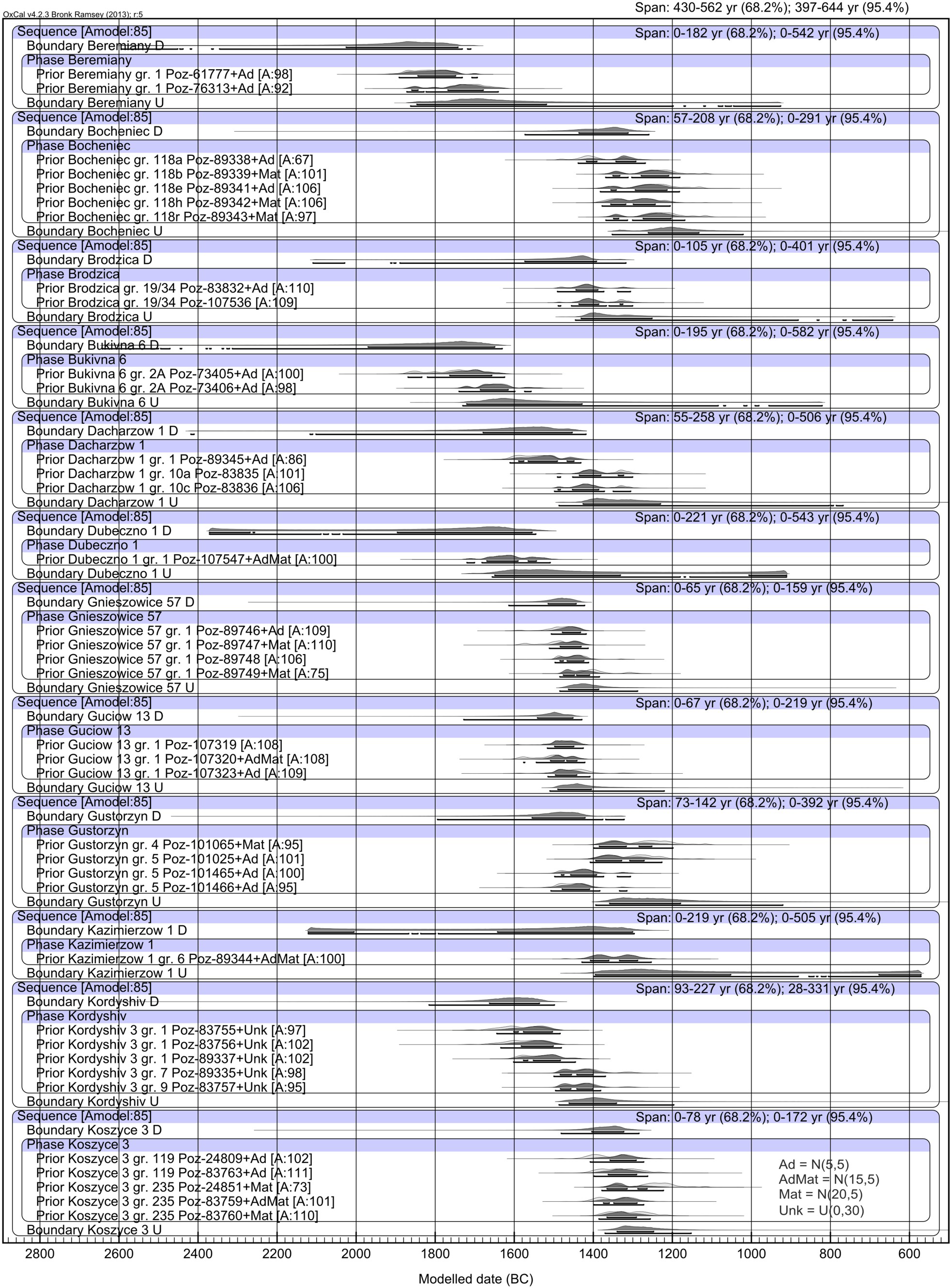
Figure 4b

The Bayesian modeling allowed the grouping of dates from particular cemeteries into separate phases without assuming any relations between the phases (Figures 4a and 4b).
Boundaries of particular phases (estimating the time frames of burials in individual cemeteries) show (Figure 5, upper) that the analyzed necropolises represent different chronological stages.
Upper part: older (red) and younger (green) boundaries of phases of using the analyzed burial grounds. The cemeteries in Dubeczno and Kazimierzów (dated by single samples only) were not taken into account. Lower part: matrix of probability showing chronological order of the older boundaries. (Please see electronic version for color figures.)
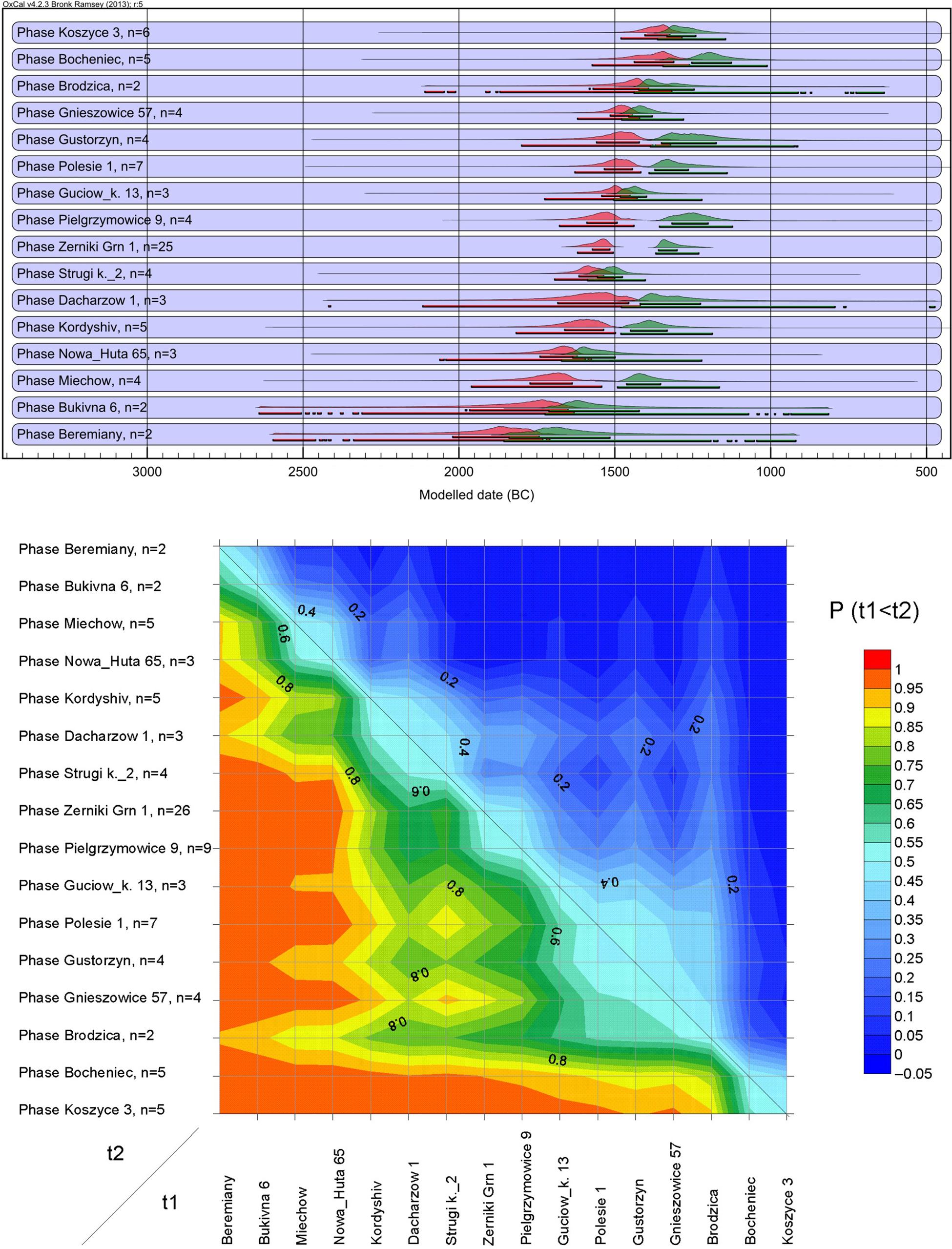
The temporal relation between burial grounds was quantitatively represented by a probability matrix (“Order” function). In this matrix every element “P(t1<t2)” (Figure 5, lower part) shows the probability that the cemetery in site “1” began to be used earlier than the cemetery in site “2”.
The Bayesian modeling of the 14C-dates suggests that collective burials of the TCC had a long chronology, generally falling between 1830–1690 (95.4%) and 1320–1160 (95.4%) BC. From an archaeological standpoint this represents the entire duration of the cultural unit, i.e., the late Early and Middle Bronze Age. Successful transmission of the collective burial practice for ca. 400–650 (95.4%) or 430–560 (68.2%) years (approximately max. 16–25 generations) allows it to be considered a long-term custom, possibly linked to identity–formation of the TCC communities. The duration of cemeteries with collective burials was diverse, sometimes exceeding 200 or more years (for the Spans, see Figures 4a and 4b).
The spatial distribution of 14C dates from collective burials indicates that the structures appeared earliest in the Podolian Upland around the Upper Dniester (Beremiany and Bukivna then Kordishiv), slightly later in the Lesser Poland Upland (Miechów, Nowa Huta-Mogiła), Lublin Polesie (Dubeczno) and Sandomierz Upland (Dacharzów), and finally in the Greater Poland-Kuyavian Lowland (Strugi, Gustorzyn) and central Poland (Polesie). In general, it seems that the idea of collective burials spread from the southeast to the northwest. This ritual custom was long-lasting in the Lesser Poland Upland (Miechów–Koszyce). It was simultaneously observed among barrow and “flat” cemeteries with no major chronological differences between cremated (in situ cremation in mortuary houses found inside barrows) and inhumation burials (cf. Makarowicz Reference Makarowicz2010a; Makarowicz et al. Reference Makarowicz, Goslar, Niebieszczański, Cwaliński, Kochkin, Romaniszyn, Lysenko and Ważny2018).
Żerniki Górne, Lesser Poland—Case Study
Site 1 in Żerniki Górne (Figure 1:8) is located in the western part of Lesser Poland and is the largest cemetery of the TCC (Kempisty Reference Kempisty1978: 34; Włodarczak Reference Włodarczak1998; Makarowicz Reference Makarowicz2010a). The excavated features included: stone circles, graves, mound, burnt layers and ceramic concentrations (Figure 6). In total, 15 collective graves were found with a minimum of 173 buried individuals. The graves were not distributed in a regular fashion, with the distance between them measuring from several centimeters to a few meters. The majority of them were found in the eastern part of the necropolis and were oriented along a N–S (NE–SW) axis, while in the southern and southwestern part of the cemetery they were oriented along a W–E axis (grave 62 shows a slight deviation to the southwestern direction). In the central part of the barrow there was a modern pit, which might have destroyed the assumed central burial. Graves had different sizes with areas measuring from 0.6 m2 (grave 5) to 8 m2 (grave 69) and volumes of 0.7 m3 (grave 3) to 8.1 m3 (grave 71).
Layout of the cemetery in Żerniki Górne, site 1. 1—pit, 2—grave, 3—stone circle, 4—contemporary mound range, 5—primary mound range (Makarowicz Reference Makarowicz2010a).

Several spatio-temporal models have been constructed for the cemetery, including stratigraphic observations and the distributions of material culture (Kempisty Reference Kempisty1978: 330–332; Włodarczak Reference Włodarczak1998: 173f.; Górski Reference Górski2007: 25f.; Makarowicz Reference Makarowicz2010a: 221f.). The common thread of these models is the non-contemporaneity of the graves and non-grave features (stone circles, pits, burnt layers). The unresolved issue is the stratigraphic relationship between the barrow and some graves. Six spatial units were distinguished for the cemetery (Włodarczak Reference Włodarczak1998: 173; Makarowicz Reference Makarowicz2010a: 221f.), possibly linked to the different formation stages. They include (1) burnt layers, stone circles and pits 1, 2, 4, (2) graves 10, 12, 54, 62, and 86 (located to the south of the circles and oriented along the W–E axis), (3) graves 69, 71, 98, 99 as well as pits 5 and 123a (located to the east of the circles and oriented along the N–S), (4) graves 72, 73, 102, 117 and pit 3 (oriented similarly to group 4), (5) graves 3 and 5 dug into the mound, with a W–E orientation, and (6) the mound covering the stone circles and pits 1, 2, 3. The entire area measures ca. 650 m2.
Several observations can be made on the basis of the model outlined above. The cemetery, or rather sanctuary-cemetery, was successively expanded over the course of several generations. In the center of the necropolis—perhaps as a result of ritual activities—was an extensive but shallow burnt layer (ritual clearance of the surface?). The first stone circles constructed were I, II and III, along with some of the pits. The graves were not built simultaneously, as shown by the stratigraphic relations between them. For the majority of them there is no possibility of establishing a stratigraphic relationship with the barrow (Kempisty Reference Kempisty1978: 331f.; Włodarczak Reference Włodarczak1998: 174). It seems plausible that the extent of the mound restricted the area available for construction of graves and affected their orientation, which allows the assumption that the majority of graves were dug after the construction of the mound (Górski Reference Górski2007: 25). Thus, the barrow construction did not serve as a final stage of the cemetery. Even the mound itself was subsequently used, as shown by graves 3 and 5 (Kempisty Reference Kempisty1978: 332).
The Żerniki Górne cemetery is characterized by a relatively large number of 14C determinations, with 26 dates originating from 14 collective graves (grave 102 was not dated due to the poor bone preservation). One to six individuals were dated for every sampled grave (Table 1). The investigation of the temporal relationship of graves followed the methodology established for the analysis of cemeteries. However, sets of dates from one grave were Combined, assuming that all humans in the grave died roughly at the same time (Figure 7).
Bayesian chronological model of 14C dates of bones from Żerniki Górne cemetery. For graves 10, 62, 69 and 99, consistence of dates of different individuals in a grave was tested by χ2 statistics.
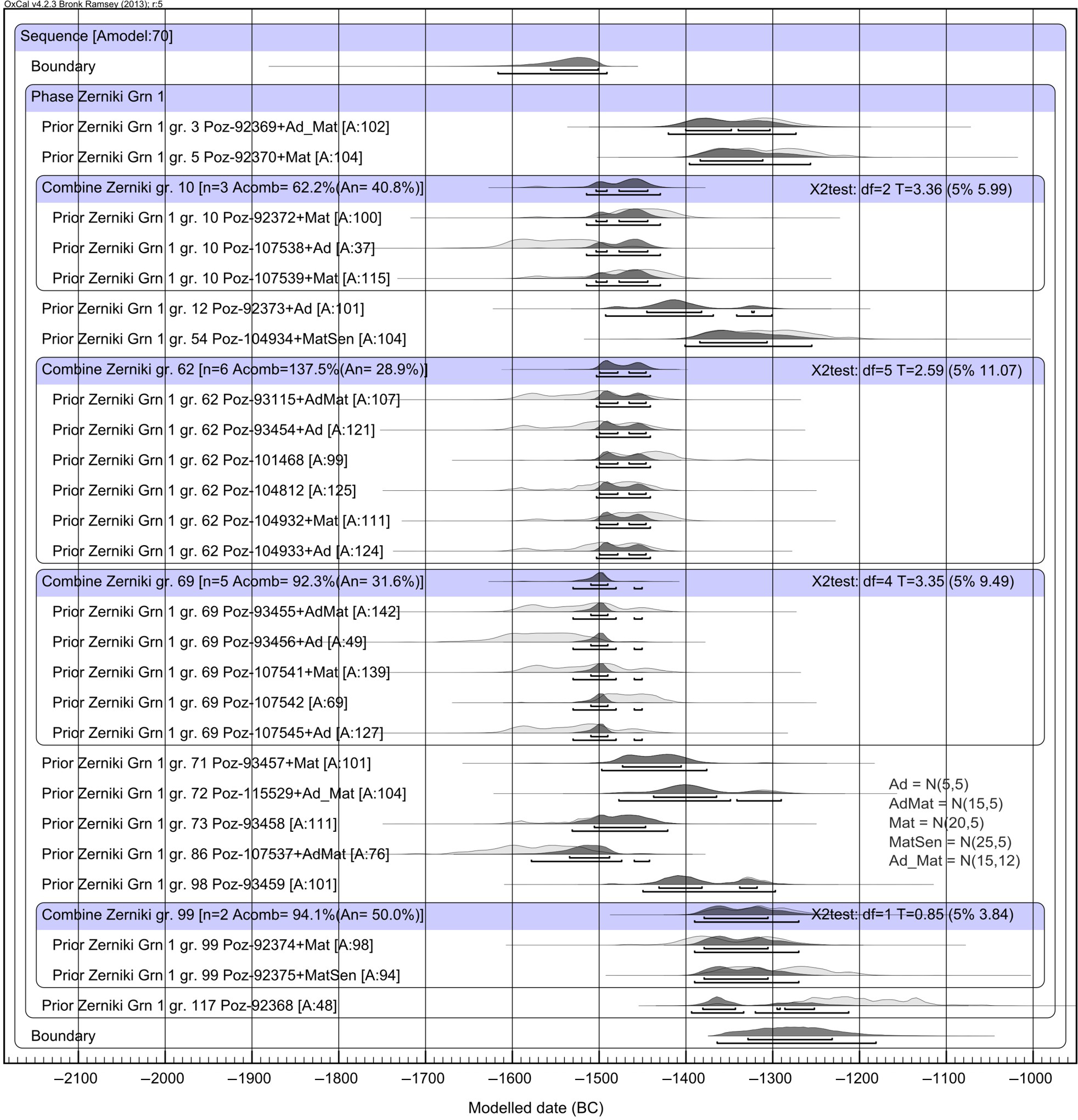
The modeled probability distributions show that burials in individual graves were occurring in different time periods (Figure 8, upper). Like for the analysis of the cemeteries, temporal relations between the use of particular graves were presented in a probability matrix, where every element “P(t1<t2)” shows the probability that grave “1” is older than grave “2” (Figure 8, lower).
Upper part: modeled probability distributions of dates from the analyzed collective burials in Żerniki Górne. Lower part: matrix of probability showing chronological order of the described graves (lower part).

The results of the Bayesian modeling allow testing of the hypotheses laid out above; namely, they allow the specification of the absolute chronology of the Żerniki Górne cemetery, especially the construction sequence of graves, their duration and the duration of grave groups. The probability distribution indicates that the necropolis was used for ca. 150–240 (68.2%) or 140–310 (95.4%) years, i.e., approximately a maximum of 12 generations (Figure 8, see also the Span displayed in Figure 4b). Based on these results, it appears that burials started in the southern part of the cemetery (graves 86, 69, 62, 10, 71, 12). The precise or standardized orientation of graves does not appear to have been significant during this process. Later on, graves were established in the eastern part of the cemetery (graves 72, 98 and then 117), although one of them, grave (73) in the northeastern part might have been established earlier than other burials from the southern concentration. The latest graves were established in the southern part (graves 54 and 99) and in the mid-southern area of the cemetery (graves 3 and 5 dug into the burial mound) It is noteworthy that many graves were used synchronously or partly synchronously (Figure 8, upper part). This could indicate the contemporaneous burial of individuals as well as groups, directly after their death or excarnation (Makarowicz Reference Makarowicz2019), in graves located in different parts of the cemetery (see Figures 6 and 8, upper part).
Based on ancient mtDNA studies, the relationship between certain individuals within collective graves can be linked to matrilineal descent (Juras et al. Reference Juras, Makarowicz, Chyleński, Ehler, Malmström, Krzewińska, Pospieszny, Górski, Taras, Szczepanek, Polańska, Włodarczak, Szyca, Lasota-Kuś, Wójcik, Jakobsson and Dabert2020), though the nDNA analysis is still in progress. This suggests that the formation of the cemetery was a consequence of long-term, continued use by different family members and most likely distinct lineages/kinships (Makarowicz Reference Makarowicz2010a: 293f.). Such groups used specific graves, sometimes for a relatively long time and often in a synchronous way (Figure 8, upper part).
The absolute chronology does not indicate any relationship between the barrow and particular graves. It appears that the barrow covered only the stone circles and pits, as well as delimited the space for grave construction to the south and east (apart from graves 3 and 5 which were dug into the mound). Such a sequence of ritual practices: barrow construction followed by a formation of surrounding flat graves, is a common scenario for spatial development of cemeteries in the Early and Middle Bronze Age in Central-Eastern Europe and also among the TCC (e.g., Górski et al. Reference Górski, Makarowicz and Wawrusiewicz2011, Reference Górski, Makarowicz and Wawrusiewicz2012).
Case Study of the Selected Collective Burial
In order to investigate the overall duration of use of individual collective graves, the burying sequence in grave 669 from Pielgrzymowice was selected. This selection was primarily based on the availability of dating for all of the individuals buried in the grave.
Within the Pielgrzymowice settlement, a few single and collective graves were exposed, inside of which burials of males and females were documented. The individuals were buried in both anatomic and non-anatomic order. The 14C dates suggest that the dead were placed there continuously for a long time period.
Grave 669 was a circular pit measuring 150 cm in diameter with a trapezoidal cross-section. At a depth of 100 cm from the level of discovery, a collective inhumation was exposed in which the articulated bones of six overlapping individuals were found (Figure 9). One individual was lying extended in a supine position. The remaining five individuals had been placed on their right or left side, with their legs pulled up to varying degrees. The bone material was found directly above the bottom of the pit. The fill contained only a few pottery sherds with no burial goods. The oldest 14C determination was 3180 ± 35; the youngest 3030 ± 35 BP (Table 1).
Pielgrzymowice. Collective burial (grave 669). Photo: A. Lasota-Kuś.

The relatively wide time span indicates that not all individuals buried inside died at the same time (combining these dates brings the Chi 2 of 11.96, that exceeds the 5% critical value for df=5 [11.10]). In order to examine this observation, all of the dates were grouped into a single-phase (Figure 10, upper part), and the probability distribution of the resulting span was calculated (“Span”, Figure 10, bottom left). Additionally, a probability matrix for every element “P(t1<t2)” shows the probability that a randomly selected burial from grave “1” is older than the randomly selected burial from grave “2” (Figure 10, bottom right).
Upper part: Bayesian model of the 14C dates from the individuals buried in grave 669 in Pielgrzymowice. Bottom left: probability distribution of the death time span of the analyzed individuals. Bottom right: probability matrix of the temporal ordering of the analyzed individuals.
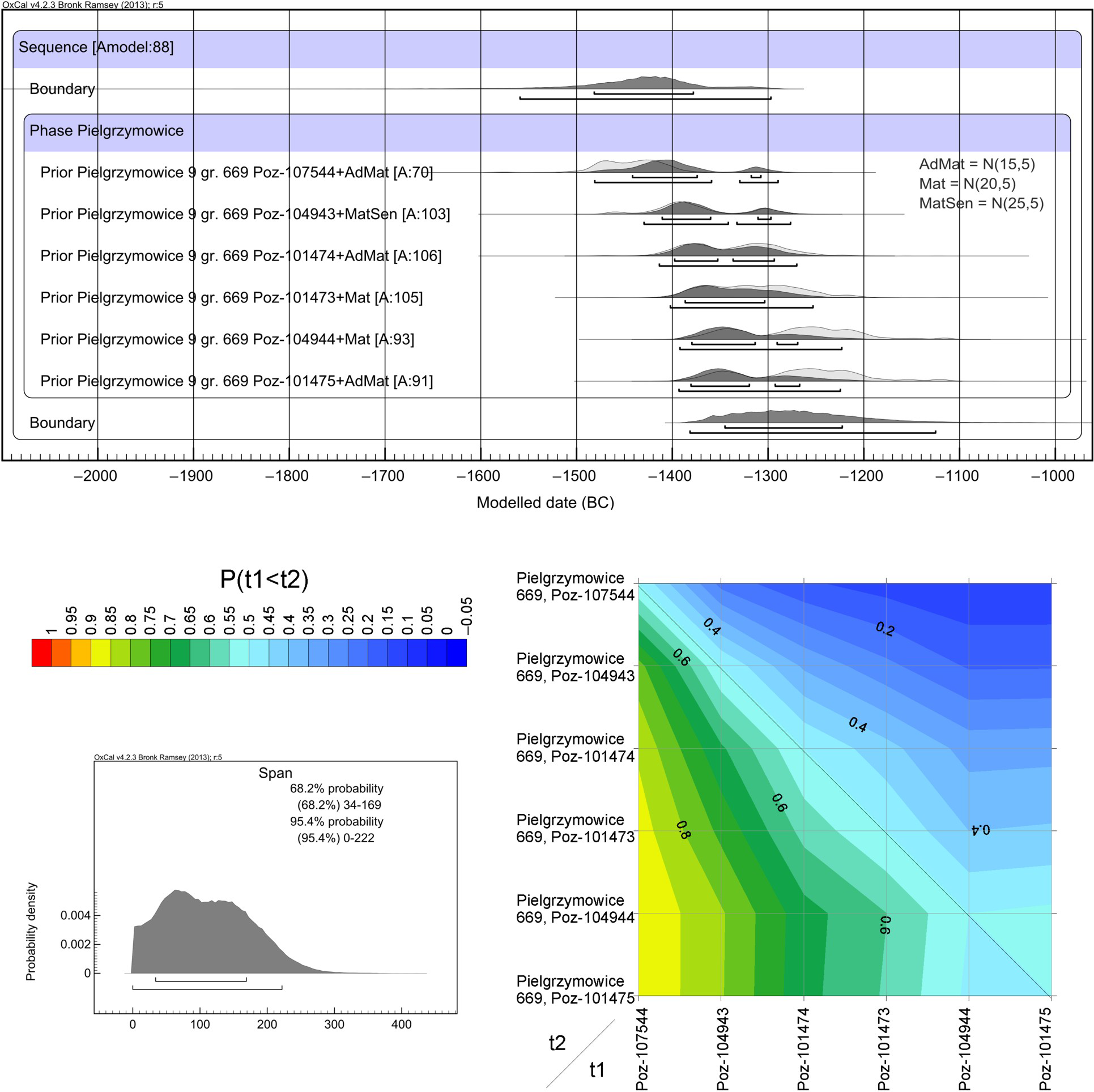
The Bayesian modeling shows—even assuming all dates are representing a single phase—that individuals were not buried within a short time span (1 σ: 34–169 yr, Figure 10, bottom left). In addition, the calendar date of the sample Poz-107544, with a probability of 0.9, is older than samples Poz-104944 and Poz-101475. This indicates that some of the individuals buried in grave 669 died at different times, a pattern supported by archaeological data (spatial distribution of the remains and stratigraphic observations) from other collective graves found in different cemeteries. In general, burials of additional individuals or groups required the displacement of the previously deceased. Only in some instance would the bodies be deposited on the previously laid remains (Makarowicz Reference Makarowicz2010a: 244–253; Szczepanek Reference Szczepanek2013).
However, this chronological observation is not related to the date of burial as much as to the date of death of the analyzed individuals. From an archaeological standpoint, there is evidence of gathering of the deceased in other areas prior to the final burial or temporary burial in special structures, e.g., mortuary houses with good accessibility (Górski Reference Górski and Tyniec2018; Makarowicz Reference Makarowicz2019). In terms of the Pielgrzymowice collective burial, the deceased were buried on the same level, i.e., the bottom of the pit, which confirms the hypothesis regarding the contemporaneous burial of individuals who had died at a different time.
Similar indications that individuals buried in one grave died at different times (over a time span of several decades or even up to 200 years) concern some other collective graves, e.g., Polesie, grave 1182; Gustorzyn, grave 5; and Bocheniec, grave 118. Alternatively, the burials found in the barrows in Strugi and Guciów suggest that the individuals died within a short time period or even contemporaneously, which led to a relatively fast burial of multiple individuals (Table 1; Figure 4).
The analysis above suggests that some collective graves were used for a relatively long period of time, some of them even for 150–250 years. However, the burial rhythm remains unknown. People died at different times, but after their death they might have been kept in an ossuary until a larger number of deceased accumulated (Górski, Tyniec Reference Górski and Tyniec2018; Makarowicz Reference Makarowicz2019). Perhaps the burial ritual was linked to major social events, e.g., the termination of a lineage or the death of the final family member. Until excarnation, the corpses might have been deposited elsewhere, the duration of which is related to different climatic conditions and could last from several months to a few years (Makarowicz Reference Makarowicz2019). Such observations—linked to the non-continuous use of collective graves—are increasingly frequent after the incorporation of Bayesian modeling for large datasets originating from Neolithic megalithic graves, where chambers were re-opened in order to bury additional individuals or groups (e.g., Aranda Jiménez, Lozano Medina Reference Aranda Jiménez and Lozano Medina2014; Aranda Jiménez et al. Reference Aranda Jiménez, Lozano Medina and Sánchez Romero2018; Salazar-García et al. Reference Salazar-García, García-Puchol, de Miguel-Ibáñez and Talamo2016; Steuri et al. Reference Steuri, Siebke, Furtwängler, Sönke, Krause, Lösh and Hafner2019). The burial rite of the TCC communities, especially collective burials, partial burials, dismemberment, and non-anatomic positioning of the individuals shows links to the preceding megalithic practices (e.g., Tomé et al. Reference Tomé, Díaz-Zorita Bonilla, Silva, Cunha and Boaventura2014), especially behavior patterns documented among the Late Neolithic Globular Amphorae Culture (Szmyt Reference Szmyt1999; Makarowicz 2010a; Reference Makarowicz2010b; Nowaczyk et al. Reference Nowaczyk, Pospieszny and Sobkowiak-Tabaka2017).
CONCLUSIONS
The results of the investigation can be summarized in the following points:
-
1. The collective burial of individuals was typical during the entire duration of the TCC from the Early/Classical to the Late phase between 1830–1690 (95.4%) and 1320–1160 (95.4%) BC, i.e., ca. 400–640 (95.4%) years = 16–25 generations.
-
2. Collective burials were especially widespread in the upland (southern) part of the TCC area. The modeled 14C ages suggest that the phenomenon of such burials spread relatively fast and roughly from the SE to the NW.
-
3. The oldest graves with multiple individuals were found in Beremiany (flat grave) and Bukivna (barrow grave) in the Upper Dniester basin, Dubeczno in the Western Polissia (barrow grave) and Nowa Huta-Mogiła in the Lesser Poland Upland (flat grave). In general, the collective burials appeared simultaneously in under-barrow and flat graves. Both cremation and inhumation were present in mass burials at the same time.
-
4. Bayesian modeling of the 14C dates from the Żerniki Górne cemetery in the Lesser Poland Upland allowed estimating the duration of the largest TCC cemetery as 140–310 (95.4%) years.
-
5. In some collective burials, individuals were buried over an extensive period of time (in extreme cases up to 8–10 generations), while in others the burials comprised of individuals both dying and being interred in graves within a much shorter time span.
-
6. The death of an individual did not necessarily result in an immediate burial in a mass grave. Some deceased (e.g., Pielgrzymowice, grave 669) were buried in groups after a certain time, similarly to the practices observed in megalithic traditions. Their remains were awaiting a final burial in a different area (e.g., an ossuary) until excarnation, accumulation of a larger number of deceased or termination of a family or lineage.
-
7. Some collective graves found on larger cemeteries were used contemporaneously probably by different social groups (families, lineages?) of the TCC community.
ACKNOWLEDGMENTS
This work was supported by the Polish National Science Center (NSC) grant No. 2015/17/B/HS3/00114) lead by Przemysław Makarowicz. Janusz Czebreszuk was supported by NSC grant No 2014/15/G/HS3/04720, Marek Nowak was supported by NSC grant No 2016/23/B/HS3/00387, Małgorzata Marcinkowska-Swojak and Marek Figlerowicz were supported by NSC grant No. 2014/12/W/NZ2/00466. We would like to thank Robert Staniuk, Christian-Albrechts-Universität zu Kiel, and Sarah Martini, Yale University, for linguistic corrections and their careful comments on the original manuscript.


 Open access

