


Introduction
The globally ‘Vulnerable’ Swan Goose Anser cygnoides breeds in central and eastern Mongolia and adjacent regions of China and Russia (Primorye and Sakhalin Island) (BirdLife International 2009). Recent contraction and fragmentation of the breeding range and declines in abundance and breeding success justify concern for the species (Lu Reference Lu1996, Miyabayashi and Munkdur Reference Miyabayashi and Mundkur1999, Goroshko Reference Goroshko2001, Poyarkov Reference Poyarkov2001, Kear Reference Kear2005, BirdLife International 2009). The main wintering area for the species has always been eastern China, although formerly it was found in small numbers in Japan and Korea (Kear Reference Kear2005). The entire global population now winters only in eastern China; non-breeding season surveys in winters 2003/2004 and 2004/2005 found 95% of the estimated world population in the Yangtze floodplain, located at fewer than ten sites (Barter et al. Reference Barter, Chen, Cao and Lei2004, Reference Barter, Lei and Cao2006, Cao et al. Reference Cao, Barter and Lei2008).
The Yangtze floodplain wetlands are globally unique: nowhere is such an enormous region subject to summer monsoonal flooding followed by autumn/winter water level recession (Shankman and Liang Reference Shankman and Liang2003). This hydrological cycle creates numerous, shallow, ephemeral and highly productive wetlands extending to c.10,500 km2 (He and Zhang Reference He and Zhang2001).
Swan Geese extract nutritious storage organs of submerged macrophytes, particularly those of Vallisneria spiralis, made successively available from muddy lake sediments by winter water level recession (Zhang and Lu Reference Zhang and Lu1999, Fox et al. Reference Fox, Hearn, Cao, Cong, Wang, Zhang, Dou, Shao, Barter and Rees2008, Barzen et al. Reference Barzen, Engels, Burnham, Harris and Wu2009). This unique combination of food source and water level behaviour makes the species highly sensitive to hydrological change in the seasonally flooded wetlands of the Yangtze floodplain. The annual influx of monsoonal water, sediment and nutrients has maintained these wetlands until now, but recent major hydrological change caused by hydroelectric and water diversion projects, such as the Three Gorges Dam (TGD, which commenced operation in June 2003) has modified these patterns. The TGD has affected water levels by delaying the summer peak monsoonal flows in the Yangtze River. These changes in water regime have a number of consequences for the hydrology of the vast ephemeral wetlands of the Yangtze catchment. Lower summer water levels caused by delayed periods of highest water level may reduce the competitive ability of submerged water plants, such as Vallisnaria and Potamogeton which may be overshadowed by floating plants such as Trapa and shallow water emergent plants such as Zizania. However, some lake systems, particularly those under sluice control, also experience enhanced water levels in the autumn and winter which may deny Swan Geese access to shallow water areas where they grub for Vallisnaria. Hence, changes in water regime may have profound effects on the relative abundance of dominant macrophytes in these wetland systems which may have potential impacts on higher taxa, including waterbirds.
In this paper we examine the changes that have occurred in numbers and distribution of Swan Geese at a well-studied site over the last five years and, historically, throughout the Yangtze floodplain, investigate the changes that have taken place in submerged vegetation communities and hydrological regimes within the floodplain, discuss possible reasons for the observed changes in Swan Goose status and list a number of key questions that need answers to underpin effective conservation measures for the Swan Goose.
Methods
Study site
The Shengjin Lake National Nature Reserve (116°55′ to 117°15′E; 30°15′ to 30°30′N) lies south of the Yangtze River and is the only wetland national nature reserve in Anhui Province (Figure 1). The reserve covers 333 km2 and includes Shengjin Lake – a large and shallow, permanent, fresh water lake with a 165 km shoreline – as well as small lakes, fishponds, rice paddies and forests. Lake water comes from three rivers flowing directly into the lake (catchment area 1,548 km2) and from the Yangtze River via a sluice built in 1965. During the summer flood season the maximum lake area is 140 km2 (water level = 17.0 m asl, Wusong datum); the water level falls to less than 10 m during September to February (dry season) causing the lake area to decrease to approximately 34 km2 (Cheng and Xu Reference Cheng and Xu2005).
The three key wintering locations for Swan Geese in the Yangtze floodplain in 2004 and 2005 (outlined in white). The site of the Three Gorges Dam, Hukou, the five floodplain provinces and Shanghai are also shown.

The average annual rainfall is 1,600 mm, varying from 759 mm to 2,022 mm; most rain falls April–August. The average annual temperature is 16.1° C; average January temperature is 4.0° C.
Data sources
Swan Geese were counted at Shengjin Lake nine times during the 2008/2009 winter (October to mid-April) (Cheng et al. Reference Cheng, Xu, Cao and Barter2009) and the counts were compared with those made in February 2004 and February 2005 as part of two comprehensive, synchronous waterbird surveys conducted throughout the Yangtze floodplain (Barter et al. Reference Barter, Chen, Cao and Lei2004, Reference Barter, Lei and Cao2006).
Shengjin Lake is one of many Yangtze floodplain wetlands, so to assess whether changes in numbers were confined to Shengjin Lake, or reflected a general population redistribution, Swan Goose counts were obtained during winters 2005/2006- 2008/2009 from other key sites (Ji and Zeng Reference Ji and Zeng2006, Xu et al. Reference Xu, Cheng and Long2006b, Ji and Wang Reference Ji and Wang2007, Ji et al. Reference Ji, Zeng, Wang, Gong, Xu and Bao2007, Xu et al. Reference Xu, Zhao, Long and Yin2007, Yu et al. Reference Yu, Wu and Ying2008, Y. Jiang unpubl. data, W. Z. Zhu unpubl. data). Interpretation of these more recent data is complicated, as counts were conducted non-synchronously during December–March. However, satellite tracking of six marked birds suggests that Swan Geese generally do not move long distances once settled in winter (two birds < 4 km, one < 20 km, two 40–60 km, one about 250 km; USGS 2009) suggesting that these counts provide a reasonable indication of wintering numbers and distribution.
We studied winter Swan Goose foraging behaviour at Shengjin Lake in 2008/2009 to assess how this varied depending on food supply and water levels. We scan-sampled geese (see methods in Fox et al. Reference Fox, Hearn, Cao, Cong, Wang, Zhang, Dou, Shao, Barter and Rees2008) at three major sites: Dazhou, the “grazing site” and the “grubbing site”, and assigned individuals as “dip-feeding” (probing in the substrate in shallow water), “grubbing” (digging in wet exposed substrate above the water line) or “grazing” (feeding on dry terrestrial vegetation). For simplicity, here we present data on the most frequent feeding method at the three study sites under contrasting hydrological conditions.
As wintering Swan Geese feed largely on submerged macrophyte tubers, we reviewed published literature to obtain information on changes in submerged vegetation communities at Shengjin Lake in recent decades; we also conducted vegetation surveys of the entire lake in July 2008 and 2009 during the summer flood period. Changes in the extent of emergent and floating vegetation in the central and southern parts of the Upper Lake were measured from Landsat ETM+ colour composite images (RGB = 4,3,2) obtained on 11 July 2002 and 10 August 2007.
Large disturbances to the normal hydrological regime may affect submerged vegetation productivity. In order to assess the impacts of TGD on water levels at Shengjin Lake and in the Yangtze River, we obtained data from the Yangtze River Water Resources Commission on Shengjin Lake levels for January 2001–April 2009 (pre- and post-TGD) at the Huangpen Sluice, located on the entry canal to Shengjin Lake, and for the Yangtze River at the Hukou Hydrological Station, located about 130 km upstream from Shengjin Lake (Figure 1).
Results
Swan Goose abundance and distribution in the Yangtze floodplain
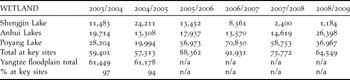
About 61,000 Swan Geese were counted in the Yangtze floodplain in 2004 and 2005 (Barter et al. Reference Barter, Chen, Cao and Lei2004, Reference Barter, Lei and Cao2006) distributed between the same group of wetlands: Shengjin Lake and the Anhui Lakes in Anhui Province, and Poyang Lake in Jiangxi Province, all within 260 km of each other and holding 94–97% of the total number counted (Figure 1 and Table 1).
Swan goose count data from the key sites during 2003/2004–2008/2009 winters.
Changes in Swan Goose numbers and distribution at Shengjin Lake
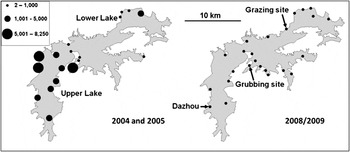
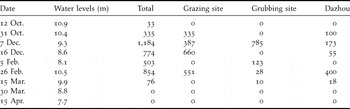
Swan Goose numbers have declined greatly at Shengjin Lake since winter 2006/2007, but have remained high at Poyang Lake and the Anhui Lakes (Table 1). The maximum Shengjin Lake count of 1,184 (early December 2008) indicates that a decline of the order of 10,000-20,000 birds has occurred in the last five years at this site. The “grazing site” was the most important foraging area during the 2008/2009 winter (Table 2 and Figure 2).
Swan Goose distribution in Shengjin Lake in 2004 and 2005 (combined data) (left) and during the 2008/2009 winter (right). All sites at which Swan Geese were found during the surveys are shown. Note differences in distribution as well as abundance between years.
Swan Goose total numbers and numbers present at the key Shengjin Lake sites during the 2008/2009 winter, with lake water levels at the time of the counts.
The Upper Lake was more important than the Lower Lake in both 2004 and 2005 and 10 sites held > 1,000 birds during the two counts (Figure 2). However, in the 2008/2009 winter those areas that had held large numbers of Swan Geese in the earlier counts held few or no birds.
Water levels pre- and post-TGD
There was a significant difference in the average timing of flows and maximum river levels of the Yangtze River at Hukou pre- and post-TGD (Figure 3): river levels rose up to a month later during the April-June period and fell about a month earlier during August-December; the summer flood peak is about 2 m lower; and winter levels are 0.5–1 m lower. The difference between winter and summer water levels has decreased from 10 m to 8 m.
Average monthly Yangtze River water levels (Wusong, Shanghai, datum) at the Hukou Hydrological Station; the 1978–2002 and 2004–2007 curves represent the periods before and after the TGD was commissioned (1 June 2003).

Within Shengjin Lake there was also a spring flood delay of about one month post-TGD. However, the difference between pre- and post-TGD flood levels (1 m) was less than in the Yangtze whilst winter levels were similar pre-and post-TGD, indicating that sluice control moderated changes in lake water levels (Figure 4).
Average daily Shengjin Lake water levels (Wusong, Shanghai, datum); the 2001–2002 and 2004–2008 curves represent the periods before and after the TGD was commissioned (1 June 2003).

Shengjin Lake water levels in winter 2008–2009
In winter, the Yangtze water level is normally lower than in the lake. Winter water levels varied considerably due to release of TGD water and rainfall in the catchments, moderated by sluice operation (Figure 5). Following the usual October decline in Yangtze River levels, the river rose quickly in early November following a large release from the TGD. This, plus local rainfall, led to a significant rise in the lake level until the sluice was closed. The lake water level then fell steadily to a mid-winter level of approximately 8 m. Heavy and continuous rainfall in February elevated lake levels until the sluice was closed, whereupon the level declined until late March. Lake levels are lowered annually to facilitate fishing during the winter months and raised in spring to supply irrigation water.
Water levels (Wusong, Shanghai, datum) at the Shengjin Lake sluice (Yangtze River and Shengjin Lake sides), rainfall, sluice control and timing of the nine surveys during 2008/2009 winter. Open arrow shows when the Yangtze River rose quickly due to release of water from the TGD. N.B. Yangtze River water levels are not measured when they are lower than about 7.8 m.

Impact of water levels on Swan Goose feeding behaviour
Swan Goose feeding behaviour was sensitive to changes in water levels, which differed between sites. At the “grubbing site”, a low lying muddy area, geese fed by dip-feeding in shallow water when this area was exposed at lowest water levels throughout the mid-winter period (Figure 6); at higher water levels, the birds were forced to graze on grasslands above the normal feeding area. At the slightly higher “grazing site”, geese fed first by dip-feeding at high water levels, later switching to grubbing in exposed mud as water levels dropped away, finally only using the site to graze later in the season. At Dazhou, one of the higher sites in the system, the mudflats were exposed much earlier in the season, so geese could only grub during the brief periods of winter inundation in early November and again in late February. During the rest of the winter, this area was too dry for them to feed on Vallisneria so geese only briefly remained to graze.
Schematic representation of the feeding behaviour of Swan Geese foraging at Shengjin Hu in winter 2008/2009. Solid line shows the water level measured in the lake relative to the Wusong, Shanghai, datum. Superimposed symbols show the dates when large numbers of Swan Geese were present at each of three different sites within the lake (birds were absent from these sites at other times) and the symbols indicate the predominant type of feeding used on each occasion at each site. Note that Dazhou is higher than the “grazing site”, which is higher above datum than the “grubbing site”.

Changes in vegetation communities at Shengjin Hu
There is evidence of very large declines in the extent of Vallisneria at Shengjin Lake in recent years, especially in the Upper Lake. In 1974, the whole lake was covered by the submerged macrophytes Vallisneria and Potamogeton (Meng Reference Meng1979); 70% of the Upper Lake in 1996–1998 was still dominated by Vallisneria and Potamogeton (Liu et al. Reference Liu, Xu, Wang, Shi, Xu and Yu2001). Thus, sluice operation since 1965 does not appear to have affected submerged macrophyte coverage. However, surveys throughout the lake in July 2008 and 2009 found little submerged macrophyte vegetation present (USTC unpubl. data). The decline appears to be associated with increases in aggressively expanding floating macrophyte (Trapa) and emergent grass species (Zizania) systems, both of very low biodiversity significance. The expansion in area of floating and emergent vegetation is clearly evident in satellite images (Figure 7); the marked regions increased by more than 100% in area between 2002 and 2007, from 4.2 to 9.1 km2.
Difference in area of floating and emergent macrophytes in the Upper Lake between summer 2002 and summer 2007 (Landsat ETM+ composite images (RGB = 4,3,2) for 11 July 2002 and 10 August 2007.)

Discussion
The decline in Swan Goose numbers at Shengjin Lake appears to be a continuation of a general range contraction that has occurred during the last two decades. Recent count data for East Dongting Hu confirms a decline in Swan Goose numbers to a few hundred currently, compared to c.3,100–5,600 birds in 1992–1996 (Lei and Qian Reference Lei and Qian1998, Y. Jiang unpubl. data). Numbers have also decreased on the Jiangsu coast from a mean of 10,800 during 1987–91 to less than 1,000 now (Perennou et al. Reference Perennou, Mundkur, Scott, Follestad and Kvelnid1994; Cao et al. in press). Swan Geese were amongst the commonest waterbirds in hunting bags at Hong Lake, Hubei, during 1951–1970 (Hu and Cui Reference Hu, Cui and Matthews1990), yet none were present in February 2004 and 2005 when only 139 and 1,260 individuals, respectively, were counted throughout Hubei Province (Barter et al. Reference Barter, Chen, Cao and Lei2004, Reference Barter, Lei and Cao2006). Poyang Lake and the Anhui Lakes are now the only key global wintering sites for the species.
Whilst it appears that overall population numbers may not have declined (Table 1) and that the decrease at Shengjin Lake is caused by local factors, we lack the synchronous census data from throughout the wintering range, as collected in February 2004 and February 2005, to positively determine whether the change represents a global population decline or a distribution shift. A priority must be to conduct similar coordinated counts throughout the winter range as soon as possible.
The likely explanation for the decline in Swan Goose abundance at Shengjin Lake is the recent decrease in submerged vegetation, particularly tuber-producing Vallisneria which is the species’s main food. Xu et al. (Reference Xu and Zhou2008) believe that the commencement of intensive aquaculture (crab and fish farming) was probably the main reason for the disappearance of submerged plants in Shengjin Lake. Aquaculture started in the Upper Lake in 1995, changing from extensive to intensive farming in 2002 (Zhou et al. Reference Zhou, Zhou, Chen, Xu and Cheng2009); intensive aquaculture started in the Lower Lake in 2006. Recently, Swan Geese have been observed grazing in Carex/Phalaris meadows; thus they may be responding to the decline in their traditional tuber food source by switching to a less nutritious diet. The fitness consequences of this dietary change are unknown (Fox et al. Reference Fox, Hearn, Cao, Cong, Wang, Zhang, Dou, Shao, Barter and Rees2008). The decrease also appears to be affecting Hooded Cranes Grus monacha, which typically have fed on tubers around the lake edge but since 2006 have mainly resorted to spilt rice in lakeside paddies (Zhou et al. Reference Zhou, Zhou, Chen, Xu and Cheng2009); Tundra Swans Cygnus columbianus, which also feed on tubers (Barzen et al. Reference Barzen, Engels, Burnham, Harris and Wu2009), have decreased in numbers at Shengjin Lake during the same period (Cheng et al. Reference Cheng, Xu, Cao and Barter2009).
The range contraction that has occurred over recent decades in the Yangtze floodplain was also probably caused by reductions in the extent of submerged vegetation. Submerged plants dominated the Yangtze floodplain lakes in the 1970–1980s (e.g. Poyang Lake: Guan et al. Reference Guan, Lang and Zhang1987; Hubei lakes: Peng et al. Reference Peng, Jian, Wang and Ni2004; Shengjin Lake: Meng Reference Meng1979; Longgan Lake: Zhang et al. Reference Zhang, Dou and Jiang1996; Jiangsu: Liu and Huang Reference Liu and Huang1984) and were abundant at Dongting Lake (Scott Reference Scott1989), but submerged macrophytes have decreased in abundance and distribution throughout most of the floodplain during past 20–30 years due to increasing human activity (Wang et al. Reference Wang, Wang, Liang, Ni, Liu and Cui2005a; Xu et al. Reference Xu, Jin and Yan2006a). The major reasons presented for the vegetation decline are intensive aquaculture, harvest of aquatic plants, water pollution, land claim and sedimentation (Wu et al. Reference Wu, Tang, Shi, Zhang and Yuan2007; Ge and Wang Reference Ge and Wang2008; Yang et al. Reference Yang, Shi, Chen, Chen, Zhou and Liu2004).
Hydrological changes, such as those now being caused by TGD, could also impact on submerged macrophyte productivity through alterations to water depth and turbidity which can affect the light intensity reaching the plant canopy, water temperature and nutrient availability (Best et al. Reference Best, Buzzelli, Bartell, Wetzel, Boyd, Doyle and Campbell2001). Wang et al. (Reference Wang, Wang, Liang, Ni, Liu and Cui2005a) found that March–June was the critical macrophyte growth period in four Yangtze floodplain lakes; therefore, the one month delay in the flood season post-TGD will shorten the growth period and likely reduce macrophyte growth. Additionally the lower flood height post-TGD may cause re-suspension of sediments through wave action on muddy shorelines (Wu et al. Reference Wu, de Leeuw and Liu2009a), increasing turbidity and further reducing photosynthesis; during previous higher water levels, the water edge penetrated into the upper Carex and summer grass zones reducing sediment re-suspension from wave action. Thus, it is predicted that the delayed water level rise during the peak growth stages, the shortened summer growth period and the possibility of sediment re-suspension due to lower water levels, will lead to lower submerged macrophyte productivity at Shengjin Lake, with wider consequences for freshwater trophic relationships throughout the lake.
In their study of the impact of the TGD on Vallisneria spiralis at Dahuchi (part of Poyang Lake), Wu et al. (Reference Wu, de Leeuw, Skidmore, Prins, Best and Liu2009b) concluded that the predicted higher summer water levels (Wang et al. Reference Wang, Lee and Cheng2005b) would lead to an earlier switch from turbid to clear water and that this might lead to an increase in the production of V. spiralis. However, water levels post-TGD are in fact lower than pre-TGD at Hukou (mouth of Poyang Lake) (Figure 3) and it is likely that the duration of turbidity is longer due to re-suspension which, in combination with the delayed and shortened flood season, will likely impact on V. spiralis productivity. This is of particular concern as Poyang Lake is one of the two remaining key Swan Goose sites.
Rapid changes in lake water level can impact adversely on Swan Geese. Those that occurred during the 2008/2009 winter at Shengjin Lake restricted use of the species’ highly specialist feeding technique (grubbing in shallow water and/or soft mud) to a few specific sites within the lake; these occasions were totally associated with periods of water level recession which softened the substrate in a way necessary for food extraction. Consequently, it is desirable for a lake water level management strategy which allows Swan Geese to use their preferred foraging method. Additionally, lake edge habitats of low slope should be protected as these allow for the maximum extent of soft mud needed for efficient grubbing as water level recession occurs.
There is an urgent requirement to survey the Anhui Lakes, the other key Swan Goose wintering area, to assess the current status of submerged vegetation and determine whether there are any threats to this vegetation. Like Shengjin Lake, these lakes are sluice-controlled and thus have the same potential for intensive aquaculture. This problem is much less serious at Poyang Lake as it is not under sluice control and the large change in water level between the flood and dry seasons prohibits intensive aquaculture.
The evidence indicates that the Swan Goose range contraction and the decline in numbers at Shengjin Lake are likely linked with the historical decrease in submerged plant coverage throught the Yangtze floodplain and the more recent decrease at Shengjin Lake. It has been suggested that a major reason for the decline in submerged vegetation at Shengjin Lake is the introduction of intensive aquaculture, which has also been implicated in vegetation declines elsewhere in the floodplain. It seems that the changed hydrology post-TGD may also adversely affect submerged vegetation productivity.
There remain a number of key questions that need answers before we can adequately implement effective conservation measures for the Swan Goose in its highly restricted global distribution. These include:
1. What are the fitness consequences of Swan Geese being forced to switch to different foods? Can they survive as a species without Vallisneria?
2. What is the impact of intensive aquaculture on submerged vegetation? Do crabs and fish have preferred foods? Is it possible for crabs, fish and Swan Geese (and other waterbirds) to coexist through controlling aquaculture intensity?
3. Will the changing hydrology post-TGD have a serious effect on submerged vegetation, particularly on key Swan Goose food plants?
4. What is the best way to manage sluice-controlled wetlands (such as Shengjin Lake and the Anhui lakes) to ensure that adequate food is produced during the summer period and that it is available throughout the winter?
Acknowledgements
We are grateful to the staff of Shengjin Lake National Nature Reserve for facilitating the studies and our students Meng Meng Sun, Song Tao Dou, Yu Wen Cui and Si Long Wang for assisting with the fieldwork. The study was supported by the National Natural Science Foundation of China (Grant No.30940010), Chinese Academy of Sciences Innovation Project (Grant No. KZCX2-YW-QN503), Chinese Academy of Sciences Visiting Professorship for Senior International Scientists (2009s1-42), University of Science and Technology of China Graduate School Educational Innovation Base and a Danske Universiteter travel grant to ADF. We are also very grateful to two anonymous referees whose comments helped to improve the paper greatly.



